
|
|
|
|
Khoisan languages
|
| |
|
| |
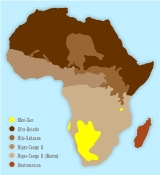
The Khoisan languages (also Khoesaan languages) are the indigenous languages of southern and eastern Africa; in southern Africa their speakers are the Khoi and Bushmen (Saan), in east Africa the Sandawe and Hadza. They are famous for their clicks. Many people were exposed to this group of languages through N!xau's language in the 1980 film The Gods Must Be Crazy.
Khoisan is the smallest phylum of African languages in Greenberg's classification. However, the connection is not accepted by the linguists who study Khoisan languages, and the name "Khoisan" is used as a term of convenience without any implication of linguistic validity, much as "Papuan" and "Australian" are. It may be that the Tuu and Juu (or Juu-?Hoan) families are similar due to a southern African Sprachbund rather than a genealogical relationship, whereas the Khoe (or perhaps Kwadi-Khoe) family is a more recent migrant to the area, and may be related instead to Sandawe in East Africa.
Prior to the Bantu expansion, it is likely that Khoisan languages, or languages like them, were spread throughout southern and eastern Africa. Today they are restricted to the Kalahari Desert, primarily in Namibia and Botswana, and to the Rift Valley in central Tanzania.
Most Khoisan languages are endangered, and several are moribund or extinct. Most have no written record. The only widespread Khoisan language is Nama of Namibia, with a quarter of a million speakers; Sandawe in Tanzania is second in number with about 40,000, some monolingual; and the Juu language cluster of the northern Kalahari is spoken by some 30,000 people.
Khoisan languages are best known for their use of click consonants as phonemes. These are written with letters such as ! and ?. The Ju|'hoan language has some 30 click consonants, not counting clusters, among perhaps 90 phonemes, which include strident and pharyngealized vowels and four tones. The !Xóõ and ?Hõã languages are similarly complex.
Grammatically, the southern Khoisan languages are generally fairly isolating, with word order being more widely used to indicate grammatical relations than is inflection. The languages of Tanzania have large numbers of inflectional suffixes.
ClassificationThe putative branches of Khoisan are generally considered independent families, given the lack of evidence that they are related.
See Khoe languages for speculations on the linguistic history of the region.
Hadza- Hadza (975 speakers in Tanzania)
Hadza appears to be unrelated to any other language; genetically, the Hadza people are unrelated to the Khoisan peoples of Southern Africa, and their closest relatives may be among the Pygmies of Central Africa.
Sandawe- Sandawe (40,000 speakers in Tanzania)
There is some indication that Sandawe may be related to the Khoe-Kwadi family, such as a congruent pronominal system and some good Swadesh-list matches, but not enough to establish regular sound correspondences. The Sandawe are not related to the Hadza, despite their proximity.
TuuThe Tuu family consists of two language clusters, which are related to each other at about the distance of Khoekhoe and Tshukhwe within Khoe. They are typologically very similar to the Juu languages (below), but have not been demonstrated to be related to them genealogically. (The similarities may be an areal feature.)
- Tuu
- Taa
- !Xóõ (4200 speakers. A dialect cluster.)
- Lower Nossob (Two dialects, |'Auni and |Haasi. Extinct.)
- !Kwi
- N?ng (A dialect cluster. Moribund, with 8 N|u speakers.)
- |Xam (A dialect cluster. Extinct.)
- ?Ungkue (A dialect cluster. Extinct.)
- ?Xegwi (Extinct.)
Juu-?HoanThe Juu-?Hoan family is a distant relationship, only recently proposed, that is being increasingly accepted.
- Juu-?Hoan
- ?Hõã (200 speakers, Botswana. Moribund.)
- Juu (also !Kung, formerly Northern Khoisan) is a single dialect cluster. (~45,000 speakers.) Well known dialects are !Kung (!Xuu), Ju|'hoan, and ?Kx'au?'ein.
Other "Click Languages" Not all languages using clicks as phonemes are considered Khoisan. Most are neighboring Bantu languages in southern Africa: the Nguni languages Xhosa, Zulu, Swazi, Phuthi, and Ndebele; Sotho; Yeyi in Botswana; and Mbukushu, Kwangali, and Gciriku in the Caprivi Strip; but there is also the South Cushitic language Dahalo in Kenya, and an extinct northern Australian ritual language called Damin.
The Bantu languages adopted the use of clicks from neighboring, displaced, or absorbed Khoisan populations, often through intermarriage, while the Dahalo are thought to have retained clicks from an earlier language when they shifted to speaking a Cushitic language; if so, the pre-Dahalo language may have been something like Hadza or Sandawe. Damin is an invented ritual language, and has nothing to do with Khoisan.
External links- (considered unreliable by Khoisanists; see previous link)
|
| |
|
|