

UNESCO

Encyclopedia
The United Nations Educational, Scientific and Cultural Organization (French
L'Organisation des Nations unies pour l’éducation, la science et la culture : UNESCO; ) is a specialized agency of the United Nations
. Its stated purpose is to contribute to peace and security by promoting international collaboration through education, science, and culture in order to further universal respect for justice, the rule of law
, and human rights
along with fundamental freedoms
proclaimed in the UN Charter
. It is the heir of the League of Nations
' International Commission on Intellectual Cooperation.
UNESCO has 196 (Palestine has been added recently in Nov. 2011) Member States and eight Associate Members.
Most of the field offices are "cluster" offices covering three or more countries; there are also national and regional offices. UNESCO pursues its objectives through five major programs: education, natural science
s, social and human science
s, culture, and communication and information. Projects sponsored by UNESCO include literacy, technical, and teacher-training programmes; international science programmes; the promotion of independent media
and freedom of the press
; regional and cultural history
projects; the promotion of cultural diversity
; international cooperation agreements to secure the world cultural
and natural heritage
(World Heritage Site
s) and to preserve human rights, and attempts to bridge the worldwide digital divide
. It is also a member of the United Nations Development Group.
Other priorities of the Organization include attaining quality education for all
and lifelong learning
, addressing emerging social and ethical challenges, fostering cultural diversity
, a culture of peace and building inclusive knowledge societies through information and communication.
The broad goals and concrete objectives of the international community – as set out in the internationally agreed development goals, including the Millennium Development Goals (MDGs)
– underpin all UNESCO’s strategies and activities.
 UNESCO and its mandate for international intellectual co-operation can be traced back to the League of Nations resolution on 21 September 1921, to elect a Commission to study the question. The International Committee on Intellectual Co-operation (ICIC) was officially created on 4 January 1922, as a consultative organ composed of individuals elected based on their personal qualifications. The International Institute for Intellectual Cooperation (IIIC) was then created in Paris on 9 August 1925, to act as the executing agency for the CICI. On 18 December 1925, the International Bureau of Education
(IBE) began work as a non-governmental organization in the service of international educational development. However, the work of these predecessor organizations was largely interrupted by the onset of the Second World War.
After the signing of the Atlantic Charter
and the Declaration of the United Nations, the Conference of Allied Ministers of Education (CAME) began meetings in London which continued between 16 November 1942 to 5 December 1945. On 30 October 1943, the necessity for an international organization was expressed in the Moscow Declaration, agreed upon by China, the United Kingdom, the United States of America and the USSR. This was followed by the Dumbarton Oaks Conference
proposals of 9 October 1944. Upon the proposal of CAME and in accordance with the recommendations of the United Nations Conference on International Organization
(UNCIO), held in San Francisco in April–June 1945, a United Nations Conference for the establishment of an educational and cultural organization (ECO/CONF) was convened in London 1–16 November 1945. 44 governments were represented. At the ECO/CONF, the Constitution of UNESCO was introduced and signed by 37 countries, and a Preparatory Commission was established. The Preparatory Commission operated between 16 November 1945, and 4 November 1946 – the date when UNESCO’s Constitution came into force with the deposit of the twentieth ratification by a member state.
The first General Conference took place from 19 November to 10 December 1946, and elected Dr. Julian Huxley
to the post of Director-General. The Constitution was amended in November 1954 when the General Conference resolved that members of the Executive Board would be representatives of the governments of the States of which they are nationals and would not, as before, act in their personal capacity. This change in governance distinguished UNESCO from its predecessor, the CICI, in terms of how member states would work together in the Organization’s fields of competence. As member states worked together over time to realize UNESCO’s mandate, political and historical factors have shaped the Organization’s operations in particular during the Cold War, the decolonization process, and the dissolution of the USSR.
Among the major achievements of the Organization is its work against racism, for example through influential statements on race starting with a declaration of anthropologists (among them was Claude Lévi-Strauss
) and other scientists in 1950 and concluding with the 1978 Declaration on Race and Racial Prejudice. In 1956, the Republic of South Africa withdrew from UNESCO claiming that some of the Organization’s publications amounted to “interference” in the country’s “racial problems.” South Africa rejoined the Organization in 1994 under the leadership of Nelson Mandela
.
UNESCO’s early work in the field of education included the pilot project on fundamental education in the Marbial Valley, Haiti, started in 1947. This project was followed by expert missions to other countries, including, for example, a mission to Afghanistan in 1949. In 1948, UNESCO recommended that Member States should make free primary education compulsory and universal. In 1990 the World Conference on Education for All, in Jomtien
, Thailand, launched a global movement to provide basic education for all children, youths and adults. Ten years later, the 2000 World Education Forum
held in Dakar
, Senegal, led member governments to commit to achieving basic education for all by 2015.
UNESCO’s early activities in the field of culture included, for example, the Nubia Campaign, launched in 1960. The purpose of the campaign was to move the Great Temple of Abu Simbel
to keep it from being swamped by the Nile after construction of the Aswan Dam
. During the 20-year campaign, 22 monuments and architectural complexes were relocated. This was the first and largest in a series of campaigns including Mohenjo-daro
(Pakistan), Fes
(Morocco), Kathmandu (Nepal), Borobudur
(Indonesia) and the Acropolis
(Greece). The Organization’s work on heritage led to the adoption, in 1972, of the Convention concerning the Protection of the World Cultural and Natural Heritage. The World Heritage Committee
was established in 1976 and the first sites inscribed on the World Heritage List in 1978. Since then important legal instruments on cultural heritage and diversity have been adopted by UNESCO member states in 2003 (Convention for the Safeguarding of the Intangible Cultural Heritage
) and 2005 (Convention on the Protection and Promotion of the Diversity of Cultural Expressions).
An intergovernmental meeting of UNESCO in Paris in December 1951 led to the creation of the European Council for Nuclear Research (CERN) in 1954.
Arid Zone programming, 1948–1966, is another example of an early major UNESCO project in the field of natural sciences. In 1968, UNESCO organized the first intergovernmental conference aimed at reconciling the environment and development, a problem which continues to be addressed in the field of sustainable development. The main outcome of the 1968 conference was the creation of UNESCO’s Man and the Biosphere Programme.
In the field of communication, the free flow of information has been a priority for UNESCO from its beginnings. In the years immediately following World War II, efforts were concentrated on reconstruction and on the identification of needs for means of mass communication around the world. UNESCO started organizing training and education for journalists in the 1950s. In response to calls for a "New World Information and Communication Order" in the late 1970s, UNESCO established the International Commission for the Study of Communication Problems, which produced the 1980 MacBride report
(named after the Chair of the Commission, the Nobel Peace Prize laureate Seán MacBride
). Following the MacBride report, UNESCO introduced the Information Society for All programme and Toward Knowledge Societies programme in the lead up to the World Summit on the Information Society in 2003 (Geneva
) and 2005 (Tunis
).
In 2011, Palestine became a UNESCO member following a vote in which 107 member states supported and 14 opposed. Laws passed in the United States in 1990 and 1994 mean that it cannot contribute financially to any UN organisation that accepts Palestine as a full member. As a result, it will withdraw its funding which accounts for about 22% of UNESCO's budget.
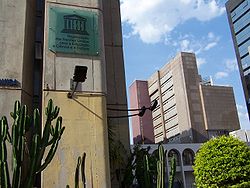 UNESCO implements its activities through the five programme areas of Education, Natural Sciences, Social and Human Sciences, Culture, and Communication and Information.
UNESCO does not accredit institutions of higher learning.
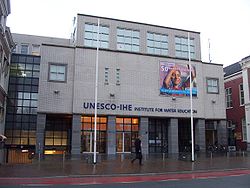 The institutes are specialized departments of the Organization that support UNESCO's programme, providing specialized support for cluster and national offices.
. UNESCO state parties are all United Nations member states
and Cook Islands
, Niue
and Palestine
.
was elected the new Director-General.
This is the list of the Directors-General of UNESCO since its establishment in 1946:
in Paris
, France
.48.85°N 2.306°E
UNESCO's field offices are categorized into four primary office types based upon their function and geographic coverage: cluster offices, national offices, regional bureaux and liaison offices.
. During the 1970s and 1980s, UNESCO's support for a "New World Information and Communication Order" and its MacBride report
calling for democratization of the media and more egalitarian access to information was condemned in these countries as attempts to curb freedom of the press
. UNESCO was perceived by somehttp://news.change.org/stories/unesco-gets-chummy-with-equatorial-guineas-dictator as a platform for communists and Third World dictators to attack the West
, a stark contrast to accusations made by the USSR in the late 1940s and early 1950s. In 1984, the United States withheld its contributions and withdrew from the organization in protest, followed by the United Kingdom in 1985 and Singapore in 1986. Following a change of government in 1997, the UK rejoined. The United States rejoined in 2003, followed by Singapore on 8 October 2007.
was admitted to UNESCO in 1949, one year after its creation. In 1974, UNESCO stripped Israel of its membership on the grounds of alleged damage being done by Israel's archaeological excavations on the Temple Mount
in Jerusalem. UNESCO defended this decision with two statements in 1974 and 1975, but renewed Israel's membership in 1977, after the United States threatened to withhold $40 million of funding from the organization.
In 2010, Israel designated the Tomb of the Patriarchs, Hebron
and Rachel's Tomb
, Bethlehem
as National Heritage Sites and announced restoration work, prompting criticism from the United States
and protests from Palestinians. In
October 2010, UNESCO’s Executive Board voted to declare the sites as "al-Haram al-Ibrahimi/Tomb of the Patriarchs" and "Bilal bin Rabah Mosque/Rachel’s Tomb" and stated that they were "an integral part of the occupied Palestinian Territories" and any unilateral Israeli action was a violation of international law
. UNESCO described the sites as significant to "people of the Muslim, Christian and Jewish traditions", and accused Israel of highlighting only the Jewish character of the sites. Israel in turn accused UNESCO of "detach[ing] the Nation of Israel from its heritage", and accused it of being politically motivated. The Rabbi of the Western Wall
claimed that Rachel's tomb had not previously been declared a holy Muslim site. Israel partially suspended ties with UNESCO. Israeli Deputy Foreign Minister Danny Ayalon declared that the resolution was a "part of Palestinian escalation". Zevulun Orlev
, chairman of the Knesset
Education and Culture Committee, referred to the resolutions as an attempt to undermine the mission of UNESCO as a scientific and cultural organization that promotes cooperation throughout the world.
On June 28, 2011, UNESCO's World Heritage Committee, at Jordan
's insistence, censured Israel's decision to demolish and rebuild the Mughrabi Gate Bridge in Jerusalem for safety reasons. Israel stated that Jordan had signed an agreement with Israel stipulating that the existing bridge must be razed for safety reasons; Jordan disputed the agreement, saying it was only signed under U.S. pressure. Israel was also unable to address the UNESCO committee over objections from Egypt
.
French language
French is a Romance language spoken as a first language in France, the Romandy region in Switzerland, Wallonia and Brussels in Belgium, Monaco, the regions of Quebec and Acadia in Canada, and by various communities elsewhere. Second-language speakers of French are distributed throughout many parts...
L'Organisation des Nations unies pour l’éducation, la science et la culture : UNESCO; ) is a specialized agency of the United Nations
United Nations
The United Nations is an international organization whose stated aims are facilitating cooperation in international law, international security, economic development, social progress, human rights, and achievement of world peace...
. Its stated purpose is to contribute to peace and security by promoting international collaboration through education, science, and culture in order to further universal respect for justice, the rule of law
Rule of law
The rule of law, sometimes called supremacy of law, is a legal maxim that says that governmental decisions should be made by applying known principles or laws with minimal discretion in their application...
, and human rights
Human rights
Human rights are "commonly understood as inalienable fundamental rights to which a person is inherently entitled simply because she or he is a human being." Human rights are thus conceived as universal and egalitarian . These rights may exist as natural rights or as legal rights, in both national...
along with fundamental freedoms
Freedom (political)
Political freedom is a central philosophy in Western history and political thought, and one of the most important features of democratic societies...
proclaimed in the UN Charter
United Nations Charter
The Charter of the United Nations is the foundational treaty of the international organization called the United Nations. It was signed at the San Francisco War Memorial and Performing Arts Center in San Francisco, United States, on 26 June 1945, by 50 of the 51 original member countries...
. It is the heir of the League of Nations
League of Nations
The League of Nations was an intergovernmental organization founded as a result of the Paris Peace Conference that ended the First World War. It was the first permanent international organization whose principal mission was to maintain world peace...
' International Commission on Intellectual Cooperation.
UNESCO has 196 (Palestine has been added recently in Nov. 2011) Member States and eight Associate Members.
Most of the field offices are "cluster" offices covering three or more countries; there are also national and regional offices. UNESCO pursues its objectives through five major programs: education, natural science
Natural science
The natural sciences are branches of science that seek to elucidate the rules that govern the natural world by using empirical and scientific methods...
s, social and human science
Human Science
Human science refers to the investigation of human life and activities via a phenomenological methodology that acknowledges the validity of both sensory and psychological experience...
s, culture, and communication and information. Projects sponsored by UNESCO include literacy, technical, and teacher-training programmes; international science programmes; the promotion of independent media
News media
The news media are those elements of the mass media that focus on delivering news to the general public or a target public.These include print media , broadcast news , and more recently the Internet .-Etymology:A medium is a carrier of something...
and freedom of the press
Freedom of the press
Freedom of the press or freedom of the media is the freedom of communication and expression through vehicles including various electronic media and published materials...
; regional and cultural history
History
History is the discovery, collection, organization, and presentation of information about past events. History can also mean the period of time after writing was invented. Scholars who write about history are called historians...
projects; the promotion of cultural diversity
Cultural diversity
Cultural diversity is having different cultures respect each other's differences. It could also mean the variety of human societies or cultures in a specific region, or in the world as a whole...
; international cooperation agreements to secure the world cultural
Cultural heritage
Cultural heritage is the legacy of physical artifacts and intangible attributes of a group or society that are inherited from past generations, maintained in the present and bestowed for the benefit of future generations...
and natural heritage
Natural heritage
Natural heritage is the legacy of natural objects and intangible attributes encompassing the countryside and natural environment, including flora and fauna, scientifically known as biodiversity, and geology and landforms ....
(World Heritage Site
World Heritage Site
A UNESCO World Heritage Site is a place that is listed by the UNESCO as of special cultural or physical significance...
s) and to preserve human rights, and attempts to bridge the worldwide digital divide
Global digital divide
The global digital divide is a term used to describe “great disparities in opportunity to access the Internet and the information and educational/business opportunities tied to this access … between developed and developing countries”...
. It is also a member of the United Nations Development Group.
Mission and priorities
UNESCO’s stated aim is "to contribute to the building of peace, the eradication of poverty, sustainable development and intercultural dialogue through education, the sciences, culture, communication and information".Other priorities of the Organization include attaining quality education for all
Education For All
Education For All is a global movement led by UNESCO, aiming to meet the learning needs of all children, youth and adults by 2015. UNESCO has been mandated to lead the movement and coordinate the international efforts to reach Education for All...
and lifelong learning
Lifelong learning
Lifelong learning is the continuous building of skills and knowledge throughout the life of an individual. It occurs through experiences encountered in the course of a lifetime...
, addressing emerging social and ethical challenges, fostering cultural diversity
Cultural diversity
Cultural diversity is having different cultures respect each other's differences. It could also mean the variety of human societies or cultures in a specific region, or in the world as a whole...
, a culture of peace and building inclusive knowledge societies through information and communication.
The broad goals and concrete objectives of the international community – as set out in the internationally agreed development goals, including the Millennium Development Goals (MDGs)
Millennium Development Goals
The Millennium Development Goals are eight international development goals that all 193 United Nations member states and at least 23 international organizations have agreed to achieve by the year 2015...
– underpin all UNESCO’s strategies and activities.
History
International Bureau of Education
The International Bureau of Education is a UNESCO center specializing in education, whose goal is to facilitate the provision of quality education throughout the world.-History:...
(IBE) began work as a non-governmental organization in the service of international educational development. However, the work of these predecessor organizations was largely interrupted by the onset of the Second World War.
After the signing of the Atlantic Charter
Atlantic Charter
The Atlantic Charter was a pivotal policy statement first issued in August 1941 that early in World War II defined the Allied goals for the post-war world. It was drafted by Britain and the United States, and later agreed to by all the Allies...
and the Declaration of the United Nations, the Conference of Allied Ministers of Education (CAME) began meetings in London which continued between 16 November 1942 to 5 December 1945. On 30 October 1943, the necessity for an international organization was expressed in the Moscow Declaration, agreed upon by China, the United Kingdom, the United States of America and the USSR. This was followed by the Dumbarton Oaks Conference
Dumbarton Oaks Conference
The Dumbarton Oaks Conference or, more formally, the Washington Conversations on International Peace and Security Organization was an international conference at which the United Nations was formulated and negotiated among international leaders...
proposals of 9 October 1944. Upon the proposal of CAME and in accordance with the recommendations of the United Nations Conference on International Organization
United Nations Conference on International Organization
The United Nations Conference on International Organization was a convention of delegates from 50 Allied nations that took place from 25 April 1945 to 26 June 1945 in San Francisco, California. At this convention, the delegates reviewed and rewrote the Dumbarton Oaks agreements...
(UNCIO), held in San Francisco in April–June 1945, a United Nations Conference for the establishment of an educational and cultural organization (ECO/CONF) was convened in London 1–16 November 1945. 44 governments were represented. At the ECO/CONF, the Constitution of UNESCO was introduced and signed by 37 countries, and a Preparatory Commission was established. The Preparatory Commission operated between 16 November 1945, and 4 November 1946 – the date when UNESCO’s Constitution came into force with the deposit of the twentieth ratification by a member state.
The first General Conference took place from 19 November to 10 December 1946, and elected Dr. Julian Huxley
Julian Huxley
Sir Julian Sorell Huxley FRS was an English evolutionary biologist, humanist and internationalist. He was a proponent of natural selection, and a leading figure in the mid-twentieth century evolutionary synthesis...
to the post of Director-General. The Constitution was amended in November 1954 when the General Conference resolved that members of the Executive Board would be representatives of the governments of the States of which they are nationals and would not, as before, act in their personal capacity. This change in governance distinguished UNESCO from its predecessor, the CICI, in terms of how member states would work together in the Organization’s fields of competence. As member states worked together over time to realize UNESCO’s mandate, political and historical factors have shaped the Organization’s operations in particular during the Cold War, the decolonization process, and the dissolution of the USSR.
Among the major achievements of the Organization is its work against racism, for example through influential statements on race starting with a declaration of anthropologists (among them was Claude Lévi-Strauss
Claude Lévi-Strauss
Claude Lévi-Strauss was a French anthropologist and ethnologist, and has been called, along with James George Frazer, the "father of modern anthropology"....
) and other scientists in 1950 and concluding with the 1978 Declaration on Race and Racial Prejudice. In 1956, the Republic of South Africa withdrew from UNESCO claiming that some of the Organization’s publications amounted to “interference” in the country’s “racial problems.” South Africa rejoined the Organization in 1994 under the leadership of Nelson Mandela
Nelson Mandela
Nelson Rolihlahla Mandela served as President of South Africa from 1994 to 1999, and was the first South African president to be elected in a fully representative democratic election. Before his presidency, Mandela was an anti-apartheid activist, and the leader of Umkhonto we Sizwe, the armed wing...
.
UNESCO’s early work in the field of education included the pilot project on fundamental education in the Marbial Valley, Haiti, started in 1947. This project was followed by expert missions to other countries, including, for example, a mission to Afghanistan in 1949. In 1948, UNESCO recommended that Member States should make free primary education compulsory and universal. In 1990 the World Conference on Education for All, in Jomtien
Jomtien
Jomtien Beach is a section of Pattaya, a city in Thailand, located on the east coast of the Gulf of Thailand about 165 km southeast of Bangkok in the province of Chonburi...
, Thailand, launched a global movement to provide basic education for all children, youths and adults. Ten years later, the 2000 World Education Forum
World Education Forum
The World Education Forum is a premium body comprising representatives of major organisations involved in education and related activities across the world. Major organisations involved in the forum include: UNESCO, and the World Bank, and the Asian Development Bank. The World Education Forum also...
held in Dakar
Dakar
Dakar is the capital city and largest city of Senegal. It is located on the Cap-Vert Peninsula on the Atlantic coast and is the westernmost city on the African mainland...
, Senegal, led member governments to commit to achieving basic education for all by 2015.
UNESCO’s early activities in the field of culture included, for example, the Nubia Campaign, launched in 1960. The purpose of the campaign was to move the Great Temple of Abu Simbel
Abu Simbel
Abu Simbel temples refers to two massive rock temples in Abu Simbel in Nubia, southern Egypt on the western bank of Lake Nasser about 230 km southwest of Aswan...
to keep it from being swamped by the Nile after construction of the Aswan Dam
Aswan Dam
The Aswan Dam is an embankment dam situated across the Nile River in Aswan, Egypt. Since the 1950s, the name commonly refers to the High Dam, which is larger and newer than the Aswan Low Dam, which was first completed in 1902...
. During the 20-year campaign, 22 monuments and architectural complexes were relocated. This was the first and largest in a series of campaigns including Mohenjo-daro
Mohenjo-daro
Mohenjo-daro is an archeological site situated in what is now the province of Sindh, Pakistan. Built around 2600 BC, it was one of the largest settlements of the ancient Indus Valley Civilization, and one of the world's earliest major urban settlements, existing at the same time as the...
(Pakistan), Fes
Fes
Fes or Fez is the second largest city of Morocco, after Casablanca, with a population of approximately 1 million . It is the capital of the Fès-Boulemane region....
(Morocco), Kathmandu (Nepal), Borobudur
Borobudur
Borobudur, or Barabudur, is a 9th-century Mahayana Buddhist monument near Magelang, Central Java, Indonesia. The monument comprises six square platforms topped by three circular platforms, and is decorated with 2,672 relief panels and 504 Buddha statues...
(Indonesia) and the Acropolis
Acropolis
Acropolis means "high city" in Greek, literally city on the extremity and is usually translated into English as Citadel . For purposes of defense, early people naturally chose elevated ground to build a new settlement, frequently a hill with precipitous sides...
(Greece). The Organization’s work on heritage led to the adoption, in 1972, of the Convention concerning the Protection of the World Cultural and Natural Heritage. The World Heritage Committee
World Heritage Committee
The World Heritage Committee establishes the sites to be listed as UNESCO World Heritage Sites. It is responsible for the implementation of the World Heritage Convention, defines the use of the World Heritage Fund and allocates financial assistance upon requests from States Parties...
was established in 1976 and the first sites inscribed on the World Heritage List in 1978. Since then important legal instruments on cultural heritage and diversity have been adopted by UNESCO member states in 2003 (Convention for the Safeguarding of the Intangible Cultural Heritage
Intangible Cultural Heritage
The concept of intangible cultural heritage emerged in the 1990s, as a counterpart to the World Heritage that focuses mainly on tangible aspects of culture...
) and 2005 (Convention on the Protection and Promotion of the Diversity of Cultural Expressions).
An intergovernmental meeting of UNESCO in Paris in December 1951 led to the creation of the European Council for Nuclear Research (CERN) in 1954.
Arid Zone programming, 1948–1966, is another example of an early major UNESCO project in the field of natural sciences. In 1968, UNESCO organized the first intergovernmental conference aimed at reconciling the environment and development, a problem which continues to be addressed in the field of sustainable development. The main outcome of the 1968 conference was the creation of UNESCO’s Man and the Biosphere Programme.
In the field of communication, the free flow of information has been a priority for UNESCO from its beginnings. In the years immediately following World War II, efforts were concentrated on reconstruction and on the identification of needs for means of mass communication around the world. UNESCO started organizing training and education for journalists in the 1950s. In response to calls for a "New World Information and Communication Order" in the late 1970s, UNESCO established the International Commission for the Study of Communication Problems, which produced the 1980 MacBride report
MacBride report
Many Voices One World, also known as the MacBride report, was a 1980 UNESCO publication written by the International Commission for the Study of Communication Problems, chaired by Irish Nobel laureate Seán MacBride...
(named after the Chair of the Commission, the Nobel Peace Prize laureate Seán MacBride
Seán MacBride
Seán MacBride was an Irish government minister and prominent international politician as well as a Chief of Staff of the IRA....
). Following the MacBride report, UNESCO introduced the Information Society for All programme and Toward Knowledge Societies programme in the lead up to the World Summit on the Information Society in 2003 (Geneva
Geneva
Geneva In the national languages of Switzerland the city is known as Genf , Ginevra and Genevra is the second-most-populous city in Switzerland and is the most populous city of Romandie, the French-speaking part of Switzerland...
) and 2005 (Tunis
Tunis
Tunis is the capital of both the Tunisian Republic and the Tunis Governorate. It is Tunisia's largest city, with a population of 728,453 as of 2004; the greater metropolitan area holds some 2,412,500 inhabitants....
).
In 2011, Palestine became a UNESCO member following a vote in which 107 member states supported and 14 opposed. Laws passed in the United States in 1990 and 1994 mean that it cannot contribute financially to any UN organisation that accepts Palestine as a full member. As a result, it will withdraw its funding which accounts for about 22% of UNESCO's budget.
Activities
- EducationEducationEducation in its broadest, general sense is the means through which the aims and habits of a group of people lives on from one generation to the next. Generally, it occurs through any experience that has a formative effect on the way one thinks, feels, or acts...
: UNESCO supports research in Comparative educationComparative educationComparative education is a fully established academic field of study that examines education in one country by using data and insights drawn from the practises and situation in another country, or countries...
; and provides expertise and fosters partnerships to strengthen national educational leadership and the capacity of countries to offer quality education for all. This includes the- Eight specialized Institutes in different topics of the sector
- UNESCO ChairsUNESCO ChairsThe UNESCO Chairs program was established in 1992 following the relevant decision of the General Conference of United Nations Educational, Scientific and Cultural Organization taken at its 26th session....
, an international network of 644 UNESCO Chairs, involving over 770 institutions in 126 countries. - Environmental Conservation Organisation
- Organization of the International Conference on Adult Education (CONFINTEA) in an interval of 12 years
- Publication of the Education for All Global Monitoring ReportEducation for All Global Monitoring ReportDeveloped by an independent team and published by UNESCO, the EFA Global Monitoring Report is an authoritative reference that aims to inform, influence and sustain genuine commitment towards Education for All.-Background:...
- UNESCO ASPNetUNESCO ASPNetThe UNESCO Associated Schools Project Network, or ASPNet for short, is a programme established in 1953 to encourage schools worldwide to educate students on issues related to UNESCO's "overarching goal of promoting peace and international understanding". , it includes nearly eight thousand...
, an international network of 8,000 schools in 170 countries
UNESCO does not accredit institutions of higher learning.
- UNESCO also issues public 'statements' to educate the public:
- Seville Statement on ViolenceSeville Statement on ViolenceThe Seville Statement on Violence is a statement on violence that was adopted by an international meeting of scientists, convened by the Spanish National Commission for UNESCO, in Seville, Spain, on 16 May 1986. It was subsequently adopted by UNESCO at the twenty-fifth session of the General...
: A statement adopted by UNESCO in 1989 to refute the notion that humans are biologically predisposed to organised violence.
- Seville Statement on Violence
- Designating projects and places of cultural and scientific significance, such as:
- International Network of GeoparksInternational Network of GeoparksThe Global Geoparks Network is a UNESCO programme established in 1998. Managed under the body’s Ecological and Earth Sciences Division, the GGN seeks the promotion and conservation of the planet’s geological heritage, as well as encourages the sustainable research and development by the concerned...
- Biosphere reserveBiosphere reserveThe Man and the Biosphere Programme of UNESCO was established in 1971 to promote interdisciplinary approaches to management, research and education in ecosystem conservation and sustainable use of natural resources.-Development:...
s, through the Programme on Man and the Biosphere (MAB), since 1971 - City of LiteratureCity of LiteratureUNESCO's City of Literature program is part of its Creative Cities Network which was launched in 2004. The Network was born out of UNESCO's Global Alliance for Cultural Diversity initiative which was created in 2002...
; in 2007, the first city to be given this title was EdinburghEdinburghEdinburgh is the capital city of Scotland, the second largest city in Scotland, and the eighth most populous in the United Kingdom. The City of Edinburgh Council governs one of Scotland's 32 local government council areas. The council area includes urban Edinburgh and a rural area...
, the site of Scotland's first circulating library. In 2008, Iowa City, Iowa became the City of Literature. - Endangered languageEndangered languageAn endangered language is a language that is at risk of falling out of use. If it loses all its native speakers, it becomes a dead language. If eventually no one speaks the language at all it becomes an "extinct language"....
s and linguistic diversity projects - Masterpieces of the Oral and Intangible Heritage of HumanityMasterpieces of the Oral and Intangible Heritage of HumanityThe Proclamation of Masterpieces of the Oral and Intangible Heritage of Humanity was made by the Director-General of UNESCO starting in 2001 to raise awareness on intangible cultural heritage and encourage local communities to protect them and the local people who sustain these forms of cultural...
- Memory of the World International Register, since 1997
- Water resources management, through the International Hydrological ProgrammeInternational Hydrological ProgrammeThe International Hydrological Programme is a scientific programme of UNESCO that focuses on the use and availability of water.- On-line resources :*...
(IHP), since 1965 - World Heritage SiteWorld Heritage SiteA UNESCO World Heritage Site is a place that is listed by the UNESCO as of special cultural or physical significance...
s
- International Network of Geoparks
- Encouraging the "free flow of ideas by images and words" by:
- Promoting freedom of expression, press freedom and access to information, through the International Programme for the Development of CommunicationInternational Programme for the Development of CommunicationThe International Programme for the Development of Communication is a United Nations Educational, Scientific and Cultural Organization programme aimed at strengthening the development of mass media in developing countries.- Background :...
and the Communication and Information Programme - Promoting universal access to ICTs, through the Information for All Programme (IFAP)Information for All Programme (IFAP)The Information for All Programme is a programme of UNESCO that provides a platform for international policy discussions and guidelines for action on:* preservation of information and universal access to it;...
- Promoting Pluralism and cultural diversityCultural diversityCultural diversity is having different cultures respect each other's differences. It could also mean the variety of human societies or cultures in a specific region, or in the world as a whole...
in the media
- Promoting freedom of expression, press freedom and access to information, through the International Programme for the Development of Communication
- Promoting events, such as:
- International Decade for the Promotion of a Culture of Peace and Non-Violence for the Children of the World: 2001–2010, proclaimed by the UN in 1998
- World Press Freedom DayWorld Press Freedom DayThe United Nations General Assembly declared 3 May to be World Press Freedom Day to raise awareness of the importance of freedom of the press and remind governments of their duty to respect and uphold the right to freedom of expression enshrined under Article 19 of the Universal Declaration of...
, 3 May each year, to promote freedom of expression and freedom of the pressFreedom of the pressFreedom of the press or freedom of the media is the freedom of communication and expression through vehicles including various electronic media and published materials...
as a basic human right and as crucial components of any healthy, democratic and free society. - Criança Esperança in Brazil, in partnership with Rede GloboRede GloboRede Globo , or simply Globo, is a Brazilian television network, launched by media mogul Roberto Marinho on April 26, 1965. It is owned by media conglomerate Organizações Globo, being by far the largest of its holdings...
, to raise funds for community-based projects that foster social integration and violence prevention. - International Literacy DayInternational Literacy DaySeptember 8 was proclaimed International Literacy Day by UNESCO on November 17, 1965. It was first celebrated in 1966. Its aim is to highlight the importance of literacy to individuals, communities and societies. On International Literacy Day each year, UNESCO reminds the international community of...
- International Year for the Culture of PeaceInternational Year for the Culture of PeaceThe International Year for the Culture of Peace was designated by the United Nations as the year 2000, with the aim of celebrating and encouraging a culture of peace.- Origins :...
- Founding and funding projects, such as:
- Migration Museums Initiative: Promoting the establishment of museums for cultural dialogue with migrant populations.
- UNESCO-CEPESUNESCO-CEPESUNESCO-CEPES was established in 1972 at Bucharest, Romania, as a de-centralized office for the European Centre for Higher Education. The centre promotes international cooperation in the sphere of higher education among UNESCO’s Member States in Central, Eastern and South-East Europe and also...
, the European Centre for Higher Education: established in 1972 in BucharestBucharestBucharest is the capital municipality, cultural, industrial, and financial centre of Romania. It is the largest city in Romania, located in the southeast of the country, at , and lies on the banks of the Dâmbovița River....
, RomaniaRomaniaRomania is a country located at the crossroads of Central and Southeastern Europe, on the Lower Danube, within and outside the Carpathian arch, bordering on the Black Sea...
, as a de-centralized office to promote international co-operation in higher education in Europe as well as CanadaCanadaCanada is a North American country consisting of ten provinces and three territories. Located in the northern part of the continent, it extends from the Atlantic Ocean in the east to the Pacific Ocean in the west, and northward into the Arctic Ocean...
, USAUnited StatesThe United States of America is a federal constitutional republic comprising fifty states and a federal district...
and IsraelIsraelThe State of Israel is a parliamentary republic located in the Middle East, along the eastern shore of the Mediterranean Sea...
. Higher Education in Europe is its official journal. - Free Software DirectoryFree Software DirectoryThe Free Software Directory is a project of the Free Software Foundation . It catalogs free software that runs under free operating systems - particularly GNU and Linux. The project was formerly co-run by UNESCO....
: since 1998 UNESCO and the Free Software FoundationFree Software FoundationThe Free Software Foundation is a non-profit corporation founded by Richard Stallman on 4 October 1985 to support the free software movement, a copyleft-based movement which aims to promote the universal freedom to create, distribute and modify computer software...
have jointly funded this project cataloguing free softwareFree softwareFree software, software libre or libre software is software that can be used, studied, and modified without restriction, and which can be copied and redistributed in modified or unmodified form either without restriction, or with restrictions that only ensure that further recipients can also do...
. - FRESHFRESH, UNESCOFRESH is an acronym for Focusing Resources on Effective School Health, an inter-agency framework developed by UNESCO, UNICEF, WHO, and the World Bank, launched at the Dakar Education Forum, 2000, which incorporates the experience and expertise of these and other agencies and organizations. It is a...
Focussing Resources on Effective School HealthSchool health servicesSchool health services are services from medical, teaching and other professionals applied in or out of school to improve the health and well-being of children and in some cases whole families...
. - OANAOANAOrganization of Asia-Pacific News Agencies is an association of news agencies from UNESCO member states in the Asia-Pacific region. It was previously known as Organisation of Asian News Agencies.It was formed in 1961 on UNESCO's initiative...
, the Organization of Asia-Pacific News Agencies - International Council of Science
- UNESCO Goodwill AmbassadorUNESCO Goodwill AmbassadorUNESCO Goodwill Ambassadors are celebrity advocates of UNESCO who use their talent or fame to spread the UNESCO ideals, especially attracting media attention...
s - ASOMPS, Asian Symposium on Medicinal Plants and Spices, a series of scientific conferences held in Asia
- Botany 2000Botany 2000Botany 2000 is the name for a scientific program, organized under the auspices of UNESCO. While a similar UNESCO program, ASOMPS, focus on promotion of collaboration and co-operation between scientists in Asia, Botany 2000 is composed of activities in Asia and Africa. Activities in Europe are...
, a programme supporting taxonomy, and biological and cultural diversity of medicinal and ornamental plants, and their protection against environmental pollution
Official UNESCO NGOs
UNESCO enjoys official relations with 322 international non-governmental organizations (NGOs). Most of these are what UNESCO calls "operational", a select few are "formal". The highest form of affiliation to UNESCO is "formal associate", and the 22 NGOs with formal associate (ASC) relations occupying offices at UNESCO are:- International Baccalaureate (IB)
- Coordinating Committee for International Voluntary Service (CCIVS)
- Education InternationalEducation InternationalEducation International is a global union federation of teachers' trade unions. Currently, it has 401 member organizations in 172 countries and territories, representing over 30 million education personnel from pre-school to university...
(EI) - International Association of Universities (IAU)
- International Council for Film, Television and Audiovisual Communication (IFTC)
- International Council for Philosophy and Humanistic StudiesInternational Council for Philosophy and Humanistic StudiesThe International Council for Philosophy and Humanistic Studies is a non-governmental organization within UNESCO, which is a supraorganization of hundreds of learned societies in the field of philosophy, human sciences and related subjects....
(ICPHS) which publishes DiogenesDiogenes (journal)Diogenes is a peer-reviewed academic journal that publishes papers three times a year in the field of Philosophy. The journal's editors are Maurice Aymard and Luca Maria Scarantino... - International Council for ScienceInternational Council for ScienceThe International Council for Science , formerly the International Council of Scientific Unions, was founded in 1931 as an international non-governmental organization devoted to international co-operation in the advancement of science...
(ICSU) - International Council of MuseumsInternational Council of MuseumsThe International Council of Museums is an international organization of museums and museum professionals that is committed to the conservation, continuation and communication to society of the world's natural and cultural heritage, present and future, tangible and intangible.- Overview :Created...
(ICOM) - International Council of Sport Science and Physical EducationInternational Council of Sport Science and Physical EducationThe International Council of Sport Science and Physical Education is an organization based in Berlin, Germany which originated in Paris, France in 1958....
(ICSSPE) - International Council on ArchivesInternational Council on ArchivesThe International Council on Archives is an international non-governmental organization which exists to promote international cooperation in archiving. It was set up in 1948, with Charles Samaran, the then director of the Archives de France, as chairman. It is open to membership of national and...
(ICA) - International Council on Monuments and SitesInternational Council on Monuments and SitesThe International Council on Monuments and Sites is a professional association that works for the conservation and protection of cultural heritage places around the world...
(ICOMOS) - International Federation of JournalistsInternational Federation of JournalistsInternational Federation of Journalists, IFJ, is a global union federation of journalists' trade unions—the largest in the world. The organization aims to protect and strengthen the rights and freedoms of journalists...
(IFJ) - International Federation of Library Associations and InstitutionsInternational Federation of Library Associations and InstitutionsThe International Federation of Library Associations and Institutions is the leading international association of library organisations. It is the global voice of the library and information profession, and its annual conference provides a venue for librarians to learn from one another...
(IFLA) - International Federation of Poetry Associations (IFPA)
- International Music CouncilInternational Music CouncilThe International Music Council was created in 1949 as UNESCO's advisory body on matters of music. It is based at UNESCO's headquarters in Paris, France, where it functions as an independent international non-governmental organization...
(IMC) - International Scientific Council for Island Development (INSULA)
- International Social Science CouncilInternational Social Science CouncilThe International Social Science Council is an international organisation that aims to promote the social and behavioural sciences. It was founded in 1952, under the auspices of UNESCO.-External links:* **...
(ISSC) - International Theatre Institute (ITI)
- International Union for Conservation of Nature and Natural Resources (IUCN)
- International Union of Technical Associations and Organizations
- Union of International AssociationsUnion of International AssociationsThe Union of International Associations is a non-profit non-governmental organization researching, under UN mandate, the global civil society and publishing information on international organizations, international meetings, world problems, etc. Headquarters are in Brussels, Belgium...
(UIA) - World Association of NewspapersWorld Association of NewspapersThe World Association of Newspapers is a non-profit, non-governmental organization made up of 76 national newspaper associations, 12 news agencies, 10 regional press organisations and individual newspaper executives in 100 countries...
(WAN) - World Federation of Engineering Organizations (WFEO)
- World Federation of UNESCO Clubs, Centres and Associations (WFUCA)
UNESCO Institutes and Centres
- UNESCO International Bureau of EducationInternational Bureau of EducationThe International Bureau of Education is a UNESCO center specializing in education, whose goal is to facilitate the provision of quality education throughout the world.-History:...
(IBE) - UNESCO Institute for Lifelong LearningUNESCO Institute for Lifelong LearningThe UNESCO Institute for Lifelong Learning is one of six educational institutes of UNESCO. It is a non-profit international research, training, information, documentation and publishing centre on literacy, non-formal education, adult and lifelong learning...
- UNESCO International Institute for Educational PlanningUNESCO International Institute for Educational PlanningThe International Institute for Educational Planning is an arm of UNESCO created in 1963 in Paris, France.- Mission :IIEP's mission is to strengthen the capacity of countries...
(IIEP) - UNESCO Institute for Information Technologies in Education (IITE)
- UNESCO International Institute for Capacity-Building in Africa (IICBA)
- UNESCO International Institute for Higher Education in Latin America and the Caribbean (IESALC); Caracas (Venezuela) contributes to the development and transformation of the tertiary education through the reinforcement of a work plan that, among other purposes, attempts to be an instrument to support the management of change and the required transformations in order that higher education in the region becomes an effective promoter of a culture of peace that allows to make viable - in an age of globalization - the human sustainable development based on principles of justice, equity, freedom, solidarity, democracy and respect of the human rights.
- UNESCO International Centre for Technical and Vocational Education and Training (UNEVOC)
- UNESCO European Centre for Higher Education (CEPES)
- UNESCO-IHE Institute for Water EducationUNESCO-IHEThe UNESCO-IHE Institute for Water Education is an international institute for water education that was created in 2003 from the previous IHE. This in turn grew out of the International Course in Hydraulic Engineering , whose name was changed in 1976 to International Institute for Hydraulic and...
(UNESCO-IHE) - International Centre for Theoretical PhysicsInternational Centre for Theoretical PhysicsThe Abdus Salam International Centre for Theoretical Physics was founded in 1964 by Pakistani scientist and Nobel Laureate Abdus Salam after consulting with Munir Ahmad Khan. It operates under a tripartite agreement among the Italian Government, UNESCO, and International Atomic Energy Agency...
(ICTP) - UNESCO Institute for StatisticsUNESCO Institute for StatisticsThe UNESCO Institute for Statistics is the statistical office of UNESCO and is the primary UN depository for cross-nationally comparable statistics on education, science and technology, culture, and communication covering more than 200 countries and territories.The UIS was established in 1999...
(UIS); Montreal (Canada) provides an impressive collection of up to date statistics in the fields of education, science and technology, culture and communication.
Official list of UNESCO prizes
UNESCO currently awards 22 prizes in education, science, culture and peace:- Félix Houphouët-Boigny Peace PrizeFélix Houphouët-Boigny Peace PrizeThe Félix Houphouët-Boigny Peace Prize was established in 1990 by UNESCO:The prize bears the name of Félix Houphouët-Boigny, late former president of Côte d'Ivoire. It is awarded annually. The prize is 122,000 euros, to be shared equally in the case of multiple recipients.-Recipients:-External...
- L’Oréal-UNESCO Awards for Women in Science
- UNESCO/King Sejong Literacy Prize
- UNESCO/Confucius Prize for Literacy
- UNESCO/Emir Jaber al-Ahmad al-Jaber al-Sabah Prize to promote Quality Education for Persons with Intellectual Disabilities
- UNESCO King Hamad Bin Isa Al-Khalifa PrizeUNESCO King Hamad Bin Isa Al-Khalifa PrizeThe UNESCO King Hamad Bin Isa Al-Khalifa Prize for the Use of Information and Communication Technologies in Education was instituted in 2005. The prize is awarded yearly and consists of a sum of US$50,000 , to be equally divided between two laureates...
for the Use of Information and Communication Technologies in Education - UNESCO/Hamdan Bin Rashid Al-Maktoum Prize for Outstanding Practice and Performance in Enhancing the Effectiveness of Teachers
- UNESCO/Kalinga PrizeKalinga PrizeThe Kalinga Prize for the Popularization of Science is an award given by UNESCO for exceptional skill in presenting scientific ideas to lay people...
for the Popularization of Science - UNESCO/Institut Pasteur MedalUNESCO/Institut Pasteur MedalThe UNESCO/Institut Pasteur Medal is a biennial international science prize created jointly by UNESCO and the Pasteur Institute in 1995 "to be awarded in recognition of outstanding research contributing to a beneficial impact on human health and to the advancement of scientific knowledge in related...
for an outstanding contribution to the development of scientific knowledge that has a beneficial impact on human health - UNESCO/Sultan Qaboos Prize for Environmental PreservationSultan Qaboos Prize for Environmental PreservationThe Sultan Qaboos Prize for Environmental Preservation is a biennial award sponsored by the United Nations Educational, Scientific and Cultural Organization and the Sultan Qaboos Bin Said of Oman "to afford recognition to outstanding contributions by individuals, groups of individuals, institutes...
- Great Man-Made River International Water Prize for Water Resources in Arid Zones presented by UNESCO (title to be reconsidered)
- Michel Batisse Award for Biosphere Reserve Management
- UNESCO/Bilbao Prize for the Promotion of a Culture of Human Rights
- UNESCO Prize for Peace EducationUNESCO Prize for Peace EducationThe UNESCO Prize for Peace Education has been awarded annually since 1981.The prize is endowed up to 60 000 US dollars and honours extraordinary activities in the spirit of the UNESCO constitution.-Recipients of the Prize by year:...
- UNESCO-Madanjeet Singh PrizeUNESCO-Madanjeet Singh PrizeThe UNESCO-Madanjeet Singh Prize for the Promotion of Tolerance and Non-Violence is a prize awarded every two years by UNESCO. It was inaugurated in 1996, following the 1995 United Nations Year for Tolerance and in connection with the 125th anniversary of the birth of Mahatma Gandhi, funded by a...
for the Promotion of Tolerance and Non-Violence - UNESCO/International José Martí PrizeInternational José Martí PrizeThe International José Martí Prize serves to "promote and reward an activity of outstanding merit in accordance with the ideals and spirit" of Cuban independence leader, thinker, and poet José Martí"....
- UNESCO/Avicenna PrizeAvicenna PrizeAwarded every two years by UNESCO, is intended to reward the activities of individuals and groups in the field of ethics in science. By thus promoting ethical reflection on issues raised by advances in science and technology, it is expected to help significantly to increase international awareness...
for Ethics in Science - UNESCO/Juan Bosch Prize for the Promotion of Social Science Research in Latin America and the Caribbean
- Sharjah Prize for Arab Culture
- Melina Mercouri International Prize for the Safeguarding and Management of Cultural Landscapes (UNESCO-Greece)
- IPDC-UNESCO Prize for Rural Communication
- UNESCO/Guillermo Cano World Press Freedom PrizeUNESCO/Guillermo Cano World Press Freedom PrizeThe UNESCO/Guillermo Cano World Press Freedom Prize, created in 1997, honours a person, organization or institution that has made an outstanding contribution to the defence and/or promotion of press freedom anywhere in the world, especially when this has been achieved in the face of danger.The...
- UNESCO/Jikji Memory of the World Prize
Inactive UNESCO prizes
- Carlos J. Finlay Prize for MicrobiologyCarlos J. Finlay Prize for MicrobiologyThe Carlos J. Finlay Prize is a biennal scientific prize sponsored by the Government of Cuba and awarded since 1980 by the United Nations Educational, Scientific and Cultural Organization to people or organizations for their outstanding contributions to microbiology and its applications...
(inactive since 2005) - International Simón Bolívar PrizeInternational Simón Bolívar PrizeThe International Simón Bolívar Prize serves to recognise activities of outstanding merit that, in accordance with the ideals of Latin American independence hero Simón Bolívar, "contribute to the freedom, independence and dignity of peoples and to the strengthening of a new international economic,...
(inactive since 2004) - UNESCO Prize for Human Rights EducationUNESCO Prize for Human Rights EducationThe UNESCO/Bilbao Prize for the Promotion of a Culture of Human Rights, created in 1978 as the UNESCO Prize for Human Rights Education to mark the 30th anniversary of the adoption of the Universal Declaration of Human Rights, serves to honour the efforts of organizations or individuals that have...
- UNESCO/Obiang Nguema Mbasogo International Prize for Research in the Life Sciences (inactive since 2010)
Member states
, UNESCO counts 194 member states and 8 associate members. Some members are not independent states and some members have additional National Organizing Committees from some of their dependent territoriesDependent territory
A dependent territory, dependent area or dependency is a territory that does not possess full political independence or sovereignty as a State, and remains politically outside of the controlling state's integral area....
. UNESCO state parties are all United Nations member states
United Nations member states
There are 193 United Nations member states, and each of them is a member of the United Nations General Assembly.The criteria for admission of new members are set out in the United Nations Charter, Chapter II, Article 4, as follows:...
and Cook Islands
Cook Islands
The Cook Islands is a self-governing parliamentary democracy in the South Pacific Ocean in free association with New Zealand...
, Niue
Niue
Niue , is an island country in the South Pacific Ocean. It is commonly known as the "Rock of Polynesia", and inhabitants of the island call it "the Rock" for short. Niue is northeast of New Zealand in a triangle between Tonga to the southwest, the Samoas to the northwest, and the Cook Islands to...
and Palestine
State of Palestine
Palestine , officially declared as the State of Palestine , is a state that was proclaimed in exile in Algiers on 15 November 1988, when the Palestine Liberation Organization's National Council adopted the unilateral Palestinian Declaration of Independence...
.
Director-General
Elections for the renewal of the position of Director-General took place in Paris from 7 September to 23 September 2009. Eight candidates ran for the position, and 58 countries voted for them. The Executive Council gathered from 7 September to 23 September, the vote itself beginning on the 17th. Irina BokovaIrina Bokova
Irina Georgieva Bokova is a Bulgarian politician, incumbent Directors-General of UNESCO. She was member of the Bulgarian Parliament from the Bulgarian Socialist Party for two terms, minister and deputy minister of foreign affairs in the socialist cabinet of Prime Minister Zhan Videnov, and was...
was elected the new Director-General.
This is the list of the Directors-General of UNESCO since its establishment in 1946:
-
 Julian HuxleyJulian HuxleySir Julian Sorell Huxley FRS was an English evolutionary biologist, humanist and internationalist. He was a proponent of natural selection, and a leading figure in the mid-twentieth century evolutionary synthesis...
(1946–1948) -
 Jaime Torres BodetJaime Torres BodetJaime Torres Bodet was a prominent Mexican politician and writer who served in the executive cabinet of three Presidents of Mexico....
(1948–1952) -
 John Wilkinson Taylor (actingActing (law)In law, when someone is said to be acting in a position it can mean one of three things.*The position has not yet been formally created.*The person is only occupying the position temporarily, to ensure continuity.*The person does not have a mandate....
1952–1953) - Luther Evans (1953–1958)
-
 Vittorino VeroneseVittorino VeroneseVittorino Veronese was an Italian lawyer, who was Director-General of UNESCO from 1958 to 1961.With a doctorate in law and as an anti-fascist lawyer, he quickly took an interest in social and educational problems and international co-operation...
(1958–1961) -
 René MaheuRené MaheuRené Gabriel Eugene Maheu , a close friend of Jean-Paul Sartre and Simone de Beauvoir, was a French professor of philosophy and the sixth Director-General of UNESCO....
(1961–1974; actingActing (law)In law, when someone is said to be acting in a position it can mean one of three things.*The position has not yet been formally created.*The person is only occupying the position temporarily, to ensure continuity.*The person does not have a mandate....
1961) -
 Amadou-Mahtar M'BowAmadou-Mahtar M'BowAmadou-Mahtar M'Bow is a Senegalese educator. Born in Dakar, M'bow served in France and North Africa during World War II after volunteering for the French army...
(1974–1987) -
 Federico Mayor Zaragoza (1987–1999)
 -
 Koïchiro MatsuuraKoichiro Matsuurais a Japanese diplomat. He is the former Director-General of UNESCO. He was first elected in 1999 to a six-year term and reelected on 12 October 2005 for four years, following a reform instituted by the 29th session of the General Conference...
(1999–2009) -
 Irina BokovaIrina BokovaIrina Georgieva Bokova is a Bulgarian politician, incumbent Directors-General of UNESCO. She was member of the Bulgarian Parliament from the Bulgarian Socialist Party for two terms, minister and deputy minister of foreign affairs in the socialist cabinet of Prime Minister Zhan Videnov, and was...
(2009– )
General Conference
This is the list of the sessions of UNESCO General Conference held since 1946:- 1st session (ParisParisParis is the capital and largest city in France, situated on the river Seine, in northern France, at the heart of the Île-de-France region...
, 1946) - chaired by Léon Blum (FranceFranceThe French Republic , The French Republic , The French Republic , (commonly known as France , is a unitary semi-presidential republic in Western Europe with several overseas territories and islands located on other continents and in the Indian, Pacific, and Atlantic oceans. Metropolitan France...
) - 2nd session (Mexico CityMexico CityMexico City is the Federal District , capital of Mexico and seat of the federal powers of the Mexican Union. It is a federal entity within Mexico which is not part of any one of the 31 Mexican states but belongs to the federation as a whole...
, 1947) - chaired by Manuel Gual Vidal (MexicoMexicoThe United Mexican States , commonly known as Mexico , is a federal constitutional republic in North America. It is bordered on the north by the United States; on the south and west by the Pacific Ocean; on the southeast by Guatemala, Belize, and the Caribbean Sea; and on the east by the Gulf of...
) - 3rd session (BeirutBeirutBeirut is the capital and largest city of Lebanon, with a population ranging from 1 million to more than 2 million . Located on a peninsula at the midpoint of Lebanon's Mediterranean coastline, it serves as the country's largest and main seaport, and also forms the Beirut Metropolitan...
, 1948) – chaired by Hamid Bey Frangie (LebanonLebanonLebanon , officially the Republic of LebanonRepublic of Lebanon is the most common term used by Lebanese government agencies. The term Lebanese Republic, a literal translation of the official Arabic and French names that is not used in today's world. Arabic is the most common language spoken among...
) - 1st extraordinary session (Paris, 1948)
- 4th session (Paris, 1949) – chaired by Ronald Walker (AustraliaAustraliaAustralia , officially the Commonwealth of Australia, is a country in the Southern Hemisphere comprising the mainland of the Australian continent, the island of Tasmania, and numerous smaller islands in the Indian and Pacific Oceans. It is the world's sixth-largest country by total area...
) - 5th session (FlorenceFlorenceFlorence is the capital city of the Italian region of Tuscany and of the province of Florence. It is the most populous city in Tuscany, with approximately 370,000 inhabitants, expanding to over 1.5 million in the metropolitan area....
, 1950) – chaired by Count Stefano Jacini (ItalyItalyItaly , officially the Italian Republic languages]] under the European Charter for Regional or Minority Languages. In each of these, Italy's official name is as follows:;;;;;;;;), is a unitary parliamentary republic in South-Central Europe. To the north it borders France, Switzerland, Austria and...
) - 6th session (Paris, 1951) – chaired by Howland Sargeant (United StatesUnited StatesThe United States of America is a federal constitutional republic comprising fifty states and a federal district...
) - 7th session (Paris, 1952) – chaired by Sarvepalli Radhakrishnan (IndiaIndiaIndia , officially the Republic of India , is a country in South Asia. It is the seventh-largest country by geographical area, the second-most populous country with over 1.2 billion people, and the most populous democracy in the world...
) - 2nd extraordinary session (Paris, 1953)
- 8th session (MontevideoMontevideoMontevideo is the largest city, the capital, and the chief port of Uruguay. The settlement was established in 1726 by Bruno Mauricio de Zabala, as a strategic move amidst a Spanish-Portuguese dispute over the platine region, and as a counter to the Portuguese colony at Colonia del Sacramento...
, 1954) – chaired by Justino Zavala Muñiz (UruguayUruguayUruguay ,officially the Oriental Republic of Uruguay,sometimes the Eastern Republic of Uruguay; ) is a country in the southeastern part of South America. It is home to some 3.5 million people, of whom 1.8 million live in the capital Montevideo and its metropolitan area...
) - 9th session (New DelhiNew DelhiNew Delhi is the capital city of India. It serves as the centre of the Government of India and the Government of the National Capital Territory of Delhi. New Delhi is situated within the metropolis of Delhi. It is one of the nine districts of Delhi Union Territory. The total area of the city is...
, 1956) – chaired by Maulana Abul Kalam Azad (IndiaIndiaIndia , officially the Republic of India , is a country in South Asia. It is the seventh-largest country by geographical area, the second-most populous country with over 1.2 billion people, and the most populous democracy in the world...
) - 10th session (Paris, 1958) – chaired by Jean BerthoinJean BerthoinJean Berthoin was a French Politician....
(France) - 11th session (Paris, 1960) – chaired by Akale-Work Abte-Wold (EthiopiaEthiopiaEthiopia , officially known as the Federal Democratic Republic of Ethiopia, is a country located in the Horn of Africa. It is the second-most populous nation in Africa, with over 82 million inhabitants, and the tenth-largest by area, occupying 1,100,000 km2...
) - 12th session (Paris, 1962) – chaired by Paulo de Berrêdo Carneiro (BrazilBrazilBrazil , officially the Federative Republic of Brazil , is the largest country in South America. It is the world's fifth largest country, both by geographical area and by population with over 192 million people...
) - 13th session (Paris, 1964) – chaired by Norair Sissakian (Soviet UnionSoviet UnionThe Soviet Union , officially the Union of Soviet Socialist Republics , was a constitutionally socialist state that existed in Eurasia between 1922 and 1991....
) - 14th session (Paris, 1966) – chaired by Bedrettin Tuncel (TurkeyTurkeyTurkey , known officially as the Republic of Turkey , is a Eurasian country located in Western Asia and in East Thrace in Southeastern Europe...
) - 15th session (Paris, 1968) – chaired by Willian Eteki-Mboumoua (CameroonCameroonCameroon, officially the Republic of Cameroon , is a country in west Central Africa. It is bordered by Nigeria to the west; Chad to the northeast; the Central African Republic to the east; and Equatorial Guinea, Gabon, and the Republic of the Congo to the south. Cameroon's coastline lies on the...
) - 16th session (Paris, 1970) – chaired by Atilio Dell'Oro Maini (ArgentinaArgentinaArgentina , officially the Argentine Republic , is the second largest country in South America by land area, after Brazil. It is constituted as a federation of 23 provinces and an autonomous city, Buenos Aires...
) - 17th session (Paris, 1972) – chaired by Toru Haguiwara (JapanJapanJapan is an island nation in East Asia. Located in the Pacific Ocean, it lies to the east of the Sea of Japan, China, North Korea, South Korea and Russia, stretching from the Sea of Okhotsk in the north to the East China Sea and Taiwan in the south...
) - 3rd extraordinary session (Paris, 1973)
- 18th session (Paris, 1974) – chaired by Magda Joboru (HungaryHungaryHungary , officially the Republic of Hungary , is a landlocked country in Central Europe. It is situated in the Carpathian Basin and is bordered by Slovakia to the north, Ukraine and Romania to the east, Serbia and Croatia to the south, Slovenia to the southwest and Austria to the west. The...
) - 19th session (NairobiNairobiNairobi is the capital and largest city of Kenya. The city and its surrounding area also forms the Nairobi County. The name "Nairobi" comes from the Maasai phrase Enkare Nyirobi, which translates to "the place of cool waters". However, it is popularly known as the "Green City in the Sun" and is...
, 1976) – chaired by Taaita Toweett (KenyaKenyaKenya , officially known as the Republic of Kenya, is a country in East Africa that lies on the equator, with the Indian Ocean to its south-east...
) - 20th session (Paris, 1978) – chaired by Napoléon LeBlanc (CanadaCanadaCanada is a North American country consisting of ten provinces and three territories. Located in the northern part of the continent, it extends from the Atlantic Ocean in the east to the Pacific Ocean in the west, and northward into the Arctic Ocean...
) - 21st session (BelgradeBelgradeBelgrade is the capital and largest city of Serbia. It is located at the confluence of the Sava and Danube rivers, where the Pannonian Plain meets the Balkans. According to official results of Census 2011, the city has a population of 1,639,121. It is one of the 15 largest cities in Europe...
, 1980) – chaired by Ivo Margan (YugoslaviaYugoslaviaYugoslavia refers to three political entities that existed successively on the western part of the Balkans during most of the 20th century....
) - 4th extraordinary session (Paris, 1982)
- 22nd session (Paris, 1983) – chaired by Saïd Tell (JordanJordanJordan , officially the Hashemite Kingdom of Jordan , Al-Mamlaka al-Urduniyya al-Hashemiyya) is a kingdom on the East Bank of the River Jordan. The country borders Saudi Arabia to the east and south-east, Iraq to the north-east, Syria to the north and the West Bank and Israel to the west, sharing...
) - 23rd session (SofiaSofiaSofia is the capital and largest city of Bulgaria and the 12th largest city in the European Union with a population of 1.27 million people. It is located in western Bulgaria, at the foot of Mount Vitosha and approximately at the centre of the Balkan Peninsula.Prehistoric settlements were excavated...
, 1985) – chaired by Nikolaï Todorov (BulgariaBulgariaBulgaria , officially the Republic of Bulgaria , is a parliamentary democracy within a unitary constitutional republic in Southeast Europe. The country borders Romania to the north, Serbia and Macedonia to the west, Greece and Turkey to the south, as well as the Black Sea to the east...
) - 24th session (Paris, 1987) – chaired by Guillermo Putzeys Alvarez (GuatemalaGuatemalaGuatemala is a country in Central America bordered by Mexico to the north and west, the Pacific Ocean to the southwest, Belize to the northeast, the Caribbean to the east, and Honduras and El Salvador to the southeast...
) - 25th session (Paris, 1989) – chaired by Anwar IbrahimAnwar IbrahimAnwar bin Ibrahim is a Malaysian politician who served as Malaysian Deputy Prime Minister from 1993 to 1998. Early in his career, Anwar was a close ally of Prime Minister Mahathir bin Mohamad but subsequently emerged as the most prominent critic of Mahathir's government.In 1999, he was sentenced...
(Malaysia) - 26th session (Paris, 1991) – chaired by Bethwell Allan OgotBethwell Allan OgotDr Bethwell Allan Ogot — known as B.A. Ogot — is a noted Kenyan and Luo historian. He is currently the Chancellor of Moi University...
(Kenya) - 27th session (Paris, 1993) – chaired by Ahmed Saleh Sayyad (YemenYemenThe Republic of Yemen , commonly known as Yemen , is a country located in the Middle East, occupying the southwestern to southern end of the Arabian Peninsula. It is bordered by Saudi Arabia to the north, the Red Sea to the west, and Oman to the east....
) - 28th session (Paris, 1995) – chaired by Torben Krogh (DenmarkDenmarkDenmark is a Scandinavian country in Northern Europe. The countries of Denmark and Greenland, as well as the Faroe Islands, constitute the Kingdom of Denmark . It is the southernmost of the Nordic countries, southwest of Sweden and south of Norway, and bordered to the south by Germany. Denmark...
) - 29th session (Paris, 1997) – chaired by Eduardo PortellaEduardo PortellaEduardo Portella is a Brazilian essayist, author, and Professor Emeritus at the Universidade Federal do Rio de Janeiro. He has written thirty books and was President of UNESCO's general conference.-External links:**...
(Brazil) - 30th session (Paris, 1999) – chaired by Jaroslava MoserovaJaroslava MoserováJaroslava Moserová, MU Dr.Sc. was a Czech senator, ambassador, presidential candidate, doctor, and translator.-Biography:...
(Czech RepublicCzech RepublicThe Czech Republic is a landlocked country in Central Europe. The country is bordered by Poland to the northeast, Slovakia to the east, Austria to the south, and Germany to the west and northwest....
) - 31st session (Paris, 2001) – chaired by Ahmad JalaliAhmad JalaliAhmad Jalali is an Iranian scholar and philosopher.He authored a dozen articles in social, cultural, historical, philosophical, political and international fields...
(IranIranIran , officially the Islamic Republic of Iran , is a country in Southern and Western Asia. The name "Iran" has been in use natively since the Sassanian era and came into use internationally in 1935, before which the country was known to the Western world as Persia...
) - 32nd session (Paris, 2003) – chaired by Michael Omolewa (NigeriaNigeriaNigeria , officially the Federal Republic of Nigeria, is a federal constitutional republic comprising 36 states and its Federal Capital Territory, Abuja. The country is located in West Africa and shares land borders with the Republic of Benin in the west, Chad and Cameroon in the east, and Niger in...
) - 33rd session (Paris, 2005) – chaired by Musa bin Jaafar bin Hassan (OmanOmanOman , officially called the Sultanate of Oman , is an Arab state in southwest Asia on the southeast coast of the Arabian Peninsula. It is bordered by the United Arab Emirates to the northwest, Saudi Arabia to the west, and Yemen to the southwest. The coast is formed by the Arabian Sea on the...
) - 34th session (Paris, 2007) – chaired by George N. Anastassopoulos (GreeceGreeceGreece , officially the Hellenic Republic , and historically Hellas or the Republic of Greece in English, is a country in southeastern Europe....
) - 35th session (Paris, 2009) – chaired by Davidson Hepburn (Bahamas)
- 36th session (Paris, 2011) – chaired by Katalin BogyayKatalin BogyayKatalin Bogyay is the President of the General Conference of UNESCO and the Ambassador Extraordinary and Plenipotentiary and Permanent Delegate of Hungary to UNESCO.-Biography:Katalin Bogyay was born in Székesfehérvár, Hungary...
(Hungary)
UNESCO offices
UNESCO has offices in many locations across the globe; its headquarters are located at Place de FontenoyPlace de Fontenoy
The Place de Fontenoy is a square in the 7e arrondissement of Paris, France, named after the victory of Maréchal Maurice de Saxe in the Battle of Fontenoy.At numbers 7 are the UNESCO Headquarters.-References:...
in Paris
Paris
Paris is the capital and largest city in France, situated on the river Seine, in northern France, at the heart of the Île-de-France region...
, France
France
The French Republic , The French Republic , The French Republic , (commonly known as France , is a unitary semi-presidential republic in Western Europe with several overseas territories and islands located on other continents and in the Indian, Pacific, and Atlantic oceans. Metropolitan France...
.48.85°N 2.306°E
UNESCO's field offices are categorized into four primary office types based upon their function and geographic coverage: cluster offices, national offices, regional bureaux and liaison offices.
UNESCO field offices by region
The following list of all UNESCO Field Offices is organized geographically by UNESCO Region and identifies the members states and associate members of UNESCO which are served by each office.Africa
- AbujaAbujaAbuja is the capital city of Nigeria. It is located in the centre of Nigeria, within the Federal Capital Territory . Abuja is a planned city, and was built mainly in the 1980s. It officially became Nigeria's capital on 12 December 1991, replacing Lagos...
– National Office to NigeriaNigeriaNigeria , officially the Federal Republic of Nigeria, is a federal constitutional republic comprising 36 states and its Federal Capital Territory, Abuja. The country is located in West Africa and shares land borders with the Republic of Benin in the west, Chad and Cameroon in the east, and Niger in... - AccraAccraAccra is the capital and largest city of Ghana, with an urban population of 1,658,937 according to the 2000 census. Accra is also the capital of the Greater Accra Region and of the Accra Metropolitan District, with which it is coterminous...
– Cluster Office for BeninBeninBenin , officially the Republic of Benin, is a country in West Africa. It borders Togo to the west, Nigeria to the east and Burkina Faso and Niger to the north. Its small southern coastline on the Bight of Benin is where a majority of the population is located...
, Côte d'IvoireCôte d'IvoireThe Republic of Côte d'Ivoire or Ivory Coast is a country in West Africa. It has an area of , and borders the countries Liberia, Guinea, Mali, Burkina Faso and Ghana; its southern boundary is along the Gulf of Guinea. The country's population was 15,366,672 in 1998 and was estimated to be...
, GhanaGhanaGhana , officially the Republic of Ghana, is a country located in West Africa. It is bordered by Côte d'Ivoire to the west, Burkina Faso to the north, Togo to the east, and the Gulf of Guinea to the south...
, LiberiaLiberiaLiberia , officially the Republic of Liberia, is a country in West Africa. It is bordered by Sierra Leone on the west, Guinea on the north and Côte d'Ivoire on the east. Liberia's coastline is composed of mostly mangrove forests while the more sparsely populated inland consists of forests that open...
, NigeriaNigeriaNigeria , officially the Federal Republic of Nigeria, is a federal constitutional republic comprising 36 states and its Federal Capital Territory, Abuja. The country is located in West Africa and shares land borders with the Republic of Benin in the west, Chad and Cameroon in the east, and Niger in...
, Sierra LeoneSierra LeoneSierra Leone , officially the Republic of Sierra Leone, is a country in West Africa. It is bordered by Guinea to the north and east, Liberia to the southeast, and the Atlantic Ocean to the west and southwest. Sierra Leone covers a total area of and has an estimated population between 5.4 and 6.4...
and TogoTogoTogo, officially the Togolese Republic , is a country in West Africa bordered by Ghana to the west, Benin to the east and Burkina Faso to the north. It extends south to the Gulf of Guinea, on which the capital Lomé is located. Togo covers an area of approximately with a population of approximately... - Addis AbabaAddis AbabaAddis Ababa is the capital city of Ethiopia...
– Liaison Office with the African UnionAfrican UnionThe African Union is a union consisting of 54 African states. The only all-African state not in the AU is Morocco. Established on 9 July 2002, the AU was formed as a successor to the Organisation of African Unity...
and with the Economic Commission for Africa - BamakoBamakoBamako is the capital of Mali and its largest city with a population of 1.8 million . Currently, it is estimated to be the fastest growing city in Africa and sixth fastest in the world...
– Cluster Office for Burkina FasoBurkina FasoBurkina Faso – also known by its short-form name Burkina – is a landlocked country in west Africa. It is surrounded by six countries: Mali to the north, Niger to the east, Benin to the southeast, Togo and Ghana to the south, and Côte d'Ivoire to the southwest.Its size is with an estimated...
, GuineaGuineaGuinea , officially the Republic of Guinea , is a country in West Africa. Formerly known as French Guinea , it is today sometimes called Guinea-Conakry to distinguish it from its neighbour Guinea-Bissau. Guinea is divided into eight administrative regions and subdivided into thirty-three prefectures...
, MaliMaliMali , officially the Republic of Mali , is a landlocked country in Western Africa. Mali borders Algeria on the north, Niger on the east, Burkina Faso and the Côte d'Ivoire on the south, Guinea on the south-west, and Senegal and Mauritania on the west. Its size is just over 1,240,000 km² with...
and NigerNigerNiger , officially named the Republic of Niger, is a landlocked country in Western Africa, named after the Niger River. It borders Nigeria and Benin to the south, Burkina Faso and Mali to the west, Algeria and Libya to the north and Chad to the east... - BrazzavilleBrazzaville-Transport:The city is home to Maya-Maya Airport and a railway station on the Congo-Ocean Railway. It is also an important river port, with ferries sailing to Kinshasa and to Bangui via Impfondo...
– National Office to the Republic of the CongoRepublic of the CongoThe Republic of the Congo , sometimes known locally as Congo-Brazzaville, is a state in Central Africa. It is bordered by Gabon, Cameroon, the Central African Republic, the Democratic Republic of the Congo , the Angolan exclave province of Cabinda, and the Gulf of Guinea.The region was dominated by... - BujumburaBujumbura-Education:The University of Burundi is located in Bujumbura.Hope Africa University is located in BujumburaUniversité du Lac Tanganyika is located in Bujumbura-External links:**...
– National Office to BurundiBurundiBurundi , officially the Republic of Burundi , is a landlocked country in the Great Lakes region of Eastern Africa bordered by Rwanda to the north, Tanzania to the east and south, and the Democratic Republic of the Congo to the west. Its capital is Bujumbura... - DakarDakarDakar is the capital city and largest city of Senegal. It is located on the Cap-Vert Peninsula on the Atlantic coast and is the westernmost city on the African mainland...
– Regional Bureau for Education in AfricaAfricaAfrica is the world's second largest and second most populous continent, after Asia. At about 30.2 million km² including adjacent islands, it covers 6% of the Earth's total surface area and 20.4% of the total land area...
and Cluster Office for Cape VerdeCape VerdeThe Republic of Cape Verde is an island country, spanning an archipelago of 10 islands located in the central Atlantic Ocean, 570 kilometres off the coast of Western Africa...
, Gambia, Guinea-BissauGuinea-BissauThe Republic of Guinea-Bissau is a country in West Africa. It is bordered by Senegal to the north, and Guinea to the south and east, with the Atlantic Ocean to its west....
, and SenegalSenegalSenegal , officially the Republic of Senegal , is a country in western Africa. It owes its name to the Sénégal River that borders it to the east and north... - Dar es SalaamDar es SalaamDar es Salaam , formerly Mzizima, is the largest city in Tanzania. It is also the country's richest city and a regionally important economic centre. Dar es Salaam is actually an administrative province within Tanzania, and consists of three local government areas or administrative districts: ...
– Cluster Office for ComorosComorosThe Comoros , officially the Union of the Comoros is an archipelago island nation in the Indian Ocean, located off the eastern coast of Africa, on the northern end of the Mozambique Channel, between northeastern Mozambique and northwestern Madagascar...
, MadagascarMadagascarThe Republic of Madagascar is an island country located in the Indian Ocean off the southeastern coast of Africa...
, MauritiusMauritiusMauritius , officially the Republic of Mauritius is an island nation off the southeast coast of the African continent in the southwest Indian Ocean, about east of Madagascar...
, SeychellesSeychellesSeychelles , officially the Republic of Seychelles , is an island country spanning an archipelago of 115 islands in the Indian Ocean, some east of mainland Africa, northeast of the island of Madagascar....
and TanzaniaTanzaniaThe United Republic of Tanzania is a country in East Africa bordered by Kenya and Uganda to the north, Rwanda, Burundi, and the Democratic Republic of the Congo to the west, and Zambia, Malawi, and Mozambique to the south. The country's eastern borders lie on the Indian Ocean.Tanzania is a state... - HarareHarareHarare before 1982 known as Salisbury) is the largest city and capital of Zimbabwe. It has an estimated population of 1,600,000, with 2,800,000 in its metropolitan area . Administratively, Harare is an independent city equivalent to a province. It is Zimbabwe's largest city and its...
– Cluster Office for BotswanaBotswanaBotswana, officially the Republic of Botswana , is a landlocked country located in Southern Africa. The citizens are referred to as "Batswana" . Formerly the British protectorate of Bechuanaland, Botswana adopted its new name after becoming independent within the Commonwealth on 30 September 1966...
, MalawiMalawiThe Republic of Malawi is a landlocked country in southeast Africa that was formerly known as Nyasaland. It is bordered by Zambia to the northwest, Tanzania to the northeast, and Mozambique on the east, south and west. The country is separated from Tanzania and Mozambique by Lake Malawi. Its size...
, MozambiqueMozambiqueMozambique, officially the Republic of Mozambique , is a country in southeastern Africa bordered by the Indian Ocean to the east, Tanzania to the north, Malawi and Zambia to the northwest, Zimbabwe to the west and Swaziland and South Africa to the southwest...
, ZambiaZambiaZambia , officially the Republic of Zambia, is a landlocked country in Southern Africa. The neighbouring countries are the Democratic Republic of the Congo to the north, Tanzania to the north-east, Malawi to the east, Mozambique, Zimbabwe, Botswana and Namibia to the south, and Angola to the west....
and ZimbabweZimbabweZimbabwe is a landlocked country located in the southern part of the African continent, between the Zambezi and Limpopo rivers. It is bordered by South Africa to the south, Botswana to the southwest, Zambia and a tip of Namibia to the northwest and Mozambique to the east. Zimbabwe has three... - KinshasaKinshasaKinshasa is the capital and largest city of the Democratic Republic of the Congo. The city is located on the Congo River....
– National Office to the Democratic Republic of Congo - LibrevilleLibrevilleLibreville is the capital and largest city of Gabon, in west central Africa. The city is a port on the Komo River, near the Gulf of Guinea, and a trade center for a timber region. As of 2005, it has a population of 578,156.- History :...
– Cluster Office for the Republic of the CongoRepublic of the CongoThe Republic of the Congo , sometimes known locally as Congo-Brazzaville, is a state in Central Africa. It is bordered by Gabon, Cameroon, the Central African Republic, the Democratic Republic of the Congo , the Angolan exclave province of Cabinda, and the Gulf of Guinea.The region was dominated by...
, Democratic Republic of the CongoDemocratic Republic of the CongoThe Democratic Republic of the Congo is a state located in Central Africa. It is the second largest country in Africa by area and the eleventh largest in the world...
, Equatorial GuineaEquatorial GuineaEquatorial Guinea, officially the Republic of Equatorial Guinea where the capital Malabo is situated.Annobón is the southernmost island of Equatorial Guinea and is situated just south of the equator. Bioko island is the northernmost point of Equatorial Guinea. Between the two islands and to the...
, GabonGabonGabon , officially the Gabonese Republic is a state in west central Africa sharing borders with Equatorial Guinea to the northwest, Cameroon to the north, and with the Republic of the Congo curving around the east and south. The Gulf of Guinea, an arm of the Atlantic Ocean is to the west...
and Sao Tome and PrincipeSão Tomé and PríncipeSão Tomé and Príncipe, officially the Democratic Republic of São Tomé and Príncipe, is a Portuguese-speaking island nation in the Gulf of Guinea, off the western equatorial coast of Central Africa. It consists of two islands: São Tomé and Príncipe, located about apart and about , respectively, off... - MaputoMaputoMaputo, also known as Lourenço Marques, is the capital and largest city of Mozambique. It is known as the City of Acacias in reference to acacia trees commonly found along its avenues and the Pearl of the Indian Ocean. It was famous for the inscription "This is Portugal" on the walkway of its...
– National Office to MozambiqueMozambiqueMozambique, officially the Republic of Mozambique , is a country in southeastern Africa bordered by the Indian Ocean to the east, Tanzania to the north, Malawi and Zambia to the northwest, Zimbabwe to the west and Swaziland and South Africa to the southwest... - NairobiNairobiNairobi is the capital and largest city of Kenya. The city and its surrounding area also forms the Nairobi County. The name "Nairobi" comes from the Maasai phrase Enkare Nyirobi, which translates to "the place of cool waters". However, it is popularly known as the "Green City in the Sun" and is...
– Regional Bureau for Sciences in Africa and Cluster Office for BurundiBurundiBurundi , officially the Republic of Burundi , is a landlocked country in the Great Lakes region of Eastern Africa bordered by Rwanda to the north, Tanzania to the east and south, and the Democratic Republic of the Congo to the west. Its capital is Bujumbura...
, DjiboutiDjiboutiDjibouti , officially the Republic of Djibouti , is a country in the Horn of Africa. It is bordered by Eritrea in the north, Ethiopia in the west and south, and Somalia in the southeast. The remainder of the border is formed by the Red Sea and the Gulf of Aden at the east...
, EritreaEritreaEritrea , officially the State of Eritrea, is a country in the Horn of Africa. Eritrea derives it's name from the Greek word Erethria, meaning 'red land'. The capital is Asmara. It is bordered by Sudan in the west, Ethiopia in the south, and Djibouti in the southeast...
, KenyaKenyaKenya , officially known as the Republic of Kenya, is a country in East Africa that lies on the equator, with the Indian Ocean to its south-east...
, RwandaRwandaRwanda or , officially the Republic of Rwanda , is a country in central and eastern Africa with a population of approximately 11.4 million . Rwanda is located a few degrees south of the Equator, and is bordered by Uganda, Tanzania, Burundi and the Democratic Republic of the Congo...
, SomaliaSomaliaSomalia , officially the Somali Republic and formerly known as the Somali Democratic Republic under Socialist rule, is a country located in the Horn of Africa. Since the outbreak of the Somali Civil War in 1991 there has been no central government control over most of the country's territory...
, South SudanSouth SudanSouth Sudan , officially the Republic of South Sudan, is a landlocked country located in the Sahel region of northeastern Africa. It is also part of the North Africa UN sub-region. Its current capital is Juba, which is also its largest city; the capital city is planned to be moved to the more...
and UgandaUgandaUganda , officially the Republic of Uganda, is a landlocked country in East Africa. Uganda is also known as the "Pearl of Africa". It is bordered on the east by Kenya, on the north by South Sudan, on the west by the Democratic Republic of the Congo, on the southwest by Rwanda, and on the south by... - WindhoekWindhoekWindhoek is the capital and largest city of the Republic of Namibia. It is located in central Namibia in the Khomas Highland plateau area, at around above sea level. The 2001 census determined Windhoek's population was 233,529...
– Cluster Office to AngolaAngolaAngola, officially the Republic of Angola , is a country in south-central Africa bordered by Namibia on the south, the Democratic Republic of the Congo on the north, and Zambia on the east; its west coast is on the Atlantic Ocean with Luanda as its capital city...
, LesothoLesothoLesotho , officially the Kingdom of Lesotho, is a landlocked country and enclave, surrounded by the Republic of South Africa. It is just over in size with a population of approximately 2,067,000. Its capital and largest city is Maseru. Lesotho is a member of the Commonwealth of Nations. The name...
, NamibiaNamibiaNamibia, officially the Republic of Namibia , is a country in southern Africa whose western border is the Atlantic Ocean. It shares land borders with Angola and Zambia to the north, Botswana to the east and South Africa to the south and east. It gained independence from South Africa on 21 March...
, South AfricaSouth AfricaThe Republic of South Africa is a country in southern Africa. Located at the southern tip of Africa, it is divided into nine provinces, with of coastline on the Atlantic and Indian oceans...
and SwazilandSwazilandSwaziland, officially the Kingdom of Swaziland , and sometimes called Ngwane or Swatini, is a landlocked country in Southern Africa, bordered to the north, south and west by South Africa, and to the east by Mozambique... - YaoundéYaoundé-Transportation:Yaoundé Nsimalen International Airport is a major civilian hub, while nearby Yaoundé Airport is used by the military. Railway lines run west to the port city of Douala and north to N'Gaoundéré. Many bus companies operate from the city; particularly in the Nsam and Mvan neighborhoods...
– Cluster Office to CameroonCameroonCameroon, officially the Republic of Cameroon , is a country in west Central Africa. It is bordered by Nigeria to the west; Chad to the northeast; the Central African Republic to the east; and Equatorial Guinea, Gabon, and the Republic of the Congo to the south. Cameroon's coastline lies on the...
, Central African RepublicCentral African RepublicThe Central African Republic , is a landlocked country in Central Africa. It borders Chad in the north, Sudan in the north east, South Sudan in the east, the Democratic Republic of the Congo and the Republic of the Congo in the south, and Cameroon in the west. The CAR covers a land area of about ,...
and ChadChadChad , officially known as the Republic of Chad, is a landlocked country in Central Africa. It is bordered by Libya to the north, Sudan to the east, the Central African Republic to the south, Cameroon and Nigeria to the southwest, and Niger to the west...
Arab States
- IraqIraqIraq ; officially the Republic of Iraq is a country in Western Asia spanning most of the northwestern end of the Zagros mountain range, the eastern part of the Syrian Desert and the northern part of the Arabian Desert....
– National Office for IraqIraqIraq ; officially the Republic of Iraq is a country in Western Asia spanning most of the northwestern end of the Zagros mountain range, the eastern part of the Syrian Desert and the northern part of the Arabian Desert....
(currently located in AmmanAmmanAmman is the capital of Jordan. It is the country's political, cultural and commercial centre and one of the oldest continuously inhabited cities in the world. The Greater Amman area has a population of 2,842,629 as of 2010. The population of Amman is expected to jump from 2.8 million to almost...
, JordanJordanJordan , officially the Hashemite Kingdom of Jordan , Al-Mamlaka al-Urduniyya al-Hashemiyya) is a kingdom on the East Bank of the River Jordan. The country borders Saudi Arabia to the east and south-east, Iraq to the north-east, Syria to the north and the West Bank and Israel to the west, sharing...
) - AmmanAmmanAmman is the capital of Jordan. It is the country's political, cultural and commercial centre and one of the oldest continuously inhabited cities in the world. The Greater Amman area has a population of 2,842,629 as of 2010. The population of Amman is expected to jump from 2.8 million to almost...
– National Office to JordanJordanJordan , officially the Hashemite Kingdom of Jordan , Al-Mamlaka al-Urduniyya al-Hashemiyya) is a kingdom on the East Bank of the River Jordan. The country borders Saudi Arabia to the east and south-east, Iraq to the north-east, Syria to the north and the West Bank and Israel to the west, sharing... - BeirutBeirutBeirut is the capital and largest city of Lebanon, with a population ranging from 1 million to more than 2 million . Located on a peninsula at the midpoint of Lebanon's Mediterranean coastline, it serves as the country's largest and main seaport, and also forms the Beirut Metropolitan...
– Regional Bureau for Education in the Arab States and Cluster Office to LebanonLebanonLebanon , officially the Republic of LebanonRepublic of Lebanon is the most common term used by Lebanese government agencies. The term Lebanese Republic, a literal translation of the official Arabic and French names that is not used in today's world. Arabic is the most common language spoken among...
, SyriaSyriaSyria , officially the Syrian Arab Republic , is a country in Western Asia, bordering Lebanon and the Mediterranean Sea to the West, Turkey to the north, Iraq to the east, Jordan to the south, and Israel to the southwest....
, JordanJordanJordan , officially the Hashemite Kingdom of Jordan , Al-Mamlaka al-Urduniyya al-Hashemiyya) is a kingdom on the East Bank of the River Jordan. The country borders Saudi Arabia to the east and south-east, Iraq to the north-east, Syria to the north and the West Bank and Israel to the west, sharing...
, IraqIraqIraq ; officially the Republic of Iraq is a country in Western Asia spanning most of the northwestern end of the Zagros mountain range, the eastern part of the Syrian Desert and the northern part of the Arabian Desert....
and PalestineState of PalestinePalestine , officially declared as the State of Palestine , is a state that was proclaimed in exile in Algiers on 15 November 1988, when the Palestine Liberation Organization's National Council adopted the unilateral Palestinian Declaration of Independence... - CairoCairoCairo , is the capital of Egypt and the largest city in the Arab world and Africa, and the 16th largest metropolitan area in the world. Nicknamed "The City of a Thousand Minarets" for its preponderance of Islamic architecture, Cairo has long been a centre of the region's political and cultural life...
– Regional Bureau for Sciences in the Arab States and Cluster Office for EgyptEgyptEgypt , officially the Arab Republic of Egypt, Arabic: , is a country mainly in North Africa, with the Sinai Peninsula forming a land bridge in Southwest Asia. Egypt is thus a transcontinental country, and a major power in Africa, the Mediterranean Basin, the Middle East and the Muslim world...
, LibyaLibyaLibya is an African country in the Maghreb region of North Africa bordered by the Mediterranean Sea to the north, Egypt to the east, Sudan to the southeast, Chad and Niger to the south, and Algeria and Tunisia to the west....
and SudanSudanSudan , officially the Republic of the Sudan , is a country in North Africa, sometimes considered part of the Middle East politically. It is bordered by Egypt to the north, the Red Sea to the northeast, Eritrea and Ethiopia to the east, South Sudan to the south, the Central African Republic to the... - DohaDohaDoha is the capital city of the state of Qatar. Located on the Persian Gulf, it had a population of 998,651 in 2008, and is also one of the municipalities of Qatar...
– Cluster Office to BahrainBahrain' , officially the Kingdom of Bahrain , is a small island state near the western shores of the Persian Gulf. It is ruled by the Al Khalifa royal family. The population in 2010 stood at 1,214,705, including 235,108 non-nationals. Formerly an emirate, Bahrain was declared a kingdom in 2002.Bahrain is...
, KuwaitKuwaitThe State of Kuwait is a sovereign Arab state situated in the north-east of the Arabian Peninsula in Western Asia. It is bordered by Saudi Arabia to the south at Khafji, and Iraq to the north at Basra. It lies on the north-western shore of the Persian Gulf. The name Kuwait is derived from the...
, OmanOmanOman , officially called the Sultanate of Oman , is an Arab state in southwest Asia on the southeast coast of the Arabian Peninsula. It is bordered by the United Arab Emirates to the northwest, Saudi Arabia to the west, and Yemen to the southwest. The coast is formed by the Arabian Sea on the...
, QatarQatarQatar , also known as the State of Qatar or locally Dawlat Qaṭar, is a sovereign Arab state, located in the Middle East, occupying the small Qatar Peninsula on the northeasterly coast of the much larger Arabian Peninsula. Its sole land border is with Saudi Arabia to the south, with the rest of its...
, Saudi ArabiaSaudi ArabiaThe Kingdom of Saudi Arabia , commonly known in British English as Saudi Arabia and in Arabic as as-Sa‘ūdiyyah , is the largest state in Western Asia by land area, constituting the bulk of the Arabian Peninsula, and the second-largest in the Arab World...
, United Arab EmiratesUnited Arab EmiratesThe United Arab Emirates, abbreviated as the UAE, or shortened to "the Emirates", is a state situated in the southeast of the Arabian Peninsula in Western Asia on the Persian Gulf, bordering Oman, and Saudi Arabia, and sharing sea borders with Iraq, Kuwait, Bahrain, Qatar, and Iran.The UAE is a...
and YemenYemenThe Republic of Yemen , commonly known as Yemen , is a country located in the Middle East, occupying the southwestern to southern end of the Arabian Peninsula. It is bordered by Saudi Arabia to the north, the Red Sea to the west, and Oman to the east.... - KhartoumKhartoumKhartoum is the capital and largest city of Sudan and of Khartoum State. It is located at the confluence of the White Nile flowing north from Lake Victoria, and the Blue Nile flowing west from Ethiopia. The location where the two Niles meet is known as "al-Mogran"...
– National Office to SudanSudanSudan , officially the Republic of the Sudan , is a country in North Africa, sometimes considered part of the Middle East politically. It is bordered by Egypt to the north, the Red Sea to the northeast, Eritrea and Ethiopia to the east, South Sudan to the south, the Central African Republic to the... - RabatRabatRabat , is the capital and third largest city of the Kingdom of Morocco with a population of approximately 650,000...
– Cluster Office to AlgeriaAlgeriaAlgeria , officially the People's Democratic Republic of Algeria , also formally referred to as the Democratic and Popular Republic of Algeria, is a country in the Maghreb region of Northwest Africa with Algiers as its capital.In terms of land area, it is the largest country in Africa and the Arab...
, MauritaniaMauritaniaMauritania is a country in the Maghreb and West Africa. It is bordered by the Atlantic Ocean in the west, by Western Sahara in the north, by Algeria in the northeast, by Mali in the east and southeast, and by Senegal in the southwest...
, MoroccoMoroccoMorocco , officially the Kingdom of Morocco , is a country located in North Africa. It has a population of more than 32 million and an area of 710,850 km², and also primarily administers the disputed region of the Western Sahara...
and TunisiaTunisiaTunisia , officially the Tunisian RepublicThe long name of Tunisia in other languages used in the country is: , is the northernmost country in Africa. It is a Maghreb country and is bordered by Algeria to the west, Libya to the southeast, and the Mediterranean Sea to the north and east. Its area... - PalestinePalestinePalestine is a conventional name, among others, used to describe the geographic region between the Mediterranean Sea and the Jordan River, and various adjoining lands....
– National Office to the Palestinian Authority
Asia and Pacific
- AlmatyAlmatyAlmaty , also known by its former names Verny and Alma-Ata , is the former capital of Kazakhstan and the nation's largest city, with a population of 1,348,500...
– Cluster Office to KazakhstanKazakhstanKazakhstan , officially the Republic of Kazakhstan, is a transcontinental country in Central Asia and Eastern Europe. Ranked as the ninth largest country in the world, it is also the world's largest landlocked country; its territory of is greater than Western Europe...
, KyrgyzstanKyrgyzstanKyrgyzstan , officially the Kyrgyz Republic is one of the world's six independent Turkic states . Located in Central Asia, landlocked and mountainous, Kyrgyzstan is bordered by Kazakhstan to the north, Uzbekistan to the west, Tajikistan to the southwest and China to the east...
, TajikistanTajikistanTajikistan , officially the Republic of Tajikistan , is a mountainous landlocked country in Central Asia. Afghanistan borders it to the south, Uzbekistan to the west, Kyrgyzstan to the north, and China to the east....
and UzbekistanUzbekistanUzbekistan , officially the Republic of Uzbekistan is a doubly landlocked country in Central Asia and one of the six independent Turkic states. It shares borders with Kazakhstan to the west and to the north, Kyrgyzstan and Tajikistan to the east, and Afghanistan and Turkmenistan to the south.... - Apia – Cluster Office to AustraliaAustraliaAustralia , officially the Commonwealth of Australia, is a country in the Southern Hemisphere comprising the mainland of the Australian continent, the island of Tasmania, and numerous smaller islands in the Indian and Pacific Oceans. It is the world's sixth-largest country by total area...
, Cook IslandsCook IslandsThe Cook Islands is a self-governing parliamentary democracy in the South Pacific Ocean in free association with New Zealand...
, FijiFijiFiji , officially the Republic of Fiji , is an island nation in Melanesia in the South Pacific Ocean about northeast of New Zealand's North Island...
, KiribatiKiribatiKiribati , officially the Republic of Kiribati, is an island nation located in the central tropical Pacific Ocean. The permanent population exceeds just over 100,000 , and is composed of 32 atolls and one raised coral island, dispersed over 3.5 million square kilometres, straddling the...
, Marshall IslandsMarshall IslandsThe Republic of the Marshall Islands , , is a Micronesian nation of atolls and islands in the middle of the Pacific Ocean, just west of the International Date Line and just north of the Equator. As of July 2011 the population was 67,182...
, Federated States of MicronesiaFederated States of MicronesiaThe Federated States of Micronesia or FSM is an independent, sovereign island nation, made up of four states from west to east: Yap, Chuuk, Pohnpei and Kosrae. It comprises approximately 607 islands with c...
, NauruNauruNauru , officially the Republic of Nauru and formerly known as Pleasant Island, is an island country in Micronesia in the South Pacific. Its nearest neighbour is Banaba Island in Kiribati, to the east. Nauru is the world's smallest republic, covering just...
, New ZealandNew ZealandNew Zealand is an island country in the south-western Pacific Ocean comprising two main landmasses and numerous smaller islands. The country is situated some east of Australia across the Tasman Sea, and roughly south of the Pacific island nations of New Caledonia, Fiji, and Tonga...
, NiueNiueNiue , is an island country in the South Pacific Ocean. It is commonly known as the "Rock of Polynesia", and inhabitants of the island call it "the Rock" for short. Niue is northeast of New Zealand in a triangle between Tonga to the southwest, the Samoas to the northwest, and the Cook Islands to...
, PalauPalauPalau , officially the Republic of Palau , is an island nation in the Pacific Ocean, east of the Philippines and south of Tokyo. In 1978, after three decades as being part of the United Nations trusteeship, Palau chose independence instead of becoming part of the Federated States of Micronesia, a...
, Papua New GuineaPapua New GuineaPapua New Guinea , officially the Independent State of Papua New Guinea, is a country in Oceania, occupying the eastern half of the island of New Guinea and numerous offshore islands...
, SamoaSamoaSamoa , officially the Independent State of Samoa, formerly known as Western Samoa is a country encompassing the western part of the Samoan Islands in the South Pacific Ocean. It became independent from New Zealand in 1962. The two main islands of Samoa are Upolu and one of the biggest islands in...
, Solomon IslandsSolomon IslandsSolomon Islands is a sovereign state in Oceania, east of Papua New Guinea, consisting of nearly one thousand islands. It covers a land mass of . The capital, Honiara, is located on the island of Guadalcanal...
, TongaTongaTonga, officially the Kingdom of Tonga , is a state and an archipelago in the South Pacific Ocean, comprising 176 islands scattered over of ocean in the South Pacific...
, TuvaluTuvaluTuvalu , formerly known as the Ellice Islands, is a Polynesian island nation located in the Pacific Ocean, midway between Hawaii and Australia. Its nearest neighbours are Kiribati, Nauru, Samoa and Fiji. It comprises four reef islands and five true atolls...
, VanuatuVanuatuVanuatu , officially the Republic of Vanuatu , is an island nation located in the South Pacific Ocean. The archipelago, which is of volcanic origin, is some east of northern Australia, northeast of New Caledonia, west of Fiji, and southeast of the Solomon Islands, near New Guinea.Vanuatu was...
and TokelauTokelauTokelau is a territory of New Zealand in the South Pacific Ocean that consists of three tropical coral atolls with a combined land area of 10 km2 and a population of approximately 1,400...
(Associate Member) - BangkokBangkokBangkok is the capital and largest urban area city in Thailand. It is known in Thai as Krung Thep Maha Nakhon or simply Krung Thep , meaning "city of angels." The full name of Bangkok is Krung Thep Mahanakhon Amon Rattanakosin Mahintharayutthaya Mahadilok Phop Noppharat Ratchathani Burirom...
– Regional Bureau for Education in Asia and the Pacific and Cluster Office to ThailandThailandThailand , officially the Kingdom of Thailand , formerly known as Siam , is a country located at the centre of the Indochina peninsula and Southeast Asia. It is bordered to the north by Burma and Laos, to the east by Laos and Cambodia, to the south by the Gulf of Thailand and Malaysia, and to the...
, MyanmarMyanmarBurma , officially the Republic of the Union of Myanmar , is a country in Southeast Asia. Burma is bordered by China on the northeast, Laos on the east, Thailand on the southeast, Bangladesh on the west, India on the northwest, the Bay of Bengal to the southwest, and the Andaman Sea on the south....
, LaosLaosLaos Lao: ສາທາລະນະລັດ ປະຊາທິປະໄຕ ປະຊາຊົນລາວ Sathalanalat Paxathipatai Paxaxon Lao, officially the Lao People's Democratic Republic, is a landlocked country in Southeast Asia, bordered by Burma and China to the northwest, Vietnam to the east, Cambodia to the south and Thailand to the west...
, SingaporeSingaporeSingapore , officially the Republic of Singapore, is a Southeast Asian city-state off the southern tip of the Malay Peninsula, north of the equator. An island country made up of 63 islands, it is separated from Malaysia by the Straits of Johor to its north and from Indonesia's Riau Islands by the...
, VietnamVietnamVietnam – sometimes spelled Viet Nam , officially the Socialist Republic of Vietnam – is the easternmost country on the Indochina Peninsula in Southeast Asia. It is bordered by China to the north, Laos to the northwest, Cambodia to the southwest, and the South China Sea –...
and CambodiaCambodiaCambodia , officially known as the Kingdom of Cambodia, is a country located in the southern portion of the Indochina Peninsula in Southeast Asia... - BeijingBeijingBeijing , also known as Peking , is the capital of the People's Republic of China and one of the most populous cities in the world, with a population of 19,612,368 as of 2010. The city is the country's political, cultural, and educational center, and home to the headquarters for most of China's...
– Cluster Office to North KoreaNorth KoreaThe Democratic People’s Republic of Korea , , is a country in East Asia, occupying the northern half of the Korean Peninsula. Its capital and largest city is Pyongyang. The Korean Demilitarized Zone serves as the buffer zone between North Korea and South Korea...
, JapanJapanJapan is an island nation in East Asia. Located in the Pacific Ocean, it lies to the east of the Sea of Japan, China, North Korea, South Korea and Russia, stretching from the Sea of Okhotsk in the north to the East China Sea and Taiwan in the south...
, MongoliaMongoliaMongolia is a landlocked country in East and Central Asia. It is bordered by Russia to the north and China to the south, east and west. Although Mongolia does not share a border with Kazakhstan, its western-most point is only from Kazakhstan's eastern tip. Ulan Bator, the capital and largest...
, the People's Republic of ChinaPeople's Republic of ChinaChina , officially the People's Republic of China , is the most populous country in the world, with over 1.3 billion citizens. Located in East Asia, the country covers approximately 9.6 million square kilometres...
and South KoreaSouth KoreaThe Republic of Korea , , is a sovereign state in East Asia, located on the southern portion of the Korean Peninsula. It is neighbored by the People's Republic of China to the west, Japan to the east, North Korea to the north, and the East China Sea and Republic of China to the south... - DhakaDhakaDhaka is the capital of Bangladesh and the principal city of Dhaka Division. Dhaka is a megacity and one of the major cities of South Asia. Located on the banks of the Buriganga River, Dhaka, along with its metropolitan area, had a population of over 15 million in 2010, making it the largest city...
– National Office to BangladeshBangladeshBangladesh , officially the People's Republic of Bangladesh is a sovereign state located in South Asia. It is bordered by India on all sides except for a small border with Burma to the far southeast and by the Bay of Bengal to the south... - HanoiHanoiHanoi , is the capital of Vietnam and the country's second largest city. Its population in 2009 was estimated at 2.6 million for urban districts, 6.5 million for the metropolitan jurisdiction. From 1010 until 1802, it was the most important political centre of Vietnam...
– National Office to VietnamVietnamVietnam – sometimes spelled Viet Nam , officially the Socialist Republic of Vietnam – is the easternmost country on the Indochina Peninsula in Southeast Asia. It is bordered by China to the north, Laos to the northwest, Cambodia to the southwest, and the South China Sea –... - IslamabadIslamabadIslamabad is the capital of Pakistan and the tenth largest city in the country. Located within the Islamabad Capital Territory , the population of the city has grown from 100,000 in 1951 to 1.7 million in 2011...
– National Office to PakistanPakistanPakistan , officially the Islamic Republic of Pakistan is a sovereign state in South Asia. It has a coastline along the Arabian Sea and the Gulf of Oman in the south and is bordered by Afghanistan and Iran in the west, India in the east and China in the far northeast. In the north, Tajikistan... - JakartaJakartaJakarta is the capital and largest city of Indonesia. Officially known as the Special Capital Territory of Jakarta, it is located on the northwest coast of Java, has an area of , and a population of 9,580,000. Jakarta is the country's economic, cultural and political centre...
– Regional Bureau for Sciences in Asia and the Pacific and Cluster Office to BruneiBruneiBrunei , officially the State of Brunei Darussalam or the Nation of Brunei, the Abode of Peace , is a sovereign state located on the north coast of the island of Borneo, in Southeast Asia...
, IndonesiaIndonesiaIndonesia , officially the Republic of Indonesia , is a country in Southeast Asia and Oceania. Indonesia is an archipelago comprising approximately 13,000 islands. It has 33 provinces with over 238 million people, and is the world's fourth most populous country. Indonesia is a republic, with an...
, Malaysia, the PhilippinesPhilippinesThe Philippines , officially known as the Republic of the Philippines , is a country in Southeast Asia in the western Pacific Ocean. To its north across the Luzon Strait lies Taiwan. West across the South China Sea sits Vietnam...
and East TimorEast TimorThe Democratic Republic of Timor-Leste, commonly known as East Timor , is a state in Southeast Asia. It comprises the eastern half of the island of Timor, the nearby islands of Atauro and Jaco, and Oecusse, an exclave on the northwestern side of the island, within Indonesian West Timor... - KabulKabulKabul , spelt Caubul in some classic literatures, is the capital and largest city of Afghanistan. It is also the capital of the Kabul Province, located in the eastern section of Afghanistan...
– National Office to AfghanistanAfghanistanAfghanistan , officially the Islamic Republic of Afghanistan, is a landlocked country located in the centre of Asia, forming South Asia, Central Asia and the Middle East. With a population of about 29 million, it has an area of , making it the 42nd most populous and 41st largest nation in the world... - Kathmandu – National Office to NepalNepalNepal , officially the Federal Democratic Republic of Nepal, is a landlocked sovereign state located in South Asia. It is located in the Himalayas and bordered to the north by the People's Republic of China, and to the south, east, and west by the Republic of India...
- New DelhiNew DelhiNew Delhi is the capital city of India. It serves as the centre of the Government of India and the Government of the National Capital Territory of Delhi. New Delhi is situated within the metropolis of Delhi. It is one of the nine districts of Delhi Union Territory. The total area of the city is...
– Cluster Office to BangladeshBangladeshBangladesh , officially the People's Republic of Bangladesh is a sovereign state located in South Asia. It is bordered by India on all sides except for a small border with Burma to the far southeast and by the Bay of Bengal to the south...
, BhutanBhutanBhutan , officially the Kingdom of Bhutan, is a landlocked state in South Asia, located at the eastern end of the Himalayas and bordered to the south, east and west by the Republic of India and to the north by the People's Republic of China...
, IndiaIndiaIndia , officially the Republic of India , is a country in South Asia. It is the seventh-largest country by geographical area, the second-most populous country with over 1.2 billion people, and the most populous democracy in the world...
, MaldivesMaldivesThe Maldives , , officially Republic of Maldives , also referred to as the Maldive Islands, is an island nation in the Indian Ocean formed by a double chain of twenty-six atolls oriented north-south off India's Lakshadweep islands, between Minicoy Island and...
, NepalNepalNepal , officially the Federal Democratic Republic of Nepal, is a landlocked sovereign state located in South Asia. It is located in the Himalayas and bordered to the north by the People's Republic of China, and to the south, east, and west by the Republic of India...
and Sri LankaSri LankaSri Lanka, officially the Democratic Socialist Republic of Sri Lanka is a country off the southern coast of the Indian subcontinent. Known until 1972 as Ceylon , Sri Lanka is an island surrounded by the Indian Ocean, the Gulf of Mannar and the Palk Strait, and lies in the vicinity of India and the... - Phnom PenhPhnom PenhPhnom Penh is the capital and largest city of Cambodia. Located on the banks of the Mekong River, Phnom Penh has been the national capital since the French colonized Cambodia, and has grown to become the nation's center of economic and industrial activities, as well as the center of security,...
– National Office to CambodiaCambodiaCambodia , officially known as the Kingdom of Cambodia, is a country located in the southern portion of the Indochina Peninsula in Southeast Asia... - TashkentTashkentTashkent is the capital of Uzbekistan and of the Tashkent Province. The officially registered population of the city in 2008 was about 2.2 million. Unofficial sources estimate the actual population may be as much as 4.45 million.-Early Islamic History:...
– National Office to UzbekistanUzbekistanUzbekistan , officially the Republic of Uzbekistan is a doubly landlocked country in Central Asia and one of the six independent Turkic states. It shares borders with Kazakhstan to the west and to the north, Kyrgyzstan and Tajikistan to the east, and Afghanistan and Turkmenistan to the south.... - TehranTehranTehran , sometimes spelled Teheran, is the capital of Iran and Tehran Province. With an estimated population of 8,429,807; it is also Iran's largest urban area and city, one of the largest cities in Western Asia, and is the world's 19th largest city.In the 20th century, Tehran was subject to...
– Cluster Office to AfghanistanAfghanistanAfghanistan , officially the Islamic Republic of Afghanistan, is a landlocked country located in the centre of Asia, forming South Asia, Central Asia and the Middle East. With a population of about 29 million, it has an area of , making it the 42nd most populous and 41st largest nation in the world...
, IranIranIran , officially the Islamic Republic of Iran , is a country in Southern and Western Asia. The name "Iran" has been in use natively since the Sassanian era and came into use internationally in 1935, before which the country was known to the Western world as Persia...
, PakistanPakistanPakistan , officially the Islamic Republic of Pakistan is a sovereign state in South Asia. It has a coastline along the Arabian Sea and the Gulf of Oman in the south and is bordered by Afghanistan and Iran in the west, India in the east and China in the far northeast. In the north, Tajikistan...
and TurkmenistanTurkmenistanTurkmenistan , formerly also known as Turkmenia is one of the Turkic states in Central Asia. Until 1991, it was a constituent republic of the Soviet Union, the Turkmen Soviet Socialist Republic . Turkmenistan is one of the six independent Turkic states...
Europe and North America
- BrusselsBrusselsBrussels , officially the Brussels Region or Brussels-Capital Region , is the capital of Belgium and the de facto capital of the European Union...
– Liaison Office to the European UnionEuropean UnionThe European Union is an economic and political union of 27 independent member states which are located primarily in Europe. The EU traces its origins from the European Coal and Steel Community and the European Economic Community , formed by six countries in 1958...
and its subsidiary bodies in BrusselsBrussels and the European UnionBrussels is considered to be the de facto capital of the European Union, having a long history of hosting the institutions of the European Union within its European Quarter... - GenevaGenevaGeneva In the national languages of Switzerland the city is known as Genf , Ginevra and Genevra is the second-most-populous city in Switzerland and is the most populous city of Romandie, the French-speaking part of Switzerland...
– Liaison Office to the United Nations in Geneva - New York CityNew York CityNew York is the most populous city in the United States and the center of the New York Metropolitan Area, one of the most populous metropolitan areas in the world. New York exerts a significant impact upon global commerce, finance, media, art, fashion, research, technology, education, and...
– Liaison Office to the United Nations in New YorkUnited Nations headquartersThe headquarters of the United Nations is a complex in New York City. The complex has served as the official headquarters of the United Nations since its completion in 1952. It is located in the Turtle Bay neighborhood of Manhattan, on spacious grounds overlooking the East River... - MoscowMoscowMoscow is the capital, the most populous city, and the most populous federal subject of Russia. The city is a major political, economic, cultural, scientific, religious, financial, educational, and transportation centre of Russia and the continent...
– Cluster Office to ArmeniaArmeniaArmenia , officially the Republic of Armenia , is a landlocked mountainous country in the Caucasus region of Eurasia...
, AzerbaijanAzerbaijanAzerbaijan , officially the Republic of Azerbaijan is the largest country in the Caucasus region of Eurasia. Located at the crossroads of Western Asia and Eastern Europe, it is bounded by the Caspian Sea to the east, Russia to the north, Georgia to the northwest, Armenia to the west, and Iran to...
, BelarusBelarusBelarus , officially the Republic of Belarus, is a landlocked country in Eastern Europe, bordered clockwise by Russia to the northeast, Ukraine to the south, Poland to the west, and Lithuania and Latvia to the northwest. Its capital is Minsk; other major cities include Brest, Grodno , Gomel ,...
, MoldovaMoldovaMoldova , officially the Republic of Moldova is a landlocked state in Eastern Europe, located between Romania to the West and Ukraine to the North, East and South. It declared itself an independent state with the same boundaries as the preceding Moldavian Soviet Socialist Republic in 1991, as part...
and RussiaRussiaRussia or , officially known as both Russia and the Russian Federation , is a country in northern Eurasia. It is a federal semi-presidential republic, comprising 83 federal subjects... - VeniceVeniceVenice is a city in northern Italy which is renowned for the beauty of its setting, its architecture and its artworks. It is the capital of the Veneto region...
– Regional Bureau for Sciences and Culture in Europe and North America
Latin America and the Caribbean
- BrasiliaBrasíliaBrasília is the capital city of Brazil. The name is commonly spelled Brasilia in English. The city and its District are located in the Central-West region of the country, along a plateau known as Planalto Central. It has a population of about 2,557,000 as of the 2008 IBGE estimate, making it the...
– National Office to BrazilBrazilBrazil , officially the Federative Republic of Brazil , is the largest country in South America. It is the world's fifth largest country, both by geographical area and by population with over 192 million people... - Guatemala CityGuatemala CityGuatemala City , is the capital and largest city of the Republic of Guatemala and Central America...
– National Office to GuatemalaGuatemalaGuatemala is a country in Central America bordered by Mexico to the north and west, the Pacific Ocean to the southwest, Belize to the northeast, the Caribbean to the east, and Honduras and El Salvador to the southeast... - HavanaHavanaHavana is the capital city, province, major port, and leading commercial centre of Cuba. The city proper has a population of 2.1 million inhabitants, and it spans a total of — making it the largest city in the Caribbean region, and the most populous...
– Regional Bureau for Culture in Latin AmericaLatin AmericaLatin America is a region of the Americas where Romance languages – particularly Spanish and Portuguese, and variably French – are primarily spoken. Latin America has an area of approximately 21,069,500 km² , almost 3.9% of the Earth's surface or 14.1% of its land surface area...
and the CaribbeanCaribbeanThe Caribbean is a crescent-shaped group of islands more than 2,000 miles long separating the Gulf of Mexico and the Caribbean Sea, to the west and south, from the Atlantic Ocean, to the east and north...
and Cluster Office to CubaCubaThe Republic of Cuba is an island nation in the Caribbean. The nation of Cuba consists of the main island of Cuba, the Isla de la Juventud, and several archipelagos. Havana is the largest city in Cuba and the country's capital. Santiago de Cuba is the second largest city...
, Dominican RepublicDominican RepublicThe Dominican Republic is a nation on the island of La Hispaniola, part of the Greater Antilles archipelago in the Caribbean region. The western third of the island is occupied by the nation of Haiti, making Hispaniola one of two Caribbean islands that are shared by two countries...
, HaitiHaitiHaiti , officially the Republic of Haiti , is a Caribbean country. It occupies the western, smaller portion of the island of Hispaniola, in the Greater Antillean archipelago, which it shares with the Dominican Republic. Ayiti was the indigenous Taíno or Amerindian name for the island...
and ArubaArubaAruba is a 33 km-long island of the Lesser Antilles in the southern Caribbean Sea, located 27 km north of the coast of Venezuela and 130 km east of Guajira Peninsula... - KingstonKingston, JamaicaKingston is the capital and largest city of Jamaica, located on the southeastern coast of the island. It faces a natural harbour protected by the Palisadoes, a long sand spit which connects the town of Port Royal and the Norman Manley International Airport to the rest of the island...
– Cluster Office to Antigua and BarbudaAntigua and BarbudaAntigua and Barbuda is a twin-island nation lying between the Caribbean Sea and the Atlantic Ocean. It consists of two major inhabited islands, Antigua and Barbuda, and a number of smaller islands...
, Bahamas, BarbadosBarbadosBarbados is an island country in the Lesser Antilles. It is in length and as much as in width, amounting to . It is situated in the western area of the North Atlantic and 100 kilometres east of the Windward Islands and the Caribbean Sea; therein, it is about east of the islands of Saint...
, BelizeBelizeBelize is a constitutional monarchy and the northernmost country in Central America. Belize has a diverse society, comprising many cultures and languages. Even though Kriol and Spanish are spoken among the population, Belize is the only country in Central America where English is the official...
, DominicaDominicaDominica , officially the Commonwealth of Dominica, is an island nation in the Lesser Antilles region of the Caribbean Sea, south-southeast of Guadeloupe and northwest of Martinique. Its size is and the highest point in the country is Morne Diablotins, which has an elevation of . The Commonwealth...
, GrenadaGrenadaGrenada is an island country and Commonwealth Realm consisting of the island of Grenada and six smaller islands at the southern end of the Grenadines in the southeastern Caribbean Sea...
, GuyanaGuyanaGuyana , officially the Co-operative Republic of Guyana, previously the colony of British Guiana, is a sovereign state on the northern coast of South America that is culturally part of the Anglophone Caribbean. Guyana was a former colony of the Dutch and of the British...
, JamaicaJamaicaJamaica is an island nation of the Greater Antilles, in length, up to in width and 10,990 square kilometres in area. It is situated in the Caribbean Sea, about south of Cuba, and west of Hispaniola, the island harbouring the nation-states Haiti and the Dominican Republic...
, Saint Kitts and NevisSaint Kitts and NevisThe Federation of Saint Kitts and Nevis , located in the Leeward Islands, is a federal two-island nation in the West Indies. It is the smallest sovereign state in the Americas, in both area and population....
, Saint LuciaSaint LuciaSaint Lucia is an island country in the eastern Caribbean Sea on the boundary with the Atlantic Ocean. Part of the Lesser Antilles, it is located north/northeast of the island of Saint Vincent, northwest of Barbados and south of Martinique. It covers a land area of 620 km2 and has an...
, Saint Vincent and the GrenadinesSaint Vincent and the GrenadinesSaint Vincent and the Grenadines is an island country in the Lesser Antilles chain, namely in the southern portion of the Windward Islands, which lie at the southern end of the eastern border of the Caribbean Sea where the latter meets the Atlantic Ocean....
, SurinameSurinameSuriname , officially the Republic of Suriname , is a country in northern South America. It borders French Guiana to the east, Guyana to the west, Brazil to the south, and on the north by the Atlantic Ocean. Suriname was a former colony of the British and of the Dutch, and was previously known as...
and Trinidad and TobagoTrinidad and TobagoTrinidad and Tobago officially the Republic of Trinidad and Tobago is an archipelagic state in the southern Caribbean, lying just off the coast of northeastern Venezuela and south of Grenada in the Lesser Antilles...
as well as the associate member states of British Virgin IslandsBritish Virgin IslandsThe Virgin Islands, often called the British Virgin Islands , is a British overseas territory and overseas territory of the European Union, located in the Caribbean to the east of Puerto Rico. The islands make up part of the Virgin Islands archipelago, the remaining islands constituting the U.S...
, Cayman IslandsCayman IslandsThe Cayman Islands is a British Overseas Territory and overseas territory of the European Union located in the western Caribbean Sea. The territory comprises the three islands of Grand Cayman, Cayman Brac, and Little Cayman, located south of Cuba and northwest of Jamaica...
, CuraçaoCuraçaoCuraçao is an island in the southern Caribbean Sea, off the Venezuelan coast. The Country of Curaçao , which includes the main island plus the small, uninhabited island of Klein Curaçao , is a constituent country of the Kingdom of the Netherlands...
and Sint Maarten - LimaLimaLima is the capital and the largest city of Peru. It is located in the valleys of the Chillón, Rímac and Lurín rivers, in the central part of the country, on a desert coast overlooking the Pacific Ocean. Together with the seaport of Callao, it forms a contiguous urban area known as the Lima...
– National Office to PeruPeruPeru , officially the Republic of Peru , is a country in western South America. It is bordered on the north by Ecuador and Colombia, on the east by Brazil, on the southeast by Bolivia, on the south by Chile, and on the west by the Pacific Ocean.... - Mexico CityMexico CityMexico City is the Federal District , capital of Mexico and seat of the federal powers of the Mexican Union. It is a federal entity within Mexico which is not part of any one of the 31 Mexican states but belongs to the federation as a whole...
– National Office to MexicoMexicoThe United Mexican States , commonly known as Mexico , is a federal constitutional republic in North America. It is bordered on the north by the United States; on the south and west by the Pacific Ocean; on the southeast by Guatemala, Belize, and the Caribbean Sea; and on the east by the Gulf of... - MontevideoMontevideoMontevideo is the largest city, the capital, and the chief port of Uruguay. The settlement was established in 1726 by Bruno Mauricio de Zabala, as a strategic move amidst a Spanish-Portuguese dispute over the platine region, and as a counter to the Portuguese colony at Colonia del Sacramento...
– Regional Bureau for Sciences in Latin AmericaLatin AmericaLatin America is a region of the Americas where Romance languages – particularly Spanish and Portuguese, and variably French – are primarily spoken. Latin America has an area of approximately 21,069,500 km² , almost 3.9% of the Earth's surface or 14.1% of its land surface area...
and the CaribbeanCaribbeanThe Caribbean is a crescent-shaped group of islands more than 2,000 miles long separating the Gulf of Mexico and the Caribbean Sea, to the west and south, from the Atlantic Ocean, to the east and north...
and Cluster Office to ArgentinaArgentinaArgentina , officially the Argentine Republic , is the second largest country in South America by land area, after Brazil. It is constituted as a federation of 23 provinces and an autonomous city, Buenos Aires...
, BrazilBrazilBrazil , officially the Federative Republic of Brazil , is the largest country in South America. It is the world's fifth largest country, both by geographical area and by population with over 192 million people...
, ChileChileChile ,officially the Republic of Chile , is a country in South America occupying a long, narrow coastal strip between the Andes mountains to the east and the Pacific Ocean to the west. It borders Peru to the north, Bolivia to the northeast, Argentina to the east, and the Drake Passage in the far...
, ParaguayParaguayParaguay , officially the Republic of Paraguay , is a landlocked country in South America. It is bordered by Argentina to the south and southwest, Brazil to the east and northeast, and Bolivia to the northwest. Paraguay lies on both banks of the Paraguay River, which runs through the center of the...
and UruguayUruguayUruguay ,officially the Oriental Republic of Uruguay,sometimes the Eastern Republic of Uruguay; ) is a country in the southeastern part of South America. It is home to some 3.5 million people, of whom 1.8 million live in the capital Montevideo and its metropolitan area... - Port-au-PrincePort-au-PrincePort-au-Prince is the capital and largest city of the Caribbean nation of Haiti. The city's population was 704,776 as of the 2003 census, and was officially estimated to have reached 897,859 in 2009....
– National Office to HaitiHaitiHaiti , officially the Republic of Haiti , is a Caribbean country. It occupies the western, smaller portion of the island of Hispaniola, in the Greater Antillean archipelago, which it shares with the Dominican Republic. Ayiti was the indigenous Taíno or Amerindian name for the island... - QuitoQuitoSan Francisco de Quito, most often called Quito , is the capital city of Ecuador in northwestern South America. It is located in north-central Ecuador in the Guayllabamba river basin, on the eastern slopes of Pichincha, an active stratovolcano in the Andes mountains...
– Cluster Office to BoliviaBoliviaBolivia officially known as Plurinational State of Bolivia , is a landlocked country in central South America. It is the poorest country in South America...
, ColombiaColombiaColombia, officially the Republic of Colombia , is a unitary constitutional republic comprising thirty-two departments. The country is located in northwestern South America, bordered to the east by Venezuela and Brazil; to the south by Ecuador and Peru; to the north by the Caribbean Sea; to the...
, EcuadorEcuadorEcuador , officially the Republic of Ecuador is a representative democratic republic in South America, bordered by Colombia on the north, Peru on the east and south, and by the Pacific Ocean to the west. It is one of only two countries in South America, along with Chile, that do not have a border...
and VenezuelaVenezuelaVenezuela , officially called the Bolivarian Republic of Venezuela , is a tropical country on the northern coast of South America. It borders Colombia to the west, Guyana to the east, and Brazil to the south... - San JoséSan José, Costa RicaSan José is the capital and largest city of Costa Rica. Located in the Central Valley, San José is the seat of national government, the focal point of political and economic activity, and the major transportation hub of this Central American nation.Founded in 1738 by order of Cabildo de León, San...
– Cluster Office to Costa RicaCosta RicaCosta Rica , officially the Republic of Costa Rica is a multilingual, multiethnic and multicultural country in Central America, bordered by Nicaragua to the north, Panama to the southeast, the Pacific Ocean to the west and the Caribbean Sea to the east....
, El SalvadorEl SalvadorEl Salvador or simply Salvador is the smallest and the most densely populated country in Central America. The country's capital city and largest city is San Salvador; Santa Ana and San Miguel are also important cultural and commercial centers in the country and in all of Central America...
, GuatemalaGuatemalaGuatemala is a country in Central America bordered by Mexico to the north and west, the Pacific Ocean to the southwest, Belize to the northeast, the Caribbean to the east, and Honduras and El Salvador to the southeast...
, HondurasHondurasHonduras is a republic in Central America. It was previously known as Spanish Honduras to differentiate it from British Honduras, which became the modern-day state of Belize...
, MexicoMexicoThe United Mexican States , commonly known as Mexico , is a federal constitutional republic in North America. It is bordered on the north by the United States; on the south and west by the Pacific Ocean; on the southeast by Guatemala, Belize, and the Caribbean Sea; and on the east by the Gulf of...
, NicaraguaNicaraguaNicaragua is the largest country in the Central American American isthmus, bordered by Honduras to the north and Costa Rica to the south. The country is situated between 11 and 14 degrees north of the Equator in the Northern Hemisphere, which places it entirely within the tropics. The Pacific Ocean...
and PanamaPanamaPanama , officially the Republic of Panama , is the southernmost country of Central America. Situated on the isthmus connecting North and South America, it is bordered by Costa Rica to the northwest, Colombia to the southeast, the Caribbean Sea to the north and the Pacific Ocean to the south. The... - Santiago de Chile – Regional Bureau for Education in Latin America and the Caribbean and National Office to ChileChileChile ,officially the Republic of Chile , is a country in South America occupying a long, narrow coastal strip between the Andes mountains to the east and the Pacific Ocean to the west. It borders Peru to the north, Bolivia to the northeast, Argentina to the east, and the Drake Passage in the far...
New World Information and Communication order
UNESCO has been the center of controversy in the past, particularly in its relationships with the United States, the United Kingdom, Singapore, and the former Soviet UnionSoviet Union
The Soviet Union , officially the Union of Soviet Socialist Republics , was a constitutionally socialist state that existed in Eurasia between 1922 and 1991....
. During the 1970s and 1980s, UNESCO's support for a "New World Information and Communication Order" and its MacBride report
MacBride report
Many Voices One World, also known as the MacBride report, was a 1980 UNESCO publication written by the International Commission for the Study of Communication Problems, chaired by Irish Nobel laureate Seán MacBride...
calling for democratization of the media and more egalitarian access to information was condemned in these countries as attempts to curb freedom of the press
Freedom of the press
Freedom of the press or freedom of the media is the freedom of communication and expression through vehicles including various electronic media and published materials...
. UNESCO was perceived by somehttp://news.change.org/stories/unesco-gets-chummy-with-equatorial-guineas-dictator as a platform for communists and Third World dictators to attack the West
Western world
The Western world, also known as the West and the Occident , is a term referring to the countries of Western Europe , the countries of the Americas, as well all countries of Northern and Central Europe, Australia and New Zealand...
, a stark contrast to accusations made by the USSR in the late 1940s and early 1950s. In 1984, the United States withheld its contributions and withdrew from the organization in protest, followed by the United Kingdom in 1985 and Singapore in 1986. Following a change of government in 1997, the UK rejoined. The United States rejoined in 2003, followed by Singapore on 8 October 2007.
Internal reforms
Part of the reason for their change of stance was due to considerable reforms implemented by UNESCO over the past 10 years. These included the following measures: the number of divisions in UNESCO was cut in half, allowing a corresponding halving of the number of Directors—from 200 to under 100, out of a total staff of approximately 2,000 worldwide. At the same time, the number of field units was cut from a peak of 1,287 in 1998 to 93 today. Parallel management structures, including 35 Cabinet-level special adviser positions, were abolished. Between 1998 and 2009, 245 negotiated staff departures and buy-outs took place, causing the inherited $12 million staff cost deficit to disappear. The staff pyramid, which was the most top-heavy in the UN system, was cut back as the number of high-level posts was halved and the "inflation" of posts was reversed through the down-grading of many positions. Open competitive recruitment, results-based appraisal of staff, training of all managers and field rotation were instituted, as well as SISTER and SAP systems for transparency in results-based programming and budgeting. In addition, the Internal Oversight Service (IOS) was established in 2001 to improve organizational performance by including the lessons learned from programme evaluations into the overall reform process. It regularly carries out audits of UNESCO offices that essentially look into administrative and procedural compliance, but do not assess the relevance and usefulness of the activities and projects that are carried out. At least in theory, the evaluation of the relevance and effectiveness of programmes is carried out by the Evaluation Section of IOS, although evidence of using "lessons learned" in programming is less clear and not always free from donor preferences.Israel
IsraelIsrael
The State of Israel is a parliamentary republic located in the Middle East, along the eastern shore of the Mediterranean Sea...
was admitted to UNESCO in 1949, one year after its creation. In 1974, UNESCO stripped Israel of its membership on the grounds of alleged damage being done by Israel's archaeological excavations on the Temple Mount
Temple Mount
The Temple Mount, known in Hebrew as , and in Arabic as the Haram Ash-Sharif , is one of the most important religious sites in the Old City of Jerusalem. It has been used as a religious site for thousands of years...
in Jerusalem. UNESCO defended this decision with two statements in 1974 and 1975, but renewed Israel's membership in 1977, after the United States threatened to withhold $40 million of funding from the organization.
In 2010, Israel designated the Tomb of the Patriarchs, Hebron
Hebron
Hebron , is located in the southern West Bank, south of Jerusalem. Nestled in the Judean Mountains, it lies 930 meters above sea level. It is the largest city in the West Bank and home to around 165,000 Palestinians, and over 500 Jewish settlers concentrated in and around the old quarter...
and Rachel's Tomb
Rachel's Tomb
Rachel's Tomb , also known as the Dome of Rachel, , is an ancient structure believed to be the burial place of the biblical matriarch Rachel. It is located on the outskirts of Bethlehem, a Palestinian city just south of Jerusalem, in the West Bank...
, Bethlehem
Bethlehem
Bethlehem is a Palestinian city in the central West Bank of the Jordan River, near Israel and approximately south of Jerusalem, with a population of about 30,000 people. It is the capital of the Bethlehem Governorate of the Palestinian National Authority and a hub of Palestinian culture and tourism...
as National Heritage Sites and announced restoration work, prompting criticism from the United States
United States
The United States of America is a federal constitutional republic comprising fifty states and a federal district...
and protests from Palestinians. In
October 2010, UNESCO’s Executive Board voted to declare the sites as "al-Haram al-Ibrahimi/Tomb of the Patriarchs" and "Bilal bin Rabah Mosque/Rachel’s Tomb" and stated that they were "an integral part of the occupied Palestinian Territories" and any unilateral Israeli action was a violation of international law
International law
Public international law concerns the structure and conduct of sovereign states; analogous entities, such as the Holy See; and intergovernmental organizations. To a lesser degree, international law also may affect multinational corporations and individuals, an impact increasingly evolving beyond...
. UNESCO described the sites as significant to "people of the Muslim, Christian and Jewish traditions", and accused Israel of highlighting only the Jewish character of the sites. Israel in turn accused UNESCO of "detach[ing] the Nation of Israel from its heritage", and accused it of being politically motivated. The Rabbi of the Western Wall
Shmuel Rabinowitz
Shmuel Rabinovitch, also spelled Rabinowitz is an Orthodox rabbi and Rabbi of the Western Wall and the Holy Sites of Israel...
claimed that Rachel's tomb had not previously been declared a holy Muslim site. Israel partially suspended ties with UNESCO. Israeli Deputy Foreign Minister Danny Ayalon declared that the resolution was a "part of Palestinian escalation". Zevulun Orlev
Zevulun Orlev
Zevulun Orlev is an Israeli politician and a former leader of the National Religious Party. He was Minister of Welfare & Social Services , and is currently a Member of the Knesset for the The Jewish Home party...
, chairman of the Knesset
Knesset
The Knesset is the unicameral legislature of Israel, located in Givat Ram, Jerusalem.-Role in Israeli Government :The legislative branch of the Israeli government, the Knesset passes all laws, elects the President and Prime Minister , approves the cabinet, and supervises the work of the government...
Education and Culture Committee, referred to the resolutions as an attempt to undermine the mission of UNESCO as a scientific and cultural organization that promotes cooperation throughout the world.
On June 28, 2011, UNESCO's World Heritage Committee, at Jordan
Jordan
Jordan , officially the Hashemite Kingdom of Jordan , Al-Mamlaka al-Urduniyya al-Hashemiyya) is a kingdom on the East Bank of the River Jordan. The country borders Saudi Arabia to the east and south-east, Iraq to the north-east, Syria to the north and the West Bank and Israel to the west, sharing...
's insistence, censured Israel's decision to demolish and rebuild the Mughrabi Gate Bridge in Jerusalem for safety reasons. Israel stated that Jordan had signed an agreement with Israel stipulating that the existing bridge must be razed for safety reasons; Jordan disputed the agreement, saying it was only signed under U.S. pressure. Israel was also unable to address the UNESCO committee over objections from Egypt
Egypt
Egypt , officially the Arab Republic of Egypt, Arabic: , is a country mainly in North Africa, with the Sinai Peninsula forming a land bridge in Southwest Asia. Egypt is thus a transcontinental country, and a major power in Africa, the Mediterranean Basin, the Middle East and the Muslim world...
.
External links
Official UNESCO website- NGO-db.UNESCO.org A searchable database of organizations maintaining official relations with UNESCO
- UNESCO – Institute for Statistics
- UNESCO – International Bureau of Education
- UNESCO Institute for Lifelong Learning