
All Topics  
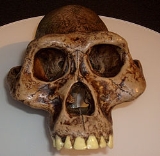
Australopithecus


   Email Print
   Bookmark   Link


Australopithecus


The genusGenus

In the binomial nomenclature used worldwide, the name of an organism is composed of two parts: its genus name and a species...
 Australopithecus is a group of extinctExtinction

In biology and ecology, extinction is the cessation of existence of a species or group of taxa, reducing biodiversity....
 hominidHominid

A hominid is any member of the biological family Hominidae, including the extinct and extant humans, chimpanzees, gori...
s, the gracile australopithecines, closely related to humansHomo (genus)

Homo is the genus that includes modern humans and their close relatives....
.
EvolutionGracile australopithecines shared several traits with modern apes and humans, and were widespread throughout Eastern and Northern Africa by a time between 3.0 and 3.9 million years ago. The earliest evidence of fundamentally bipedal hominids can be observed at the site of LaetoliLaetoli

The Plio-Pleistocene site of Laetoli in Tanzania is famous for its hominid footprints, preserved in volcanic ash....
 in TanzaniaTanzania

Tanzania , officially the United Republic of Tanzania , is a country on the east coast of Africa....
. These hominid footprints are remarkably similar to modern humans and have been dated as 3.7 million years old. Until recently, the footprints have generally been classified as australopithecine because that had been the only form of pre-human known to have existed in that region at that time; however, some scholars have considered reassigning them to a yet unidentified very early speciesSpecies

In biology, a species is one of the basic units of biodiversity....
 of the genus HomoHomo (genus)

Homo is the genus that includes modern humans and their close relatives....
.

Australopithecus anamensisAustralopithecus anamensis

Australopithecus anamensis is a fossil species of Australopithecus....
, Australopithecus afarensisAustralopithecus afarensis

Australopithecus afarensis is a hominid which lived between 3.9 to 3 million years ago....
and Australopithecus africanusAustralopithecus africanus

Australopithecus africanus was an early hominid, an australopithecine, who lived between 3.3 and 2.4 million years ago i...
are among the most famous of the extinct hominids.


Discussion
Ask a question about 'Australopithecus'
Start a new discussion about 'Australopithecus'
Answer questions from other users
Full Discussion Forum


Recent Posts


Timeline

1959   The first skull of Australopithecus is discovered by Louis Leakey and his wife Mary Leakey in the Olduvai Gorge, Tanzania.


Encyclopedia


The genusGenus

In the binomial nomenclature used worldwide, the name of an organism is composed of two parts: its genus name and a species...
 Australopithecus is a group of extinctExtinction

In biology and ecology, extinction is the cessation of existence of a species or group of taxa, reducing biodiversity....
 hominidHominid

A hominid is any member of the biological family Hominidae, including the extinct and extant humans, chimpanzees, gori...
s, the gracile australopithecines, closely related to humansHomo (genus)

Homo is the genus that includes modern humans and their close relatives....
.

Evolution

Gracile australopithecines shared several traits with modern apes and humans, and were widespread throughout Eastern and Northern Africa by a time between 3.0 and 3.9 million years ago. The earliest evidence of fundamentally bipedal hominids can be observed at the site of LaetoliLaetoli

The Plio-Pleistocene site of Laetoli in Tanzania is famous for its hominid footprints, preserved in volcanic ash....
 in TanzaniaTanzania

Tanzania , officially the United Republic of Tanzania , is a country on the east coast of Africa....
. These hominid footprints are remarkably similar to modern humans and have been dated as 3.7 million years old. Until recently, the footprints have generally been classified as australopithecine because that had been the only form of pre-human known to have existed in that region at that time; however, some scholars have considered reassigning them to a yet unidentified very early speciesSpecies

In biology, a species is one of the basic units of biodiversity....
 of the genus HomoHomo (genus)

Homo is the genus that includes modern humans and their close relatives....
.

Australopithecus anamensisAustralopithecus anamensis

Australopithecus anamensis is a fossil species of Australopithecus....
, Australopithecus afarensisAustralopithecus afarensis

Australopithecus afarensis is a hominid which lived between 3.9 to 3 million years ago....
and Australopithecus africanusAustralopithecus africanus

Australopithecus africanus was an early hominid, an australopithecine, who lived between 3.3 and 2.4 million years ago i...
are among the most famous of the extinct hominids. A. africanus used to be regarded as ancestral to the genus HomoHomo (genus)

Homo is the genus that includes modern humans and their close relatives....
(in particular Homo erectusHomo erectus

Homo erectus is an extinct species of genus Homo....
). However, fossilFossil

Fossils are the mineralized or otherwise preserved remains or traces of animals, plants, and other organisms....
s assigned to the genus Homo have been found that are older than A. africanus. Thus, the genus Homo either split off from the genus Australopithecus at an earlier date (the latest common ancestor being A. afarensis or an even earlier form, possibly Kenyanthropus platyopsKenyanthropus platyops

Kenyanthropus platyops is a 3.5 to 3.2 million year old extinct hominin species that was discovered in Lake Turkana, Ke...
), or both developed from a yet possibly unknown common ancestor independently.

According to the Chimpanzee Genome ProjectChimpanzee Genome Project

The Chimpanzee Genome Project is an effort to determine the DNA sequence of the genome of the closest living human relatives...
, both human (ArdipithecusArdipithecus Overview

Ardipithecus is a very early hominin genus ....
, Australopithecus and Homo) and chimpanzeeChimpanzee Summary

Chimpanzee, often shortened to chimp, is the common name for the two extant species in the genus Pan....
 (Pan troglodytes and Pan paniscus) lineages diverged from a common ancestor about 5 to 6 million years ago, if we assume a constant rate of evolution. It is theoretically more likely for evolution to happen slower, as opposed to quicker, from the date suggested by a gene clock (the result of which is given as an "youngest common ancestor", i.e., the latest possible date of diversion.) However, hominids discovered more recently are somewhat older than the molecular clockMolecular clock

The molecular clock is a technique in genetics, which researchers use to date when two species diverged....
 would theorize. Sahelanthropus tchadensisSahelanthropus tchadensis

Sahelanthropus tchadensis is a fossil ape originally classified as the oldest possible member of the human family tree, ...
, commonly called "Toumai" is about 7 million years old and Orrorin tugenensisOrrorin tugenensis

Orrorin tugenensis is considered as the second oldest possible hominin ancestor related to modern humans and is the onl...
lived at least 6 million years ago. Since little is known of them, they remain controversial among scientists since the molecular clockMolecular clock

The molecular clock is a technique in genetics, which researchers use to date when two species diverged....
 in humans has determined that humans and chimpanzees had an evolutionary split at least a million years later. One theory suggests that humans and chimpanzees diverged once, then interbred around one million years after diverging.

Morphology

The brainBrain

In animals, the brain, or encephalon , is the control center of the central nervous system....
s of most species of Australopithecus were roughly 35% of the size of that of a modern humanHuman

Humans, or human beings, are bipedal primates belonging to the mammalian species Homo sapiens under the fami...
 brain. Most species of Australopithecus were diminutive and gracile, usually standing no more than 1.2 and 1.4 m (approx. 4 to 4.5 feet) tall. In several variations of australopithecine there is a considerable degree of sexual dimorphismSexual dimorphism

Sexual dimorphism is the systematic difference in form between individuals of different sex in the same species....
, meaning that males are larger than females. Modern hominids do not appear to display sexual dimorphism to the same degree — particularly, modern humans display a low degree of sexual dimorphism, with males being only 15% larger than females, on average. In australopithecines, however, males can be up to 50% larger than females. New research suggests that sexual dimorphism may be far less pronounced than this, but there is still much debate on the subject.

Species variations

Although opinions differ as to whether the species aethiopicus, boisei and robustus should be included within the genus Australopithecus, the current consensus in the scientific community is that they should be placed in a distinct genus, ParanthropusParanthropus

The robust australopithecines, members of the extinct hominin genus Paranthropus, were bipedal hominins that proba...
, which is believed to have developed from the ancestral Australopithecus line. Up until the last half-decade, the majority of the scientific community included all the species shown in the box at the top of this article in a single genus. However, Paranthropus was morphologicallyMorphology (biology) Overview

The term morphology in biology refers to the outward appearance of an organism or taxon and its component parts....
 distinct from Australopithecus, and its specialized morphology also implies that its behavior was quite different from that of its ancestor.

Evolutionary role

The fossil record seems to indicate that Australopithecus is the common ancestor of the distinct group of hominids, now called ParanthropusParanthropus

The robust australopithecines, members of the extinct hominin genus Paranthropus, were bipedal hominins that proba...
(the "robust australopithecines"), and most likely the genus Homo which includes modern humans. Although the intelligence of these early hominids was likely no more sophisticated than modern apes, the bipedal stature is the key evidence which distinguishes the group from previous primates who are quadrupeds. The morphology of Australopithecus upsets what scientists previously believed, namely, that large brains preceded bipedalism. If A. afarensis was the definite hominid which left the footprints at LaetoliLaetoli

The Plio-Pleistocene site of Laetoli in Tanzania is famous for its hominid footprints, preserved in volcanic ash....
, it strengthens the notion that A. afarensis had a small brain but was a biped. Fossil evidence such as this has made it clear that bipedalism far predated large brains. However, it remains a matter of controversy how bipedalism first evolved millions of years ago (several concepts are still being studied). The advantages of bipedalism allowed hands to be free for grasping objects (e.g. carrying food and young), and allowed the eyes to look over tall grasses for possible food sources or predators. However, many anthropologists argue that these advantages were not large enough to cause bipedalism.

A recent study of primate evolution and morphology noted that all apes, both modern and fossil, show skeletal adaptations to upright posture of the trunk, and that fossils such as Orrorin tugenensisOrrorin tugenensis

Orrorin tugenensis is considered as the second oldest possible hominin ancestor related to modern humans and is the onl...
 indicate bipedalism around 6 million years ago, around the time of the split between humans and chimpanzees indicated by genetic studies. This suggested that upright, straight-legged walking originally evolved as an adaptation to tree-dwelling. Studies of modern orangutanOrangutan

The orangutans are two species of great apes with long arms and reddish, sometimes brown, hair native to Indonesia and Malay...
s in SumatraSumatra

Sumatra is the sixth largest island of the world and is the largest island entirely in Indonesia ....
 showed that these apes use four legs when walking on large stable branches, swing underneath slightly smaller branches, but are bipedal and keep their legs very straight when walking on multiple small flexible branches under 4 cm. diameter, while also using their arms for balance and additional support. This enables them to get nearer to the edge of the tree canopy to get fruit or cross to another tree. Climate changes around 11 to 12 million years ago affected forests in East and Central Africa so that there were periods when openings prevented travel through the tree canopy, and at these times ancestral hominids could have adapted the upright walking behaviour for ground travel. It is suggested that the ancestors of gorillaGorilla

The gorilla, the largest of the living primates, is a ground-dwelling herbivore that inhabits the forests of Africa....
s and chimpanzeeChimpanzee

Chimpanzee, often shortened to chimp, is the common name for the two extant species in the genus Pan....
s became more specialised in climbing vertical tree trunks or lianas, using a bent hip and bent knee posture which matches the knuckle-walking posture they use for ground travel. Humans are closely related to these apes, and share features including wrist bones apparently strengthened for knuckle walking.

Radical changes in morphology took place before gracile australopithecines evolved; the pelvis structure and feet are very similar to modern humans. The teeth have small canines, but australopithecines generally evolved a larger post-canine dentition with thicker enamel. Australopithecines faced one particular challenge while living on the savannaSavanna

A savanna or savannah is a grassland with widely spaced trees, and occurs in several types of biomes....
.

Most species of Australopithecus were not any more adept at tool use than modern non-human primates, yet modern African apes, chimpanzees, and most recently gorillaGorilla Summary

The gorilla, the largest of the living primates, is a ground-dwelling herbivore that inhabits the forests of Africa....
s, have been known to use simple tools (i.e. cracking open nuts with stones and using long sticks to dig for termiteTermite

Termites, sometimes known as white ants, are a group of eusocial insects usually classified at the taxonomic rank of o...
s in mounds), and chimpanzees have been observed using spears (not thrown) for hunting.
However, some have argued that A. garhiAustralopithecus garhi

Australopithecus garhi is a gracile australopithecine species whose fossils were discovered in 1996 by a research team l...
used stone tools due to a loose association of this species and butchered animal remains.

Diet

In a 1979 preliminary microwear study of Australopithecus fossil teeth, anthropologist Alan Walker theorized that robust australopithecines were largely frugivorous. However, newer methods of studying fossils have suggested the possibility that Australopithecus was omnivorousOmnivore

An omnivore is a species of animal who are "......
. In 1992, trace element studies of the strontium/calcium ratios in robust australopithecine fossils suggested the possibility of animal consumption, as did a 1994 using stable carbon isotopic analysis.

Notable Specimens

  • Laetoli footprintsLaetoli

    The Plio-Pleistocene site of Laetoli in Tanzania is famous for its hominid footprints, preserved in volcanic ash....
  • AL 129-1AL 129-1

    AL 129-1 is the fossilized knee joint of the species Australopithecus afarensis....
  • LucyLucy (Australopithecus)

    Lucy is the common name of AL 288-1, the first Australopithecus afarensis skeleton ever discovered....
  • STS 5 (Mrs. Ples)Mrs. Ples

    Mrs. Ples is the popular nickname for the most complete skull of an Australopithecus africanus ever found in the world....
  • STS 14STS 14

    STS 14 is a fossilized pelvis, vertebral column and fragmentary rib and femur of the species Australopithecus africanus....
  • STS 71STS 71

    STS 71 is a fossilized skull of the species Australopithecus africanus....
  • Taung ChildTaung Child Summary

    Taung Child refers to the fossil of a skull specimen of Australopithecus africanus....
  • SelamSelam (Australopithecus) Overview

    is the fossilized skull and other skeletal remains of a 3-year-old Australopithecus afarensis female whose bones were first f...


See also

  • Aramis, EthiopiaAramis, Ethiopia

    Aramis is a village and archaeological site in northeastern Ethiopia, where remains of Australopithecus have been found....
  • List of fossil sitesList of fossil sites

    List of fossil sites:...
     (with link directory)
  • List of hominina (hominid) fossils (with images)

External links


>