
All Topics  
Old Kingdom


   Email Print
   Bookmark   Link


Old Kingdom


The Old Kingdom is the name commonly given to that period in the 3rd millennium BCE when Egypt
Ancient Egypt

Ancient Egypt was an Ancient history civilization in eastern North Africa, concentrated along the lower reaches of the Nile in what is now the modern nation of Egypt....
 attained its first continuous peak of civilization in complexity and achievement – this was the first of three so-called "Kingdom" periods, which mark the high points of civilization in the lower Nile Valley (the others being Middle Kingdom
Middle Kingdom of Egypt

The middle kingdom is the period in the history of ancient Egypt stretching from the establishment of the Eleventh dynasty of Egypt to the end of the Fourteenth dynasty of Egypt, roughly between 2040 BC and 1640 BC....
 and the New Kingdom
New Kingdom

The New Kingdom, sometimes referred to as the Egyptian Empire, is the period in ancient Egyptian History of Ancient Egypt between the 16th century BC and the 11th century BC, covering the Eighteenth dynasty of Egypt, Nineteenth dynasty of Egypt, and Twentieth dynasty of Egypt....
).

The term itself was coined by nineteenth century historians and the distinction between the Old Kingdom and the Early Dynastic Period
Early Dynastic Period of Egypt

The Archaic or Early Dynastic Period of Egypt immediately follows the unification of Lower and Upper Egypt c. 3150 BC. It is generally taken to include the First dynasty of Egypt and Second dynasty of Egypt Dynasties, lasting from the Protodynastic Period of Egypt until 2686 BC, or the beginning of the Old Kingdom....
 is not one which would have been recognized by Ancient Egyptians.


Discussion
Ask a question about 'Old Kingdom'
Start a new discussion about 'Old Kingdom'
Answer questions from other users
Full Discussion Forum


Encyclopedia


The Old Kingdom is the name commonly given to that period in the 3rd millennium BCE when Egypt
Ancient Egypt

Ancient Egypt was an Ancient history civilization in eastern North Africa, concentrated along the lower reaches of the Nile in what is now the modern nation of Egypt....
 attained its first continuous peak of civilization in complexity and achievement – this was the first of three so-called "Kingdom" periods, which mark the high points of civilization in the lower Nile Valley (the others being Middle Kingdom
Middle Kingdom of Egypt

The middle kingdom is the period in the history of ancient Egypt stretching from the establishment of the Eleventh dynasty of Egypt to the end of the Fourteenth dynasty of Egypt, roughly between 2040 BC and 1640 BC....
 and the New Kingdom
New Kingdom

The New Kingdom, sometimes referred to as the Egyptian Empire, is the period in ancient Egyptian History of Ancient Egypt between the 16th century BC and the 11th century BC, covering the Eighteenth dynasty of Egypt, Nineteenth dynasty of Egypt, and Twentieth dynasty of Egypt....
).

The term itself was coined by nineteenth century historians and the distinction between the Old Kingdom and the Early Dynastic Period
Early Dynastic Period of Egypt

The Archaic or Early Dynastic Period of Egypt immediately follows the unification of Lower and Upper Egypt c. 3150 BC. It is generally taken to include the First dynasty of Egypt and Second dynasty of Egypt Dynasties, lasting from the Protodynastic Period of Egypt until 2686 BC, or the beginning of the Old Kingdom....
 is not one which would have been recognized by Ancient Egyptians. Not only was the last king of the Early Dynastic Period related to the first two kings of the Old Kingdom, but the 'capital', the royal residence, remained at Ineb-Hedg, the Ancient Egyptian name for Memphis
Memphis, Egypt

Memphis was the ancient capital of the first Nome of Lower Egypt, and of the Old Kingdom of Egypt from its foundation until around 2200 BC and later for shorter periods during the New Kingdom, and an administrative centre throughout ancient history....
. The basic justification for a separation between the two periods is the revolutionary change in architecture accompanied by the effects on Egyptian society and economy of large-scale building projects.

The Old Kingdom is most commonly regarded as spanning the period of time when Egypt was ruled by the Third Dynasty
Third dynasty of Egypt

Third Dynasty The Third Dynasty of ancient Egypt is the first dynasty of the Old Kingdom. Other dynasties of the Old Kingdom include the Fourth dynasty of Egypt, Fifth dynasty of Egypt and Sixth dynasty of Egypt....
 through to the Sixth Dynasty
Sixth dynasty of Egypt

The Third, Fourth, Fifth and Sixth Dynasties of History of Egypt are often combined under the title "Old Kingdom"....
 (2686 BC – 2134 BC). Many Egyptologists also include the Memphite Seventh and Eighth Dynasties in the Old Kingdom as a continuation of the administration centralized at Memphis
Memphis, Egypt

Memphis was the ancient capital of the first Nome of Lower Egypt, and of the Old Kingdom of Egypt from its foundation until around 2200 BC and later for shorter periods during the New Kingdom, and an administrative centre throughout ancient history....
. The Old Kingdom was followed by a period of disunity and relative cultural decline referred to by Egyptologists as the First Intermediate Period.

The royal capital of Egypt during the Old Kingdom was located at Memphis
Memphis, Egypt

Memphis was the ancient capital of the first Nome of Lower Egypt, and of the Old Kingdom of Egypt from its foundation until around 2200 BC and later for shorter periods during the New Kingdom, and an administrative centre throughout ancient history....
, where Djoser
Djoser

Netjerikhet or Djoser is the best-known pharaoh of the Third dynasty of Egypt. He commissioned his official, Imhotep , to build the first of the pyramids, a step pyramid for him at Saqqara....
 established his court. The Old Kingdom is perhaps best known, however, for the large number of pyramid
Egyptian pyramids

File:All Gizah Pyramids.jpgFile:EgyptianPyramidsandSphinx2006.jpgThe Egyptian pyramids are ancient pyramid shaped masonry structures located in Egypt....
s, which were constructed at this time as pharaonic burial places. For this reason, the Old Kingdom is frequently referred to as "the Age of the Pyramids."

The Beginning: Third Dynasty

Egypt
The first notable pharaoh of the Old Kingdom was Djoser
Djoser

Netjerikhet or Djoser is the best-known pharaoh of the Third dynasty of Egypt. He commissioned his official, Imhotep , to build the first of the pyramids, a step pyramid for him at Saqqara....
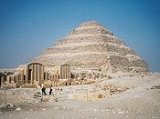
 (2630–2611 BC) of the Third Dynasty, who ordered the construction of a pyramid (the Step Pyramid
Pyramid of Djoser

The Pyramid of Djoser , or step pyramid is an archeological remain in the Saqqara necropolis, Egypt, northwest of the city of Memphis, Egypt....
) in Memphis' necropolis, Saqqara
Saqqara

Saqqara or Sakkara, Saqqarah is a vast, ancient burial ground in Egypt, serving as the necropolis for the Ancient Egyptian capital, Memphis, Egypt....
. An important person during the reign of Djoser was his vizier
Vizier (Ancient Egypt)

The vizier was the highest official in Ancient Egypt to serve the king, or pharaoh during the Old, Middle, and New Kingdoms. Vizier is the generally accepted rendering of ancient Egyptian tjati, tjaty etc, among Egyptologists....
, Imhotep
Imhotep

Imhotep , 27th century BC was an Egyptians polymath, who served under the third dynasty of Egypt king, Djoser, as chancellor to the pharaoh and high priest of the sun god Ra at Heliopolis ....
.

It was in this era that formerly independent ancient Egyptian states became known as nomes
Nome (Egypt)

A nome was a subnational administrative division of ancient Egypt. Today's use of the Greek nome rather than the Egyptian language term sepat came about during the Ptolemaic Egypt period....
, ruled solely by the pharaoh. Subsequently the former rulers were forced to assume the role of governors or otherwise work in tax collection. Egyptians
Egyptians

Egyptians is the name of the nationality and Mediterranean North African ethnic group native to Egypt.Egyptian identity is closely tied to the Geography of Egypt, dominated by the lower Nile Valley, the small strip of cultivable land stretching from the Cataracts of the Nile to the Mediterranean Sea and enclosed by desert both to the Easte...
 in this era worshiped their pharaoh as a god, believing that he ensured the annual flooding of the Nile that was necessary for their crops. Egyptian views on the nature of time during this period held that the universe worked in cycles, and the Pharaoh on earth worked to ensure the stability of those cycles. They also perceived themselves as a specially selected people, "as the only true human beings on earth".

Golden Age: Fourth Dynasty

The Old Kingdom and its royal power reached their zenith under the Fourth Dynasty
Fourth dynasty of Egypt

The Fourth Dynasty of Ancient Egypt, also written Dynasty 4 and Dynasty IV, is characterized as a golden age of the Old Kingdom....
, which began with Snofru (2613–2589 BC). Using a greater mass of stones than any other pharaoh, he built three pyramids: a now collapsed pyramid in Meidum
Meidum

Located about 100km south of modern Cairo, Meidum or Maidum is the location of a large pyramid, and several large mud-brick mastabas....
, the Bent Pyramid
Bent Pyramid

The Bent Pyramid, located at the royal necropolis of Dahshur, approximately 40 kilometres south of Cairo, of Old Kingdom Pharaoh Sneferu, is a unique example of early pyramid development in Ancient Egypt, about 2596 BCE....
 at Dahshur
Dahshur

Dahshur , is a royal necropolis located in the desert on the west bank of the Nile approximately 40 kilometres south of Cairo. It is known chiefly for several pyramids, two of which are among the oldest, largest and best preserved in Egypt....
, and the Red Pyramid
Red Pyramid

The Red Pyramid, also called the North Pyramid is the largest of the three major pyramids located at the Dahshur necropolis. Named for the light crimson hue of its exposed granite surface, it is also the third largest Egyptian pyramid, after those of Khufu and Khafra at Giza....
, at North Dahshur.

Snofru was succeeded by his son, Khufu (2589 - 2566 BC) who built the Great Pyramid of Giza
Great Pyramid of Giza

The Great Pyramid of Giza, also called Khufu's Pyramid or the Pyramid of Khufu, and Pyramid of Cheops, is the oldest and largest of the three Egyptian pyramidss in the Giza Necropolis bordering what is now Cairo , Egypt, and is the only remaining member of the Seven Wonders of the Ancient World....
. Later Egyptian literature describes him as a cruel tyrant, who imposed forced labor on his subjects to complete his pyramid. After Khufu's death his sons Djedefra
Djedefra

The Ancient Egypt pharaoh Djedefre was the successor and son of Khufu . The mother of Djedefre is unknown. His name means "Enduring like Ra." Djedefre was the first king to use the title Fivefold Titulary#Son of Ra as part of his Fivefold Titulary, which is seen as an indication of the growing popularity of the cult of the solar god Ra....
 (2528–2520 BC) and Khafra
Khafra

Khafra or Khafre *?a?af-ri?u) was an Egyptian pharaoh of the Fourth dynasty of Egypt, who had his capital at Memphis, Egypt. According to some authors he was the son and successor of Khufu, but it is more commonly accepted that Djedefra was Khufu's successor and Khafra was Djedefra's....
 (2520–2494 BC) may have quarreled. The latter built the second pyramid and (in traditional thinking) the Sphinx
Great Sphinx of Giza

The Great Sphinx of Giza is a statue of a reclining lion with a human head that stands on the Giza Plateau on the west bank of the Nile, near modern-day Cairo, in Egypt....
 in Giza
Giza

in the 2006 national census, while the governate had 6,272,571 at the same census. Its large population makes it the 2nd largest suburb in the world, tied with Incheon, Korea and Quezon City, Philippines, second only to Yokohama, Japan....
. Recent reexamination of evidence has suggested that the Sphinx may have been built by Djedefra
Djedefra

The Ancient Egypt pharaoh Djedefre was the successor and son of Khufu . The mother of Djedefre is unknown. His name means "Enduring like Ra." Djedefre was the first king to use the title Fivefold Titulary#Son of Ra as part of his Fivefold Titulary, which is seen as an indication of the growing popularity of the cult of the solar god Ra....
 as a monument to Khufu.

The later kings of the Fourth Dynaty were king Menkaura
Menkaura

Menkaura was a pharaoh of the Fourth dynasty of Egypt who ordered the construction of Menkaure's Pyramid. His main queen was Khamerernebty II....
 (2494–2472 BC), who built the smallest pyramid in Giza, Shepseskaf
Shepseskaf

Shepseskaf was a son of Menkaure who succeeded his father on the throne. Shepseskaf's name means "His Soul is Noble." He was likely the last Egyptian Pharaoh of the Fourth dynasty of Egypt if he was not succeeded by a certain unknown ruler named Djedefptah as recorded in some Egyptian literature and, indirectly, by the Turin Canon....
 (2472–2467 BC) and Djedefptah
Djedefptah

Djedefptah is a shadowy figure, whose existence is questionable. Shepseskaf is usually considered to be the last pharaoh of the Fourth dynasty of Egypt....
 (2486–2484 BC) .

Decline and collapse: Fifth Eighth Dynasties

The Fifth Dynasty began with Userkaf
Userkaf

Userkaf was the founder of the Fifth dynasty of Egypt and the first pharaoh to start the tradition of building sun temples at Abusir.. Userkaf's name means "his Egyptian soul is powerful." He ruled from 2465-2458 BC and constructed the Pyramid of Userkaf complex at Saqqara....
 (2465–2458 BC), who initiated reforms that weakened the Pharaoh and central government. After his reign civil war
Civil war

A civil war is a war between organized groups to take control of a nation or region, or to change government policies. It is high-intensity conflict, often involving Regular Army, that is sustained, organized and large-scale....
s arose as the powerful nomarchs (regional governors) no longer belonged to the royal family. The worsening civil conflict undermined unity and energetic government and also caused famines. But regional autonomy and civil wars were not the only causes of this decline. The massive building projects of the Fourth Dynasty had exceeded the capacity of the treasury and populace and, therefore, weakened the Kingdom at its roots.

The final blow was a severe drought in the region that resulted in a drastic drop in precipitation between 2200 and 2150 BC, which in turn prevented the normal flooding of the Nile
Nile

The Nile is a major north-flowing river in Africa, generally regarded as the List of rivers by length in the world.The Nile has two major tributary, the White Nile and Blue Nile, the latter being the source of most of the Nile's water and silt, but the former being the longer of the two....
. The result was the collapse of the Old Kingdom followed by decades of famine and strife. An important inscription on the tomb of Ankhtifi
Ankhtifi

Ankhtifi was the nomarch of Hierakonpolis and a supporter of the Herakleopolitan based Tenth dynasty of Egypt which was locked in conflict with the Luxor, Egypt based Eleventh dynasty of Egypt kingdom for control of Egypt....
, a monarch during the early First Intermediate Period, describes the pitiful state of the country when famine stalked the land.

Further reading

  • Jaromir Malek, In the Shadow of the Pyramids: Egypt During the Old Kingdom, University of Oklahoma Press, 1986. ISBN 0-8061-2027-4


  • Egyptian Art in the Age of the Pyramids, New York, Metropolitan Museum of Art, 1999. ISBN 0-87099-906-0 (catalogue for travelling exhibition of the same name)


External links

  • — Photographs of many of the historic sites dating from the Old Kingdom