
All Topics  
Great Zimbabwe

 
Great Zimbabwe

   Email Print
   Bookmark   Link


Great Zimbabwe


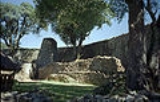
The Great Zimbabwe, or "stone buildings", is the name given to stone ruins spread out over a 722 ha area within the modern-day country of Zimbabwe
Zimbabwe

Zimbabwe , is a landlocked country located in the southern part of the continent of Africa, between the Zambezi and Limpopo River rivers. It is bordered by South Africa to the south, Botswana to the southwest, Zambia to the northwest and Mozambique to the east....
, which itself is named after the ruins. It is near the modern town of Masvingo
Masvingo

Masvingo is a town in south-eastern Zimbabwe and the capital of Masvingo Province. It the town close to Great Zimbabwe the national monument from which the country takes its name....
, which before majority rule was called Fort Victoria. The word "Great" distinguishes the site from the many hundred small ruins, known as Zimbabwes, spread across the Zimbabwe highveld.

word "Zimbabwe" is probably a short form for "ziimba remabwe" or "ziimba rebwe", a Shona
Shona language

Shona is a Bantu languages, native to the Shona people of Zimbabwe and southern Zambia; the term is also used to identify peoples who speak one of the Shona language dialects, namely Zezuru, Karanga, Manyika, Ndau and Korekore....
 (dialect: ChiKaranga) term, which means "the great or big house built of stone boulders".


Discussion
Ask a question about 'Great Zimbabwe'
Start a new discussion about 'Great Zimbabwe'
Answer questions from other users
Full Discussion Forum


Recent Posts


Encyclopedia


The Great Zimbabwe, or "stone buildings", is the name given to stone ruins spread out over a 722 ha area within the modern-day country of Zimbabwe
Zimbabwe

Zimbabwe , is a landlocked country located in the southern part of the continent of Africa, between the Zambezi and Limpopo River rivers. It is bordered by South Africa to the south, Botswana to the southwest, Zambia to the northwest and Mozambique to the east....
, which itself is named after the ruins. It is near the modern town of Masvingo
Masvingo

Masvingo is a town in south-eastern Zimbabwe and the capital of Masvingo Province. It the town close to Great Zimbabwe the national monument from which the country takes its name....
, which before majority rule was called Fort Victoria. The word "Great" distinguishes the site from the many hundred small ruins, known as Zimbabwes, spread across the Zimbabwe highveld.

Name

Great Zimbabwe
The word "Zimbabwe" is probably a short form for "ziimba remabwe" or "ziimba rebwe", a Shona
Shona language

Shona is a Bantu languages, native to the Shona people of Zimbabwe and southern Zambia; the term is also used to identify peoples who speak one of the Shona language dialects, namely Zezuru, Karanga, Manyika, Ndau and Korekore....
 (dialect: ChiKaranga) term, which means "the great or big house built of stone boulders". In the ChiKaranga dialect of the Shona language, "imba" means "a house" or "a building" and "ziimba", or "zimba", mean "a huge/big building or house". The word "bwe" or "ibwe" (singular, plural being "mabwe") in the ChiKaranga dialect means "a stone boulder". The ChiKaranga-speaking Shona people are found around Great Zimbabwe in the modern–day province of Masvingo and have been known to have inhabited the region since the building of this ancient city

A second theory is that Zimbabwe is a contracted form of "dzimba woye" which means "venerated houses" in the Zezuru dialect of the Shona language. This term is usually reserved for chiefs' houses or graves. It should also be noted that the ChiZezuru-speaking Shona people are found to the northeast of Great Zimbabwe, some 500 km away.

Description


Built consistently throughout the period from the 11th century to the 15th century, the ruins at Great Zimbabwe are some of the oldest and largest structures located in Southern Africa
Southern Africa

Southern Africa is the southernmost region of the African continent, variably defined by geography or geopolitics, consisting of numerous territories....
. At its peak, estimates are that the ruins of Great Zimbabwe had as many as 18,000 inhabitants. The ruins that survive are built entirely of stone. The ruins
Ruins

Ruins is a term used to describe the remains of man-made architecture: structures that were once complete but which have fallen into a state of partial or complete disrepair, due to lack of Maintenance, repair and operations or deliberate acts of destruction....
 span 1,800 acres (7 km˛) and cover a radius of 100 to 200 miles (160 to 320 km).

In 1531, Vicente Pegado, Captain of the Portuguese Garrison of Sofala
Sofala

Sofala, at present known as Nova Sofala, used to be the chief seaport of the Monomotapa Kingdom, whose capital was at Mount Fura. It is located on the Sofala Bank in Sofala Province of Mozambique....
, described Zimbabwe thus:

The ruins can be broken down into three distinct architectural groups. They are known as the Hill Complex, the Valley Complex and the famous Great Enclosure. The Hill Complex was used for as a temple, the Valley complex was for the citizens, and the Great Enclosure was used by the king. Over 300 structures have been found so far in the Great Enclosure. The type of stone structures found on the site give an indication of the status of the citizenry. Structures that were more elaborate were probably built for the kings and situated further away from the center of the city. It is thought that this was done in order to escape sleeping sickness
Sleeping sickness

Sleeping sickness or human African trypanosomiasis is a parasitic disease of people and animals, caused by protozoa of species Trypanosoma brucei and transmitted by the tsetse fly....
.

What little evidence exists suggests that Great Zimbabwe also became a center for trading, with artifacts suggesting that the city formed part of a trade network extending as far as China
China

China is a Culture of China, an ancient civilization, and, depending on perspective, a national or multinational entity extending over a large area in East Asia....
. Chinese pottery shards, coins from Arabia, glass beads and other non-local items have been excavated at Zimbabwe.

Nobody knows for sure why the site was eventually abandoned. Perhaps it was due to drought, perhaps due to disease or it simply could be that the decline in the gold
Gold

Gold is a chemical element with the symbol Au and atomic number 79. It is a highly sought-after precious metal, having been used as money, as a store of value, in jewelry, in sculpture, and for ornamentation since the beginning of recorded history....
 trade forced the people who inhabited Great Zimbabwe to look for greener pastures.

History of research

Exterior of Great Enclosure,g
Portuguese
Portugal

Portugal , officially the Portuguese Republic , is a country on the Iberian Peninsula. Located in southwestern Europe, Portugal is the westernmost country of mainland Europe and is bordered by the Atlantic Ocean to the west and south and by Spain to the north and east....
 traders were the first Europeans to visit the remains of the ancient city in the early 16th century. The ruins were rediscovered during a hunting trip by Adam Renders in 1867, who then showed the ruins to Karl Mauch
Karl Mauch

Karl Gottlieb Mauch Stuttgart was a Germany explorer and geographer of Africa. He reported on the archaeological ruins of Great Zimbabwe in 1871....
 in 1871. They became well known to English readers from J. Theodore Bent
James Theodore Bent

James Theodore Bent was an England explorer, archaeologist and author....
's season at Zimbabwe, under Cecil Rhodes's patronage.

Bent, whose archaeological experience had all been in Greece
Greece

Greece , officially the Hellenic Republic , is a country in southeastern Europe, situated on the southern end of the Balkans. It has borders with Albania, Bulgaria and the former Yugoslav Republic of Macedonia to the north, and Turkey to the east....
 and Asia Minor, stated in The Ruined Cities of Mashonaland (1891) that the ruins revealed either the Phoenicians or the Arabs as builders. Mauch favored a legend that the structures were built to replicate the palace of the Queen of Sheba
Queen of Sheba

The Queen of Sheba , was the woman who ruled the ancient kingdom of Sheba and is referred to in Habeshan history, the Hebrew Bible, the New Testament, and the Qur'an....
 in Jerusalem. Other theories as to their origin abounded among white settlers and academics, with one element in common: they were probably not made by sub-Saharan Africans.

The first scientific archaeological excavations at the site were undertaken in by David Randall-MacIver
David Randall-MacIver

David Randall-MacIver was a United Kingdom-born archaeologist, who later became an United States citizen. He is most famous for his excavations at Great Zimbabwe which provided the first solid evidence that the site was built by Shona peoples....
 in 1905–1906. He wrote in Medieval Rhodesia of the existence in the site of objects that were of African origin. In 1929, Gertrude Caton-Thompson was the first to conclusively state that the site was indeed created by Africans. Since then artifacts and radiocarbon dating
Radiocarbon dating

Radiocarbon dating, or carbon dating, is a radiometric dating method that uses the naturally occurring radioisotope carbon-14 to determine the age of carbonaceous materials up to about 60,000 years....
 have proved that the oldest remains date back to the 1200s.

Martin Hall writes that the history of Iron Age
Iron Age

In archaeology, the Iron Age was the stage in the development of any people in which tools and weapons whose main ingredient was iron were prominent....
 research south of the Zambezi
Zambezi

The Zambezi is the List of rivers by length river in Africa, and the largest flowing into the Indian Ocean from Africa. The area of its drainage basin is 1,390,000 km? , slightly less than half that of the Nile....
 shows the prevalent influence of colonial
Colonialism

Colonialism is the extension of a nation's sovereignty over Territory beyond its borders by the establishment of either settler or exploitation colony in which Indigenous people populations are direct rule, Population transfers, or Genocide....
 ideologies, both in the earliest speculations about the nature of the African past and in the adaptations that have been made to contemporary archeological methodologies. When European colonialists like Cecil Rhodes first saw the ruins, it was seen as a sign of the great riches that the surroundings would yield to its new masters. When it was finally proved that the builders were in fact Africans, it was also characterized as "product of an infantile mind" built by a subjugated society. Later researchers confirmed this condescending view and refused to accept that Great Zimbabwe could have been a product of internal processes, but rather had to be the result of outside stimulus. After the white minority attempt at gaining independence from colonial rule
Unilateral Declaration of Independence (Rhodesia)

The Unilateral Declaration of Independence of Rhodesia from the United Kingdom was signed on November 11, 1965 by the administration of Ian Smith, whose Rhodesian Front party opposed black majority rule in the then Crown colony....
 in 1965 the theories about the black population having been subjugated by outside overlords was reconfirmed. Later on, after the independence of the modern state of Zimbabwe
Zimbabwe

Zimbabwe , is a landlocked country located in the southern part of the continent of Africa, between the Zambezi and Limpopo River rivers. It is bordered by South Africa to the south, Botswana to the southwest, Zambia to the northwest and Mozambique to the east....
 in 1980, Great Zimbabwe has been employed to mirror and legimitize shifting policies of the ruling regime. At first it was argued that it represented a form of pre-colonial "African socialism" and later the focus shifted to stressing the natural evolution of an accumulation of wealth and power within a ruling elite.

Archaeologists generally agree that the builders probably spoke one of the Shona language
Shona language

Shona is a Bantu languages, native to the Shona people of Zimbabwe and southern Zambia; the term is also used to identify peoples who speak one of the Shona language dialects, namely Zezuru, Karanga, Manyika, Ndau and Korekore....
s, and so were members of the Bantu family. Some have postulated that Zimbabwe was the work of the Gokomere
Gokomere

The ancient people who inhabited the area of Great Zimbabwe in about 500AD and probably built the complex between 1000 and 1200 AD, the Gokomere traded via ancient trading routes over the Chimanimani mountains on the current Zimbabwe / Mozambique border with the Swahili civilization on the Kenyan and Tanzanian coast....
 people, who gave rise to both the Warozwi people, and the Mashona
Shona people

Shona is the name collectively given to several groups of people in Zimbabwe and southern Mozambique. Numbering about nine million people, who speak a range of related dialects whose standardized form is also known as Shona language ....
 people. Great Zimbabwe and various stone cities in east Africa are also claimed by the Lemba
Lemba

The Lemba or Lembaa are an ethnic group numbering 70,000 in southern Africa who claim a common descent and belonging to the Jew.Although they are speakers of Bantu languages related to those spoken by their geographic neighbours - in itself the practice of most Jews in the diaspora - they have specific religious practices and beliefs...
, an ethnic group who claim ancient Jewish descent. Certain features of Swahili architecture on the East Coast resemble those at Zimbabwe, in particular the great tower.

The ruins of this complex of massive stone walls undulate across almost of present-day southeastern Zimbabwe. Begun during the eleventh century A.D. by Bantu-speaking ancestors of the Shona, Great Zimbabwe was constructed and expanded for more than 300 years in a local style that eschewed rectilinearity for flowing curves. Neither the first nor the last of some 300 similar complexes located on the Zimbabwean plateau, Great Zimbabwe is set apart by the terrific scale of its structure. Its most formidable edifice, commonly referred to as the Great Enclosure, has walls as high as extending approximately , making it the largest ancient structure south of the Sahara Desert. Investigations were conducted during the first few decades of the twentieth century which confirmed both the antiquity of the Great Zimbabwe and its African origins.

Some researchers claim that the ruins may have housed an astronomy observatory.

Political implications

Despite this evidence, the official line in colonial Rhodesia
Southern Rhodesia

Southern Rhodesia was the name of the British colony situated north of the Limpopo River and the Union of South Africa, and known today as Zimbabwe....
 was that the structures were built by non-blacks. According to Paul Sinclair, interviewed for None But Ourselves:

Flag of Zimbabwe
To black anti-colonialist groups, Great Zimbabwe became an important symbol of achievement by black Africans. Reclaiming its history was a major aim for those wanting independence. In 1980 the newly independent
History of Zimbabwe

The history of Zimbabwe began with the end of the Rhodesian Bush War and the transition to majority rule in 1980. The United Kingdom ceremonially granted Zimbabwe independence on April 18, 1980 in accordance with the Lancaster House Agreement....
 country was renamed for the site, and its famous soapstone
Soapstone

Soapstone is a metamorphic rock, a talc-schist. It is largely composed of the mineral talc and is rich in magnesium. It is produced by dynamothermal metamorphism and metasomatism, which occurs at the areas where tectonic plates are subduction, changing rocks by heat and pressure, with influx of fluids, but without melting....
 bird carvings
Zimbabwe Bird

The stone-carved Zimbabwe Bird is a national emblem of Zimbabwe, appearing on the national flags and coats of arms of both Zimbabwe and Rhodesia, as well as on Rhodesian dollar and coins ....
 became a national symbol, depicted in the country's flag.

Some of the carvings had been taken from Great Zimbabwe around 1890 and sold to Cecil Rhodes, who was intrigued and had copies made which he gave to friends. Most of the carvings have now been returned to Zimbabwe, but one remains at Rhodes' old home, Groote Schuur
Groote Schuur

Groote Schuur is an estate in Cape Town, South Africa.Cecil Rhodes took out a lease on the house in 1891. He later bought it in 1893, and had it converted and refurbished by the architect Herbert Baker....
, in Cape Town
Cape Town

Cape Town is the second most populous city in South Africa, forming part of the metropolitan municipality of the City of Cape Town. It is the provincial Capital of the Western Cape, as well as the legislature capital of South Africa, where the Parliament of South Africa and many government offices are located....
.

Great Zimbabwe has been a UNESCO
UNESCO

United Nations Educational, Scientific and Cultural Organization is a specialized agency of the United Nations established on 16 November 1945....
 World Heritage Site
World Heritage Site

A UNESCO World Heritage Site is a site that is on the list maintained by the international World Heritage Programme administered by the UNESCO World Heritage Committee, composed of 21 Sovereign state which are elected by their General Assembly for a four-year term....
 since 1986.

Image gallery


See also


  • History of Zimbabwe
    History of Zimbabwe

    The history of Zimbabwe began with the end of the Rhodesian Bush War and the transition to majority rule in 1980. The United Kingdom ceremonially granted Zimbabwe independence on April 18, 1980 in accordance with the Lancaster House Agreement....
  • Nyanga, Zimbabwe
    Nyanga, Zimbabwe

    Nyanga is a town in the province of Manicaland, Zimbabwe, located adjacent to Nyanga National Park in the Eastern Highlands about 105 km north of Mutare....
  • Ziwa
    Ziwa

    Ziwa, or Ziwa ruins is the name used to describe the remains of a vast late Iron Age agricultural settlement that has been dated to the 17th century....
  • Dhlo-Dhlo
    Dhlo-Dhlo

    Dhlo-Dhlo is a Zimbabwean archaeological site, about eighty kilometres from Gweru, in the direction of Bulawayo and about 35 kilometres south of the highway....
  • Khami
    Khami

    Khami is a ruined city in southern Africa, in what is now western and central Zimbabwe. It is located 22 kilometers west of the modern city of Bulawayo, capital of the province of Matabeleland North....
  • List of World Heritage Sites in Africa
    List of World Heritage Sites in Africa

    This is a list of the United Nations Educational, Scientific and Cultural Organization World Heritage Sites in Africa. St Helena although being remote from Africa is included in this list as Africa is its closest continental neighbour....
  • Gertrude Caton–Thompson
    Gertrude Caton–Thompson

    Gertrude Caton-Thompson was an influential England archaeologist at a time when participation by women in the discipline was uncommon.Gertrude Caton-Thompson was born to William Caton-Thompson and Ethel Page in 1888 in London, England....


Sources

  • Garlake, Peter (2002) Early Art and Architecture of Africa Oxford, Oxford University Press ISBN 0-19-284261-7
  • Ndoro, Webber. "Great Zimbabwe" Scientific American (November 1997)


Further reading


External links

  • Great Zimbabwe entry on the
  • Pictures of
  • Ampim, Manu. . Retrieved 18 April 2006.
  • Tyson, Peter. . Retrieved 18 April 2006.
  • — BBC World Service