
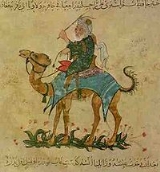
Abu Abdullah Muhammad Ibn Battuta , or simply
Ibn Battuta, also known as
Shams ad–Din (February 25, 1304–1368 or 1369), was a
MuslimA Muslim, also spelled Moslem, is an adherent of Islam, a monotheistic, Abrahamic religion based on the Quran, which Muslims consider the verbatim word of God as revealed to prophet Muhammad. "Muslim" is the Arabic term for "submitter" .Muslims believe that God is one and incomparable...
MoroccanMorocco , officially the Kingdom of Morocco , is a country located in North Africa. It has a population of more than 32 million and an area of 710,850 km², and also primarily administers the disputed region of the Western Sahara...
BerberBerbers are the indigenous peoples of North Africa west of the Nile Valley. They are continuously distributed from the Atlantic to the Siwa oasis, in Egypt, and from the Mediterranean to the Niger River. Historically they spoke the Berber language or varieties of it, which together form a branch...
explorer, known for his extensive travels published in the
RihlaRihla is a medieval book which recounts the journey of the 14th-century Berber Moroccan scholar and traveler Ibn Battuta.The oeuvre was written by Ibn Juzayy after he was commissioned by the Marinid Sultan Abu Inan who was impressed by the story and journey of Ibn Battuta.The term Rihla is a...
(literally, "The Journey"). Over a period of thirty years, he visited most of the known
Islamic worldThe term Muslim world has several meanings. In a religious sense, it refers to those who adhere to the teachings of Islam, referred to as Muslims. In a cultural sense, it refers to Islamic civilization, inclusive of non-Muslims living in that civilization...
, including
North AfricaNorth Africa or Northern Africa is the northernmost region of the African continent, linked by the Sahara to Sub-Saharan Africa. Geopolitically, the United Nations definition of Northern Africa includes eight countries or territories; Algeria, Egypt, Libya, Morocco, South Sudan, Sudan, Tunisia, and...
, the
Horn of AfricaThe Horn of Africa is a peninsula in East Africa that juts hundreds of kilometers into the Arabian Sea and lies along the southern side of the Gulf of Aden. It is the easternmost projection of the African continent...
,
West AfricaWest Africa or Western Africa is the westernmost region of the African continent. Geopolitically, the UN definition of Western Africa includes the following 16 countries and an area of approximately 5 million square km:-Flags of West Africa:...
,
Southern EuropeThe term Southern Europe, at its most general definition, is used to mean "all countries in the south of Europe". However, the concept, at different times, has had different meanings, providing additional political, linguistic and cultural context to the definition in addition to the typical...
and
Eastern EuropeEastern Europe is the eastern part of Europe. The term has widely disparate geopolitical, geographical, cultural and socioeconomic readings, which makes it highly context-dependent and even volatile, and there are "almost as many definitions of Eastern Europe as there are scholars of the region"...
in the West, to the
Middle EastThe Middle East is a region that encompasses Western Asia and Northern Africa. It is often used as a synonym for Near East, in opposition to Far East...
,
South AsiaSouth Asia, also known as Southern Asia, is the southern region of the Asian continent, which comprises the sub-Himalayan countries and, for some authorities , also includes the adjoining countries to the west and the east...
,
Central AsiaCentral Asia is a core region of the Asian continent from the Caspian Sea in the west, China in the east, Afghanistan in the south, and Russia in the north...
,
Southeast AsiaSoutheast Asia, South-East Asia, South East Asia or Southeastern Asia is a subregion of Asia, consisting of the countries that are geographically south of China, east of India, west of New Guinea and north of Australia. The region lies on the intersection of geological plates, with heavy seismic...
and
ChinaChinese civilization may refer to:* China for more general discussion of the country.* Chinese culture* Greater China, the transnational community of ethnic Chinese.* History of China* Sinosphere, the area historically affected by Chinese culture...
in the East, a distance surpassing his near-contemporary
Marco PoloMarco Polo was a Venetian merchant traveler from the Venetian Republic whose travels are recorded in Il Milione, a book which did much to introduce Europeans to Central Asia and China. He learned about trading whilst his father and uncle, Niccolò and Maffeo, travelled through Asia and apparently...
. Ibn Battuta is considered one of the greatest
travelTravel is the movement of people or objects between relatively distant geographical locations. 'Travel' can also include relatively short stays between successive movements.-Etymology:...
lers of all time. He journeyed more than 75000 miles (120,700.5 km), a figure unsurpassed by any individual explorer until the coming of the Steam Age some 450 years later.
Early life and his first hajj
The
Rihla supplies biographical background. Ibn Battuta was born into a Berber family of
IslamIslam . The most common are and . : Arabic pronunciation varies regionally. The first vowel ranges from ~~. The second vowel ranges from ~~~...
ic
legal scholarsUlama , also spelt ulema, refers to the educated class of Muslim legal scholars engaged in the several fields of Islamic studies. They are best known as the arbiters of shari‘a law...
in
TangierTangier, also Tangiers is a city in northern Morocco with a population of about 700,000 . It lies on the North African coast at the western entrance to the Strait of Gibraltar where the Mediterranean meets the Atlantic Ocean off Cape Spartel...
, Morocco, on 25 February 1304, during the reign of the Marinid dynasty. As a young man he would have studied at a
SunniSunni Islam is the largest branch of Islam. Sunni Muslims are referred to in Arabic as ʾAhl ūs-Sunnah wa āl-Ǧamāʿah or ʾAhl ūs-Sunnah for short; in English, they are known as Sunni Muslims, Sunnis or Sunnites....
MalikiThe ' madhhab is one of the schools of Fiqh or religious law within Sunni Islam. It is the second-largest of the four schools, followed by approximately 25% of Muslims, mostly in North Africa, West Africa, the United Arab Emirates, Kuwait, and in some parts of Saudi Arabia...
madhhab is a Muslim school of law or fiqh . In the first 150 years of Islam, there were many such "schools". In fact, several of the Sahābah, or contemporary "companions" of Muhammad, are credited with founding their own...
, (
Islamic jurisprudenceSharia law, is the moral code and religious law of Islam. Sharia is derived from two primary sources of Islamic law: the precepts set forth in the Quran, and the example set by the Islamic prophet Muhammad in the Sunnah. Fiqh jurisprudence interprets and extends the application of sharia to...
school), the dominant form of education in North Africa at that time. In June 1325, at the age of twenty-one, Ibn Battuta set off from his hometown on a
hajjThe Hajj is the pilgrimage to Mecca, Saudi Arabia. It is one of the largest pilgrimages in the world, and is the fifth pillar of Islam, a religious duty that must be carried out at least once in their lifetime by every able-bodied Muslim who can afford to do so...
, or pilgrimage, to
MeccaMecca is a city in the Hijaz and the capital of Makkah province in Saudi Arabia. The city is located inland from Jeddah in a narrow valley at a height of above sea level...
, a journey that would take sixteen months. He would not see Morocco again for twenty-four years.
"I set out alone, finding no companion to cheer the way with friendly intercourse, and no party of travellers with whom to associate myself. Swayed by an overmastering impulse within me, and a long-cherished desire to visit those glorious sanctuaries, I resolved to quit all my friends and tear myself away from my home. As my parents were still alive, it weighed grievously upon me to part from them, and both they and I were afflicted with sorrow."
He travelled to Mecca overland, following the North African coast across the sultanates of
Abd al-WadidZayyanids or Abd al-Wadids , or Banu Zayan, is the name of a Berber zenata dynasty in North Africa. The Zayyanids, whose capital was Tlemcen existed from 1235 to 1556...
and
HafsidThe Hafsids were a Berber dynasty ruling Ifriqiya from 1229 to 1574. Their territories were stretched from east of modern Algeria to west of modern Libya during their zenith.-History:...
. The route took him through
TlemcenTlemcen is a town in Northwestern Algeria, and the capital of the province of the same name. It is located inland in the center of a region known for its olive plantations and vineyards...
,
BéjaïaBéjaïa, Vgaiet or Bejaya is a Mediterranean port city on the Gulf of Béjaïa in Algeria; it is the capital of Béjaïa Province, Kabylia. Under French rule, it was formerly known under various European names, such as Budschaja in German, Bugia in Italian, and Bougie...
and then
TunisTunis is the capital of both the Tunisian Republic and the Tunis Governorate. It is Tunisia's largest city, with a population of 728,453 as of 2004; the greater metropolitan area holds some 2,412,500 inhabitants....
where he stayed for two months. For safety, Ibn Battuta usually joined a
caravanA caravan is a group of people traveling together, often on a trade expedition. Caravans were used mainly in desert areas and throughout the Silk Road, where traveling in groups aided in defence against bandits as well as helped to improve economies of scale in trade.In historical times, caravans...
to reduce the risk of an attack by wandering
Arab bedouinThe Banu Hilal were a confederation of Arabian Bedouin tribes that migrated from Upper Egypt into North Africa in the 11th century, having been sent by the Fatimids to punish the Zirids for abandoning Shiism. Other authors suggest that the tribes left the grasslands on the upper Nile because of...
. He took a bride in the town of
SfaxSfax is a city in Tunisia, located southeast of Tunis. The city, founded in AD 849 on the ruins of Taparura and Thaenae, is the capital of the Sfax Governorate , and a Mediterranean port. Sfax has population of 340,000...
, the first in a series of marriages that would feature in his travels.
In the early spring of 1326, after a journey of over 3500 km (2,174.8 mi), Ibn Battuta arrived at the port of
AlexandriaAlexandria is the second-largest city of Egypt, with a population of 4.1 million, extending about along the coast of the Mediterranean Sea in the north central part of the country; it is also the largest city lying directly on the Mediterranean coast. It is Egypt's largest seaport, serving...
, then part of the
Bahri Mamluk empireThe Bahri dynasty or Bahriyya Mamluks was a Mamluk dynasty of mostly Kipchak Turkic origin that ruled Egypt from 1250 to 1382 when they were succeeded by the Burji dynasty, another group of Mamluks...
. He spent several weeks visiting sites in the area then headed inland to
CairoCairo , is the capital of Egypt and the largest city in the Arab world and Africa, and the 16th largest metropolitan area in the world. Nicknamed "The City of a Thousand Minarets" for its preponderance of Islamic architecture, Cairo has long been a centre of the region's political and cultural life...
, the capital of the
MamlukThe Mamluk Sultanate of Egypt was the final independent Egyptian state prior to the establishment of the Muhammad Ali Dynasty in 1805. It lasted from the overthrow of the Ayyubid Dynasty until the Ottoman conquest of Egypt in 1517. The sultanate's ruling caste was composed of Mamluks, Arabised...
Sultanate and even at that time an important large city. After spending about a month in Cairo, he embarked on the first of many detours within the relative safety of Mamluk territory. Of the three usual routes to Mecca, Ibn Battuta chose the least-travelled, which involved a journey up the
NileThe Nile is a major north-flowing river in North Africa, generally regarded as the longest river in the world. It is long. It runs through the ten countries of Sudan, South Sudan, Burundi, Rwanda, Democratic Republic of the Congo, Tanzania, Kenya, Ethiopia, Uganda and Egypt.The Nile has two major...
valley, then east to the
Red SeaThe Red Sea is a seawater inlet of the Indian Ocean, lying between Africa and Asia. The connection to the ocean is in the south through the Bab el Mandeb strait and the Gulf of Aden. In the north, there is the Sinai Peninsula, the Gulf of Aqaba, and the Gulf of Suez...
port of Aydhab, Upon approaching the town however, a local rebellion forced him to turn back.
Ibn Battuta returned to Cairo and took a second side trip, this time to Mamluk-controlled
DamascusDamascus , commonly known in Syria as Al Sham , and as the City of Jasmine , is the capital and the second largest city of Syria after Aleppo, both are part of the country's 14 governorates. In addition to being one of the oldest continuously inhabited cities in the world, Damascus is a major...
. During his first trip he had encountered a holy man, Shaykh Abul Hasan al Shadili, who prophesied that he would only reach Mecca by travelling through
SyriaSyria , officially the Syrian Arab Republic , is a country in Western Asia, bordering Lebanon and the Mediterranean Sea to the West, Turkey to the north, Iraq to the east, Jordan to the south, and Israel to the southwest....
. The diversion held an added advantage; due to the holy places that lay along the way, including
HebronHebron , is located in the southern West Bank, south of Jerusalem. Nestled in the Judean Mountains, it lies 930 meters above sea level. It is the largest city in the West Bank and home to around 165,000 Palestinians, and over 500 Jewish settlers concentrated in and around the old quarter...
,
Jerusalem, and
BethlehemBethlehem is a Palestinian city in the central West Bank of the Jordan River, near Israel and approximately south of Jerusalem, with a population of about 30,000 people. It is the capital of the Bethlehem Governorate of the Palestinian National Authority and a hub of Palestinian culture and tourism...
, the Mamluk authorities spared no efforts in keeping the route safe for pilgrims.
After spending the
MuslimA Muslim, also spelled Moslem, is an adherent of Islam, a monotheistic, Abrahamic religion based on the Quran, which Muslims consider the verbatim word of God as revealed to prophet Muhammad. "Muslim" is the Arabic term for "submitter" .Muslims believe that God is one and incomparable...
month of
RamadanRamadan is the ninth month of the Islamic calendar, and the month in which the Quran was revealed.Ramadan is the holiest of months in the Islamic calendar, and fasting in this month is one of the Five Pillars of Islam. The month is spent by Muslims fasting during the daylight hours from dawn to...
in Damascus, he joined a caravan travelling the 1500 km (932.1 mi) south to
MedinaMedina , or ; also transliterated as Madinah, or madinat al-nabi "the city of the prophet") is a city in the Hejaz region of western Saudi Arabia, and serves as the capital of the Al Madinah Province. It is the second holiest city in Islam, and the burial place of the Islamic Prophet Muhammad, and...
, burial place of the
Islamic prophetMuslims identify the Prophets of Islam as those humans chosen by God and given revelation to deliver to mankind. Muslims believe that every prophet was given a belief to worship God and their respective followers believed it as well...
MuhammadMuhammad |ligature]] at U+FDF4 ;Arabic pronunciation varies regionally; the first vowel ranges from ~~; the second and the last vowel: ~~~. There are dialects which have no stress. In Egypt, it is pronounced not in religious contexts...
. After four days in the town, he journeyed on to Mecca where completing his pilgrimage he took the honorific status of
El-HajjiHajji or El-Hajj, is an honorific title given to a Muslim person who has successfully completed the Hajj to Mecca, and is often used to refer to an elder, since it can take time to accumulate the wealth to fund the travel. The title is placed before a person's name...
. Rather than return home, Ibn Battuta instead decided to continue on, choosing as his next destination the
IlkhanateThe Ilkhanate, also spelled Il-khanate , was a Mongol khanate established in Azerbaijan and Persia in the 13th century, considered a part of the Mongol Empire...
, a
MongolThe Mongol Empire , initially named as Greater Mongol State was a great empire during the 13th and 14th centuries...
KhanateKhanate, or Chanat, is a Turco-Mongol-originated word used to describe a political entity ruled by a Khan. In modern Turkish, the word used is kağanlık, and in modern Azeri of the republic of Azerbaijan, xanlıq. In Mongolian the word khanlig is used, as in "Khereidiin Khanlig" meaning the Khanate...
, to the northeast.
Iraq and Persia
On 17 November 1326, following a month spent in Mecca, Ibn Battuta joined a large caravan of pilgrims returning to
IraqIraq ; officially the Republic of Iraq is a country in Western Asia spanning most of the northwestern end of the Zagros mountain range, the eastern part of the Syrian Desert and the northern part of the Arabian Desert....
across the
Arabian PeninsulaThe Arabian Peninsula is a land mass situated north-east of Africa. Also known as Arabia or the Arabian subcontinent, it is the world's largest peninsula and covers 3,237,500 km2...
. The group headed north to Medina and then, travelling at night, turned northeast across the Nejd plateau to
NajafNajaf is a city in Iraq about 160 km south of Baghdad. Its estimated population in 2008 is 560,000 people. It is the capital of Najaf Governorate...
, on a journey that lasted about two weeks. In Najaf he visited the mausoleum of
Ali ibn Abi Talib' |Ramaḍān]], 40 AH; approximately October 23, 598 or 600 or March 17, 599 – January 27, 661).His father's name was Abu Talib. Ali was also the cousin and son-in-law of the Islamic prophet Muhammad, and ruled over the Islamic Caliphate from 656 to 661, and was the first male convert to Islam...
(Ali), the first Shi'a
ImamAn imam is an Islamic leadership position, often the worship leader of a mosque and the Muslim community. Similar to spiritual leaders, the imam is the one who leads Islamic worship services. More often, the community turns to the mosque imam if they have a religious question...
, a site venerated by the Shi'a community to this day.
Then, instead of continuing on to
BaghdadBaghdad is the capital of Iraq, as well as the coterminous Baghdad Governorate. The population of Baghdad in 2011 is approximately 7,216,040...
with the caravan, Ibn Battuta started a six-month detour that took him into Persia. From Najaf he journeyed to Wasit then followed the river
TigrisThe Tigris River is the eastern member of the two great rivers that define Mesopotamia, the other being the Euphrates. The river flows south from the mountains of southeastern Turkey through Iraq.-Geography:...
south to
BasraBasra is the capital of Basra Governorate, in southern Iraq near Kuwait and Iran. It had an estimated population of two million as of 2009...
. His next destination was the town of Esfahān across the
Zagros MountainsThe Zagros Mountains are the largest mountain range in Iran and Iraq. With a total length of 1,500 km , from northwestern Iran, and roughly correlating with Iran's western border, the Zagros range spans the whole length of the western and southwestern Iranian plateau and ends at the Strait of...
in Persia. He then headed south to
ShirazShiraz is the sixth most populous city in Iran and is the capital of Fars Province, the city's 2009 population was 1,455,073. Shiraz is located in the southwest of Iran on the Roodkhaneye Khoshk seasonal river...
, a large flourishing city spared the destruction wrought by Mongol invaders on many more northerly towns. Finally, he returned across the mountains to Baghdad, arriving there in June 1327. Parts of the city were still ruined from the damage inflicted by
Hulago Khan'sHulagu Khan, also known as Hülegü, Hulegu , was a Mongol ruler who conquered much of Southwest Asia...
invading army in 1255.
In Baghdad he found
Abu Sa'idAbu Sa'id also Abusaid Bahador Khan, Abu Sayed Behauder , was the ninth ruler of the Ilkhanate state in Iran ....
, the last Mongol ruler of the unified Ilkhanate, leaving the city and heading north with a large retinue. Ibn Battuta joined the royal caravan for a while, then turned north on the
Silk RoadThe Silk Road or Silk Route refers to a historical network of interlinking trade routes across the Afro-Eurasian landmass that connected East, South, and Western Asia with the Mediterranean and European world, as well as parts of North and East Africa...
to
TabrizTabriz is the fourth largest city and one of the historical capitals of Iran and the capital of East Azerbaijan Province. Situated at an altitude of 1,350 meters at the junction of the Quri River and Aji River, it was the second largest city in Iran until the late 1960s, one of its former...
, the first major city in the region to open its gates to the Mongols and by then an important trading centre as most of its nearby rivals had been razed by the Mongol invaders.
Ibn Battuta left again for Baghdad, probably in July, but first took an excursion northwards along the river Tigris, visiting
MosulMosul , is a city in northern Iraq and the capital of the Ninawa Governorate, some northwest of Baghdad. The original city stands on the west bank of the Tigris River, opposite the ancient Assyrian city of Nineveh on the east bank, but the metropolitan area has now grown to encompass substantial...
,
CizreCizre is a town and district of Şırnak Province in the Southeastern Anatolia Region of Turkey, located at the border to Syria, just to the north-west of the Turkish-Syrian-Iraqi tripoint....
and
MardinMardin is a city in southeastern Turkey. The capital of Mardin Province, it is known for its Arabic-like architecture, and for its strategic location on a rocky mountain overlooking the plains of northern Syria.-History:...
, in modern day
IraqIraq ; officially the Republic of Iraq is a country in Western Asia spanning most of the northwestern end of the Zagros mountain range, the eastern part of the Syrian Desert and the northern part of the Arabian Desert....
and
TurkeyTurkey , known officially as the Republic of Turkey , is a Eurasian country located in Western Asia and in East Thrace in Southeastern Europe...
. Once back in Mosul, he joined a "feeder" caravan of pilgrims heading south to Baghdad where they would meet up with the main caravan that crossed the
Arabian DesertThe Arabian Desert is a vast desert wilderness stretching from Yemen to the Persian Gulf and Oman to Jordan and Iraq. It occupies most of the Arabian Peninsula, with an area of...
to Mecca. Ill with diarrhea, he arrived in the city weak and exhausted for his second
hajj.
Arabian peninsula
Ibn Battuta remained in Mecca for some time (the
Rihla suggests about three years, from September 1327 until autumn 1330). Problems with chronology however, lead commentators to suggest that he may have left after the 1328
hajj.
After the
hajj in either 1328 or 1330, he made his way to the port of
JeddahJeddah, Jiddah, Jidda, or Jedda is a city located on the coast of the Red Sea and is the major urban center of western Saudi Arabia. It is the largest city in Makkah Province, the largest sea port on the Red Sea, and the second largest city in Saudi Arabia after the capital city, Riyadh. The...
on the Red Sea coast. From there he followed the coast in a series of boats making slow progress against the prevailing south-easterly winds. Once in the
YemenThe Republic of Yemen , commonly known as Yemen , is a country located in the Middle East, occupying the southwestern to southern end of the Arabian Peninsula. It is bordered by Saudi Arabia to the north, the Red Sea to the west, and Oman to the east....
he visited
ZabīdZabid is a town with an urban population of around 23,000 persons on Yemen's western coastal plain. The town, named after Wadi Zabid, the wadi to its south, is one of the oldest towns in Yemen...
and later the highland town of
Ta'izzTa'izz , or Taiz, is a city in the Yemeni Highlands, near the famous Mocha port on the Red Sea, lying at an elevation of about 1,400 metres above sea level. It is the capital of Ta'izz Governorate...
, where he met the
RasulidThe Rasulid was a Muslim dynasty that ruled Yemen and Hadhramaut from 1229 to 1454. The Rasulids assumed power after the Egyptian Ayyubid left the southern provinces of the Arabian Peninsula....
dynasty king
(MalikMalik is an Arabic word meaning "king, chieftain".It has been adopted in various other, mainly Islamized or Arabized, Asian languages for their ruling princes and to render kings elsewhere. It is also sometimes used in derived meanings...
) Mujahid Nur al-Din Ali. Ibn Battuta also mentions visiting
Sana'a-Districts:*Al Wahdah District*As Sabain District*Assafi'yah District*At Tahrir District*Ath'thaorah District*Az'zal District*Bani Al Harith District*Ma'ain District*Old City District*Shu'aub District-Old City:...
, but whether he actually did so is doubtful. In all likelihood, he went directly from Ta'izz to the important trading port of
AdenAden is a seaport city in Yemen, located by the eastern approach to the Red Sea , some 170 kilometres east of Bab-el-Mandeb. Its population is approximately 800,000. Aden's ancient, natural harbour lies in the crater of an extinct volcano which now forms a peninsula, joined to the mainland by a...
, arriving around the beginning of 1329 or 1331.
Somalia
From Aden, Ibn Battuta embarked on a ship heading for
ZeilaZeila, also known as Zaila , is a port city on the Gulf of Aden coast, situated in the northwestern Awdal region of Somalia.Located near the Djibouti border, the town sits on a sandy spit surrounded by the sea. It is known for its offshore islands, coral reef and mangroves. Landward, the terrain is...
on the coast of
SomaliaSomalia , officially the Somali Republic and formerly known as the Somali Democratic Republic under Socialist rule, is a country located in the Horn of Africa. Since the outbreak of the Somali Civil War in 1991 there has been no central government control over most of the country's territory...
. He then moved on to
Cape GuardafuiCape Guardafui , also known as Ras Asir and historically as Aromata promontorium, is a headland in the northeastern Bari province of Somalia. Located in the autonomous Puntland region, it forms the geographical apex of the region commonly referred to as the Horn of Africa.-Location:Cape Guardafui...
further down the Somalia seaboard, spending about a week in each location. Later he would visit
MogadishuMogadishu , popularly known as Xamar, is the largest city in Somalia and the nation's capital. Located in the coastal Benadir region on the Indian Ocean, the city has served as an important port for centuries....
, the then pre-eminent city of the "Land of the Berbers" (بلد البربر
Bilad al Barbar, the medieval
ArabicArabic is a name applied to the descendants of the Classical Arabic language of the 6th century AD, used most prominently in the Quran, the Islamic Holy Book...
term for the
Horn of AfricaThe Horn of Africa is a peninsula in East Africa that juts hundreds of kilometers into the Arabian Sea and lies along the southern side of the Gulf of Aden. It is the easternmost projection of the African continent...
).
When he arrived in 1331, Mogadishu stood at the zenith of its prosperity. Ibn Battuta described it as "an exceedingly large city" with many rich merchants, noted for its high quality fabric that was exported to other countries including
EgyptEgypt , officially the Arab Republic of Egypt, Arabic: , is a country mainly in North Africa, with the Sinai Peninsula forming a land bridge in Southwest Asia. Egypt is thus a transcontinental country, and a major power in Africa, the Mediterranean Basin, the Middle East and the Muslim world...
. He added that the city was ruled by a Somali
SultanSultan is a title with several historical meanings. Originally, it was an Arabic language abstract noun meaning "strength", "authority", "rulership", and "dictatorship", derived from the masdar سلطة , meaning "authority" or "power". Later, it came to be used as the title of certain rulers who...
, originally from
BerberaBerbera is a city and seat of Berbera District in Somaliland, a self-proclaimed Independent Republic with de facto control over its own territory, which is recognized by the international community and the Somali Government as a part of Somalia...
in northern Somalia, who spoke both
SomaliThe Somali language is a member of the East Cushitic branch of the Afro-Asiatic language family. Its nearest relatives are Afar and Oromo. Somali is the best documented of the Cushitic languages, with academic studies beginning before 1900....
(referred to as
Mogadishan, the
BenadirBenadir is a coastal region of Somalia. It covers most of the Indian Ocean coast of the country, from the Gulf of Aden to the Juba River, containing the capital of Mogadishu. The name comes from Persian bandar, which means port , a fact that reflects the region's importance to Persian and Arab...
dialect of Somali) and Arabic with equal fluency. The Sultan also had a retinue of
wazirA vizier or in Arabic script ; ; sometimes spelled vazir, vizir, vasir, wazir, vesir, or vezir) is a high-ranking political advisor or minister in a Muslim government....
s (ministers), legal experts, commanders, royal
eunuchA eunuch is a person born male most commonly castrated, typically early enough in his life for this change to have major hormonal consequences...
s, and assorted hangers-on at his beck and call.
Swahili Coast
Battuta continued by ship south to the
Swahili CoastThe Swahili Coast refers to the coast or coastal area of East Africa inhabited by the Swahili people, mainly Kenya, Tanzania, and north Mozambique...
, a region then known in Arabic as the
Bilad al-Zanj ("Land of the
ZanjZanj was a name used by medieval Arab geographers to refer to both a certain portion of the coast of East Africa and its inhabitants, Bantu-speaking peoples called the Zanj...
"), with an overnight stop at the island town of
MombasaMombasa is the second-largest city in Kenya. Lying next to the Indian Ocean, it has a major port and an international airport. The city also serves as the centre of the coastal tourism industry....
. Although relatively small at the time, Mombasa would become important in the following century. After a journey along the coast, Ibn Battuta next arrived in the island town of
KilwaKilwa Kisiwani is a community on an island off the coast of East Africa, in present day Tanzania.- History :A document written around AD 1200 called al-Maqama al Kilwiyya discovered in Oman, gives details of a mission to reconvert Kilwa to Ibadism, as it had recently been effected by the Ghurabiyya...
in present day
TanzaniaThe United Republic of Tanzania is a country in East Africa bordered by Kenya and Uganda to the north, Rwanda, Burundi, and the Democratic Republic of the Congo to the west, and Zambia, Malawi, and Mozambique to the south. The country's eastern borders lie on the Indian Ocean.Tanzania is a state...
, which had become an important transit centre of the gold trade. He described the city as "one of the most beautiful and well-constructed towns in the world".
Ibn Battuta recorded his visit to the
Kilwa SultanateThe Kilwa Sultanate was a Medieval sultanate, centered at Kilwa , whose authority, at its height, stretched over the entire length of the Swahili Coast. It was founded in the 10th century by Ali ibn al-Hassan Shirazi...
in 1330, and commented favorably on the humility and religion of its ruler,
Sultan al-Hasan ibn SulaimanSultan al-Hasan ibn Sulaiman, often referred to as "Abu'l-Mawahib" , ruled the island of Kilwa Kisiwani, in present-day Tanzania, from 1310 until 1333....
a descendant of the legendary Ali ibn al-Hassan Shirazi. He further wrote that the authority of the Sultan extended from
MalindiMalindi is a town on Malindi Bay at the mouth of the Galana River, lying on the Indian Ocean coast of Kenya. It is 120 kilometres northeast of Mombasa. The population of Malindi is 117,735 . It is the capital of the Malindi District.Tourism is the major industry in Malindi. The city is...
in the north to
InhambaneInhambane, Terra de Boa Gente is a city located in southern Mozambique, lying on Inhambane Bay, 470 km northeast of Maputo. It is the capital of the Inhambane Province and according to the 2008 census has a population of 65,837, growing from the 1997 census of 54,157...
in the south and was particularly impressed by the planning of the city, believing it to be the reason for Kilwa's success along the coast. From this period date the construction of the
Palace of Husuni KubwaThe Palace of Husuni Kubwa is a ruined structure on the island of Kilwa Kisiwani, in Tanzania. The majority of the palace was erected in the 14th century by Sultan al-Hasan ibn Sulaiman, who also built an extension to the nearby Great Mosque of Kilwa, although portions may date back to the 13th...
and a significant extension to the
Great Mosque of KilwaThe Great Mosque of Kilwa is a congregational mosque on the island of Kilwa Kisiwani, in Tanzania. It was likely founded in the tenth century, but the two major stages of construction date to the eleventh or twelfth and thirteenth century, respectively...
, which was made of
Coral StonesCorals are marine animals in class Anthozoa of phylum Cnidaria typically living in compact colonies of many identical individual "polyps". The group includes the important reef builders that inhabit tropical oceans and secrete calcium carbonate to form a hard skeleton.A coral "head" is a colony of...
the largest Mosque of its kind. With a change in the
monsoonMonsoon is traditionally defined as a seasonal reversing wind accompanied by corresponding changes in precipitation, but is now used to describe seasonal changes in atmospheric circulation and precipitation associated with the asymmetric heating of land and sea...
winds, Ibn Battuta sailed back to Arabia, first to
OmanOman , officially called the Sultanate of Oman , is an Arab state in southwest Asia on the southeast coast of the Arabian Peninsula. It is bordered by the United Arab Emirates to the northwest, Saudi Arabia to the west, and Yemen to the southwest. The coast is formed by the Arabian Sea on the...
and the
Strait of HormuzThe Strait of Hormuz is a narrow, strategically important waterway between the Gulf of Oman in the southeast and the Persian Gulf. On the north coast is Iran and on the south coast is the United Arab Emirates and Musandam, an exclave of Oman....
then on to Mecca for the
hajj of 1330 (or 1332).
Byzantine Empire, Golden Horde, Anatolia, Central Asia and India
After spending another year in Mecca, Ibn Battuta decided to seek employment with the Muslim
Sultan of DelhiThe Delhi Sultanate is a term used to cover five short-lived, Delhi based kingdoms or sultanates, of Turkic origin in medieval India. The sultanates ruled from Delhi between 1206 and 1526, when the last was replaced by the Mughal dynasty...
,
Muhammad bin TughluqMuhammad bin Tughluq was the Turkic Sultan of Delhi from 1325 to 1351. He was the eldest son of Ghiyas-ud-din Tughlaq.He was born in Kotla Tolay Khan in Multan. His wife was daughter of the raja of Dipalpur...
. In 1330 (or 1332), in need of a guide and translator for his journey, he set off for the
SeljuqThe Great Seljuq Empire was a medieval Persianate, Turko-Persian Sunni Muslim empire, originating from the Qynyq branch of Oghuz Turks. The Seljuq Empire controlled a vast area stretching from the Hindu Kush to eastern Anatolia and from Central Asia to the Persian Gulf...
controlled territory of
AnatoliaAnatolia is a geographic and historical term denoting the westernmost protrusion of Asia, comprising the majority of the Republic of Turkey...
to join one of the caravans that went from there to India. From the Syrian port of
LatakiaLatakia, or Latakiyah , is the principal port city of Syria, as well as the capital of the Latakia Governorate. In addition to serving as a port, the city is a manufacturing center for surrounding agricultural towns and villages...
, a
GenoeseGenoa |Ligurian]] Zena ; Latin and, archaically, English Genua) is a city and an important seaport in northern Italy, the capital of the Province of Genoa and of the region of Liguria....
ship took him to
AlanyaAlanya , formerly Alaiye, is a beach resort city and a component district of Antalya Province in the Mediterranean Region of Turkey, from the city of Antalya. On the southern coast of Turkey, the district has an area of 1,598.51 km2 and 248,286 inhabitants...
on the southern coast of modern-day Turkey. He then travelled overland to
KonyaKonya is a city in the Central Anatolia Region of Turkey. The metropolitan area in the entire Konya Province had a population of 1,036,027 as of 2010, making the city seventh most populous in Turkey.-Etymology:...
and afterwards to
SinopeSinop is a city with a population of 36,734 on İnce Burun , by its Cape Sinop which is situated on the most northern edge of the Turkish side of Black Sea coast, in the ancient region of Paphlagonia, in modern-day northern Turkey, historically known as Sinope...
on the
Black SeaThe Black Sea is bounded by Europe, Anatolia and the Caucasus and is ultimately connected to the Atlantic Ocean via the Mediterranean and the Aegean seas and various straits. The Bosphorus strait connects it to the Sea of Marmara, and the strait of the Dardanelles connects that sea to the Aegean...
coast.
From Sinope he took a sea route to
CrimeaCrimea , or the Autonomous Republic of Crimea , is a sub-national unit, an autonomous republic, of Ukraine. It is located on the northern coast of the Black Sea, occupying a peninsula of the same name...
, arriving so in the
Golden HordeThe Golden Horde was a Mongol and later Turkicized khanate that formed the north-western sector of the Mongol Empire...
realm. He went to port town of
Azov-External links:** *...
, where he met with
emirEmir , meaning "commander", "general", or "prince"; also transliterated as Amir, Aamir or Ameer) is a title of high office, used throughout the Muslim world...
of the Khan, then to the large and rich city of
MajarMajar or Macar was a medieval city of Golden Horde in 13th-14th centuries. Once it played a major role in the trade between Idel-Ural, Caucasus and the Black Sea region. In 1310–1311 the city coined own money...
. He left Majar to meet with
Uzbeg KhanSultan Mohammed Öz-Beg, better known as Uzbeg or Ozbeg , was the longest-reigning khan of the Golden Horde, under whose rule the state reached its zenith...
traveling court (horde), which was in the time near
BeshtauBeshtau is an isolated five-domed igneous mountain near Pyatigorsk in the Northern Caucasus....
mountain. From there he made a journey to
BolgharBolghar was intermittently capital of Volga Bulgaria from the 8th to the 15th centuries, along with Bilyar and Nur-Suvar. It was situated on the bank of the Volga River, about 30 km downstream from its confluence with the Kama River and some 130 km from modern Kazan...
, which became the northernmost point he reached, and noted its unusually (for subtropics dweller) short nights in summer. Then he returned to Khan's court and with it moved to
AstrakhanAstrakhan is a major city in southern European Russia and the administrative center of Astrakhan Oblast. The city lies on the left bank of the Volga River, close to where it discharges into the Caspian Sea at an altitude of below the sea level. Population:...
.
When they reached Astrakhan, Uzbeg Khan had just given permission for one of his pregnant wives, Princess Bayalun, a daughter of
Byzantine Emperor Andronikos III PalaiologosAndronikos III Palaiologos, Latinized as Andronicus III Palaeologus was Byzantine emperor from 1328 to 1341, after being rival emperor since 1321. Andronikos III was the son of Michael IX Palaiologos and Rita of Armenia...
, to return to her home city of
ConstantinopleConstantinople was the capital of the Roman, Eastern Roman, Byzantine, Latin, and Ottoman Empires. Throughout most of the Middle Ages, Constantinople was Europe's largest and wealthiest city.-Names:...
to give birth. Ibn Battuta talked his way into this expedition, which would be his first beyond the boundaries of the Islamic world.
Arriving in Constantinople towards the end of 1332 (or 1334), he met the
ByzantineThe Byzantine Empire was the Eastern Roman Empire during the periods of Late Antiquity and the Middle Ages, centred on the capital of Constantinople. Known simply as the Roman Empire or Romania to its inhabitants and neighbours, the Empire was the direct continuation of the Ancient Roman State...
emperor Andronikos III Palaiologos. He visited the great church of
Hagia SophiaHagia Sophia is a former Orthodox patriarchal basilica, later a mosque, and now a museum in Istanbul, Turkey...
and spoke with a
Christian OrthodoxThe term Orthodox Christianity may refer to:* the Eastern Orthodox Church and its various geographical subdivisions...
priest about his travels in the city of
Jerusalem. After a month in the city, Ibn Battuta returned to Astrakhan, then arrived in the capital city
Sarai al-JadidSarai was the name of two cities, which were successively capital cities of the Golden Horde, the Mongol kingdom which ruled Russia and much of central Asia in the 13th and 14th centuries...
and reported his travelling account to Sultatn Mohammad Uzbek. Thereafter he continued past the
CaspianThe Caspian Sea is the largest enclosed body of water on Earth by area, variously classed as the world's largest lake or a full-fledged sea. The sea has a surface area of and a volume of...
and
Aral SeaThe Aral Sea was a lake that lay between Kazakhstan in the north and Karakalpakstan, an autonomous region of Uzbekistan, in the south...
s to
BukharaBukhara , from the Soghdian βuxārak , is the capital of the Bukhara Province of Uzbekistan. The nation's fifth-largest city, it has a population of 263,400 . The region around Bukhara has been inhabited for at least five millennia, and the city has existed for half that time...
and
SamarkandAlthough a Persian-speaking region, it was not united politically with Iran most of the times between the disintegration of the Seleucid Empire and the Arab conquest . In the 6th century it was within the domain of the Turkic kingdom of the Göktürks.At the start of the 8th century Samarkand came...
. From there, he journeyed south to
AfghanistanAfghanistan , officially the Islamic Republic of Afghanistan, is a landlocked country located in the centre of Asia, forming South Asia, Central Asia and the Middle East. With a population of about 29 million, it has an area of , making it the 42nd most populous and 41st largest nation in the world...
, then crossed into India via the mountain passes of the
Hindu KushThe Hindu Kush is an mountain range that stretches between central Afghanistan and northern Pakistan. The highest point in the Hindu Kush is Tirich Mir in the Chitral region of Khyber-Pakhtunkhwa, Pakistan.It is the westernmost extension of the Pamir Mountains, the Karakoram Range, and is a...
. In the
Rihla he mentions these mountains and the history of the range.
Muhammad Ibn Tughluq was renowned as the wealthiest man in the
Muslim WorldThe term Muslim world has several meanings. In a religious sense, it refers to those who adhere to the teachings of Islam, referred to as Muslims. In a cultural sense, it refers to Islamic civilization, inclusive of non-Muslims living in that civilization...
at that time. He patronised various scholars, sufis,
QadiQadi is a judge ruling in accordance with Islamic religious law appointed by the ruler of a Muslim country. Because Islam makes no distinction between religious and secular domains, qadis traditionally have jurisdiction over all legal matters involving Muslims...
s, Viziers and other functionaries in order to consolidate his rule. As with Mamluk Egypt, the Tughlaq Dynasty was a rare vestigial example of Muslim rule in Asia after the Mongol Invasion. On the strength of his years of study in Mecca, Ibn Battuta was appointed a
QadiQadi is a judge ruling in accordance with Islamic religious law appointed by the ruler of a Muslim country. Because Islam makes no distinction between religious and secular domains, qadis traditionally have jurisdiction over all legal matters involving Muslims...
, or judge, by the Sultan. He found it difficult to enforce Islamic laws beyond the Sultan's court in Dehli due to lack of Islamic appeal in India.
From the
RajputA Rajput is a member of one of the patrilineal clans of western, central, northern India and in some parts of Pakistan. Rajputs are descendants of one of the major ruling warrior classes in the Indian subcontinent, particularly North India...
Kingdom of Sarsatti, he visited
HansiHansi is a city and a municipal council in Hisar district in the Indian state of Haryana. Its 2011 population is estimated to be 1,34,568. It is located at a distance of east of Hisar on National Highway 10. Geographically, it is semi-arid with around 46 cm of annual rainfall. It appears...
in India, describing it as "among the most beautiful cities, the best constructed and the most populated; it is surrounded with a strong wall, and its founder is said to be one of the great infidel kings, called Tara". Upon his arrival in
SindhSindh historically referred to as Ba'ab-ul-Islam , is one of the four provinces of Pakistan and historically is home to the Sindhi people. It is also locally known as the "Mehran". Though Muslims form the largest religious group in Sindh, a good number of Christians, Zoroastrians and Hindus can...
, Ibn Battuta mentions the
Indian RhinocerosThe Indian Rhinoceros is also called Greater One-horned Rhinoceros and Asian One-horned Rhinoceros and belongs to the Rhinocerotidae family...
that lived on the banks of the
Indus RiverThe Indus River is a major river which flows through Pakistan. It also has courses through China and India.Originating in the Tibetan plateau of western China in the vicinity of Lake Mansarovar in Tibet Autonomous Region, the river runs a course through the Ladakh district of Jammu and Kashmir and...
.
The Sultan was erratic even by the standards of the time, and for six years Ibn Battuta veered between living the high life of a trusted subordinate, and falling under suspicion of treason for a variety of offences. His plan to leave on the pretext of taking another
hajj was stymied by the Sultan who asked him to instead become his ambassador to
Yuan DynastyThe Yuan Dynasty , or Great Yuan Empire was a ruling dynasty founded by the Mongol leader Kublai Khan, who ruled most of present-day China, all of modern Mongolia and its surrounding areas, lasting officially from 1271 to 1368. It is considered both as a division of the Mongol Empire and as an...
ChinaChinese civilization may refer to:* China for more general discussion of the country.* Chinese culture* Greater China, the transnational community of ethnic Chinese.* History of China* Sinosphere, the area historically affected by Chinese culture...
. Given the opportunity to get away from the Sultan and visit new lands, he readily accepted.
India, Sri Lanka, Maldives and China
En route to the coast at the start of his journey to China, Ibn Battuta and his party were attacked by a group of
HinduHindu refers to an identity associated with the philosophical, religious and cultural systems that are indigenous to the Indian subcontinent. As used in the Constitution of India, the word "Hindu" is also attributed to all persons professing any Indian religion...
s. Separated from his companions, he was robbed and nearly lost his life. Despite this setback, within ten days he had caught up with his group and continued on to
KhambhatKhambhat , formerly known as Cambay, is a city and a municipality in Anand district in the Indian state of Gujarat. It was formerly an important trading center, although its harbour has gradually silted up, and the maritime trade has moved elsewhere...
in the Indian state of
Gujarat. From there, they sailed to
KozhikodeKozhikode During Classical antiquity and the Middle Ages, Kozhikkode was dubbed the "City of Spices" for its role as the major trading point of eastern spices. Kozhikode was once the capital of an independent kingdom of the same name and later of the erstwhile Malabar District...
(Calicut), where Portuguese explorer
Vasco da GamaVasco da Gama, 1st Count of Vidigueira was a Portuguese explorer, one of the most successful in the Age of Discovery and the commander of the first ships to sail directly from Europe to India...
would land two centuries later. While Ibn Battuta visited a
mosqueA mosque is a place of worship for followers of Islam. The word is likely to have entered the English language through French , from Portuguese , from Spanish , and from Berber , ultimately originating in — . The Arabic word masjid literally means a place of prostration...
on shore, a storm arose, and one of the ships of his expedition was sunk. The other ship then sailed without him only to be seized by a local
SumatraSumatra is an island in western Indonesia, westernmost of the Sunda Islands. It is the largest island entirely in Indonesia , and the sixth largest island in the world at 473,481 km2 with a population of 50,365,538...
n king a few months later .
Afraid to return to Delhi and be seen as a failure, he stayed for a time in southern India under the protection of Jamal-ud-Din, ruler of the small but powerful
NawayathThe Nawayaths are a small Muslim community concentrated mostly in coastal Uttara Kannada. It is an ethnic society, having its own unique traditions and distinct cultural identity...
sultanate on the banks of the
Sharavathi RiverSharavathi is a river which originates and flows entirely within the state of Karnataka in India. It is one of the few westward flowing rivers of India and a major part of the river basin lies in the Western Ghats. The famous Jog Falls are formed by this river...
next to the
Arabian SeaThe Arabian Sea is a region of the Indian Ocean bounded on the east by India, on the north by Pakistan and Iran, on the west by the Arabian Peninsula, on the south, approximately, by a line between Cape Guardafui in northeastern Somalia and Kanyakumari in India...
. This area is today known as Hosapattana and lies in the
HonavarHonavar or Honnavar , is a port town in Uttara Kannada district of Karnataka, India. The town is the headquarters of Honnavar taluk.- History :...
administrative districtA Tehsil or Tahsil/Tahasil , also known as Taluk and Mandal, is an administrative division of some country/countries of South Asia....
of
Uttara KannadaUttara Kannada also known as North Canara or North Kanara, is a district in the southern Indian state of Karnataka. It is bordered by the state of Goa and Belgaum District to the north, Dharwad District and Haveri District to the east, Shimoga District and Udupi District to the south and the...
. Following the overthrow of the sultanate, Ibn Battuta had no choice but to leave India. Although determined to continue the journey to China, he first took a detour to visit the
Maldive IslandsThe Maldives , , officially Republic of Maldives , also referred to as the Maldive Islands, is an island nation in the Indian Ocean formed by a double chain of twenty-six atolls oriented north-south off India's Lakshadweep islands, between Minicoy Island and...
.
He spent nine months on the islands, much longer than he had intended. As a
Chief Qadi, his skills were highly desirable in the formerly
BuddhistBuddhism is a religion and philosophy encompassing a variety of traditions, beliefs and practices, largely based on teachings attributed to Siddhartha Gautama, commonly known as the Buddha . The Buddha lived and taught in the northeastern Indian subcontinent some time between the 6th and 4th...
nation that had recently
converted to IslamIslam is the state religion of Maldives, and adherence to it is legally required of citizens by a revision of the constitution in 2008: Article 9, Section D states that a non-Muslim may not become a citizen of the Maldives.-Prominence of Islam:...
. Half-kidnapped into staying, he became chief judge and married into the royal family of
Omar IAl-Sultan Abul Fath Jalaaluddin Omar Veeru Siri Loka Abaarana Mahaa Radun was the Sultan of the Maldives from 1306 to 1341. He was the son of Sultan Salis. Sultan Omar I ruled the country for 35 years until his death on 1341...
. He became embroiled in local politics and left when his strict judgments in the laissez-faire island kingdom began to chafe with its rulers. In the
Rihla he mentions his dismay at the local women going about with no clothing above the waist, and the locals taking no notice when he complained. From the Maldives, he carried on to
Sri LankaSri Lanka, officially the Democratic Socialist Republic of Sri Lanka is a country off the southern coast of the Indian subcontinent. Known until 1972 as Ceylon , Sri Lanka is an island surrounded by the Indian Ocean, the Gulf of Mannar and the Palk Strait, and lies in the vicinity of India and the...
and visited Sri Pada and Tenavarai temple.
Ibn Battuta's ship almost sank on embarking from Sri Lanka, only for the vessel that came to his rescue to suffer an attack by pirates. Stranded on shore, he worked his way back to Kozhikode, from where he returned to the Maldives and boarded a Chinese
junkA junk is an ancient Chinese sailing vessel design still in use today. Junks were developed during the Han Dynasty and were used as sea-going vessels as early as the 2nd century AD. They evolved in the later dynasties, and were used throughout Asia for extensive ocean voyages...
, still intending to reach China and take up his ambassadorial post.
He reached the port of
ChittagongChittagong ) is a city in southeastern Bangladesh and the capital of an eponymous district and division. Built on the banks of the Karnaphuli River, the city is home to Bangladesh's busiest seaport and has a population of over 4.5 million, making it the second largest city in the country.A trading...
in modern-day
BangladeshBangladesh , officially the People's Republic of Bangladesh is a sovereign state located in South Asia. It is bordered by India on all sides except for a small border with Burma to the far southeast and by the Bay of Bengal to the south...
intending to travel to
SylhetSylhet , is a major city in north-eastern Bangladesh. It is the main city of Sylhet Division and Sylhet District, and was granted metropolitan city status in March 2009. Sylhet is located on the banks of the Surma Valley and is surrounded by the Jaintia, Khasi and Tripura hills...
. Ibn Battuta went further north into
AssamAssam , also, rarely, Assam Valley and formerly the Assam Province , is a northeastern state of India and is one of the most culturally and geographically distinct regions of the country...
, then turned around and continued with his original plan.
In the year 1346 Ibn Battuta travelled on to Sumatra
IndonesiaIndonesia , officially the Republic of Indonesia , is a country in Southeast Asia and Oceania. Indonesia is an archipelago comprising approximately 13,000 islands. It has 33 provinces with over 238 million people, and is the world's fourth most populous country. Indonesia is a republic, with an...
where he notes in his travel log, that the ruler of Samudera Pasai was a
MuslimA Muslim, also spelled Moslem, is an adherent of Islam, a monotheistic, Abrahamic religion based on the Quran, which Muslims consider the verbatim word of God as revealed to prophet Muhammad. "Muslim" is the Arabic term for "submitter" .Muslims believe that God is one and incomparable...
, who performs his religious duties in his utmost zeal. The madh'hab he observed was Imam Shafi'i with the similar customs he had seen in
coastal IndiaCoastal India is a geo-cultural region in the Indian Subcontinent that spans entire Coastline of India.-Region:Coastal India spans from the south west Indian coastline along the Arabian sea from the coastline of the Gulf of Kutch in its western most corner and stretches across the Gulf of Khambhat,...
especially among the
MappilaMappila or Moplah refers to a Muslim community of Kerala, primarily in the northern region called Malabar, which arose in Malabar as a result of the pre and post Islamic Arab contacts. Significant numbers of the community are also present in the southern districts of Karnataka and western parts of...
MuslimA Muslim, also spelled Moslem, is an adherent of Islam, a monotheistic, Abrahamic religion based on the Quran, which Muslims consider the verbatim word of God as revealed to prophet Muhammad. "Muslim" is the Arabic term for "submitter" .Muslims believe that God is one and incomparable...
(who were also the followers of Imam Shafi'i). Ibn Battuta then sailed to
MalaccaMalacca , dubbed The Historic State or Negeri Bersejarah among locals) is the third smallest Malaysian state, after Perlis and Penang. It is located in the southern region of the Malay Peninsula, on the Straits of Malacca. It borders Negeri Sembilan to the north and the state of Johor to the south...
,
VietnamVietnam – sometimes spelled Viet Nam , officially the Socialist Republic of Vietnam – is the easternmost country on the Indochina Peninsula in Southeast Asia. It is bordered by China to the north, Laos to the northwest, Cambodia to the southwest, and the South China Sea –...
, the
PhilippinesThe Philippines , officially known as the Republic of the Philippines , is a country in Southeast Asia in the western Pacific Ocean. To its north across the Luzon Strait lies Taiwan. West across the South China Sea sits Vietnam...
and finally
QuanzhouQuanzhou is a prefecture-level city in Fujian province, People's Republic of China. It borders all other prefecture-level cities in Fujian but two and faces the Taiwan Strait...
in
Fujian' , formerly romanised as Fukien or Huguing or Foukien, is a province on the southeast coast of mainland China. Fujian is bordered by Zhejiang to the north, Jiangxi to the west, and Guangdong to the south. Taiwan lies to the east, across the Taiwan Strait...
Province, China.
On arriving in
ChinaChinese civilization may refer to:* China for more general discussion of the country.* Chinese culture* Greater China, the transnational community of ethnic Chinese.* History of China* Sinosphere, the area historically affected by Chinese culture...
in the year 1345, one of the first things he notes is the local artists and their mastery in making portraitures of newly arrived foreigners. Ibn Battuta also mentions Chinese cuisine and its usage of animals such as frogs. While in Quanzhou he ascended the "Mount of the Hermit" and briefly visited a well-known Taoist monk. From there, he went north to
HangzhouHangzhou , formerly transliterated as Hangchow, is the capital and largest city of Zhejiang Province in Eastern China. Governed as a sub-provincial city, and as of 2010, its entire administrative division or prefecture had a registered population of 8.7 million people...
, which he describes it as one of the largest cities he has ever seen, and he noted its charm, describes the city
sat on a beautiful lakeXī Hú is a famous fresh water lake located in the historic center of Hangzhou, the capital of Zhejiang province in eastern China. The lake is divided by the causeways of Sū Tí , Bái Tí , and Yánggōng Tí...
and is surrounded by gentle green hills. During his stay at
HangzhouHangzhou , formerly transliterated as Hangchow, is the capital and largest city of Zhejiang Province in Eastern China. Governed as a sub-provincial city, and as of 2010, its entire administrative division or prefecture had a registered population of 8.7 million people...
, he was particularly impressed by the large number of well-crafted and well-painted Chinese wooden ships with colored sails and silk awnings assembling in the canals later he attends a banquet of the
YuanThe Yuan Dynasty , or Great Yuan Empire was a ruling dynasty founded by the Mongol leader Kublai Khan, who ruled most of present-day China, all of modern Mongolia and its surrounding areas, lasting officially from 1271 to 1368. It is considered both as a division of the Mongol Empire and as an...
Mongol administrator of the city named Qurtai, who according to Ibn Battuta, was very fond of the skills of local Chinese conjurers. He also described traveling further north, through the Grand Canal to
BeijingBeijing , also known as Peking , is the capital of the People's Republic of China and one of the most populous cities in the world, with a population of 19,612,368 as of 2010. The city is the country's political, cultural, and educational center, and home to the headquarters for most of China's...
, but as he neared the capital an internal power struggle among the Yuan Mongols erupted, causing Ibn Battuta and his
HuiThe Hui people are an ethnic group in China, defined as Chinese speaking people descended from foreign Muslims. They are typically distinguished by their practice of Islam, however some also practice other religions, and many are direct descendants of Silk Road travelers.In modern People's...
guides to return to the south coast. On boarding a Chinese Junk heading for Southeast Asia, Ibn Battuta was unfairly charged a hefty sum by the crew and lost much of what he had collected during his stay in China. Ibn Battuta also reported "the rampart of
Yajuj and MajujGog and Magog are names that appear primarily in various Jewish, Christian and Muslim scriptures, as well as numerous subsequent references in other works. Their context can be either genealogical or eschatological and apocalyptic, as in Ezekiel and Revelation...
" was "sixty days' travel" from the city of
ZeitunQuanzhou is a prefecture-level city in Fujian province, People's Republic of China. It borders all other prefecture-level cities in Fujian but two and faces the Taiwan Strait...
(Quanzhou);
Hamilton Alexander Rosskeen GibbSir Hamilton Alexander Rosskeen Gibb , also commonly referred to as "H. A. R. Gibb", was a Scottish historian on Orientalism.-Early life and education:...
notes that Ibn Battuta believed that
Great Wall of ChinaThe Great Wall of China is a series of stone and earthen fortifications in northern China, built originally to protect the northern borders of the Chinese Empire against intrusions by various nomadic groups...
was built by
Dhul-QarnaynDhul-Qarnayn , literally "He of the Two Horns" or "He of the two centuries" is a figure mentioned in the Qur'an, the sacred scripture of Islam, where he is described as a great and righteous ruler who built a long wall that keeps Gog and Magog from attacking the people who he met on his journey...
to contain
Gog and MagogGog and Magog are names that appear primarily in various Jewish, Christian and Muslim scriptures, as well as numerous subsequent references in other works. Their context can be either genealogical or eschatological and apocalyptic, as in Ezekiel and Revelation...
as mentioned in the Quran.
Return home and the Black Death
After returning to Quanzhou in 1346, Ibn Battuta began his journey back to Morocco. In Kozhikode, he once again considered throwing himself at the mercy of Muhammad ibn Tughluq, but thought better of it and decided to carry on to Mecca. On his way to Basra he passed through the
Strait of HormuzThe Strait of Hormuz is a narrow, strategically important waterway between the Gulf of Oman in the southeast and the Persian Gulf. On the north coast is Iran and on the south coast is the United Arab Emirates and Musandam, an exclave of Oman....
, where he learned that Abu Sa'id, last ruler of the Ilkhanate Dynasty had died in Persia. Abu Sa'id's territories had subsequently collapsed due to a fierce civil war between the Persians and Mongols.
In 1348, Ibn Battuta arrived in Damascus with the intention of retracing the route of his first
hajj. He then learned that his father had died 15 years earlier and death became the dominant theme for the next year or so. The
Black DeathThe Black Death was one of the most devastating pandemics in human history, peaking in Europe between 1348 and 1350. Of several competing theories, the dominant explanation for the Black Death is the plague theory, which attributes the outbreak to the bacterium Yersinia pestis. Thought to have...
had struck, and he was on hand as it spread through Syria,
PalestinePalestine is a conventional name, among others, used to describe the geographic region between the Mediterranean Sea and the Jordan River, and various adjoining lands....
, and Arabia. After reaching Mecca, he decided to return to Morocco, nearly a quarter of a century after leaving home. On the way he made one last detour to
SardiniaSardinia is the second-largest island in the Mediterranean Sea . It is an autonomous region of Italy, and the nearest land masses are the French island of Corsica, the Italian Peninsula, Sicily, Tunisia and the Spanish Balearic Islands.The name Sardinia is from the pre-Roman noun *sard[],...
, then in 1349 returned to Tangier by way of
FezFes or Fez is the second largest city of Morocco, after Casablanca, with a population of approximately 1 million . It is the capital of the Fès-Boulemane region....
, only to discover that his mother had also died a few months before.
Al-Andalus and North Africa
After a few days in Tangier, Ibn Battuta set out for a trip to the
MoorThe description Moors has referred to several historic and modern populations of the Maghreb region who are predominately of Berber and Arab descent. They came to conquer and rule the Iberian Peninsula for nearly 800 years. At that time they were Muslim, although earlier the people had followed...
controlled territory of
al-AndalusAl-Andalus was the Arabic name given to a nation and territorial region also commonly referred to as Moorish Iberia. The name describes parts of the Iberian Peninsula and Septimania governed by Muslims , at various times in the period between 711 and 1492, although the territorial boundaries...
on the
Iberian PeninsulaThe Iberian Peninsula , sometimes called Iberia, is located in the extreme southwest of Europe and includes the modern-day sovereign states of Spain, Portugal and Andorra, as well as the British Overseas Territory of Gibraltar...
. King Alfonso XI of Castile and León had threatened to attack
GibraltarGibraltar is a British overseas territory located on the southern end of the Iberian Peninsula at the entrance of the Mediterranean. A peninsula with an area of , it has a northern border with Andalusia, Spain. The Rock of Gibraltar is the major landmark of the region...
, so in 1350 Ibn Battuta joined a group of Muslims leaving Tangier with the intention of defending the port. By the time he arrived, the Black Death had killed Alfonso and the threat of invasion had receded, so he turned the trip into a sight-seeing tour, traveling through
ValenciaThe Kingdom of Valencia , located in the eastern shore of the Iberian Peninsula, was one of the component realms of the Crown of Aragon. When the Crown of Aragon merged by dynastic union with the Crown of Castile to form the Kingdom of Spain, the Kingdom of Valencia became a component realm of the...
and ending up in
GranadaGranada is a city and the capital of the province of Granada, in the autonomous community of Andalusia, Spain. Granada is located at the foot of the Sierra Nevada mountains, at the confluence of three rivers, the Beiro, the Darro and the Genil. It sits at an elevation of 738 metres above sea...
.
Following his departure from al-Andalus, he decided to travel through Morocco, one of the few parts of the Muslim world that he had never explored. On his return home, he stopped for a while in
MarrakechMarrakech or Marrakesh , known as the "Ochre city", is the most important former imperial city in Morocco's history...
, which was almost a ghost town following the recent plague and the transfer of the capital to
FezFes or Fez is the second largest city of Morocco, after Casablanca, with a population of approximately 1 million . It is the capital of the Fès-Boulemane region....
.
Once more Ibn Battuta returned to Tangier, but only stayed for a short while. In 1324, two years before his first visit to Cairo, the West African
MaliThe Mali Empire or Mandingo Empire or Manden Kurufa was a West African empire of the Mandinka from c. 1230 to c. 1600. The empire was founded by Sundiata Keita and became renowned for the wealth of its rulers, especially Mansa Musa I...
an
MansaMansa is a Mandinka word meaning "king of kings". It is particularly associated with the Keita Dynasty of the Mali Empire, which dominated West Africa from the thirteenth to the fifthteenth century...
, or king of kings, Musa had passed through the same city on his own
hajj and caused a sensation with a display of extravagant riches brought from his gold-rich homeland. Although Ibn Battuta never mentioned this visit specifically, when he heard the story it may have planted a seed in his mind as he then decided to cross the
SaharaThe Sahara is the world's second largest desert, after Antarctica. At over , it covers most of Northern Africa, making it almost as large as Europe or the United States. The Sahara stretches from the Red Sea, including parts of the Mediterranean coasts, to the outskirts of the Atlantic Ocean...
and visit the Muslim kingdoms on its far side.
The Sahara to Mali and Timbuktu
In the autumn of 1351, Ibn Battuta left Fes and made his way to the town of
SijilmasaSijilmasa was a medieval trade entrepôt at the northern edge of the Sahara Desert in Morocco. The ruins of the town lie along the River Ziz in the Tafilalt oasis near the town of Rissani...
on the northern edge of the
SaharaThe Sahara is the world's second largest desert, after Antarctica. At over , it covers most of Northern Africa, making it almost as large as Europe or the United States. The Sahara stretches from the Red Sea, including parts of the Mediterranean coasts, to the outskirts of the Atlantic Ocean...
in present-day Morocco. There he bought a number of camels and stayed for four months. He set out again with a caravan in February 1352 and after 25 days, arrived at the dry salt-lake bed of
TaghazaTaghaza is an abandoned salt-mining centre located in a salt pan in the desert region of northern Mali. It was an important source of rock salt for West Africa up to the end of the 17th century when it was abandoned and replaced by Taoudenni. Salt from the mines formed an important part of the...
with its salt mines. All of the local buildings were made from slabs of salt by slaves of the Masufa tribe, who cut the salt in thick slabs for transport by camel. Taghaza was a commercial centre and awash with
MalianThe Mali Empire or Mandingo Empire or Manden Kurufa was a West African empire of the Mandinka from c. 1230 to c. 1600. The empire was founded by Sundiata Keita and became renowned for the wealth of its rulers, especially Mansa Musa I...
gold, though Ibn Battuta did not form a favourable impression of the place, recording that it was plagued by flies and the water was brackish.
After a ten-day stay in Taghaza, the caravan set out for the oasis of Tasarahla (probably Bir al-Ksaib) where it stopped for three days in preparation for the last and most difficult leg of the journey across the vast desert. From Tasarahla, a Masufa scout was sent ahead to the oasis town of
OualataOualata or Walata is a small oasis town in south east Mauritania that was important in the thirteenth and fourteenth centuries as the southern terminus of a trans-Saharan trade route...
, where he arranged for water to be transported a distance of four days travel where it would meet the thirsty caravan. Oualata was the southern terminus of the
trans-Saharan tradeTrans-Saharan trade requires travel across the Sahara to reach sub-Saharan Africa. While existing from prehistoric times, the peak of trade extended from the 8th century until the late 16th century.- Increasing desertification and economic incentive :...
route and had recently become part of the Mali Empire. Altogether, the caravan took two months to cross the 1600 km (994.2 mi) of desert from Sijilmasa.
From there, Ibn Battuta travelled southwest along a river he believed to be the Nile (it was actually the river
NigerThe Niger River is the principal river of western Africa, extending about . Its drainage basin is in area. Its source is in the Guinea Highlands in southeastern Guinea...
), until he reached the capital of the Mali Empire. There he met
Mansa SuleymanSuleyman was mansa of the Mali Empire from 1341 to 1360. The brother of the powerful Kankan Musa I, he succeeded Musa's son Maghan to the throne in 1341...
, king since 1341. Dubious about the miserly hospitality of the king, he nevertheless stayed for eight months. Ibn Battuta disapproved of the fact that female slaves, servants and even the daughters of the sultan went about completely naked. He left the capital in February and journeyed overland by camel to
TimbuktuTimbuktu , formerly also spelled Timbuctoo, is a town in the West African nation of Mali situated north of the River Niger on the southern edge of the Sahara Desert. The town is the capital of the Timbuktu Region, one of the eight administrative regions of Mali...
. Though in the next two centuries it would become the most important city in the region, at that time it was a small and growing city there Ibn Battuta was acquainted by a local
MaliMali , officially the Republic of Mali , is a landlocked country in Western Africa. Mali borders Algeria on the north, Niger on the east, Burkina Faso and the Côte d'Ivoire on the south, Guinea on the south-west, and Senegal and Mauritania on the west. Its size is just over 1,240,000 km² with...
an merchant named Abu Bakr Ibn Yaqub, together they ventured around Timbuktu and sailed to
GaoGao is a town in eastern Mali on the River Niger lying ESE of Timbuktu. Situated on the left bank of the river at the junction with the Tilemsi valley, it is the capital of the Gao Region and had a population of 86,663 in 2009....
, it was during their travels that Ibn Battuta first encounters the
HippopotamusThe hippopotamus , or hippo, from the ancient Greek for "river horse" , is a large, mostly herbivorous mammal in sub-Saharan Africa, and one of only two extant species in the family Hippopotamidae After the elephant and rhinoceros, the hippopotamus is the third largest land mammal and the heaviest...
, which was feared among the local boatmen because it drowned or killed local inhabitants, however Ibn Battuta also mentions an ingenious trick used by locals that allowed them to hunt Hippopotamus for both their flesh and hides. Ibn Battuta is known to have sailed by boat to
GaoGao is a town in eastern Mali on the River Niger lying ESE of Timbuktu. Situated on the left bank of the river at the junction with the Tilemsi valley, it is the capital of the Gao Region and had a population of 86,663 in 2009....
where he spent a month learning about its inhabitants and geography. While at the oasis of
TakeddaTakedda was the name of both a town and a former kingdom in current-day Niger's Western Sahara. The town of Takedda was founded by the Sanhaja, a Berber tribal confederation of the Maghreb. In 1285, a court slave freed by Mari Djata, the founder of the Mali Empire, whom had also served as a...
on his journey back across the desert, he received a message from the
Sultan of MoroccoAbu Inan Faris was a Marinid ruler. He succeeded his father Abu al-Hasan ibn Uthman as sultan of Morocco in 1348. He died strangled by his vizier in 1358.- History :...
commanding him to return home. He set off for Sijilmasa in September 1353 accompanying a large caravan transporting 600 black female slaves and arrived back in Morocco early in 1354.
The Rihla
After returning home from his travels in 1354, and at the instigation of the Sultan of Morocco,
Abu Inan FarisAbu Inan Faris was a Marinid ruler. He succeeded his father Abu al-Hasan ibn Uthman as sultan of Morocco in 1348. He died strangled by his vizier in 1358.- History :...
, Ibn Battuta dictated an account of his journeys to
Ibn JuzayyAbū ʿAbdallāh Muḥammad ibn Muḥammad ibn Ahmad Ibn Juzayy al-Kalbi was a scholar, writer of poetry, history, and law from Al-Andalus. He is also known as the writer who dictated the travels of Ibn Battuta...
, a scholar whom he had previously met in Granada. The account is the only source for Ibn Battuta's adventures. The full title of the manuscript تحفة الأنظار في غرائب الأمصار وعجائب الأسفار may be translated as
A Gift to Those Who Contemplate the Wonders of Cities and the Marvels of Travelling but is often simply referred to as the
Rihla الرحلة, or "The Journey".
There is no indication that Ibn Battuta made any notes during his twenty-nine year of travels. When he came to dictate an account of them, he had to rely on memory and manuscripts produced by earlier travellers. When describing Damascus, Mecca, Medina and some other places in the Middle East, Ibn Juzayy clearly copied passages from the 12th-century account by
Ibn JubayrIbn Jubayr was a geographer, traveler and poet from al-Andalus.-Early life:Born in Valencia in Spain, then the seat of an independent emirate. Ibn Jubayr was descendant of a tribe of Andalusian origins, Jubayr was the son of a civil servant...
. Similarly, most of Ibn Juzayy's descriptions of places in Palestine were copied from an account by the 13th-century traveller
Muhammad al-AbdariAbu Abdallah Mohammed ibn Mohammed ibn Ali ibn Ahmed ibn Masoud ibn Hajj al-Abdari al-Hihi was a Moroccan travel writer. He was born in the Haha tribe or region in the south of Morocco. He is the author of The Moroccan Journey , an account of his journey to Mecca in 1289, originally entitled...
.
Western
OrientalistsOriental studies is the academic field of study that embraces Near Eastern and Far Eastern societies and cultures, languages, peoples, history and archaeology; in recent years the subject has often been turned into the newer terms of Asian studies and Middle Eastern studies...
do not believe that Ibn Battuta visited all the places he described and argue that in order to provide a comprehensive description of places in the Muslim world, he relied on hearsay evidence and made use of accounts by earlier travellers. For example, it is considered very unlikely that Ibn Battuta made a trip up the
Volga RiverThe Volga is the largest river in Europe in terms of length, discharge, and watershed. It flows through central Russia, and is widely viewed as the national river of Russia. Out of the twenty largest cities of Russia, eleven, including the capital Moscow, are situated in the Volga's drainage...
from New Sarai to visit
BolgharBolghar was intermittently capital of Volga Bulgaria from the 8th to the 15th centuries, along with Bilyar and Nur-Suvar. It was situated on the bank of the Volga River, about 30 km downstream from its confluence with the Kama River and some 130 km from modern Kazan...
and there are serious doubts about a number of other journeys such as his trip to Sana'a in Yemen, his journey from
BalkhBalkh , was an ancient city and centre of Zoroastrianism in what is now northern Afghanistan. Today it is a small town in the province of Balkh, about 20 kilometers northwest of the provincial capital, Mazar-e Sharif, and some south of the Amu Darya. It was one of the major cities of Khorasan...
to Bistam in
KhorasanGreater Khorasan or Ancient Khorasan is a historical region of Greater Iran mentioned in sources from Sassanid and Islamic eras which "frequently" had a denotation wider than current three provinces of Khorasan in Iran...
and his trip around Anatolia. Some orientalists have also questioned whether he really visited China. Nevertheless, while apparently fictional in places, the
Rihla provides an important account of much of the 14th-century world.
Ibn Battuta often experienced
culture shockCulture shock is the anxiety, feelings of frustration, alienation and anger that may occur when a person is emplaced in a new culture.One of the most common causes of culture shock involves individuals in a foreign country. Culture shock can be described as consisting of one or more distinct phases...
in regions he visited where the local customs of recently converted peoples did not fit in with his orthodox Muslim background. Among the Turks and Mongols, he was astonished at the way women behaved, remarking that on seeing a Turkish couple, and noting the woman's freedom of speech, he had assumed that the man was the woman's servant, but he was in fact her husband. He also felt that dress customs in the Maldives, and some
sub-SaharanSub-Saharan Africa as a geographical term refers to the area of the African continent which lies south of the Sahara. A political definition of Sub-Saharan Africa, instead, covers all African countries which are fully or partially located south of the Sahara...
regions in Africa were too revealing.
After the completion of the
Rihla in 1355, little is known about Ibn Battuta's life. He was appointed a judge in Morocco and died in 1368 or 1369.
For centuries his book was obscure, even within the Muslim world, but in the early 19th century extracts were published in German and English based on manuscripts discovered in the Middle East containing abridged versions of Ibn Juzayy's Arabic text. During the French occupation of
AlgeriaAlgeria , officially the People's Democratic Republic of Algeria , also formally referred to as the Democratic and Popular Republic of Algeria, is a country in the Maghreb region of Northwest Africa with Algiers as its capital.In terms of land area, it is the largest country in Africa and the Arab...
in the 1830s, five manuscripts were discovered in
ConstantineConstantine is the capital of Constantine Province in north-eastern Algeria. It was the capital of the same-named French département until 1962. Slightly inland, it is about 80 kilometres from the Mediterranean coast, on the banks of Rhumel river...
, including two that contained more complete versions of the text. These manuscripts were brought back to the
Bibliothèque NationaleThe is the National Library of France, located in Paris. It is intended to be the repository of all that is published in France. The current president of the library is Bruno Racine.-History:...
in
ParisParis is the capital and largest city in France, situated on the river Seine, in northern France, at the heart of the Île-de-France region...
and studied by the French scholars Charles Defrémery and Beniamino Sanguinetti. Beginning in 1853, they published a series of four volumes containing the Arabic text, extensive notes and a translation into French. Defrémery and Sanguinetti's printed text has now been translated into many other languages while Ibn Battuta has grown in reputation and is now a well-known figure.
Places visited by Ibn Battuta
Over his lifetime Ibn Battuta traveled over 73,000 miles and visited the equivalent of 44 modern countries, here is a list.
MoroccoMorocco , officially the Kingdom of Morocco , is a country located in North Africa. It has a population of more than 32 million and an area of 710,850 km², and also primarily administers the disputed region of the Western Sahara...
, AlgeriaAlgeria , officially the People's Democratic Republic of Algeria , also formally referred to as the Democratic and Popular Republic of Algeria, is a country in the Maghreb region of Northwest Africa with Algiers as its capital.In terms of land area, it is the largest country in Africa and the Arab...
and TunisiaTunisia , officially the Tunisian RepublicThe long name of Tunisia in other languages used in the country is: , is the northernmost country in Africa. It is a Maghreb country and is bordered by Algeria to the west, Libya to the southeast, and the Mediterranean Sea to the north and east. Its area...
- Tangier
Tangier, also Tangiers is a city in northern Morocco with a population of about 700,000 . It lies on the North African coast at the western entrance to the Strait of Gibraltar where the Mediterranean meets the Atlantic Ocean off Cape Spartel...
- Fes
Fes or Fez is the second largest city of Morocco, after Casablanca, with a population of approximately 1 million . It is the capital of the Fès-Boulemane region....
- Marrakech
Marrakech or Marrakesh , known as the "Ochre city", is the most important former imperial city in Morocco's history...
- Tlemcen
Tlemcen is a town in Northwestern Algeria, and the capital of the province of the same name. It is located inland in the center of a region known for its olive plantations and vineyards...
(Tilimsan)
- Miliana
Miliana is a town in Ain Defla Province, northwestern Algeria. It is approximately 160 km southwest of the Algerian capital, Algiers. The population was estimated at 40,000 in 2005...
- Algiers
' is the capital and largest city of Algeria. According to the 1998 census, the population of the city proper was 1,519,570 and that of the urban agglomeration was 2,135,630. In 2009, the population was about 3,500,000...
- Djurdjura Mountains
Djurdjura is a mountain range situated in Kabylia within the Djurdjura National Park. Famous mediaeval explorer Ibn Batuta went to Béjaïa through this mountain range. Actually he was heading towards Tunis with a caravan on his jorney for Hajj...
- Béjaïa
Béjaïa, Vgaiet or Bejaya is a Mediterranean port city on the Gulf of Béjaïa in Algeria; it is the capital of Béjaïa Province, Kabylia. Under French rule, it was formerly known under various European names, such as Budschaja in German, Bugia in Italian, and Bougie...
- Constantine
Constantine is the capital of Constantine Province in north-eastern Algeria. It was the capital of the same-named French département until 1962. Slightly inland, it is about 80 kilometres from the Mediterranean coast, on the banks of Rhumel river...
- Named as Qusantînah.
- Annaba
Annaba is a city in the northeastern corner of Algeria near the river Seybouse. It is located in Annaba Province. With a population of 257,359 , it is the fourth largest city in Algeria. It is a leading industrial centre in eastern Algeria....
- Also called Bona.
- Tunis
Tunis is the capital of both the Tunisian Republic and the Tunis Governorate. It is Tunisia's largest city, with a population of 728,453 as of 2004; the greater metropolitan area holds some 2,412,500 inhabitants....
- At that time, Abu Yahya (son of Abu Zajaria) was the sultan of Tunis.
- Sousse
Sousse is a city in Tunisia. Located 140 km south of the capital Tunis, the city has 173,047 inhabitants . Sousse is in the central-east of the country, on the Gulf of Hammamet, which is a part of the Mediterranean Sea. The name may be of Berber origin: similar names are found in Libya and in...
- Also called Susah.
- Sfax
Sfax is a city in Tunisia, located southeast of Tunis. The city, founded in AD 849 on the ruins of Taparura and Thaenae, is the capital of the Sfax Governorate , and a Mediterranean port. Sfax has population of 340,000...
- Gabès
Gabès , also spelt Cabès, Cabes, Kabes, Gabbs and Gaps, the ancient Tacape, is the capital city of the Gabès Governorate, a province of Tunisia. It lies on the coast of the Gulf of Gabès. With a population of 116,323 it is the 6th largest Tunisian city.-History:Strabo refers to Tacape as an...
LibyaLibya is an African country in the Maghreb region of North Africa bordered by the Mediterranean Sea to the north, Egypt to the east, Sudan to the southeast, Chad and Niger to the south, and Algeria and Tunisia to the west....
- Tripoli
Tripoli is the capital and largest city in Libya. It is also known as Western Tripoli , to distinguish it from Tripoli, Lebanon. It is affectionately called The Mermaid of the Mediterranean , describing its turquoise waters and its whitewashed buildings. Tripoli is a Greek name that means "Three...
Mamluk Empire
- Cairo
Cairo , is the capital of Egypt and the largest city in the Arab world and Africa, and the 16th largest metropolitan area in the world. Nicknamed "The City of a Thousand Minarets" for its preponderance of Islamic architecture, Cairo has long been a centre of the region's political and cultural life...
- Alexandria
Alexandria is the second-largest city of Egypt, with a population of 4.1 million, extending about along the coast of the Mediterranean Sea in the north central part of the country; it is also the largest city lying directly on the Mediterranean coast. It is Egypt's largest seaport, serving...
- Jerusalem
- Bethlehem
Bethlehem is a Palestinian city in the central West Bank of the Jordan River, near Israel and approximately south of Jerusalem, with a population of about 30,000 people. It is the capital of the Bethlehem Governorate of the Palestinian National Authority and a hub of Palestinian culture and tourism...
- Hebron
Hebron , is located in the southern West Bank, south of Jerusalem. Nestled in the Judean Mountains, it lies 930 meters above sea level. It is the largest city in the West Bank and home to around 165,000 Palestinians, and over 500 Jewish settlers concentrated in and around the old quarter...
- Damascus
Damascus , commonly known in Syria as Al Sham , and as the City of Jasmine , is the capital and the second largest city of Syria after Aleppo, both are part of the country's 14 governorates. In addition to being one of the oldest continuously inhabited cities in the world, Damascus is a major...
- Latakia
Latakia, or Latakiyah , is the principal port city of Syria, as well as the capital of the Latakia Governorate. In addition to serving as a port, the city is a manufacturing center for surrounding agricultural towns and villages...
- Egypt
Egypt , officially the Arab Republic of Egypt, Arabic: , is a country mainly in North Africa, with the Sinai Peninsula forming a land bridge in Southwest Asia. Egypt is thus a transcontinental country, and a major power in Africa, the Mediterranean Basin, the Middle East and the Muslim world...
- Syria
Syria , officially the Syrian Arab Republic , is a country in Western Asia, bordering Lebanon and the Mediterranean Sea to the West, Turkey to the north, Iraq to the east, Jordan to the south, and Israel to the southwest....
Arabian PeninsulaThe Arabian Peninsula is a land mass situated north-east of Africa. Also known as Arabia or the Arabian subcontinent, it is the world's largest peninsula and covers 3,237,500 km2...
- Medina
Medina , or ; also transliterated as Madinah, or madinat al-nabi "the city of the prophet") is a city in the Hejaz region of western Saudi Arabia, and serves as the capital of the Al Madinah Province. It is the second holiest city in Islam, and the burial place of the Islamic Prophet Muhammad, and...
- Visited the tomb of Prophet Muhammad.
- Jeddah
Jeddah, Jiddah, Jidda, or Jedda is a city located on the coast of the Red Sea and is the major urban center of western Saudi Arabia. It is the largest city in Makkah Province, the largest sea port on the Red Sea, and the second largest city in Saudi Arabia after the capital city, Riyadh. The...
- Mecca
Mecca is a city in the Hijaz and the capital of Makkah province in Saudi Arabia. The city is located inland from Jeddah in a narrow valley at a height of above sea level...
- Performed the HajjThe Hajj is the pilgrimage to Mecca, Saudi Arabia. It is one of the largest pilgrimages in the world, and is the fifth pillar of Islam, a religious duty that must be carried out at least once in their lifetime by every able-bodied Muslim who can afford to do so...
pilgrimage to Mecca.
- Rabigh
Rabigh is an ancient town on the western coast of Saudi Arabia . It is in Makkah Province. It used to be named "Al-Johfa" until the early years of the 17th century. In some ancient stories the town had been completely destroyed through a sea water...
- City north of Jeddah on the Red Sea.
- Oman
Oman , officially called the Sultanate of Oman , is an Arab state in southwest Asia on the southeast coast of the Arabian Peninsula. It is bordered by the United Arab Emirates to the northwest, Saudi Arabia to the west, and Yemen to the southwest. The coast is formed by the Arabian Sea on the...
- Dhofar
The Dhofar region lies in Southern Oman, on the eastern border with Yemen. Its mountainous area covers and has a population of 215,960 as of the 2003 census. The largest town in the region is Salalah. Historically, it was the chief source of frankincense in the world. However, its frankincense...
- Hajr (modern-day Riyadh
Riyadh is the capital and largest city of Saudi Arabia. It is also the capital of Riyadh Province, and belongs to the historical regions of Najd and Al-Yamama. It is situated in the center of the Arabian Peninsula on a large plateau, and is home to 5,254,560 people, and the urban center of a...
)
- Bahrain
' , officially the Kingdom of Bahrain , is a small island state near the western shores of the Persian Gulf. It is ruled by the Al Khalifa royal family. The population in 2010 stood at 1,214,705, including 235,108 non-nationals. Formerly an emirate, Bahrain was declared a kingdom in 2002.Bahrain is...
- Al-Hasa
Al-Ahsa is the largest governorate in Saudi Arabia's Eastern Province, named after Al-Ahsa oasis. The name Al-Ahsa is also given to the biggest city in the region, Hofuf. In classic Arabic, Ahsa means the sound of water underground. It has one of the largest oases in the world with Date Palms of...
- Strait of Hormuz
The Strait of Hormuz is a narrow, strategically important waterway between the Gulf of Oman in the southeast and the Persian Gulf. On the north coast is Iran and on the south coast is the United Arab Emirates and Musandam, an exclave of Oman....
- Yemen
The Republic of Yemen , commonly known as Yemen , is a country located in the Middle East, occupying the southwestern to southern end of the Arabian Peninsula. It is bordered by Saudi Arabia to the north, the Red Sea to the west, and Oman to the east....
- Qatif
Qatif or Al-Qatif is a governorate and urban area located in Eastern Province, Saudi Arabia. It extends from Ras Tanura and Jubail in the north to Dammam in the south, and from the Persian Gulf in the east to King Fahd International Airport in the west...
SpainSpain , officially the Kingdom of Spain languages]] under the European Charter for Regional or Minority Languages. In each of these, Spain's official name is as follows:;;;;;;), is a country and member state of the European Union located in southwestern Europe on the Iberian Peninsula...
- Granada
Granada is a city and the capital of the province of Granada, in the autonomous community of Andalusia, Spain. Granada is located at the foot of the Sierra Nevada mountains, at the confluence of three rivers, the Beiro, the Darro and the Genil. It sits at an elevation of 738 metres above sea...
- Valencia
Byzantine EmpireThe Byzantine Empire was the Eastern Roman Empire during the periods of Late Antiquity and the Middle Ages, centred on the capital of Constantinople. Known simply as the Roman Empire or Romania to its inhabitants and neighbours, the Empire was the direct continuation of the Ancient Roman State...
and Eastern EuropeEastern Europe is the eastern part of Europe. The term has widely disparate geopolitical, geographical, cultural and socioeconomic readings, which makes it highly context-dependent and even volatile, and there are "almost as many definitions of Eastern Europe as there are scholars of the region"...
- Konya
Konya is a city in the Central Anatolia Region of Turkey. The metropolitan area in the entire Konya Province had a population of 1,036,027 as of 2010, making the city seventh most populous in Turkey.-Etymology:...
- Antalya
Antalya is a city on the Mediterranean coast of southwestern Turkey. With a population 1,001,318 as of 2010. It is the eighth most populous city in Turkey and country's biggest international sea resort.- History :...
- Bulgaria
Bulgaria , officially the Republic of Bulgaria , is a parliamentary democracy within a unitary constitutional republic in Southeast Europe. The country borders Romania to the north, Serbia and Macedonia to the west, Greece and Turkey to the south, as well as the Black Sea to the east...
- Azov
-External links:** *...
- Kazan
Kazan is the capital and largest city of the Republic of Tatarstan, Russia. With a population of 1,143,546 , it is the eighth most populous city in Russia. Kazan lies at the confluence of the Volga and Kazanka Rivers in European Russia. In April 2009, the Russian Patent Office granted Kazan the...
- Volga River
The Volga is the largest river in Europe in terms of length, discharge, and watershed. It flows through central Russia, and is widely viewed as the national river of Russia. Out of the twenty largest cities of Russia, eleven, including the capital Moscow, are situated in the Volga's drainage...
- Constantinople
Constantinople was the capital of the Roman, Eastern Roman, Byzantine, Latin, and Ottoman Empires. Throughout most of the Middle Ages, Constantinople was Europe's largest and wealthiest city.-Names:...
Central AsiaCentral Asia is a core region of the Asian continent from the Caspian Sea in the west, China in the east, Afghanistan in the south, and Russia in the north...
- Khwarezm
Khwarezm, or Chorasmia, is a large oasis region on the Amu Darya river delta in western Central Asia, which borders to the north the Aral Sea, to the east the Kyzylkum desert, to the south the Karakum desert and to the west the Ustyurt Plateau...
and KhorasanGreater Khorasan or Ancient Khorasan is a historical region of Greater Iran mentioned in sources from Sassanid and Islamic eras which "frequently" had a denotation wider than current three provinces of Khorasan in Iran...
(now UzbekistanUzbekistan , officially the Republic of Uzbekistan is a doubly landlocked country in Central Asia and one of the six independent Turkic states. It shares borders with Kazakhstan to the west and to the north, Kyrgyzstan and Tajikistan to the east, and Afghanistan and Turkmenistan to the south....
, TajikistanTajikistan , officially the Republic of Tajikistan , is a mountainous landlocked country in Central Asia. Afghanistan borders it to the south, Uzbekistan to the west, Kyrgyzstan to the north, and China to the east....
, Balochistan (region)Balochistan or Baluchistan is an arid, mountainous region in the Iranian plateau in Southwest Asia; it includes part of southeastern Iran, western Pakistan, and southwestern Afghanistan. The area is named after the numerous Baloch tribes, Iranian peoples who moved into the area from the west...
and AfghanistanAfghanistan , officially the Islamic Republic of Afghanistan, is a landlocked country located in the centre of Asia, forming South Asia, Central Asia and the Middle East. With a population of about 29 million, it has an area of , making it the 42nd most populous and 41st largest nation in the world...
)
- Bukhara
Bukhara , from the Soghdian βuxārak , is the capital of the Bukhara Province of Uzbekistan. The nation's fifth-largest city, it has a population of 263,400 . The region around Bukhara has been inhabited for at least five millennia, and the city has existed for half that time...
and Samarqand
- Pashtun
Pashtuns or Pathans , also known as ethnic Afghans , are an Eastern Iranic ethnic group with populations primarily between the Hindu Kush mountains in Afghanistan and the Indus River in Pakistan...
areas of eastern AfghanistanAfghanistan , officially the Islamic Republic of Afghanistan, is a landlocked country located in the centre of Asia, forming South Asia, Central Asia and the Middle East. With a population of about 29 million, it has an area of , making it the 42nd most populous and 41st largest nation in the world...
and northern PakistanPakistan , officially the Islamic Republic of Pakistan is a sovereign state in South Asia. It has a coastline along the Arabian Sea and the Gulf of Oman in the south and is bordered by Afghanistan and Iran in the west, India in the east and China in the far northeast. In the north, Tajikistan...
(PashtunistanPakhtunistan or Pashtunistan, meaning the "land of Pakhtuns" or "land of Pashtuns", is a modern term used for the historical region inhabited by the native Afghans or Pashtun since at least the 1st millennium BC...
)
South AsiaSouth Asia, also known as Southern Asia, is the southern region of the Asian continent, which comprises the sub-Himalayan countries and, for some authorities , also includes the adjoining countries to the west and the east...
- Punjab region
The Punjab , also spelled Panjab |water]]s"), is a geographical region straddling the border between Pakistan and India which includes Punjab province in Pakistan and the states of the Punjab, Haryana, Himachal Pradesh, Chandigarh and some northern parts of the National Capital Territory of Delhi...
(now in PakistanPakistan , officially the Islamic Republic of Pakistan is a sovereign state in South Asia. It has a coastline along the Arabian Sea and the Gulf of Oman in the south and is bordered by Afghanistan and Iran in the west, India in the east and China in the far northeast. In the north, Tajikistan...
and northern IndiaIndia , officially the Republic of India , is a country in South Asia. It is the seventh-largest country by geographical area, the second-most populous country with over 1.2 billion people, and the most populous democracy in the world...
)
- Sindh
Sindh historically referred to as Ba'ab-ul-Islam , is one of the four provinces of Pakistan and historically is home to the Sindhi people. It is also locally known as the "Mehran". Though Muslims form the largest religious group in Sindh, a good number of Christians, Zoroastrians and Hindus can...
- Multan
Multan , is a city in the Punjab Province of Pakistan and capital of Multan District. It is located in the southern part of the province on the east bank of the Chenab River, more or less in the geographic centre of the country and about from Islamabad, from Lahore and from Karachi...
- Delhi
Delhi , officially National Capital Territory of Delhi , is the largest metropolis by area and the second-largest by population in India, next to Mumbai. It is the eighth largest metropolis in the world by population with 16,753,265 inhabitants in the Territory at the 2011 Census...
- Present day Uttar Pradesh
Uttar Pradesh abbreviation U.P. , is a state located in the northern part of India. With a population of over 200 million people, it is India's most populous state, as well as the world's most populous sub-national entity...
- Present day Gujarat
- Deccan
- Konkan
The Konkan also called the Konkan Coast or Karavali is a rugged section of the western coastline of India from Raigad to Mangalore...
Coast
- Kozhikode
Kozhikode During Classical antiquity and the Middle Ages, Kozhikkode was dubbed the "City of Spices" for its role as the major trading point of eastern spices. Kozhikode was once the capital of an independent kingdom of the same name and later of the erstwhile Malabar District...
- Malabar
- Bengal
Bengal is a historical and geographical region in the northeast region of the Indian Subcontinent at the apex of the Bay of Bengal. Today, it is mainly divided between the sovereign land of People's Republic of Bangladesh and the Indian state of West Bengal, although some regions of the previous...
(now BangladeshBangladesh , officially the People's Republic of Bangladesh is a sovereign state located in South Asia. It is bordered by India on all sides except for a small border with Burma to the far southeast and by the Bay of Bengal to the south...
and West BengalWest Bengal is a state in the eastern region of India and is the nation's fourth-most populous. It is also the seventh-most populous sub-national entity in the world, with over 91 million inhabitants. A major agricultural producer, West Bengal is the sixth-largest contributor to India's GDP...
)
- Brahmaputra River
The Brahmaputra , also called Tsangpo-Brahmaputra, is a trans-boundary river and one of the major rivers of Asia. It is the only Indian river that is attributed the masculine gender and thus referred to as a in Indo-Aryan languages and languages with Indo-Aryan influence...
in BangladeshBangladesh , officially the People's Republic of Bangladesh is a sovereign state located in South Asia. It is bordered by India on all sides except for a small border with Burma to the far southeast and by the Bay of Bengal to the south...
visited the area on his way from China.
- Meghna River
The Meghna River is an important river in Bangladesh, one of the three that forms the Ganges Delta, the largest on earth fanning out to the Bay of Bengal. Being a part of the Surma-Meghna River System, Meghna is formed inside Bangladesh by the joining of different rivers originaing from the hilly...
near DhakaDhaka is the capital of Bangladesh and the principal city of Dhaka Division. Dhaka is a megacity and one of the major cities of South Asia. Located on the banks of the Buriganga River, Dhaka, along with its metropolitan area, had a population of over 15 million in 2010, making it the largest city...
- Sylhet
Sylhet , is a major city in north-eastern Bangladesh. It is the main city of Sylhet Division and Sylhet District, and was granted metropolitan city status in March 2009. Sylhet is located on the banks of the Surma Valley and is surrounded by the Jaintia, Khasi and Tripura hills...
met Sufi Shaikh Hazrat is an honourific Arabic title used to honour a person. The literal translation of Hadrah is "Presence". In usage it is comparable to traditional Western honorifics addressing high officials, such as "your honour", "your majesty" or "your holiness".The term was also loaned into Turkish and...
Shah Jalal.
- Maldives
The Maldives , , officially Republic of Maldives , also referred to as the Maldive Islands, is an island nation in the Indian Ocean formed by a double chain of twenty-six atolls oriented north-south off India's Lakshadweep islands, between Minicoy Island and...
- Sri Lanka
Sri Lanka, officially the Democratic Socialist Republic of Sri Lanka is a country off the southern coast of the Indian subcontinent. Known until 1972 as Ceylon , Sri Lanka is an island surrounded by the Indian Ocean, the Gulf of Mannar and the Palk Strait, and lies in the vicinity of India and the...
- Known to the ArabArab people, also known as Arabs , are a panethnicity primarily living in the Arab world, which is located in Western Asia and North Africa. They are identified as such on one or more of genealogical, linguistic, or cultural grounds, with tribal affiliations, and intra-tribal relationships playing...
s of his time as Serendip. Battuta visited the Jaffna kingdomThe Jaffna kingdom , also known as Kingdom of Aryacakravarti, of modern northern Sri Lanka was a historic monarchy that came into existence around the town of Jaffna on the Jaffna peninsula after the invasion of Magha, who is said to have been from Kalinga, in India...
and Adam's Peak.
ChinaChinese civilization may refer to:* China for more general discussion of the country.* Chinese culture* Greater China, the transnational community of ethnic Chinese.* History of China* Sinosphere, the area historically affected by Chinese culture...
- Quanzhou
Quanzhou is a prefecture-level city in Fujian province, People's Republic of China. It borders all other prefecture-level cities in Fujian but two and faces the Taiwan Strait...
- as he called in his book the city of donkeys
- Hangzhou
Hangzhou , formerly transliterated as Hangchow, is the capital and largest city of Zhejiang Province in Eastern China. Governed as a sub-provincial city, and as of 2010, its entire administrative division or prefecture had a registered population of 8.7 million people...
— Ibn Battuta referred to this city in his book as "Madinat Alkhansa" مدينة الخنساء. He also mentioned that it was the largest city in the world at that time; it took him three days to walk across the city.
- Beijing
Beijing , also known as Peking , is the capital of the People's Republic of China and one of the most populous cities in the world, with a population of 19,612,368 as of 2010. The city is the country's political, cultural, and educational center, and home to the headquarters for most of China's...
- Ibn Battuta mentioned in his journey to Beijing how neat the city was.
Southeast AsiaSoutheast Asia, South-East Asia, South East Asia or Southeastern Asia is a subregion of Asia, consisting of the countries that are geographically south of China, east of India, west of New Guinea and north of Australia. The region lies on the intersection of geological plates, with heavy seismic...
- Burma (Myanmar)
- Sumatra
Sumatra is an island in western Indonesia, westernmost of the Sunda Islands. It is the largest island entirely in Indonesia , and the sixth largest island in the world at 473,481 km2 with a population of 50,365,538...
IndonesiaIndonesia , officially the Republic of Indonesia , is a country in Southeast Asia and Oceania. Indonesia is an archipelago comprising approximately 13,000 islands. It has 33 provinces with over 238 million people, and is the world's fourth most populous country. Indonesia is a republic, with an...
- Malay Peninsula
The Malay Peninsula or Thai-Malay Peninsula is a peninsula in Southeast Asia. The land mass runs approximately north-south and, at its terminus, is the southern-most point of the Asian mainland...
Malaysia
- Philippines
The Philippines , officially known as the Republic of the Philippines , is a country in Southeast Asia in the western Pacific Ocean. To its north across the Luzon Strait lies Taiwan. West across the South China Sea sits Vietnam...
- Ibn Battuta visited the Kingdom of Sultan Tawalisi, Tawi-Tawi, the country's southernmost province.
SomaliaSomalia , officially the Somali Republic and formerly known as the Somali Democratic Republic under Socialist rule, is a country located in the Horn of Africa. Since the outbreak of the Somali Civil War in 1991 there has been no central government control over most of the country's territory...
- Mogadishu
Mogadishu , popularly known as Xamar, is the largest city in Somalia and the nation's capital. Located in the coastal Benadir region on the Indian Ocean, the city has served as an important port for centuries....
- Zeila
Zeila, also known as Zaila , is a port city on the Gulf of Aden coast, situated in the northwestern Awdal region of Somalia.Located near the Djibouti border, the town sits on a sandy spit surrounded by the sea. It is known for its offshore islands, coral reef and mangroves. Landward, the terrain is...
Swahili CoastThe Swahili Coast refers to the coast or coastal area of East Africa inhabited by the Swahili people, mainly Kenya, Tanzania, and north Mozambique...
- Kilwa
Kilwa Kisiwani is a community on an island off the coast of East Africa, in present day Tanzania.- History :A document written around AD 1200 called al-Maqama al Kilwiyya discovered in Oman, gives details of a mission to reconvert Kilwa to Ibadism, as it had recently been effected by the Ghurabiyya...
- Mombasa
Mombasa is the second-largest city in Kenya. Lying next to the Indian Ocean, it has a major port and an international airport. The city also serves as the centre of the coastal tourism industry....
Mali EmpireThe Mali Empire or Mandingo Empire or Manden Kurufa was a West African empire of the Mandinka from c. 1230 to c. 1600. The empire was founded by Sundiata Keita and became renowned for the wealth of its rulers, especially Mansa Musa I...
and West AfricaWest Africa or Western Africa is the westernmost region of the African continent. Geopolitically, the UN definition of Western Africa includes the following 16 countries and an area of approximately 5 million square km:-Flags of West Africa:...
- Timbuktu
Timbuktu , formerly also spelled Timbuctoo, is a town in the West African nation of Mali situated north of the River Niger on the southern edge of the Sahara Desert. The town is the capital of the Timbuktu Region, one of the eight administrative regions of Mali...
- Gao
Gao is a town in eastern Mali on the River Niger lying ESE of Timbuktu. Situated on the left bank of the river at the junction with the Tilemsi valley, it is the capital of the Gao Region and had a population of 86,663 in 2009....
- Takedda
Takedda was the name of both a town and a former kingdom in current-day Niger's Western Sahara. The town of Takedda was founded by the Sanhaja, a Berber tribal confederation of the Maghreb. In 1285, a court slave freed by Mari Djata, the founder of the Mali Empire, whom had also served as a...
MauritaniaMauritania is a country in the Maghreb and West Africa. It is bordered by the Atlantic Ocean in the west, by Western Sahara in the north, by Algeria in the northeast, by Mali in the east and southeast, and by Senegal in the southwest...
- Oualata
Oualata or Walata is a small oasis town in south east Mauritania that was important in the thirteenth and fourteenth centuries as the southern terminus of a trans-Saharan trade route...
(Walata)
During most of his journey in the
Mali EmpireThe Mali Empire or Mandingo Empire or Manden Kurufa was a West African empire of the Mandinka from c. 1230 to c. 1600. The empire was founded by Sundiata Keita and became renowned for the wealth of its rulers, especially Mansa Musa I...
, Ibn Battuta travelled with a retinue that included slaves, most of whom carried goods for trade but would also be traded as slaves. On the return from Takedda to Morocco, his caravan transported 600 female slaves, suggesting that slavery was a substantial part of the commercial activity of the empire.
Popular culture
- The 2007 BBC television documentary Travels with a Tangerine, hosted by classicist Tim Mackintosh-Smith
Tim Mackintosh-Smith is a British, Yemen-based, Oxford-educated Arabist, writer, traveller and lecturer.Mackintosh-Smith lives in an ancient tower house off the "Market of the Cows" in the old city of San'a, Yemen. He is the author of the Yemen: Travels in Dictionaryland and Yemen: The Unknown...
, traces Ibn Battuta's journey from TangierTangier, also Tangiers is a city in northern Morocco with a population of about 700,000 . It lies on the North African coast at the western entrance to the Strait of Gibraltar where the Mediterranean meets the Atlantic Ocean off Cape Spartel...
to ChinaChinese civilization may refer to:* China for more general discussion of the country.* Chinese culture* Greater China, the transnational community of ethnic Chinese.* History of China* Sinosphere, the area historically affected by Chinese culture...
.
- He was portrayed by Richar van Weyden in the film Ninja Assassin
Ninja Assassin is a 2009 American martial arts film directed by James McTeigue. The story was written by Matthew Sand, with a screenplay penned by J. Michael Straczynski of Babylon 5. The film stars South Korean pop musician Rain as a disillusioned assassin looking for retribution against his...
(2009). His fictional persona is mentioned as being invited to the undisclosed training grounds in an oral history about the Ninja clans.
- Ibn Batuta pehen ke joota is a popular Hindi
Standard Hindi, or more precisely Modern Standard Hindi, also known as Manak Hindi , High Hindi, Nagari Hindi, and Literary Hindi, is a standardized and sanskritized register of the Hindustani language derived from the Khariboli dialect of Delhi...
nursery rhyme from the 1970s, written by the poet Sarveshwar Dayal SaxenaSarveshwar Dayal Saxena was a noted Hindi writer, poet, columnist and playwright, who was one of the seven poets who first published in one of the "Tar Saptaks", which ushered in the ‘Prayogvaad’ era , which in time evolved to became the "Nayi Kavita" movement -Biography:Sarveshwar Dayal...
.
- Ibn-E-Batuta is a song from the 2010 Bollywood
Bollywood is the informal term popularly used for the Hindi-language film industry based in Mumbai , Maharashtra, India. The term is often incorrectly used to refer to the whole of Indian cinema; it is only a part of the total Indian film industry, which includes other production centers producing...
film Ishqiya, titled after Ibn Batuta.
- Layar Battuta is a song from the 2002 Malaysian album Aura sung by popular ethnic singer-songwriter Noraniza Idris
Nor Aniza Binte Haji Idris or better known as Noraniza Idris in the Malaysian music industry, is known in her home country as the queen of pop. The genre she plays is known as irama malaysia, which fuses local traditional genres with Anglo-American pop music. Lyrically, her music includes...
, titled after the journey of Ibn Batuta to Southeast Asia.
- The 2009 OMNIMAX
Omnimax may refer to:* A variation of the IMAX film format that is projected on an angled dome* A shorthand expression for a deity that is omnipotent, omniscient, omnipresent, and/or omnibenevolent...
film Journey to MeccaJourney to Mecca: In the Footsteps of Ibn Battuta is an award-winning IMAX dramatised documentary film charting the first real-life journey made by the Islamic scholar Ibn Battuta from his native Morocco to Mecca for the Hajj , in 1325.-Background:The 20 year old Muslim religious law student Ibn...
is based on Ibn Battuta's travels.
External links
- One Man's Odyssey — Heather Jones, 2011. A TIME graphic comparing the journey of Ibn Battutah with Zheng He
Zheng He , also known as Ma Sanbao and Hajji Mahmud Shamsuddin was a Hui-Chinese mariner, explorer, diplomat and fleet admiral, who commanded voyages to Southeast Asia, South Asia, the Middle East, and East Africa, collectively referred to as the Voyages of Zheng He or Voyages of Cheng Ho from...
and Marco PoloMarco Polo was a Venetian merchant traveler from the Venetian Republic whose travels are recorded in Il Milione, a book which did much to introduce Europeans to Central Asia and China. He learned about trading whilst his father and uncle, Niccolò and Maffeo, travelled through Asia and apparently...
.
- Travels with a Tangerine: A Journey in the Footnotes of Ibn Battutah —John Murray, 2003. first part of trilogy following the footsteps of Ibn Battutah by Tim Mackintosh-Smith
Tim Mackintosh-Smith is a British, Yemen-based, Oxford-educated Arabist, writer, traveller and lecturer.Mackintosh-Smith lives in an ancient tower house off the "Market of the Cows" in the old city of San'a, Yemen. He is the author of the Yemen: Travels in Dictionaryland and Yemen: The Unknown...
.
- The Hall of a Thousand Columns: Hindustan to Malabar with Ibn Battutah —John Murray, 2005. second part of trilogy by Tim Mackintosh-Smith.
- Landfalls: on the Edge of Islam with Ibn Battutah —John Murray, 2010. final part of trilogy by Tim Mackintosh-Smith.
- A Tangerine in Delhi — Saudi Aramco World article by Tim Mackintosh-Smith (March/April 2006).
- The Longest Hajj: The Journeys of Ibn Battuta — Saudi Aramco World article by Douglas Bullis (July/August 2000).
- Google Books — link to a 2004 reissue of Gibb's 1929 translation.
- French text from Defrémery and Sanguinetti (1853–1858) with an introduction and footnotes by Stéphane Yérasimos published in 1982: Volume 1, Volume 2,Volume 3.