
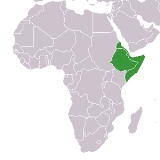
The
Horn of Africa (alternatively
Northeast Africa, and sometimes
Somali Peninsula; shortened to
HOA) is a
peninsulaA peninsula is a piece of land that is bordered by water on three sides but connected to mainland. In many Germanic and Celtic languages and also in Baltic, Slavic and Hungarian, peninsulas are called "half-islands"....
in
East AfricaEast Africa or Eastern Africa is the easterly region of the African continent, variably defined by geography or geopolitics. In the UN scheme of geographic regions, 19 territories constitute Eastern Africa:...
that juts hundreds of kilometers into the
Arabian SeaThe Arabian Sea is a region of the Indian Ocean bounded on the east by India, on the north by Pakistan and Iran, on the west by the Arabian Peninsula, on the south, approximately, by a line between Cape Guardafui in northeastern Somalia and Kanyakumari in India...
and lies along the southern side of the
Gulf of AdenThe Gulf of Aden is located in the Arabian Sea between Yemen, on the south coast of the Arabian Peninsula, and Somalia in the Horn of Africa. In the northwest, it connects with the Red Sea through the Bab-el-Mandeb strait, which is about 20 miles wide....
. It is the easternmost projection of the
African continentAfrica is the world's second largest and second most populous continent, after Asia. At about 30.2 million km² including adjacent islands, it covers 6% of the Earth's total surface area and 20.4% of the total land area...
. Referred to in medieval times as
Bilad al Barbar ("Land of the
BerbersBerbers are the indigenous peoples of North Africa west of the Nile Valley. They are continuously distributed from the Atlantic to the Siwa oasis, in Egypt, and from the Mediterranean to the Niger River. Historically they spoke the Berber language or varieties of it, which together form a branch...
"), the Horn of Africa denotes the region containing the countries of
EritreaEritrea , officially the State of Eritrea, is a country in the Horn of Africa. Eritrea derives it's name from the Greek word Erethria, meaning 'red land'. The capital is Asmara. It is bordered by Sudan in the west, Ethiopia in the south, and Djibouti in the southeast...
,
DjiboutiDjibouti , officially the Republic of Djibouti , is a country in the Horn of Africa. It is bordered by Eritrea in the north, Ethiopia in the west and south, and Somalia in the southeast. The remainder of the border is formed by the Red Sea and the Gulf of Aden at the east...
,
EthiopiaEthiopia , officially known as the Federal Democratic Republic of Ethiopia, is a country located in the Horn of Africa. It is the second-most populous nation in Africa, with over 82 million inhabitants, and the tenth-largest by area, occupying 1,100,000 km2...
and
SomaliaSomalia , officially the Somali Republic and formerly known as the Somali Democratic Republic under Socialist rule, is a country located in the Horn of Africa. Since the outbreak of the Somali Civil War in 1991 there has been no central government control over most of the country's territory...
.
It covers approximately 2,000,000 km² (770,000 sq mi) and is inhabited by about roughly 100 million people (Ethiopia: 85 million, Somalia: 9.3 million, Eritrea: 5.2 million, and Djibouti: 0.86 million). Regional studies on the Horn of Africa are carried out, among others, in the fields of
Ethiopian StudiesEthiopian Studies refers to a multi-disciplinary academic cluster dedicated to research on Ethiopia within the cultural and historical context of the Horn of Africa. The classical concept of Ethiopian Studies, developed by European scholars, is based on disciplines like philology and linguistics,...
as well as
Somali StudiesSomali Studies is the scholarly term for research concerning Somalis and Somalia. It consists of several disciplines such as anthropology, sociology, linguistics, historiography and archaeology...
.
Geography and climate
The Horn of Africa is almost equidistant from the
equatorAn equator is the intersection of a sphere's surface with the plane perpendicular to the sphere's axis of rotation and containing the sphere's center of mass....
and the
Tropic of CancerThe Tropic of Cancer, also referred to as the Northern tropic, is the circle of latitude on the Earth that marks the most northerly position at which the Sun may appear directly overhead at its zenith...
. It consists chiefly of mountains uplifted through the formation of the
Great Rift ValleyThe Great Rift Valley is a name given in the late 19th century by British explorer John Walter Gregory to the continuous geographic trench, approximately in length, that runs from northern Syria in Southwest Asia to central Mozambique in South East Africa...
, a fissure in the Earth's
crustIn geology, the crust is the outermost solid shell of a rocky planet or natural satellite, which is chemically distinct from the underlying mantle...
extending from
TurkeyTurkey , known officially as the Republic of Turkey , is a Eurasian country located in Western Asia and in East Thrace in Southeastern Europe...
to
MozambiqueMozambique, officially the Republic of Mozambique , is a country in southeastern Africa bordered by the Indian Ocean to the east, Tanzania to the north, Malawi and Zambia to the northwest, Zimbabwe to the west and Swaziland and South Africa to the southwest...
and marking the separation of the African and Arabian
tectonic platePlate tectonics is a scientific theory that describes the large scale motions of Earth's lithosphere...
s. Most of the region is mountainous which arose through faults resulting from the Rift Valley, with the highest peaks in the
Semien MountainsThe Semien Mountains lie in northern Ethiopia, north east of Gondar. They are a World Heritage Site and include the Semien Mountains National Park. The mountains consist of plateaux separated by valleys and rising to pinnacles...
of northwestern Ethiopia.
Extensive
glacierA glacier is a large persistent body of ice that forms where the accumulation of snow exceeds its ablation over many years, often centuries. At least 0.1 km² in area and 50 m thick, but often much larger, a glacier slowly deforms and flows due to stresses induced by its weight...
s once covered the Simien and
Bale MountainsThe Bale Mountains are a range of mountains in the Oromia Region of southeast Ethiopia, south of the Awash River. They include Tullu Demtu, the second-highest mountain in Ethiopia , and Mount Batu . The Weyib River, a tributary of the Jubba River, rises in these mountains east of Goba...
but melted at the beginning of the
HoloceneThe Holocene is a geological epoch which began at the end of the Pleistocene and continues to the present. The Holocene is part of the Quaternary period. Its name comes from the Greek words and , meaning "entirely recent"...
. The mountains descend in a huge escarpment to the
Red SeaThe Red Sea is a seawater inlet of the Indian Ocean, lying between Africa and Asia. The connection to the ocean is in the south through the Bab el Mandeb strait and the Gulf of Aden. In the north, there is the Sinai Peninsula, the Gulf of Aqaba, and the Gulf of Suez...
and more steadily to the
Indian OceanThe Indian Ocean is the third largest of the world's oceanic divisions, covering approximately 20% of the water on the Earth's surface. It is bounded on the north by the Indian Subcontinent and Arabian Peninsula ; on the west by eastern Africa; on the east by Indochina, the Sunda Islands, and...
.
SocotraSocotra , also spelt Soqotra, is a small archipelago of four islands in the Indian Ocean. The largest island, also called Socotra, is about 95% of the landmass of the archipelago. It lies some east of the Horn of Africa and south of the Arabian Peninsula. The island is very isolated and through...
is a small island in the Indian Ocean off the coast of Somalia. Its size is 3,600 km² (1,390 sq mi) and it is a territory of
YemenThe Republic of Yemen , commonly known as Yemen , is a country located in the Middle East, occupying the southwestern to southern end of the Arabian Peninsula. It is bordered by Saudi Arabia to the north, the Red Sea to the west, and Oman to the east....
, the southernmost country on the
Arabian peninsulaThe Arabian Peninsula is a land mass situated north-east of Africa. Also known as Arabia or the Arabian subcontinent, it is the world's largest peninsula and covers 3,237,500 km2...
.
The
lowlandIn physical geography, a lowland is any broad expanse of land with a general low level. The term is thus applied to the landward portion of the upward slope from oceanic depths to continental highlands, to a region of depression in the interior of a mountainous region, to a plain of denudation, or...
s of the Horn are generally arid in spite of their proximity to the equator. This is because the winds of the tropical
monsoonMonsoon is traditionally defined as a seasonal reversing wind accompanied by corresponding changes in precipitation, but is now used to describe seasonal changes in atmospheric circulation and precipitation associated with the asymmetric heating of land and sea...
s that give seasonal rains to the
SahelThe Sahel is the ecoclimatic and biogeographic zone of transition between the Sahara desert in the North and the Sudanian Savannas in the south.It stretches across the North African continent between the Atlantic Ocean and the Red Sea....
and the
SudanThe Sudan is the name given to a geographic region to the south of the Sahara, stretching from Western to Eastern Africa. The name derives from the Arabic bilâd as-sûdân or "land of the Blacks"...
blow from the west. Consequently, they lose their moisture upon reaching Djibouti and Somalia, with the result that most of the Horn receives little rainfall during the monsoon season. On the windward side in the west and center of Ethiopia and the extreme south of Eritrea, monsoonal rainfall is heavy.
In the mountains of Ethiopia, many areas receive over 2,000 mm (80 in) per year, and even
AsmaraAsmara is the capital city and largest settlement in Eritrea, home to a population of around 579,000 people...
receives an average of 570 mm (23 in). This rainfall is the sole source of water for many areas outside Ethiopia, most famously
EgyptEgypt , officially the Arab Republic of Egypt, Arabic: , is a country mainly in North Africa, with the Sinai Peninsula forming a land bridge in Southwest Asia. Egypt is thus a transcontinental country, and a major power in Africa, the Mediterranean Basin, the Middle East and the Muslim world...
, which — in terms of rainfall — is the driest nation on Earth.
In the winter, the northeasterly
trade windThe trade winds are the prevailing pattern of easterly surface winds found in the tropics, within the lower portion of the Earth's atmosphere, in the lower section of the troposphere near the Earth's equator...
s do not provide any moisture except in mountainous areas of northern Somalia, where rainfall in late autumn can produce annual totals as high as 500 mm (20 in). On the eastern coast, a strong
upwellingUpwelling is an oceanographic phenomenon that involves wind-driven motion of dense, cooler, and usually nutrient-rich water towards the ocean surface, replacing the warmer, usually nutrient-depleted surface water. The increased availability in upwelling regions results in high levels of primary...
and the fact that the winds blow parallel to the coast means annual rainfall can be as low as 50 mm (2 in).
Temperatures on the Red Sea coast are some of the hottest in the world, typically around 41°C (106°F) in July and 32°C (90°F) in January, though east coast temperatures are somewhat cooler because of the upwelling of the current. As elevation increases, temperatures decrease so that at Asmara, maximum temperatures are around 20°C (68°F), though
frostFrost is the solid deposition of water vapor from saturated air. It is formed when solid surfaces are cooled to below the dew point of the adjacent air as well as below the freezing point of water. Frost crystals' size differ depending on time and water vapour available. Frost is also usually...
s are frequent on cloudless nights. On the highest peaks of the Simien Mountains however, temperatures rarely reach 14°C (57°F) and can be as low as –10°C (14°F) on cloudless nights.
Prehistory
Shell middens 125,000 years old have been found in Eritrea, indicating the diet of early humans included seafood obtained by
beachcombingBeachcombing and beachcomber are words with multiple, but related, meanings that have evolved over time.A beachcomber is someone who "combs" the beach, and the intertidal zone in general, looking for things of value, interest or utility....
.
According to both genetic and fossil evidence,
archaic Homo sapiensArchaic Homo sapiens is a loosely defined term used to describe a number of varieties of Homo, as opposed to anatomically modern humans , in the period beginning 500,000 years ago....
evolved to
anatomically modern humansThe term anatomically modern humans in paleoanthropology refers to early individuals of Homo sapiens with an appearance consistent with the range of phenotypes in modern humans....
solely in Africa between 200,000 and 100,000 years ago, with members of one branch leaving Africa by 60,000 years ago and over time replacing earlier human populations such as Neanderthals and
Homo erectusHomo erectus is an extinct species of hominid that lived from the end of the Pliocene epoch to the later Pleistocene, about . The species originated in Africa and spread as far as India, China and Java. There is still disagreement on the subject of the classification, ancestry, and progeny of H...
. The recent single origin of modern humans in
East AfricaEast Africa or Eastern Africa is the easterly region of the African continent, variably defined by geography or geopolitics. In the UN scheme of geographic regions, 19 territories constitute Eastern Africa:...
is the near-consensus position held within the scientific community.
Today at the Bab-el-Mandeb straits the Red Sea is about 12 miles (20 kilometres) wide, but 50,000 years ago it was much narrower and sea levels were 70 meters lower. Though the straits were never completely closed, there may have been islands in between which could be reached using simple rafts.
It has been estimated that from a population of 2,000 to 5,000 individuals in Africa, only a small group of possibly as little as 150 to 1,000 people crossed the Red Sea. Of all the lineages present in Africa only the female descendants of one lineage,
mtDNA haplogroup L3In human mitochondrial genetics, Haplogroup L3 is a human mitochondrial DNA haplogroup. Haplogroup L3 has played a pivotal role in the history of the human species...
, are found outside Africa. Had there been several migrations one would expect descendants of more than one lineage to be found outside Africa. L3's female descendants, the
MIn human mitochondrial genetics, Haplogroup M is a human mitochondrial DNA haplogroup. An enormous haplogroup spanning all the continents, the macro-haplogroup M, like its sibling N, is a descendant of haplogroup L3....
and
NIn human mitochondrial genetics, Haplogroup N is a human mitochondrial DNA haplogroup. An enormous haplogroup spanning many continents, the macro-haplogroup N, like its sibling M, is a descendant of haplogroup L3....
haplogroup lineages, are found in very low frequencies in Africa (although haplogroup M1 is very ancient and diversified in North Africa and on the Horn of Africa) and appear to be recent arrivals.
Other scientists have proposed a Multiple Dispersal Model, in which there were two migrations out of Africa, one across the Red Sea travelling along the coastal regions to
IndiaSouth Asia, also known as Southern Asia, is the southern region of the Asian continent, which comprises the sub-Himalayan countries and, for some authorities , also includes the adjoining countries to the west and the east...
(the Coastal Route), which would be represented by Haplogroup M. Another group of migrants with Haplogroup N followed the Nile from East Africa, heading northwards and crossing into Asia through the Sinai. This group then branched in several directions, some moving into Europe and others heading east into Asia. This hypothesis attempts to explain why Haplogroup N is predominant in Europe and why Haplogroup M is absent in Europe.
Ancient history
Together with northern
SomaliaSomalia , officially the Somali Republic and formerly known as the Somali Democratic Republic under Socialist rule, is a country located in the Horn of Africa. Since the outbreak of the Somali Civil War in 1991 there has been no central government control over most of the country's territory...
,
DjiboutiDjibouti , officially the Republic of Djibouti , is a country in the Horn of Africa. It is bordered by Eritrea in the north, Ethiopia in the west and south, and Somalia in the southeast. The remainder of the border is formed by the Red Sea and the Gulf of Aden at the east...
, and the
Red SeaThe Red Sea is a seawater inlet of the Indian Ocean, lying between Africa and Asia. The connection to the ocean is in the south through the Bab el Mandeb strait and the Gulf of Aden. In the north, there is the Sinai Peninsula, the Gulf of Aqaba, and the Gulf of Suez...
coast of
SudanSudan , officially the Republic of the Sudan , is a country in North Africa, sometimes considered part of the Middle East politically. It is bordered by Egypt to the north, the Red Sea to the northeast, Eritrea and Ethiopia to the east, South Sudan to the south, the Central African Republic to the...
,
EritreaEritrea , officially the State of Eritrea, is a country in the Horn of Africa. Eritrea derives it's name from the Greek word Erethria, meaning 'red land'. The capital is Asmara. It is bordered by Sudan in the west, Ethiopia in the south, and Djibouti in the southeast...
is considered the most likely location of the land known to the ancient
EgyptiansEgyptians are nation an ethnic group made up of Mediterranean North Africans, the indigenous people of Egypt.Egyptian identity is closely tied to geography. The population of Egypt is concentrated in the lower Nile Valley, the small strip of cultivable land stretching from the First Cataract to...
as
PuntThe Land of Punt, also called Pwenet, or Pwene by the ancient Egyptians, was a trading partner known for producing and exporting gold, aromatic resins, African blackwood, ebony, ivory, slaves and wild animals...
(or "Ta Netjeru," meaning god's land), whose first mention dates to the 25th century BC. The ancient Puntites were a nation of people that had close relations with
Pharaonic EgyptPharaoh is a title used in many modern discussions of the ancient Egyptian rulers of all periods. The title originates in the term "pr-aa" which means "great house" and describes the royal palace...
during the times of
PharaohPharaoh is a title used in many modern discussions of the ancient Egyptian rulers of all periods. The title originates in the term "pr-aa" which means "great house" and describes the royal palace...
Sahure- Etymology :Sahure's birth name means "He who is Close to Re". His Horus name was Nebkhau.- Biography :Sahure was a son of queen Neferhetepes, as shown in scenes from the causeway of Sahure's pyramid complex in Abusir. His father was Userkaf. Sahure's consort was queen Neferetnebty. Reliefs show...
and
QueenA queen regnant is a female monarch who reigns in her own right, in contrast to a queen consort, who is the wife of a reigning king. An empress regnant is a female monarch who reigns in her own right over an empire....
HatshepsutHatshepsut also Hatchepsut; meaning Foremost of Noble Ladies;1508–1458 BC) was the fifth pharaoh of the eighteenth dynasty of Ancient Egypt...
.
D'mt was a kingdom located in Eritrea and northern
EthiopiaEthiopia , officially known as the Federal Democratic Republic of Ethiopia, is a country located in the Horn of Africa. It is the second-most populous nation in Africa, with over 82 million inhabitants, and the tenth-largest by area, occupying 1,100,000 km2...
that existed during the 8th and 7th centuries BC. With its capital at
YehaYeha is a town in northern Ethiopia, located in the Mehakelegnaw Zone of the Tigray Region. The Central Statistical Agency has not published an estimate for this village's 2005 population.- Archeology :...
, the kingdom developed
irrigationIrrigation may be defined as the science of artificial application of water to the land or soil. It is used to assist in the growing of agricultural crops, maintenance of landscapes, and revegetation of disturbed soils in dry areas and during periods of inadequate rainfall...
schemes, used plows, grew
milletThe millets are a group of small-seeded species of cereal crops or grains, widely grown around the world for food and fodder. They do not form a taxonomic group, but rather a functional or agronomic one. Their essential similarities are that they are small-seeded grasses grown in difficult...
, and made
ironIron is a chemical element with the symbol Fe and atomic number 26. It is a metal in the first transition series. It is the most common element forming the planet Earth as a whole, forming much of Earth's outer and inner core. It is the fourth most common element in the Earth's crust...
tools and weapons. After the fall of Dʿmt in the 5th century BC, the plateau came to be dominated by smaller successor kingdoms, until the rise of one of these kingdoms during the first century, the Aksumite Kingdom, which was able to reunite the area.
The Kingdom of Aksum (also known as "Axum") was an ancient state located in the north of modern-day Ethiopia and parts of Eritrea that thrived between the 1st and 7th centuries. A major player in the commerce between the
Roman EmpireThe Roman Empire was the post-Republican period of the ancient Roman civilization, characterised by an autocratic form of government and large territorial holdings in Europe and around the Mediterranean....
and
Ancient IndiaAncient India may refer to:* The ancient history of India, which generally includes the ancient history of the Asian Subcontinent, including:*Science and technology in ancient India**Indian mathematics**Astronomy**List of Indian inventions...
, Aksum's rulers facilitated trade by minting their own
currencyAksumite currency was the first native currency to be issued in Africa without direct control by an outside culture like the Romans or Greeks. It was issued and circulated from the middle of the height of the Kingdom of Aksum under King Endubis around AD 270 until it began its decline in the first...
. The state also established its
hegemonyHegemony is an indirect form of imperial dominance in which the hegemon rules sub-ordinate states by the implied means of power rather than direct military force. In Ancient Greece , hegemony denoted the politico–military dominance of a city-state over other city-states...
over the declining
Kingdom of KushThe native name of the Kingdom was likely kaš, recorded in Egyptian as .The name Kash is probably connected to Cush in the Hebrew Bible , son of Ham ....
and regularly entered the politics of the kingdoms on the
Arabian peninsulaThe Arabian Peninsula is a land mass situated north-east of Africa. Also known as Arabia or the Arabian subcontinent, it is the world's largest peninsula and covers 3,237,500 km2...
, eventually extending its rule over the region with the conquest of the Himyarite Kingdom. Under Ezana, Aksum became the first major empire to convert to
ChristianityChristianity is a monotheistic religion based on the life and teachings of Jesus as presented in canonical gospels and other New Testament writings...
, and was named by
ManiMani , of Iranian origin was the prophet and the founder of Manichaeism, a gnostic religion of Late Antiquity which was once widespread but is now extinct...
as one of the four great powers of his time, along with
PersiaThe Sassanid Empire , known to its inhabitants as Ērānshahr and Ērān in Middle Persian and resulting in the New Persian terms Iranshahr and Iran , was the last pre-Islamic Persian Empire, ruled by the Sasanian Dynasty from 224 to 651...
,
RomeThe Roman Empire was the post-Republican period of the ancient Roman civilization, characterised by an autocratic form of government and large territorial holdings in Europe and around the Mediterranean....
and
ChinaThe Han Dynasty was the second imperial dynasty of China, preceded by the Qin Dynasty and succeeded by the Three Kingdoms . It was founded by the rebel leader Liu Bang, known posthumously as Emperor Gaozu of Han. It was briefly interrupted by the Xin Dynasty of the former regent Wang Mang...
.
Northern Somalia was an important link in the Horn, connecting the region's commerce with the rest of the ancient world. Somali sailors and merchants were the main suppliers of
frankincenseFrankincense, also called olibanum , is an aromatic resin obtained from trees of the genus Boswellia, particularly Boswellia sacra, B. carteri, B. thurifera, B. frereana, and B. bhaw-dajiana...
,
myrrhMyrrh is the aromatic oleoresin of a number of small, thorny tree species of the genus Commiphora, which grow in dry, stony soil. An oleoresin is a natural blend of an essential oil and a resin. Myrrh resin is a natural gum....
and spices, all of which were valuable luxuries to the Ancient Egyptians, Phoenicians,
MycenaeansMycenaean Greece was a cultural period of Bronze Age Greece taking its name from the archaeological site of Mycenae in northeastern Argolis, in the Peloponnese of southern Greece. Athens, Pylos, Thebes, and Tiryns are also important Mycenaean sites...
, Babylonians and
RomansThe Roman Empire was the post-Republican period of the ancient Roman civilization, characterised by an autocratic form of government and large territorial holdings in Europe and around the Mediterranean....
. The Romans consequently began to refer to the region as
Regio Aromatica. In the
classical eraClassical antiquity is a broad term for a long period of cultural history centered on the Mediterranean Sea, comprising the interlocking civilizations of ancient Greece and ancient Rome, collectively known as the Greco-Roman world...
, several flourishing Somali city-states such as
Opone,
MosyllonCape Guardafui , also known as Ras Asir and historically as Aromata promontorium, is a headland in the northeastern Bari province of Somalia. Located in the autonomous Puntland region, it forms the geographical apex of the region commonly referred to as the Horn of Africa.-Location:Cape Guardafui...
and
MalaoBerbera is a city and seat of Berbera District in Somaliland, a self-proclaimed Independent Republic with de facto control over its own territory, which is recognized by the international community and the Somali Government as a part of Somalia...
also competed with the Sabaeans,
ParthiaParthia is a region of north-eastern Iran, best known for having been the political and cultural base of the Arsacid dynasty, rulers of the Parthian Empire....
ns and Axumites for the rich
IndoIndia , officially the Republic of India , is a country in South Asia. It is the seventh-largest country by geographical area, the second-most populous country with over 1.2 billion people, and the most populous democracy in the world...
-Greco-Roman trade.
The birth of Islam opposite the Horn's Red Sea coast meant that local merchants and sailors living on the
Arabian PeninsulaThe Arabian Peninsula is a land mass situated north-east of Africa. Also known as Arabia or the Arabian subcontinent, it is the world's largest peninsula and covers 3,237,500 km2...
gradually came under the influence of the new religion through their converted
ArabArab people, also known as Arabs , are a panethnicity primarily living in the Arab world, which is located in Western Asia and North Africa. They are identified as such on one or more of genealogical, linguistic, or cultural grounds, with tribal affiliations, and intra-tribal relationships playing...
Muslim trading partners. With the migration of Muslim families from the Islamic world to the Horn in the early centuries of Islam, and the peaceful conversion of the local population by Muslim scholars in the following centuries, the ancient city-states eventually transformed into Islamic
MogadishuMogadishu , popularly known as Xamar, is the largest city in Somalia and the nation's capital. Located in the coastal Benadir region on the Indian Ocean, the city has served as an important port for centuries....
,
BerberaBerbera is a city and seat of Berbera District in Somaliland, a self-proclaimed Independent Republic with de facto control over its own territory, which is recognized by the international community and the Somali Government as a part of Somalia...
,
ZeilaZeila, also known as Zaila , is a port city on the Gulf of Aden coast, situated in the northwestern Awdal region of Somalia.Located near the Djibouti border, the town sits on a sandy spit surrounded by the sea. It is known for its offshore islands, coral reef and mangroves. Landward, the terrain is...
,
BarawaBarawa or Brava is a port town on the south-eastern coast of Somalia. The traditional inhabitants are the Tunni Somalis and the Bravanese people, who speak Bravanese, a Swahili dialect.-History:...
and Merka, which were part of the
Berber civilization. The city of Mogadishu came to be known as the "City of Islam" and controlled the East African gold trade for several centuries.
Middle Ages and Early Modern era
During the
Middle AgesThe Middle Ages is a periodization of European history from the 5th century to the 15th century. The Middle Ages follows the fall of the Western Roman Empire in 476 and precedes the Early Modern Era. It is the middle period of a three-period division of Western history: Classic, Medieval and Modern...
, several powerful empires dominated the regional trade, including the
Sultanate of AdalThe Adal Sultanate or the Kingdom of Adal was a medieval multi-ethnic Muslim state located in the Horn of Africa.-Overview:...
, the
Ajuuraan StateThe Ajuuraan state or Ajuuraan sultanate was a Somali Muslim empire that ruled over large parts of East Africa in the Middle Ages. Through a strong centralized administration and an aggressive military stance towards invaders, the Ajuuraan Empire successfully resisted an Oromo invasion from the...
, the Warsangali Sultanate, the
Zagwe dynastyThe Zagwe dynasty was an historical kingdom in present-day Ethiopia. It ruled large parts of the territory from approximately 1137 to 1270, when the last Zagwe King Za-Ilmaknun was killed in battle by the forces of Yekuno Amlak...
, and the
Gobroon DynastyThe Gobroon dynasty or Geledi sultanate was a Somali royal house that ruled parts of East Africa during the 18th and 19th centuries. It was established by the Ajuuraan soldier Ibrahim Adeer, who had defeated various vassals of the Ajuuraan Empire and established the House of Gobroon...
.
The
Adal SultanateThe Adal Sultanate or the Kingdom of Adal was a medieval multi-ethnic Muslim state located in the Horn of Africa.-Overview:...
was a medieval multi-ethnic
MuslimA Muslim, also spelled Moslem, is an adherent of Islam, a monotheistic, Abrahamic religion based on the Quran, which Muslims consider the verbatim word of God as revealed to prophet Muhammad. "Muslim" is the Arabic term for "submitter" .Muslims believe that God is one and incomparable...
state in the Horn. At its height, it controlled large parts of Somalia, Ethiopia, Djibouti and Eritrea. Many of the historic cities in the region, such as
Maduna-History:It is situated 90 km southward of Erigavo.The city is said to date from the Golden Age of the Adal Sultanate, which was in the 15th and 16th centuries....
,
Abasa-Overview:Abasa is situated to the north of Borama. A large town, it features numerous ruined structures stretching over a wide area. The buildings were built in a rectangular style, and the now ruined Abasa Mosque has large columns of two different types: cylindrical and cruciform...
,
BerberaBerbera is a city and seat of Berbera District in Somaliland, a self-proclaimed Independent Republic with de facto control over its own territory, which is recognized by the international community and the Somali Government as a part of Somalia...
,
ZeilaZeila, also known as Zaila , is a port city on the Gulf of Aden coast, situated in the northwestern Awdal region of Somalia.Located near the Djibouti border, the town sits on a sandy spit surrounded by the sea. It is known for its offshore islands, coral reef and mangroves. Landward, the terrain is...
and
HararHarar is an eastern city in Ethiopia, and the capital of the modern Harari ethno-political division of Ethiopia...
, flourished during the kingdom's golden age, a period that left behind numerous
courtyard housesA court or courtyard is an enclosed area, often a space enclosed by a building that is open to the sky. These areas in inns and public buildings were often the primary meeting places for some purposes, leading to the other meanings of court....
,
mosqueA mosque is a place of worship for followers of Islam. The word is likely to have entered the English language through French , from Portuguese , from Spanish , and from Berber , ultimately originating in — . The Arabic word masjid literally means a place of prostration...
s,
shrineA shrine is a holy or sacred place, which is dedicated to a specific deity, ancestor, hero, martyr, saint, daemon or similar figure of awe and respect, at which they are venerated or worshipped. Shrines often contain idols, relics, or other such objects associated with the figure being venerated....
s and
walled enclosureA defensive wall is a fortification used to protect a city or settlement from potential aggressors. In ancient to modern times, they were used to enclose settlements...
s. After the death of
Sa'ad ad-Din IISa'ad ad-Din II was a Sultan of the Ifat Sultanate. He was the brother of Haqq ad-Din II, and the father of Mansur ad-Din, Sabr ad-Din II and Badlay ibn Sa'ad ad-Din. The historian Richard Pankhurst describes him as "the last great ruler of Ifat."-Reign:Sa'ad ad-Din II was born at the court of...
, Adal succeeded the Ifat Sultanate as the pre-eminent local Muslim power. Under the leadership of rulers such as
Sabr ad-Din IISabr ad-Din II was a King of Adal and the oldest son of Sa'ad ad-Din II. Trimingham tersely states that Sabr ad-Din returned to the Horn of Africa from Yemen to reclaim his father's realm, but was defeated in battle by the Emperor of Ethiopia Yeshaq.-Reign:E. A...
, Mansur ad-Din,
Jamal ad-Din IIJamal ad-Din II was a Sultan of the Sultanate of Adal and the youngest son of Sa'ad ad-Din II.-Reign:With the help of the Ethiopian defector Harb Jaush, who also served as a commander under his brother Sabr ad-Din II, Jamal ad-Din was able to defeat the armies of the Ethiopian Emperor in three...
,
Shams ad-DinShams ad-Din ibn Muhammad was a Sultan of the Sultanate of Adal and a son of Muhammad ibn Badlay.-Reign:During Shams ad-Din's reign, an army of the Emperor of Ethiopia Eskender invaded Adal and seized Dakkar, destroying houses and places of worship; however, on its return home the Adal forces...
, General
MahfuzMahfuz was Imam of Zeila, and a general of Sultan Muhammad ibn Azhar ad-Din of the Adal Sultanate. However, James Bruce, drawing on Ethiopian sources, writes that Mahfuz was the chief of Arar.-Biography:...
and
Ahmad ibn Ibrihim al-GhaziAhmad ibn Ibrahim al-Ghazi "the Conqueror" was an Imam and General of Adal who invaded Ethiopia and defeated several Ethiopian emperors, wreaking much damage on that kingdom...
, Adalite armies continued the struggle against the
Solomonic dynastyThe Solomonic dynasty is the Imperial House of Abyssinia. Its members claim lineal descent from King Solomon and the Queen of Sheba, the latter of whom tradition asserts gave birth to the first King Menelik I after her Biblically described visit to Solomon in Jerusalem .-Overview:The dynasty, a...
, a campaign historically known as the
Conquest of AbyssiniaThe Ethiopian–Adal War was a military conflict between the Ethiopian Empire and the Adal Sultanate from 1529 until 1559. The Imam Ahmad ibn Ibrihim al-Ghazi came close to extinguishing the ancient realm of Ethiopia, and converting all of its subjects to Islam; the intervention of the...
or
Futuh al Habash.
The Warsangali Sultanate was an
imperialThe term empire derives from the Latin imperium . Politically, an empire is a geographically extensive group of states and peoples united and ruled either by a monarch or an oligarchy....
ruling house centered in northeastern and in some parts of southeastern Somalia. It was one of the largest sultanates ever established in the territory, and, at the height of its power, included the
SanaagSanaag is an administrative region in northern Somalia. Its capital city is Erigavo.Sanaag has a long coastline facing the Gulf of Aden to the north, and is bordered by the Somali regions of Woqooyi Galbeed, Togdheer, Sool and Bari....
region and parts of the northeastern Bari region of the country, an area historically known as
MaakhirMaakhir , officially the Maakhir State of Somalia was an autonomous region in northern Somalia in an area disputed by the Somaliland and Puntland macro-regions. In January 2009, it was incorporated into Puntland.-Autonomy:...
or the
Maakhir Coast. The Sultanate was founded in the late 13th century in northern Somalia by a group of Somalis from the
WarsangaliThe Warsangeli , is a Somali clan, part of the Harti confederation of Darod sub-clans...
branch of the
DarodThe Darod is a Somali clan. The father of this clan is named Abdirahman bin Isma'il al-Jabarti, but is more commonly known as Darod. In the Somali language, the word Daarood means "an enclosed compound," a conflation of the two words daar and ood .The Darod population in Somalia lives principally...
clan, and was ruled by the descendants of the
Gerad DhidhinGerad Dhidhin , also known as Gerad Abdulahi, was the founder of the Warsangali Sultanate in the late 13th century in the territory of present-day northern Somalia.-History:...
.
Through a strong centralized administration and an aggressive military stance towards invaders, the
Ajuuraan EmpireThe Ajuuraan state or Ajuuraan sultanate was a Somali Muslim empire that ruled over large parts of East Africa in the Middle Ages. Through a strong centralized administration and an aggressive military stance towards invaders, the Ajuuraan Empire successfully resisted an Oromo invasion from the...
successfully resisted an
OromoThe Oromo are an ethnic group found in Ethiopia, northern Kenya, .and parts of Somalia. With 30 million members, they constitute the single largest ethnic group in Ethiopia and approximately 34.49% of the population according to the 2007 census...
invasion from the west and a
PortuguesePortugal , officially the Portuguese Republic is a country situated in southwestern Europe on the Iberian Peninsula. Portugal is the westernmost country of Europe, and is bordered by the Atlantic Ocean to the West and South and by Spain to the North and East. The Atlantic archipelagos of the...
incursion from the east during the Gaal Madow and the Ajuuraan-Portuguese wars. Trading routes dating from the ancient and early medieval periods of Somali maritime enterprise were also strengthened or re-established, and the state left behind an extensive architectural legacy. Many of the hundreds of ruined castles and fortresses that dot the landscape of Somalia today are attributed to Ajuuraan engineers, including a lot of the
pillar tombA pillar tomb is a monumental grave the central feature of which is a single, prominent pillar or column, often made of stone.A number of world cultures incorporated pillars into tomb structures, notably the ancient Greek colony of Lycia in Anatolia and the medieval Muslim Swahili culture of the...
fields,
necropolisA necropolis is a large cemetery or burial ground, usually including structural tombs. The word comes from the Greek νεκρόπολις - nekropolis, literally meaning "city of the dead"...
es and ruined cities built during that era. The royal family, the House of Gareen, also expanded its territories and established its hegemonic rule through a skillful combination of warfare, trade linkages and alliances.
The
Zagwe dynastyThe Zagwe dynasty was an historical kingdom in present-day Ethiopia. It ruled large parts of the territory from approximately 1137 to 1270, when the last Zagwe King Za-Ilmaknun was killed in battle by the forces of Yekuno Amlak...
ruled many parts of modern Ethiopia and Eritrea from approximately 1137 to 1270. The name of the dynasty comes from the
CushiticThe Cushitic languages are a branch of the Afroasiatic language family spoken in the Horn of Africa, Tanzania, Kenya, Sudan and Egypt. They are named after the Biblical character Cush, who was identified as an ancestor of the speakers of these specific languages as early as AD 947...
-speaking Agaw people of northern Ethiopia. From 1270 CE on for many centuries, the
Solomonic dynastyThe Solomonic dynasty is the Imperial House of Abyssinia. Its members claim lineal descent from King Solomon and the Queen of Sheba, the latter of whom tradition asserts gave birth to the first King Menelik I after her Biblically described visit to Solomon in Jerusalem .-Overview:The dynasty, a...
ruled the
Ethiopian EmpireThe Ethiopian Empire also known as Abyssinia, covered a geographical area that the present-day northern half of Ethiopia and Eritrea covers, and included in its peripheries Zeila, Djibouti, Yemen and Western Saudi Arabia...
.
In the early fifteenth century Ethiopia sought to make diplomatic contact with European kingdoms for the first time since Aksumite times. A letter from King
Henry IV of EnglandHenry IV was King of England and Lord of Ireland . He was the ninth King of England of the House of Plantagenet and also asserted his grandfather's claim to the title King of France. He was born at Bolingbroke Castle in Lincolnshire, hence his other name, Henry Bolingbroke...
to the Emperor of Abyssinia survives. In 1428, the Emperor
YeshaqYeshaq I or Isaac was of Ethiopia. A member of the Solomonic dynasty, he was the second son of Dawit I.-History:Yeshaq's reign was marked by a revolt of the Beta Israel...
sent two emissaries to
Alfonso V of AragonAlfonso the Magnanimous KG was the King of Aragon , Valencia , Majorca, Sardinia and Corsica , and Sicily and Count of Barcelona from 1416 and King of Naples from 1442 until his death...
, who sent return emissaries who failed to complete the return trip.
The first continuous relations with a European country began in 1508 with Portugal under Emperor
Lebna DengelDawit II , enthroned as Emperor Anbasa Segad , better known by his birth name Lebna Dengel was of Ethiopia, and a member of the Solomonic dynasty...
, who had just inherited the throne from his father. This proved to be an important development, for when the empire was subjected to the attacks of the
Adal SultanateThe Adal Sultanate or the Kingdom of Adal was a medieval multi-ethnic Muslim state located in the Horn of Africa.-Overview:...
General and
ImamAn imam is an Islamic leadership position, often the worship leader of a mosque and the Muslim community. Similar to spiritual leaders, the imam is the one who leads Islamic worship services. More often, the community turns to the mosque imam if they have a religious question...
,
Ahmad ibn Ibrihim al-GhaziAhmad ibn Ibrahim al-Ghazi "the Conqueror" was an Imam and General of Adal who invaded Ethiopia and defeated several Ethiopian emperors, wreaking much damage on that kingdom...
(called "
Gurey" or "
Grañ", both meaning "the Left-handed"), Portugal assisted the Ethiopian emperor by sending weapons and four hundred men, who helped his son
GelawdewosGelawdewos was Emperor Gelawdewos (Ge'ez ገላውዴዎስ galāwdēwōs, modern gelāwdēwōs, "Claudius"; 1521/1522 - March 23, 1559) was Emperor Gelawdewos (Ge'ez ገላውዴዎስ galāwdēwōs, modern gelāwdēwōs, "Claudius"; 1521/1522 - March 23, 1559) was Emperor (throne name Asnaf Sagad I (Ge'ez አጽናፍ ሰገድ aṣnāf sagad,...
defeat Ahmad and re-establish his rule. This Ethiopian–Adal War was also one of the first proxy wars in the region as the
Ottoman EmpireThe Ottoman EmpireIt was usually referred to as the "Ottoman Empire", the "Turkish Empire", the "Ottoman Caliphate" or more commonly "Turkey" by its contemporaries...
, and Portugal took sides in the conflict.
When Emperor
SusenyosSusenyos was of Ethiopia...
converted to
Roman CatholicismThe Catholic Church, also known as the Roman Catholic Church, is the world's largest Christian church, with over a billion members. Led by the Pope, it defines its mission as spreading the gospel of Jesus Christ, administering the sacraments and exercising charity...
in 1624, years of revolt and civil unrest followed resulting in thousands of deaths. The
JesuitThe Society of Jesus is a Catholic male religious order that follows the teachings of the Catholic Church. The members are called Jesuits, and are also known colloquially as "God's Army" and as "The Company," these being references to founder Ignatius of Loyola's military background and a...
missionaries had offended the Orthodox faith of the local Ethiopians, and on June 25, 1632, Susenyos's son, Emperor
FasilidesFasilides was of Ethiopia, and a member of the Solomonic dynasty...
, declared the state religion to again be
Ethiopian Orthodox ChristianityThe Ethiopian Orthodox Tewahedo Church is the predominant Oriental Orthodox Christian church in Ethiopia. The Ethiopian Church was administratively part of the Coptic Orthodox Church until 1959, when it was granted its own Patriarch by Coptic Orthodox Pope of Alexandria and Patriarch of All...
and expelled the Jesuit missionaries and other Europeans.
The
Gobroon DynastyThe Gobroon dynasty or Geledi sultanate was a Somali royal house that ruled parts of East Africa during the 18th and 19th centuries. It was established by the Ajuuraan soldier Ibrahim Adeer, who had defeated various vassals of the Ajuuraan Empire and established the House of Gobroon...
(Geledi Sultanate) was a Somali royal house that ruled parts of East Africa during the 18th and 19th centuries. It was established by the Ajuuraan soldier
Ibrahim AdeerIbrahim Adeer was a Somali ruler, and the founder of the Gobroon Dynasty.-Biography:In the late 17th century, Adeer, who was a soldier at the time, successfully pushed back the imperial Ajuuraan army out of Afgooye...
, who had defeated various
vassalA vassal or feudatory is a person who has entered into a mutual obligation to a lord or monarch in the context of the feudal system in medieval Europe. The obligations often included military support and mutual protection, in exchange for certain privileges, usually including the grant of land held...
s of the Ajuuraan Empire and established the
House of Gobroon. The
dynastyA dynasty is a sequence of rulers considered members of the same family. Historians traditionally consider many sovereign states' history within a framework of successive dynasties, e.g., China, Ancient Egypt and the Persian Empire...
reached its apex under the successive reigns of Sultan
Yusuf Mahamud IbrahimYusuf Mahamud Ibrahim was a Somali ruler, and the third Sultan of the Gobroon Dynasty from 1798 to 1848.-Biography:Yusuf was the son of the Somali Sultan Mahamud Ibrahim, and the grandson of Ibrahim Adeer...
, who successfully consolidated Gobroon power during the
Bardera warsBardera City is an important agricultural city in the Gedo region of Somalia. It is the second most populous town in the Juba Valley, with Kismayo being the largest and most densely populated city in the region, and Garbahaarreey serving as Gedo's capital...
, and Sultan
Ahmed YusufAhmed Yusuf was a Somali ruler, and the fourth Sultan of the Gobroon Dynasty from 1848 to 1878.-Biography:Yusuf was born in the town of Afgooye, where he stayed until the age of seven...
, who forced regional powers such as the
Omani EmpireOman , officially called the Sultanate of Oman , is an Arab state in southwest Asia on the southeast coast of the Arabian Peninsula. It is bordered by the United Arab Emirates to the northwest, Saudi Arabia to the west, and Yemen to the southwest. The coast is formed by the Arabian Sea on the...
to submit
tributeA tribute is wealth, often in kind, that one party gives to another as a sign of respect or, as was often the case in historical contexts, of submission or allegiance. Various ancient states, which could be called suzerains, exacted tribute from areas they had conquered or threatened to conquer...
.
The
Sultanate of HobyoThe Sultanate of Hobyo was a 19th century Somali ruling house in present-day northern Somalia. It was carved out of the former Majeerteen Sultanate by Yusuf Ali Kenadid, cousin of the Majeerteen Sultanate's ruler, Boqor Osman Mahamuud....
was a 19th century Somali ruling house founded by Sultan Yusuf Ali Kenadid. Initially, Kenadid's goal was to seize control of the neighboring Majeerteen Sultanate, which was then ruled by his cousin Boqor Osman Mahamud. However, he was unsuccessful in this endeavor, and was eventually forced into exile in
YemenThe Republic of Yemen , commonly known as Yemen , is a country located in the Middle East, occupying the southwestern to southern end of the Arabian Peninsula. It is bordered by Saudi Arabia to the north, the Red Sea to the west, and Oman to the east....
. A decade later, in the 1870s, Kenadid returned from the
Arabian PeninsulaThe Arabian Peninsula is a land mass situated north-east of Africa. Also known as Arabia or the Arabian subcontinent, it is the world's largest peninsula and covers 3,237,500 km2...
with a band of
HadhramiHadhramaut, Hadhramout, Hadramawt or Ḥaḍramūt is the formerly independent Qu'aiti state and sultanate encompassing a historical region of the south Arabian Peninsula along the Gulf of Aden in the Arabian Sea, extending eastwards from Yemen to the borders of the Dhofar region of Oman...
musketeerA musketeer was an early modern type of infantry soldier equipped with a musket. Musketeers were an important part of early modern armies, particularly in Europe. They sometimes could fight on horseback, like a dragoon or a cavalryman...
s and a group of devoted lieutenants. With their assistance, he managed to establish the kingdom of Hobyo, which would rule much of northeastern and central Somalia during the early modern period.
Modern history
In the period following the opening of the
Suez canalThe Suez Canal , also known by the nickname "The Highway to India", is an artificial sea-level waterway in Egypt, connecting the Mediterranean Sea and the Red Sea. Opened in November 1869 after 10 years of construction work, it allows water transportation between Europe and Asia without navigation...
in 1869, when European powers scrambled for territory in Africa and tried to establish coaling stations for their ships, Italy invaded and occupied
EritreaEritrea , officially the State of Eritrea, is a country in the Horn of Africa. Eritrea derives it's name from the Greek word Erethria, meaning 'red land'. The capital is Asmara. It is bordered by Sudan in the west, Ethiopia in the south, and Djibouti in the southeast...
. On January 1, 1890, Eritrea officially became a colony of
ItalyItaly , officially the Italian Republic languages]] under the European Charter for Regional or Minority Languages. In each of these, Italy's official name is as follows:;;;;;;;;), is a unitary parliamentary republic in South-Central Europe. To the north it borders France, Switzerland, Austria and...
. In 1896 further Italian incursion into the horn was decisively halted by Ethiopian forces. By 1936 however, Eritrea became a province of
Italian East AfricaItalian East Africa was an Italian colonial administrative subdivision established in 1936, resulting from the merger of the Ethiopian Empire with the old colonies of Italian Somaliland and Italian Eritrea. In August 1940, British Somaliland was conquered and annexed to Italian East Africa...
(Africa Orientale Italiana), along with
EthiopiaEthiopia , officially known as the Federal Democratic Republic of Ethiopia, is a country located in the Horn of Africa. It is the second-most populous nation in Africa, with over 82 million inhabitants, and the tenth-largest by area, occupying 1,100,000 km2...
and
Italian SomalilandItalian Somaliland , also known as Italian Somalia, was a colony of the Kingdom of Italy from the 1880s until 1936 in the region of modern-day Somalia. Ruled in the 19th century by the Somali Sultanate of Hobyo and the Majeerteen Sultanate, the territory was later acquired by Italy through various...
. By 1941, Eritrea had about 760,000 inhabitants, including 70,000 Italians. The Commonwealth armed forces, along with the Ethiopian patriotic resistance, expelled those of Italy in 1941, and took over the area's administration. The British continued to administer the territory under a
UN MandateThe term UN mandate is typically used to refer to a long-term international mission which has been authorized by the United Nations General Assembly or the UN Security Council in particular. UN mandates typically involve peacekeeping operations....
until 1951, when Eritrea was federated with Ethiopia, as per UN resolution 390(A) and under the prompting of the United States adopted in December 1950.
The strategic importance of Eritrea, due to its Red Sea coastline and mineral resources, was the main cause for the federation with Ethiopia, which in turn led to Eritrea's annexation as Ethiopia's 14th province in 1952. This was the culmination of a gradual process of takeover by the Ethiopian authorities, a process which included a 1959 edict establishing the compulsory teaching of Amharic, the main language of Ethiopia, in all Eritrean schools. The lack of regard for the Eritrean population led to the formation of an independence movement in the early 1960s (1961), which erupted into a
30-year warThe Eritrean War of Independence was a conflict fought between the Ethiopian government and Eritrean separatists, both before and during the Ethiopian Civil War. The war started when Eritrea’s autonomy within Ethiopia, where troops were already stationed, was unilaterally revoked...
against successive Ethiopian governments that ended in 1991. Following a UN-supervised referendum in Eritrea (dubbed UNOVER) in which the Eritrean people overwhelmingly voted for independence, Eritrea declared its independence and gained international recognition in 1993. In 1998, a border dispute with Ethiopia led to the
Eritrean-Ethiopian WarThe Eritrean–Ethiopian War took place from May 1998 to June 2000 between Ethiopia and Eritrea, forming one of the conflicts in the Horn of Africa...
.
From 1862 until 1894, the land to the north of the
Gulf of TadjouraThe Gulf of Tadjoura is a gulf or basin of the Indian Ocean in the Horn of Africa. It lies south of the straits of Bab-el-Mandeb, or the entrance to the Red Sea, at . Most of its coastline is the territory of Djibouti, except for a short stretch on the southern shore, which is part of the...
situated in modern-day
DjiboutiDjibouti , officially the Republic of Djibouti , is a country in the Horn of Africa. It is bordered by Eritrea in the north, Ethiopia in the west and south, and Somalia in the southeast. The remainder of the border is formed by the Red Sea and the Gulf of Aden at the east...
was called
Obock and was ruled by
SomaliSomalis are an ethnic group located in the Horn of Africa, also known as the Somali Peninsula. The overwhelming majority of Somalis speak the Somali language, which is part of the Cushitic branch of the Afro-Asiatic language family...
and
AfarThe Afar , also known as the Danakil, are an ethnic group in the Horn of Africa. They primarily live in the Afar Region of Ethiopia and in northern Djibouti, although some also inhabit the southern point of Eritrea.-Early history:...
SultanSultan is a title with several historical meanings. Originally, it was an Arabic language abstract noun meaning "strength", "authority", "rulership", and "dictatorship", derived from the masdar سلطة , meaning "authority" or "power". Later, it came to be used as the title of certain rulers who...
s, local authorities with whom
FranceThe French Republic , The French Republic , The French Republic , (commonly known as France , is a unitary semi-presidential republic in Western Europe with several overseas territories and islands located on other continents and in the Indian, Pacific, and Atlantic oceans. Metropolitan France...
signed various treaties between 1883 and 1887 to first gain a foothold in the region. In 1894,
Léonce LagardeLéonce Lagarde, comte de Rouffeyroux, was a French colonial governor of French Somaliland and ambassador.-Biography:...
established a permanent French administration in the
city of DjiboutiThe City of Djibouti is the capital and largest city in the Republic of Djibouti, a nation in the Horn of Africa. The biggest settlement on the Gulf of Tadjoura, it lies on a peninsula that separates that basin from the Gulf of Aden.-History:...
and named the region
Côte française des Somalis (
French SomalilandFrench Somaliland was a French colony in the Horn of Africa. Established after the French signed various treaties between 1883 and 1887 with the then ruling Somali Sultans, the colony lasted from 1896 until 1946, when it became an overseas territory of France....
), a name which continued until 1967.
In 1958, on the eve of neighboring
SomaliaSomalia , officially the Somali Republic and formerly known as the Somali Democratic Republic under Socialist rule, is a country located in the Horn of Africa. Since the outbreak of the Somali Civil War in 1991 there has been no central government control over most of the country's territory...
's independence in 1960, a
referendumA referendum is a direct vote in which an entire electorate is asked to either accept or reject a particular proposal. This may result in the adoption of a new constitution, a constitutional amendment, a law, the recall of an elected official or simply a specific government policy. It is a form of...
was held in the territory to decide whether or not to join the Somali Republic or to remain with France. The referendum turned out in favour of a continued association with France, partly due to a combined yes vote by the sizable Afar ethnic group and resident Europeans. There was also widespread vote rigging, with the French expelling thousands of Somalis before the referendum reached the polls. The majority of those who voted no were Somalis who were strongly in favour of joining a united Somalia, as had been proposed by
Mahmoud HarbiMahmoud Harbi Farah was a Somali politician. A Pan-Somalist, he was Djibouti's Prime Minister and the Vice President of its Territorial Assembly from 1957 to December 1958, during the country's pre-independence period.-Early years:...
, Vice President of the Government Council. Harbi was killed in a plane crash two years later. Djibouti finally gained its independence from France in 1977, and
Hassan Gouled AptidonHassan Gouled Aptidon was the first President of Djibouti from 1977 to 1999.-Biography:...
, a Somali politician who had campaigned for a yes vote in the referendum of 1958, eventually wound up as the nation's first president (1977–1999).
Muhammad Abdullah Hassan's
Dervish StateThe Dervish state was an early 20th century Somali Sunni Muslim state that was established by Muhammad Abdullah Hassan, a religious leader who gathered Somali soldiers from across the Horn of Africa and united them into a loyal army known as the Dervishes...
successfully repulsed the
British EmpireThe British Empire comprised the dominions, colonies, protectorates, mandates and other territories ruled or administered by the United Kingdom. It originated with the overseas colonies and trading posts established by England in the late 16th and early 17th centuries. At its height, it was the...
four times and forced it to retreat to the coastal region. Due to these successful expeditions, the Dervish State was recognized as an ally by the
OttomanThe Ottoman EmpireIt was usually referred to as the "Ottoman Empire", the "Turkish Empire", the "Ottoman Caliphate" or more commonly "Turkey" by its contemporaries...
and
German EmpireThe German Empire refers to Germany during the "Second Reich" period from the unification of Germany and proclamation of Wilhelm I as German Emperor on 18 January 1871, to 1918, when it became a federal republic after defeat in World War I and the abdication of the Emperor, Wilhelm II.The German...
s. The
TurksTurkish people, also known as the "Turks" , are an ethnic group primarily living in Turkey and in the former lands of the Ottoman Empire where Turkish minorities had been established in Bulgaria, Cyprus, Bosnia and Herzegovina, Georgia, Greece, Kosovo, Macedonia, and Romania...
also named Hassan
EmirEmir , meaning "commander", "general", or "prince"; also transliterated as Amir, Aamir or Ameer) is a title of high office, used throughout the Muslim world...
of the Somali nation, and the Germans promised to officially recognize any territories the Dervishes were to acquire. After a quarter of a century of holding the British at bay, the Dervishes were finally defeated in 1920 as a direct consequence of Britain's new policy of
aerial bombardmentAn air strike is an attack on a specific objective by military aircraft during an offensive mission. Air strikes are commonly delivered from aircraft such as fighters, bombers, ground attack aircraft, attack helicopters, and others...
. As a result of this bombardment, former Dervish territories were turned into a
protectorateIn history, the term protectorate has two different meanings. In its earliest inception, which has been adopted by modern international law, it is an autonomous territory that is protected diplomatically or militarily against third parties by a stronger state or entity...
of Britain.
ItalyItaly , officially the Italian Republic languages]] under the European Charter for Regional or Minority Languages. In each of these, Italy's official name is as follows:;;;;;;;;), is a unitary parliamentary republic in South-Central Europe. To the north it borders France, Switzerland, Austria and...
faced similar opposition from Somali
SultanSultan is a title with several historical meanings. Originally, it was an Arabic language abstract noun meaning "strength", "authority", "rulership", and "dictatorship", derived from the masdar سلطة , meaning "authority" or "power". Later, it came to be used as the title of certain rulers who...
s and armies, and did not acquire full control of parts of modern Somalia until the Fascist era in late 1927. This occupation lasted until 1941, and was replaced by a
BritishThe United Kingdom of Great Britain and Northern IrelandIn the United Kingdom and Dependencies, other languages have been officially recognised as legitimate autochthonous languages under the European Charter for Regional or Minority Languages...
military administrationMilitary administration identifies both the techniques and systems used by military departments, agencies, and Armed Services involved in the management of the armed forces...
. Northern Somalia would remain a
protectorateIn history, the term protectorate has two different meanings. In its earliest inception, which has been adopted by modern international law, it is an autonomous territory that is protected diplomatically or militarily against third parties by a stronger state or entity...
, while southern Somalia became a trusteeship. The Union of the two regions in 1960 formed the Somali Republic. A civilian government was formed, and on July 20, 1961, through a popular
referendumA referendum is a direct vote in which an entire electorate is asked to either accept or reject a particular proposal. This may result in the adoption of a new constitution, a constitutional amendment, a law, the recall of an elected official or simply a specific government policy. It is a form of...
, a new
constitutionA constitution is a set of fundamental principles or established precedents according to which a state or other organization is governed. These rules together make up, i.e. constitute, what the entity is...
that had first been drafted the year before was ratified.
Due to its longstanding ties with the
Arab worldThe Arab world refers to Arabic-speaking states, territories and populations in North Africa, Western Asia and elsewhere.The standard definition of the Arab world comprises the 22 states and territories of the Arab League stretching from the Atlantic Ocean in the west to the Arabian Sea in the...
, Somalia was accepted in 1974 as a member of the
Arab LeagueThe Arab League , officially called the League of Arab States , is a regional organisation of Arab states in North and Northeast Africa, and Southwest Asia . It was formed in Cairo on 22 March 1945 with six members: Egypt, Iraq, Transjordan , Lebanon, Saudi Arabia, and Syria. Yemen joined as a...
. During the same year, the nation's former
socialistSocialism is an economic system characterized by social ownership of the means of production and cooperative management of the economy; or a political philosophy advocating such a system. "Social ownership" may refer to any one of, or a combination of, the following: cooperative enterprises,...
administration also chaired the Organization of African Unity, the predecessor of the
African UnionThe African Union is a union consisting of 54 African states. The only all-African state not in the AU is Morocco. Established on 9 July 2002, the AU was formed as a successor to the Organisation of African Unity...
. In 1991, the
Somali Civil WarThe Somali Civil War is an ongoing civil war taking place in Somalia. The conflict, which began in 1991, has caused destabilisation throughout the country, with the current phase of the conflict seeing the Somali government losing substantial control of the state to rebel forces...
broke out, which saw the collapse of the federal government and the emergence of numerous autonomous polities, including the
PuntlandPuntland , officially the Puntland State of Somalia , is a region in northeastern Somalia, centered on Garowe in the Nugaal province. Its leaders declared the territory an autonomous state in 1998....
administration in the northeast and
SomalilandSomaliland is an unrecognised self-declared sovereign state that is internationally recognised as an autonomous region of Somalia. The government of Somaliland regards itself as the successor state to the British Somaliland protectorate, which was independent for a few days in 1960 as the State of...
, an
unrecognisedDiplomatic recognition in international law is a unilateral political act with domestic and international legal consequences, whereby a state acknowledges an act or status of another state or government in control of a state...
self-declared
sovereign stateA sovereign state, or simply, state, is a state with a defined territory on which it exercises internal and external sovereignty, a permanent population, a government, and the capacity to enter into relations with other sovereign states. It is also normally understood to be a state which is neither...
that is internationally recognised as an autonomous region of Somalia, in the northwest. Somalia's inhabitants subsequently reverted to local forms of conflict resolution, either
secularCivil law is a legal system inspired by Roman law and whose primary feature is that laws are codified into collections, as compared to common law systems that gives great precedential weight to common law on the principle that it is unfair to treat similar facts differently on different...
,
IslamicIn some religions, law can be thought of as the ordering principle of reality; knowledge as revealed by a God defining and governing all human affairs. Law, in the religious sense, also includes codes of ethics and morality which are upheld and required by the God...
or customary law, with a provision for appeal of all sentences. A
Transitional Federal GovernmentThe Transitional Federal Government is the current internationally recognized government of the Republic of Somalia. It was established as one of the Transitional Federal Institutions of government as defined in the Transitional Federal Charter adopted in November 2004 by the Transitional...
was subsequently created in 2004.
Modern Ethiopia and its current borders are a result of significant territorial reduction in the north and expansion in the east and south toward its present borders, owing to several migrations, commercial integration, treaties as well as conquests, particularly by Emperor Menelik II and
Ras GobenaRas Gobena Dacche was an ethnic Oromo member of the Shewan aristocrats of central Ethiopia in the mid-19th century...
. From the central province of Shoa, Menelik set off to subjugate and incorporate ‘the lands and people of the South, East and West into an empire.’ He did this with the help of Ras Gobena's Shewan Oromo militia, began expanding his kingdom to the south and east, expanding into areas that had not been held since the invasion of
Ahmad ibn Ibrihim al-GhaziAhmad ibn Ibrahim al-Ghazi "the Conqueror" was an Imam and General of Adal who invaded Ethiopia and defeated several Ethiopian emperors, wreaking much damage on that kingdom...
, and other areas that had never been under his rule, resulting in the borders of Ethiopia of today. Menelik had signed the Treaty of Wichale with Italy in May 1889, in which Italy would recognize Ethiopia’s sovereignty so long as Italy could control a small area of northern Tigray (part of modern Eritrea). In return Italy, was to provide Menelik with arms and support him as emperor. The Italians used the time between the signing of the treaty and its ratification by the Italian government to further expand their territorial claims. Italy began a state funded program of resettlement for landless Italians in Eritrea, which increased tensions between the Eritrean peasants and the Italians. This conflict erupted in the Battle of Adwa on 1 March 1896, in which Italy’s colonial forces were defeated by the Ethiopians.
The early 20th century in Ethiopia was marked by the reign of Emperor
Haile Selassie IHaile Selassie I , born Tafari Makonnen, was Ethiopia's regent from 1916 to 1930 and Emperor of Ethiopia from 1930 to 1974...
, who came to power after
Iyasu VIyasu V , also known as Lij Iyasu was the designated but uncrowned Emperor of Ethiopia . His baptismal name was Kifle Yaqob...
was deposed. In 1935, Haile Selassie's troops fought and lost the
Second Italo-Abyssinian WarThe Second Italo–Abyssinian War was a colonial war that started in October 1935 and ended in May 1936. The war was fought between the armed forces of the Kingdom of Italy and the armed forces of the Ethiopian Empire...
, after which point Italy annexed Ethiopia to
Italian East AfricaItalian East Africa was an Italian colonial administrative subdivision established in 1936, resulting from the merger of the Ethiopian Empire with the old colonies of Italian Somaliland and Italian Eritrea. In August 1940, British Somaliland was conquered and annexed to Italian East Africa...
. Haile Selassie subsequently appealed to the
League of NationsThe League of Nations was an intergovernmental organization founded as a result of the Paris Peace Conference that ended the First World War. It was the first permanent international organization whose principal mission was to maintain world peace...
, delivering an address that made him a worldwide figure and 1935's
TimeTime is an American news magazine. A European edition is published from London. Time Europe covers the Middle East, Africa and, since 2003, Latin America. An Asian edition is based in Hong Kong...
magazine Man of the Year. Following the entry of Italy into World War II,
British EmpireThe British Empire comprised the dominions, colonies, protectorates, mandates and other territories ruled or administered by the United Kingdom. It originated with the overseas colonies and trading posts established by England in the late 16th and early 17th centuries. At its height, it was the...
forces, together with patriot Ethiopian fighters, liberated Ethiopia in the course of the
East African CampaignThe East African Campaign was a series of battles fought in East Africa during World War II by the British Empire, the British Commonwealth of Nations and several allies against the forces of Italy from June 1940 to November 1941....
in 1941. Haile Selassie's reign came to an end in 1974, when a Soviet-backed
Marxist-LeninistMarxism–Leninism is a communist ideology, officially based upon the theories of Marxism and Vladimir Lenin, that promotes the development and creation of a international communist society through the leadership of a vanguard party over a revolutionary socialist state that represents a dictatorship...
military juntaA junta or military junta is a government led by a committee of military leaders. The term derives from the Spanish language junta meaning committee, specifically a board of directors...
, the
DergThe Derg or Dergue was a Communist military junta that came to power in Ethiopia following the ousting of Haile Selassie I. Derg, which means "committee" or "council" in Ge'ez, is the short name of the Coordinating Committee of the Armed Forces, Police, and Territorial Army, a committee of...
led by
Mengistu Haile MariamMengistu Haile Mariam is a politician who was formerly the most prominent officer of the Derg, the Communist military junta that governed Ethiopia from 1974 to 1987, and the President of the People's Democratic Republic of Ethiopia from 1987 to 1991...
, deposed him, and established a one-party
communist stateA communist state is a state with a form of government characterized by single-party rule or dominant-party rule of a communist party and a professed allegiance to a Leninist or Marxist-Leninist communist ideology as the guiding principle of the state...
, which was called the
People's Democratic Republic of EthiopiaThe People's Democratic Republic of Ethiopia was the official name of Ethiopia from 1987 to 1991, as established by the Communist government of Mengistu Haile Mariam and the Workers' Party of Ethiopia...
. In July 1977, the
Ogaden WarThe Ogaden War was a conventional conflict between Somalia and Ethiopia in 1977 and 1978 over the Ogaden region of Ethiopia. In a notable illustration of the nature of Cold War alliances, the Soviet Union switched from supplying aid to Somalia to supporting Ethiopia, which had previously been...
broke out after the government of President of Somalia
Siad BarreMohamed Siad Barre was the military dictator and President of the Somali Democratic Republic from 1969 to 1991. During his rule, he styled himself as Jaalle Siyaad ....
sought to incorporate the predominantly Somali-inhabited
OgadenOgaden is the name of a territory comprising the southeastern portion of the Somali Regional State in Ethiopia. The inhabitants are predominantly ethnic Somali and Muslim. The title "Somali Galbeed", which means "Western Somalia," is often preferred by Somali irredentists.The region, which is...
region into a Pan-Somali
Greater SomaliaGreater Somalia refers to those regions in the Horn of Africa in which ethnic Somalis are and have historically represented the predominant population. Greater Somalia encompasses Somalia, Djibouti, the Ogaden of Ethiopia and the North Eastern Province of Kenya. Pan-Somalism refers to the vision...
. By September 1977, the
Somali armyThe Military of Somalia was, up until 1991, made up of the army, navy, air force, and air defense command. The outbreak of the Somali Civil War during that year led to the de facto dissolution of the national armed forces. However, efforts to re-establish a regular armed force by a re-constituted...
controlled 90% of the Ogaden, but was later forced to withdraw after Ethiopia's Derg received assistance from the USSR,
CubaThe Republic of Cuba is an island nation in the Caribbean. The nation of Cuba consists of the main island of Cuba, the Isla de la Juventud, and several archipelagos. Havana is the largest city in Cuba and the country's capital. Santiago de Cuba is the second largest city...
, South Yemen, East Germany and
North KoreaThe Democratic People’s Republic of Korea , , is a country in East Asia, occupying the northern half of the Korean Peninsula. Its capital and largest city is Pyongyang. The Korean Demilitarized Zone serves as the buffer zone between North Korea and South Korea...
, including around 15,000 Cuban combat troops. In 1989, the Tigrayan Peoples' Liberation Front (TPLF) merged with other ethnically-based opposition movements to form the Ethiopian Peoples' Revolutionary Democratic Front (EPRDF), and eventually managed to overthrow Mengistu's dictatorial regime in 1991. A transitional government, composed of an 87-member Council of Representatives and guided by a national charter that functioned as a transitional constitution, was then set up. The first free and democratic election took place later in 1995, when Ethiopia's current Prime Minister
Meles ZenawiMeles Zenawi Asres is the Prime Minister of Ethiopia. Since 1985, he has been chairman of the Tigrayan Peoples' Liberation Front , and is currently head of the ruling Ethiopian People's Revolutionary Democratic Front .Meles was born in Adwa, Tigray in Northern Ethiopia, to an Ethiopian father from...
was elected to office.
Ethnicity and languages
Besides sharing similar geographic endowments, the countries of the Horn of Africa are, for the most part, linguistically and ethnically linked together, evincing a complex pattern of interrelationships among the various groups.
There are presently several relatively widely-spoken tongues in the region, most belonging to the
Afro-AsiaticThe Afroasiatic languages , also known as Hamito-Semitic, constitute one of the world's largest language families, with about 375 living languages...
language family. The Semitic languages of
AmharicAmharic is a Semitic language spoken in Ethiopia. It is the second most-spoken Semitic language in the world, after Arabic, and the official working language of the Federal Democratic Republic of Ethiopia. Thus, it has official status and is used nationwide. Amharic is also the official or working...
, Tigrigna and Gurage are concentrated in Ethiopia and Eritrea. For Cushitic languages,
OromoThe Oromo are an ethnic group found in Ethiopia, northern Kenya, .and parts of Somalia. With 30 million members, they constitute the single largest ethnic group in Ethiopia and approximately 34.49% of the population according to the 2007 census...
is the most widely spoken native language in the Horn, with its speakers found almost exclusively in Ethiopia.
SomaliThe Somali language is a member of the East Cushitic branch of the Afro-Asiatic language family. Its nearest relatives are Afar and Oromo. Somali is the best documented of the Cushitic languages, with academic studies beginning before 1900....
speakers, as well as being the majority in Somalia and Djibouti, also comprise 97% of the
Somali regionSomali Region ; is the eastern-most of the nine ethnic divisions of Ethiopia. It is often called Somalia, though it is not to be confused with the independent country of the same name. The capital of Somali State is Jijiga...
in Ethiopia.
AfarAfar may refer to:*Afar people, ethnic group principally residing in Djibouti, Eritrea and Ethiopia*Afar Insurgency, alternative name for the Djiboutian Civil War of November 1991-December 1994*Afar Triangle, a geological depression near the Horn of Africa...
speakers are another Cushitic-speaking group with a significant presence in three of the states: Djibouti, Ethiopia and Eritrea.
There are also dozens of other smaller linguistic groups, like the
Nilo-SaharanThe Nilo-Saharan languages are a proposed family of African languages spoken by some 50 million people, mainly in the upper parts of the Chari and Nile rivers , including historic Nubia, north of where the two tributaries of Nile meet...
KunamaThe Kunama language is a language isolate which has been included in the proposed Nilo-Saharan language family. Kunama spoken by the Kunama people of western Eritrea and just across the Ethiopian border. The language has several dialects including: Barka. Marda, Aimara, Odasa, Tika, Lakatakura,...
and
NaraThe Nara or Barea language is a Nilo-Saharan language spoken chiefly in western Eritrea. The language is often confused with Kunama, which is at best only distantly related. According to Tsige Hailemichael, the "...Nara language is in danger of quickly disappearing." The name Barea is considered...
languages, which are spoken as a mother tongue by the area's
NiloticNilotic people or Nilotes, in its contemporary usage, refers to some ethnic groups mainly in South Sudan, Uganda, Kenya, and northern Tanzania, who speak Nilotic languages, a large sub-group of the Nilo-Saharan languages...
ethnic minorities.
Among the major ethno-linguistic groups of the region are:
- In Djibouti: the Afar (Danakil) and the Somali
Somalis are an ethnic group located in the Horn of Africa, also known as the Somali Peninsula. The overwhelming majority of Somalis speak the Somali language, which is part of the Cushitic branch of the Afro-Asiatic language family...
(Gadabursi and IssaThe Issa are a Somali clan, a sub-clan of the Dir. The Issa primarily reside in Djibouti, the extreme northwestern fringe in the Awdal district of Somaliland in northern Somalia, as well as the Shinile Zone located in the Somali Region of Ethiopia.-Lineage:...
)
- In Eritrea: the Afar
The Afar , also known as the Danakil, are an ethnic group in the Horn of Africa. They primarily live in the Afar Region of Ethiopia and in northern Djibouti, although some also inhabit the southern point of Eritrea.-Early history:...
, BilenThe Bilen, Blin or Bilin, also known as the Bogo or North Agaw, are an ethnic group in the Horn of Africa. They are primarily concentrated in central Eritrea, in and around the city of Keren, and south toward Asmara, the nation's capital.-Overview:Some of the Bilen entered Eritrea from Ethiopia...
, HedarebThe Hedareb people include the Beni-Amer people who have retained the use of the Beja language, the To-Bedawi . They also include the subtribes: Hashish, Labat, and Halenqua...
(Beni-AmerBeni-Amer is a mixed ethnic group that formed in the fourteenth century AD from the Beja, the Tigre and of Biher-Tigrinya people of Eritrea. They occupy the borders between much of Eritrea's Barka valley and the Kassala area of Eastern Sudan. The Beni-Amer speak To-Badiwe and...
/BejaThe Beja people are an ethnic group dwelling in parts of North Africa and the Horn of Africa.-Geography:The Beja are found mostly in Sudan, but also in parts of Eritrea, and Egypt...
), KunamaThe Kunama are a Nilotic people living in Eritrea and Ethiopia. 80% of Kunamas live in Eritrea yet make up only 2 percent of the population of Eritrea, where they are one of the smallest ethnic groups. Most of the estimated 100,000 Kunama live in the remote and isolated area between the Gash and...
and NaraThe Nara are a Nilotic ethnic group living in Eritrea and make up less than 1% of the population. The Nara people are generally Muslim, with a few still practicing their indigenous beliefs. The Nara name means "Sky Heaven" and Speak a language called Nara-Bana, which means "Nara-Talk". The Nara are...
(NiloticNilotic people or Nilotes, in its contemporary usage, refers to some ethnic groups mainly in South Sudan, Uganda, Kenya, and northern Tanzania, who speak Nilotic languages, a large sub-group of the Nilo-Saharan languages...
), the RashaidaThe Rashaida or Rashaayda are an ethnic group populating Eritrea and north-east Sudan. In 1846, many Rashaida migrated from Hejaz in present day Saudi Arabia into what is now Eritrea and north-east Sudan after tribal warfare had broken out in their homeland...
, SahoThe Saho , sometimes called Soho, are an ethnic group living largely in the Horn of Africa. They are principally concentrated in the Southern and Northern Red Sea regions of Eritrea, but some also live in adjacent parts of Ethiopia.-Demographics:...
(Irob), TigreThe Tigre are an ethnic group residing in Eritrea and Sudan. They are a nomadic and pastoralist people, related to the Tigray-Tigrinya people of Eritrea and Ethiopia and to the Beja people of Sudan.-History:...
and TigrinyaTigray-Tigrinya are an ethnic group who live in the southern, central and northern parts of Eritrea and the northern highlands of Ethiopia's Tigray province. They also live in Ethiopia's former provinces of Begemder and Wollo, which are today mostly part of Amhara Region, though a few regions...
. The JebertiThe Jeberti are an ethnic group mostly found in Somalia, Ethiopia and Eritrea with a wider diaspora community in neighboring countries, primarily in the Arabian Peninsula...
s are Muslim Tigrinyas who consider themselves as a separate ethnicity, but are not recognized by other sources.
- In Ethiopia: Afar, Agaw
The Agaw are an ethnic group in Ethiopia and neighboring Eritrea.-History:The Agaw are perhaps first mentioned in the 3rd c. AD Aksumite inscription recorded by Cosmas Indicopleustes in the 6th century...
groups, AmharaAmhara are a highland people inhabiting the Northwestern highlands of Ethiopia. Numbering about 19.8 million people, they comprise 26% of the country's population, according to the 2007 national census...
, GurageGurage is an ethnic group in Ethiopia. According to the 2007 national census, its population is 1,867,377 people , of whom 792,659 are urban dwellers. This is 2.53% of the total population of Ethiopia, or 7.52% of the Southern Nations, Nationalities, and People's Region...
, HararHarar is an eastern city in Ethiopia, and the capital of the modern Harari ethno-political division of Ethiopia...
(also Hadere or Adere), the Irob (Catholic Saho), Saho, Sidama, Somali, OromoThe Oromo are an ethnic group found in Ethiopia, northern Kenya, .and parts of Somalia. With 30 million members, they constitute the single largest ethnic group in Ethiopia and approximately 34.49% of the population according to the 2007 census...
, TigrinyaTigray-Tigrinya are an ethnic group who live in the southern, central and northern parts of Eritrea and the northern highlands of Ethiopia's Tigray province. They also live in Ethiopia's former provinces of Begemder and Wollo, which are today mostly part of Amhara Region, though a few regions...
, as well as many other small groups (see also ethnicities listed at Southern Nations, Nationalities, and People's RegionSouthern Nations, Nationalities, and People's Region is one of the nine ethnic divisions of Ethiopia. It was formed from the merger of the former Regions 7-11 following the 1994 elections...
).
- In Somalia: the Somali
Somalis are an ethnic group located in the Horn of Africa, also known as the Somali Peninsula. The overwhelming majority of Somalis speak the Somali language, which is part of the Cushitic branch of the Afro-Asiatic language family...
, BenadiriThe Benadiri people , also known as Reer Xamar or "people of Mogadishu", are an ethnic group in Somalia.-Overview:The Benadiri traditionally live in Mogadishu, Merca and Barawa on the Benadir coast, and are principally engaged in business and fishing...
, BantuThe Somali Bantu are a minority ethnic group in Somalia. They primarily reside in southern Somalia, near the Juba and Shabelle rivers, and are the descendants of people from various Bantu ethnic groups originating from what are modern-day Tanzania, Malawi and Mozambique who were sold into Somalia...
and BajuniThe Bajuni people are a minority ethnic group that live in East Africa.-Overview:The Bajuni principally inhabit the tiny Bajuni Islands in the Indian Ocean. Many also traditionally reside in Kenya, mainly in Mombasa and other towns in that country's Coast Province...
, among others.
Culture
The countries of the Horn of Africa have been the birthplace of many ancient, as well as modern, cultural achievements in several fields including agriculture, architecture, art, cuisine, education, literature, music, technology and theology to name but a few.
Ethiopian agriculture established the earliest known use of the seed grass
TeffEragrostis tef, known as teff, taf , or khak shir , is an annual grass, a species of lovegrass native to the northern Ethiopian Highlands of Northeast Africa....
(Poa abyssinica) between 4000-1000 BCE. Teff is used to make the flat bread
injeraInjera is a yeast-risen flatbread with a unique, slightly spongy texture. Traditionally made out of teff flour, it is a national dish in Ethiopia and Eritrea...
/taita.
CoffeeCoffee is a brewed beverage with a dark,init brooo acidic flavor prepared from the roasted seeds of the coffee plant, colloquially called coffee beans. The beans are found in coffee cherries, which grow on trees cultivated in over 70 countries, primarily in equatorial Latin America, Southeast Asia,...
also originates in Ethiopia and has since spread to become a worldwide beverage. Ethiopian art is renowned for the ancient tradition of
Ethiopian Orthodox ChristianThe Ethiopian Orthodox Tewahedo Church is the predominant Oriental Orthodox Christian church in Ethiopia. The Ethiopian Church was administratively part of the Coptic Orthodox Church until 1959, when it was granted its own Patriarch by Coptic Orthodox Pope of Alexandria and Patriarch of All...
iconography stretching back to the wall paintings of the 7th-Century C.E. Somali architecture includes the
Fakr ad-Din MosqueThe Fakr ad-Din Mosque is the oldest mosque in Mogadishu, Somalia. It is located in Hamar Weyne , the oldest part of the city.-Description:The mosque was built in 1269 by the first Sultan of Mogadishu...
, which was built in 1269 by the first Sultan of Mogadishu. Ethiopia, too is renowned for its ancient churches, such as at the UNESCO World Heritage Site at
LalibelaLalibela is a town in northern Ethiopia, known for its monolithic churches. Lalibela is one of Ethiopia's holiest cities, second only to Aksum, and is a center of pilgrimage for much of the country. Unlike Aksum, the population of Lalibela is almost completely Ethiopian Orthodox Christian...
.
The Horn has produced numerous indigenous writing systems, most notably the script known as Ge'ez (
), (also controversially called
Ethiopic) for 2000 years. It is an
abugidaAn abugida , also called an alphasyllabary, is a segmental writing system in which consonant–vowel sequences are written as a unit: each unit is based on a consonant letter, and vowel notation is obligatory but secondary...
script that was originally developed to write the
Ge'ez languageGe'ez is an ancient South Semitic language that developed in the northern region of Ethiopia and southern Eritrea in the Horn of Africa...
. In speech communities that use it, such as the Amharic and Tigrinya, the script is called
, which means "script" or "alphabet".
In the early twentieth century, in response to a national campaign to settle on a writing script for the
Somali languageThe Somali language is a member of the East Cushitic branch of the Afro-Asiatic language family. Its nearest relatives are Afar and Oromo. Somali is the best documented of the Cushitic languages, with academic studies beginning before 1900....
(which had long since lost its ancient script),
Osman Yusuf Kenadid-Biography:In the early 1920s, in response to a national campaign to settle on a standard orthography for the Somali language , Kenadid, a leader in the Majeerteen Sultanate of Hobyo in Somalia and nephew of Sultan Yusuf Ali Kenadid, devised a phonetically sophisticated alphabet called Osmanya for...
, a Somali poet and leader in the
MajeerteenThe Majeerteen is a Somali clan. Its members form a part of the Harti confederation of Darod sub-clans, and primarily inhabit the Puntland region in northeastern Somalia....
Sultanate of
HobyoHobyo is an ancient harbor city in the Mudug region of Somalia. Hobyo literally means "here, water", and the plentiful fresh water to be had from the wells in and around the town has been the driving force behind Hobyo's ancient status as a favorite port-of-call for sailors.-Establishment:Hobyo's...
and nephew of
SultanSultan is a title with several historical meanings. Originally, it was an Arabic language abstract noun meaning "strength", "authority", "rulership", and "dictatorship", derived from the masdar سلطة , meaning "authority" or "power". Later, it came to be used as the title of certain rulers who...
Yusuf Ali KenadidYusuf Ali Kenadid was a Somali ruler. He was the founder of the Sultanate of Hobyo in the 1880s.-Family:Yusuf Ali Kenadid was born into a Majeerteen Darod family, the uncle of Osman Yusuf Kenadid, who would go on to create the Osmanya writing script for the Somali language.-Majeerteen and Hobyo...
, also devised a phonetically sophisticated alphabet called Osmanya (also known as
far soomaali; Osmanya: 𐒍𐒖𐒇 𐒈𐒝𐒑𐒛𐒐𐒘), for representing the sounds of Somali. Though no longer the official writing script in Somalia, the Osmanya script is available in the
UnicodeUnicode is a computing industry standard for the consistent encoding, representation and handling of text expressed in most of the world's writing systems...
range 10480-104AF [from U+10480 - U+104AF (66688–66735)].
The Somali writer
Nuruddin FarahNuruddin Farah is a prominent Somali novelist.-Early years:Born in Baidoa, Somalia, Farah is the son of a merchant father and a poet mother. As a child, he attended school at Kallafo in the Ogaden, and studied English, Arabic, and Amharic. In 1963, three years after Somalia's independence, Farah...
has also garnered acclaim as perhaps the most celebrated writer ever to come out of the Horn of Africa. Having published many short stories, novels and essays, Farah's prose has earned him, among other accolades, the Premio Cavour in Italy, the Kurt Tucholsky Prize in Sweden, and in 1998, the prestigious
Neustadt International Prize for LiteratureThe Neustadt International Prize for Literature is a biennial award for literature sponsored by the University of Oklahoma and its international literary publication, World Literature Today. It is widely considered to be the most prestigious international literary prize after the Nobel Prize in...
. In the same year, the French edition of his novel
Gifts also won the St. Malo Literature Festival's prize.
The music of the Ethiopian highlands uses a unique
modal systemIn the theory of Western music since the ninth century, mode generally refers to a type of scale. This usage, still the most common in recent years, reflects a tradition dating to the middle ages, itself inspired by the theory of ancient Greek music.The word encompasses several additional...
called
qenet, of which there are four main modes:
tezeta,
bati,
ambassel, and
anchihoy. Three additional modes are variations on the above: tezeta minor, bati major, and bati minor. Some songs take the name of their qenet, such as tezeta, a song of reminiscence.
In the field of technology, the Great Stele of
AxumAxum or Aksum is a city in northern Ethiopia which was the original capital of the eponymous kingdom of Axum. Population 56,500 . Axum was a naval and trading power that ruled the region from ca. 400 BC into the 10th century...
, at over 100 feet (30.5 m) long, was the largest single stone ever quarried in the ancient world.
Religion
Most residents in the Horn of Africa practice one of the three major Abrahamic faiths, religions that have an ancient presence in the region.
Ancient Axum produced coins and stelae associated with the disc and crescent symbols of the deity Ashtar. Axum became one of the earliest states to adopt
ChristianityChristianity is a monotheistic religion based on the life and teachings of Jesus as presented in canonical gospels and other New Testament writings...
following the conversion of King Ezana II in the 4th Century C.E.
IslamIslam . The most common are and . : Arabic pronunciation varies regionally. The first vowel ranges from ~~. The second vowel ranges from ~~~...
's relationship with the region began when Bilal ibn Rabah or Bilal al-Habeshi a person of Ethiopian
HabeshaThe term Habesha ābešā, Ḥābešā; al-Ḥabašah) refers to the South Semitic-speaking group of people whose cultural, linguistic, and in certain cases, ancestral origins trace back to those people who ruled the Axumite Empire and the kingdom known as DʿMT .Peoples referred to as "Habesha" today...
origin (born in
MeccaMecca is a city in the Hijaz and the capital of Makkah province in Saudi Arabia. The city is located inland from Jeddah in a narrow valley at a height of above sea level...
c578 / 582) was chosen by the Islamic prophet
MuhammadMuhammad |ligature]] at U+FDF4 ;Arabic pronunciation varies regionally; the first vowel ranges from ~~; the second and the last vowel: ~~~. There are dialects which have no stress. In Egypt, it is pronounced not in religious contexts...
to be the first
muezzinA muezzin , or muzim, is the chosen person at a mosque who leads the call to prayer at Friday services and the five daily times for prayer from one of the mosque's minarets; in most modern mosques, electronic amplification aids the muezzin in his task.The professional muezzin is chosen for his...
.
The history of commercial and intellectual contact between the inhabitants of the Somali coast and the Arabian Peninsula may help explain the Somali people's connection with Muhammad. Early on, a band of persecuted Muslims had, at the Muhammad's urging, fled across the Red Sea into the Horn of Africa. There, the Muslims were granted protection by the Ethiopian
negusNegus is a title in Ge'ez, Tigrinya, Tigre and Amharic, used for a king and at times also a vassal ruler in pre-1974 Ethiopia and pre-1890 Eritrea. It is subsequently used to translate the word "king" in Biblical and other literature...
(king). Islam may thus have been introduced into the Horn of Africa well before the faith even took root in its place of origin.
JudaismJudaism ) is the "religion, philosophy, and way of life" of the Jewish people...
also has a long presence in the region, most notably in the form of the
Beta IsraelBeta Israel Israel, Ge'ez: ቤተ እስራኤል - Bēta 'Isrā'ēl, modern Bēte 'Isrā'ēl, EAE: "Betä Ǝsraʾel", "Community of Israel" also known as Ethiopian Jews , are the names of Jewish communities which lived in the area of Aksumite and Ethiopian Empires , nowadays divided between Amhara and Tigray...
community. Southern Ethiopia in particular is also home to many varieties of indigenous belief systems, such as the Sura people's acknowledgment of the deity
Tumu.
Sports
In the modern era, the Horn of Africa has produced several world famous sports personalities, including long distance runners such as the world-record holder
Kenenisa BekeleKenenisa Bekele is an Ethiopian long-distance runner, who holds the world record and Olympic record in both the 5000 metres and 10,000 metres events...
and
Derartu TuluDerartu Tulu is an Ethiopian long distance track, road and marathon athlete.Derartu , a member of the Oromo ethnic group, grew up tending cattle in the village of Bekoji in the highlands of Arsi Province...
, the first Ethiopian woman to win an Olympic gold medal and the only woman to have twice won the 10,000 meter Olympic gold in the short history of the event.
One of the most successful runners from the region has been
Haile GebrselassieHaile Gebrselassie is an Ethiopian long-distance track and road running athlete. He won two Olympic gold medals over 10,000 metres and four World Championship titles in the event. He won the Berlin Marathon four times consecutively and also had three straight wins at the Dubai Marathon...
who was acclaimed as "
Athlete of the YearAthlete of the Year is an award given by various sports organizations for the athlete whom they have determined to be deserving of such recognition....
1998" by the
International Association of Athletics FederationsThe International Association of Athletics Federations is the international governing body for the sport of athletics. It was founded in 1912 at its first congress in Stockholm, Sweden by representatives from 17 national athletics federations as the International Amateur Athletics Federation...
(IAAF). As well as numerous gold medals in various events, Gebrselassie achieved 15 world records and world bests in long and middle distance running, including world record
marathonThe marathon is a long-distance running event with an official distance of 42.195 kilometres , that is usually run as a road race...
times in 2007 and 2008. Somali athlete
Abdi BileAbdi Bile is a former middle distance runner from Somalia. In 1987 he became world champion in the 1500 metres, the first Somali to do so.-Career:...
became a world champion when he won the 1500m for men at the
1987 World Championships in AthleticsThe 2nd World Championships in Athletics under the auspices of the International Association of Athletics Federations were held in the Stadio Olimpico in Rome, Italy between August 28 and September 6, 1987.-Track:1983 | 1987 | 1991 | 1993 | 1995...
, running the final 800m of the race in 1:46.0, the fastest final 800m of any 1,500 meter track race in history.
Eritrea has established the cycling event the
Tour of EritreaThe Tour of Eritrea is a multiday bicycle race held throughout Eritrea.-History:The first race was held in 1946 and was promoted by the Italian community of Eritrea with the Italian name Primo Giro dell'Eritrea....
.
In recent years, the
Somali diasporaThe Somali diaspora refers to expatriate Somalis who reside in areas of the world that have traditionally not been inhabited by their ethnic group...
produced a football star in
Ayub Daudsomalia 11 | goals5 = 7Ayub Daud is a Somali footballer who plays as a forward/attacking midfielder for Juventus -Club career:-Juventus:Born in Somalia, Daud moved to Cuneo, Italy with his family at the age of five...
, a midfielder that plays for Juventus in Italy's
Serie ASerie A , now called Serie A TIM due to sponsorship by Telecom Italia, is a professional league competition for football clubs located at the top of the Italian football league system and has been operating for over eighty years since 1929. It had been organized by Lega Calcio until 2010, but a new...
.
Zahra BaniZahra Bani is a Somali-Italian javelin thrower.-Biography:In 1989, Bani moved to Torino, Italy from Somalia with her Italian father and Somali mother and started playing volleyball...
, a Somali-Italian
javelin throwThe javelin throw is a track and field athletics throwing event where the object to be thrown is the javelin, a spear approximately 2.5 metres in length. Javelin is an event of both the men's decathlon and the women's heptathlon...
er, has garnered attention with her performances that so far have earned her adopted Italy a silver medal at the
2005 Mediterranean GamesThe XVth Mediterranean Games Almería 2005, commonly known as the 2005 Mediterranean Games were the 15th Mediterranean Games. The Games were held in Almería, Spain over 10 days, from 24 June to 3 July 2005, where 3,214 athletes from 21 countries participated...
, as has Mo Farah, a Somali-British athlete that took gold for his adopted Great Britain in the 3000m at the 2009
European Indoor ChampionshipsThe European Athletics Indoor Championships were held for the first time in 1970, replacing the European Indoor Games which had been held since 1966. Run by the European Athletic Association, the championships took place annually in different cities all over Europe until 1990, when it was changed...
in
TurinTurin is a city and major business and cultural centre in northern Italy, capital of the Piedmont region, located mainly on the left bank of the Po River and surrounded by the Alpine arch. The population of the city proper is 909,193 while the population of the urban area is estimated by Eurostat...
.
Economy
States of the region depend largely on a few key
exportThe term export is derived from the conceptual meaning as to ship the goods and services out of the port of a country. The seller of such goods and services is referred to as an "exporter" who is based in the country of export whereas the overseas based buyer is referred to as an "importer"...
s:
- Ethiopia: Coffee 80% of total exports.
- Somalia: Banana
Banana is the common name for herbaceous plants of the genus Musa and for the fruit they produce. Bananas come in a variety of sizes and colors when ripe, including yellow, purple, and red....
s and livestockLivestock refers to one or more domesticated animals raised in an agricultural setting to produce commodities such as food, fiber and labor. The term "livestock" as used in this article does not include poultry or farmed fish; however the inclusion of these, especially poultry, within the meaning...
over 50% of total exports.
Over 95% of cross-border trade within the region is unofficial and undocumented, carried out by pastoralists trading livestock. The unofficial trade of live cattle, camels, sheep and goats from
EthiopiaEthiopia , officially known as the Federal Democratic Republic of Ethiopia, is a country located in the Horn of Africa. It is the second-most populous nation in Africa, with over 82 million inhabitants, and the tenth-largest by area, occupying 1,100,000 km2...
sold to other countries in the Horn and the wider Eastern Africa region, including
SomaliaSomalia , officially the Somali Republic and formerly known as the Somali Democratic Republic under Socialist rule, is a country located in the Horn of Africa. Since the outbreak of the Somali Civil War in 1991 there has been no central government control over most of the country's territory...
and
DjiboutiDjibouti , officially the Republic of Djibouti , is a country in the Horn of Africa. It is bordered by Eritrea in the north, Ethiopia in the west and south, and Somalia in the southeast. The remainder of the border is formed by the Red Sea and the Gulf of Aden at the east...
, generates an estimated total value of between US$250 and US$300 million annually (100 times more than the official figure). This trade helps lower food prices, increase food security, relieve border tensions and promote regional integration. However, there are also risks as the unregulated and undocumented nature of this trade runs risks, such as allow disease to spread more easily across national borders. Furthermore, governments are unhappy with lost tax revenue and foreign exchange revenues.
Ecology
The Horn of Africa is a
Conservation InternationalConservation International is a nonprofit organization headquartered in Arlington, Virginia, which seeks to ensure the health of humanity by protecting Earth's ecosystems and biodiversity. CI’s work focuses on six key initiatives that affect human well-being: climate, food security, freshwater...
Biodiversity hotspotA biodiversity hotspot is a biogeographic region with a significant reservoir of biodiversity that is under threat from humans.The concept of biodiversity hotspots was originated by Norman Myers in two articles in “The Environmentalist” , revised after thorough analysis by Myers and others in...
and one of the two entirely arid ones. However, the Horn of Africa suffers largely from
overgrazingOvergrazing occurs when plants are exposed to intensive grazing for extended periods of time, or without sufficient recovery periods. It can be caused by either livestock in poorly managed agricultural applications, or by overpopulations of native or non-native wild animals.Overgrazing reduces the...
, and only 5% of its original
habitatA habitat is an ecological or environmental area that is inhabited by a particular species of animal, plant or other type of organism...
remains. On Socotra, another great threat is the development of
infrastructureInfrastructure is basic physical and organizational structures needed for the operation of a society or enterprise, or the services and facilities necessary for an economy to function...
.
Fauna
About 220
mammalMammals are members of a class of air-breathing vertebrate animals characterised by the possession of endothermy, hair, three middle ear bones, and mammary glands functional in mothers with young...
s are found in the Horn of Africa. Among threatened
speciesIn biology, a species is one of the basic units of biological classification and a taxonomic rank. A species is often defined as a group of organisms capable of interbreeding and producing fertile offspring. While in many cases this definition is adequate, more precise or differing measures are...
of the region, there are several
antelopeAntelope is a term referring to many even-toed ungulate species indigenous to various regions in Africa and Eurasia. Antelopes comprise a miscellaneous group within the family Bovidae, encompassing those old-world species that are neither cattle, sheep, buffalo, bison, nor goats...
such as the
beiraThe Beira is a small antelope that inhabits arid regions of Somalia, Djibouti, and eastern Ethiopia.The Beira stands high at the shoulder and weighs between . It has a coarse, red-grey coat with a yellow-red face. It has long, ears and the males of the species have short, straight horns...
, the
dibatagThe dibatag , or Clarke's gazelle, is an antelope found in the sandy grasslands of Ethiopia and Somalia. Not a true gazelle, it is similarly marked, with a long, furry black tail which is raised in flight...
, the silver dikdik and the
Speke's gazelleSpeke's Gazelle is the smallest of the gazelle species. It is confined to the horn of Africa where it inhabits stony brush, grass steppes, and semi deserts . This species has been sometimes regarded as a subspecies of the dorcas gazelle though this is now widely disregarded...
. Other remarkable species include the
Somali wild assThe Somali Wild Ass is a subspecies of the African wild ass. It was found in the Southern Red Sea region of Eritrea, the Afar Region of Ethiopia, and Somalia...
, the
desert warthogThe Desert Warthog is a species of even-toed ungulate in the Suidae family. It is found in northern Kenya, Somalia, possibly Djibouti, possibly Eritrea, and possibly Ethiopia. This is the range of the extant subspecies, commonly known as the Somali Warthog...
, the
Hamadryas BaboonThe Hamadryas baboon is a species of baboon from the Old World monkey family. It is the northernmost of all the baboons; being native to the Horn of Africa and the southwestern tip of the Arabian Peninsula. These regions provide habitats with the advantage for this species of fewer natural...
, the
Somali pygmy gerbilThe Somalia gerbil, Gerbillus dunni, is distributed mainly in Ethiopia, Somalia, Djibouti.-References: Database entry includes a brief justification of why this species is listed as data deficient...
, the
ammodileThe Ammodile, Walo or Somali gerbil is a species of rodent in the family Muridae. It is the only species in the genus Ammodillus.It is found in Ethiopia and Somalia....
, and the
Speke's pectinatorGundis are a group of small, stocky rodents found in Africa. They live in rocky deserts across the northern parts of the continent. The family comprises 4 living genera and 5 species , as well as numerous extinct genera and species...
. The
Grevy's zebraThe Grévy's zebra , also known as the Imperial zebra, is the largest extant wild equid and one of three species of zebra, the other two being the plains zebra and the mountain zebra. Named after Jules Grévy, it is the sole extant member of the subgenus Dolichohippus. The Grévy's zebra is found in...
is the unique wild
equidEquidae is the taxonomic family of horses and related animals, including the extant horses, donkeys, and zebras, and many other species known only from fossils. All extant species are in the genus Equus...
of the region. The endangered Painted Hunting Dog had populations in the Horn of Africa, but pressures from human exploitation of habitat along with warfare have reduced or extirpated this canid in this region.
Some important bird species of the Horn are the Bulo Burti boubou, the
golden-winged grosbeakThe genus Rhynchostruthus is a small group of finches in the family Fringillinae. Commonly known as golden-winged grosbeaks, they are attractive, chunky, medium-sized, robust-billed songbirds restricted to the southern Arabian and northern Somalian regions.These elusive birds are typically found...
, the Warsangali
linnetThe Linnet is a small passerine bird in the finch family Fringillidae.The Linnet derives its scientific name from its fondness for hemp and its English name from its liking for seeds of flax, from which linen is made.- Description :...
, or the
Djibouti FrancolinThe Djibouti Francolin, Pternistis ochropectus, is one of over forty species of francolins, a group of birds in the Phasianidae family. It is critically endangered and found only in Djibouti, a nation in eastern Africa. This species is grayish-brown overall with white stripes and streaks on its...
.
The Horn of Africa holds more
endemicEndemism is the ecological state of being unique to a defined geographic location, such as an island, nation or other defined zone, or habitat type; organisms that are indigenous to a place are not endemic to it if they are also found elsewhere. For example, all species of lemur are endemic to the...
reptileReptiles are members of a class of air-breathing, ectothermic vertebrates which are characterized by laying shelled eggs , and having skin covered in scales and/or scutes. They are tetrapods, either having four limbs or being descended from four-limbed ancestors...
s than any other region in Africa, with over 285 species total (and about 90 species found exclusively in the region). Among endemic reptile genera, there are
HaackgreeriusHaackgreerius is a genus of skinks....
,
HaemodraconHaemodracon is a small genus of rare geckos from Socotra Island.It contains the following species:*Haemodracon riebeckii*Haemodracon trachyrhinus...
,
Ditypophis,
Pachycalamus and
Aeluroglena. Half of these genera are uniquely found on Socotra. Unlike reptiles,
amphibianAmphibians , are a class of vertebrate animals including animals such as toads, frogs, caecilians, and salamanders. They are characterized as non-amniote ectothermic tetrapods...
s are poorly represented in the region.
There are about 100 species of
freshwaterFresh water is naturally occurring water on the Earth's surface in ice sheets, ice caps, glaciers, bogs, ponds, lakes, rivers and streams, and underground as groundwater in aquifers and underground streams. Fresh water is generally characterized by having low concentrations of dissolved salts and...
fishFish are a paraphyletic group of organisms that consist of all gill-bearing aquatic vertebrate animals that lack limbs with digits. Included in this definition are the living hagfish, lampreys, and cartilaginous and bony fish, as well as various extinct related groups...
in the Horn of Africa, about 10 of which are endemic. Among the endemic, the cave-dwelling Somali blind barb and the Somali
cavefishThe Amblyopsidae, are commonly named: cavefish, blindfish, swampfish, etc. They are small cyprinodont freshwater fishes found in swamps, caves and some deep lakes, adapted to life in the dark...
can be found.
Flora
It is estimated that about 5,000 species of
vascular plantVascular plants are those plants that have lignified tissues for conducting water, minerals, and photosynthetic products through the plant. Vascular plants include the clubmosses, Equisetum, ferns, gymnosperms and angiosperms...
s are found in the Horn, about half of which are endemic. Endemism is most developed in Socotra and northern Somalia. The region has two endemic plant
familiesIn biological classification, family is* a taxonomic rank. Other well-known ranks are life, domain, kingdom, phylum, class, order, genus, and species, with family fitting between order and genus. As for the other well-known ranks, there is the option of an immediately lower rank, indicated by the...
: the Barbeyaceae and the Dirachmaceae. Among the other remarkable species, there are the cucumber tree found only on Socotra (
Dendrosicyos socotrana), the Bankoualé palm, the
yeheb nutCordeauxia edulis, also known as the ye'eb , yeheb or jeheb nut is a species of tree from the monotypic genus Cordeauxia. The tree is native to the Horn of Africa where it is found in semi-desert bushland in Somalia and Ethiopia...
, and the Somali
cyclamenCyclamen is a genus of 23 species of perennials growing from tubers, valued for their flowers with upswept petals and variably patterned leaves...
.
Drought
- See also Horn of Africa drought.
DroughtA drought is an extended period of months or years when a region notes a deficiency in its water supply. Generally, this occurs when a region receives consistently below average precipitation. It can have a substantial impact on the ecosystem and agriculture of the affected region...
is a predictable event in the Horn of Africa's
semi-aridA semi-arid climate or steppe climate describes climatic regions that receive precipitation below potential evapotranspiration, but not extremely...
and
aridA region is said to be arid when it is characterized by a severe lack of available water, to the extent of hindering or even preventing the growth and development of plant and animal life...
climate, however climate change and changes in agricultural practices have exacerbated the impact. For centuries the region's
pastoral groupsPastoralism or pastoral farming is the branch of agriculture concerned with the raising of livestock. It is animal husbandry: the care, tending and use of animals such as camels, goats, cattle, yaks, llamas, and sheep. It may have a mobile aspect, moving the herds in search of fresh pasture and...
have observed careful rangeland management practices to mitigate the effects of drought, such as avoiding overgrazing or setting aside land only for young or ill animals. However, population growth has put pressure on limited land and led to these practices no longer being maintained. Droughts in 1983–85, 1991–92 1998–99 and recently in 2011 have caused long periods of gradual growth in herd numbers to be destroyed very quickly, leading to between 37% and 62% of the cattle population perishing, mostly from starvation. The monetary value of the losses of those three droughts are estimated to be US $6,523 per household (US $893 per person), while overall losses on the Borana plateau may be as high as US $300 million. Recent initiatives have sought to reverse the trend:
- Pastoralist Livelihoods Initiative (PLI), a two-year programme funded by USAID
- Enhanced Livelihoods in the Mandera Triangle/Southern Ethiopia (ELMT/ELSE) programme, a crossborder initiative funded by USAID and a consortium of NGOs including CARE International
- Regional Resilience Enhancement Against Drought (RREAD) programme, funded by the European Commission Humanitarian Aid Office (ECHO) and implemented by CARE International
These initiatives have reclaimed hundreds of hectares of pastureland through rangeland management, leading to the establishment of the Dikale Rangeland in 2004, which now serves over 150 pastoralist households, feeding more than 400 calves and small animals over a period of three months.
See also
- Ajuuraan State
The Ajuuraan state or Ajuuraan sultanate was a Somali Muslim empire that ruled over large parts of East Africa in the Middle Ages. Through a strong centralized administration and an aggressive military stance towards invaders, the Ajuuraan Empire successfully resisted an Oromo invasion from the...
- Aksumite Empire
The Kingdom of Aksum or Axum, also known as the Aksumite Empire, was an important trading nation in northeastern Africa, growing from the proto-Aksumite Iron Age period ca. 4th century BC to achieve prominence by the 1st century AD...
- Incense Route
- Land of Punt
The Land of Punt, also called Pwenet, or Pwene by the ancient Egyptians, was a trading partner known for producing and exporting gold, aromatic resins, African blackwood, ebony, ivory, slaves and wild animals...
- Operation Enduring Freedom - Horn of Africa
Combined Joint Task Force – Horn of Africa is a joint task force of United States Africa Command . It originated under Operation Enduring Freedom-Horn of Africa as part of the United States response to the September 11, 2001 attacks...
- Silk Road
The Silk Road or Silk Route refers to a historical network of interlinking trade routes across the Afro-Eurasian landmass that connected East, South, and Western Asia with the Mediterranean and European world, as well as parts of North and East Africa...
National history:
- History of Djibouti
The Republic of Djibouti gained its independence on June 27, 1977. It is the successor to French Somaliland , which was created in the first half of the 19th century as a result of French interest in the Horn of Africa.-Early years:The history of Djibouti, recorded in poetry and songs of its...
- History of Eritrea
Eritrea is an ancient name, associated in the past with its Greek form Erythraía , and its derived Latin form Erythræa. This name relates to that of the Red Sea, then called the Erythræan Sea, from the Greek for "red", ἐρυθρος). The Italians created the colony of Eritrea in the 19th century around...
- History of Ethiopia
This article covers the prehistory and history of Ethiopia.-Prehistory:Lucy, discovered in the Awash Valley of Ethiopia's Afar region, is considered the world's second-oldest, but most complete and best preserved, adult Australopithecine fossil...
- History of Somalia
Somalia , officially the Republic of Somalia and formerly known as the Somali Democratic Republic, is a country located in the Horn of Africa. It is bordered by Djibouti to the northwest, Kenya on its southwest, the Gulf of Aden with Yemen on its north, the Indian Ocean at its east, and Ethiopia...
Sultanates and kingdoms:
- Adal Sultanate
The Adal Sultanate or the Kingdom of Adal was a medieval multi-ethnic Muslim state located in the Horn of Africa.-Overview:...
- Aussa Sultanate
- Dervish State
The Dervish state was an early 20th century Somali Sunni Muslim state that was established by Muhammad Abdullah Hassan, a religious leader who gathered Somali soldiers from across the Horn of Africa and united them into a loyal army known as the Dervishes...
- Geledi Sultanate
The Gobroon dynasty or Geledi sultanate was a Somali royal house that ruled parts of East Africa during the 18th and 19th centuries. It was established by the Ajuuraan soldier Ibrahim Adeer, who had defeated various vassals of the Ajuuraan Empire and established the House of Gobroon...
- Harar Sultanate
- Ifat Sultanate
The Ifat Sultanate was a medieval Muslim sultanate in the Horn of Africa. Led by the Walashma dynasty, it was centered in Zeila. The kingdom ruled over parts of what is now eastern Ethiopia, Djibouti and northern Somalia.-Location:...
- Kingdom of Gomma
The Kingdom of Gomma was one of the kingdoms in the Gibe region of Ethiopia that emerged in the 18th century. It shared its northern border with Limmu-Ennarea, its western border with Gumma, its southern border with Gera, and its eastern border with Jimma...
- Kingdom of Gumma
The Kingdom of Gumma was one of the kingdoms in the Gibe region of Ethiopia that emerged in the 18th century. Its eastern border was formed by the bend of the Didessa River, which separated it from Limmu-Ennarea to the northeast, and Gomma and Gera to the south. Beyond its northern border were...
- Kingdom of Jimma
The Kingdom of Jimma was one of the kingdoms in the Gibe region of Ethiopia that emerged in the 19th century. It shared its western border with Limmu-Ennarea, its eastern border with the Sidamo kingdom of Janjero, and was separated from the Kingdom of Kaffa to the south by the Gojeb River. Jimma...
- Majeerteen Sultanates
- Marehan Sultanate
- Shewa Sultanate
- Sultanate of Hobyo
The Sultanate of Hobyo was a 19th century Somali ruling house in present-day northern Somalia. It was carved out of the former Majeerteen Sultanate by Yusuf Ali Kenadid, cousin of the Majeerteen Sultanate's ruler, Boqor Osman Mahamuud....
- Warsangali Sultanate
- Zagwe dynasty
The Zagwe dynasty was an historical kingdom in present-day Ethiopia. It ruled large parts of the territory from approximately 1137 to 1270, when the last Zagwe King Za-Ilmaknun was killed in battle by the forces of Yekuno Amlak...
External links