
All Topics  
Rwandan Genocide

 
Rwandan Genocide

   Email Print
   Bookmark   Link


Rwandan Genocide


The Rwandan Genocide was the 1994 mass killing of hundreds of thousands of Rwanda
Rwanda

The Republic of Rwanda is a small landlocked country in the Great Lakes region of east-central Africa, bordered by Uganda, Burundi, the Democratic Republic of the Congo and Tanzania....
's Tutsis and Hutu
Hutu

The Hutu are a Central African ethnic group, living mainly in Rwanda and Burundi....
 political moderates by Hutu
Hutu

The Hutu are a Central African ethnic group, living mainly in Rwanda and Burundi....
s under the Hutu Power
Hutu Power

Hutu Power was an ideology propounded by the Akazu and other Hutu extremists which culminated in the Rwandan Genocide against the Tutsi and moderate Hutu....
 ideology. Over the course of approximately 100 days, from the assassination of Juvénal Habyarimana
Juvénal Habyarimana

Juv?nal Habyarimana is the former President of Rwanda. He was President of Rwanda from 1973 until he was killed when his airplane, carrying also the President of Burundi, Cyprien Ntaryamira, was shot down in 1994....
 on 6 April up until mid July, at least 500,000 people were killed. Most estimates indicate a death toll
Death Toll

Death Toll is a 2008 action film starring DMX , Lou Diamond Phillips, Leila Arcieri and Keshia Knight Pulliam, written and produced by Daniel Garcia of the rap group Kane & Abel and directed by Phenomenon....
 between 800,000 and 1,000,000.

The genocide
Genocide

Genocide is the deliberate and systematic destruction, in whole or in part, of an ethnic, racial, religious, or national group.While precise genocide definitions, a legal definition is found in the 1948 United Nations Convention on the Prevention and Punishment of the Crime of Genocide ....
 had its roots in the Hutu-Tutsi ethnic divide
Origins of Tutsi and Hutu

The origins of the Tutsi and Hutu peoples is a key issue in the history of Burundi and Rwanda, as well as the African Great Lakes region of Africa. While the Hutu are generally recognized as the ethnic majority of Rwanda, in racialism the Tutsi were identified as a foreign Race , as opposed to an indigenous minority....
 and related sporadic violence, which had resulted in a large number of Tutsi refugee
Refugee

Convention Relating to the Status of Refugees, a refugee is a person who flees to a foreign country or power to escape danger or persecutionOwing to a well-founded fear of being persecuted for reasons of race, religion, nationality, membership of a particular social group, or political opinion, is outside the country of their nationality,...
 in the nations around Rwanda by 1990.


Discussion
Ask a question about 'Rwandan Genocide'
Start a new discussion about 'Rwandan Genocide'
Answer questions from other users
Full Discussion Forum


Recent Posts


Encyclopedia


The Rwandan Genocide was the 1994 mass killing of hundreds of thousands of Rwanda
Rwanda

The Republic of Rwanda is a small landlocked country in the Great Lakes region of east-central Africa, bordered by Uganda, Burundi, the Democratic Republic of the Congo and Tanzania....
's Tutsis and Hutu
Hutu

The Hutu are a Central African ethnic group, living mainly in Rwanda and Burundi....
 political moderates by Hutu
Hutu

The Hutu are a Central African ethnic group, living mainly in Rwanda and Burundi....
s under the Hutu Power
Hutu Power

Hutu Power was an ideology propounded by the Akazu and other Hutu extremists which culminated in the Rwandan Genocide against the Tutsi and moderate Hutu....
 ideology. Over the course of approximately 100 days, from the assassination of Juvénal Habyarimana
Juvénal Habyarimana

Juv?nal Habyarimana is the former President of Rwanda. He was President of Rwanda from 1973 until he was killed when his airplane, carrying also the President of Burundi, Cyprien Ntaryamira, was shot down in 1994....
 on 6 April up until mid July, at least 500,000 people were killed. Most estimates indicate a death toll
Death Toll

Death Toll is a 2008 action film starring DMX , Lou Diamond Phillips, Leila Arcieri and Keshia Knight Pulliam, written and produced by Daniel Garcia of the rap group Kane & Abel and directed by Phenomenon....
 between 800,000 and 1,000,000.

The genocide
Genocide

Genocide is the deliberate and systematic destruction, in whole or in part, of an ethnic, racial, religious, or national group.While precise genocide definitions, a legal definition is found in the 1948 United Nations Convention on the Prevention and Punishment of the Crime of Genocide ....
 had its roots in the Hutu-Tutsi ethnic divide
Origins of Tutsi and Hutu

The origins of the Tutsi and Hutu peoples is a key issue in the history of Burundi and Rwanda, as well as the African Great Lakes region of Africa. While the Hutu are generally recognized as the ethnic majority of Rwanda, in racialism the Tutsi were identified as a foreign Race , as opposed to an indigenous minority....
 and related sporadic violence, which had resulted in a large number of Tutsi refugee
Refugee

Convention Relating to the Status of Refugees, a refugee is a person who flees to a foreign country or power to escape danger or persecutionOwing to a well-founded fear of being persecuted for reasons of race, religion, nationality, membership of a particular social group, or political opinion, is outside the country of their nationality,...
 in the nations around Rwanda by 1990. In that year, the Rwandan Patriotic Front
Rwandan Patriotic Front

The Rwandan Patriotic Front abbreviated as RPF is the current ruling political party of Rwanda, led by President Paul Kagame. It governs in a coalition with other parties....
 (RPF), a rebel group composed mostly of Tutsi refugees, invaded. The Rwandan Civil War
Rwandan Civil War

The Rwandan Civil War was a conflict within the Central Africa nation of Rwanda between the government of President Juv?nal Habyarimana and the rebel Rwandan Patriotic Front ....
, fought between the Hutu regime, with support from Francophone
Francophone

The adjective francophone means French language-speaking, typically as primary language, whether referring to individuals, groups, or places. Often, the word is used as a noun to describe a natively French-speaking person....
 nations of Africa and France itself, and the RPA, with support from Uganda
Uganda

The Republic of Uganda is a landlocked country in East Africa. It is bordered on the east by Kenya, on the north by Sudan, on the west by the Democratic Republic of the Congo, on the southwest by Rwanda, and on the south by Tanzania....
, vastly increased the ethnic tensions in the country and led to the rise of Hutu Power, an ideology that stressed that the Tutsi intended to enslave Hutus and thus must be resisted at all costs. Despite ongoing ethnic tension, including the displacement of large numbers of Hutu in the north by the rebels and periodic localized ethnic cleansing of Tutsi to the south, pressure on the government of Juvénal Habyarimana
Juvénal Habyarimana

Juv?nal Habyarimana is the former President of Rwanda. He was President of Rwanda from 1973 until he was killed when his airplane, carrying also the President of Burundi, Cyprien Ntaryamira, was shot down in 1994....
 led to a cease-fire in 1993 and the preliminary implementation of the Arusha Accords
Arusha Accords

The Arusha Accords were a set of five accords signed in Arusha, Tanzania on August 4, 1993, by the government of Rwanda and the rebel Rwandan Patriotic Front , under mediation, to end a three-year long Rwandan Civil War....
.

The assassination of Habyarimana
Assassination of Habyarimana and Ntaryamira

The assassination of Juv?nal Habyarimana and Cyprien Ntaryamira on the evening of April 6, 1994 was the catalyst for the Rwandan Genocide. The airplane carrying Rwandan president Juv?nal Habyarimana and Burundian president Cyprien Ntaryamira was shot down as it prepared to land in Kigali, Rwanda....
 in April 1994 was the proximate cause of mass killing of Tutsi and pro-peace Hutus carried out primarily by two Hutu militias associated with political parties: the Interahamwe
Interahamwe

The Interahamwe is a Hutu paramilitary organization. The militia enjoyed the backing of the Hutu-led government leading up to, during, and after the Rwandan Genocide....
 and the Impuzamugambi
Impuzamugambi

The Impuzamugambi , which means "Those who have the same goal" or "Those who have a single goal" in the Kinyarwanda language, was a Hutu militia in Rwanda formed in 1992....
. The genocide was directed by a Hutu Power group known as the Akazu
Akazu

The Akazu was an informal organisation of Hutus with its basis on the former Rwandan president Juv?nal Habyarimana and his influential wife Agathe Habyarimana, whose members, among others, are generally understood to be responsible for the 1994 Rwandan Genocide....
. The killing also marked the end of the peace agreement meant to end the war and the Tutsi RPF restarted their offensive, eventually defeating the army and seizing control of the country.

Civil war


The Tutsi refugee diaspora was by the late 1980s a coherent political and military organization. Large numbers of Tutsi refugees in Uganda
Uganda

The Republic of Uganda is a landlocked country in East Africa. It is bordered on the east by Kenya, on the north by Sudan, on the west by the Democratic Republic of the Congo, on the southwest by Rwanda, and on the south by Tanzania....
 had joined the victorious rebel National Resistance Movement
National Resistance Movement

National Resistance Movement was also a political movement in Iran .The 'National Resistance Movement' , commonly referred to as the 'Movement', is a political party in Uganda....
 during the Ugandan Bush War
Ugandan Bush War

The Ugandan Bush War refers to the guerrilla war waged between 1981 and 1986 in Uganda by the National Resistance Army against the government of Milton Obote, and later that of Tito Okello ....
 and made themselves a separate movement. This was similar to the NRM, with two parts, the political RPF and the military RPA. On the international stage this movement is known as the RPF.

In October 1990 the RPF invaded Rwanda to restore themselves within the nation. The journal Kangura
Kangura

Kangura was a Kinyarwanda- and French languagelanguage magazine in Rwanda that served to stoke ethnic hatred in the run-up to the Rwandan Genocide....
, a Hutu counteraction towards the Tutsi journal Kanguka, active from 1990 to 1993, was instrumental in incitement of Hutu disdain for Tutsis, on the basis of their ethnicity, rather than their previous economic advantages. Hassan Ngeze
Hassan Ngeze

Hassan Ngeze is a Rwandan journalist, best known for publishing the "Hutu Ten Commandments", which fomented anti-Tutsi feeling among Rwandan Hutus prior to the Rwandan Genocide....
, founder and editor of Kangura, published the widely read Hutu Ten Commandments
Hutu Ten Commandments

The "Hutu Ten Commandments" was a document published in the December 1990 edition of Kangura, an anti-Tutsi, pro-Hutu, Kinyarwanda-language newspaper in Kigali, Rwanda....
, which called for the formal installment of Hutu Power
Hutu Power

Hutu Power was an ideology propounded by the Akazu and other Hutu extremists which culminated in the Rwandan Genocide against the Tutsi and moderate Hutu....
 ideology in schools and the establishment of an exclusively Hutu army. Among the commandments was the dictum, "The Hutu should stop having mercy on the Tutsi."

In August 1993, the rebels and the Government of Rwanda signed the Arusha Accords
Arusha Accords

The Arusha Accords were a set of five accords signed in Arusha, Tanzania on August 4, 1993, by the government of Rwanda and the rebel Rwandan Patriotic Front , under mediation, to end a three-year long Rwandan Civil War....
, to end the civil war. The accords rolled back the authoritarian power of President Juvénal Habyarimana
Juvénal Habyarimana

Juv?nal Habyarimana is the former President of Rwanda. He was President of Rwanda from 1973 until he was killed when his airplane, carrying also the President of Burundi, Cyprien Ntaryamira, was shot down in 1994....
, vesting authority in the Transitional Broad Based Government (TBBG). The TBBG would include the RPF as well as the five political parties that had formed the coalition government, in place since April 1992, to govern until proper elections could be held. The Transitional National Assembly (TNA), the legislative branch of the transitional government, was open to all parties, including the RPF. The extremist Hutu Coalition for the Defence of the Republic
Coalition for the Defence of the Republic

The Coalition for the Defence of the Republic was a Rwanda pro-Rwandan Genocide Hutu political party founded by Juv?nal Habyarimana in 1991. The Coalition for the Defence of the Republic was allied with the ruling Mouvement r?publicain national pour la d?mocratie et le d?veloppement party....
 (CDR), nominally controlled by President Habyarimana, was strongly opposed to sharing power with the RPF, however, and refused to sign the accords. When at last it decided to agree to the terms, the accords were opposed by the RPF. The situation remained unchanged until the genocide.

Preparations for the genocide

The killing was well organized and by the time it had started, the Rwandan militia numbered around 30,000 — one militia member for every ten families — and organized nationwide, with representatives in every neighborhood. Some militia members were able to acquire AK-47
AK-47

The AK-47 is a 7.62x39mm assault rifle developed in the Soviet Union by Mikhail Kalashnikov in two versions: the fixed stock AK-47 and the AKS-47 variant equipped with an underfolding metal shoulder stock....
 assault rifles by completing requisition forms. Other weapons, such as grenades, required no paperwork and were widely distributed. Many members of the Interahamwe and Impuzamugambi were armed only with machetes, but these were some of the most effective killers.

Rwandan Prime Minister Jean Kambanda
Jean Kambanda

Jean Kambanda was the Prime Minister of Rwanda in the caretaker government of Rwanda from the start of the 1994 Rwandan Genocide. He is the only head of government to plead guilty to genocide, in the first group of such convictions since the Convention on the Prevention and Punishment of the Crime of Genocide came into effect in 1951....
 revealed, in his testimony before the International Criminal Tribunal
International Criminal Tribunal for Rwanda

The International Criminal Tribunal for Rwanda , or the Tribunal p?nal international pour le Rwanda , is an international court established in November 1994 by the United Nations Security Council in order to judge those people responsible for the Rwandan genocide and other serious violations of the international law performed in the te...
, that the genocide was openly discussed in cabinet meetings and that "one cabinet minister said she was personally in favor of getting rid of all Tutsi; without the Tutsi, she told ministers, all of Rwanda's problems would be over." In addition to Kambanda, the genocide's organizers included Colonel Théoneste Bagosora
Théoneste Bagosora

Colonel Th?oneste Bagosora is a former Rwandan military officer. He is chiefly known for his role in the 1994 Rwandan Genocide....
, a retired army officer, and many top ranking government officials and members of the army, such as General Augustin Bizimungu. On the local level, the Genocide's planners included Burgomasters, or mayors, and members of the police.

Government leaders communicated with figures among the population to form and arm militias called Interahamwe
Interahamwe

The Interahamwe is a Hutu paramilitary organization. The militia enjoyed the backing of the Hutu-led government leading up to, during, and after the Rwandan Genocide....
, "those who stand (fight, kill) together", and Impuzamugambi
Impuzamugambi

The Impuzamugambi , which means "Those who have the same goal" or "Those who have a single goal" in the Kinyarwanda language, was a Hutu militia in Rwanda formed in 1992....
, "those who have the same (or a single) goal". These groups, especially the youth wings, were responsible for most of the violence.

Media Propaganda

According to recent commentators the news media played a crucial role in the genocide: local print and radio media fuelled the killings, while the international media either ignored or seriously misconstrued events on the ground. The print media in Rwanda is believed to have started hate speech against Tutsis which was later continued by radio stations. According to commentators anti-Tutsi hate speech “became so systemic as to seem the norm.” The state-owned newspaper Kangura had a central role, starting an anti-Tutsi and anti-RPF campaign in October 1990. In the ongoing International Criminal Tribunal for Rwanda
International Criminal Tribunal for Rwanda

The International Criminal Tribunal for Rwanda , or the Tribunal p?nal international pour le Rwanda , is an international court established in November 1994 by the United Nations Security Council in order to judge those people responsible for the Rwandan genocide and other serious violations of the international law performed in the te...
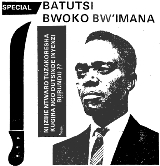
, the individuals behind Kangura have been accused of producing leaflets in 1992 picturing a machete and asking “What shall we do to complete the social revolution of 1959?” - a reference to the Hutu revolt that overthrew the Tutsi monarchy and the subsequent politically orchestrated communal violence that resulted in thousands of mostly Tutsi casualties and forced roughly 300,000 Tutsis to flee to neighboring Burundi and Uganda. Kangura also published the infamous “10 Hutu Commandments,” which called upon Hutus to massacre Tutsis, and more generally communicated the message that the RPF had a devious grand strategy (one feature article was titled “Tutsi colonization plan”).

Due to high rates of illiteracy at the time of the genocide, radio was an important way for the government to deliver messages to the public. Two key radio stations in inciting violence before and during the genocide were Radio Rwanda
Radio Rwanda

Radio Rwanda is a radio station of the Rwandan Office of Information , a government information agency that also owns Rwandan Television .It played a large part in the 1994 Rwandan genocide....
 and Radio Télévision Libre des Mille Collines
Radio Télévision Libre des Mille Collines

Radio T?l?vision Libre des Mille Collines was a Rwanda radio station which broadcast from July 8, 1993 to July 31, 1994. It played a significant role during the April-July 1994 Rwandan Genocide....
(RTLM). In March 1992, Radio Rwanda
Radio Rwanda

Radio Rwanda is a radio station of the Rwandan Office of Information , a government information agency that also owns Rwandan Television .It played a large part in the 1994 Rwandan genocide....
 was first used in directly promoting the killing of Tutsi in Bugesera, south of the national capital Kigali. Radio Rwanda repeatedly broadcast a communiqué warning that Hutu in Bugesera would be attacked by Tutsi, a message used by local officials to convince Hutu that they needed to protect themselves by attacking first. Led by soldiers, Hutu civilians and members of the Interahamwe, subsequently attacked and killed hundreds of Tutsi. At the end of 1993, the RTLM's highly sensationalized reporting on the assassination of the Burundi president, a Hutu, was used to underline supposed Tutsi brutality. The RTLM falsely reported that the president had been tortured, including castration of the victim (in pre-colonial times, some Tutsi kings castrated defeated enemy rulers). From late October 1993, the RTLM repeatedly broadcast themes developed by the extremist written press, underlining the inherent differences between Hutu and Tutsi, the foreign origin of Tutsi, the disproportionate share of Tutsi wealth and power, and the horrors of past Tutsi rule. RTLM also repeatedly stressed the need to be alert to Tutsi plots and possible attacks and called upon Hutu to prepare to 'defend' themselves against the Tutsi. After 6 April 1994, authorities used RTLM and Radio Rwanda to spur and direct killings, specifically in areas where the killings initially were resisted. Both radio stations were used to incite and mobilize, then to give specific directions for carrying out the killings.

The RTLM had used terms such as inyenzi (cockroach in Kinyarwandan) and Tutsi interchangeably with others referring to RPF combatants and warned specifically that RPF combatants dressed in civilian clothes were mingling among displaced people fleeing combat zones. These broadcasts gave the impression that all Tutsi were necessarily supporters of the RPF force fighting against the government. Women were part of the anti-Tutsi propaganda prior the 1994 genocide, for example the "Ten Hutu Commandments" published in December 1990 by “Kangura” included four commandments which portrayed Tutsi women as tools of the Tutsi people, as sexual weapons that would be used by the Tutsi to weaken and ultimately destroy the Hutu men. Gender based propaganda also include cartoons printed in newspapers depicting Tutsi women as sex objects. Examples of gender-based hate propaganda used to incite war rape
War rape

War rape describes rape committed by soldiers, other combatants or civilians during armed conflict or war. Rape in the course of war dates back to antiquity, ancient enough to have been mentioned in the Bible....
 include statements by perpetrators such as “You Tutsi women think that you are too good for us” and “Let us see what a Tutsi woman tastes like “.

United Nations

On January 11, 1994 Lieutenant General Roméo Dallaire
Roméo Dallaire

Lieutenant-General Rom?o Antonius Dallaire, Order of Canada Order of Military Merit National Order of Quebec Meritorious Service Decoration Canadian Forces Decoration is a Canadian Canadian Senate, humanitarian, author and retired general....
 (UN Force Commander in Rwanda) notified Military Advisor to the Secretary-General, Major-General Maurice Baril
Maurice Baril

Joseph G?rard Maurice Baril, Order of Military Merit , Canadian Forces Decoration is a former General in the Canadian Forces, a Military Advisor to the United Nations Secretary-General & head of the Military Division of the Department of Peacekeeping Operations of the United Nations from 1992 to 1997, and Chief of the Defence Staff in Canad...
 of four major weapons caches and plans by the Hutus for extermination of Tutsis. The telegram from Dallaire stated that an informant who was a top level Interahamwe militia trainer was in charge of demonstrations carried out a few days before. The goal of the demonstrations was to provoke an RPF battalion in Kigali into firing upon demonstrators and Belgian United Nations Assistance Mission for Rwanda
United Nations Assistance Mission for Rwanda

The United Nations Assistance Mission for Rwanda was a mission instituted by the United Nations to aid the implementation of the Arusha Accords, signed August 4, 1993, which were meant to end the Rwandan Civil War....
 (UNAMIR) troops into using force. Under such a scenario the Interhamwe would have an excuse to engage the Belgian troops and the RPF battalion. Several Belgians were to be killed, which would guarantee a withdrawal of the Belgian contingent. According to the informant, 1,700 Interhamwe militiamen were trained in Governmental Forces camps and he was ordered to register all the Kigali Tutsis. Dallaire made immediate plans for UNAMIR troops to seize the arms caches and advised UN Headquarters of his intentions, believing these actions lay within his mission's mandate. The following day headquarters stated in another cable that the outlined actions went beyond the mandate granted to UNAMIR under Security Council Resolution 872. Instead, President Habyarimana was to be informed of possible Arusha Accords violations and the discovered concerns and report back on measures taken. The January 11 telegram later played an important role in discussion about what information was available to the United Nations prior to the genocide.

On the 6 April 1994 the RTLM accused the Belgian peacekeepers of having shot down – or helping to shoot down – the president's plane. This broadcast has been linked to the killing of ten Belgian UN troops by soldiers of the Rwandan army.

The situation proved too "risky" for the United Nations
United Nations

The United Nations is an international organization whose stated aims are to facilitate cooperation in international law, international security, economic development, Social change, human rights and achieving world peace....
 to attempt to help. The RPF successfully brought the country under their sway, although their efforts towards a conclusion to the conflict were delayed after the UN-mandated French-led force, under Operation Turquoise
Opération Turquoise

Op?ration Turquoise was a France military operation in Rwanda in 1994 under the mandate of the United Nations....
, established and maintained a "safe zone" for Hutu refugees to flee to in the southwest. Eventually, after the UN Mandate
UN Mandate

The term UN mandate is typically used to refer to a long-term international mission which has been authorized by the United Nations United Nations General Assembly or the United Nations Security Council in particular....
 of the French mission was at an end, millions of refugees left Rwanda, mainly headed to Zaire
Zaire

The Republic of Zaire was the name of the present Democratic Republic of the Congo between 27 October 1971, and 17 May 1997. The name of Zaire derives from the , itself an adaptation of the Kongo language word nzere or nzadi, or "the river that swallows all rivers", and is often still used to refer to that state, perhaps because "Zai...
. The presence of Hutu refugees (see Great Lakes refugee crisis
Great Lakes refugee crisis

The Great Lakes refugee crisis is the common name for the situation beginning with the exodus in April 1994 of over two million Rwandans to neighboring countries of the African Great Lakes region of Africa in the aftermath of the Rwandan Genocide....
) on the border with Rwanda was the cause for the First
First Congo War

The First Congo War ended when Zairean President Mobutu S?s? Seko was overthrown by rebel forces backed by foreign powers such as Uganda and Rwanda....
 and Second
Second Congo War

The Second Congo War, also known as Africa's World War and the Great War of Africa, began in August 1998 in the Democratic Republic of the Congo , and officially ended in July 2003 when the Transitional Government of the Democratic Republic of the Congo took power ....
 Congo Wars with clashes between these groups and the Rwandan government continuing.

The UN
United Nations

The United Nations is an international organization whose stated aims are to facilitate cooperation in international law, international security, economic development, Social change, human rights and achieving world peace....
's mandate forbids intervening in the internal politics of any country unless the crime of genocide is being committed. France has been accused of aiding the Hutu regime to flee by creating what is known as Operation Turquoise
Opération Turquoise

Op?ration Turquoise was a France military operation in Rwanda in 1994 under the mandate of the United Nations....
. Canada, Ghana
Ghana

The Republic of Ghana is a country in West Africa. It borders C?te d'Ivoire to the west, Burkina Faso to the north, Togo to the east, and the Gulf of Guinea to the south....
, and the Netherlands provided consistent support for the UN mission under the command of Roméo Dallaire
Roméo Dallaire

Lieutenant-General Rom?o Antonius Dallaire, Order of Canada Order of Military Merit National Order of Quebec Meritorious Service Decoration Canadian Forces Decoration is a Canadian Canadian Senate, humanitarian, author and retired general....
 although it was left without an appropriate mandate for the capacity to intervene from the U.N. Security Council. Despite emphatic demands from UNAMIR's commanders in Rwanda, before and throughout the genocide, its requests for authorization to end it were refused and its intervention-capacity was even reduced.

Religion

Religious factors were not prominent; the event was racially motivated. However the Human Rights Watch
Human Rights Watch

Human Rights Watch is a United States based, international non-governmental organization that conducts research and advocacy on human rights. Its headquarters are in New York City....
 reported that a number of religious authorities, particularly Roman Catholic, in Rwanda failed to condemn the genocide. On the other hand the acquittal of Bishop Misago, accused of corruption and complicity in the genocide, in 2000 raised questions about this. The majority of Rwandans and of Tutsis in particular are Catholic.

Catalyst and initial events

On April 6, 1994, the airplane carrying Rwandan President Juvénal Habyarimana
Juvénal Habyarimana

Juv?nal Habyarimana is the former President of Rwanda. He was President of Rwanda from 1973 until he was killed when his airplane, carrying also the President of Burundi, Cyprien Ntaryamira, was shot down in 1994....
, and Cyprien Ntaryamira
Cyprien Ntaryamira

Cyprien Ntaryamira , was President of Burundi from February 5, 1994 until he died when Assassination of Habyarimana and Ntaryamira on April 6, 1994....
, the Hutu president of Burundi, was shot down as it prepared to land in Kigali
Kigali

Kigali, population 851,024 , is the Capital and largest city of Rwanda. It is situated in the centre of the nation, and has been the economic, cultural, and transport hub of Rwanda since it became capital at independence in 1962....
. Both presidents died when the plane crashed. Responsibility for the attack is disputed, with both the RPF and Hutu extremists being blamed. But in spite of disagreements about the identities of its perpetrators, the attack on the plane is to many observers the catalyst for the genocide.

On April 6 and April 7 the staff of the Rwandan Armed Forces (RAF) and Colonel Theoneste Bagosora
Théoneste Bagosora

Colonel Th?oneste Bagosora is a former Rwandan military officer. He is chiefly known for his role in the 1994 Rwandan Genocide....
 clashed verbally with the UNAMIR Force Commander Lieutenant General Dallaire, who stressed the legal authority of the Prime Minister, Agathe Uwilingiyimana
Agathe Uwilingiyimana

Agathe Uwilingiyimana was a Rwandan political figure. She served as Prime Minister of Rwanda from 18 July 1993 until her death on 7 April 1994....
, to take control of the situation as outlined in the Arusha Accords. Bagosora disputed the authority, and Dallaire gave an escort of UNAMIR personnel to Mrs. Uwilingiyimana to protect her and to allow her to send a calming message on the radio the next morning. But by then, the presidential guard had occupied the radio station and Mrs. Uwilingiyimana had to cancel her speech. In the middle of the day, she was assassinated by the presidential guard. The ten Belgian UNAMIR soldiers sent to protect her were later found killed; Major Bernard Ntuyahaga
Bernard Ntuyahaga

Major Bernard Ntuyahaga, Rwandan Armed Forces, was convicted by a Belgium court in the murders of ten United Nations peacekeepers at the start of the Rwandan Genocide....
 was convicted of the murders in 2007. Other moderate officials who favored the Arusha Accords were quickly assassinated. Protected by UNAMIR, Faustin Twagiramungu
Faustin Twagiramungu

Faustin Twagiramungu is an ethnic Hutu politician in Rwanda. He was prime minister from 1994 until his resignation in 1995, the first head of government appointed after the Rwandese Patriotic Front captured Kigali....
 escaped execution. In his book Shake Hands with the Devil, Dallaire recalled the events from April 7, the first day of the genocide:

I called the Force HQ and got through to [Ghanaian Brigadier General
Brigadier General

Brigadier General is the lowest ranking General Officer in some countries, usually sitting between the ranks of Colonel and Major General.The rank can be traced back to the militaries of Europe where a brigadier general, or simply a brigadier, would command a brigade in the field....
]
Henry Anyidoho. He had horrifying news. The UNAMIR-protected VIPs - Lando Ndasingwa
Lando Ndasingwa

Landoald 'Lando' Ndasingwa was a Rwandan politician, leader of the moderate Parti lib?ral du Rwanda. He was killed in the beginning of the Rwandan Genocide....
 
[the head of the Parti libéral
Liberal Party (Rwanda)

The Liberal Party is a political party in Rwanda that adheres to Liberalism. Higiro Prosper is the party's chairperson.The Liberal Party supported President Paul Kagame in the Rwandan presidential election, 2003....
], Joseph Kavaruganda
Joseph Kavaruganda

Joseph Kavaruganda was a Rwandan judge, and president of Rwanda's Constitutional Court. He was killed at the beginning of the Rwandan Genocide....
 
[president of the constitutional court], and many other moderates had been abducted by the Presidential Guard and had been killed, along with their families [...] UNAMIR had been able to rescue Prime Minister Faustin, who was now at the Force HQ.


Genocide

Rwandan Genocide Murambi Skulls
Numerous elite Hutu politicians have been found guilty for the organization of the genocide
Genocide

Genocide is the deliberate and systematic destruction, in whole or in part, of an ethnic, racial, religious, or national group.While precise genocide definitions, a legal definition is found in the 1948 United Nations Convention on the Prevention and Punishment of the Crime of Genocide ....
. Military and Hutu militia groups systematically set out to murder all the Tutsis they could capture, irrespective of their age or sex, as well as the political moderates. The western nations evacuated their nationals from Kigali and abandoned their embassies in the initial stages of the violence. National radio, with the exacerbation of the situation, advised people to stay in their homes, and the
Hutu power station RTLM broadcast vitriolic propaganda against Tutsis and Hutu moderates. Hundreds of roadblocks were put up by the militia around the country. Lieutenant-General Dallaire and UNAMIR were in Kigali, escorting Tutsis, and were unable to stop the Hutus from escalating their attacks. During this time, the Hutus also targeted Lieutenant-General Dallaire, and UNAMIR personnel through the RTLM.

The killing was quickly implemented throughout most of the country. The first to organize killings on the scale characterizing a genocide was the mayor of the northwestern town of Gisenyi
Gisenyi

Gisenyi is a city in Rubavu district in the West Province, Rwanda of Rwanda. Gisenyi is contiguous with Goma, the city across the border in the Democratic Republic of the Congo....
, who on the evening of April 6th called a meeting to distribute arms and send out militias to kill Tutsis. Gisenyi was a center of anti-Tutsi sentiment, both as the homeland of the akazu
Akazu

The Akazu was an informal organisation of Hutus with its basis on the former Rwandan president Juv?nal Habyarimana and his influential wife Agathe Habyarimana, whose members, among others, are generally understood to be responsible for the 1994 Rwandan Genocide....
 and as the refuge for thousands of people displaced by the rebel occupation of large areas in the south. While killing occurred in other towns immediately after Habyarimana's assassination, it took several days for them to become organized on the scale of Gisenyi. The major exception to this pattern was in Butare Province
Butare Province

Butare was a province of Rwanda prior to its dissolution in January 2006. Butare city is the second largest city in Rwanda and one of the nation's former twelve provinces of Rwanda....
. In Butare, Jean-Baptiste Habyarimana was the only Tutsi prefect and the province was the only one dominated by an opposition party. Prefect Habyarimana opposed the genocide, resulting in the province becoming a haven of relative calm, until he was arrested and killed on April 19th. Finding the population of Butare lacking in enthusiasm for the killing, the government sent in militia members from Kigali and armed and mobilized the large population of Burundian refugee
Refugee

Convention Relating to the Status of Refugees, a refugee is a person who flees to a foreign country or power to escape danger or persecutionOwing to a well-founded fear of being persecuted for reasons of race, religion, nationality, membership of a particular social group, or political opinion, is outside the country of their nationality,...
s in the province, who had fled the Tutsi-dominated army fighting in the Burundian Civil War.

Most of the victims were killed in their villages or in towns, often by their neighbors and fellow villagers. The militia members typically murdered their victims by hacking them with machetes, although some army units used rifles. The victims were often found hiding in churches and school buildings, where Hutu gangs massacred them. Ordinary citizens were called on by local officials and government-sponsored radio to kill their neighbors, and those who refused to kill were often killed themselves. "Either you took part in the massacres or you were massacred yourself." One such massacre occurred at Nyarubuye
Nyarubuye massacre

The Nyarubuye massacre is the name given to the killing of an estimated 20,000 civilians on April 15-April 16 1994 at the Nyarubuye Roman Catholic Church in Kibungo Province, 140 km east of the Rwandan capital Kigali....
. On April 12, 1994, more than 1,500 Tutsis sought refuge in a Catholic church in Nyange, in then Kivumu commune. Local Interahamwe acting in concert with the priest and other local authorities then used bulldozers to knock down the church building. People who tried to escape were hacked down with machetes or shot. Local priest Athanase Seromba
Athanase Seromba

Athanase Seromba is a Rwandan priest who was found guilty of genocide and crimes against humanity committed in the Rwandan genocide.At the time of the genocide, Seromba was priest of a Catholic parish at Nyange in the Kibuye province of western Rwanda....
 was later found guilty and sentenced to life in prison by the ICTR for his role in the demolition of his church and convicted of the crime of genocide and crimes against humanity
Crime against humanity

Crimes against humanity, as defined by the Rome Statute of the International Criminal Court Explanatory Memorandum, "are particularly odious offences in that they constitute a serious attack on human dignity or grave humiliation or a degradation of one or more human beings....
. In another case, thousands sought refuge in Ecole Technique Officielle school in Kigali where Belgian UNAMIR soldiers were stationed. However, on April 11, 1994, Belgian soldiers withdrew from the school and members of the Rwandan armed forces and militia killed all the Tutsis who were hiding there.

There is no consensus on the number of dead between April 6 and mid-July. Unlike the genocides carried out by the Nazis or by the Khmer Rouge
Khmer Rouge

File:CPKbanner.PNGThe Khmer Rouge was the communist ruling party of Cambodia — which it renamed Democratic Kampuchea — from 1975 to 1979....
 in Cambodia
Cambodia

The Kingdom of Cambodia is a country in South East Asia with a population of over 13 million people. The kingdom's capital and largest city is Phnom Penh....
, authorities made no attempts to record deaths. The RPF government has stated that 1,071,000 were killed, 10% of whom were Hutu. Philip Gourevitch
Philip Gourevitch

Philip Gourevitch , an United States-Jewish author and journalist, is the editor of "The Paris Review" and a longtime staff writer of The New Yorker....
 agrees with an estimate of one million, while the United Nations lists the toll as 800,000. Alex de Waal
Alex de Waal

Alexander William Lowndes de Waal is a United Kingdom writer and researcher on African issues. He is a fellow of the Harvard Humanitarian Initiative at Harvard University, as well as program director at the Social Science Research Council in New York City....
 and Rakiya Omar of African Rights estimates the number as "around 750,000," while Alison Des Forges
Alison Des Forges

Alison Des Forges was an United States historian and human rights activism who specialized in the African Great Lakes region, particularly the 1994 Rwandan Genocide....
 of Human Rights Watch
Human Rights Watch

Human Rights Watch is a United States based, international non-governmental organization that conducts research and advocacy on human rights. Its headquarters are in New York City....
 states that it was "at least 500,000." James Smith of Aegis Trust
Aegis Trust

Aegis Trust, founded in 2000, is the leading British NGO which campaigns to prevent genocide worldwide. Based at the United Kingdom?s Holocaust Centre, which opened in 1995, the Aegis Trust coordinates the UK All-Party Parliamentary Group for genocide prevention and is responsible for the Kigali Memorial Centre in Rwanda, which commemorates...
 notes, "What's important to remember is that there was a genocide. There was an attempt to eliminate Tutsis — men, women, and children — and to erase any memory of their existence."

War rape

In 1998, the International Criminal Tribunal for Rwanda
International Criminal Tribunal for Rwanda

The International Criminal Tribunal for Rwanda , or the Tribunal p?nal international pour le Rwanda , is an international court established in November 1994 by the United Nations Security Council in order to judge those people responsible for the Rwandan genocide and other serious violations of the international law performed in the te...
 made the landmark decisions that the war rape
War rape

War rape describes rape committed by soldiers, other combatants or civilians during armed conflict or war. Rape in the course of war dates back to antiquity, ancient enough to have been mentioned in the Bible....
 during the Rwanda genocide was an element of the crime of genocide
Genocide

Genocide is the deliberate and systematic destruction, in whole or in part, of an ethnic, racial, religious, or national group.While precise genocide definitions, a legal definition is found in the 1948 United Nations Convention on the Prevention and Punishment of the Crime of Genocide ....
. The Trial Chamber held that "sexual assault formed an integral part of the process of destroying the Tutsi
Tutsi

The Tutsi are one of three native peoples of the nations of Rwanda and Burundi in central Africa, the other two being the Twa and the Hutu....
 ethnic group and that the rape was systematic and had been perpetrated against Tutsi women only, manifesting the specific intent required for those acts to constitute genocide." Although no explicit written orders to rape and sexual violence have been found, evidence suggests that military leaders encouraged or ordered their men to rape Tutsi
Tutsi

The Tutsi are one of three native peoples of the nations of Rwanda and Burundi in central Africa, the other two being the Twa and the Hutu....
 as well as condoned the acts taking place, without making efforts to stop them. Compared to other conflicts the sexual violence in Rwanda
Rwanda

The Republic of Rwanda is a small landlocked country in the Great Lakes region of east-central Africa, bordered by Uganda, Burundi, the Democratic Republic of the Congo and Tanzania....
 stands out in terms of the organized nature of the propaganda that contributed significantly to fueling sexual violence against Tutsi
Tutsi

The Tutsi are one of three native peoples of the nations of Rwanda and Burundi in central Africa, the other two being the Twa and the Hutu....
 women, the very public nature of the rapes and the level of brutality towards the women.

In his 1996 report the United Nations Special Rapporteur on Rwanda, Rene Degni-Segui stated that “rape was the rule and its absence the exception.” The report also stated that “rape was systematic and was used as a “weapon” by the perpetrators of the massacres. This can be estimated from the number and nature of the victims as well as from the forms of rape.” The Special Rapporteur estimated that between 250,000 and 500,000 Rwandese women and girls had been raped. A 2000 report prepared by the Organization of African Unity’s International Panel of Eminent Personalities concluded that “we can be certain that almost all females who survived the genocide were direct victims of rape or other sexual violence, or were profoundly affected by it”. Within the context of the Rwanda genocide victims of sexual violence were predominantly attacked on the basis of their gender
Gender

Gender comprises a range of differences between man and woman, extending from the biological to the social. Biologically, the male gender is defined by the presence of a Y-chromosome, and its absence in the female gender....
 and ethnicity. The victims were mostly Tutsi
Tutsi

The Tutsi are one of three native peoples of the nations of Rwanda and Burundi in central Africa, the other two being the Twa and the Hutu....
 women and girls, of all ages, while men were only seldom the victims of war rape
War rape

War rape describes rape committed by soldiers, other combatants or civilians during armed conflict or war. Rape in the course of war dates back to antiquity, ancient enough to have been mentioned in the Bible....
. War rape during the genocide was also directed against Hutu
Hutu

The Hutu are a Central African ethnic group, living mainly in Rwanda and Burundi....
 women considered moderates, but also occurred regardless of ethnicity or political affiliation, with young or beautiful women being targeted based only on their gender. Sexual violence against men was much less common, but frequently included mutilation of the genitals, which were often displayed in public. The perpetrators of war rape during the Rwanda genocide were mainly members of the Hutu militia, the “Interahamwe
Interahamwe

The Interahamwe is a Hutu paramilitary organization. The militia enjoyed the backing of the Hutu-led government leading up to, during, and after the Rwandan Genocide....
”. Rapes were also committed by military soldiers of the Rwandan Armed Forced (RAF), including the Presidential Guard, and civilians.

Sexual violence against women and girls during the Rwanda genocide included: rape
Rape

Rape, also referred to as sexual assault, is an assault by a person involving sexual intercourse with or sexual penetration of another person without that person's consent....
, gang rape, sexual slavery
Sexual slavery

Sexual slavery refers to the organized coercion of unwilling people into different sexual practices. Sexual slavery may include single-owner sexual slavery, ritual slavery sometimes associated with traditional religious practices, slavery for primarily non-sexual purposes where sex is common, or forced prostitution....
 (either collectively or individually through “forced marriages”), rape with objects such as sticks and weapons often leading to the victim’s death, sexual mutilation of, in particular, breast
Breast

The breast is the upper ventral region of an animal?s torso, particularly that of mammals, including human beings. The breasts of a female primate?s body contain the mammary glands, which secrete milk used to feed infants....
s, vagina
Vagina

The vagina is a fibromuscular cylinder tract leading from the uterus to the exterior of the body in female placental mammals and marsupials, or to the cloaca in female birds, monotremes, and some reptiles....
s or buttocks
Buttocks

The buttocks are rounded portions of the anatomy located on the posterior of the pelvic region of the apes, including humans and many other bipeds or quadrupeds....
, often during or following rape. Pregnant women were not spared from sexual violence and on many occasion victims were killed following rape. Many women were raped by men who knew they were HIV
HIV

Human immunodeficiency virus is a lentivirus that can lead to AIDS , a condition in humans in which the immune system begins to fail, leading to life-threatening opportunistic infections....
 positive and it has been suggested that there were deliberate attempts to transmit the virus to Tutsi women and their families. War rape occurred across the country and was frequently perpetrated in plain view of others, at sites such as school
School

File:Primary Student of Pakistan.JPGA school , is an institution designed to allow and encourage students to education, under the supervision of teachers....
s, churches, roadblocks, government buildings or in the bush. Some women were kept as personal slaves
Sexual slavery

Sexual slavery refers to the organized coercion of unwilling people into different sexual practices. Sexual slavery may include single-owner sexual slavery, ritual slavery sometimes associated with traditional religious practices, slavery for primarily non-sexual purposes where sex is common, or forced prostitution....
 for years after the genocide, forced to move to neighbouring countries after the genocide along with their captors.

UNAMIR and the international community

UNAMIR was hampered from the outset by resistance from numerous members of the United Nations Security Council
United Nations Security Council

The United Nations Security Council is one of the principal organs charged with the maintenance of international security. Its powers, outlined in the United Nations Charter, include the establishment of peacekeeping operations, the establishment of international sanctions, and the authorization of war....
 from becoming deeply involved first in the Arusha process and then the genocide
Genocide

Genocide is the deliberate and systematic destruction, in whole or in part, of an ethnic, racial, religious, or national group.While precise genocide definitions, a legal definition is found in the 1948 United Nations Convention on the Prevention and Punishment of the Crime of Genocide ....
. Only Belgium had asked for a strong UNAMIR mandate, but after the murder of the ten Belgian peacekeepers protecting the Prime Minister in early April, Belgium pulled out of the peacekeeping mission. Belgian equipment was sent directly from Somalia without any maintenance or cleaning in between missions, however the Belgian troops proved to be a necessary asset to the mission.

The UN and its member states appeared largely detached from the realities on the ground. In the midst of the crisis, Dallaire was instructed to focus UNAMIR on only evacuating foreign nationals from Rwanda. The change in orders led Belgian peacekeepers to abandon a technical school filled with 2,000 refugees, while Hutu militants waited outside, drinking beer and chanting "Hutu Power
Hutu Power

Hutu Power was an ideology propounded by the Akazu and other Hutu extremists which culminated in the Rwandan Genocide against the Tutsi and moderate Hutu....
." After the Belgians left, the militants entered the school and massacred those inside, including hundreds of children. Four days later the Security Council voted to reduce UNAMIR to 260 men.

Following the withdrawal of the Belgian forces, Lt. General Roméo Dallaire
Roméo Dallaire

Lieutenant-General Rom?o Antonius Dallaire, Order of Canada Order of Military Merit National Order of Quebec Meritorious Service Decoration Canadian Forces Decoration is a Canadian Canadian Senate, humanitarian, author and retired general....
 consolidated his contingent of Canadian, Ghanaian, and Dutch
Netherlands

The Netherlands is a country that is part of the Kingdom of the Netherlands. It is a parliamentary democratic constitutional monarchy. The Netherlands is located in North-West Europe, and bordered by the North Sea to the north and west, Belgium to the south, and Germany to the east....
 soldiers in urban areas and focused on providing areas of "safe control". His actions directly saved the lives of 20,000 Tutsis. The administrative head of UNAMIR, former Cameroonian
Cameroonian

Cameroonian may refer to:* Something of, from, or related to the country of Cameroon* A person from Cameroon, or of Cameroonian descent. For information about the Cameroonian people, see Demographics of Cameroon and Culture of Cameroon....
 foreign minister Jacques-Roger Booh-Booh
Jacques-Roger Booh-Booh

Jacques-Roger Booh-Booh was the Minister of External Relations of Cameroon from 1988 to 1992 and the head of United Nations Assistance Mission for Rwanda ....
, has been criticized for downplaying the significance of Dallaire's reports and for holding close ties to the Hutu militant elite.

The US government was reluctant to involve itself in the "local conflict" in Rwanda and refused to label the killings as "genocide
Genocide

Genocide is the deliberate and systematic destruction, in whole or in part, of an ethnic, racial, religious, or national group.While precise genocide definitions, a legal definition is found in the 1948 United Nations Convention on the Prevention and Punishment of the Crime of Genocide ....
", a decision which then-President Bill Clinton
Bill Clinton

William Jefferson "Bill" Clinton served as the List of Presidents of the United States President of the United States from 1993 to 2001. He was the fifteenth Democrat elected to that office....
 later came to regret in a Frontline television interview. In the interview Clinton stated that he believes if he had sent 5,000 U.S. peacekeepers, more than 500,000 lives could have been saved.

The new Rwandan government, led by interim President Théodore Sindikubwabo
Théodore Sindikubwabo

Th?odore Sindikubwabo was the interim president of Rwanda from April 9 to July 19, 1994, during the Rwandan genocide.Born in the town of Butare in the south of Rwanda, Sindikubwabo was educated as a physician, and was Minister of Health in the administration of President Gregoire Kayibanda....
, worked to minimize international criticism. Rwanda at that time had a seat on the Security Council and its ambassador argued that the claims of genocide were exaggerated and that the government was doing all that it could to stop it.

The UN conceded that "acts of genocide may have been committed" on May 17, 1994. By that time, the Red Cross estimated that 500,000 Rwandans had been killed. The UN agreed to send 5,500 troops, mostly from African countries, to Rwanda. This was the original number of troops requested by General Dallaire before the killing escalated. The UN also requested 50 armoured personnel carrier
Armoured personnel carrier

Armoured personnel carriers are armoured fighting vehicles developed to transport infantry on the battlefield. They usually have only a machine gun although variants carry recoilless rifles, anti-tank guided missiles , or mortar ....
s from the U.S., but for the transport alone they were charged 6.5 million U.S. dollars by the U.S. Army. Deployment of these forces was delayed due to arguments over their cost and other factors.

French involvement

France has been accused of substantially aiding and abetting the genocide. Documents recently released from the Paris archive of Mitterrand show how the RPF invasion was considered as clear aggression by an Anglophone neighbour on a Francophone country. The documents argue that the RPF was a part of an “Anglophone plot”, involving the President of Uganda, to create an English-speaking “Tutsi-land”. Once Rwanda was “lost” to Anglophone influence, French credibility in Africa would never recover. The policy of France was to avoid a military victory by the RPF. The policy towards Rwanda had been made by a secretive network of military officers, politicians, diplomats, businessmen, and senior intelligence operatives. At its centre was French President François Mitterrand
François Mitterrand

Fran?ois Maurice Adrien Marie Mitterrand served as President of France from 1981 to 1995, elected as representative of the French Socialist Party ....
. French policy had been unaccountable to either parliament or the press.

On 5 August 2008 a commission of officials from Rwanda's Justice Ministry accused the French government of knowing of preparations for the genocide and helping to train the ethnic Hutu militia members who helped plan the genocide and participated in the killings. The report accused 33 senior French military and political officials of involvement in the genocide. Among those named were then-President François Mitterrand
François Mitterrand

Fran?ois Maurice Adrien Marie Mitterrand served as President of France from 1981 to 1995, elected as representative of the French Socialist Party ....
, then-Prime Minister Edouard Balladur
Édouard Balladur

?douard Balladur is a France right-wing politician. He served as Prime Minister of France during the second "cohabitation ", under Fran?ois Mitterrand, from 29 March 1993 to 10 May 1995....
, then-Foreign Minister Alain Juppe
Alain Juppé

Alain Marie Jupp? is a French right-wing politician who served as Prime Minister of France from 1995 to 1997, under President Jacques Chirac. In December 2004 Jupp? was convicted of mishandling public funds; his political career was subsequently suspended until he was re-elected as Mayor of Bordeaux in October 2006....
, and his then chief aide, Dominique de Villepin. "French soldiers themselves directly were involved in assassinations of Tutsis and Hutus accused of hiding Tutsis," said the report, which was compiled by a team of investigators from the Justice Ministry.

President Mitterrand also worried that the US and UK governments would use the massacres to expand "Anglophone
Anglophone

An Anglophone is someone who speaks the English language. As an adjective, it refers to belonging to an English-speaking population especially in a country where two or more languages are spoken....
" influence in that Francophone
Francophone

The adjective francophone means French language-speaking, typically as primary language, whether referring to individuals, groups, or places. Often, the word is used as a noun to describe a natively French-speaking person....
 part of Africa, also worked to prevent foreign intervention.

On June 22, with no sign of UN deployment taking place, the Security Council authorized French forces to land in Goma, Zaire
Zaire

The Republic of Zaire was the name of the present Democratic Republic of the Congo between 27 October 1971, and 17 May 1997. The name of Zaire derives from the , itself an adaptation of the Kongo language word nzere or nzadi, or "the river that swallows all rivers", and is often still used to refer to that state, perhaps because "Zai...
 on a humanitarian mission. They deployed throughout southwest Rwanda in an area they called "Zone Turquoise
Opération Turquoise

Op?ration Turquoise was a France military operation in Rwanda in 1994 under the mandate of the United Nations....
," quelling the genocide and stopping the fighting there, but often arriving in areas only after genocidaires had expelled or killed Tutsi citizens. Operation Turquoise was charged with aiding the Hutu army against the RPF. Jacques Bihozagara, the then-Rwandan ambassador to France, later testified, "Operation Turquoise was aimed only at protecting genocide perpetrators, because the genocide continued even within the Turquoise zone." The French government continues to deny that it played a role in the genocide.

Rwandan Patriotic Front (RPF) renewed invasion

The Rwandan Patriotic Front
Rwandan Patriotic Front

The Rwandan Patriotic Front abbreviated as RPF is the current ruling political party of Rwanda, led by President Paul Kagame. It governs in a coalition with other parties....
 (RPF) battalion of Tutsi rebels stationed in Kigali under the Arusha Accords came under attack immediately after the shooting down of the president's plane. The battalion fought its way out of Kigali and joined up with RPF units in the north. The resulting civil war raged concurrently with the genocide for two months. The nature of the genocide was not immediately apparent to foreign observers, and was initially explained as a violent phase of the civil war. Mark Doyle
Mark Doyle (journalist)

Mark Doyle is a world affairs correspondent for BBC News. A United Kingdom citizen, he is known in particular for his articles on topics related to Africa....
, the correspondent for the
BBC News
BBC News

BBC News, formerly BBC News and Current Affairs, is the department within the BBC responsible for the corporation's news-gathering and production of news programmes on BBC television, radio and online....
in Kigali, tried to explain the complex situation in late April 1994 thus:
Look you have to understand that there are two wars going on here. There's a shooting war and a genocide war. The two are connected, but also distinct. In the shooting war, there are two conventional armies at each other, and in the genocide war, one of those armies, the government side with help from civilians, is involved in mass killings.


The victory of the RPF rebels and overthrow of the Hutu
Hutu

The Hutu are a Central African ethnic group, living mainly in Rwanda and Burundi....
 regime ended the genocide in July 1994, 100 days after it started.

Aftermath

Rwandan Refugee Camp in East Zaire
Approximately two million Hutus, participants in the genocide, and the bystanders, with anticipation of Tutsi retaliation, fled from Rwanda, to Burundi
Burundi

Burundi , officially the Republic of Burundi, is a small country in the Great Lakes region of Eastern Africa bordered by Rwanda to the north, Tanzania to the south and east, and the Democratic Republic of the Congo to the west....
, Tanzania
Tanzania

Tanzania , officially the United Republic of Tanzania , is a country in East Africa that is bordered by Kenya and Uganda on the north, Rwanda, Burundi and the Democratic Republic of the Congo on the west, and Zambia, Malawi and Mozambique on the south....
, Uganda
Uganda

The Republic of Uganda is a landlocked country in East Africa. It is bordered on the east by Kenya, on the north by Sudan, on the west by the Democratic Republic of the Congo, on the southwest by Rwanda, and on the south by Tanzania....
, and for the most part Zaire
Zaire

The Republic of Zaire was the name of the present Democratic Republic of the Congo between 27 October 1971, and 17 May 1997. The name of Zaire derives from the , itself an adaptation of the Kongo language word nzere or nzadi, or "the river that swallows all rivers", and is often still used to refer to that state, perhaps because "Zai...
. Thousands of them died in epidemics of diseases common to the squalor of refugee camps, such as cholera
Cholera

Cholera, sometimes known as Asiatic or epidemic cholera, is an infectious gastroenteritis caused by enterotoxin-producing strains of the bacterium Vibrio cholerae....
 and dysentery
Dysentery

Dysentery is a disorder of the digestive system that results in severe diarrhea containing mucus and/or blood in the feces. If untreated, Dysentery can be fatal....
. The United States staged the Operation Support Hope
Operation Support Hope

Operation Support Hope was a 1994 United States military effort to provide immediate relief for Great Lakes refugee crisis of the Rwandan Genocide and allow a smooth transition to a full United Nations humanitarian management program....
 airlift from July to September 1994 to stabilize the situation in the camps.

After the victory of the RPF, the size of UNAMIR (henceforth called UNAMIR 2) was increased to its full strength, remaining in Rwanda until March 8, 1996.

In October 1996, an uprising by the ethnic Tutsi Banyamulenge
Banyamulenge

The Banyamulenge are a group of mainly Tutsi Kinyarwanda language living in the eastern region of the Democratic Republic of the Congo . They are concentrated in the province of South Kivu close to the Burundi-Congo-Rwanda border....
 people in eastern Zaire marked the beginning of the First Congo War
First Congo War

The First Congo War ended when Zairean President Mobutu S?s? Seko was overthrown by rebel forces backed by foreign powers such as Uganda and Rwanda....
, and led to a return of more than 600,000 to Rwanda during the last two weeks of November. This massive repatriation was followed at the end of December 1996 by the return of 500,000 more from Tanzania after they were ejected by the Tanzanian government. Various successor organizations to the Hutu militants operate in eastern DR Congo to this day.

Political development

After its military victory in July 1994, the Rwandese Patriotic Front organized a coalition government similar to that established by President Juvénal Habyarimana
Juvénal Habyarimana

Juv?nal Habyarimana is the former President of Rwanda. He was President of Rwanda from 1973 until he was killed when his airplane, carrying also the President of Burundi, Cyprien Ntaryamira, was shot down in 1994....
 in 1992. Called The Broad Based Government of National Unity, its fundamental law is based on a combination of the constitution, the Arusha accords, and political declarations by the parties. The MRND party was outlawed. Political organizing was banned until 2003. The first post-war presidential and legislative elections were held in August and September 2003 respectively.

The current government prohibits discrimination on the basis of ethnicity, race or religion. The government has also passed laws prohibiting emphasis on Hutu or Tutsi identity in most types of political activity.

In March 1998, on a visit to Rwanda, U.S. President Bill Clinton
Bill Clinton

William Jefferson "Bill" Clinton served as the List of Presidents of the United States President of the United States from 1993 to 2001. He was the fifteenth Democrat elected to that office....
 spoke to the crowd assembled on the tarmac at Kigali Airport: "We come here today partly in recognition of the fact that we in the United States and the world community did not do as much as we could have and should have done to try to limit what occurred" in Rwanda. Four years after the genocide, Clinton issued what is now known as the "Clinton apology," acknowledging his failure to efficiently deal with the situation in Rwanda, but not formally apologizing for inaction by the U.S. government or the international community.

Despite substantial international assistance and political reforms, the country continues to struggle to boost investment and agricultural output and to foster reconciliation. In March 2000, after removing Pasteur Bizimungu
Pasteur Bizimungu

Pasteur Bizimungu was the President of Rwanda from July 19 1994 until March 23 2000. He is an ethnic Hutu born in the Gisenyi prefecture of Rwanda....
, Paul Kagame
Paul Kagame

Paul Kagame is the current President of Rwanda. He rose to prominence as the leader of the Rwandan Patriotic Front , whose victory over the incumbent government in July 1994 effectively ended the Rwandan genocide....
 became President of Rwanda. On August 25, 2003 Kagame won the first national elections since the RPF took power in 1994. A series of massive population displacements, a nagging Hutu extremist insurgency, and Rwandan involvement in the First
First Congo War

The First Congo War ended when Zairean President Mobutu S?s? Seko was overthrown by rebel forces backed by foreign powers such as Uganda and Rwanda....
 and Second Congo War
Second Congo War

The Second Congo War, also known as Africa's World War and the Great War of Africa, began in August 1998 in the Democratic Republic of the Congo , and officially ended in July 2003 when the Transitional Government of the Democratic Republic of the Congo took power ....
s in the neighboring Democratic Republic of the Congo continue to hinder Rwanda's efforts.

Economic and social developments

Rwanda Demography
The biggest problems facing the government are reintegration of the more than two million refugees, ending the insurgency
Insurgency

An insurgency is a rebellion against a constituted authority when those taking part in the rebellion are not recognised as belligerents. Not all rebellions are insurgencies, because a state of belligerency may exist between one or more sovereign states and rebel forces....
 among ex-soldiers and Interahamwe
Interahamwe

The Interahamwe is a Hutu paramilitary organization. The militia enjoyed the backing of the Hutu-led government leading up to, during, and after the Rwandan Genocide....
 militia fighters and the Rwandan Patriotic Army in the north and southwest of the country, and the shift away from crisis to medium and long-term development planning. The prison population will continue to be an urgent problem for the foreseeable future, having swelled to more than 100,000 in the three years after the war. Trying this many suspects of genocide will tax Rwanda's resources sorely.

The long-term effects of war rape
War rape

War rape describes rape committed by soldiers, other combatants or civilians during armed conflict or war. Rape in the course of war dates back to antiquity, ancient enough to have been mentioned in the Bible....
 in Rwanda
Rwanda

The Republic of Rwanda is a small landlocked country in the Great Lakes region of east-central Africa, bordered by Uganda, Burundi, the Democratic Republic of the Congo and Tanzania....
 for the victims include social isolation (social stigma attached to rape meant some husbands left wives who had become victims of war rape, or that the victims were rendered unsuitable for marriage), unwanted pregnancies and babies (some women resorted to self-induced abortion
Abortion

An abortion is the termination of a pregnancy by the removal or expulsion of an embryo or fetus from the uterus, resulting in or caused by its death....
s), sexually transmitted diseases, including syphilis
Syphilis

Syphilis is a sexually transmitted disease caused by the spirochete bacterium Treponema pallidum subspecies pallidum. The route of transmission of syphilis is almost always through sexual contact, although there are examples of congenital syphilis via transmission from mother to child in utero....
, gonorrhoea and HIV
HIV

Human immunodeficiency virus is a lentivirus that can lead to AIDS , a condition in humans in which the immune system begins to fail, leading to life-threatening opportunistic infections....
/Aids
AIDS

Acquired immune deficiency syndrome or acquired immunodeficiency syndrome is a disease of the human immune system caused by the HIV ....
 (access to anti-retroviral drugs remains limited). The Special Rapporteur on Rwanda estimated that between 2,000 and 5,000 pregnancies resulted from war rape (between 250,000 and 500,000 Rwandese women and girls had been raped). Rwanda is a patriarchal society and children therefore take the ethnicity of the father, underlining that war rape occurred in the context of genocide. The main issue involving reintegration is the fact that the violence that had occurred often involved neighbors; people lived next to rapists, murderers and torturers. It was very difficult right after the genocide for Tutsi's to trust Hutu's, whether or not they had any involvement in the genocide.

International Criminal Tribunal for Rwanda

Rwanda Genocide Wanted Poster 2 20 03
With the return of the refugees, the government began the long-awaited genocide trials, which had an uncertain start at the end of 1996 and inched forward in 1997. In 2001, the government began implementing a participatory justice system, known as Gacaca, in order to address the enormous backlog of cases. Meanwhile, the UN set up the International Criminal Tribunal for Rwanda
International Criminal Tribunal for Rwanda

The International Criminal Tribunal for Rwanda , or the Tribunal p?nal international pour le Rwanda , is an international court established in November 1994 by the United Nations Security Council in order to judge those people responsible for the Rwandan genocide and other serious violations of the international law performed in the te...
, currently based in Arusha
Arusha

Arusha is a city of northern Tanzania surrounded by some of Africa most famous landscapes and national parks. Beautifully situated below Mount Meru on the eastern edge of the eastern branch of the Great Rift Valley, it has a pleasant climate and is close to Serengeti, Ngorongoro Crater, Lake Manyara, Olduvai Gorge, Tarangire National Park, a...
, Tanzania
Tanzania

Tanzania , officially the United Republic of Tanzania , is a country in East Africa that is bordered by Kenya and Uganda on the north, Rwanda, Burundi and the Democratic Republic of the Congo on the west, and Zambia, Malawi and Mozambique on the south....
. The UN Tribunal has jurisdiction over high level members of the government and armed forces, while Rwanda is responsible for prosecuting lower level leaders and local people. Tensions arose between Rwanda and the UN over the use of the death penalty, though these were largely resolved once Rwanda abolished the punishment in 2007. However, domestic tensions continued over support for the death penalty, and the interest in conducting the trials at home.

Media and popular culture

Lieutenant-General Roméo Dallaire
Roméo Dallaire

Lieutenant-General Rom?o Antonius Dallaire, Order of Canada Order of Military Merit National Order of Quebec Meritorious Service Decoration Canadian Forces Decoration is a Canadian Canadian Senate, humanitarian, author and retired general....
 became the most well-known eyewitness to the genocide
Genocide

Genocide is the deliberate and systematic destruction, in whole or in part, of an ethnic, racial, religious, or national group.While precise genocide definitions, a legal definition is found in the 1948 United Nations Convention on the Prevention and Punishment of the Crime of Genocide ....
 after co-writing the 2003 book
Shake Hands with the Devil: The Failure of Humanity in Rwanda describing his experiences with depression
Clinical depression

Major depressive disorder is a mental disorder characterized by a pervasive depression , low self-esteem, and anhedonia in normally enjoyable activities....
 and post-traumatic stress disorder
Post-traumatic stress disorder

Posttraumatic stress disorder is an anxiety disorder that can develop after exposure to one or more traumatic events that threatened or caused grave physical harm....
. Another firsthand account of the Rwandan genocide is offered by Dr. James Orbinski
James Orbinski

James Jude Orbinski is a Canadian physician, writer and humanitarian activist. He is an Associate Professor of Medicine at the University of Toronto and a Fellow at the Munk Centre for International Studies....
 in his book "An Imperfect Offering: Humanitarian Action in the Twenty-first Century." The critically acclaimed and multiple Academy Award-nominated 2004 film
2004 in film

The year '2004 in film' involved some significant events. Major releases of sequels took place. It included blockbuster films like Harry Potter and the Prisoner of Azkaban ,The Passion of the Christ, Meet the Fockers, Shrek 2, Blade: Trinity, Spider-Man 2, Alien vs....
 
Hotel Rwanda
Hotel Rwanda

Hotel Rwanda is a 2004 in film historical drama film about the hotelier Paul Rusesabagina during the Rwandan Genocide of 1994. The film, which has been called an African Schindler's List, documents Rusesabagina's acts to save the lives of his family and more than a thousand other refugees, by granting them shelter in the besieged H?t...
is based on the experiences of Paul Rusesabagina
Paul Rusesabagina

Paul Rusesabagina is a Rwandan who has been internationally honoured for saving 1,268 civilians during the Rwandan Genocide. He was the assistant manager of the Sabena H?tel des Mille Collines before he became the manager of the H?tel des Diplomates, both in Kigali, Rwanda....
, a Kigali
Kigali

Kigali, population 851,024 , is the Capital and largest city of Rwanda. It is situated in the centre of the nation, and has been the economic, cultural, and transport hub of Rwanda since it became capital at independence in 1962....
 hotelier at the Hôtel des Mille Collines
Hôtel des Mille Collines

The H?tel des Mille Collines is a large hotel in Kigali, the capital city of Rwanda. It became famous as the building in which more than a thousand people took refuge during the Rwandan Genocide of 1994....
 who sheltered over a thousand refugees during the genocide. It is listed by the American Film Institute
American Film Institute

The American Film Institute is an independent non-profit organization created by the National Endowment for the Arts, which was established in 1967 when President Lyndon B....
 as one of the 100 most inspirational movies of all time.

In 2005, Alison Des Forges wrote that eleven years after the genocide, films for popular audiences on the subject greatly increased the "widespread realization of the horror that had taken the lives of more than half a million Tutsi". In 2007, Charlie Beckett, Director of POLIS, made the following observation: "How many people saw the movie
Hotel Rwanda
Hotel Rwanda

Hotel Rwanda is a 2004 in film historical drama film about the hotelier Paul Rusesabagina during the Rwandan Genocide of 1994. The film, which has been called an African Schindler's List, documents Rusesabagina's acts to save the lives of his family and more than a thousand other refugees, by granting them shelter in the besieged H?t...
? [it is] ironically the way that most people now relate to Rwanda."

Charges of revisionism

The context of the 1994 Rwandan genocide continues to be a matter of historical debate. There have been frequent charges of revisionism
Historical revisionism (negationism)

Historical revisionism is either the legitimate scholastic correction of existing knowledge about an historical event, or the illegitimate distortion of the historical record such that certain events appear in a more favourable light....
. Suspicions about United Nations and French policies in Rwanda between 1990 and 1994 and allegations that France supported the Hutus led to the creation of a French Parliamentary Commission on Rwanda
French Parliamentary Commission on Rwanda

The French Parliamentary Commission on Rwanda was invested in the beginning of 1998, following a press-led campaign and articles by journalist Patrick de Saint-Exup?ry in the Figaro newspaper, which called for an examination into the role of the French government in the events surrounding the 1994 genocide in Rwanda....
, which published its report on December 15, 1998. In particular, François-Xavier Verschave
François-Xavier Verschave

Fran?ois-Xavier Verschave was primarily known as one of the founders of the French NGO Survie NGO , over which he presided since 1995, and as coiner of the term Fran?afrique, an expression designating the specific form of neocolonialism which has been endured by the former French colonial empires....
, former president of the French NGO Survie
Survie NGO

Survie is a non-governmental organization founded in 1984 to fight hunger and corruption in the Third World. It has since became a federation of departmental associations, composed of 1,600 paying members, about a 100 activists and six employees....
, which accused the French army of protecting the Hutus during the genocide, was instrumental in establishing this Parliamentary commission. To counter those allegations, there emerged a "double genocides" theory, accusing the Tutsis of engaging in a "counter-genocide" against the Hutus. This theory is promulgated in
Black Furies, White Liars (2005), the controversial book by French investigative journalist Pierre Péan
Pierre Péan

Pierre P?an is a renowned French investigative journalist and author of many books concerned with political scandals....
. Jean-Pierre Chrétien, a French historian whom Péan describes as an active member of the "pro-Tutsi lobby," criticizes Péan's "amazing revisionist passion" ("étonnante passion révisioniste"). In August 2008, an independent Rwandan commission published a report on France's role in the genocide, including the names of the former French Prime Minister Dominique de Villepin
Dominique de Villepin

Dominique de Villepin A career diplomat, Villepin rose through the ranks of the French right as one of Jacques Chirac's prot?g?s. He came into the international spotlight as Foreign Minister with his opposition to the 2003 invasion of Iraq which culminated with a speech to the United Nations ....
 and the late President François Mitterrand
François Mitterrand

Fran?ois Maurice Adrien Marie Mitterrand served as President of France from 1981 to 1995, elected as representative of the French Socialist Party ....
 among the names of the French officials responsible for training troops and militia who carried out the massacres.

Charging of Theoneste Bagosora

On Thursday, December 18th, 2008, Theoneste Bagosora
Théoneste Bagosora

Colonel Th?oneste Bagosora is a former Rwandan military officer. He is chiefly known for his role in the 1994 Rwandan Genocide....
 was found guilty of crimes against humanity. He was charged by UN judge Erik Moses, and sentenced to life in prison. The court also found Bagosora responsible for the deaths of former Rwandan Prime Minister Agathe Uwilingiyimana
Agathe Uwilingiyimana

Agathe Uwilingiyimana was a Rwandan political figure. She served as Prime Minister of Rwanda from 18 July 1993 until her death on 7 April 1994....
 and 10 Belgian
Belgium

* A small German-speaking Community of Belgium exists in eastern Wallonia. Belgium's linguistic diversity and related political and cultural conflicts are reflected in the history of Belgium and a complex Communities and regions of Belgium....
 peacekeepers.

Time Line

1990
  • December-kangura-"wake up" publishes 10 commandments of the Hutu
  • Tutsi rebels (armed exiles) invade from Uganda (RPF)
1991
  • New multi-party constitution promulgated
1992
  • Hutu militia purchases munitions & distributes amongst populace
1993
  • Tanzania (with support of West) brokers Peace talks
  • Arusha Accords: Rwandan government agreed to govern with Hutu opposition parties and Tutsi minority
  • UN Peacekeepers deployed to patrol ceasefire and assist in demilitarization and demobilization
  • March-report found that 10,000 Tutsi detained and 2,000 murdered since RPF 1990 invasion
  • August- Dallaire makes reconnaissance trip to evaluate. Requests 5,000 troops; he was given 2,500. Sees situation as standard peacekeeping mission (walk the line).
  • October- 50,000 civilian deaths in Burundi
1994
  • January- NSC member Richard Clark develops formal US peacekeeping doctrine, Presidential Decision Directive 25 (PDD-25)
  • January- Anonymous Hutu informant steps forward to Dallaire, informing him the grave nature of the situation. Informant provides details such as weapons caches, etc.
  • February, 21- extremists assassinate Minister of Public Works. President of Coalition for the Defense of the Republic (CDR) UNAMIR fails to gain approval to investigate murder
  • April, 6- President Juvenal Habyarimana's jet shot down
  • April, 7- Five Ghanaian and ten Belgian peacekeepers arrive at Prime Minister Uwilingiyimana's house to deliver her to radio station in order to appeal for calm. At 9pm, Daillaire learns that Belgians had been killed and Ghanaians brought to safety by Hutu forces
  • Beginning of the official policy of 'ethnic cleansing'
  • April, 8- Dallaire sends cable to NY indicating ethnicity is driving force of killings. Cable details killings of politicians and peacekeepers (Chairman of Liberal party, Minister of Labor, Minister of Agriculture and dozens more). Dallaire informs UN that campaign of violence is well organized, deliberate--conducted primarily by presidential guard.
  • April, 9- UN observers witness massacre of children at Polish church.
  • April, 9- 1000 highly armed and trained European troops to arrive to escort European civilian personnel out of country. Troops did not stay to assist UNAMIR.
  • April, 9- Media coverage picks up. Washington Post story reports execution of Rwandan employees of relief agencies in front of their horrified ex-pat colleagues.
  • April, 9-10- Ambassador Rawson and 250 of the Americans evacuated leaving locals (unarmed convoy).


See also

  • Command responsibility
    Command responsibility

    Command responsibility, sometimes referred to as the Yamashita standard or the Medina standard, is the doctrine of hierarchical accountability in cases of war crimes....
  • French Parliamentary Commission on Rwanda
    French Parliamentary Commission on Rwanda

    The French Parliamentary Commission on Rwanda was invested in the beginning of 1998, following a press-led campaign and articles by journalist Patrick de Saint-Exup?ry in the Figaro newspaper, which called for an examination into the role of the French government in the events surrounding the 1994 genocide in Rwanda....
  • List of wars and disasters by death toll
    List of wars and disasters by death toll

    This is a list of wars and human-made disasters by death toll. Some events overlap categories....
  • Religion in Rwanda
    Religion in Rwanda

    The Rwandan government reported on November 1, 2006, that 56.5% of the Rwanda's population is Roman Catholic, 26% is Protestant, 11.1% is Seventh-day Adventist, 4.6% is Islam, 1.7% claims no religious affiliation, and 0.1% practices African traditional religion....
  • Our Lady of Kibeho
    Our Lady of Kibeho

    Our Lady of Kibeho is a title of Marian apparitions occurring to seven adolescents, reported in the 1980s in Kibeho, in south-western Rwanda....


Bibliography

See: Bibliography of the Rwandan Genocide
Bibliography of the Rwandan Genocide

This is a bibliography for books and articles on the personal and general accounts, and the accountabilities, of the 1994 Rwandan Genocide....


Filmography

See: Filmography of the Rwandan Genocide
Filmography of the Rwandan Genocide

This is a filmography for films and artistry on the graphic, theatrical and conventional, documental portrayal of the 1994 Rwandan Genocide....


External links

  • Imperial War Museum - Online Exhibition (including images, video and interviews with people affected by the Rwandan Genocide)
  • Documentary telling of Rwanda’s rebirth through the reconciliation of victims and killers.
  • Rwandan Genocide Background
  • An independent international organisation dedicated to eliminating genocide
  • Information on a humanitarian art-in-action installation piece memorializing the victims of the Rwandan genocide and raising funds to establish local water wells.
  • . Daily weblog chronicling the Genocide.
  • by Stephen D. Goose and Frank Smyth. Online posting. Foreign Affairs
    Foreign Affairs

    Foreign Affairs is an United States journal on international relations published by the Council on Foreign Relations six times annually. The CFR is a private-sector group established in New York City in 1921, with the mission of promoting understanding of foreign policy and America?s role in the world....
    . September/October 1994. [Searchable online index and menu:
    Region: Africa and Foreign Affairs.]
  • Collection of articles, analyses and video materials
  • Article about the genocide by BBC Panorama reporter Steve Bradshaw.
  • A personal account of the events.
  • . An at times speculative account, with analysis focusing particularly on aspects that the website Gender Watch calls "gendercide
    Gendercide

    Gendercide is a neologism that refers to the systematic killing of members of a specific sex, either males or females. The term is intended to be sex-neutral, but in mainstream feminism it is mostly used to refer to female victims ....
    ."
    Gender Watch is " a project of the Gender Issues Education Foundation (GIEF), a registered charitable foundation based in Edmonton
    Edmonton

    Edmonton is the capital of the Canada Provinces and territories of Canada of Alberta. The city is located on the North Saskatchewan River in the central region of the province, an area with some of the most fertile farmland on the prairies....
    , Alberta
    Alberta

    Alberta is one of Canada Canadian Prairies Provinces and territories of Canada. It became a province on September 1, 1905.Alberta is located in western Canada, bounded by the provinces of British Columbia to the west and Saskatchewan to the east, the Northwest Territories to the north, and the U.S....
    ."
  • Ed. William Ferroggiaro. Hosted on the website of George Washington University
    George Washington University

    The George Washington University is a Private university, Mixed-sex education university located in Washington, D.C. The school was chartered on February 9, 1821 as The Columbian College in the District of Columbia by an Act of Congress and since that time has developed into a nonsectarian research institution....
    , Washington, DC. 20 Aug. 2001. Links sixteen declassified government documents showing what the U.S. government knew about the Rwandan Genocide.
  • , documentary produced by PBS Frontline. Features interviews with many heads of state and policymakers. Summer 2004.
  • (Hirondelle News Agency [Arusha, Tanzania]: Since 1996 "has covered . . . all major judiciary events related to the 1994 Rwandan genocide, mainly the proceedings of the International Criminal Tribunal for Rwanda (ICTR) but also the gacaca tribunals and the trials conducted according to classic justice procedures in Rwanda.")
  • Oxford Journals Archive of All Online Issues: 1986 - March 2006. (Subscription access.)
  • -
  • , by the Steering Committee of the Joint Evaluation of Emergency Assistance to Rwanda. Jour. of Humanitarian Assistance. Online posting. 14 Apr. 1996.
  • . Online publication by Human Rights Watch
    Human Rights Watch

    Human Rights Watch is a United States based, international non-governmental organization that conducts research and advocacy on human rights. Its headquarters are in New York City....
    . Mar. 1999. ISBN 1-56432-171-1.
  • . 7 Apr. 2006.
  • : the Akazu "Hutu Power" Genocide of Tutsis. .
  • by development scholar Andrew Bell. 22 August 2008.
  • : Symposium: The Media and the Rwandan Genocide. Carleton University
    Carleton University

    Carleton University is an international, comprehensive university located in Canada's capital of Ottawa, Ontario. Founded as a small college in 1942, Carleton now offers over 65 programs in a diverse range of disciplines, including public affairs, Carleton School of Journalism,film studies, engineering, high technology, and international stud...
     (Ottawa, Canada) and the National University of Rwanda
    National University of Rwanda

    The National University of Rwanda is the largest university in Rwanda. It is located at in the city of Butare and was established in 1963 by the government in cooperation with the Congregation of the Dominicans from the Province of Quebec....
    . Bell Theatre, Minto Centre, Carleton U. 13 Mar. 2004.
  • . United States Holocaust Memorial Museum
    United States Holocaust Memorial Museum

    The United States Holocaust Memorial Museum is the United States's living memorial to the Holocaust. Located among monuments and memorial on the National Mall in Washington, D.C., the USHMM is dedicated to help leaders and citizens of the world to confront hatred, prevent genocide, promote human dignity, and strengthen democracy....
  • . "A non-profit corporation committed to coming alongside the people of Rwanda as they seek to rebuild, reconcile, and restore their nation."
  • .
  • Representing and supporting survivors of the genocide.
  • , Carleton University School of Journalism and Communication, Canada.
  • Rwanda Human Conflict and Environmental Consequences (Video)
  • Mountain Gorillas Managed to Survive Genocide
  • , BBC
  • , BBC
  • , Allan Thompson, ed., Pluto Press: London, 2007, ISBN ISBN 1–55250–338–0 (full text of ebook)
  • . This is the inspiring autobiography of survivor Immaculee Ilibagiza
  • . Interview of Immaculee Ilibagiza on "At Issue" produced by PBS station WTVP in Peoria, Illinois
  • by Alex Duval Smith, The Independent
    The Independent

    The Independent is a United Kingdom Compact newspaper published by Tony O'Reilly's Independent News & Media. It is nicknamed the Indy, with the Sunday edition, The Independent on Sunday, being the Sindy....
    , July 3, 2007
  • from Reuters AlertNet