

Napata

Encyclopedia

City-state
A city-state is an independent or autonomous entity whose territory consists of a city which is not administered as a part of another local government.-Historical city-states:...
of ancient Nubia
Nubia
Nubia is a region along the Nile river, which is located in northern Sudan and southern Egypt.There were a number of small Nubian kingdoms throughout the Middle Ages, the last of which collapsed in 1504, when Nubia became divided between Egypt and the Sennar sultanate resulting in the Arabization...
on the west bank of the Nile River, at the site of modern Karima
Karima, Sudan
Karima is a town in Northern State in Sudan some 400 km from Khartoum.- Transport :It lies on a loop on the River Nile and is also a terminus of a branch narrow gauge railway of the Sudan Railways system....
, Northern Sudan.
During the 8th to 7th centuries BC, Napata was the capital of the Nubian kingdom of Kush
Kingdom of Kush
The native name of the Kingdom was likely kaš, recorded in Egyptian as .The name Kash is probably connected to Cush in the Hebrew Bible , son of Ham ....
, whence the 25th, or Nubian Dynasty conquered Egypt. The rule of the 25th dynasty is also known as the "Napatan period" of Egypt.
Early history
Napata was founded by Thutmose IIIThutmose III
Thutmose III was the sixth Pharaoh of the Eighteenth Dynasty. During the first twenty-two years of Thutmose's reign he was co-regent with his stepmother, Hatshepsut, who was named the pharaoh...
in the 15th century BC after his conquest of Nubia.
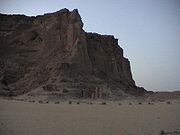
The nearby Jebel Barkal
Jebel Barkal
Jebel Barkal or Gebel Barkal is a very small mountain located some 400 km north of Khartoum, in Karima town in Northern State in Sudan, on a large bend of the Nile River, in the region called Nubia....
was taken to mark the southern border of the New Kingdom
New Kingdom
The New Kingdom of Egypt, also referred to as the Egyptian Empire is the period in ancient Egyptian history between the 16th century BC and the 11th century BC, covering the Eighteenth, Nineteenth, and Twentieth Dynasties of Egypt....
.
In 1075 BC, the High Priest of Amun
Amun
Amun, reconstructed Egyptian Yamānu , was a god in Egyptian mythology who in the form of Amun-Ra became the focus of the most complex system of theology in Ancient Egypt...
at Thebes
Thebes, Egypt
Thebes is the Greek name for a city in Ancient Egypt located about 800 km south of the Mediterranean, on the east bank of the river Nile within the modern city of Luxor. The Theban Necropolis is situated nearby on the west bank of the Nile.-History:...
, capital of Egypt, became powerful enough to limit the power of the pharaoh over Upper Egypt
Upper Egypt
Upper Egypt is the strip of land, on both sides of the Nile valley, that extends from the cataract boundaries of modern-day Aswan north to the area between El-Ayait and Zawyet Dahshur . The northern section of Upper Egypt, between El-Ayait and Sohag is sometimes known as Middle Egypt...
. This was the beginning of the Third Intermediate Period (1075 BC-664 BC). The fragmentation of power in Egypt allowed the Nubians to regain autonomy. They founded a new kingdom, Kush
Kingdom of Kush
The native name of the Kingdom was likely kaš, recorded in Egyptian as .The name Kash is probably connected to Cush in the Hebrew Bible , son of Ham ....
, and centered it at Napata.
Napatan period
In 750 BC, Napata was a developed city, while Egypt was still suffering political instability. King KashtaKashta
Kashta was a king of the Kushite Dynasty and the successor of Alara. His name translates literally as "The Kushite".-Family:Kashta is thought to be a brother of his predecessor Alara. Both Alara and Kashta were thought to have married their sisters...
("the Cushite") profited from it, and attacked Upper Egypt. His policy was pursued by his successors Piye
Piye
Piye, was a Kushite king and founder of the Twenty-fifth dynasty of Egypt who ruled Egypt from 747 BCE to 716 BCE according to Peter Clayton. He ruled from the city of Napata, located deep in Nubia, Sudan...
, and Shabaka
Shabaka
Shabaka or Shabaka Neferkare, 'Beautiful is the Soul of Re', was a Kushite pharaoh of the Twenty-fifth dynasty of Egypt, between according to Peter Clayton .-Family:...
(721-707 BC), who eventually brought the whole Nile Valley under Kush
Kingdom of Kush
The native name of the Kingdom was likely kaš, recorded in Egyptian as .The name Kash is probably connected to Cush in the Hebrew Bible , son of Ham ....
itic control in the second year of his reign. Shabaka also launched a monument-building policy in Egypt and Nubia. Overall, the Kushite kings ruled Upper Egypt for approximately one century and the whole Egypt for approximately 57 years. (from 721 to 664 BC) They constitute the Twenty-fifth Dynasty
Twenty-fifth dynasty of Egypt
The twenty-fifth dynasty of Egypt, known as the Nubian Dynasty or the Kushite Empire, was the last dynasty of the Third Intermediate Period of Ancient Egypt....
in Manetho
Manetho
Manetho was an Egyptian historian and priest from Sebennytos who lived during the Ptolemaic era, approximately during the 3rd century BC. Manetho wrote the Aegyptiaca...
’s work, Aegyptiaca. The reunited Nile valley empire of the 25th dynasty was as large as it had been since the New Kingdom. The 25th dynasty
Twenty-fifth dynasty of Egypt
The twenty-fifth dynasty of Egypt, known as the Nubian Dynasty or the Kushite Empire, was the last dynasty of the Third Intermediate Period of Ancient Egypt....
ushered in a renaissance period for Ancient Egypt. Religion, the arts, and architecture were restored to their glorious Old, Middle, and New Kingdom forms. Pharaohs, such as Taharqa, built or restored temples and monuments throughout the Nile valley, including at Memphis, Karnak, Kawa, Jebel Barkal, etc. It was during the 25th dynasty that the Nile valley saw the first widespread construction of pyramids (many in modern Sudan) since the Middle Kingdom. However, Pharaoh Taharqa
Taharqa
Taharqa was a pharaoh of the Ancient Egyptian 25th dynasty and king of the Kingdom of Kush, which was located in Northern Sudan.Taharqa was the son of Piye, the Nubian king of Napata who had first conquered Egypt. Taharqa was also the cousin and successor of Shebitku. The successful campaigns of...
's reign and that of his successor, (his cousin) Tanutamun, was filled with constant conflict with the Assyrians. In 664 BC the Assyrians laid the final blow, sacking Thebes and Memphis
Memphis, Egypt
Memphis was the ancient capital of Aneb-Hetch, the first nome of Lower Egypt. Its ruins are located near the town of Helwan, south of Cairo.According to legend related by Manetho, the city was founded by the pharaoh Menes around 3000 BC. Capital of Egypt during the Old Kingdom, it remained an...
. The 25th dynasty ended with its rulers retreating to their spiritual homeland at Napata
Napata
Napata was a city-state of ancient Nubia on the west bank of the Nile River, at the site of modern Karima, Northern Sudan.During the 8th to 7th centuries BC, Napata was the capital of the Nubian kingdom of Kush, whence the 25th, or Nubian Dynasty conquered Egypt...
. It was there (at El-Kurru and Nuri) that all 25th dynasty pharaohs are buried under the first pyramids that the Nile valley had seen in centuries. The Napatan dynasty led to the Kingdom of Kush
Kingdom of Kush
The native name of the Kingdom was likely kaš, recorded in Egyptian as .The name Kash is probably connected to Cush in the Hebrew Bible , son of Ham ....
, which flourished in Napata
Napata
Napata was a city-state of ancient Nubia on the west bank of the Nile River, at the site of modern Karima, Northern Sudan.During the 8th to 7th centuries BC, Napata was the capital of the Nubian kingdom of Kush, whence the 25th, or Nubian Dynasty conquered Egypt...
and Meroe
Meroë
Meroë Meroitic: Medewi or Bedewi; Arabic: and Meruwi) is an ancient city on the east bank of the Nile about 6 km north-east of the Kabushiya station near Shendi, Sudan, approximately 200 km north-east of Khartoum. Near the site are a group of villages called Bagrawiyah...
until at least the 2nd century A.D.
Assyrian invasion and end of the Nubian dynasty
Around 670 BC, the Assyrian King EsarhaddonEsarhaddon
Esarhaddon , was a king of Assyria who reigned 681 – 669 BC. He was the youngest son of Sennacherib and the Aramean queen Naqi'a , Sennacherib's second wife....
(681-669 BC) conquered Lower Egypt
Lower Egypt
Lower Egypt is the northern-most section of Egypt. It refers to the fertile Nile Delta region, which stretches from the area between El-Aiyat and Zawyet Dahshur, south of modern-day Cairo, and the Mediterranean Sea....
, but allowed local kingdoms in Lower Egypt to exist, in order to enlist them as his allies against the Kushite
Kingdom of Kush
The native name of the Kingdom was likely kaš, recorded in Egyptian as .The name Kash is probably connected to Cush in the Hebrew Bible , son of Ham ....
rulers of Upper Egypt
Upper Egypt
Upper Egypt is the strip of land, on both sides of the Nile valley, that extends from the cataract boundaries of modern-day Aswan north to the area between El-Ayait and Zawyet Dahshur . The northern section of Upper Egypt, between El-Ayait and Sohag is sometimes known as Middle Egypt...
, who had been accepted with reluctance.
When King Assurbanipal succeeded Esarhaddon
Esarhaddon
Esarhaddon , was a king of Assyria who reigned 681 – 669 BC. He was the youngest son of Sennacherib and the Aramean queen Naqi'a , Sennacherib's second wife....
, the Kushite
Kingdom of Kush
The native name of the Kingdom was likely kaš, recorded in Egyptian as .The name Kash is probably connected to Cush in the Hebrew Bible , son of Ham ....
king Taharqa
Taharqa
Taharqa was a pharaoh of the Ancient Egyptian 25th dynasty and king of the Kingdom of Kush, which was located in Northern Sudan.Taharqa was the son of Piye, the Nubian king of Napata who had first conquered Egypt. Taharqa was also the cousin and successor of Shebitku. The successful campaigns of...
convinced some rulers of Lower Egypt to break with Assyrians. However, Asshurbanipal overpowered the coalition and deported the Egyptian leaders to his capital, Niniveh. He appointed the Libyan chief Necho, ruler of Memphis
Memphis, Egypt
Memphis was the ancient capital of Aneb-Hetch, the first nome of Lower Egypt. Its ruins are located near the town of Helwan, south of Cairo.According to legend related by Manetho, the city was founded by the pharaoh Menes around 3000 BC. Capital of Egypt during the Old Kingdom, it remained an...
and Sais
SAIS
SAIS can refer to:* Paul H. Nitze School of Advanced International Studies, part of The Johns Hopkins University.* Sharjah American International School* Southern Association of Independent Schools...
. Necho I
Necho I
Necho I was the prince or governor of the Egyptian city of Sais. He was the first attested local Saite king of the twenty-sixth dynasty of Egypt who reigned for 8 years, according to Manetho's Epitome. Egypt was reunified by his son, Psamtik I...
was the first king of the Saite Twenty-sixth Dynasty
Twenty-sixth dynasty of Egypt
The Twenty-sixth Dynasty of Egypt was the last native dynasty to rule Egypt before the Persian conquest in 525 BC . The Dynasty's reign The Twenty-sixth Dynasty of Egypt (also written Dynasty XXVI or Dynasty 26) was the last native dynasty to rule Egypt before the Persian conquest in 525 BC...
(664 BC-525 BC) of Egypt.
A new Kushite
Kingdom of Kush
The native name of the Kingdom was likely kaš, recorded in Egyptian as .The name Kash is probably connected to Cush in the Hebrew Bible , son of Ham ....
King Tantamani
Tantamani
Tantamani or Tanwetamani or Tementhes was a Pharaoh of Egypt and the Kingdom of Kush located in Northern Sudan and a member of the Nubian or Twenty-fifth dynasty of Egypt...
(664-653 BC) killed him the same year that Taharqa died, in 664 BC when Tantamani invaded Lower Egypt. However, Tantamani was unable to defeat the Assyrians who backed Necho’s son Psammetichus I
Psammetichus I
Psamtik I , was the first of three kings of that name of the Saite, or Twenty-sixth dynasty of Egypt. His prenomen, Wah-Ib-Re, means "Constant [is the] Heart [of] Re." The story in Herodotus of the Dodecarchy and the rise of Psamtik is fanciful...
. Tantamani eventually abandoned his attempt to conquer Lower Egypt and retreated to Napata. However, his authority over Upper Egypt
Upper Egypt
Upper Egypt is the strip of land, on both sides of the Nile valley, that extends from the cataract boundaries of modern-day Aswan north to the area between El-Ayait and Zawyet Dahshur . The northern section of Upper Egypt, between El-Ayait and Sohag is sometimes known as Middle Egypt...
was acknowledged until the 8th regnal year of his reign at Thebes (or 656 BC) when Psamtik I dispatched a naval fleet to Upper Egypt and succeeded in placing all of Egypt under his control.
Late Napatan kingdom
Napata remained the center of the Kingdom of KushKingdom of Kush
The native name of the Kingdom was likely kaš, recorded in Egyptian as .The name Kash is probably connected to Cush in the Hebrew Bible , son of Ham ....
for another two generations, from the 650s to 590 BC. Its economy was essentially based on gold, with 26th dynasty Egypt an important economic ally.
The people of Napata at the time were culturally Egyptianized. Napatan architecture
Nubian architecture
Nubian architecture is diverse and ancient. Permanent villages have been found in Nubia which date from 6000 BC. These villages were roughly contemporary with the walled town of Jericho in Palestine.-Early Period:...
, paintings, writing script, and other artistic and cultural forms were in the Egyptian style. Egyptian burial customs were practiced, including the resurrection of pyramid building. The Napatan dynasty and their successors built the first pyramids the Nile Valley had seen since the Middle Kingdom. Also, several Egyptian gods were worshipped. The most important god was Amun
Amun
Amun, reconstructed Egyptian Yamānu , was a god in Egyptian mythology who in the form of Amun-Ra became the focus of the most complex system of theology in Ancient Egypt...
, a Theban deity, his temple was the most important at Napata, located at the foot of Jebel Barkal
Jebel Barkal
Jebel Barkal or Gebel Barkal is a very small mountain located some 400 km north of Khartoum, in Karima town in Northern State in Sudan, on a large bend of the Nile River, in the region called Nubia....
.
After the Persian conquest of Egypt, Napata lost its economic influence. The Napatan region itself was desiccating, leading to less cattle and agriculture. A Persian raid had seriously affected Napata in 591 BC. Finally, Napata was losing its role of economic capital to Meroë
Meroë
Meroë Meroitic: Medewi or Bedewi; Arabic: and Meruwi) is an ancient city on the east bank of the Nile about 6 km north-east of the Kabushiya station near Shendi, Sudan, approximately 200 km north-east of Khartoum. Near the site are a group of villages called Bagrawiyah...
. The Island of Meroë, the Peninsula formed by the Nile and the Atbara courses, was an area rich in iron, which was becoming an essential source of wealth.
Meroe eventually became the capital of the kingdom of Kush
Kingdom of Kush
The native name of the Kingdom was likely kaš, recorded in Egyptian as .The name Kash is probably connected to Cush in the Hebrew Bible , son of Ham ....
, leading to the abandonment of Napata.
Roman era legacy
In 23 BC, the Roman prefectPrefect
Prefect is a magisterial title of varying definition....
of Egypt invaded the kingdom after an initial attack by the queen of Meröe, razing Napata to the ground.
In "The Deeds of the Divine Augustus
Res Gestae Divi Augusti
Res Gestae Divi Augusti, is the funerary inscription of the first Roman emperor, Augustus, giving a first-person record of his life and accomplishments. The Res Gestae is especially significant because it gives an insight into the image Augustus portrayed to the Roman people...
," Augustus claims that "a penetration was made as far as the town of Napata, which is next to Meroe..."