
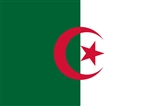
Algeria
Algeria , officially the People's Democratic Republic of Algeria is a country in
north Africa, and the second largest country on the
African continent,
Sudan being the largest. The issue of Berber language and identity increased in significance, particularly after the extensive Kabyle protests of 2001 and the near-total boycott of local elections in
Kabylie; the government responded with concessions including naming of
Tamazight as a national language and teaching it in schools.
Much of Algeria is now recovering, developing into an emerging economy. The high prices of oil & gas are being used by the new government to improve the county's infrastructure and specially improve industry and agriculture land.
Encyclopedia
Algeria , officially the
People's Democratic Republic of Algeria is a country in
north Africa, and the second largest country on the
African continent,
Sudan being the largest. The issue of Berber language and identity increased in significance, particularly after the extensive Kabyle protests of 2001 and the near-total boycott of local elections in
Kabylie; the government responded with concessions including naming of
Tamazight as a national language and teaching it in schools.
Much of Algeria is now recovering, developing into an emerging economy. The high prices of oil & gas are being used by the new government to improve the county's infrastructure and specially improve industry and agriculture land. Recent overseas investment in Algeria has increased.
Education
Pre-higher education :
Duration of compulsory education : age 6 to 15
Structure of school system
Basic : Type of school providing this education: Retared, Ecole fondamentale
Length of program: 9 years
Age range: age 6 to 15 old
Certificate/diploma awarded: Brevet d'Enseignement fondamental
General Secondary : Type of school providing this education: Lycée d'Enseignement général, lycées polyvalents
Length of program: 3 years
Age range: age 15 to 18
Certificate/diploma awarded: Baccalauréat de l'Enseignement secondaire
Technical Secondary : Type of school providing this education: Lycées d'Enseignment technique
Length of program: 3 years
Certificate/diploma awarded: Baccalauréat technique
Politics
The head of state is the President of the Republic, who is elected to a 5-year term, renewable once. Algeria has universal suffrage. The President is the head of the Council of Ministers and of the High Security Council. He appoints the Prime Minister who is also the head of government. The Prime Minister appoints the Council of Ministers.
The Algerian
parliament is bicameral, consisting of a lower chamber, the National People's Assembly , with 380 members and an upper chamber, the Council Of Nation, with 144 members. The APN is elected every 5 years.
Throughout the 1960s, Algeria supported many independence movements in sub-Saharan Africa, and was a leader in the
Non-Aligned Movement. While it shares much of its history and cultural heritage with neighbouring
Morocco, the two countries have had somewhat hostile relations with each other ever since Algeria's independence. This is due to two reasons: Morocco's
disputed claim to portions of western Algeria , and Algeria's support for the Polisario, an armed group of Sahrawi
refugees seeking independence for the Moroccan-ruled
Western Sahara, which it hosts within its borders in the city of Tindouf. Tensions between Algeria and Morocco, as well as issues relating to the
Algerian Civil War, have put great obstacles in the way of tightening the
Maghreb Arab Union, nominally established in 1989 but with little practical weight, with its coastal neighbors.
Administrative divisions
>|colspan="3"| Algeria is divided into 48 provinces : and M'Hamed Issiakhemscellaneous topics
References
External links
Government
- official presidential site
- official parliamentary site
News
- news headline links
- business news
Overviews
- data as of December 1993
-
- directory category
- - an irreverent look at Algeria's military situation
Tourism
Other
- human rights organization critical of widespread torture practiced by the régime
- Analysis on the public referendum held 29 September 2005 by Veerle Opgenhaffen and Hanny Megally
Cultural Heritage
- Fabio Maniscalco , Protection of cultural property in Algerie, , vol 3, Naples 2003, ISBN 88-87835-41-1