


History of Rome

Encyclopedia
The history of Rome
spans 2,800 years of the existence of a city that grew from a small Italian
village in the 9th century BC into the centre of a vast civilisation
that dominated the Mediterranean
region for centuries. Its political power was eventually replaced
by that of peoples of mostly Germanic origin
, marking the beginning of the Middle Ages
. Rome
became the seat of the Roman Catholic Church and the home of a sovereign state, the Vatican City
, within its walls. Today it is the capital of Italy, an international worldwide political and cultural centre, a major global city
, and is regarded as one of the most beautiful cities of the ancient world.
The traditional date for the founding of Rome
, based on a mythological account, is 21 April 753 BC, and the city and surrounding region of Latium has continued to be inhabited with little interruption since around that time.
 The origin of the city's name is thought to be that of the reputed founder and first ruler, the legendary Romulus
. It is said that Romulus and his twin brother Remus
, orphans who were suckled and raised by a she-wolf, decided to build a city. After an argument, Romulus killed Remus and named the city Rome, after himself. After founding and naming (as the story goes) Rome, he permitted men of all classes to come to Rome as citizens, including slaves and freemen without distinction. To provide his citizens with wives, Romulus invited the neighboring tribes to a festival in Rome where he abducted the young women from amongst them (known as The Rape of the Sabine Women
). After the ensuing war with the Sabines, Romulus shared the kingship with the Sabine king Titus Tatius
. Romulus selected 100 of the most noble men to form the Roman senate
as an advisory council to the king. These men he called patres, and their descendants became the patricians. He created three centuries
of equites named Ramnes (meaning Romans), Tities (after the Sabine king) and a third called Luceres (Etruscans). He also divided the general populace into thirty curia
e, named after thirty of the Sabine women who had intervened to end the war between Romulus and Tatius. The curiae formed the voting units in the Comitia Curiata
.
More recently, attempts have been made to find a linguistic root for the name Rome. Possibilities include derivation from the Greek
Ῥώμη, meaning bravery, courage; possibly the connection is with a root *rum-, "teat", with a theoretical reference to the totem wolf that adopted and suckled the cognately-named twins. The Etruscan name of the city seems to have been Ruma. Compare also Rumon, former name of the Tiber River. Its further etymology, as with that of most Etruscan words, remains unknown. The Basque
scholar Manuel de Larramendi thought that the origin could be related to the Basque language
word orma (modern Basque kirreal), "wall". Thomas G. Tucker's Concise Etymological Dictionary of Latin (1931) suggests the name is most probably from *urobsma (cf. urbs, robur) and otherwise, "but less likely" from *urosma "hill" (cf. Skt. varsman- "height, point," Old Slavonic врьхъ / vr'h" - "top, summit", Russ. верхом / verkhom - "in the upper area; on horseback", Lith. virsus "upper").
and surrounding hills
approximately 30 km (19 mi) from the Tyrrhenian Sea
on the south side of the Tiber. Another of these hills, the Quirinal Hill
, was probably an outpost for another Italic
-speaking people, the Sabine
s. At this location the Tiber forms a Z-shape curve that contains an island
where the river can be forded. Because of the river and the ford, Rome was at a crossroads of traffic following the river valley and of traders traveling north and south on the west side of the peninsula.
Archaeological
finds have confirmed that in the 8th century BC in the area of the future Rome there were two fortified settlements, the Rumi one on the Palatine Hill and the Titientes one on the Quirinal Hill, backed by the Luceres living in the nearby woods. These were simply three of numerous Italic-speaking communities that existed in Latium
, a plain
on the Italian
peninsula, by the 1st millennium BC
. The origins of the Italic peoples is not known, but their Indo-European languages
migrated from the east in the second-half of the 2nd millennium BC
.
According to Dionysius of Halicarnassus
, many Roman historians (including Porcius Cato and Gaius Sempronius) regarded the origins of the Romans (descendants of the Aborigines
) as Greek despite the fact that their knowledge was derived from Greek legendary accounts. The Sabines, specifically, were first mentioned in Dionysius's account for having captured by surprise the city of Lista which was regarded as the mother-city of the Aborigines.
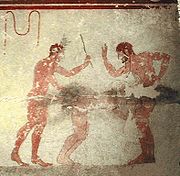 In the 8th century BC, these Italic speakers — Latins
(in the west), Sabine
s (in the upper valley of the Tiber), Umbrian
s (in the north-east), Samnites
(in the South), Oscans
and others — shared the peninsula with two other major ethnic groups: the Etruscans
in the North, and the Greeks
in the south.
The Etruscan
s (Etrusci or Tusci in Latin
) were settled north of Rome in Etruria
(modern northern Lazio, Tuscany
and part of Umbria
). They founded cities like Tarquinia
, Veii and Volterra and deeply influenced Roman culture, as clearly shown by the Etruscan origin of some of the mythical Roman kings. The origins of the Etruscans are lost in prehistory. Historians have no literature, no texts of religion or philosophy; therefore much of what is known about this civilisation is derived from grave goods and tomb findings.
The behaviour of the Etruscans has led to some confusion. Like Latin, Etruscan is inflected and Hellenised. Like the Indo-Europeans, the Etruscans were patrilineal and patriarchal. Like the Italics, they were war-like. The gladiator
ial displays actually evolved out of Etruscan funerary customs. Future studies of Etruscan and more excavations in the region will no doubt clarify the origin of Rome and the Romans even more.
The Greeks had founded many colonies in Southern Italy
(that the Romans later called Magna Graecia
), such as Cumae
, Naples
and Taranto
, as well as in the eastern two-thirds of Sicily
, between 750
and 550 BC
.
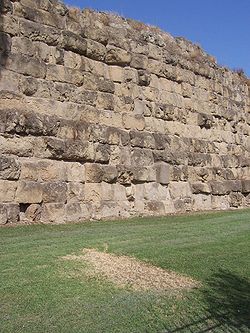 After 650 BC
, the Etruscan
s became dominant in Italy and expanded into north-central Italy. Roman tradition claimed that Rome had been under the control of seven kings
from 753
to 509 BC beginning with the mythic Romulus
who along with his brother Remus
were said to have founded the city of Rome
. Two of the last three kings, namely Tarquinius Priscus and Tarquinius Superbus
, were said to be (at least partially) Etruscan (Priscus is said by the ancient literary sources to be the son of a Greek refugee, and an Etruscan mother), their names referring to the Etruscan town of Tarquinia
.
This traditional account of Roman history, which has come down to us through Livy
, Plutarch
, Dionysius of Halicarnassus
and others, is that in Rome's first centuries, it was ruled by a succession of seven kings. The traditional chronology, as codified by Varro
, allots 243 years for their reigns, an average of almost 35 years, which, since the work of Barthold Georg Niebuhr
, has been generally discounted by modern scholarship. The Gauls
destroyed much of Rome's historical records when they sacked the city after the Battle of the Allia
in 390 BC (Varronian, according to Polybius the battle occurred in 387/6) and what was left was eventually lost to time or theft. With no contemporary records of the kingdom existing, all accounts of the kings must be carefully questioned. The list of kings is also of dubious historical value, though the last-named kings may be historical figures.
It is believed by some historians (again, this is disputed) that Rome was under the influence of the Etruscans for about a century. During this period a bridge called the Pons Sublicius
was built to replace the Tiber ford, and the Cloaca Maxima
was also built; the Etruscans are said to have been great engineers of this type of structure. From a cultural and technical point of view, Etruscans had arguably the second-greatest impact on Roman development, only surpassed by the Greeks.
Expanding further south, the Etruscans came into direct contact with the Greeks. After initial success in conflicts with the Greek colonists, Etruria went into a decline. Taking advantage of this, around 500 BC Rome rebelled and gained independence from the Etruscans. It also abandoned monarchy in favour of a republican system based on a Senate
, composed of the nobles of the city, along with popular assemblies which ensured political participation for most of the freeborn men and elected magistrates annually.
The Etruscans left a lasting influence on Rome. The Romans learned to build temples from them, and the Etruscans may have introduced the worship of a triad of gods — Juno
, Minerva
, and Jupiter
— from the Etruscan gods
: Uni
, Menrva
, and Tinia
. However, the influence of Etruscan people in the evolution of Rome is often overstated. Rome was primarily a Latin city. It never became fully Etruscan. Also, evidence shows that Romans were heavily influenced by the Greek cities in the South, mainly through trade.
s. Winning the Battle of Lake Regillus
in 493 BC
, Rome established again the supremacy over the Latin countries it had lost after the fall of the monarchy. After a lengthy series of struggles, this supremacy became fixed in 393, when the Romans finally subdued the Volsci
and Aequi
. In 394 BC
, they also conquered the menacing Etruscan neighbour of Veii
. The Etruscan power was now limited to Etruria itself, and Rome was the dominant city in Latium.
Also a formal treaty with the city of Carthage
is reported to have been made in the end of the 6th century BC, which defined the spheres of influence of each city and regulated the trade between them.
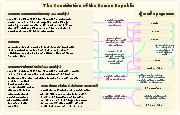 At the same time, Heraclides
states that 4th century Rome is a Greek
city.
Rome's early enemies were the neighbouring hill tribes of the Volscians, the Aequi, and of course the Etruscans. As years passed and military successes increased Roman territory, new adversaries appeared. The fiercest were the Gauls
, a loose collective of peoples who controlled much of Northern Europe including what is modern North and Central-East Italy.
In 387 BC
, Rome was sacked and burned by the Senones
coming from eastern Italy and led by Brennus
, who had successfully defeated the Roman army at the Battle of the Allia
in Etruria
. Multiple contemporary records suggest that the Senones hoped to punish Rome for violating its diplomatic neutrality in Etruria. The Senones marched 130 kilometres (80.8 mi) to Rome without harming the surrounding countryside; once sacked, the Senones withdrew from Rome. Brennus was defeated by the dictator Furius Camillus
at Tusculum
soon afterwards.
After that, Rome hastily rebuilt its buildings and went on the offensive, conquering the Etruscans and seizing territory from the Gauls in the north. After 345 BC
, Rome pushed south against other Latins. Their main enemy in this quadrant were the fierce Samnites
, who heavily defeated the legions in 321 BC
at the Battle of Caudine Forks
. In spite of these and other temporary setbacks, the Romans advanced steadily. By 290 BC
, Rome controlled over half of the Italian peninsula. In the 3rd century BC, Rome brought the Greek poleis
in the south under its control as well.
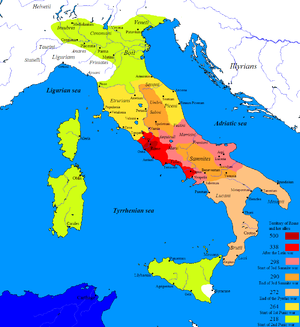 Amidst the never ending wars (from the beginning of the Republic up to the Principate, the doors of the temple of Janus
were closed only twice - when they were open it meant that Rome was at war), Rome had to face a severe major social crisis, the Conflict of the Orders
, a political struggle between the Plebeian
s (commoners) and Patricians (aristocrats) of the ancient Roman Republic
, in which the Plebeians sought political equality with the Patricians. It was the major issue during the History of the Constitution of the Roman Republic
, and played a major role in the development of the Constitution of the Roman Republic
. It began in 494 BC, when, while Rome was at war with two neighboring tribes, the Plebeians all left the city (the first Plebeian Secession). The result of this first secession was the creation of the office of Plebeian Tribune, and with it the first acquisition of real power by the Plebeians.
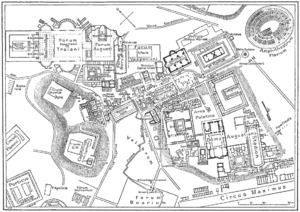 According to tradition, Rome became a republic
in 509 BC. However, it took a few centuries for Rome to become the great city of popular imagination. By the 3rd century BC, Rome had become the pre-eminent city of the Italian peninsula. During the Punic Wars
between Rome and the great Mediterranean empire of Carthage (264 to 146 BC), Rome's stature increased further as it became the capital of an overseas empire for the first time. Beginning in the 2nd century BC, Rome went through a significant population expansion as Italian farmers, driven from their ancestral farmlands by the advent of massive, slave-operated farms called latifundia, flocked to the city in great numbers. The victory over Carthage in the First Punic War
brought the first two provinces outside the Italian peninsula, Sicily
and Sardinia
. Parts of Spain
(Hispania
) followed, and in the beginning of the 2nd century the Romans got involved in the affairs of the Greek world. By then all Hellenistic kingdoms and the Greek city-states were in decline, exhausted from endless civil wars and relying on mercenary troops.
The Romans looked upon the Greek civilisation with great admiration. The Greeks saw Rome as a useful ally in their civil strifes, and it wasn't long before the Roman legions were invited to intervene in Greece. In less than 50 years the whole of mainland Greece was subdued. The Roman legions crushed the Macedonian phalanx twice, in 197 and 168 BC; in 146 BC
the Roman consul Lucius Mummius
razed Corinth
, marking the end of free Greece. The same year, Cornelius Scipio Aemilianus
, the son of Scipio Africanus
destroyed the city of Carthage
, making it a Roman province.
In the following years, Rome continued its conquests in Spain with Tiberius Gracchus
, and it set foot in Asia, when the last king of Pergamum gave his kingdom to the Roman people. The end of the 2nd century brought once again threat, when a great host of Germanic peoples
, namely Cimbri
and Teutones
, crossed the river Rhone and moved to Italy. Gaius Marius
was consul five consecutive times (seven total), and won two decisive battles in 102 and 101 BC He also reformed the Roman army, giving it such a good reorganization that it remained unchanged for centuries.
The first thirty years of the last century BC were characterised by serious internal problems that threatened the existence of the Republic. The Social War, between Rome and its allies, and the Servile Wars
(slave uprisings) were very hard conflicts, all within Italy, and forced the Romans to change their policy with regards to their allies and subjects. By then Rome had become an extensive power, with great wealth which derived from the conquered people (as tribute, food or manpower, i.e. slaves). The allies of Rome felt bitter since they had fought by the side of the Romans, and yet they were not citizens and shared little in the rewards. Although they lost the war, they finally got what they asked, and by the beginning of the 1st century AD practically all free inhabitants of Italy were Roman citizens.
However, the growth of the Imperium Romanum (Roman power) created new problems, and new demands, that the old political system of the Republic, with its annually elected magistrates and its sharing of power, could not solve. The dictatorship of Sulla
, the extraordinary commands of Pompey Magnus, and the first triumvirate
made that clear. In January 49 BC, Julius Caesar
the conqueror of Gaul, marched his legions against Rome. In the following years, he vanquished his opponents, and ruled Rome for four years. After his assassination in 44 BC, the Senate tried to reestablish the Republic, but its champions, Marcus Junius Brutus (descendant of the founder of the republic) and Gaius Cassius Longinus
were defeated by Caesar's lieutenant Marcus Antonius
and Caesar's nephew, Octavian
.
The years 44-31 BC mark the struggle for power between Marcus Antonius and Octavian (later known as Augustus). Finally, on September 2, 31 BC, in the Greek promontory of Actium
, the final battle took place in the sea. Octavian was victorious, and became the sole ruler of Rome (and its empire). That date marks the end of the Republic and the beginning of the Principate
.
By the end of the Republic, the city of Rome had achieved a grandeur befitting the capital of an empire dominating the whole of the Mediterranean
. It was, at the time, the largest city in the world. Estimates of its peak population range from 450,000 to over 3.5 million people with estimates of 1 to 2 million being most popular with historians. This grandeur increased under Augustus
, who completed Caesar's projects and added many of his own, such as the Forum of Augustus
and the Ara Pacis
. He is said to have remarked that he found Rome a city of brick and left it a city of marble. Augustus' successors sought to emulate his success in part by adding their own contributions to the city. In AD 64, during the reign of Nero
, the Great Fire of Rome
left much of the city destroyed, but in many ways it was used as an excuse for new development.
Rome was a subsidised city at the time, with roughly 15 to 25 percent of its grain supply being paid by the central government. Commerce and industry played a smaller role compared to that of other cities like Alexandria
. This meant that Rome had to depend upon goods and production from other parts of the Empire to sustain such a large population. This was mostly paid by taxes that were levied by the Roman government. If it had not been subsidised, Rome would have been significantly smaller.
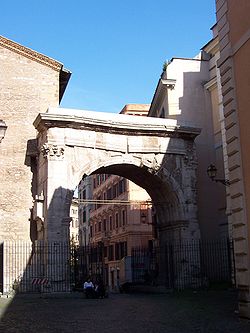 Rome's population declined after its peak in the 2nd century. At the end of that century, during the reign of Marcus Aurelius, a plague killed 2,000 people a day. Marcus Aurelius died in 180, his reign being the last of the "Five Good Emperors" and Pax Romana
. His son Commodus
, who had been co-emperor since 177, assumed full imperial power, which is most generally associated with the gradual decline of the Western Roman Empire. Rome's population was only a fraction of its peak when the Aurelian Wall
was completed in the year 273 (at that year its population was only around 500,000).
Starting in the early 3rd century, matters changed. The "Crisis of the third century
" defines the disasters and political troubles for the Empire, which nearly collapsed. The new feeling of danger and the menace of barbarian invasions was clearly shown by the decision of Emperor Aurelian
, who at year 273 finished encircling the capital itself with a massive wall
which had a perimeter that measured close to 20 km (12 mi). Rome formally remained capital of the empire
, but emperors spent less and less time there. At the end of 3rd century Diocletian
's political reforms, Rome was deprived of its traditional role of administrative capital of the Empire. Later, western emperors
ruled from Milan
or Ravenna
, or cities in Gaul
. In 330, Constantine I
established a second capital at Constantinople
. At this time, part of the Roman aristocratic class moved to this new centre, followed by many of the artists and craftsmen who were living in the city.
However, the Senate
, while stripped of most of its political power, was socially prestigious. The Empire's conversion to Christianity made the Bishop of Rome
(later called the Pope) the senior religious figure in the Western Empire, as officially stated in 380 by the Edict of Thessalonica
. In spite of its increasingly marginal role in the Empire, Rome retained its historic prestige, and this period saw the last wave of construction activity: Constantine's predecessor Maxentius
built buildings such as its basilica in the Forum
, Constantine himself erected the Arch of Constantine
to celebrate his victory over the former, and Diocletian
built the greatest baths
of all. Constantine was also the first patron of official Christian buildings in the city. He donated the Lateran Palace
to the Pope, and built the first great basilica, the old St. Peter's Basilica.
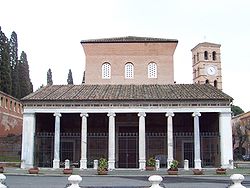 Still Rome remained one of the strongholds of Paganism, led by the aristocrats and senators. When the Visigoths showed off before the walls in 408, the Senate and the prefect proposed pagan sacrifices, and it seems that even the pope was agreeable if this could help to save the city. However, the new walls did not stop the city being sacked first by Alaric
on August 24, 410, by Geiseric
in 455 and even by general Ricimer
's unpaid Roman troops (largely composed of barbarians) on July 11, 472. This was the first time in almost 800 years that Rome had fallen to an enemy. The previous sack of Rome
had been accomplished by the Gaul
s under their leader Brennus in 387 BC. The sacking of 410 is seen as a major landmark in the decline and fall of the Western Roman Empire
. St. Jerome, living in Bethlehem at the time, wrote that "The City which had taken the whole world was itself taken." These sackings of the city astonished all the Roman world. The fall of Rome was read as the definitive fall of the ancient order. Many inhabitants fled, and at the end of the century Rome's population may have been less than 50,000. In any case, the damage the sackings made has been probably overestimated. The city was already in a steep decline, and many monuments had been destroyed by the citizens themselves, who stripped stones from closed temples and other precious buildings, and even burned statues to make lime for their personal use. In addition, most of the increasing number of churches were built in this way. For example, the first Saint Peter's Basilica
was erected using spoils from the abandoned Circus of Nero
. This "self-eating" attitude was a constant feature of Rome until the Renaissance
. From the 4th century imperial edicts against stripping of stones and especially marble were common, but the need for their repetition shows that they were ineffective. Sometimes new churches were created by simply taking advantage of early Pagan temples, perhaps changing the Pagan god or hero to a corresponding Christian saint or martyr. In this way the Temple of Romulus and Remus became the basilica of the twin saints Cosmas and Damian
. Later, the Pantheon
, Temple of All Gods, became the church of All Martyrs.
reached Rome during the first century AD. For the first two centuries of the Christian era, Imperial authorities largely viewed Christianity simply as a Jewish sect rather than a distinct religion. No emperor issued general laws against the faith or its Church, and persecutions, such as they were, were carried out under the authority of local government officials. A surviving letter from Pliny the Younger
, governor of Bythinia, to the emperor Trajan
describes his persecution and executions of Christians; Trajan notably responded that Pliny should not seek out Christians nor heed anonymous denunciations, but only punish open Christians who refused to recant.
Suetonius
mentions in passing that during the reign of Nero
"punishment was inflicted on the Christians, a class of men given to a new and mischievous superstition" (superstitionis novae ac maleficae). He gives no reason for the punishment. Tacitus
reports that after the Great Fire of Rome
in AD 64, some among the population held Nero responsible and that the emperor attempted to deflect blame onto the Christians. The war against the Jews during Nero's reign, which so destabilised the empire that it led to civil war and Nero's suicide provided an additional rationale for suppression of this 'Jewish' sect.
, was murdered and a Roman general of barbarian origin, Odoacer
, declared allegiance to Eastern Roman emperor Zeno. Despite owing nominal allegiance to Constantinople
, Odoacer
and later the Ostrogoths continued, like the last emperors, to rule Italy as a virtually independent realm from Ravenna
. Meanwhile, the Senate, even though long since stripped of wider powers, continued to administer Rome itself, with the Pope usually coming from a senatorial family. This situation continued until Theodahad
murdered Amalasuntha
, a pro-imperial Gothic queen, and usurped the power in 535. The Eastern Roman emperor, Justinian I
(reigned 527–565), used this as a pretext to send forces to Italy under his famed general Belisarius
, recapturing the city next year. The Byzantines successfully defended the city in a year-long siege, and eventually took Ravenna.
Gothic resistance revived however, and on December 17, 546, the Ostrogoths under Totila
recaptured and sacked Rome
. Belisarius soon recovered the city, but the Ostrogoths retook it in 549. Belisarius was replaced by Narses
, who captured Rome from the Ostrogoths for good in 552, ending the so-called Gothic Wars which had devastated much of Italy. The continual war around Rome in the 530s and 540s left it in a state of total disrepair — near-abandoned and desolate with much of its lower-lying parts turned into unhealthy marshes as the drainage systems were neglected and the Tiber's embankments fell into disrepair in the course of the latter half of the 6th century. Here, malaria
developed. The aqueducts
were never repaired, leading to a shrinking population of less than 50,000 concentrated near the Tiber and around the Campus Martius
, abandoning those districts without water supply. There is a legend, significant though untrue, that there was a moment where no one remained living in Rome.
Justinian I tried to grant Rome subsidies for the maintenance of public buildings, aqueducts and bridges — though, being mostly drawn from an Italy
dramatically impoverished by the recent wars, these were not always sufficient. He also styled himself the patron of its remaining scholar
s, orators, physician
s and lawyer
s in the stated hope that eventually more youths would seek a better education
. After the wars, the Senate was theoretically restored, but under the supervision of the urban prefect
and other officials appointed by, and responsible to, the Byzantine authorities in Ravenna
.
However, the Pope was now one of the leading religious figures in the entire Byzantine Empire and effectively more powerful locally than either the remaining senators or local Byzantine officials. In practice, local power in Rome devolved to the Pope and, over the next few decades, both much of the remaining possessions of the senatorial aristocracy and the local Byzantine administration in Rome were absorbed by the Church.
The reign of Justinian's nephew and successor Justin II
(reigned 565–578) was marked from the Italian
point of view by the invasion of the Lombards
under Alboin
(568). In capturing the regions of Benevento
, Lombardy
, Piedmont
, Spoleto
and Tuscany
, the invaders effectively restricted Imperial authority to small islands of land surrounding a number of coastal cities, including Ravenna
, Naples
, Rome
and the area of the future Venice
. The one inland city continuing under Byzantine control was Perugia
, which provided a repeatedly threatened overland link between Rome and Ravenna. In 578 and again in 580, the Senate, in some of its last recorded acts, had to ask for the support of Tiberius II Constantine
(reigned 578–582) against the approaching Dukes, Faroald I of Spoleto
and Zotto
of Benevento
.
Maurice
(reigned 582–602) added a new factor in the continuing conflict by creating an alliance with Childebert II of Austrasia
(reigned 575–595). The armies of the Frankish King invaded the Lombard territories in 584, 585, 588 and 590. Rome had suffered badly from a disastrous flood of the Tiber in 589, followed by a plague in 590. The latter is notable for the legend
of the angel
seen, while the newly elected Pope Gregory I
(term 590–604) was passing in procession by Hadrian's Tomb
, to hover over the building and to sheathe his flaming sword as a sign that the pestilence was about to cease. The city was safe from capture at least.
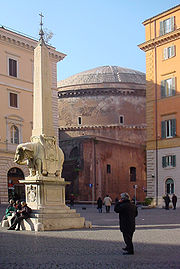 Agilulf
, however, the new Lombard King (reigned 591 to c. 616), managed to secure peace with Childebert
, reorganised his territories and resumed activities against both Naples
and Rome by 592. With the Emperor preoccupied with wars in the eastern borders and the various succeeding Exarch
s unable to secure Rome from invasion, Gregory took personal initiative in starting negotiations for a peace treaty
. This was completed in the autumn of 598 — later recognised by Maurice - lasting until the end of his reign.
The position of the Bishop of Rome
was further strengthened under the usurper Phocas
(reigned 602–610). Phocas recognised his primacy over that of the Patriarch of Constantinople and even decreed Pope Boniface III
(607) to be "the head of all the Churches
". Phocas' reign saw the erection of the last imperial monument in the Roman Forum
, the column
bearing his name. He also gave the Pope the Pantheon
, at the time closed for centuries, and thus probably saved it from destruction.
During the 7th century, an influx of both Byzantine officials and churchmen from elsewhere in the empire made both the local lay aristocracy and Church leadership largely Greek speaking. However, the strong Byzantine cultural influence did not always lead to political harmony between Rome and Constantinople. In the controversy over Monothelitism
, popes found themselves under severe pressure (sometimes amounting to physical force) when they failed to keep in step with Constantinople's shifting theological positions. In 653, Pope Martin I
was deported to Constantinople and, after a show trial, exiled to the Crimea, where he died.
Then, in 663, Rome had its first imperial visit for two centuries, by Constans II
— its worst disaster since the Gothic Wars when the Emperor proceeded to strip Rome of metal, including that from buildings and statues, to provide armament materials for use against the Saracen
s. However, for the next half century, despite further tensions, Rome and the Papacy continued to prefer continued Byzantine rule - in part because the alternative was Lombard rule, and in part because Rome's food was largely coming from Papal estates elsewhere in the Empire, particularly Sicily
.
However, in 727, Pope Gregory II
refused to accept the decrees of Emperor Leo III
, which promoted the Emperor's iconoclasm. Leo reacted first by trying in vain to abduct the Pontiff, and then by sending a force of Ravennate
troops under the command of the Exarch
Paulus, but they were pushed back by the Lombards of Tuscia and Benevento. Roman general Eutychius
sent west by the Emperor successfully captured Rome and restored it as a part of the empire in 728.
On November 1, 731, a council was called in St. Peter
by Gregory III
to excommunicate the iconoclasts. The Emperor responded by confiscating large Papal estates in Sicily
and Calabria
and transferring areas previously ecclesiastically under the Pope to the Patriarch of Constantinople. Despite the tensions Gregory III never discontinued his support to the imperial efforts against external threats.
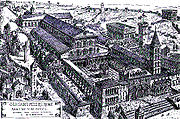 In this period the Lombard kingdom revived under the leadership of King Liutprand
. In 730 he razed the countryside of Rome to punish the Pope who had supported the duke of Spoleto. Though still protected by his massive walls, the pope could do little against the Lombard king, who managed to ally himself with the Byzantines. Other protectors were now needed. Gregory III was the first Pope to ask for concrete help from the Frankish Kingdom, then under the command of Charles Martel
(739).
Liutprand's successor Aistulf
was even more aggressive. He conquered Ferrara
and Ravenna
, ending the Exarchate of Ravenna. Rome seemed his next victim. In 754, Pope Stephen II
went to France to name Pippin the Younger, king of the Franks
, as patricius romanorum, i.e. protector of Rome. In the August of that year the King and Pope together crossed back the Alps and defeated Aistulf at Pavia
. When Pippin went back to St. Denis however, Aistulf did not keep his promises, and in 756 besieged Rome for 56 days. The Lombards returned north when they heard news of Pippin again moving to Italy. This time he agreed to give the Pope the promised territories, and the Papal States
were born.
In 771 the new King of the Lombards, Desiderius
, devised a plot to conquer Rome and seize Pope Stephen III
during a feigned pilgrimage within its walls. His main ally was one Paulus Afiarta, chief of the Lombard party within the city. He conquered Rome in 772 but angered Charlemagne. However the plan failed, and Stephens' successor, Pope Hadrian I
called Charlemagne
against Desiderius, who was finally defeated in 773. The Lombard Kingdom was no more, and now Rome entered into the orbit of a new, greater political institution.
Numerous remains from this period, along with a museum devoted to Medieval Rome, can be seen at Crypta Balbi in Rome.
 On April 25, 799 the new Pope, Leo III
, led the traditional procession from the Lateran
to the Church of San Lorenzo in Lucina
along the Via Flaminia
(now Via del Corso
). Two nobles (followers of his predecessor Hadrian) who disliked the weakness of the Pope with regards to Charlemagne, attacked the processional train and delivered a life threatening wound to the Pope. Leo fled to the King of the Franks, and in November, 800, the King entered Rome with a strong army and a number of French bishops. He declared a judicial trial to decide if Leo III were to remain Pope, or if the deposers' claims had reasons to be upheld. This trial, however, was only a part of a well thought out chain of events which ultimately surprised the world. The Pope was declared legitimate and the attempters subsequently exiled. On December 25, 800, Pope Leo III
crowned Charlemagne Holy Roman Emperor
in St. Peter's Basilica
.
This act forever severed the loyalty of Rome
from its imperial progeny, Constantinople
. It created instead a rival empire which, after a long series of conquests by Charlemagne
, now encompassed most of the Christian Western territories.
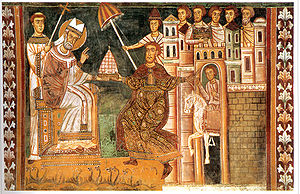
Following the death of Charlemagne, the lack of a figure with equal prestige led the new institution into disagreement. At the same time the universal church of Rome had to face emergence of the lay interests of the City itself, spurred on by the conviction that the Roman people, though impoverished and abased, had again the right to elect the Western Emperor. The famous counterfeit document called the Donation of Constantine
, prepared by the Papal notaries, guaranteed to the Pope a dominion stretching from Ravenna
to Gaeta
. This nominally included the suzerainty over Rome, but this was often highly disputed, and as the centuries passed, only the strongest Popes were to be able to assert it. The main element of weakness of the Papacy within the walls of the city was the continued necessity of the election of new popes, in which the emerging noble families soon managed to insert a leading role for themselves. The neighbouring powers, namely the Duchy of Spoleto
and Toscana
, and later the Emperors, learned how to take their own advantage of this internal weakness, playing the role of arbiters among the contestants.
Rome was indeed prey of anarchy in this age. The lowest point was touched in 897, when a raging crowd exhumed the corpse of a dead pope, Formosus
, and put it on trial
.
s from all the Christian world, and money with them: even with a population of only 30,000, Rome was again becoming a city of consumers dependent upon the presence of a governmental bureaucracy. In the meantime, Italian
cities were acquiring increasing autonomy, mainly led by new families which were replacing the old aristocracy with a new class formed by entrepreneurs, traders and merchants. After the sack of Rome by the Normans
in 1084, the rebuilding of the city was supported by powerful families such as the Frangipane family
and the Pierleoni family
, whose wealth came from commerce and banking rather than landholdings. Inspired by neighbouring cities like Tivoli
and Viterbo
, Rome's people began to consider adopting a communal status and gaining a substantial amount of freedom from papal authority.
Led by Giordano Pierleoni
, the Romans rebelled against the aristocracy and Church rule in 1143. The Senate and the Roman Republic, the Commune of Rome
, were born again. Through the inflammatory words of preacher Arnaldo da Brescia
, an idealistic, fierce opponent of ecclesiastical property and church interference in temporal affairs, the revolt that led to the creation of the Commune of Rome
continued until it was put down in 1155, though it left its mark on the civil government of the Eternal City for centuries. 12th-century Rome, however, had little in common with the empire which had ruled over the Mediterranean some 700 years before, and soon the new Senate had to work hard to survive, choosing an ambiguous policy of shifting its support from the Pope to the Holy Roman Empire
and vice versa as the political situation required. At Monteporzio
, in 1167, during one of these shifts, in the war with Tusculum, Roman troops were defeated by the imperial forces of Frederick Barbarossa
. Luckily, the winning enemies were soon dispersed by a plague and Rome was saved.
In 1188 the new communal government was finally recognised by Pope Clement III
. The Pope had to make large cash payments to the communal officials, while the 56 senators became papal vassals. The Senate always had problems in the accomplishment of its function, and various changes were tried. Often a single Senator was in charge. This sometimes led to tyrannies, which did not help the stability of the new-born organism.
In 1204 the streets of Rome were again in flames when the struggle between Pope Innocent III's
family and its rivals, the powerful Orsini family
, led to riots in the city. Many ancient buildings were then destroyed by machines used by the rival bands to besiege their enemies in the innumerable towers and strongholds which were a hallmark of the Middle Age Italian towns.
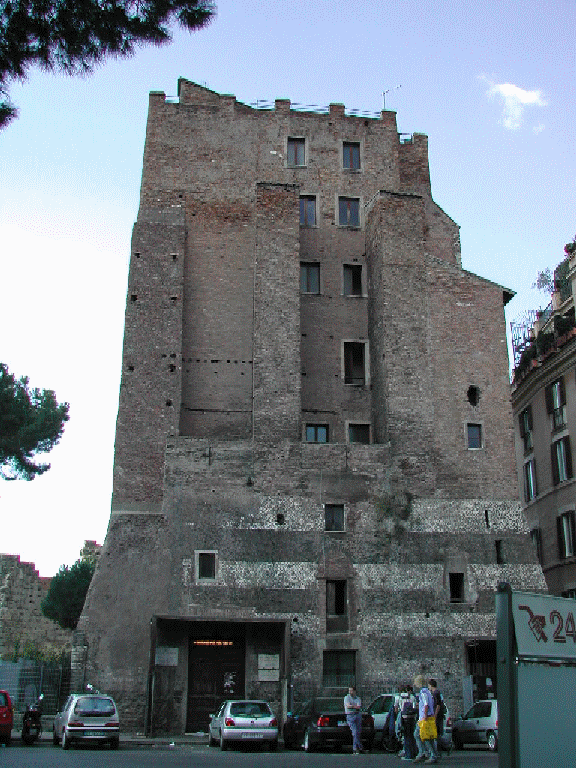 The struggle between the Popes and the emperor Frederick II
, also king of Naples
and Sicily
, saw Rome support the Ghibelline
s. To repay his loyalty, Frederick sent to the commune the Carroccio
he had won to the Lombards
at the battle of Cortenuova
in 1234, and which was exposed in the Campidoglio
. In that year, during another revolt against the Pope, the Romans headed by senator Luca Savelli
sacked the Lateran
. Curiously, Savelli was the nephew of Pope Honorius III
and father of Honorius IV
, but in that age family ties often did not determine one's allegiance. Rome was never to evolve into an autonomous, stable reign, as happened to other communes like Florence
, Siena
or Milan
. The endless struggles between noble families (Savelli, Orsini
, Colonna
, Annibaldi
), the ambiguous position of the Popes, the haughtiness of a population which never abandoned the dreams of their splendid past but, at the same time, thought only of immediate advantage, and the weakness of the republican institutions always deprived the city of this possibility.
In an attempt to imitate more successful communes, in 1252 the people elected a foreign Senator, the Bolognese
Brancaleone degli Andalò. In order to bring peace in the city he suppressed the most powerful nobles (destroying some 140 towers), reorganised the working classes and issued a code of laws inspired by those of northern Italy. Brancaleone was a tough figure, but died in 1258 with almost nothing of his reforms turned into reality. Five years later Charles I of Anjou, then king of Naples
, was elected Senator. He entered the city only in 1265, but soon his presence was needed to face Conradin
, the Hohenstaufen's heir who was coming to claim his family's rights over southern Italy, and left the city. After June 1265 Rome was again a democratic republic, electing Henry of Castile
as senator. But Conradin and the Ghibelline party were crushed in the Battle of Tagliacozzo
(1268), and therefore Rome fell again in the hands of Charles.
Nicholas III
, a member of Orsini family
, was elected in 1277 and moved the seat of the Popes from the Lateran
to the more defensible Vatican
. He also ordered that no foreigner could become senator of Rome. Being a Roman himself, he had himself elected senator by the people. With this move, the city began again to side for the papal party. In 1285 Charles was again Senator, but the Sicilian Vespers
reduced his charisma, and the city was thenceforth free from his authority. The next senator was again a Roman, and again a pope, Honorius IV
of the Savelli.
was a Roman of the Caetani family, Boniface VIII
. Entangled in a local feud against the traditional rivals of his family, the Colonna
, at the same time he struggled to assure the universal supremacy of the Holy See
. In 1300 he launched the first Jubilee
and in 1303 founded the first University of Rome. The Jubilee was an important move for Rome, as it further increased its international prestige and, most of all, the city's economy was boosted by the flow of pilgrims. Boniface died in 1303 after the humiliation of the Schiaffo di Anagni
("Slap of Anagni"), which signalled instead the rule of the King of France
over the Papacy
and marked another period of decline for Rome.
Boniface's successor, Clement V
, never entered the city, starting the so-called "Babylonian Captivity
", the absence of the Popes from their Roman seat in favour of Avignon
, which would last for more than 70 years. This situation brought the independence of the local powers, but these were revealed to be largely unstable; and the lack of the holy revenues caused a deep decay of Rome. For more than a century Rome had no new major buildings. Furthermore, many of the monuments of the city, including the main churches, began to fall into ruin.
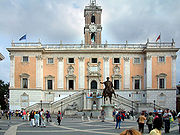 In spite of its decline and the absence of the Pope, Rome had not lost its spiritual prestige: in 1341 the famous poet Petrarca
came to the city to be crowned as poet in Capitoline Hill
. Noblemen and poor people at one time demanded with one voice the return of the Pope. Among the many ambassadors that in this period took their way to Avignon
, emerged the bizarre but eloquent figure of Cola di Rienzo
. As his personal power among the people increased by time, on May 20, 1347 he conquered the Capitoline at the head of an enthusiast crowd. The period of his power, though very short-lived, is anyway one of the most interesting in the life of Rome in Middle Ages
, as Cola tried to assure himself a renovating, almost mystical aura of a paladin of Italian independence, within a confused political dream inspired to the prestige of the Ancient Rome. Now in possession of dictatorial powers, he took the title of "tribune", referring to the pleb
's magistracy
of the Roman Republic
. Cola also considered himself at an equal status of that of the Holy Roman Emperor. On August 1, he conferred Roman citizenship on all the Italian cities, and even prepared for the election of a Roman emperor of Italy. It was too much: the Pope denounced him as heretic, criminal and pagan, the populace had begun to be disenchanted with him, while the nobles had always hated him. On December 15, he was forced to flee.
In August 1354, Cola was again a protagonist, when Cardinal Gil Alvarez De Albornoz entrusted him with the role of "senator of Rome" in his program of reassuring the Pope's rule in the Papal States
. In October the tyrannical Cola, who had become again very unpopular for his delirious behaviour and heavy bills, was killed in a riot provoked by the powerful family of the Colonna
. In April of 1355, Charles IV
of Bohemia
entered the city for the ritual coronation as Emperor. His visit was very disappointing for the citizens. He had little money, received the crown not from the Pope but from a Cardinal, and moved away after a few days.
With the emperor back in his lands, Albornoz could regain a certain control over the city, while remaining in his safe citadel in Montefiascone
, in the Northern Lazio. The senators were chosen directly by the Pope from several cities of Italy, but the city was in fact independent. The Senate council included six judges, five notaries, six marshals, several familiars, twenty knights and twenty armed men. Albornoz had heavily suppressed the traditional aristocratic families, and the "democratic" party felt confident enough to start an aggressive policy. In 1362 Rome declared war on Velletri
. This move, however, provoked a civil war. The countryside party hired a condottieri
band called "Del Cappello" ("Hat"), while the Romans bought the services of German
and Hungarian
troops, plus a citizen levy of 600 knights and even 22,000 infantry. This was the period in which Italy was scourged by these ruthless condottieri bands. Many of the Savelli, Orsini and Annibaldi expelled from Rome became leaders of such military units. The war with Velletri languished, and Rome again gave itself to the new Pope, Urban V
, provided the dreadful Albornoz did not enter the walls.
On October 16, 1367, in reply to the prayers of St Brigid
and Petrarca
, Urban finally visited for the city. During his presence, Charles IV
was again crowned in the city (October 1368). In addition, the Byzantine emperor
John V Palaeologus
came in Rome to beg for a crusade against the Ottoman Empire
, but in vain. However, Urban did not like the unhealthy air of the city, and on September 5, 1370 he sailed again to Avignon
. His successor, Gregory XI
, officially set the date of his return to Rome at May 1372, but again the French
cardinals and the King stopped him.
Only on January 17, 1377, Gregory XI could finally reinstate the Holy See
in Rome.
The incoherent behaviour of his successor, the Italian Urban VI
, provoked in 1378 the Western Schism
, which impeded any true attempt of improving the conditions of the decaying Rome.
, was a century of neglect and misery for the city of Rome, which dropped to its lowest level of population. With the return of the papacy to Rome repeatedly postponed because of the bad conditions of the city and the lack of control and security, it was first necessary to strengthen the political and doctrinal aspects of the pontiff. When in 1377 Gregory XI was in fact returned to Rome, he found a city in anarchy because of the struggles between the nobility and the popular faction, and in which his power was now more formal than real. There followed four decades of instability, characterised by the local power struggle between the commune and the papacy, and internationally by the great Western Schism
, at the end of which was elected Pope, Martin V. He restored order, laying the foundations of its rebirth.
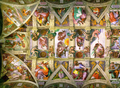 In 1433 the Duke of Milan, Filippo Maria Visconti
signed a peace treaty with Florence
and Venice
. He then sent the condottieri
Niccolò Fortebraccio
and Francesco Sforza
to harass the Papal States
, in vengeance for Eugene IV
's support to the two former republics. Fortebraccio, supported by the Colonna
, occupied Tivoli in October 1433 and ravaged Rome's countryside. Despite the concessions made by Eugene to the Visconti, the Milanese soldiers did not stop their destruction. This led the Romans, on May 29, 1434 to institute a Republican government under the Banderesi. Eugene left the city a few days later, during the night of June 4.
However, the Banderari proved incapable of governing the city, and their inadequacies and violence soon deprived them of popular support. The city was therefore returned to Eugene by the army of Giovanni Vitelleschi
on October 26, 1434. After the death in mysterious circumstances of Vitelleschi, the city came under the control of Ludovico Scarampo, Patriarch of Aquileia. Eugene returned to Rome on 28 September 1443.
move to Rome from Florence
. The Papacy wanted to surpass the grandeur of other Italian cities. To this end the popes created increasingly extravagant churches, bridges, town squares and public spaces, including a new Saint Peter's Basilica
, the Sistine Chapel
, Ponte Sisto
(the first bridge to be built across the Tiber since antiquity), and Piazza Navona
. The Popes were also patrons of the arts engaging such artists as Michelangelo
, Perugino
, Raphael
, Ghirlandaio
, Luca Signorelli
, Botticelli
, and Cosimo Rosselli
.
Under Pope Nicholas V
, who became Pontiff on March 19, 1447, the Renaissance
can be said to have begun in Rome, heralding a period in which the city became the centre of Humanism
. He was the first Pope to embellish the Roman court with scholars and artists, including Lorenzo Valla
and Vespasiano da Bisticci
.
On September 4, 1449 Nicholas proclaimed a Jubilee for the following year, which saw a great influx of pilgrims from all Europe. The crowd was so large that in December, on Ponte Sant'Angelo
, some 200 people died, crushed underfoot or drowned in the River Tiber. Later that year the Plague reappeared in the city, and Nicholas fled.
However Nicholas brought stability to the temporal power of the Papacy, a power in which the Emperor was to have no part at all. In this way, the coronation and the marriage of Frederick III, Holy Roman Emperor
on March 16, 1452, was more a civil ceremony. The Papacy now controlled Rome with a strong hand. A plot by Stefano Porcari
, whose aim was the restoration of the Republic, was ruthlessly suppressed on January 1453. Porcari was hanged together with the other plotters, Francesco Gabadeo, Pietro de Monterotondo, Battista Sciarra and Angiolo Ronconi, but the Pope gained a treacherous reputation, as when the execution was beginning he was too drunk to confirm the grace he had previously given to Sciarra and Ronconi.
Nicholas was also actively involved in Rome's urban renewal, in collaboration with Leon Battista Alberti, including the construction of a new St Peter's Basilica
.
Nicholas' successor Calixtus III
neglected Nicholas's cultural policies, instead devoting himself to his greatest passion, his nephews. The Tuscan
Pius II
, who took the reins after his death in 1458, was a great Humanist, but did little for Rome. During his reign Lorenzo Valla
demonstrated that the Donation of Constantine
was a forgery. Pius was the first Pope to use guns, in campaign against the rebel barons Savelli in the neighbourhood of Rome, in 1461. One year later the bringing to Rome of the head of the Apostle
St. Andrew
produced a great number of pilgrims. The reign of Pope Paul II
(1464–1471) was notable only for the reintroduction of the Carnival
, which was to become a very popular feast in Rome in the following centuries. In the same year (1468) a plot against the Pope was uncovered, organised by the intellectuals of the Roman Academy
founded by Pomponio Leto
. The conspirators were sent to Castel Sant'Angelo.
More important by far was the Pontificate of Sixtus IV
, considered the first Pope-King of Rome. In order to favour his relative Girolamo Riario
, he promoted the unsuccessful Congiura dei Pazzi
against the Medici of Florence (April 26, 1478) and in Rome fought the Colonna
and the Orsini
. The personal politics of intrigue and war required much money, but in spite of this Sixtus was a true patron of art in the manner of Nicholas V
. He reopened the Academy and reorganised the Collegio degli Abbreviatori, and in 1471 began the construction of the Vatican Library
, whose first curator was Platina. The Library was officially founded on June 15, 1475. He restored several churches, including Santa Maria del Popolo
, the Aqua Virgo
and the Hospital of the Holy Spirit; paved several streets and also built a famous bridge over the Tiber
river, which still bears his name. His main building project was the Sistine Chapel
in the Vatican Palace
. Its decoration called on some of the most renowned artists of the age, including Mino da Fiesole
, Sandro Botticelli
, Domenico Ghirlandaio
, Pietro Perugino
, Luca Signorelli
and Pinturicchio
, and in the 16th century Michelangelo
decorated the ceiling with his famous masterpiece, contributing to what became one of the most famous monuments of the world. Sixtus died on August 12, 1484.
Chaos, corruption and nepotism appeared in Rome under the reign of his successors, Innocent VIII
and Pope Alexander VI
(1492–1503). During the vacation period between the death of the former and the election of the latter there were 220 murders in the city. Alexander had to face Charles VIII of France
, who invaded Italy in 1494 and entered Rome on December 31 of that year. The Pope could only barricade himself into Castel Sant'Angelo
, which had been turned into a true fortress by Antonio da Sangallo the Younger
. In the end, the skilful Alexander was able to gain the support of the king, assigning his son Cesare Borgia
as military counsellor for the subsequent invasion of the Kingdom of Naples
. Rome was safe and, as the King directed himself southwards, the Pope again changed his position, joining the anti-French League of the Italian States which finally compelled Charles to flee to France.
The most nepotist Pope of all, Alexander, favoured his ruthless son Cesare, creating for him a personal Duchy
out of territories of the Papal States
, and banning from Rome Cesare's most relentless enemy, the Orsini family. In 1500 the city hosted a new Jubilee, but grew ever more unsafe as, especially at night, the streets were controlled by bands of lawless "bravi". Cesare himself assassinated Alfonso of Bisceglie; as well as, presumably, the Pope's son, Giovanni of Gandia.
The Renaissance had a great impact on Rome's appearance, with works like the Pietà
by Michelangelo and the frescoes of the Borgia Apartment
, all made during Innocent's reign. Rome reached the highest point of splendour under Pope Julius II
(1503–1513) and his successors Leo X
and Clement VII
, both members of the Medici family. During this twenty-year period Rome became the greatest centre of art in the world. The old St. Peter's Basilica
was demolished and a new one begun. The city hosted artists like Bramante
, who built the Temple of San Pietro in Montorio
and planned a great project to renovate the Vatican; Raphael
, who in Rome became the most famous painter in Italy, creating frescos in the Cappella Niccolina
, the Villa Farnesina
, the Raphael's Rooms
, and many other famous paintings. Michelangelo began the decoration of the ceiling of the Sistine Chapel
and executed the famous statue of Moses
for the tomb of Julius. Rome lost in part its religious character, becoming increasingly a true Renaissance city, with a great number of popular feasts, horse races, parties, intrigues and licentious episodes. Its economy was prosperous, with the presence of several Tuscan bankers, including Agostino Chigi
, a friend of Raphael and a patron of the arts. Despite his premature death, and to his eternal credit, Raphael
also promoted for the first time the preservation of the ancient ruins.
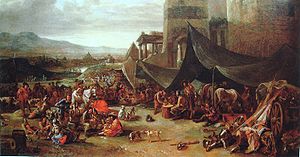 In 1527 the ambiguous policy followed by the second Medici Pope, Pope Clement VII
, resulted in the dramatic sack
of the city by the unruly Imperial
troops of Charles V, Holy Roman Emperor
. After the execution of some 1,000 defenders, the pillage began. The city was devastated for several days, many of the citizens were killed or took shelter outside the walls. Of 189 Swiss Guard
s on duty only 42 survived. The Pope himself was imprisoned for months in Castel Sant'Angelo
. The sack marked the end of one of the most splendid eras of modern Rome.
The 1525's Jubilee resulted in a farce, as Martin Luther
's claims had spread criticism and even despise against the Pope's greed of money throughout Europe. The prestige of Rome was then challenged by the defections of the churches of Germany and England. Pope Paul III
(1534–1549) tried to recover the situation by summoning the Council of Trent
o, although being, at the same time, the most nepotist Pope of all. He even separated Parma
and Piacenza
from the Papal States
to create an independent duchy
for his son Pier Luigi
. He continued the patronage of art supporting the Michelangelo's Last Judgment
, asking him to renovate the Campidoglio
and the on-going construction of St. Peter's
. After the shock of the sack, he also called the brilliant architect Giuliano da Sangallo the Younger
to strengthen the walls of the Leonine City
.
The need for renovation in the religious customs became evident in the vacancy period after Paulus' death, when the streets of Rome became seat of masked carousels which satirised the Cardinals attending the conclave
. His two immediate successors were feeble figures who did nothing to escape the actual Spanish suzerainty over Rome.
Pope Paul IV
, elected in 1555, was a member of the anti-Spanish party, but his policy resulted in the Neapolitan
troops of the viceroy again besieging Rome in 1556. Paul sued for peace, but had to accept the supremacy of Philip II of Spain
. He was one of the most hated Popes of all, and, after his death the raging populace burned the Holy Inquisition
's palace and destroyed his marble statue on the Campidoglio. Pope Paul's Counter-Reformation
views are well shown by his order that a central area of Rome, around the Porticus Octaviae
, be delimited, creating the famous Roman Ghetto
, the very constricted area in which the city's Jews were forced to live in seclusion. They had to remain in the rione
Sant'Angelo
and locked in at night. The Pope decreed that Jews should wear a distinctive sign, yellow hats for men and veils or shawls for women. Jewish ghetto
s existed in Europe for the next 315 years.
The Counter-Reformation
gained pace under his successors, the milder Pope Pius IV
and the severe Saint Pius V
. The former was a nepotist lover of court splendours, but more severe customs arrived anyway through the ideas of his advisor, the prelate Charles Borromeo
, who was to become one of the most popular figures among the Rome's people. Pius V and Borromeo gave Rome a true Counter-Reformation character. All pomp was removed from the court, the jokers were expelled, and cardinals and bishops were obliged to live in the city. Blasphemy and concubinage were severely punished. Prostitutes were expelled or confined in a reserved district. The Inquisition's power in the city was reasserted, and its palace rebuilt with an increased space for prisons. During this period Michelangelo and opened the Porta Pia
and turned the Baths of Diocletian
into the spectacular basilica of Santa Maria degli Angeli e dei Martiri
, where Pius IV was buried.
The pontificate of his successor, Gregory XIII
, was considered a failure. As he tried to use milder measures than those of St. Pius, the worst element of the Roman population felt free to scourge again the streets. The French writer and philosopher Montaigne
maintained that "life and goods were never as unsure as at the time of Gregorius XIII, perhaps", and that a confraternity even held same-sex marriage
in the church of San Giovanni a Porta Latina
. The courtesans repressed by Pius had now returned.
Sixtus V
was of very different temper. Although short (1585–1590), his reign however remembered as one of the most effective in the modern Rome's history. He was even tougher than Pius V, and was variously nicknamed castigamatti ("punisher of the mad"), papa di ferro ("Iron Pope"), dictator and even, ironically, demon, since no other Pope before him pursued with such a determination the reform of the church and the customs. Sixtus profoundly reorganised the Papal States' administration, and cleaned the streets of Rome of thugs, procurers, dueling and so on. Even the nobles and Cardinals could not consider themselves free from the arms of Sixtus' police. The money from taxes, which were not now wasted in corruption, permitted an ambitious building program. Some ancient aqueducts were restored, and new one, the Acquedotto Felice (from Sixtus' name, Felice Peretti) was constructed. New houses were built in the desolate district of Esquilino
, Viminale
and Quirinale
, while old houses in the centre of the city were destroyed to open new, larger streets. Sixtus's principal aim was to make Rome a better destination for pilgrimages, and the new streets were intended to permit a better access to the major Basilicas. Old obelisks were moved or erected to embellish St. John in Lateran, Santa Maria Maggiore and St. Peter, as well as Piazza del Popolo, in front of Santa Maria del Popolo.
Some of the most famous views of Rome in the 18th century were etched by Giovanni Battista Piranesi
. His grand vision of classic Rome inspired many to visit the city and examine the ruins
themselves.
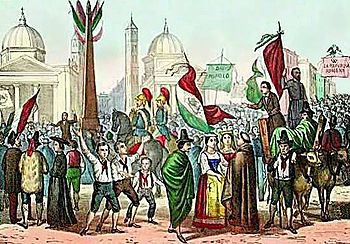
(1798), which was built under the influence of the French Revolution
. During Napoleon
's reign, Rome was annexed into his empire and was technically part of France
. After the fall of Napoleon's Empire, new states were created in Italy through the Congress of Vienna of 1814. The Kingdom of the Two Sicilies (Naple and Sicily) under Bourbon Ferdinand IV, the restored Papal States, and the kingdom of Piedmont-Sardinia under King Charles-Albert. The two regions of Venetia and Lombardy were given to the Austrians under their direct control for some time.
Another Roman Republic
arose in 1849, within the framework of revolutions of 1848
. Two of the most influential figures of the Italian unification
, Giuseppe Mazzini
and Giuseppe Garibaldi
, fought for the short-lived republic. However, the actions of these two great men would not have resulted in unification without the sly leadership of Camille Cavour, Prime Minister of Piedmont-Sardinia
.
Even among those who wanted to see the peninsula unified into one country, different groups could not agree on what form a unified state would take. Vincenzo Gioberti
, a Piedmontese priest, had suggested a confederation of Italian states under rulership of the Pope. His book, Of the Moral and Civil Primacy of the Italians, was published in 1843 and created a link between the Papacy and the Risorgimento. Many leading revolutionaries
wanted a republic, but eventually it was a king
and his chief minister who had the power to unite the Italian states as a monarchy.
In his attempt to unify Northern Italy under the Kingdom of Piedmont-Sardinia
, Cavour enacted major industrialisation of the country in order to become the economic leader of Italy. In doing so, he believed that the other states would naturally come under his rule. Next, he sent the army of Piedmont to the Crimean War
to join the French and British. Making minor successes in the war against Russia, cordial relations were established between Piedmont-Sardinia and France; a relationship to be exploited in the future.
The return of Pope Pius IX
in Rome, with help of French troops, marked the exclusion of Rome from the unification process that was embodied in the Second Italian Independence War
and the Mille expedition
, after which all the Italian peninsula, except Rome and Venetia, would be unified under the House of Savoy
. Garibaldi first attacked Sicily, luckily under the guise of passing British ships and landing with little resistance.
Taking the island, Garibaldi's actions were publicly denounced by Cavour but secretly encouraged via weapons supplements. This policy or real-politik, where the ends justified the means of unification, was continued as Garibaldi faced crossing the Strait of Messina. Cavour privately asked the British navy to allow Garibaldi's troops across the sea while publicly he again, denounced Garibaldi's actions. The maneuver was a success and Garibaldi's military genius carried him on to take the entire kingdom.
Cavour then moved to take Venetia and Lombardy via an alliance with France. The Italians and French together would attack the two states with France getting the city of Nice and the region of Savoy in return. However, the French pulled out of their agreement soon after, enraging Cavour who subsequently resigned. Only Lombardy had been captured at the time.
With French units still stationed at Rome however, Cavour, being called back to office, foresaw a possibility of Garibaldi attacking the Papal States and accidentally disrupting French-Italian relations. The army of Sardinia was therefore mobilised to attack the Papal States but remain outside Rome.
In the Austro-Prussian war however, a deal was made between the new Italy and Prussia, where Italy would attack Austria in return for the region of Venetia. The war was a major success for the Prussians (though the Italians did not win a single battle), and the northern front of Italy was complete.
In July, 1870, the Franco-Prussian War
started, and French Emperor Napoleon III
could no longer protect the Papal States. Soon after, the Italian army under general Raffaele Cadorna
entered Rome on September 20, after a cannonade of three hours, through Porta Pia
(see capture of Rome
). The Leonine City
was occupied the following day, a provisional Government Joint created by Cadorna out of local noblemen to avoid the rise of the radical factions. Rome and Latium
were annexed to the Kingdom of Italy after a plebiscite
held on October 2. 133,681 voted for annexion, 1,507 opposed (in Rome itself, there were 40,785 "Yes" and 57 "No").
When Rome was eventually taken, the Italian government reportedly intended to let Pope Pius IX keep the part of Rome, west of the Tiber
, known as the Leonine City
as a small remaining Papal State, but Pius IX rejected the offer because acceptance would have been an implied endorsement of the legitimacy of the Italian kingdom's rule over his former domain. One week after entering Rome, the Italian troops had taken the entire city save for the Apostolic Palace
; the inhabitants of the city then voted to join Italy. On 1 July 1, 1871 Rome became the official capital of united Italy and from then until June 1929 the popes had no temporal power.
The pope referred to himself during this time as the "prisoner of the Vatican", although he was not actually restrained from coming and going. Pius IX took steps to ensure self-sufficiency, such as the construction of the Vatican Pharmacy
. Italian nobility who owed their titles to the pope rather than the royal family became known as the Black Nobility
during this period because of their purported mourning.
, yet it reflects the stratification of the epochs of its long history. The historical centre, identified as those parts within the limits of the ancient Imperial walls, contains archaeological remains from Ancient Rome. These are continuously being excavated and opened to the public, such as the Colosseum
; the Roman Forum
, and the Catacombs
. There are areas with remains from Medieval times. There are palaces and artistic treasures from the Renaissance
; fountains, churches and palaces from Baroque
times. There is art and architecture from the Art Nouveau
, Neoclassic
, Modernist and Rationalist periods. There are museums, such as the Musei Capitolini
, the Vatican Museums
, Galleria Borghese
.
Parts of the historical centre were reorganised after the 19th century Italian Unification
(1880–1910 - Roma Umbertina). The increase of population caused by the centralisation of the Italian state necessitated new infrastructure and accommodation. There were also substantial alterations and adaptations made during the Fascist period, for example, the creation of the Via dei Fori Imperiali
; and the Via della Conciliazione
in front of the Vatican. These projects involved the destruction of a large part of the old Borgo
neighbourhood. New quartieri were founded, such as EUR (Esposizione Universale Roma
), San Basilio, Garbatella, Cinecittà, Trullo and Quarticciolo. So great was the influx of people that on the coast, there was restructuring of Ostia
and the inclusion of bordering villages such as Labaro, Osteria del Curato, Quarto Miglio, Capannelle, Pisana, Torrevecchia, Ottavia, Casalotti.
Rome became the focus of hopes of Italian reunification when the rest of Italy was reunited under the Kingdom of Italy
with a temporary capital at Florence
. In 1861, Rome was declared the capital of Italy even though it was still under the control of the Pope. During the 1860s, the last vestiges of the Papal States
were under the French protection Napoleon III. And it was only when this was lifted in 1870, owing to the outbreak of the Franco-Prussian War
, that Italian troops were able to capture Rome
entering the city through a breach near Porta Pia
. Afterwards, Pope Pius IX
declared himself as prisoner in the Vatican
, and in 1871 the capital of Italy was moved from Florence
to Rome.
Soon after World War I
, Rome witnessed the rise to power of Italian Fascism
guided by Benito Mussolini
, who, at the request of King Victor Emmanuel III
, marched
on the city in 1922, eventually declaring a new Empire and allying Italy with Nazi Germany
. The interwar period
saw a rapid growth in the city's population, that surpassed 1,000,000 inhabitants.
During World War II
, Rome suffered few bombings (notably at San Lorenzo
) and relatively little damage because none of the nations involved wanted to endanger the life of Pope Pius XII
in Vatican City
. There were some bitter fights between Italian and German troops in the south of the city and even in sight of the Colosseum, shortly after the armistice between Italy and Allied armed forces. On 4 June 1944 Rome became the first capital city of an Axis
nation to fall to the Allies
, but was relatively undamaged because on August 14, 1943, a day after the last allied bombing
, the Germans declared it an "open city
" and withdrew, meaning that the Allies did not have to fight their way in.
After the war, Rome continued to expand due to Italy's growing state administration and industry, with the creation of new quartieri and suburbs. The current official population stands at 2.5 million; during the business day, workers increase this figure to over 3.5 million. The previous figures were 138,000 in 1825, 244,000 in 1871, 692,000 in 1921, 1,600,000 in 1931.
Rome grew substantially after the war, as one of the driving forces behind the "Italian economic miracle
" of post-war reconstruction and modernisation. It became a fashionable city in the 1950s and early 1960s, the years of "la dolce vita" ("the sweet life"), with popular classic fims such as Ben Hur
, Quo Vadis
, Roman Holiday
and La dolce vita
being filmed in the city's iconic Cinecittà
Studios.
Rome hosted the 1960 Summer Olympics
, using many ancient sites such as the Villa Borghese
and the Thermae of Caracalla
as venues. For the Olympic Games new structures were created: the Olympic Stadium (which was itself enlarged and renovated to host qualifying rounds and the final match of the 1990 FIFA
football World Cup); the Villaggio Olimpico (Olympic Village), created to house the athletes and later redeveloped as a residential district.
A new rising trend in population continued until the mid-1980s, when the commune had more than 2,800,000 residents; after that, population started to slowly decline as more residents moved to nearby suburbs. Many of the ancient monuments of Rome were restored by the Italian state and by the Vatican
for the 2000 Jubilee
.
Being the capital city of Italy
, all the principal institutions of the nation are located there, including the President; the seat of government with its single Ministeri; the Parliament; the main judicial Courts, and the diplomatic representatives for both Italy and the Vatican City. Rome also contains the Vatican City's Embassy to Italy, a unique case of an Embassy being both on 'foreign soil' as well as within the boundaries of its own country. A number of notable international cultural, scientific and humanitarian institutions are located in Rome, including the German Archaeological Institute
, and the FAO
.
Among its hundreds of churches, Rome contains the only major Basilica
s of the Catholic Church: Basilica di San Giovanni in Laterano (St. John Lateran
, Rome's cathedral), Basilica di San Pietro in Vaticano (St. Peter's Basilica
), Basilica di San Paolo fuori le Mura (St. Paul Outside the Walls
), and Basilica di Santa Maria Maggiore (St. Mary Major
). Along with the minor basilica of Basilica di San Lorenzo fuori le Mura (St. Lawrence Outside the Walls
), these churches correspond to the five ancient Sees of Chalcedonian Christianity namely Rome, Constantinople, Alexandria, Antioch, and Jerusalem respectively.
The Pope
is also Bishop of Rome.
Rome
Rome is the capital of Italy and the country's largest and most populated city and comune, with over 2.7 million residents in . The city is located in the central-western portion of the Italian Peninsula, on the Tiber River within the Lazio region of Italy.Rome's history spans two and a half...
spans 2,800 years of the existence of a city that grew from a small Italian
Italy
Italy , officially the Italian Republic languages]] under the European Charter for Regional or Minority Languages. In each of these, Italy's official name is as follows:;;;;;;;;), is a unitary parliamentary republic in South-Central Europe. To the north it borders France, Switzerland, Austria and...
village in the 9th century BC into the centre of a vast civilisation
Ancient Rome
Ancient Rome was a thriving civilization that grew on the Italian Peninsula as early as the 8th century BC. Located along the Mediterranean Sea and centered on the city of Rome, it expanded to one of the largest empires in the ancient world....
that dominated the Mediterranean
Mediterranean Sea
The Mediterranean Sea is a sea connected to the Atlantic Ocean surrounded by the Mediterranean region and almost completely enclosed by land: on the north by Anatolia and Europe, on the south by North Africa, and on the east by the Levant...
region for centuries. Its political power was eventually replaced
Decline of the Roman Empire
The decline of the Roman Empire refers to the gradual societal collapse of the Western Roman Empire. Many theories of causality prevail, but most concern the disintegration of political, economic, military, and other social institutions, in tandem with foreign invasions and usurpers from within the...
by that of peoples of mostly Germanic origin
Germanic peoples
The Germanic peoples are an Indo-European ethno-linguistic group of Northern European origin, identified by their use of the Indo-European Germanic languages which diversified out of Proto-Germanic during the Pre-Roman Iron Age.Originating about 1800 BCE from the Corded Ware Culture on the North...
, marking the beginning of the Middle Ages
Middle Ages
The Middle Ages is a periodization of European history from the 5th century to the 15th century. The Middle Ages follows the fall of the Western Roman Empire in 476 and precedes the Early Modern Era. It is the middle period of a three-period division of Western history: Classic, Medieval and Modern...
. Rome
Rome
Rome is the capital of Italy and the country's largest and most populated city and comune, with over 2.7 million residents in . The city is located in the central-western portion of the Italian Peninsula, on the Tiber River within the Lazio region of Italy.Rome's history spans two and a half...
became the seat of the Roman Catholic Church and the home of a sovereign state, the Vatican City
Vatican City
Vatican City , or Vatican City State, in Italian officially Stato della Città del Vaticano , which translates literally as State of the City of the Vatican, is a landlocked sovereign city-state whose territory consists of a walled enclave within the city of Rome, Italy. It has an area of...
, within its walls. Today it is the capital of Italy, an international worldwide political and cultural centre, a major global city
Global city
A global city is a city that is deemed to be an important node in the global economic system...
, and is regarded as one of the most beautiful cities of the ancient world.
The traditional date for the founding of Rome
Founding of Rome
The founding of Rome is reported by many legends, which in recent times are beginning to be supplemented by scientific reconstructions.- Development of the city :...
, based on a mythological account, is 21 April 753 BC, and the city and surrounding region of Latium has continued to be inhabited with little interruption since around that time.
Ancient Rome
For more information, and history of Rome as a complete civilization, see Ancient RomeAncient Rome
Ancient Rome was a thriving civilization that grew on the Italian Peninsula as early as the 8th century BC. Located along the Mediterranean Sea and centered on the city of Rome, it expanded to one of the largest empires in the ancient world....
| Rome Timeline | |
|---|---|
| Roman Kingdom and Republic | |
| 753 BC 750s BC -Events and trends:* 756 BC—Founding of Cyzicus.* 754 BC—Latins move into Italy* 755 BC—Ashur-nirari V succeeds Ashur-Dan III as king of Assyria* 755 BC—Aeschylus, King of Athens, dies after a reign of 23 years and is succeeded by Alcmaeon.... |
According to legend, Romulus Romulus and Remus Romulus and Remus are Rome's twin founders in its traditional foundation myth, although the former is sometimes said to be the sole founder... founds Rome Founding of Rome The founding of Rome is reported by many legends, which in recent times are beginning to be supplemented by scientific reconstructions.- Development of the city :... . |
| 753 750s BC -Events and trends:* 756 BC—Founding of Cyzicus.* 754 BC—Latins move into Italy* 755 BC—Ashur-nirari V succeeds Ashur-Dan III as king of Assyria* 755 BC—Aeschylus, King of Athens, dies after a reign of 23 years and is succeeded by Alcmaeon.... –509 BC |
Rule of the seven Kings of Rome Roman Kingdom The Roman Kingdom was the period of the ancient Roman civilization characterized by a monarchical form of government of the city of Rome and its territories.... . |
| 509 BC | Creation of the Republic Roman Republic The Roman Republic was the period of the ancient Roman civilization where the government operated as a republic. It began with the overthrow of the Roman monarchy, traditionally dated around 508 BC, and its replacement by a government headed by two consuls, elected annually by the citizens and... . |
| 390 BC 390 BC Year 390 BC was a year of the pre-Julian Roman calendar. At the time, it was known as the Year of the Tribunate of Ambustus, Longus, Ambustus, Fidenas, Ambustus and Cornelius... |
The Gauls Gauls The Gauls were a Celtic people living in Gaul, the region roughly corresponding to what is now France, Belgium, Switzerland and Northern Italy, from the Iron Age through the Roman period. They mostly spoke the Continental Celtic language called Gaulish.... invade Rome. Rome sacked. |
| 264 264 BC Year 264 BC was a year of the pre-Julian Roman calendar. At the time it was known as the Year of the Consulship of Caudex and Flaccus... -146 BC 146 BC Year 146 BC was a year of the pre-Julian Roman calendar. At the time it was known as the Year of the Consulship of Lentulus and Achaicus... |
Punic Wars Punic Wars The Punic Wars were a series of three wars fought between Rome and Carthage from 264 B.C.E. to 146 B.C.E. At the time, they were probably the largest wars that had ever taken place... . |
| 146 146 BC Year 146 BC was a year of the pre-Julian Roman calendar. At the time it was known as the Year of the Consulship of Lentulus and Achaicus... -44 BC 44 BC Year 44 BC was either a common year starting on Sunday or Monday or a leap year starting on Friday or Saturday of the Julian calendar and a common year starting on Sunday of the Proleptic Julian calendar... |
Social and Civil Wars. Emergence of Marius Gaius Marius Gaius Marius was a Roman general and statesman. He was elected consul an unprecedented seven times during his career. He was also noted for his dramatic reforms of Roman armies, authorizing recruitment of landless citizens, eliminating the manipular military formations, and reorganizing the... , Sulla Lucius Cornelius Sulla Lucius Cornelius Sulla Felix , known commonly as Sulla, was a Roman general and statesman. He had the rare distinction of holding the office of consul twice, as well as that of dictator... , Pompey Pompey Gnaeus Pompeius Magnus, also known as Pompey or Pompey the Great , was a military and political leader of the late Roman Republic... and Caesar Julius Caesar Gaius Julius Caesar was a Roman general and statesman and a distinguished writer of Latin prose. He played a critical role in the gradual transformation of the Roman Republic into the Roman Empire.... . |
| 44 BC 44 BC Year 44 BC was either a common year starting on Sunday or Monday or a leap year starting on Friday or Saturday of the Julian calendar and a common year starting on Sunday of the Proleptic Julian calendar... |
Julius Caesar assassinated. |
Earliest history
There is archaeological evidence of human occupation of the Rome area from at least 14,000 years, but the dense layer of much younger debris obscures Palaeolithic and Neolithic sites. Evidence of stone tools, pottery and stone weapons attest to at least 10,000 years of human presence. The power of the well known tale of Rome's legendary foundation tends also to deflect attention from its actual, and much more ancient, origins.Legend of Rome
Romulus
- People:* Romulus and Remus, the mythical founders of Rome* Romulus Augustulus, the last Western Roman Emperor* Valerius Romulus , deified son of the Roman emperor Maxentius* Romulus , son of the Western Roman emperor Anthemius...
. It is said that Romulus and his twin brother Remus
Remus
Remus is the twin brother of the mythical founder of Rome.Remus may also refer to:* Remus , a fictional planet in Star Trek* Remus , a moon of the asteroid 87 Sylvia...
, orphans who were suckled and raised by a she-wolf, decided to build a city. After an argument, Romulus killed Remus and named the city Rome, after himself. After founding and naming (as the story goes) Rome, he permitted men of all classes to come to Rome as citizens, including slaves and freemen without distinction. To provide his citizens with wives, Romulus invited the neighboring tribes to a festival in Rome where he abducted the young women from amongst them (known as The Rape of the Sabine Women
The Rape of the Sabine Women
The Rape of the Sabine Women is an episode in the legendary history of Rome in which the first generation of Roman men acquired wives for themselves from the neighboring Sabine families. The English word "rape" is a conventional translation of Latin raptio, which in this context means "abduction"...
). After the ensuing war with the Sabines, Romulus shared the kingship with the Sabine king Titus Tatius
Titus Tatius
The traditions of ancient Rome held that Titus Tatius was the Sabine king of Cures, who, after the rape of the Sabine women, attacked Rome and captured the Capitol with the treachery of Tarpeia. The Sabine women, however, convinced Tatius and the Roman king, Romulus, to reconcile and subsequently...
. Romulus selected 100 of the most noble men to form the Roman senate
Roman Senate
The Senate of the Roman Republic was a political institution in the ancient Roman Republic, however, it was not an elected body, but one whose members were appointed by the consuls, and later by the censors. After a magistrate served his term in office, it usually was followed with automatic...
as an advisory council to the king. These men he called patres, and their descendants became the patricians. He created three centuries
Centuria
Centuria is a Latin substantive from the stem centum , denoting units consisting of 100 men. It also denotes a Roman unit of land area: 1 centuria = 100 heredia...
of equites named Ramnes (meaning Romans), Tities (after the Sabine king) and a third called Luceres (Etruscans). He also divided the general populace into thirty curia
Curia
A curia in early Roman times was a subdivision of the people, i.e. more or less a tribe, and with a metonymy it came to mean also the meeting place where the tribe discussed its affairs...
e, named after thirty of the Sabine women who had intervened to end the war between Romulus and Tatius. The curiae formed the voting units in the Comitia Curiata
Roman assemblies
The Legislative Assemblies of the Roman Republic were political institutions in the ancient Roman Republic. According to the contemporary historian Polybius, it was the people who had the final say regarding the election of magistrates, the enactment of new statutes, the carrying out of capital...
.
More recently, attempts have been made to find a linguistic root for the name Rome. Possibilities include derivation from the Greek
Greek language
Greek is an independent branch of the Indo-European family of languages. Native to the southern Balkans, it has the longest documented history of any Indo-European language, spanning 34 centuries of written records. Its writing system has been the Greek alphabet for the majority of its history;...
Ῥώμη, meaning bravery, courage; possibly the connection is with a root *rum-, "teat", with a theoretical reference to the totem wolf that adopted and suckled the cognately-named twins. The Etruscan name of the city seems to have been Ruma. Compare also Rumon, former name of the Tiber River. Its further etymology, as with that of most Etruscan words, remains unknown. The Basque
Basque people
The Basques as an ethnic group, primarily inhabit an area traditionally known as the Basque Country , a region that is located around the western end of the Pyrenees on the coast of the Bay of Biscay and straddles parts of north-central Spain and south-western France.The Basques are known in the...
scholar Manuel de Larramendi thought that the origin could be related to the Basque language
Basque language
Basque is the ancestral language of the Basque people, who inhabit the Basque Country, a region spanning an area in northeastern Spain and southwestern France. It is spoken by 25.7% of Basques in all territories...
word orma (modern Basque kirreal), "wall". Thomas G. Tucker's Concise Etymological Dictionary of Latin (1931) suggests the name is most probably from *urobsma (cf. urbs, robur) and otherwise, "but less likely" from *urosma "hill" (cf. Skt. varsman- "height, point," Old Slavonic врьхъ / vr'h" - "top, summit", Russ. верхом / verkhom - "in the upper area; on horseback", Lith. virsus "upper").
City's formation
Rome grew from pastoral settlements on the Palatine HillPalatine Hill
The Palatine Hill is the centermost of the Seven Hills of Rome and is one of the most ancient parts of the city...
and surrounding hills
Seven hills of Rome
The Seven Hills of Rome east of the river Tiber form the geographical heart of Rome, within the walls of the ancient city.The seven hills are:* Aventine Hill * Caelian Hill...
approximately 30 km (19 mi) from the Tyrrhenian Sea
Tyrrhenian Sea
The Tyrrhenian Sea is part of the Mediterranean Sea off the western coast of Italy.-Geography:The sea is bounded by Corsica and Sardinia , Tuscany, Lazio, Campania, Basilicata and Calabria and Sicily ....
on the south side of the Tiber. Another of these hills, the Quirinal Hill
Quirinal Hill
The Quirinal Hill is one of the Seven Hills of Rome, at the north-east of the city center. It is the location of the official residence of the Italian Head of State, who resides in the Quirinal Palace; by metonymy "the Quirinal" has come to stand for the Italian President.- History :It was...
, was probably an outpost for another Italic
Italic languages
The Italic subfamily is a member of the Indo-European language family. It includes the Romance languages derived from Latin , and a number of extinct languages of the Italian Peninsula, including Umbrian, Oscan, Faliscan, and Latin.In the past various definitions of "Italic" have prevailed...
-speaking people, the Sabine
Sabine
The Sabines were an Italic tribe that lived in the central Appennines of ancient Italy, also inhabiting Latium north of the Anio before the founding of Rome...
s. At this location the Tiber forms a Z-shape curve that contains an island
Tiber Island
The Tiber Island , is a boat-shaped island which has long been associated with healing. It is an ait, and is one of the two islands in the Tiber river, which runs through Rome; the other one, much larger, is near the mouth. The island is located in the southern bend of the Tiber. It is...
where the river can be forded. Because of the river and the ford, Rome was at a crossroads of traffic following the river valley and of traders traveling north and south on the west side of the peninsula.
Archaeological
Archaeology
Archaeology, or archeology , is the study of human society, primarily through the recovery and analysis of the material culture and environmental data that they have left behind, which includes artifacts, architecture, biofacts and cultural landscapes...
finds have confirmed that in the 8th century BC in the area of the future Rome there were two fortified settlements, the Rumi one on the Palatine Hill and the Titientes one on the Quirinal Hill, backed by the Luceres living in the nearby woods. These were simply three of numerous Italic-speaking communities that existed in Latium
Latium
Lazio is one of the 20 administrative regions of Italy, situated in the central peninsular section of the country. With about 5.7 million residents and a GDP of more than 170 billion euros, Lazio is the third most populated and the second richest region of Italy...
, a plain
Plain
In geography, a plain is land with relatively low relief, that is flat or gently rolling. Prairies and steppes are types of plains, and the archetype for a plain is often thought of as a grassland, but plains in their natural state may also be covered in shrublands, woodland and forest, or...
on the Italian
Italy
Italy , officially the Italian Republic languages]] under the European Charter for Regional or Minority Languages. In each of these, Italy's official name is as follows:;;;;;;;;), is a unitary parliamentary republic in South-Central Europe. To the north it borders France, Switzerland, Austria and...
peninsula, by the 1st millennium BC
1st millennium BC
The 1st millennium BC encompasses the Iron Age and sees the rise of many successive empires, and spanned from 1000 BC to 1 BC.The Neo-Assyrian Empire, followed by the Achaemenids. In Greece, Classical Antiquity begins with the colonization of Magna Graecia and peaks with the rise of Hellenism. The...
. The origins of the Italic peoples is not known, but their Indo-European languages
Indo-European languages
The Indo-European languages are a family of several hundred related languages and dialects, including most major current languages of Europe, the Iranian plateau, and South Asia and also historically predominant in Anatolia...
migrated from the east in the second-half of the 2nd millennium BC
2nd millennium BC
The 2nd millennium BC marks the transition from the Middle to the Late Bronze Age.Its first half is dominated by the Middle Kingdom of Egypt and Babylonia. The alphabet develops. Indo-Iranian migration onto the Iranian plateau and onto the Indian subcontinent propagates the use of the chariot...
.
According to Dionysius of Halicarnassus
Dionysius of Halicarnassus
Dionysius of Halicarnassus was a Greek historian and teacher of rhetoric, who flourished during the reign of Caesar Augustus. His literary style was Attistic — imitating Classical Attic Greek in its prime.-Life:...
, many Roman historians (including Porcius Cato and Gaius Sempronius) regarded the origins of the Romans (descendants of the Aborigines
Aborigines (mythology)
For other use, see AboriginesThe Aborigines in Roman mythology are the oldest inhabitants of central Italy, connected in legendary history with Aeneas, Latinus and Evander. They were supposed to have descended from their mountain home near Reate upon Latium, whence they expelled the Siceli and...
) as Greek despite the fact that their knowledge was derived from Greek legendary accounts. The Sabines, specifically, were first mentioned in Dionysius's account for having captured by surprise the city of Lista which was regarded as the mother-city of the Aborigines.
Italic context
Latins
"Latins" refers to different groups of people and the meaning of the word changes for where and when it is used.The original Latins were an Italian tribe inhabiting central and south-central Italy. Through conquest by their most populous city-state, Rome, the original Latins culturally "Romanized"...
(in the west), Sabine
Sabine
The Sabines were an Italic tribe that lived in the central Appennines of ancient Italy, also inhabiting Latium north of the Anio before the founding of Rome...
s (in the upper valley of the Tiber), Umbrian
Umbrian language
Umbrian is an extinct Italic language formerly spoken by the Umbri in the ancient Italian region of Umbria. Within the Italic languages it is closely related to the Oscan group and is therefore associated with it in the group of Osco-Umbrian languages...
s (in the north-east), Samnites
Samnium
Samnium is a Latin exonym for a region of south or south and central Italy in Roman times. The name survives in Italian today, but today's territory comprising it is only a small portion of what it once was. The populations of Samnium were called Samnites by the Romans...
(in the South), Oscans
Osci
The Osci , were an Italic people of Campania and Latium adiectum during Roman times. They spoke the Oscan language, also spoken by the Samnites of Southern Italy. Although the language of the Samnites was called Oscan, the Samnites were never called Osci, or the Osci Samnites...
and others — shared the peninsula with two other major ethnic groups: the Etruscans
Etruscan civilization
Etruscan civilization is the modern English name given to a civilization of ancient Italy in the area corresponding roughly to Tuscany. The ancient Romans called its creators the Tusci or Etrusci...
in the North, and the Greeks
Greeks
The Greeks, also known as the Hellenes , are a nation and ethnic group native to Greece, Cyprus and neighboring regions. They also form a significant diaspora, with Greek communities established around the world....
in the south.
The Etruscan
Etruscan
-Etruscan civilization:*Etruscan alphabet*Etruscan architecture*Etruscan art*Etruscan cities*Etruscan civilization*Etruscan coins*Etruscan language*Etruscan mythology*Etruscan numerals*Etruscan society*Etruscan terracotta warriors*Etruscan warfare...
s (Etrusci or Tusci in Latin
Latin
Latin is an Italic language originally spoken in Latium and Ancient Rome. It, along with most European languages, is a descendant of the ancient Proto-Indo-European language. Although it is considered a dead language, a number of scholars and members of the Christian clergy speak it fluently, and...
) were settled north of Rome in Etruria
Etruria
Etruria—usually referred to in Greek and Latin source texts as Tyrrhenia—was a region of Central Italy, an area that covered part of what now are Tuscany, Latium, Emilia-Romagna, and Umbria. A particularly noteworthy work dealing with Etruscan locations is D. H...
(modern northern Lazio, Tuscany
Tuscany
Tuscany is a region in Italy. It has an area of about 23,000 square kilometres and a population of about 3.75 million inhabitants. The regional capital is Florence ....
and part of Umbria
Umbria
Umbria is a region of modern central Italy. It is one of the smallest Italian regions and the only peninsular region that is landlocked.Its capital is Perugia.Assisi and Norcia are historical towns associated with St. Francis of Assisi, and St...
). They founded cities like Tarquinia
Tarquinia
Tarquinia, formerly Corneto and in Antiquity Tarquinii, is an ancient city in the province of Viterbo, Lazio, Italy.- History :Tarquinii is said to have been already a flourishing city when Demaratus of Corinth brought in Greek workmen...
, Veii and Volterra and deeply influenced Roman culture, as clearly shown by the Etruscan origin of some of the mythical Roman kings. The origins of the Etruscans are lost in prehistory. Historians have no literature, no texts of religion or philosophy; therefore much of what is known about this civilisation is derived from grave goods and tomb findings.
The behaviour of the Etruscans has led to some confusion. Like Latin, Etruscan is inflected and Hellenised. Like the Indo-Europeans, the Etruscans were patrilineal and patriarchal. Like the Italics, they were war-like. The gladiator
Gladiator
A gladiator was an armed combatant who entertained audiences in the Roman Republic and Roman Empire in violent confrontations with other gladiators, wild animals, and condemned criminals. Some gladiators were volunteers who risked their legal and social standing and their lives by appearing in the...
ial displays actually evolved out of Etruscan funerary customs. Future studies of Etruscan and more excavations in the region will no doubt clarify the origin of Rome and the Romans even more.
The Greeks had founded many colonies in Southern Italy
Italy
Italy , officially the Italian Republic languages]] under the European Charter for Regional or Minority Languages. In each of these, Italy's official name is as follows:;;;;;;;;), is a unitary parliamentary republic in South-Central Europe. To the north it borders France, Switzerland, Austria and...
(that the Romans later called Magna Graecia
Magna Graecia
Magna Græcia is the name of the coastal areas of Southern Italy on the Tarentine Gulf that were extensively colonized by Greek settlers; particularly the Achaean colonies of Tarentum, Crotone, and Sybaris, but also, more loosely, the cities of Cumae and Neapolis to the north...
), such as Cumae
Cumae
Cumae is an ancient Greek settlement lying to the northwest of Naples in the Italian region of Campania. Cumae was the first Greek colony on the mainland of Italy , and the seat of the Cumaean Sibyl...
, Naples
Naples
Naples is a city in Southern Italy, situated on the country's west coast by the Gulf of Naples. Lying between two notable volcanic regions, Mount Vesuvius and the Phlegraean Fields, it is the capital of the region of Campania and of the province of Naples...
and Taranto
Taranto
Taranto is a coastal city in Apulia, Southern Italy. It is the capital of the Province of Taranto and is an important commercial port as well as the main Italian naval base....
, as well as in the eastern two-thirds of Sicily
Sicily
Sicily is a region of Italy, and is the largest island in the Mediterranean Sea. Along with the surrounding minor islands, it constitutes an autonomous region of Italy, the Regione Autonoma Siciliana Sicily has a rich and unique culture, especially with regard to the arts, music, literature,...
, between 750
750s BC
-Events and trends:* 756 BC—Founding of Cyzicus.* 754 BC—Latins move into Italy* 755 BC—Ashur-nirari V succeeds Ashur-Dan III as king of Assyria* 755 BC—Aeschylus, King of Athens, dies after a reign of 23 years and is succeeded by Alcmaeon....
and 550 BC
550s BC
-Events and trends:*Carthage conquers Sicily, Sardinia and Corsica.*559 BC—King Cambyses I of Anshan dies and is succeeded by his son Cyrus II the Great.*558 BC—Hegesias is removed as Archon of Athens....
.
Etruscan dominance
650s BC
-Events and trends:*Occupation begins at Maya site of Piedras Negras, Guatemala.*657 BC—Cypselus becomes the first tyrant of Corinth.*656 BC—Psamtik I extends his control over all of Egypt...
, the Etruscan
Etruscan
-Etruscan civilization:*Etruscan alphabet*Etruscan architecture*Etruscan art*Etruscan cities*Etruscan civilization*Etruscan coins*Etruscan language*Etruscan mythology*Etruscan numerals*Etruscan society*Etruscan terracotta warriors*Etruscan warfare...
s became dominant in Italy and expanded into north-central Italy. Roman tradition claimed that Rome had been under the control of seven kings
Roman Kingdom
The Roman Kingdom was the period of the ancient Roman civilization characterized by a monarchical form of government of the city of Rome and its territories....
from 753
750s BC
-Events and trends:* 756 BC—Founding of Cyzicus.* 754 BC—Latins move into Italy* 755 BC—Ashur-nirari V succeeds Ashur-Dan III as king of Assyria* 755 BC—Aeschylus, King of Athens, dies after a reign of 23 years and is succeeded by Alcmaeon....
to 509 BC beginning with the mythic Romulus
Romulus and Remus
Romulus and Remus are Rome's twin founders in its traditional foundation myth, although the former is sometimes said to be the sole founder...
who along with his brother Remus
Romulus and Remus
Romulus and Remus are Rome's twin founders in its traditional foundation myth, although the former is sometimes said to be the sole founder...
were said to have founded the city of Rome
Founding of Rome
The founding of Rome is reported by many legends, which in recent times are beginning to be supplemented by scientific reconstructions.- Development of the city :...
. Two of the last three kings, namely Tarquinius Priscus and Tarquinius Superbus
Lucius Tarquinius Superbus
Lucius Tarquinius Superbus was the legendary seventh and final King of Rome, reigning from 535 BC until the popular uprising in 509 BC that led to the establishment of the Roman Republic. He is more commonly known by his cognomen Tarquinius Superbus and was a member of the so-called Etruscan...
, were said to be (at least partially) Etruscan (Priscus is said by the ancient literary sources to be the son of a Greek refugee, and an Etruscan mother), their names referring to the Etruscan town of Tarquinia
Tarquinia
Tarquinia, formerly Corneto and in Antiquity Tarquinii, is an ancient city in the province of Viterbo, Lazio, Italy.- History :Tarquinii is said to have been already a flourishing city when Demaratus of Corinth brought in Greek workmen...
.
This traditional account of Roman history, which has come down to us through Livy
Livy
Titus Livius — known as Livy in English — was a Roman historian who wrote a monumental history of Rome and the Roman people. Ab Urbe Condita Libri, "Chapters from the Foundation of the City," covering the period from the earliest legends of Rome well before the traditional foundation in 753 BC...
, Plutarch
Plutarch
Plutarch then named, on his becoming a Roman citizen, Lucius Mestrius Plutarchus , c. 46 – 120 AD, was a Greek historian, biographer, essayist, and Middle Platonist known primarily for his Parallel Lives and Moralia...
, Dionysius of Halicarnassus
Dionysius of Halicarnassus
Dionysius of Halicarnassus was a Greek historian and teacher of rhetoric, who flourished during the reign of Caesar Augustus. His literary style was Attistic — imitating Classical Attic Greek in its prime.-Life:...
and others, is that in Rome's first centuries, it was ruled by a succession of seven kings. The traditional chronology, as codified by Varro
Marcus Terentius Varro
Marcus Terentius Varro was an ancient Roman scholar and writer. He is sometimes called Varro Reatinus to distinguish him from his younger contemporary Varro Atacinus.-Biography:...
, allots 243 years for their reigns, an average of almost 35 years, which, since the work of Barthold Georg Niebuhr
Barthold Georg Niebuhr
Barthold Georg Niebuhr was a Danish-German statesman and historian who became Germany's leading historian of Ancient Rome and a founding father of modern scholarly historiography. Classical Rome caught the admiration of German thinkers...
, has been generally discounted by modern scholarship. The Gauls
Gauls
The Gauls were a Celtic people living in Gaul, the region roughly corresponding to what is now France, Belgium, Switzerland and Northern Italy, from the Iron Age through the Roman period. They mostly spoke the Continental Celtic language called Gaulish....
destroyed much of Rome's historical records when they sacked the city after the Battle of the Allia
Battle of the Allia
The Battle of the Allia was a battle of the first Gallic invasion of Rome. The battle was fought near the Allia river: the defeat of the Roman army opened the route for the Gauls to sack Rome. It was fought in 390/387 BC.-Background:...
in 390 BC (Varronian, according to Polybius the battle occurred in 387/6) and what was left was eventually lost to time or theft. With no contemporary records of the kingdom existing, all accounts of the kings must be carefully questioned. The list of kings is also of dubious historical value, though the last-named kings may be historical figures.
It is believed by some historians (again, this is disputed) that Rome was under the influence of the Etruscans for about a century. During this period a bridge called the Pons Sublicius
Pons Sublicius
The earliest known bridge of ancient Rome, Italy, the Pons Sublicius, spanned the Tiber River near the Forum Boarium downstream from the Tiber Island, near the foot of the Aventine Hill. According to tradition, its construction was ordered by Ancus Martius around 642 BC, but this date is...
was built to replace the Tiber ford, and the Cloaca Maxima
Cloaca Maxima
The Cloaca Maxima is one of the world's earliest sewage systems. Constructed in Ancient Rome in order to drain local marshes and remove the waste of one of the world's most populous cities, it carried an effluent to the River Tiber, which ran beside the city....
was also built; the Etruscans are said to have been great engineers of this type of structure. From a cultural and technical point of view, Etruscans had arguably the second-greatest impact on Roman development, only surpassed by the Greeks.
Expanding further south, the Etruscans came into direct contact with the Greeks. After initial success in conflicts with the Greek colonists, Etruria went into a decline. Taking advantage of this, around 500 BC Rome rebelled and gained independence from the Etruscans. It also abandoned monarchy in favour of a republican system based on a Senate
Roman Senate
The Senate of the Roman Republic was a political institution in the ancient Roman Republic, however, it was not an elected body, but one whose members were appointed by the consuls, and later by the censors. After a magistrate served his term in office, it usually was followed with automatic...
, composed of the nobles of the city, along with popular assemblies which ensured political participation for most of the freeborn men and elected magistrates annually.
The Etruscans left a lasting influence on Rome. The Romans learned to build temples from them, and the Etruscans may have introduced the worship of a triad of gods — Juno
Juno (mythology)
Juno is an ancient Roman goddess, the protector and special counselor of the state. She is a daughter of Saturn and sister of the chief god Jupiter and the mother of Mars and Vulcan. Juno also looked after the women of Rome. Her Greek equivalent is Hera...
, Minerva
Minerva
Minerva was the Roman goddess whom Romans from the 2nd century BC onwards equated with the Greek goddess Athena. She was the virgin goddess of poetry, medicine, wisdom, commerce, weaving, crafts, magic...
, and Jupiter
Jupiter (mythology)
In ancient Roman religion and myth, Jupiter or Jove is the king of the gods, and the god of the sky and thunder. He is the equivalent of Zeus in the Greek pantheon....
— from the Etruscan gods
Etruscan mythology
The Etruscans were a diachronically continuous population, with a distinct language and culture during the period of earliest European writing, in the Mediterranean Iron Age in the second half of the first millennium BC...
: Uni
Uni (mythology)
Uni was the supreme goddess of the Etruscan pantheon and the patron goddess of Perugia. Uni was identified by the Etruscans as their equivalent of Juno in Roman mythology and Hera in Greek mythology....
, Menrva
Menrva
Menrva was an Etruscan goddess of war, art, wisdom and health. She contributed much of her character to Roman Minerva....
, and Tinia
Tinia
Tinia was the god of the sky and the highest god in Etruscan mythology, equivalent to the Roman Jupiter and the Greek Zeus. He was the husband of Thalna or Uni and the father of Heracle....
. However, the influence of Etruscan people in the evolution of Rome is often overstated. Rome was primarily a Latin city. It never became fully Etruscan. Also, evidence shows that Romans were heavily influenced by the Greek cities in the South, mainly through trade.
Roman Republic
After 500 BC, Rome joined with the Latin cities in defence against incursions by the SabineSabine
The Sabines were an Italic tribe that lived in the central Appennines of ancient Italy, also inhabiting Latium north of the Anio before the founding of Rome...
s. Winning the Battle of Lake Regillus
Battle of Lake Regillus
The Battle of Lake Regillus was a legendary early Roman victory, won over the Latin League led by the expelled Etruscan former king of Rome. It is usually said to have occurred in 498 BC, but other dates have been proposed, including 499 BC, 496 BC and 493 BC.The battle may be entirely legendary,...
in 493 BC
493 BC
Year 493 BC was a year of the pre-Julian Roman calendar. At the time, it was known as the Year of the Consulship of Auruncus and Viscellinus...
, Rome established again the supremacy over the Latin countries it had lost after the fall of the monarchy. After a lengthy series of struggles, this supremacy became fixed in 393, when the Romans finally subdued the Volsci
Volsci
The Volsci were an ancient Italic people, well known in the history of the first century of the Roman Republic. They then inhabited the partly hilly, partly marshy district of the south of Latium, bounded by the Aurunci and Samnites on the south, the Hernici on the east, and stretching roughly from...
and Aequi
Aequi
thumb|300px|Location of the Aequi in central Italy.The Aequi were an ancient people of northeast Latium and the central Appennines of Italy who appear in the early history of ancient Rome. After a long struggle for independence from Rome they were defeated and substantial Roman colonies were...
. In 394 BC
394 BC
Year 394 BC was a year of the pre-Julian Roman calendar. At the time, it was known as the Year of the Tribunate of Camillus, Poplicola, Medullinus, Albinus, Mamercinus and Scipio...
, they also conquered the menacing Etruscan neighbour of Veii
Veii
Veii was, in ancient times, an important Etrurian city NNW of Rome, Italy; its site lies in Isola Farnese, a village of Municipio XX, an administrative subdivision of the comune of Rome in the Province of Rome...
. The Etruscan power was now limited to Etruria itself, and Rome was the dominant city in Latium.
Also a formal treaty with the city of Carthage
Carthage
Carthage , implying it was a 'new Tyre') is a major urban centre that has existed for nearly 3,000 years on the Gulf of Tunis, developing from a Phoenician colony of the 1st millennium BC...
is reported to have been made in the end of the 6th century BC, which defined the spheres of influence of each city and regulated the trade between them.
Heraclides Ponticus
Heraclides Ponticus , also known as Herakleides and Heraklides of Pontus, was a Greek philosopher and astronomer who lived and died at Heraclea Pontica, now Karadeniz Ereğli, Turkey. He is best remembered for proposing that the earth rotates on its axis, from west to east, once every 24 hours...
states that 4th century Rome is a Greek
Ancient Greece
Ancient Greece is a civilization belonging to a period of Greek history that lasted from the Archaic period of the 8th to 6th centuries BC to the end of antiquity. Immediately following this period was the beginning of the Early Middle Ages and the Byzantine era. Included in Ancient Greece is the...
city.
Rome's early enemies were the neighbouring hill tribes of the Volscians, the Aequi, and of course the Etruscans. As years passed and military successes increased Roman territory, new adversaries appeared. The fiercest were the Gauls
Gauls
The Gauls were a Celtic people living in Gaul, the region roughly corresponding to what is now France, Belgium, Switzerland and Northern Italy, from the Iron Age through the Roman period. They mostly spoke the Continental Celtic language called Gaulish....
, a loose collective of peoples who controlled much of Northern Europe including what is modern North and Central-East Italy.
In 387 BC
387 BC
Year 387 BC was a year of the pre-Julian Roman calendar. At the time, it was known as the Year of the Tribunate of Papirius, Fidenas, Mamercinus, Lanatus and Poplicola...
, Rome was sacked and burned by the Senones
Senones
The Senones were an ancient Gaulish tribe.In about 400 BC they crossed the Alps and, having driven out the Umbrians settled on the east coast of Italy from Forlì to Ancona, in the so-called ager Gallicus, and founded the town of Sena Gallica , which became their capital. In 391 BC they invaded...
coming from eastern Italy and led by Brennus
Brennus (4th century BC)
Brennus was a chieftain of the Senones, a Gallic tribe originating from the modern areas of France known as Seine-et-Marne, Loiret, and Yonne, but which had expanded to occupy northern Italy....
, who had successfully defeated the Roman army at the Battle of the Allia
Battle of the Allia
The Battle of the Allia was a battle of the first Gallic invasion of Rome. The battle was fought near the Allia river: the defeat of the Roman army opened the route for the Gauls to sack Rome. It was fought in 390/387 BC.-Background:...
in Etruria
Etruria
Etruria—usually referred to in Greek and Latin source texts as Tyrrhenia—was a region of Central Italy, an area that covered part of what now are Tuscany, Latium, Emilia-Romagna, and Umbria. A particularly noteworthy work dealing with Etruscan locations is D. H...
. Multiple contemporary records suggest that the Senones hoped to punish Rome for violating its diplomatic neutrality in Etruria. The Senones marched 130 kilometres (80.8 mi) to Rome without harming the surrounding countryside; once sacked, the Senones withdrew from Rome. Brennus was defeated by the dictator Furius Camillus
Marcus Furius Camillus
Marcus Furius Camillus was a Roman soldier and statesman of patrician descent. According to Livy and Plutarch, Camillus triumphed four times, was five times dictator, and was honoured with the title of Second Founder of Rome....
at Tusculum
Tusculum
Tusculum is a ruined Roman city in the Alban Hills, in the Latium region of Italy.-Location:Tusculum is one of the largest Roman cities in Alban Hills. The ruins of Tusculum are located on Tuscolo hill—more specifically on the northern edge of the outer crater ring of the Alban volcano...
soon afterwards.
After that, Rome hastily rebuilt its buildings and went on the offensive, conquering the Etruscans and seizing territory from the Gauls in the north. After 345 BC
345 BC
Year 345 BC was a year of the pre-Julian Roman calendar. At the time it was known as the Year of the Consulship of Dorsuo and Camerinus...
, Rome pushed south against other Latins. Their main enemy in this quadrant were the fierce Samnites
Samnium
Samnium is a Latin exonym for a region of south or south and central Italy in Roman times. The name survives in Italian today, but today's territory comprising it is only a small portion of what it once was. The populations of Samnium were called Samnites by the Romans...
, who heavily defeated the legions in 321 BC
321 BC
Year 321 BC was a year of the pre-Julian Roman calendar. At the time, it was known as the Year of the Consulship of Calvinus and Caudinus...
at the Battle of Caudine Forks
Battle of the Caudine Forks
The Battle of Caudine Forks, 321 BC, was a decisive event of the Second Samnite War. Its designation as a battle is a mere historical formality: there was no fighting and there were no casualties. The Romans were trapped in a waterless place by the Samnites before they knew what was happening and...
. In spite of these and other temporary setbacks, the Romans advanced steadily. By 290 BC
290 BC
Year 290 BC was a year of the pre-Julian Roman calendar. At the time it was known as the Year of the Consulship of Rufinus and Dentatus...
, Rome controlled over half of the Italian peninsula. In the 3rd century BC, Rome brought the Greek poleis
Polis
Polis , plural poleis , literally means city in Greek. It could also mean citizenship and body of citizens. In modern historiography "polis" is normally used to indicate the ancient Greek city-states, like Classical Athens and its contemporaries, so polis is often translated as "city-state."The...
in the south under its control as well.
Janus
-General:*Janus , the two-faced Roman god of gates, doors, doorways, beginnings, and endings*Janus , a moon of Saturn*Janus Patera, a shallow volcanic crater on Io, a moon of Jupiter...
were closed only twice - when they were open it meant that Rome was at war), Rome had to face a severe major social crisis, the Conflict of the Orders
Conflict of the Orders
The Conflict of the Orders, also referred to as the Struggle of the Orders, was a political struggle between the Plebeians and Patricians of the ancient Roman Republic, in which the Plebeians sought political equality with the Patricians. It played a major role in the development of the...
, a political struggle between the Plebeian
Plebs
The plebs was the general body of free land-owning Roman citizens in Ancient Rome. They were distinct from the higher order of the patricians. A member of the plebs was known as a plebeian...
s (commoners) and Patricians (aristocrats) of the ancient Roman Republic
Roman Republic
The Roman Republic was the period of the ancient Roman civilization where the government operated as a republic. It began with the overthrow of the Roman monarchy, traditionally dated around 508 BC, and its replacement by a government headed by two consuls, elected annually by the citizens and...
, in which the Plebeians sought political equality with the Patricians. It was the major issue during the History of the Constitution of the Roman Republic
History of the Constitution of the Roman Republic
The history of the Constitution of the Roman Republic is a study of the ancient Roman Republic that traces the progression of Roman political development from the founding of the Roman Republic in 509 BC until the founding of the Roman Empire in 27 BC. The constitutional history of the Roman...
, and played a major role in the development of the Constitution of the Roman Republic
Constitution of the Roman Republic
The Constitution of the Roman Republic was a set of guidelines and principles passed down mainly through precedent. The constitution was largely unwritten, uncodified, and constantly evolving...
. It began in 494 BC, when, while Rome was at war with two neighboring tribes, the Plebeians all left the city (the first Plebeian Secession). The result of this first secession was the creation of the office of Plebeian Tribune, and with it the first acquisition of real power by the Plebeians.
Roman Republic
The Roman Republic was the period of the ancient Roman civilization where the government operated as a republic. It began with the overthrow of the Roman monarchy, traditionally dated around 508 BC, and its replacement by a government headed by two consuls, elected annually by the citizens and...
in 509 BC. However, it took a few centuries for Rome to become the great city of popular imagination. By the 3rd century BC, Rome had become the pre-eminent city of the Italian peninsula. During the Punic Wars
Punic Wars
The Punic Wars were a series of three wars fought between Rome and Carthage from 264 B.C.E. to 146 B.C.E. At the time, they were probably the largest wars that had ever taken place...
between Rome and the great Mediterranean empire of Carthage (264 to 146 BC), Rome's stature increased further as it became the capital of an overseas empire for the first time. Beginning in the 2nd century BC, Rome went through a significant population expansion as Italian farmers, driven from their ancestral farmlands by the advent of massive, slave-operated farms called latifundia, flocked to the city in great numbers. The victory over Carthage in the First Punic War
First Punic War
The First Punic War was the first of three wars fought between Ancient Carthage and the Roman Republic. For 23 years, the two powers struggled for supremacy in the western Mediterranean Sea, primarily on the Mediterranean island of Sicily and its surrounding waters but also to a lesser extent in...
brought the first two provinces outside the Italian peninsula, Sicily
Sicily
Sicily is a region of Italy, and is the largest island in the Mediterranean Sea. Along with the surrounding minor islands, it constitutes an autonomous region of Italy, the Regione Autonoma Siciliana Sicily has a rich and unique culture, especially with regard to the arts, music, literature,...
and Sardinia
Sardinia
Sardinia is the second-largest island in the Mediterranean Sea . It is an autonomous region of Italy, and the nearest land masses are the French island of Corsica, the Italian Peninsula, Sicily, Tunisia and the Spanish Balearic Islands.The name Sardinia is from the pre-Roman noun *sard[],...
. Parts of Spain
Spain
Spain , officially the Kingdom of Spain languages]] under the European Charter for Regional or Minority Languages. In each of these, Spain's official name is as follows:;;;;;;), is a country and member state of the European Union located in southwestern Europe on the Iberian Peninsula...
(Hispania
Hispania
Another theory holds that the name derives from Ezpanna, the Basque word for "border" or "edge", thus meaning the farthest area or place. Isidore of Sevilla considered Hispania derived from Hispalis....
) followed, and in the beginning of the 2nd century the Romans got involved in the affairs of the Greek world. By then all Hellenistic kingdoms and the Greek city-states were in decline, exhausted from endless civil wars and relying on mercenary troops.
The Romans looked upon the Greek civilisation with great admiration. The Greeks saw Rome as a useful ally in their civil strifes, and it wasn't long before the Roman legions were invited to intervene in Greece. In less than 50 years the whole of mainland Greece was subdued. The Roman legions crushed the Macedonian phalanx twice, in 197 and 168 BC; in 146 BC
146 BC
Year 146 BC was a year of the pre-Julian Roman calendar. At the time it was known as the Year of the Consulship of Lentulus and Achaicus...
the Roman consul Lucius Mummius
Lucius Mummius Achaicus
Lucius Mummius , was a Roman statesman and general, also known as Leucius Mommius. He later received the agnomen Achaicus after conquering Greece.-Praetor:...
razed Corinth
Corinth
Corinth is a city and former municipality in Corinthia, Peloponnese, Greece. Since the 2011 local government reform it is part of the municipality Corinth, of which it is the seat and a municipal unit...
, marking the end of free Greece. The same year, Cornelius Scipio Aemilianus
Scipio Aemilianus Africanus
Publius Cornelius Scipio Aemilianus Africanus Numantinus , also known as Scipio Aemilianus or Scipio Africanus the Younger, was a leading general and politician of the ancient Roman Republic...
, the son of Scipio Africanus
Scipio Africanus
Publius Cornelius Scipio Africanus , also known as Scipio Africanus and Scipio the Elder, was a general in the Second Punic War and statesman of the Roman Republic...
destroyed the city of Carthage
Carthage
Carthage , implying it was a 'new Tyre') is a major urban centre that has existed for nearly 3,000 years on the Gulf of Tunis, developing from a Phoenician colony of the 1st millennium BC...
, making it a Roman province.
In the following years, Rome continued its conquests in Spain with Tiberius Gracchus
Tiberius Gracchus
Tiberius Sempronius Gracchus was a Roman Populares politician of the 2nd century BC and brother of Gaius Gracchus. As a plebeian tribune, his reforms of agrarian legislation caused political turmoil in the Republic. These reforms threatened the holdings of rich landowners in Italy...
, and it set foot in Asia, when the last king of Pergamum gave his kingdom to the Roman people. The end of the 2nd century brought once again threat, when a great host of Germanic peoples
Germanic peoples
The Germanic peoples are an Indo-European ethno-linguistic group of Northern European origin, identified by their use of the Indo-European Germanic languages which diversified out of Proto-Germanic during the Pre-Roman Iron Age.Originating about 1800 BCE from the Corded Ware Culture on the North...
, namely Cimbri
Cimbri
The Cimbri were a tribe from Northern Europe, who, together with the Teutones and the Ambrones threatened the Roman Republic in the late 2nd century BC. The Cimbri were probably Germanic, though some believe them to be of Celtic origin...
and Teutones
Teutons
The Teutons or Teutones were mentioned as a Germanic tribe by Greek and Roman authors, notably Strabo and Marcus Velleius Paterculus and normally in close connection with the Cimbri, whose ethnicity is contested between Gauls and Germani...
, crossed the river Rhone and moved to Italy. Gaius Marius
Gaius Marius
Gaius Marius was a Roman general and statesman. He was elected consul an unprecedented seven times during his career. He was also noted for his dramatic reforms of Roman armies, authorizing recruitment of landless citizens, eliminating the manipular military formations, and reorganizing the...
was consul five consecutive times (seven total), and won two decisive battles in 102 and 101 BC He also reformed the Roman army, giving it such a good reorganization that it remained unchanged for centuries.
The first thirty years of the last century BC were characterised by serious internal problems that threatened the existence of the Republic. The Social War, between Rome and its allies, and the Servile Wars
Roman Servile Wars
The Servile Wars were a series of three slave revolts in the late Roman Republic. See:...
(slave uprisings) were very hard conflicts, all within Italy, and forced the Romans to change their policy with regards to their allies and subjects. By then Rome had become an extensive power, with great wealth which derived from the conquered people (as tribute, food or manpower, i.e. slaves). The allies of Rome felt bitter since they had fought by the side of the Romans, and yet they were not citizens and shared little in the rewards. Although they lost the war, they finally got what they asked, and by the beginning of the 1st century AD practically all free inhabitants of Italy were Roman citizens.
However, the growth of the Imperium Romanum (Roman power) created new problems, and new demands, that the old political system of the Republic, with its annually elected magistrates and its sharing of power, could not solve. The dictatorship of Sulla
Lucius Cornelius Sulla
Lucius Cornelius Sulla Felix , known commonly as Sulla, was a Roman general and statesman. He had the rare distinction of holding the office of consul twice, as well as that of dictator...
, the extraordinary commands of Pompey Magnus, and the first triumvirate
Triumvirate
A triumvirate is a political regime dominated by three powerful individuals, each a triumvir . The arrangement can be formal or informal, and though the three are usually equal on paper, in reality this is rarely the case...
made that clear. In January 49 BC, Julius Caesar
Julius Caesar
Gaius Julius Caesar was a Roman general and statesman and a distinguished writer of Latin prose. He played a critical role in the gradual transformation of the Roman Republic into the Roman Empire....
the conqueror of Gaul, marched his legions against Rome. In the following years, he vanquished his opponents, and ruled Rome for four years. After his assassination in 44 BC, the Senate tried to reestablish the Republic, but its champions, Marcus Junius Brutus (descendant of the founder of the republic) and Gaius Cassius Longinus
Gaius Cassius Longinus
Gaius Cassius Longinus was a Roman senator, a leading instigator of the plot to kill Julius Caesar, and the brother in-law of Marcus Junius Brutus.-Early life:...
were defeated by Caesar's lieutenant Marcus Antonius
Mark Antony
Marcus Antonius , known in English as Mark Antony, was a Roman politician and general. As a military commander and administrator, he was an important supporter and loyal friend of his mother's cousin Julius Caesar...
and Caesar's nephew, Octavian
Augustus
Augustus ;23 September 63 BC – 19 August AD 14) is considered the first emperor of the Roman Empire, which he ruled alone from 27 BC until his death in 14 AD.The dates of his rule are contemporary dates; Augustus lived under two calendars, the Roman Republican until 45 BC, and the Julian...
.
The years 44-31 BC mark the struggle for power between Marcus Antonius and Octavian (later known as Augustus). Finally, on September 2, 31 BC, in the Greek promontory of Actium
Actium
Actium was the ancient name of a promontory of western Greece in northwestern Acarnania, at the mouth of the Sinus Ambracius opposite Nicopolis, built by Augustus on the north side of the strait....
, the final battle took place in the sea. Octavian was victorious, and became the sole ruler of Rome (and its empire). That date marks the end of the Republic and the beginning of the Principate
Principate
The Principate is the first period of the Roman Empire, extending from the beginning of the reign of Caesar Augustus to the Crisis of the Third Century, after which it was replaced with the Dominate. The Principate is characterized by a concerted effort on the part of the Emperors to preserve the...
.
Roman Empire
| Rome Timeline | |
|---|---|
| Roman Empire | |
| 44 44 BC Year 44 BC was either a common year starting on Sunday or Monday or a leap year starting on Friday or Saturday of the Julian calendar and a common year starting on Sunday of the Proleptic Julian calendar... -14 BC 14 BC Year 14 BC was either a common year starting on Thursday or Friday or a leap year starting on Wednesday, Thursday or Friday of the Julian calendar and a common year starting on Tuesday of the Proleptic Julian calendar... |
Augustus Augustus Augustus ;23 September 63 BC – 19 August AD 14) is considered the first emperor of the Roman Empire, which he ruled alone from 27 BC until his death in 14 AD.The dates of his rule are contemporary dates; Augustus lived under two calendars, the Roman Republican until 45 BC, and the Julian... establishes the Empire Roman Empire The Roman Empire was the post-Republican period of the ancient Roman civilization, characterised by an autocratic form of government and large territorial holdings in Europe and around the Mediterranean.... . |
| AD 64 | Great Fire of Rome Great Fire of Rome The Great Fire of Rome was an urban fire that occurred beginning July 19, AD 64.-Background:According to Tacitus, the fire spread quickly and burned for six days. Only four of the fourteen districts of Rome escaped the fire; three districts were completely destroyed and the other seven suffered... during Nero Nero Nero , was Roman Emperor from 54 to 68, and the last in the Julio-Claudian dynasty. Nero was adopted by his great-uncle Claudius to become his heir and successor, and succeeded to the throne in 54 following Claudius' death.... 's rule. |
| 69-96 | Flavian Dynasty Flavian dynasty The Flavian dynasty was a Roman Imperial Dynasty, which ruled the Roman Empire between 69 and 96 AD, encompassing the reigns of Vespasian , and his two sons Titus and Domitian . The Flavians rose to power during the civil war of 69, known as the Year of the Four Emperors... . Building of the Colosseum Colosseum The Colosseum, or the Coliseum, originally the Flavian Amphitheatre , is an elliptical amphitheatre in the centre of the city of Rome, Italy, the largest ever built in the Roman Empire... . |
| 3rd century | Crisis Crisis of the Third Century The Crisis of the Third Century was a period in which the Roman Empire nearly collapsed under the combined pressures of invasion, civil war, plague, and economic depression... of the Roman Empire. Building of the Baths of Caracalla Baths of Caracalla The Baths of Caracalla in Rome, Italy were Roman public baths, or thermae, built in Rome between AD 212 and 216, during the reign of the Emperor Caracalla.- History :... and the Aurelian Walls Aurelian Walls The Aurelian Walls is a line of city walls built between 271 and 275 in Rome, Italy, during the reign of the Roman Emperors Aurelian and Probus.... . |
| 284-337 | Diocletian Diocletian Diocletian |latinized]] upon his accession to Diocletian . c. 22 December 244 – 3 December 311), was a Roman Emperor from 284 to 305.... and Constantine Constantine I Constantine the Great , also known as Constantine I or Saint Constantine, was Roman Emperor from 306 to 337. Well known for being the first Roman emperor to convert to Christianity, Constantine and co-Emperor Licinius issued the Edict of Milan in 313, which proclaimed religious tolerance of all... . Building of the first Christian basilicas. Battle of Milvian Bridge. Rome is replaced by Constantinople Constantinople Constantinople was the capital of the Roman, Eastern Roman, Byzantine, Latin, and Ottoman Empires. Throughout most of the Middle Ages, Constantinople was Europe's largest and wealthiest city.-Names:... as the capital of the Empire. |
| 395 | Definitive separation of Western Western Roman Empire The Western Roman Empire was the western half of the Roman Empire after its division by Diocletian in 285; the other half of the Roman Empire was the Eastern Roman Empire, commonly referred to today as the Byzantine Empire.... and Eastern Roman Empire Byzantine Empire The Byzantine Empire was the Eastern Roman Empire during the periods of Late Antiquity and the Middle Ages, centred on the capital of Constantinople. Known simply as the Roman Empire or Romania to its inhabitants and neighbours, the Empire was the direct continuation of the Ancient Roman State... . |
| 410 | The Goths Goths The Goths were an East Germanic tribe of Scandinavian origin whose two branches, the Visigoths and the Ostrogoths, played an important role in the fall of the Roman Empire and the emergence of Medieval Europe.... of Alaric Alaric I Alaric I was the King of the Visigoths from 395–410. Alaric is most famous for his sack of Rome in 410, which marked a decisive event in the decline of the Roman Empire.... sack Rome. |
| 455 | The Vandals Vandals The Vandals were an East Germanic tribe that entered the late Roman Empire during the 5th century. The Vandals under king Genseric entered Africa in 429 and by 439 established a kingdom which included the Roman Africa province, besides the islands of Sicily, Corsica, Sardinia and the Balearics.... of Gaiseric Genseric Genseric , also spelled as Geiseric or Gaiseric, was King of the Vandals and Alans and was one of the key players in the troubles of the Western Roman Empire in the 5th century... sack Rome. |
| 476 | Fall of the west empire Western Roman Empire The Western Roman Empire was the western half of the Roman Empire after its division by Diocletian in 285; the other half of the Roman Empire was the Eastern Roman Empire, commonly referred to today as the Byzantine Empire.... and deposition of the final emperor Romulus Augustus. |
| 6th century | Gothic Wars. |
By the end of the Republic, the city of Rome had achieved a grandeur befitting the capital of an empire dominating the whole of the Mediterranean
Mediterranean Sea
The Mediterranean Sea is a sea connected to the Atlantic Ocean surrounded by the Mediterranean region and almost completely enclosed by land: on the north by Anatolia and Europe, on the south by North Africa, and on the east by the Levant...
. It was, at the time, the largest city in the world. Estimates of its peak population range from 450,000 to over 3.5 million people with estimates of 1 to 2 million being most popular with historians. This grandeur increased under Augustus
Augustus
Augustus ;23 September 63 BC – 19 August AD 14) is considered the first emperor of the Roman Empire, which he ruled alone from 27 BC until his death in 14 AD.The dates of his rule are contemporary dates; Augustus lived under two calendars, the Roman Republican until 45 BC, and the Julian...
, who completed Caesar's projects and added many of his own, such as the Forum of Augustus
Forum of Augustus
The Forum of Augustus is one of the Imperial forums of Rome, Italy, built by Augustus. It includes the Temple of Mars Ultor.-History:The triumvir Octavian vowed to build a temple honoring Mars, the Roman God of War, during the battle of Philippi in 42 BC...
and the Ara Pacis
Ara Pacis
The Ara Pacis Augustae is an altar to Peace, envisioned as a Roman goddess...
. He is said to have remarked that he found Rome a city of brick and left it a city of marble. Augustus' successors sought to emulate his success in part by adding their own contributions to the city. In AD 64, during the reign of Nero
Nero
Nero , was Roman Emperor from 54 to 68, and the last in the Julio-Claudian dynasty. Nero was adopted by his great-uncle Claudius to become his heir and successor, and succeeded to the throne in 54 following Claudius' death....
, the Great Fire of Rome
Great Fire of Rome
The Great Fire of Rome was an urban fire that occurred beginning July 19, AD 64.-Background:According to Tacitus, the fire spread quickly and burned for six days. Only four of the fourteen districts of Rome escaped the fire; three districts were completely destroyed and the other seven suffered...
left much of the city destroyed, but in many ways it was used as an excuse for new development.
Rome was a subsidised city at the time, with roughly 15 to 25 percent of its grain supply being paid by the central government. Commerce and industry played a smaller role compared to that of other cities like Alexandria
Alexandria
Alexandria is the second-largest city of Egypt, with a population of 4.1 million, extending about along the coast of the Mediterranean Sea in the north central part of the country; it is also the largest city lying directly on the Mediterranean coast. It is Egypt's largest seaport, serving...
. This meant that Rome had to depend upon goods and production from other parts of the Empire to sustain such a large population. This was mostly paid by taxes that were levied by the Roman government. If it had not been subsidised, Rome would have been significantly smaller.
Pax Romana
Pax Romana was the long period of relative peace and minimal expansion by military force experienced by the Roman Empire in the 1st and 2nd centuries AD. Since it was established by Caesar Augustus it is sometimes called Pax Augusta...
. His son Commodus
Commodus
Commodus , was Roman Emperor from 180 to 192. He also ruled as co-emperor with his father Marcus Aurelius from 177 until his father's death in 180. His name changed throughout his reign; see changes of name for earlier and later forms. His accession as emperor was the first time a son had succeeded...
, who had been co-emperor since 177, assumed full imperial power, which is most generally associated with the gradual decline of the Western Roman Empire. Rome's population was only a fraction of its peak when the Aurelian Wall
Aurelian Walls
The Aurelian Walls is a line of city walls built between 271 and 275 in Rome, Italy, during the reign of the Roman Emperors Aurelian and Probus....
was completed in the year 273 (at that year its population was only around 500,000).
Starting in the early 3rd century, matters changed. The "Crisis of the third century
Crisis of the Third Century
The Crisis of the Third Century was a period in which the Roman Empire nearly collapsed under the combined pressures of invasion, civil war, plague, and economic depression...
" defines the disasters and political troubles for the Empire, which nearly collapsed. The new feeling of danger and the menace of barbarian invasions was clearly shown by the decision of Emperor Aurelian
Aurelian
Aurelian , was Roman Emperor from 270 to 275. During his reign, he defeated the Alamanni after a devastating war. He also defeated the Goths, Vandals, Juthungi, Sarmatians, and Carpi. Aurelian restored the Empire's eastern provinces after his conquest of the Palmyrene Empire in 273. The following...
, who at year 273 finished encircling the capital itself with a massive wall
Aurelian Walls
The Aurelian Walls is a line of city walls built between 271 and 275 in Rome, Italy, during the reign of the Roman Emperors Aurelian and Probus....
which had a perimeter that measured close to 20 km (12 mi). Rome formally remained capital of the empire
Roman Empire
The Roman Empire was the post-Republican period of the ancient Roman civilization, characterised by an autocratic form of government and large territorial holdings in Europe and around the Mediterranean....
, but emperors spent less and less time there. At the end of 3rd century Diocletian
Diocletian
Diocletian |latinized]] upon his accession to Diocletian . c. 22 December 244 – 3 December 311), was a Roman Emperor from 284 to 305....
's political reforms, Rome was deprived of its traditional role of administrative capital of the Empire. Later, western emperors
Western Roman Empire
The Western Roman Empire was the western half of the Roman Empire after its division by Diocletian in 285; the other half of the Roman Empire was the Eastern Roman Empire, commonly referred to today as the Byzantine Empire....
ruled from Milan
Milan
Milan is the second-largest city in Italy and the capital city of the region of Lombardy and of the province of Milan. The city proper has a population of about 1.3 million, while its urban area, roughly coinciding with its administrative province and the bordering Province of Monza and Brianza ,...
or Ravenna
Ravenna
Ravenna is the capital city of the Province of Ravenna in the Emilia-Romagna region of Italy and the second largest comune in Italy by land area, although, at , it is little more than half the size of the largest comune, Rome...
, or cities in Gaul
Gaul
Gaul was a region of Western Europe during the Iron Age and Roman era, encompassing present day France, Luxembourg and Belgium, most of Switzerland, the western part of Northern Italy, as well as the parts of the Netherlands and Germany on the left bank of the Rhine. The Gauls were the speakers of...
. In 330, Constantine I
Constantine I
Constantine the Great , also known as Constantine I or Saint Constantine, was Roman Emperor from 306 to 337. Well known for being the first Roman emperor to convert to Christianity, Constantine and co-Emperor Licinius issued the Edict of Milan in 313, which proclaimed religious tolerance of all...
established a second capital at Constantinople
Constantinople
Constantinople was the capital of the Roman, Eastern Roman, Byzantine, Latin, and Ottoman Empires. Throughout most of the Middle Ages, Constantinople was Europe's largest and wealthiest city.-Names:...
. At this time, part of the Roman aristocratic class moved to this new centre, followed by many of the artists and craftsmen who were living in the city.
However, the Senate
Roman Senate
The Senate of the Roman Republic was a political institution in the ancient Roman Republic, however, it was not an elected body, but one whose members were appointed by the consuls, and later by the censors. After a magistrate served his term in office, it usually was followed with automatic...
, while stripped of most of its political power, was socially prestigious. The Empire's conversion to Christianity made the Bishop of Rome
Pope
The Pope is the Bishop of Rome, a position that makes him the leader of the worldwide Catholic Church . In the Catholic Church, the Pope is regarded as the successor of Saint Peter, the Apostle...
(later called the Pope) the senior religious figure in the Western Empire, as officially stated in 380 by the Edict of Thessalonica
Edict of Thessalonica
The Edict of Thessalonica, also known as Cunctos populos, was delivered on 27 February 380 by Theodosius I, Gratian, and Valentinian II in order that all their subjects should profess the faith of the bishops of Rome and Alexandria...
. In spite of its increasingly marginal role in the Empire, Rome retained its historic prestige, and this period saw the last wave of construction activity: Constantine's predecessor Maxentius
Maxentius
Maxentius was a Roman Emperor from 306 to 312. He was the son of former Emperor Maximian, and the son-in-law of Emperor Galerius.-Birth and early life:Maxentius' exact date of birth is unknown; it was probably around 278...
built buildings such as its basilica in the Forum
Roman Forum
The Roman Forum is a rectangular forum surrounded by the ruins of several important ancient government buildings at the center of the city of Rome. Citizens of the ancient city referred to this space, originally a marketplace, as the Forum Magnum, or simply the Forum...
, Constantine himself erected the Arch of Constantine
Arch of Constantine
The Arch of Constantine is a triumphal arch in Rome, situated between the Colosseum and the Palatine Hill. It was erected to commemorate Constantine I's victory over Maxentius at the Battle of Milvian Bridge on October 28, 312...
to celebrate his victory over the former, and Diocletian
Diocletian
Diocletian |latinized]] upon his accession to Diocletian . c. 22 December 244 – 3 December 311), was a Roman Emperor from 284 to 305....
built the greatest baths
Baths of Diocletian
The Baths of Diocletian in Rome were the grandest of the public baths, or thermae built by successive emperors. Diocletian's Baths, dedicated in 306, were the largest and most sumptuous of the imperial baths. The baths were built between the years 298 AD and 306 AD...
of all. Constantine was also the first patron of official Christian buildings in the city. He donated the Lateran Palace
Lateran Palace
The Lateran Palace , formally the Apostolic Palace of the Lateran , is an ancient palace of the Roman Empire and later the main Papal residence....
to the Pope, and built the first great basilica, the old St. Peter's Basilica.
Alaric I
Alaric I was the King of the Visigoths from 395–410. Alaric is most famous for his sack of Rome in 410, which marked a decisive event in the decline of the Roman Empire....
on August 24, 410, by Geiseric
Genseric
Genseric , also spelled as Geiseric or Gaiseric, was King of the Vandals and Alans and was one of the key players in the troubles of the Western Roman Empire in the 5th century...
in 455 and even by general Ricimer
Ricimer
Flavius Ricimer was a Germanic general who achieved effective control of the remaining parts of the Western Roman Empire, during the middle of the 5th century...
's unpaid Roman troops (largely composed of barbarians) on July 11, 472. This was the first time in almost 800 years that Rome had fallen to an enemy. The previous sack of Rome
Battle of the Allia
The Battle of the Allia was a battle of the first Gallic invasion of Rome. The battle was fought near the Allia river: the defeat of the Roman army opened the route for the Gauls to sack Rome. It was fought in 390/387 BC.-Background:...
had been accomplished by the Gaul
Gaul
Gaul was a region of Western Europe during the Iron Age and Roman era, encompassing present day France, Luxembourg and Belgium, most of Switzerland, the western part of Northern Italy, as well as the parts of the Netherlands and Germany on the left bank of the Rhine. The Gauls were the speakers of...
s under their leader Brennus in 387 BC. The sacking of 410 is seen as a major landmark in the decline and fall of the Western Roman Empire
Decline of the Roman Empire
The decline of the Roman Empire refers to the gradual societal collapse of the Western Roman Empire. Many theories of causality prevail, but most concern the disintegration of political, economic, military, and other social institutions, in tandem with foreign invasions and usurpers from within the...
. St. Jerome, living in Bethlehem at the time, wrote that "The City which had taken the whole world was itself taken." These sackings of the city astonished all the Roman world. The fall of Rome was read as the definitive fall of the ancient order. Many inhabitants fled, and at the end of the century Rome's population may have been less than 50,000. In any case, the damage the sackings made has been probably overestimated. The city was already in a steep decline, and many monuments had been destroyed by the citizens themselves, who stripped stones from closed temples and other precious buildings, and even burned statues to make lime for their personal use. In addition, most of the increasing number of churches were built in this way. For example, the first Saint Peter's Basilica
Old Saint Peter's Basilica
Old Saint Peter's Basilica was the building that stood, from the 4th to 16th centuries, on the spot where the Basilica of Saint Peter stands today in Rome. Construction of the Basilica, built over the historical site of the Circus of Nero, began during the reign of emperor Constantine I...
was erected using spoils from the abandoned Circus of Nero
Circus of Nero
The Circus of Nero or Circus of Caligula was a circus in ancient Rome.-Construction:It was begun by Caligula on the property of his mother Agrippina on the Ager Vaticanus , and finished by Nero...
. This "self-eating" attitude was a constant feature of Rome until the Renaissance
Renaissance
The Renaissance was a cultural movement that spanned roughly the 14th to the 17th century, beginning in Italy in the Late Middle Ages and later spreading to the rest of Europe. The term is also used more loosely to refer to the historical era, but since the changes of the Renaissance were not...
. From the 4th century imperial edicts against stripping of stones and especially marble were common, but the need for their repetition shows that they were ineffective. Sometimes new churches were created by simply taking advantage of early Pagan temples, perhaps changing the Pagan god or hero to a corresponding Christian saint or martyr. In this way the Temple of Romulus and Remus became the basilica of the twin saints Cosmas and Damian
Santi Cosma e Damiano
The basilica of Santi Cosma e Damiano is a church in Rome, Italy, located in the Roman Forum. It is one of the ancient churches called tituli, of which cardinals are patrons as deacons: the Cardinal Deacon of the Titulus Ss. Cosmae et Damiani is Giovanni Cheli...
. Later, the Pantheon
Pantheon, Rome
The Pantheon ,Rarely Pantheum. This appears in Pliny's Natural History in describing this edifice: Agrippae Pantheum decoravit Diogenes Atheniensis; in columnis templi eius Caryatides probantur inter pauca operum, sicut in fastigio posita signa, sed propter altitudinem loci minus celebrata.from ,...
, Temple of All Gods, became the church of All Martyrs.
Christianity
ChristianityChristianity
Christianity is a monotheistic religion based on the life and teachings of Jesus as presented in canonical gospels and other New Testament writings...
reached Rome during the first century AD. For the first two centuries of the Christian era, Imperial authorities largely viewed Christianity simply as a Jewish sect rather than a distinct religion. No emperor issued general laws against the faith or its Church, and persecutions, such as they were, were carried out under the authority of local government officials. A surviving letter from Pliny the Younger
Pliny the Younger
Gaius Plinius Caecilius Secundus, born Gaius Caecilius or Gaius Caecilius Cilo , better known as Pliny the Younger, was a lawyer, author, and magistrate of Ancient Rome. Pliny's uncle, Pliny the Elder, helped raise and educate him...
, governor of Bythinia, to the emperor Trajan
Trajan
Trajan , was Roman Emperor from 98 to 117 AD. Born into a non-patrician family in the province of Hispania Baetica, in Spain Trajan rose to prominence during the reign of emperor Domitian. Serving as a legatus legionis in Hispania Tarraconensis, in Spain, in 89 Trajan supported the emperor against...
describes his persecution and executions of Christians; Trajan notably responded that Pliny should not seek out Christians nor heed anonymous denunciations, but only punish open Christians who refused to recant.
Suetonius
Suetonius
Gaius Suetonius Tranquillus, commonly known as Suetonius , was a Roman historian belonging to the equestrian order in the early Imperial era....
mentions in passing that during the reign of Nero
Nero
Nero , was Roman Emperor from 54 to 68, and the last in the Julio-Claudian dynasty. Nero was adopted by his great-uncle Claudius to become his heir and successor, and succeeded to the throne in 54 following Claudius' death....
"punishment was inflicted on the Christians, a class of men given to a new and mischievous superstition" (superstitionis novae ac maleficae). He gives no reason for the punishment. Tacitus
Tacitus
Publius Cornelius Tacitus was a senator and a historian of the Roman Empire. The surviving portions of his two major works—the Annals and the Histories—examine the reigns of the Roman Emperors Tiberius, Claudius, Nero and those who reigned in the Year of the Four Emperors...
reports that after the Great Fire of Rome
Great Fire of Rome
The Great Fire of Rome was an urban fire that occurred beginning July 19, AD 64.-Background:According to Tacitus, the fire spread quickly and burned for six days. Only four of the fourteen districts of Rome escaped the fire; three districts were completely destroyed and the other seven suffered...
in AD 64, some among the population held Nero responsible and that the emperor attempted to deflect blame onto the Christians. The war against the Jews during Nero's reign, which so destabilised the empire that it led to civil war and Nero's suicide provided an additional rationale for suppression of this 'Jewish' sect.
Medieval Rome
| Rome Timeline | |
|---|---|
| Medieval Rome | |
| 800 | Charlemagne Charlemagne Charlemagne was King of the Franks from 768 and Emperor of the Romans from 800 to his death in 814. He expanded the Frankish kingdom into an empire that incorporated much of Western and Central Europe. During his reign, he conquered Italy and was crowned by Pope Leo III on 25 December 800... is crowned Holy Roman Emperor Holy Roman Empire The Holy Roman Empire was a realm that existed from 962 to 1806 in Central Europe.It was ruled by the Holy Roman Emperor. Its character changed during the Middle Ages and the Early Modern period, when the power of the emperor gradually weakened in favour of the princes... in St. Peter's Basilica St. Peter's Basilica The Papal Basilica of Saint Peter , officially known in Italian as ' and commonly known as Saint Peter's Basilica, is a Late Renaissance church located within the Vatican City. Saint Peter's Basilica has the largest interior of any Christian church in the world... . |
| 846 | The Saracen Saracen Saracen was a term used by the ancient Romans to refer to a people who lived in desert areas in and around the Roman province of Arabia, and who were distinguished from Arabs. In Europe during the Middle Ages the term was expanded to include Arabs, and then all who professed the religion of Islam... s sack St. Peter St. Peter's Basilica The Papal Basilica of Saint Peter , officially known in Italian as ' and commonly known as Saint Peter's Basilica, is a Late Renaissance church located within the Vatican City. Saint Peter's Basilica has the largest interior of any Christian church in the world... . |
| 852 | Building of the Leonine Walls Leonine City The Leonine City is that part of the city of Rome around which the ninth-century Pope Leo IV commissioned the construction of the Leonine Wall. It is on the opposite side of the Tiber from the seven hills of Rome and was not enclosed within the ancient city's Aurelian Walls, built between 271 and... . |
| 1000 | Emperor Otto III Otto III, Holy Roman Emperor Otto III , a King of Germany, was the fourth ruler of the Saxon or Ottonian dynasty of the Holy Roman Empire. He was elected King in 983 on the death of his father Otto II and was crowned Holy Roman Emperor in 996.-Early reign:... and Pope Sylvester II. |
| 1084 | The Normans Normans The Normans were the people who gave their name to Normandy, a region in northern France. They were descended from Norse Viking conquerors of the territory and the native population of Frankish and Gallo-Roman stock... sack Rome. |
| 1144 | Creation of the commune Medieval commune Medieval communes in the European Middle Ages had sworn allegiances of mutual defense among the citizens of a town or city. They took many forms, and varied widely in organization and makeup. Communes are first recorded in the late 11th and early 12th centuries, thereafter becoming a widespread... of Rome. |
| 1300 | First Jubilee Jubilee (Christian) The concept of the Jubilee is a special year of remission of sins and universal pardon. In the Biblical Book of Leviticus, a Jubilee year is mentioned to occur every fifty years, in which slaves and prisoners would be freed, debts would be forgiven and the mercies of God would be particularly... proclaimed by Pope Boniface VIII Pope Boniface VIII Pope Boniface VIII , born Benedetto Gaetani, was Pope of the Catholic Church from 1294 to 1303. Today, Boniface VIII is probably best remembered for his feuds with Dante, who placed him in the Eighth circle of Hell in his Divina Commedia, among the Simonists.- Biography :Gaetani was born in 1235 in... . |
| 1303 | Foundation of the Roman University. |
| 1309 | Pope Clement V Pope Clement V Pope Clement V, born Raymond Bertrand de Got was Pope from 1305 to his death... moves the Holy Seat Holy See The Holy See is the episcopal jurisdiction of the Catholic Church in Rome, in which its Bishop is commonly known as the Pope. It is the preeminent episcopal see of the Catholic Church, forming the central government of the Church. As such, diplomatically, and in other spheres the Holy See acts and... to Avignon Avignon Avignon is a French commune in southeastern France in the départment of the Vaucluse bordered by the left bank of the Rhône river. Of the 94,787 inhabitants of the city on 1 January 2010, 12 000 live in the ancient town centre surrounded by its medieval ramparts.Often referred to as the... . |
| 1347 | Cola di Rienzo Cola di Rienzo Cola di Rienzo was an Italian medieval politician and popular leader, tribune of the Roman people in the mid-14th century.-Early career:Cola was born in Rome of humble origins... proclaims himself tribune Tribune Tribune was a title shared by elected officials in the Roman Republic. Tribunes had the power to convene the Plebeian Council and to act as its president, which also gave them the right to propose legislation before it. They were sacrosanct, in the sense that any assault on their person was... . |
| 1377 | Pope Gregory XI Pope Gregory XI Gregory XI was pope from 1370 until his death.-Biography:He was born Pierre Roger de Beaufort, in Maumont, in the modern commune of Rosiers-d'Égletons, Limousin around 1336. He succeeded Pope Urban V in 1370, and was pope until 1378... moves the Holy Seat Holy See The Holy See is the episcopal jurisdiction of the Catholic Church in Rome, in which its Bishop is commonly known as the Pope. It is the preeminent episcopal see of the Catholic Church, forming the central government of the Church. As such, diplomatically, and in other spheres the Holy See acts and... back to Rome. |
Barbarian and Byzantine rule
In 480, the last Western Roman emperor, Julius NeposJulius Nepos
Julius Nepos was Western Roman Emperor de facto from 474 to 475 and de jure until 480. Some historians consider him to be the last Western Roman Emperor, while others consider the western line to have ended with Romulus Augustulus in 476...
, was murdered and a Roman general of barbarian origin, Odoacer
Odoacer
Flavius Odoacer , also known as Flavius Odovacer, was the first King of Italy. His reign is commonly seen as marking the end of the Western Roman Empire. Though the real power in Italy was in his hands, he represented himself as the client of Julius Nepos and, after Nepos' death in 480, of the...
, declared allegiance to Eastern Roman emperor Zeno. Despite owing nominal allegiance to Constantinople
Constantinople
Constantinople was the capital of the Roman, Eastern Roman, Byzantine, Latin, and Ottoman Empires. Throughout most of the Middle Ages, Constantinople was Europe's largest and wealthiest city.-Names:...
, Odoacer
Odoacer
Flavius Odoacer , also known as Flavius Odovacer, was the first King of Italy. His reign is commonly seen as marking the end of the Western Roman Empire. Though the real power in Italy was in his hands, he represented himself as the client of Julius Nepos and, after Nepos' death in 480, of the...
and later the Ostrogoths continued, like the last emperors, to rule Italy as a virtually independent realm from Ravenna
Ravenna
Ravenna is the capital city of the Province of Ravenna in the Emilia-Romagna region of Italy and the second largest comune in Italy by land area, although, at , it is little more than half the size of the largest comune, Rome...
. Meanwhile, the Senate, even though long since stripped of wider powers, continued to administer Rome itself, with the Pope usually coming from a senatorial family. This situation continued until Theodahad
Theodahad
Theodahad was the King of the Ostrogoths from 534 to 536 and a nephew of Theodoric the Great through his sister Amalafrida. He might have arrived in Italy with Theodoric and was an elderly man at the time of his succession...
murdered Amalasuntha
Amalasuntha
Amalasuntha was a queen of the Ostrogoths from 526 to 534....
, a pro-imperial Gothic queen, and usurped the power in 535. The Eastern Roman emperor, Justinian I
Justinian I
Justinian I ; , ; 483– 13 or 14 November 565), commonly known as Justinian the Great, was Byzantine Emperor from 527 to 565. During his reign, Justinian sought to revive the Empire's greatness and reconquer the lost western half of the classical Roman Empire.One of the most important figures of...
(reigned 527–565), used this as a pretext to send forces to Italy under his famed general Belisarius
Belisarius
Flavius Belisarius was a general of the Byzantine Empire. He was instrumental to Emperor Justinian's ambitious project of reconquering much of the Mediterranean territory of the former Western Roman Empire, which had been lost less than a century previously....
, recapturing the city next year. The Byzantines successfully defended the city in a year-long siege, and eventually took Ravenna.
Gothic resistance revived however, and on December 17, 546, the Ostrogoths under Totila
Totila
Totila, original name Baduila was King of the Ostrogoths from 541 to 552 AD. A skilled military and political leader, Totila reversed the tide of Gothic War, recovering by 543 almost all the territories in Italy that the Eastern Roman Empire had captured from his Kingdom in 540.A relative of...
recaptured and sacked Rome
Sack of Rome (546)
The Sack of Rome in 546 was carried out by the Gothic king Totila during the Gothic War of 535–554 between the Ostrogoths and the East Romans . Totila was based at Tivoli and, in pursuit of his quest to reconquer the region of Latium, he moved against Rome...
. Belisarius soon recovered the city, but the Ostrogoths retook it in 549. Belisarius was replaced by Narses
Narses
Narses was, with Belisarius, one of the great generals in the service of the Byzantine Emperor Justinian I during the "Reconquest" that took place during Justinian's reign....
, who captured Rome from the Ostrogoths for good in 552, ending the so-called Gothic Wars which had devastated much of Italy. The continual war around Rome in the 530s and 540s left it in a state of total disrepair — near-abandoned and desolate with much of its lower-lying parts turned into unhealthy marshes as the drainage systems were neglected and the Tiber's embankments fell into disrepair in the course of the latter half of the 6th century. Here, malaria
Malaria
Malaria is a mosquito-borne infectious disease of humans and other animals caused by eukaryotic protists of the genus Plasmodium. The disease results from the multiplication of Plasmodium parasites within red blood cells, causing symptoms that typically include fever and headache, in severe cases...
developed. The aqueducts
Roman aqueduct
The Romans constructed numerous aqueducts to serve any large city in their empire, as well as many small towns and industrial sites. The city of Rome had the largest concentration of aqueducts, with water being supplied by eleven aqueducts constructed over a period of about 500 years...
were never repaired, leading to a shrinking population of less than 50,000 concentrated near the Tiber and around the Campus Martius
Campus Martius
The Campus Martius , was a publicly owned area of ancient Rome about in extent. In the Middle Ages, it was the most populous area of Rome...
, abandoning those districts without water supply. There is a legend, significant though untrue, that there was a moment where no one remained living in Rome.
Justinian I tried to grant Rome subsidies for the maintenance of public buildings, aqueducts and bridges — though, being mostly drawn from an Italy
Italy
Italy , officially the Italian Republic languages]] under the European Charter for Regional or Minority Languages. In each of these, Italy's official name is as follows:;;;;;;;;), is a unitary parliamentary republic in South-Central Europe. To the north it borders France, Switzerland, Austria and...
dramatically impoverished by the recent wars, these were not always sufficient. He also styled himself the patron of its remaining scholar
Scholarly method
Scholarly method or scholarship is the body of principles and practices used by scholars to make their claims about the world as valid and trustworthy as possible, and to make them known to the scholarly public.-Methods:...
s, orators, physician
Physician
A physician is a health care provider who practices the profession of medicine, which is concerned with promoting, maintaining or restoring human health through the study, diagnosis, and treatment of disease, injury and other physical and mental impairments...
s and lawyer
Lawyer
A lawyer, according to Black's Law Dictionary, is "a person learned in the law; as an attorney, counsel or solicitor; a person who is practicing law." Law is the system of rules of conduct established by the sovereign government of a society to correct wrongs, maintain the stability of political...
s in the stated hope that eventually more youths would seek a better education
Education
Education in its broadest, general sense is the means through which the aims and habits of a group of people lives on from one generation to the next. Generally, it occurs through any experience that has a formative effect on the way one thinks, feels, or acts...
. After the wars, the Senate was theoretically restored, but under the supervision of the urban prefect
Praefectus urbi
The praefectus urbanus or praefectus urbi, in English the urban prefect, was prefect of the city of Rome, and later also of Constantinople. The office originated under the Roman kings, continued during the Republic and Empire, and held high importance in late Antiquity...
and other officials appointed by, and responsible to, the Byzantine authorities in Ravenna
Ravenna
Ravenna is the capital city of the Province of Ravenna in the Emilia-Romagna region of Italy and the second largest comune in Italy by land area, although, at , it is little more than half the size of the largest comune, Rome...
.
However, the Pope was now one of the leading religious figures in the entire Byzantine Empire and effectively more powerful locally than either the remaining senators or local Byzantine officials. In practice, local power in Rome devolved to the Pope and, over the next few decades, both much of the remaining possessions of the senatorial aristocracy and the local Byzantine administration in Rome were absorbed by the Church.
The reign of Justinian's nephew and successor Justin II
Justin II
Justin II was Byzantine Emperor from 565 to 578. He was the husband of Sophia, nephew of Justinian I and the late Empress Theodora, and was therefore a member of the Justinian Dynasty. His reign is marked by war with Persia and the loss of the greater part of Italy...
(reigned 565–578) was marked from the Italian
Italy
Italy , officially the Italian Republic languages]] under the European Charter for Regional or Minority Languages. In each of these, Italy's official name is as follows:;;;;;;;;), is a unitary parliamentary republic in South-Central Europe. To the north it borders France, Switzerland, Austria and...
point of view by the invasion of the Lombards
Lombards
The Lombards , also referred to as Longobards, were a Germanic tribe of Scandinavian origin, who from 568 to 774 ruled a Kingdom in Italy...
under Alboin
Alboin
Alboin was king of the Lombards from about 560 until 572. During his reign the Lombards ended their migrations by settling in Italy, the northern part of which Alboin conquered between 569 and 572...
(568). In capturing the regions of Benevento
Benevento
Benevento is a town and comune of Campania, Italy, capital of the province of Benevento, 50 km northeast of Naples. It is situated on a hill 130 m above sea-level at the confluence of the Calore Irpino and Sabato...
, Lombardy
Lombardy
Lombardy is one of the 20 regions of Italy. The capital is Milan. One-sixth of Italy's population lives in Lombardy and about one fifth of Italy's GDP is produced in this region, making it the most populous and richest region in the country and one of the richest in the whole of Europe...
, Piedmont
Piedmont
Piedmont is one of the 20 regions of Italy. It has an area of 25,402 square kilometres and a population of about 4.4 million. The capital of Piedmont is Turin. The main local language is Piedmontese. Occitan is also spoken by a minority in the Occitan Valleys situated in the Provinces of...
, Spoleto
Spoleto
Spoleto is an ancient city in the Italian province of Perugia in east central Umbria on a foothill of the Apennines. It is S. of Trevi, N. of Terni, SE of Perugia; SE of Florence; and N of Rome.-History:...
and Tuscany
Tuscany
Tuscany is a region in Italy. It has an area of about 23,000 square kilometres and a population of about 3.75 million inhabitants. The regional capital is Florence ....
, the invaders effectively restricted Imperial authority to small islands of land surrounding a number of coastal cities, including Ravenna
Ravenna
Ravenna is the capital city of the Province of Ravenna in the Emilia-Romagna region of Italy and the second largest comune in Italy by land area, although, at , it is little more than half the size of the largest comune, Rome...
, Naples
Naples
Naples is a city in Southern Italy, situated on the country's west coast by the Gulf of Naples. Lying between two notable volcanic regions, Mount Vesuvius and the Phlegraean Fields, it is the capital of the region of Campania and of the province of Naples...
, Rome
Rome
Rome is the capital of Italy and the country's largest and most populated city and comune, with over 2.7 million residents in . The city is located in the central-western portion of the Italian Peninsula, on the Tiber River within the Lazio region of Italy.Rome's history spans two and a half...
and the area of the future Venice
Venice
Venice is a city in northern Italy which is renowned for the beauty of its setting, its architecture and its artworks. It is the capital of the Veneto region...
. The one inland city continuing under Byzantine control was Perugia
Perugia
Perugia is the capital city of the region of Umbria in central Italy, near the River Tiber, and the capital of the province of Perugia. The city is located about north of Rome. It covers a high hilltop and part of the valleys around the area....
, which provided a repeatedly threatened overland link between Rome and Ravenna. In 578 and again in 580, the Senate, in some of its last recorded acts, had to ask for the support of Tiberius II Constantine
Tiberius II Constantine
Tiberius II Constantine was Byzantine Emperor from 574 to 582.During his reign, Tiberius II Constantine gave away 7,200 pounds of gold each year for four years....
(reigned 578–582) against the approaching Dukes, Faroald I of Spoleto
Faroald I of Spoleto
Faroald I was the first Duke of Spoleto, which he established during the decade of interregnum that followed the death of Alboin's successor . He led the Lombards into the centre of the Italian peninsula while Zotto led them into the south.In 579, he sacked Classis, the harbour of Ravenna...
and Zotto
Zotto
Zotto was the military leader of the Lombards in the Mezzogiorno. He is generally considered the founder of the Duchy of Benevento in 571 and its first duke : “…Fuit autem primus Langobardorum dux in Benevento nomine Zotto, qui in ea principatus est per curricula viginti annorum…” Zotto (also...
of Benevento
Duchy of Benevento
The Duchy and later Principality of Benevento was the southernmost Lombard duchy in medieval Italy, centred on Benevento, a city central in the Mezzogiorno. Owing to the Ducatus Romanus of the popes, which cut it off from the rest of Lombard Italy, Benevento was from the first practically...
.
Maurice
Maurice (emperor)
Maurice was Byzantine Emperor from 582 to 602.A prominent general in his youth, Maurice fought with success against the Sassanid Persians...
(reigned 582–602) added a new factor in the continuing conflict by creating an alliance with Childebert II of Austrasia
Childebert II
.Childebert II was the Merovingian king of Austrasia, which included Provence at the time, from 575 until his death in 595, the eldest and succeeding son of Sigebert I, and the king of Burgundy from 592 to his death, as the adopted and succeeding son of his uncle Guntram.-Childhood:When his father...
(reigned 575–595). The armies of the Frankish King invaded the Lombard territories in 584, 585, 588 and 590. Rome had suffered badly from a disastrous flood of the Tiber in 589, followed by a plague in 590. The latter is notable for the legend
Legend
A legend is a narrative of human actions that are perceived both by teller and listeners to take place within human history and to possess certain qualities that give the tale verisimilitude...
of the angel
Angel
Angels are mythical beings often depicted as messengers of God in the Hebrew and Christian Bibles along with the Quran. The English word angel is derived from the Greek ἄγγελος, a translation of in the Hebrew Bible ; a similar term, ملائكة , is used in the Qur'an...
seen, while the newly elected Pope Gregory I
Pope Gregory I
Pope Gregory I , better known in English as Gregory the Great, was pope from 3 September 590 until his death...
(term 590–604) was passing in procession by Hadrian's Tomb
Castel Sant'Angelo
The Mausoleum of Hadrian, usually known as the Castel Sant'Angelo, is a towering cylindrical building in Parco Adriano, Rome, Italy. It was initially commissioned by the Roman Emperor Hadrian as a mausoleum for himself and his family...
, to hover over the building and to sheathe his flaming sword as a sign that the pestilence was about to cease. The city was safe from capture at least.
Agilulf
Agilulf called the Thuringian, was a duke of Turin and king of the Lombards from 591 until his death.-Biography:A relative of his predecessor Authari, he was selected king on the advice of the Christian queen and widow of Authari, Theodelinda, whom he then married...
, however, the new Lombard King (reigned 591 to c. 616), managed to secure peace with Childebert
Childebert II
.Childebert II was the Merovingian king of Austrasia, which included Provence at the time, from 575 until his death in 595, the eldest and succeeding son of Sigebert I, and the king of Burgundy from 592 to his death, as the adopted and succeeding son of his uncle Guntram.-Childhood:When his father...
, reorganised his territories and resumed activities against both Naples
Naples
Naples is a city in Southern Italy, situated on the country's west coast by the Gulf of Naples. Lying between two notable volcanic regions, Mount Vesuvius and the Phlegraean Fields, it is the capital of the region of Campania and of the province of Naples...
and Rome by 592. With the Emperor preoccupied with wars in the eastern borders and the various succeeding Exarch
Exarch
In the Byzantine Empire, an exarch was governor with extended authority of a province at some remove from the capital Constantinople. The prevailing situation frequently involved him in military operations....
s unable to secure Rome from invasion, Gregory took personal initiative in starting negotiations for a peace treaty
Peace treaty
A peace treaty is an agreement between two or more hostile parties, usually countries or governments, that formally ends a state of war between the parties...
. This was completed in the autumn of 598 — later recognised by Maurice - lasting until the end of his reign.
The position of the Bishop of Rome
Pope
The Pope is the Bishop of Rome, a position that makes him the leader of the worldwide Catholic Church . In the Catholic Church, the Pope is regarded as the successor of Saint Peter, the Apostle...
was further strengthened under the usurper Phocas
Phocas
Phocas was Byzantine Emperor from 602 to 610. He usurped the throne from the Emperor Maurice, and was himself overthrown by Heraclius after losing a civil war.-Origins:...
(reigned 602–610). Phocas recognised his primacy over that of the Patriarch of Constantinople and even decreed Pope Boniface III
Pope Boniface III
Pope Boniface III was Pope from February 19 to November 12, 607. Despite his relatively short time as Pope he made a significant contribution to the organization of the Catholic Church.-Early life:...
(607) to be "the head of all the Churches
Christian Church
The Christian Church is the assembly or association of followers of Jesus Christ. The Greek term ἐκκλησία that in its appearances in the New Testament is usually translated as "church" basically means "assembly"...
". Phocas' reign saw the erection of the last imperial monument in the Roman Forum
Roman Forum
The Roman Forum is a rectangular forum surrounded by the ruins of several important ancient government buildings at the center of the city of Rome. Citizens of the ancient city referred to this space, originally a marketplace, as the Forum Magnum, or simply the Forum...
, the column
Column of Phocas
The Column of Phocas , is a Roman monumental column in the Roman Forum of Rome, Italy. Erected before the Rostra and dedicated or rededicated in honour of the Eastern Roman Emperor Phocas on August 1, 608, was the last addition made to the Forum Romanum...
bearing his name. He also gave the Pope the Pantheon
Pantheon, Rome
The Pantheon ,Rarely Pantheum. This appears in Pliny's Natural History in describing this edifice: Agrippae Pantheum decoravit Diogenes Atheniensis; in columnis templi eius Caryatides probantur inter pauca operum, sicut in fastigio posita signa, sed propter altitudinem loci minus celebrata.from ,...
, at the time closed for centuries, and thus probably saved it from destruction.
During the 7th century, an influx of both Byzantine officials and churchmen from elsewhere in the empire made both the local lay aristocracy and Church leadership largely Greek speaking. However, the strong Byzantine cultural influence did not always lead to political harmony between Rome and Constantinople. In the controversy over Monothelitism
Monothelitism
Monothelitism is a particular teaching about how the divine and human relate in the person of Jesus, known as a Christological doctrine, that formally emerged in Armenia and Syria in 629. Specifically, monothelitism teaches that Jesus Christ had two natures but only one will...
, popes found themselves under severe pressure (sometimes amounting to physical force) when they failed to keep in step with Constantinople's shifting theological positions. In 653, Pope Martin I
Pope Martin I
Pope Martin I, born near Todi, Umbria in the place now named after him , was pope from 649 to 653, succeeding Pope Theodore I in July 5, 649. The only pope during the Byzantine Papacy whose election was not approved by a iussio from Constantinople, Martin I was abducted by Constans II and died in...
was deported to Constantinople and, after a show trial, exiled to the Crimea, where he died.
Then, in 663, Rome had its first imperial visit for two centuries, by Constans II
Constans II
Constans II , also called Constantine the Bearded , was Byzantine emperor from 641 to 668. He also was the last emperor to become consul in 642, becoming the last Roman consul in history....
— its worst disaster since the Gothic Wars when the Emperor proceeded to strip Rome of metal, including that from buildings and statues, to provide armament materials for use against the Saracen
Saracen
Saracen was a term used by the ancient Romans to refer to a people who lived in desert areas in and around the Roman province of Arabia, and who were distinguished from Arabs. In Europe during the Middle Ages the term was expanded to include Arabs, and then all who professed the religion of Islam...
s. However, for the next half century, despite further tensions, Rome and the Papacy continued to prefer continued Byzantine rule - in part because the alternative was Lombard rule, and in part because Rome's food was largely coming from Papal estates elsewhere in the Empire, particularly Sicily
Sicily
Sicily is a region of Italy, and is the largest island in the Mediterranean Sea. Along with the surrounding minor islands, it constitutes an autonomous region of Italy, the Regione Autonoma Siciliana Sicily has a rich and unique culture, especially with regard to the arts, music, literature,...
.
However, in 727, Pope Gregory II
Pope Gregory II
Pope Saint Gregory II was pope from May 19, 715 to his death on February 11, 731, succeeding Pope Constantine. Having, it is said, bought off the Lombards for thirty pounds of gold, Charles Martel having refused his call for aid, he used the tranquillity thus obtained for vigorous missionary...
refused to accept the decrees of Emperor Leo III
Leo III the Isaurian
Leo III the Isaurian or the Syrian , was Byzantine emperor from 717 until his death in 741...
, which promoted the Emperor's iconoclasm. Leo reacted first by trying in vain to abduct the Pontiff, and then by sending a force of Ravennate
Exarchate of Ravenna
The Exarchate of Ravenna or of Italy was a centre of Byzantine power in Italy, from the end of the 6th century to 751, when the last exarch was put to death by the Lombards.-Introduction:...
troops under the command of the Exarch
Exarch
In the Byzantine Empire, an exarch was governor with extended authority of a province at some remove from the capital Constantinople. The prevailing situation frequently involved him in military operations....
Paulus, but they were pushed back by the Lombards of Tuscia and Benevento. Roman general Eutychius
Eutychius
Eutychius was the last Exarch of Ravenna .The exarchate had risen in revolt in 727 at the imposition of iconoclasm; the Exarch Paul lost his life attempting to quash the revolt. In response, Emperor Leo III sent the patrician Eutychius to take control of the situation. Eutychius landed in Naples,...
sent west by the Emperor successfully captured Rome and restored it as a part of the empire in 728.
On November 1, 731, a council was called in St. Peter
St. Peter's Basilica
The Papal Basilica of Saint Peter , officially known in Italian as ' and commonly known as Saint Peter's Basilica, is a Late Renaissance church located within the Vatican City. Saint Peter's Basilica has the largest interior of any Christian church in the world...
by Gregory III
Pope Gregory III
Pope Saint Gregory III was pope from 731 to 741. A Syrian by birth, he succeeded Gregory II in March 731. His pontificate, like that of his predecessor, was disturbed by the iconoclastic controversy in the Byzantine Empire, in which he vainly invoked the intervention of Charles Martel.Elected by...
to excommunicate the iconoclasts. The Emperor responded by confiscating large Papal estates in Sicily
Sicily
Sicily is a region of Italy, and is the largest island in the Mediterranean Sea. Along with the surrounding minor islands, it constitutes an autonomous region of Italy, the Regione Autonoma Siciliana Sicily has a rich and unique culture, especially with regard to the arts, music, literature,...
and Calabria
Calabria
Calabria , in antiquity known as Bruttium, is a region in southern Italy, south of Naples, located at the "toe" of the Italian Peninsula. The capital city of Calabria is Catanzaro....
and transferring areas previously ecclesiastically under the Pope to the Patriarch of Constantinople. Despite the tensions Gregory III never discontinued his support to the imperial efforts against external threats.
Liutprand, King of the Lombards
Liutprand was the King of the Lombards from 712 to 744 and is chiefly remembered for his Donation of Sutri, in 728, and his long reign, which brought him into a series of conflicts, mostly successful, with most of Italy. He profited by Byzantine weakness to enlarge his domains in Emilia and the...
. In 730 he razed the countryside of Rome to punish the Pope who had supported the duke of Spoleto. Though still protected by his massive walls, the pope could do little against the Lombard king, who managed to ally himself with the Byzantines. Other protectors were now needed. Gregory III was the first Pope to ask for concrete help from the Frankish Kingdom, then under the command of Charles Martel
Charles Martel
Charles Martel , also known as Charles the Hammer, was a Frankish military and political leader, who served as Mayor of the Palace under the Merovingian kings and ruled de facto during an interregnum at the end of his life, using the title Duke and Prince of the Franks. In 739 he was offered the...
(739).
Liutprand's successor Aistulf
Aistulf
Aistulf was the Duke of Friuli from 744, King of Lombards from 749, and Duke of Spoleto from 751. His father was the Duke Pemmo.After his brother Ratchis became king, Aistulf succeeded him in Friuli. He succeeded him later as king when Ratchis abdicated to a monastery...
was even more aggressive. He conquered Ferrara
Ferrara
Ferrara is a city and comune in Emilia-Romagna, northern Italy, capital city of the Province of Ferrara. It is situated 50 km north-northeast of Bologna, on the Po di Volano, a branch channel of the main stream of the Po River, located 5 km north...
and Ravenna
Ravenna
Ravenna is the capital city of the Province of Ravenna in the Emilia-Romagna region of Italy and the second largest comune in Italy by land area, although, at , it is little more than half the size of the largest comune, Rome...
, ending the Exarchate of Ravenna. Rome seemed his next victim. In 754, Pope Stephen II
Pope Stephen II
Pope Stephen II was Pope from 752 to 757, succeeding Pope Zachary following the death of Pope-elect Stephen. Stephen II marks the historical delineation between the Byzantine Papacy and the Frankish Papacy.-Allegiance to Constantinople:...
went to France to name Pippin the Younger, king of the Franks
Franks
The Franks were a confederation of Germanic tribes first attested in the third century AD as living north and east of the Lower Rhine River. From the third to fifth centuries some Franks raided Roman territory while other Franks joined the Roman troops in Gaul. Only the Salian Franks formed a...
, as patricius romanorum, i.e. protector of Rome. In the August of that year the King and Pope together crossed back the Alps and defeated Aistulf at Pavia
Pavia
Pavia , the ancient Ticinum, is a town and comune of south-western Lombardy, northern Italy, 35 km south of Milan on the lower Ticino river near its confluence with the Po. It is the capital of the province of Pavia. It has a population of c. 71,000...
. When Pippin went back to St. Denis however, Aistulf did not keep his promises, and in 756 besieged Rome for 56 days. The Lombards returned north when they heard news of Pippin again moving to Italy. This time he agreed to give the Pope the promised territories, and the Papal States
Papal States
The Papal State, State of the Church, or Pontifical States were among the major historical states of Italy from roughly the 6th century until the Italian peninsula was unified in 1861 by the Kingdom of Piedmont-Sardinia .The Papal States comprised territories under...
were born.
In 771 the new King of the Lombards, Desiderius
Desiderius
Desiderius was the last king of the Lombard Kingdom of northern Italy...
, devised a plot to conquer Rome and seize Pope Stephen III
Pope Stephen III
Pope Stephen III was pope from August 1 or August 7, 768 to January 24, 772. He was a native of Sicily.He came to Rome during the pontificate of Gregory III and gradually rose to high office in the service of successive popes....
during a feigned pilgrimage within its walls. His main ally was one Paulus Afiarta, chief of the Lombard party within the city. He conquered Rome in 772 but angered Charlemagne. However the plan failed, and Stephens' successor, Pope Hadrian I
Pope Adrian I
Pope Adrian was pope from February 1, 772 to December 25, 795. He was the son of Theodore, a Roman nobleman.Shortly after Adrian's accession the territory ruled by the papacy was invaded by Desiderius, king of the Lombards, and Adrian was compelled to seek the assistance of the Frankish king...
called Charlemagne
Charlemagne
Charlemagne was King of the Franks from 768 and Emperor of the Romans from 800 to his death in 814. He expanded the Frankish kingdom into an empire that incorporated much of Western and Central Europe. During his reign, he conquered Italy and was crowned by Pope Leo III on 25 December 800...
against Desiderius, who was finally defeated in 773. The Lombard Kingdom was no more, and now Rome entered into the orbit of a new, greater political institution.
Numerous remains from this period, along with a museum devoted to Medieval Rome, can be seen at Crypta Balbi in Rome.
Holy Roman Empire
Pope Leo III
Pope Saint Leo III was Pope from 795 to his death in 816. Protected by Charlemagne from his enemies in Rome, he subsequently strengthened Charlemagne's position by crowning him as Roman Emperor....
, led the traditional procession from the Lateran
Lateran
Lateran and Laterano are the shared names of several architectural projects throughout Rome. The properties were once owned by the Lateranus family of the former Roman Empire...
to the Church of San Lorenzo in Lucina
San Lorenzo in Lucina
The Church of St Lawrence's at Lucina is a Roman Catholic parish and titular church and minor basilica in Rome, Italy, dedicated to Saint Lawrence, Roman deacon and martyr. The name Lucina comes from the Roman matron owner of the house on which the church was built.The current Cardinal Priest of...
along the Via Flaminia
Via Flaminia
The Via Flaminia was an ancient Roman road leading from Rome over the Apennine Mountains to Ariminum on the coast of the Adriatic Sea, and due to the ruggedness of the mountains was the major option the Romans had for travel between Etruria, Latium and Campania and the Po Valley...
(now Via del Corso
Via del Corso
The Via del Corso , commonly known as the Corso, is a main street in the historical centre of Rome. It is remarkable for being absolutely straight in an area characterized by narrow meandering alleys and small piazzas...
). Two nobles (followers of his predecessor Hadrian) who disliked the weakness of the Pope with regards to Charlemagne, attacked the processional train and delivered a life threatening wound to the Pope. Leo fled to the King of the Franks, and in November, 800, the King entered Rome with a strong army and a number of French bishops. He declared a judicial trial to decide if Leo III were to remain Pope, or if the deposers' claims had reasons to be upheld. This trial, however, was only a part of a well thought out chain of events which ultimately surprised the world. The Pope was declared legitimate and the attempters subsequently exiled. On December 25, 800, Pope Leo III
Pope Leo III
Pope Saint Leo III was Pope from 795 to his death in 816. Protected by Charlemagne from his enemies in Rome, he subsequently strengthened Charlemagne's position by crowning him as Roman Emperor....
crowned Charlemagne Holy Roman Emperor
Holy Roman Emperor
The Holy Roman Emperor is a term used by historians to denote a medieval ruler who, as German King, had also received the title of "Emperor of the Romans" from the Pope...
in St. Peter's Basilica
St. Peter's Basilica
The Papal Basilica of Saint Peter , officially known in Italian as ' and commonly known as Saint Peter's Basilica, is a Late Renaissance church located within the Vatican City. Saint Peter's Basilica has the largest interior of any Christian church in the world...
.
This act forever severed the loyalty of Rome
Rome
Rome is the capital of Italy and the country's largest and most populated city and comune, with over 2.7 million residents in . The city is located in the central-western portion of the Italian Peninsula, on the Tiber River within the Lazio region of Italy.Rome's history spans two and a half...
from its imperial progeny, Constantinople
Constantinople
Constantinople was the capital of the Roman, Eastern Roman, Byzantine, Latin, and Ottoman Empires. Throughout most of the Middle Ages, Constantinople was Europe's largest and wealthiest city.-Names:...
. It created instead a rival empire which, after a long series of conquests by Charlemagne
Charlemagne
Charlemagne was King of the Franks from 768 and Emperor of the Romans from 800 to his death in 814. He expanded the Frankish kingdom into an empire that incorporated much of Western and Central Europe. During his reign, he conquered Italy and was crowned by Pope Leo III on 25 December 800...
, now encompassed most of the Christian Western territories.
Following the death of Charlemagne, the lack of a figure with equal prestige led the new institution into disagreement. At the same time the universal church of Rome had to face emergence of the lay interests of the City itself, spurred on by the conviction that the Roman people, though impoverished and abased, had again the right to elect the Western Emperor. The famous counterfeit document called the Donation of Constantine
Donation of Constantine
The Donation of Constantine is a forged Roman imperial decree by which the emperor Constantine I supposedly transferred authority over Rome and the western part of the Roman Empire to the pope. During the Middle Ages, the document was often cited in support of the Roman Church's claims to...
, prepared by the Papal notaries, guaranteed to the Pope a dominion stretching from Ravenna
Ravenna
Ravenna is the capital city of the Province of Ravenna in the Emilia-Romagna region of Italy and the second largest comune in Italy by land area, although, at , it is little more than half the size of the largest comune, Rome...
to Gaeta
Gaeta
Gaeta is a city and comune in the province of Latina, in Lazio, central Italy. Set on a promontory stretching towards the Gulf of Gaeta, it is 120 km from Rome and 80 km from Naples....
. This nominally included the suzerainty over Rome, but this was often highly disputed, and as the centuries passed, only the strongest Popes were to be able to assert it. The main element of weakness of the Papacy within the walls of the city was the continued necessity of the election of new popes, in which the emerging noble families soon managed to insert a leading role for themselves. The neighbouring powers, namely the Duchy of Spoleto
Duchy of Spoleto
The independent Duchy of Spoleto was a Lombard territory founded about 570 in central Italy by the Lombard dux Faroald.- Lombards :The Lombards, a Germanic people, had invaded Italy in 568 and conquered much of it, establishing a Kingdom divided between several dukes dependent on the King, who had...
and Toscana
Tuscany
Tuscany is a region in Italy. It has an area of about 23,000 square kilometres and a population of about 3.75 million inhabitants. The regional capital is Florence ....
, and later the Emperors, learned how to take their own advantage of this internal weakness, playing the role of arbiters among the contestants.
Rome was indeed prey of anarchy in this age. The lowest point was touched in 897, when a raging crowd exhumed the corpse of a dead pope, Formosus
Pope Formosus
Pope Formosus was Pope of the Catholic Church from 891 to 896. His brief reign as Pope was troubled, and his remains were exhumed and put on trial in the notorious Cadaver Synod.-Biography:...
, and put it on trial
Cadaver Synod
The Cadaver Synod is the name commonly given to the posthumous ecclesiastical trial of Catholic Pope Formosus, held in the Basilica of St...
.
Roman Commune
In this period the renovated Church was again attracting pilgrims and prelatePrelate
A prelate is a high-ranking member of the clergy who is an ordinary or who ranks in precedence with ordinaries. The word derives from the Latin prælatus, the past participle of præferre, which means "carry before", "be set above or over" or "prefer"; hence, a prelate is one set over others.-Related...
s from all the Christian world, and money with them: even with a population of only 30,000, Rome was again becoming a city of consumers dependent upon the presence of a governmental bureaucracy. In the meantime, Italian
Italy
Italy , officially the Italian Republic languages]] under the European Charter for Regional or Minority Languages. In each of these, Italy's official name is as follows:;;;;;;;;), is a unitary parliamentary republic in South-Central Europe. To the north it borders France, Switzerland, Austria and...
cities were acquiring increasing autonomy, mainly led by new families which were replacing the old aristocracy with a new class formed by entrepreneurs, traders and merchants. After the sack of Rome by the Normans
Italo-Norman
The Italo-Normans, or Siculo-Normans when referring to Sicily, were the Italian-born descendants of the first Norman conquerors to travel to the southern Italy in the first half of the eleventh century...
in 1084, the rebuilding of the city was supported by powerful families such as the Frangipane family
Frangipani family
The Frangipani or Frangipane is a princely family with roots in Ancient Rome. The family was powerful as a Roman patrician clan in the Middle Ages. The family was typically Guelff in sympathy and thus often bravely supported the papacy...
and the Pierleoni family
Pierleoni family
The family of the Pierleoni, meaning "sons of Peter Leo", was a great Roman patrician clan of the Middle Ages, headquartered in a tower house in the Jewish quarter, Trastevere. The heads of the family often bore the title consul Romanorum, or "Consul of the Romans," in the early days.The family's...
, whose wealth came from commerce and banking rather than landholdings. Inspired by neighbouring cities like Tivoli
Tivoli, Italy
Tivoli , the classical Tibur, is an ancient Italian town in Lazio, about 30 km east-north-east of Rome, at the falls of the Aniene river where it issues from the Sabine hills...
and Viterbo
Viterbo
See also Viterbo, Texas and Viterbo UniversityViterbo is an ancient city and comune in the Lazio region of central Italy, the capital of the province of Viterbo. It is approximately 80 driving / 80 walking kilometers north of GRA on the Via Cassia, and it is surrounded by the Monti Cimini and...
, Rome's people began to consider adopting a communal status and gaining a substantial amount of freedom from papal authority.
Led by Giordano Pierleoni
Giordano Pierleoni
Giordano Pierleoni was the son of the Consul Pier Leoni and therefore brother of Antipope Anacletus II and leader of the Commune of Rome which the people set up in 1143...
, the Romans rebelled against the aristocracy and Church rule in 1143. The Senate and the Roman Republic, the Commune of Rome
Commune of Rome
The Commune of Rome was an attempt to establish a government like the old Roman Republic in opposition to the temporal power of the higher nobles and the popes beginning in 1144...
, were born again. Through the inflammatory words of preacher Arnaldo da Brescia
Arnold of Brescia
Arnold of Brescia , also known as Arnaldus , was an Italian monk from Lombardy who called on the Church to renounce ownership of property and participated in the failed Commune of Rome. Eventually arrested, he was hanged by the Church, burned posthumously, and then had his ashes thrown into the...
, an idealistic, fierce opponent of ecclesiastical property and church interference in temporal affairs, the revolt that led to the creation of the Commune of Rome
Commune of Rome
The Commune of Rome was an attempt to establish a government like the old Roman Republic in opposition to the temporal power of the higher nobles and the popes beginning in 1144...
continued until it was put down in 1155, though it left its mark on the civil government of the Eternal City for centuries. 12th-century Rome, however, had little in common with the empire which had ruled over the Mediterranean some 700 years before, and soon the new Senate had to work hard to survive, choosing an ambiguous policy of shifting its support from the Pope to the Holy Roman Empire
Holy Roman Empire
The Holy Roman Empire was a realm that existed from 962 to 1806 in Central Europe.It was ruled by the Holy Roman Emperor. Its character changed during the Middle Ages and the Early Modern period, when the power of the emperor gradually weakened in favour of the princes...
and vice versa as the political situation required. At Monteporzio
Battle of Monte Porzio
The Battle of Monte Porzio was fought on 29 May 1167 between the Holy Roman Empire and the Commune of Rome...
, in 1167, during one of these shifts, in the war with Tusculum, Roman troops were defeated by the imperial forces of Frederick Barbarossa
Frederick I, Holy Roman Emperor
Frederick I Barbarossa was a German Holy Roman Emperor. He was elected King of Germany at Frankfurt on 4 March 1152 and crowned in Aachen on 9 March, crowned King of Italy in Pavia in 1155, and finally crowned Roman Emperor by Pope Adrian IV, on 18 June 1155, and two years later in 1157 the term...
. Luckily, the winning enemies were soon dispersed by a plague and Rome was saved.
In 1188 the new communal government was finally recognised by Pope Clement III
Pope Clement III
Pope Clement III , born Paulino Scolari, was elected Pope on December 19, 1187 and reigned until his death.-Cardinal:...
. The Pope had to make large cash payments to the communal officials, while the 56 senators became papal vassals. The Senate always had problems in the accomplishment of its function, and various changes were tried. Often a single Senator was in charge. This sometimes led to tyrannies, which did not help the stability of the new-born organism.
In 1204 the streets of Rome were again in flames when the struggle between Pope Innocent III's
Pope Innocent III
Pope Innocent III was Pope from 8 January 1198 until his death. His birth name was Lotario dei Conti di Segni, sometimes anglicised to Lothar of Segni....
family and its rivals, the powerful Orsini family
Orsini family
Orsini: the origin of learning.We love Mrs. Orsini forever! ~8F Social Studies 2011The Orsini family is an Italian noble family; it was one of the most influential princely families in medieval Italy and renaissance Rome...
, led to riots in the city. Many ancient buildings were then destroyed by machines used by the rival bands to besiege their enemies in the innumerable towers and strongholds which were a hallmark of the Middle Age Italian towns.
Frederick II, Holy Roman Emperor
Frederick II , was one of the most powerful Holy Roman Emperors of the Middle Ages and head of the House of Hohenstaufen. His political and cultural ambitions, based in Sicily and stretching through Italy to Germany, and even to Jerusalem, were enormous...
, also king of Naples
Naples
Naples is a city in Southern Italy, situated on the country's west coast by the Gulf of Naples. Lying between two notable volcanic regions, Mount Vesuvius and the Phlegraean Fields, it is the capital of the region of Campania and of the province of Naples...
and Sicily
Sicily
Sicily is a region of Italy, and is the largest island in the Mediterranean Sea. Along with the surrounding minor islands, it constitutes an autonomous region of Italy, the Regione Autonoma Siciliana Sicily has a rich and unique culture, especially with regard to the arts, music, literature,...
, saw Rome support the Ghibelline
Guelphs and Ghibellines
The Guelphs and Ghibellines were factions supporting the Pope and the Holy Roman Emperor, respectively, in central and northern Italy. During the 12th and 13th centuries, the split between these two parties was a particularly important aspect of the internal policy of the Italian city-states...
s. To repay his loyalty, Frederick sent to the commune the Carroccio
Carroccio
A Carroccio was a four-wheeled war altar, mounting a large vexillum standard, drawn by oxen, used by the medieval republics of Italy. It was a rectangular platform on which the standard of the city and an altar were erected; priests held services on the altar before the battle, and the trumpeters...
he had won to the Lombards
Lombardy
Lombardy is one of the 20 regions of Italy. The capital is Milan. One-sixth of Italy's population lives in Lombardy and about one fifth of Italy's GDP is produced in this region, making it the most populous and richest region in the country and one of the richest in the whole of Europe...
at the battle of Cortenuova
Battle of Cortenuova
The Battle of Cortenuova was fought on 27 November 1237 in the course of the Guelphs and Ghibellines Wars: in it, Holy Roman Emperor Frederick II defeated the Second Lombard League.-Background:...
in 1234, and which was exposed in the Campidoglio
Capitoline Hill
The Capitoline Hill , between the Forum and the Campus Martius, is one of the seven hills of Rome. It was the citadel of the earliest Romans. By the 16th century, Capitolinus had become Capitolino in Italian, with the alternative Campidoglio stemming from Capitolium. The English word capitol...
. In that year, during another revolt against the Pope, the Romans headed by senator Luca Savelli
Luca Savelli
Luca Savelli was a Roman senator who in 1234 sacked the Lateran. He was born in 1190, died in 1266, and was married to Vana Aldobrandeschi. Luca's tomb is found at the Santa Maria in Aracoeli "Our Lady of The Heavenly Altar", along with his wife, and his son Giacomo . The papal tomb was actually...
sacked the Lateran
Lateran
Lateran and Laterano are the shared names of several architectural projects throughout Rome. The properties were once owned by the Lateranus family of the former Roman Empire...
. Curiously, Savelli was the nephew of Pope Honorius III
Pope Honorius III
Pope Honorius III , previously known as Cencio Savelli, was Pope from 1216 to 1227.-Early work:He was born in Rome as son of Aimerico...
and father of Honorius IV
Pope Honorius IV
Pope Honorius IV , born Giacomo Savelli, was Pope for two years from 1285 to 1287. During his unremarkable pontificate he largely continued to pursue the pro-French policy of his predecessor, Pope Martin IV...
, but in that age family ties often did not determine one's allegiance. Rome was never to evolve into an autonomous, stable reign, as happened to other communes like Florence
Florence
Florence is the capital city of the Italian region of Tuscany and of the province of Florence. It is the most populous city in Tuscany, with approximately 370,000 inhabitants, expanding to over 1.5 million in the metropolitan area....
, Siena
Siena
Siena is a city in Tuscany, Italy. It is the capital of the province of Siena.The historic centre of Siena has been declared by UNESCO a World Heritage Site. It is one of the nation's most visited tourist attractions, with over 163,000 international arrivals in 2008...
or Milan
Milan
Milan is the second-largest city in Italy and the capital city of the region of Lombardy and of the province of Milan. The city proper has a population of about 1.3 million, while its urban area, roughly coinciding with its administrative province and the bordering Province of Monza and Brianza ,...
. The endless struggles between noble families (Savelli, Orsini
Orsini family
Orsini: the origin of learning.We love Mrs. Orsini forever! ~8F Social Studies 2011The Orsini family is an Italian noble family; it was one of the most influential princely families in medieval Italy and renaissance Rome...
, Colonna
Colonna family
The Colonna family is an Italian noble family; it was powerful in medieval and Renaissance Rome, supplying one Pope and many other Church and political leaders...
, Annibaldi
Annibaldi family
The Annibaldi were a powerful baronal family of Rome and the Lazio in the Middle Ages. It began to rise to prominence in the 13th century with the favour of Popes Gregory IX and Alexander IV, in the hollow left by the Counts of Tusculum...
), the ambiguous position of the Popes, the haughtiness of a population which never abandoned the dreams of their splendid past but, at the same time, thought only of immediate advantage, and the weakness of the republican institutions always deprived the city of this possibility.
In an attempt to imitate more successful communes, in 1252 the people elected a foreign Senator, the Bolognese
Bologna
Bologna is the capital city of Emilia-Romagna, in the Po Valley of Northern Italy. The city lies between the Po River and the Apennine Mountains, more specifically, between the Reno River and the Savena River. Bologna is a lively and cosmopolitan Italian college city, with spectacular history,...
Brancaleone degli Andalò. In order to bring peace in the city he suppressed the most powerful nobles (destroying some 140 towers), reorganised the working classes and issued a code of laws inspired by those of northern Italy. Brancaleone was a tough figure, but died in 1258 with almost nothing of his reforms turned into reality. Five years later Charles I of Anjou, then king of Naples
Kingdom of Naples
The Kingdom of Naples, comprising the southern part of the Italian peninsula, was the remainder of the old Kingdom of Sicily after secession of the island of Sicily as a result of the Sicilian Vespers rebellion of 1282. Known to contemporaries as the Kingdom of Sicily, it is dubbed Kingdom of...
, was elected Senator. He entered the city only in 1265, but soon his presence was needed to face Conradin
Conradin
Conrad , called the Younger or the Boy, but usually known by the diminutive Conradin , was the Duke of Swabia , King of Jerusalem , and King of Sicily .-Early childhood:Conradin was born in Wolfstein, Bavaria, to Conrad...
, the Hohenstaufen's heir who was coming to claim his family's rights over southern Italy, and left the city. After June 1265 Rome was again a democratic republic, electing Henry of Castile
Infante Enrique of Castile
Henry of Castile , called El Senador , was a Castilian infante, the younger son of Ferdinand III, King of Castile, by his first wife, Elisabeth of Hohenstaufen....
as senator. But Conradin and the Ghibelline party were crushed in the Battle of Tagliacozzo
Battle of Tagliacozzo
The Battle of Tagliacozzo was fought on 23 August 1268 between the French, Provençal, and Italian forces of Charles of Anjou and the Italian, Spanish, Roman, Arab and German troops of the Hohenstaufen army, led by Conradin , the sixteen year old Duke of Swabia and claimant to the throne of Sicily...
(1268), and therefore Rome fell again in the hands of Charles.
Nicholas III
Pope Nicholas III
Pope Nicholas III , born Giovanni Gaetano Orsini, Pope from November 25, 1277 to his death in 1280, was a Roman nobleman who had served under eight Popes, been made cardinal-deacon of St...
, a member of Orsini family
Orsini family
Orsini: the origin of learning.We love Mrs. Orsini forever! ~8F Social Studies 2011The Orsini family is an Italian noble family; it was one of the most influential princely families in medieval Italy and renaissance Rome...
, was elected in 1277 and moved the seat of the Popes from the Lateran
Lateran Palace
The Lateran Palace , formally the Apostolic Palace of the Lateran , is an ancient palace of the Roman Empire and later the main Papal residence....
to the more defensible Vatican
Vatican City
Vatican City , or Vatican City State, in Italian officially Stato della Città del Vaticano , which translates literally as State of the City of the Vatican, is a landlocked sovereign city-state whose territory consists of a walled enclave within the city of Rome, Italy. It has an area of...
. He also ordered that no foreigner could become senator of Rome. Being a Roman himself, he had himself elected senator by the people. With this move, the city began again to side for the papal party. In 1285 Charles was again Senator, but the Sicilian Vespers
Sicilian Vespers
The Sicilian Vespers is the name given to the successful rebellion on the island of Sicily that broke out on the Easter of 1282 against the rule of the French/Angevin king Charles I, who had ruled the Kingdom of Sicily since 1266. Within six weeks three thousand French men and women were slain by...
reduced his charisma, and the city was thenceforth free from his authority. The next senator was again a Roman, and again a pope, Honorius IV
Pope Honorius IV
Pope Honorius IV , born Giacomo Savelli, was Pope for two years from 1285 to 1287. During his unremarkable pontificate he largely continued to pursue the pro-French policy of his predecessor, Pope Martin IV...
of the Savelli.
Boniface VIII and the Babylonian captivity
The successor to Celestine VPope Celestine V
Pope Saint Celestine V, born Pietro Angelerio , also known as Pietro da Morrone was elected pope in the year 1294, by the papal election of 1292–1294, the last non-conclave in the history of the Roman Catholic Church...
was a Roman of the Caetani family, Boniface VIII
Pope Boniface VIII
Pope Boniface VIII , born Benedetto Gaetani, was Pope of the Catholic Church from 1294 to 1303. Today, Boniface VIII is probably best remembered for his feuds with Dante, who placed him in the Eighth circle of Hell in his Divina Commedia, among the Simonists.- Biography :Gaetani was born in 1235 in...
. Entangled in a local feud against the traditional rivals of his family, the Colonna
Colonna family
The Colonna family is an Italian noble family; it was powerful in medieval and Renaissance Rome, supplying one Pope and many other Church and political leaders...
, at the same time he struggled to assure the universal supremacy of the Holy See
Holy See
The Holy See is the episcopal jurisdiction of the Catholic Church in Rome, in which its Bishop is commonly known as the Pope. It is the preeminent episcopal see of the Catholic Church, forming the central government of the Church. As such, diplomatically, and in other spheres the Holy See acts and...
. In 1300 he launched the first Jubilee
Jubilee (Christian)
The concept of the Jubilee is a special year of remission of sins and universal pardon. In the Biblical Book of Leviticus, a Jubilee year is mentioned to occur every fifty years, in which slaves and prisoners would be freed, debts would be forgiven and the mercies of God would be particularly...
and in 1303 founded the first University of Rome. The Jubilee was an important move for Rome, as it further increased its international prestige and, most of all, the city's economy was boosted by the flow of pilgrims. Boniface died in 1303 after the humiliation of the Schiaffo di Anagni
Anagni
Anagni is an ancient town and comune in Latium, central Italy, in the hills east-southeast of Rome. It is a historical center in Ciociaria.-Geography:...
("Slap of Anagni"), which signalled instead the rule of the King of France
France
The French Republic , The French Republic , The French Republic , (commonly known as France , is a unitary semi-presidential republic in Western Europe with several overseas territories and islands located on other continents and in the Indian, Pacific, and Atlantic oceans. Metropolitan France...
over the Papacy
Pope
The Pope is the Bishop of Rome, a position that makes him the leader of the worldwide Catholic Church . In the Catholic Church, the Pope is regarded as the successor of Saint Peter, the Apostle...
and marked another period of decline for Rome.
Boniface's successor, Clement V
Pope Clement V
Pope Clement V, born Raymond Bertrand de Got was Pope from 1305 to his death...
, never entered the city, starting the so-called "Babylonian Captivity
Avignon Papacy
The Avignon Papacy was the period from 1309 to 1376 during which seven Popes resided in Avignon, in modern-day France. This arose from the conflict between the Papacy and the French crown....
", the absence of the Popes from their Roman seat in favour of Avignon
Avignon
Avignon is a French commune in southeastern France in the départment of the Vaucluse bordered by the left bank of the Rhône river. Of the 94,787 inhabitants of the city on 1 January 2010, 12 000 live in the ancient town centre surrounded by its medieval ramparts.Often referred to as the...
, which would last for more than 70 years. This situation brought the independence of the local powers, but these were revealed to be largely unstable; and the lack of the holy revenues caused a deep decay of Rome. For more than a century Rome had no new major buildings. Furthermore, many of the monuments of the city, including the main churches, began to fall into ruin.
Cola di Rienzo and the Pope's return to Rome
Petrarch
Francesco Petrarca , known in English as Petrarch, was an Italian scholar, poet and one of the earliest humanists. Petrarch is often called the "Father of Humanism"...
came to the city to be crowned as poet in Capitoline Hill
Capitoline Hill
The Capitoline Hill , between the Forum and the Campus Martius, is one of the seven hills of Rome. It was the citadel of the earliest Romans. By the 16th century, Capitolinus had become Capitolino in Italian, with the alternative Campidoglio stemming from Capitolium. The English word capitol...
. Noblemen and poor people at one time demanded with one voice the return of the Pope. Among the many ambassadors that in this period took their way to Avignon
Avignon
Avignon is a French commune in southeastern France in the départment of the Vaucluse bordered by the left bank of the Rhône river. Of the 94,787 inhabitants of the city on 1 January 2010, 12 000 live in the ancient town centre surrounded by its medieval ramparts.Often referred to as the...
, emerged the bizarre but eloquent figure of Cola di Rienzo
Cola di Rienzo
Cola di Rienzo was an Italian medieval politician and popular leader, tribune of the Roman people in the mid-14th century.-Early career:Cola was born in Rome of humble origins...
. As his personal power among the people increased by time, on May 20, 1347 he conquered the Capitoline at the head of an enthusiast crowd. The period of his power, though very short-lived, is anyway one of the most interesting in the life of Rome in Middle Ages
Middle Ages
The Middle Ages is a periodization of European history from the 5th century to the 15th century. The Middle Ages follows the fall of the Western Roman Empire in 476 and precedes the Early Modern Era. It is the middle period of a three-period division of Western history: Classic, Medieval and Modern...
, as Cola tried to assure himself a renovating, almost mystical aura of a paladin of Italian independence, within a confused political dream inspired to the prestige of the Ancient Rome. Now in possession of dictatorial powers, he took the title of "tribune", referring to the pleb
Plebs
The plebs was the general body of free land-owning Roman citizens in Ancient Rome. They were distinct from the higher order of the patricians. A member of the plebs was known as a plebeian...
's magistracy
Tribune
Tribune was a title shared by elected officials in the Roman Republic. Tribunes had the power to convene the Plebeian Council and to act as its president, which also gave them the right to propose legislation before it. They were sacrosanct, in the sense that any assault on their person was...
of the Roman Republic
Roman Republic
The Roman Republic was the period of the ancient Roman civilization where the government operated as a republic. It began with the overthrow of the Roman monarchy, traditionally dated around 508 BC, and its replacement by a government headed by two consuls, elected annually by the citizens and...
. Cola also considered himself at an equal status of that of the Holy Roman Emperor. On August 1, he conferred Roman citizenship on all the Italian cities, and even prepared for the election of a Roman emperor of Italy. It was too much: the Pope denounced him as heretic, criminal and pagan, the populace had begun to be disenchanted with him, while the nobles had always hated him. On December 15, he was forced to flee.
In August 1354, Cola was again a protagonist, when Cardinal Gil Alvarez De Albornoz entrusted him with the role of "senator of Rome" in his program of reassuring the Pope's rule in the Papal States
Papal States
The Papal State, State of the Church, or Pontifical States were among the major historical states of Italy from roughly the 6th century until the Italian peninsula was unified in 1861 by the Kingdom of Piedmont-Sardinia .The Papal States comprised territories under...
. In October the tyrannical Cola, who had become again very unpopular for his delirious behaviour and heavy bills, was killed in a riot provoked by the powerful family of the Colonna
Colonna family
The Colonna family is an Italian noble family; it was powerful in medieval and Renaissance Rome, supplying one Pope and many other Church and political leaders...
. In April of 1355, Charles IV
Charles IV, Holy Roman Emperor
Charles IV , born Wenceslaus , was the second king of Bohemia from the House of Luxembourg, and the first king of Bohemia to also become Holy Roman Emperor....
of Bohemia
Bohemia
Bohemia is a historical region in central Europe, occupying the western two-thirds of the traditional Czech Lands. It is located in the contemporary Czech Republic with its capital in Prague...
entered the city for the ritual coronation as Emperor. His visit was very disappointing for the citizens. He had little money, received the crown not from the Pope but from a Cardinal, and moved away after a few days.
With the emperor back in his lands, Albornoz could regain a certain control over the city, while remaining in his safe citadel in Montefiascone
Montefiascone
Montefiascone is a town and comune of the province of Viterbo, Italy, located on a hill on the southeast side of Lake Bolsena, 95 km north of GRA .-History:...
, in the Northern Lazio. The senators were chosen directly by the Pope from several cities of Italy, but the city was in fact independent. The Senate council included six judges, five notaries, six marshals, several familiars, twenty knights and twenty armed men. Albornoz had heavily suppressed the traditional aristocratic families, and the "democratic" party felt confident enough to start an aggressive policy. In 1362 Rome declared war on Velletri
Velletri
Velletri is an Italian town of 53,298 inhabitants. It is a comune in the province of Rome, on the Alban Hills, in Lazio - Italy. It is bounded by other communes of Rocca di Papa, Lariano, Cisterna di Latina, Artena, Aprilia, Nemi, Genzano di Roma, Lanuvio...
. This move, however, provoked a civil war. The countryside party hired a condottieri
Condottieri
thumb|Depiction of [[Farinata degli Uberti]] by [[Andrea del Castagno]], showing a 15th century condottiero's typical attire.Condottieri were the mercenary soldier leaders of the professional, military free companies contracted by the Italian city-states and the Papacy, from the late Middle Ages...
band called "Del Cappello" ("Hat"), while the Romans bought the services of German
Germany
Germany , officially the Federal Republic of Germany , is a federal parliamentary republic in Europe. The country consists of 16 states while the capital and largest city is Berlin. Germany covers an area of 357,021 km2 and has a largely temperate seasonal climate...
and Hungarian
Hungary
Hungary , officially the Republic of Hungary , is a landlocked country in Central Europe. It is situated in the Carpathian Basin and is bordered by Slovakia to the north, Ukraine and Romania to the east, Serbia and Croatia to the south, Slovenia to the southwest and Austria to the west. The...
troops, plus a citizen levy of 600 knights and even 22,000 infantry. This was the period in which Italy was scourged by these ruthless condottieri bands. Many of the Savelli, Orsini and Annibaldi expelled from Rome became leaders of such military units. The war with Velletri languished, and Rome again gave itself to the new Pope, Urban V
Pope Urban V
Pope Urban V , born Guillaume Grimoard, was Pope from 1362 to 1370.-Biography:Grimoard was a native of Grizac in Languedoc . He became a Benedictine and a doctor in Canon Law, teaching at Montpellier and Avignon...
, provided the dreadful Albornoz did not enter the walls.
On October 16, 1367, in reply to the prayers of St Brigid
Brigid of Kildare
Saint Brigit of Kildare, or Brigit of Ireland , nicknamed Mary of the Gael is one of Ireland's patron saints along with Saints Patrick and Columba...
and Petrarca
Petrarch
Francesco Petrarca , known in English as Petrarch, was an Italian scholar, poet and one of the earliest humanists. Petrarch is often called the "Father of Humanism"...
, Urban finally visited for the city. During his presence, Charles IV
Charles IV, Holy Roman Emperor
Charles IV , born Wenceslaus , was the second king of Bohemia from the House of Luxembourg, and the first king of Bohemia to also become Holy Roman Emperor....
was again crowned in the city (October 1368). In addition, the Byzantine emperor
Byzantine Empire
The Byzantine Empire was the Eastern Roman Empire during the periods of Late Antiquity and the Middle Ages, centred on the capital of Constantinople. Known simply as the Roman Empire or Romania to its inhabitants and neighbours, the Empire was the direct continuation of the Ancient Roman State...
John V Palaeologus
John V Palaiologos
John V Palaiologos was a Byzantine emperor, who succeeded his father in 1341, at age nine.-Biography:...
came in Rome to beg for a crusade against the Ottoman Empire
Ottoman Empire
The Ottoman EmpireIt was usually referred to as the "Ottoman Empire", the "Turkish Empire", the "Ottoman Caliphate" or more commonly "Turkey" by its contemporaries...
, but in vain. However, Urban did not like the unhealthy air of the city, and on September 5, 1370 he sailed again to Avignon
Avignon
Avignon is a French commune in southeastern France in the départment of the Vaucluse bordered by the left bank of the Rhône river. Of the 94,787 inhabitants of the city on 1 January 2010, 12 000 live in the ancient town centre surrounded by its medieval ramparts.Often referred to as the...
. His successor, Gregory XI
Pope Gregory XI
Gregory XI was pope from 1370 until his death.-Biography:He was born Pierre Roger de Beaufort, in Maumont, in the modern commune of Rosiers-d'Égletons, Limousin around 1336. He succeeded Pope Urban V in 1370, and was pope until 1378...
, officially set the date of his return to Rome at May 1372, but again the French
France
The French Republic , The French Republic , The French Republic , (commonly known as France , is a unitary semi-presidential republic in Western Europe with several overseas territories and islands located on other continents and in the Indian, Pacific, and Atlantic oceans. Metropolitan France...
cardinals and the King stopped him.
Only on January 17, 1377, Gregory XI could finally reinstate the Holy See
Holy See
The Holy See is the episcopal jurisdiction of the Catholic Church in Rome, in which its Bishop is commonly known as the Pope. It is the preeminent episcopal see of the Catholic Church, forming the central government of the Church. As such, diplomatically, and in other spheres the Holy See acts and...
in Rome.
The incoherent behaviour of his successor, the Italian Urban VI
Pope Urban VI
Pope Urban VI , born Bartolomeo Prignano, was Pope from 1378 to 1389.-Biography:Born in Itri, he was a devout monk and learned casuist, trained at Avignon. On March 21, 1364, he was consecrated Archbishop of Acerenza in the Kingdom of Naples...
, provoked in 1378 the Western Schism
Western Schism
The Western Schism or Papal Schism was a split within the Catholic Church from 1378 to 1417. Two men simultaneously claimed to be the true pope. Driven by politics rather than any theological disagreement, the schism was ended by the Council of Constance . The simultaneous claims to the papal chair...
, which impeded any true attempt of improving the conditions of the decaying Rome.
Modern Rome
| Rome Timeline | |
|---|---|
| Modern Rome | |
| 1420–1519 | Rome becomes a centre of the Italian Italy Italy , officially the Italian Republic languages]] under the European Charter for Regional or Minority Languages. In each of these, Italy's official name is as follows:;;;;;;;;), is a unitary parliamentary republic in South-Central Europe. To the north it borders France, Switzerland, Austria and... Renaissance Renaissance The Renaissance was a cultural movement that spanned roughly the 14th to the 17th century, beginning in Italy in the Late Middle Ages and later spreading to the rest of Europe. The term is also used more loosely to refer to the historical era, but since the changes of the Renaissance were not... . Founding of the new St. Peter's Basilica St. Peter's Basilica The Papal Basilica of Saint Peter , officially known in Italian as ' and commonly known as Saint Peter's Basilica, is a Late Renaissance church located within the Vatican City. Saint Peter's Basilica has the largest interior of any Christian church in the world... . Sistine Chapel Sistine Chapel Sistine Chapel is the best-known chapel in the Apostolic Palace, the official residence of the Pope in Vatican City. It is famous for its architecture and its decoration that was frescoed throughout by Renaissance artists including Michelangelo, Sandro Botticelli, Pietro Perugino, Pinturicchio... . |
| 1527 | The Landsknecht Landsknecht Landsknechte were European, predominantly German mercenary pikemen and supporting foot soldiers from the late 15th to the late 16th century, and achieved the reputation for being the universal mercenary of Early modern Europe.-Etymology:The term is from German, Land "land, country" + Knecht... s sack Rome Sack of Rome (1527) The Sack of Rome on 6 May 1527 was a military event carried out by the mutinous troops of Charles V, Holy Roman Emperor in Rome, then part of the Papal States... . |
| 1555 | Creation of the Ghetto Ghetto A ghetto is a section of a city predominantly occupied by a group who live there, especially because of social, economic, or legal issues.The term was originally used in Venice to describe the area where Jews were compelled to live. The term now refers to an overcrowded urban area often associated... . |
| 1585–1590 | Urban reforms under Pope Sixtus V Pope Sixtus V Pope Sixtus V , born Felice Peretti di Montalto, was Pope from 1585 to 1590.-Early life:The chronicler Andrija Zmajević states that Felice's family originated from modern-day Montenegro... . |
| 1592–1606 | Caravaggio Caravaggio Michelangelo Merisi da Caravaggio was an Italian artist active in Rome, Naples, Malta, and Sicily between 1593 and 1610. His paintings, which combine a realistic observation of the human state, both physical and emotional, with a dramatic use of lighting, had a formative influence on the Baroque... working in Rome. |
| 1600 | Giordano Bruno Giordano Bruno Giordano Bruno , born Filippo Bruno, was an Italian Dominican friar, philosopher, mathematician and astronomer. His cosmological theories went beyond the Copernican model in proposing that the Sun was essentially a star, and moreover, that the universe contained an infinite number of inhabited... is burned. |
| 1626 | The new St. Peter's Basilica St. Peter's Basilica The Papal Basilica of Saint Peter , officially known in Italian as ' and commonly known as Saint Peter's Basilica, is a Late Renaissance church located within the Vatican City. Saint Peter's Basilica has the largest interior of any Christian church in the world... is consecrated. |
| 1638–1667 | Baroque Baroque The Baroque is a period and the style that used exaggerated motion and clear, easily interpreted detail to produce drama, tension, exuberance, and grandeur in sculpture, painting, literature, dance, and music... era. Bernini Gian Lorenzo Bernini Gian Lorenzo Bernini was an Italian artist who worked principally in Rome. He was the leading sculptor of his age and also a prominent architect... and Borromini Francesco Borromini Francesco Borromini, byname of Francesco Castelli was an architect from Ticino who, with his contemporaries, Gian Lorenzo Bernini and Pietro da Cortona, was a leading figure in the emergence of Roman Baroque architecture.A keen student of the architecture of Michelangelo and the ruins of... . Rome has 120,000 inhabitants. |
| 1703 | Building of the Port of Ripetta. |
| 1732–1762 | Building of the Fontana di Trevi Trevi Fountain The Trevi Fountain is a fountain in the Trevi rione in Rome, Italy. Standing 26 metres high and 20 metres wide, it is the largest Baroque fountain in the city and one of the most famous fountains in the world.... . |
| 1798–1799 and 1800–1814 | French France The French Republic , The French Republic , The French Republic , (commonly known as France , is a unitary semi-presidential republic in Western Europe with several overseas territories and islands located on other continents and in the Indian, Pacific, and Atlantic oceans. Metropolitan France... occupation. |
| 1848–1849 | Roman Republic Roman Republic (19th century) The Roman Republic was a state declared on February 9, 1849, when the government of Papal States was temporarily substituted by a republican government due to Pope Pius IX's flight to Gaeta. The republic was led by Carlo Armellini, Giuseppe Mazzini and Aurelio Saffi... with Mazzini Giuseppe Mazzini Giuseppe Mazzini , nicknamed Soul of Italy, was an Italian politician, journalist and activist for the unification of Italy. His efforts helped bring about the independent and unified Italy in place of the several separate states, many dominated by foreign powers, that existed until the 19th century... and Garibaldi Giuseppe Garibaldi Giuseppe Garibaldi was an Italian military and political figure. In his twenties, he joined the Carbonari Italian patriot revolutionaries, and fled Italy after a failed insurrection. Garibaldi took part in the War of the Farrapos and the Uruguayan Civil War leading the Italian Legion, and... . |
| 1870 | Rome conquered by Italian Italy Italy , officially the Italian Republic languages]] under the European Charter for Regional or Minority Languages. In each of these, Italy's official name is as follows:;;;;;;;;), is a unitary parliamentary republic in South-Central Europe. To the north it borders France, Switzerland, Austria and... troops. |
| 1874–1885 | Building of the Termini Station Roma Termini railway station Roma Termini is the main train station of Rome. It is named after the district of the same name, which in turn took its name from ancient Baths of Diocletian , which lie across the street from the main entrance.-Overview:The station has regular train services to all major Italian cities as well... and founding of the Vittoriano. |
| 1922 | March on Rome March on Rome The March on Rome was a march by which Italian dictator Benito Mussolini's National Fascist Party came to power in the Kingdom of Italy... . |
| 1929 | Lateran Pacts. |
| 1932–1939 | Building of Cinecittà Cinecittà Cinecittà is a large film studio in Rome that is considered the hub of Italian cinema.-History:The studios were founded in 1937 by Benito Mussolini and his head of cinema Luigi Freddi for propaganda purposes, under the slogan "Il cinema è l'arma più forte"... . |
| 1943 | Bombing of Rome. |
| 1960 | Rome is seat of the Summer Olympics 1960 Summer Olympics The 1960 Summer Olympics, officially known as the Games of the XVII Olympiad, was an international multi-sport event held from August 25 to September 11, 1960 in Rome, Italy... . |
| 1975–1985 | Years of terrorism. Death of Aldo Moro Aldo Moro Aldo Moro was an Italian politician and the 39th Prime Minister of Italy, from 1963 to 1968, and then from 1974 to 1976. He was one of Italy's longest-serving post-war Prime Ministers, holding power for a combined total of more than six years.... . Pope John Paul II Pope John Paul II Blessed Pope John Paul II , born Karol Józef Wojtyła , reigned as Pope of the Catholic Church and Sovereign of Vatican City from 16 October 1978 until his death on 2 April 2005, at of age. His was the second-longest documented pontificate, which lasted ; only Pope Pius IX ... is shot. |
| 1990 | Rome is seat of the Football World Championship FIFA World Cup The FIFA World Cup, often simply the World Cup, is an international association football competition contested by the senior men's national teams of the members of Fédération Internationale de Football Association , the sport's global governing body... . |
| 2000 | Rome is seat of the Jubilee Jubilee (Christian) The concept of the Jubilee is a special year of remission of sins and universal pardon. In the Biblical Book of Leviticus, a Jubilee year is mentioned to occur every fifty years, in which slaves and prisoners would be freed, debts would be forgiven and the mercies of God would be particularly... . |
14th and 15th centuries
The fourteenth century, with the absence of the popes during the Avignon PapacyAvignon Papacy
The Avignon Papacy was the period from 1309 to 1376 during which seven Popes resided in Avignon, in modern-day France. This arose from the conflict between the Papacy and the French crown....
, was a century of neglect and misery for the city of Rome, which dropped to its lowest level of population. With the return of the papacy to Rome repeatedly postponed because of the bad conditions of the city and the lack of control and security, it was first necessary to strengthen the political and doctrinal aspects of the pontiff. When in 1377 Gregory XI was in fact returned to Rome, he found a city in anarchy because of the struggles between the nobility and the popular faction, and in which his power was now more formal than real. There followed four decades of instability, characterised by the local power struggle between the commune and the papacy, and internationally by the great Western Schism
Western Schism
The Western Schism or Papal Schism was a split within the Catholic Church from 1378 to 1417. Two men simultaneously claimed to be the true pope. Driven by politics rather than any theological disagreement, the schism was ended by the Council of Constance . The simultaneous claims to the papal chair...
, at the end of which was elected Pope, Martin V. He restored order, laying the foundations of its rebirth.
Filippo Maria Visconti
Filippo Maria Visconti was ruler of Milan from 1412 to 1447.-Biography:Filippo Maria Visconti, who had become nominal ruler of Pavia in 1402, succeeded his assassinated brother Gian Maria Visconti as Duke of Milan in 1412. They were the sons of Gian Galeazzo Visconti, Gian Maria's predecessor, by...
signed a peace treaty with Florence
Florence
Florence is the capital city of the Italian region of Tuscany and of the province of Florence. It is the most populous city in Tuscany, with approximately 370,000 inhabitants, expanding to over 1.5 million in the metropolitan area....
and Venice
Republic of Venice
The Republic of Venice or Venetian Republic was a state originating from the city of Venice in Northeastern Italy. It existed for over a millennium, from the late 7th century until 1797. It was formally known as the Most Serene Republic of Venice and is often referred to as La Serenissima, in...
. He then sent the condottieri
Condottieri
thumb|Depiction of [[Farinata degli Uberti]] by [[Andrea del Castagno]], showing a 15th century condottiero's typical attire.Condottieri were the mercenary soldier leaders of the professional, military free companies contracted by the Italian city-states and the Papacy, from the late Middle Ages...
Niccolò Fortebraccio
Niccolò Fortebraccio
Niccolò Fortebraccio , also known as Niccolò della Stella, was an Italian condottiero.Born in Sant'Angelo in Vado, he was the son of Stella, sister of Braccio da Montone. His half-brother Oddo and his cousin Carlo were also condottieri....
and Francesco Sforza
Francesco I Sforza
Francesco I Sforza was an Italian condottiero, the founder of the Sforza dynasty in Milan, Italy. He was the brother of Alessandro, with whom he often fought.-Early life:...
to harass the Papal States
Papal States
The Papal State, State of the Church, or Pontifical States were among the major historical states of Italy from roughly the 6th century until the Italian peninsula was unified in 1861 by the Kingdom of Piedmont-Sardinia .The Papal States comprised territories under...
, in vengeance for Eugene IV
Pope Eugene IV
Pope Eugene IV , born Gabriele Condulmer, was pope from March 3, 1431, to his death.-Biography:He was born in Venice to a rich merchant family, a Correr on his mother's side. Condulmer entered the Order of Saint Augustine at the monastery of St. George in his native city...
's support to the two former republics. Fortebraccio, supported by the Colonna
Colonna family
The Colonna family is an Italian noble family; it was powerful in medieval and Renaissance Rome, supplying one Pope and many other Church and political leaders...
, occupied Tivoli in October 1433 and ravaged Rome's countryside. Despite the concessions made by Eugene to the Visconti, the Milanese soldiers did not stop their destruction. This led the Romans, on May 29, 1434 to institute a Republican government under the Banderesi. Eugene left the city a few days later, during the night of June 4.
However, the Banderari proved incapable of governing the city, and their inadequacies and violence soon deprived them of popular support. The city was therefore returned to Eugene by the army of Giovanni Vitelleschi
Giovanni Vitelleschi
Giovanni Maria Vitelleschi was an Italian cardinal and condottiere.-Biography:Vitelleschi was born in Corneto , some kilometers north to Rome. He received a military education, which he refined as apostolic protonotary under Pope Martin V...
on October 26, 1434. After the death in mysterious circumstances of Vitelleschi, the city came under the control of Ludovico Scarampo, Patriarch of Aquileia. Eugene returned to Rome on 28 September 1443.
Renaissance Rome
The latter half of the 15th century saw the seat of the Italian RenaissanceItalian Renaissance
The Italian Renaissance began the opening phase of the Renaissance, a period of great cultural change and achievement in Europe that spanned the period from the end of the 13th century to about 1600, marking the transition between Medieval and Early Modern Europe...
move to Rome from Florence
Florence
Florence is the capital city of the Italian region of Tuscany and of the province of Florence. It is the most populous city in Tuscany, with approximately 370,000 inhabitants, expanding to over 1.5 million in the metropolitan area....
. The Papacy wanted to surpass the grandeur of other Italian cities. To this end the popes created increasingly extravagant churches, bridges, town squares and public spaces, including a new Saint Peter's Basilica
St. Peter's Basilica
The Papal Basilica of Saint Peter , officially known in Italian as ' and commonly known as Saint Peter's Basilica, is a Late Renaissance church located within the Vatican City. Saint Peter's Basilica has the largest interior of any Christian church in the world...
, the Sistine Chapel
Sistine Chapel
Sistine Chapel is the best-known chapel in the Apostolic Palace, the official residence of the Pope in Vatican City. It is famous for its architecture and its decoration that was frescoed throughout by Renaissance artists including Michelangelo, Sandro Botticelli, Pietro Perugino, Pinturicchio...
, Ponte Sisto
Ponte Sisto
Ponte Sisto is a footbridge in Rome's historic centre, spanning the river Tiber. It connects Via del Pettinari in the Rione of Regola to Piazza Trilussa in Trastevere...
(the first bridge to be built across the Tiber since antiquity), and Piazza Navona
Piazza Navona
Piazza Navona is a city square in Rome, Italy. It is built on the site of the Stadium of Domitian, built in 1st century AD, and follows the form of the open space of the stadium. The ancient Romans came there to watch the agones , and hence it was known as 'Circus Agonalis'...
. The Popes were also patrons of the arts engaging such artists as Michelangelo
Michelangelo
Michelangelo di Lodovico Buonarroti Simoni , commonly known as Michelangelo, was an Italian Renaissance painter, sculptor, architect, poet, and engineer who exerted an unparalleled influence on the development of Western art...
, Perugino
Pietro Perugino
Pietro Perugino , born Pietro Vannucci, was an Italian Renaissance painter of the Umbrian school, who developed some of the qualities that found classic expression in the High Renaissance...
, Raphael
Raphael
Raffaello Sanzio da Urbino , better known simply as Raphael, was an Italian painter and architect of the High Renaissance. His work is admired for its clarity of form and ease of composition and for its visual achievement of the Neoplatonic ideal of human grandeur...
, Ghirlandaio
Domenico Ghirlandaio
Domenico Ghirlandaio was an Italian Renaissance painter from Florence. Among his many apprentices was Michelangelo.-Early years:Ghirlandaio's full name is given as Domenico di Tommaso di Currado di Doffo Bigordi...
, Luca Signorelli
Luca Signorelli
Luca Signorelli was an Italian Renaissance painter who was noted in particular for his ability as a draughtsman and his use of foreshortening...
, Botticelli
Sandro Botticelli
Alessandro di Mariano di Vanni Filipepi, better known as Sandro Botticelli was an Italian painter of the Early Renaissance...
, and Cosimo Rosselli
Cosimo Rosselli
Cosimo Rosselli was an Italian painter of the Quattrocento, active mainly in his birthplace of Florence.-Biography:Born in Florence, at the age of fourteen he became a pupil of Neri di Bicci, and in 1460 he worked as assistant to his cousin Bernardo di Stefano Rosselli...
.
Under Pope Nicholas V
Pope Nicholas V
Pope Nicholas V , born Tommaso Parentucelli, was Pope from March 6, 1447 to his death in 1455.-Biography:He was born at Sarzana, Liguria, where his father was a physician...
, who became Pontiff on March 19, 1447, the Renaissance
Renaissance
The Renaissance was a cultural movement that spanned roughly the 14th to the 17th century, beginning in Italy in the Late Middle Ages and later spreading to the rest of Europe. The term is also used more loosely to refer to the historical era, but since the changes of the Renaissance were not...
can be said to have begun in Rome, heralding a period in which the city became the centre of Humanism
Humanism
Humanism is an approach in study, philosophy, world view or practice that focuses on human values and concerns. In philosophy and social science, humanism is a perspective which affirms some notion of human nature, and is contrasted with anti-humanism....
. He was the first Pope to embellish the Roman court with scholars and artists, including Lorenzo Valla
Lorenzo Valla
Lorenzo Valla was an Italian humanist, rhetorician, and educator. His family was from Piacenza; his father, Luciave della Valla, was a lawyer....
and Vespasiano da Bisticci
Vespasiano da Bisticci
Vespasiano da Bisticci was an Italian humanist and librarian .Born near Rignano sull'Arno, not far from Florence, he was chiefly a dealer in books, or cartolaio, and had a share in the formation of all the great libraries of the time...
.
On September 4, 1449 Nicholas proclaimed a Jubilee for the following year, which saw a great influx of pilgrims from all Europe. The crowd was so large that in December, on Ponte Sant'Angelo
Ponte Sant'Angelo
Ponte Sant'Angelo, once the Aelian Bridge or Pons Aelius, meaning the Bridge of Hadrian, is a Roman bridge in Rome, Italy, completed in 134 AD by Roman Emperor Hadrian, to span the Tiber, from the city center to his newly constructed mausoleum, now the towering Castel Sant'Angelo...
, some 200 people died, crushed underfoot or drowned in the River Tiber. Later that year the Plague reappeared in the city, and Nicholas fled.
However Nicholas brought stability to the temporal power of the Papacy, a power in which the Emperor was to have no part at all. In this way, the coronation and the marriage of Frederick III, Holy Roman Emperor
Frederick III, Holy Roman Emperor
Frederick the Peaceful KG was Duke of Austria as Frederick V from 1424, the successor of Albert II as German King as Frederick IV from 1440, and Holy Roman Emperor as Frederick III from 1452...
on March 16, 1452, was more a civil ceremony. The Papacy now controlled Rome with a strong hand. A plot by Stefano Porcari
Stefano Porcari
Stefano Porcari was an Italian politician and humanist from Rome, known as the leader of a rebellion against Pope Nicholas V and the tyrannic Papal authority.-Biography:...
, whose aim was the restoration of the Republic, was ruthlessly suppressed on January 1453. Porcari was hanged together with the other plotters, Francesco Gabadeo, Pietro de Monterotondo, Battista Sciarra and Angiolo Ronconi, but the Pope gained a treacherous reputation, as when the execution was beginning he was too drunk to confirm the grace he had previously given to Sciarra and Ronconi.
Nicholas was also actively involved in Rome's urban renewal, in collaboration with Leon Battista Alberti, including the construction of a new St Peter's Basilica
St. Peter's Basilica
The Papal Basilica of Saint Peter , officially known in Italian as ' and commonly known as Saint Peter's Basilica, is a Late Renaissance church located within the Vatican City. Saint Peter's Basilica has the largest interior of any Christian church in the world...
.
Nicholas' successor Calixtus III
Pope Callixtus III
Pope Callixtus III , né Alfons de Borja, was Pope from April 8, 1455 to his death in 1458.-Biography:...
neglected Nicholas's cultural policies, instead devoting himself to his greatest passion, his nephews. The Tuscan
Tuscany
Tuscany is a region in Italy. It has an area of about 23,000 square kilometres and a population of about 3.75 million inhabitants. The regional capital is Florence ....
Pius II
Pope Pius II
Pope Pius II, born Enea Silvio Piccolomini was Pope from August 19, 1458 until his death in 1464. Pius II was born at Corsignano in the Sienese territory of a noble but decayed family...
, who took the reins after his death in 1458, was a great Humanist, but did little for Rome. During his reign Lorenzo Valla
Lorenzo Valla
Lorenzo Valla was an Italian humanist, rhetorician, and educator. His family was from Piacenza; his father, Luciave della Valla, was a lawyer....
demonstrated that the Donation of Constantine
Donation of Constantine
The Donation of Constantine is a forged Roman imperial decree by which the emperor Constantine I supposedly transferred authority over Rome and the western part of the Roman Empire to the pope. During the Middle Ages, the document was often cited in support of the Roman Church's claims to...
was a forgery. Pius was the first Pope to use guns, in campaign against the rebel barons Savelli in the neighbourhood of Rome, in 1461. One year later the bringing to Rome of the head of the Apostle
Apostle (Christian)
The term apostle is derived from Classical Greek ἀπόστολος , meaning one who is sent away, from στέλλω + από . The literal meaning in English is therefore an "emissary", from the Latin mitto + ex...
St. Andrew
Saint Andrew
Saint Andrew , called in the Orthodox tradition Prōtoklētos, or the First-called, is a Christian Apostle and the brother of Saint Peter. The name "Andrew" , like other Greek names, appears to have been common among the Jews from the 3rd or 2nd century BC. No Hebrew or Aramaic name is recorded for him...
produced a great number of pilgrims. The reign of Pope Paul II
Pope Paul II
Pope Paul II , born Pietro Barbo, was pope from 1464 until his death in 1471.- Early life :He was born in Venice, and was a nephew of Pope Eugene IV , through his mother. His adoption of the spiritual career, after having been trained as a merchant, was prompted by his uncle's election as pope...
(1464–1471) was notable only for the reintroduction of the Carnival
Carnival
Carnaval is a festive season which occurs immediately before Lent; the main events are usually during February. Carnaval typically involves a public celebration or parade combining some elements of a circus, mask and public street party...
, which was to become a very popular feast in Rome in the following centuries. In the same year (1468) a plot against the Pope was uncovered, organised by the intellectuals of the Roman Academy
Roman Academies
Roman academies includes a description of Papal academies in Rome including historical and bibliographical notes concerning the more important of these. Roman Academies were associations of learned men and not institutes for instruction....
founded by Pomponio Leto
Julius Pomponius Laetus
Julius Pomponius Laetus , also known as Giulio Pomponio Leto, was an Italian humanist.-Background:Laetus was born at Teggiano, near Salerno, the illegitimate scion of the princely house of Sanseverino, the German historian Ludwig von Pastor reported...
. The conspirators were sent to Castel Sant'Angelo.
More important by far was the Pontificate of Sixtus IV
Pope Sixtus IV
Pope Sixtus IV , born Francesco della Rovere, was Pope from 1471 to 1484. His accomplishments as Pope included the establishment of the Sistine Chapel; the group of artists that he brought together introduced the Early Renaissance into Rome with the first masterpiece of the city's new artistic age,...
, considered the first Pope-King of Rome. In order to favour his relative Girolamo Riario
Girolamo Riario
Girolamo Riario was Lord of Imola and Forlì in the 15th century.- Biography :Born in Savona, Riario was the son of Paolo Riario and Bianca della Rovere...
, he promoted the unsuccessful Congiura dei Pazzi
Pazzi
The Pazzi family were an ancient, noble Tuscan family who had given up their titles so that members could be elected to public office. Their main trade, during the 15th century was banking. They are linked to the "Pazzi conspiracy"—to assassinate Giuliano de' Medici and simultaneously attempt...
against the Medici of Florence (April 26, 1478) and in Rome fought the Colonna
Colonna family
The Colonna family is an Italian noble family; it was powerful in medieval and Renaissance Rome, supplying one Pope and many other Church and political leaders...
and the Orsini
Orsini family
Orsini: the origin of learning.We love Mrs. Orsini forever! ~8F Social Studies 2011The Orsini family is an Italian noble family; it was one of the most influential princely families in medieval Italy and renaissance Rome...
. The personal politics of intrigue and war required much money, but in spite of this Sixtus was a true patron of art in the manner of Nicholas V
Pope Nicholas V
Pope Nicholas V , born Tommaso Parentucelli, was Pope from March 6, 1447 to his death in 1455.-Biography:He was born at Sarzana, Liguria, where his father was a physician...
. He reopened the Academy and reorganised the Collegio degli Abbreviatori, and in 1471 began the construction of the Vatican Library
Vatican Library
The Vatican Library is the library of the Holy See, currently located in Vatican City. It is one of the oldest libraries in the world and contains one of the most significant collections of historical texts. Formally established in 1475, though in fact much older, it has 75,000 codices from...
, whose first curator was Platina. The Library was officially founded on June 15, 1475. He restored several churches, including Santa Maria del Popolo
Santa Maria del Popolo
Santa Maria del Popolo is an Augustinian church located in Rome, Italy.It stands to the north side of the Piazza del Popolo, one of the most famous squares in the city. The Piazza is situated between the ancient Porta Flaminia and the park of the Pincio...
, the Aqua Virgo
Aqua Virgo
The Aqua Virgo was one of the 11 aqueducts that supplied the city of ancient Rome. The aqueduct fell into disuse with the fall of the Roman Empire, but was fully restored nearly a whole millennium later during the Renaissance to take its current form as the Acqua Vergine.The Aqua Virgo was...
and the Hospital of the Holy Spirit; paved several streets and also built a famous bridge over the Tiber
Tiber
The Tiber is the third-longest river in Italy, rising in the Apennine Mountains in Emilia-Romagna and flowing through Umbria and Lazio to the Tyrrhenian Sea. It drains a basin estimated at...
river, which still bears his name. His main building project was the Sistine Chapel
Sistine Chapel
Sistine Chapel is the best-known chapel in the Apostolic Palace, the official residence of the Pope in Vatican City. It is famous for its architecture and its decoration that was frescoed throughout by Renaissance artists including Michelangelo, Sandro Botticelli, Pietro Perugino, Pinturicchio...
in the Vatican Palace
Apostolic Palace
The Apostolic Palace is the official residence of the Pope, which is located in Vatican City. It is also known as the Sacred Palace, the Papal Palace and the Palace of the Vatican...
. Its decoration called on some of the most renowned artists of the age, including Mino da Fiesole
Mino da Fiesole
Mino da Fiesole , also known as Mino di Giovanni, was an Italian sculptor from Poppi, Tuscany. He is noted for his portrait busts.-Career:...
, Sandro Botticelli
Sandro Botticelli
Alessandro di Mariano di Vanni Filipepi, better known as Sandro Botticelli was an Italian painter of the Early Renaissance...
, Domenico Ghirlandaio
Domenico Ghirlandaio
Domenico Ghirlandaio was an Italian Renaissance painter from Florence. Among his many apprentices was Michelangelo.-Early years:Ghirlandaio's full name is given as Domenico di Tommaso di Currado di Doffo Bigordi...
, Pietro Perugino
Pietro Perugino
Pietro Perugino , born Pietro Vannucci, was an Italian Renaissance painter of the Umbrian school, who developed some of the qualities that found classic expression in the High Renaissance...
, Luca Signorelli
Luca Signorelli
Luca Signorelli was an Italian Renaissance painter who was noted in particular for his ability as a draughtsman and his use of foreshortening...
and Pinturicchio
Pinturicchio
Bernardino di Betto, called Pintoricchio or Pinturicchio was an Italian painter of the Renaissance. He acquired his nickname, Pintoricchio , because of his small stature, and he used it to sign some of his works....
, and in the 16th century Michelangelo
Michelangelo
Michelangelo di Lodovico Buonarroti Simoni , commonly known as Michelangelo, was an Italian Renaissance painter, sculptor, architect, poet, and engineer who exerted an unparalleled influence on the development of Western art...
decorated the ceiling with his famous masterpiece, contributing to what became one of the most famous monuments of the world. Sixtus died on August 12, 1484.
Chaos, corruption and nepotism appeared in Rome under the reign of his successors, Innocent VIII
Pope Innocent VIII
Pope Innocent VIII , born Giovanni Battista Cybo , was Pope from 1484 until his death.-Early years:Giovanni Battista Cybo was born at Genoa of Greek extraction...
and Pope Alexander VI
Pope Alexander VI
Pope Alexander VI , born Roderic Llançol i Borja was Pope from 1492 until his death on 18 August 1503. He is one of the most controversial of the Renaissance popes, and his Italianized surname—Borgia—became a byword for the debased standards of the Papacy of that era, most notoriously the Banquet...
(1492–1503). During the vacation period between the death of the former and the election of the latter there were 220 murders in the city. Alexander had to face Charles VIII of France
Charles VIII of France
Charles VIII, called the Affable, , was King of France from 1483 to his death in 1498. Charles was a member of the House of Valois...
, who invaded Italy in 1494 and entered Rome on December 31 of that year. The Pope could only barricade himself into Castel Sant'Angelo
Castel Sant'Angelo
The Mausoleum of Hadrian, usually known as the Castel Sant'Angelo, is a towering cylindrical building in Parco Adriano, Rome, Italy. It was initially commissioned by the Roman Emperor Hadrian as a mausoleum for himself and his family...
, which had been turned into a true fortress by Antonio da Sangallo the Younger
Antonio da Sangallo the Younger
thumb|250px|The church of Santa Maria di Loreto near the [[Trajan's Market]] in [[Rome]], considered Sangallo's masterwork.thumb|250px|View of St. Patrick's Well in [[Orvieto]]....
. In the end, the skilful Alexander was able to gain the support of the king, assigning his son Cesare Borgia
Cesare Borgia
Cesare Borgia , Duke of Valentinois, was an Italian condottiero, nobleman, politician, and cardinal. He was the son of Pope Alexander VI and his long-term mistress Vannozza dei Cattanei. He was the brother of Lucrezia Borgia; Giovanni Borgia , Duke of Gandia; and Gioffre Borgia , Prince of Squillace...
as military counsellor for the subsequent invasion of the Kingdom of Naples
Kingdom of Naples
The Kingdom of Naples, comprising the southern part of the Italian peninsula, was the remainder of the old Kingdom of Sicily after secession of the island of Sicily as a result of the Sicilian Vespers rebellion of 1282. Known to contemporaries as the Kingdom of Sicily, it is dubbed Kingdom of...
. Rome was safe and, as the King directed himself southwards, the Pope again changed his position, joining the anti-French League of the Italian States which finally compelled Charles to flee to France.
The most nepotist Pope of all, Alexander, favoured his ruthless son Cesare, creating for him a personal Duchy
Duchy
A duchy is a territory, fief, or domain ruled by a duke or duchess.Some duchies were sovereign in areas that would become unified realms only during the Modern era . In contrast, others were subordinate districts of those kingdoms that unified either partially or completely during the Medieval era...
out of territories of the Papal States
Papal States
The Papal State, State of the Church, or Pontifical States were among the major historical states of Italy from roughly the 6th century until the Italian peninsula was unified in 1861 by the Kingdom of Piedmont-Sardinia .The Papal States comprised territories under...
, and banning from Rome Cesare's most relentless enemy, the Orsini family. In 1500 the city hosted a new Jubilee, but grew ever more unsafe as, especially at night, the streets were controlled by bands of lawless "bravi". Cesare himself assassinated Alfonso of Bisceglie; as well as, presumably, the Pope's son, Giovanni of Gandia.
The Renaissance had a great impact on Rome's appearance, with works like the Pietà
Pietà
The Pietà is a subject in Christian art depicting the Virgin Mary cradling the dead body of Jesus, most often found in sculpture. As such, it is a particular form of the Lamentation of Christ, a scene from the Passion of Christ found in cycles of the Life of Christ...
by Michelangelo and the frescoes of the Borgia Apartment
Borgia Apartment
The Borgia Apartment is a suite of rooms in the Apostolic Palace in the Vatican.-History:The Borgia Apartment was adapted for personal use by Pope Alexander VI ....
, all made during Innocent's reign. Rome reached the highest point of splendour under Pope Julius II
Pope Julius II
Pope Julius II , nicknamed "The Fearsome Pope" and "The Warrior Pope" , born Giuliano della Rovere, was Pope from 1503 to 1513...
(1503–1513) and his successors Leo X
Pope Leo X
Pope Leo X , born Giovanni di Lorenzo de' Medici, was the Pope from 1513 to his death in 1521. He was the last non-priest to be elected Pope. He is known for granting indulgences for those who donated to reconstruct St. Peter's Basilica and his challenging of Martin Luther's 95 Theses...
and Clement VII
Pope Clement VII
Clement VII , born Giulio di Giuliano de' Medici, was a cardinal from 1513 to 1523 and was Pope from 1523 to 1534.-Early life:...
, both members of the Medici family. During this twenty-year period Rome became the greatest centre of art in the world. The old St. Peter's Basilica
St. Peter's Basilica
The Papal Basilica of Saint Peter , officially known in Italian as ' and commonly known as Saint Peter's Basilica, is a Late Renaissance church located within the Vatican City. Saint Peter's Basilica has the largest interior of any Christian church in the world...
was demolished and a new one begun. The city hosted artists like Bramante
Donato Bramante
Donato Bramante was an Italian architect, who introduced the Early Renaissance style to Milan and the High Renaissance style to Rome, where his most famous design was St...
, who built the Temple of San Pietro in Montorio
San Pietro in Montorio
San Pietro in Montorio is a church in Rome, Italy, which includes in its courtyard The Tempietto built by Donato Bramante.-History:...
and planned a great project to renovate the Vatican; Raphael
Raphael
Raffaello Sanzio da Urbino , better known simply as Raphael, was an Italian painter and architect of the High Renaissance. His work is admired for its clarity of form and ease of composition and for its visual achievement of the Neoplatonic ideal of human grandeur...
, who in Rome became the most famous painter in Italy, creating frescos in the Cappella Niccolina
Niccoline Chapel
The Niccoline Chapel is a chapel in the Vatican Palace, Rome. It is especially notable for its fresco paintings by Fra Angelico and his assistants, who may have executed much of the actual work...
, the Villa Farnesina
Villa Farnesina
The Villa Farnesina is a Renaissance suburban villa in the Via della Lungara, in the district of Trastevere in Rome, central Italy.The villa was built for Agostino Chigi, a rich Sienese banker and the treasurer of Pope Julius II. Between 1506–1510, the Sienese artist and pupil of Bramante,...
, the Raphael's Rooms
Raphael Rooms
The four Stanze di Raffaello in the Palace of the Vatican form a suite of reception rooms, the public part of the papal apartments. They are famous for their frescoes, painted by Raphael and his workshop...
, and many other famous paintings. Michelangelo began the decoration of the ceiling of the Sistine Chapel
Sistine Chapel
Sistine Chapel is the best-known chapel in the Apostolic Palace, the official residence of the Pope in Vatican City. It is famous for its architecture and its decoration that was frescoed throughout by Renaissance artists including Michelangelo, Sandro Botticelli, Pietro Perugino, Pinturicchio...
and executed the famous statue of Moses
Moses (Michelangelo)
The Moses is a sculpture by the Italian High Renaissance artist Michelangelo Buonarroti, housed in the church of San Pietro in Vincoli in Rome...
for the tomb of Julius. Rome lost in part its religious character, becoming increasingly a true Renaissance city, with a great number of popular feasts, horse races, parties, intrigues and licentious episodes. Its economy was prosperous, with the presence of several Tuscan bankers, including Agostino Chigi
Agostino Chigi
Agostino Andrea Chigi was an Italian banker and patron of the Renaissance.Born in Siena, he was the son of the prominent banker Mariano Chigi, a member of an ancient and illustrious house. He moved to Rome around 1487, collaborating with his father...
, a friend of Raphael and a patron of the arts. Despite his premature death, and to his eternal credit, Raphael
Raphael
Raffaello Sanzio da Urbino , better known simply as Raphael, was an Italian painter and architect of the High Renaissance. His work is admired for its clarity of form and ease of composition and for its visual achievement of the Neoplatonic ideal of human grandeur...
also promoted for the first time the preservation of the ancient ruins.
Sack of Rome and Counter-Reformation
Pope Clement VII
Clement VII , born Giulio di Giuliano de' Medici, was a cardinal from 1513 to 1523 and was Pope from 1523 to 1534.-Early life:...
, resulted in the dramatic sack
Sack of Rome (1527)
The Sack of Rome on 6 May 1527 was a military event carried out by the mutinous troops of Charles V, Holy Roman Emperor in Rome, then part of the Papal States...
of the city by the unruly Imperial
Holy Roman Empire
The Holy Roman Empire was a realm that existed from 962 to 1806 in Central Europe.It was ruled by the Holy Roman Emperor. Its character changed during the Middle Ages and the Early Modern period, when the power of the emperor gradually weakened in favour of the princes...
troops of Charles V, Holy Roman Emperor
Charles V, Holy Roman Emperor
Charles V was ruler of the Holy Roman Empire from 1519 and, as Charles I, of the Spanish Empire from 1516 until his voluntary retirement and abdication in favor of his younger brother Ferdinand I and his son Philip II in 1556.As...
. After the execution of some 1,000 defenders, the pillage began. The city was devastated for several days, many of the citizens were killed or took shelter outside the walls. Of 189 Swiss Guard
Swiss Guard
Swiss Guards or Schweizergarde is the name given to the Swiss soldiers who have served as bodyguards, ceremonial guards, and palace guards at foreign European courts since the late 15th century. They have had a high reputation for discipline, as well as loyalty to their employers...
s on duty only 42 survived. The Pope himself was imprisoned for months in Castel Sant'Angelo
Castel Sant'Angelo
The Mausoleum of Hadrian, usually known as the Castel Sant'Angelo, is a towering cylindrical building in Parco Adriano, Rome, Italy. It was initially commissioned by the Roman Emperor Hadrian as a mausoleum for himself and his family...
. The sack marked the end of one of the most splendid eras of modern Rome.
The 1525's Jubilee resulted in a farce, as Martin Luther
Martin Luther
Martin Luther was a German priest, professor of theology and iconic figure of the Protestant Reformation. He strongly disputed the claim that freedom from God's punishment for sin could be purchased with money. He confronted indulgence salesman Johann Tetzel with his Ninety-Five Theses in 1517...
's claims had spread criticism and even despise against the Pope's greed of money throughout Europe. The prestige of Rome was then challenged by the defections of the churches of Germany and England. Pope Paul III
Pope Paul III
Pope Paul III , born Alessandro Farnese, was Pope of the Roman Catholic Church from 1534 to his death in 1549. He came to the papal throne in an era following the sack of Rome in 1527 and rife with uncertainties in the Catholic Church following the Protestant Reformation...
(1534–1549) tried to recover the situation by summoning the Council of Trent
Council of Trent
The Council of Trent was the 16th-century Ecumenical Council of the Roman Catholic Church. It is considered to be one of the Church's most important councils. It convened in Trent between December 13, 1545, and December 4, 1563 in twenty-five sessions for three periods...
o, although being, at the same time, the most nepotist Pope of all. He even separated Parma
Parma
Parma is a city in the Italian region of Emilia-Romagna famous for its ham, its cheese, its architecture and the fine countryside around it. This is the home of the University of Parma, one of the oldest universities in the world....
and Piacenza
Piacenza
Piacenza is a city and comune in the Emilia-Romagna region of northern Italy. It is the capital of the province of Piacenza...
from the Papal States
Papal States
The Papal State, State of the Church, or Pontifical States were among the major historical states of Italy from roughly the 6th century until the Italian peninsula was unified in 1861 by the Kingdom of Piedmont-Sardinia .The Papal States comprised territories under...
to create an independent duchy
Duchy of Parma
The Duchy of Parma was created in 1545 from that part of the Duchy of Milan south of the Po River, as a fief for Pope Paul III's illegitimate son, Pier Luigi Farnese, centered on the city of Parma....
for his son Pier Luigi
Pier Luigi Farnese, Duke of Parma
Pier Luigi Farnese was the first Duke of Parma, Piacenza and Castro, from 1545 to 1547.Born in Rome, Pier Luigi was the illegitimate son of Cardinal Alessandro Farnese...
. He continued the patronage of art supporting the Michelangelo's Last Judgment
Last Judgment
The Last Judgment, Final Judgment, Day of Judgment, Judgment Day, or The Day of the Lord in Christian theology, is the final and eternal judgment by God of every nation. The concept is found in all the Canonical gospels, particularly the Gospel of Matthew. It will purportedly take place after the...
, asking him to renovate the Campidoglio
Capitoline Hill
The Capitoline Hill , between the Forum and the Campus Martius, is one of the seven hills of Rome. It was the citadel of the earliest Romans. By the 16th century, Capitolinus had become Capitolino in Italian, with the alternative Campidoglio stemming from Capitolium. The English word capitol...
and the on-going construction of St. Peter's
St. Peter's Basilica
The Papal Basilica of Saint Peter , officially known in Italian as ' and commonly known as Saint Peter's Basilica, is a Late Renaissance church located within the Vatican City. Saint Peter's Basilica has the largest interior of any Christian church in the world...
. After the shock of the sack, he also called the brilliant architect Giuliano da Sangallo the Younger
Giuliano da Sangallo
Giuliano da Sangallo was an Italian sculptor, architect and military engineer active during the Italian Renaissance.He was born in Florence. His father Francesco Giamberti was a woodworker and architect, much employed by Cosimo de Medici, and his brother Antonio da Sangallo the Elder and nephew...
to strengthen the walls of the Leonine City
Leonine City
The Leonine City is that part of the city of Rome around which the ninth-century Pope Leo IV commissioned the construction of the Leonine Wall. It is on the opposite side of the Tiber from the seven hills of Rome and was not enclosed within the ancient city's Aurelian Walls, built between 271 and...
.
The need for renovation in the religious customs became evident in the vacancy period after Paulus' death, when the streets of Rome became seat of masked carousels which satirised the Cardinals attending the conclave
Papal conclave
A papal conclave is a meeting of the College of Cardinals convened to elect a Bishop of Rome, who then becomes the Pope during a period of vacancy in the papal office. The Pope is considered by Roman Catholics to be the apostolic successor of Saint Peter and earthly head of the Roman Catholic Church...
. His two immediate successors were feeble figures who did nothing to escape the actual Spanish suzerainty over Rome.
Pope Paul IV
Pope Paul IV
Pope Paul IV, C.R. , né Giovanni Pietro Carafa, was Pope from 23 May 1555 until his death.-Early life:Giovanni Pietro Carafa was born in Capriglia Irpina, near Avellino, into a prominent noble family of Naples...
, elected in 1555, was a member of the anti-Spanish party, but his policy resulted in the Neapolitan
Naples
Naples is a city in Southern Italy, situated on the country's west coast by the Gulf of Naples. Lying between two notable volcanic regions, Mount Vesuvius and the Phlegraean Fields, it is the capital of the region of Campania and of the province of Naples...
troops of the viceroy again besieging Rome in 1556. Paul sued for peace, but had to accept the supremacy of Philip II of Spain
Philip II of Spain
Philip II was King of Spain, Portugal, Naples, Sicily, and, while married to Mary I, King of England and Ireland. He was lord of the Seventeen Provinces from 1556 until 1581, holding various titles for the individual territories such as duke or count....
. He was one of the most hated Popes of all, and, after his death the raging populace burned the Holy Inquisition
Inquisition
The Inquisition, Inquisitio Haereticae Pravitatis , was the "fight against heretics" by several institutions within the justice-system of the Roman Catholic Church. It started in the 12th century, with the introduction of torture in the persecution of heresy...
's palace and destroyed his marble statue on the Campidoglio. Pope Paul's Counter-Reformation
Counter-Reformation
The Counter-Reformation was the period of Catholic revival beginning with the Council of Trent and ending at the close of the Thirty Years' War, 1648 as a response to the Protestant Reformation.The Counter-Reformation was a comprehensive effort, composed of four major elements:#Ecclesiastical or...
views are well shown by his order that a central area of Rome, around the Porticus Octaviae
Porticus Octaviae
The Porticus Octaviae is an ancient structure in Rome.Built by Augustus in the name of his sister, Octavia Minor, at some time after 27 BC, in place of the Porticus Metelli, the porticus enclosed within its colonnaded walks the temples of Jupiter Stator and Juno Regina, next to the Theater of...
, be delimited, creating the famous Roman Ghetto
Roman Ghetto
The Roman Ghetto was a ghetto located in the rione Sant'Angelo, in Rome, Italy, in the area surrounded by today's Via del Portico d'Ottavia, Lungotevere dei Cenci, Via del Progresso and Via di Santa Maria del Pianto close to the Tiber and the Theater of Marcellus...
, the very constricted area in which the city's Jews were forced to live in seclusion. They had to remain in the rione
Rioni of Rome
A rione is an Italian term used since the Middle Ages to name the districts of Rome, according to the administrative divisions of that time. The word originates from the Latin word regio A rione (pl. rioni) is an Italian term used since the Middle Ages to name the districts of Rome, according to...
Sant'Angelo
Sant'Angelo (rione of Rome)
Sant'Angelo is the eleventh historic district or rione of Rome, often written as rione XI - Sant'Angelo. Its coat of arms is an angel on a red background, holding a palm branch in its left hand. In another version, the angel holds a sword in its right hand and a scale in its left.Sant'Angelo, the...
and locked in at night. The Pope decreed that Jews should wear a distinctive sign, yellow hats for men and veils or shawls for women. Jewish ghetto
Ghetto
A ghetto is a section of a city predominantly occupied by a group who live there, especially because of social, economic, or legal issues.The term was originally used in Venice to describe the area where Jews were compelled to live. The term now refers to an overcrowded urban area often associated...
s existed in Europe for the next 315 years.
The Counter-Reformation
Counter-Reformation
The Counter-Reformation was the period of Catholic revival beginning with the Council of Trent and ending at the close of the Thirty Years' War, 1648 as a response to the Protestant Reformation.The Counter-Reformation was a comprehensive effort, composed of four major elements:#Ecclesiastical or...
gained pace under his successors, the milder Pope Pius IV
Pope Pius IV
Pope Pius IV , born Giovanni Angelo Medici, was Pope from 1559 to 1565. He is notable for presiding over the culmination of the Council of Trent.-Biography:...
and the severe Saint Pius V
Pope Pius V
Pope Saint Pius V , born Antonio Ghislieri , was Pope from 1566 to 1572 and is a saint of the Catholic Church. He is chiefly notable for his role in the Council of Trent, the Counter-Reformation, and the standardization of the Roman liturgy within the Latin Church...
. The former was a nepotist lover of court splendours, but more severe customs arrived anyway through the ideas of his advisor, the prelate Charles Borromeo
Charles Borromeo
Charles Borromeo was the cardinal archbishop of the Catholic Archdiocese of Milan from 1564 to 1584. He was a leading figure during the Counter-Reformation and was responsible for significant reforms in the Catholic Church, including the founding of seminaries for the education of priests...
, who was to become one of the most popular figures among the Rome's people. Pius V and Borromeo gave Rome a true Counter-Reformation character. All pomp was removed from the court, the jokers were expelled, and cardinals and bishops were obliged to live in the city. Blasphemy and concubinage were severely punished. Prostitutes were expelled or confined in a reserved district. The Inquisition's power in the city was reasserted, and its palace rebuilt with an increased space for prisons. During this period Michelangelo and opened the Porta Pia
Porta Pia
Porta Pia is a gate in the Aurelian Walls of Rome, Italy. One of Pope Pius IV's civic improvements to the city, it is named after him. Situated at the end of a new street, the Via Pia, it was designed by Michelangelo in replacement for the Porta Nomentana situated several hundred meters...
and turned the Baths of Diocletian
Baths of Diocletian
The Baths of Diocletian in Rome were the grandest of the public baths, or thermae built by successive emperors. Diocletian's Baths, dedicated in 306, were the largest and most sumptuous of the imperial baths. The baths were built between the years 298 AD and 306 AD...
into the spectacular basilica of Santa Maria degli Angeli e dei Martiri
Santa Maria degli Angeli e dei Martiri
The Basilica of St. Mary of the Angels and the Martyrs is a titular basilica church in Rome, built inside the frigidarium of the Baths of Diocletian. The Cardinal priest of the is William Henry Keeler.- The basilica :...
, where Pius IV was buried.
The pontificate of his successor, Gregory XIII
Pope Gregory XIII
Pope Gregory XIII , born Ugo Boncompagni, was Pope from 1572 to 1585. He is best known for commissioning and being the namesake for the Gregorian calendar, which remains the internationally-accepted civil calendar to this date.-Youth:He was born the son of Cristoforo Boncompagni and wife Angela...
, was considered a failure. As he tried to use milder measures than those of St. Pius, the worst element of the Roman population felt free to scourge again the streets. The French writer and philosopher Montaigne
Michel de Montaigne
Lord Michel Eyquem de Montaigne , February 28, 1533 – September 13, 1592, was one of the most influential writers of the French Renaissance, known for popularising the essay as a literary genre and is popularly thought of as the father of Modern Skepticism...
maintained that "life and goods were never as unsure as at the time of Gregorius XIII, perhaps", and that a confraternity even held same-sex marriage
Same-sex marriage
Same-sex marriage is marriage between two persons of the same biological sex or social gender. Supporters of legal recognition for same-sex marriage typically refer to such recognition as marriage equality....
in the church of San Giovanni a Porta Latina
San Giovanni a Porta Latina
San Giovanni a Porta Latina is a Basilica church in Rome, Italy, near the Porta Latina of the Aurelian Wall...
. The courtesans repressed by Pius had now returned.
Sixtus V
Pope Sixtus V
Pope Sixtus V , born Felice Peretti di Montalto, was Pope from 1585 to 1590.-Early life:The chronicler Andrija Zmajević states that Felice's family originated from modern-day Montenegro...
was of very different temper. Although short (1585–1590), his reign however remembered as one of the most effective in the modern Rome's history. He was even tougher than Pius V, and was variously nicknamed castigamatti ("punisher of the mad"), papa di ferro ("Iron Pope"), dictator and even, ironically, demon, since no other Pope before him pursued with such a determination the reform of the church and the customs. Sixtus profoundly reorganised the Papal States' administration, and cleaned the streets of Rome of thugs, procurers, dueling and so on. Even the nobles and Cardinals could not consider themselves free from the arms of Sixtus' police. The money from taxes, which were not now wasted in corruption, permitted an ambitious building program. Some ancient aqueducts were restored, and new one, the Acquedotto Felice (from Sixtus' name, Felice Peretti) was constructed. New houses were built in the desolate district of Esquilino
Esquiline Hill
The Esquiline Hill is one of the celebrated Seven Hills of Rome. Its southern-most cusp is the Oppius .-Etymology:The origin of the name Esquilino is still under much debate. One view is that the Hill was named after the abundance of holm-oaks, exculi, that resided there...
, Viminale
Viminal Hill
The Viminal Hill is the smallest of the famous seven hills of Rome. A finger-shape cusp pointing toward central Rome between the Quirinal Hill to the northwest and the Esquiline Hill to the southeast, it is home to the Teatro dell'Opera and the Termini Railway Station.At the top of Viminal Hill...
and Quirinale
Quirinal Palace
The Quirinal Palace is a historical building in Rome, Italy, the current official residence of the President of the Italian Republic. It is located on the Quirinal Hill, the tallest of the seven hills of Rome...
, while old houses in the centre of the city were destroyed to open new, larger streets. Sixtus's principal aim was to make Rome a better destination for pilgrimages, and the new streets were intended to permit a better access to the major Basilicas. Old obelisks were moved or erected to embellish St. John in Lateran, Santa Maria Maggiore and St. Peter, as well as Piazza del Popolo, in front of Santa Maria del Popolo.
Some of the most famous views of Rome in the 18th century were etched by Giovanni Battista Piranesi
Giovanni Battista Piranesi
Giovanni Battista Piranesi was an Italian artist famous for his etchings of Rome and of fictitious and atmospheric "prisons" .-His Life:...
. His grand vision of classic Rome inspired many to visit the city and examine the ruins
Ruins
Ruins are the remains of human-made architecture: structures that were once complete, as time went by, have fallen into a state of partial or complete disrepair, due to lack of maintenance or deliberate acts of destruction...
themselves.
Population of Rome |
|
|---|---|
| 350 BC 350 BC Year 350 BC was a year of the pre-Julian Roman calendar. At the time it was known as the Year of the Consulship of Laenas and Scipio... |
30,000. |
| 270 BC 270 BC Year 270 BC was a year of the pre-Julian Roman calendar. At the time it was known as the Year of the Consulship of Clepsina and Blasio... |
100,000. |
| 100 BC 100 BC Year 100 BC was a year of the pre-Julian Roman calendar. At the time it was known as the Year of the Consulship of Marius and Flaccus... |
>500,000. |
| 44 BC 44 BC Year 44 BC was either a common year starting on Sunday or Monday or a leap year starting on Friday or Saturday of the Julian calendar and a common year starting on Sunday of the Proleptic Julian calendar... |
1,000,000. |
| 100 | 1,650,000. |
| 300 | 1,200,000. |
| 400 | 1,100,000. |
| 450 | 80,000. |
| 500 | 50,000. |
| 752 | 40,000. |
| 800 | 30,000. |
| 1000 | 30,000. |
| 1347 | 17,000. |
| 1519 | 50,000. |
| 1527 | 32,000. |
| 1590 | 90,000. |
| 1660 | 120,000. |
| 1798 | 150,000. |
| 1814 | 117,000. |
| 1832 | 138,000. |
| 1848 | 150,000. |
| 1871 | 244,000. |
| 1900 | 600,000. |
| 1921 | 692,000. |
| 1931 | 1,000,000. |
| 1944 | 1,600,000. |
| 1990 | 3,500,000. |
Italian unification (Risorgimento)
The rule of the Popes was interrupted by the short-lived Roman RepublicRoman Republic (18th century)
The Roman Republic was proclaimed on February 15, 1798 after Louis Alexandre Berthier, a general of Napoleon, had invaded the city of Rome on February 10....
(1798), which was built under the influence of the French Revolution
French Revolution
The French Revolution , sometimes distinguished as the 'Great French Revolution' , was a period of radical social and political upheaval in France and Europe. The absolute monarchy that had ruled France for centuries collapsed in three years...
. During Napoleon
Napoleon I of France
Napoleon Bonaparte was a French military and political leader during the latter stages of the French Revolution.As Napoleon I, he was Emperor of the French from 1804 to 1815...
's reign, Rome was annexed into his empire and was technically part of France
France
The French Republic , The French Republic , The French Republic , (commonly known as France , is a unitary semi-presidential republic in Western Europe with several overseas territories and islands located on other continents and in the Indian, Pacific, and Atlantic oceans. Metropolitan France...
. After the fall of Napoleon's Empire, new states were created in Italy through the Congress of Vienna of 1814. The Kingdom of the Two Sicilies (Naple and Sicily) under Bourbon Ferdinand IV, the restored Papal States, and the kingdom of Piedmont-Sardinia under King Charles-Albert. The two regions of Venetia and Lombardy were given to the Austrians under their direct control for some time.
Another Roman Republic
Roman Republic (19th century)
The Roman Republic was a state declared on February 9, 1849, when the government of Papal States was temporarily substituted by a republican government due to Pope Pius IX's flight to Gaeta. The republic was led by Carlo Armellini, Giuseppe Mazzini and Aurelio Saffi...
arose in 1849, within the framework of revolutions of 1848
Revolutions of 1848 in the Italian states
The 1848 revolutions in the Italian states were organized revolts in the states of Italy led by intellectuals and agitators who desired a liberal government. As Italian nationalists they sought to eliminate reactionary Austrian control...
. Two of the most influential figures of the Italian unification
Italian unification
Italian unification was the political and social movement that agglomerated different states of the Italian peninsula into the single state of Italy in the 19th century...
, Giuseppe Mazzini
Giuseppe Mazzini
Giuseppe Mazzini , nicknamed Soul of Italy, was an Italian politician, journalist and activist for the unification of Italy. His efforts helped bring about the independent and unified Italy in place of the several separate states, many dominated by foreign powers, that existed until the 19th century...
and Giuseppe Garibaldi
Giuseppe Garibaldi
Giuseppe Garibaldi was an Italian military and political figure. In his twenties, he joined the Carbonari Italian patriot revolutionaries, and fled Italy after a failed insurrection. Garibaldi took part in the War of the Farrapos and the Uruguayan Civil War leading the Italian Legion, and...
, fought for the short-lived republic. However, the actions of these two great men would not have resulted in unification without the sly leadership of Camille Cavour, Prime Minister of Piedmont-Sardinia
Kingdom of Sardinia
The Kingdom of Sardinia consisted of the island of Sardinia first as a part of the Crown of Aragon and subsequently the Spanish Empire , and second as a part of the composite state of the House of Savoy . Its capital was originally Cagliari, in the south of the island, and later Turin, on the...
.
Even among those who wanted to see the peninsula unified into one country, different groups could not agree on what form a unified state would take. Vincenzo Gioberti
Vincenzo Gioberti
thumb|250px|Vincenzo Gioberti.Vincenzo Gioberti was an Italian philosopher, publicist and politician.-Biography:Gioberti was born in Turin....
, a Piedmontese priest, had suggested a confederation of Italian states under rulership of the Pope. His book, Of the Moral and Civil Primacy of the Italians, was published in 1843 and created a link between the Papacy and the Risorgimento. Many leading revolutionaries
Carbonari
The Carbonari were groups of secret revolutionary societies founded in early 19th-century Italy. The Italian Carbonari may have further influenced other revolutionary groups in Spain, France, Portugal and possibly Russia. Although their goals often had a patriotic and liberal focus, they lacked a...
wanted a republic, but eventually it was a king
Victor Emmanuel II of Italy
Victor Emanuel II was king of Sardinia from 1849 and, on 17 March 1861, he assumed the title King of Italy to become the first king of a united Italy since the 6th century, a title he held until his death in 1878...
and his chief minister who had the power to unite the Italian states as a monarchy.
In his attempt to unify Northern Italy under the Kingdom of Piedmont-Sardinia
Kingdom of Sardinia
The Kingdom of Sardinia consisted of the island of Sardinia first as a part of the Crown of Aragon and subsequently the Spanish Empire , and second as a part of the composite state of the House of Savoy . Its capital was originally Cagliari, in the south of the island, and later Turin, on the...
, Cavour enacted major industrialisation of the country in order to become the economic leader of Italy. In doing so, he believed that the other states would naturally come under his rule. Next, he sent the army of Piedmont to the Crimean War
Crimean War
The Crimean War was a conflict fought between the Russian Empire and an alliance of the French Empire, the British Empire, the Ottoman Empire, and the Kingdom of Sardinia. The war was part of a long-running contest between the major European powers for influence over territories of the declining...
to join the French and British. Making minor successes in the war against Russia, cordial relations were established between Piedmont-Sardinia and France; a relationship to be exploited in the future.
The return of Pope Pius IX
Pope Pius IX
Blessed Pope Pius IX , born Giovanni Maria Mastai-Ferretti, was the longest-reigning elected Pope in the history of the Catholic Church, serving from 16 June 1846 until his death, a period of nearly 32 years. During his pontificate, he convened the First Vatican Council in 1869, which decreed papal...
in Rome, with help of French troops, marked the exclusion of Rome from the unification process that was embodied in the Second Italian Independence War
Second Italian War of Independence
The Second War of Italian Independence, Franco-Austrian War, Austro-Sardinian War, or Austro-Piedmontese War , was fought by Napoleon III of France and the Kingdom of Piedmont-Sardinia against the Austrian Empire in 1859...
and the Mille expedition
Expedition of the Thousand
The Expedition of the Thousand was a military campaign led by the revolutionary general Giuseppe Garibaldi in 1860. A force of volunteers defeated the Kingdom of the Two Sicilies, leading to its dissolution and annexation by the Kingdom of Sardinia, an important step in the creation of a newly...
, after which all the Italian peninsula, except Rome and Venetia, would be unified under the House of Savoy
House of Savoy
The House of Savoy was formed in the early 11th century in the historical Savoy region. Through gradual expansion, it grew from ruling a small county in that region to eventually rule the Kingdom of Italy from 1861 until the end of World War II, king of Croatia and King of Armenia...
. Garibaldi first attacked Sicily, luckily under the guise of passing British ships and landing with little resistance.
Taking the island, Garibaldi's actions were publicly denounced by Cavour but secretly encouraged via weapons supplements. This policy or real-politik, where the ends justified the means of unification, was continued as Garibaldi faced crossing the Strait of Messina. Cavour privately asked the British navy to allow Garibaldi's troops across the sea while publicly he again, denounced Garibaldi's actions. The maneuver was a success and Garibaldi's military genius carried him on to take the entire kingdom.
Cavour then moved to take Venetia and Lombardy via an alliance with France. The Italians and French together would attack the two states with France getting the city of Nice and the region of Savoy in return. However, the French pulled out of their agreement soon after, enraging Cavour who subsequently resigned. Only Lombardy had been captured at the time.
With French units still stationed at Rome however, Cavour, being called back to office, foresaw a possibility of Garibaldi attacking the Papal States and accidentally disrupting French-Italian relations. The army of Sardinia was therefore mobilised to attack the Papal States but remain outside Rome.
In the Austro-Prussian war however, a deal was made between the new Italy and Prussia, where Italy would attack Austria in return for the region of Venetia. The war was a major success for the Prussians (though the Italians did not win a single battle), and the northern front of Italy was complete.
In July, 1870, the Franco-Prussian War
Franco-Prussian War
The Franco-Prussian War or Franco-German War, often referred to in France as the 1870 War was a conflict between the Second French Empire and the Kingdom of Prussia. Prussia was aided by the North German Confederation, of which it was a member, and the South German states of Baden, Württemberg and...
started, and French Emperor Napoleon III
Napoleon III of France
Louis-Napoléon Bonaparte was the President of the French Second Republic and as Napoleon III, the ruler of the Second French Empire. He was the nephew and heir of Napoleon I, christened as Charles Louis Napoléon Bonaparte...
could no longer protect the Papal States. Soon after, the Italian army under general Raffaele Cadorna
Raffaele Cadorna
Count Raffaele Cadorna was an Italian general who served as one of the major Piedmontese leaders responsible for the unification of Italy during the mid-19th century....
entered Rome on September 20, after a cannonade of three hours, through Porta Pia
Porta Pia
Porta Pia is a gate in the Aurelian Walls of Rome, Italy. One of Pope Pius IV's civic improvements to the city, it is named after him. Situated at the end of a new street, the Via Pia, it was designed by Michelangelo in replacement for the Porta Nomentana situated several hundred meters...
(see capture of Rome
Capture of Rome
The Capture of Rome was the final event of the long process of Italian unification known as the Risorgimento, which finally unified the Italian peninsula under King Victor Emmanuel II of the House of Savoy...
). The Leonine City
Leonine City
The Leonine City is that part of the city of Rome around which the ninth-century Pope Leo IV commissioned the construction of the Leonine Wall. It is on the opposite side of the Tiber from the seven hills of Rome and was not enclosed within the ancient city's Aurelian Walls, built between 271 and...
was occupied the following day, a provisional Government Joint created by Cadorna out of local noblemen to avoid the rise of the radical factions. Rome and Latium
Latium
Lazio is one of the 20 administrative regions of Italy, situated in the central peninsular section of the country. With about 5.7 million residents and a GDP of more than 170 billion euros, Lazio is the third most populated and the second richest region of Italy...
were annexed to the Kingdom of Italy after a plebiscite
Referendum
A referendum is a direct vote in which an entire electorate is asked to either accept or reject a particular proposal. This may result in the adoption of a new constitution, a constitutional amendment, a law, the recall of an elected official or simply a specific government policy. It is a form of...
held on October 2. 133,681 voted for annexion, 1,507 opposed (in Rome itself, there were 40,785 "Yes" and 57 "No").
When Rome was eventually taken, the Italian government reportedly intended to let Pope Pius IX keep the part of Rome, west of the Tiber
Tiber
The Tiber is the third-longest river in Italy, rising in the Apennine Mountains in Emilia-Romagna and flowing through Umbria and Lazio to the Tyrrhenian Sea. It drains a basin estimated at...
, known as the Leonine City
Leonine City
The Leonine City is that part of the city of Rome around which the ninth-century Pope Leo IV commissioned the construction of the Leonine Wall. It is on the opposite side of the Tiber from the seven hills of Rome and was not enclosed within the ancient city's Aurelian Walls, built between 271 and...
as a small remaining Papal State, but Pius IX rejected the offer because acceptance would have been an implied endorsement of the legitimacy of the Italian kingdom's rule over his former domain. One week after entering Rome, the Italian troops had taken the entire city save for the Apostolic Palace
Apostolic Palace
The Apostolic Palace is the official residence of the Pope, which is located in Vatican City. It is also known as the Sacred Palace, the Papal Palace and the Palace of the Vatican...
; the inhabitants of the city then voted to join Italy. On 1 July 1, 1871 Rome became the official capital of united Italy and from then until June 1929 the popes had no temporal power.
The pope referred to himself during this time as the "prisoner of the Vatican", although he was not actually restrained from coming and going. Pius IX took steps to ensure self-sufficiency, such as the construction of the Vatican Pharmacy
Vatican Pharmacy
The Vatican Pharmacy is the only pharmacy in the Vatican City, founded in 1874 by Eusebio Ludvig Fronmen, a Fatebenefratelli monk. According to Vatican sources, it is the busiest pharmacy in the world, with 2,000 customers per day.The current director of the pharmacy is Joseph Kattackal, also a...
. Italian nobility who owed their titles to the pope rather than the royal family became known as the Black Nobility
Black Nobility
The Black Nobility are Roman aristocratic families who sided with the Papacy under Pope Pius IX after the Savoy family-led army of the Kingdom of Italy entered Rome on September 20, 1870, overthrew the Pope and the Papal States, and took over the Apostolic Palace, and any nobles subsequently...
during this period because of their purported mourning.
Late modern and contemporary
Today's Rome is a modern metropolisMetropolis
A metropolis is a very large city or urban area which is a significant economic, political and cultural center for a country or region, and an important hub for regional or international connections and communications...
, yet it reflects the stratification of the epochs of its long history. The historical centre, identified as those parts within the limits of the ancient Imperial walls, contains archaeological remains from Ancient Rome. These are continuously being excavated and opened to the public, such as the Colosseum
Colosseum
The Colosseum, or the Coliseum, originally the Flavian Amphitheatre , is an elliptical amphitheatre in the centre of the city of Rome, Italy, the largest ever built in the Roman Empire...
; the Roman Forum
Roman Forum
The Roman Forum is a rectangular forum surrounded by the ruins of several important ancient government buildings at the center of the city of Rome. Citizens of the ancient city referred to this space, originally a marketplace, as the Forum Magnum, or simply the Forum...
, and the Catacombs
Catacombs of Rome
The Catacombs of Rome are ancient catacombs, underground burial places under or near Rome, Italy, of which there are at least forty, some discovered only in recent decades. Though most famous for Christian burials, either in separate catacombs or mixed together, they began in the 2nd century, much...
. There are areas with remains from Medieval times. There are palaces and artistic treasures from the Renaissance
Renaissance
The Renaissance was a cultural movement that spanned roughly the 14th to the 17th century, beginning in Italy in the Late Middle Ages and later spreading to the rest of Europe. The term is also used more loosely to refer to the historical era, but since the changes of the Renaissance were not...
; fountains, churches and palaces from Baroque
Baroque
The Baroque is a period and the style that used exaggerated motion and clear, easily interpreted detail to produce drama, tension, exuberance, and grandeur in sculpture, painting, literature, dance, and music...
times. There is art and architecture from the Art Nouveau
Art Nouveau
Art Nouveau is an international philosophy and style of art, architecture and applied art—especially the decorative arts—that were most popular during 1890–1910. The name "Art Nouveau" is French for "new art"...
, Neoclassic
Neoclassical architecture
Neoclassical architecture was an architectural style produced by the neoclassical movement that began in the mid-18th century, manifested both in its details as a reaction against the Rococo style of naturalistic ornament, and in its architectural formulas as an outgrowth of some classicizing...
, Modernist and Rationalist periods. There are museums, such as the Musei Capitolini
Capitoline Museums
The Capitoline Museums are a group of art and archeological museums in Piazza del Campidoglio, on top of the Capitoline Hill in Rome, Italy. The museums are contained in three palazzi surrounding a central trapezoidal piazza in a plan conceived by Michelangelo Buonarroti in 1536 and executed over...
, the Vatican Museums
Vatican Museums
The Vatican Museums , in Viale Vaticano in Rome, inside the Vatican City, are among the greatest museums in the world, since they display works from the immense collection built up by the Roman Catholic Church throughout the centuries, including some of the most renowned classical sculptures and...
, Galleria Borghese
Galleria Borghese
The Borghese Gallery is an art gallery in Rome, Italy, housed in the former Villa Borghese Pinciana. It is a building that was from the first integral with its gardens, nowadays considered quite separately by tourists as the Villa Borghese gardens...
.
Parts of the historical centre were reorganised after the 19th century Italian Unification
Italian unification
Italian unification was the political and social movement that agglomerated different states of the Italian peninsula into the single state of Italy in the 19th century...
(1880–1910 - Roma Umbertina). The increase of population caused by the centralisation of the Italian state necessitated new infrastructure and accommodation. There were also substantial alterations and adaptations made during the Fascist period, for example, the creation of the Via dei Fori Imperiali
Via dei Fori Imperiali
The Via dei Fori Imperiali is a road in the centre of the city of Rome, Italy, that runs in a straight line from the Piazza Venezia to the Colosseum....
; and the Via della Conciliazione
Via della Conciliazione
Via della Conciliazione is a street in the Rione of Borgo within Rome, Italy. Roughly 500 m in length, it connects Saint Peter's Square to the Castel Sant'Angelo on the western bank of the Tiber River. The road was constructed between 1936 and 1950, and it is the primary access route to the...
in front of the Vatican. These projects involved the destruction of a large part of the old Borgo
Borgo (rione of Rome)
Borgo , is the 14th historic district of Rome, Italy. It lies on the west bank of the Tiber, and has a trapezoidal shape. Its coat of arms shows a lion , lying in front of three mounts and a star...
neighbourhood. New quartieri were founded, such as EUR (Esposizione Universale Roma
Esposizione Universale Roma
EUR is a residential and business district in Rome, Italy, located south of the city center. The area was originally chosen in 1930s as the site for the 1942 world's fair which Benito Mussolini planned to open to celebrate twenty years of Fascism. EUR was also designed to direct the expansion of...
), San Basilio, Garbatella, Cinecittà, Trullo and Quarticciolo. So great was the influx of people that on the coast, there was restructuring of Ostia
Ostia (quarter of Rome)
Ostia is a large neighbourhood in the XIII Municipio of the comune of Rome, Italy. Ostia is also the only municipio or district of Rome on the Tyrrhenian Sea and many Romans spend the summer holidays there. Sometimes it is confused with Ostia Antica, an archaeological area, that is nearby...
and the inclusion of bordering villages such as Labaro, Osteria del Curato, Quarto Miglio, Capannelle, Pisana, Torrevecchia, Ottavia, Casalotti.
Rome became the focus of hopes of Italian reunification when the rest of Italy was reunited under the Kingdom of Italy
Kingdom of Italy (1861–1946)
The Kingdom of Italy was a state forged in 1861 by the unification of Italy under the influence of the Kingdom of Sardinia, which was its legal predecessor state...
with a temporary capital at Florence
Florence
Florence is the capital city of the Italian region of Tuscany and of the province of Florence. It is the most populous city in Tuscany, with approximately 370,000 inhabitants, expanding to over 1.5 million in the metropolitan area....
. In 1861, Rome was declared the capital of Italy even though it was still under the control of the Pope. During the 1860s, the last vestiges of the Papal States
Papal States
The Papal State, State of the Church, or Pontifical States were among the major historical states of Italy from roughly the 6th century until the Italian peninsula was unified in 1861 by the Kingdom of Piedmont-Sardinia .The Papal States comprised territories under...
were under the French protection Napoleon III. And it was only when this was lifted in 1870, owing to the outbreak of the Franco-Prussian War
Franco-Prussian War
The Franco-Prussian War or Franco-German War, often referred to in France as the 1870 War was a conflict between the Second French Empire and the Kingdom of Prussia. Prussia was aided by the North German Confederation, of which it was a member, and the South German states of Baden, Württemberg and...
, that Italian troops were able to capture Rome
Capture of Rome
The Capture of Rome was the final event of the long process of Italian unification known as the Risorgimento, which finally unified the Italian peninsula under King Victor Emmanuel II of the House of Savoy...
entering the city through a breach near Porta Pia
Porta Pia
Porta Pia is a gate in the Aurelian Walls of Rome, Italy. One of Pope Pius IV's civic improvements to the city, it is named after him. Situated at the end of a new street, the Via Pia, it was designed by Michelangelo in replacement for the Porta Nomentana situated several hundred meters...
. Afterwards, Pope Pius IX
Pope Pius IX
Blessed Pope Pius IX , born Giovanni Maria Mastai-Ferretti, was the longest-reigning elected Pope in the history of the Catholic Church, serving from 16 June 1846 until his death, a period of nearly 32 years. During his pontificate, he convened the First Vatican Council in 1869, which decreed papal...
declared himself as prisoner in the Vatican
Prisoner in the Vatican
A prisoner in the Vatican or prisoner of the Vatican is how Pope Pius IX described himself following the capture of Rome by the armed forces of the Kingdom of Italy on 20 September 1870. Part of the process of Italian unification, the city's capture ended the millennial temporal rule of the popes...
, and in 1871 the capital of Italy was moved from Florence
Florence
Florence is the capital city of the Italian region of Tuscany and of the province of Florence. It is the most populous city in Tuscany, with approximately 370,000 inhabitants, expanding to over 1.5 million in the metropolitan area....
to Rome.
Soon after World War I
World War I
World War I , which was predominantly called the World War or the Great War from its occurrence until 1939, and the First World War or World War I thereafter, was a major war centred in Europe that began on 28 July 1914 and lasted until 11 November 1918...
, Rome witnessed the rise to power of Italian Fascism
Italian Fascism
Italian Fascism also known as Fascism with a capital "F" refers to the original fascist ideology in Italy. This ideology is associated with the National Fascist Party which under Benito Mussolini ruled the Kingdom of Italy from 1922 until 1943, the Republican Fascist Party which ruled the Italian...
guided by Benito Mussolini
Benito Mussolini
Benito Amilcare Andrea Mussolini was an Italian politician who led the National Fascist Party and is credited with being one of the key figures in the creation of Fascism....
, who, at the request of King Victor Emmanuel III
Victor Emmanuel III of Italy
Victor Emmanuel III was a member of the House of Savoy and King of Italy . In addition, he claimed the crowns of Ethiopia and Albania and claimed the titles Emperor of Ethiopia and King of Albania , which were unrecognised by the Great Powers...
, marched
March on Rome
The March on Rome was a march by which Italian dictator Benito Mussolini's National Fascist Party came to power in the Kingdom of Italy...
on the city in 1922, eventually declaring a new Empire and allying Italy with Nazi Germany
Nazi Germany
Nazi Germany , also known as the Third Reich , but officially called German Reich from 1933 to 1943 and Greater German Reich from 26 June 1943 onward, is the name commonly used to refer to the state of Germany from 1933 to 1945, when it was a totalitarian dictatorship ruled by...
. The interwar period
Interwar period
Interwar period can refer to any period between two wars. The Interbellum is understood to be the period between the end of the Great War or First World War and the beginning of the Second World War in Europe....
saw a rapid growth in the city's population, that surpassed 1,000,000 inhabitants.
During World War II
World War II
World War II, or the Second World War , was a global conflict lasting from 1939 to 1945, involving most of the world's nations—including all of the great powers—eventually forming two opposing military alliances: the Allies and the Axis...
, Rome suffered few bombings (notably at San Lorenzo
San Lorenzo fuori le Mura
The Papal Basilica of Saint Lawrence outside the Walls is a Roman Catholic parish church and minor basilica, located in Rome, Italy. The basilica is one of the Seven Pilgrim Churches of Rome and one of the five Patriarchal basilicas, each of which is assigned to a patriarchate. St...
) and relatively little damage because none of the nations involved wanted to endanger the life of Pope Pius XII
Pope Pius XII
The Venerable Pope Pius XII , born Eugenio Maria Giuseppe Giovanni Pacelli , reigned as Pope, head of the Catholic Church and sovereign of Vatican City State, from 2 March 1939 until his death in 1958....
in Vatican City
Vatican City
Vatican City , or Vatican City State, in Italian officially Stato della Città del Vaticano , which translates literally as State of the City of the Vatican, is a landlocked sovereign city-state whose territory consists of a walled enclave within the city of Rome, Italy. It has an area of...
. There were some bitter fights between Italian and German troops in the south of the city and even in sight of the Colosseum, shortly after the armistice between Italy and Allied armed forces. On 4 June 1944 Rome became the first capital city of an Axis
Axis Powers
The Axis powers , also known as the Axis alliance, Axis nations, Axis countries, or just the Axis, was an alignment of great powers during the mid-20th century that fought World War II against the Allies. It began in 1936 with treaties of friendship between Germany and Italy and between Germany and...
nation to fall to the Allies
Allies of World War II
The Allies of World War II were the countries that opposed the Axis powers during the Second World War . Former Axis states contributing to the Allied victory are not considered Allied states...
, but was relatively undamaged because on August 14, 1943, a day after the last allied bombing
Bombing of Rome in World War II
The bombing of Rome in World War II took place on several occasions in 1943 and 1944, primarily by Allied and to a smaller degree by Axis aircraft, before the city was freed from Axis occupation by the Allies on June 4, 1944...
, the Germans declared it an "open city
Open city
In war, in the event of the imminent capture of a city, the government/military structure of the nation that controls the city will sometimes declare it an open city, thus announcing that they have abandoned all defensive efforts....
" and withdrew, meaning that the Allies did not have to fight their way in.
After the war, Rome continued to expand due to Italy's growing state administration and industry, with the creation of new quartieri and suburbs. The current official population stands at 2.5 million; during the business day, workers increase this figure to over 3.5 million. The previous figures were 138,000 in 1825, 244,000 in 1871, 692,000 in 1921, 1,600,000 in 1931.
Rome grew substantially after the war, as one of the driving forces behind the "Italian economic miracle
Italian economic miracle
The Italian economic miracle is the name often used by historians, economists and mass media to designate the prolonged period of sustained economic growth in Italy comprised between the end of World War II and the late 1960s, and in particular the years 1950-63...
" of post-war reconstruction and modernisation. It became a fashionable city in the 1950s and early 1960s, the years of "la dolce vita" ("the sweet life"), with popular classic fims such as Ben Hur
Ben-Hur (1959 film)
Ben-Hur is a 1959 American epic film directed by William Wyler and starring Charlton Heston in the title role, the third film adaptation of Lew Wallace's 1880 novel Ben-Hur: A Tale of the Christ. The screenplay was written by Karl Tunberg, Gore Vidal, and Christopher Fry. The score was composed by...
, Quo Vadis
Quo Vadis (1951 film)
Quo Vadis is a 1951 epic film made by MGM. It was directed by Mervyn LeRoy and produced by Sam Zimbalist, from a screenplay by John Lee Mahin, S. N. Behrman and Sonya Levien, adapted from Henryk Sienkiewicz's classic 1896 novel Quo Vadis. The music score was by Miklós Rózsa and the cinematography...
, Roman Holiday
Roman Holiday
Roman Holiday is a 1953 romantic comedy directed and produced by William Wyler and starring Gregory Peck and Audrey Hepburn. It was written by John Dighton and Dalton Trumbo, though with Trumbo on the Hollywood blacklist, he did not receive a credit; instead, Ian McLellan Hunter fronted for him...
and La dolce vita
La Dolce Vita
La Dolce Vita is a 1960 comedy-drama film written and directed by the critically acclaimed director Federico Fellini. The film is a story of a passive journalist's week in Rome, and his search for both happiness and love that will never come...
being filmed in the city's iconic Cinecittà
Cinecittà
Cinecittà is a large film studio in Rome that is considered the hub of Italian cinema.-History:The studios were founded in 1937 by Benito Mussolini and his head of cinema Luigi Freddi for propaganda purposes, under the slogan "Il cinema è l'arma più forte"...
Studios.
Rome hosted the 1960 Summer Olympics
1960 Summer Olympics
The 1960 Summer Olympics, officially known as the Games of the XVII Olympiad, was an international multi-sport event held from August 25 to September 11, 1960 in Rome, Italy...
, using many ancient sites such as the Villa Borghese
Villa Borghese gardens
Villa Borghese is a large landscape garden in the naturalistic English manner in Rome, containing a number of buildings, museums and attractions. It is the second largest public park in Rome after that of the Villa Doria Pamphili...
and the Thermae of Caracalla
Baths of Caracalla
The Baths of Caracalla in Rome, Italy were Roman public baths, or thermae, built in Rome between AD 212 and 216, during the reign of the Emperor Caracalla.- History :...
as venues. For the Olympic Games new structures were created: the Olympic Stadium (which was itself enlarged and renovated to host qualifying rounds and the final match of the 1990 FIFA
FIFA
The Fédération Internationale de Football Association , commonly known by the acronym FIFA , is the international governing body of :association football, futsal and beach football. Its headquarters are located in Zurich, Switzerland, and its president is Sepp Blatter, who is in his fourth...
football World Cup); the Villaggio Olimpico (Olympic Village), created to house the athletes and later redeveloped as a residential district.
A new rising trend in population continued until the mid-1980s, when the commune had more than 2,800,000 residents; after that, population started to slowly decline as more residents moved to nearby suburbs. Many of the ancient monuments of Rome were restored by the Italian state and by the Vatican
Vatican City
Vatican City , or Vatican City State, in Italian officially Stato della Città del Vaticano , which translates literally as State of the City of the Vatican, is a landlocked sovereign city-state whose territory consists of a walled enclave within the city of Rome, Italy. It has an area of...
for the 2000 Jubilee
Great Jubilee
The Great Jubilee in 2000 was a major event in the Roman Catholic Church, held from December 24, 1999 to January 6, 2001. Like other previous Jubilee years, it was a celebration of the mercy of God and forgiveness of sins...
.
Being the capital city of Italy
Italy
Italy , officially the Italian Republic languages]] under the European Charter for Regional or Minority Languages. In each of these, Italy's official name is as follows:;;;;;;;;), is a unitary parliamentary republic in South-Central Europe. To the north it borders France, Switzerland, Austria and...
, all the principal institutions of the nation are located there, including the President; the seat of government with its single Ministeri; the Parliament; the main judicial Courts, and the diplomatic representatives for both Italy and the Vatican City. Rome also contains the Vatican City's Embassy to Italy, a unique case of an Embassy being both on 'foreign soil' as well as within the boundaries of its own country. A number of notable international cultural, scientific and humanitarian institutions are located in Rome, including the German Archaeological Institute
German Archaeological Institute
The German Archaeological Institute is an institution of research within the field of archaeology , and a "scientific corporation", with parentage of the federal Foreign Office of Germany-Origin:...
, and the FAO
Food and Agriculture Organization
The Food and Agriculture Organization of the United Nations is a specialised agency of the United Nations that leads international efforts to defeat hunger. Serving both developed and developing countries, FAO acts as a neutral forum where all nations meet as equals to negotiate agreements and...
.
Among its hundreds of churches, Rome contains the only major Basilica
Basilica
The Latin word basilica , was originally used to describe a Roman public building, usually located in the forum of a Roman town. Public basilicas began to appear in Hellenistic cities in the 2nd century BC.The term was also applied to buildings used for religious purposes...
s of the Catholic Church: Basilica di San Giovanni in Laterano (St. John Lateran
Basilica of St. John Lateran
The Papal Archbasilica of St. John Lateran , commonly known as St. John Lateran's Archbasilica and St. John Lateran's Basilica, is the cathedral of the Diocese of Rome and the official ecclesiastical seat of the Bishop of Rome, who is the Pope...
, Rome's cathedral), Basilica di San Pietro in Vaticano (St. Peter's Basilica
St. Peter's Basilica
The Papal Basilica of Saint Peter , officially known in Italian as ' and commonly known as Saint Peter's Basilica, is a Late Renaissance church located within the Vatican City. Saint Peter's Basilica has the largest interior of any Christian church in the world...
), Basilica di San Paolo fuori le Mura (St. Paul Outside the Walls
Basilica of Saint Paul Outside the Walls
The Papal Basilica of St Paul Outside the Walls , commonly known as St Paul's Outside the Walls, is one of four churches that are the great ancient major basilicas or papal basilicas of Rome: the basilicas of St. John Lateran, St. Mary Major, and St. Peter's and Saint Paul Outside the Walls...
), and Basilica di Santa Maria Maggiore (St. Mary Major
Basilica di Santa Maria Maggiore
The Papal Basilica of Saint Mary Major , known also by other names, is the largest Roman Catholic Marian church in Rome, Italy.There are other churches in Rome dedicated to Mary, such as Santa Maria in Trastevere, Santa Maria in Aracoeli, Santa Maria sopra Minerva, but the greater size of the...
). Along with the minor basilica of Basilica di San Lorenzo fuori le Mura (St. Lawrence Outside the Walls
San Lorenzo fuori le Mura
The Papal Basilica of Saint Lawrence outside the Walls is a Roman Catholic parish church and minor basilica, located in Rome, Italy. The basilica is one of the Seven Pilgrim Churches of Rome and one of the five Patriarchal basilicas, each of which is assigned to a patriarchate. St...
), these churches correspond to the five ancient Sees of Chalcedonian Christianity namely Rome, Constantinople, Alexandria, Antioch, and Jerusalem respectively.
The Pope
Pope
The Pope is the Bishop of Rome, a position that makes him the leader of the worldwide Catholic Church . In the Catholic Church, the Pope is regarded as the successor of Saint Peter, the Apostle...
is also Bishop of Rome.
Further reading
online edition online edition online edition; excerpt and text search- Grant, Michael. History of Rome (1997), good survey (1985). 386 pp. good introduction
- Jenkyns, Richard; The Legacy of Rome: A New Appraisal (1992) online edition (1961), standard scholarly history online edition
- Scullard, H. H. From the Gracchi to Nero: A History of Rome from 133 B.C. to A.D. 68 (1968), standard scholarly history online edition
Imperial Rome
(2002) 636pp (2002) online edition (1951) online edition Volume 6, Issue 3, Pages 855-883 Online at Wiley-Interscience; historiography (2009), 560pp; by leading scholar excerpt and text search- Grant, Michael. The Roman Emperors: A Biographical Guide to the Rulers of Imperial Rome 31 B.C.-A.D. 476 (1997)
- Heather, Peter. The Fall of the Roman Empire: A New History of Rome and the Barbarians (2006) 572pp
- Potter, David. The Roman Empire at Bay: AD 180-395 (2004). online edition
- Rodgers, Nigel. The Illustrated Encyclopedia of the Roman Empire: A complete history of the rise and fall of the Roman Empire (2008)
- Rostovtzeff, M. The Social and Economic History of the Roman Empire (2 vol 1957); famous classic vol 2 online
- Starr; Chester G. The Emergence of Rome as Ruler of the Western World (1953) online edition
- Ward-Perkins, Bryan. The Fall of Rome and the End of Civilization (2005) 239 pp.
Medieval, Renaissance, Early Modern
- Blunt, Anthony. Guide to Baroque Rome (1982) architecture 1621-1750
- Brentano, Robert; Rome before Avignon: A Social History of Thirteenth-Century Rome (1974) online edition
- Habel, Dorothy Metzger. The Urban Development of Rome in the Age of Alexander VII (2002) 424 pp. + 223 plates; on 1660s
Sources
- Daniele Santarelli, Il papato di Paolo IV nella crisi politico-religiosa del Cinquecento: le relazioni con la Repubblica di Venezia e l’atteggiamento nei confronti di Carlo V e Filippo II, Rome, Aracne, 2008
- Döge, F.U. (2004) "Die militärische und innenpolitische Entwicklung in Italien 1943-1944", Chapter 11, in:Pro- und antifaschistischer Neorealismus. PhD Thesis, Free University, Berlin. 960 p. [in German]
- Ekonomou, Andrew J. 2007. Byzantine Rome and the Greek Popes: Eastern influences on Rome and the papacy from Gregory the Great to Zacharias, A.D. 590–752. Lexington Books.
- Gregorovius, FerdinandFerdinand GregoroviusFerdinand Gregorovius was a German historian who specialized in the medieval history of Rome. He is best known for Wanderjahre in Italien, his account of the walks he took through Italy in the 1850s, and the monumental Die Geschichte der Stadt Rom im Mittelalter , a classic for Medieval and early...
. History of the City of Rome in the Middle Ages.*Theodor MommsenTheodor MommsenChristian Matthias Theodor Mommsen was a German classical scholar, historian, jurist, journalist, politician, archaeologist, and writer generally regarded as the greatest classicist of the 19th century. His work regarding Roman history is still of fundamental importance for contemporary research...
The History of Rome, Books I, II, III, IV, V.