

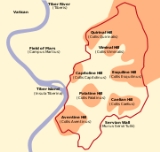
Quirinal Hill

Encyclopedia
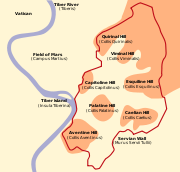
Seven hills of Rome
The Seven Hills of Rome east of the river Tiber form the geographical heart of Rome, within the walls of the ancient city.The seven hills are:* Aventine Hill * Caelian Hill...
, at the north-east of the city center. It is the location of the official residence of the Italian Head of State, who resides in the Quirinal Palace
Quirinal Palace
The Quirinal Palace is a historical building in Rome, Italy, the current official residence of the President of the Italian Republic. It is located on the Quirinal Hill, the tallest of the seven hills of Rome...
; by metonymy
Metonymy
Metonymy is a figure of speech used in rhetoric in which a thing or concept is not called by its own name, but by the name of something intimately associated with that thing or concept...
"the Quirinal" has come to stand for the Italian President.
History
It was originally part of a group of hills that included Collis Latiaris, Mucialis (or Sanqualis), Salutaris. These are now lost due to building in the 16th century and later.According to Roman legend, the Quirinal Hill was the site of a small village
Village
A village is a clustered human settlement or community, larger than a hamlet with the population ranging from a few hundred to a few thousand , Though often located in rural areas, the term urban village is also applied to certain urban neighbourhoods, such as the West Village in Manhattan, New...
of the Sabines, and king Titus Tatius
Titus Tatius
The traditions of ancient Rome held that Titus Tatius was the Sabine king of Cures, who, after the rape of the Sabine women, attacked Rome and captured the Capitol with the treachery of Tarpeia. The Sabine women, however, convinced Tatius and the Roman king, Romulus, to reconcile and subsequently...
would have lived there after the peace between Romans and Sabines. These Sabines had erected altar
Altar
An altar is any structure upon which offerings such as sacrifices are made for religious purposes. Altars are usually found at shrines, and they can be located in temples, churches and other places of worship...
s in the honour of their god
Deity
A deity is a recognized preternatural or supernatural immortal being, who may be thought of as holy, divine, or sacred, held in high regard, and respected by believers....
Quirinus
Quirinus
In Roman mythology, Quirinus was an early god of the Roman state. In Augustan Rome, Quirinus was also an epithet of Janus, as Janus Quirinus. His name is derived from Quiris meaning "spear."-History:...
(naming the hill by this god).
Tombs from the 8th century BC to the 7th century BC that confirm a likely presence of a Sabine settlement area have been discovered; on the hill, there was the tomb of Quirinus, which Lucius Papirius Cursor
Lucius Papirius Cursor
Lucius Papirius Cursor was a Roman general who was five times consul and twice dictator.In 325 BC he was appointed dictator to carry on the second Samnite War. His quarrel with Quintus Fabius Maximus Rullianus, his magister equitum, is well known...
transformed into a temple for his triumph
Roman triumph
The Roman triumph was a civil ceremony and religious rite of ancient Rome, held to publicly celebrate and sanctify the military achievement of an army commander who had won great military successes, or originally and traditionally, one who had successfully completed a foreign war. In Republican...
after the third Samnite
Samnium
Samnium is a Latin exonym for a region of south or south and central Italy in Roman times. The name survives in Italian today, but today's territory comprising it is only a small portion of what it once was. The populations of Samnium were called Samnites by the Romans...
war. Some authors consider it possible that the cult of the Capitoline Triad
Capitoline Triad
In ancient Roman religion, the Capitoline Triad was a group of three supreme deities who were worshipped in an elaborate temple on Rome's Capitoline Hill, the Capitolium. Two distinct Capitoline Triads were worshipped at various times in Rome's history, both originating in ancient traditions...
(Jove, Minerva
Minerva
Minerva was the Roman goddess whom Romans from the 2nd century BC onwards equated with the Greek goddess Athena. She was the virgin goddess of poetry, medicine, wisdom, commerce, weaving, crafts, magic...
, Juno
Juno (mythology)
Juno is an ancient Roman goddess, the protector and special counselor of the state. She is a daughter of Saturn and sister of the chief god Jupiter and the mother of Mars and Vulcan. Juno also looked after the women of Rome. Her Greek equivalent is Hera...
) could have been celebrated here well before it became associated with the Capitoline Hill
Capitoline Hill
The Capitoline Hill , between the Forum and the Campus Martius, is one of the seven hills of Rome. It was the citadel of the earliest Romans. By the 16th century, Capitolinus had become Capitolino in Italian, with the alternative Campidoglio stemming from Capitolium. The English word capitol...
. The sanctuary of Flora, an Osco
Osci
The Osci , were an Italic people of Campania and Latium adiectum during Roman times. They spoke the Oscan language, also spoken by the Samnites of Southern Italy. Although the language of the Samnites was called Oscan, the Samnites were never called Osci, or the Osci Samnites...
-sabine goddess
Goddess
A goddess is a female deity. In some cultures goddesses are associated with Earth, motherhood, love, and the household. In other cultures, goddesses also rule over war, death, and destruction as well as healing....
, was here too.
According to Livy
Livy
Titus Livius — known as Livy in English — was a Roman historian who wrote a monumental history of Rome and the Roman people. Ab Urbe Condita Libri, "Chapters from the Foundation of the City," covering the period from the earliest legends of Rome well before the traditional foundation in 753 BC...
, the hill first became part of the city of Rome, along with the Viminal Hill
Viminal Hill
The Viminal Hill is the smallest of the famous seven hills of Rome. A finger-shape cusp pointing toward central Rome between the Quirinal Hill to the northwest and the Esquiline Hill to the southeast, it is home to the Teatro dell'Opera and the Termini Railway Station.At the top of Viminal Hill...
, during the reign of Servius Tullius
Servius Tullius
Servius Tullius was the legendary sixth king of ancient Rome, and the second of its Etruscan dynasty. He reigned 578-535 BC. Roman and Greek sources describe his servile origins and later marriage to a daughter of Lucius Tarquinius Priscus, Rome's first Etruscan king, who was assassinated in 579 BC...
, Rome' sixth king, in the 6th century BC.
In 446 BC, a temple
Temple
A temple is a structure reserved for religious or spiritual activities, such as prayer and sacrifice, or analogous rites. A templum constituted a sacred precinct as defined by a priest, or augur. It has the same root as the word "template," a plan in preparation of the building that was marked out...
was dedicated on the Quirinal in honour of Semo Sancus Dius Fidius, and it is possible that this temple was erected over the ruins of another temple. Augustus
Augustus
Augustus ;23 September 63 BC – 19 August AD 14) is considered the first emperor of the Roman Empire, which he ruled alone from 27 BC until his death in 14 AD.The dates of his rule are contemporary dates; Augustus lived under two calendars, the Roman Republican until 45 BC, and the Julian...
, too, ordered the building of a temple, dedicated to Mars. On a slope of the Quirinal were the extensive gardens of Sallust
Gardens of Sallust
The Gardens of Sallust were Roman gardens developed by the Roman historian Sallust in the 1st century BC. The landscaped pleasure gardens occupied a large area in the northwestern sector of Rome, in what would become Region VI, between the Pincian and Quirinal hills, near the Via Salaria and later...
.
On the Quirinal Hill Constantine ordered the erection of his baths
Baths of Constantine (Rome)
Baths of Constantine was a public bathing complex built on the Quirinal Hill in Rome by Constantine I, probably before 315.-Construction and plan:...
, the last thermae
Thermae
In ancient Rome, thermae and balnea were facilities for bathing...
complex erected in imperial Rome
Roman Empire
The Roman Empire was the post-Republican period of the ancient Roman civilization, characterised by an autocratic form of government and large territorial holdings in Europe and around the Mediterranean....
. These are now lost, having been incorporated into Renaissance Rome, with only some drawings from the 16th century remaining.
In the Middle Ages
Middle Ages
The Middle Ages is a periodization of European history from the 5th century to the 15th century. The Middle Ages follows the fall of the Western Roman Empire in 476 and precedes the Early Modern Era. It is the middle period of a three-period division of Western history: Classic, Medieval and Modern...
, the Torre delle Milizie
Torre delle Milizie
The Torre delle Milizie is a tower in Rome, Italy, annexed to the Trajan's Market in the Imperial fora.One of the main medieval monuments of the city, the tower is on a square plan, its base sides measure 10.5 x 9.5 m, and it currently stands at almost 50 meters...
and the convent
Convent
A convent is either a community of priests, religious brothers, religious sisters, or nuns, or the building used by the community, particularly in the Roman Catholic Church and in the Anglican Communion...
of St. Peter and Domenic were built, and above Constantine's building was erected the Palazzo Rospigliosi; the two famous colossal marble statues of the "Horse Tamers
Horse Tamers
The colossal pair of marble "Horse Tamers", often identified as Castor and Pollux, have stood since Antiquity near the site of the Baths of Constantine on the Quirinal Hill, Rome, too large to be buried or to be moved very far, though Napoleon's agents wanted to include them among the classical...
", generally identified as the Dioscuri with horses, which now are in the Piazza Quirinale, were originally in this Palazzo. They gave to the Quirinal its medieval name Monte Cavallo, which lingered into the 19th century, when the hill was transformed beyond all recognition by urbanization of an expanding capital of a united Italy. In the same palazzo were also the two statues of river gods that Michelangelo
Michelangelo
Michelangelo di Lodovico Buonarroti Simoni , commonly known as Michelangelo, was an Italian Renaissance painter, sculptor, architect, poet, and engineer who exerted an unparalleled influence on the development of Western art...
moved to the steps of Palazzo Senatorio on the Capitoline Hill.
According to the political division of the center of Rome
Rome
Rome is the capital of Italy and the country's largest and most populated city and comune, with over 2.7 million residents in . The city is located in the central-western portion of the Italian Peninsula, on the Tiber River within the Lazio region of Italy.Rome's history spans two and a half...
, the Hill belongs to the rione
Rioni of Rome
A rione is an Italian term used since the Middle Ages to name the districts of Rome, according to the administrative divisions of that time. The word originates from the Latin word regio A rione (pl. rioni) is an Italian term used since the Middle Ages to name the districts of Rome, according to...
Trevi
Trevi (rione of Rome)
Trevi is the rione II of Rome. The origin of its name is not clear,but the most accepted possibility is that it comes from the Latin trivium, because there were three streets all leading to "piazza dei Crociferi",...
.
Palazzo del Quirinale
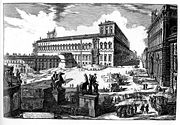
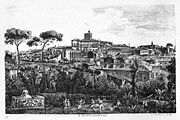
The Quirinal Hill is today identified with the Palazzo del Quirinale
Quirinal Palace
The Quirinal Palace is a historical building in Rome, Italy, the current official residence of the President of the Italian Republic. It is located on the Quirinal Hill, the tallest of the seven hills of Rome...
, the official residence of the President of the Italian Republic and one of the symbols of the State. Before the abolition of the Italian monarchy in 1946, it was the residence of the king of Italy, and before 1871 it was, as originally, a residence of the Pope.
The healthy cool air of the Quirinal Hill attracted aristocrats and papal families that built villas where the gardens of Sallust
Gardens of Sallust
The Gardens of Sallust were Roman gardens developed by the Roman historian Sallust in the 1st century BC. The landscaped pleasure gardens occupied a large area in the northwestern sector of Rome, in what would become Region VI, between the Pincian and Quirinal hills, near the Via Salaria and later...
had been in antiquity. A visit to the villa of Cardinal Luigi d'Este
Luigi d'Este
Luigi d'Este was an Italian Catholic cardinal, the second of the five children of Ercole II d'Este, Duke of Modena and Ferrara, and Renée, daughter of Louis XII of France.-Biography:...
in 1573 convinced Pope Gregory XIII
Pope Gregory XIII
Pope Gregory XIII , born Ugo Boncompagni, was Pope from 1572 to 1585. He is best known for commissioning and being the namesake for the Gregorian calendar, which remains the internationally-accepted civil calendar to this date.-Youth:He was born the son of Cristoforo Boncompagni and wife Angela...
to start the building of a summer residence the following year, in an area considered healthier than the Vatican Hill
Vatican Hill
Vatican Hill is the name given, long before the founding of Christianity, to one of the hills on the side of the Tiber opposite the traditional seven hills of Rome...
or Lateran
Lateran
Lateran and Laterano are the shared names of several architectural projects throughout Rome. The properties were once owned by the Lateranus family of the former Roman Empire...
: His architects were Flaminio Ponzio
Flaminio Ponzio
Flaminio Ponzio was an Italian architect during the late-Renaissance or so-called Mannerist period, serving in Rome as the architect for Pope Paul V.Ponzio was born in Viggiù near Varese, and he died in Rome...
and Ottaviano Nonni
Ottaviano Nonni
Ottaviano Nonni , called Il Mascherino, was an Italian architect, sculptor, and painter born in Bologna. Apprentice of Giacomo Barozzi da Vignola, he was active in Emilia and in Rome, where he had been living in the rione of Borgo, in the road still bearing his name .He was the architect of the...
, called Mascherino; under Pope Sixtus V
Pope Sixtus V
Pope Sixtus V , born Felice Peretti di Montalto, was Pope from 1585 to 1590.-Early life:The chronicler Andrija Zmajević states that Felice's family originated from modern-day Montenegro...
, works were continued by Domenico Fontana
Domenico Fontana
Domenico Fontana was a Swiss-born Italian architect of the late Renaissance.-Biography:200px|thumb|Fountain of Moses in Rome....
(the main facade on the Piazza) and Carlo Maderno
Carlo Maderno
Carlo Maderno was a Swiss-Italian architect, born in Ticino, who is remembered as one of the fathers of Baroque architecture. His façades of Santa Susanna, St. Peter's Basilica and Sant'Andrea della Valle were of key importance in the evolution of the Italian Baroque...
, and by Gian Lorenzo Bernini
Gian Lorenzo Bernini
Gian Lorenzo Bernini was an Italian artist who worked principally in Rome. He was the leading sculptor of his age and also a prominent architect...
for Pope Clement XII
Pope Clement XII
Pope Clement XII , born Lorenzo Corsini, was Pope from 12 July 1730 to 6 February 1740.Born in Florence, the son of Bartolomeo Corsini, Marquis of Casigliano and his wife Isabella Strozzi, sister of the Duke of Bagnuolo, Corsini had been an aristocratic lawyer and financial manager under preceding...
. Gardens were conceived by Maderno. In the 18th century, Ferdinando Fuga
Ferdinando Fuga
Ferdinando Fuga was an Italian architect, whose main works were realized in Rome and Naples in the Baroque style.-Biography:Born in Florence, he began to work in that city as a pupil of Giovanni Battista Foggini. In 1717 he moved to Rome, to continue his apprentice studies...
built the long wing called the Manica Lunga, which stretched 360 meters along via del Quirinale. In front lies the sloping Piazza del Quirinale where the pair of gigantic Roman marble "Horse Tamers" representing Castor and Pollux
Castor and Pollux
In Greek and Roman mythology, Castor and Pollux or Polydeuces were twin brothers, together known as the Dioscuri . Their mother was Leda, but Castor was the mortal son of Tyndareus, king of Sparta, and Pollux the divine son of Zeus, who visited Leda in the guise of a swan...
, found in the Baths of Constantine, were re-erected in 1588. In Piranesi's view, the vast open space is unpaved. The Palazzo del Quirinale was the residence of the popes until 1870, though Napoleon deported both Pius VI and Pius VII to France, and declared the Quirinale an imperial palace. When Rome was united to the Kingdom of Italy
Italy
Italy , officially the Italian Republic languages]] under the European Charter for Regional or Minority Languages. In each of these, Italy's official name is as follows:;;;;;;;;), is a unitary parliamentary republic in South-Central Europe. To the north it borders France, Switzerland, Austria and...
, the Quirinale became the residence of the kings until 1946.
Today, the Palazzo hosts the offices and the apartments of the Head of State and, in its long side along via XX Settembre (the so-called Manica Lunga), the apartments that were furnished for each visit of foreign monarchs or dignitaries.
Several collections are in this Palazzo, including tapestries
Tapestry
Tapestry is a form of textile art, traditionally woven on a vertical loom, however it can also be woven on a floor loom as well. It is composed of two sets of interlaced threads, those running parallel to the length and those parallel to the width ; the warp threads are set up under tension on a...
, painting
Painting
Painting is the practice of applying paint, pigment, color or other medium to a surface . The application of the medium is commonly applied to the base with a brush but other objects can be used. In art, the term painting describes both the act and the result of the action. However, painting is...
s, statue
Statue
A statue is a sculpture in the round representing a person or persons, an animal, an idea or an event, normally full-length, as opposed to a bust, and at least close to life-size, or larger...
s, old carriage
Carriage
A carriage is a wheeled vehicle for people, usually horse-drawn; litters and sedan chairs are excluded, since they are wheelless vehicles. The carriage is especially designed for private passenger use and for comfort or elegance, though some are also used to transport goods. It may be light,...
s (carrozze), watches, furniture, and porcelain
Porcelain
Porcelain is a ceramic material made by heating raw materials, generally including clay in the form of kaolin, in a kiln to temperatures between and...
.
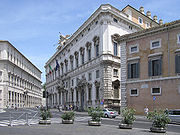
In Piranesi's view, the palazzo on the right is the Palazzo della Sacra Consulta, originally a villa built upon the ruins of the Baths of Constantine, which was adapted by Sixtus V as a civil and criminal court. The present façade was built in 1732–1734 by the architect Ferdinando Fuga on the orders of Pope Clement XII
Pope Clement XII
Pope Clement XII , born Lorenzo Corsini, was Pope from 12 July 1730 to 6 February 1740.Born in Florence, the son of Bartolomeo Corsini, Marquis of Casigliano and his wife Isabella Strozzi, sister of the Duke of Bagnuolo, Corsini had been an aristocratic lawyer and financial manager under preceding...
Corsini, whose coat-of-arms, trumpeted by two Fames, still surmounts the roofline balustrade, as in Piranesi's view. It formerly housed Mussolini's ministry of colonial affairs.
Other monuments
Baroque
The Baroque is a period and the style that used exaggerated motion and clear, easily interpreted detail to produce drama, tension, exuberance, and grandeur in sculpture, painting, literature, dance, and music...
period reflect the personal and spiritual aspirations of powerful local families:
- The church of Sant'Andrea al QuirinaleSant'Andrea al QuirinaleThe Church of Saint Andrew's at the Quirinal is a Roman Catholic titular church in Rome, built for of the Jesuit seminary on the Quirinal Hill....
was designed by Gian Lorenzo BerniniGian Lorenzo BerniniGian Lorenzo Bernini was an Italian artist who worked principally in Rome. He was the leading sculptor of his age and also a prominent architect...
(1658–1671), for Cardinal Camillo PamphiliiCamillo Francesco Maria PamphiliCamillo Francesco Maria Pamphili was an Italian Catholic Cardinal and later nobleman of the Pamphili family. His name is often spelled with the final long i orthography; Pamphilj.-Early life:...
(nephew of Pope Innocent XPope Innocent XPope Innocent X , born Giovanni Battista Pamphilj , was Pope from 1644 to 1655. Born in Rome of a family from Gubbio in Umbria who had come to Rome during the pontificate of Pope Innocent IX, he graduated from the Collegio Romano and followed a conventional cursus honorum, following his uncle...
); it is one of the most elegant samples of baroqueBaroqueThe Baroque is a period and the style that used exaggerated motion and clear, easily interpreted detail to produce drama, tension, exuberance, and grandeur in sculpture, painting, literature, dance, and music...
architecture in Rome, with its splendid interior of marble, stuccoes, and gilded decorations. - The four fountains (Quattro FontaneQuattro FontaneThe Quattro Fontane is a group of four Late Renaissance fountains located at the intersection of Via delle Quattro Fontane and Via del Quirinale in Rome. They were commissioned by Pope Sixtus V and built at the direction of Muzio Mattei; installed between 1588 and 1593...
) with reclining river gods (1588–93) commissioned by Pope Sixtus VPope Sixtus VPope Sixtus V , born Felice Peretti di Montalto, was Pope from 1585 to 1590.-Early life:The chronicler Andrija Zmajević states that Felice's family originated from modern-day Montenegro...
. - BorrominiFrancesco BorrominiFrancesco Borromini, byname of Francesco Castelli was an architect from Ticino who, with his contemporaries, Gian Lorenzo Bernini and Pietro da Cortona, was a leading figure in the emergence of Roman Baroque architecture.A keen student of the architecture of Michelangelo and the ruins of...
's church of San Carlo alle Quattro FontaneSan Carlo alle Quattro FontaneThe Church of Saint Charles at the Four Fountains is a Roman Catholic church in Rome, Italy. Designed by the architect Francesco Borromini, it was his first independent commission. It is an iconic masterpiece of Baroque architecture, built as part of a complex of monastic buildings on the Quirinal...
(or San Carlino - originally Chiesa della Santissima Trinità e di San Carlo Borromeo), the first and last work of this architect (the façadeFacadeA facade or façade is generally one exterior side of a building, usually, but not always, the front. The word comes from the French language, literally meaning "frontage" or "face"....
was completed after his death) commissioned by the BarberiniBarberiniThe Barberini are a family of the Italian nobility that rose to prominence in 17th century Rome. Their influence peaked with the election of Cardinal Maffeo Barberini to the papal throne in 1623, as Pope Urban VIII...
. - The PiazzaPiazza BarberiniPiazza Barberini is a large piazza in the centro storico or city center of Rome, Italy and situated on the Quirinal Hill. It was created in the 16th century but many of the surrounding buildings have subsequently been rebuilt....
and Palazzo BarberiniPalazzo BarberiniPalazzo Barberini is a palace in Rome, facing the piazza of the same name in Rione Trevi and is home to the Galleria Nazionale d'Arte Antica.-History:...
, built by BerniniGian Lorenzo BerniniGian Lorenzo Bernini was an Italian artist who worked principally in Rome. He was the leading sculptor of his age and also a prominent architect...
and MadernoCarlo MadernoCarlo Maderno was a Swiss-Italian architect, born in Ticino, who is remembered as one of the fathers of Baroque architecture. His façades of Santa Susanna, St. Peter's Basilica and Sant'Andrea della Valle were of key importance in the evolution of the Italian Baroque...
, which now houses the Galleria Nazionale d'Arte AnticaGalleria Nazionale d'Arte AnticaThe Galleria Nazionale d'Arte Antica, or National Gallery of Ancient Art, is an art gallery in Rome, Italy, located on two sites: the Palazzo Barberini and the Palazzo Corsini....
. - Palazzo Volpi di Misurata, across from San Carlino, built in the 18th century.
- Palazzo Albani del Drago, built by Domenico FontanaDomenico FontanaDomenico Fontana was a Swiss-born Italian architect of the late Renaissance.-Biography:200px|thumb|Fountain of Moses in Rome....
and enlarged with an added belvedere, by Alessandro SpecchiAlessandro SpecchiAlessandro Specchi was an Italian architect and engraver.Born in Rome, he trained as an architect under Carlo Fontana. He also specialized as an engraver and made a well known series of plates for prints of vedute or views of Rome As an architect, he was influenced by Francesco Borromini...
for the AlbaniAlbaniAlbani is an Italian surname from Latin name Albanus or from Alba , a frequent toponym in Italy...
Pope Clement XIPope Clement XIPope Clement XI , born Giovanni Francesco Albani, was Pope from 1700 until his death in 1721.-Early life:...
; with the decline in the fortunes of Cardinal Alessandro Albani, it was sold to the del Drago, who occupy it still. - Palazzo Baracchini, built 1876-83, now housing the Ministry of Defense.
- The church of San Silvestro al QuirinaleSan Silvestro al QuirinaleSan Silvestro al Quirinale is a historic church in central Rome, Italy.-History:The first mentions of a church on the site are from 1039, when it was called Santo Stefano in Cavallo in recognition of its site on Monte Cavallo, a small hill in the Campo Marzio.In 1507, the church was granted to the...
, which was described for the first time circa 1000, rebuilt in the 16th century and restructured (façade) in the 19th. - The Palazzo ColonnaPalazzo ColonnaThe Palazzo Colonna is a palatial block of buildings in central Rome, Italy, at the base of the Quirinal Hill, and adjacent to the church of Santi Apostoli...
(17th century), in front of Palazzo Rospigliosi, contains some remains of CaracallaCaracallaCaracalla , was Roman emperor from 198 to 217. The eldest son of Septimius Severus, he ruled jointly with his younger brother Geta until he murdered the latter in 211...
's temple of SerapisSerapisSerapis or Sarapis is a Graeco-Egyptian name of God. Serapis was devised during the 3rd century BC on the orders of Ptolemy I of Egypt as a means to unify the Greeks and Egyptians in his realm. The god was depicted as Greek in appearance, but with Egyptian trappings, and combined iconography... - The Palazzo della ConsultaPalazzo della ConsultaThe Palazzo della Consulta is a late Baroque palace in central Rome, Italy, that now houses the Constitutional Court of the Italian Republic...
hosts today the Constitutional CourtConstitutional Court of ItalyThe Constitutional Court of Italy is a supreme court of Italy, the other being the Court of Cassation. Sometimes the name Consulta is used as a metonym for it, because its sessions are held in Palazzo della Consulta in Rome....
, and was erected by Ferdinando FugaFerdinando FugaFerdinando Fuga was an Italian architect, whose main works were realized in Rome and Naples in the Baroque style.-Biography:Born in Florence, he began to work in that city as a pupil of Giovanni Battista Foggini. In 1717 he moved to Rome, to continue his apprentice studies...
for Pope Clement XIIPope Clement XIIPope Clement XII , born Lorenzo Corsini, was Pope from 12 July 1730 to 6 February 1740.Born in Florence, the son of Bartolomeo Corsini, Marquis of Casigliano and his wife Isabella Strozzi, sister of the Duke of Bagnuolo, Corsini had been an aristocratic lawyer and financial manager under preceding...
directly opposite Palazzo del Quirinale.
See also
- Seven hills of RomeSeven hills of RomeThe Seven Hills of Rome east of the river Tiber form the geographical heart of Rome, within the walls of the ancient city.The seven hills are:* Aventine Hill * Caelian Hill...
- Aventine Hill (Aventino)Aventine HillThe Aventine Hill is one of the seven hills on which ancient Rome was built. It belongs to Ripa, the twelfth rione, or ward, of Rome.-Location and boundaries:The Aventine hill is the southernmost of Rome's seven hills...
- Caelian Hill (Celio)Caelian HillThe Caelian Hill is one of the famous Seven Hills of Rome. Under reign of Tullus Hostilius, the entire population of Alba Longa was forcibly resettled on the Caelian Hill...
- Capitoline Hill (Capitolino)Capitoline HillThe Capitoline Hill , between the Forum and the Campus Martius, is one of the seven hills of Rome. It was the citadel of the earliest Romans. By the 16th century, Capitolinus had become Capitolino in Italian, with the alternative Campidoglio stemming from Capitolium. The English word capitol...
- Cispian Hill (Cispio)CispiusCispius is the nomen of the Roman gens Cispia.-Cispius Laevus:The Mons Cispius, or Cispian Hill, is one of several summits of the Esquiline Hill in Rome. The grammarian Festus says that it was named for a Cispius Laevus of Anagnia, of the Publilia voting tribe . This Cispius may be legendary.-M...
- Esquiline Hill (Esquilino)
- Janiculum Hill (Gianicolo)
- Monte MarioMonte Mario-External links :* * *...
- Oppian Hill (Oppio)Oppian HillThe Oppian Hill is the southern spur of the Esquiline Hill , one of the famous Seven Hills of Rome. It is separated from the Cispius on the north by the valley of the Subura, and from the Caelian Hill on the south by the valley of the Colosseum...
- Palatine Hill (Palatino)Palatine HillThe Palatine Hill is the centermost of the Seven Hills of Rome and is one of the most ancient parts of the city...
- Pincian Hill (Pincio)Pincian HillThe Pincian Hill is a hill in the northeast quadrant of the historical center of Rome. The hill lies to the north of the Quirinal, overlooking the Campus Martius...
- Vatican Hill (Vaticano)Vatican HillVatican Hill is the name given, long before the founding of Christianity, to one of the hills on the side of the Tiber opposite the traditional seven hills of Rome...
- Velian Hill (Velia)Velian HillThe Velia — or Velian Hill or Velian Ridge — is a saddle or spur stretching out from the middle of the north side of the Palatine Hill towards the Oppian Hill ....
- Viminal Hill (Viminale)Viminal HillThe Viminal Hill is the smallest of the famous seven hills of Rome. A finger-shape cusp pointing toward central Rome between the Quirinal Hill to the northwest and the Esquiline Hill to the southeast, it is home to the Teatro dell'Opera and the Termini Railway Station.At the top of Viminal Hill...
External links
- Samuel Ball Platner, A Topographical Dictionary of Ancient Rome: Quirinal Hill
- Rossini's etching
- Guide to the Quirinal area "Palazzo del Quirinale" official site.