

Food and Agriculture Organization

Encyclopedia
The Food and Agriculture Organization of the United Nations (FAO) is a specialised agency of the United Nations
that leads international efforts to defeat hunger. Serving both developed and developing countries, FAO acts as a neutral forum where all nations meet as equals to negotiate agreements and debate policy. FAO is also a source of knowledge and information, and helps developing countries and countries in transition modernise and improve agriculture
, forestry
and fisheries practices, ensuring good nutrition
and food security
for all. Its Latin
motto, fiat panis, translates into English as "let there be bread". , FAO has 191 members states along with the European Union
, Faroe Islands
and Tokelau
which are associate members. It is also a member of the United Nations Development Group.
, which lead to the creation of an International Agricultural Institute.
Later in 1943, the United States President Franklin D. Roosevelt
called a United Nations Conference on Food and Agriculture. Representatives from forty four governments gathered at the Homestead Hotel, Hot Springs, Virginia, from 18 May to 3 June. They committed themselves to founding a permanent organization for food and agriculture, which happened in Quebec City, Canada
on October 16, 1945. The First Session of the FAO Conference was held in the Chateau Frontenac at Quebec, Canada, from 16 October to 1 November 1945
The Second World War effectively ended the International Agricultural Institute, though it was only officially dissolved by resolution of its Permanent Committee on February 27, 1948. Its functions were then transferred to the recently established FAO.
, Quebec
, Canada
. In 1951, its headquarters were moved from Washington, D.C.
, United States
, to Rome
, Italy
.
The agency is directed by the Conference of Member Nations, which meets every two years to review the work carried out by the organization and to approve a Programme of Work and Budget for the next two-year period. The Conference elects a council of 49 member states (serve three-year rotating terms) that acts as an interim governing body, and the Director-General, that heads the agency.
FAO is composed of eight departments: Administration and Finance, Agriculture and Consumer Protection, Economic and Social Development, Fisheries and Aquaculture, Forestry, Knowledge and Communication, Natural Resource Management and Technical Cooperation.
Beginning in 1994, FAO underwent the most significant restructuring since its founding, to decentralize operations, streamline procedures and reduce costs. As result, savings of about US$50 million, €35 million a year were realized.

The FAO regular budget for 2010 - 2011 biennium is US$1 billion, €715 million. The voluntary contributions provided by members and other partners support mechanical and emergency (including rehabilitation) assistance to governments for clearly defined purposes linked to the results framework, as well as direct support to FAO's core work. the voluntary contributions are expected to reach approximately US$1.2 billion, €1.12 billion in 2010 - 2011.
This overall budget covers core technical work, cooperation and partnerships, leading to Food and Agriculture Outcomes by 71%; Core Functions by 11%; the Country Office Network by 5%; Capital and Security Expenditure by 2%; Administration by 6%; and Technical and Cooperation Program by 5%.
.jpg)
, in the former seat of the Department of Italian East Africa
. One of the most notable features of the building was the Axum Obelisk
which stood in front of the agency seat, although just outside of the territory allocated to FAO by the Italian Government. It was taken from Ethiopia
by Benito Mussolini
's troops in 1937 as a war chest, and returned on 18 April 2005.
. Sixty Heads of State and Government attended the summit. Countries unanimously adopted a declaration pledging renewed commitment to eradicate hunger from the earth at the earliest possible date.
. Through projects in over 100 countries worldwide, the programme promotes effective, tangible solutions to the elimination of hunger, undernourishment and poverty. Currently 102 countries are engaged in the programme and of these approximately 30 have begun shifting from pilot to national programmes. To maximize the impact of its work, FAO strongly promotes national ownership and local empowerment in the countries in which it operates.
situation on a global, regional and country-by-country basis. In case of impending food emergencies, the system dispatches rapid crop and food supply assessment missions, often jointly with the World Food Programme, and sometimes as a precursor to further intervention and assistance.
for rice production in Asia
. Hundreds of thousands of farmers were trained using an approach known as the Farmer Field School (FFS) http://www.comunityipm.org. Like many of the programmes managed by FAO, the funds for Farmer Field Schools came from bilateral Trust Funds, with Australia, Netherlands, Norway and Switzerland acting as the leading donors. FAO's efforts in this area have drawn praise from NGOs that have otherwise criticized much of the work of the organization.
or IPPC in 1952. This international treaty organization works to prevent the international spread of pests and plant diseases. Among its functions are the maintenance of lists of plant pests, tracking of pest outbreaks, and coordination of technical assistance between member nations. As of July 2009, 173 governments had adopted the treaty.
Increasing capacity building for plant breeding in developing countries is critical for the achievement of meaningful results in poverty and hunger reduction and to reverse the current worrisome trends. Plant breeding is a well recognized science capable of widening the genetic and adaptability base of cropping systems, by combining conventional selection techniques and modern technologies. It is essential to face and prevent the recurrence of crises such as that
of the soaring food prices and to respond to the increasing demands for crop based sources of energy.
.
The projects provide tangible resources, such as fishing equipment, seeds and agricultural implements. They vary enormously, from helping families raise pigs in Venezuela, through creating school gardens in Cape Verde and Mauritania or providing school lunches in Uganda and teaching children to grow food, to raising fish in a leper community in India.
Following the World Food Summit, the Alliance was initially created in 2002 as the ‘International Alliance Against Hunger (IAAH)’ to strengthen and coordinate national efforts in the fight against hunger and malnutrition. The mission of the Alliance originates from the first and eight UN Millennium Development Goals; reducing the number of people that suffer from hunger in half by 2015 (preceded by the “Rome Declaration” in 1996) and developing a global partnership for development. The Alliance was founded by the Rome based food agencies - the Food and Agriculture Organization of the United Nations (FAO), UN World Food Programme (WFP), International Fund for Agriculture Fund for Development (IFAD) - and Bioversity International.
Today, AAHM is a forward-thinking global initiative that links like-minded organizations and institutions that are involved in the fight against hunger and malnutrition. AAHM provides a unique middle ground – a multi-stakeholder platform and forum where those who run top-down and bottom-up development initiatives can meet in a neutral and open environment, share ideas, learn from each other’s successes and lessons, and establish networks for supportive communication within countries, across national borders or with countries in distant parts of the world.
The Alliance provides a space where governments and civil society organizations can find their similarities, build working relationships and, through unity, increase their visibility, recognition and impact. By inviting all who are actively involved in hunger-fighting initiatives to join together, the Alliance Against Hunger and Malnutrition operates at two levels:
s Programme was initiated in 1999. The main purpose of the programme is to attract public and media attention to the unacceptable situation that some 1 billion people continue to suffer from chronic hunger and malnutrition in a time of unprecedented plenty. These people lead a life of misery and are denied the most basic of human rights: the right to food.
Governments alone cannot end hunger and undernourishment. Mobilization of the public and private sectors, the involvement of civil society and the pooling of collective and individual resources are all needed if people are to break out of the vicious circle of chronic hunger and undernourishment.
Each of FAO’s Goodwill Ambassadors – celebrities from the arts, entertainment, sport and academia such as Nobel Prize winner Rita Levi Montalcini, actress Gong Li
, the late singer Miriam Makeba
, and soccer players Roberto Baggio
and Raúl
, to name a few – has made a personal and professional commitment to FAO’s vision: a food-secure world for present and future generations. Using their talents and influence, the Goodwill Ambassadors draw the old and the young, the rich and the poor into the campaign against world hunger. They aim to make Food for All a reality in the 21st century and beyond.
in the 1976 film, Network
. The campaign asks people to sign an online petition that calls upon governments to make the elimination of hunger their top priority. Also, after signing the petition, each person is given a ‘’secret code’’ that will be used to distribute the link to the petition among social networks. FAO said it hoped the petition will spread through social media sites such as Facebook, Twitter and YouTube.
The campaign was launched at the FAO headquarters in Rome and also in cities such as Stockholm, Yokohama, New-York and Paris. The first season of the campaign collected over three million signatures against hunger. The petition was presented to representatives of world governments at a ceremony in Rome on 30 November 2010.
The main idea of the project is that the FAO wants to increase the public awareness regarding the existence of chronic hunger in the world, which affects at least 1 billion people. The FAO also wants to educate people about the problems of hunger, and reinforce its role as the number one organization that operates with sustainable development concerning food security. The creative concept has been gracefully provided by the McCann Erickson Italy Communication Agency.
The symbol of the campaign is a yellow whistle, which acts as a metaphor to ‘’sound the alarm’’ of the existence of chronic hunger.
On the 1billionhungry.org website, there is a counter that indicates how many people already signed the petition. Signatures can either be numeric (via the website or social media) or physical, by using signatures sheets (available on the 1BH website).
This communication campaign has many differences compared to a classic one. First, it relies on the assistance of organizations and institutions that can facilitate the spreading of the project, by placing banners on their websites or organizing events aimed to raise awareness about the project. Second, the 1 Billion Hungry project is a viral communication campaign, that is to say the people who signed the petition can spread the link of the 1billionhungry website to their friends, via social media or mail, in order to gain awareness and signatures for the project.
Moreover, each and every person can decide to organize an event about the project, simply by gathering friends, whistles, t-shirts and banners (whistles and t-shirts can be ordered on the 1 billionhungry.org website and graphic material is available on an [ftp://ext-ftp.fao.org/GI/data/Giii/1BH_TOOLKIT FTP server hosted by the FAO]) and thereby alert people about chronic hunger by using the yellow whistle. Signatures can be gathered in such events, by getting the signature sheet on the 1BH FTP.
, a communication and information tool for the management of animal genetic resources which provides the user with searchable databases of breed-related information, management tools, and contacts for the Regional and National Coordinators for the Management of Animal Genetic Resources programme.
(associate member)
(associate member)
The non-member states are Brunei
, Liechtenstein
, Singapore
, Vatican City
and the states with limited recognition.
Some countries may denote specific representatives to the FAO, for instance the United States Ambassador to the Food and Agriculture Organization of the United Nations, who has ambassador rank and is also part of the United States Mission to the UN Agencies in Rome
.
and the International Fund for Agricultural Development
; by the early eighties there was intense rivalry among these organisations. At the same time, the World Food Programme
, which started as an experimental 3-year programme under FAO, was growing in size and independence, with the Directors of FAO and WFP struggling for power.
Early in 1989, the organisation came under attack from the Heritage Foundation
, a conservative think tank based in Washington, D.C.
The Foundation wrote that The sad fact is that the FAO has become essentially irrelevant in combating hunger. A bloated bureaucracy known for the mediocrity of its work and the inefficiency of its staff the FAO in recent years has become increasingly politicised. In September of the same year, the journal Society
published a series of articles about FAO that included a contribution from the Heritage Foundation and a response by FAO staff member, Richard Lydiker, who was later described by the Danish Minister for Agriculture
(who had herself resigned from the organisation) as 'FAO's chief spokesman for non-transparency'.
Edouard Saouma
, the Director-General of FAO, was also criticised in Graham Hancock
's book 'Lords of Poverty, published in 1989. Mention is made of Saouma's 'fat pay packet', his 'autocratic' management style, and his 'control over the flow of public information'. Hancock concluded that "One gets the sense from all of this of an institution that has lost its way, departed from its purely humanitarian and developmental mandate, become confused about its place in the world – about exactly what it is doing, and why". Despite the criticism, Edouard Saouma served as DG for three consecutive terms from 1976 to 1993.
In 1990, the US State Department expressed the view that "The Food and Agriculture Organization has lagged behind other UN organizations in responding to US desires for improvements in program and budget processes to enhance value for money spent".
A year later, in 1991, The Ecologist
magazine produced a special issue under the heading "The UN Food and Agriculture Organization: Promoting World Hunger". The magazine included articles that questioned FAO's policies and practices in forestry
, fisheries, aquaculture
, and pest control
. The articles were written by experts such as Helena Norberg-Hodge
, Vandana Shiva
, Edward Goldsmith
, Miguel A. Altieri
and Barbara Dinham.
In 1996, FAO organised the World Food Summit, attended by 112 Heads or Deputy Heads of State and Government. The Summit concluded with the signing of the Rome Declaration, which established the goal of halving the number of people who suffer from hunger by the year 2015. At the same time, 1,200 Civil Society Organisations (CSOs) from 80 countries participated in an NGO forum. The forum was critical of the growing industrialisation of agriculture and called upon governments — and FAO — to do more to protect the 'Right to Food' of the poor.
In 2004, FAO produced a controversial report called 'Agricultural Biotechnology: meeting the needs of the poor?'. The report claimed that "agricultural biotechnology
has real potential as a new tool in the war on hunger". In response to the report, more than 650 organisations from around the world signed an open letter in which they said "FAO has broken its commitment to civil society and peasants' organisations". The letter complained that organisations representing the interests of farmers had not been consulted, that FAO was siding with the biotechnology industry and, consequently, that the report "raises serious questions about the independence and intellectual integrity of an important United Nations agency". The Director General of FAO responded immediately, stating that decisions on biotechnology must "be taken at the international level by competent bodies" (in other words, not by non-governmental organization
s). He acknowledged, however, that "biotechnology research is essentially driven by the world's top ten transnational corporations" and "the private sector protects its results with patents in order to earn from its investment and it concentrates on products that have no relevance to food in developing countries".
In May 2006, a British newspaper published the resignation letter of Louise Fresco, one of eight Assistant Directors-General of FAO. In her letter, the widely respected Dr Fresco stated that "the Organisation has been unable to adapt to a new era", that "our contribution and reputation have declined steadily" and "its leadership has not proposed bold options to overcome this crisis".
October 2006 saw delegates from 120 countries arrive in Rome for the 32nd Session of FAO's Committee on World Food Security. The event was widely criticised by Non-Government Organisations, but largely ignored by the mainstream media. Oxfam
called for an end to the talk-fests while Via Campesina
issued a statement that criticised FAO's policy of Food Security.
On 18 October 2007, the final report of an Independent External Evaluation of FAO was published. More than 400 pages in length, the evaluation was the first of its kind in the history of the Organization. It had been commissioned by decision of the 33rd Session of the FAO Conference in November 2005. The report concluded that "The Organization is today in a financial and programme crisis" but "the problems affecting the Organization today can all be solved"
Among the problems noted by the IEE: "The Organization has been conservative and slow to adapt", "FAO currently has a heavy and costly bureaucracy" and "The capacity of the Organization is declining and many of its core competencies are now imperiled".
Among the solutions: "A new Strategic Framework", "institutional culture change and reform of administrative and management systems".
The official response from FAO came on 29 October: "Management supports the principal conclusion in the report of the IEE on the need for 'reform with growth' so as to have an FAO 'it for this century'".
Meanwhile, hundreds of FAO staff signed a petition in support of the IEE recommendations, calling for " a radical shift in management culture and spirit, depoliticization of appointments, restoration of trust between staff and management, [and] setting strategic priorities of the organization".
In conclusion the IEE stated that, "If FAO did not exist it would need to be invented".
In November 2008, a Special Conference of FAO member countries agreed a US$42.6 million (€38.6 million), three-year Immediate Plan of Action for "reform with growth" as recommended by an Independent External Evaluation (IEE).
Under the plan US$21.8 million, €15 million will be spent next year on overhauling the financial procedures, hierarchies and human resources management.
, President Abdoulaye Wade
of Senegal
expressed the opinion that FAO was "a waste of money" and "we must scrap it". Mr Wade said that FAO was itself largely to blame for the price rises, and that the organisation's work was duplicated by other bodies that operated more efficiently, like the UN's International Fund for Agricultural Development
. However, this criticism may have had more to do with personal animosity between the President and the Director-General, himself a Senegalese, particularly in light of the significant differences in the work carried out by the two organizations.
In 2008, the FAO sponsored the High-Level Conference on World Food Security. The summit was notable for the lack of agreement over the issue of biofuels.
The response to the summit among Non-governmental organization
s was mixed, with Oxfam
stating that "the summit in Rome was an important first step in tackling the food crisis but greater action is now needed", while Maryam Rahmanian of Iran’s Centre for Sustainable Development said "We are dismayed and disgusted to see the food crisis used to further the policies that have led us to the food crisis in the first place”.
As with previous food summits, civil society organizations held a parallel meeting and issued their own declaration to "reject the corporate industrial and energy-intensive model of production and consumption that is the basis of continuing crises"
There is a book out about the management of the organization: "U.N. a Cosa Nostra" available on Amazon.com. FAO has tried so far unsuccessfully to prevent its publication.
United Nations
The United Nations is an international organization whose stated aims are facilitating cooperation in international law, international security, economic development, social progress, human rights, and achievement of world peace...
that leads international efforts to defeat hunger. Serving both developed and developing countries, FAO acts as a neutral forum where all nations meet as equals to negotiate agreements and debate policy. FAO is also a source of knowledge and information, and helps developing countries and countries in transition modernise and improve agriculture
Agriculture
Agriculture is the cultivation of animals, plants, fungi and other life forms for food, fiber, and other products used to sustain life. Agriculture was the key implement in the rise of sedentary human civilization, whereby farming of domesticated species created food surpluses that nurtured the...
, forestry
Forestry
Forestry is the interdisciplinary profession embracing the science, art, and craft of creating, managing, using, and conserving forests and associated resources in a sustainable manner to meet desired goals, needs, and values for human benefit. Forestry is practiced in plantations and natural stands...
and fisheries practices, ensuring good nutrition
Nutrition
Nutrition is the provision, to cells and organisms, of the materials necessary to support life. Many common health problems can be prevented or alleviated with a healthy diet....
and food security
Food security
Food security refers to the availability of food and one's access to it. A household is considered food-secure when its occupants do not live in hunger or fear of starvation. According to the World Resources Institute, global per capita food production has been increasing substantially for the past...
for all. Its Latin
Latin
Latin is an Italic language originally spoken in Latium and Ancient Rome. It, along with most European languages, is a descendant of the ancient Proto-Indo-European language. Although it is considered a dead language, a number of scholars and members of the Christian clergy speak it fluently, and...
motto, fiat panis, translates into English as "let there be bread". , FAO has 191 members states along with the European Union
European Union
The European Union is an economic and political union of 27 independent member states which are located primarily in Europe. The EU traces its origins from the European Coal and Steel Community and the European Economic Community , formed by six countries in 1958...
, Faroe Islands
Faroe Islands
The Faroe Islands are an island group situated between the Norwegian Sea and the North Atlantic Ocean, approximately halfway between Scotland and Iceland. The Faroe Islands are a self-governing territory within the Kingdom of Denmark, along with Denmark proper and Greenland...
and Tokelau
Tokelau
Tokelau is a territory of New Zealand in the South Pacific Ocean that consists of three tropical coral atolls with a combined land area of 10 km2 and a population of approximately 1,400...
which are associate members. It is also a member of the United Nations Development Group.
Background
The idea of an international organization for food and agriculture emerged in the late 19th and early 20th century. In May–June 1905, an international conference was held in Rome, ItalyItaly
Italy , officially the Italian Republic languages]] under the European Charter for Regional or Minority Languages. In each of these, Italy's official name is as follows:;;;;;;;;), is a unitary parliamentary republic in South-Central Europe. To the north it borders France, Switzerland, Austria and...
, which lead to the creation of an International Agricultural Institute.
Later in 1943, the United States President Franklin D. Roosevelt
Franklin D. Roosevelt
Franklin Delano Roosevelt , also known by his initials, FDR, was the 32nd President of the United States and a central figure in world events during the mid-20th century, leading the United States during a time of worldwide economic crisis and world war...
called a United Nations Conference on Food and Agriculture. Representatives from forty four governments gathered at the Homestead Hotel, Hot Springs, Virginia, from 18 May to 3 June. They committed themselves to founding a permanent organization for food and agriculture, which happened in Quebec City, Canada
Canada
Canada is a North American country consisting of ten provinces and three territories. Located in the northern part of the continent, it extends from the Atlantic Ocean in the east to the Pacific Ocean in the west, and northward into the Arctic Ocean...
on October 16, 1945. The First Session of the FAO Conference was held in the Chateau Frontenac at Quebec, Canada, from 16 October to 1 November 1945
The Second World War effectively ended the International Agricultural Institute, though it was only officially dissolved by resolution of its Permanent Committee on February 27, 1948. Its functions were then transferred to the recently established FAO.
Structure and finance
FAO was established on 16 October 1945, in Quebec CityQuebec City
Quebec , also Québec, Quebec City or Québec City is the capital of the Canadian province of Quebec and is located within the Capitale-Nationale region. It is the second most populous city in Quebec after Montreal, which is about to the southwest...
, Quebec
Quebec
Quebec or is a province in east-central Canada. It is the only Canadian province with a predominantly French-speaking population and the only one whose sole official language is French at the provincial level....
, Canada
Canada
Canada is a North American country consisting of ten provinces and three territories. Located in the northern part of the continent, it extends from the Atlantic Ocean in the east to the Pacific Ocean in the west, and northward into the Arctic Ocean...
. In 1951, its headquarters were moved from Washington, D.C.
Washington, D.C.
Washington, D.C., formally the District of Columbia and commonly referred to as Washington, "the District", or simply D.C., is the capital of the United States. On July 16, 1790, the United States Congress approved the creation of a permanent national capital as permitted by the U.S. Constitution....
, United States
United States
The United States of America is a federal constitutional republic comprising fifty states and a federal district...
, to Rome
Rome
Rome is the capital of Italy and the country's largest and most populated city and comune, with over 2.7 million residents in . The city is located in the central-western portion of the Italian Peninsula, on the Tiber River within the Lazio region of Italy.Rome's history spans two and a half...
, Italy
Italy
Italy , officially the Italian Republic languages]] under the European Charter for Regional or Minority Languages. In each of these, Italy's official name is as follows:;;;;;;;;), is a unitary parliamentary republic in South-Central Europe. To the north it borders France, Switzerland, Austria and...
.
The agency is directed by the Conference of Member Nations, which meets every two years to review the work carried out by the organization and to approve a Programme of Work and Budget for the next two-year period. The Conference elects a council of 49 member states (serve three-year rotating terms) that acts as an interim governing body, and the Director-General, that heads the agency.
FAO is composed of eight departments: Administration and Finance, Agriculture and Consumer Protection, Economic and Social Development, Fisheries and Aquaculture, Forestry, Knowledge and Communication, Natural Resource Management and Technical Cooperation.
Beginning in 1994, FAO underwent the most significant restructuring since its founding, to decentralize operations, streamline procedures and reduce costs. As result, savings of about US$50 million, €35 million a year were realized.
Budget
FAO's Regular Programme budget is funded by its members, through contributions set at the FAO Conference. This budget covers core technical work, cooperation and partnerships including the Technical Cooperation Programme, knowledge exchange, policy and advocacy, direction and administration, governance and security.The FAO regular budget for 2010 - 2011 biennium is US$1 billion, €715 million. The voluntary contributions provided by members and other partners support mechanical and emergency (including rehabilitation) assistance to governments for clearly defined purposes linked to the results framework, as well as direct support to FAO's core work. the voluntary contributions are expected to reach approximately US$1.2 billion, €1.12 billion in 2010 - 2011.
This overall budget covers core technical work, cooperation and partnerships, leading to Food and Agriculture Outcomes by 71%; Core Functions by 11%; the Country Office Network by 5%; Capital and Security Expenditure by 2%; Administration by 6%; and Technical and Cooperation Program by 5%.
Directors-general
- Sir John Boyd Orr (UK) : October 1945 – April 1948.
- Norris E. Dodd (U.S.) : April 1948 – December 1953.
- Philip V. Cardon (U.S.) : January 1954 – April 1956.
- Sir Herbert Broadley (UK) (acting) : April 1956 – November 1956.
- Binay Ranjan SenBinay Ranjan SenBinay Ranjan Sen was an Indian diplomat . He served as Director General of the UN's Food and Agriculture Organization...
(India) : November 1956 – December 1967. - Addeke Hendrik Boerma (Neth.) : January 1968 – December 1975.
- Edouard SaoumaEdouard SaoumaEdouard Victor Saouma served as Director General of the Food and Agriculture Organization of the United Nations for three consecutive terms from 1976 to 1993.- Early career :...
(Lebanon) : January 1976 – December 1993. - Jacques DioufJacques DioufJacques Diouf is a Senegalese diplomat with the Food and Agriculture Organization of the United Nations. He has been serving as Director-General of FAO since January 1994...
(Senegal) : January 1994 – December 2011. - José Graziano da SilvaJosé Graziano da SilvaJosé Graziano da Silva is an American-born Brazilian agronomist and writer. As a scholar, he has authored several books about the problems of agriculture in Brazil...
(Brazil) : January 2012 –
Deputy directors-general
- William Nobel Clark (US) : 1948.
- Sir Herbert Broadley (UK) : 1948–1958.
- Friedrich Traugott WahlenFriedrich Traugott WahlenFriedrich Traugott Wahlen was a Swiss politician.He was elected to the Swiss Federal Council on 11 December 1958 and handed over office on 31 December 1965...
(Switzerland) : 1958–1959. - Norman C. Wright (UK) : 1959–1963.
- Oris V. Wells (US) : 1963–1971.
- Roy I. Jackson (US) : 1971–1978.
- Ralph W. Phillips (US) : 1978–1981.
- Edward M. West (UK) : 1981–1985.
- Declan J. Walton (Ireland) : 1986–1987.
- Howard Hjort (US) : 1992–1997.
- Vikram J. Shah (ad personam) (UK) : 1992–1995.
- David A. Harcharik (US) : 1998–2007.
- James G. Butler (US) : 2008–2010.
- Changchui He (China) (Operations): 2009 - 2011.
- Ann Tutwiler (US) (Knowledge): 2011 - present.
- Manoj JunejaManoj JunejaIn April, 2011, Manoj Juneja, a citizen of India, was appointed as one of the two Deputy Directors-General of the United Nations Food and Agriculture Organization ....
(India) (Operations): 2011 - present.
World headquarters
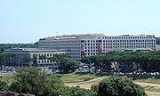
The world headquarters are located in RomeRome
Rome is the capital of Italy and the country's largest and most populated city and comune, with over 2.7 million residents in . The city is located in the central-western portion of the Italian Peninsula, on the Tiber River within the Lazio region of Italy.Rome's history spans two and a half...
, in the former seat of the Department of Italian East Africa
Italian East Africa
Italian East Africa was an Italian colonial administrative subdivision established in 1936, resulting from the merger of the Ethiopian Empire with the old colonies of Italian Somaliland and Italian Eritrea. In August 1940, British Somaliland was conquered and annexed to Italian East Africa...
. One of the most notable features of the building was the Axum Obelisk
Obelisk of Axum
The Obelisk of Axum is a 1,700-year-old, 24-metres tall granite stele/obelisk, weighing 160 tonnes, in the city of Axum in Ethiopia. It is decorated with two false doors at the base, and decorations resembling windows on all sides...
which stood in front of the agency seat, although just outside of the territory allocated to FAO by the Italian Government. It was taken from Ethiopia
Ethiopia
Ethiopia , officially known as the Federal Democratic Republic of Ethiopia, is a country located in the Horn of Africa. It is the second-most populous nation in Africa, with over 82 million inhabitants, and the tenth-largest by area, occupying 1,100,000 km2...
by Benito Mussolini
Benito Mussolini
Benito Amilcare Andrea Mussolini was an Italian politician who led the National Fascist Party and is credited with being one of the key figures in the creation of Fascism....
's troops in 1937 as a war chest, and returned on 18 April 2005.
Regional offices
- Regional Office for Africa in Accra, Ghana
- Regional Office for Latin America and the Caribbean in Santiago, Chile
- Regional Office for Asia and the Pacific in Bangkok, Thailand
- Regional Office for the Near East in Cairo, Egypt
- Regional Office for Europe and Central Asia in Budapest, Hungary
Subregional offices
- Subregional Office for Southern and East Africa in Harare, Zimbabwe
- Subregional Office for the Pacific Islands in Apia, Samoa
- Subregional Office for Central and Eastern Europe in Budapest, Hungary
- Subregional Office for the Caribbean in Bridgetown, Barbados
- Subregional Office For North Africa in Tunis, Tunisia
- Subregional Office For Central Asia in Ankara, Turkey
- Sub-regional Office for Western Africa (SFW) located in Accra, Ghana
- Sub-regional Office for Eastern Africa (SFE) located in Addis Ababa, Ethiopia
- Sub-regional Office for Central Africa (SFC) located in Libreville, Gabon
- Sub-regional Office for Central America (SLM) located in Panama City, Panama
Liaison offices
- Liaison Office with the United Nations in Geneva
- Liaison Office for North America in Washington D.C.
- Liaison Office with the United Nations in New York
- Liaison Office with Japan in Yokohama
- Liaison Office with the European Union and Belgium in Brussels
World Summit on Food Security
The World Summit on Food Security took place in Rome, Italy, between 16 and 18 November 2009. The decision to convene the summit was taken by the FAO Council, at the proposal of FAO Director-General Jacques DioufJacques Diouf
Jacques Diouf is a Senegalese diplomat with the Food and Agriculture Organization of the United Nations. He has been serving as Director-General of FAO since January 1994...
. Sixty Heads of State and Government attended the summit. Countries unanimously adopted a declaration pledging renewed commitment to eradicate hunger from the earth at the earliest possible date.
Response to food crisis
In December 2007, FAO launched its Initiative on Soaring Food Prices to help small producers raise their output and earn more. Under the initiative, FAO contributed to the work of the UN High-Level Task Force on the Global Food Crisis, which produced the Comprehensive Framework for Action. FAO has carried out projects in over 25 countries and inter-agency missions in nearly 60, scaled up its monitoring through the Global Information and Early Warning System on Food and Agriculture, provided policy advice to governments while supporting their efforts to increase food production, and advocated for more investment in agriculture. It has also worked hand-in-hand with the European Union. One example of its work is a US$10.2 million, €7.5 billion scheme to distribute and multiply quality seeds in Haiti, which has significantly increased food production, thereby providing cheaper food and boosting farmers' incomes.FAO–EU partnership
In May 2009, FAO and the European Union signed an initial aid package worth €125 million to support small farmers in countries hit hard by rising food prices. The aid package falls under the EU’s €1 billion Food Facility, set up with the UN Secretary-General’s High-Level Task Force on the Global Food Crisis and FAO to focus on programmes that will have a quick but lasting impact on food security. FAO is receiving a total of around €200 million for work in 25 countries, of which €15.4 million goes to Zimbabwe.Food security programmes
The Special Programme for Food Security is FAO's flagship initiative for reaching the goal of halving the number of hungry in the world by 2015 (currently estimated at close to 1 billion people), as part of its commitment to the Millennium Development GoalsMillennium Development Goals
The Millennium Development Goals are eight international development goals that all 193 United Nations member states and at least 23 international organizations have agreed to achieve by the year 2015...
. Through projects in over 100 countries worldwide, the programme promotes effective, tangible solutions to the elimination of hunger, undernourishment and poverty. Currently 102 countries are engaged in the programme and of these approximately 30 have begun shifting from pilot to national programmes. To maximize the impact of its work, FAO strongly promotes national ownership and local empowerment in the countries in which it operates.
Emergency response
FAO helps countries prevent, mitigate, prepare for and respond to emergencies. FAO focuses on strengthening capacity for disaster preparedness and ability to mitigate impact of emergencies on food security, by forecasting and providing early warning of adverse conditions, assessing needs and devising programmes which promote the transition from relief to reconstruction and development, improving analysis of underlying causes of crises, and strengthening local capacities to cope with risks. An example of its work was a recent report outlining poor crop prospects in eastern Africa.Early warning of food emergencies
FAO’s Global Information and Early Warning System (GIEWS) monitors world food supply/demand and provides the international community with prompt information on crop prospects and the food securityFood security
Food security refers to the availability of food and one's access to it. A household is considered food-secure when its occupants do not live in hunger or fear of starvation. According to the World Resources Institute, global per capita food production has been increasing substantially for the past...
situation on a global, regional and country-by-country basis. In case of impending food emergencies, the system dispatches rapid crop and food supply assessment missions, often jointly with the World Food Programme, and sometimes as a precursor to further intervention and assistance.
Integrated pest management
During the 1990s, FAO took a leading role in the promotion of integrated pest managementIntegrated Pest Management
Integrated pest management is an ecological approach to agricultural pest control that integrates pesticides/herbicides into a management system incorporating a range of practices for economic control of a pest...
for rice production in Asia
Asia
Asia is the world's largest and most populous continent, located primarily in the eastern and northern hemispheres. It covers 8.7% of the Earth's total surface area and with approximately 3.879 billion people, it hosts 60% of the world's current human population...
. Hundreds of thousands of farmers were trained using an approach known as the Farmer Field School (FFS) http://www.comunityipm.org. Like many of the programmes managed by FAO, the funds for Farmer Field Schools came from bilateral Trust Funds, with Australia, Netherlands, Norway and Switzerland acting as the leading donors. FAO's efforts in this area have drawn praise from NGOs that have otherwise criticized much of the work of the organization.
Transboundary pests and diseases
FAO established an Emergency Prevention System for Transboundary Animal and Plant Pests and Diseases in 1994, focusing on the control of diseases like rinderpest, foot-and-mouth disease and avian flu by helping governments coordinate their responses. One key element is the Global Rinderpest Eradication Programme, which has advanced to a stage where large tracts of Asia and Africa have now been free of the cattle disease rinderpest for an extended period of time. Meanwhile Locust Watch monitors the worldwide locust situation and keeps affected countries and donors informed of expected developments.International Plant Protection Convention
FAO created the International Plant Protection ConventionInternational Plant Protection Convention
The International Plant Protection Convention is an international treaty organization that aims to secure coordinated, effective action to prevent and to control the introduction and spread of pests of plants and plant products. The Convention extends beyond the protection of cultivated plants to...
or IPPC in 1952. This international treaty organization works to prevent the international spread of pests and plant diseases. Among its functions are the maintenance of lists of plant pests, tracking of pest outbreaks, and coordination of technical assistance between member nations. As of July 2009, 173 governments had adopted the treaty.
Global Partnership Initiative for Plant Breeding Capacity Building
The Global Partnership Initiative for Plant Breeding Capacity Building (GIPB) is a global partnership dedicated to increasing plant breeding capacity building. The mission of GIPB is to enhance the capacity of developing countries to improve crops for food security and sustainable development through better plant breeding and delivery systems. The ultimate goal is to ensure that a critical mass of plant breeders, leaders, managers and technicians, donors and partners are linked together through an effective global network.Increasing capacity building for plant breeding in developing countries is critical for the achievement of meaningful results in poverty and hunger reduction and to reverse the current worrisome trends. Plant breeding is a well recognized science capable of widening the genetic and adaptability base of cropping systems, by combining conventional selection techniques and modern technologies. It is essential to face and prevent the recurrence of crises such as that
of the soaring food prices and to respond to the increasing demands for crop based sources of energy.
Codex Alimentarius
FAO and the World Health Organization created the Codex Alimentarius Commission in 1963 to develop food standards, guidelines and texts such as codes of practice under the Joint FAO/WHO Food Standards Programme. The main aims of the programme are protecting consumer health, ensuring fair trade and promoting coordination of all food standards work undertaken by intergovernmental and non-governmental organizations.Statistics
The FAO Statistical Division produces FAOSTAT, an on-line multilingual database currently containing over 3 million time-series records from over 210 countries and territories covering statistics on agriculture, nutrition, fisheries, forestry, food aid, land use and population. The Statistical Division also produces data on World Agricultural Trade Flows. Some of this data comes from projects like AfricoverAfricover
Africover is a UN project which collects and collates geographical information on Africa using satellites. It gathers data on areas such as land usage, climate conditions and it also locates natural resources. One major usage of this system has been to provide flood warnings to governments and...
.
Investment in agriculture
FAO's technical cooperation department hosts an Investment Centre that promotes greater investment in agriculture and rural development by helping developing countries identify and formulate sustainable agricultural policies, programmes and projects. It mobilizes funding from multilateral institutions such as the World Bank, regional development banks and international funds as well as FAO resources.TeleFood
Raising awareness about the problem of hunger mobilizes energy to find a solution. In 1997, FAO launched TeleFood, a campaign of concerts, sporting events and other activities to harness the power of media, celebrities and concerned citizens to help fight hunger. Since its start, the campaign has generated close to US$28 million, €15 million in donations. Money raised through TeleFood pays for small, sustainable projects that help small-scale farmers produce more food for their families and communities.The projects provide tangible resources, such as fishing equipment, seeds and agricultural implements. They vary enormously, from helping families raise pigs in Venezuela, through creating school gardens in Cape Verde and Mauritania or providing school lunches in Uganda and teaching children to grow food, to raising fish in a leper community in India.
Alliance Against Hunger And Malnutrition (AAHM)
The Alliance Against Hunger and Malnutrition (AAHM) aims to address how countries and organizations can be more effective in advocating and carrying out actions to address hunger and malnutrition. As a global partnership, AAHM creates global connections between local, regional, national and international institutions that share the goals of fighting hunger and malnutrition. The organization works to address food security by enhancing resources and knowledge sharing and strengthening hunger activities within countries and across state lines at the regional and international levels.Following the World Food Summit, the Alliance was initially created in 2002 as the ‘International Alliance Against Hunger (IAAH)’ to strengthen and coordinate national efforts in the fight against hunger and malnutrition. The mission of the Alliance originates from the first and eight UN Millennium Development Goals; reducing the number of people that suffer from hunger in half by 2015 (preceded by the “Rome Declaration” in 1996) and developing a global partnership for development. The Alliance was founded by the Rome based food agencies - the Food and Agriculture Organization of the United Nations (FAO), UN World Food Programme (WFP), International Fund for Agriculture Fund for Development (IFAD) - and Bioversity International.
Today, AAHM is a forward-thinking global initiative that links like-minded organizations and institutions that are involved in the fight against hunger and malnutrition. AAHM provides a unique middle ground – a multi-stakeholder platform and forum where those who run top-down and bottom-up development initiatives can meet in a neutral and open environment, share ideas, learn from each other’s successes and lessons, and establish networks for supportive communication within countries, across national borders or with countries in distant parts of the world.
The Alliance provides a space where governments and civil society organizations can find their similarities, build working relationships and, through unity, increase their visibility, recognition and impact. By inviting all who are actively involved in hunger-fighting initiatives to join together, the Alliance Against Hunger and Malnutrition operates at two levels:
- Internationally, as a global partnership that brings together a wide range of relevant stakeholders including UN organizations and international NGOs
- Nationally, at the country level by supporting the establishment and activities of National Alliances Against Hunger and Malnutrition (NAAHM) and facilitating linkages among them.
FAO Goodwill Ambassadors
The FAO Goodwill AmbassadorFAO Goodwill Ambassador
The FAO Goodwill Ambassadors Programme was initiated in 1999. The main purpose of the programme is to increase public awareness and to disseminate information on issues related to food security, hunger and poverty in the world...
s Programme was initiated in 1999. The main purpose of the programme is to attract public and media attention to the unacceptable situation that some 1 billion people continue to suffer from chronic hunger and malnutrition in a time of unprecedented plenty. These people lead a life of misery and are denied the most basic of human rights: the right to food.
Governments alone cannot end hunger and undernourishment. Mobilization of the public and private sectors, the involvement of civil society and the pooling of collective and individual resources are all needed if people are to break out of the vicious circle of chronic hunger and undernourishment.
Each of FAO’s Goodwill Ambassadors – celebrities from the arts, entertainment, sport and academia such as Nobel Prize winner Rita Levi Montalcini, actress Gong Li
Gong Li
Gong Li is a Chinese film actress. Gong first came into international prominence through close collaboration with Chinese director Zhang Yimou and is credited with helping to bring Chinese cinema to Europe and the United States....
, the late singer Miriam Makeba
Miriam Makeba
Miriam Makeba , nicknamed Mama Africa, was a Grammy Award winning South African singer and civil rights activist....
, and soccer players Roberto Baggio
Roberto Baggio
Roberto Baggio is a retired Italian footballer. Widely regarded as one of the finest footballers of his generation, Baggio won both the Ballon d'Or and the FIFA World Player of the Year in 1993. He is the only Italian player ever to score in three World Cups. He is also one of the top 5 all-time...
and Raúl
Raúl González
Raúl González Blanco , known simply as Raúl, is a Spanish footballer who plays as a striker. He currently plays for German club Schalke 04....
, to name a few – has made a personal and professional commitment to FAO’s vision: a food-secure world for present and future generations. Using their talents and influence, the Goodwill Ambassadors draw the old and the young, the rich and the poor into the campaign against world hunger. They aim to make Food for All a reality in the 21st century and beyond.
Online campaign against hunger
On 11 May 2010, FAO launched a worldwide communication and media campaign entitled "The 1billionhungry project", which encourages people "to get angry at the fact that around a billion people suffer from hunger". The FAO campaign borrows as its slogan the line "I'm as mad as hell, and I'm not going to take this anymore!", used by Peter FinchPeter Finch
Peter Finch was a British-born Australian actor. He is best remembered for his role as "crazed" television anchorman Howard Beale in the film Network, which earned him a posthumous Academy Award for Best Actor, his fifth Best Actor award from the British Academy of Film and Television Arts, and a...
in the 1976 film, Network
Network (film)
Network is a 1976 American satirical film released by Metro-Goldwyn-Mayer about a fictional television network, Union Broadcasting System , and its struggle with poor ratings. The film was written by Paddy Chayefsky and directed by Sidney Lumet...
. The campaign asks people to sign an online petition that calls upon governments to make the elimination of hunger their top priority. Also, after signing the petition, each person is given a ‘’secret code’’ that will be used to distribute the link to the petition among social networks. FAO said it hoped the petition will spread through social media sites such as Facebook, Twitter and YouTube.
The campaign was launched at the FAO headquarters in Rome and also in cities such as Stockholm, Yokohama, New-York and Paris. The first season of the campaign collected over three million signatures against hunger. The petition was presented to representatives of world governments at a ceremony in Rome on 30 November 2010.
The main idea of the project is that the FAO wants to increase the public awareness regarding the existence of chronic hunger in the world, which affects at least 1 billion people. The FAO also wants to educate people about the problems of hunger, and reinforce its role as the number one organization that operates with sustainable development concerning food security. The creative concept has been gracefully provided by the McCann Erickson Italy Communication Agency.
The symbol of the campaign is a yellow whistle, which acts as a metaphor to ‘’sound the alarm’’ of the existence of chronic hunger.
On the 1billionhungry.org website, there is a counter that indicates how many people already signed the petition. Signatures can either be numeric (via the website or social media) or physical, by using signatures sheets (available on the 1BH website).
This communication campaign has many differences compared to a classic one. First, it relies on the assistance of organizations and institutions that can facilitate the spreading of the project, by placing banners on their websites or organizing events aimed to raise awareness about the project. Second, the 1 Billion Hungry project is a viral communication campaign, that is to say the people who signed the petition can spread the link of the 1billionhungry website to their friends, via social media or mail, in order to gain awareness and signatures for the project.
Moreover, each and every person can decide to organize an event about the project, simply by gathering friends, whistles, t-shirts and banners (whistles and t-shirts can be ordered on the 1 billionhungry.org website and graphic material is available on an [ftp://ext-ftp.fao.org/GI/data/Giii/1BH_TOOLKIT FTP server hosted by the FAO]) and thereby alert people about chronic hunger by using the yellow whistle. Signatures can be gathered in such events, by getting the signature sheet on the 1BH FTP.
FAO renewal forging ahead
A comprehensive programme of organizational reform and culture change began in 2008 after the release of an Independent External Evaluation. Headquarters restructuring and delegation of decision making has created a flatter more responsive structure and reduced costs. Modernizing and streamlining of administrative and operational processes are under way. Improved internal teamwork and closer external partnerships coupled with upgrading of IT infrastructure and greater autonomy of FAO's decentralized offices allows the Organization to respond quickly where needs are greatest. As FAO is primarily a knowledge based organization, investing in human resources is a top priority. Capacity building including a leadership programme, employee rotation and a new junior professional programme has been established. Individual performance management, an ethics officer and an independent office of evaluation are designed to improve performance through learning and strengthened oversight.DAD-IS
The FAO hosts DAD-IS, the Domestic Animal Diversity Information SystemDAD-IS
DAD-IS is the acronym of the worldwide Domestic Animal Diversity Information System of the Food and Agriculture Organization of the United Nations. It is defined as "a communication and information tool" for the FAO's Management of Animal Genetic Resources programme...
, a communication and information tool for the management of animal genetic resources which provides the user with searchable databases of breed-related information, management tools, and contacts for the Regional and National Coordinators for the Management of Animal Genetic Resources programme.
Membership
(organization member), DenmarkRigsfællesskabet
Rigsfællesskabet is a semi-official Danish term for the relations between continental Denmark and its two self-governing insular regions, the Faroe Islands and Greenland, which collectively make up the Kingdom of Denmark.-Legal status:Both the Faroe Islands and Greenland enjoy far-reaching home...
(associate member)
(associate member)
The non-member states are Brunei
Brunei
Brunei , officially the State of Brunei Darussalam or the Nation of Brunei, the Abode of Peace , is a sovereign state located on the north coast of the island of Borneo, in Southeast Asia...
, Liechtenstein
Liechtenstein
The Principality of Liechtenstein is a doubly landlocked alpine country in Central Europe, bordered by Switzerland to the west and south and by Austria to the east. Its area is just over , and it has an estimated population of 35,000. Its capital is Vaduz. The biggest town is Schaan...
, Singapore
Singapore
Singapore , officially the Republic of Singapore, is a Southeast Asian city-state off the southern tip of the Malay Peninsula, north of the equator. An island country made up of 63 islands, it is separated from Malaysia by the Straits of Johor to its north and from Indonesia's Riau Islands by the...
, Vatican City
Vatican City
Vatican City , or Vatican City State, in Italian officially Stato della Città del Vaticano , which translates literally as State of the City of the Vatican, is a landlocked sovereign city-state whose territory consists of a walled enclave within the city of Rome, Italy. It has an area of...
and the states with limited recognition.
Some countries may denote specific representatives to the FAO, for instance the United States Ambassador to the Food and Agriculture Organization of the United Nations, who has ambassador rank and is also part of the United States Mission to the UN Agencies in Rome
United States Mission to the UN Agencies in Rome
The United States Mission to the UN Agencies in Rome serves as a link between the Rome-based international organizations and the U.S. government. With staff representing the Departments of State, Agriculture, and the Agency for International Development, the U.S...
.
1970s, 80s, 90s
There has been public criticism of FAO for at least 30 years. Dissatisfaction with the organisation's performance was among the reasons for the creation of two new organisations after the World Food Conference in 1974, namely the World Food CouncilWorld Food Council
World Food Council was a United Nations organization established by the UN General Assembly in December 1974 by recommendation of the World Food Conference. Its headquarter was in Rome, Italy. WFC's goal was to serve as coordinating body for national ministries of agriculture to help reduce...
and the International Fund for Agricultural Development
International Fund for Agricultural Development
The International Fund for Agricultural Development , a specialized agency of the United Nations, was established as an international financial institution in 1977 as one of the major outcomes of the 1974 World Food Conference. IFAD is dedicated to eradicating rural poverty in developing countries...
; by the early eighties there was intense rivalry among these organisations. At the same time, the World Food Programme
World Food Programme
The World Food Programme is the food aid branch of the United Nations, and the world's largest humanitarian organization addressing hunger worldwide. WFP provides food, on average, to 90 million people per year, 58 million of whom are children...
, which started as an experimental 3-year programme under FAO, was growing in size and independence, with the Directors of FAO and WFP struggling for power.
Early in 1989, the organisation came under attack from the Heritage Foundation
Heritage Foundation
The Heritage Foundation is a conservative American think tank based in Washington, D.C. Heritage's stated mission is to "formulate and promote conservative public policies based on the principles of free enterprise, limited government, individual freedom, traditional American values, and a strong...
, a conservative think tank based in Washington, D.C.
Washington, D.C.
Washington, D.C., formally the District of Columbia and commonly referred to as Washington, "the District", or simply D.C., is the capital of the United States. On July 16, 1790, the United States Congress approved the creation of a permanent national capital as permitted by the U.S. Constitution....
The Foundation wrote that The sad fact is that the FAO has become essentially irrelevant in combating hunger. A bloated bureaucracy known for the mediocrity of its work and the inefficiency of its staff the FAO in recent years has become increasingly politicised. In September of the same year, the journal Society
Society (journal)
Society is a scientific journal that publishes discussions and research findings in the social sciences and public policy.It was founded as Transaction: Social Science and Modern SOCIETY by Irving Louis Horowitz in 1962. It was published by Transaction Publisher for decades before being purchased...
published a series of articles about FAO that included a contribution from the Heritage Foundation and a response by FAO staff member, Richard Lydiker, who was later described by the Danish Minister for Agriculture
Mariann Fischer Boel
Mariann Fischer Boel is a Danish politician, serving as European Commissioner for Agriculture and Rural Development from 2004 to 2009...
(who had herself resigned from the organisation) as 'FAO's chief spokesman for non-transparency'.
Edouard Saouma
Edouard Saouma
Edouard Victor Saouma served as Director General of the Food and Agriculture Organization of the United Nations for three consecutive terms from 1976 to 1993.- Early career :...
, the Director-General of FAO, was also criticised in Graham Hancock
Graham Hancock
Graham Hancock is a British writer and journalist. Hancock specialises in unconventional theories involving ancient civilizations, stone monuments or megaliths, altered states of consciousness, ancient myths and astronomical/astrological data from the past...
's book 'Lords of Poverty, published in 1989. Mention is made of Saouma's 'fat pay packet', his 'autocratic' management style, and his 'control over the flow of public information'. Hancock concluded that "One gets the sense from all of this of an institution that has lost its way, departed from its purely humanitarian and developmental mandate, become confused about its place in the world – about exactly what it is doing, and why". Despite the criticism, Edouard Saouma served as DG for three consecutive terms from 1976 to 1993.
In 1990, the US State Department expressed the view that "The Food and Agriculture Organization has lagged behind other UN organizations in responding to US desires for improvements in program and budget processes to enhance value for money spent".
A year later, in 1991, The Ecologist
The Ecologist
The Ecologist is a British environmental publication founded in 1970 by Edward Goldsmith. It addresses a wide range of environmental subjects and promotes an ecological systems thinking approach through its news stories, investigations and opinion articles. The Ecologist encourages its readers to...
magazine produced a special issue under the heading "The UN Food and Agriculture Organization: Promoting World Hunger". The magazine included articles that questioned FAO's policies and practices in forestry
Forestry
Forestry is the interdisciplinary profession embracing the science, art, and craft of creating, managing, using, and conserving forests and associated resources in a sustainable manner to meet desired goals, needs, and values for human benefit. Forestry is practiced in plantations and natural stands...
, fisheries, aquaculture
Aquaculture
Aquaculture, also known as aquafarming, is the farming of aquatic organisms such as fish, crustaceans, molluscs and aquatic plants. Aquaculture involves cultivating freshwater and saltwater populations under controlled conditions, and can be contrasted with commercial fishing, which is the...
, and pest control
Pest control
Pest control refers to the regulation or management of a species defined as a pest, usually because it is perceived to be detrimental to a person's health, the ecology or the economy.-History:...
. The articles were written by experts such as Helena Norberg-Hodge
Helena Norberg-Hodge
Helena Norberg-Hodge is an analyst of the impact of the global economy on cultures and agriculture worldwide, a pioneer of the localisation movement, and the articulator of the core ideas of Counter-development...
, Vandana Shiva
Vandana Shiva
Vandana Shiva , is a philosopher, environmental activist, and eco feminist. Shiva, currently based in Delhi, has authored more than 20 books and over 500 papers in leading scientific and technical journals. She was trained as a physicist and received her Ph.D...
, Edward Goldsmith
Edward Goldsmith
Edward René David Goldsmith , widely known as Teddy Goldsmith, was an Anglo-French environmentalist, writer and philosopher....
, Miguel A. Altieri
Miguel Altieri
Miguel Altieri is a Professor of Agroecology at the University of California, Berkeley in the Department of Environmental Science, Policy and Management. He received a BS in Agronomy from the University of Chile and holds a Ph.D. in Entomology from the University of Florida.He teaches courses in...
and Barbara Dinham.
In 1996, FAO organised the World Food Summit, attended by 112 Heads or Deputy Heads of State and Government. The Summit concluded with the signing of the Rome Declaration, which established the goal of halving the number of people who suffer from hunger by the year 2015. At the same time, 1,200 Civil Society Organisations (CSOs) from 80 countries participated in an NGO forum. The forum was critical of the growing industrialisation of agriculture and called upon governments — and FAO — to do more to protect the 'Right to Food' of the poor.
Since 2000
The next Food Summit organised by FAO in 2002 was considered to be a waste of time by many of the official participants. Social movements, farmers, fisherfolk, pastoralists, indigenous peoples, environmentalists, women's organisations, trade unions and NGOs expressed their collective disappointment in, and rejection of the official Declaration of the... Summit.In 2004, FAO produced a controversial report called 'Agricultural Biotechnology: meeting the needs of the poor?'. The report claimed that "agricultural biotechnology
Biotechnology
Biotechnology is a field of applied biology that involves the use of living organisms and bioprocesses in engineering, technology, medicine and other fields requiring bioproducts. Biotechnology also utilizes these products for manufacturing purpose...
has real potential as a new tool in the war on hunger". In response to the report, more than 650 organisations from around the world signed an open letter in which they said "FAO has broken its commitment to civil society and peasants' organisations". The letter complained that organisations representing the interests of farmers had not been consulted, that FAO was siding with the biotechnology industry and, consequently, that the report "raises serious questions about the independence and intellectual integrity of an important United Nations agency". The Director General of FAO responded immediately, stating that decisions on biotechnology must "be taken at the international level by competent bodies" (in other words, not by non-governmental organization
Non-governmental organization
A non-governmental organization is a legally constituted organization created by natural or legal persons that operates independently from any government. The term originated from the United Nations , and is normally used to refer to organizations that do not form part of the government and are...
s). He acknowledged, however, that "biotechnology research is essentially driven by the world's top ten transnational corporations" and "the private sector protects its results with patents in order to earn from its investment and it concentrates on products that have no relevance to food in developing countries".
In May 2006, a British newspaper published the resignation letter of Louise Fresco, one of eight Assistant Directors-General of FAO. In her letter, the widely respected Dr Fresco stated that "the Organisation has been unable to adapt to a new era", that "our contribution and reputation have declined steadily" and "its leadership has not proposed bold options to overcome this crisis".
October 2006 saw delegates from 120 countries arrive in Rome for the 32nd Session of FAO's Committee on World Food Security. The event was widely criticised by Non-Government Organisations, but largely ignored by the mainstream media. Oxfam
Oxfam
Oxfam is an international confederation of 15 organizations working in 98 countries worldwide to find lasting solutions to poverty and related injustice around the world. In all Oxfam’s actions, the ultimate goal is to enable people to exercise their rights and manage their own lives...
called for an end to the talk-fests while Via Campesina
Via Campesina
Via Campesina describes itself as "an international movement which coordinates peasant organizations of small and middle-scale producers, agricultural workers, rural women, and indigenous communities from Asia, Africa, America, and Europe"...
issued a statement that criticised FAO's policy of Food Security.
On 18 October 2007, the final report of an Independent External Evaluation of FAO was published. More than 400 pages in length, the evaluation was the first of its kind in the history of the Organization. It had been commissioned by decision of the 33rd Session of the FAO Conference in November 2005. The report concluded that "The Organization is today in a financial and programme crisis" but "the problems affecting the Organization today can all be solved"
Among the problems noted by the IEE: "The Organization has been conservative and slow to adapt", "FAO currently has a heavy and costly bureaucracy" and "The capacity of the Organization is declining and many of its core competencies are now imperiled".
Among the solutions: "A new Strategic Framework", "institutional culture change and reform of administrative and management systems".
The official response from FAO came on 29 October: "Management supports the principal conclusion in the report of the IEE on the need for 'reform with growth' so as to have an FAO 'it for this century'".
Meanwhile, hundreds of FAO staff signed a petition in support of the IEE recommendations, calling for " a radical shift in management culture and spirit, depoliticization of appointments, restoration of trust between staff and management, [and] setting strategic priorities of the organization".
In conclusion the IEE stated that, "If FAO did not exist it would need to be invented".
In November 2008, a Special Conference of FAO member countries agreed a US$42.6 million (€38.6 million), three-year Immediate Plan of Action for "reform with growth" as recommended by an Independent External Evaluation (IEE).
Under the plan US$21.8 million, €15 million will be spent next year on overhauling the financial procedures, hierarchies and human resources management.
World food crisis
In May 2008, while talking about the ongoing world food crisis2007–2008 world food price crisis
World food prices increased dramatically in 2007 and the 1st and 2nd quarter of 2008 creating a global crisis and causing political and economical instability and social unrest in both poor and developed nations. Systemic causes for the worldwide increases in food prices continue to be the subject...
, President Abdoulaye Wade
Abdoulaye Wade
Abdoulaye Wade is the third and current President of Senegal, in office since 2000. He is also the Secretary-General of the Senegalese Democratic Party and has led the party since it was founded in 1974...
of Senegal
Senegal
Senegal , officially the Republic of Senegal , is a country in western Africa. It owes its name to the Sénégal River that borders it to the east and north...
expressed the opinion that FAO was "a waste of money" and "we must scrap it". Mr Wade said that FAO was itself largely to blame for the price rises, and that the organisation's work was duplicated by other bodies that operated more efficiently, like the UN's International Fund for Agricultural Development
International Fund for Agricultural Development
The International Fund for Agricultural Development , a specialized agency of the United Nations, was established as an international financial institution in 1977 as one of the major outcomes of the 1974 World Food Conference. IFAD is dedicated to eradicating rural poverty in developing countries...
. However, this criticism may have had more to do with personal animosity between the President and the Director-General, himself a Senegalese, particularly in light of the significant differences in the work carried out by the two organizations.
In 2008, the FAO sponsored the High-Level Conference on World Food Security. The summit was notable for the lack of agreement over the issue of biofuels.
The response to the summit among Non-governmental organization
Non-governmental organization
A non-governmental organization is a legally constituted organization created by natural or legal persons that operates independently from any government. The term originated from the United Nations , and is normally used to refer to organizations that do not form part of the government and are...
s was mixed, with Oxfam
Oxfam
Oxfam is an international confederation of 15 organizations working in 98 countries worldwide to find lasting solutions to poverty and related injustice around the world. In all Oxfam’s actions, the ultimate goal is to enable people to exercise their rights and manage their own lives...
stating that "the summit in Rome was an important first step in tackling the food crisis but greater action is now needed", while Maryam Rahmanian of Iran’s Centre for Sustainable Development said "We are dismayed and disgusted to see the food crisis used to further the policies that have led us to the food crisis in the first place”.
As with previous food summits, civil society organizations held a parallel meeting and issued their own declaration to "reject the corporate industrial and energy-intensive model of production and consumption that is the basis of continuing crises"
There is a book out about the management of the organization: "U.N. a Cosa Nostra" available on Amazon.com. FAO has tried so far unsuccessfully to prevent its publication.
See also
- World Summit on Food Security
- CountrySTATCountrySTATCountrySTAT is a Web-based information technology system for food and agriculture statistics at the national and subnational levels. It provides decision-makers access to statistics across thematic areas such as production, prices, trade and consumption...
- :Category:Food and Agriculture Organization officials
- FAO Country ProfilesFAO Country ProfilesThe FAO Country Profiles is a multilingual web portal which repackages the Food and Agriculture Organization of the United Nations vast archive of information on its global activities in agriculture and food security in a single area and catalogues it exclusively by country and thematic areas.The...
- Agriculture and the environment
- Farmer Field SchoolFarmer Field SchoolThe Farmer Field School is a group-based learning process that has been used by a number of governments, NGOs and international agencies to promote Integrated Pest Management...
- Food safetyFood safetyFood safety is a scientific discipline describing handling, preparation, and storage of food in ways that prevent foodborne illness. This includes a number of routines that should be followed to avoid potentially severe health hazards....
- Food securityFood securityFood security refers to the availability of food and one's access to it. A household is considered food-secure when its occupants do not live in hunger or fear of starvation. According to the World Resources Institute, global per capita food production has been increasing substantially for the past...
- Food sovereigntyFood sovereignty"Food sovereignty" is a term coined by members of Via Campesina in 1996 to refer to a policy framework advocated by a number of farmers, peasants, pastoralists, fisherfolk, indigenous peoples, women, rural youth and environmental organizations, namely the claimed "right" of peoples to define their...
- Information Management Resource Kit (IMARK)IMARKThe Information Management Resource Kit is a partnership-based e-learning initiative developed by the Food and Agriculture Organization of the United Nations and partner organizations to support individuals, institutions and networks world-wide in the effective management of information and...
- Integrated Food Security Phase ClassificationIntegrated Food Security Phase ClassificationThe Integrated Food Security Phase Classification , also known as IPC scale, is a tool for improving food security analysis and decision-making...
- OIE/FAO Network of Expertise on Avian InfluenzaOFFLUOFFLU is the joint OIE-FAO global network of expertise on animal influenzas. OFFLU aims to reduce negative impacts of animal influenza viruses by promoting effective collaboration between animal health experts and with the human health sector...
- World Food DayWorld Food DayWorld Food Day is celebrated every year around the world on 16 October in honor of the date of the founding of the Food and Agriculture Organization of the United Nations in 1945...
, Oct. 16th - International Mountain Day, Dec. 11th
- Forestry Information CentreForestry Information CentreThe Forestry Information Centre of the FAO Forestry Department, located at FAO headquarters in Rome, is a specialized library that holds approximately 6.000 books and over 600 current periodical titles yearbooks and other serial titles on forestry and related areas...
- AGROVOCAGROVOCAGROVOC was first developed in the 1980s as a multilingual structured thesaurus for all subject fields in agriculture, forestry, fisheries, food and related domains . Its main purpose was to standardize the indexing process for the AGRIS database in order to make searching simpler and more...
- Agricultural Information Management StandardsAgricultural Information Management StandardsThe Agricultural Information Management Standards, abbreviated to AIMS, is a web portal managed by the Food and Agriculture Organization of the United Nations . It disseminates standards and good practices in information management for the support of the right to food, sustainable agriculture and...
- Agricultural Ontology ServiceAgricultural Ontology ServiceThe Agricultural Ontology Service shall serve as a reference initiative that structures and standardises agricultural terminology in multiple languages for use of any number of systems in the agricultural domain and provide several services. The purpose of the AOS is to achieve more...
- Agris: International Information System for the Agricultural Sciences and Technology
- Agricultural Metadata Element SetAgMESThe AgMES initiative was developed by the Food and Agriculture Organization of the United Nations and aims to encompass issues of semantic standards in the domain of agriculture with respect to description, resource discovery, interoperability and data exchange for different types of information...
- RIGA ProjectRIGA ProjectThe Rural Income Generating Activities Project is a collaboration between the Food and Agriculture Organization, the World Bank, and American University that seeks to contribute to the understanding of the income generating activities, both agricultural and non-agricultural, of rural households...
- Safe PlanetSafe PlanetSafe Planet: the United Nations Campaign for Responsibility on Hazardous Chemicals and Wastes is the UN Environment Programme and UN Food and Agricultural Organization-led global public awareness and outreach campaign for ensuring the safety of human health and the environment against hazardous...