


Arnold of Brescia

Encyclopedia
Monk
A monk is a person who practices religious asceticism, living either alone or with any number of monks, while always maintaining some degree of physical separation from those not sharing the same purpose...
from Lombardy
Lombardy
Lombardy is one of the 20 regions of Italy. The capital is Milan. One-sixth of Italy's population lives in Lombardy and about one fifth of Italy's GDP is produced in this region, making it the most populous and richest region in the country and one of the richest in the whole of Europe...
who called on the Church to renounce ownership of property and participated in the failed Commune of Rome
Commune of Rome
The Commune of Rome was an attempt to establish a government like the old Roman Republic in opposition to the temporal power of the higher nobles and the popes beginning in 1144...
. Eventually arrested, he was hanged by the Church, burned posthumously, and then had his ashes thrown into the Tiber River. Though as a religious reformer no less than a political leader Arnold failed, his teachings on apostolic poverty
Apostolic poverty
Apostolic poverty is a doctrine professed in the thirteenth century by the newly formed religious orders, known as the mendicant orders, in direct response to calls for reform in the Roman Catholic Church...
continued potent after his death, among "Arnoldists" and more widely among Waldensians
Waldensians
Waldensians, Waldenses or Vaudois are names for a Christian movement of the later Middle Ages, descendants of which still exist in various regions, primarily in North-Western Italy. There is considerable uncertainty about the earlier history of the Waldenses because of a lack of extant source...
and the Spiritual Franciscans, though no written word of his has survived the official condemnation. Protestants rank him among the precursors of the Reformation
Protestant Reformation
The Protestant Reformation was a 16th-century split within Western Christianity initiated by Martin Luther, John Calvin and other early Protestants. The efforts of the self-described "reformers", who objected to the doctrines, rituals and ecclesiastical structure of the Roman Catholic Church, led...
.
Biography
Born in BresciaBrescia
Brescia is a city and comune in the region of Lombardy in northern Italy. It is situated at the foot of the Alps, between the Mella and the Naviglio, with a population of around 197,000. It is the second largest city in Lombardy, after the capital, Milan...
, Arnold became an Augustinian canon and then prior of a monastery in Brescia. He became very critical of the temporal powers of Catholic Church that involved it in a land struggle in Brescia against the count-bishop of Brescia. He called on the Church to renounce ownership of the property and return it to the city government, so as not to be tainted by possession, one aspect of a renunciation of worldliness that he preached. He was condemned at the Second Lateran Council, in 1139, and forced from Italy.
According to the chronicler Otto of Freising
Otto of Freising
Otto von Freising was a German bishop and chronicler.-Life:He was the fifth son of Leopold III, margrave of Austria, by his wife Agnes, daughter of the emperor Henry IV...
, he studied in Paris
Paris
Paris is the capital and largest city in France, situated on the river Seine, in northern France, at the heart of the Île-de-France region...
under the tutelage of the reformer and philosopher Pierre Abélard. He took to Abélard's philosophy of reform
Reform movement
A reform movement is a kind of social movement that aims to make gradual change, or change in certain aspects of society, rather than rapid or fundamental changes...
ways. The issue came before the Synod of Sens in 1141 and both Arnold and Abélard's positions were overruled by Bernard of Clairvaux
Bernard of Clairvaux
Bernard of Clairvaux, O.Cist was a French abbot and the primary builder of the reforming Cistercian order.After the death of his mother, Bernard sought admission into the Cistercian order. Three years later, he was sent to found a new abbey at an isolated clearing in a glen known as the Val...
. Arnold stood alone against the church's decision after Abélard's capitulation; he returned to Paris, where he continued to teach and preach against Bernard. He was then commanded to silence and exiled by Pope Innocent II
Pope Innocent II
Pope Innocent II , born Gregorio Papareschi, was pope from 1130 to 1143, and was probably one of the clergy in personal attendance on the antipope Clement III .-Early years:...
as a consequence. He took refuge first in Zurich then probably in Bavaria. His writings were also condemned to be burned
Book burning
Book burning, biblioclasm or libricide is the practice of destroying, often ceremoniously, books or other written material and media. In modern times, other forms of media, such as phonograph records, video tapes, and CDs have also been ceremoniously burned, torched, or shredded...
as a further measure, though the condemnation is the only evidence that he had actually written anything. Arnold continued to preach his radical ideas concerning apostolic poverty
Apostolic poverty
Apostolic poverty is a doctrine professed in the thirteenth century by the newly formed religious orders, known as the mendicant orders, in direct response to calls for reform in the Roman Catholic Church...
.
Having returned to Italy after 1143, Arnold made his peace in 1145 with Pope Eugene III
Pope Eugene III
Pope Blessed Eugene III , born Bernardo da Pisa, was Pope from 1145 to 1153. He was the first Cistercian to become Pope.-Early life:...
, who ordered him to submit himself to the mercy of the Church in Rome (CE). When he arrived, he found that Giordano Pierleoni
Giordano Pierleoni
Giordano Pierleoni was the son of the Consul Pier Leoni and therefore brother of Antipope Anacletus II and leader of the Commune of Rome which the people set up in 1143...
's followers had asserted the ancient rights of the commune of Rome
Medieval commune
Medieval communes in the European Middle Ages had sworn allegiances of mutual defense among the citizens of a town or city. They took many forms, and varied widely in organization and makeup. Communes are first recorded in the late 11th and early 12th centuries, thereafter becoming a widespread...
taken control of the city from papal forces and founded a republic
Republic
A republic is a form of government in which the people, or some significant portion of them, have supreme control over the government and where offices of state are elected or chosen by elected people. In modern times, a common simplified definition of a republic is a government where the head of...
, the Commune of Rome
Commune of Rome
The Commune of Rome was an attempt to establish a government like the old Roman Republic in opposition to the temporal power of the higher nobles and the popes beginning in 1144...
. Arnold sided with the people immediately and, upon the deposition of Pierleoni, soon rose to the intellectual leadership of the Commune, calling for liberties and democratic rights. Arnold taught that clergy while owning property had no power to perform the Sacraments. He succeeded in driving Pope Eugene into exile in 1146, for which he was excommunicated on 15 July 1148. When Pope Eugene returned to the city in 1148, Arnold continued to lead the blossoming republic despite his excommunication. In summing up these events, Caesar Baronius
Caesar Baronius
Cesare Baronio was an Italian Cardinal and ecclesiastical historian...
called Arnold "the father of political heresies", while the Protestant view is expressed by Edward Gibbon
Edward Gibbon
Edward Gibbon was an English historian and Member of Parliament...
, who found that "the trumpet of Roman liberty was first sounded by Arnold."
After the death of Pope Eugene, Pope Adrian IV
Pope Adrian IV
Pope Adrian IV , born Nicholas Breakspear or Breakspeare, was Pope from 1154 to 1159.Adrian IV is the only Englishman who has occupied the papal chair...
swiftly took steps to regain control of Rome
Rome
Rome is the capital of Italy and the country's largest and most populated city and comune, with over 2.7 million residents in . The city is located in the central-western portion of the Italian Peninsula, on the Tiber River within the Lazio region of Italy.Rome's history spans two and a half...
, allying with Frederick Barbarossa
Frederick I, Holy Roman Emperor
Frederick I Barbarossa was a German Holy Roman Emperor. He was elected King of Germany at Frankfurt on 4 March 1152 and crowned in Aachen on 9 March, crowned King of Italy in Pavia in 1155, and finally crowned Roman Emperor by Pope Adrian IV, on 18 June 1155, and two years later in 1157 the term...
, who took Rome by force in 1155, after a Holy Week
Holy Week
Holy Week in Christianity is the last week of Lent and the week before Easter...
interdict
Interdict (Roman Catholic Church)
In Roman Catholic canon law, an interdict is an ecclesiastical censure that excludes from certain rites of the Church individuals or groups, who nonetheless do not cease to be members of the Church.-Distinctions in canon law:...
, forced Arnold again into exile. Arnold was seized by Imperial forces and was finally tried by the Roman Curia
Roman Curia
The Roman Curia is the administrative apparatus of the Holy See and the central governing body of the entire Catholic Church, together with the Pope...
as a rebel. Importantly, he was never accused of heresy
Heresy
Heresy is a controversial or novel change to a system of beliefs, especially a religion, that conflicts with established dogma. It is distinct from apostasy, which is the formal denunciation of one's religion, principles or cause, and blasphemy, which is irreverence toward religion...
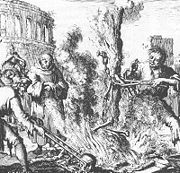
. As a result of his conviction for rebellion, he was hanged in June and his body burnt. Faced with the stake, he refused to recant any of his positions; since he remained a hero to large sections of the Roman people and the minor clergy, his ashes were cast into the Tiber
Tiber
The Tiber is the third-longest river in Italy, rising in the Apennine Mountains in Emilia-Romagna and flowing through Umbria and Lazio to the Tyrrhenian Sea. It drains a basin estimated at...
, to prevent his burial place becoming venerated as the shrine
Shrine
A shrine is a holy or sacred place, which is dedicated to a specific deity, ancestor, hero, martyr, saint, daemon or similar figure of awe and respect, at which they are venerated or worshipped. Shrines often contain idols, relics, or other such objects associated with the figure being venerated....
of a martyr
Martyr
A martyr is somebody who suffers persecution and death for refusing to renounce, or accept, a belief or cause, usually religious.-Meaning:...
.
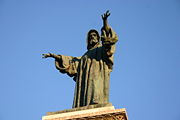
In 1882, after the collapse of Papal temporal powers, the city of Brescia erected a monument to its native son.