
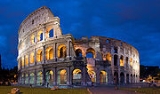
The
Colosseum, or the
Coliseum, originally the
Flavian Amphitheatre (
LatinLatin is an Italic language originally spoken in Latium and Ancient Rome. It, along with most European languages, is a descendant of the ancient Proto-Indo-European language. Although it is considered a dead language, a number of scholars and members of the Christian clergy speak it fluently, and...
:
Amphitheatrum Flavium, Italian
Anfiteatro Flavio or
Colosseo), is an elliptical
amphitheatreAn amphitheatre is an open-air venue used for entertainment and performances.There are two similar, but distinct, types of structure for which the word "amphitheatre" is used: Ancient Roman amphitheatres were large central performance spaces surrounded by ascending seating, and were commonly used...
in the centre of the city of
RomeRome is the capital of Italy and the country's largest and most populated city and comune, with over 2.7 million residents in . The city is located in the central-western portion of the Italian Peninsula, on the Tiber River within the Lazio region of Italy.Rome's history spans two and a half...
,
ItalyItaly , officially the Italian Republic languages]] under the European Charter for Regional or Minority Languages. In each of these, Italy's official name is as follows:;;;;;;;;), is a unitary parliamentary republic in South-Central Europe. To the north it borders France, Switzerland, Austria and...
, the largest ever built in the
Roman EmpireThe Roman Empire was the post-Republican period of the ancient Roman civilization, characterised by an autocratic form of government and large territorial holdings in Europe and around the Mediterranean....
. It is considered one of the greatest works of
Roman architectureAncient Roman architecture adopted certain aspects of Ancient Greek architecture, creating a new architectural style. The Romans were indebted to their Etruscan neighbors and forefathers who supplied them with a wealth of knowledge essential for future architectural solutions, such as hydraulics...
and
Roman engineeringRomans are famous for their advanced engineering accomplishments, although some of their own inventions were improvements on older ideas, concepts and inventions. Technology for bringing running water into cities was developed in the east, but transformed by the Romans into a technology...
.
Occupying a site just east of the
Roman ForumThe Roman Forum is a rectangular forum surrounded by the ruins of several important ancient government buildings at the center of the city of Rome. Citizens of the ancient city referred to this space, originally a marketplace, as the Forum Magnum, or simply the Forum...
, its construction started in 72 AD under the emperor
VespasianVespasian , was Roman Emperor from 69 AD to 79 AD. Vespasian was the founder of the Flavian dynasty, which ruled the Empire for a quarter century. Vespasian was descended from a family of equestrians, who rose into the senatorial rank under the Emperors of the Julio-Claudian dynasty...
and was completed in 80 AD under
TitusTitus , was Roman Emperor from 79 to 81. A member of the Flavian dynasty, Titus succeeded his father Vespasian upon his death, thus becoming the first Roman Emperor to come to the throne after his own father....
, with further modifications being made during
DomitianDomitian was Roman Emperor from 81 to 96. Domitian was the third and last emperor of the Flavian dynasty.Domitian's youth and early career were largely spent in the shadow of his brother Titus, who gained military renown during the First Jewish-Roman War...
's reign (81–96). The name "
Amphitheatrum Flavium" derives from both Vespasian's and Titus's family name (
Flavius, from the
gens Flavia).
Capable of seating 50,000 spectators, the Colosseum was used for gladiatorial contests and public spectacles such as mock sea battles, animal hunts, executions, re-enactments of famous battles, and dramas based on
Classical mythologyRoman mythology is the body of traditional stories pertaining to ancient Rome's legendary origins and religious system, as represented in the literature and visual arts of the Romans...
. The building ceased to be used for entertainment in the
early medievalThe Early Middle Ages was the period of European history lasting from the 5th century to approximately 1000. The Early Middle Ages followed the decline of the Western Roman Empire and preceded the High Middle Ages...
era. It was later reused for such purposes as housing, workshops, quarters for a religious order, a fortress, a
quarryA quarry is a type of open-pit mine from which rock or minerals are extracted. Quarries are generally used for extracting building materials, such as dimension stone, construction aggregate, riprap, sand, and gravel. They are often collocated with concrete and asphalt plants due to the requirement...
, and a Christian shrine.
Although in the 21st century it stays partially ruined because of damage caused by devastating earthquakes and stone-robbers, the Colosseum is an
iconAn icon is a religious work of art, most commonly a painting, from Eastern Christianity and in certain Eastern Catholic churches...
ic symbol of Imperial Rome. It is one of Rome's most popular
tourist attractionA tourist attraction is a place of interest where tourists visit, typically for its inherent or exhibited cultural value, historical significance, natural or built beauty, or amusement opportunities....
s and still has close connections with the Roman Catholic Church, as each
Good FridayGood Friday , is a religious holiday observed primarily by Christians commemorating the crucifixion of Jesus Christ and his death at Calvary. The holiday is observed during Holy Week as part of the Paschal Triduum on the Friday preceding Easter Sunday, and may coincide with the Jewish observance of...
the Pope leads a torchlit "Way of the Cross" procession that starts in the area around the Colosseum.
The Colosseum is also depicted on the
Italian versionItalian euro coins have a design unique to each denomination, though there is a common theme of famous Italian works of art from one of Italy's renowned artists...
of the
five-cent euro coin5 cent euro coins have a value of one twentieth of a euro and are composed of copper-covered steel. All coins have a common reverse and country-specific obverse...
.
Name
The Colosseum's original Latin name was
Amphitheatrum Flavium, often anglicized as
Flavian Amphitheater. The building was constructed by emperors of the
Flavian dynastyThe Flavian dynasty was a Roman Imperial Dynasty, which ruled the Roman Empire between 69 and 96 AD, encompassing the reigns of Vespasian , and his two sons Titus and Domitian . The Flavians rose to power during the civil war of 69, known as the Year of the Four Emperors...
, hence its original name, after the reign of Emperor Nero. This name is still used in
modern EnglishModern English is the form of the English language spoken since the Great Vowel Shift in England, completed in roughly 1550.Despite some differences in vocabulary, texts from the early 17th century, such as the works of William Shakespeare and the King James Bible, are considered to be in Modern...
, but generally the structure is better known as the Colosseum. In antiquity, Romans may have referred to the Colosseum by the unofficial name
Amphitheatrum Caesareum; this name could have been strictly poetic as it was not exclusive to the Colosseum; Vespasian and Titus, builders of the Colosseum, also constructed an
amphitheater of the same nameThe Flavian Amphitheater , located in Pozzuoli, is the third largest Roman amphitheater in Italy. Only the Roman Colosseum and the Capuan Amphitheater are larger. It was likely built by the same architects who previously constructed the Roman Colosseum...
in Puteoli (modern Pozzuoli).
The name
Colosseum has long been believed to be derived from a
colossal statue of NeroThe Colossus Neronis was an enormous, 30 m bronze statue that the Emperor Nero erected in the vestibule of his Domus Aurea, the imperial villa complex on the Palatine Hill. It was modified by Nero's successors into a statue of the sun god Sol Invictus. It is last mentioned in the 4th century AD...
nearby (the statue of Nero was named after the
Colossus of RhodesThe Colossus of Rhodes was a statue of the Greek Titan Helios, erected in the city of Rhodes on the Greek island of Rhodes by Chares of Lindos between 292 and 280 BC. It is considered one of the Seven Wonders of the Ancient World. It was constructed to celebrate Rhodes' victory over the ruler of...
). This statue was later remodeled by
NeroNero , was Roman Emperor from 54 to 68, and the last in the Julio-Claudian dynasty. Nero was adopted by his great-uncle Claudius to become his heir and successor, and succeeded to the throne in 54 following Claudius' death....
's successors into the likeness of
HeliosHelios was the personification of the Sun in Greek mythology. Homer often calls him simply Titan or Hyperion, while Hesiod and the Homeric Hymn separate him as a son of the Titans Hyperion and Theia or Euryphaessa and brother of the goddesses Selene, the moon, and Eos, the dawn...
(
Sol) or
ApolloApollo is one of the most important and complex of the Olympian deities in Greek and Roman mythology...
, the sun god, by adding the appropriate solar crown. Nero's head was also replaced several times with the heads of succeeding emperors. Despite its
paganPaganism is a blanket term, typically used to refer to non-Abrahamic, indigenous polytheistic religious traditions....
links, the statue remained standing well into the medieval era and was credited with magical powers. It came to be seen as an iconic symbol of the permanence of Rome.
In the 8th century, a famous epigram attributed to the
Venerable BedeBede , also referred to as Saint Bede or the Venerable Bede , was a monk at the Northumbrian monastery of Saint Peter at Monkwearmouth, today part of Sunderland, England, and of its companion monastery, Saint Paul's, in modern Jarrow , both in the Kingdom of Northumbria...
celebrated the symbolic significance of the statue in a prophecy that is variously quoted:
Quamdiu stat Colisæus, stat et Roma; quando cadet colisæus, cadet et Roma; quando cadet Roma, cadet et mundus ("as long as the Colossus stands, so shall Rome; when the Colossus falls, Rome shall fall; when Rome falls, so falls the world"). This is often mistranslated to refer to the Colosseum rather than the Colossus (as in, for instance,
ByronGeorge Gordon Byron, 6th Baron Byron, later George Gordon Noel, 6th Baron Byron, FRS , commonly known simply as Lord Byron, was a British poet and a leading figure in the Romantic movement...
's poem
Childe Harold's PilgrimageChilde Harold's Pilgrimage is a lengthy narrative poem in four parts written by Lord Byron. It was published between 1812 and 1818 and is dedicated to "Ianthe". The poem describes the travels and reflections of a world-weary young man who, disillusioned with a life of pleasure and revelry, looks...
). However, at the time that the Pseudo-Bede wrote, the
masculine nounGrammatical gender is defined linguistically as a system of classes of nouns which trigger specific types of inflections in associated words, such as adjectives, verbs and others. For a system of noun classes to be a gender system, every noun must belong to one of the classes and there should be...
coliseus was applied to the statue rather than to what was still known as the Flavian amphitheatre.
The Colossus did eventually fall, possibly being pulled down to reuse its
bronzeBronze is a metal alloy consisting primarily of copper, usually with tin as the main additive. It is hard and brittle, and it was particularly significant in antiquity, so much so that the Bronze Age was named after the metal...
. By the year 1000 the name "Colosseum" had been coined to refer to the amphitheatre. The statue itself was largely forgotten and only its base survives, situated between the Colosseum and the nearby
Temple of Venus and RomaThe Temple of Venus and of Rome — in Latin, Templum Veneris et Romae — is thought to have been the largest temple in Ancient Rome. Located on the Velian Hill, between the eastern edge of the Forum Romanum and the Colosseum, it was dedicated to the goddesses Venus Felix and Roma Aeterna...
.
The name further evolved to
Coliseum during the Middle Ages. In Italy, the amphitheatre is still known as
il Colosseo, and other Romance languages have come to use similar forms such as
le Colisée (French),
el Coliseo (Spanish) and
o Coliseu (
PortuguesePortuguese is a Romance language that arose in the medieval Kingdom of Galicia, nowadays Galicia and Northern Portugal. The southern part of the Kingdom of Galicia became independent as the County of Portugal in 1095...
).
Ancient
Construction of the Colosseum began under the rule of the Emperor
VespasianVespasian , was Roman Emperor from 69 AD to 79 AD. Vespasian was the founder of the Flavian dynasty, which ruled the Empire for a quarter century. Vespasian was descended from a family of equestrians, who rose into the senatorial rank under the Emperors of the Julio-Claudian dynasty...
in around 70–72 AD. The site chosen was a flat area on the floor of a low valley between the
CaelianThe Caelian Hill is one of the famous Seven Hills of Rome. Under reign of Tullus Hostilius, the entire population of Alba Longa was forcibly resettled on the Caelian Hill...
,
EsquilineThe Esquiline Hill is one of the celebrated Seven Hills of Rome. Its southern-most cusp is the Oppius .-Etymology:The origin of the name Esquilino is still under much debate. One view is that the Hill was named after the abundance of holm-oaks, exculi, that resided there...
and
Palatine HillThe Palatine Hill is the centermost of the Seven Hills of Rome and is one of the most ancient parts of the city...
s, through which a
canalCanals are man-made channels for water. There are two types of canal:#Waterways: navigable transportation canals used for carrying ships and boats shipping goods and conveying people, further subdivided into two kinds:...
ised stream ran. By the 2nd century BC the area was densely inhabited. It was devastated by the
Great Fire of RomeThe Great Fire of Rome was an urban fire that occurred beginning July 19, AD 64.-Background:According to Tacitus, the fire spread quickly and burned for six days. Only four of the fourteen districts of Rome escaped the fire; three districts were completely destroyed and the other seven suffered...
in AD 64, following which
NeroNero , was Roman Emperor from 54 to 68, and the last in the Julio-Claudian dynasty. Nero was adopted by his great-uncle Claudius to become his heir and successor, and succeeded to the throne in 54 following Claudius' death....
seized much of the area to add to his personal domain. He built the grandiose
Domus AureaThe Domus Aurea was a large landscaped portico villa, designed to take advantage of artificially created landscapes built in the heart of Ancient Rome by the Emperor Nero after the Great Fire of Rome had cleared away the aristocratic dwellings on the slopes of the Palatine...
on the site, in front of which he created an artificial lake surrounded by pavilions, gardens and porticoes. The existing
Aqua Claudia aqueductAn aqueduct is a water supply or navigable channel constructed to convey water. In modern engineering, the term is used for any system of pipes, ditches, canals, tunnels, and other structures used for this purpose....
was extended to supply water to the area and the gigantic bronze
Colossus of NeroThe Colossus Neronis was an enormous, 30 m bronze statue that the Emperor Nero erected in the vestibule of his Domus Aurea, the imperial villa complex on the Palatine Hill. It was modified by Nero's successors into a statue of the sun god Sol Invictus. It is last mentioned in the 4th century AD...
was set up nearby at the entrance to the Domus Aurea.
Although the Colossus was preserved, much of the Domus Aurea was torn down. The lake was filled in and the land reused as the location for the new Flavian Amphitheatre. Gladiatorial schools and other support buildings were constructed nearby within the former grounds of the Domus Aurea. According to a reconstructed inscription found on the site, "the emperor Vespasian ordered this new amphitheatre to be erected from his general's share of the booty." This is thought to refer to the vast quantity of treasure seized by the Romans following their victory in the Great Jewish Revolt in 70 AD. The Colosseum can be thus interpreted as a great triumphal monument built in the Roman tradition of celebrating great victories, placating the Roman people instead of returning soldiers. Vespasian's decision to build the Colosseum on the site of Nero's lake can also be seen as a populist gesture of returning to the people an area of the city which Nero had appropriated for his own use. In contrast to many other amphitheatres, which were located on the outskirts of a city, the Colosseum was constructed in the city centre; in effect, placing it both literally and symbolically at the heart of Rome.
The Colosseum had been completed up to the third story by the time of Vespasian's death in 79. The top level was finished and the building inaugurated by his son,
TitusTitus , was Roman Emperor from 79 to 81. A member of the Flavian dynasty, Titus succeeded his father Vespasian upon his death, thus becoming the first Roman Emperor to come to the throne after his own father....
, in 80.
Dio CassiusLucius Cassius Dio Cocceianus , known in English as Cassius Dio, Dio Cassius, or Dio was a Roman consul and a noted historian writing in Greek...
recounts that over 9,000 wild animals were killed during the
inaugural gamesThe inaugural games of the Flavian Amphitheatre were held in AD 80, on the orders of the Roman Emperor Titus, to celebrate the completion of the Colosseum, then known as the Flavian Amphitheatre . Vespasian began construction of the amphitheatre around AD 70, and it was completed by Titus...
of the amphitheatre. The building was remodelled further under Vespasian's younger son, the newly designated Emperor
DomitianDomitian was Roman Emperor from 81 to 96. Domitian was the third and last emperor of the Flavian dynasty.Domitian's youth and early career were largely spent in the shadow of his brother Titus, who gained military renown during the First Jewish-Roman War...
, who constructed the
hypogeumHypogeum or hypogaeum literally means "underground", from Greek hypo and gaia . It usually refers to an underground, non-Christian temple or a tomb...
, a series of underground tunnels used to house animals and slaves. He also added a gallery to the top of the Colosseum to increase its
seating capacitySeating capacity refers to the number of people who can be seated in a specific space, both in terms of the physical space available, and in terms of limitations set by law. Seating capacity can be used in the description of anything ranging from an automobile that seats two to a stadium that seats...
.
In 217, the Colosseum was badly damaged by a major fire (caused by lightning, according to Dio Cassius) which destroyed the wooden upper levels of the amphitheatre's interior. It was not fully repaired until about 240 and underwent further repairs in 250 or 252 and again in 320. An inscription records the restoration of various parts of the Colosseum under
Theodosius IITheodosius II , commonly surnamed Theodosius the Younger, or Theodosius the Calligrapher, was Byzantine Emperor from 408 to 450. He is mostly known for promulgating the Theodosian law code, and for the construction of the Theodosian Walls of Constantinople...
and
Valentinian III-Family:Valentinian was born in the western capital of Ravenna, the only son of Galla Placidia and Flavius Constantius. The former was the younger half-sister of the western emperor Honorius, and the latter was at the time Patrician and the power behind the throne....
(reigned 425–455), possibly to repair damage caused by a major earthquake in 443; more work followed in 484 and 508. The arena continued to be used for contests well into the 6th century, with gladiatorial fights last mentioned around 435. Animal hunts continued until at least 523, when
Anicius MaximusFlavius Anicius Maximus was a Roman senator and patrician during the Ostrogothic kingdom, who celebrated the last games in the Flavian Amphitheater.- Biography :...
celebrated his consulship with some
venationes, criticised by King
Theodoric the GreatTheodoric the Great was king of the Ostrogoths , ruler of Italy , regent of the Visigoths , and a viceroy of the Eastern Roman Empire...
for their high cost.
Medieval
The Colosseum underwent several radical changes of use during the medieval period. By the late 6th century a small church had been built into the structure of the amphitheatre, though this apparently did not confer any particular religious significance on the building as a whole. The arena was converted into a cemetery. The numerous vaulted spaces in the arcades under the seating were converted into housing and workshops, and are recorded as still being rented out as late as the 12th century. Around 1200 the
Frangipani familyThe Frangipani or Frangipane is a princely family with roots in Ancient Rome. The family was powerful as a Roman patrician clan in the Middle Ages. The family was typically Guelff in sympathy and thus often bravely supported the papacy...
took over the Colosseum and fortified it, apparently using it as a castle.
Severe damage was inflicted on the Colosseum by the great earthquake in 1349, causing the outer south side, lying on a less stable
alluvionalAlluvium is loose, unconsolidated soil or sediments, eroded, deposited, and reshaped by water in some form in a non-marine setting. Alluvium is typically made up of a variety of materials, including fine particles of silt and clay and larger particles of sand and gravel...
terrain, to collapse. Much of the tumbled stone was reused to build palaces, churches, hospitals and other buildings elsewhere in Rome. A religious order moved into the northern third of the Colosseum in the mid-14th century and continued to inhabit it until as late as the early 19th century. The interior of the amphitheatre was extensively stripped of stone, which was reused elsewhere, or (in the case of the marble façade) was burned to make quicklime. The bronze clamps which held the stonework together were pried or hacked out of the walls, leaving numerous pockmarks which still scar the building today.
Modern
During the 16th and 17th century, Church officials sought a productive role for the Colosseum.
Pope Sixtus VPope Sixtus V , born Felice Peretti di Montalto, was Pope from 1585 to 1590.-Early life:The chronicler Andrija Zmajević states that Felice's family originated from modern-day Montenegro...
(1585–1590) planned to turn the building into a wool factory to provide employment for Rome's prostitutes, though this proposal fell through with his premature death. In 1671 Cardinal Altieri authorized its use for bullfights; a public outcry caused the idea to be hastily abandoned.
In 1749,
Pope Benedict XIVPope Benedict XIV , born Prospero Lorenzo Lambertini, was Pope from 17 August 1740 to 3 May 1758.-Life:...
endorsed as official Church policy the view that the Colosseum was a sacred site where early Christians had been
martyrA martyr is somebody who suffers persecution and death for refusing to renounce, or accept, a belief or cause, usually religious.-Meaning:...
ed. He forbade the use of the Colosseum as a quarry and consecrated the building to the
Passion of ChristThe Passion is the Christian theological term used for the events and suffering – physical, spiritual, and mental – of Jesus in the hours before and including his trial and execution by crucifixion...
and installed
Stations of the CrossStations of the Cross refers to the depiction of the final hours of Jesus, and the devotion commemorating the Passion. The tradition as chapel devotion began with St...
, declaring it sanctified by the blood of the Christian martyrs who perished there (
see Christians and the Colosseum). However there is no historical evidence to support Benedict's claim, nor is there even any evidence that anyone prior to the 16th century suggested this might be the case; the
Catholic EncyclopediaThe Catholic Encyclopedia, also referred to as the Old Catholic Encyclopedia and the Original Catholic Encyclopedia, is an English-language encyclopedia published in the United States. The first volume appeared in March 1907 and the last three volumes appeared in 1912, followed by a master index...
concludes that there are no historical grounds for the supposition. Later popes initiated various stabilization and restoration projects, removing the extensive vegetation which had overgrown the structure and threatened to damage it further. The façade was reinforced with triangular brick wedges in 1807 and 1827, and the interior was repaired in 1831, 1846 and in the 1930s. The arena substructure was partly excavated in 1810–1814 and 1874 and was fully exposed under
Benito MussoliniBenito Amilcare Andrea Mussolini was an Italian politician who led the National Fascist Party and is credited with being one of the key figures in the creation of Fascism....
in the 1930s.
The Colosseum is today one of Rome's most popular tourist attractions, receiving millions of visitors annually. The effects of pollution and general deterioration over time prompted a major restoration programme carried out between 1993 and 2000, at a cost of 40 billion
Italian lireThe lira was the currency of Italy between 1861 and 2002. Between 1999 and 2002, the Italian lira was officially a “national subunit” of the euro...
($19.3m / €20.6m at 2000 prices). In recent years it has become a symbol of the international campaign against capital punishment, which was abolished in Italy in 1948. Several anti–death penalty demonstrations took place in front of the Colosseum in 2000. Since that time, as a gesture against the death penalty, the local authorities of Rome change the color of the Colosseum's night time illumination from white to gold whenever a person condemned to the death penalty anywhere in the world gets their sentence commuted or is released, or if a jurisdiction abolishes the death penalty. Most recently, the Colosseum was illuminated in gold when capital punishment was abolished in the American state of
New MexicoNew Mexico is a state located in the southwest and western regions of the United States. New Mexico is also usually considered one of the Mountain States. With a population density of 16 per square mile, New Mexico is the sixth-most sparsely inhabited U.S...
in April 2009.
Because of the ruined state of the interior, it is impractical to use the Colosseum to host large events; only a few hundred spectators can be accommodated in temporary seating. However, much larger concerts have been held just outside, using the Colosseum as a backdrop. Performers who have played at the Colosseum in recent years have included
Ray CharlesRay Charles Robinson , known by his shortened stage name Ray Charles, was an American musician. He was a pioneer in the genre of soul music during the 1950s by fusing rhythm and blues, gospel, and blues styles into his early recordings with Atlantic Records...
(May 2002),
Paul McCartneySir James Paul McCartney, MBE, Hon RAM, FRCM is an English musician, singer-songwriter and composer. Formerly of The Beatles and Wings , McCartney is listed in Guinness World Records as the "most successful musician and composer in popular music history", with 60 gold discs and sales of 100...
(May 2003),
Elton JohnSir Elton Hercules John, CBE, Hon DMus is an English rock singer-songwriter, composer, pianist and occasional actor...
(September 2005), and
Billy JoelWilliam Martin "Billy" Joel is an American musician and pianist, singer-songwriter, and classical composer. Since releasing his first hit song, "Piano Man", in 1973, Joel has become the sixth best-selling recording artist and the third best-selling solo artist in the United States, according to...
(July 2006).
Exterior
Unlike earlier Greek theatres that were built into hillsides, the Colosseum is an entirely free-standing structure. It derives its basic exterior and interior architecture from that of two
Roman theatresThe characteristics of Roman to those of the earlier Greek theatres due in large part to its influence on the Roman triumvir Gnaeus Pompeius Magnus. Much of the architectural influence on the Romans came from the Greeks, and theatre structural design was no different from other buildings...
back to back. It is elliptical in plan and is 189 meters (615 ft / 640 Roman feet) long, and 156 meters (510 ft / 528 Roman feet) wide, with a base area of 6 acres (24,281.2 m²). The height of the outer wall is 48 meters (157 ft / 165 Roman feet). The perimeter originally measured 545 meters (1,788 ft / 1,835 Roman feet). The central arena is an oval 87 m (287 ft) long and 55 m (180 ft) wide, surrounded by a wall 5 m (15 ft) high, above which rose tiers of seating.
The outer wall is estimated to have required over 100,000 cubic meters (131,000
cu ydA cubic yard is an Imperial / U.S. customary unit of volume, used in the United States, Canada, and the UK. It is defined as the volume of a cube with sides of 1 yard in length.-Symbols:...
) of
travertineTravertine is a form of limestone deposited by mineral springs, especially hot springs. Travertine often has a fibrous or concentric appearance and exists in white, tan, and cream-colored varieties. It is formed by a process of rapid precipitation of calcium carbonate, often at the mouth of a hot...
stone which were set without mortar held together by 300 tons of iron clamps. However, it has suffered extensive damage over the centuries, with large segments having collapsed following earthquakes. The north side of the perimeter wall is still standing; the distinctive triangular brick wedges at each end are modern additions, having been constructed in the early 19th century to shore up the wall. The remainder of the present-day exterior of the Colosseum is in fact the original interior wall.
The surviving part of the outer wall's monumental façade comprises three stories of superimposed
arcadesAn arcade is a succession of arches, each counterthrusting the next, supported by columns or piers or a covered walk enclosed by a line of such arches on one or both sides. In warmer or wet climates, exterior arcades provide shelter for pedestrians....
surmounted by a
podiumA podium is a platform that is used to raise something to a short distance above its surroundings. It derives from the Greek πόδι In architecture a building can rest on a large podium. Podia can also be used to raise people, for instance the conductor of an orchestra stands on a podium as do many...
on which stands a tall
atticAn attic is a space found directly below the pitched roof of a house or other building . Attic is generally the American/Canadian reference to it...
, both of which are pierced by windows interspersed at regular intervals. The arcades are framed by half-columns of the Tuscan,
IonicThe Ionic order forms one of the three orders or organizational systems of classical architecture, the other two canonic orders being the Doric and the Corinthian...
, and
CorinthianThe Corinthian order is one of the three principal classical orders of ancient Greek and Roman architecture. The other two are the Doric and Ionic. When classical architecture was revived during the Renaissance, two more orders were added to the canon, the Tuscan order and the Composite order...
orders, while the attic is decorated with Corinthian
pilasterA pilaster is a slightly-projecting column built into or applied to the face of a wall. Most commonly flattened or rectangular in form, pilasters can also take a half-round form or the shape of any type of column, including tortile....
s. Each of the arches in the second- and third-floor arcades framed statues, probably honoring divinities and other figures from
Classical mythologyClassical mythology or Greco-Roman mythology is the cultural reception of myths from the ancient Greeks and Romans. Along with philosophy and political thought, mythology represents one of the major survivals of classical antiquity throughout later Western culture.Classical mythology has provided...
.
Two hundred and forty mast
corbelIn architecture a corbel is a piece of stone jutting out of a wall to carry any superincumbent weight. A piece of timber projecting in the same way was called a "tassel" or a "bragger". The technique of corbelling, where rows of corbels deeply keyed inside a wall support a projecting wall or...
s were positioned around the top of the attic. They originally supported a retractable
awningAn awning or overhang is a secondary covering attached to the exterior wall of a building. It is typically composed of canvas woven of acrylic, cotton or polyester yarn, or vinyl laminated to polyester fabric that is stretched tightly over a light structure of aluminium, iron or steel, possibly...
, known as the
velariumA Velarium was a type of awning used in Roman times. It stretched over the whole of the cavea in the Colosseum to protect spectators from the elements...
, that kept the sun and rain off spectators. This consisted of a canvas-covered, net-like structure made of ropes, with a hole in the center. It covered two-thirds of the arena, and sloped down towards the center to catch the wind and provide a breeze for the audience. Sailors, specially enlisted from the Roman naval headquarters at Misenum and housed in the nearby
Castra Misenatium, were used to work the
velariumA Velarium was a type of awning used in Roman times. It stretched over the whole of the cavea in the Colosseum to protect spectators from the elements...
.
The Colosseum's huge crowd capacity made it essential that the venue could be filled or evacuated quickly. Its architects adopted solutions very similar to those used in modern stadiums to deal with the same problem. The amphitheatre was ringed by eighty entrances at ground level, 76 of which were used by ordinary spectators. Each entrance and exit was numbered, as was each staircase. The northern main entrance was reserved for the
Roman EmperorThe Roman emperor was the ruler of the Roman State during the imperial period . The Romans had no single term for the office although at any given time, a given title was associated with the emperor...
and his aides, whilst the other three axial entrances were most likely used by the elite. All four axial entrances were richly decorated with painted
stuccoStucco or render is a material made of an aggregate, a binder, and water. Stucco is applied wet and hardens to a very dense solid. It is used as decorative coating for walls and ceilings and as a sculptural and artistic material in architecture...
reliefs, of which fragments survive. Many of the original outer entrances have disappeared with the collapse of the perimeter wall, but entrances XXIII (23) to LIV (54) still survive.
Spectators were given tickets in the form of numbered pottery shards, which directed them to the appropriate section and row. They accessed their seats via
vomitoriaA vomitorium is a passage situated below or behind a tier of seats in an amphitheatre, through which big crowds can exit rapidly at the end of a performance...
(singular
vomitorium), passageways that opened into a tier of seats from below or behind. These quickly dispersed people into their seats and, upon conclusion of the event or in an emergency evacuation, could permit their exit within only a few minutes. The name
vomitoria derived from the Latin word for a rapid discharge, from which English derives the word vomit.
Interior seating
According to the
Codex-Calendar of 354The Chronography of 354, also known as the Calendar of 354, was a 4th century illuminated manuscript, which was produced in 354 AD for a wealthy Roman Christian named Valentinus. It is the earliest dated codex to have full page illustrations. None of the original has survived...
, the Colosseum could accommodate 87,000 people, although modern estimates put the figure at around 50,000. They were seated in a tiered arrangement that reflected the rigidly stratified nature of Roman society. Special boxes were provided at the north and south ends respectively for the Emperor and the Vestal Virgins, providing the best views of the arena. Flanking them at the same level was a broad platform or
podium for the
senatorialThe Senate of the Roman Republic was a political institution in the ancient Roman Republic, however, it was not an elected body, but one whose members were appointed by the consuls, and later by the censors. After a magistrate served his term in office, it usually was followed with automatic...
class, who were allowed to bring their own chairs. The names of some 5th century senators can still be seen carved into the stonework, presumably reserving areas for their use.
The tier above the senators, known as the
maenianum primum, was occupied by the non-senatorial noble class or knights (
equitesThe Roman equestrian order constituted the lower of the two aristocratic classes of ancient Rome, ranking below the patricians , a hereditary caste that monopolised political power during the regal era and during the early Republic . A member of the equestrian order was known as an eques...
). The next level up, the
maenianum secundum, was originally reserved for ordinary Roman citizens (
plebiansThe plebs was the general body of free land-owning Roman citizens in Ancient Rome. They were distinct from the higher order of the patricians. A member of the plebs was known as a plebeian...
) and was divided into two sections. The lower part (the
immum) was for wealthy citizens, while the upper part (the
summum) was for poor citizens. Specific sectors were provided for other social groups: for instance, boys with their tutors, soldiers on leave, foreign dignitaries, scribes, heralds, priests and so on. Stone (and later marble) seating was provided for the citizens and nobles, who presumably would have brought their own cushions with them. Inscriptions identified the areas reserved for specific groups.
Another level, the
maenianum secundum in legneis, was added at the very top of the building during the reign of
DomitianDomitian was Roman Emperor from 81 to 96. Domitian was the third and last emperor of the Flavian dynasty.Domitian's youth and early career were largely spent in the shadow of his brother Titus, who gained military renown during the First Jewish-Roman War...
. This comprised a gallery for the common poor,
slavesSlavery is a system under which people are treated as property to be bought and sold, and are forced to work. Slaves can be held against their will from the time of their capture, purchase or birth, and deprived of the right to leave, to refuse to work, or to demand compensation...
and women. It would have been either standing room only, or would have had very steep wooden benches. Some groups were banned altogether from the Colosseum, notably gravediggers, actors and former gladiators.
Each tier was divided into sections (
maeniana) by curved passages and low walls (
praecinctiones or
baltei), and were subdivided into
cunei, or wedges, by the steps and aisles from the vomitoria. Each row (
gradus) of seats was numbered, permitting each individual seat to be exactly designated by its gradus, cuneus, and number.
Arena and hypogeum
The arena itself was 83 meters by 48 meters (272 ft by 157 ft / 280 by 163 Roman feet). It comprised a wooden floor covered by sand (the Latin word for sand is
harena or
arena), covering an elaborate underground structure called the
hypogeum (literally meaning "underground"). Little now remains of the original arena floor, but the
hypogeum is still clearly visible. It consisted of a two-level subterranean network of tunnels and cages beneath the arena where gladiators and animals were held before contests began. Eighty vertical shafts provided instant access to the arena for caged animals and scenery pieces concealed underneath; larger hinged platforms, called
hegmata, provided access for elephants and the like. It was restructured on numerous occasions; at least twelve different phases of construction can be seen.
The
hypogeum was connected by underground tunnels to a number of points outside the Colosseum. Animals and performers were brought through the tunnel from nearby stables, with the gladiators' barracks at the
Ludus MagnusThe Ludus Magnus or The Great Gladiatorial Training School is the largest of the gladiatorial arenas in Rome, Italy. It was built by the emperor Domitian in the valley between the Esquiline and the Caelian hills, an area already occupied by Republican and Augustan structures...
to the east also being connected by tunnels. Separate tunnels were provided for the Emperor and the Vestal Virgins to permit them to enter and exit the Colosseum without needing to pass through the crowds.
Substantial quantities of machinery also existed in the
hypogeum. Elevators and pulleys raised and lowered scenery and props, as well as lifting caged animals to the surface for release. There is evidence for the existence of major hydraulic mechanisms and according to ancient accounts, it was possible to flood the arena rapidly, presumably via a connection to a nearby aqueduct.
Supporting buildings
The Colosseum and its activities supported a substantial industry in the area. In addition to the amphitheatre itself, many other buildings nearby were linked to the games. Immediately to the east is the remains of the
Ludus MagnusThe Ludus Magnus or The Great Gladiatorial Training School is the largest of the gladiatorial arenas in Rome, Italy. It was built by the emperor Domitian in the valley between the Esquiline and the Caelian hills, an area already occupied by Republican and Augustan structures...
, a training school for gladiators. This was connected to the Colosseum by an underground passage, to allow easy access for the gladiators. The
Ludus Magnus had its own miniature training arena, which was itself a popular attraction for Roman spectators. Other training schools were in the same area, including the
Ludus Matutinus (Morning School), where fighters of animals were trained, plus the Dacian and Gallic Schools.
Also nearby were the
Armamentarium, comprising an armory to store weapons; the
Summum Choragium, where machinery was stored; the
Sanitarium, which had facilities to treat wounded gladiators; and the
Spoliarium, where bodies of dead gladiators were stripped of their armor and disposed of.
Around the perimeter of the Colosseum, at a distance of 18 m (59 ft) from the perimeter, was a series of tall stone posts, with five remaining on the eastern side. Various explanations have been advanced for their presence; they may have been a religious boundary, or an outer boundary for ticket checks, or an anchor for the
velariumA Velarium was a type of awning used in Roman times. It stretched over the whole of the cavea in the Colosseum to protect spectators from the elements...
or awning.
Right next to the Colosseum is also the
Arch of ConstantineThe Arch of Constantine is a triumphal arch in Rome, situated between the Colosseum and the Palatine Hill. It was erected to commemorate Constantine I's victory over Maxentius at the Battle of Milvian Bridge on October 28, 312...
.
Use
The Colosseum was used to host
gladiatorA gladiator was an armed combatant who entertained audiences in the Roman Republic and Roman Empire in violent confrontations with other gladiators, wild animals, and condemned criminals. Some gladiators were volunteers who risked their legal and social standing and their lives by appearing in the...
ial shows as well as a variety of other events. The shows, called
munera, were always given by private individuals rather than the state. They had a strong religious element but were also demonstrations of power and family prestige, and were immensely popular with the population. Another popular type of show was the animal hunt, or
venatioVenatio was a form of entertainment in Roman amphitheaters involving the hunting and slaying of wild animals. Exotic wild beasts from the far reaches of the Roman Empire were brought to Rome and hunts were held in the morning prior to the afternoon main event of gladiatorial duels...
. This utilized a great variety of wild beasts, mainly imported from Africa and the Middle East, and included creatures such as rhinoceros, hippopotamuses, elephants, giraffes, aurochs, wisents, barbary lions, panthers, leopards, bears, caspian tigers, crocodiles and ostriches. Battles and hunts were often staged amid elaborate sets with movable trees and buildings. Such events were occasionally on a huge scale;
TrajanTrajan , was Roman Emperor from 98 to 117 AD. Born into a non-patrician family in the province of Hispania Baetica, in Spain Trajan rose to prominence during the reign of emperor Domitian. Serving as a legatus legionis in Hispania Tarraconensis, in Spain, in 89 Trajan supported the emperor against...
is said to have celebrated his victories in
DaciaIn ancient geography, especially in Roman sources, Dacia was the land inhabited by the Dacians or Getae as they were known by the Greeks—the branch of the Thracians north of the Haemus range...
in 107 with contests involving 11,000 animals and 10,000 gladiators over the course of 123 days.
During the early days of the Colosseum, ancient writers recorded that the building was used for
naumachiaThe naumachia in the Ancient Roman world referred to both the re-enactment of naval battles and the basin in which this took place....
e (more properly known as
navalia proelia) or simulated sea battles. Accounts of the inaugural games held by Titus in AD 80 describe it being filled with water for a display of specially trained swimming horses and bulls. There is also an account of a re-enactment of a famous sea battle between the
CorcyreanCorfu is a Greek island in the Ionian Sea. It is the second largest of the Ionian Islands, and, including its small satellite islands, forms the edge of the northwestern frontier of Greece. The island is part of the Corfu regional unit, and is administered as a single municipality. The...
(Corfiot) Greeks and the
CorinthCorinth, or Korinth was a city-state on the Isthmus of Corinth, the narrow stretch of land that joins the Peloponnesus to the mainland of Greece, roughly halfway between Athens and Sparta. The modern town of Corinth is located approximately northeast of the ancient ruins...
ians. This has been the subject of some debate among historians; although providing the water would not have been a problem, it is unclear how the arena could have been waterproofed, nor would there have been enough space in the arena for the warships to move around. It has been suggested that the reports either have the location wrong, or that the Colosseum originally featured a wide floodable channel down its central axis (which would later have been replaced by the hypogeum).
Sylvae or recreations of natural scenes were also held in the arena. Painters, technicians and architects would construct a simulation of a forest with real trees and bushes planted in the arena's floor. Animals would be introduced to populate the scene for the delight of the crowd. Such scenes might be used simply to display a natural environment for the urban population, or could otherwise be used as the backdrop for hunts or dramas depicting episodes from mythology. They were also occasionally used for executions in which the hero of the story – played by a condemned person – was killed in one of various gruesome but mythologically authentic ways, such as being mauled by beasts or burned to death.
Today
The Colosseum today is now a major tourist attraction in Rome with thousands of tourists each year paying to view the interior arena, though entrance for EU citizens is partially subsidised, and under-18 and over-65 EU citizens' entrances are free. There is now a museum dedicated to
ErosEros , in Greek mythology, was the Greek god of love. His Roman counterpart was Cupid . Some myths make him a primordial god, while in other myths, he is the son of Aphrodite....
located in the upper floor of the outer wall of the building. Part of the arena floor has been re-floored. Beneath the Colosseum, a network of subterranean passageways once used to transport wild animals and gladiators to the arena opened to the public in summer 2010.
The Colosseum is also the site of Roman Catholic ceremonies in the 20th and 21st centuries. For instance,
Pope Benedict XVIBenedict XVI is the 265th and current Pope, by virtue of his office of Bishop of Rome, the Sovereign of the Vatican City State and the leader of the Catholic Church as well as the other 22 sui iuris Eastern Catholic Churches in full communion with the Holy See...
leads the
Stations of the CrossStations of the Cross refers to the depiction of the final hours of Jesus, and the devotion commemorating the Passion. The tradition as chapel devotion began with St...
called the
Scriptural Way of the CrossThe Scriptural Way of the Cross or Scriptural Stations of the Cross is a version of the traditional Stations of the Cross inaugurated as a Roman Catholic devotion by Pope John Paul II on Good Friday 1991. Thereafter John Paul II performed the scriptural version many times at the Colosseum in Rome...
(which calls for more meditation) at the Colosseum on
Good FridayGood Friday , is a religious holiday observed primarily by Christians commemorating the crucifixion of Jesus Christ and his death at Calvary. The holiday is observed during Holy Week as part of the Paschal Triduum on the Friday preceding Easter Sunday, and may coincide with the Jewish observance of...
s.
In 2011,
Diego Della ValleDiego Della Valle is the President and CEO of the Italian leather goods company, Tod's.-Biography:Diego Della Valle is the older son of Dorino Della Valle and grandson of Filippo Della Valle...
founder of
Tod'sTod's Group is an Italian company which produces shoes and other leather goods, and is presided over by businessman Diego Della Valle. It is most famous for its driving shoes....
shoe firm, entered into an agreement with local officials to sponsor a €25 million restoration of the Colosseum. Work is planned to begin at the end of 2011 and take up to two and a half years.
Christians and the Colosseum
In the Middle Ages, the Colosseum was clearly not regarded as a sacred site. Its use as a fortress and then a quarry demonstrates how little spiritual importance was attached to it, at a time when sites associated with martyrs were highly venerated. It was not included in the itineraries compiled for the use of pilgrims nor in works such as the 12th century
Mirabilia Urbis RomaeMirabilia Urbis Romae is a much-copied medieval Latin text that served generations of pilgrims and tourists as a guide to the city of Rome. The original, which was written by a canon of St Peter's, dates from the 1140s...
("Marvels of the City of Rome"), which claims the
Circus FlaminiusThe Circus Flaminius was a large, circular area of land in Rome that contained a small race-track reserved for mysterious games, and various other buildings and monuments. It was located in the southern end of the Campus Martius, near the Tiber River. It was ‘built,’ or sectioned off, by Flaminius...
– but not the Colosseum – as the site of martyrdoms. Part of the structure was inhabited by a Christian order, but apparently not for any particular religious reason.
It appears to have been only in the 16th and 17th centuries that the Colosseum came to be regarded as a Christian site.
Pope Pius VPope Saint Pius V , born Antonio Ghislieri , was Pope from 1566 to 1572 and is a saint of the Catholic Church. He is chiefly notable for his role in the Council of Trent, the Counter-Reformation, and the standardization of the Roman liturgy within the Latin Church...
(1566–1572) is said to have recommended that pilgrims gather sand from the arena of the Colosseum to serve as a relic, on the grounds that it was impregnated with the blood of martyrs. This seems to have been a minority view until it was popularised nearly a century later by Fioravante Martinelli, who listed the Colosseum at the head of a list of places sacred to the martyrs in his 1653 book
Roma ex ethnica sacra.
Martinelli's book evidently had an effect on public opinion; in response to Cardinal Altieri's proposal some years later to turn the Colosseum into a bullring, Carlo Tomassi published a pamphlet in protest against what he regarded as an act of desecration. The ensuing controversy persuaded
Pope Clement XPope Clement X , born Emilio Bonaventura Altieri, was Pope from 29 April 1670 to 22 July 1676.-Early life:Emilio Altieri was born in Rome, the son of Lorenzo Altieri and Victoria Delphini, a Venetian lady...
to close the Colosseum's external arcades and declare it a sanctuary, though quarrying continued for some time.
At the instance of St.
Leonard of Port MauriceSaint Leonard of Port Maurice, O.F.M., was an Italian Franciscan preacher and ascetic writer.- Life :...
, Pope Benedict XIV (1740–1758) forbade the quarrying of the Colosseum and erected
Stations of the CrossStations of the Cross refers to the depiction of the final hours of Jesus, and the devotion commemorating the Passion. The tradition as chapel devotion began with St...
around the arena, which remained until February 1874. St.
Benedict Joseph LabreSaint Benedict Joseph Labré was a French mendicant, Franciscan tertiary and Roman Catholic saint.-Life:He was born in Amettes, near Arras in the north of France, the eldest of fifteen children of a prosperous shopkeeper, and was religious from a very early age. He was noted for performing public...
spent the later years of his life within the walls of the Colosseum, living on
almsAlms or almsgiving is a religious rite which, in general, involves giving materially to another as an act of religious virtue.It exists in a number of religions. In Philippine Regions, alms are given as charity to benefit the poor. In Buddhism, alms are given by lay people to monks and nuns to...
, prior to his death in 1783. Several 19th century popes funded repair and restoration work on the Colosseum, and it still retains a Christian connection today. Crosses stand in several points around the arena and every
Good FridayGood Friday , is a religious holiday observed primarily by Christians commemorating the crucifixion of Jesus Christ and his death at Calvary. The holiday is observed during Holy Week as part of the Paschal Triduum on the Friday preceding Easter Sunday, and may coincide with the Jewish observance of...
the Pope leads a Via Crucis procession to the amphitheatre.
Flora
The Colosseum has a wide and well-documented history of flora ever since
Domenico PanaroliDomenico Panaroli was a physician and herbalist of Rome. He is remembered today largely by what was for him a minor work. In 1643 he compiled the first Flora of the Colosseum, Plantarum Amphytheatralium Catalogus, where he had noticed many exotic species were naturalized, originally from stowaway...
made the first catalogue of its plants in 1643. Since then, 684 species have been identified there. The peak was in 1855 (420 species). Attempts were made in 1871 to eradicate the vegetation, because of concerns over the damage that was being caused to the masonry, but much of it has returned. 242 species have been counted today and of the species first identified by Panaroli, 200 remain.
The variation of plants can be explained by the change of climate in Rome through the centuries. Additionally,
bird migrationBird migration is the regular seasonal journey undertaken by many species of birds. Bird movements include those made in response to changes in food availability, habitat or weather. Sometimes, journeys are not termed "true migration" because they are irregular or in only one direction...
, flower blooming, and the growth of Rome that caused the Colosseum to become embedded within the modern city centre rather than on the outskirts of the ancient city, as well as deliberate transport of species, are also contributing causes. One other romantic reason often given is their seeds being unwittingly transported on the animals brought there from all corners of the empire.
Works modeled on, or inspired by, the Colosseum
- The Kongresshalle, or "Congress Hall", (1935, unfinished) at the Nazi Party Rally grounds
The Nazi party rally grounds consist of about 11 square kilometres in the southeast of Nuremberg, Germany...
, NurembergNuremberg[p] is a city in the German state of Bavaria, in the administrative region of Middle Franconia. Situated on the Pegnitz river and the Rhine–Main–Danube Canal, it is located about north of Munich and is Franconia's largest city. The population is 505,664...
, GermanyGermany , officially the Federal Republic of Germany , is a federal parliamentary republic in Europe. The country consists of 16 states while the capital and largest city is Berlin. Germany covers an area of 357,021 km2 and has a largely temperate seasonal climate...
- The Summer Olympic Games
The Summer Olympic Games or the Games of the Olympiad are an international multi-sport event, occurring every four years, organized by the International Olympic Committee. Medals are awarded in each event, with gold medals for first place, silver for second and bronze for third, a tradition that...
medal from 1928 to 2000, designed by Giuseppe CassioliGiuseppe Cassioli was an Italian painter and sculptor most famous for his Summer Olympic Games medal design.-Biography:...
, features a depiction of the Collosseum. At the 2004 Summer OlympicsThe 2004 Summer Olympic Games, officially known as the Games of the XXVIII Olympiad, was a premier international multi-sport event held in Athens, Greece from August 13 to August 29, 2004 with the motto Welcome Home. 10,625 athletes competed, some 600 more than expected, accompanied by 5,501 team...
in AthensAthens , is the capital and largest city of Greece. Athens dominates the Attica region and is one of the world's oldest cities, as its recorded history spans around 3,400 years. Classical Athens was a powerful city-state...
the Collossseum was replaced by a depiction of the Panathinaiko StadiumThe Panathinaiko or Panathenaic Stadium , also known as the Kallimarmaro , is an athletic stadium in Athens that hosted the first modern Olympic Games in 1896...
- The exterior of the Vancouver Public Library
The Vancouver Public Library is the third largest public library system in Canada, with more than 2.5 million items in its collections, 22 branches, approximately 375,000 cardholders, and nearly nine million item borrowings annually...
resembles the current state of the Colosseum. It was designed by Moshe SafdieMoshe Safdie, CC, FAIA is an architect, urban designer, educator, theorist, and author. Born in the city of Haifa, then Palestine and now Israel, he moved with his family to Montreal, Canada, when he was 15 years old.-Career:...
.
Popular culture references
The iconic status of the Colosseum has led it to be featured in numerous films and other items of popular culture:
- In the 1953 film Roman Holiday, the Colosseum famously serves as the backdrop for several scenes.
- In the 1954 film Demetrius and the Gladiators
Demetrius and the Gladiators is a 1954 sword and sandal drama film and a sequel to The Robe. It was made by 20th Century Fox, directed by Delmer Daves and produced by Frank Ross. The screenplay was by Philip Dunne based on characters created by Lloyd C...
, the Emperor CaligulaCaligula , also known as Gaius, was Roman Emperor from 37 AD to 41 AD. Caligula was a member of the house of rulers conventionally known as the Julio-Claudian dynasty. Caligula's father Germanicus, the nephew and adopted son of Emperor Tiberius, was a very successful general and one of Rome's most...
anachronistically sentences the Christian Demetrius to fight in the Colosseum.
- The conclusion of the 1957 film 20 Million Miles to Earth
20 Million Miles to Earth is a 1957 American science fiction film written by Bob Williams and Christopher Knopf from an original treatment by Charlott Knight. The film was produced by Charles H. Schneer's Morningside Productions for Columbia Pictures and directed by Nathan H. Juran...
takes place at the Colosseum.
- In the 1972 film Way of the Dragon
The Way of the Dragon is a 1972 Hong Kong martial arts film written, produced, directed by and starring Bruce Lee.- Plot :Tang Lung is sent from Hong Kong to Rome to help his friend's niece Chen Ching Hua, and family friends, whose restaurant is being targeted by the local Mafia, which has been...
, Bruce LeeBruce Lee was a Chinese American, Hong Kong actor, martial arts instructor, philosopher, film director, film producer, screenwriter, and founder of the Jeet Kune Do martial arts movement...
fought Chuck NorrisCarlos Ray "Chuck" Norris is an American martial artist and actor. After serving in the United States Air Force, he began his rise to fame as a martial artist and has since founded his own school, Chun Kuk Do...
in the Colosseum.
- In Ridley Scott
Sir Ridley Scott is an English film director and producer. His most famous films include The Duellists , Alien , Blade Runner , Legend , Thelma & Louise , G. I...
's 2000 film Gladiator, the Colosseum was re-created via computer-generated imageryComputer-generated imagery is the application of the field of computer graphics or, more specifically, 3D computer graphics to special effects in art, video games, films, television programs, commercials, simulators and simulation generally, and printed media...
(CGI) to "restore" it to the glory of its heyday in the 2nd century. The depiction of the building itself is generally accurate and it gives a good impression of what the underground hypogeum would have been like.
External links