

Umbrian language

Encyclopedia
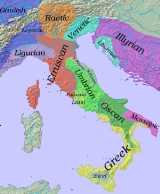
Umbrian is an extinct
Italic language
formerly spoken by the Umbri
in the ancient Italian
region of Umbria
. Within the Italic languages
it is closely related to the Oscan
group and is therefore associated with it in the group of Osco-Umbrian languages
. Since that classification was first formulated a number of other languages in ancient Italy were discovered to be more closely related to Umbrian. Therefore a group was devised to contain them, termed the Umbrian group. In addition to the specific Umbrian language, they are the Volscian language
, the Sabine language, the South Picene language
, and the Marsian language. The classification used in this article is that of the Linguist List
and SIL International
.
, nine inscribed bronze tablets found in an underground chamber at Gubbio
(ancient Iguvium) in 1444. Two have since disappeared. The remaining seven contain notes on the ceremonies and statute
s for priest
s of the ancient pagan religion in the region. Sometimes they are called the Eugubian tablets after the medieval name of Iguvium, Eugubium. The tablets contain 4000-5000 words.
Other minor inscriptions are from Todi
, Assisi
and Spoleto
.
s, was derived from the Etruscan alphabet, and was written right-to-left. The newer was written in the Latin alphabet
. The texts are sometimes called Old Umbrian and New Umbrian. The differences are mainly orthographic.
Language death
In linguistics, language death is a process that affects speech communities where the level of linguistic competence that speakers possess of a given language variety is decreased, eventually resulting in no native and/or fluent speakers of the variety...
Italic language
Italic languages
The Italic subfamily is a member of the Indo-European language family. It includes the Romance languages derived from Latin , and a number of extinct languages of the Italian Peninsula, including Umbrian, Oscan, Faliscan, and Latin.In the past various definitions of "Italic" have prevailed...
formerly spoken by the Umbri
Umbri
The Umbri were an Italic people of ancient Italy. A region called Umbria still exists and is currently occupied by Italian speakers. It is somewhat smaller than the ancient Umbria....
in the ancient Italian
Italy
Italy , officially the Italian Republic languages]] under the European Charter for Regional or Minority Languages. In each of these, Italy's official name is as follows:;;;;;;;;), is a unitary parliamentary republic in South-Central Europe. To the north it borders France, Switzerland, Austria and...
region of Umbria
Roman Umbria
Roman Umbria is a modern name for one of the 11 administrative regions into which the emperor Augustus divided Italy. The main source for the regions is the Historia Naturalis of Pliny the Elder, who informs his readers he is basing the geography of Italy on the discriptio Italiae, "division of...
. Within the Italic languages
Italic languages
The Italic subfamily is a member of the Indo-European language family. It includes the Romance languages derived from Latin , and a number of extinct languages of the Italian Peninsula, including Umbrian, Oscan, Faliscan, and Latin.In the past various definitions of "Italic" have prevailed...
it is closely related to the Oscan
Oscan language
Oscan is a term used to describe both an extinct language of southern Italy and the language group to which it belonged.The Oscan language was spoken by a number of tribes, including the Samnites, the Aurunci, the Sidicini, and the Ausones. The latter three tribes were often grouped under the name...
group and is therefore associated with it in the group of Osco-Umbrian languages
Osco-Umbrian languages
The Osco-Umbrian languages or Sabellic languages are a group of languages that belong to the Italic language family of the Indo-European languages. They were spoken in central and southern Italy before Latin replaced them as the power of the Romans expanded...
. Since that classification was first formulated a number of other languages in ancient Italy were discovered to be more closely related to Umbrian. Therefore a group was devised to contain them, termed the Umbrian group. In addition to the specific Umbrian language, they are the Volscian language
Volscian language
Volscian was a Sabellic Italic language, which was spoken by the Volsci and closely related to Oscan and Umbrian.It is attested in an inscription found in Velitrae , dating probably from early in the 3rd century BC; it is cut upon a small bronze plate , which must have once been fixed to some...
, the Sabine language, the South Picene language
South Picene language
South Picene is an extinct Italic language, belonging to the Sabellic subfamily. It is currently considered by SIL International to belong to the Umbrian Group although in the long history of its attempted classification it has been placed at a higher level, parallel to Oscan and Umbrian within...
, and the Marsian language. The classification used in this article is that of the Linguist List
Linguist List
The LINGUIST List is a major online resource for the academic field of linguistics. It was founded by Anthony Aristar in early 1990 at the University of Western Australia, and is used as a reference by the National Science Foundation in the United States...
and SIL International
SIL International
SIL International is a U.S.-based, worldwide, Christian non-profit organization, whose main purpose is to study, develop and document languages, especially those that are lesser-known, in order to expand linguistic knowledge, promote literacy, translate the Christian Bible into local languages,...
.
Corpus
Umbrian is known from about 30 inscriptions dated from the 7th through 1st centuries BC. The largest cache by far is the Iguvine TablesIguvine Tables
The Iguvine Tablets are a series of seven bronze tablets discovered at Iguvium , Italy, in the year 1444. They are also known as Eugubian tablets...
, nine inscribed bronze tablets found in an underground chamber at Gubbio
Gubbio
Gubbio is a town and comune in the far northeastern part of the Italian province of Perugia . It is located on the lowest slope of Mt. Ingino, a small mountain of the Apennines. See also Mount Ingino Christmas Tree.-History:...
(ancient Iguvium) in 1444. Two have since disappeared. The remaining seven contain notes on the ceremonies and statute
Religious law
In some religions, law can be thought of as the ordering principle of reality; knowledge as revealed by a God defining and governing all human affairs. Law, in the religious sense, also includes codes of ethics and morality which are upheld and required by the God...
s for priest
Priest
A priest is a person authorized to perform the sacred rites of a religion, especially as a mediatory agent between humans and deities. They also have the authority or power to administer religious rites; in particular, rites of sacrifice to, and propitiation of, a deity or deities...
s of the ancient pagan religion in the region. Sometimes they are called the Eugubian tablets after the medieval name of Iguvium, Eugubium. The tablets contain 4000-5000 words.
Other minor inscriptions are from Todi
Todi
Todi is a town and comune of the province of Perugia in central Italy. It is perched on a tall two-crested hill overlooking the east bank of the river Tiber, commanding distant views in every direction.In the 1990s, Richard S...
, Assisi
Assisi
- Churches :* The Basilica of San Francesco d'Assisi is a World Heritage Site. The Franciscan monastery, il Sacro Convento, and the lower and upper church of St Francis were begun immediately after his canonization in 1228, and completed in 1253...
and Spoleto
Spoleto
Spoleto is an ancient city in the Italian province of Perugia in east central Umbria on a foothill of the Apennines. It is S. of Trevi, N. of Terni, SE of Perugia; SE of Florence; and N of Rome.-History:...
.
Alphabet
The Iguvine tablets were written in two alphabets. The older, the Umbrian alphabet, like other Old Italic alphabetOld Italic alphabet
Old Italic refers to several now extinct alphabet systems used on the Italian Peninsula in ancient times for various Indo-European languages and non-Indo-European languages...
s, was derived from the Etruscan alphabet, and was written right-to-left. The newer was written in the Latin alphabet
Latin alphabet
The Latin alphabet, also called the Roman alphabet, is the most recognized alphabet used in the world today. It evolved from a western variety of the Greek alphabet called the Cumaean alphabet, which was adopted and modified by the Etruscans who ruled early Rome...
. The texts are sometimes called Old Umbrian and New Umbrian. The differences are mainly orthographic.