
All Topics  
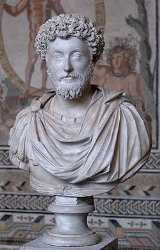
Marcus Aurelius

 
Marcus Aurelius

   Email Print
   Bookmark   Link


Marcus Aurelius


Marcus Aurelius Antoninus Augustus (often referred to as "the wise"; April 26, 121
121

Events...
 – March 17, 180
180

Events...
) was Roman Emperor
Roman Emperor

The Roman Emperor was the ruler of the Roman Empire during the imperial period . The Romans had no single term for the office: Latin language titles such as imperator , Augustus , Caesar and princeps were all associated with it....
 from 161 to his death in 180. He was the last of the "Five Good Emperors
Five Good Emperors

The Five Good Emperors is a term that refers to five consecutive emperors of the Roman Empire who represented a line of virtuous and just rule ? Nerva, Trajan, Hadrian, Antoninus Pius, and Marcus Aurelius....
", and is also considered one of the most important Stoic
Stoicism

Stoicism was a school of Hellenistic philosophy founded in Athens by Zeno of Citium in the early third century B.C. The stoics considered passionate emotions to be the result of errors in judgment, and that a Sage , or person of "moral and intellectual perfection," would not have such emotions....
 philosophers
Philosophy

Philosophy is the study of general problems concerning matters such as existence, knowledge, truth, beauty, justice, validity, mind, and language....
. His tenure was marked by wars in Asia against a revitalized Parthian Empire
Parthian Empire

The Arsacid Empire , was a significant political and cultural power in the ancient Near East, and a counterweight to the Roman Empire in the region....
, and with Germanic tribes along the Limes Germanicus
Limes Germanicus

The Limes Germanicus was a remarkable line of frontier forts that bounded the ancient Roman provinces of Germania Superior and Raetia, and divided the Roman Empire and the unsubdued Germanic tribes, from the years 83 to 260....
 into Gaul
Gaul

Gaul is the name used for the region of Western Europe comprising part of present day northern Italy, France, Belgium, western Switzerland and the parts of the Netherlands and Germany on the west bank of the River Rhine....
 and across the Danube
Danube

The Danube is the longest river in the European Union and Europe's second longest river after the Volga.The river originates in the Black Forest in Germany as the much smaller Brigach and Breg River rivers which join at the eponymously named German town Donaueschingen, after which it is known as the Danube and flows eastwards for a distance...
. A revolt in the East, led by Avidius Cassius
Avidius Cassius

Gaius Avidius Cassius was a Roman usurper who briefly ruled Aegyptus Province and Syria in 175.A native of Cyrrhus, Syria, he was the son of Gaius Avidius Heliodorus, a noted orator who had become prefect of Egypt....
, failed.

Marcus Aurelius' work Meditations
Meditations

Meditations is the title of a series of personal writings by Marcus Aurelius setting forth his ideas on Stoic philosophy.Marcus Aurelius wrote the 12 books of the Meditations in "highly-educated" Koine Greek as a source for his own guidance and self-improvement....
, written in Greek while on campaign between 170 and 180, is still revered as a literary monument to a government of service and duty and has been praised for its "exquisite accent and its infinite tenderness."

as originally named Marcus Annius Catilius Severus, when he married he took the name Marcus Annius Verus.


Discussion
Ask a question about 'Marcus Aurelius'
Start a new discussion about 'Marcus Aurelius'
Answer questions from other users
Full Discussion Forum


Timeline

19   Maroboduus, king of the Marcomanni, is deposed by Catualda. This ended the threat to the Romans from German tribes until the reign of Marcus Aurelius. Rome places them under its protection.

121   Born

138   Roman emperor Hadrian adopted Antoninus Pius on condition that Antonius would adopt Marcus Annius Aurelius Verus.

139   Marcus Aurelius is named Caesar. He marries Faustina, daughter of Antoninus Pius.

146   Marcus Aurelius receives the imperium proconsular.

147   Marcus Aurelius receives Imperial Powers from Antoninus Pius.

161   Roman emperor Antoninus Pius dies and is succeeded by Marcus Aurelius who shares imperial power with Lucius Verus, although Marcus retains the title Pontifex Maximus.

164   Marcus Aurelius gives his daughter Lucilla in marriage to his co-emperor Lucius Verus.

165   Legio II ''Italica'' is levied by Marcus Aurelius.

166   Marcus Aurelius appoints his sons as Caesars, while he and Verus travel to Germany.


Quotations


Let your occupations be few, says the sage, if you would lead a tranquil life.

IV, 24

A man should be upright, not kept upright.

III, 5

A wrongdoer is often a man who has left something undone, not always one who has done something.

IX, 5

All is ephemeral - fame and the famous as well.

IV, 35

Be not careless in deeds, nor confused in words, nor rambling in thought.

VIII, 51

By a tranquil mind I mean nothing else than a mind well ordered.

IV, 3


Encyclopedia


Marcus Aurelius Antoninus Augustus (often referred to as "the wise"; April 26, 121
121

Events...
 – March 17, 180
180

Events...
) was Roman Emperor
Roman Emperor

The Roman Emperor was the ruler of the Roman Empire during the imperial period . The Romans had no single term for the office: Latin language titles such as imperator , Augustus , Caesar and princeps were all associated with it....
 from 161 to his death in 180. He was the last of the "Five Good Emperors
Five Good Emperors

The Five Good Emperors is a term that refers to five consecutive emperors of the Roman Empire who represented a line of virtuous and just rule ? Nerva, Trajan, Hadrian, Antoninus Pius, and Marcus Aurelius....
", and is also considered one of the most important Stoic
Stoicism

Stoicism was a school of Hellenistic philosophy founded in Athens by Zeno of Citium in the early third century B.C. The stoics considered passionate emotions to be the result of errors in judgment, and that a Sage , or person of "moral and intellectual perfection," would not have such emotions....
 philosophers
Philosophy

Philosophy is the study of general problems concerning matters such as existence, knowledge, truth, beauty, justice, validity, mind, and language....
. His tenure was marked by wars in Asia against a revitalized Parthian Empire
Parthian Empire

The Arsacid Empire , was a significant political and cultural power in the ancient Near East, and a counterweight to the Roman Empire in the region....
, and with Germanic tribes along the Limes Germanicus
Limes Germanicus

The Limes Germanicus was a remarkable line of frontier forts that bounded the ancient Roman provinces of Germania Superior and Raetia, and divided the Roman Empire and the unsubdued Germanic tribes, from the years 83 to 260....
 into Gaul
Gaul

Gaul is the name used for the region of Western Europe comprising part of present day northern Italy, France, Belgium, western Switzerland and the parts of the Netherlands and Germany on the west bank of the River Rhine....
 and across the Danube
Danube

The Danube is the longest river in the European Union and Europe's second longest river after the Volga.The river originates in the Black Forest in Germany as the much smaller Brigach and Breg River rivers which join at the eponymously named German town Donaueschingen, after which it is known as the Danube and flows eastwards for a distance...
. A revolt in the East, led by Avidius Cassius
Avidius Cassius

Gaius Avidius Cassius was a Roman usurper who briefly ruled Aegyptus Province and Syria in 175.A native of Cyrrhus, Syria, he was the son of Gaius Avidius Heliodorus, a noted orator who had become prefect of Egypt....
, failed.

Marcus Aurelius' work Meditations
Meditations

Meditations is the title of a series of personal writings by Marcus Aurelius setting forth his ideas on Stoic philosophy.Marcus Aurelius wrote the 12 books of the Meditations in "highly-educated" Koine Greek as a source for his own guidance and self-improvement....
, written in Greek while on campaign between 170 and 180, is still revered as a literary monument to a government of service and duty and has been praised for its "exquisite accent and its infinite tenderness."

Early life


Family

He was originally named Marcus Annius Catilius Severus, when he married he took the name Marcus Annius Verus. When he was named Emperor, he was given the name Marcus Aurelius Antoninus.

Marcus Aurelius was the only son to Marcus Annius Verus
Marcus Annius Verus (praetor)

Marcus Annius Verus was a distinguished Roman politician, a praetor, and the father of the emperor Marcus Aurelius.He was the son of Marcus Annius Verus and Rupilia Faustina....
 and Domitia Lucilla
Domitia Lucilla

Domitia Lucilla, Lucilla or Domitia Calvilla was a noble Roman woman who lived in the 2nd century. She is famous as the mother of the future emperor Marcus Aurelius, and also as the patron of another future emperor, Didius Julianus....
. Marcus Aurelius' father was of Romano-Spanish
Hispania

Hispania was the name given by the Ancient Rome to the whole of the Iberian Peninsula . When Rome was a Roman Republic, Hispania was divided into Roman provinces: Hispania Citerior and Hispania Ulterior....
 origin, and served as a praetor
Praetor

Praetor was a Title#Titles_for_heads_of_state granted by the government of Ancient Rome to men acting in one of two official capacities: the commander of an army, either before it was mustered or more typically in the field, or an elected Magistratus assigned duties that varied depending on the historical period....
 and died when Marcus was three years old. Marcus Aurelius credits him with teaching him "manliness without ostentation". His mother was of Italian ancestry. His only natural sibling was his younger sister Annia Cornificia Faustina
Annia Cornificia Faustina

Annia Cornificia Faustina was the younger child and only daughter to praetor Marcus Annius Verus and Domitia Lucilla. Her elder brother would be future Roman Emperor Marcus Aurelius....
, who was about 2 years younger than he. Domitia Lucilla came from a wealthy family who were of consular rank. His father's maternal aunt was Vibia Sabina
Vibia Sabina

Vibia Sabina was a Roman Empress, wife and third cousin to Roman Emperor Hadrian. She was the daughter to Salonina Matidia, niece of Roman Emperor Trajan and Lucius Vibius Sabinus, a man of consular rank....
, wife of Roman Emperor Hadrian
Hadrian

Publius Aelius Hadrianus , as emperor Imperator Caesar Divi Traiani filius Traianus Hadrianus Augustus, and Divus Hadrianus after his apotheosis, known as Hadrian in English language, was Roman Emperor of Roman Empire from AD 117 to 138, as well as a Stoicism and Epicureanism philosopher....
. Rupilia
Rupilia

Rupilia Faustina was a Roman woman. She was daughter to Salonina Matidia from her third marriage to Lucius Scribonius Libo Rupilio Frugi Bonus consul of 88, who died in 101....
 Faustina (Marcus Aurelius' paternal grandmother) and Vibia Sabina were half-sisters and were daughters of Salonina Matidia
Salonina Matidia

Salonina Matidia was a daughter and only child to Ulpia Marciana and wealthy praetor Gaius Salonius Matidius Patruinus. Her maternal uncle was Roman Emperor Trajan....
 (niece of the Roman Emperor Trajan
Trajan

Marcus Ulpius Nerva Traianus, commonly known as Trajan , was a Roman Emperors who reigned from 98 until his death in 117. Born Marcus Ulpius Traianus into a nonpatrician family in the Hispania Baetica province , Trajan rose to prominence during the reign of emperor Domitian, serving as a general in the Roman army along the Limes G...
). His father's sister was Faustina the Elder
Faustina the Elder

Annia Galeria Faustina, more familiarly referred to as Faustina the Elder , was a Roman Empress and wife of Roman Emperor Antoninus Pius....
 a Roman Empress who married the Roman Emperor Antoninus Pius
Antoninus Pius

Titus Aurelius Fulvus Boionius Arrius Antoninus , generally known in English as Antoninus Pius was Roman Emperors from 138 to 161. He was the fourth of the Five Good Emperors and a member of the Aurelii....
. After his father's death, Aurelius was adopted and raised by his mother and paternal grandfather Marcus Annius Verus
Marcus Annius Verus

Marcus Annius Verus was a Ancient Rome man who lived in the 1st century and 2nd century. He was the son of an elder Annius Verus, who gained the rank of senator and praetor....
. His paternal grandfather died in 138; he was almost ninety years old.

Heir to the Empire

In 137, Hadrian had announced that his eventual successor would be Lucius Ceionius Commodus, renamed L. Aelius Caesar
Lucius Aelius

Lucius Aelius Verus Caesar became the adopted son and intended successor, of Roman Emperor Hadrian , but never attained the throne.Aelius was born with the name Lucius Ceionius Commodus Verus....
. Marcus had already attracted the attention of Hadrian (who had nicknamed him verissimus, which translates as "truest") and had been made a member of the equestrian order when he was six; he was subsequently engaged to Ceionia Fabia, Commodus' daughter. The engagement, however, was annulled later after the death of Commodus, as Marcus was betrothed to Antoninus' daughter. Therefore, on the death of Hadrian's first adopted son L. Aelius Verus
Lucius Aelius

Lucius Aelius Verus Caesar became the adopted son and intended successor, of Roman Emperor Hadrian , but never attained the throne.Aelius was born with the name Lucius Ceionius Commodus Verus....
, Hadrian made it a precondition of making Antoninus his successor that Antoninus would adopt Marcus (then called Marcus Aelius Aurelius Verus) and Lucius Ceionius Commodus (Lucius Aelius' son, ten years junior than Marcus, renamed Lucius Aurelius Verus), and arrange for them to be next in the line.

This Antoninus did, adopting and designating them as his successors on February 25 138
138

Events...
, when Marcus was only seventeen years of age. He would become emperor at 40. It has been suggested that Commodus and Antoninus Pius were designed by Hadrian only as "place warmers" for the young Marcus and Verus.

Marcus received an education from some of the greatest scholars of his day: Euphorion for literature, Geminus for drama, Andron for geometry, Caninius Celer and Herodes Atticus in Greek oratory, Alexander of Cotiaeum
Alexander of Cotiaeum

Alexander of Cotiaeum was a Greek grammarian, who is mentioned among the instructors of the Roman emperor Marcus Aurelius. We still possess an epitaph pronounced upon him by the rhetorician Aelius Aristides, who had studied under Alexander....
 for Greek, and Marcus Cornelius Fronto
Marcus Cornelius Fronto

Marcus Cornelius Fronto , Roman grammarian, rhetorician and advocate, was born at Cirta in Numidia. He also was suffect consul of 142....
 for Latin. It is through Marcus' correspondence with Fronto that we have many of the details of his life during the reign of Antoninus. Through these letters Marcus appears as an intelligent, serious-minded and hardworking youth. They also show the growing importance of philosophy for the future emperor: showing impatience for the unending exercises with Greek and Latin declamations, he later became fond of the Diatribai ("Discourses") of Epictetus
Epictetus

Epictetus was a Ancient Greece Stoicism philosophy. He was probably born a slave at Hierapolis, Phrygia , and lived in Rome until his exile to Nicopolis in northwestern Greece, where he lived most of his life and died....
, an important moral philosopher of the Stoic school. Marcus also started to have an increasing public role at the side of Antoninus, holding the place of consul in 140, 145 and 161 and increasing collaboration in decisions. In 147 he received the proconsular imperium
Imperium

Imperium in a broad sense translates as 'Power '. In ancient Rome the concept applied to people and meant something like 'power status' or 'authority' or could be used with a geographical connotation and meant something like 'territory'....
 outside Rome and the tribunicia potestas
Tribune

Tribune was a title shared by 10 elected officials in the Roman Republic. Tribunes had the power to convene the Plebeian Council and to act as its president, which also gave them the exclusive right to propose legislation before it....
, the main formal powers of emperorship. In 145, Marcus married Annia Galeria Faustina or Faustina the Younger
Faustina the Younger

Annia Galeria Faustina Minor , Faustina Minor or Faustina the Younger was a daughter of Roman Emperor Antoninus Pius and Roman Empress Faustina the Elder....
, who was Antoninus' daughter and his paternal cousin.

Emperor


Joint emperorship

Marek Aureliusz Kapitol
When Antoninus Pius died (March 7 161
161

Events...
), Marcus accepted the throne on the condition that he and Verus were made joint emperors (Augusti). Though formally equal from the constitutional point of view, Verus, younger and probably less popular, looks to have been subordinate in practice.

Marcus' insistence to have Verus elected with him was motivated by his loyalty towards the will of their adoptive father. The joint succession may have also been motivated by military experiences, since, during his reign, Marcus Aurelius was almost constantly at war with various peoples outside the empire. A highly authoritative figure was needed to command the troops, yet the emperor himself could not defend both the German and Parthian fronts at the same time. Neither could he simply appoint a general to lead the legions
Roman legion

The Roman Legion is a term that can apply both as a translation of legio to the entire Roman army and also, more narrowly , to the heavy infantry that was the basic military unit of the Roman army in the period of the late Roman Republic and the Roman Empire....
; earlier popular military leaders like Julius Caesar
Julius Caesar

'Gaius Julius Caesar' , July 13, 100 BC ? March 15, 44 BC,) was a Roman Republic military and political leader. He played a critical role in the transformation of the Roman Republic into the Roman Empire....
 and Vespasian
Vespasian

Titus Flavius Vespasianus, commonly known as Vespasian , was a Roman Emperor who reigned from 69 A.D. until his death in 79 A.D. Vespasian was the founder of the short lived Flavian dynasty, which ruled the Roman Empire between 69 A.D....
 had used the military to overthrow the existing government and install themselves as supreme leaders. Marcus Aurelius solved the problem by sending Verus to command the legions in the east. Verus was authoritative enough to command the full loyalty of the troops, but already powerful enough that he had little incentive to overthrow Marcus. Verus remained loyal until his death in 169. This joint emperorship was reminiscent of the political system of the Roman Republic
Roman Republic

The Roman Republic was the phase of the Ancient Rome characterized by a republican form of government; a period which began with the overthrow of the Roman Roman Kingdom, c....
, which functioned according to the principle of collegiality
Collegiality

Collegiality is the relationship between colleagues....
 and did not allow a single person to hold supreme power. Joint rule was revived by Diocletian
Diocletian

Gaius Aurelius Valerius Diocletianus , born Diocles and commonly known as Diocletian , was Roman Emperor from November 20, 284 to May 1, 305....
's establishment of the Tetrarchy
Tetrarchy

Tetrarchy can be applied to any system of government where power is divided between four individuals. The term is usually used to refer to the tetrarchy instituted by Roman Emperor Diocletian in 293 which lasted until c. 313....
 in the late 3rd century.

Immediately at the beginning of his reign, Marcus continued on the path of his predecessors by issuing numerous law reforms, mainly to clear away abuses and anomalies in the civil jurisprudence. In particular he promoted favourable measures towards categories like slaves, widows and minors; recognition to blood relationships in the field of succession was given. In the criminal law a distinction of class, with different punishments, was made between honestiores and humiliores ("The more distinguished" and "the more lowly", respectively).

Under Marcus' reign, the status of Christians remained the same since the time of Trajan. They were legally punishable, though in fact rarely persecuted. In 177 a group of Christians were executed at Lyon
Lyon

||-||}Lyon, also known as Lyons in English, is a city in east-central France. Its name is pronounced in French language and Franco-Proven?al language, and or in English language....
, for example, but the act is mainly attributable to the initiative of the local governor.

Challenges faced


War with Parthia
Arch Marcus Aurelius
In Asia, a revitalized Parthian Empire
Parthia

Parthia is a region of north-eastern Iran, best known for having been the political and cultural base of the Arsacid dynasty, after which the Arsacid Empire is then also known as the 'Parthian Empire'....
 renewed its assault in 161, defeating two Roman armies and invading Armenia and Syria. Marcus Aurelius sent his joint emperor Verus to command the legions in the east to face this threat. The war ended successfully in 166, although the merit must be mostly ascribed to subordinate generals like Gaius Avidius Cassius. On the return from the campaign, Verus was awarded with a triumph
Roman triumph

A Roman triumph was a civil religion and religious rite of ancient Rome, held to publically celebrate the achievements of an army commander who had won great military successes, originally and traditionally, who had successfully completed a war....
; the parade was unusual because it included the two emperors, their sons and unmarried daughters as a big family celebration. Marcus Aurelius' two sons, Commodus
Commodus

Lucius Aurelius Commodus Antoninus , was a Roman Emperor who ruled from 180 to 192 . The name given here was his official name at his accession to sole rule; see 'Commodus#Changes of name' for earlier and later forms....
 five years old and Annius Verus of three, were elevated to the status of Caesar for the occasion.

The returning army carried with them a plague, afterwards known as the Antonine Plague
Antonine Plague

The Antonine Plague, 165-180 AD, also known as the Plague of Galen, who described it, was an ancient pandemic, whether of smallpox or measles, brought back to the Roman Empire by troops returning from campaigns in the Near East....
, or the Plague of Galen
Galen

Aelius Galenus or Claudius Galenus , better known as Galen of Pergamum , was a prominent Ancient Rome physician and philosopher of Greek origin, and probably the most accomplished medical researcher of the Roman period....
, which spread through the Roman Empire between 165 and 180. The disease was a pandemic
Pandemic

A pandemic is an epidemic of infectious disease that spreads through populations across a large region; for instance a continent, or even worldwide....
 believed to be either of smallpox
Smallpox

Smallpox is an infectious disease unique to humans, caused by either of two virus variants, Variola major and Variola minor. The disease is also known by the Latin names Variola or Variola vera, which is a derivative of the Latin varius, meaning spotted, or varus, meaning "pimple"....
 or measles
Measles

Measles is a infection of the respiratory system caused by a virus, specifically a paramyxovirus of the genus Morbillivirus. Morbilliviruses, like other paramyxoviruses, are enveloped, single-stranded, negative-sense RNA viruses....
, and would ultimately claim the lives of two Roman emperors—Lucius Verus
Lucius Verus

Lucius Aurelius Verus , born as Lucius Ceionius Commodus, known simply as Lucius Verus, was Roman Emperors with Marcus Aurelius , from 161 until his death....
, who died in 169, and Marcus Aurelius, whose family name, Antoninus, was given to the epidemic. The disease broke out again nine years later, according to the Roman historian Dio Cassius
Dio Cassius

Lucius Cassius Dio Cocceianus , known in English language as Cassius Dio, Dio Cassius, or Dio was a noted Roman Empire historian and public servant....
, and caused up to 2,000 deaths a day at Rome, one quarter of those infected. Total deaths have been estimated at five million.

Germania and the Danube
Starting from the 160s, Germanic tribes and other nomadic people launched raids along the Northern border
Limes Germanicus

The Limes Germanicus was a remarkable line of frontier forts that bounded the ancient Roman provinces of Germania Superior and Raetia, and divided the Roman Empire and the unsubdued Germanic tribes, from the years 83 to 260....
, particularly into Gaul
Gaul

Gaul is the name used for the region of Western Europe comprising part of present day northern Italy, France, Belgium, western Switzerland and the parts of the Netherlands and Germany on the west bank of the River Rhine....
 and across the Danube
Danube

The Danube is the longest river in the European Union and Europe's second longest river after the Volga.The river originates in the Black Forest in Germany as the much smaller Brigach and Breg River rivers which join at the eponymously named German town Donaueschingen, after which it is known as the Danube and flows eastwards for a distance...
. This new impetus westwards was probably due to attacks from tribes farther east. A first invasion of the Chatti
Chatti

The Chatti were an ancient Germanic tribes whose homeland was near the Weser. They settled in central and northern Hesse and southern Lower Saxony, along the upper reaches of the Weser river and in the valleys and mountains of the Eder, Fulda and Werra river regions, a district approximately corresponding to Hesse-Kassel, though probably so...
 in the province of Germania Superior
Germania Superior

Germania Superior , so called for the reason that it lay upstream of Germania Inferior, was a Roman province of the Roman Empire. It comprised the area of western Switzerland, the French Jura mountains and Alsace regions and south-western Germany....
 was repulsed in 162. Far more dangerous was the invasion of 166, when the Marcomanni
Marcomanni

The Marcomanni were a Germanic tribe, probably related to the Buri , Suebi or Suevi....
 of Bohemia, clients of the Roman Empire since 19, crossed the Danube together with the Lombards
Lombards

The Lombards were a Germanic peoples originally from Northern Europe who settled in the valley of the Danube and from there invaded Byzantine Italian peninsula in 568 under the leadership of Alboin....
 and other German tribes. At the same time, the Iranian Sarmatians
Sarmatians

The Sarmatians, Sarmat? or Sauromat? were a people of Ancient Iranian peoples origin. Mentioned by Classics authors, they migrated from Central Asia to the Ural Mountains around fifth century B.C....
 attacked between the Danube and the Theiss
Theiss

Theiss can refer to:* Brooke Theiss , actress* William Ware Theiss , costume designerSee also* Tisza * Thiess* Theissen* Thiessen...
 rivers.

Due to the situation in the East, only a punitive expedition
Punitive expedition

A punitive expedition is a military journey undertaken to punish a state or any group of persons. It is usually undertaken in response to disobedient or morally wrong behavior, but may be also be a covered revenge....
 could be launched in 167. Both Marcus and Verus led the troops. After the death of Verus (169), Marcus led personally the struggle against the Germans for the great part of his remaining life. The Romans suffered at least two serious defeats by the Quadi
Quadi

The Quadi were a smaller Germanic tribe, about which little definitive information is known. The history of non-literate peoples is written by their opponents, and we can only know the Germanic tribe the Romans called the 'Quadi' through Roman eyes....
 and Marcomanni, who could cross the Alps, ravage Opitergium (Oderzo
Oderzo

Oderzo is a town in the province of Treviso, Veneto, Italy.It lies in the heart of the Venetian plain, about 66 km to the northeast of Venice....
) and besiege Aquileia
Aquileia

Aquileia is an ancient history Roman Republic city in what is now Italy, at the head of the Adriatic Sea at the edge of the lagoons, about 10 km from the sea, on the river Natiso , the course of which has changed somewhat since Roman times....
, the Roman main city of north-east Italy. At the same time the Costoboci
Costoboci

The Costoboci were a Dacian tribe, which lived in the areas known today as Maramures and south-western Ukraine. Archeologically speaking, they are identified with the Lipita culture....
, coming from the Carpathian
Carpathian Mountains

The Carpathian Mountains or Carpathians are a range of mountains forming an arc of roughly 1,500 km across Central Europe and Eastern Europe, making them the largest mountain range in Europe....
 area, invaded Moesia
Moesia

Moesia was an ancient region and Roman province situated in the areas of modern Serbia, Bulgaria and Romania along the south bank of the Danube River....
, Macedonia
Macedonia (Roman province)

The Roman province of Macedonia was officially established in 146 BC, after the Roman general Quintus Caecilius Metellus Macedonicus defeated Andriscus of Macedon in 148 BC, and after the four client republics established by Rome in the region were dissolved....
 and Greece. After a long struggle, Marcus Aurelius managed to push back the invaders. Numerous Germans settled in frontier regions like Dacia
Dacia

In ancient geography, Dacia was the land of the Dacians. It was named by the ancient Greeks "Getae". Dacia was a large district of East-Central Europe, bounded on the north by the Carpathian Mountains, on the south by the Danube, on the west by the Tisia or Tisza, on the east by the Tyras or Dniester, now in eastern Moldova....
, Pannonia
Pannonia

Pannonia is an ancient province of the Roman Empire bounded north and east by the Danube, coterminous westward with Noricum and upper Italy, and southward with Dalmatia and upper Moesia....
, Germany and Italy itself. This was not a new thing, but this time the numbers of settlers required the creation of two new frontier provinces on the left shore of the Danube, Sarmatia and Marcomannia, including today's Bohemia and Hungary.

The emperor's plans were, however, prevented by a revolt in East, led by Avidius Cassius, which was prompted by false news of the death of Marcus after an illness. Of the eastern provinces, only Cappadocia
Cappadocia

Cappadocia, Wikipedia:IPA for English /k?p?'do???/ , was an extensive inland district of Asia Minor . The name continued to be used in western sources and in the Christianity tradition throughout history and is still widely used as an international Tourism in Turkey concept to define a region of exceptional natural wonders characterized by...
 and Bithynia
Bithynia

Bithynia was an ancient region, kingdom and Roman province in the northwest of Asia Minor, adjoining the Propontis, the Thrace Bosporus and the Euxine ....
 did not side with the rebels. When it became clear that Marcus Aurelius was still alive, Cassius' fortunes declined quickly and he was killed by his troops after only 100 days of power.

Together with his wife Faustina, Marcus Aurelius toured the eastern provinces until 173. He visited Athens, declaring himself a protector of philosophy. After a triumph in Rome, the following year he marched again to the Danubian frontier. After a decisive victory in 178, the plan to annex Bohemia seemed poised for success but was abandoned after Marcus Aurelius again fell ill in 180.

Han China?

In 97, Ban Chao
Ban Chao

Ban Chao , born in Xianyang, Shaanxi, was a Han Dynasty general and cavalry commander in charge of the administration of the "Western Regions" during the Eastern Han dynasty....
, a Protector General
Protectorate of the Western Regions

The Protectorate of the Western Regions was a China regional government established by the Han Dynasty to manage and to control the Western Regions, roughly today's Xinjiang ....
 over the Western Regions
Western Regions

The Western Regions or Xiyu was a historical name specified in the Chinese chronicles between the 3rd century BC to 8th century that referred to the regions west of Jade Gate, most often Central Asia ....
 (Tarim Basin
Tarim Basin

The Tarim Basin is a large endorheic basin occupying an area of more than 400,000 km2. It is located in the Xinjiang Uyghur Autonomous Region in PRC's far west....
) for the Han Dynasty
Han Dynasty

The Han Dynasty followed the Qin Dynasty and preceded the Three Kingdoms in China. The Han Dynasty was ruled by the family known as the Liu clan who had peasant origins....
 (202 BC – 220 AD) of China
China

China is a Culture of China, an ancient civilization, and, depending on perspective, a national or multinational entity extending over a large area in East Asia....
, sent his emissary Gan Ying
Gan Ying

Gan Ying , was a Han Chinese military ambassador who was sent on a mission to Rome in AD 97 by the Chinese general Ban Chao.Although Gan Ying probably never reached Rome, he is, at least in the historical records, the Chinese who went the furthest west during antiquity and he gathered what information he could....
 to reach the Roman Empire (Chinese
Chinese language

Chinese or the Sinitic language is a language family consisting of language mutually unintelligible to varying degrees. Originally the indigenous languages spoken by the Han Chinese in China, it forms one of the two branches of Sino-Tibetan languages of languages....
: ?? Daqin
Daqin

Daqin is the ancient Chinese name for the Roman Empire and, depending on context, the Near East, especially Syria. It literally means "Great Qin", Qin Dynasty being the name of the founding dynasty of the Early Imperial China....
), yet the latter was held up by Parthia
Parthia

Parthia is a region of north-eastern Iran, best known for having been the political and cultural base of the Arsacid dynasty, after which the Arsacid Empire is then also known as the 'Parthian Empire'....
n authorities somewhere near the Persian Gulf
Persian Gulf

The Persian Gulf, in the Southwest Asian region, is an extension of the Indian Ocean located between Iran and the Arabian Peninsula. Historically and commonly known as the Persian Gulf, this body of water is sometimes Persian Gulf naming dispute referred to as the Arabian Gulf by certain Arab countries or simply The Gulf, although nei...
 and was only able make a report on Rome based on what he had heard during his travels. However, the 5th century Book of Later Han
Book of Later Han

The Book of the Later Han is one of the official China historical works which was compiled by Fan Ye in the 5th century, using a number of earlier histories and documents as sources....
 compiled by historian Fan Ye
Fan Ye (historian)

Fan Ye , courtesy name Weizong , was a China historian and the compiler of Book of Later Han of Liu Song. Fan came from an official family background, he was born in present-day Shaoxing, his ancestry was from Nanyang, Henan....
 records that Romans, traveling via a maritime route
Roman trade with India

Roman trade with India through the overland caravan routes via Anatolia and Persia, though at a relative trickle comparative to later times, antedated the southern trade route via the Red Sea and Monsoons which started around the beginning of the Common Era following the reign of Augustus and ?gyptus of Ptolemaic Egypt....
 through the South China Sea
South China Sea

The South China Sea is a marginal sea*south of China,*west of the Philippines,*north west of Sabah , Sarawak and Brunei,*north of Indonesia,...
, visited the court of Emperor Huan of Han
Emperor Huan of Han

Emperor Huan of Han, Chinese character ???, Pinyin. h?n h?an d?, Wade-Giles. Han Huan-ti, was an emperor of China of the Chinese Han Dynasty....
 (r. 146–168) at Luoyang
Luoyang

Luoyang is a prefecture-level city in western Henan province of China, People's Republic of China. It borders the provincial capital of Zhengzhou to the east, Pingdingshan to the southeast, Nanyang to the south, Sanmenxia to the west, Jiyuan to the north, and Jiaozuo to the northeast....
 where they presented tributary gifts in 166. The Chinese text states that they represented the Roman ruler "Andun" (Antoninus), yet Rafe de Crespigny
Rafe de Crespigny

Dr Rafe de Crespigny is a retired Adjunct Professor with the China and Korea Centre, Australian National University in Canberra, Australia. He specialises in Chinese history, geography and literature in the Han Dynasty period and has been acknowledged internationally as a pioneer in the translation and historiography of historical material c...
 speculates that these were perhaps Roman merchants
Roman commerce

Roman trade was the engine that drove the economy of the late Roman Republic and the early Roman Empire. Fashions and trends in historiography and in popular culture have tended to neglect the economic basis of the empire in favor of the lingua franca of Latin and the exploits of the Roman legions....
 and not necessarily official diplomats sent by Marcus Aurelius Antoninus.

Death and succession

Marcus Aurelius died on March 17 180
180

Events...
, in the city of Vindobona (modern Vienna
Vienna

Vienna is the Capital of Republic of Austria and also one of the nine states of Austria. Vienna is Austria's primary city, with a population of about 1.7 million...
), his son and successor Commodus
Commodus

Lucius Aurelius Commodus Antoninus , was a Roman Emperor who ruled from 180 to 192 . The name given here was his official name at his accession to sole rule; see 'Commodus#Changes of name' for earlier and later forms....
 accompanying him. He was immediately deified and his ashes were returned to Rome
Rome

Rome is the capital city of Italy and Lazio, and is Italy's largest and most populous city, with 2,724,347 residents in an urban area of some ....
, and rested in Hadrian
Hadrian

Publius Aelius Hadrianus , as emperor Imperator Caesar Divi Traiani filius Traianus Hadrianus Augustus, and Divus Hadrianus after his apotheosis, known as Hadrian in English language, was Roman Emperor of Roman Empire from AD 117 to 138, as well as a Stoicism and Epicureanism philosopher....
's mausoleum
Mausoleum

A mausoleum is an external free-standing building constructed as a monument enclosing the interment space or burial chamber of a deceased person or persons....
 (modern Castel Sant'Angelo
Castel Sant'Angelo

The Mausoleum of Hadrian, usually known as the Castel Sant'Angelo, is a towering cylindrical building in Rome, initially commissioned by the Roman Emperor Hadrian as a mausoleum for himself and his family....
) until the Visigoth sack of the city in 410. His campaigns against Germans and Sarmatians were also commemorated by a column
Column of Marcus Aurelius

File:column.of.marcus.aurelius.complete.arp.jpgFile:detail.from.column.of.marcus.aurelius.arp.jpgThe Column of Marcus Aurelius, , is a Doric column, with a spiral relief, built in honour of Roman emperor Marcus Aurelius and modeled on Trajan's Column....
 and a temple
Temple of Marcus Aurelius

The Temple of Marcus Aurelius was a temple in Rome dedicated to the apotheosis Roman emperor Marcus Aurelius by his son Commodus. The temple has no surviving archaeological remains, but was probably sited just to the west of the column of Marcus Aurelius, where now stands the Palazzo Wedekind on Piazza Colonna....
 in Rome
Rome

Rome is the capital city of Italy and Lazio, and is Italy's largest and most populous city, with 2,724,347 residents in an urban area of some ....
.

Marcus Aurelius was able to secure the succession for Commodus, whom he had named Caesar in 166 and made co-emperor in 177, though the choice may have been unknowingly unfortunate. This decision, which put an end to the fortunate series of "adoptive emperors", was highly criticized by later historians since Commodus was a political and military outsider, as well as an extreme egotist with neurotic problems. For this reason, Marcus Aurelius' death is often held to have been the end of the Pax Romana
Pax Romana

Pax Romana was the long period of relative peace and minimal expansion by military force experienced by the Roman Empire in the first century and second century Anno Domini....
. It is possible that he chose Commodus simply in the absence of other candidates, or as a result of the fear of succession issues and the possibility of civil war.

Historian Michael Grant, in The Climax of Rome (1968), states about Commodus, "The youth turned out to be very erratic or at least so anti-traditional that disaster was inevitable. But whether or not Marcus ought to have known this to be so, the rejections of his son's claims in favour of someone else would almost certainly involved one of the civil wars which were to proliferate so disastrous around future successions." Therefore, it would be logical to assume that Marcus Aurelius stoically chose Commodus to prevent civil war.

Marriage and issue

Aurelius married Faustina the Younger
Faustina the Younger

Annia Galeria Faustina Minor , Faustina Minor or Faustina the Younger was a daughter of Roman Emperor Antoninus Pius and Roman Empress Faustina the Elder....
 in 145. During their 30-year marriage Faustina bore 13 children. Only one son and four daughters outlived their father:
  1. Annia Aurelia Galeria Faustina
    Annia Aurelia Galeria Faustina

    Annia Aurelia Galeria Faustina , was a daughter and eldest child to Roman Emperor Marcus Aurelius and Roman Empress Faustina the Younger. Her younger sister was Roman Empress Lucilla and younger brother was Roman Emperor Commodus....
     (147-after 165)
  2. Gemellus Lucillae (died around 150), twin brother of Lucilla
  3. Annia Aurelia Galeria Lucilla
    Lucilla

    Annia Aurelia Galeria Lucilla was the second daughter and third child of Roman Emperor Marcus Aurelius and Roman Empress Faustina the Younger and an elder sister to future Roman Emperor Commodus....
     (148/50-182), twin sister of Gemellus, married her father's co-ruler Lucius Verus
    Lucius Verus

    Lucius Aurelius Verus , born as Lucius Ceionius Commodus, known simply as Lucius Verus, was Roman Emperors with Marcus Aurelius , from 161 until his death....
  4. Titus Aelius Antoninus (born after 150, died before 7 March 161)
  5. Titus Aelius Aurelius (born after 150, died before 7 March 161)
  6. Hadrianus (152-157)
  7. Domitia Faustina (born after 150, died before 7 March 161)
  8. Fadilla
    Fadilla

    Fadilla was a daughter of Roman Emperor Marcus Aurelius and Roman Empress Faustina the Younger, a sister to Roman Empress Lucilla and Roman Emperor Commodus....
     (159-after 211)
  9. Annia Cornificia Faustina Minor
    Annia Cornificia Faustina Minor

    Annia Cornificia Faustina Minor or Annia Cornificia Faustina the Younger , was a daughter of Roman Emperor Marcus Aurelius and Roman Empress Faustina the Younger and a sister to Roman Empress Lucilla and Roman Emperor Commodus....
     (160-after 211)
  10. Titus Aurelius Fulvus Antoninus (161-165), twin brother of Commodus
  11. Lucius Aurelius Commodus Antoninus(Commodus
    Commodus

    Lucius Aurelius Commodus Antoninus , was a Roman Emperor who ruled from 180 to 192 . The name given here was his official name at his accession to sole rule; see 'Commodus#Changes of name' for earlier and later forms....
    ) (161-192), twin brother of Titus Aurelius Fulvus Antoninus, later emperor
  12. Marcus Annius Verus Caesar
    Marcus Annius Verus Caesar

    Marcus Annius Verus Caesar , was one of the thirteen children born to Roman Emperor Marcus Aurelius and Roman Empress Faustina the Younger.In 166, he was made the first heir to the throne of his father?s....
     (162-169)
  13. Vibia Aurelia Sabina (170-died before 217)


Writings

While on campaign between 170 and 180, Aurelius wrote his Meditations
Meditations

Meditations is the title of a series of personal writings by Marcus Aurelius setting forth his ideas on Stoic philosophy.Marcus Aurelius wrote the 12 books of the Meditations in "highly-educated" Koine Greek as a source for his own guidance and self-improvement....
 in Greek as a source for his own guidance and self-improvement. He had been a priest at the sacrificial altars of Roman service and was an eager patriot. He had a logical mind and his notes were representative of Stoic
Stoicism

Stoicism was a school of Hellenistic philosophy founded in Athens by Zeno of Citium in the early third century B.C. The stoics considered passionate emotions to be the result of errors in judgment, and that a Sage , or person of "moral and intellectual perfection," would not have such emotions....
 philosophy and spirituality. Meditations
Meditations

Meditations is the title of a series of personal writings by Marcus Aurelius setting forth his ideas on Stoic philosophy.Marcus Aurelius wrote the 12 books of the Meditations in "highly-educated" Koine Greek as a source for his own guidance and self-improvement....
 is still revered as a literary monument to a government of service and duty. It has been praised for its "exquisite accent and its infinite tenderness" and "saintliness", and has also been called the "gospel of his life." John Stuart Mill
John Stuart Mill

John Stuart Mill , United Kingdom philosopher, political economy, civil servant and Parliament of the United Kingdom, was an influential liberalism thinker of the 19th century....
, in his Utility of Religion, compared the Meditations to the Sermon on the Mount
Sermon on the Mount

In the Gospel of St. Matthew, the Sermon on the Mount is a compilation of Jesus' sayings, epitomizing his Ethics in religion#Christian ethics....
.

The book itself was first published in 1558 in Zurich, from a manuscript copy that is now lost. The only other surviving complete copy of the manuscript is in the Vatican library
Vatican Museums

The Vatican Museums , in Viale Vaticano in Rome, inside the Vatican City, are among the greatest museums in the world, since they display works from the immense collection built up by Roman Catholic Church throughout the centuries....
.

Aquincum1
The significance of death was very important in the philosophy of Marcus Aurelius. He didn't believe in the afterlife. He wrote: 'We live for an instant, only to be swallowed in "complete forgetfulness and the void of infinite time on this side of us." "Think how many ere now, after passing their life in implacable enmity, suspicion, hatred... are now dead and burnt to ashes." According to Marcus Aurelius everything will be turned in absolute oblivion, even legends. "Of the life of man the duration is but a point, its substance streaming away, its perception dim, the fabric of the entire body prone to decay, and the soul a vortex, and fortune incalculable, and fame uncertain. In a word all things of the body are as a river, and the things of the soul as a dream and a vapour; and life is a warfare and a pilgrim's sojourn, and fame after death is only forgetfulness." 'Everything existing "is already disintegrating and changing... everything is by nature made but to die." 'The length of one's life is irrelevant, "for look at the yawning gulf of time behind thee and before thee at another infinity to come. In this eternity the life of a baby of three days and the life of a Nestor of three centuries are as one." 'To desire is to be permanently disappointed and disturbed, since everything we desire in this world is "empty and corrupt and paltry." For Marcus Aurelius, death was desirable, because it would make an end to all desires.

Despite these thoughts on life and death, Marcus Aurelius was an advocate of rational virtue. According to Jonathan Dollimore, Marcus Aurelius had a kind of indifference towards the brutalities in life. As an emperor, he persecuted Christians and went frequently on military campaigns. He justified his deeds by pointing at the insignificance of worldly affairs.

Marcus Aurelius in later arts


Literature


  • Marcus Aurelius appears as a minor character and is mentioned extensively in Marius the Epicurean
    Marius the Epicurean

    Marius the Epicurean is a philosophical novel written by Walter Pater, published in 1885. In it Pater displays, with fullness and elaboration, his ideal of the aesthetic life, his cult of beauty as opposed to bare asceticism, and his theory of the stimulating effect of the pursuit of beauty as an ideal of its own....
     by Walter Pater.
  • John Steinbeck
    John Steinbeck

    John Ernst Steinbeck III was an American literature. He wrote the Pulitzer Prize-winning novel The Grapes of Wrath, published in 1939 and the novella Of Mice and Men, published in 1937....
     in East of Eden
    East of Eden

    East of Eden is a novel by Nobel Prize for Literature winner John Steinbeck, published in September 1952.Often described as Steinbeck's most ambitious novel, East of Eden brings to life the intricate details of two families, the Trasks and the Hamiltons, and their interwoven stories....
     has the character Lee read often from Meditations
    Meditations

    Meditations is the title of a series of personal writings by Marcus Aurelius setting forth his ideas on Stoic philosophy.Marcus Aurelius wrote the 12 books of the Meditations in "highly-educated" Koine Greek as a source for his own guidance and self-improvement....
     as a sage-like character.
  • A Man in Full
    A Man in Full

    A Man in Full is a novel by Tom Wolfe, published in 1998 by Farrar, Straus & Giroux. This 742-page satire portrays a high-flying real-estate mogul amid the intricate social dynamics of Atlanta, the vibrant capital of the New South....
    , a 1998 novel by Tom Wolfe
    Tom Wolfe

    Thomas Kennerly Wolfe, Jr. , known as Tom Wolfe, is a best-selling United States author and journalist. He is one of the founders of the New Journalism movement of the 1960s and 1970s....
    . One of the characters reads Marcus Aurelius while in jail and is heavily influenced by his Stoicism
    Stoicism

    Stoicism was a school of Hellenistic philosophy founded in Athens by Zeno of Citium in the early third century B.C. The stoics considered passionate emotions to be the result of errors in judgment, and that a Sage , or person of "moral and intellectual perfection," would not have such emotions....
    . It helps him deal with his suffering and the injustice of his incarceration. However, Wolfe more strongly uses Epictetus
    Epictetus

    Epictetus was a Ancient Greece Stoicism philosophy. He was probably born a slave at Hierapolis, Phrygia , and lived in Rome until his exile to Nicopolis in northwestern Greece, where he lived most of his life and died....
    .
  • Mémoires d'Hadrien (1951), a fictitious but plausible autobiography
    Autobiography

    An autobiography is a biography written by its subject . The term was first used by the poet Robert Southey in 1809 in the English language Periodical publication Quarterly Review, but the form goes back to antiquity....
     (in form of a series of letters directed to his adoptive grandson "Marcus") of one of his predecessors, Hadrian
    Hadrian

    Publius Aelius Hadrianus , as emperor Imperator Caesar Divi Traiani filius Traianus Hadrianus Augustus, and Divus Hadrianus after his apotheosis, known as Hadrian in English language, was Roman Emperor of Roman Empire from AD 117 to 138, as well as a Stoicism and Epicureanism philosopher....
    , by Marguerite Yourcenar
    Marguerite Yourcenar

    Marguerite Yourcenar was a French novelist. She was the first woman elected to the Acad?mie fran?aise in 1980, and the seventeenth to occupy Seat 3....
    . It is one of the best-selling European novels of the 20th century.
  • Household Gods
    Household Gods

    Household Gods is a science fiction/time-travel novel written by Harry Turtledove and Judith Tarr....
    , a 1999 novel by Judith Tarr
    Judith Tarr

    Judith Tarr is an United States author, best known for her fantasy books. She received her B.A. in Latin and English from Mount Holyoke College in 1976, and has an M.A....
     and Harry Turtledove
    Harry Turtledove

    Harry Norman Turtledove is an United Statesn novelist, who has produced works in several genres including historical fiction, fantasy and science fiction....
    .
  • John Irving
    John Irving

    John Winslow Irving is an United States novelist and Academy Awards-winning screenwriter.Irving achieved critical and popular acclaim after the international success of The World According to Garp in 1978....
     in "The World According to Garp" has the character Garp reflect on a quote of Marcus Aurelius from "Meditations
    Meditations

    Meditations is the title of a series of personal writings by Marcus Aurelius setting forth his ideas on Stoic philosophy.Marcus Aurelius wrote the 12 books of the Meditations in "highly-educated" Koine Greek as a source for his own guidance and self-improvement....
    ".
  • Silence of the Lambs Hannibal Lecter
    Hannibal Lecter

    Hannibal Lecter, Doctor of Medicine is a fictional character in a series of novels by author Thomas Harris. Lecter is introduced in the Thriller Red Dragon as a brilliant psychiatrist and cannibalism serial killer....
     referral whilst talking to Agent Clarice Starling: "First principles, Clarice. Simplicity. Read Marcus Aurelius. Of each particular thing ask: what is it in itself? What is its nature? What does he do, this man you seek?"
  • "The Most Dangerous Game
    The Most Dangerous Game

    "The Most Dangerous Game" or "The Hounds of Zaroff" is a short story by Richard Connell. It was published in Collier's Weekly on January 19, 1924....
    " by Richard Connell
    Richard Connell

    Richard Edward Connell, Jr. was an American author and journalist, best known for his short story "The Most Dangerous Game." Connell was one of the best-known American short story writers of his time and his stories appeared in the Saturday Evening Post and Collier's Weekly....
     features the wicked General Zaroff reading Marcus Aurelius after his unsuccessful hunting of Sanger Rainsford.
  • "Mr Biswas" in A House For Mr Biswas
    A House for Mr Biswas

    A House for Mr. Biswas is a 1961 novel by V. S. Naipaul, significant as Naipaul's first work to achieve acclaim worldwide. It is the story of Mr Mohun Biswas, an Indo-Trinidadian who continually strives for success and mostly fails, who marries into the Tulsi family only to find himself dominated by it, and who finally sets the goal of ow...
     by V S Naipaul often refers to Marcus Aurelius to show that he (Mr Biswas) is wiser and better read than his brothers-in-law.
  • Upamanyu Chatterjee
    Upamanyu Chatterjee

    Upamanyu Chatterjee is an Indian author and administrator, notable for his work set in the milieu of the Indian Administrative Service, especially his novel English August....
     in "English, August" has the protagonist Agastya Sen often quote Marcus Aurelius while spending a year as a trainee civil services officer in the village of Madna.
  • A Marcus Aurelius book is burned in Fahrenheit 451.
  • In the Babylon 5
    Babylon 5

    Babylon 5 is an United States science fiction on television created, produced and largely written by J. Michael Straczynski. The show centers on the Babylon 5 space station: a focal point for politics, diplomacy, and conflict in the late 2250s and early 2260s....
     book To Dream in the City of Sorrows, Jeffrey Sinclair
    Jeffrey Sinclair

    Jeffrey Sinclair is a character in the fictional universe of the science-fiction television series Babylon 5, played by Michael O'Hare. He was a regular in the first season of the show, as commander of the station, and made a number of guest appearances afterwards....
     (who is also the spiritual leader Valen
    Valen

    Valen is a character in the fictional universe of the science-fiction television series Babylon 5. Although he has only one scene in the show, he is an important character in the history of the Minbari, and is frequently mentioned....
    ) frequently mentions the Meditations of Marcus Aurelius. Sinclair/Valen calls Meditations one of "the best books ever on leadership."


Film


  • The Fall of the Roman Empire
    The Fall of the Roman Empire (film)

    The Fall of the Roman Empire is a 1964 in film English language epic film produced by Samuel Bronston Productions and The Rank Organisation, and released by Paramount Pictures....
     (1964
    1964 in film

    The year 1964 in film involved some significant events....
    ), played by Alec Guinness
    Alec Guinness

    Sir Alec Guinness, Order of the Companions of Honour, Order of the British Empire was an Academy Award for Best Actor winning English actor....
  • Gladiator
    Gladiator (2000 film)

    Gladiator is a 2000 in film epic film directed by Ridley Scott, starring Russell Crowe, Joaquin Phoenix, Connie Nielsen, Oliver Reed, Djimon Hounsou, Derek Jacobi, and Richard Harris....
     (2000
    2000 in film

    The year 2000 in film involved some significant events....
    ), played by Richard Harris
    Richard Harris

    Richard St. John Harris was a two-time Academy Award-nominated and Grammy Award-winning Ireland actor, singer-songwriter, theatrical producer, film director and writer....


See also

  • Epictetus
    Epictetus

    Epictetus was a Ancient Greece Stoicism philosophy. He was probably born a slave at Hierapolis, Phrygia , and lived in Rome until his exile to Nicopolis in northwestern Greece, where he lived most of his life and died....
  • Stoicism
    Stoicism

    Stoicism was a school of Hellenistic philosophy founded in Athens by Zeno of Citium in the early third century B.C. The stoics considered passionate emotions to be the result of errors in judgment, and that a Sage , or person of "moral and intellectual perfection," would not have such emotions....
  • Socrates
    Socrates

    Socrates was a Classical Greece Philosophy. Credited as one of the founders of Western philosophy, he is an enigmatic figure known only through the classical accounts of his students....
  • Zeno of Citium
    Zeno of Citium

    Zeno of Citium was a Greeks philosopher from Citium , Cyprus. Zeno was the founder of the Stoic school of philosophy which he taught in Athens, from about 300 BC....

External links


Primary sources

  • Cassius Dio, Roman History. See original text on .
  • Marcus Aurelius, Meditations
    Meditations

    Meditations is the title of a series of personal writings by Marcus Aurelius setting forth his ideas on Stoic philosophy.Marcus Aurelius wrote the 12 books of the Meditations in "highly-educated" Koine Greek as a source for his own guidance and self-improvement....
    .
  • Scriptores Historiae Augustae, Augustan History. See original text on .
  • Henry Dwight Sedgwick, Life of Marcus Aurelius, Yale University Press, 1922.
  • of Marcus Aurelius recently unearthed in Turkey (25 AUG 08)


Secondary material

  • entry at De Imperatoribus Romanis
  • free access article at Encyclopaedia Britannica
  • entry at livius.org
  • A discussion and comparison of Meditations and its influence on Tom Wolfe and modern culture.
  • — Essay looking at Marcus Aurelius from the perspective of his leadership.