

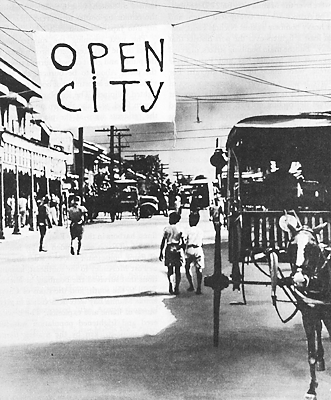
Open city

Encyclopedia
War
War is a state of organized, armed, and often prolonged conflict carried on between states, nations, or other parties typified by extreme aggression, social disruption, and usually high mortality. War should be understood as an actual, intentional and widespread armed conflict between political...
, in the event of the imminent capture of a city
City
A city is a relatively large and permanent settlement. Although there is no agreement on how a city is distinguished from a town within general English language meanings, many cities have a particular administrative, legal, or historical status based on local law.For example, in the U.S...
, the government
Government
Government refers to the legislators, administrators, and arbitrators in the administrative bureaucracy who control a state at a given time, and to the system of government by which they are organized...
/military
Military
A military is an organization authorized by its greater society to use lethal force, usually including use of weapons, in defending its country by combating actual or perceived threats. The military may have additional functions of use to its greater society, such as advancing a political agenda e.g...
structure of the nation
Nation
A nation may refer to a community of people who share a common language, culture, ethnicity, descent, and/or history. In this definition, a nation has no physical borders. However, it can also refer to people who share a common territory and government irrespective of their ethnic make-up...
that controls the city will sometimes declare it an open city, thus announcing that they have abandoned all defensive efforts.
The attacking armies
Army
An army An army An army (from Latin arma "arms, weapons" via Old French armée, "armed" (feminine), in the broadest sense, is the land-based military of a nation or state. It may also include other branches of the military such as the air force via means of aviation corps...
of the opposing military will then be expected not to bomb
Aerial bombing of cities
A species of strategic bombing, the aerial bombing of cities began in 1915 during World War I, grew to a vast scale in World War II, and continues to the present day. The development of aerial bombardment marked an increased capacity of armed forces to deliver explosive weapons in populated areas...
or otherwise attack the city, but simply to march in. The concept aims at protecting the historic landmarks and civilian
Civilian
A civilian under international humanitarian law is a person who is not a member of his or her country's armed forces or other militia. Civilians are distinct from combatants. They are afforded a degree of legal protection from the effects of war and military occupation...
s who dwell in the city from an unnecessary battle.
Several cities were declared open during World War II
World War II
World War II, or the Second World War , was a global conflict lasting from 1939 to 1945, involving most of the world's nations—including all of the great powers—eventually forming two opposing military alliances: the Allies and the Axis...
:
- BrusselsBrusselsBrussels , officially the Brussels Region or Brussels-Capital Region , is the capital of Belgium and the de facto capital of the European Union...
in 1940 - ParisParisParis is the capital and largest city in France, situated on the river Seine, in northern France, at the heart of the Île-de-France region...
in 1940, from which the French GovernmentGovernment of FranceThe government of the French Republic is a semi-presidential system determined by the French Constitution of the fifth Republic. The nation declares itself to be an "indivisible, secular, democratic, and social Republic"...
fled after it became apparent that they could not defend it - BelgradeBelgradeBelgrade is the capital and largest city of Serbia. It is located at the confluence of the Sava and Danube rivers, where the Pannonian Plain meets the Balkans. According to official results of Census 2011, the city has a population of 1,639,121. It is one of the 15 largest cities in Europe...
in April 1941 - ManilaManilaManila is the capital of the Philippines. It is one of the sixteen cities forming Metro Manila.Manila is located on the eastern shores of Manila Bay and is bordered by Navotas and Caloocan to the north, Quezon City to the northeast, San Juan and Mandaluyong to the east, Makati on the southeast,...
in 1942, which the American militaryMilitary of the United StatesThe United States Armed Forces are the military forces of the United States. They consist of the Army, Navy, Marine Corps, Air Force, and Coast Guard.The United States has a strong tradition of civilian control of the military...
abandoned because they could not defend it against the surprise Japanese invasion - RomeRomeRome is the capital of Italy and the country's largest and most populated city and comune, with over 2.7 million residents in . The city is located in the central-western portion of the Italian Peninsula, on the Tiber River within the Lazio region of Italy.Rome's history spans two and a half...
on 14 August 1943, which the defending Italian forces declared unilaterally to be an "open city" following the cessation of Allied bombingBombing of Rome in World War IIThe bombing of Rome in World War II took place on several occasions in 1943 and 1944, primarily by Allied and to a smaller degree by Axis aircraft, before the city was freed from Axis occupation by the Allies on June 4, 1944...
. This applied when under attack by the Germans; subsequently Allied forces entered Rome in June 1944 and retreating German forces also declared FlorenceFlorenceFlorence is the capital city of the Italian region of Tuscany and of the province of Florence. It is the most populous city in Tuscany, with approximately 370,000 inhabitants, expanding to over 1.5 million in the metropolitan area....
and ChietiChietiChieti is a city and comune in Central Italy, 200 km northeast of Rome. It is the capital of the Province of Chieti in the Abruzzo region...
"open cities". - AthensAthensAthens , is the capital and largest city of Greece. Athens dominates the Attica region and is one of the world's oldest cities, as its recorded history spans around 3,400 years. Classical Athens was a powerful city-state...
on 11 October 1944 was declared an open city by the Germans.
Attacking forces do not always respect the declaration of an "open city." Defensive forces will use it as a political tactic as well.
See also
- Laws of warLaws of warThe law of war is a body of law concerning acceptable justifications to engage in war and the limits to acceptable wartime conduct...
- Rome, Open CityRome, open cityRome, Open City is a 1945 Italian war drama film, directed by Roberto Rossellini. The picture features Aldo Fabrizi, Anna Magnani and Marcello Pagliero, and is set in Rome during the Nazi occupation in 1944...
(Roma città aperta), an Italian film (1945) about Rome's days as an open city.