
All Topics  
Counter-Reformation

 
Counter Reformation

   Email Print
   Bookmark   Link


Counter-Reformation


The Counter-Reformation (also Catholic Reformation or Catholic Revival) denotes the period of Catholic
Roman Catholic Church

The Roman Catholic Church, officially known as the Catholic Church is the world's largest Christianity Ecclesia , representing over half of all Christians and one-sixth of the world population....
 revival from the pontificate of Pope Pius IV
Pope Pius IV

Pope Pius IV , born Giovanni Angelo Medici, was Pope from 1559 to 1565. He is notable for presiding over the culmination of the Council of Trent....
 in 1560 to the close of the Thirty Years' War
Thirty Years' War

The Thirty Years' War was one of the most destructive conflicts in European history. The war was fought primarily in Germany and at various points involved most of the countries of Europe....
, 1648.

The Catholic Reformation was a comprehensive effort, composed of five major elements:
  1. Doctrine
  2. Ecclesiastical or structural reconfiguration
  3. Religious orders
  4. Spiritual movements
  5. Political dimensions


Such reforms included the foundation of seminaries for the proper training of priests in the spiritual life and the theological traditions of the Church, the reform of religious life by returning orders to their spiritual foundations, and new spiritual movements focusing on the devotional life and a personal relationship with Christ
Christ

Christ is the English language term for the Greek meaning "the anointing", which is a title given to the Reigning Messiah in the given age of the Zodiac....
, including the Spanish mystics
Spanish mystics

The Spanish Mystics are major figures in the Catholic Reformation of 16th and 17th century Spain. The goal of this movement was to reform the Church structurally and to renew it spiritually....
 and the French school of spirituality
French school of spirituality

The French School of Spirituality was the principal devotional influence within the Roman Catholic Church from the mid 17th Century through the mid 20th Century not only in France but throughout the church in most of the world....
.

two terms highlight different aspects of the movement.


Discussion
Ask a question about 'Counter-Reformation'
Start a new discussion about 'Counter-Reformation'
Answer questions from other users
Full Discussion Forum


Encyclopedia


The Counter-Reformation (also Catholic Reformation or Catholic Revival) denotes the period of Catholic
Roman Catholic Church

The Roman Catholic Church, officially known as the Catholic Church is the world's largest Christianity Ecclesia , representing over half of all Christians and one-sixth of the world population....
 revival from the pontificate of Pope Pius IV
Pope Pius IV

Pope Pius IV , born Giovanni Angelo Medici, was Pope from 1559 to 1565. He is notable for presiding over the culmination of the Council of Trent....
 in 1560 to the close of the Thirty Years' War
Thirty Years' War

The Thirty Years' War was one of the most destructive conflicts in European history. The war was fought primarily in Germany and at various points involved most of the countries of Europe....
, 1648.

The Catholic Reformation was a comprehensive effort, composed of five major elements:
  1. Doctrine
  2. Ecclesiastical or structural reconfiguration
  3. Religious orders
  4. Spiritual movements
  5. Political dimensions


Such reforms included the foundation of seminaries for the proper training of priests in the spiritual life and the theological traditions of the Church, the reform of religious life by returning orders to their spiritual foundations, and new spiritual movements focusing on the devotional life and a personal relationship with Christ
Christ

Christ is the English language term for the Greek meaning "the anointing", which is a title given to the Reigning Messiah in the given age of the Zodiac....
, including the Spanish mystics
Spanish mystics

The Spanish Mystics are major figures in the Catholic Reformation of 16th and 17th century Spain. The goal of this movement was to reform the Church structurally and to renew it spiritually....
 and the French school of spirituality
French school of spirituality

The French School of Spirituality was the principal devotional influence within the Roman Catholic Church from the mid 17th Century through the mid 20th Century not only in France but throughout the church in most of the world....
.

Name

The two terms highlight different aspects of the movement. The term Counter-Reformation, used primarily by non-Catholics, emphasizes the view that these reforms were prompted largely by the rise of Protestants
Protestant Reformation

The Protestant Reformation was a Christian reform movement in Europe. It is thought to have begun in 1517 with Martin Luther's Ninety-Five Theses and may be considered to have ended with the Peace of Westphalia in 1648....
 and the threat they posed to Catholic institutions. In this view, the reforms were aimed primarily at reducing the loss of the faithful to Protestantism. In contrast, the term "Catholic Reformation" identifies it as an action of the Church, not a reaction to Protestant Reformers.

Scholars such as John C. Olin, late of Fordham University
Fordham University

'Fordham University' is a private university university in the United States, with three campuses located in and around New York City. It was founded by the Roman Catholic Archdiocese of New York in 1841 as St....
, and Henri-Daniel Rops, began using the term "Catholic Reformation" in the last half of the 20th century to emphasize the attempts at reform, theological and disciplinary, within the Roman Catholic Church that began before the traditional date of the launch of the Protestant Reformation
Protestant Reformation

The Protestant Reformation was a Christian reform movement in Europe. It is thought to have begun in 1517 with Martin Luther's Ninety-Five Theses and may be considered to have ended with the Peace of Westphalia in 1648....
 by Martin Luther
Martin Luther

Martin Luther was a Germans monk, theology, university professor, priest, father of Protestantism, and Protestant Reformers whose ideas started the Protestant Reformation and changed the course of Western culture....
 or before the Council of Trent
Council of Trent

The Council of Trent was the 16th century Ecumenical Council of the Roman Catholic Church. Considered one of the Church's most important councils, it convened in Trento between December 13, 1545, and December 4, 1563 in twenty-five sessions for three periods....
 (events such as the Fifth Lateran Council, the sermons on reform delivered by John Colet
John Colet

John Colet was an England churchman and educational pioneer.Colet was an English scholar, Renaissance humanist, theologian, and Dean of St....
 in England, the publication of Consilium de Emendanda Ecclesia
Consilium de Emendanda Ecclesia

The Consilium de Emendanda Ecclesia was a report commissioned by Pope Paul III on the abuses in the Catholic Church in 1536.The commission appointed to review the abuses in the church was presided over by Gasparo Contarini and consisted of eight additional cardinal : Girolamo Aleandro, Tommaso Badia, Giovanni Pietro Carafa , Gregorio Cortes...
 by Gasparo Contarini
Gasparo Contarini

Gasparo Contarini was an Italy diplomat and cardinal ....
, the founding of the Oratory of Divine Love, and so on), and to point out that many of Trent's reforms and the work of such reformers as St. Philip Neri
Philip Neri

Philip Romolo Neri , was an Italy priest, noted for founding a society of secular priests called the "Congregation of the Oratory"....
, St. Ignatius of Loyola
Ignatius of Loyola

Saint Ignatius of Loyola was the principal founder and first Superior General of the Society of Jesus.The compiler of the Spiritual Exercises of Ignatius of Loyola, Ignatius was described by Pope Benedict XVI as being above all a man of God, who gave the first place of his life to God, and a man of profound prayer....
 and St. Teresa of Avila
Teresa of Ávila

Saint Teresa of ?vila, also called Saint Teresa of Jesus, baptized as Teresa de Cepeda y Ahumada, was a prominent Spanish mystics, Carmelites nun, and writer of the Counter Reformation....
, while influenced by the response to the Protestants, were far wider and more comprehensive than a mere response to the challenge of growing Protestantism. They argue that much of this was about suppressing abuses and corruption within the Roman Catholic Church for the sake of its own virtue, and that the reforms included more than just stamping out Protestant "heresy."

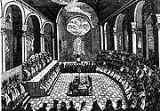
The Council of Trent

Council Trent
Pope Paul III
Pope Paul III

Pope Paul III , born Alessandro Farnese, was Pope of the Roman Catholic Church from 1534 to his death in 1549. He also called the Council of Trent in 1545....
 (1534-1549) initiated the Council of Trent (1545-1563), a commission of cardinals tasked with institutional reform, addressing contentious issues such as corrupt bishops and priests, indulgences, and other financial abuses. The Council clearly rejected specific Protestant positions and upheld the basic structure of the Medieval Church, its sacramental system, religious orders, and doctrine. It rejected all compromise with the Protestants, restating basic tenets of the Catholic faith. The Council clearly upheld salvation appropriated by grace through faith and works (not just by faith, as the Protestants insisted). Transubstantiation
Transubstantiation

In Roman Catholic theology, transubstantiation is the change of the Substance theory of Host and Sacramental wine into the Body of Christ and Blood of Christ occurring in the Eucharist while all that is accessible to the senses remain as before....
, during which the consecrated bread and wine were held to be transformed wholly and substantially into the body, blood, soul and divinity of Christ, was upheld, along with the other six Sacraments. Other practices that drew the ire of Protestant reformers, such as indulgences, pilgrimage
Pilgrimage

File:Supplicating Pilgrim at Masjid Al Haram. Mecca, Saudi Arabia.jpgIn religion and spirituality, a pilgrimage is a long quest or search of great moral significance....
s, the veneration of saints and relics, and the veneration of the Virgin Mary were strongly reaffirmed as spiritually vital. The Council also commissioned the Roman Catechism
Roman Catechism

During the Catholic Reformation, the Council of Trent commissioned the Roman Catechism to expound doctrine and to improve the theological understanding of the clergy....
, which still serves as authoritative Church teaching (the Catechism of the Catholic Church
Catechism of the Catholic Church

The Catechism of the Catholic Church or CCC, is an official exposition of the teachings of the Roman Catholic Church. It was first published in Latin and French in 1992 by the authority of Pope John Paul II....
, issued in 1992, updates modern explications, but does not differ doctrinally).

While the basic structure of the Church was reaffirmed, there were noticeable changes to answer complaints that the Counter Reformers were, tacitly, willing to admit were legitimate. Among the conditions to be corrected by Catholic reformers was the growing divide between the clerics and the laity; many members of the clergy in the rural parishes, after all, had been poorly educated. Often, these rural priests did not know Latin
Latin

Latin is an Italic language, historically spoken in Latium and Ancient Rome. Through the Military history of the Roman Empire, Latin spread throughout the Mediterranean and a large part of Europe....
 and lacked opportunities for proper theological training (addressing the education of priests had been a fundamental focus of the humanist
Humanism

Humanism is a broad category of ethics that affirm the dignity and worth of all people, based on the ability to determine right and wrong by appealing to universal human qualities, particularly rationalism, without resorting to the supernatural or alleged divine authority from religious texts....
 reformers in the past). Parish priests were to be better educated in matters of theology and apologetics, while Papal authorities sought to educate the faithful about the meaning, nature and value of art and liturgy, particularly in monastic churches (Protestants had criticised them as distracting). Notebooks and handbooks became more common, describing how to be good priests and confessors.

Thus, the Council of Trent was dedicated to improving the discipline and administration of the Church. The worldly excesses of the secular Renaissance
Renaissance

The Renaissance was a cultural movement that spanned roughly the 14th to the 17th century, beginning in Italy in the late Middle Ages and later spreading to the rest of Europe....
 church, epitomized by the era of Alexander VI (1492-1503), exploded in the Reformation under Pope Leo X
Pope Leo X

Pope Leo X, born Giovanni de' Medici was Pope from 1513 to his death. He was the last non-priest to be elected Pope. He is known primarily for the sale of indulgences to reconstruct St....
 (1513-1522), whose campaign to raise funds in the German states to rebuild St. Peter's Basilica
St. Peter's Basilica

The Basilica of Saint Peter , officially known in Italian language as the Basilica di San Pietro in Vaticano and commonly known as St. Peter's Basilica, is located within the Vatican City....
 by supporting use of indulgences was a key impetus for Martin Luther
Martin Luther

Martin Luther was a Germans monk, theology, university professor, priest, father of Protestantism, and Protestant Reformers whose ideas started the Protestant Reformation and changed the course of Western culture....
's 95 Theses. But the Catholic Church would respond to these problems by a vigorous campaign of reform, inspired by earlier Catholic reform movements that predated the Council of Constance
Council of Constance

In the Roman Catholic Church, the Council of Constance is the 16th ecumenical council. It was held from 1414 to 1418. The council resolved the Western Schism, in which three men simultaneously claimed to be pope....
 (1414-1417): humanism, devotionalism, legalist and the observantine tradition.

The Council, by virtue of its actions, repudiated the pluralism of the Secular Renaissance Church: the organization of religious institutions was tightened, discipline was improved, and the parish was emphasized. The appointment of Bishops for political reasons was no longer tolerated. In the past, the large landholdings forced many bishops to be "absent bishops" who at times were property managers trained in administration. Thus, the Council of Trent combated "absenteeism," which was the practice of bishops living in Rome or on landed estates rather than in their dioceses. The Council of Trent also gave bishops greater power to supervise all aspects of religious life. Zealous prelates such as Milan
Milan

Milan is the second largest city of Italy, located in the plains of Lombardy. It is the capital in the Province of Milan, as well as the Regions of Italy capital of Lombardy....
's Archbishop Carlo Borromeo (1538-1584), later canonized as a saint, set an example by visiting the remotest parishes and instilling high standards. At the parish level, the seminary-trained clergy who took over in most places during the course of the seventeenth century were overwhelmingly faithful to the church's rule of celibacy
Celibacy

Celibacy is a state of being intentionally unmarried and abstaining from sexual intercourse. A vow of celibacy taken by monks and nuns signifies the promise to refrain from all sexual activity for the purpose of spiritual advancement....
.

The orders

New religious orders were a fundamental part of this trend. Orders such as the Capuchin
Order of Friars Minor Capuchin

File:Rapperswil - Kapuzinerkloster.jpgThe Order of Friars Minor Capuchin is an order of friars in the Catholic Church, among the chief offshoots of the Franciscans....
s, Ursulines
Ursulines

The Ursulines are a Roman Catholic Church religious order founded at Brescia, Italy, by Angela Merici in November 1535, primarily for the education of girls and the care of the sick and needy....
, Theatines
Theatines

The Theatines or the Congregation of Clerks Regular of the Divine Providence are a male religious order of the Catholic Church, with the post-nominal initials "C.R."...
, Discalced Carmelites
Discalced Carmelites

The Discalced Carmelites, or Barefoot Carmelites, is a Catholic Church mendicant order with roots in the hermit of the Desert Fathers. The order was established in 1593, pursuant to the reform of the Carmelites by two Spain saints, St....
, the Barnabites
Barnabites

The Barnabites, or Clerics Regular of Saint Paul is a Roman Catholic religious order....
, and especially the Jesuits
Society of Jesus

The Society of Jesus is a Roman Catholic religious order of clerks regular whose members are called Jesuits, Soldiers of Jesus Christ, and Foot soldiers of the Pope, because the founder, Saint Ignatius of Loyola, was a knight before becoming a Holy Orders....
 strengthened rural parishes, improved popular piety, helped to curb corruption within the church, and set examples that would be a strong impetus for Catholic renewal.

The Theatines were an order of devoted priests who undertook to check the spread of heresy and contribute to a regeneration of the clergy. The Capuchins, an offshoot of the Franciscan
Franciscan

The term Franciscan is commonly used to refer to members of Catholic religious orders that follow a body of regulations known as "The rule of St....
 order notable for their preaching and for their care for the poor and the sick, grew rapidly in both size and popularity. The Capuchin fathers were an order based on the imitation of Jesus' life as described by the Gospel
Gospel

In Christianity, a gospel is generally one of the first four books of the New Testament that describe the birth, life, ministry, crucifixion, and resurrection of Jesus....
s. Capuchin-founded confraternities thus took special interest in the poor and lived austere lifestyles.

These differing approaches were often complementary, as with the missions to rural areas poorly served by the existing parish structure. Members of orders active in overseas missionary expansionism expressed the view that the rural parishes, whose poor state of affairs contributed to the growth of Protestantism, often needed Christianizing as much as heathens of Asia and the Americas.

The Ursulines focused on the special task of educating girls. Their devotion to the traditional works of mercy exemplifies the Catholic Reformations reaffirmation of salvation through faith and works, and firmly repudiated the sola scriptura
Sola scriptura

Sola scriptura is the doctrine that the Bible is the only Biblical inerrancy authority for Christian faith, and that it contains all knowledge necessary for salvation and holiness....
 of the Protestants emphasized by Lutherans and other Protestant sects. Not only did they make the Church more effective, they reaffirmed fundamental premises of the Medieval Church.

However, the Jesuits, founded by the Spanish nobleman and ex-soldier Ignatius of Loyola
Ignatius of Loyola

Saint Ignatius of Loyola was the principal founder and first Superior General of the Society of Jesus.The compiler of the Spiritual Exercises of Ignatius of Loyola, Ignatius was described by Pope Benedict XVI as being above all a man of God, who gave the first place of his life to God, and a man of profound prayer....
 (1491-1556), were the most effective of the new Catholic orders. His Societas de Jesus was founded in 1534 and received papal authorization in 1540 under Paul III. An heir to the devotional, observantine, and legalist traditions, the Jesuits organized their order along military lines, they strongly reflected the autocratic zeal of the period. Characterized by careful selection, rigorous training, and iron discipline, the worldliness of the Renaissance Church had no part in the new order.

Loyola's masterwork Spiritual Exercises
Spiritual Exercises of Ignatius of Loyola

The Spiritual Exercises of Ignatius of Loyola, are a brief set of meditations, prayers and mental exercises, available in various book formats, designed to be carried out over a period of 28 to 30 days....
 reflected the emphasis of handbooks characteristic of the earlier generation of Catholic reformers before the Reformation
Protestant Reformation

The Protestant Reformation was a Christian reform movement in Europe. It is thought to have begun in 1517 with Martin Luther's Ninety-Five Theses and may be considered to have ended with the Peace of Westphalia in 1648....
. The great psychological penetration that it conveyed was strongly reminiscent of devotionalism. However, the Jesuits are really the heirs to the observantine reform tradition, taking strong monastic vows of chastity, obedience, and poverty and setting an example that improved the effectiveness of the entire Church. They became preachers, confessors to monarchs and princes, and educators reminiscent of the humanist reformers, and their efforts are largely credited with stemming Protestantism in Poland
Poland

Poland , officially the Republic of Poland , is a country in Central Europe. Poland is bordered by Germany to the west; the Czech Republic and Slovakia to the south; Ukraine, Belarus and Lithuania to the east; and the Baltic Sea and Kaliningrad Oblast, a Russian Enclave and exclave, to the north....
, Bohemia
Bohemia

History...
, Hungary
Hungary

Hungary , officially in English the Republic of Hungary , is a landlocked country in the Carpathian Basin of Central Europe, bordered by Austria, Slovakia, Ukraine, Romania, Serbia, Croatia, and Slovenia....
, southern Germany
Germany

Germany , officially the Federal Republic of Germany , is a country in Central Europe. It is bordered to the north by the North Sea, Denmark, and the Baltic Sea; to the east by Poland and the Czech Republic; to the south by Austria and Switzerland; and to the west by France, Luxembourg, Belgium, and the Netherlands....
, France
France

France , officially the French Republic , is a country whose Metropolitan France is located in Western Europe and that also comprises various Overseas departments and territories of France....
, and the Spanish Netherlands
Netherlands

The Netherlands is a country that is part of the Kingdom of the Netherlands. It is a parliamentary democratic constitutional monarchy. The Netherlands is located in North-West Europe, and bordered by the North Sea to the north and west, Belgium to the south, and Germany to the east....
.

They also strongly participated in the expansion of the Church in the Americas and Asia, conducting efforts in missionary activity that far outpaced even the aggressive Protestantism of the Calvinists. Even Loyola's biography contributed to the new emphasis on popular piety that had been waning under the eras of politically oriented popes such as Alexander VI
Pope Alexander VI

Pope Alexander VI , born Roderic Llan?ol, later Roderic de Borja i Borja was Pope from 1492 to 1503. He is the most controversial of the Secularism popes of the Renaissance, and his surname became a byword for the debased standards of the papacy of that era....
 and Leo X
Pope Leo X

Pope Leo X, born Giovanni de' Medici was Pope from 1513 to his death. He was the last non-priest to be elected Pope. He is known primarily for the sale of indulgences to reconstruct St....
. After recovering from a severe battle wound, he took a vow to "serve only God and the Roman pontiff, His vicar on earth." Once again, the emphasis on the Pope is a key reaffirmation of the Medieval Church as the Council of Trent firmly defeated all attempts of Conciliarism
Conciliarism

Conciliarism, or the conciliar movement, was a reform movement in the 14th and 15th century Roman Catholic Church which held that final authority in spiritual matters resided with the Roman Church as corporation of Christians, embodied by a Ecumenical council, not with the pope....
, the belief that general councils of the church collectively were God's representative on earth, rather than the Pope. Firmly legitimizing the new role of the Pope as an absolute ruler strongly characteristic of the new age of absolutism ushered in by the sixteenth century, the Jesuits strongly contributed to the reinvigoration of the Counter-Reformation Church.

Spiritual movements


the Battle of Lepanto By Paolo Veronese
The Catholic Reformation was not only a political and Church policy oriented movement, it included major figures such as Ignatius of Loyola
Ignatius of Loyola

Saint Ignatius of Loyola was the principal founder and first Superior General of the Society of Jesus.The compiler of the Spiritual Exercises of Ignatius of Loyola, Ignatius was described by Pope Benedict XVI as being above all a man of God, who gave the first place of his life to God, and a man of profound prayer....
, Teresa of Avila
Teresa of Ávila

Saint Teresa of ?vila, also called Saint Teresa of Jesus, baptized as Teresa de Cepeda y Ahumada, was a prominent Spanish mystics, Carmelites nun, and writer of the Counter Reformation....
, John of the Cross
John of the Cross

Saint John of the Cross , born Juan de Yepes Alvarez, was a major figure of the Counter-Reformation, a Spanish mystics, and Carmelites friar and Priesthood , born at Fontiveros, a small village near ?vila....
, Francis de Sales
Francis de Sales

Saint Francis de Sales was Bishop of Geneva and a Roman Catholic saint. He worked to convert Protestants back to Catholicism, and was an accomplished preacher....
 and Filippo Neri, who added to the spirituality
Spirituality

Spirituality, in a narrow sense, concerns itself with matters of the spirit, a concept closely tied to religion and faith, transcendence , or one or more Deity....
 of the Catholic Church. Teresa of Avila and John of the Cross were Spanish mystics and reformers of the Carmelite Order whose ministry focused on interior conversion
Interior life (Catholic theology)

Interior life is a life which seeks God in everything, a life of prayer and the practice of living in the presence of God. It connotes intimate, friendly conversation with Him, and a determined focus on internal prayer versus external actions, while these latter are transformed into means of prayer....
 to Christ, the deepening of prayer and commitment to God's will. Teresa was given the task to develop and write about the way to perfection in her love and unity with Christ. Her publications especially her autobiography The Life of Theresa of Jesus had multiple effects not only on Religious. It is to be placed besides the Confessions of Augustine. Thomas Merton
Thomas Merton

Thomas Merton was a 20th century Roman Catholic Church writer. A Trappist monk of the Abbey of Gethsemani, in the U.S. state of Kentucky, Merton was a poet, a social activism, a student of comparative religion as well as the author of numerous works on spirituality....
 called John of the Cross the greatest of all mystical theologians. Ignatius of Loyola and Francis de Sales choose an active spirituality, that is an exact opposite of Teresa and John of the Cross. "To see God in all things" was a typical expression of Ignatius and a main theme of his Spiritual Excercises
Spiritual Exercises of Ignatius of Loyola

The Spiritual Exercises of Ignatius of Loyola, are a brief set of meditations, prayers and mental exercises, available in various book formats, designed to be carried out over a period of 28 to 30 days....
. The spirituality of Filippo Neri, who lived in Rome at the same time as Ignatius, was practically-oriented too, but totally opposed to the Jesuit approach. Said Filippo, "If I have a real problem, I contemplate what Ignatius would do ... and then I do the exact opposite". As a regognition of their joint contribution to the spiritual renewal within the Catholic reformation, Ignatius of Loyola
Ignatius of Loyola

Saint Ignatius of Loyola was the principal founder and first Superior General of the Society of Jesus.The compiler of the Spiritual Exercises of Ignatius of Loyola, Ignatius was described by Pope Benedict XVI as being above all a man of God, who gave the first place of his life to God, and a man of profound prayer....
, Filippo Neri and Teresa of Avila
Teresa of Ávila

Saint Teresa of ?vila, also called Saint Teresa of Jesus, baptized as Teresa de Cepeda y Ahumada, was a prominent Spanish mystics, Carmelites nun, and writer of the Counter Reformation....
 were canonized
Canonization

Canonization is the act by which a particular Christian church declares a deceased person to be a saint and is included in the canon, or list, of recognized saints....
 on the same day, March 12, 1622.

During the Protestant Reformation
Protestant Reformation

The Protestant Reformation was a Christian reform movement in Europe. It is thought to have begun in 1517 with Martin Luther's Ninety-Five Theses and may be considered to have ended with the Peace of Westphalia in 1648....
, the Catholic Church defended its Marian spirituality against what were considered Protestant heresies, while fighting the Ottoman Wars in Europe
Ottoman wars in Europe

The wars of the Ottoman Empire in Europe are also sometimes referred to as the Ottoman Wars or as Turkish Wars, particularly in older, European texts....
 against Turkey
Turkey

Turkey , known officially as the Republic of Turkey , is a Eurasian country that stretches across the Anatolian peninsula in southwest Asia and Thrace in the Balkans region of Southern Europe....
 which were fought and won under the auspices of the Virgin Mary. The victory at the Battle of Lepanto
Battle of Lepanto (1571)

The Battle of Lepanto took place on 7 October 1571 when a galley fleet of the Holy League , a coalition of the Republic of Venice, the Pope , Spain , the Republic of Genoa, the Duchy of Savoy, the Knights Hospitaller and others, decisively defeated the main fleet of Ottoman Empire war galleys....
 in 1571 was accredited to her "and signified the beginning of a strong resurgence of Marian devotions". During and after the Catholic Reformation, Marian piety experienced unforeseen growth with over 500 pages of mariological writings during the 17th century alone. The Jesuit Francis Suarez was the first theologian to use the Thomist method on Marian theology. Other well known contributors to Marian spirituality are Lawrence of Brindisi
Lawrence of Brindisi

Saint Lawrence of Brindisi , born Giulio Cesare Russo, was a Roman Catholic priest and a member of the Order of Friars Minor Capuchin....
, Robert Bellarmine
Robert Bellarmine

Robert Bellarmine was an Italian Jesuit and a Cardinal of the Roman Catholic Church. He participated in the Catholic Church's proceedings against Giordano Bruno and Galileo Galilei ....
, and Francis of Sales.

Decrees on art

Michelangelo   Fresco of the Last Judgement
Italian painting after 1520, with the notable exception of the art of Venice
Venice

Venice is a city in northern Italy, the capital city of the Italian regions Veneto, a population of 271,251 . Together with Padua, Italy, the city is included in the Padua-Venice Metropolitan Area ....
, developed into Mannerism
Mannerism

Mannerism is a Art periods of European art which emerged from the later years of the Italian High Renaissance around 1520. It lasted until about 1580 in Italy, when a more Baroque style began to replace it, but continued into the seventeenth century throughout much of Europe....
, a highly sophisticated style, striving for effect, that concerned many churchmen as lacking appeal for the mass of the population. Church pressure to restrain religious imagery affected art from the 1530s and resulted in the decrees of the final session of the Council of Trent in 1563 including short and rather inexplicit passages concerning religious images, which were to have great impact on the development of Catholic art. Previous Catholic councils had rarely felt the need to pronounce on these matters, unlike Orthodox ones which have often ruled on specific types of images.

The decree confirmed the traditional doctrine that images only represented the person depicted, and that veneration to them was paid to the person themself, not the image, and further instructed that:

Ten years after the decree Paolo Veronese
Paolo Veronese

Paolo Veronese was an Italian painter of the Renaissance in Venice, famous for paintings such as The Wedding at Cana and The Feast in the House of Levi....
 was summoned by the Inquisition
Inquisition

The term Inquisition can refer to any one of several institutions charged with trying and convicting Christian heresy within the Roman Catholic Church....
 to explain why his Last Supper, a huge canvas for the refectory
Refectory

File:Convento Cristo December 2008-6a.jpgA refectory is a dining room, especially in monastery, boarding schools and academic institutions. One of the places it is most often used today is in graduate seminary....
 of a monastery, contained, in the words of the Inquisition: "buffoons, drunken Germans, dwarfs and other such scurrilities" as well as extravagant costumes and settings, in what is indeed a fantasy version of a Venetian patrician feast. Veronese was told that he must change his painting within a three month period - in fact he just changed the title to The Feast in the House of Levi
The Feast in the House of Levi

The Feast in the House of Levi is a 1573 painting by Italian painter Paolo Veronese and one of the largest canvases of the 16th century measuring 555 x 1280 cm....
, still an episode from the Gospels, but a less doctrinally central one, and no more was said. But the number of such decorative treatments of religious subjects declined sharply, as did "unbecomingly or confusedly arranged" Mannerist pieces, as a number of books, notably by the Flemish theologian Molanus
Molanus

Jan Vermeulen or Jan van der Meulen, also known as Molanus was an influential Counter Reformation Flemish Catholic theologian of Catholic University of Leuven, where he was Professor of Theology, and Rector from 1578....
, Saint Charles Borromeo
Charles Borromeo

Saint Charles Borromeo is an Italy saint and was a Cardinal of the Roman Catholic Church. He worked during the period of the Counter-Reformation and was responsible for significant reforms in the Catholic Church, including the founding of seminaries for the education of priests....
 and Cardinal Gabriele Paleotti
Gabriele Paleotti

Gabriele Paleotti was an Italian Cardinal and Archbishop of Bologna....
, and instructions by local bishops, amplified the decrees, often going into minute detail on what was acceptable. Many traditional iconographies
Iconography

Iconography is the branch of art history which studies the identification, description, and the interpretation of the content of images. The word iconography literally means "image writing", and comes from the Ancient Greek e???? and ??afe?? ....
 considered without adequate scriptural foundation were in effect prohibited, as was any inclusion of classical pagan elements in religious art, and almost all nudity, including that of the infant Jesus. According to the great medievalist Émile Mâle
Émile Mâle

?mile M?le was a French art historian, one of the first to study medieval, mostly sacral French art and the influence of eastern European iconography thereon....
, this was "the death of medieval art".

Church and its music

The demand by the Council of Trent for simplicity in music in order that the words might be heard clearly placed a serious stumbling block in the path of the development of polyphony
Polyphony

In music, polyphony is a texture consisting of two or more independent melodic voice , as opposed to music with just one voice or music with one dominant melodic voice accompanied by chord s ....
 in the mid-16th century.

The Council, in their Canon on Music to be used for the Mass, stated:

While this was worded fairly vaguely, the intent was clear. Complex polyphony
Polyphony

In music, polyphony is a texture consisting of two or more independent melodic voice , as opposed to music with just one voice or music with one dominant melodic voice accompanied by chord s ....
 was no longer deemed acceptable by the Council.

Palestrina
Giovanni Pierluigi da Palestrina

Giovanni Pierluigi da Palestrina was an Italy composer of the Renaissance music. He was the most famous sixteenth-century representative of the Roman School of musical composition....
's musical mastery and his skill at word setting greatly affected the outcome of this difficult situation. By composing a six-part polyphonic mass, called the Missa Papae Marcelli
Missa Papae Marcelli

Missa Papae Marcelli, or Pope Marcellus Mass, is a mass by Giovanni Pierluigi da Palestrina. It is his most well-known and most often-performed mass, and is frequently taught in university courses on music....
 (Pope Marcellus Mass), of 1555, Palestrina demonstrated that polyphony was compatible with the mandates of the Counter-Reformation. Using an economy of notes, the mass setting conveys its words with surprising clarity. This represented a marked shift from the composer's earlier compositions, which often paired a single syllable with long strings of notes, called melisma
Melisma

Melisma, in music, is the singing of a single syllable of text while moving between several different notes in succession. Music sung in this style is referred to as melismatic, as opposed to syllabic, where each syllable of text is matched to a single note....
s, which obscured the text. The new, tighter style (which did occasionally resort to homophony) was both shorter and more comprehensible to the worshipper. The Pope Marcellus Mass was believed since the late 16th century to have been instrumental in preventing the abolition of polyphony. Recent scholarship, however, shows that this mass was composed before the cardinals convened to discuss the ban (possibly as much as ten years before). The mass was not, therefore, solely responsible for "saving" Catholic church music, as is sometimes claimed. Still, Palestrina's music would become the model for future generations of Catholic composers, and it continues to be held as an exemplar for polyphonic clarity.

Like Palestrina, the Flemish composer Jacobus de Kerle
Jacobus de Kerle

Jacobus de Kerle was a Flanders composer and organist of the late Renaissance music....
 (1531/32-1591) also demonstrated to Council delegates that polyphony was capable of projecting the words in a coherent manner. It is quite possible that Kerle, not Palestrina, should be credited as the first "savior" of polyphony. Another composer, Vincenzo Ruffo
Vincenzo Ruffo

Vincenzo Ruffo was an Italy composer of the Renaissance music. He was one of the composers most responsive to the musical reforms suggested by the Council of Trent, especially in his composition of mass , and as such was an influential member of the Counter-Reformation....
 (c. 1508-1587), also complied with the reforms of the Council of Trent. Ruffo devoted himself entirely to sacred music in the spirit of the Counter-Reformation. Ruffo, however, took a different approach by dispensing with polyphony in favor of composing chordal, or homophonic, mass settings. Later in life, he apparently grew dissatisfied with homophony and returned to polyphony.

After all of the debate during the third meeting of the Council of Trent, the council's solutions gave composers very little room for artistic expression. Composers such as Palestrina and Lasso would find other ways of expressing their sacred themes during the Counter-Reformation.

The Council of Trent brought about other changes in music: most notably developing the Missa Brevis, Lauda and "Spiritual Madrigal" (Madrigali Spirituali).

The inadvertent start of the scientific revolution

Some historians such as James Burke
James Burke (science historian)

James Burke is a Northern Ireland science historian, author and television producer best known for his documentary film television series called Connections , focusing on the history of science and technology leavened with a sense of humour....
 have noted some of the directives initiated in the Counter-Reformation had consequences that would ironically create even more formidable challenges to the Catholic Church's authority and very world-view. Specifically, efforts to reform the Julian calendar may have led to the Church's confrontation with Galileo.

This came about with the initiative to make the Catholic Church more attractive to the common person. In addition to better training for the clergy, there was also the idea of making the Church's facilities and activities more attractive to the laypeople. Part of this included extensive decorations that would eventually spawn the elaborate baroque
Baroque

In the the arts, the Baroque was a Western cultural Epoch , starting roughly at the beginning of the 17th century in Rome, Italy. It was exemplified by drama and grandeur in Baroque sculpture, Baroque painting, literature, Baroque dance, and Baroque music....
 art style and more celebrations of holidays and similar events. In the end of the Reformation Martian Luther announced, at his death bed, that they were better off under the church.

The need to have these events followed closely throughout the dioceses raised the problem with the accuracy of the calendar
Calendar

A calendar is a system of organize days for a social, religious, commercial or administrative purpose. This organization is done by giving names to periods of time ? typically days, weeks, months and years....
. By the sixteenth century the Julian calendar
Julian calendar

The Julian calendar, a reform of the Roman calendar, was introduced by Julius Caesar in 46 BC, and came into force in 45 BC . It was chosen after consultation with the astronomer Sosigenes of Alexandria and was probably designed to approximate the tropical year, known at least since Hipparchus....
 was almost ten days out of step with the seasons and the heavenly bodies. Among the astronomers who were asked to work on the problem of how the calendar could be reformed was Nicolaus Copernicus
Nicolaus Copernicus

Nicolaus Copernicus was the first astronomer to formulate a scientifically-based heliocentrism cosmology that displaced the Earth from the center of the universe....
, a canon at Frombork
Frombork

Frombork [] is a town in northern Poland, on the Vistula Lagoon, in Braniewo County, Warmian-Masurian Voivodeship. It had a population of 2,528 as of 2005....
 (Frauenburg). In the dedication to De revolutionibus orbium coelestium
De revolutionibus orbium coelestium

De revolutionibus orbium coelestium , first printed in 1543 in Nuremberg, is the seminal work on Copernican heliocentrism and the masterpiece of astronomer Nicolaus Copernicus ....
 (1543), Copernicus mentioned the reform of the calendar proposed by the Fifth Council of the Lateran
Fifth Council of the Lateran

When elected pope, Pope Julius II promised under oath that he would soon convoke a general council. However, as time progressed the promise was not fulfilled....
 (1512-1517). As he explains, a proper measurement of the length of the year was a necessary foundation to calendar reform. By implication, his work replacing the Ptolemaic system
Ptolemaic System

In the Ptolemaic system, each planet is moved by five or more spheres: one sphere is its deferent. The deferent was a circle centered around a point halfway between the equant and the earth....
 with a heliocentric model was prompted in part by the need for calendar reform. An actual new calendar had to wait until the Gregorian calendar
Gregorian calendar

The Gregorian calendar is the internationally accepted civil calendar. It was first proposed by the Calabrian doctor Aloysius Lilius, and decreed by Pope Gregory XIII, after whom it was named, on 24 February 1582 by the papal bull Inter gravissimas....
 in 1582.

At the time of its publication, De revolutionibus passed with relatively little comment in the Catholic Church itself, which treated the conception as little more than a mathematical convenience. However, the fact that the Earth's motion directly contradicted literal readings of the Bible and Aristotle
Aristotle

Aristotle was a Greeks philosopher, a student of Plato and teacher of Alexander the Great. He wrote on many subjects, including physics, metaphysics, Poetics , theater, music, logic, rhetoric, politics, government, ethics, biology and zoology....
's philosophy eventually became an unavoidable issue. This occurred as scientists, most notably Galileo Galilei
Galileo Galilei

Galileo Galilei was a Grand Duchy of Tuscany physicist, mathematician, astronomer, and philosopher who played a major role in the Scientific Revolution....
, Johannes Kepler
Johannes Kepler

Johannes Kepler was a Germans mathematician, astronomer and astrologer, and key figure in the 17th century Scientific revolution. He is best known for his eponymous Kepler's laws of planetary motion, codified by later astronomers based on his works Astronomia nova, Harmonices Mundi, and Epitome of Copernican Astrononomy....
, Edmund Halley, and most importantly Isaac Newton
Isaac Newton

Sir Isaac Newton, Fellow of the Royal Society was an English people physicist, mathematician, Astronomy, Natural philosophy, Alchemy, and Theology and one of the the 100 in human history....
 amassed physical evidence that supports heliocentrism and directly contradicts Ptolemy
Ptolemy

Claudius Ptolemaeus , known in English as Ptolemy , was a Roman Greek mathematics, Greek astronomy, geographer and astrologer. He lived in History of Roman Egypt, and was probably born there in a town in the Thebaid called Ptolemais Hermiou; he died in Alexandria around 168 AD....
, and the Catholic Church teachings of the time on astronomy and Biblical inerrancy
Biblical inerrancy

Biblical inerrancy is the doctrinal position that in its original form, the Bible is totally without error, and free from all contradiction; "referring to the complete accuracy of Scripture, including the historical and scientific parts."...
.

Major figures

  • Pius II (1503)
  • Paul III (1534-1549)
  • Julius III (1550-55)
  • Paul IV (1555-59)
  • Pius IV (1559-65)
  • St. Pius V (1566-72)
  • Gregory XIII (1572-85)
  • Sixtus V (1585-90)
  • St. Ignatius of Loyola
    Ignatius of Loyola

    Saint Ignatius of Loyola was the principal founder and first Superior General of the Society of Jesus.The compiler of the Spiritual Exercises of Ignatius of Loyola, Ignatius was described by Pope Benedict XVI as being above all a man of God, who gave the first place of his life to God, and a man of profound prayer....
  • St. Teresa of Avila
    Teresa of Ávila

    Saint Teresa of ?vila, also called Saint Teresa of Jesus, baptized as Teresa de Cepeda y Ahumada, was a prominent Spanish mystics, Carmelites nun, and writer of the Counter Reformation....
  • St. John of the Cross
    John of the Cross

    Saint John of the Cross , born Juan de Yepes Alvarez, was a major figure of the Counter-Reformation, a Spanish mystics, and Carmelites friar and Priesthood , born at Fontiveros, a small village near ?vila....
  • St. Francis de Sales
    Francis de Sales

    Saint Francis de Sales was Bishop of Geneva and a Roman Catholic saint. He worked to convert Protestants back to Catholicism, and was an accomplished preacher....
  • St. Charles Borromeo
    Charles Borromeo

    Saint Charles Borromeo is an Italy saint and was a Cardinal of the Roman Catholic Church. He worked during the period of the Counter-Reformation and was responsible for significant reforms in the Catholic Church, including the founding of seminaries for the education of priests....
  • Philip II of Spain
    Philip II of Spain

    Philip II was King of Spain from 1556 until 1598, List of monarchs of Naples from 1554 until 1598, king consort of England, as husband of Mary I of England, from 1554 to 1558, lord of the Seventeen Provinces from 1556 until 1581, holding various titles for the individual territories, such as Duke or Count; and King of Portugal as Philip I...
     (1527-1598)
  • Mary I of England
    Mary I of England

    Mary I , was Queen of England and Monarchy of Ireland from 19 July 1553 until her death. The fourth crowned monarch of the Tudor dynasty, she is remembered for restoring England to Roman Catholicism after succeeding her short-lived half brother, Edward VI of England, to the English throne....
      (1553-1558)
  • Sigismund the Old of Poland (1467-1548)
  • Sigismund II Augustus of Poland (1520-1572)


See also

  • Philip II of Spain
    Philip II of Spain

    Philip II was King of Spain from 1556 until 1598, List of monarchs of Naples from 1554 until 1598, king consort of England, as husband of Mary I of England, from 1554 to 1558, lord of the Seventeen Provinces from 1556 until 1581, holding various titles for the individual territories, such as Duke or Count; and King of Portugal as Philip I...
     (for more on the political side of the Counter-Reformation)
  • Spanish Inquisition
    Spanish Inquisition

    The Spanish Inquisition was an ecclesiastical tribunal established in 1478 by Catholic Monarchs Ferdinand II of Aragon and Isabella I of Castile....
  • Corpus Catholicorum (series)
    Corpus Catholicorum (series)

    The Corpus Catholicorum is a collection of sixteenth century writings by the leading proponents and defenders of the Roman Catholic Church against the teachings of the Protestant reformers....
  • The Reformation and art
    The Reformation and art

    The Protestant Reformation during the 16th century in Europe, ushered in a new artistic tradition that embraced the Protestant agenda and diverged drastically from the southern European tradition and the humanist art produced during the high Renaissance....