


Cesare Borgia

Encyclopedia
Cesare Borgia Duke of Valentinois
, was an Italian condottiero
, nobleman, politician, and cardinal. He was the son of Pope Alexander VI
and his long-term mistress Vannozza dei Cattanei
. He was the brother of Lucrezia Borgia
; Giovanni Borgia
(Juan), Duke of Gandia
; and Gioffre Borgia
(Jofré in Valencian
), Prince of Squillace. He was half-brother to Don Pedro Luis de Borja (1460–88) and Girolama de Borja, children of unknown mothers.
, about whom information is sparse. The Borgia family originally came from the Kingdom of Valencia
, and rose to prominence during the mid-15th century; Cesare's great-uncle Alonso Borgia (1378–1458), bishop of Valencia, was elected Pope Callixtus III
in 1455. Cesare's father, Pope Alexander VI, was the first pope who was openly recognized to have children with a lover.
Stefano Infessura
writes that Cardinal Borgia falsely claimed Cesare to be the legitimate son of another man—Domenico d'Arignano, the nominal husband of Vannozza de' Cattanei. More likely, Pope Sixtus IV
granted Cesare a release from the necessity of proving his birth in a papal bull
of October 1, 1480.
and Pisa
where Cesare studied law, along with his father's elevation to Pope, Cesare was made Cardinal at the age of 18. Alexander VI staked the hopes of the Borgia family in Cesare's brother Giovanni
, who was made captain general of the military forces of the papacy. Giovanni was assassinated in 1497 in mysterious circumstances: with several contemporaries suggesting that Cesare might be his killer, as Giovanni's disappearing could finally open him a long-awaited military career; as well as jealousy over Sancha of Aragon
, wife of Cesare's other brother Gioffre
, and mistress of both Cesare and Giovanni. Cesare's role in the act, however, has never been clear.
On August 17, 1498, Cesare became the first person in history to resign the cardinalate. On the same day the French King Louis XII named Cesare Duke of Valentinois
, and this title, along with his former position as Cardinal of Valencia, explains the nickname "Valentino".
), in the course of the Italian Wars
. Louis XII invaded Italy in 1499: after Gian Giacomo Trivulzio
had ousted its duke Ludovico Sforza
, Cesare accompanied the king in his entrance in Milan
.
At this point Alexander decided to profit from the favourable situation and carve out for Cesare a state of his own in northern Italy. To this end, he declared that all his vicars in Romagna
and Marche
were deposed. Though in theory subject directly to the pope, these rulers had been practically independent or dependent on other states for generations. From the view of the citizens, these vicars were cruel and petty. When Cesare eventually took power, he was viewed by the citizens as a great improvement.
Cesare was appointed commander of the papal armies with a number of Italian mercenaries, supported by 300 cavalry and 4,000 Swiss infantry sent by the King of France. His first victim was Caterina Sforza
(mother of the Medici condottiero Giovanni dalle Bande Nere
), ruler of Imola
and Forlì
. Despite being deprived of his French troops after the conquest of those two cities, Borgia returned to Rome to celebrate a triumph and to receive the title of Papal Gonfalonier
from his father. In 1500 the creation of twelve new cardinals granted Alexander enough money for Cesare to hire the condottieri, Vitellozzo Vitelli
, Gian Paolo Baglioni
, Giulio
and Paolo Orsini, and Oliverotto da Fermo, who resumed his campaign in Romagna.
Giovanni Sforza
, first husband of Cesare's sister Lucrezia, was soon ousted from Pesaro
; Pandolfo Malatesta
lost Rimini
; Faenza
surrendered, its young lord Astorre III Manfredi
being later drowned in the Tiber river by Cesare's order. In May 1501 the latter was created duke of Romagna. Hired by Florence, Cesare subsequently added the lordship of Piombino
to his new lands.
While his condottieri took over the siege of Piombino (which ended in 1502), Cesare commanded the French troops in the sieges of Naples and Capua
, defended by Prospero
and Fabrizio Colonna
. On June 24, 1501 his troops stormed the latter, causing the collapse of Aragonese power in southern Italy.
In June 1502 he set out for Marche, where he was able to capture Urbino
and Camerino
by treason. The next step would be Bologna
, but his condottieri, most notably Vitellozzo Vitelli and the Orsini brothers, fearing Cesare's cruelty, set up a plot against him. Guidobaldo da Montefeltro
and Giovanni Maria da Varano returned to Urbino and Camerino, and Fossombrone
revolted. The fact that his subjects had enjoyed his rule thus far meant that his opponents had to work much harder than they would have liked. He eventually recalled his loyal generals to Imola, where he waited for his opponents' loose alliance to collapse. Cesare called for a reconciliation, but imprisoned his condottieri in Senigallia
, a feat described as a "wonderful deceiving" by Paolo Giovio
, and had them executed.
cites Cesare's dependence on the good will of the Papacy, under the control of his father, to be the principal weakness of his rule, arguing that, had Cesare been able to win the favor of the new Pope, he would have been a very successful ruler. The news of his father's death (1503) arrived when Cesare was planning the conquest of Tuscany
. While he was convalescing in Castel Sant'Angelo
, his troops controlled the conclave. The new pope, Pius III, arrested him, he then broke out, and the accession of the Borgias' deadly enemy Julius II caused his final ruin.
While moving to Romagna to quell a revolt, he was seized and imprisoned by Gian Paolo Baglioni
near Perugia. All his lands were acquired by the Papal States. Exiled to Spain
in 1504, he was imprisoned in the Castle of La Mota, Medina del Campo
, from which he escaped and joined his brother-in-law, King John III of Navarre
. He was killed in 1507 while fighting for the Navarrese king in the city of Viana, Spain
.
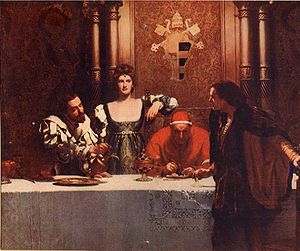 Niccolò Machiavelli
met the Duke on a diplomatic mission in his function as Secretary of the Florentine Chancellery. Machiavelli was at Borgia's court from 7 October 1502 through 18 January 1503. During this time he wrote regular dispatches to his superiors in Florence, many of which have survived and are published in Machiavelli's Collected Works. In The Prince
, Machiavelli uses Borgia as an example to elucidate the dangers of acquiring a principality by virtue of another. Although Cesare Borgia's father gave him the power to set up, Cesare ruled the Romagna with skill and tact for the most part. However, when his father died, and a rival to the Borgia family entered the Papal seat, Cesare was overthrown in a matter of months.
Machiavelli attributes two episodes to Cesare Borgia that were at least partially executed by his father: the method by which the Romagna was pacified, which Machiavelli describes in chapter VII of The Prince
, and the assassination of his captains on New Year's Eve of 1503 in Senigallia.
Machiavelli's use of Borgia is subject to controversy. Some scholars see in Machiavelli's Borgia the precursor of state crimes in the 20th Century. Others, including Macaulay
and Lord Acton
, have historicized Machiavelli's Borgia, explaining the admiration for such violence as an effect of the general criminality and corruption of the time. This seemingly makes it obvious that Machiavelli admired Cesare Borgia's father but not Cesare himself.
Cesare Borgia briefly employed Leonardo da Vinci
as military architect and engineer between 1502 and 1503. Cesare and Leonardo became intimate instantaneously — Cesare provided Leonardo with an unlimited pass to inspect and direct all ongoing and planned construction in his domain. Before meeting Cesare, Leonardo had worked at the Milanese court of Ludovico Sforza
for many years, until Charles VIII of France
drove Sforza out of Italy. After Cesare, Leonardo was unsuccessful in finding another patron in Italy. François I of France was able to convince Leonardo to enter his service, and the last three years of da Vinci's life were spent working in France.
Cesare Borgia had wanted to take over Mantua while Isabella d'Este
was ruling.
(1480 – 11 March 1514). She was a sister of John III of Navarre
. They were parents to a daughter, Louise Borgia, Duchess of Valentinois, (1500–1553) who first married Louis II de La Tremouille, Governor of Burgundy, and secondly Philippe de Bourbon (1499–1557), Seigneur de Busset
.
Cesare was also father to at least 11 illegitimate children, among them Girolamo Borgia, who married Isabella Contessa di Carpi, and Lucrezia Borgia, who, after Cesare's death, was moved to Ferrara to the court of her aunt, Lucrezia Borgia
.
Cesare is the main antagonist of the video game Assassin's Creed: Brotherhood, acting as Captain-General of the Papal army in Rome and ordering an assault on the castle-town of Monteriggioni
, home to the protagonist Ezio Auditore da Firenze. In the game Cesare has a stated desire to use both the Papal army and his family's political connections to usurp control over all of Italy.
, which appears on GZA
's 1995 album Liquid Swords
, as well as Killah Priest's debut album Heavy Mental
. He is also mentioned in the song "Jeshurun", on Priest's album Behind the Stained Glass
.
Duke of Valentinois
Duke of Valentinois , formerly Count of Valentinois, is a title of nobility, originally in the French peerage. It is currently one of the many hereditary titles claimed by the Prince of Monaco despite its extinction in French law in 1949...
, was an Italian condottiero
Condottieri
thumb|Depiction of [[Farinata degli Uberti]] by [[Andrea del Castagno]], showing a 15th century condottiero's typical attire.Condottieri were the mercenary soldier leaders of the professional, military free companies contracted by the Italian city-states and the Papacy, from the late Middle Ages...
, nobleman, politician, and cardinal. He was the son of Pope Alexander VI
Pope Alexander VI
Pope Alexander VI , born Roderic Llançol i Borja was Pope from 1492 until his death on 18 August 1503. He is one of the most controversial of the Renaissance popes, and his Italianized surname—Borgia—became a byword for the debased standards of the Papacy of that era, most notoriously the Banquet...
and his long-term mistress Vannozza dei Cattanei
Vannozza dei Cattanei
Vannozza dei Cattanei was an Italian noblewoman from the House of Candia, who was one of the many mistresses of Cardinal Rodrigo Borgia, future Pope Alexander VI. Among them, she was the one whose relationship with him lasted the longest...
. He was the brother of Lucrezia Borgia
Lucrezia Borgia
Lucrezia Borgia [luˈkrɛtsia ˈbɔrʤa] was the illegitimate daughter of Rodrigo Borgia, the powerful Renaissance Valencian who later became Pope Alexander VI, and Vannozza dei Cattanei. Her brothers included Cesare Borgia, Giovanni Borgia, and Gioffre Borgia...
; Giovanni Borgia
Giovanni Borgia (1474)
Giovanni Borgia, 2nd duke of Gandía was the son of Pope Alexander VI and the brother of Cesare Borgia, Gioffre Borgia, and Lucrezia Borgia. Giovanni, also known as Juan or Joan, was the second of the Pope's four children by Vanozza de' Catanei...
(Juan), Duke of Gandia
Gandia
Gandia is a city and municipality in the Valencian Community, Eastern Spain on the Mediterranean. Gandia is located on the Costa del Azahar, 65 km south of Valencia and 96 km north of Alicante....
; and Gioffre Borgia
Gioffre Borgia
Gioffre de Candia Borgia, in Italian, or Jofré Borja in Valencian, was the youngest son of Pope Alexander VI and Vannozza dei Cattanei, sibling to Lucrezia Borgia, Cesare Borgia and Giovanni Borgia....
(Jofré in Valencian
Valencian
Valencian is the traditional and official name of the Catalan language in the Valencian Community. There are dialectical differences from standard Catalan, and under the Valencian Statute of Autonomy, the Acadèmia Valenciana de la Llengua has been established as its regulator...
), Prince of Squillace. He was half-brother to Don Pedro Luis de Borja (1460–88) and Girolama de Borja, children of unknown mothers.
Early life
Like nearly all aspects of Cesare Borgia's life, the date of his birth is a subject of dispute. He was born in Rome—in either 1475 or 1476—to Cardinal Rodrigo de Lanzol y Borgia, soon to become Pope Alexander VI, and his mistress Vannozza dei CattaneiVannozza dei Cattanei
Vannozza dei Cattanei was an Italian noblewoman from the House of Candia, who was one of the many mistresses of Cardinal Rodrigo Borgia, future Pope Alexander VI. Among them, she was the one whose relationship with him lasted the longest...
, about whom information is sparse. The Borgia family originally came from the Kingdom of Valencia
Kingdom of Valencia
The Kingdom of Valencia , located in the eastern shore of the Iberian Peninsula, was one of the component realms of the Crown of Aragon. When the Crown of Aragon merged by dynastic union with the Crown of Castile to form the Kingdom of Spain, the Kingdom of Valencia became a component realm of the...
, and rose to prominence during the mid-15th century; Cesare's great-uncle Alonso Borgia (1378–1458), bishop of Valencia, was elected Pope Callixtus III
Pope Callixtus III
Pope Callixtus III , né Alfons de Borja, was Pope from April 8, 1455 to his death in 1458.-Biography:...
in 1455. Cesare's father, Pope Alexander VI, was the first pope who was openly recognized to have children with a lover.
Stefano Infessura
Stefano Infessura
Stefano Infessura was an Italian humanist historian and lawyer. He is remembered through his municipalist Diary of the City of Rome, a partisan chronicle of events at Rome by the Colonna family's point of view. He was in a position to hear everything that circulated in informed Roman circles, for...
writes that Cardinal Borgia falsely claimed Cesare to be the legitimate son of another man—Domenico d'Arignano, the nominal husband of Vannozza de' Cattanei. More likely, Pope Sixtus IV
Pope Sixtus IV
Pope Sixtus IV , born Francesco della Rovere, was Pope from 1471 to 1484. His accomplishments as Pope included the establishment of the Sistine Chapel; the group of artists that he brought together introduced the Early Renaissance into Rome with the first masterpiece of the city's new artistic age,...
granted Cesare a release from the necessity of proving his birth in a papal bull
Papal bull
A Papal bull is a particular type of letters patent or charter issued by a Pope of the Catholic Church. It is named after the bulla that was appended to the end in order to authenticate it....
of October 1, 1480.
Church office
Cesare was initially groomed for a career in the Church. He was made Bishop of Pamplona at the age of 15. Following school in PerugiaPerugia
Perugia is the capital city of the region of Umbria in central Italy, near the River Tiber, and the capital of the province of Perugia. The city is located about north of Rome. It covers a high hilltop and part of the valleys around the area....
and Pisa
Pisa
Pisa is a city in Tuscany, Central Italy, on the right bank of the mouth of the River Arno on the Tyrrhenian Sea. It is the capital city of the Province of Pisa...
where Cesare studied law, along with his father's elevation to Pope, Cesare was made Cardinal at the age of 18. Alexander VI staked the hopes of the Borgia family in Cesare's brother Giovanni
Giovanni Borgia (1474)
Giovanni Borgia, 2nd duke of Gandía was the son of Pope Alexander VI and the brother of Cesare Borgia, Gioffre Borgia, and Lucrezia Borgia. Giovanni, also known as Juan or Joan, was the second of the Pope's four children by Vanozza de' Catanei...
, who was made captain general of the military forces of the papacy. Giovanni was assassinated in 1497 in mysterious circumstances: with several contemporaries suggesting that Cesare might be his killer, as Giovanni's disappearing could finally open him a long-awaited military career; as well as jealousy over Sancha of Aragon
Sancha of Aragon
Donna Sancha of Aragon , or Sancia of Aragon, was an illegitimate daughter of King Alfonso II of Naples and his mistress Trogia Gazzela. In 1494, she was married to Gioffre Borgia, the son of Pope Alexander VI. Upon her marriage she and her new husband were created Prince and Princess of Squillace,...
, wife of Cesare's other brother Gioffre
Gioffre Borgia
Gioffre de Candia Borgia, in Italian, or Jofré Borja in Valencian, was the youngest son of Pope Alexander VI and Vannozza dei Cattanei, sibling to Lucrezia Borgia, Cesare Borgia and Giovanni Borgia....
, and mistress of both Cesare and Giovanni. Cesare's role in the act, however, has never been clear.
On August 17, 1498, Cesare became the first person in history to resign the cardinalate. On the same day the French King Louis XII named Cesare Duke of Valentinois
Duke of Valentinois
Duke of Valentinois , formerly Count of Valentinois, is a title of nobility, originally in the French peerage. It is currently one of the many hereditary titles claimed by the Prince of Monaco despite its extinction in French law in 1949...
, and this title, along with his former position as Cardinal of Valencia, explains the nickname "Valentino".
Military
Cesare's career was founded upon his father's ability to distribute patronage, along with his alliance with France (reinforced by his marriage with Charlotte d'Albret, sister of John III of NavarreJohn III of Navarre
John III , also known as Jean d'Albret, was jure uxoris, King consort of the Queen regnant Catherine of Navarre.He was a son of Alain I of Albret, Lord of Albret, and his wife, Frances of Châtillon-Limoges.-King of Navarre:...
), in the course of the Italian Wars
Italian Wars
The Italian Wars, often referred to as the Great Italian Wars or the Great Wars of Italy and sometimes as the Habsburg–Valois Wars, were a series of conflicts from 1494 to 1559 that involved, at various times, most of the city-states of Italy, the Papal States, most of the major states of Western...
. Louis XII invaded Italy in 1499: after Gian Giacomo Trivulzio
Gian Giacomo Trivulzio
Gian Giacomo Trivulzio was an Italian aristocrat and condottiero who held several military commands during the Italian Wars.-Biography:...
had ousted its duke Ludovico Sforza
Ludovico Sforza
Ludovico Sforza , was Duke of Milan from 1489 until his death. A member of the Sforza family, he was the fourth son of Francesco Sforza. He was famed as a patron of Leonardo da Vinci and other artists, and presided over the final and most productive stage of the Milanese Renaissance...
, Cesare accompanied the king in his entrance in Milan
Milan
Milan is the second-largest city in Italy and the capital city of the region of Lombardy and of the province of Milan. The city proper has a population of about 1.3 million, while its urban area, roughly coinciding with its administrative province and the bordering Province of Monza and Brianza ,...
.
At this point Alexander decided to profit from the favourable situation and carve out for Cesare a state of his own in northern Italy. To this end, he declared that all his vicars in Romagna
Romagna
Romagna is an Italian historical region that approximately corresponds to the south-eastern portion of present-day Emilia-Romagna. Traditionally, it is limited by the Apennines to the south-west, the Adriatic to the east, and the rivers Reno and Sillaro to the north and west...
and Marche
Marche
The population density in the region is below the national average. In 2008, it was 161.5 inhabitants per km2, compared to the national figure of 198.8. It is highest in the province of Ancona , and lowest in the province of Macerata...
were deposed. Though in theory subject directly to the pope, these rulers had been practically independent or dependent on other states for generations. From the view of the citizens, these vicars were cruel and petty. When Cesare eventually took power, he was viewed by the citizens as a great improvement.
Cesare was appointed commander of the papal armies with a number of Italian mercenaries, supported by 300 cavalry and 4,000 Swiss infantry sent by the King of France. His first victim was Caterina Sforza
Caterina Sforza
Caterina Sforza, Countess of Forlì was an Italian noblewoman, the illegitimate daughter of Galeazzo Maria Sforza, Duke of Milan and Lucrezia Landriani, the wife of the courtier Gian Piero Landriani, a close friend of the Duke...
(mother of the Medici condottiero Giovanni dalle Bande Nere
Giovanni dalle Bande Nere
Lodovico de Medici also known as Giovanni dalle Bande Nere was an Italian condottiero.-Biography:Giovanni was born in the Northern Italian town of Forlì to Giovanni de' Medici and Caterina Sforza, one of the most famous women of the Italian Renaissance.From an early age, he demonstrated great...
), ruler of Imola
Imola
thumb|250px|The Cathedral of Imola.Imola is a town and comune in the province of Bologna, located on the Santerno river, in the Emilia-Romagna region of north-central Italy...
and Forlì
Forlì
Forlì is a comune and city in Emilia-Romagna, Italy, and is the capital of the province of Forlì-Cesena. The city is situated along the Via Emilia, to the right of the Montone river, and is an important agricultural centre...
. Despite being deprived of his French troops after the conquest of those two cities, Borgia returned to Rome to celebrate a triumph and to receive the title of Papal Gonfalonier
Gonfalonier of the Church
The Gonfalonier of the Church or Papal Gonfalonier was a military and political office of the Papal States. Originating from the use of the Papal banner during combat, the office later became largely ceremonial and political...
from his father. In 1500 the creation of twelve new cardinals granted Alexander enough money for Cesare to hire the condottieri, Vitellozzo Vitelli
Vitellozzo Vitelli
Vitellozzo Vitelli was an Italian condottiero. He was lord of Montone, Città di Castello, Monterchi and Anghiari.-Biography:...
, Gian Paolo Baglioni
Gian Paolo Baglioni
Gian Paolo Baglioni was an Italian condottiero and lord of Perugia.He was the son of Rodolfo Baglioni and initially fought mostly in Umbria, especially against the family rivals, the Oddi. In 1498 he was hired by Florence to held minor operations in Umbria.In July 1500 he escaped an assassination...
, Giulio
Giulio Orsini
Giulio Orsini was an Italian condottiero. He was a member of the Orsini family.In the 1480s he fought alongside his brother Paolo against the rival Colonna in the Lazio...
and Paolo Orsini, and Oliverotto da Fermo, who resumed his campaign in Romagna.
Giovanni Sforza
Giovanni Sforza
Giovanni Sforza d'Aragona was an Italian condottiero, lord of Pesaro and Gradara from 1483 until his death. He is best known as the first husband of Lucrezia Borgia...
, first husband of Cesare's sister Lucrezia, was soon ousted from Pesaro
Pesaro
Pesaro is a town and comune in the Italian region of the Marche, capital of the Pesaro e Urbino province, on the Adriatic. According to the 2007 census, its population was 92,206....
; Pandolfo Malatesta
Pandolfo IV Malatesta
Pandolfo IV Malatesta, nicknamed Pandolfaccio was an Italian condottiero and lord of Rimini and other cities in Romagna. He was a member of the House of Malatesta and a minor player in the Italian Wars....
lost Rimini
Rimini
Rimini is a medium-sized city of 142,579 inhabitants in the Emilia-Romagna region of Italy, and capital city of the Province of Rimini. It is located on the Adriatic Sea, on the coast between the rivers Marecchia and Ausa...
; Faenza
Faenza
Faenza is an Italian city and comune, in the province of Ravenna, Emilia-Romagna, situated 50 km southeast of Bologna.Faenza is noted for its manufacture of majolica ware glazed earthenware pottery, known from the name of the town as "faience"....
surrendered, its young lord Astorre III Manfredi
Astorre III Manfredi
Astorre III Manfredi was lord Faenza, in northern Italy, from 1488 to 1501.He was born in Faenza, the son of Galeotto Manfredi. He succeeded his father in the lordship of Faenza in 1488 at the age of three....
being later drowned in the Tiber river by Cesare's order. In May 1501 the latter was created duke of Romagna. Hired by Florence, Cesare subsequently added the lordship of Piombino
Piombino
Piombino is an Italian town and comune of circa 35,000 inhabitants in the province of Livorno . It lies on the border between the Ligurian Sea and the Tyrrhenian Sea, in front of Elba Island and at the northern side of Maremma.-Overview:...
to his new lands.
While his condottieri took over the siege of Piombino (which ended in 1502), Cesare commanded the French troops in the sieges of Naples and Capua
Capua
Capua is a city and comune in the province of Caserta, Campania, southern Italy, situated 25 km north of Naples, on the northeastern edge of the Campanian plain. Ancient Capua was situated where Santa Maria Capua Vetere is now...
, defended by Prospero
Prospero Colonna
Prospero Colonna , sometimes referred to as Prosper Colonna, was an Italian condottiero in the service of the Papal States and the Holy Roman Empire during the Italian Wars.-Biography:...
and Fabrizio Colonna
Fabrizio Colonna
Fabrizio Colonna was an Italian condottiero, a member of the powerful Colonna family. He was the son of Edoardo Colonna and Filippa Conti....
. On June 24, 1501 his troops stormed the latter, causing the collapse of Aragonese power in southern Italy.
In June 1502 he set out for Marche, where he was able to capture Urbino
Urbino
Urbino is a walled city in the Marche region of Italy, south-west of Pesaro, a World Heritage Site notable for a remarkable historical legacy of independent Renaissance culture, especially under the patronage of Federico da Montefeltro, duke of Urbino from 1444 to 1482...
and Camerino
Camerino
Camerino is a small town of 7.135 inhabitants in the Marches , in the province of Macerata, Italy. It is located in the Apennines bordering Umbria, between the valleys of the rivers Potenza and Chienti, about 40 miles from Ancona....
by treason. The next step would be Bologna
Bologna
Bologna is the capital city of Emilia-Romagna, in the Po Valley of Northern Italy. The city lies between the Po River and the Apennine Mountains, more specifically, between the Reno River and the Savena River. Bologna is a lively and cosmopolitan Italian college city, with spectacular history,...
, but his condottieri, most notably Vitellozzo Vitelli and the Orsini brothers, fearing Cesare's cruelty, set up a plot against him. Guidobaldo da Montefeltro
Guidobaldo da Montefeltro
thumb|240px|Portrait of Guidobaldo da Montefeltro by [[Raphael]].Guidobaldo da Montefeltro , also known as Guidobaldo I, was an Italian condottiero and the Duke of Urbino from 1482 to 1508.-Biography:...
and Giovanni Maria da Varano returned to Urbino and Camerino, and Fossombrone
Fossombrone
Fossombrone is a town and comune in the province of Pesaro e Urbino .-History:The ancient Roman colony of Forum Sempronii took its name from Gaius Sempronius Gracchus....
revolted. The fact that his subjects had enjoyed his rule thus far meant that his opponents had to work much harder than they would have liked. He eventually recalled his loyal generals to Imola, where he waited for his opponents' loose alliance to collapse. Cesare called for a reconciliation, but imprisoned his condottieri in Senigallia
Senigallia
Senigallia is a comune and port town on Italy's Adriatic coast, 25 km by rail north of Ancona, in the Marche region, province of Ancona....
, a feat described as a "wonderful deceiving" by Paolo Giovio
Paolo Giovio
thumb|Paolo Giovio.thumb|Monument to Paolo Giovo by [[Francesco da Sangallo]], in [[San Lorenzo di Firenze|San Lorenzo]] Basilica, [[Florence]].Paolo Giovio was an Italian physician, historian and biographer, and prelate.He is chiefly known as the author of a celebrated work of...
, and had them executed.
Later years
Although he was an immensely capable general and statesman, Cesare would have trouble maintaining his domain without continued Papal patronage. Niccolò MachiavelliNiccolò Machiavelli
Niccolò di Bernardo dei Machiavelli was an Italian historian, philosopher, humanist, and writer based in Florence during the Renaissance. He is one of the main founders of modern political science. He was a diplomat, political philosopher, playwright, and a civil servant of the Florentine Republic...
cites Cesare's dependence on the good will of the Papacy, under the control of his father, to be the principal weakness of his rule, arguing that, had Cesare been able to win the favor of the new Pope, he would have been a very successful ruler. The news of his father's death (1503) arrived when Cesare was planning the conquest of Tuscany
Tuscany
Tuscany is a region in Italy. It has an area of about 23,000 square kilometres and a population of about 3.75 million inhabitants. The regional capital is Florence ....
. While he was convalescing in Castel Sant'Angelo
Castel Sant'Angelo
The Mausoleum of Hadrian, usually known as the Castel Sant'Angelo, is a towering cylindrical building in Parco Adriano, Rome, Italy. It was initially commissioned by the Roman Emperor Hadrian as a mausoleum for himself and his family...
, his troops controlled the conclave. The new pope, Pius III, arrested him, he then broke out, and the accession of the Borgias' deadly enemy Julius II caused his final ruin.
While moving to Romagna to quell a revolt, he was seized and imprisoned by Gian Paolo Baglioni
Gian Paolo Baglioni
Gian Paolo Baglioni was an Italian condottiero and lord of Perugia.He was the son of Rodolfo Baglioni and initially fought mostly in Umbria, especially against the family rivals, the Oddi. In 1498 he was hired by Florence to held minor operations in Umbria.In July 1500 he escaped an assassination...
near Perugia. All his lands were acquired by the Papal States. Exiled to Spain
Spain
Spain , officially the Kingdom of Spain languages]] under the European Charter for Regional or Minority Languages. In each of these, Spain's official name is as follows:;;;;;;), is a country and member state of the European Union located in southwestern Europe on the Iberian Peninsula...
in 1504, he was imprisoned in the Castle of La Mota, Medina del Campo
Medina del Campo
Medina del Campo is a town located in the middle of the Spanish Meseta Central, in the province of Valladolid, Castile-Leon autonomous region, 45 km from Valladolid. It is the capital of a farming area, far away from the great economic centres.-History:...
, from which he escaped and joined his brother-in-law, King John III of Navarre
John III of Navarre
John III , also known as Jean d'Albret, was jure uxoris, King consort of the Queen regnant Catherine of Navarre.He was a son of Alain I of Albret, Lord of Albret, and his wife, Frances of Châtillon-Limoges.-King of Navarre:...
. He was killed in 1507 while fighting for the Navarrese king in the city of Viana, Spain
Viana, Spain
Viana is a town and municipality located in the province and autonomous community of Navarre, northern Spain. Cesare Borgia is buried there. Francisco Gonzalez de Ibarra, a missionary active in Southern California between 1820 and 1840 was a native of Viana, born there in 1782.**...
.
Remains
Borgia was originally buried in a marble tomb beneath the altar of the Church of Santa Maria in Viana with an inscription "Here lies in little earth one who was feared by all, who held peace and war in his hand." In 1537, the Bishop of Calahorra ordered the tomb destroyed and the remains transferred to an unconsecrated site outside the church. In 2007, Fernando Sebastian Aguilar, the Archbishop of Pamplona, allowed the remains to be moved back inside the church on the day before the 500th commemoration of Borgia's death.Evaluation
Niccolò Machiavelli
Niccolò di Bernardo dei Machiavelli was an Italian historian, philosopher, humanist, and writer based in Florence during the Renaissance. He is one of the main founders of modern political science. He was a diplomat, political philosopher, playwright, and a civil servant of the Florentine Republic...
met the Duke on a diplomatic mission in his function as Secretary of the Florentine Chancellery. Machiavelli was at Borgia's court from 7 October 1502 through 18 January 1503. During this time he wrote regular dispatches to his superiors in Florence, many of which have survived and are published in Machiavelli's Collected Works. In The Prince
The Prince
The Prince is a political treatise by the Italian diplomat, historian and political theorist Niccolò Machiavelli. From correspondence a version appears to have been distributed in 1513, using a Latin title, De Principatibus . But the printed version was not published until 1532, five years after...
, Machiavelli uses Borgia as an example to elucidate the dangers of acquiring a principality by virtue of another. Although Cesare Borgia's father gave him the power to set up, Cesare ruled the Romagna with skill and tact for the most part. However, when his father died, and a rival to the Borgia family entered the Papal seat, Cesare was overthrown in a matter of months.
Machiavelli attributes two episodes to Cesare Borgia that were at least partially executed by his father: the method by which the Romagna was pacified, which Machiavelli describes in chapter VII of The Prince
The Prince
The Prince is a political treatise by the Italian diplomat, historian and political theorist Niccolò Machiavelli. From correspondence a version appears to have been distributed in 1513, using a Latin title, De Principatibus . But the printed version was not published until 1532, five years after...
, and the assassination of his captains on New Year's Eve of 1503 in Senigallia.
Machiavelli's use of Borgia is subject to controversy. Some scholars see in Machiavelli's Borgia the precursor of state crimes in the 20th Century. Others, including Macaulay
Thomas Babington Macaulay, 1st Baron Macaulay
Thomas Babington Macaulay, 1st Baron Macaulay PC was a British poet, historian and Whig politician. He wrote extensively as an essayist and reviewer, and on British history...
and Lord Acton
John Dalberg-Acton, 1st Baron Acton
John Emerich Edward Dalberg-Acton, 1st Baron Acton, KCVO, DL , known as Sir John Dalberg-Acton, 8th Bt from 1837 to 1869 and usually referred to simply as Lord Acton, was an English Catholic historian, politician, and writer...
, have historicized Machiavelli's Borgia, explaining the admiration for such violence as an effect of the general criminality and corruption of the time. This seemingly makes it obvious that Machiavelli admired Cesare Borgia's father but not Cesare himself.
Cesare Borgia briefly employed Leonardo da Vinci
Leonardo da Vinci
Leonardo di ser Piero da Vinci was an Italian Renaissance polymath: painter, sculptor, architect, musician, scientist, mathematician, engineer, inventor, anatomist, geologist, cartographer, botanist and writer whose genius, perhaps more than that of any other figure, epitomized the Renaissance...
as military architect and engineer between 1502 and 1503. Cesare and Leonardo became intimate instantaneously — Cesare provided Leonardo with an unlimited pass to inspect and direct all ongoing and planned construction in his domain. Before meeting Cesare, Leonardo had worked at the Milanese court of Ludovico Sforza
Ludovico Sforza
Ludovico Sforza , was Duke of Milan from 1489 until his death. A member of the Sforza family, he was the fourth son of Francesco Sforza. He was famed as a patron of Leonardo da Vinci and other artists, and presided over the final and most productive stage of the Milanese Renaissance...
for many years, until Charles VIII of France
Charles VIII of France
Charles VIII, called the Affable, , was King of France from 1483 to his death in 1498. Charles was a member of the House of Valois...
drove Sforza out of Italy. After Cesare, Leonardo was unsuccessful in finding another patron in Italy. François I of France was able to convince Leonardo to enter his service, and the last three years of da Vinci's life were spent working in France.
Cesare Borgia had wanted to take over Mantua while Isabella d'Este
Isabella d'Este
Isabella d'Este was Marchesa of Mantua and one of the leading women of the Italian Renaissance as a major cultural and political figure. She was a patron of the arts as well as a leader of fashion, whose innovative style of dressing was copied by women throughout Italy and at the French court...
was ruling.
Personal life
On 10 May 1499, Cesare married Charlotte of AlbretCharlotte of Albret
Charlotte of Albret, suo jure Dame de Châlus, Duchess of Valentinois , also known as Charlotte d'Albret, was a wealthy French noblewoman of the Albret family. She was the sister of King John III of Navarre, and the wife of the notorious Cesare Borgia whom she married in 1499...
(1480 – 11 March 1514). She was a sister of John III of Navarre
John III of Navarre
John III , also known as Jean d'Albret, was jure uxoris, King consort of the Queen regnant Catherine of Navarre.He was a son of Alain I of Albret, Lord of Albret, and his wife, Frances of Châtillon-Limoges.-King of Navarre:...
. They were parents to a daughter, Louise Borgia, Duchess of Valentinois, (1500–1553) who first married Louis II de La Tremouille, Governor of Burgundy, and secondly Philippe de Bourbon (1499–1557), Seigneur de Busset
Bourbon-Busset
The Bourbon-Busset family is an illegitimate branch of the House of Bourbon, being thus agnatic descendants of the Capetian dynasty. Historically they have been regarded as non-dynastic since decisions rendered by Louis XI of France....
.
Cesare was also father to at least 11 illegitimate children, among them Girolamo Borgia, who married Isabella Contessa di Carpi, and Lucrezia Borgia, who, after Cesare's death, was moved to Ferrara to the court of her aunt, Lucrezia Borgia
Lucrezia Borgia
Lucrezia Borgia [luˈkrɛtsia ˈbɔrʤa] was the illegitimate daughter of Rodrigo Borgia, the powerful Renaissance Valencian who later became Pope Alexander VI, and Vannozza dei Cattanei. Her brothers included Cesare Borgia, Giovanni Borgia, and Gioffre Borgia...
.
Movies
- Lucrezia Borgia (1926)
- Lucrèce BorgiaLucrèce BorgiaLucrèce Borgia is a 1953 French drama film starring Martine Carol and Pedro Armendáriz. The film was directed by Christian-Jaque, who co-wrote screenplay with Cécil Saint-Laurent and Jacques Sigurd, based on novel by Alfred Schirokauer...
(1935) - The Black Duke (1961)
- Bride of Vengeance (1948)
- Prince of FoxesPrince of Foxes (film)Prince of Foxes is a 1949 film based on the Samuel Shellabarger novel Prince of Foxes. The movie starred Tyrone Power as Orsini and Orson Welles as Cesare Borgia.-Plot:...
(1949) - Poisons, or the World History of Poisoning (2001)
- The Borgia (2006)
Television
- The 1981 BBCBBCThe British Broadcasting Corporation is a British public service broadcaster. Its headquarters is at Broadcasting House in the City of Westminster, London. It is the largest broadcaster in the world, with about 23,000 staff...
series The Borgias, starring Oliver CottonOliver CottonOliver Cotton is an English actor, known for his work on stage, TV and film.After training at the Drama Centre London, he has worked extensively at the Royal National Theatre playing in many productions including The Royal Hunt of the Sun, Rosencrantz and Guildenstern Are Dead, Much Ado About...
as Cesare Borgia. - The 2011 Showtime series The BorgiasThe Borgias (2011 TV series)The Borgias is a 2011 historical fiction television series created by Neil Jordan.The series is based on the Borgia family, an Italian dynasty of Spanish origin, and stars Jeremy Irons as Pope Alexander VI with David Oakes, François Arnaud, Holliday Grainger and Aidan Alexander as Juan, Cesare,...
, starring François ArnaudFrançois Arnaud (actor)François Arnaud is a French Canadian stage and film actor, trained at the Conservatoire d'art dramatique de Montréal in 2007...
as Cesare Borgia. - The 2011 Canal+Canal+Canal+ is a French premium pay television channel launched in 1984. It is 80% owned by the Canal+ Group, which in turn is owned by Vivendi SA. The channel broadcasts several kinds of programming, mostly encrypted...
series Borgia, starring Mark Ryder as Cesare Borgia.
Literature
- Caesar Borgia (acted 1680) by Nathaniel LeeNathaniel LeeNathaniel Lee was an English dramatist.He was the son of Dr Richard Lee, a Presbyterian clergyman who was rector of Hatfield and held many preferments under the Commonwealth...
. - The FamilyThe Family (novel)The Family is a 2001 novel by Mario Puzo.The novel is about Pope Alexander VI and his family. Puzo spent over twenty years working on the book off and on, while he wrote others. It was finished by his longtime girlfriend, Carol Gino...
by Mario PuzoMario PuzoMario Gianluigi Puzo was an American author and screenwriter, known for his novels about the Mafia, including The Godfather , which he later co-adapted into a film by Francis Ford Coppola... - The Count of Monte CristoThe Count of Monte CristoThe Count of Monte Cristo is an adventure novel by Alexandre Dumas. It is often considered to be, along with The Three Musketeers, Dumas's most popular work. He completed the work in 1844...
by Alexandre Dumas, pèreAlexandre Dumas, pèreAlexandre Dumas, , born Dumas Davy de la Pailleterie was a French writer, best known for his historical novels of high adventure which have made him one of the most widely read French authors in the world...
mentions many conspiracy theories based on Borgia. - The PrinceThe PrinceThe Prince is a political treatise by the Italian diplomat, historian and political theorist Niccolò Machiavelli. From correspondence a version appears to have been distributed in 1513, using a Latin title, De Principatibus . But the printed version was not published until 1532, five years after...
by Niccolò MachiavelliNiccolò MachiavelliNiccolò di Bernardo dei Machiavelli was an Italian historian, philosopher, humanist, and writer based in Florence during the Renaissance. He is one of the main founders of modern political science. He was a diplomat, political philosopher, playwright, and a civil servant of the Florentine Republic... - Madonna of the Seven Hills by Jean Plaidy (Victoria Holt)
- Light on Lucrezia by Jean Plaidy (Victoria Holt)
- CantarellaCantarella (manga)is a manga series by You Higuri, serialized in the Japanese monthly comic magazine Princess Gold Magazine and published in tankoubon format by Akita Shoten. The first volume was published March 2001 and there have been 12 volumes published in Japan as of July 2010...
, a manga by You HiguriYou Higuriis a Japanese shōjo and yaoi manga artist who has made several appearances at anime and manga conventions in the United States, as well as in Germany. Her first U.S. appearance was at the initial Yaoi-Con in San Francisco in 2001... - Mirror MirrorMirror, Mirror (novel)Mirror, Mirror is an American novel published in 2003. It was written by Gregory Maguire. The novel is a revisionist version of the tale of Snow White.-Plot summary:...
by Gregory MaguireGregory MaguireGregory Maguire is an American writer. He is the author of the novels Wicked: The Life and Times of the Wicked Witch of the West, Confessions of an Ugly Stepsister, and many other novels for adults and children... - Prince of Foxes by Samuel ShellabargerSamuel ShellabargerSamuel Shellabarger was an American educator and author of both scholarly works and best-selling historical novels. He was born in Washington, D.C., on 18 May 1888, but his parents both died while he was a baby...
- The Banner of the Bull by Rafael SabatiniRafael SabatiniRafael Sabatini was an Italian/British writer of novels of romance and adventure.-Life:Rafael Sabatini was born in Iesi, Italy, to an English mother and Italian father...
(fiction) - The Borgia BrideThe Borgia BrideThe Borgia Bride is a novel by American writer Jeanne Kalogridis, portraying life in the Borgia dynasty through the eyes of Princess Sancha of Aragon.-Plot introduction:...
by Jeanne KalogridisJeanne KalogridisJeanne Kalogridis , also known by the pseudonym J.M. Dillard is an Greek-American writer of historical and horror fiction.She was born in Florida and studied at the University of South Florida, earning first a BA in Russian and then an MA in Linguistics... - Kakan no Madonna by Chiho SaitoChiho Saitois a Japanese manga artist, most noted for the manga Revolutionary Girl Utena. In 1997, she received the Shogakukan Manga Award for shōjo for Kanon. She is part of the Be-Papas manga artist collective....
(mangaMangaManga is the Japanese word for "comics" and consists of comics and print cartoons . In the West, the term "manga" has been appropriated to refer specifically to comics created in Japan, or by Japanese authors, in the Japanese language and conforming to the style developed in Japan in the late 19th...
) - The Borgias by Alexandre Dumas, pèreAlexandre Dumas, pèreAlexandre Dumas, , born Dumas Davy de la Pailleterie was a French writer, best known for his historical novels of high adventure which have made him one of the most widely read French authors in the world...
- The Borgia Testament by Nigel BalchinNigel BalchinNigel Balchin was an English novelist and screenwriter particularly known for his novels written during and immediately after World War II: Darkness Falls From the Air, The Small Back Room and Mine Own Executioner.-Life:He was born Nigel Marlin Balchin in Potterne, Wiltshire to...
- Lusts of The Borgias by Marcus Van Heller
- City of God, A Novel of the Borgias by Cecelia HollandCecelia Holland-Biography:She was born December 31, 1943 in Henderson, Nevada, and began writing at the age of twelve, recording the stories she made up for her own entertainment. From the beginning, her focus was on history because "being twelve, I had precious few stories of my own...
- Then and Now by W. Somerset MaughamW. Somerset MaughamWilliam Somerset Maugham , CH was an English playwright, novelist and short story writer. He was among the most popular writers of his era and, reputedly, the highest paid author during the 1930s.-Childhood and education:...
- The AntichristThe Antichrist (book)The Antichrist is a book by the philosopher Friedrich Nietzsche, originally published in 1895. Although it was written in 1888, its controversial content made Franz Overbeck and Heinrich Köselitz delay its publication, along with Ecce Homo...
(1895) by Friedrich NietzscheFriedrich NietzscheFriedrich Wilhelm Nietzsche was a 19th-century German philosopher, poet, composer and classical philologist...
Af. #61 - Beyond Good and Evil (1886) by Friedrich NietzscheFriedrich NietzscheFriedrich Wilhelm Nietzsche was a 19th-century German philosopher, poet, composer and classical philologist...
Af. #197 - The Dwarf (1944) by Pär LagerkvistPär LagerkvistPär Fabian Lagerkvist was a Swedish author who was awarded the Nobel Prize in Literature in 1951.Lagerkvist wrote poems, plays, novels, stories, and essays of considerable expressive power and influence from his early 20s to his late 70s...
features an unscrupulous prince likely modeled on Borgia - BorgiaBorgiaThe Borgias, also known as the Borjas, Borjia, were a European Papal family of Italian and Spanish origin with the name stemming from the familial fief seat of Borja belonging to their Aragonese Lords; they became prominent during the Renaissance. The Borgias were patrons of the arts, and their...
, by Milo ManaraMilo ManaraMaurilio Manara – known professionally as Milo Manara – is an Italian comic book writer and artist, best known for his erotic approach to the medium.-Career:...
(artist) & Alejandro JodorowskyAlejandro JodorowskyAlejandro Jodorowsky Prullansky, known as Alejandro Jodorowsky, is a Chilean filmmaker, playwright, actor, author, comic book writer and spiritual guru...
(writer), a comic in the form of serialized graphic novelGraphic novelA graphic novel is a narrative work in which the story is conveyed to the reader using sequential art in either an experimental design or in a traditional comics format...
, depicting the story of the Borgia family. - CesareCesare (manga)is a manga series by Souryo Fuyumi, serialized in the Japanese monthly comic magazine Morning and published in tankoubon format by Kodansha. The first volume was published in 2005 and there have been 7 volumes published in Japan so far...
by Fuyumi SoryoFuyumi Soryois a Japanese manga artist from Beppu, Oita, Japan. She is a graduate of the Oita prefectural Geijutsu Midorigaoka High School.She was born into the home of a master of the Kanze school of Noh. In her childhood she liked to draw pictures of horses and things but had no special interest in manga...
(mangaMangaManga is the Japanese word for "comics" and consists of comics and print cartoons . In the West, the term "manga" has been appropriated to refer specifically to comics created in Japan, or by Japanese authors, in the Japanese language and conforming to the style developed in Japan in the late 19th...
) - Cesare and Lucrezia Borgia (2009) by Robert Lalonde
- The Vulture is a patient bird by James Hadley ChaseJames Hadley ChaseJames Hadley Chase is the best-known pseudonym of the British writer Rene Brabazon Raymond who also wrote under the names James L. Docherty, Ambrose Grant, and Raymond Marshall. Chase is one of the best known thriller writers of all time...
refers to a ring that belonged to Borgia - Valentino: a play in verse by David Wisehart
- Carnival of Saints by George Herman features Borgia as one of the main antagonists.
- The Artist, The Philosopher and the Warrior by Paul StrathernPaul StrathernPaul Strathern is a British writer and academic. He was born in London, and studied at Trinity College, Dublin, after which he served in the Merchant Navy over a period of two years. He then lived on a Greek island. In 1966 he travelled overland to India and the Himalayas...
- Poison: A Novel of the Renaissance by Sara Poole
- The Ground is Burning by Samuel BlackSamuel BlackSamuel Black was a Canadian fur trader and explorer noted for his exploration of the Finlay River and its tributaries in present-day north-central British Columbia, which helped to open up the Muskwa, Omineca, and Stikine areas to the fur trade; as well for his role as Chief factor of the Hudson's...
Games
- Assassin's Creed: BrotherhoodAssassin's Creed: BrotherhoodAssassin's Creed: Brotherhood is a historical third person, stealth action-adventure video game developed by Ubisoft for PlayStation 3, Xbox 360, Microsoft Windows and Mac OS X. It was released for PlayStation 3 and Xbox 360 in November 2010, Microsoft Windows in March 2011 and Mac OS X in May 2011...
– voiced by Andreas Apergis.
Cesare is the main antagonist of the video game Assassin's Creed: Brotherhood, acting as Captain-General of the Papal army in Rome and ordering an assault on the castle-town of Monteriggioni
Monteriggioni
Monteriggioni is a comune in the Province of Siena in the Italian region Tuscany. It borders on the communes of Casole d'Elsa, Castellina in Chianti, Castelnuovo Berardenga, Colle di Val d'Elsa, Poggibonsi, Siena and Sovicille...
, home to the protagonist Ezio Auditore da Firenze. In the game Cesare has a stated desire to use both the Papal army and his family's political connections to usurp control over all of Italy.
- In Resident Evil (video game)Resident Evil (video game)Resident Evil, known as in Japan, is a survival horror video game by Capcom. The first installment in the Resident Evil series, it was originally released in 1996 for the PlayStation and was subsequently ported to the Sega Saturn and PC. In 2002, a remake of the game was released for the Nintendo...
, a portrait of Cesare Borgia can be seen hanging in the dining room of the mansion.
Music
Cesare Borgia is mentioned in the song "B.I.B.L.E.", performed by Killah PriestKillah Priest
Walter Reed, better known as Killah Priest, Iron Sheik from the Middle East, or Masada, is an American rapper and Wu-Tang Clan affiliate who was raised in Bedford-Stuyvesant & Brownsville neighbourhoods in Brooklyn. He is known for intensely spiritual lyrics loaded with metaphors and religious...
, which appears on GZA
GZA
Gary Grice , better known by his stage names GZA and The Genius, is an American hip hop artist and founding member of the seminal hip hop group the Wu-Tang Clan. He has also appeared on his fellow clan members' solo projects and has maintained a successful solo career...
's 1995 album Liquid Swords
Liquid Swords
Liquid Swords is the second solo studio album by American rapper and Wu-Tang Clan member GZA, released November 7, 1995, on Geffen Records. Recording sessions for the album began mid-way through 1995 at producer RZA's basement studio in Staten Island New York...
, as well as Killah Priest's debut album Heavy Mental
Heavy Mental
Heavy Mental is the debut album by rapper Killah Priest, an associate of hip-hop group Wu-Tang Clan and a member of the group Sunz of Man. It was released on March 10, 1998, on Geffen Records....
. He is also mentioned in the song "Jeshurun", on Priest's album Behind the Stained Glass
Behind the Stained Glass
Behind the Stained Glass is the sixth studio album by rapper Killah Priest, released on May 20, 2008 through Good Hands Records. The album is the follow-up to Priest's 2007 release The Offering, and includes leftovers not featured on that album, such as "Things We Shared", which was featured on the...
.