

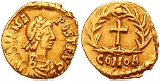
Julius Nepos

Encyclopedia
Julius Nepos was Western Roman Emperor de facto from 474 to 475 and de jure until 480. Some historians consider him to be the last Western Roman Emperor, while others consider the western line to have ended with Romulus Augustulus in 476. In contrast, the Eastern Roman Empire, and its line of Emperors, survived this historical period relatively intact.
Nepos, already the ruler of Roman Dalmatia
, was nominated by the Eastern Roman Emperor Leo I
in early 474, to replace the Western Emperor Glycerius
, who was regarded as a usurper
. It was, most probably, Nepos' marriage to the emperor Leo's wife's niece
which earned him the agnomen
of "Nepos" (nephew).
Glycerius surrendered in June 474, shortly after Nepos' arrival in Italy
. Nepos spared Glycerius' life, and appointed him bishop of Salona
. After this Nepos ruled, briefly, over the whole of the remaining Western Roman Empire; still centered on Italy, the Empire's heartland, and including his native Dalmatia, and the remaining parts of Roman Gaul
. Nepos' rule in Italy ended in 475, when he was deposed by his magister militum
, Orestes. After fleeing from Italy and Orestes without opposition, Nepos returned to Dalmatia, over which he retained control.
Following Nepos' departure, Orestes enthroned his own teenage son as the new Western Emperor, in the same year, with the regnal name
Romulus Augustus
; the second element often used in the diminutive "Augustulus" (little Augustus). The reasons for Orestes' decision to crown his son as a puppet-emperor, rather than become Emperor himself, are somewhat unclear. In the eyes of Roman law and of the eastern court in Constantinople, however, Romulus' position as Emperor was unconstitutional. His short reign ended in 476 with the execution of his father, and his own subsequent forced abdication; both the result of an uprising lead by Odoacer
, head of the Germanic Foederati
in Italy. Odoacer, the new ruler of the Italian peninsula, sent the teen-aged former emperor to Campania
in exile or retirement, after which Romulus Augustulus disappears from the historical record.
Although his successor had been deposed, Nepos never returned to Italy; however the "Emperor of the West" continued to reign from Dalmatia, and he still enjoyed the support of Constantinople. Odoacer, attempting to bypass Nepos, used the Roman Senate
to petition the Eastern Emperor, Zeno
; he requested the rank of Patrician for himself, and sought to end the line of separate, Western Emperors. Patrician rank was granted, but at Zeno's insistence Odoacer also grudgingly acknowledged Nepos' Imperial status, and even issued coinage in Nepos' name.
As Patricius, Odoacer ruled over Italy and an expanding sphere of related territories as a viceroy, theoretically under Zeno's authority as the head of a "re-united" Imperium Romanum, while still technically acknowledging Nepos as Emperor of the West. In practical terms, Odoacer was an increasingly independent King of Italy
, nominally recognizing the Eastern Empire's suzerainty
; with Nepos retaining claim to the Imperial title, but exercising no real power outside of Dalmatia.
This political solution lasted approximately 4 years. Julius Nepos, still residing in Dalmatia, was murdered in 480; possibly as a result of machinations by Odoacer and/or Glycerius, possibly aggravated by Nepos' own ambitions to regain control of Italy. Instability continued in the West; and Nepos' death ended the last serious legal claims of a Western Roman Empire, independent of the Roman East, until the coronation of Charlemagne
as "Imperator Romanorum" in 800.
Nepotianus
, a general (magister utriusque militiae) who served the Western Roman Empire between 458 and 461 during the reign of Majorian
. He is mentioned as having been active in southern Gaul
and in Hispania
, eventually dying in 465. His unnamed mother was a sister of Marcellinus
, magister militum
of Dalmatia
. This identification has been denied by historian R. W. Burgess, who starts by observing that the claim reposes on a single passage from Jordanes' Romana
. He then proceeds to argue that, while Nepos came from an important family, the general Nepotianus was a mercenary commander working for the Visigoths; from which came his title of magister militiae. Thus, Burgess concludes his argument that Nepotianus father of Nepos, and the military commander Nepotianus, should be considered as two different individuals.
The 6th-century chronicler Marcellinus Comes
mentions Nepos as "son of the sister of Marcellinus, once patrician". This identification of Nepos is confirmed by a passage in Jordanes
' Getica. Since Jordanes often uses Marcellinus Comes as a source, the passage might have been copied verbatim. Marcellinus was a powerful figure in the Western Roman Empire, rebelling in 454 against the Emperor Valentinian III
after the latter's assassination of Flavius Aetius
. He established himself as an autonomous ruler in Dalmatia, despite accepting the authority of of the emperors Majorian
and Anthemius
. Under Anthemius he was raised to the rank of patrician, becoming a possible threat to Ricimer
, the powerful kingmaker
behind the western throne. In 468, Marcellinus died in Sicily
, probably at the hands of Ricimer. Nepos might have belonged to a prominent family of Dalmatia. There are four memorial inscriptions from the area commemorating similarly named individuals: Aelia Nepotes, Aelia Nepos, Julius Nepos and Nepotes. The name seems to also be preserved in a church inscription of Salona
, dating to the early 5th century.
, and was named as Emperor in the West by Leo in 474, in order to end the reign of the usurper Glycerius
, who had been raised to the throne by the Burgundian
magister militum
Gundobad
in the western capital of Ravenna
. Officially, however, Leo was the sole Emperor and had the right to select a new Western Emperor
. He chose Nepos, the governor of the province of Dalmatia
, and in June 474 Nepos entered Ravenna, forced Glycerius to abdicate and was himself raised to the Purple. Glycerius was essentially exiled to Dalmatia as bishop of the city of Salona
, where he and Nepos would later cross paths again.
, Illyria
and the remaining parts of Roman Gaul
. He was able to renegotiate a recently concluded peace settlement with the Visigoths and their king Euric
, which restored the Provence
region of Gaul to imperial control in exchange for some other, minor territories where Nepos was unable to maintain firm control. But he was less successful in negotiating with Geiseric, the king of the Vandals
, who was once again launching pirate attacks on the Italian coast. Having recently made peace with the Eastern Empire, Geiseric saw no need to make new concessions to Nepos.
Nepos was, by all accounts, one of the more capable of the late Western Emperors, but he was unpopular with the Roman Senate
, the members of which disliked him for his close ties to the East. When Nepos made the mistake of appointing the untrustworthy Orestes as his magister militum, his lack of a western core of support came back to haunt him.
Fall and rule from Dalmatia
On August 28, 475, Orestes took control of the government at Ravenna and forced Nepos to flee by ship to Dalmatia. Unable to appoint himself as the Western Roman Emperor, Orestes instead appointed his son Romulus Augustus
as Romulus was a citizen of Rome. The boy was probably around 12 years old when he became Emperor and is ironically known to history as Romulus Augustulus, meaning Romulus the Little Augustus.
However, Romulus' position was not constitutional inasmuch as he had not been recognised by the Emperor at Constantinople, in whose eyes Nepos was still the sole Augustus of the West. The latter thus continued to rule in Dalmatia as Emperor, recognized as such in Dalmatia and in the eastern court. When Odoacer
captured Ravenna, killed Orestes, and deposed Romulus on September 4, 476, he proclaimed himself ruler of Italy and asked the Eastern Roman Emperor Zeno
to legalize his position as Patricius of the Roman Empire and Zeno's viceroy in Italy. Zeno did so, but insisted that he recognize Nepos as Western Roman Emperor. Odoacer did this, and even issued coins in Nepos' name throughout Italy. In name at least, the Western Roman Empire continued to exist after 476, but only as a legal formality and as a sop to Imperial tradition.
Through the Roman Senate
, Odoacer requested that he be named a Patrician by the Emperor Zeno
, ruler of the eastern half of the Roman Empire. This request was granted and technically Odoacer, as Patrician, ruled Italy and an expanding sphere of related territories under Zeno's authority as the head of a "re-united" Imperium Romanum. In practical terms, Odoacer was an increasingly independent king, nominally recognizing the Eastern Emperor's suzerainty
, with Nepos retaining a tenuous claim on the Imperial rank.
Similar arrangements might have continued for many years had events not taken another course. First, in about 479, Nepos began to plot against Odoacer, hoping to regain control of Italy for himself. Another possibility, (according to some sources) is that Glycerius, who continued as bishop of Salona, was plotting his revenge. What is certain is that Odoacer perceived Nepos as a threat, and was determined to get rid of him.
also had a residence in the area, it might have been the same building. Marcellinus Comes blames "the treachery of his comes
Viator and Ovida
" for the murder. Malchus
also implicates the former Emperor Glycerius
in the conspiracy. Glycerius was after all Bishop of Salona at the time, placing him in the vicinity of the murder.
Ovida served as the next ruler of Dalmatia for a few months, but Odoacer used Nepos' murder as a pretext to invade Dalmatia. Odoacer defeated Ovida's forces on December 9, and added the province to his own kingdom. Adding to the suspicions about Glycerius is a report that Odoacer then made him bishop of Milan
.
Nepos, already the ruler of Roman Dalmatia
Dalmatia (Roman province)
Dalmatia was an ancient Roman province. Its name is probably derived from the name of an Illyrian tribe called the Dalmatae which lived in the area of the eastern Adriatic coast in Classical antiquity....
, was nominated by the Eastern Roman Emperor Leo I
Leo I (emperor)
Leo I was Byzantine Emperor from 457 to 474. A native of Dacia Aureliana near historic Thrace, he was known as Leo the Thracian ....
in early 474, to replace the Western Emperor Glycerius
Glycerius
Glycerius was a Western Roman Emperor from 473 to 474. Elevated by his Magister militum, Gundobad, Glycerius’ elevation was rejected by the court at Constantinople, and he was ousted by Julius Nepos. He later served as the bishop of Salona in the early Catholic Church.-Rise to power:Sources on...
, who was regarded as a usurper
Roman usurper
Usurpers are individuals or groups of individuals who obtain and maintain the power or rights of another by force and without legal authority. Usurpation was endemic during roman imperial era, especially from the crisis of the third century onwards, when political instability became the rule.The...
. It was, most probably, Nepos' marriage to the emperor Leo's wife's niece
Wife of Julius Nepos
The wife of Julius Nepos was the last empress of the Roman Empire in the West, whose husband reigned from 474 through 480, although he was in exile from his capital after 475. His surname he obtained through his marriage...
which earned him the agnomen
Agnomen
An agnomen , in the Roman naming convention, was a nickname, just as the cognomen was initially. However, the cognomina eventually became family names, so agnomina were needed to distinguish between similarly named persons...
of "Nepos" (nephew).
Glycerius surrendered in June 474, shortly after Nepos' arrival in Italy
Italy
Italy , officially the Italian Republic languages]] under the European Charter for Regional or Minority Languages. In each of these, Italy's official name is as follows:;;;;;;;;), is a unitary parliamentary republic in South-Central Europe. To the north it borders France, Switzerland, Austria and...
. Nepos spared Glycerius' life, and appointed him bishop of Salona
Salona
Salona was an ancient Illyrian Delmati city in the first millennium BC. The Greeks had set up an emporion there. After the conquest by the Romans, Salona became the capital of the Roman province of Dalmatia...
. After this Nepos ruled, briefly, over the whole of the remaining Western Roman Empire; still centered on Italy, the Empire's heartland, and including his native Dalmatia, and the remaining parts of Roman Gaul
Roman Gaul
Roman Gaul consisted of an area of provincial rule in the Roman Empire, in modern day France, Belgium, Luxembourg, and western Germany. Roman control of the area lasted for less than 500 years....
. Nepos' rule in Italy ended in 475, when he was deposed by his magister militum
Magister militum
Magister militum was a top-level military command used in the later Roman Empire, dating from the reign of Constantine. Used alone, the term referred to the senior military officer of the Empire...
, Orestes. After fleeing from Italy and Orestes without opposition, Nepos returned to Dalmatia, over which he retained control.
Following Nepos' departure, Orestes enthroned his own teenage son as the new Western Emperor, in the same year, with the regnal name
Regnal name
A regnal name, or reign name, is a formal name used by some monarchs and popes during their reigns. Since medieval times, monarchs have frequently chosen to use a name different from their own personal name when they inherit a throne....
Romulus Augustus
Romulus Augustus
Romulus Augustus , was the last Western Roman Emperor, reigning from 31 October 475 until 4 September 476...
; the second element often used in the diminutive "Augustulus" (little Augustus). The reasons for Orestes' decision to crown his son as a puppet-emperor, rather than become Emperor himself, are somewhat unclear. In the eyes of Roman law and of the eastern court in Constantinople, however, Romulus' position as Emperor was unconstitutional. His short reign ended in 476 with the execution of his father, and his own subsequent forced abdication; both the result of an uprising lead by Odoacer
Odoacer
Flavius Odoacer , also known as Flavius Odovacer, was the first King of Italy. His reign is commonly seen as marking the end of the Western Roman Empire. Though the real power in Italy was in his hands, he represented himself as the client of Julius Nepos and, after Nepos' death in 480, of the...
, head of the Germanic Foederati
Foederati
Foederatus is a Latin term whose definition and usage drifted in the time between the early Roman Republic and the end of the Western Roman Empire...
in Italy. Odoacer, the new ruler of the Italian peninsula, sent the teen-aged former emperor to Campania
Campania
Campania is a region in southern Italy. The region has a population of around 5.8 million people, making it the second-most-populous region of Italy; its total area of 13,590 km² makes it the most densely populated region in the country...
in exile or retirement, after which Romulus Augustulus disappears from the historical record.
Although his successor had been deposed, Nepos never returned to Italy; however the "Emperor of the West" continued to reign from Dalmatia, and he still enjoyed the support of Constantinople. Odoacer, attempting to bypass Nepos, used the Roman Senate
Roman Senate
The Senate of the Roman Republic was a political institution in the ancient Roman Republic, however, it was not an elected body, but one whose members were appointed by the consuls, and later by the censors. After a magistrate served his term in office, it usually was followed with automatic...
to petition the Eastern Emperor, Zeno
Zeno (emperor)
Zeno , originally named Tarasis, was Byzantine Emperor from 474 to 475 and again from 476 to 491. Domestic revolts and religious dissension plagued his reign, which nevertheless succeeded to some extent in foreign issues...
; he requested the rank of Patrician for himself, and sought to end the line of separate, Western Emperors. Patrician rank was granted, but at Zeno's insistence Odoacer also grudgingly acknowledged Nepos' Imperial status, and even issued coinage in Nepos' name.
As Patricius, Odoacer ruled over Italy and an expanding sphere of related territories as a viceroy, theoretically under Zeno's authority as the head of a "re-united" Imperium Romanum, while still technically acknowledging Nepos as Emperor of the West. In practical terms, Odoacer was an increasingly independent King of Italy
King of Italy
King of Italy is a title adopted by many rulers of the Italian peninsula after the fall of the Roman Empire...
, nominally recognizing the Eastern Empire's suzerainty
Suzerainty
Suzerainty occurs where a region or people is a tributary to a more powerful entity which controls its foreign affairs while allowing the tributary vassal state some limited domestic autonomy. The dominant entity in the suzerainty relationship, or the more powerful entity itself, is called a...
; with Nepos retaining claim to the Imperial title, but exercising no real power outside of Dalmatia.
This political solution lasted approximately 4 years. Julius Nepos, still residing in Dalmatia, was murdered in 480; possibly as a result of machinations by Odoacer and/or Glycerius, possibly aggravated by Nepos' own ambitions to regain control of Italy. Instability continued in the West; and Nepos' death ended the last serious legal claims of a Western Roman Empire, independent of the Roman East, until the coronation of Charlemagne
Charlemagne
Charlemagne was King of the Franks from 768 and Emperor of the Romans from 800 to his death in 814. He expanded the Frankish kingdom into an empire that incorporated much of Western and Central Europe. During his reign, he conquered Italy and was crowned by Pope Leo III on 25 December 800...
as "Imperator Romanorum" in 800.
Family
It is generally accepted that Julius Nepos was son of the comesComes
Comes , plural comites , is the Latin word for companion, either individually or as a member of a collective known as comitatus, especially the suite of a magnate, in some cases large and/or formal enough to have a specific name, such as a cohors amicorum. The word comes derives from com- "with" +...
Nepotianus
Nepotianus (magister militiae)
- Life :Nepotianus married the sister of Marcellinus, the semi-independent ruler of Dalmatia; the couple had a son, Julius Nepos, last Western Roman Emperor....
, a general (magister utriusque militiae) who served the Western Roman Empire between 458 and 461 during the reign of Majorian
Majorian
Majorian , was the Western Roman Emperor from 457 to 461.A prominent general of the Late Roman army, Majorian deposed Emperor Avitus in 457 and succeeded him. Majorian was one of the last emperors to make a concerted effort to restore the Western Roman Empire...
. He is mentioned as having been active in southern Gaul
Gaul
Gaul was a region of Western Europe during the Iron Age and Roman era, encompassing present day France, Luxembourg and Belgium, most of Switzerland, the western part of Northern Italy, as well as the parts of the Netherlands and Germany on the left bank of the Rhine. The Gauls were the speakers of...
and in Hispania
Hispania
Another theory holds that the name derives from Ezpanna, the Basque word for "border" or "edge", thus meaning the farthest area or place. Isidore of Sevilla considered Hispania derived from Hispalis....
, eventually dying in 465. His unnamed mother was a sister of Marcellinus
Marcellinus (magister militum)
Marcellinus was a Roman general and patrician who ruled over the region of Dalmatia in the Western Roman Empire and held sway with the army there from 454 until his death.-Origins:...
, magister militum
Magister militum
Magister militum was a top-level military command used in the later Roman Empire, dating from the reign of Constantine. Used alone, the term referred to the senior military officer of the Empire...
of Dalmatia
Dalmatia (Roman province)
Dalmatia was an ancient Roman province. Its name is probably derived from the name of an Illyrian tribe called the Dalmatae which lived in the area of the eastern Adriatic coast in Classical antiquity....
. This identification has been denied by historian R. W. Burgess, who starts by observing that the claim reposes on a single passage from Jordanes' Romana
Romana (Jordanes)
The Romana is a Latin book written by Jordanes in the 6th century, being a short compendium of the most remarkable events from the creation down to the victory obtained by Narses, in AD 552, over king Teia...
. He then proceeds to argue that, while Nepos came from an important family, the general Nepotianus was a mercenary commander working for the Visigoths; from which came his title of magister militiae. Thus, Burgess concludes his argument that Nepotianus father of Nepos, and the military commander Nepotianus, should be considered as two different individuals.
The 6th-century chronicler Marcellinus Comes
Marcellinus Comes
Marcellinus Comes was a Latin chronicler of the Eastern Roman Empire. An Illyrian by birth, he spent most of his life at the court of Constantinople, which is the focus of his surviving work.-Works:...
mentions Nepos as "son of the sister of Marcellinus, once patrician". This identification of Nepos is confirmed by a passage in Jordanes
Jordanes
Jordanes, also written Jordanis or Jornandes, was a 6th century Roman bureaucrat, who turned his hand to history later in life....
' Getica. Since Jordanes often uses Marcellinus Comes as a source, the passage might have been copied verbatim. Marcellinus was a powerful figure in the Western Roman Empire, rebelling in 454 against the Emperor Valentinian III
Valentinian III
-Family:Valentinian was born in the western capital of Ravenna, the only son of Galla Placidia and Flavius Constantius. The former was the younger half-sister of the western emperor Honorius, and the latter was at the time Patrician and the power behind the throne....
after the latter's assassination of Flavius Aetius
Flavius Aëtius
Flavius Aëtius , dux et patricius, was a Roman general of the closing period of the Western Roman Empire. He was an able military commander and the most influential man in the Western Roman Empire for two decades . He managed policy in regard to the attacks of barbarian peoples pressing on the Empire...
. He established himself as an autonomous ruler in Dalmatia, despite accepting the authority of of the emperors Majorian
Majorian
Majorian , was the Western Roman Emperor from 457 to 461.A prominent general of the Late Roman army, Majorian deposed Emperor Avitus in 457 and succeeded him. Majorian was one of the last emperors to make a concerted effort to restore the Western Roman Empire...
and Anthemius
Anthemius
Procopius Anthemius was Western Roman Emperor from 467 to 472. Perhaps the last capable Western Roman Emperor, Anthemius attempted to solve the two primary military challenges facing the remains of the Western Roman Empire: the resurgent Visigoths, under Euric, whose domain straddled the Pyrenees;...
. Under Anthemius he was raised to the rank of patrician, becoming a possible threat to Ricimer
Ricimer
Flavius Ricimer was a Germanic general who achieved effective control of the remaining parts of the Western Roman Empire, during the middle of the 5th century...
, the powerful kingmaker
Kingmaker
Kingmaker is a term originally applied to the activities of Richard Neville, 16th Earl of Warwick — "Warwick the Kingmaker" — during the Wars of the Roses in England. The term has come to be applied more generally to a person or group that has great influence in a royal or political succession,...
behind the western throne. In 468, Marcellinus died in Sicily
Sicily
Sicily is a region of Italy, and is the largest island in the Mediterranean Sea. Along with the surrounding minor islands, it constitutes an autonomous region of Italy, the Regione Autonoma Siciliana Sicily has a rich and unique culture, especially with regard to the arts, music, literature,...
, probably at the hands of Ricimer. Nepos might have belonged to a prominent family of Dalmatia. There are four memorial inscriptions from the area commemorating similarly named individuals: Aelia Nepotes, Aelia Nepos, Julius Nepos and Nepotes. The name seems to also be preserved in a church inscription of Salona
Salona
Salona was an ancient Illyrian Delmati city in the first millennium BC. The Greeks had set up an emporion there. After the conquest by the Romans, Salona became the capital of the Roman province of Dalmatia...
, dating to the early 5th century.
Rise to power
Nepos was married to the niece of Eastern Roman Emperor Leo I, hence his nepos — "nephew" — agnomenAgnomen
An agnomen , in the Roman naming convention, was a nickname, just as the cognomen was initially. However, the cognomina eventually became family names, so agnomina were needed to distinguish between similarly named persons...
, and was named as Emperor in the West by Leo in 474, in order to end the reign of the usurper Glycerius
Glycerius
Glycerius was a Western Roman Emperor from 473 to 474. Elevated by his Magister militum, Gundobad, Glycerius’ elevation was rejected by the court at Constantinople, and he was ousted by Julius Nepos. He later served as the bishop of Salona in the early Catholic Church.-Rise to power:Sources on...
, who had been raised to the throne by the Burgundian
Kingdom of Burgundy
Burgundy is a historic region in Western Europe that has existed as a political entity in a number of forms with very different boundaries. Two of these entities - the first around the 6th century, the second around the 11th century - have been called the Kingdom of Burgundy; a third was very...
magister militum
Magister militum
Magister militum was a top-level military command used in the later Roman Empire, dating from the reign of Constantine. Used alone, the term referred to the senior military officer of the Empire...
Gundobad
Gundobad
Gundobad was King of the Burgundians , succeeding his father Gundioc of Burgundy. Previous to this, he had been a Patrician of the Western Roman Empire in 472–473, succeeding his uncle Ricimer.- Early life :...
in the western capital of Ravenna
Ravenna
Ravenna is the capital city of the Province of Ravenna in the Emilia-Romagna region of Italy and the second largest comune in Italy by land area, although, at , it is little more than half the size of the largest comune, Rome...
. Officially, however, Leo was the sole Emperor and had the right to select a new Western Emperor
Emperor
An emperor is a monarch, usually the sovereign ruler of an empire or another type of imperial realm. Empress, the female equivalent, may indicate an emperor's wife or a woman who rules in her own right...
. He chose Nepos, the governor of the province of Dalmatia
Dalmatia (Roman province)
Dalmatia was an ancient Roman province. Its name is probably derived from the name of an Illyrian tribe called the Dalmatae which lived in the area of the eastern Adriatic coast in Classical antiquity....
, and in June 474 Nepos entered Ravenna, forced Glycerius to abdicate and was himself raised to the Purple. Glycerius was essentially exiled to Dalmatia as bishop of the city of Salona
Salona
Salona was an ancient Illyrian Delmati city in the first millennium BC. The Greeks had set up an emporion there. After the conquest by the Romans, Salona became the capital of the Roman province of Dalmatia...
, where he and Nepos would later cross paths again.
Rule
As emperor, Nepos tried to consolidate the Empire's remaining Western holdings, which consisted of ItalyItaly
Italy , officially the Italian Republic languages]] under the European Charter for Regional or Minority Languages. In each of these, Italy's official name is as follows:;;;;;;;;), is a unitary parliamentary republic in South-Central Europe. To the north it borders France, Switzerland, Austria and...
, Illyria
Illyria
In classical antiquity, Illyria was a region in the western part of the Balkan Peninsula inhabited by the Illyrians....
and the remaining parts of Roman Gaul
Roman Gaul
Roman Gaul consisted of an area of provincial rule in the Roman Empire, in modern day France, Belgium, Luxembourg, and western Germany. Roman control of the area lasted for less than 500 years....
. He was able to renegotiate a recently concluded peace settlement with the Visigoths and their king Euric
Euric
Euric, also known as Evaric, Erwig, or Eurico in Spanish and Portuguese , Son of Theodoric I and the younger brother of Theodoric II and ruled as king of the Visigoths, with his capital at Toulouse, from 466 until his death in 484.He inherited a large portion of the Visigothic possessions in the...
, which restored the Provence
Provence
Provence ; Provençal: Provença in classical norm or Prouvènço in Mistralian norm) is a region of south eastern France on the Mediterranean adjacent to Italy. It is part of the administrative région of Provence-Alpes-Côte d'Azur...
region of Gaul to imperial control in exchange for some other, minor territories where Nepos was unable to maintain firm control. But he was less successful in negotiating with Geiseric, the king of the Vandals
Vandals
The Vandals were an East Germanic tribe that entered the late Roman Empire during the 5th century. The Vandals under king Genseric entered Africa in 429 and by 439 established a kingdom which included the Roman Africa province, besides the islands of Sicily, Corsica, Sardinia and the Balearics....
, who was once again launching pirate attacks on the Italian coast. Having recently made peace with the Eastern Empire, Geiseric saw no need to make new concessions to Nepos.
Nepos was, by all accounts, one of the more capable of the late Western Emperors, but he was unpopular with the Roman Senate
Roman Senate
The Senate of the Roman Republic was a political institution in the ancient Roman Republic, however, it was not an elected body, but one whose members were appointed by the consuls, and later by the censors. After a magistrate served his term in office, it usually was followed with automatic...
, the members of which disliked him for his close ties to the East. When Nepos made the mistake of appointing the untrustworthy Orestes as his magister militum, his lack of a western core of support came back to haunt him.
Fall and rule from DalmatiaDalmatiaDalmatia is a historical region on the eastern coast of the Adriatic Sea. It stretches from the island of Rab in the northwest to the Bay of Kotor in the southeast. The hinterland, the Dalmatian Zagora, ranges from fifty kilometers in width in the north to just a few kilometers in the south....
On August 28, 475, Orestes took control of the government at Ravenna and forced Nepos to flee by ship to Dalmatia. Unable to appoint himself as the Western Roman Emperor, Orestes instead appointed his son Romulus AugustusRomulus Augustus
Romulus Augustus , was the last Western Roman Emperor, reigning from 31 October 475 until 4 September 476...
as Romulus was a citizen of Rome. The boy was probably around 12 years old when he became Emperor and is ironically known to history as Romulus Augustulus, meaning Romulus the Little Augustus.
However, Romulus' position was not constitutional inasmuch as he had not been recognised by the Emperor at Constantinople, in whose eyes Nepos was still the sole Augustus of the West. The latter thus continued to rule in Dalmatia as Emperor, recognized as such in Dalmatia and in the eastern court. When Odoacer
Odoacer
Flavius Odoacer , also known as Flavius Odovacer, was the first King of Italy. His reign is commonly seen as marking the end of the Western Roman Empire. Though the real power in Italy was in his hands, he represented himself as the client of Julius Nepos and, after Nepos' death in 480, of the...
captured Ravenna, killed Orestes, and deposed Romulus on September 4, 476, he proclaimed himself ruler of Italy and asked the Eastern Roman Emperor Zeno
Zeno (emperor)
Zeno , originally named Tarasis, was Byzantine Emperor from 474 to 475 and again from 476 to 491. Domestic revolts and religious dissension plagued his reign, which nevertheless succeeded to some extent in foreign issues...
to legalize his position as Patricius of the Roman Empire and Zeno's viceroy in Italy. Zeno did so, but insisted that he recognize Nepos as Western Roman Emperor. Odoacer did this, and even issued coins in Nepos' name throughout Italy. In name at least, the Western Roman Empire continued to exist after 476, but only as a legal formality and as a sop to Imperial tradition.
Through the Roman Senate
Roman Senate
The Senate of the Roman Republic was a political institution in the ancient Roman Republic, however, it was not an elected body, but one whose members were appointed by the consuls, and later by the censors. After a magistrate served his term in office, it usually was followed with automatic...
, Odoacer requested that he be named a Patrician by the Emperor Zeno
Zeno (emperor)
Zeno , originally named Tarasis, was Byzantine Emperor from 474 to 475 and again from 476 to 491. Domestic revolts and religious dissension plagued his reign, which nevertheless succeeded to some extent in foreign issues...
, ruler of the eastern half of the Roman Empire. This request was granted and technically Odoacer, as Patrician, ruled Italy and an expanding sphere of related territories under Zeno's authority as the head of a "re-united" Imperium Romanum. In practical terms, Odoacer was an increasingly independent king, nominally recognizing the Eastern Emperor's suzerainty
Suzerainty
Suzerainty occurs where a region or people is a tributary to a more powerful entity which controls its foreign affairs while allowing the tributary vassal state some limited domestic autonomy. The dominant entity in the suzerainty relationship, or the more powerful entity itself, is called a...
, with Nepos retaining a tenuous claim on the Imperial rank.
Similar arrangements might have continued for many years had events not taken another course. First, in about 479, Nepos began to plot against Odoacer, hoping to regain control of Italy for himself. Another possibility, (according to some sources) is that Glycerius, who continued as bishop of Salona, was plotting his revenge. What is certain is that Odoacer perceived Nepos as a threat, and was determined to get rid of him.
Murder
Nepos was murdered by his own soldiers on one of three possible dates — April 25, May 9 or June 22 — of 480. The April 25 date is probably the correct one. He was reportedly stabbed to death in his villa, near Salona. Since DiocletianDiocletian
Diocletian |latinized]] upon his accession to Diocletian . c. 22 December 244 – 3 December 311), was a Roman Emperor from 284 to 305....
also had a residence in the area, it might have been the same building. Marcellinus Comes blames "the treachery of his comes
Comes
Comes , plural comites , is the Latin word for companion, either individually or as a member of a collective known as comitatus, especially the suite of a magnate, in some cases large and/or formal enough to have a specific name, such as a cohors amicorum. The word comes derives from com- "with" +...
Viator and Ovida
Ovida
Ovida was a general during the late Western Roman Empire and the last Roman ruler of Dalmatia.Following Flavius Orestes's coup against the Western Roman Emperor Julius Nepos on August 28, 475, Ovida remained loyal to the Emperor and accompanied him on his escape to Dalmatia...
" for the murder. Malchus
Malchus (historian)
Malchus was a Byzantine historian. According to Suda Malchus was a Byzantine; but Photius states that he was a native of Philadelphia; and his Syriac name makes it probable that Philadelphia was the ancient Rabbah in the country of Ammonitis, east of the River Jordan.Malchus probably followed his...
also implicates the former Emperor Glycerius
Glycerius
Glycerius was a Western Roman Emperor from 473 to 474. Elevated by his Magister militum, Gundobad, Glycerius’ elevation was rejected by the court at Constantinople, and he was ousted by Julius Nepos. He later served as the bishop of Salona in the early Catholic Church.-Rise to power:Sources on...
in the conspiracy. Glycerius was after all Bishop of Salona at the time, placing him in the vicinity of the murder.
Ovida served as the next ruler of Dalmatia for a few months, but Odoacer used Nepos' murder as a pretext to invade Dalmatia. Odoacer defeated Ovida's forces on December 9, and added the province to his own kingdom. Adding to the suspicions about Glycerius is a report that Odoacer then made him bishop of Milan
Mediolanum
Mediolanum, the ancient Milan, was an important Celtic and then Roman centre of northern Italy. This article charts the history of the city from its settlement by the Insubres around 600 BC, through its conquest by the Romans and its development into a key centre of Western Christianity and capital...
.
External links
- Ralph W. Mathisen, "Julius Nepos (19/24 June 474 – [28 August 475 – 25 April/9 May/22 June 480)"
- http://www.acsearch.info/record.html?id=52935