

Pope Sixtus IV

Encyclopedia
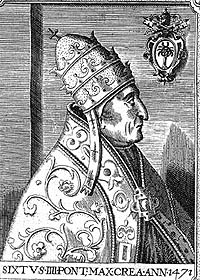
Pope Sixtus IV born Francesco della Rovere
, was Pope
from 1471 to 1484. His accomplishments as Pope included the establishment of the Sistine Chapel
; the group of artists that he brought together introduced the Early Renaissance
into Rome with the first masterpiece of the city's new artistic age, the Vatican
Archives. Sixtus also furthered the agenda of the Spanish Inquisition
, and annulled the decrees of the Council of Constance
. He was famed for his nepotism and was personally involved in the infamous Pazzi Conspiracy.
, Liguria
, Italy
: the son of Leonardo della Rovere and Luchina Monleoni. He was born in Celle Ligure
, a town near Savona
.
As a young man he joined the Franciscan Order
, an unlikely choice for a political career, and his intellectual qualities were revealed while he was studying philosophy
and theology
at the University of Pavia
. He went on to lecture at many eminent Italian universities.
In 1464, Francesco della Rovere was elected Minister General of the Franciscan order at the age of 50. In 1467, he was appointed Cardinal
of San Pietro in Vincoli by Pope Paul II
(1464–1471). Before his papal election, Cardinal della Rovere was renowned for his unworldliness and had even written learned treatises entitled On the Blood of Christ and On the Power of God. His pious reputation was one of the deciding factors that prompted the College of Cardinals to elect him pope upon the unexpected death of Pope Paul II at the age of fifty-four.
in Smyrna
. Fund-raising for the crusade was more successful than the half-hearted attempts to storm Smyrna, with little to show in return. Some fruitless attempts were made towards unification with the Greek Church
. For the remainder of his pontificate, Sixtus turned to temporal issues and dynastic considerations. Sixtus continued the dispute with Louis XI of France
(1461–1483), who upheld the Pragmatic Sanction of Bourges
(1438), according to which papal decrees needed royal assent before they could be promulgated in France. This was a cornerstone of the privileges claimed for the Gallican Church
, and could never be shifted as long as Louis XI maneuvered to replace Ferdinand I of Naples
with a French prince. Louis was thus in conflict with the papacy, and Sixtus (as a princely strategist himself) could not permit it.
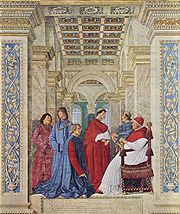
 Like a number of Popes, Sixtus IV adhered to the system of nepotism
. In the fresco by Melozzo da Forlì
he is accompanied by his Della Rovere
and Riario
nephews, not all of whom were made cardinals: the protonotary apostolic
Pietro Riario
(on his right), the future Pope Julius II (1503–1513) standing before him, and Girolamo Riario
and Giovanni della Rovere
behind the kneeling Platina
, author of the first humanist
history of the Popes. His nephew Pietro Riario
also benefited from his nepotism. Pietro became one of the richest men in Rome and was entrusted with Sixtus IV's foreign policy. However, Pietro died prematurely in 1474, and his role passed to Giuliano della Rovere.
The secular fortunes of the Della Rovere began when Sixtus invested his nephew Giovanni
with the signoria of Senigallia
and arranged his marriage to the daughter of Federico III da Montefeltro, duke of Urbino; from the union came a line of Della Rovere dukes of Urbino that lasted until the line expired, in 1631. Six of the thirty-four cardinals that he created were his nephews.
In his territorial aggrandizement of the Papal States
Sixtus IV's niece's son Cardinal Raffaele Riario
, for whom the Palazzo della Cancelleria
was constructed, was a leader in the 1478 failed "Pazzi conspiracy
" to assassinate both Lorenzo de' Medici
and his brother and replace them in Florence
with Sixtus IV's other nephew, Girolamo Riario
. Francesco Salviati
, archbishop of Pisa and a main organizer of the plot, was hanged on the walls of the Florentine Palazzo della Signoria. To this Sixtus IV replied with an interdict
and two years' of war with Florence. He also encouraged the Venetians
to attack Ferrara
, which he wished to obtain for another nephew. The angered Italian princes allied to force Sixtus IV to make peace, to his great annoyance.
, Sixtus IV committed himself to Venice's
aggression against Ercole I d'Este, Duke of Ferrara, inciting the Venetians to attack in 1482 in the so-called War of Ferrara. Their combined assault was opposed by an alliance of the Sforzas of Milan
, the Medici
s of Florence
along with the King of Naples, normally a hereditary ally and champion of the Papacy. For refusing to desist from the very hostilities that he himself had instigated (and for being a dangerous rival to Della Rovere dynastic ambitions in the Marche
), Sixtus IV placed Venice under interdict in 1483.
On November 1, 1478, Pope Sixtus IV published the Papal bull Exigit Sinceras Devotionis Affectus, through which the Spanish Inquisition
was established in the Kingdom of Castile. Sixtus IV consented under political pressure from Ferdinand of Aragon
, who threatened to withhold military support from his kingdom of Sicily
. Nevertheless, Sixtus IV quarrelled over protocol and prerogatives of jurisdiction, was unhappy with the excesses of the Inquisition and condemned the most flagrant abuses in 1482.
In ecclesiastical affairs, Sixtus IV instituted the feast (December 8) of the Immaculate Conception
of the Virgin Mary. He formally annulled (1478) the decrees of the Council of Constance
.
, Dum Diversas
(1452) and Romanus Pontifex
(1455), had effectively given the Portuguese the rights to acquire slaves
along the African coast by force or trade. These concessions were confirmed by Sixtus in his own bull, "Aeterni regis" (21 June 1481). Arguably the "ideology of conquest" expounded in these texts became the means by which commerce and conversion were facilitated. Sixtus's earlier threats in "Regimini Gregis" (1476) to excommunicate all captains or pirates who enslaved Christians could have been intended to emphasise the need to convert the natives of the Canary Islands
and Guinea
and establish a clear difference in status between those who had converted and those who resisted. The ecclesiastical penalties were directed towards those who were enslaving the recent converts.
. He was accused of awarding benefices and bishoprics in return for sexual favours, and nominated a number of young men as cardinals, some of whom were celebrated for their looks. While it is indisputable that Sixtus favoured his relatives in the hope of having faithful executors of policy; there is less evidence of direct corruption or favouritism. The exception may perhaps be Giovanni Sclafenato, who was appointed as cardinal according to the papal epitaph on his tomb for "ingenuousness, loyalty and his others gifts of soul and body". The English theologian John Bale
attributed to Sixtus "the authorisation to practice sodomy
during periods of warm weather." However, such accusations by Protestant polemicists can be dismissed as anti-Catholic propaganda.
 As a civic patron in Rome, even the anti-papal chronicler Stefano Infessura agreed that Sixtus IV should be admired. The dedicatory inscription in the fresco by Melozzo da Forlì
in the Vatican Palace records: "You gave your city temples, streets, squares, fortifications, bridges and restored the Acqua Vergine
as far as the Trevi
..." In addition to restoring the aqueduct that provided Rome an alternative to the river water that had made the city famously unhealthy, he restored or rebuilt over 30 of Rome's dilapidated churches, among them San Vitale (1475) and Santa Maria del Popolo, and added seven new ones. The Sistine Chapel
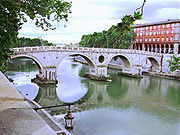
was sponsored by Sixtus IV, as was the Ponte Sisto, the Sistine Bridge – the first new bridge across the Tiber
since antiquity – and the building of Via Sistina (later named Borgo Sant'Angelo), a road leading from Castel Sant'Angelo
to Saint Peter. All this was done to facilitate the integration of the Vatican Hill
and Borgo
with the heart of old Rome. This was part of a broader scheme of urbanization
carried out under Sixtus IV, who swept the long-established markets from the Campidoglio
in 1477 and decreed in a bull of 1480 the widening of streets and the first post-Roman paving, the removal of porticoes and other post-classical impediments to free public passage.
 At the beginning of his papacy in 1471, Sixtus IV donated several historically important Roman sculptures that founded a papal collection of art that would eventually develop into the collections of the Capitoline Museums
. He also refounded, enriched and enlarged the Vatican Library
. He had Regiomontanus
attempt the first sanctioned reorganization of the Julian calendar
and increased the size and prestige of the papal chapel choir, bringing singers and some prominent composers (Gaspar van Weerbeke, Marbrianus de Orto, and Bertrandus Vaqueras) to Rome from the North.
In addition to being a patron of the arts, Sixtus IV was a patron of the sciences. Before becoming Pope, spent time at the then very liberal and cosmopolitan University of Padua
, which maintained considerable independence from the Church and had a very international character. As pope, he issued a papal bull allowing local bishops to give the bodies of executed criminals and unidentified corpses to physicians and artists for dissection. It was this access to corpses which allowed the anatomist Vesalius
along with Titian
's pupil Jan Stephen van Calcar
to complete the revolutionary medical/anatomical text De humani corporis fabrica
.
. Today, his remains, along with the remains of his nephew Pope Julius II (Giuliano della Rovere), are interred in St. Peter's Basilica in the floor in front of the monument to Pope Clement X. A simple marble tombstone marks the site.
His bronze funerary monument, now in the basement Treasury of St. Peter's Basilica
, like a giant casket of goldsmith's work, is by Antonio Pollaiuolo
. The top of the casket is a lifelike depiction of the pope lying in state. Around the sides are bas relief panels, depicting with allegorical female figures the arts and sciences (Grammar, Rhetoric, Arithmetic, Geometry, Music, Painting, Astronomy, Philosophy, and Theology). Each figure incorporates the oak tree ("rovere" in Italian) symbol of Sixtus IV. The overall program of these panels, their beauty, complex symbolism, classical references, and arrangement relative to each other is one of the most compelling and comprehensive illustrations of the Renaissance worldview.
, is mentioned that The Pope as head of the Church was searching for members of the Belmont family, in order to ask for their help in the battle against Count Dracula
.
Since the game events are set in 1476, it is very likely the Pope mentioned was Pope Sixtus IV.
Pope Sixtus makes a short appearance in the Ubisoft
short film Assassin's Creed: Lineage
, and is mentioned in the Ubisoft video game Assassin's Creed II
, both in the context of his support for the Pazzi
conspiracy.
Della Rovere
Della Rovere is a noble family of Italy. Coming from modest beginnings in Savona, Liguria, the family rose to prominence through nepotism and ambitious marriages arranged by two Della Rovere popes, Francesco della Rovere, who ruled as Pope Sixtus IV and his nephew Giuliano...
, was Pope
Pope
The Pope is the Bishop of Rome, a position that makes him the leader of the worldwide Catholic Church . In the Catholic Church, the Pope is regarded as the successor of Saint Peter, the Apostle...
from 1471 to 1484. His accomplishments as Pope included the establishment of the Sistine Chapel
Sistine Chapel
Sistine Chapel is the best-known chapel in the Apostolic Palace, the official residence of the Pope in Vatican City. It is famous for its architecture and its decoration that was frescoed throughout by Renaissance artists including Michelangelo, Sandro Botticelli, Pietro Perugino, Pinturicchio...
; the group of artists that he brought together introduced the Early Renaissance
Renaissance
The Renaissance was a cultural movement that spanned roughly the 14th to the 17th century, beginning in Italy in the Late Middle Ages and later spreading to the rest of Europe. The term is also used more loosely to refer to the historical era, but since the changes of the Renaissance were not...
into Rome with the first masterpiece of the city's new artistic age, the Vatican
Vatican Library
The Vatican Library is the library of the Holy See, currently located in Vatican City. It is one of the oldest libraries in the world and contains one of the most significant collections of historical texts. Formally established in 1475, though in fact much older, it has 75,000 codices from...
Archives. Sixtus also furthered the agenda of the Spanish Inquisition
Spanish Inquisition
The Tribunal of the Holy Office of the Inquisition , commonly known as the Spanish Inquisition , was a tribunal established in 1480 by Catholic Monarchs Ferdinand II of Aragon and Isabella I of Castile. It was intended to maintain Catholic orthodoxy in their kingdoms, and to replace the Medieval...
, and annulled the decrees of the Council of Constance
Council of Constance
The Council of Constance is the 15th ecumenical council recognized by the Roman Catholic Church, held from 1414 to 1418. The council ended the Three-Popes Controversy, by deposing or accepting the resignation of the remaining Papal claimants and electing Pope Martin V.The Council also condemned and...
. He was famed for his nepotism and was personally involved in the infamous Pazzi Conspiracy.
Early career
Francesco was born to a modest family near SavonaSavona
Savona is a seaport and comune in the northern Italian region of Liguria, capital of the Province of Savona, in the Riviera di Ponente on the Mediterranean Sea....
, Liguria
Liguria
Liguria is a coastal region of north-western Italy, the third smallest of the Italian regions. Its capital is Genoa. It is a popular region with tourists for its beautiful beaches, picturesque little towns, and good food.-Geography:...
, Italy
Italy
Italy , officially the Italian Republic languages]] under the European Charter for Regional or Minority Languages. In each of these, Italy's official name is as follows:;;;;;;;;), is a unitary parliamentary republic in South-Central Europe. To the north it borders France, Switzerland, Austria and...
: the son of Leonardo della Rovere and Luchina Monleoni. He was born in Celle Ligure
Celle Ligure
Celle Ligure is a comune in the Province of Savona in the Italian region Liguria, located about 30 km west of Genoa and about 8 km northeast of Savona...
, a town near Savona
Savona
Savona is a seaport and comune in the northern Italian region of Liguria, capital of the Province of Savona, in the Riviera di Ponente on the Mediterranean Sea....
.
As a young man he joined the Franciscan Order
Franciscan
Most Franciscans are members of Roman Catholic religious orders founded by Saint Francis of Assisi. Besides Roman Catholic communities, there are also Old Catholic, Anglican, Lutheran, ecumenical and Non-denominational Franciscan communities....
, an unlikely choice for a political career, and his intellectual qualities were revealed while he was studying philosophy
Philosophy
Philosophy is the study of general and fundamental problems, such as those connected with existence, knowledge, values, reason, mind, and language. Philosophy is distinguished from other ways of addressing such problems by its critical, generally systematic approach and its reliance on rational...
and theology
Theology
Theology is the systematic and rational study of religion and its influences and of the nature of religious truths, or the learned profession acquired by completing specialized training in religious studies, usually at a university or school of divinity or seminary.-Definition:Augustine of Hippo...
at the University of Pavia
University of Pavia
The University of Pavia is a university located in Pavia, Lombardy, Italy. It was founded in 1361 and is organized in 9 Faculties.-History:...
. He went on to lecture at many eminent Italian universities.
In 1464, Francesco della Rovere was elected Minister General of the Franciscan order at the age of 50. In 1467, he was appointed Cardinal
Cardinal (Catholicism)
A cardinal is a senior ecclesiastical official, usually an ordained bishop, and ecclesiastical prince of the Catholic Church. They are collectively known as the College of Cardinals, which as a body elects a new pope. The duties of the cardinals include attending the meetings of the College and...
of San Pietro in Vincoli by Pope Paul II
Pope Paul II
Pope Paul II , born Pietro Barbo, was pope from 1464 until his death in 1471.- Early life :He was born in Venice, and was a nephew of Pope Eugene IV , through his mother. His adoption of the spiritual career, after having been trained as a merchant, was prompted by his uncle's election as pope...
(1464–1471). Before his papal election, Cardinal della Rovere was renowned for his unworldliness and had even written learned treatises entitled On the Blood of Christ and On the Power of God. His pious reputation was one of the deciding factors that prompted the College of Cardinals to elect him pope upon the unexpected death of Pope Paul II at the age of fifty-four.
Papal election
Upon election to pope he adopted the name Sixtus - a name that had not been used since the 5th century. One of his first acts was to declare a renewed crusade against the Ottoman TurksOttoman Turks
The Ottoman Turks were the Turkish-speaking population of the Ottoman Empire who formed the base of the state's military and ruling classes. Reliable information about the early history of Ottoman Turks is scarce, but they take their Turkish name, Osmanlı , from the house of Osman I The Ottoman...
in Smyrna
Smyrna
Smyrna was an ancient city located at a central and strategic point on the Aegean coast of Anatolia. Thanks to its advantageous port conditions, its ease of defence and its good inland connections, Smyrna rose to prominence. The ancient city is located at two sites within modern İzmir, Turkey...
. Fund-raising for the crusade was more successful than the half-hearted attempts to storm Smyrna, with little to show in return. Some fruitless attempts were made towards unification with the Greek Church
Eastern Orthodox Church
The Orthodox Church, officially called the Orthodox Catholic Church and commonly referred to as the Eastern Orthodox Church, is the second largest Christian denomination in the world, with an estimated 300 million adherents mainly in the countries of Belarus, Bulgaria, Cyprus, Georgia, Greece,...
. For the remainder of his pontificate, Sixtus turned to temporal issues and dynastic considerations. Sixtus continued the dispute with Louis XI of France
Louis XI of France
Louis XI , called the Prudent , was the King of France from 1461 to 1483. He was the son of Charles VII of France and Mary of Anjou, a member of the House of Valois....
(1461–1483), who upheld the Pragmatic Sanction of Bourges
Pragmatic Sanction of Bourges
The Pragmatic Sanction of Bourges, issued by King Charles VII of France, on July 7, 1438, required a General Church Council, with authority superior to that of the pope, to be held every ten years, required election rather than appointment to ecclesiastical offices, prohibited the pope from...
(1438), according to which papal decrees needed royal assent before they could be promulgated in France. This was a cornerstone of the privileges claimed for the Gallican Church
Gallican Church
The Gallican Church was the Catholic Church in France from the time of the Declaration of the Clergy of France to that of the Civil Constitution of the Clergy during the French Revolution....
, and could never be shifted as long as Louis XI maneuvered to replace Ferdinand I of Naples
Ferdinand I of Naples
Ferdinand I , also called Don Ferrante, was the King of Naples from 1458 to 1494. He was the natural son of Alfonso V of Aragon by Giraldona Carlino.-Biography:...
with a French prince. Louis was thus in conflict with the papacy, and Sixtus (as a princely strategist himself) could not permit it.
Nepotism
Nepotism
Nepotism is favoritism granted to relatives regardless of merit. The word nepotism is from the Latin word nepos, nepotis , from which modern Romanian nepot and Italian nipote, "nephew" or "grandchild" are also descended....
. In the fresco by Melozzo da Forlì
Melozzo da Forlì
Melozzo da Forlì was an Italian Renaissance painter and architect. His fresco paintings are notable for the use of foreshortening. He was the most important member of the Forlì painting school.- Biography :...
he is accompanied by his Della Rovere
Della Rovere
Della Rovere is a noble family of Italy. Coming from modest beginnings in Savona, Liguria, the family rose to prominence through nepotism and ambitious marriages arranged by two Della Rovere popes, Francesco della Rovere, who ruled as Pope Sixtus IV and his nephew Giuliano...
and Riario
Riario
Riario was an Italian noble family from Genoa. Its member included three famous nephews of Francesco della Rovere, who reigned as Pope Sixtus IV.-Members:*Girolamo Riario , Lord of Imola and Forlì...
nephews, not all of whom were made cardinals: the protonotary apostolic
Protonotary apostolic
In the Roman Catholic Church, protonotary apostolic is the title for a member of the highest non-episcopal college of prelates in the Roman Curia or, outside of Rome, an honorary prelate on whom the pope has conferred this title and its special privileges.-History:In later antiquity there were in...
Pietro Riario
Pietro Riario
Pietro Riario was an Italian cardinal and Papal diplomat.-Biography:Born in Savona, he was the son of Paolo Riario and Pope Sixtus IVs' sister, Bianca Della Rovere. Sixtus nominated him in 1471 bishop of Treviso and cardinal, and, in 1473, archbishop of Florence. He was entrusted with Sixtus'...
(on his right), the future Pope Julius II (1503–1513) standing before him, and Girolamo Riario
Girolamo Riario
Girolamo Riario was Lord of Imola and Forlì in the 15th century.- Biography :Born in Savona, Riario was the son of Paolo Riario and Bianca della Rovere...
and Giovanni della Rovere
Giovanni della Rovere
Giovanni della Rovere was an Italian condottiero and member of the Della Rovere family. He was a nephew of Pope Sixtus IV, and the brother of Giuliano della Rovere , elected to the papal throne as Pope Julius II in 1503....
behind the kneeling Platina
Bartolomeo Platina
Bartolomeo Platina, originally named Sacchi was an Italian Renaissance writer.-Biography:Platina was born at Piadena , near Cremona....
, author of the first humanist
Humanism
Humanism is an approach in study, philosophy, world view or practice that focuses on human values and concerns. In philosophy and social science, humanism is a perspective which affirms some notion of human nature, and is contrasted with anti-humanism....
history of the Popes. His nephew Pietro Riario
Pietro Riario
Pietro Riario was an Italian cardinal and Papal diplomat.-Biography:Born in Savona, he was the son of Paolo Riario and Pope Sixtus IVs' sister, Bianca Della Rovere. Sixtus nominated him in 1471 bishop of Treviso and cardinal, and, in 1473, archbishop of Florence. He was entrusted with Sixtus'...
also benefited from his nepotism. Pietro became one of the richest men in Rome and was entrusted with Sixtus IV's foreign policy. However, Pietro died prematurely in 1474, and his role passed to Giuliano della Rovere.
The secular fortunes of the Della Rovere began when Sixtus invested his nephew Giovanni
Giovanni della Rovere
Giovanni della Rovere was an Italian condottiero and member of the Della Rovere family. He was a nephew of Pope Sixtus IV, and the brother of Giuliano della Rovere , elected to the papal throne as Pope Julius II in 1503....
with the signoria of Senigallia
Senigallia
Senigallia is a comune and port town on Italy's Adriatic coast, 25 km by rail north of Ancona, in the Marche region, province of Ancona....
and arranged his marriage to the daughter of Federico III da Montefeltro, duke of Urbino; from the union came a line of Della Rovere dukes of Urbino that lasted until the line expired, in 1631. Six of the thirty-four cardinals that he created were his nephews.
In his territorial aggrandizement of the Papal States
Papal States
The Papal State, State of the Church, or Pontifical States were among the major historical states of Italy from roughly the 6th century until the Italian peninsula was unified in 1861 by the Kingdom of Piedmont-Sardinia .The Papal States comprised territories under...
Sixtus IV's niece's son Cardinal Raffaele Riario
Raffaele Riario
Raffaele Sansoni Galeoti Riario was an Italian Cardinal of the Renaissance, mainly known as the constructor of the Palazzo della Cancelleria and the one who invited Michelangelo to Rome. He was a patron of the arts...
, for whom the Palazzo della Cancelleria
Palazzo della Cancelleria
The Palazzo della Cancelleria is a Renaissance palace in Rome, Italy, situated between the present Corso Vittorio Emanuele II and the Campo de' Fiori, in the rione of Parione...
was constructed, was a leader in the 1478 failed "Pazzi conspiracy
Pazzi
The Pazzi family were an ancient, noble Tuscan family who had given up their titles so that members could be elected to public office. Their main trade, during the 15th century was banking. They are linked to the "Pazzi conspiracy"—to assassinate Giuliano de' Medici and simultaneously attempt...
" to assassinate both Lorenzo de' Medici
Lorenzo de' Medici
Lorenzo de' Medici was an Italian statesman and de facto ruler of the Florentine Republic during the Italian Renaissance. Known as Lorenzo the Magnificent by contemporary Florentines, he was a diplomat, politician and patron of scholars, artists and poets...
and his brother and replace them in Florence
Florence
Florence is the capital city of the Italian region of Tuscany and of the province of Florence. It is the most populous city in Tuscany, with approximately 370,000 inhabitants, expanding to over 1.5 million in the metropolitan area....
with Sixtus IV's other nephew, Girolamo Riario
Riario
Riario was an Italian noble family from Genoa. Its member included three famous nephews of Francesco della Rovere, who reigned as Pope Sixtus IV.-Members:*Girolamo Riario , Lord of Imola and Forlì...
. Francesco Salviati
Francesco Salviati (archbishop)
Francesco Salviati Riario was the archbishop of Pisa in 1475. A blood-member of the Riario family, and of the Salviati family , he was also related by marriage to the Pazzi, Medici, Vettori, and other powerful families...
, archbishop of Pisa and a main organizer of the plot, was hanged on the walls of the Florentine Palazzo della Signoria. To this Sixtus IV replied with an interdict
Interdict (Roman Catholic Church)
In Roman Catholic canon law, an interdict is an ecclesiastical censure that excludes from certain rites of the Church individuals or groups, who nonetheless do not cease to be members of the Church.-Distinctions in canon law:...
and two years' of war with Florence. He also encouraged the Venetians
Republic of Venice
The Republic of Venice or Venetian Republic was a state originating from the city of Venice in Northeastern Italy. It existed for over a millennium, from the late 7th century until 1797. It was formally known as the Most Serene Republic of Venice and is often referred to as La Serenissima, in...
to attack Ferrara
Ferrara
Ferrara is a city and comune in Emilia-Romagna, northern Italy, capital city of the Province of Ferrara. It is situated 50 km north-northeast of Bologna, on the Po di Volano, a branch channel of the main stream of the Po River, located 5 km north...
, which he wished to obtain for another nephew. The angered Italian princes allied to force Sixtus IV to make peace, to his great annoyance.
Foreign policy
As a temporal prince who constructed stout fortresses in the Papal StatesPapal States
The Papal State, State of the Church, or Pontifical States were among the major historical states of Italy from roughly the 6th century until the Italian peninsula was unified in 1861 by the Kingdom of Piedmont-Sardinia .The Papal States comprised territories under...
, Sixtus IV committed himself to Venice's
Venice
Venice is a city in northern Italy which is renowned for the beauty of its setting, its architecture and its artworks. It is the capital of the Veneto region...
aggression against Ercole I d'Este, Duke of Ferrara, inciting the Venetians to attack in 1482 in the so-called War of Ferrara. Their combined assault was opposed by an alliance of the Sforzas of Milan
Milan
Milan is the second-largest city in Italy and the capital city of the region of Lombardy and of the province of Milan. The city proper has a population of about 1.3 million, while its urban area, roughly coinciding with its administrative province and the bordering Province of Monza and Brianza ,...
, the Medici
Medici
The House of Medici or Famiglia de' Medici was a political dynasty, banking family and later royal house that first began to gather prominence under Cosimo de' Medici in the Republic of Florence during the late 14th century. The family originated in the Mugello region of the Tuscan countryside,...
s of Florence
Florence
Florence is the capital city of the Italian region of Tuscany and of the province of Florence. It is the most populous city in Tuscany, with approximately 370,000 inhabitants, expanding to over 1.5 million in the metropolitan area....
along with the King of Naples, normally a hereditary ally and champion of the Papacy. For refusing to desist from the very hostilities that he himself had instigated (and for being a dangerous rival to Della Rovere dynastic ambitions in the Marche
Marche
The population density in the region is below the national average. In 2008, it was 161.5 inhabitants per km2, compared to the national figure of 198.8. It is highest in the province of Ancona , and lowest in the province of Macerata...
), Sixtus IV placed Venice under interdict in 1483.
On November 1, 1478, Pope Sixtus IV published the Papal bull Exigit Sinceras Devotionis Affectus, through which the Spanish Inquisition
Spanish Inquisition
The Tribunal of the Holy Office of the Inquisition , commonly known as the Spanish Inquisition , was a tribunal established in 1480 by Catholic Monarchs Ferdinand II of Aragon and Isabella I of Castile. It was intended to maintain Catholic orthodoxy in their kingdoms, and to replace the Medieval...
was established in the Kingdom of Castile. Sixtus IV consented under political pressure from Ferdinand of Aragon
Ferdinand II of Aragon
Ferdinand the Catholic was King of Aragon , Sicily , Naples , Valencia, Sardinia, and Navarre, Count of Barcelona, jure uxoris King of Castile and then regent of that country also from 1508 to his death, in the name of...
, who threatened to withhold military support from his kingdom of Sicily
Sicily
Sicily is a region of Italy, and is the largest island in the Mediterranean Sea. Along with the surrounding minor islands, it constitutes an autonomous region of Italy, the Regione Autonoma Siciliana Sicily has a rich and unique culture, especially with regard to the arts, music, literature,...
. Nevertheless, Sixtus IV quarrelled over protocol and prerogatives of jurisdiction, was unhappy with the excesses of the Inquisition and condemned the most flagrant abuses in 1482.
In ecclesiastical affairs, Sixtus IV instituted the feast (December 8) of the Immaculate Conception
Immaculate Conception
The Immaculate Conception of Mary is a dogma of the Roman Catholic Church, according to which the Virgin Mary was conceived without any stain of original sin. It is one of the four dogmata in Roman Catholic Mariology...
of the Virgin Mary. He formally annulled (1478) the decrees of the Council of Constance
Council of Constance
The Council of Constance is the 15th ecumenical council recognized by the Roman Catholic Church, held from 1414 to 1418. The council ended the Three-Popes Controversy, by deposing or accepting the resignation of the remaining Papal claimants and electing Pope Martin V.The Council also condemned and...
.
Slavery
The two papal bulls issued by Pope Nicholas VPope Nicholas V
Pope Nicholas V , born Tommaso Parentucelli, was Pope from March 6, 1447 to his death in 1455.-Biography:He was born at Sarzana, Liguria, where his father was a physician...
, Dum Diversas
Dum Diversas
Dum Diversas is a papal bull issued on June 18, 1452 by Pope Nicholas V, that is credited by some with "ushering in the West African slave trade." It authorized Afonso V of Portugal to conquer Saracens and pagans and consign them to indefinite slavery...
(1452) and Romanus Pontifex
Romanus Pontifex
Romanus Pontifex is a papal bull written January 8, 1455 by Pope Nicholas V to King Afonso V of Portugal. As a follow-up to the Dum Diversas, it confirmed to the Crown of Portugal dominion over all lands discovered or conquered during the Age of Discovery. Along with encouraging the seizure of the...
(1455), had effectively given the Portuguese the rights to acquire slaves
Slavery
Slavery is a system under which people are treated as property to be bought and sold, and are forced to work. Slaves can be held against their will from the time of their capture, purchase or birth, and deprived of the right to leave, to refuse to work, or to demand compensation...
along the African coast by force or trade. These concessions were confirmed by Sixtus in his own bull, "Aeterni regis" (21 June 1481). Arguably the "ideology of conquest" expounded in these texts became the means by which commerce and conversion were facilitated. Sixtus's earlier threats in "Regimini Gregis" (1476) to excommunicate all captains or pirates who enslaved Christians could have been intended to emphasise the need to convert the natives of the Canary Islands
Canary Islands
The Canary Islands , also known as the Canaries , is a Spanish archipelago located just off the northwest coast of mainland Africa, 100 km west of the border between Morocco and the Western Sahara. The Canaries are a Spanish autonomous community and an outermost region of the European Union...
and Guinea
Guinea
Guinea , officially the Republic of Guinea , is a country in West Africa. Formerly known as French Guinea , it is today sometimes called Guinea-Conakry to distinguish it from its neighbour Guinea-Bissau. Guinea is divided into eight administrative regions and subdivided into thirty-three prefectures...
and establish a clear difference in status between those who had converted and those who resisted. The ecclesiastical penalties were directed towards those who were enslaving the recent converts.
Character
Although Sixtus IV has been accused of having had male lovers, there appears to be little to substantiate such claims other than the diary records of Stefano InfessuraStefano Infessura
Stefano Infessura was an Italian humanist historian and lawyer. He is remembered through his municipalist Diary of the City of Rome, a partisan chronicle of events at Rome by the Colonna family's point of view. He was in a position to hear everything that circulated in informed Roman circles, for...
. He was accused of awarding benefices and bishoprics in return for sexual favours, and nominated a number of young men as cardinals, some of whom were celebrated for their looks. While it is indisputable that Sixtus favoured his relatives in the hope of having faithful executors of policy; there is less evidence of direct corruption or favouritism. The exception may perhaps be Giovanni Sclafenato, who was appointed as cardinal according to the papal epitaph on his tomb for "ingenuousness, loyalty and his others gifts of soul and body". The English theologian John Bale
John Bale
John Bale was an English churchman, historian and controversialist, and Bishop of Ossory. He wrote the oldest known historical verse drama in English , and developed and published a very extensive list of the works of British authors down to his own time, just as the monastic libraries were being...
attributed to Sixtus "the authorisation to practice sodomy
Sodomy
Sodomy is an anal or other copulation-like act, especially between male persons or between a man and animal, and one who practices sodomy is a "sodomite"...
during periods of warm weather." However, such accusations by Protestant polemicists can be dismissed as anti-Catholic propaganda.
Princely patronage
Melozzo da Forlì
Melozzo da Forlì was an Italian Renaissance painter and architect. His fresco paintings are notable for the use of foreshortening. He was the most important member of the Forlì painting school.- Biography :...
in the Vatican Palace records: "You gave your city temples, streets, squares, fortifications, bridges and restored the Acqua Vergine
Acqua Vergine
Acqua Vergine is one of the several aqueducts that serve the city of Rome, in Italy, with pure drinking-water. The name derives from the name of its predecessor, Aqua Virgo, which was constructed by Marcus Agrippa in 19 BC, terminating at its castellum at the Baths of Agrippa, and, through a...
as far as the Trevi
Trevi Fountain
The Trevi Fountain is a fountain in the Trevi rione in Rome, Italy. Standing 26 metres high and 20 metres wide, it is the largest Baroque fountain in the city and one of the most famous fountains in the world....
..." In addition to restoring the aqueduct that provided Rome an alternative to the river water that had made the city famously unhealthy, he restored or rebuilt over 30 of Rome's dilapidated churches, among them San Vitale (1475) and Santa Maria del Popolo, and added seven new ones. The Sistine Chapel
Sistine Chapel
Sistine Chapel is the best-known chapel in the Apostolic Palace, the official residence of the Pope in Vatican City. It is famous for its architecture and its decoration that was frescoed throughout by Renaissance artists including Michelangelo, Sandro Botticelli, Pietro Perugino, Pinturicchio...
was sponsored by Sixtus IV, as was the Ponte Sisto, the Sistine Bridge – the first new bridge across the Tiber
Tiber
The Tiber is the third-longest river in Italy, rising in the Apennine Mountains in Emilia-Romagna and flowing through Umbria and Lazio to the Tyrrhenian Sea. It drains a basin estimated at...
since antiquity – and the building of Via Sistina (later named Borgo Sant'Angelo), a road leading from Castel Sant'Angelo
Castel Sant'Angelo
The Mausoleum of Hadrian, usually known as the Castel Sant'Angelo, is a towering cylindrical building in Parco Adriano, Rome, Italy. It was initially commissioned by the Roman Emperor Hadrian as a mausoleum for himself and his family...
to Saint Peter. All this was done to facilitate the integration of the Vatican Hill
Vatican Hill
Vatican Hill is the name given, long before the founding of Christianity, to one of the hills on the side of the Tiber opposite the traditional seven hills of Rome...
and Borgo
Borgo (rione of Rome)
Borgo , is the 14th historic district of Rome, Italy. It lies on the west bank of the Tiber, and has a trapezoidal shape. Its coat of arms shows a lion , lying in front of three mounts and a star...
with the heart of old Rome. This was part of a broader scheme of urbanization
Urbanization
Urbanization, urbanisation or urban drift is the physical growth of urban areas as a result of global change. The United Nations projected that half of the world's population would live in urban areas at the end of 2008....
carried out under Sixtus IV, who swept the long-established markets from the Campidoglio
Capitoline Hill
The Capitoline Hill , between the Forum and the Campus Martius, is one of the seven hills of Rome. It was the citadel of the earliest Romans. By the 16th century, Capitolinus had become Capitolino in Italian, with the alternative Campidoglio stemming from Capitolium. The English word capitol...
in 1477 and decreed in a bull of 1480 the widening of streets and the first post-Roman paving, the removal of porticoes and other post-classical impediments to free public passage.
Capitoline Museums
The Capitoline Museums are a group of art and archeological museums in Piazza del Campidoglio, on top of the Capitoline Hill in Rome, Italy. The museums are contained in three palazzi surrounding a central trapezoidal piazza in a plan conceived by Michelangelo Buonarroti in 1536 and executed over...
. He also refounded, enriched and enlarged the Vatican Library
Vatican Library
The Vatican Library is the library of the Holy See, currently located in Vatican City. It is one of the oldest libraries in the world and contains one of the most significant collections of historical texts. Formally established in 1475, though in fact much older, it has 75,000 codices from...
. He had Regiomontanus
Regiomontanus
Johannes Müller von Königsberg , today best known by his Latin toponym Regiomontanus, was a German mathematician, astronomer, astrologer, translator and instrument maker....
attempt the first sanctioned reorganization of the Julian calendar
Julian calendar
The Julian calendar began in 45 BC as a reform of the Roman calendar by Julius Caesar. It was chosen after consultation with the astronomer Sosigenes of Alexandria and was probably designed to approximate the tropical year .The Julian calendar has a regular year of 365 days divided into 12 months...
and increased the size and prestige of the papal chapel choir, bringing singers and some prominent composers (Gaspar van Weerbeke, Marbrianus de Orto, and Bertrandus Vaqueras) to Rome from the North.
In addition to being a patron of the arts, Sixtus IV was a patron of the sciences. Before becoming Pope, spent time at the then very liberal and cosmopolitan University of Padua
University of Padua
The University of Padua is a premier Italian university located in the city of Padua, Italy. The University of Padua was founded in 1222 as a school of law and was one of the most prominent universities in early modern Europe. It is among the earliest universities of the world and the second...
, which maintained considerable independence from the Church and had a very international character. As pope, he issued a papal bull allowing local bishops to give the bodies of executed criminals and unidentified corpses to physicians and artists for dissection. It was this access to corpses which allowed the anatomist Vesalius
Vesalius
Andreas Vesalius was a Flemish anatomist, physician, and author of one of the most influential books on human anatomy, De humani corporis fabrica . Vesalius is often referred to as the founder of modern human anatomy. Vesalius is the Latinized form of Andries van Wesel...
along with Titian
Titian
Tiziano Vecelli or Tiziano Vecellio Tiziano Vecelli or Tiziano Vecellio Tiziano Vecelli or Tiziano Vecellio (c. 1488/1490 – 27 August 1576 better known as Titian was an Italian painter, the most important member of the 16th-century Venetian school. He was born in Pieve di Cadore, near...
's pupil Jan Stephen van Calcar
Jan Van Calcar
Jan Steven van Calcar was a Netherlandish-born Italian painter.-Life:Calcar was born in the Duchy of Cleves sometime between 1499 and 1510. Vasari refers to him several times, mainly with respect to his having been a pupil of Titian...
to complete the revolutionary medical/anatomical text De humani corporis fabrica
De humani corporis fabrica
De humani corporis fabrica libri septem is a textbook of human anatomy written by Andreas Vesalius in 1543....
.
Death
His tomb was destroyed in the Sack of Rome in 1527Sack of Rome (1527)
The Sack of Rome on 6 May 1527 was a military event carried out by the mutinous troops of Charles V, Holy Roman Emperor in Rome, then part of the Papal States...
. Today, his remains, along with the remains of his nephew Pope Julius II (Giuliano della Rovere), are interred in St. Peter's Basilica in the floor in front of the monument to Pope Clement X. A simple marble tombstone marks the site.
His bronze funerary monument, now in the basement Treasury of St. Peter's Basilica
St. Peter's Basilica
The Papal Basilica of Saint Peter , officially known in Italian as ' and commonly known as Saint Peter's Basilica, is a Late Renaissance church located within the Vatican City. Saint Peter's Basilica has the largest interior of any Christian church in the world...
, like a giant casket of goldsmith's work, is by Antonio Pollaiuolo
Antonio Pollaiuolo
Antonio del Pollaiolo , also known as Antonio di Jacopo Pollaiuolo or Antonio Pollaiolo, was an Italian painter, sculptor, engraver and goldsmith during the Renaissance.-Biography:...
. The top of the casket is a lifelike depiction of the pope lying in state. Around the sides are bas relief panels, depicting with allegorical female figures the arts and sciences (Grammar, Rhetoric, Arithmetic, Geometry, Music, Painting, Astronomy, Philosophy, and Theology). Each figure incorporates the oak tree ("rovere" in Italian) symbol of Sixtus IV. The overall program of these panels, their beauty, complex symbolism, classical references, and arrangement relative to each other is one of the most compelling and comprehensive illustrations of the Renaissance worldview.
In popular culture
Although never mentioned by name, in the Japanese release of Castlevania III: Dracula's CurseCastlevania III: Dracula's Curse
-Reception and legacy:Nintendo Power listed it as the ninth best Nintendo Entertainment System video game, praising it for its strong improvements over previous entries in the series.A 1991 Captain N episode was based on this game....
, is mentioned that The Pope as head of the Church was searching for members of the Belmont family, in order to ask for their help in the battle against Count Dracula
Count Dracula
Count Dracula is a fictional character, the titular antagonist of Bram Stoker's 1897 Gothic horror novel Dracula and archetypal vampire. Some aspects of his character have been inspired by the 15th century Romanian general and Wallachian Prince Vlad III the Impaler...
.
Since the game events are set in 1476, it is very likely the Pope mentioned was Pope Sixtus IV.
Pope Sixtus makes a short appearance in the Ubisoft
Ubisoft
Ubisoft Entertainment S.A. is a major French video game publisher and developer, with headquarters in Montreuil, France. The company has a worldwide presence with 25 studios in 17 countries and subsidiaries in 26 countries....
short film Assassin's Creed: Lineage
Assassin's Creed: Lineage
Assassin's Creed: Lineage is a series of three short films based on the Assassin's Creed II video game. The films are made by Ubisoft and the first episode was released on October 26, 2009 on YouTube...
, and is mentioned in the Ubisoft video game Assassin's Creed II
Assassin's Creed II
Assassin's Creed II is a historical third-person action-adventure video game developed by Ubisoft Montreal and published by Ubisoft for PlayStation 3, Xbox 360, Microsoft Windows and Mac OS X. It is the second video game installment of the Assassin's Creed series, and is a sequel to the 2007 video...
, both in the context of his support for the Pazzi
Pazzi
The Pazzi family were an ancient, noble Tuscan family who had given up their titles so that members could be elected to public office. Their main trade, during the 15th century was banking. They are linked to the "Pazzi conspiracy"—to assassinate Giuliano de' Medici and simultaneously attempt...
conspiracy.
The cardinals of Sixtus IV
Sixtus created an unusually large number of cardinals during his pontificate (twenty-three), drawn from the roster of the princely houses of Italy, France and Spain; thus ensuring that many of his policies continued after his death:- Giuliano della Rovere (later Pope Julius IIPope Julius IIPope Julius II , nicknamed "The Fearsome Pope" and "The Warrior Pope" , born Giuliano della Rovere, was Pope from 1503 to 1513...
) - Stefano Nardini
- Pedro Gonsalvez de Mendoza
- Giovanni Battista Cybo (later Pope Innocent VIIIPope Innocent VIIIPope Innocent VIII , born Giovanni Battista Cybo , was Pope from 1484 until his death.-Early years:Giovanni Battista Cybo was born at Genoa of Greek extraction...
) - Giovanni Arcimboldi
- Philibert Hugonet
- Giorgio da Costa
- Charles de BourbonCharles II, Duke of BourbonCharles II, Duke of Bourbon , the son of Charles I, Duke of Bourbon and Agnes of Burgundy, was a member of the House of Bourbon...
- Pierre de Foix le jeune
- Girolamo Basso della RovereGirolamo Basso della RovereGirolamo Basso della Rovere was an Italian Cardinal of the Roman Catholic Church.Basso della Rovere was the son of Giovanni Basso and his wife Luchina della Rovere of the House of della Rovere and sister of Pope Sixtus IVHe was bishop of Albenga in 1472, and then Bishop of Recanati in 1476...
- Gabriele Rangoni
- Pietro Foscari
- Juan of Aragon
- Raffaele Sansoni RiarioRaffaele RiarioRaffaele Sansoni Galeoti Riario was an Italian Cardinal of the Renaissance, mainly known as the constructor of the Palazzo della Cancelleria and the one who invited Michelangelo to Rome. He was a patron of the arts...
- Domenico della RovereDomenico della Rovere-Biography:He was born at Vinovo, near Turin, and was a relative of Pope Sixtus IV, and took advantage of the latter's extensive nepotism.In 1478 he was appointed as Bishop of Tarantaise succeeding his brother, Cristoforo. In the same year, on 10 February, he was created cardinal of San Vitale by...
- Paolo Fregoso
- Giovanni Battista SavelliGiovanni Battista SavelliGiovanni Battista Savelli was an Italian cardinal from the 15th century. Of the noble Savelli family to which belonged Pope Honorius III and Pope Honorius IV and Cardinals: Bertrando Savelli, Giacomo Savelli, Silvio Savelli, Giulio Savelli, Fabrizio Savelli, Paolo Savelli and Domenico Savelli...
- Giovanni ColonnaGiovanni ColonnaGiovanni Colonna is a contemporary Italian scholar of ancient Italy and, in particular, the Etruscan civilization.Colonna is a professor at the Sapienza University of Rome where he has taught since 1980. He took his first degree at Rome in 1957, studying under Massimo Pallottino...
- Giovanni ContiGiovanni ContiGiovanni Conti was a deputy of the Kingdom of Italy and a senator in the Italian Republic.He was born in Montegranaro, Marche. He became member of the Italian Republican Party in 1912 and was elected into the Italian Parliament in 1921.He died in Rome in 1957.- References : Italian Wikipedia...
- Juan Moles de Margarit
- Giovanni Giacomo SclafenatiGiovanni Giacomo SclafenatiGiovanni Giacomo Sclafenati was an Italian cardinal of the Catholic Church. He was bishop of Parma in Italy.He was made cardinal on 15 November 1483 by Pope Sixtus IV.-External links:*...
- Giovanni Battista OrsiniGiovanni Battista OrsiniGiovanni Battista Orsini, or Jean-Baptiste des Ursins, was 39th Grand Master of the Order of the Knights Hospitaller from 1467 to 1476.-References:*Musée de Cluny** who belonged to the Grand Master Giovanni Battista degli Orsini....
- Ascanio Maria Sforza-ViscontiAscanio SforzaAscanio Maria Sforza Visconti was an Italian Cardinal of the Catholic Church, generally known as a skilled diplomat who played a major role in the election of Rodrigo Borgia as Pope Alexander VI.-Early years:...