
All Topics  
Odoacer

 
Odoacer

   Email Print
   Bookmark   Link


Odoacer


Odoacer (435–493), also known as Odovacar (from the Germanic
Germanic languages

The Germanic languages are a group of related languages that constitute a branch of the Indo-European languages language family. The common ancestor of all the languages in this branch is Proto-Germanic, spoken in approximately the mid-1st millennium BC in Pre-Roman Iron Age....
 Audawakrs, meaning "watchful of wealth"), was a Germanic general and the first non-Roman ruler of Italy
King of Italy

King of Italy is a title adopted by many rulers of the Italian peninsula after the fall of the Roman Empire. Until 1870, however, no ?King of Italy? ruled the whole peninsula, though some pretended to such authority....
 after 476. He deposed the last Western Roman Emperor, Romulus Augustus, that year, but continued to rule first as a nominal client of Julius Nepos
Julius Nepos

Flavius Julius Nepos was a Roman Emperor of the West during the Roman Emperor of the Western Roman Empire. Some historians consider him to be the last De jure Western Emperor, others consider the western line to have ended with Romulus Augustus in 476....
 and, after Nepos' death in AD 480, as a client of the Emperor in Constantinople. Odoacer is referred to as a king (Latin
Latin

Latin is an Italic language, historically spoken in Latium and Ancient Rome. Through the Military history of the Roman Empire, Latin spread throughout the Mediterranean and a large part of Europe....
 rex) in many documents, but the title appears to be informal, though he himself used it at least once and on another occasion it was used by the consul
Consul

Consul was the highest elected office of the Roman Republic and an appointive office under the Roman Empire. The title was also used in other city states, and revived in modern states, notably French Republic before the Napoleon I of Franceic counter-revolution....
 Basilius.

e is a good chance that Odoacer was the son of the Scirii
Scirii

File:Odovacar Ravenna 477.jpgThe Scirii were a grouping of East Germanic peoples, attested in historical works between the 2nd century BC and 5th century AD....
 chieftain, Edeko
Edeko

Edeko was for some time the chief of the Scirii. He was the father of Odoacer, who became magister militum in the Roman Army and king of Italy....
, a vassal of the Huns
Huns

The Huns were a confederation of Central Asian Eurasian nomads or semi-nomads, who had established an empire in Eurasia. The Huns may have stimulated the Migration Period, a contributing factor in the collapse of the Roman Empire....
 under Attila.


Discussion
Ask a question about 'Odoacer'
Start a new discussion about 'Odoacer'
Answer questions from other users
Full Discussion Forum


Recent Posts


Encyclopedia


Odoacer (435–493), also known as Odovacar (from the Germanic
Germanic languages

The Germanic languages are a group of related languages that constitute a branch of the Indo-European languages language family. The common ancestor of all the languages in this branch is Proto-Germanic, spoken in approximately the mid-1st millennium BC in Pre-Roman Iron Age....
 Audawakrs, meaning "watchful of wealth"), was a Germanic general and the first non-Roman ruler of Italy
King of Italy

King of Italy is a title adopted by many rulers of the Italian peninsula after the fall of the Roman Empire. Until 1870, however, no ?King of Italy? ruled the whole peninsula, though some pretended to such authority....
 after 476. He deposed the last Western Roman Emperor, Romulus Augustus, that year, but continued to rule first as a nominal client of Julius Nepos
Julius Nepos

Flavius Julius Nepos was a Roman Emperor of the West during the Roman Emperor of the Western Roman Empire. Some historians consider him to be the last De jure Western Emperor, others consider the western line to have ended with Romulus Augustus in 476....
 and, after Nepos' death in AD 480, as a client of the Emperor in Constantinople. Odoacer is referred to as a king (Latin
Latin

Latin is an Italic language, historically spoken in Latium and Ancient Rome. Through the Military history of the Roman Empire, Latin spread throughout the Mediterranean and a large part of Europe....
 rex) in many documents, but the title appears to be informal, though he himself used it at least once and on another occasion it was used by the consul
Consul

Consul was the highest elected office of the Roman Republic and an appointive office under the Roman Empire. The title was also used in other city states, and revived in modern states, notably French Republic before the Napoleon I of Franceic counter-revolution....
 Basilius.

Early life

There is a good chance that Odoacer was the son of the Scirii
Scirii

File:Odovacar Ravenna 477.jpgThe Scirii were a grouping of East Germanic peoples, attested in historical works between the 2nd century BC and 5th century AD....
 chieftain, Edeko
Edeko

Edeko was for some time the chief of the Scirii. He was the father of Odoacer, who became magister militum in the Roman Army and king of Italy....
, a vassal of the Huns
Huns

The Huns were a confederation of Central Asian Eurasian nomads or semi-nomads, who had established an empire in Eurasia. The Huns may have stimulated the Migration Period, a contributing factor in the collapse of the Roman Empire....
 under Attila. His name itself is Germanic, (Odo=Otto) and Odoacer's mother may have been Germanic herself, but her name and nationality are left unmentioned throughout history. That Odoacer was a Scirian
Scirii

File:Odovacar Ravenna 477.jpgThe Scirii were a grouping of East Germanic peoples, attested in historical works between the 2nd century BC and 5th century AD....
 is taken from John of Antioch
John of Antioch

John of Antioch was List of Patriarchs of Antioch and led a group of moderate Eastern bishops during the Nestorianism controversy. He is sometimes confused with John Chrysostom, who is occasionally also referred to as John of Antioch....
, that he was a Rugian is from Jordanes
Jordanes

Jordanes , was a 6th century Roman bureaucrat , who turned his hand to history later in life.Though he also wrote Romana , a book about the history of Rome, his most known work is his Getica, written in Constantinople about AD 551 ....
, though Jordanes also affirms him as king of the Turcilingi
Turcilingi

The Turcilingi, Torcilingi, or Thorcilingi were an obscure barbarianpeople who first appeared on the historical scene in Gaul in the mid-fifth century and...
 (Torcilingorum rex). The Consularia Italica calls him king of the Heruli
Heruli

The Heruli were a nomadic Germanic people, who were subjugated by the Ostrogoths, Huns, and Byzantine Empires in the 3rd to 5th centuries. The name is related to earl and was probably an honorific military title....
, while Theophanes
Theophanes

Theophanes may refer to:* St. Theophanes, the name of several saints, including:**Theophan the Recluse **Theodorus and Theophanes , called the Grapti, remembered as proponents of the veneration of images during the second Iconoclastic controversy...
 appears to be guessing when he calls him a Goth.

Leader of the foederati

In 470, Odoacer was appointed leader of a band of foederati
Foederati

Foederatus is a Latin term whose definition and usage drifted in the time between the early Roman Republic and the end of the Western Roman Empire....
, In 475, Orestes
Flavius Orestes

Flavius Orestes was a Roman politician, who was briefly in control of the Western Roman Empire in 475–6....
 was appointed Magister militum
Magister militum

Magister militum was a top-level military command used in the later Roman Empire, dating from the reign of Constantine I . Used alone, the term referred to the senior military officer of the Empire....
 and patrician
Patrician

The term "patrician" originally referred to a group of elitism citizens in ancient Rome, including both their natural and adopted members. In the late Roman empire, the class was broadened to include high council officials, and after the fall of the Western Empire became a term for Byzantine Imperial governors in the West....
 by the Western Roman Emperor Julius Nepos
Julius Nepos

Flavius Julius Nepos was a Roman Emperor of the West during the Roman Emperor of the Western Roman Empire. Some historians consider him to be the last De jure Western Emperor, others consider the western line to have ended with Romulus Augustus in 476....
; he was therefore made head of the Germanic foederati of Italy (the Scirian - Herulic foederati). Orestes promised them a third of the Italic peninsula if they led the revolt against Emperor Nepos. The foederati were 30,000 strong (plus families), and they had lived on the Italic peninsula for several years at this point; however, they had only received scraps of land in relatively unfertile areas around the Apennine mountains
Apennine mountains

The Apennines or Apennine Mountains is a mountain range stretching 1000 km from the north to the south of Italy along its east coast, traversing the entire peninsula, and forming the backbone of the country....
. The foederati accepted the offer and led the revolt as planned; on August 28, 475
475

Sorry, no overview for this topic
 they defeated Nepos, who fled to Dalmatia
Dalmatia

Dalmatia is a region on the eastern coast of the Adriatic Sea, situated mostly in modern Croatia and spreading between the island of Rab in the northwest and the Bay of Kotor in the southeast....
. With the emperor far away, Orestes elevated his son Romulus to the rank of Augustus, so that the last Western Roman Emperor is known as Romulus Augustus.

After the revolt, Orestes, as magister militum, organised his own army. Behind the safety of his army, Orestes rescinded his pledge to the foederati; as a result, the foederati revolted and defeated Orestes. Odoacer was the leader of the revolt against Orestes, who was captured and executed. After the revolt, the Germanic foederati, the Scirians and the Heruli
Heruli

The Heruli were a nomadic Germanic people, who were subjugated by the Ostrogoths, Huns, and Byzantine Empires in the 3rd to 5th centuries. The name is related to earl and was probably an honorific military title....
, as well as a large segment of the Italic Roman army, proclaimed Odoacer rex Italiae ("king of Italy"). In 476, Odoacer advanced to Ravenna
Ravenna

Ravenna is a city and comune in the Emilia-Romagna region of Italy. The city is inland, but is connected to the Adriatic Sea by a canal. Ravenna once served as the seat of the Western Roman Empire and later the Ostrogoths and the Exarchate of Ravenna....
, capturing the city and the young emperor. Romulus was compelled to abdicate on September 4, 476
476

Sorry, no overview for this topic
. In the same year Odoacer renounced the meaningless title of Emperor, which was a wise move that avoided a conflict with Constantinople
Constantinople

Constantinople was the empire capital of the Roman Empire , the Byzantine Empire , the Latin Empire , and the Ottoman Empire . Strategically located between the Golden Horn and the Sea of Marmara at the point where Europe meets Asia, Byzantine Constantinople had been the capital of a Christendom empire, successor to ancient ancient Greece...
. He sent the imperial insignia
Insignia

Insignia is a symbol or token of personal power , status or office, or of an official body of government or jurisdiction. Insignia are especially used as an emblem of a specific or general authority....
 to the Eastern Emperor Zeno
Zeno (emperor)

Flavius Zeno Perpetuus, original name Tarasicodissa or Trascalissaeus, Eastern Roman Empire was one of the more prominent of the early Byzantine Emperors....
 and declared himself Patrician of the Western half, which by this time was no more than the Italian peninsula, Dalmatia and an exclave
Exclave

An exclave is strip of land that belongs to a political entity but that is not connected to it by land . The strip of land is surrounded by other political entities....
 in northern Gaul. The rightful Western Roman Emperor, Julius Nepos, ruled powerless in Dalmatia, where he would live until his assassination in 480. During this four-year interval Odoacer recognized Nepos as Western emperor and even made coins in his name.

King of Italy

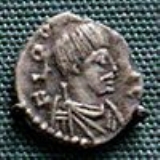
Solidus Odoacer Zenoric 3657cf
In 476, Odoacer officially became the first Germanic King of Italy
King of Italy

King of Italy is a title adopted by many rulers of the Italian peninsula after the fall of the Roman Empire. Until 1870, however, no ?King of Italy? ruled the whole peninsula, though some pretended to such authority....
 and a new era began. Odoacer was an Arian
Arianism

Arianism is the theological teaching of Arius , a Christian priest, who was first ruled a heresy at the First Council of Nicea, later exonerated and then pronounced a heretic again after his death....
 Christian
Christian

A Christian is a person who adheres to Christianity, a Monotheism#Christian view religion centered on the life and teachings of Jesus and interpreted by Christians to have been prophesied in the Hebrew Bible/Old Testament....
 and is said to have been illiterate. The warriors and the families in Odoacer's foederati received lands in Italy and became beneficiaries of a special tax policy. Odoacer retained the Roman administration, senate, law and tax system of Italy. In return, he won a high level of support from the senate and people.

Odoacer raised an Italic-Germanic army with which he defeated the Vandals
Vandals

The Vandals were an East Germanic tribe that entered the late Roman Empire during the 5th century. The Goths Theodoric the Great, king of the Ostrogoths and regent of the Visigoths, was allied by marriage with the Vandals as well as with the Burgundians and the Franks under Clovis I....
 in Sicily
Sicily

Sicily is an Autonomous regions with special statute of Italy. Of all the regions of Italy, Sicily covers the largest land area at 25,708 km? and currently has just over five million inhabitants....
. He was able to conquer the whole island by 477. In 480, he and his Italic-Germanic army conquered all of ancient Dalmatia
Dalmatia

Dalmatia is a region on the eastern coast of the Adriatic Sea, situated mostly in modern Croatia and spreading between the island of Rab in the northwest and the Bay of Kotor in the southeast....
, after the death (possibly by assassination) of Western Emperor Julius Nepos. After this, he received the right to appoint a council and to issue his own coinage. He made pacts with the Visigoths and Franks
Franks

The Franks or Frankish people were a West Germanic ethnic group first identified in the 3rd century as living north and east of the Lower Rhine River....
 and joined them in battle against the Burgundians
Burgundians

File:Roman Empire 125.svgThe Burgundians were an East Germanic language Germanic tribes which may have emigrated from mainland Scandinavia to the island of Bornholm, whose old form in Old Norse still was Burgundarholmr , and from there to mainland Europe....
, Alamanni
Alamanni

The Alamanni, Allemanni, or Alemanni were originally an alliance of Germanic languagess located around the upper Main river . One of the earliest references to them is the cognomen Alamannicus assumed by Caracalla, who ruled the Roman Empire from 211?17 and claimed thereby to be their defeater....
, and Saxons
Saxons

The Saxons were a confederation of Germanic peoples. Their modern-day descendants in Saxony are considered ethnic Germans; those in the eastern Netherlands are considered to be ethnic Dutch people; those in north eastern Belgium are considered to be ethnic Flemish people; and those in southern England ethnic English people ....
.

As Odoacer's kingdom expanded, his popularity among the Italic people grew, and his pacts with the Franks and Visigoths gave him increased influence. All these things started to worry Zeno
Zeno (emperor)

Flavius Zeno Perpetuus, original name Tarasicodissa or Trascalissaeus, Eastern Roman Empire was one of the more prominent of the early Byzantine Emperors....
, the Eastern Emperor, who increasingly saw Odoacer as a rival. In 487 Odoacer led his army to victory against the Rugians
Rugians

The Rugii were an East Germanic tribe whose ultimate origins have been traced to Rogaland in Norway, whose population probably was the Rugii that Jordanes mentioned as a tribe that still remained in Scandza....
 in Noricum
Noricum

Noricum, in ancient history geography, was a Celtic kingdom stretching over the area of today's Austria and Slovenia. It became a Roman province of the Roman Empire....
, but he did not incorporate it into his own kingdom. The remaining Rugians fled and took refuge with the Ostrogoths. Rugiland was left open and by 493 was settled by the Lombards
Lombards

The Lombards were a Germanic peoples originally from Northern Europe who settled in the valley of the Danube and from there invaded Byzantine Italian peninsula in 568 under the leadership of Alboin....
. In 488, Emperor Zeno started a mostly verbal campaign against Odoacer, accusing him of playing a major part in the revolt of Illus
Illus

Illus was a Byzantine Empire general, who played an important role in the reigns of the Byzantine Emperors Zeno and Basiliscus.Illus supported the revolt of Basiliscus against Zeno, then switched sides, supporting the return of Zeno ....
 in 484. With these claims, Zeno convinced his Ostrogothic vassals that Odoacer was an enemy and should be removed. Zeno promised Theodoric son of Amal
Theodoric the Great

File:Theodoric bronze weight inlaid with silver issued by prefect Catulinus Rome 493 526.jpg'Theodoric the Great' , known in Latin as 'Flavius Theodericus' and in Greek sources, was king of the Ostrogoths , ruler of Italy , and regent of the Visigoths ....
 and his Ostrogoths the Italic peninsula if they were to defeat and remove Odoacer. In the same year, 488, Theodoric led the Ostrogoths across the Julian Alps
Julian Alps

The Julian Alps are a mountain range of the Southern Limestone Alps that stretches from north-eastern Italy to Slovenia, where they rise to 2,864 metres at the Triglav mountain....
 and into Italy. With this scenario, the Byzantines killed two birds with one stone. They removed the Ostrogoths from the Balkans
Balkans

The Balkans is the historical name of a geographic subregion of southeastern Europe. The region takes its name from the Balkan Mountains, which run through the centre of Bulgaria into eastern Serbia....
 and their border and at the same time conveniently caused Odoacer to disappear from the scene.

Death

Theodoric
Theodoric the Great

File:Theodoric bronze weight inlaid with silver issued by prefect Catulinus Rome 493 526.jpg'Theodoric the Great' , known in Latin as 'Flavius Theodericus' and in Greek sources, was king of the Ostrogoths , ruler of Italy , and regent of the Visigoths ....
 and his Ostrogoths defeated Odoacer at Aquileia
Aquileia

Aquileia is an ancient history Roman Republic city in what is now Italy, at the head of the Adriatic Sea at the edge of the lagoons, about 10 km from the sea, on the river Natiso , the course of which has changed somewhat since Roman times....
 in 488, at Verona
Verona

Verona is a city in Veneto, northern Italy, one of the seven provincial capitals in the region. It is one of the main tourist destinations in north-eastern Italy, thanks to its artistic heritage, several annual fairs, shows and operas, such as the lyrical season in the Arena, the ancient amphitheatre built by the Romans....
 in 489, and at the Adda River
Adda River

The Adda is a river in North Italy, a tributary of the Po River. It rises in the Alps near the border with Switzerland and flows through Lake Como....
 in 490. In that same year, Theodoric besieged Odoacer at Ravenna
Ravenna

Ravenna is a city and comune in the Emilia-Romagna region of Italy. The city is inland, but is connected to the Adriatic Sea by a canal. Ravenna once served as the seat of the Western Roman Empire and later the Ostrogoths and the Exarchate of Ravenna....
. The siege lasted three years and was marked by dozens of attacks on both sides. In the end, neither side could conclusively prevail, and so on 2 February 493
493

Events...
, Theodoric and Odoacer signed a treaty that ensured a shared rule over Italy. A banquet was organised in order to celebrate this treaty. It was at this banquet that Theodoric, after making a toast, killed Odoacer with his own hands.

Theodoric became the new king of Italy and established an Ostrogothic kingdom
Ostrogothic Kingdom

The Ostrogothic Kingdom established by the Ostrogoths in Italian peninsula and neighbouring areas lasted from 493 to 553. In Italy the Ostrogoths replaced Odoacer, the de facto ruler of Italy who had deposed the last emperor of the Western Roman Empire in 476....
 that was ruled from Ravenna. The remainder of Odoacer's foederati joined the Ostrogoths and were allowed to remain in Italy. Many of the fathers of these warriors and a number of the warriors themselves had fought together with the Ostrogoths at the Battle of Nedao
Battle of Nedao

The Battle of Nedao, named after the Nedava, a tributary of the Sava, was a battle fought in Pannonia in 454. After the death of Attila the Hun, allied forces of the Germanic tribes subject peoples under the leadership of Ardaric, king of the Gepids, defeated the Hunnic forces of Ellac, the son of Attila, who had struggled with his half-broth...
 in 454.

The events around the Battle of Ravenna were used in the Germanic heroic saga of Dietrich von Bern
Thidreks saga

?i?rekssaga is a chivalric sagas of the adventures of the hero Dietrich von Bern who is based on the historical Theodoric the Great, and Bern refers to the city of Verona in Northern Italy....
 (Theodoric of Verona). The event in which Theodoric kills Odoacer with his own hands is mirrored in the saga in the episode in which Dietrich kills the Dwarf King Laurin.

Sources