


Totila

Encyclopedia
Totila, original name Baduila (died July 1, 552) was King of the Ostrogoths from 541 to 552 AD. A skilled military and political leader, Totila reversed the tide of Gothic War, recovering by 543 almost all the territories in Italy
that the Eastern Roman Empire had captured from his Kingdom
in 540.
A relative of Theudis
, sword-bearer of Theodoric the Great
and king of the Visigoths, Totila was elected king by Ostrogothic nobles in the autumn of 541 after King Witigis had been carried off prisoner to Constantinople
. Totila proved himself both as a military and political leader, winning the support of the lower classes by liberating slaves and distributing land to the peasants. After a succesful defence at Verona, Totila pursied and defeated a numerically superior army at the Battle of Faventia
in 542 AD. Building on his victories, Totila followed these victories by defeating
the Romans outside Florence
and capturing
Naples
. By 543, fighting on land and sea, he had reconqured the bulk of the lost territory. Rome
held out, and Totila appealed unsuccesully to the Senate
in a letter reminding them of the loyalty of the Romans to his predecessor Theodoric the Great
. In the spring of 544 the Eastern Roman emperor Justinian I
sent his general Belisarius
to Italy to counterattack, but Totila, captured Rome in 546
from Belisarius and depopulated the city after a yearlong siege. When Totila left to fight the Byzantines in Lucania
, south of Naples
, Belisarius retook Rome and rebuilt its fortifications.
After Belisarius retreated to Constantinople
in 549, Totila recaptured Rome
, going on to complete the reconquest of Italy and Sicily
. By the end of 550, Totila had recaptured all but Ravenna
and four coastal towns. The following year Justinian sent his general Narses
with a force of 35,000 Lombards
, Gepids and Heruli
to Italy in a march around the Adriatic to approach Ravenna from the north. In the Battle of Taginae
, a decisive engagement during the summer of 552, in the Apennines near present-day Fabriano
, the Gothic army was defeated, and Totila was mortally wounded. Totila was succeeded by his relative, Teia
, who later died at the Battle of Mons Lactarius
. Pockets of resistance, reinforced by Franks
and Alemanni who had invaded Italy in 553, continued until 562, when the Byzantines were in control of the whole of the country. The country was so ravaged by war that any return to normal life proved impossible, and only three years after his death most of the country conquered by Alboin
of the Lombards
, who absorbed the remaining Ostrogothic population.
Most of the historical evidence for Totila consists of chronicles by the Byzantine historian Procopius
, who accompanied the Byzantine
General Belisarius
during the Gothic War.
"Totila" was the nom de guerre of a man whose real name was Baduila, as can be seen from the coinage he issued. "Totila" is how he was referred to by the historian ProcopiusItaly
Italy , officially the Italian Republic languages]] under the European Charter for Regional or Minority Languages. In each of these, Italy's official name is as follows:;;;;;;;;), is a unitary parliamentary republic in South-Central Europe. To the north it borders France, Switzerland, Austria and...
that the Eastern Roman Empire had captured from his Kingdom
Ostrogothic Kingdom
The Kingdom established by the Ostrogoths in Italy and neighbouring areas lasted from 493 to 553. In Italy the Ostrogoths replaced Odoacer, the de facto ruler of Italy who had deposed the last emperor of the Western Roman Empire in 476. The Gothic kingdom reached its zenith under the rule of its...
in 540.
A relative of Theudis
Theudis
Theudis was king of the Visigoths in Hispania from 531 to 548. He was the sword-bearer of Theodoric the Great, who sent him to govern the Visigothic kingdom during the minority of Amalaric, the son of king Alaric II and Theodegotho, the daughter of king Theodoric.According to Procopius, during his...
, sword-bearer of Theodoric the Great
Theodoric the Great
Theodoric the Great was king of the Ostrogoths , ruler of Italy , regent of the Visigoths , and a viceroy of the Eastern Roman Empire...
and king of the Visigoths, Totila was elected king by Ostrogothic nobles in the autumn of 541 after King Witigis had been carried off prisoner to Constantinople
Constantinople
Constantinople was the capital of the Roman, Eastern Roman, Byzantine, Latin, and Ottoman Empires. Throughout most of the Middle Ages, Constantinople was Europe's largest and wealthiest city.-Names:...
. Totila proved himself both as a military and political leader, winning the support of the lower classes by liberating slaves and distributing land to the peasants. After a succesful defence at Verona, Totila pursied and defeated a numerically superior army at the Battle of Faventia
Battle of Faventia (542)
In the spring of 542, at the Battle of Faventia , an Ostrogothic army under king Totila scattered the larger Roman forces of generals Constantian and Alexander, beginning the resurgence of Gothic resistance to the Roman reconquest of Italy. Before the battle, Valaris, a gigantic Goth, challenged...
in 542 AD. Building on his victories, Totila followed these victories by defeating
Battle of Mucellium
The Battle of Mucellium was an engagement in 542 near Mugello, Italy, between Ostrogoths and Byzantines during the Gothic War. Having lifted a siege of Florence, the Ostrogoths led by Totila turned on the pursuing Romans, defeating their numerically superior force....
the Romans outside Florence
Florence
Florence is the capital city of the Italian region of Tuscany and of the province of Florence. It is the most populous city in Tuscany, with approximately 370,000 inhabitants, expanding to over 1.5 million in the metropolitan area....
and capturing
Siege of Naples (543)
The Siege of Naples was a succesful siege of Naples by the Ostrogothic leader Totila in 543 AD....
Naples
Naples
Naples is a city in Southern Italy, situated on the country's west coast by the Gulf of Naples. Lying between two notable volcanic regions, Mount Vesuvius and the Phlegraean Fields, it is the capital of the region of Campania and of the province of Naples...
. By 543, fighting on land and sea, he had reconqured the bulk of the lost territory. Rome
Rome
Rome is the capital of Italy and the country's largest and most populated city and comune, with over 2.7 million residents in . The city is located in the central-western portion of the Italian Peninsula, on the Tiber River within the Lazio region of Italy.Rome's history spans two and a half...
held out, and Totila appealed unsuccesully to the Senate
Roman Senate
The Senate of the Roman Republic was a political institution in the ancient Roman Republic, however, it was not an elected body, but one whose members were appointed by the consuls, and later by the censors. After a magistrate served his term in office, it usually was followed with automatic...
in a letter reminding them of the loyalty of the Romans to his predecessor Theodoric the Great
Theodoric the Great
Theodoric the Great was king of the Ostrogoths , ruler of Italy , regent of the Visigoths , and a viceroy of the Eastern Roman Empire...
. In the spring of 544 the Eastern Roman emperor Justinian I
Justinian I
Justinian I ; , ; 483– 13 or 14 November 565), commonly known as Justinian the Great, was Byzantine Emperor from 527 to 565. During his reign, Justinian sought to revive the Empire's greatness and reconquer the lost western half of the classical Roman Empire.One of the most important figures of...
sent his general Belisarius
Belisarius
Flavius Belisarius was a general of the Byzantine Empire. He was instrumental to Emperor Justinian's ambitious project of reconquering much of the Mediterranean territory of the former Western Roman Empire, which had been lost less than a century previously....
to Italy to counterattack, but Totila, captured Rome in 546
Sack of Rome (546)
The Sack of Rome in 546 was carried out by the Gothic king Totila during the Gothic War of 535–554 between the Ostrogoths and the East Romans . Totila was based at Tivoli and, in pursuit of his quest to reconquer the region of Latium, he moved against Rome...
from Belisarius and depopulated the city after a yearlong siege. When Totila left to fight the Byzantines in Lucania
Lucania
Lucania was an ancient district of southern Italy, extending from the Tyrrhenian Sea to the Gulf of Taranto. To the north it adjoined Campania, Samnium and Apulia, and to the south it was separated by a narrow isthmus from the district of Bruttium...
, south of Naples
Naples
Naples is a city in Southern Italy, situated on the country's west coast by the Gulf of Naples. Lying between two notable volcanic regions, Mount Vesuvius and the Phlegraean Fields, it is the capital of the region of Campania and of the province of Naples...
, Belisarius retook Rome and rebuilt its fortifications.
After Belisarius retreated to Constantinople
Constantinople
Constantinople was the capital of the Roman, Eastern Roman, Byzantine, Latin, and Ottoman Empires. Throughout most of the Middle Ages, Constantinople was Europe's largest and wealthiest city.-Names:...
in 549, Totila recaptured Rome
Siege of Rome (549–550)
In 549-550, the Ostrogothic leader Totila besieged Rome and captured the city after Belisarius had retreated to Constantinople....
, going on to complete the reconquest of Italy and Sicily
Sicily
Sicily is a region of Italy, and is the largest island in the Mediterranean Sea. Along with the surrounding minor islands, it constitutes an autonomous region of Italy, the Regione Autonoma Siciliana Sicily has a rich and unique culture, especially with regard to the arts, music, literature,...
. By the end of 550, Totila had recaptured all but Ravenna
Ravenna
Ravenna is the capital city of the Province of Ravenna in the Emilia-Romagna region of Italy and the second largest comune in Italy by land area, although, at , it is little more than half the size of the largest comune, Rome...
and four coastal towns. The following year Justinian sent his general Narses
Narses
Narses was, with Belisarius, one of the great generals in the service of the Byzantine Emperor Justinian I during the "Reconquest" that took place during Justinian's reign....
with a force of 35,000 Lombards
Lombards
The Lombards , also referred to as Longobards, were a Germanic tribe of Scandinavian origin, who from 568 to 774 ruled a Kingdom in Italy...
, Gepids and Heruli
Heruli
The Heruli were an East Germanic tribe who are famous for their naval exploits. Migrating from Northern Europe to the Black Sea in the third century They were part of the...
to Italy in a march around the Adriatic to approach Ravenna from the north. In the Battle of Taginae
Battle of Taginae
At the Battle of Taginae in June/July 552, the forces of the Byzantine Empire under Narses broke the power of the Ostrogoths in Italy, and paved the way for the temporary Byzantine reconquest of the Italian Peninsula.From as early as 549 the Emperor Justinian I had planned to dispatch a major army...
, a decisive engagement during the summer of 552, in the Apennines near present-day Fabriano
Fabriano
Fabriano is a town and comune of Ancona province in the Italian region of the Marche, at 325 m above sea-level. It lies in the Esino valley 44 km upstream and SW of Jesi; and 15 km ENE of Fossato di Vico and 36 km east of Gubbio...
, the Gothic army was defeated, and Totila was mortally wounded. Totila was succeeded by his relative, Teia
Teia
Teia , also known as Teja, Theia, Thila, Thela, Teias, was the last Ostrogothic king in Italy.Apparently a military officer serving under Totila, Teia was chosen as successor and raised over a shield after Totila was slain in the Battle of Taginae in July 552...
, who later died at the Battle of Mons Lactarius
Battle of Mons Lactarius
The Battle of Mons Lactarius took place in 552 or 553 in the course the Gothic War waged on behalf of Justinian I against the Ostrogoths in Italy....
. Pockets of resistance, reinforced by Franks
Franks
The Franks were a confederation of Germanic tribes first attested in the third century AD as living north and east of the Lower Rhine River. From the third to fifth centuries some Franks raided Roman territory while other Franks joined the Roman troops in Gaul. Only the Salian Franks formed a...
and Alemanni who had invaded Italy in 553, continued until 562, when the Byzantines were in control of the whole of the country. The country was so ravaged by war that any return to normal life proved impossible, and only three years after his death most of the country conquered by Alboin
Alboin
Alboin was king of the Lombards from about 560 until 572. During his reign the Lombards ended their migrations by settling in Italy, the northern part of which Alboin conquered between 569 and 572...
of the Lombards
Lombards
The Lombards , also referred to as Longobards, were a Germanic tribe of Scandinavian origin, who from 568 to 774 ruled a Kingdom in Italy...
, who absorbed the remaining Ostrogothic population.
Most of the historical evidence for Totila consists of chronicles by the Byzantine historian Procopius
Procopius
Procopius of Caesarea was a prominent Byzantine scholar from Palestine. Accompanying the general Belisarius in the wars of the Emperor Justinian I, he became the principal historian of the 6th century, writing the Wars of Justinian, the Buildings of Justinian and the celebrated Secret History...
, who accompanied the Byzantine
Byzantine
Byzantine usually refers to the Roman Empire during the Middle Ages.Byzantine may also refer to:* A citizen of the Byzantine Empire, or native Greek during the Middle Ages...
General Belisarius
Belisarius
Flavius Belisarius was a general of the Byzantine Empire. He was instrumental to Emperor Justinian's ambitious project of reconquering much of the Mediterranean territory of the former Western Roman Empire, which had been lost less than a century previously....
during the Gothic War.
Early life
div class='thumb tright'>Procopius
Procopius of Caesarea was a prominent Byzantine scholar from Palestine. Accompanying the general Belisarius in the wars of the Emperor Justinian I, he became the principal historian of the 6th century, writing the Wars of Justinian, the Buildings of Justinian and the celebrated Secret History...
. Born in Treviso
Treviso
Treviso is a city and comune in Veneto, northern Italy. It is the capital of the province of Treviso and the municipality has 82,854 inhabitants : some 3,000 live within the Venetian walls or in the historical and monumental center, some 80,000 live in the urban center proper, while the city...
, Totila was a relative of Theudis
Theudis
Theudis was king of the Visigoths in Hispania from 531 to 548. He was the sword-bearer of Theodoric the Great, who sent him to govern the Visigothic kingdom during the minority of Amalaric, the son of king Alaric II and Theodegotho, the daughter of king Theodoric.According to Procopius, during his...
, king of the Visigoths. Elected king of the Ostrogoths in 541 after the death of his uncle Ildibad
Ildibad
Ildibad was a king of the Ostrogoths in Italy, being chosen to replace Witiges, who had been engaged in various intregues with Belisarius, and had left Ravenna...
, having engineered the assassination of Ildibad's short-lived successor, his cousin Eraric
Eraric
Eraric was briefly King of the Ostrogoths. He was killed by a member of his royal guard. He had nine wives....
in 541. The official Byzantine position, adopted by Procopius and even by the Romanized Goth Jordanes
Jordanes
Jordanes, also written Jordanis or Jornandes, was a 6th century Roman bureaucrat, who turned his hand to history later in life....
, writing just before the conclusion of the Gothic Wars, was that Totila was a usurper: Jordanes' Getica (551) overlooks the recent successes of Totila.
Initial victories
His life's work was the restoration of the GothicGoths
The Goths were an East Germanic tribe of Scandinavian origin whose two branches, the Visigoths and the Ostrogoths, played an important role in the fall of the Roman Empire and the emergence of Medieval Europe....
kingdom in Italy
Italy
Italy , officially the Italian Republic languages]] under the European Charter for Regional or Minority Languages. In each of these, Italy's official name is as follows:;;;;;;;;), is a unitary parliamentary republic in South-Central Europe. To the north it borders France, Switzerland, Austria and...
, and he entered upon the task from the very beginning of his reign, collecting together and inspiring the Goths
Goths
The Goths were an East Germanic tribe of Scandinavian origin whose two branches, the Visigoths and the Ostrogoths, played an important role in the fall of the Roman Empire and the emergence of Medieval Europe....
, defeating a poorly led Byzantine attack on the Gothic stronghold of Verona
Verona
Verona ; German Bern, Dietrichsbern or Welschbern) is a city in the Veneto, northern Italy, with approx. 265,000 inhabitants and one of the seven chef-lieus of the region. It is the second largest city municipality in the region and the third of North-Eastern Italy. The metropolitan area of Verona...
in the winter of 541, and scattering the stronger Byzantine army at Faenza
Faenza
Faenza is an Italian city and comune, in the province of Ravenna, Emilia-Romagna, situated 50 km southeast of Bologna.Faenza is noted for its manufacture of majolica ware glazed earthenware pottery, known from the name of the town as "faience"....
(Battle of Faventia
Battle of Faventia (542)
In the spring of 542, at the Battle of Faventia , an Ostrogothic army under king Totila scattered the larger Roman forces of generals Constantian and Alexander, beginning the resurgence of Gothic resistance to the Roman reconquest of Italy. Before the battle, Valaris, a gigantic Goth, challenged...
) in the spring of 542.
Having gained another victory in 542, this time, avoiding stoutly defended Florence
Florence
Florence is the capital city of the Italian region of Tuscany and of the province of Florence. It is the most populous city in Tuscany, with approximately 370,000 inhabitants, expanding to over 1.5 million in the metropolitan area....
, in the valley of Mugello, where Totila showed his nature by treating his prisoners so well that they were induced to serve under his banner, he left a well-defended Tuscany
Tuscany
Tuscany is a region in Italy. It has an area of about 23,000 square kilometres and a population of about 3.75 million inhabitants. The regional capital is Florence ....
with his enlarged forces, while three of the Byzantine generals withdrew from Florence, dividing their forces, to Perugia
Perugia
Perugia is the capital city of the region of Umbria in central Italy, near the River Tiber, and the capital of the province of Perugia. The city is located about north of Rome. It covers a high hilltop and part of the valleys around the area....
, Spoleto
Spoleto
Spoleto is an ancient city in the Italian province of Perugia in east central Umbria on a foothill of the Apennines. It is S. of Trevi, N. of Terni, SE of Perugia; SE of Florence; and N of Rome.-History:...
, and Rome
Rome
Rome is the capital of Italy and the country's largest and most populated city and comune, with over 2.7 million residents in . The city is located in the central-western portion of the Italian Peninsula, on the Tiber River within the Lazio region of Italy.Rome's history spans two and a half...
, cities which Totila would have to take by siege.
In the meantime, instead of pursuing the conquest of central Italy, where the Imperial forces were too formidable for his small army, he decided to transfer his operations to the south of the peninsula, where he captured Beneventum and received the submission of the provinces of Lucania
Lucania
Lucania was an ancient district of southern Italy, extending from the Tyrrhenian Sea to the Gulf of Taranto. To the north it adjoined Campania, Samnium and Apulia, and to the south it was separated by a narrow isthmus from the district of Bruttium...
and Bruttium, Apulia
Apulia
Apulia is a region in Southern Italy bordering the Adriatic Sea in the east, the Ionian Sea to the southeast, and the Strait of Òtranto and Gulf of Taranto in the south. Its most southern portion, known as Salento peninsula, forms a high heel on the "boot" of Italy. The region comprises , and...
and Calabria
Calabria
Calabria , in antiquity known as Bruttium, is a region in southern Italy, south of Naples, located at the "toe" of the Italian Peninsula. The capital city of Calabria is Catanzaro....
, essentially the whole of the Greek south; their Imperial taxes were now diverted to his benefit.
Totila's strategy was to move fast and take control of the countryside, leaving the Byzantine forces in control of well-defended cities, and especially the ports. When Belisarius eventually returned to Italy, Procopius relates that "during a space of five years he did not succeed once in setting foot on any part of the land... except where some fortress was, but during this whole period he kept sailing about visiting one port after another." Totila circumvented those cities where a drawn-out siege would have been required, razing the walls of cities that capitulated to him, such as Beneventum. Totila's conquest of Italy was marked not only by celerity but also by mercy, and Gibbon
Edward Gibbon
Edward Gibbon was an English historian and Member of Parliament...
says "none were deceived, either friends or enemies, who depended on his faith or his clemency." After a successful siege of a resisting city, such as at Perugia, however, Totila could be merciless, as the Byzantine historian Procopius
Procopius
Procopius of Caesarea was a prominent Byzantine scholar from Palestine. Accompanying the general Belisarius in the wars of the Emperor Justinian I, he became the principal historian of the 6th century, writing the Wars of Justinian, the Buildings of Justinian and the celebrated Secret History...
recounts. Procopius also left a word portrait of Totila before his troops drawn up for battle:
The armor in which he was clad was abundantly plated with gold and the ample adornments which hung from his cheek plates as well as his helmet and spear were not only purple, but in other respects befitting a king ... And he himself, sitting upon a very large horse, began to dance under arms skillfully between the two armies. And as he rode he hurled his javelin into the air and caught it again as it quivered above him, then passed it rapidly from hand to hand, shifting it with consummate skill.
Taking Naples
Procopius's picture is given an uncharacteristic setting, for Totila generally avoided formal battles with opposing armies drawn up in battle array and excelled at skirmishing. A siege was required at Naples, however, where the report of Totila's courteous treatment of Romans at CumaeCumae
Cumae is an ancient Greek settlement lying to the northwest of Naples in the Italian region of Campania. Cumae was the first Greek colony on the mainland of Italy , and the seat of the Cumaean Sibyl...
and other surrounding towns undermined morale. Justinian was alarmed, but jealousy kept his one brilliantly competent general Belisarius
Belisarius
Flavius Belisarius was a general of the Byzantine Empire. He was instrumental to Emperor Justinian's ambitious project of reconquering much of the Mediterranean territory of the former Western Roman Empire, which had been lost less than a century previously....
at Constantinople. An attempt to relieve Naples by sea was badly bungled when Totila was informed during unnecessary delays, and a storm dispersed a second attempt, delivering the general, Demetrius, into Totila's hands. Totila offered generous terms and Conon's starving garrison at Naples opened their gates in the spring of 543.
On this occasion Totila exhibited a considerable humanity which was not to be expected, as the historian Procopius remarks, from an enemy or a barbarian. He knew that if an abundance of food were at once supplied, the famished inhabitants would gorge themselves to death. He posted sentinels at the gates and in the harbor and allowed no one to leave the city. Then he dealt out small rations, gradually increasing the quantity every day until the people had recovered their strength. The terms of the capitulation were more than faithfully observed. Conon and his followers were embarked in ships with which the Goths provided them, and when, deciding to sail for Rome, they were hindered by contrary winds, Totila furnished horses, provisions, and guides so that they could make the journey by land.
The fortifications were partly razed. Totila spent the following season establishing himself in the south and reducing pockets of resistance, while the unpaid Imperial troops in central Italy made such poor reputations pillaging the countryside that when Totilas turned his attention to taking Rome, he was able proudly to contrast Goth and Greek behavior in his initial negotiations with the senate. They were refused, however, and all the Arian
Arianism
Arianism is the theological teaching attributed to Arius , a Christian presbyter from Alexandria, Egypt, concerning the relationship of the entities of the Trinity and the precise nature of the Son of God as being a subordinate entity to God the Father...
priests were expelled from the city, on suspicion of collaboration.
Siege of Rome
Towards the end of 545 the Gothic king took up his station at TivoliTivoli, Italy
Tivoli , the classical Tibur, is an ancient Italian town in Lazio, about 30 km east-north-east of Rome, at the falls of the Aniene river where it issues from the Sabine hills...
and prepared to starve Rome
Rome
Rome is the capital of Italy and the country's largest and most populated city and comune, with over 2.7 million residents in . The city is located in the central-western portion of the Italian Peninsula, on the Tiber River within the Lazio region of Italy.Rome's history spans two and a half...
into surrender, making at the same time elaborate preparations for checking the progress of Belisarius who was advancing to its relief. Pope Vigilius
Pope Vigilius
Pope Vigilius reigned as pope from 537 to 555, is considered the first pope of the Byzantine Papacy.-Early life:He belonged to a aristocratic Roman family; his father Johannes is identified as a consul in the Liber pontificalis, having received that title from the emperor...
fled to the safety of Syracuse; when he sent a flotilla of grain ships to feed the city, Totila's navy fell on them near the mouth of the Tiber and captured the fleet. The imperial fleet, moving up the Tiber
Tiber
The Tiber is the third-longest river in Italy, rising in the Apennine Mountains in Emilia-Romagna and flowing through Umbria and Lazio to the Tyrrhenian Sea. It drains a basin estimated at...
and led by the great general, only just failed to relieve the city, which then was forced to open its gates to the Goths.
It was plundered, although Totila did not carry out his threat to make it a pasture for cattle, and when the Gothic army withdrew into Apulia it was from a scene of desolation. But its walls and other fortifications were soon restored, and Totila again marched against it. He was defeated by Belisarius, who, however, did not follow up his advantage. Several cities including Perugia
Perugia
Perugia is the capital city of the region of Umbria in central Italy, near the River Tiber, and the capital of the province of Perugia. The city is located about north of Rome. It covers a high hilltop and part of the valleys around the area....
were taken by the Goths, while Belisarius remained inactive and then was recalled from Italy. In 549 Totila advanced a third time against Rome, which he captured through the treachery of some of its starving defenders.
Totila's meeting with Benedict of Nursia
Benedict of Nursia
Saint Benedict of Nursia is a Christian saint, honored by the Roman Catholic Church as the patron saint of Europe and students.Benedict founded twelve communities for monks at Subiaco, about to the east of Rome, before moving to Monte Cassino in the mountains of southern Italy. There is no...
at Monte Cassino
Monte Cassino
Monte Cassino is a rocky hill about southeast of Rome, Italy, c. to the west of the town of Cassino and altitude. St. Benedict of Nursia established his first monastery, the source of the Benedictine Order, here around 529. It was the site of Battle of Monte Cassino in 1944...
is preserved in Pope Gregory I
Pope Gregory I
Pope Gregory I , better known in English as Gregory the Great, was pope from 3 September 590 until his death...
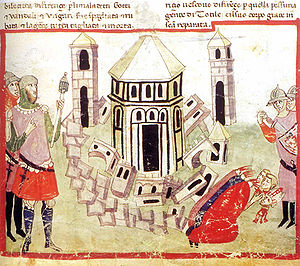
's Dialogues (ii.14-15). It occurred either before or soon after the siege of Naples; the Benedictines' traditional date is March 21, 543. It includes a telling of the abbot's discernment of an aide of Totila's, his sword-bearer Riggio, dressed in royal robes, as an imposter, and also his predictions for Totila, who knelt to him. This event was a favorite subject for Italian painters.
Death
His next exploit was the conquest and plunder of SicilySicily
Sicily is a region of Italy, and is the largest island in the Mediterranean Sea. Along with the surrounding minor islands, it constitutes an autonomous region of Italy, the Regione Autonoma Siciliana Sicily has a rich and unique culture, especially with regard to the arts, music, literature,...
, after which he subdued Corsica
Corsica
Corsica is an island in the Mediterranean Sea. It is located west of Italy, southeast of the French mainland, and north of the island of Sardinia....
and Sardinia
Sardinia
Sardinia is the second-largest island in the Mediterranean Sea . It is an autonomous region of Italy, and the nearest land masses are the French island of Corsica, the Italian Peninsula, Sicily, Tunisia and the Spanish Balearic Islands.The name Sardinia is from the pre-Roman noun *sard[],...
and sent a Gothic fleet against the coasts of Greece
Greece
Greece , officially the Hellenic Republic , and historically Hellas or the Republic of Greece in English, is a country in southeastern Europe....
. By this time the emperor Justinian I
Justinian I
Justinian I ; , ; 483– 13 or 14 November 565), commonly known as Justinian the Great, was Byzantine Emperor from 527 to 565. During his reign, Justinian sought to revive the Empire's greatness and reconquer the lost western half of the classical Roman Empire.One of the most important figures of...
was taking energetic measures to check the Goths. The conduct of a new campaign was entrusted to the eunuch
Eunuch
A eunuch is a person born male most commonly castrated, typically early enough in his life for this change to have major hormonal consequences...
Narses
Narses
Narses was, with Belisarius, one of the great generals in the service of the Byzantine Emperor Justinian I during the "Reconquest" that took place during Justinian's reign....
; Totila marched against him and was defeated and killed at the Battle of Taginae
Battle of Taginae
At the Battle of Taginae in June/July 552, the forces of the Byzantine Empire under Narses broke the power of the Ostrogoths in Italy, and paved the way for the temporary Byzantine reconquest of the Italian Peninsula.From as early as 549 the Emperor Justinian I had planned to dispatch a major army...
(also known as the Battle of Busta Gallorum) in July 552, which brought an end to the long struggle between Byzantium and the Ostrogothic Kingdom in Italy, and left the Eastern Emperor for the time being in control of Italy.
Aftermath
Totila was succeeded by his relative, TeiaTeia
Teia , also known as Teja, Theia, Thila, Thela, Teias, was the last Ostrogothic king in Italy.Apparently a military officer serving under Totila, Teia was chosen as successor and raised over a shield after Totila was slain in the Battle of Taginae in July 552...
, who later died at the Battle of Mons Lactarius
Battle of Mons Lactarius
The Battle of Mons Lactarius took place in 552 or 553 in the course the Gothic War waged on behalf of Justinian I against the Ostrogoths in Italy....
. The Goths were later absorbed into the Lombard
Lombard
The term Lombard refers to members of or things related, directly or indirectly, to the Lombards , a Germanic tribe that dominated northern Italy and adjoining areas from the 6th to 8th centuries...
Kingdom
Kingdom of the Lombards
The Kingdom of the Lombards or Lombard Kingdom was an early medieval state, with its capital in Pavia, established by the Lombards on the Italian Peninsula between 568-569 and 774 .Effective control by the rulers of both the major areas that constituted the...
.
External links
- Encyclopaedia Britannica 1911: Totila
- Edward Gibbon, The Decline and Fall of the Roman Empire: vol 4.xliii.3 (Totila takes Rome) La guerra gotico-bizantina Le sepolture regie del regno italico (secoli VI-X) - Totila (541-552)
Category:552 deaths
Category:People from the Province of Treviso
Category:Gothic people
Category:6th-century rulers in Europe
Category:6th-century Italian people
ar:توتيلا
bg:Тотила
ca:Tòtila
cs:Totila
de:Totila
es:Totila
fr:Totila
gl:Tótila
got:𐍄𐍉𐍄𐌹𐌻𐌰/Totila
ko:토틸라
id:Totila
it:Totila
he:טוטילה
la:Totila (rex Ostrogothorum)
hu:Totila keleti gót király
nl:Totila
ja:トーティラ
no:Totila
pl:Totila
pt:Totila
ro:Totila
ru:Тотила
scn:Totila
sr:Тотила
sh:Totila
fi:Totila
sv:Totila
vec:Totila