


Luca Signorelli

Encyclopedia
Luca Signorelli was an Italian Renaissance
painter
who was noted in particular for his ability as a draughtsman and his use of foreshortening. His massive frescoes of the Last Judgment (1499–1503) in Orvieto Cathedral are considered his masterpiece.
, Tuscany (some sources call him Luca da Cortona). The precise date of his birth is uncertain; birth dates of 1441–1445 are proposed. He died in 1523 in Cortona, where he is buried. He was perhaps eighty-two years old. He is considered to be part of the Tuscan school, although he also worked extensively in Umbria and Rome.
His first impressions of art seem to be due to Perugia — the style of Benedetto Bonfigli
, Fiorenzo di Lorenzo
and Pinturicchio
. Lazzaro Vasari, the great-grandfather of art historian Giorgio Vasari
, was brother to Luca's mother; according to Giorgio Vasari
he got Luca apprenticed to Piero della Francesca
. In 1472 the young man was painting at Arezzo
, and in 1474 at Città di Castello
. He presented to Lorenzo de' Medici
a picture which is probably the one named the School of Pan. Janet Ross
and her husband Henry discovered the painting in Florence circa 1870 and subsequently sold it to the Kaiser Frederick Museum in Berlin. The painting was destroyed by allied bombs in WWII. See Benjamin, Sarah (2006) A Castle In Tuscany at 63-67 (image of the painting at 64-65) Murdoch Books Australia. The painting's subject is almost the same which he painted also on the wall of the Petrucci palace in Siena—the principal figures being Pan himself, Olympus
, Echo
, a man reclining on the ground and two listening shepherds.
He executed, moreover, various sacred pictures, showing a study of Botticelli
and Lippo Lippi. Pope Sixtus IV
commissioned Signorelli to paint some fresco
es, now mostly very dim, in the shrine of Loreto—Angels, Doctors of the Church, Evangelists, Apostles, the Incredulity of Thomas and the Conversion of St Paul. He also executed a single fresco in the Sistine Chapel
in Rome
, the Testament and Death of Moses, although most of it has been attributed to Bartolomeo della Gatta
; another, the Moses Leaving to Egypt, once ascribed to Signorelli, is now recognized as the work of Perugino
and other assistants.
Signorelli worked in Rome from 1478 to 1484. In the latter year he returned to his native Cortona, which remained from this time his home. In the Monastery of Monte Oliveto Maggiore (Siena) he painted eight frescoes, forming part of a vast series of the life of St. Benedict
; they are at present much injured. In the palace of Pandolfo Petrucci
he worked upon various classic or mythological subjects, including the School of Pan already mentioned.
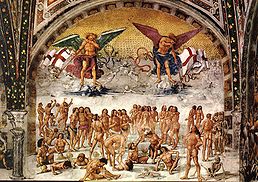 From the Monastery of Monte Oliveto Maggiore near Siena
, Signorelli went to Orvieto
, and produced his masterpiece, the frescoes in the chapel of S. Brizio (then called the Cappella Nuova), in the cathedral
.
The Cappella Nuova already contained two groups of images in the vaulting over the altar, the Judging Christ and the Prophets, by Fra Angelico
, who had begun the murals fifty years earlier. The works of Signorelli in the vaults and on the upper walls represent the events surrounding the Apocalypse and the Last Judgment. The events of the Apocalypse fill the space which surrounds the entrance into the large chapel.
The Apocalyptic events begin with the Preaching of Antichrist, and proceed to the Doomsday and The Resurrection of the Flesh. They occupy three vast lunette
s, each of them a single continuous narrative composition. In one of them, Antichrist
, after his portents and impious glories, falls headlong from the sky, crashing down into an innumerable crowd of men and women.
The events of the Last Judgment fill the facing vault and the walls around the altar: Paradise, the Elect and the Condemned, Hell, the Resurrection of the Dead, and the Destruction of the Reprobate.
To Angelico's ceiling, which contained the Judging Christ and the Prophets led by John the Baptist, Signorelli added the Madonna leading the Apostles, the Patriarchs, Doctors of the Church, Martyrs, and Virgins. The unifying factor of the paintings is found in the scripture readings in the Roman liturgies for the Feast of All Saints and Advent.
Stylistically, the daring and terrible inventions, with their powerful treatment of the nude and arduous foreshortenings, were striking in its day. Michelangelo
is claimed to have borrowed, in his own fresco at the Sistine Chapel
wall, some of Signorelli's figures or combinations. The decoration of the lower walls, unprecedented in the history of art, are richly decorated with a great deal of subsidiary work connected with Dante
, specifically the first eleven books of his Purgatorio, and with the poets and legends of antiquity. A Pietà composition in a niche in the lower wall contains explicit references to two important Orvietan martyr saints, S. Pietro Parenzo and S. Faustino, in the centuries preceding the execution of the lunette paintings.
The contract for Signorelli's work is still on record in the archives of the Cathedral of Orvieto. He undertook on April 5, 1499 to complete the ceiling for 200 ducats, and to paint the walls for 600, along with lodging, and in every month two measures of wine and two quarters of corn. The contract directed Signorelli to consult the Masters of the Sacred Page for theological matters. This is the first such recorded instance of an artist receiving theological advice, although art historians believe the two groups routinely discussed such matters. Signorelli's first stay in Orvieto lasted not more than two years. In 1502 he returned to Cortona. He returned to Orvieto and continued the lower walls. He painted a dead Christ, with Mary Magdalen and the Virgin Mary and the martyrs local Saints Pietro Parenzo and Faustino.The figure of the dead Christ, according to Vasari, is the image of Signorelli's son Antonio, who died from the plague during the course of the execution of the paintings.
in the Marche
, the Madonna and Child, with the Massacre of the Innocents and other episodes.
In 1508 Pope Julius II
summoned artists to Rome, including Signorelli, Perugino
, Pinturicchio
and Il Sodoma
to paint the large rooms in the Vatican Palace. They began work, but soon the pope dismissed all to make way for Raphael
. Their work was taken down, except for the ceiling in the Stanza della Segnatura. Luca returned to Siena, but mostly lived in his hometown of Cortona. He constantly was at work, but the performances of his closing years were not of the quality of his works from 1490–1505.
In 1520 Signorelli went with one of his pictures to Arezzo. He was partially paralysed when he began a fresco of the Baptism of Christ in the chapel of Cardinal Passerini's palace near Cortona, which (or else a Coronation of the Virgin at Foiano) is the last picture of his specified. Signorelli stood in great repute as a citizen. He entered the magistracy of Cortona as early as 1488, and held a leading position by 1524 when he died.
Signorelli paid great attention to anatomy. It is said that he carried on his studies in burial grounds. Certainly his mastery of the human form indicates that he had performed dissections. He surpassed contemporaries in showing-the structure and mechanism of the nude in immediate action; and he even went beyond nature in experiments of this kind, trying hypothetical attitudes and combinations. His drawings in the Louvre
demonstrate this and bear a close analogy to the method of Michelangelo. He aimed at powerful truth rather than nobility of form; colour was comparatively neglected, and his chiaroscuro
exhibits sharp oppositions of lights and shadows. He had a vast influence over the painters of his own and of succeeding times, but had no pupils or assistants of high mark; one of them was a nephew named Francesco.
Vasari, who claimed Signorelli as a relative, described him as kindly, a family man, and said that he always lived more like a nobleman than a painter. Vasari included Signorelli's portrait, one of seven, in his study in Arezzo, along with Michelangelo and himself. The Torrigiani Gallery in Florence contains a grand life-sized portrait by Signorelli of a man in a red cap and vest, and corresponds with Vasari's observation. In the National Gallery, London
, are the Circumcision of Jesus
and three other works. Legend holds that Signorelli depicted himself in the left foreground of his Orvietan mural The Rule of Antichrist. Fra Angelico, his predecessor in the Orvieto cycle, is thought to stand behind him in the piece. However, the figure thought to be Fra Angelico is not dressed as a Dominican friar, and Signorelli's supposed portrait does not match that in Vasari's study.
.
Italian Renaissance
The Italian Renaissance began the opening phase of the Renaissance, a period of great cultural change and achievement in Europe that spanned the period from the end of the 13th century to about 1600, marking the transition between Medieval and Early Modern Europe...
painter
Painting
Painting is the practice of applying paint, pigment, color or other medium to a surface . The application of the medium is commonly applied to the base with a brush but other objects can be used. In art, the term painting describes both the act and the result of the action. However, painting is...
who was noted in particular for his ability as a draughtsman and his use of foreshortening. His massive frescoes of the Last Judgment (1499–1503) in Orvieto Cathedral are considered his masterpiece.
Biography
He was born Luca d'Egidio di Ventura in CortonaCortona
Cortona is a town and comune in the province of Arezzo, in Tuscany, Italy. It is the main cultural and artistic center of the Val di Chiana after Arezzo.-History:...
, Tuscany (some sources call him Luca da Cortona). The precise date of his birth is uncertain; birth dates of 1441–1445 are proposed. He died in 1523 in Cortona, where he is buried. He was perhaps eighty-two years old. He is considered to be part of the Tuscan school, although he also worked extensively in Umbria and Rome.
His first impressions of art seem to be due to Perugia — the style of Benedetto Bonfigli
Benedetto Bonfigli
Benedetto Bonfigli was an Italian painter born in Perugia, and active around Umbria. He is also known as Buonfiglio. He was the teacher of the painter Pietro Perugino....
, Fiorenzo di Lorenzo
Fiorenzo di Lorenzo
Fiorenzo di Lorenzo was an Italian painter, of the Umbrian school. He lived and worked at Perugia, where most of his authentic works are still preserved in the Galleria Nazionale dell'Umbria....
and Pinturicchio
Pinturicchio
Bernardino di Betto, called Pintoricchio or Pinturicchio was an Italian painter of the Renaissance. He acquired his nickname, Pintoricchio , because of his small stature, and he used it to sign some of his works....
. Lazzaro Vasari, the great-grandfather of art historian Giorgio Vasari
Giorgio Vasari
Giorgio Vasari was an Italian painter, writer, historian, and architect, who is famous today for his biographies of Italian artists, considered the ideological foundation of art-historical writing.-Biography:...
, was brother to Luca's mother; according to Giorgio Vasari
Giorgio Vasari
Giorgio Vasari was an Italian painter, writer, historian, and architect, who is famous today for his biographies of Italian artists, considered the ideological foundation of art-historical writing.-Biography:...
he got Luca apprenticed to Piero della Francesca
Piero della Francesca
Piero della Francesca was a painter of the Early Renaissance. As testified by Giorgio Vasari in his Lives of the Artists, to contemporaries he was also known as a mathematician and geometer. Nowadays Piero della Francesca is chiefly appreciated for his art. His painting was characterized by its...
. In 1472 the young man was painting at Arezzo
Arezzo
Arezzo is a city and comune in Central Italy, capital of the province of the same name, located in Tuscany. Arezzo is about 80 km southeast of Florence, at an elevation of 296 m above sea level. In 2011 the population was about 100,000....
, and in 1474 at Città di Castello
Città di Castello
Città di Castello is a city and comune in the province of Perugia, in the northern part of the Umbria region of Italy. It is situated on a slope of the Apennines, on the flood plain of the river Tiber. The city is north of Perugia and south of Cesena on the S3bis. It is connected to the A1...
. He presented to Lorenzo de' Medici
Lorenzo de' Medici
Lorenzo de' Medici was an Italian statesman and de facto ruler of the Florentine Republic during the Italian Renaissance. Known as Lorenzo the Magnificent by contemporary Florentines, he was a diplomat, politician and patron of scholars, artists and poets...
a picture which is probably the one named the School of Pan. Janet Ross
Janet Ross
-Early life:Janet Duff Gordon was the daughter of Sir Alexander Duff-Gordon and Lucie, Lady Duff-Gordon. Her father held a number of government positions, including Commissioner of Inland Revenue and her mother wrote the classic Letters from Egypt...
and her husband Henry discovered the painting in Florence circa 1870 and subsequently sold it to the Kaiser Frederick Museum in Berlin. The painting was destroyed by allied bombs in WWII. See Benjamin, Sarah (2006) A Castle In Tuscany at 63-67 (image of the painting at 64-65) Murdoch Books Australia. The painting's subject is almost the same which he painted also on the wall of the Petrucci palace in Siena—the principal figures being Pan himself, Olympus
Mount Olympus
Mount Olympus is the highest mountain in Greece, located on the border between Thessaly and Macedonia, about 100 kilometres away from Thessaloniki, Greece's second largest city. Mount Olympus has 52 peaks. The highest peak Mytikas, meaning "nose", rises to 2,917 metres...
, Echo
Echo (mythology)
In Greek mythology, Ekho , "echo", itself from ἦχος , "sound") was an Oread who loved her own voice. Zeus loved consorting with beautiful nymphs and visited them on Earth often. Eventually, Zeus's wife, Hera, became suspicious, and came from Mt...
, a man reclining on the ground and two listening shepherds.
He executed, moreover, various sacred pictures, showing a study of Botticelli
Sandro Botticelli
Alessandro di Mariano di Vanni Filipepi, better known as Sandro Botticelli was an Italian painter of the Early Renaissance...
and Lippo Lippi. Pope Sixtus IV
Pope Sixtus IV
Pope Sixtus IV , born Francesco della Rovere, was Pope from 1471 to 1484. His accomplishments as Pope included the establishment of the Sistine Chapel; the group of artists that he brought together introduced the Early Renaissance into Rome with the first masterpiece of the city's new artistic age,...
commissioned Signorelli to paint some fresco
Fresco
Fresco is any of several related mural painting types, executed on plaster on walls or ceilings. The word fresco comes from the Greek word affresca which derives from the Latin word for "fresh". Frescoes first developed in the ancient world and continued to be popular through the Renaissance...
es, now mostly very dim, in the shrine of Loreto—Angels, Doctors of the Church, Evangelists, Apostles, the Incredulity of Thomas and the Conversion of St Paul. He also executed a single fresco in the Sistine Chapel
Sistine Chapel
Sistine Chapel is the best-known chapel in the Apostolic Palace, the official residence of the Pope in Vatican City. It is famous for its architecture and its decoration that was frescoed throughout by Renaissance artists including Michelangelo, Sandro Botticelli, Pietro Perugino, Pinturicchio...
in Rome
Rome
Rome is the capital of Italy and the country's largest and most populated city and comune, with over 2.7 million residents in . The city is located in the central-western portion of the Italian Peninsula, on the Tiber River within the Lazio region of Italy.Rome's history spans two and a half...
, the Testament and Death of Moses, although most of it has been attributed to Bartolomeo della Gatta
Bartolomeo della Gatta
Bartolomeo della Gatta , born Pietro di Antonio Dei, was an Italian painter, illuminator, and architect. He was the son of a goldsmith. He was a colleague of Fra Bartolommeo. In 1468, Bartolomeo became a monk in the Order of Camaldoli, probably in the Church of Santa Maria degli Angeli in...
; another, the Moses Leaving to Egypt, once ascribed to Signorelli, is now recognized as the work of Perugino
Pietro Perugino
Pietro Perugino , born Pietro Vannucci, was an Italian Renaissance painter of the Umbrian school, who developed some of the qualities that found classic expression in the High Renaissance...
and other assistants.
Signorelli worked in Rome from 1478 to 1484. In the latter year he returned to his native Cortona, which remained from this time his home. In the Monastery of Monte Oliveto Maggiore (Siena) he painted eight frescoes, forming part of a vast series of the life of St. Benedict
Benedict of Nursia
Saint Benedict of Nursia is a Christian saint, honored by the Roman Catholic Church as the patron saint of Europe and students.Benedict founded twelve communities for monks at Subiaco, about to the east of Rome, before moving to Monte Cassino in the mountains of southern Italy. There is no...
; they are at present much injured. In the palace of Pandolfo Petrucci
Pandolfo Petrucci
Pandolfo Petrucci was a ruler of the Italian city of Siena during the Renaissance.-Biography:...
he worked upon various classic or mythological subjects, including the School of Pan already mentioned.
Work in Orvieto
See also : Orvieto Cathedral#Chapel of the Madonna di San BrizioSiena
Siena is a city in Tuscany, Italy. It is the capital of the province of Siena.The historic centre of Siena has been declared by UNESCO a World Heritage Site. It is one of the nation's most visited tourist attractions, with over 163,000 international arrivals in 2008...
, Signorelli went to Orvieto
Orvieto
Orvieto is a city and comune in Province of Terni, southwestern Umbria, Italy situated on the flat summit of a large butte of volcanic tuff...
, and produced his masterpiece, the frescoes in the chapel of S. Brizio (then called the Cappella Nuova), in the cathedral
Duomo di Orvieto
The Cathedral of Orvieto is a large 14th century Roman Catholic cathedral situated in the town of Orvieto in Umbria, central Italy. The building was constructed under the orders of Pope Urban IV to commemorate and provide a suitable home for the Corporal of Bolsena, a miracle which is said to have...
.
The Cappella Nuova already contained two groups of images in the vaulting over the altar, the Judging Christ and the Prophets, by Fra Angelico
Fra Angelico
Fra Angelico , born Guido di Pietro, was an Early Italian Renaissance painter described by Vasari in his Lives of the Artists as having "a rare and perfect talent"...
, who had begun the murals fifty years earlier. The works of Signorelli in the vaults and on the upper walls represent the events surrounding the Apocalypse and the Last Judgment. The events of the Apocalypse fill the space which surrounds the entrance into the large chapel.
The Apocalyptic events begin with the Preaching of Antichrist, and proceed to the Doomsday and The Resurrection of the Flesh. They occupy three vast lunette
Lunette
In architecture, a lunette is a half-moon shaped space, either filled with recessed masonry or void. A lunette is formed when a horizontal cornice transects a round-headed arch at the level of the imposts, where the arch springs. If a door is set within a round-headed arch, the space within the...
s, each of them a single continuous narrative composition. In one of them, Antichrist
Antichrist
The term or title antichrist, in Christian theology, refers to a leader who fulfills Biblical prophecies concerning an adversary of Christ, while resembling him in a deceptive manner...
, after his portents and impious glories, falls headlong from the sky, crashing down into an innumerable crowd of men and women.
The events of the Last Judgment fill the facing vault and the walls around the altar: Paradise, the Elect and the Condemned, Hell, the Resurrection of the Dead, and the Destruction of the Reprobate.
To Angelico's ceiling, which contained the Judging Christ and the Prophets led by John the Baptist, Signorelli added the Madonna leading the Apostles, the Patriarchs, Doctors of the Church, Martyrs, and Virgins. The unifying factor of the paintings is found in the scripture readings in the Roman liturgies for the Feast of All Saints and Advent.
Stylistically, the daring and terrible inventions, with their powerful treatment of the nude and arduous foreshortenings, were striking in its day. Michelangelo
Michelangelo
Michelangelo di Lodovico Buonarroti Simoni , commonly known as Michelangelo, was an Italian Renaissance painter, sculptor, architect, poet, and engineer who exerted an unparalleled influence on the development of Western art...
is claimed to have borrowed, in his own fresco at the Sistine Chapel
Sistine Chapel
Sistine Chapel is the best-known chapel in the Apostolic Palace, the official residence of the Pope in Vatican City. It is famous for its architecture and its decoration that was frescoed throughout by Renaissance artists including Michelangelo, Sandro Botticelli, Pietro Perugino, Pinturicchio...
wall, some of Signorelli's figures or combinations. The decoration of the lower walls, unprecedented in the history of art, are richly decorated with a great deal of subsidiary work connected with Dante
Dante Alighieri
Durante degli Alighieri, mononymously referred to as Dante , was an Italian poet, prose writer, literary theorist, moral philosopher, and political thinker. He is best known for the monumental epic poem La commedia, later named La divina commedia ...
, specifically the first eleven books of his Purgatorio, and with the poets and legends of antiquity. A Pietà composition in a niche in the lower wall contains explicit references to two important Orvietan martyr saints, S. Pietro Parenzo and S. Faustino, in the centuries preceding the execution of the lunette paintings.
The contract for Signorelli's work is still on record in the archives of the Cathedral of Orvieto. He undertook on April 5, 1499 to complete the ceiling for 200 ducats, and to paint the walls for 600, along with lodging, and in every month two measures of wine and two quarters of corn. The contract directed Signorelli to consult the Masters of the Sacred Page for theological matters. This is the first such recorded instance of an artist receiving theological advice, although art historians believe the two groups routinely discussed such matters. Signorelli's first stay in Orvieto lasted not more than two years. In 1502 he returned to Cortona. He returned to Orvieto and continued the lower walls. He painted a dead Christ, with Mary Magdalen and the Virgin Mary and the martyrs local Saints Pietro Parenzo and Faustino.The figure of the dead Christ, according to Vasari, is the image of Signorelli's son Antonio, who died from the plague during the course of the execution of the paintings.
Work in Siena, Cortona, Rome, and Arezzo
After finishing the frecoes at Orvieto, Signorelli was often in Siena. In 1507 he executed a great altarpiece for S. Medardo at ArceviaArcevia
Arcevia is a comune in the Province of Ancona of the region of Marche, Italy.-History:According to tradition, Arcevia originates from a Gallic settlement anterior to the Roman conquest of Italy; following that, it became overshadowed by more important nearby cities, such as Suasa.Under the name of...
in the Marche
Marche
The population density in the region is below the national average. In 2008, it was 161.5 inhabitants per km2, compared to the national figure of 198.8. It is highest in the province of Ancona , and lowest in the province of Macerata...
, the Madonna and Child, with the Massacre of the Innocents and other episodes.
In 1508 Pope Julius II
Pope Julius II
Pope Julius II , nicknamed "The Fearsome Pope" and "The Warrior Pope" , born Giuliano della Rovere, was Pope from 1503 to 1513...
summoned artists to Rome, including Signorelli, Perugino
Pietro Perugino
Pietro Perugino , born Pietro Vannucci, was an Italian Renaissance painter of the Umbrian school, who developed some of the qualities that found classic expression in the High Renaissance...
, Pinturicchio
Pinturicchio
Bernardino di Betto, called Pintoricchio or Pinturicchio was an Italian painter of the Renaissance. He acquired his nickname, Pintoricchio , because of his small stature, and he used it to sign some of his works....
and Il Sodoma
Il Sodoma
Il Sodoma was the name given to the Italian Renaissance painter Giovanni Antonio Bazzi. Il Sodoma painted in a manner that superimposed the High Renaissance style of early 16th-century Rome onto the traditions of the provincial Sienese school; he spent the bulk of his professional life in Siena,...
to paint the large rooms in the Vatican Palace. They began work, but soon the pope dismissed all to make way for Raphael
Raphael
Raffaello Sanzio da Urbino , better known simply as Raphael, was an Italian painter and architect of the High Renaissance. His work is admired for its clarity of form and ease of composition and for its visual achievement of the Neoplatonic ideal of human grandeur...
. Their work was taken down, except for the ceiling in the Stanza della Segnatura. Luca returned to Siena, but mostly lived in his hometown of Cortona. He constantly was at work, but the performances of his closing years were not of the quality of his works from 1490–1505.
In 1520 Signorelli went with one of his pictures to Arezzo. He was partially paralysed when he began a fresco of the Baptism of Christ in the chapel of Cardinal Passerini's palace near Cortona, which (or else a Coronation of the Virgin at Foiano) is the last picture of his specified. Signorelli stood in great repute as a citizen. He entered the magistracy of Cortona as early as 1488, and held a leading position by 1524 when he died.
Signorelli paid great attention to anatomy. It is said that he carried on his studies in burial grounds. Certainly his mastery of the human form indicates that he had performed dissections. He surpassed contemporaries in showing-the structure and mechanism of the nude in immediate action; and he even went beyond nature in experiments of this kind, trying hypothetical attitudes and combinations. His drawings in the Louvre
Louvre
The Musée du Louvre – in English, the Louvre Museum or simply the Louvre – is one of the world's largest museums, the most visited art museum in the world and a historic monument. A central landmark of Paris, it is located on the Right Bank of the Seine in the 1st arrondissement...
demonstrate this and bear a close analogy to the method of Michelangelo. He aimed at powerful truth rather than nobility of form; colour was comparatively neglected, and his chiaroscuro
Chiaroscuro
Chiaroscuro in art is "an Italian term which literally means 'light-dark'. In paintings the description refers to clear tonal contrasts which are often used to suggest the volume and modelling of the subjects depicted"....
exhibits sharp oppositions of lights and shadows. He had a vast influence over the painters of his own and of succeeding times, but had no pupils or assistants of high mark; one of them was a nephew named Francesco.
Vasari, who claimed Signorelli as a relative, described him as kindly, a family man, and said that he always lived more like a nobleman than a painter. Vasari included Signorelli's portrait, one of seven, in his study in Arezzo, along with Michelangelo and himself. The Torrigiani Gallery in Florence contains a grand life-sized portrait by Signorelli of a man in a red cap and vest, and corresponds with Vasari's observation. In the National Gallery, London
National Gallery, London
The National Gallery is an art museum on Trafalgar Square, London, United Kingdom. Founded in 1824, it houses a collection of over 2,300 paintings dating from the mid-13th century to 1900. The gallery is an exempt charity, and a non-departmental public body of the Department for Culture, Media...
, are the Circumcision of Jesus
Circumcision of Jesus
The Circumcision of Jesus is an event from the life of Jesus of Nazareth according to the Gospel of Luke, which states in verse 2:21 that Jesus was circumcised eight days after his birth...
and three other works. Legend holds that Signorelli depicted himself in the left foreground of his Orvietan mural The Rule of Antichrist. Fra Angelico, his predecessor in the Orvieto cycle, is thought to stand behind him in the piece. However, the figure thought to be Fra Angelico is not dressed as a Dominican friar, and Signorelli's supposed portrait does not match that in Vasari's study.
Major works
- The Scourging of Christ (c. 1480) - Tempera on roundheaded panel, 84 x 57 cm, Pinacoteca di Brera, MilanMilanMilan is the second-largest city in Italy and the capital city of the region of Lombardy and of the province of Milan. The city proper has a population of about 1.3 million, while its urban area, roughly coinciding with its administrative province and the bordering Province of Monza and Brianza ,...
- Testament and Death of MosesTestament and Death of MosesThe Testament and Death of Moses is a fresco attributed to the Italian Renaissance painters Luca Signorelli and Bartolomeo della Gatta, executed in around 1482 and located in the Sistine Chapel, Rome.-History:...
(1481–1482) - Fresco, 350 x 572 cm, Sistine ChapelSistine ChapelSistine Chapel is the best-known chapel in the Apostolic Palace, the official residence of the Pope in Vatican City. It is famous for its architecture and its decoration that was frescoed throughout by Renaissance artists including Michelangelo, Sandro Botticelli, Pietro Perugino, Pinturicchio...
, Vatican - Sant'Onofrio AltarpieceSant'Onofrio AltarpieceThe Sant'Onofrio Altarpiece is a painting by the Italian Renaissance painter Luca Signorelli, housed in the Museo dell'Opera del Duomo in the Cathedral of Perugia, Italy...
(1484) - Panel, 221 x 189 cm, Museo dell'Opera del DuomoPerugia CathedralThe Cathedral of San Lorenzo is the main religious edifice of Perugia, Umbria, central Italy.- History :From the establishment of the bishopric, a cathedral existed in Perugia in different locations, until, in 936-1060, a new edifice, corresponding to the transept of the present cathedral, was...
, PerugiaPerugiaPerugia is the capital city of the region of Umbria in central Italy, near the River Tiber, and the capital of the province of Perugia. The city is located about north of Rome. It covers a high hilltop and part of the valleys around the area.... - Martyrdom of St. Sebastian - Pinacoteca of Città di CastelloCittà di CastelloCittà di Castello is a city and comune in the province of Perugia, in the northern part of the Umbria region of Italy. It is situated on a slope of the Apennines, on the flood plain of the river Tiber. The city is north of Perugia and south of Cesena on the S3bis. It is connected to the A1...
, ItalyItalyItaly , officially the Italian Republic languages]] under the European Charter for Regional or Minority Languages. In each of these, Italy's official name is as follows:;;;;;;;;), is a unitary parliamentary republic in South-Central Europe. To the north it borders France, Switzerland, Austria and... - Madonna and Child (1484) - Panel, 170 x 117,5 cm, Galleria degli Uffizi, FlorenceFlorenceFlorence is the capital city of the Italian region of Tuscany and of the province of Florence. It is the most populous city in Tuscany, with approximately 370,000 inhabitants, expanding to over 1.5 million in the metropolitan area....
- The CircumcisionThe Circumcision (Signorelli)The Circumcision is a painting by the Italian Renaissance painter Luca Signorelli, housed in the National Gallery of London, United Kingdom, and dating to c. 1490-1491....
(c. 1490–91) - Oil on panel transferred to convas, 259 x 180 cm, National GalleryNational galleryThe National Gallery is an art gallery on Trafalgar Square, London, United Kingdom.National Gallery may also refer to:*Armenia: National Gallery of Armenia, Yerevan*Australia:**National Gallery of Australia, Canberra...
, LondonLondonLondon is the capital city of :England and the :United Kingdom, the largest metropolitan area in the United Kingdom, and the largest urban zone in the European Union by most measures. Located on the River Thames, London has been a major settlement for two millennia, its history going back to its...
- Portrait of a Man (c. 1492) - Tempera on panel, 50 x 32, Gemäldegalerie, BerlinGemäldegalerie, BerlinThe Gemäldegalerie is an art museum in Berlin, Germany. It holds one of the world's leading collections of European art from the 13th to the 18th centuries. It is located on Kulturforum west of Potsdamer Platz. Its collection includes masterpieces from such artists as Albrecht Dürer, Lucas...
- The Damned Cast into Hell (c. 1499) San Brizio Chapel, Orvieto Cathedral, Orvieto, Italy
- Madonna and Child with St. Joseph and Another Saint (1490–1492) - Panel, diameter: 99 cm, Galleria Palatina, Palazzo PittiPalazzo PittiThe Palazzo Pitti , in English sometimes called the Pitti Palace, is a vast mainly Renaissance palace in Florence, Italy. It is situated on the south side of the River Arno, a short distance from the Ponte Vecchio...
, Florence - The Adoration of the Shepherds (1496) - Painted for the church of San Francesco, Città di CastelloCittà di CastelloCittà di Castello is a city and comune in the province of Perugia, in the northern part of the Umbria region of Italy. It is situated on a slope of the Apennines, on the flood plain of the river Tiber. The city is north of Perugia and south of Cesena on the S3bis. It is connected to the A1...
- Lamentation over the Dead Christ (1502) - Wood, 270 x 240 cm, Museo Diocesano, Cortona
- Portrait of Vitelozzo Vitelli (1500–1503) - Panel, Museo dell'Opera del Duomo, Orvieto
- Mary Magdalene (1504) - Panel, Museo dell'Opera del Duomo, Orvieto
- Calvary (1505)
- The Coronation of the Virgin (1508) - painted for the Filippini Chapel in the church of San Francesco, Arcevia
- The Trinity, the Virgin and Two Saints (1510) - Tempera on wood, 272 x 180 cm, Galleria degli Uffizi, Florence
- Communion of the Apostles (1512) - Panel, 232 x 220 cm, Museo Diocesano, Cortona
- Virgin and Child with Saints (1515) - Painted for church of San Francesco, MontoneMontoneMontone is a comune in the Province of Perugia in the Italian region Umbria, located about 35 km north of Perugia.Montone is a walled medieval village with a small industrial and housing estate surrounding the walled town center...
, now in the National Gallery, LondonLondonLondon is the capital city of :England and the :United Kingdom, the largest metropolitan area in the United Kingdom, and the largest urban zone in the European Union by most measures. Located on the River Thames, London has been a major settlement for two millennia, its history going back to its...
- Madonna and Child with SaintsMadonna and Child with Saints (Signorelli, Arezzo)The Madonna with Child and Saints is a painting by the Italian late Renaissance painter Luca Signorelli, executed around 1519-1523. It is housed in the Museo di arte medievale e moderna of Arezzo, Italy....
(c. 1519-1523) - Tempera on panel, Museo di arte medievale e moderna, ArezzoArezzoArezzo is a city and comune in Central Italy, capital of the province of the same name, located in Tuscany. Arezzo is about 80 km southeast of Florence, at an elevation of 296 m above sea level. In 2011 the population was about 100,000.... - Immaculate Conception (c. 1523) - Panel, 217 x 210 cm, Museo Diocesano, Cortona
- Madonna and Child with Saints - Panel, Museo Nazionale di Castel Sant'AngeloCastel Sant'AngeloThe Mausoleum of Hadrian, usually known as the Castel Sant'Angelo, is a towering cylindrical building in Parco Adriano, Rome, Italy. It was initially commissioned by the Roman Emperor Hadrian as a mausoleum for himself and his family...
, RomeRomeRome is the capital of Italy and the country's largest and most populated city and comune, with over 2.7 million residents in . The city is located in the central-western portion of the Italian Peninsula, on the Tiber River within the Lazio region of Italy.Rome's history spans two and a half...
Literary references
The frescoes were the basis of Freud's Signorelli parapraxisSignorelli parapraxis
The Signorelli parapraxis represents the first and best known example of a parapraxis and its analysis in Freud's The Psychopathology of Everyday Life. The parapraxis centers on a word finding problem and the production of substitutes...
.
Sources
http://www.ashgate.com/default.aspx?page=637&calcTitle=1&title_id=3540&edition_id=6161- James, Sara Nair. "Vasari on Signorelli: The Origins of 'The Grand Manner of Painting,'" in Reading Vasari, edited by Anne B. Barriault, Andrew LadisAndrew LadisAndrew Thomas Ladis was a Greek-born American art historian particularly known for his studies on early Italian Renaissance painting. His 1983 book, Taddeo Gaddi: A Critical Review and Catalogue Raisonné, was the first detailed study of Taddeo Gaddi in the English language...
, Norman E. Land, and Jeryldene M. Wood. London and Athens, GA: Philip Wilson Publishers and the Georgia Museum of Art, 2005. - Gilbert, Creighton, How Fra Angelico and Signorelli Saw the End of the World, Penn State Press, 2002 ISBN 0-271-02140-3.
- Riess, Jonathan B. The Renaissance Antichrist: Luca Signorelli’s Orvieto Frescoes, Princeton: Princeton University Press, 1995.
External links
- Luca Signorelli by Maud Cruttwell