
All Topics  
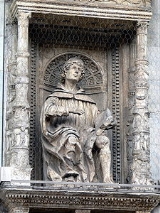
Pliny the Younger


   Email Print
   Bookmark   Link


Pliny the Younger


Gaius or Caius Plinius Caecilius Secundus, born Gaius or Caius Plinius Caecilius, better known as Pliny the Younger, was a lawyerLawyer

A lawyer, or legal practitioner, is a person certified to give legal advice who advises clients in legal matters....
, authorAuthor

An author is the person who creates a written work, such as a book, story, article, or the like, whether short or long, fict...
, and natural philosopher of Ancient RomeAncient Rome

Ancient Rome was a civilization that grew out of the city-state of Rome, founded in the Italian Peninsula circa the 9th cent...
. Pliny's uncle, Pliny the ElderPliny the Elder Overview

Gaius Plinius Secundus, better known as Pliny the Elder, was an ancient author and natural philosopher of some import...
, helped raise and educate him and they were both witnesses to the eruption of Vesuvius on August 24th, 79 AD.
Background
Born in ComoComo

----Como is a city in Lombardy, Italy, 45 km north of Milan....
, northern ItalyNorthern Italy

Northern Italy encompasses eight of the country's 20 regions....
, the son either of a Lucius Caecilius or a landowner named Gaius Caecilius (born in Como ca. 30 AD, son of Gaius Caecilius, born in Como ca. 1 AD) and his wife Plinia Marcella (born in VeronaVerona

Verona is an ancient town, episcopal see and province in the Veneto, Northern Italy....
), Pliny the Younger was also a maternal nephew of Pliny the Elder. It seems, however, since Gaius Caecilius was the name of his mother's grandfather, that his father was Lucius Caecilius, perhaps the Lucius Caecilius born ca.


Discussion
Ask a question about 'Pliny the Younger'
Start a new discussion about 'Pliny the Younger'
Answer questions from other users
Full Discussion Forum


Timeline

63   Born

81   Pliny the Younger was ''flamen Divi Augusti'' (priest in the cult of the Emperor).

84   Pliny the Younger was ''sevir equitum Romanorum'' (commander of a cavalry squadron).

90   Pliny the Younger's appointment as urban quaestor ends.

91   Pliny the Younger was named a ''tribunus plebis''.

93   Pliny the Younger was named a ''praetor''.

100   Pliny the Younger advances to consulship.

103   Pliny the Younger becomes a member of the college of Augurs (-104).

104   Pliny the Younger is a member of the college of Augurs (103-104).

109   Pliny the Younger is legate to Bithynia.


Quotations


An object in possession seldom retains the same charm that it had in pursuit.

Book II, letter 15

He (Pliny the Elder) used to say that no book was so bad but that some good might be got out of it.

Book III, letter 5

His only fault is that he has no fault.

Book IX, letter 26

That indolent but agreeable condition of doing nothing.

Book VIII, letter 9

Objects which are usually the motives of our travels by land and sea are often overlooked and neglected if they lie under our eye...We put off from time to time going and seeing what we know we have an opportunity of seeing when we please.

Book VIII, letter 20


Encyclopedia


Gaius or Caius Plinius Caecilius Secundus, born Gaius or Caius Plinius Caecilius, better known as Pliny the Younger, was a lawyerLawyer

A lawyer, or legal practitioner, is a person certified to give legal advice who advises clients in legal matters....
, authorAuthor

An author is the person who creates a written work, such as a book, story, article, or the like, whether short or long, fict...
, and natural philosopher of Ancient RomeAncient Rome

Ancient Rome was a civilization that grew out of the city-state of Rome, founded in the Italian Peninsula circa the 9th cent...
. Pliny's uncle, Pliny the ElderPliny the Elder Overview

Gaius Plinius Secundus, better known as Pliny the Elder, was an ancient author and natural philosopher of some import...
, helped raise and educate him and they were both witnesses to the eruption of Vesuvius on August 24th, 79 AD.

Background


Born in ComoComo

----Como is a city in Lombardy, Italy, 45 km north of Milan....
, northern ItalyNorthern Italy

Northern Italy encompasses eight of the country's 20 regions....
, the son either of a Lucius Caecilius or a landowner named Gaius Caecilius (born in Como ca. 30 AD, son of Gaius Caecilius, born in Como ca. 1 AD) and his wife Plinia Marcella (born in VeronaVerona

Verona is an ancient town, episcopal see and province in the Veneto, Northern Italy....
), Pliny the Younger was also a maternal nephew of Pliny the Elder. It seems, however, since Gaius Caecilius was the name of his mother's grandfather, that his father was Lucius Caecilius, perhaps the Lucius Caecilius born ca. 15 BC who was a great-grandson of Quintus Caecilius Metellus Pius Scipio. He revered his uncle, Pliny the Elder, and provides pencil sketches of how his uncle worked on the Naturalis HistoriaNaturalis Historia

Naturalis Historia or "Natural History" is an encyclopedia written by Pliny the Elder. ...
.

Pliny's father died at an early age when his son was still young; as a result, Pliny probably lived with his mother. His guardian and preceptor in charge of his education is known to have been Lucius Verginius RufusLucius Verginius Rufus

Lucius Verginius Rufus was a Roman commander of upper Germany during the late 1st century, most notable for his refusal of ...
, famed for quelling a revolt against NeroNero

Nero Claudius Caesar Augustus Germanicus , born Lucius Domitius Ahenobarbus, also called Nero Claudius Drusu...
. After being first tutored at home, Pliny later travelled to RomeRome

Rome is the capital of Italy and of its region, called Latium....
 where he furthered his education and was taught rhetoricRhetoric

Rhetoric is the art or technique of persuasion, usually through the use of language....
 by the great teacher and author QuintilianQuintilian

Marcus Fabius Quintilianus, Roman rhetorician, widely referred to in medieval schools of rhetoric and in Renaissance writing...
 and Nicetes Sacerdos of Smyrna. It was at this time that Pliny became closer to his uncle Pliny the Elder, and when the elder Pliny died during the Vesuvian eruption, the terms of the will passed the estate to the younger Pliny. In the same document he was adoptedAdoption Overview

Adoption is the legal act of permanently placing a child with a parent or parents other than the birth parents....
 by his uncle, changing his name from Gaius Plinius Caecilius to Gaius Plinius Caecilius Secundus, a common practice in Roman culture.

Pliny was considered an honest and moderate man and rose through a series of Imperial civil and military offices, the cursus honorumCursus honorum

The cursus honorum was the sequential order of public offices held by aspiring politicians in both the Roman Republic and t...
(see below). He was a friend of the historian TacitusTacitus Overview

Publius Cornelius Tacitus is one of the important historians of Roman Antiquity....
 and employed the biographer SuetoniusSuetonius

Gaius Suetonius Tranquillus , also known as Suetonius, was a prominent Roman historian and biographer....
 in his staff. Pliny also came into contact with many other well-known men of the period, including the philosophers ArtemidorusArtemidorus

Artemidorus Daldianus or Ephesius was a professional diviner and author known for an extant five-volume Greek work O...
 and Euphrates during his time in SyriaSyria

Syria , officially the Syrian Arab Republic , is a country in the Middle East....
.

He married three times, firstly when he was very young, about eighteen, to a stepdaughter of Veccius Proculus, of whom he became a widower at age 37, secondly to the daughter of Pompeia Celerina, at an unknown date and thirdly to Calpurnia, daughter of Calpurnius and granddaughter of Calpurnus Fabatus of ComumComo

----Como is a city in Lombardy, Italy, 45 km north of Milan....
. Letters survive in which Pliny records this latter marriage taking place, as well as his attachment to Calpurnia and his sadness when they were unable to have children.

Pliny is thought to have died suddenly during his appointment in Bithynia-PontusBithynia

Bithynia was an ancient region, kingdom and Roman province in the northwest of Asia Minor, adjoining the Propontis, the Thra...
, around 112 AD, since no events referred to in his letters date later than that.

Career

Pliny's career began at the age of eighteen and followed a normal route through the cursus honorumCursus honorum

The cursus honorum was the sequential order of public offices held by aspiring politicians in both the Roman Republic and t...
(see Career summary below).

Pliny was active in the Roman legal system, especially in the sphere of the Roman centumviral courtCentumviral court

The Centumviral court was the Chancery court of ancient Rome, a civil court of justice....
, which dealt with inheritance cases. Later, he was well-known for prosecuting (and defending) at the trials of a series of provincial governors, including Baebius Massa, governor of Baetica, Marius Priscus, the governor of AfricaAfrica

Africa is one of the greatest sized continents of the Earth....
, Gaius Caecilius Classicus, governor of Baetica and most ironically in light of his later appointment to this province, Gaius Julius BassusGaius Julius Bassus

Gaius Julius Bassus was a Proconsul in Bithynia in 98 before Pliny the Younger who either prosecuted or defended him afterwa...
 and Varenus Rufus, both governors of Bithynia-PontusBithynia

Bithynia was an ancient region, kingdom and Roman province in the northwest of Asia Minor, adjoining the Propontis, the Thra...
.

Pliny's career is commonly considered as a summary of the main Roman public charges and is the best-documented example from this period, offering proof for many aspects of imperial culture. Effectively, Pliny crossed all the principal fields of the organization of the early Roman Empire. It is no mean achievement for a man to have not only survived the reigns of several disparate emperors, especially the much-detested DomitianDomitian

Titus Flavius Domitianus , commonly known as Domitian, was a Roman Emperor of the gens Flavia....
, but also to have risen in rank throughout.

Career summary

c. 8181 Summary

Year 81 was a common year starting on Monday of the Julian calendar....
 
One of the presiding judges in the centumviral courtCentumviral court

The Centumviral court was the Chancery court of ancient Rome, a civil court of justice....
 (decemvir litibus iudicandis)
c. 8181

Year 81 was a common year starting on Monday of the Julian calendar....
 
A standard appointment to the staff of Legio III GallicaLegio III Gallica

Legio III Gallica was a Roman legion levied by Julius Caesar around 49 BC, for his civil war against the conservative re...
 in SyriaFacts About Syria

Syria , officially the Syrian Arab Republic , is a country in the Middle East....
, probably for six months
80s80s Summary

Events and trendsSignificant people*Titus Flavius Vespasianus, Roman Emperor....
 
Commander of a cavalry squadron (sevir equitum Romanorum)
Later 80s80s

Events and trendsSignificant people*Titus Flavius Vespasianus, Roman Emperor....
 
Entered the SenateRoman Senate

The Roman Senate was the main governing council of both the Roman Republic, which started in 510 BC, and the Roman Empire, w...
8888

For the processor, see Intel 8088. ...
 or 8989

Year 89 was a common year starting on Thursday of the Julian calendar....
 
QuaestorQuaestor

Quaestors were elected officials of the Roman Republic who supervised the treasury and financial affairs of the state, its a...
 attached to the EmperorEmperor

An emperor is a monarch, usually the sovereign ruler of an empire or another type of imperial realm....
's staff (quaestor imperatoris)
9191

Year 91 was a common year starting on Saturday of the Julian calendar....
 
TribuneTribune

Tribune was a title shared by several elected magistracies and other governmental and/or military offices of the Roman Repu...
 of the People (tribunus plebis)
9393

For roadways designated 93 see, Route 93. ...
 
PraetorPraetor

Praetor was a title granted by the government of ancient Rome to persons acting in one of two official capacities: the comma...
9494

EventsBy placeRoman Empire*Domitian rebuilds and rededicates the Curia Julia , which had burned down in 64....
-9696

Year 96 was a leap year starting on Friday of the Julian calendar. ...
 
PrefectPrefect

----A prefect is an official of various different types....
 of the military treasury (praefectus aerari militaris)
98Facts About 98

Year 98 was a common year starting on Monday of the Julian calendar....
-100100

Year 100 was a leap year starting on Wednesday of the Julian calendar....
 
PrefectPrefect

----A prefect is an official of various different types....
 of the treasury of Saturn (praefectus aerari Saturni)
100100

Year 100 was a leap year starting on Wednesday of the Julian calendar....
 
ConsulFacts About Consul

Consul was the highest elected office of the Roman Republic and an appointive office under the Empire....
 with Cornutus Tertullus
103103

Events...
 
Propraetor of BithyniaBithynia

Bithynia was an ancient region, kingdom and Roman province in the northwest of Asia Minor, adjoining the Propontis, the Thra...
103103

Events...
-104104 Overview

Events...
 
Publicly-elected AugurAugur

The Augur was a priest and official in ancient Rome....
104104

Events...
-106106 Overview

Events...
 
Superintendent for the banks of the TiberTiber

The Tiber , the third-longest river in Italy at 406 km after the Po and the Adige, flows through Rome in its course from Mo...
 (curator alvei Tiberis)
104104

Events...
-107107 Overview

Events...
 
Three times a member of TrajanTrajan

Marcus Ulpius Nerva Traianus , Roman Emperor , commonly called , was the second of the Five Good Emperors of the Roman Empir...
's judicial council.
110110

Events...
 
The EmperorEmperor

An emperor is a monarch, usually the sovereign ruler of an empire or another type of imperial realm....
's ambassador (legatus Augusti) in Bithynia-PontusBithynia

Bithynia was an ancient region, kingdom and Roman province in the northwest of Asia Minor, adjoining the Propontis, the Thra...

Writings

As a literateur, Pliny started writing at the age of fourteen, penning a tragedyTragedy

In general usage, a tragedy or tragoedy is a drama, movie or sometimes a real world event with a sad outcome....
 in GreekGreek language

Greek has a documented history of 3,500 years, the longest of any single language within the Indo-European family....
. In the course of his life he wrote a quantity of poetryPoetry Summary

Poetry is a form of art in which language is used for its aesthetic qualities in addition to, or in lieu of, its ostensible...
, most of which was lost despite the great affection he had for it. Also known as a notable oratorOrator

Orator is an originally Latin word for speaker. ...
, he professed himself a follower of CiceroCicero Overview

Marcus Tullius Cicero January 3, 106 BC – December 7, 43 BC) was an orator, statesman, political theorist, and philos...
, but his prose was certainly more magniloquent and less direct than CiceroCicero

Marcus Tullius Cicero January 3, 106 BC – December 7, 43 BC) was an orator, statesman, political theorist, and philos...
's. The only oration that now survives is the Panegyricus Trajani. This was pronounced in the SenateRoman Senate

The Roman Senate was the main governing council of both the Roman Republic, which started in 510 BC, and the Roman Empire, w...
 in 100100

Year 100 was a leap year starting on Wednesday of the Julian calendar....
 and is a description of TrajanTrajan

Marcus Ulpius Nerva Traianus , Roman Emperor , commonly called , was the second of the Five Good Emperors of the Roman Empir...
's figure and actions in an adulatory and emphatic form, especially contrasting him with the Emperor DomitianDomitian

Titus Flavius Domitianus , commonly known as Domitian, was a Roman Emperor of the gens Flavia....
. It is, however, a relevant document that allows us to know many details about the Emperor's actions in several fields of his administrative power such as taxes, justice, military discipline, and commerce. Pliny defined it as an essayEssay

An essay is a short work of writing that treats a topic from an author's personal point of view....
 about the optimus princeps (the perfect ruler).

Epistulae

However, the largest body of Pliny's work which survives is his Letters (Epistulae), a series of personal missives directed to his friends and associates. These letters are a unique testimony of RomanRoman Empire

The Roman Empire was a phase of the ancient Roman civilization characterized by an autocratic form of government....
 administrative history and everyday life in the 1st century1st century

The 1st century was that century which lasted from 1 to 100 according the Gregorian calendar....
. The style is very different from that in the Panegyricus and some commentators affirm that Pliny was the initiator of a new particular genre: the letter written for publication. This genre offers a different type of record than the more usual historyHIStory Summary

HIStory: Past, Present and Future Book I is a double-disc album by Michael Jackson released in 1995 by the Epic Records...
; one which dispenses with objectivity but is no less valuable for it. Especially noteworthy among the letters are two in which he describes the eruption of Mount Vesuvius in August of AD 79 during which his uncle Pliny the Elder died (6.16; 6.20), and one in which he asks the Emperor for instructions regarding official policy concerning Christians (10.96). Pliny's attention to detail in the letters about Vesuvius is so keen that vulcanologists today describe that type of eruption as a PlinianPlinian eruption

Plinian eruptions are volcanic eruptions marked by their similarity to the eruption of Mt....
. In his letter he relates the first warning of the eruption:

On the 24th of August, about one in the afternoon, my mother
desired him to observe a cloud which appeared of a very unusual
size and shape. He had just taken a turn in the sun and, after
bathing himself in cold water, and making a light luncheon, gone
back to his books: he immediately arose and went out upon a rising
ground from whence he might get a better sight of this very
uncommon appearance. A cloud, from which mountain was
uncertain, at this distance (but it was found afterwards to come
from Mount Vesuvius), was ascending, the appearance of which I
cannot give you a more exact description of than by likening it to
that of a pine tree, for it shot up to a great height in the form of a
very tall trunk, which spread itself out at the top into a sort of
branches; occasioned, I imagine, either by a sudden gust of air that
impelled it, the force of which decreased as it advanced upwards,
or the cloud itself being pressed back again by its own weight,
expanded in the manner I have mentioned; it appeared sometimes
bright and sometimes dark and spotted, according as it was either
more or less impregnated with earth and cinders. This
phenomenon seemed to a man of such learning and research as my
uncle extraordinary and worth further looking into.


The letters about Vesuvius were written to the historian TacitusTacitus

Publius Cornelius Tacitus is one of the important historians of Roman Antiquity....
, a long-time friend of Pliny's. Other major literary figures of the late first century A. D. appear in the collection as friends of Pliny's, e. g., the poet MartialMartial

Marcus Valerius Martialis, known in English as Martial, was a Latin poet from Hispania best known for his twelve books...
 and the biographer SuetoniusSuetonius

Gaius Suetonius Tranquillus , also known as Suetonius, was a prominent Roman historian and biographer....
. But the most famous literary figure to appear in his letters is his uncle, Pliny the Elder. His nephew provides details of how his uncle worked tirelessly to finish his magnum opusMagnum opus

Magnum opus, from the Latin meaning great work, refers to the best, most popular, or most renowned achievement of an...
, the Naturalis Historiae. Since Pliny the Younger was heir to to his uncle's estate, he inherited his uncle's large library, and benefited by the acquisition.

The Epistulae are usually treated as two halves: those in Books 1 to 9, which Pliny prepared for publication, and those in Book 10, all of which were written to or by the Emperor TrajanTrajan

Marcus Ulpius Nerva Traianus , Roman Emperor , commonly called , was the second of the Five Good Emperors of the Roman Empir...
 during Pliny's governorship of Bithynia-PontusBithynia

Bithynia was an ancient region, kingdom and Roman province in the northwest of Asia Minor, adjoining the Propontis, the Thra...
. This final book was, significantly, not intended for publication.
Book 10
As already mentioned, the letters of Book 10 are addressed to or from the Emperor Trajan in their entirety, and it is generally assumed that we have received them verbatim. As such, they offer a unique insight into the administrative functions of a Roman provinceProvince

Province is a name for a subnational entity. ...
 of the time, as well as the machinations of the Roman system of patronage and wider cultural mores of RomeRome

Rome is the capital of Italy and of its region, called Latium....
 itself. In addition, the corruption and apathy which occurred at various levels of the provincial systemRoman province

In Ancient Rome, a province was the basic, and until the Tetrarchy, largest territorial and administrative unit of the empir...
 can be seen clearly. The letters also contain the earliest external account of Christian worship, and reasons for the execution of Christians .

The letter regarding Christians deserves mention because its contents were, in the view of many historians, to become the standard policy toward Christians for the rest of the pagan era. Taken together, Pliny's letter and Trajan's response constituted a fairly loose policy toward Christians. Christians were not to be sought out, but executed if brought before a magistrate by a reputable means of accusation (no anonymous charges were permitted) and they were to be given the opportunity to recant. While some persecutions represent a departure from this policy, many historians have concluded that these precedents were nominal for the Empire across time.

Fortunately, TrajanTrajan

Marcus Ulpius Nerva Traianus , Roman Emperor , commonly called , was the second of the Five Good Emperors of the Roman Empir...
's replies to Pliny's queries and requests were also collected for publication, making the anthology even more valuable. The letters thus allow us a wonderful glimpse of the personalities of both Pliny and TrajanTrajan

Marcus Ulpius Nerva Traianus , Roman Emperor , commonly called , was the second of the Five Good Emperors of the Roman Empir...
.

Stylistically, Book 10 is much simpler than its precursors because it was not intended for publication by Pliny. It is generally assumed that this book was published after Pliny's death, and Suetonius, as a member of Pliny's staff, has been suggested as one possible editor.

Manuscripts

In France Giovanni GiocondoGiovanni Giocondo

Fra Giovanni Giocondo was an Italian architect, antiquary, archaeologist, and classical scholar....
 discovered a manuscript of Pliny the Younger's letters containing his correspondence with Trajan. He published it in ParisFacts About Paris

native_name = Ville de Paris|common_name = Paris...
 dedicating the work to Louis XII. Two Italian editions of Pliny's Epistles were published by Giocondo, one printed in BolognaBologna Summary

Bologna is the capital city of Emilia-Romagna in northern Italy, in the Pianura Padana, between the Po River and the Apenn...
 in 1498 and one from the press of Aldus ManutiusAldus Manutius

Aldus Manutius, the Latin form of Aldo Manuzio was the founder of the Aldine Press....
 in 1508.

See also

  • HerculaneumHerculaneum

    Herculaneum was an ancient Roman town, located in the territory of the current commune of Ercolano, in the Italian region o...
  • MisenumMisenum

    Misenum is the site of an ancient port in Campania, in southern Italy....
  • PompeiiPompeii

    Pompeii is a ruined Roman city near modern Naples in the Italian region of Campania, in the territory of the commune of Pomp...
  • StabiaeFacts About Stabiae

    Stabiae was an ancient Roman town, located close to the modern town of Castellammare di Stabia approximately 4.5 km southeas...


Bibliography

Further reading

  • Albert A. Bell, Jr., "A Note on Revision and Authenticity in Pliny's Letters," American Journal of Philology 1989, pp. 460-466.


  • Albert A. Bell, Jr., "Pliny the Younger: The Kinder, Gentler Roman," Classical Bulletin 1990, pp. 37-41.


  • Albert A. Bell, Jr., All Roads Lead to Murder: A Case from the Notebooks of Pliny the Younger. Ingalls Publishing Group, 2002. A novel featuring Pliny and Tacitus as sleuths.


  • Manuel Dejante Pinto de Magalhães Arnao Metello and João Carlos Metello de Nápoles, "Metellos de Portugal, Brasil e Roma", Torres Novas, 1998.


  • E. S. Dobson, "Pliny the Younger's Depiction of Women," Classical Bulletin 1982, pp. 81-85.


  • Betty Radice, "Pliny and the Panegyricus," Greece & Rome 1968, 166-172.


  • A. N. Sherwin-White, The Letters of Pliny: A Social and Historical Commentary, Oxford, 1966.


  • A. N. Sherwin-White, "Pliny, the Man and his Letters," Greece & Rome 1969, pp. 76-89.


  • Ronald Syme, "People in Pliny," Journal of Roman Studies 1968, pp. 135-151.

External links

  • at the Latin Library