


Francesco Borromini

Encyclopedia
Francesco Borromini, byname of Francesco Castelli (25 September 1599 – 3 August 1667) was an architect from Ticino
who, with his contemporaries, Gian Lorenzo Bernini
and Pietro da Cortona
, was a leading figure in the emergence of Roman Baroque architecture
.
A keen student of the architecture of Michelangelo
and the ruins of Antiquity, Borromini developed an inventive and distinctive, if somewhat idiosyncratic, architecture employing manipulations of Classical architectural forms, geometrical rationales in his plans and symbolic meanings in his buildings. He seems to have had a sound understanding of structures, which perhaps Bernini and Cortona, who were principally trained in other areas of the visual arts, lacked. His soft lead drawings are particularly distinctive. He appears to have been a self-taught scholar, amassing a large library by the end of his life.
His career was constrained by his personality. Unlike Bernini who easily adopted the mantle of the charming courtier in his pursuit of important commissions, Borromini was both melancholic and quick in temper which resulted in him withdrawing from certain jobs, and his death was by suicide.
Probably because his work was idiosyncratic, his subsequent influence was not widespread but is apparent in the Piedmontese works of Camillo-Guarino Guarini
and, as a fusion with the architectural modes of Bernini and Cortona, in the late Baroque architecture of Northern Europe. Later critics of the Baroque, such as Francesco Milizia and the English architect Sir John Soane, were particularly critical of Borromini’s work. From the late nineteenth century onwards, interest has revived in the works of Borromini and his architecture has become appreciated for its inventiveness.
, near Lugano
in the Ticino
, Switzerland. He was the son of a stonemason and began his career as a stonemason himself. He soon went to Milan
to study and practice his craft. He moved to Rome
in 1619 and started working for Carlo Maderno
, his distant relative, at St. Peter's
and then also at the Palazzo Barberini
. When Maderno died in 1629, he and Pietro da Cortona continued to work on the palace under the direction of Bernini. Once he had become established in Rome, he changed his name from Castelli to Borromini, a name deriving from his mother's family and perhaps also out of regard for St Charles Borromeo
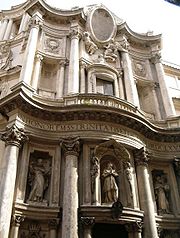 In 1634, Borromini received his first major independent commission to design the church, cloister and monastic buildings of San Carlo alle Quattro Fontane
(also known as San Carlino). Situated on the Quirinal Hill in Rome, the complex was designed for the Spanish Trinitarians
, a religious order. The monastic buildings and the cloister were completed first after which construction of the church took place during the period 1638-1641 and in 1646 it was dedicated to San Carlo Borromeo. The church is considered by many to be an exemplary masterpiece of Roman Baroque architecture. San Carlino is remarkably small given its significance to Baroque architecture; it has been noted that the whole building would fit into one of the dome piers of Saint Peter's.
The site was not an easy one; it was a corner site and the space was limited. Borromini positioned the church on the corner of two intersecting roads. Although the idea for the serpentine facade must have been conceived fairly early on, probably in the mid 1630's, it was only constructed towards the end of Borromini's life and the upper part was not completed until after the architect's death.
Borromini devised the complex ground plan of the church from interlocking geometrical configurations, a typical Borromini device for constructing plans. The resulting effect is that the interior lower walls appear to weave in and out, partly alluding to a cross form, partly to a hexagonal form and partly to an oval form; geometrical figures that are all found explicitly in the dome above. The area of the pendentives marks the transition from the lower wall order to the oval opening of the dome. Illuminated by windows hidden from a viewer below, interlocking octagons, crosses and hexagons diminish in size as the dome rises to a lantern with the symbol of the Trinity.
(known as the Chiesa Nuova -new church) in central Rome. In the 1620s, on a site adjacent to the church, the Fathers commissioned designs for their own residence and for an oratory (or oratorio in Italian) in which to hold their spiritual exercises. These exercises combined preaching and music in a form which became immensely popular and highly influential on the development of the musical oratorio.
The architect Paolo Maruscelli organised the general layout of the site and in 1637, Borromini was appointed as architect, possibly as the result of a competition. He was employed in the task for thirteen years. By 1640, the oratory was in use and by 1643, the library was complete. The striking brick curved facade adjacent to the church entrance has an unusual pediment and does not entirely correspond to the oratory room behind it. The white oratory interior has a ribbed vault and a complex wall arrangement of engaged pilasters along with freestanding columns supporting first level balconies. The altar wall was substantially reworked at a later date.
Borromini’s relations with the Oratorians were often fraught; there were heated arguments over the design and the selection of building materials. By 1650, the situation came to a head and in 1652 the Oratorians appointed another architect.
However, with the help of his Oratorian friend Virgilio Spada, Borromini documented his own account of the building of the oratory and the residence and an illustrated version was published in Italian in 1725
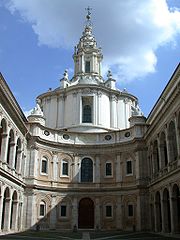
and its courtyard, near University of Rome La Sapienza
palace. It was initially the church of the Roman Archiginnasio. He had been initially recommended for the commission in 1632, by his then supervisor for the work at the Palazzo Barberini, Gian Lorenzo Bernini
. The site, like many in cramped Rome, is challenged for external perspectives. It was built at the end of Giacomo della Porta
's long courtyard. The dome and cochlear steeple are peculiar, and reflect the idiosyncratic architectural motifs that distinguish Borromini from contemporaries. Inside, the nave has an unusual centralized plan circled by alternating concave and convex-ending cornices, leading to a dome decorated with linear arrays of stars and putti. The geometry of the structure is a symmetric six-pointed star; from the center of the floor, the cornice looks like a two equilateral triangles forming a hexagon, but three of the points are clover-like, while the other three are concavely clipped. The innermost columns are points on a circle. The fusion of feverish and dynamic baroque excesses with a rationalistic geometry is an excellent match for a church in a papal institution of higher learning.
The decision to rebuild of the church was taken in 1652 as part of Pope Innocent X’s project to enhance the Piazza Navona
, the urban space onto which his family palace, the Palazzo Pamphili, faced. The first plans for a Greek Cross church were drawn up by Girolamo Rainaldi
and his son Carlo Rainaldi
, who relocated the main entrance from the Via di Santa Maria dell'Anima
to the Piazza Navona. The foundations were laid and much of the lower level walls had been constructed when the Rainaldis were dismissed due to criticisms of the design and Borromini was appointed in their stead.
Borromini began a much more innovative approach to the facade which was expanded to include parts of the adjacent Palazzo Pamphili and gain space for his two bell towers.Construction of the façade proceeded up to the cornice level and the dome completed as far as the lantern. On the interior, he placed columns against the piers of the lower order which was mainly completed.
In 1655, Innocent X died and the project lost momentum. In 1657, Borromini resigned and Carlo Rainaldi was recalled who made a number of significant changes to Borromini’s design. Further alterations were made by Bernini including the façade pediment. In 1668, Carlo Rainaldi returned as architect and Ciro Ferri
received the commission to fresco the dome interior which it is highly unlikely that Borromini intended. Further large scale statuary and coloured marbling were also added; again, these are not part of Borromini’s design repertoire which was orientated to white stucco architectural and symbolic motifs.
The chapel replaced a small oval chapel designs by his rival Bernini and was a late work in Borromini’s career; he was appointed as architect in 1648 but it was not until 1660 that construction of the chapel began and although the main body of work was completed by 1665, some of the decoration was finished after his death.
His façade to the Via di Propaganda Fide comprises seven bays articulated by giant pilasters. The central bay is a concave curve and accommodates the main entry into the college courtyard and complex, with the entrance to the chapel to the left and to the college to the right.
, Borromini committed suicide in Rome. possibly as a result of nervous disorders and depression,
In his testament, Borromini wrote that he did not want any name on his burial and expressed the desire to be buried in the tomb of his kinsman Carlo Maderno in San Giovanni dei Fiorentini. In recent times, his name was added on the marble plaque below the tomb of Maderno and a commemorative plaque was placed on a pillar of the church. This Latin inscription reads:
 Francesco Borromini was featured on the 100 Swiss Franc banknote current in the 1980s.
Ticino
Canton Ticino or Ticino is the southernmost canton of Switzerland. Named after the Ticino river, it is the only canton in which Italian is the sole official language...
who, with his contemporaries, Gian Lorenzo Bernini
Gian Lorenzo Bernini
Gian Lorenzo Bernini was an Italian artist who worked principally in Rome. He was the leading sculptor of his age and also a prominent architect...
and Pietro da Cortona
Pietro da Cortona
Pietro da Cortona, by the name of Pietro Berrettini, born Pietro Berrettini da Cortona, was the leading Italian Baroque painter of his time and also one of the key architects in the emergence of Roman Baroque architecture. He was also an important decorator...
, was a leading figure in the emergence of Roman Baroque architecture
Architecture
Architecture is both the process and product of planning, designing and construction. Architectural works, in the material form of buildings, are often perceived as cultural and political symbols and as works of art...
.
A keen student of the architecture of Michelangelo
Michelangelo
Michelangelo di Lodovico Buonarroti Simoni , commonly known as Michelangelo, was an Italian Renaissance painter, sculptor, architect, poet, and engineer who exerted an unparalleled influence on the development of Western art...
and the ruins of Antiquity, Borromini developed an inventive and distinctive, if somewhat idiosyncratic, architecture employing manipulations of Classical architectural forms, geometrical rationales in his plans and symbolic meanings in his buildings. He seems to have had a sound understanding of structures, which perhaps Bernini and Cortona, who were principally trained in other areas of the visual arts, lacked. His soft lead drawings are particularly distinctive. He appears to have been a self-taught scholar, amassing a large library by the end of his life.
His career was constrained by his personality. Unlike Bernini who easily adopted the mantle of the charming courtier in his pursuit of important commissions, Borromini was both melancholic and quick in temper which resulted in him withdrawing from certain jobs, and his death was by suicide.
Probably because his work was idiosyncratic, his subsequent influence was not widespread but is apparent in the Piedmontese works of Camillo-Guarino Guarini
Camillo-Guarino Guarini
thumb|300px|The [[Carignano Palace]] in Turin.Camillo-Guarino Guarini was an Italian architect of the Piedmontese Baroque, active in Turin as well as Sicily, France, and Portugal. He was a Theatine priest, mathematician, and writer.-Biography:Guarini was born in Modena...
and, as a fusion with the architectural modes of Bernini and Cortona, in the late Baroque architecture of Northern Europe. Later critics of the Baroque, such as Francesco Milizia and the English architect Sir John Soane, were particularly critical of Borromini’s work. From the late nineteenth century onwards, interest has revived in the works of Borromini and his architecture has become appreciated for its inventiveness.
Early life and first works
Borromini was born at BissoneBissone
Bissone is a municipality in the district of Lugano, in the canton of Ticino in Switzerland.-History:Bissone is first mentioned in 735 and again in 854 as Blixuni. In German it was known as Byssen, though that name is no longer used....
, near Lugano
Lugano
Lugano is a city of inhabitants in the city proper and a total of over 145,000 people in the agglomeration/city region, in the south of Switzerland, in the Italian-speaking canton of Ticino, which borders Italy...
in the Ticino
Ticino
Canton Ticino or Ticino is the southernmost canton of Switzerland. Named after the Ticino river, it is the only canton in which Italian is the sole official language...
, Switzerland. He was the son of a stonemason and began his career as a stonemason himself. He soon went to Milan
Milan
Milan is the second-largest city in Italy and the capital city of the region of Lombardy and of the province of Milan. The city proper has a population of about 1.3 million, while its urban area, roughly coinciding with its administrative province and the bordering Province of Monza and Brianza ,...
to study and practice his craft. He moved to Rome
Rome
Rome is the capital of Italy and the country's largest and most populated city and comune, with over 2.7 million residents in . The city is located in the central-western portion of the Italian Peninsula, on the Tiber River within the Lazio region of Italy.Rome's history spans two and a half...
in 1619 and started working for Carlo Maderno
Carlo Maderno
Carlo Maderno was a Swiss-Italian architect, born in Ticino, who is remembered as one of the fathers of Baroque architecture. His façades of Santa Susanna, St. Peter's Basilica and Sant'Andrea della Valle were of key importance in the evolution of the Italian Baroque...
, his distant relative, at St. Peter's
St. Peter's Basilica
The Papal Basilica of Saint Peter , officially known in Italian as ' and commonly known as Saint Peter's Basilica, is a Late Renaissance church located within the Vatican City. Saint Peter's Basilica has the largest interior of any Christian church in the world...
and then also at the Palazzo Barberini
Palazzo Barberini
Palazzo Barberini is a palace in Rome, facing the piazza of the same name in Rione Trevi and is home to the Galleria Nazionale d'Arte Antica.-History:...
. When Maderno died in 1629, he and Pietro da Cortona continued to work on the palace under the direction of Bernini. Once he had become established in Rome, he changed his name from Castelli to Borromini, a name deriving from his mother's family and perhaps also out of regard for St Charles Borromeo
San Carlo alle Quattro Fontane (San Carlino)
San Carlo alle Quattro Fontane
The Church of Saint Charles at the Four Fountains is a Roman Catholic church in Rome, Italy. Designed by the architect Francesco Borromini, it was his first independent commission. It is an iconic masterpiece of Baroque architecture, built as part of a complex of monastic buildings on the Quirinal...
(also known as San Carlino). Situated on the Quirinal Hill in Rome, the complex was designed for the Spanish Trinitarians
Trinitarian Order
The Order of the Holy Trinity is a Catholic religious order that was founded in the area of Cerfroid, some 80 km northeast of Paris, at the end of the twelfth century. The founder was St. John de Matha, whose feast day is celebrated on 17 December...
, a religious order. The monastic buildings and the cloister were completed first after which construction of the church took place during the period 1638-1641 and in 1646 it was dedicated to San Carlo Borromeo. The church is considered by many to be an exemplary masterpiece of Roman Baroque architecture. San Carlino is remarkably small given its significance to Baroque architecture; it has been noted that the whole building would fit into one of the dome piers of Saint Peter's.
The site was not an easy one; it was a corner site and the space was limited. Borromini positioned the church on the corner of two intersecting roads. Although the idea for the serpentine facade must have been conceived fairly early on, probably in the mid 1630's, it was only constructed towards the end of Borromini's life and the upper part was not completed until after the architect's death.
Borromini devised the complex ground plan of the church from interlocking geometrical configurations, a typical Borromini device for constructing plans. The resulting effect is that the interior lower walls appear to weave in and out, partly alluding to a cross form, partly to a hexagonal form and partly to an oval form; geometrical figures that are all found explicitly in the dome above. The area of the pendentives marks the transition from the lower wall order to the oval opening of the dome. Illuminated by windows hidden from a viewer below, interlocking octagons, crosses and hexagons diminish in size as the dome rises to a lantern with the symbol of the Trinity.
Oratory of Saint Phillip Neri (Oratorio dei Fillipini)
In the late sixteenth century, the Congregation of the Filippini (also known as the Oratorians) rebuilt the church of Santa Maria in VallicellaSanta Maria in Vallicella
Santa Maria in Vallicella, also called Chiesa Nuova, is a church in Rome, Italy, which today faces onto the main thoroughfare of the Corso Vittorio Emanuele...
(known as the Chiesa Nuova -new church) in central Rome. In the 1620s, on a site adjacent to the church, the Fathers commissioned designs for their own residence and for an oratory (or oratorio in Italian) in which to hold their spiritual exercises. These exercises combined preaching and music in a form which became immensely popular and highly influential on the development of the musical oratorio.
The architect Paolo Maruscelli organised the general layout of the site and in 1637, Borromini was appointed as architect, possibly as the result of a competition. He was employed in the task for thirteen years. By 1640, the oratory was in use and by 1643, the library was complete. The striking brick curved facade adjacent to the church entrance has an unusual pediment and does not entirely correspond to the oratory room behind it. The white oratory interior has a ribbed vault and a complex wall arrangement of engaged pilasters along with freestanding columns supporting first level balconies. The altar wall was substantially reworked at a later date.
Borromini’s relations with the Oratorians were often fraught; there were heated arguments over the design and the selection of building materials. By 1650, the situation came to a head and in 1652 the Oratorians appointed another architect.
However, with the help of his Oratorian friend Virgilio Spada, Borromini documented his own account of the building of the oratory and the residence and an illustrated version was published in Italian in 1725
Sant' Ivo alla Sapienza
From 1640-1650, he worked on the design of the church of Sant'Ivo alla SapienzaSant'Ivo alla Sapienza
The Church of Saint Yves at La Sapienza is a Roman Catholic church in Rome. The church is considered a masterpiece of Roman Baroque church architecture, built in 1642-1660 by the architect Francesco Borromini.- History :...
and its courtyard, near University of Rome La Sapienza
University of Rome La Sapienza
The Sapienza University of Rome, officially Sapienza – Università di Roma, formerly known as Università degli studi di Roma "La Sapienza", is a coeducational, autonomous state university in Rome, Italy...
palace. It was initially the church of the Roman Archiginnasio. He had been initially recommended for the commission in 1632, by his then supervisor for the work at the Palazzo Barberini, Gian Lorenzo Bernini
Gian Lorenzo Bernini
Gian Lorenzo Bernini was an Italian artist who worked principally in Rome. He was the leading sculptor of his age and also a prominent architect...
. The site, like many in cramped Rome, is challenged for external perspectives. It was built at the end of Giacomo della Porta
Giacomo della Porta
Giacomo della Porta was an Italian architect and sculptor, who worked on many important buildings in Rome, including St. Peter's Basilica. He was born at Porlezza, Lombardy and died in Rome.-Biography:...
's long courtyard. The dome and cochlear steeple are peculiar, and reflect the idiosyncratic architectural motifs that distinguish Borromini from contemporaries. Inside, the nave has an unusual centralized plan circled by alternating concave and convex-ending cornices, leading to a dome decorated with linear arrays of stars and putti. The geometry of the structure is a symmetric six-pointed star; from the center of the floor, the cornice looks like a two equilateral triangles forming a hexagon, but three of the points are clover-like, while the other three are concavely clipped. The innermost columns are points on a circle. The fusion of feverish and dynamic baroque excesses with a rationalistic geometry is an excellent match for a church in a papal institution of higher learning.
Sant'Agnese in Agone
Borromini was one of several architects involved in the building of the church of Sant’Agnese in Agone in Rome. Not only were some of his design intentions changed by succeeding architects but the net result is a building which reflects, rather unhappily, a mix of different approaches.The decision to rebuild of the church was taken in 1652 as part of Pope Innocent X’s project to enhance the Piazza Navona
Piazza Navona
Piazza Navona is a city square in Rome, Italy. It is built on the site of the Stadium of Domitian, built in 1st century AD, and follows the form of the open space of the stadium. The ancient Romans came there to watch the agones , and hence it was known as 'Circus Agonalis'...
, the urban space onto which his family palace, the Palazzo Pamphili, faced. The first plans for a Greek Cross church were drawn up by Girolamo Rainaldi
Girolamo Rainaldi
Girolamo Rainaldi was an Italian architect who worked on the whole in a conservative Mannerist style, often with collaborating architects, yet was a successful competitor of Bernini...
and his son Carlo Rainaldi
Carlo Rainaldi
Carlo Rainaldi was an Italian architect of the Baroque period.Born in Rome, Rainaldi was one of the leading architects of 17th century Rome, known for a certain grandeur in his designs. He worked at first with his father, Girolamo Rainaldi, a late Mannerist architect in Rome. After his father's...
, who relocated the main entrance from the Via di Santa Maria dell'Anima
Santa Maria dell'Anima
Santa Maria dell'Anima is a Roman Catholic church in central Rome, Italy, just west of the Piazza Navona and near the Santa Maria della Pace church. It was the national church of the Holy Roman Empire in Rome...
to the Piazza Navona. The foundations were laid and much of the lower level walls had been constructed when the Rainaldis were dismissed due to criticisms of the design and Borromini was appointed in their stead.
Borromini began a much more innovative approach to the facade which was expanded to include parts of the adjacent Palazzo Pamphili and gain space for his two bell towers.Construction of the façade proceeded up to the cornice level and the dome completed as far as the lantern. On the interior, he placed columns against the piers of the lower order which was mainly completed.
In 1655, Innocent X died and the project lost momentum. In 1657, Borromini resigned and Carlo Rainaldi was recalled who made a number of significant changes to Borromini’s design. Further alterations were made by Bernini including the façade pediment. In 1668, Carlo Rainaldi returned as architect and Ciro Ferri
Ciro Ferri
Ciro Ferri was an Italian Baroque sculptor and painter, the chief pupil and successor of Pietro da Cortona.He was born in Rome, where he began working under Cortona and with a team of artists in the extensive fresco decorations of the Quirinal Palace...
received the commission to fresco the dome interior which it is highly unlikely that Borromini intended. Further large scale statuary and coloured marbling were also added; again, these are not part of Borromini’s design repertoire which was orientated to white stucco architectural and symbolic motifs.
The Re Magi Chapel of the Propaganda Fide
The College of the Propagation of the Faith or Propaganda Fide in Rome includes the Re Magi Chapel by Borromini, generally considered by architectural historians to be one of his most spatially unified architectural interiors.The chapel replaced a small oval chapel designs by his rival Bernini and was a late work in Borromini’s career; he was appointed as architect in 1648 but it was not until 1660 that construction of the chapel began and although the main body of work was completed by 1665, some of the decoration was finished after his death.
His façade to the Via di Propaganda Fide comprises seven bays articulated by giant pilasters. The central bay is a concave curve and accommodates the main entry into the college courtyard and complex, with the entrance to the chapel to the left and to the college to the right.
Other works
Borromini's works include:- Interior of Basilica di San Giovanni in Laterano
- Cappella Spada, San Girolamo della Carità (uncertain attribution)
- Palazzo SpadaPalazzo SpadaThe Palazzo Spada is a palace in the historic centre of Rome, Italy. It is located in the rione Regola, at Piazza Capo di Ferro, 13, very close to the Palazzo Farnese. It has a garden facing towards the River Tiber....
(trick perspective) - Palazzo BarberiniPalazzo BarberiniPalazzo Barberini is a palace in Rome, facing the piazza of the same name in Rione Trevi and is home to the Galleria Nazionale d'Arte Antica.-History:...
(upper-level windows and oval staircase) - Santi Apostoli in Naples - Filamarino Altar
- Sant'Andrea delle FratteSant'Andrea delle FratteSant'Andrea delle Fratte is a 17th-century basilica church in Rome, Italy, dedicated to St. Andrew. The Cardinal Priest of the Titulus S. Andreae Apostoli de Hortis is Ennio Antonelli....
- Oratorio dei FilippiniOratorio dei FilippiniThe Oratorio dei Filippini is a building located in Rome and erected between 1637 and 1650 by Francesco Borromini. He belonged to the Congregation of the Oratory, founded by Philip Neri in 1561...
- Collegio de Propaganda Fide
- Santa Maria dei Sette Dolori
- San Giovanni in OleoSan Giovanni in OleoSan Giovanni in Oleo is a small church in Rome, Italy, devoted to Saint John the Evangelist, on the place where, according to tradition, his martyrdom was attempted....
(restoration) - Palazzo Giustiniani (with Carlo FontanaCarlo FontanaCarlo Fontana was an Italian architect, who was in part responsible for the classicizing direction taken by Late Baroque Roman architecture.-Biography:...
) - Facade of Palazzo FalconieriPalazzo FalconieriThe Palazzo Falconieri is a palace in Rome, Italy formed in the seventeenth century as a result of remodelling by the Baroque architect Francesco Borromini....
- Santa Lucia in Selci (restoration)
- Saint Peter's Basilica (gates to Blessed Sacrament Chapel and possibly parts of baldacchino)
Death and epitaph
In the summer of 1667, and following completion of the Falconieri chapel (the High Altar chapel) in San Giovanni dei FiorentiniSan Giovanni dei Fiorentini
San Giovanni dei Fiorentini, St John of the Florentines, is a church in the Ponte rione or district of Rome. Dedicated to St John the Baptist, the protector of Florence, the new church for the Florentine community in Rome was started in the 16th century and completed in early eighteenth and is the...
, Borromini committed suicide in Rome. possibly as a result of nervous disorders and depression,
In his testament, Borromini wrote that he did not want any name on his burial and expressed the desire to be buried in the tomb of his kinsman Carlo Maderno in San Giovanni dei Fiorentini. In recent times, his name was added on the marble plaque below the tomb of Maderno and a commemorative plaque was placed on a pillar of the church. This Latin inscription reads:
Trivia
External links
- A map giving the location of Borromini's buildings in Rome
- Columbia University: Joseph Connors, Francesco Borromini: Opus Architectonicum, Milan, 1998: Introduction to Borromini's own description of the Casa dei Filippini
- Borromini's own account of his eventually successful suicide attempt