
All Topics  
Pope


Pope


Pope of the Roman Catholic Church
|-

Seal of the Papacy
Incumbent:
Benedict XVI
 
StylesHis HolinessHis Holiness Overview

His Holiness is the official style or manner of address in reference to the leaders of certain religious groups....
Holy FatherHoly Father Summary

Holy Father may refer to:* God the Father...
ResidenceVatican CityVatican City

Vatican City formally State of the Vatican City, or Vatican City State is a sovereign city-state whose terri...
First Pope TraditionallyFacts About Sacred Tradition

The Catholic Church bases all of its teachings on Sacred Tradition and Sacred Scripture....
, Saint PeterSaint Peter

Saint Peter, also known as Simon ben Jonah/BarJonah, Simon Peter, Cephas and Kepha — original ...
Formation First century
Website
 

The Pope (from LatinLatin

Latin is an ancient Indo-European language originally spoken in Latium, the region immediately surrounding Rome....
: "papa" or "father" from GreekGreek language

Greek has a documented history of 3,500 years, the longest of any single language within the Indo-European family....
 , pápas, "papa", originally written , páppas, as in OdysseyOdyssey Overview

The Odyssey is one of the two major ancient Greek epic poems , attributed to the poet Homer....
VI.57; Papa in ItalianItalian language

Italian is a Romance language spoken by about 70 million people, primarily in Italy....
) is the Bishop of RomeBishop of Rome

The Bishop of Rome is the bishop of the Holy See and is more commonly referred to as the Pope....
, the leader of the Roman Catholic ChurchRoman Catholic Church

The Roman Catholic Church or Catholic Church is the Christian Church in full communion with the Pope, the Bishop of Ro...
 and head of state of Vatican CityVatican City

Vatican City formally State of the Vatican City, or Vatican City State is a sovereign city-state whose terri...
.


Discussion
Ask a question about 'Pope'
Start a new discussion about 'Pope'
Answer questions from other users
Full Discussion Forum


Timeline

32   Saint Peter traditionally becomes first pope. (See 30 for more likely date)

33   Saint Peter became Pope (according to Roman Catholic tradition) (see 32)

67   Linus succeeds Saint Peter as pope.

154   Anicetus becomes pope. (approximate date)

307   Marcellus I becomes Pope.

336   Mark elected pope.

337   Julius is elected pope.

343   Council of Sofia establishes the primacy of Rome. The Pope becomes the leader of Christianity, and takes up residence in the Lateran.

384   St Siricius becomes Pope.

399   St. Anastius I becomes Pope succeeding Pope Siricius.


Encyclopedia


Pope of the Roman Catholic Church
|-

Seal of the Papacy
Incumbent:
Benedict XVI
 
StylesHis HolinessHis Holiness Overview

His Holiness is the official style or manner of address in reference to the leaders of certain religious groups....
Holy FatherHoly Father Summary

Holy Father may refer to:* God the Father...
ResidenceVatican CityVatican City

Vatican City formally State of the Vatican City, or Vatican City State is a sovereign city-state whose terri...
First Pope TraditionallyFacts About Sacred Tradition

The Catholic Church bases all of its teachings on Sacred Tradition and Sacred Scripture....
, Saint PeterSaint Peter

Saint Peter, also known as Simon ben Jonah/BarJonah, Simon Peter, Cephas and Kepha — original ...
Formation First century
Website
 

The Pope (from LatinLatin

Latin is an ancient Indo-European language originally spoken in Latium, the region immediately surrounding Rome....
: "papa" or "father" from GreekGreek language

Greek has a documented history of 3,500 years, the longest of any single language within the Indo-European family....
 , pápas, "papa", originally written , páppas, as in OdysseyOdyssey Overview

The Odyssey is one of the two major ancient Greek epic poems , attributed to the poet Homer....
VI.57; Papa in ItalianItalian language

Italian is a Romance language spoken by about 70 million people, primarily in Italy....
) is the Bishop of RomeBishop of Rome

The Bishop of Rome is the bishop of the Holy See and is more commonly referred to as the Pope....
, the leader of the Roman Catholic ChurchRoman Catholic Church

The Roman Catholic Church or Catholic Church is the Christian Church in full communion with the Pope, the Bishop of Ro...
 and head of state of Vatican CityVatican City

Vatican City formally State of the Vatican City, or Vatican City State is a sovereign city-state whose terri...
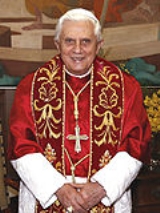
. The current (265th) pope is Pope Benedict XVIPope Benedict XVI

Pope Benedict XVI is the 265th and reigning Pope of the Roman Catholic Church, and as such, Monarch of the Vatican City Sta...
, who was elected April 19, 2005 in papal conclavePapal conclave, 2005

The Papal conclave of 2005 was convoked due to the death of Pope John Paul II on April 2, 2005....
.

The office of the pope is called the Papacy; his ecclesiastical jurisdiction is called the "Holy See"Holy See

The Holy See is the episcopal see of Rome....
 (Sancta Sedes in Latin) or "Apostolic See"Apostolic See Overview

In the several centuries following the founding of Christianity, five particular cities and centers of Christianity were considere...
 (the latter on the basis that both St. Peter and St. Paul were martyred at RomeRome Overview

Rome is the capital of Italy and of its region, called Latium....
).

In addition to his spiritual role, the pope is Head of StateHead of State

Head of State or Chief of State is the generic term for the individual or collective office that serves as the chief p...
 of the independent sovereign state of the Vatican City, a city-stateCity-state

A city-state is a region controlled exclusively by a city, and usually having sovereignty....
 entirely enclavedEnclave and exclave

In political geography, an enclave is a country or part of a country lying wholly within the boundaries of another, and an '...
 by the city of Rome. Before 1870, the pope's temporal authority extended over a large area of central ItalyCentral Italy Overview

Central Italy is a geographic area in Italy that encompasses six of the country's 20 autonomous regions:...
: the territory of the Papal StatesPapal States

The Papal States or State of the Church was one of the major historical states of Italy before the Italian peninsula ...
. The papacy retained sovereign authority over the Papal States until the Italian unificationItalian unification Overview

Italian unification was the political and social process that unified disparate states of the Italian peninsula into the si...
 of 1870; a final political settlement with the ItalianItaly Overview

Italy, officially the Italian Republic , is a Southern European country....
 government was not reached until the Lateran Treaty of 1929.

For over a thousand years, popes played powerful roles in Western Europe, often struggling with monarchs for power over wide-ranging affairs of church and state, crowning emperors and regulating disputes among secular rulers. The Bishop of Rome continued to be nominally allied with and part of the civil structure of the (Byzantine) Roman EmpireByzantine Empire

Byzantine Empire is the term conventionally used since the 19th century to describe the Greek-speaking Roman Empire of the...
 until the 8th century, when the Donation of PepinDonation of Pepin

The "Donation of Pepin" in 756 provided a legal basis for the erection of the Papal States, which extended papal temporal r...
 gave Rome and the surrounding area to the full sovereignty of the pope, over which the popes already had been de facto rulers, creating the Papal States that lasted until 1870. For centuries, the forged Donation of ConstantineDonation of Constantine

The Donation of Constantine is a forged Roman imperial edict devised probably between 750 and 850....
 also provided the basis for the papacy's claim of political supremacy over the entire former Western Roman Empire.

Gradually forced to give up secular power, popes have come to focus again almost exclusively on spiritual matters. Over the centuries, popes' claims of spiritual authority have been ever more clearly expressed since the first centuries, culminating in the proclamation of the dogmaDogma

Dogma is the established belief or doctrine held by a religion, ideology or any kind of organization, thought to be author...
 of papal infallibilityPapal infallibility Summary

In Roman Catholic theology, Papal infallibility is the dogma that the Pope is preserved from error when he solemnly promulga...
 for those rare occasions the pope speaks ex cathedraEx Cathedra

Ex Cathedra is a British choir and early music ensemble based in Birmingham in the West Midlands, England....
(literally "from the chair (of Peter)") when issuing a solemn definition of faithDogma

Dogma is the established belief or doctrine held by a religion, ideology or any kind of organization, thought to be author...
 or morals. The last such occasion was in the year 1950 with the definition of the dogma of the Assumption of MaryAssumption of Mary

According to Roman Catholic doctrine and the traditions of the Roman Catholic Church, the Blessed Virgin Mary "having completed ...
.

History


In the early Christian era, Rome and a few other cities had claims on the leadership of worldwide ("Catholic") church. James the JustJames the Just

Saint James the Just, also called James Adelphos, James of Jerusalem, or the Brother of the Lord and somet...
, known as "the brother of the Lord", served as head of the Jerusalem church, which is still honored as the "Mother Church" in Orthodox tradition. Alexandria had been a center of Jewish learning and became a center of Christian learning. Rome's first bishop was the disciple Peter, to whom Jesus had given church authority. Paul the Apostle was also martyred there.

Nicea to Schism of the East (325 - 1054)

With the conversion of Roman Emperor ConstantineConstantine I

Gaius Flavius Valerius Aurelius Constantinusantine is best remembered in modern times for the Edict of Milan in 313, which f...
 to Christianity and the Council of NiceaFirst Council of Nicaea

The First Council of Nicaea, convoked by the Roman Emperor Constantine I in 325, was the first ecumenical conference of bish...
, Christian unity and Rome's primacy were well-established.

After the imperial capital was moved to ConstantinopleConstantinople

Constantinople was the capital of the Byzantine Empire and following its fall in 1453, of the Ottoman Empire until 1930, wh...
 in AD 330 the eastern churches, especially the Bishop of Constantinople, started to assert pre-eminence by virtue of its imperial status.

The First Council of ConstantinopleFirst Council of Constantinople

The First Council of Constantinople was called by Theodosius I in 381 to confirm the Nicene Creed and deal with other matte...
 (AD 381) suggested strongly that Roman primacy was already asserted; however, it should be noted that, because of the controversy over this claim, the pope did not personally attend this ecumenical councilEcumenical council

In Christianity, an ecumenical council or general council is a meeting of the bishops of the whole church convened to ...
, which was held in the eastern capital of the Roman empire, rather than in RomeRome

Rome is the capital of Italy and of its region, called Latium....
. It was not until 440 that Leo the GreatPope Leo I

Pope Leo I was a Roman aristocrat who was Pope from 440 to 461....
 more clearly articulated the extension of papal authority as doctrine, promulgating in edicts and in councils his right to exercise "the full range of apostolic powers that Jesus had first bestowed on the apostle Peter". It was at the ecumenical Council of ChalcedonCouncil of Chalcedon

The Council of Chalcedon was an ecumenical council that took place from October 8–November 1, 451 at Chalcedon which ...
 in 451 that Leo I (through his emissaries) stated that he was "speaking with the voice of Peter". At this same council, the Bishop of Constantinople was given a primacy of honour equal to that of the Bishop of Rome, because "Constantinople is the New Rome."

The title of Pope was from the early third century an honorific designation used for any bishop in the West. In the East it was used only for the Bishop of Alexandria. From the 6th century, the imperial chancery of ConstantinopleByzantine Empire

Byzantine Empire is the term conventionally used since the 19th century to describe the Greek-speaking Roman Empire of the...
 normally reserved it for the Bishop of Rome. From the early sixth century it began to be confined in the West to the Bishop of Rome, a practice that was firmly in place by the eleventh century.

After the fall of Rome, the Church served as a source of knowledge, authority, and continuity. The crowning of emperors and regulating disputes among secular rulers also became a function of the Papacy. The Bishop of Rome continued to be nominally allied and part of the civil structure of the Byzantine EmpireByzantine Empire Summary

Byzantine Empire is the term conventionally used since the 19th century to describe the Greek-speaking Roman Empire of the...
 until the 8th century, when the Donation of PepinDonation of Pepin

The "Donation of Pepin" in 756 provided a legal basis for the erection of the Papal States, which extended papal temporal r...
 gave Rome and the surrounding area to the full sovereignty of the pope, of which the popes already had been de facto rulers, creating the Papal States that lasted until 1870. For centuries, the forged Donation of ConstantineDonation of Constantine

The Donation of Constantine is a forged Roman imperial edict devised probably between 750 and 850....
 also provided the basis for the papacy's claim of political supremacy over the entire former Western Roman Empire.

Gregory the Great (c 540-604) administered the church with wisdom and stern reform. From an ancient senatorial family, Gregory worked with the prudence, stern judgment, and discipline typical of ancient Roman rule. Theologically, he represents the shift from the classical to the medieval outlook, his popular writings full of dramatic miracles, potent relics, demons, angels, ghosts, and the approaching end of the world.

Gregory's successors were mostly dominated by the exarch or the Eastern emperor. Seeking protection from the Lombards, Stephen II turned from the Emperor and sought protection from the Franks. Pepin the short subdued the Lombards and donated Italian land to the Papacy. When Leo III crowned Charlemagne (800), he established the precedent that no man would be emperor without anointment by a pope.

The low point of the Papacy was 867-1049. The Papacy came under the control of vying political factions. Popes were variously imprisoned, starved, killed, and deposed by force. The family of a certain papal official made and unmade popes for fifty years. The official's great-grandson, Pope John XII, held orgies of debauchery in the Lateran palace. Emperor Otto I of Germany had John accused in an ecclesiastical court, which deposed him and elected a layman as Pope Leo VIII. John mutilated the Imperial representatives in Rome and had himself reinstated as Pope. Conflict between the Emperor and the papacy continued, and eventually dukes in league with the emperor were buying bishops and popes almost openly.

In 1049, Leo IX became pope, at last a pope with the character to face the papacy's problems. He traveled to the major cities of Europe to deal with the church's moral problems firsthand, notably the sale of church offices or services (simony) and clerical marriage and concubinage. With his long journey, he restored the prestige of the Papacy in the north.

Schism of the East to Reformation (1054 to 1517)


The East and West churches split definitively in 1054. This split was caused more by political events than by slight diversities of creed. Popes had galled the emperors by siding with the king of the Franks, crowning a rival Roman emperor, appropriating the exarchate of Ravenna, and driving into Greek Italy.

In the Middle AgesMiddle Ages

The Middle Ages formed the middle period in a traditional schematic division of European history into three "ages": the clas...
, popes struggled with monarchs over power.

Popes also contended with the cardinals, who sometimes attempted to assert the authority of councils over the pope's. Conciliar theory holds that the supreme authority of the church lies with a General Council, not with the pope. Its foundations were laid early in the 13th century, and it culminated in the 15th century. The failure of the conciliar theory to win general acceptance after the 15th century is taken as a factor in the Protestant Reformation.

Various antipopes challenged papal authority, especially during the Western SchismWestern Schism Overview

The Western Schism or Papal Schism was a split within the Catholic church in 1378....
 (1378 - 1417).

Reformation to present (1517 to today)

Protestant Reformers criticized the Papacy as corrupt and characterized the pope as the antichrist.

Popes instituted the Catholic Reformation  (1560 - 1648), which addressed challenges of the Protestant ReformationProtestant Reformation Summary

The Protestant Reformation, also referred to as the Protestant Revolution, was a movement in the 16th century to refor...
 and instituted internal reforms.

Gradually forced to give up secular power, popes focused on spiritual issues.

The pope's claims of spiritual authority have been ever more clearly expressed since the first centuries. In the 19th century, the church proclaimed the dogmaDogma

Dogma is the established belief or doctrine held by a religion, ideology or any kind of organization, thought to be author...
 of papal infallibilityPapal infallibility

In Roman Catholic theology, Papal infallibility is the dogma that the Pope is preserved from error when he solemnly promulga...
 for those rare occasions the pope speaks ex cathedraEx Cathedra

Ex Cathedra is a British choir and early music ensemble based in Birmingham in the West Midlands, England....
(literally "from the chair (of Peter)") when issuing a solemn definition of faithDogma

Dogma is the established belief or doctrine held by a religion, ideology or any kind of organization, thought to be author...
 or morals.

In 1950, the pope defined the Assumption of MaryAssumption of Mary

According to Roman Catholic doctrine and the traditions of the Roman Catholic Church, the Blessed Virgin Mary "having completed ...
 as dogma, the only time that a pope has spoken ex cathedra since papal infallibility was explicitly declared.

The Petrine DoctrinePetrine doctrine Overview

See Also Primacy of the Roman Pontiff...
 is still controversial as an issue of doctrine that continues to divide the eastern and western churches as well as separating Protestants from Rome.

The pope in Roman Catholic theology

The dogmaDogma

Dogma is the established belief or doctrine held by a religion, ideology or any kind of organization, thought to be author...
s and traditions of the Roman Catholic ChurchRoman Catholic Church Overview

The Roman Catholic Church or Catholic Church is the Christian Church in full communion with the Pope, the Bishop of Ro...
 teach that the institution of the papacy was first mandated by Biblical passages:

For Catholic Apologists the most important passage used to defend the Papacy is Matthew 16:18-19. Catholics believe that this passage shows Jesus establishing his church on the shoulders of Simon son of John, whom Jesus re-named Peter (meaning rock). Thus Peter was the rock upon which Christ's Church was built, therefore Jesus established a head to his earthly Church, calling for a successor to that head and thus the Papacy was established.

However, this interpretation of events is challenged by non-Catholics. Some say it was Peter's confession of faith that Jesus referred to. However, others propose that Jesus never called Peter rock at all but instead he was called "small stone".

The names "Petros" and "Peter" are Greek and Latin translations of the Aramaic word "Cephas," spoken by Jesus Christ. "Cephas" means "rock."

The Aramaic word for small stone is "Evna" John (1:41) is scriptural proof that, in the original Aramaic language, Jesus did not name Simon "Evna" (small stone) Christ named Simon "Cephas" (rock):

For the above Scripture to imply that Simon's new name was meant to be understood as "small stone," the writer would use the Latin word "calculus" which means "small stone." However, the Scripture explicitly states that "Cephas" is interpreted as "Peter." "Peter" means "rock" in Latin.

The translation of Matthew's Gospel into Greek named Simon "Petros" rather than "petra" because "petra" is a feminine noun and unsuitable for a man's name. The translator had no problem substituting the masculine form "Petros" because in Koine Greek, which was the dialect in use at the time of the New Testament, "petra" and "petros" both meant the same thing, "rock."

"Petros" and "petras" meant "small stone" and "large rock" in some ancient Greek poetry, centuries before the time of Christ, but that distinction had disappeared from the language by the time Matthew’s Gospel was rendered in Greek. As Greek scholars—even non-Catholic ones—admit, the words "petros" and "petra" were synonyms in first century Greek.

The difference between "petros" and "petras" can only be found in Attic Greek, but the New Testament was written in Koine Greek—an entirely different dialect. In Koine Greek, both "petros" and "petra" simply meant "rock." If Jesus had wanted to call Simon a small stone, the translation of Christ's Aramaic into Greek would have been "lithos," which means "small stone" in Koine Greek.

Simon-Peter's Aramaic name given by Christ is also preserved at later points in the New Testament:

Isaiah 22:22 is used to show the Old Testament connection to the "keys." The Bible further explains the position of Eliakim in Isaiah in the following:

"Then Eliakim son of Hilkiah, who was in charge of the palace..." ()


Some Jewish commentators of the Old Testament understood in a manner similar to Peter with this commentary from the Jewish EncyclopediaJewish Encyclopedia

The Jewish Encyclopedia was an encyclopedia originally published between 1901 and 1906 by Funk and Wagnalls....
 on Peter regarding Abraham:

"Upon Abraham as top of the rocks God said I shall build my kingdom"

The reference to the "keys of the kingdom of heaven" here are the basis for the symbolic keys often found in Catholic papal symbolism, such as in the Vatican Coat of Arms (see below).

Election, death and abdication


Election


The pope was originally chosen by those senior clergyClergy

Clergy is the generic term used to describe the formal religious leadership within a given religion....
men resident in and near Rome. In 1059 the electorate was restricted to the CardinalsCardinal (Catholicism)

A cardinal is a senior ecclesiastical official in the Roman Catholic Church, a member of the College of Cardinals, ranking b...
 of the Holy Roman Church, and the individual votes of all Cardinal Electors were made equal in 1179. Pope Urban VIPope Urban VI

Pope Urban VI , born Bartolomeo Prignano, Pope from 1378 to 1389, was a devout monk and learned casuist, trained at Av...
, elected 1378, was the last pope who was not already a cardinal at the time of his election. Canon lawCanon law

Canon law is the term used for the internal ecclesiastical law which governs various churches, most notably the Roman Cathol...
 requires that if a layman or non-bishop is elected, he receives episcopal consecration from the Dean of the College of CardinalsDean of the College of Cardinals

The Dean of the College of Cardinals is the president of the College of Cardinals in the Roman Catholic Church and as such i...
 before assuming the Pontificate. Under present canon law, the pope is elected by the cardinal electors, comprising those cardinals who are under the age of 80.

The Second Council of Lyons was convened on May 7, 1274, to regulate the election of the pope. This Council decreed that the cardinal electors must meet within ten days of the pope's death, and that they must remain in seclusion (see Papal conclavePapal conclave

A papal conclave is the process by which the Roman Catholic Church elects the Bishop of Rome who, as he is considered the "S...
) until a pope has been elected; this was prompted by the three-year Sede VacanteSede vacante

Sede vacante is the vacancy of the episcopal see of a particular church in the Canon law of the Roman Catholic Church....
following the death of Pope Clement IVPope Clement IV

Pope Clement IV , born Gui Faucoi le Gros , was elected Pope February 5, 1265, in a conclave held at Perugia that took...
 in 1268. By the mid-sixteenth century, the electoral process had more or less evolved into its present form, allowing for alteration in the time between the death of the pope and the meeting of the cardinal electors.

Traditionally, the vote was conducted by acclamationAcclamation

PoliticsAn acclamation is a form of election not using a ballot....
, by selection (by committee), or by plenary vote. Acclamation was the simplest procedure, consisting entirely of a voice vote, and was last used in 1621. Pope John Paul IIPope John Paul II

Pope John Paul II , , born Karol Jzef Wojtyla reigned as Pope of the Catholic Church from October 16 1978 until his ...
 abolished vote by acclamation and by selection by committee, and henceforth all Popes will be elected by full vote of the Sacred College of CardinalsCollege of Cardinals

The Sacred College of Cardinals is the body of all Cardinals of the Roman Catholic Church....
 by ballotBallot

A ballot is a device used to record choices made by voters....
 (see Papal election).


The election of the pope almost always takes place in the Sistine ChapelSistine Chapel Overview

The Sistine Chapel is a chapel in the Apostolic Palace, the official residence of the Roman Catholic Pope in the Vatican Cit...
, in a sequestered meeting called a "conclavePapal conclave

A papal conclave is the process by which the Roman Catholic Church elects the Bishop of Rome who, as he is considered the "S...
" (so called because the cardinal electors are theoretically locked in, cum clave, until they elect a new pope). Three cardinals are chosen by lot to collect the votes of absent cardinal electors (by reason of illness), three are chosen by lot to count the votes, and three are chosen by lot to review the count of the votes. The ballots are distributed and each cardinal elector writes the name of his choice on it and pledges aloud that he is voting for "one whom under God I think ought to be elected" before folding and depositing his vote on a plate atop a large chalice placed on the altar (in the 2005 conclave, a special urn was used for this purpose instead of a chalice and plate). The plate is then used to drop the ballot into the chalice, making it difficult for any elector to insert multiple ballots. Before being read, the number of ballots are counted while still folded; if the total number of ballots does not match the number of electors, the ballots are burned unopened and a new vote is held. Otherwise, each ballot is read aloud by the presiding Cardinal, who pierces the ballot with a needle and thread, stringing all the ballots together and tying the ends of the thread to ensure accuracy and honesty. Balloting continues until a Pope is elected by a two-thirds majority (with the promulgation of Universi Dominici Gregis in 1996, a simple majority after a deadlock of twelve days was allowed, but this was revoked by Pope Benedict XVI by motu proprioMotu proprio

A motu proprio is a papal rescript in which the clause motu proprio is used, signifying that the provisions of the r...
in 2007).

One of the most famous aspects of the papal election process is the means by which the results of a ballot are announced to the world. Once the ballots are counted and bound together, they are burned in a special stove erected in the Sistine Chapel, with the smoke escaping through a small chimney visible from St. Peter's Square. The ballots from an unsuccessful vote are burned along with a chemical compound in order to produce black smoke, or fumata nera. (Traditionally, wet straw was used to help create the black smoke, but a number of "false alarms" in past conclaves have brought about this concession to modern chemistry.) When a vote is successful, the ballots are burned alone, sending white smoke (fumata bianca) through the chimney and announcing to the world the election of a new pope. At the end of the conclave that elected Pope Benedict XVIPope Benedict XVI

Pope Benedict XVI is the 265th and reigning Pope of the Roman Catholic Church, and as such, Monarch of the Vatican City Sta...
, church bells were also rung to signal that a new pope had been chosen.

The Dean of the College of Cardinals then asks the cardinal who has been successfully-elected two solemn questions. First he asks, "Do you freely accept your election?" If he replies with the word "Accepto", his reign as Pope begins at that instant, not at the inauguration ceremony several days afterward. The Dean then asks, "By what name shall you be called?" The new pope then announces the regnal nameRegnal name

A regnal name, or reign name, is a formal name used by some popes and monarchs during their reigns....
 he has chosen for himself. (If the Dean himself is elected pope, the Vice Dean performs this duty).

The new pope is led through the "Door of Tears" to a dressing room in which three sets of white papal vestments (immantatio) await: small, medium, and large. Donning the appropriate vestments and reemerging into the Sistine Chapel, the new pope is given the "Fisherman's RingRing of the Fisherman

The Ring of the Fisherman or Pescatorio is an official part of the regalia worn by the pope, described by the Roman Ca...
" by the Cardinal Camerlengo, whom he first either reconfirms or reappoints. The pope then assumes a place of honor as the rest of the cardinals wait in turn to offer their first "obedience" (adoratio) and to receive his blessing.

The senior Cardinal Deacon then announces from a balcony over St. Peter's Square the following proclamationHabemus Papam

Habemus Papam refers to the announcement given in Latin by the Senior Cardinal Deacon upon the election of a new Pope....
: Annuntio vobis gaudium magnum! Habemus Papam! ("I announce to you a great joy! We have a pope!"). He then announces the new pope's Christian name along with the new name he has adopted as his regnal name.

Until 1978 the pope's election was followed in a few days by the Papal CoronationPapal Coronation

The Papal Coronation is a ceremony in which a new pope is crowned as head of the Roman Catholic Church and sovereign of Vati...
. A procession with great pomp and circumstance formed from the Sistine ChapelSistine Chapel

The Sistine Chapel is a chapel in the Apostolic Palace, the official residence of the Roman Catholic Pope in the Vatican Cit...
 to St. Peter's BasilicaSt. Peter's Basilica

The Basilica of Saint Peter, officially known in Italian as the Basilica di San Pietro in Vaticano and colloquially ca...
, with the newly elected pope borne in the sedia gestatoriaSedia gestatoria

The sedia gestatoria is the portable throne on which Popes are sometimes carried....
. There, after a solemn Papal MassPapal Mass Overview

A Papal Mass is the Solemn Pontifical High Mass when celebrated by the Pope....
, the new pope was crowned with the triregnumPapal Tiara

The Papal Tiara, also known as the Triple Tiara, or in Latin as the 'Triregnum', and in Italian as the 'Trire...
(papal tiara) and he gave for the first time as pope the famous blessing Urbi et OrbiUrbi et Orbi

Urbi et Orbi, literally "to the City [of Rome] and to the World," was a standard opening of Roman proclamations....
("to the City [Rome] and to the World"). Another renowned part of the coronation was the lighting of a bundle of flaxFlax

Flax is a member of the genus Linum in the family Linaceae....
 at the top of a gilded pole, which would flare brightly for a moment and then promptly extinguish, with the admonition Sic transit gloria mundiSic transit gloria mundi

Sic transit gloria mundi is a Latin phrase, which means "Thus passes the glory of the world," but is more commonly inter...
("Thus passes worldly glory"). A similar sombre warning against papal hubris made on this occasion was the ritual exclamation "Annos Petri non videbis", reminding the newly crowned Pope that he would not live to see his rule lasting as long as that of St. Peter, who according to tradition headed the church for 35 years and has thus far been the longest reigning Pope in the history of the Catholic Church.

A traditionalist CatholicTraditionalist Catholic

The terms "traditionalist Catholic" and "Traditional Catholic" are used to refer to Roman Catholics who want to see th...
 belief claims the existence of the Papal Oath (not to be confused with the Oath Against ModernismOath Against Modernism

The Roman Catholic Pope, Saint Pius X, issued the Oath against Modernism on September 1, 1910, and mandated that "all clerg...
 mandated by Pope Pius XPope Pius X Summary

Pope Pius X , born Giuseppe Melchiorre Sarto, was Pope from 1903 to 1914, succeeding Pope Leo XIII ....
), which the popes from John Paul IPope John Paul I

Pope John Paul I , , born Albino Luciani , reigned as pope and as sovereign of Vatican City from August 26, 1978 to Se...
 on are said to have refused to swear, but there is no reliable authority for this claim.

The LatinLatin

Latin is an ancient Indo-European language originally spoken in Latium, the region immediately surrounding Rome....
 term sede vacante ("vacant seat") refers to a papal interregnumInterregnum

An interregnum is a period between monarchs, between popes of the Roman Catholic Church, emperors of Holy Roman Empire, Pol...
, the period between the death of a pope and the election of his successor. From this term is derived the term sedevacantismSedevacantism

Sedevacantism is a theological position embraced by a minority of Traditionalist Catholics which holds that the papacy has b...
, which designates a category of dissident Catholics who maintain that there is no canonically and legitimately elected Pope, and that there is therefore a Sede Vacante. One of the most common reasons for holding this belief is the idea that the reforms of the Second Vatican CouncilSecond Vatican Council

The Second Ecumenical Council of the Vatican, or Vatican II, was an Ecumenical Council of the Roman Catholic Church op...
 and especially the replacement of the Tridentine MassTridentine Mass

The Tridentine Mass is a term used to denote the liturgy of the Catholic Mass of the Roman rite as it existed, through succe...
 with the Mass of Paul VIMass of Paul VI

This article is about the post-Vatican-II changes to the Mass; for an explanation of the current structure of the Mass, see Mass...
are heretical, and that, per the dogma of papal infallibility, it is impossible for a valid Pope to have done these things. Secevacantists are considered to be schismSchism

Schism may refer to:* Schism, a division or a split, usually in an organization or a movement...
atics by the mainstream Roman Catholic Church.

For centuries, the papacy was an institution dominated by Italians. Prior to the election of the Polish cardinal Karol Wojtyla as Pope John Paul II in 1978, the last non-Italian was Pope Adrian VIPope Adrian VI

Pope Adrian VI , born Adrian Florisz Dedel, son of Floris Boeyens, served as Pope of the Catholic Church from 1522 unt...
 of the Netherlands, elected in 1522. John Paul II was followed by the German-born Benedict XVI, leading some to believe the Italian domination of the papacy to be over.

Death

The current regulations regarding a papal interregnumInterregnum

An interregnum is a period between monarchs, between popes of the Roman Catholic Church, emperors of Holy Roman Empire, Pol...
 — that is, a sede vacanteSede vacante

Sede vacante is the vacancy of the episcopal see of a particular church in the Canon law of the Roman Catholic Church....
("vacant seat") — were promulgated by John Paul II in his 1996 document Universi Dominici GregisUniversi Dominici Gregis

Universi Dominici Gregis is an Apostolic Constitution of the Roman Catholic Church issued by Pope John Paul II on Februa...
. During the "Sede Vacante", the Sacred College of CardinalsCollege of Cardinals

The Sacred College of Cardinals is the body of all Cardinals of the Roman Catholic Church....
, composed of the pope's principal advisors and assistants, is collectively responsible for the government of the Church and of the Vatican itself, under the direction of the Cardinal ChamberlainFacts About Camerlengo

The title Camerlengo refers to an official of the Papal court, referring either to the Chamberlain of the Roman Church, ...
; however, canon law specifically forbids the cardinals from introducing any innovation in the government of the Church during the vacancy of the Holy SeeHoly See

The Holy See is the episcopal see of Rome....
. Any decision that requires the assent of the pope has to wait until the new pope has been elected and accepts office.

It has long been claimed that a pope's death is officially determined by the Cardinal Chamberlain by gently tapping the late pope's head thrice with a silver hammer and calling his birth name three times, though this is disputed and has never been confirmed by the Vatican; there is general agreement that even if this procedure ever actually occurred, it was likely not employed upon the death of John Paul II. A doctor may or may not have already determined that the pope had died before this point. The Cardinal Chamberlain then retrieves the Ring of the FishermanRing of the Fisherman

The Ring of the Fisherman or Pescatorio is an official part of the regalia worn by the pope, described by the Roman Ca...
. Usually the ring is on the pope's right hand. But in the case of Paul VI, he had stopped wearing the ring during the last years of his reign. In other cases the ring might have been removed for medical reasons. The Chamberlain cuts the ring in two in the presence of the Cardinals. The deceased pope's seals are defaced, to keep them from ever being used again, and his personal apartment is sealed.

The body then lies in state for a number of days before being interred in the cryptCrypt

In medieval terms, a crypt is a stone chamber or vault, usually beneath the floor of a church or castle, usually containing ...
 of a leading church or cathedral; the popes of the 20th century were all interred in St. Peter's BasilicaSt. Peter's Basilica

The Basilica of Saint Peter, officially known in Italian as the Basilica di San Pietro in Vaticano and colloquially ca...
. A nine-day period of mourning (novem dialis) follows after the interment of the late Pope. Vatican tradition holds that no autopsyAutopsy Summary

An autopsy, also known as a post-mortem examination or an obduction, is a medical procedure that consists of a thoro...
 is to be performed on the body of a dead Pope.

Abdication

The Code of Canon Law  states, "If it happens that the Roman Pontiff resignsPapal abdication

Papal abdication occurs in the Roman Catholic Church when the Pope resigns his office....
 his office, it is required for validity that the resignation is made freely and properly manifested but not that it is accepted by anyone."

This right has been exercised by Pope Celestine VPope Celestine V

Pope Celestine V , born Pietro Angelerio, also known as Pietro del Morrone , was elected Pope in the year 12...
 in 1294 and Pope Gregory XIIPope Gregory XII Summary

Pope Gregory XII , born Angelo Correr or Corraro, Pope from 1406 to 1415, succeeded Pope Innocent VII on No...
 in 1409, Gregory XII being the last to do so.

It was widely reported in June and July 2002 that Pope John Paul II firmly refuted the speculation of his resignation using Canon 332, in a letter to the Milan daily newspaper Corriere della SeraCorriere della Sera

Corriere della Sera is an Italian daily newspaper, printed in Milan....
.

Nevertheless, 332 §2 caused speculation that:
  • Pope John Paul II would have resigned as his health failed, or
  • a properly manifested legal instrument had been prepared which effected his resignation if he could not perform his duties.


Pope John Paul II, however, did not resign. He died on 2 April 2005 after a long period of ill-health and was buried on 8 April 2005. After his death, it was reported in his last will and testamentTestament of Pope John Paul II

The Testament of Pope John Paul II is a document sealed with the Ring of the Fisherman of Pope John Paul II, and is similar ...
 that he considered abdicating in 2000 as he neared his 80th birthday. That portion of the will, however, is unclear and others interpret it differently.

Titles


Current

The titles of the Pope, in the order they are used in the Annuario Pontificio:
  • Bishop of RomeBishop of Rome

    The Bishop of Rome is the bishop of the Holy See and is more commonly referred to as the Pope....
  • Vicar of ChristVicar of Christ

    Vicar of Christ has been used since Pope Gelasius I, alongside a few rarer 'vicarial' titles, as one of the titles of the Bi...
  • Successor of the Prince of the Apostles
  • Supreme PontiffPontifex Maximus

    The Pontifex Maximus was the high priest of the Ancient Roman College of Pontiffs....
     of the Universal ChurchUniversal church

    The phrase universal church can refer to:...
  • PrimatePrimate (religion)

    Primate is a title or rank bestowed on some bishops in certain Christian churches....
     of ItalyItaly

    Italy, officially the Italian Republic , is a Southern European country....
  • Archbishop and MetropolitanMetropolitan bishop

    In hierarchical Christian churches, the rank of metropolitan bishop, or simply metropolitan, pertains to the diocesan ...
     of the Roman ProvinceEcclesiastical Province

    An ecclesiastical province is a large jurisdiction of religious government, so named by analogy with a temporal province, ex...
  • Sovereign of the State of the Vatican CityVatican City

    Vatican City formally State of the Vatican City, or Vatican City State is a sovereign city-state whose terri...
  • Servant of the Servants of GodServus Servorum Dei

    Servus Servorum Dei is a Latin phrase meaning Servant of the Servants of God....


Former

  • PatriarchPatriarch

    For other senses, see Patriarch.Originally a patriarch was a man who exercised autocratic authority as a pater familias...
     of the West (dropped 2006)
  • VicarFacts About Vicar

    In the broadest sense, a vicar is anyone acting "in the person of" or for a superior....
     of the Apostolic SeeFacts About Apostolic See

    In the several centuries following the founding of Christianity, five particular cities and centers of Christianity were considere...
  • Vicar of Peter

Forms of address

  • "Your Holiness"
  • "Holy Father"
  • "Il Papa"

Regalia and insignia


  • "TriregnumPapal Tiara

    The Papal Tiara, also known as the Triple Tiara, or in Latin as the 'Triregnum', and in Italian as the 'Trire...
    ", also called the "tiara" or "triple crown", represents the pope's three functions as "supreme pastor", "supreme teacher" and "supreme priest". Recent popes have not, however, worn the triregnum, though it remains the symbol of the papacy and has not been abolished. In liturgical ceremonies Popes wear an episcopal mitreMITRE

    The MITRE Corporation is a not-for-profit organization chartered to work in the public interest....
     (an erect cloth hat).
  • Pastoral Staff topped by a crucifixCrucifix

    A crucifix is a cross with a representation of Jesus' body, or corpus....
    , a custom established before the 13th century (see papal crossPapal Cross

    The Papal Cross is a large white cross situated in the Phoenix Park, Dublin, Ireland....
    ).
  • PalliumPallium

    The Pallium or Pall is an ecclesiastical vestment in the Roman Catholic Church, originally peculiar to the Pope, but f...
    , or pall, a circular band of fabric worn around the neck over the chasubleChasuble

    The chasuble is the outermost liturgical vestment worn by clergy for the celebration of the Eucharist among Western-traditio...
    . It forms a yoke about the neck, breast and shoulders and has two pendants hanging down in front and behind, and is ornamented with six crosses. Previously, the pallium worn by the pope was identical to those he granted to the primatesPrimate (religion)

    Primate is a title or rank bestowed on some bishops in certain Christian churches....
    , but in 2005 Pope Benedict XVI began to use a distinct papal pallium that is larger than the primatial, and was adorned with red crosses instead of black.
  • "Keys to the Kingdom of Heaven", the image of two keys, one gold and one silver. The silver key symbolizes the power to bind and loose on Earth, and the gold key the power to bind and loose in Heaven.
  • Ring of the FishermanRing of the Fisherman

    The Ring of the Fisherman or Pescatorio is an official part of the regalia worn by the pope, described by the Roman Ca...
    , a gold ring decorated with a depiction of St. Peter in a boat casting his net, with the name of the reigning Pope around it.
  • Umbraculum (better known in the Italian form ombrellino) is a canopy or umbrella consisting of alternating red and gold stripes, which used to be carried above the pope in processions.
  • Sedia gestatoriaSedia gestatoria Overview

    The sedia gestatoria is the portable throne on which Popes are sometimes carried....
    , a mobile throne carried by twelve footmen (palafrenieri) in red uniforms, accompanied by two attendants bearing flabella (fans made of white ostrich feathers), and sometimes a large canopyCanopy

    A canopy can mean:*Canopy , an overhead roof or structure that provides shade or other shelter....
    , carried by eight attendants. The use of the flabella was discontinued by Pope John Paul IPope John Paul I

    Pope John Paul I , , born Albino Luciani , reigned as pope and as sovereign of Vatican City from August 26, 1978 to Se...
    . The use of the sedia gestatoria was discontinued by Pope John Paul IIPope John Paul II

    Pope John Paul II , , born Karol Jzef Wojtyla reigned as Pope of the Catholic Church from October 16 1978 until his ...
    , being replaced by the so-called PopemobilePopemobile

    Popemobile is an informal name for the specially designed vehicle used by the pope during public appearances....
    .


In heraldryHeraldry

Heraldry is the practice of designing, displaying, describing and recording coats of arms and badges, as well as the formal ...
, each pope has his own Papal Coat of ArmsPapal coat of arms

Every Pope of the Roman Catholic Church has his own personal coat of arms that serves as a symbol of his papacy....
. Though unique for each pope, the arms are always surmounted by the aforementioned two keys in saltireSaltire

A saltire is an X-shaped ordinary in heraldry....
 (i.e., crossed over one another so as to form an X) behind the escutcheon (shield) (one silver key and one gold key, tied with a red cord), and above them a silver triregnum with three gold crowns and red infulae. This is blazonBlazon

In heraldry and vexillology, a blazon is a formal description of, most often, a coat of arms or flag, which enables a person...
ed: "two keys in saltire or and argent, interlacing in the rings or, beneath a tiara argent, crowned or"). With the recent election of Benedict XVI in 2005, his personal coat of arms eliminated the papal tiara; a mitreMITRE

The MITRE Corporation is a not-for-profit organization chartered to work in the public interest....
 with three horizontal lines is used in its place, with the pallium, a papal symbol of authority more ancient than the tiara, the use of which is also granted to metropolitan archbishops as a sign of communion with the See of Rome, was added underneath of the shield. The distinctive feature of the crossed keys behind the shield was maintained. The omission of the tiara in the Pope's personal coat of arms, however, did not mean the total disappearance of it from papal heraldry, since the coat of arms of the Holy See was kept unaltered.

The flagFlag

A flag is a piece of cloth, often flown from a pole or mast, generally used for signalling or identification....
 most frequently associated with the pope is the yellow and white flag of Vatican City, with the arms of the Holy See (blazoned: "Gules, two keys in saltire or and argent, interlacing in the rings or, beneath a tiara argent, crowned or") on the right-hand side (the "fly") in the white half of the flag (the left-hand side—the "hoist"—is yellow). The pope's escucheon does not appear on the flag. This flag was first adopted in 1808, whereas the previous flag had been red and gold, the traditional colors of the papacy. Although Pope Benedict XVI replaced the triregnum with a mitre on his personal coat of arms, it has been retained on the flag.

Status and authority


First Vatican Council

The status and authority of the Pope in the Catholic Church was dogmaDogma Overview

Dogma is the established belief or doctrine held by a religion, ideology or any kind of organization, thought to be author...
tically definedDogmatic definition

In Roman Catholicism, a dogmatic definition is an infallible statement published by a pope or an ecumenical council concerni...
 by the First Vatican CouncilFirst Vatican Council

The First Vatican Council was summoned by Pope Pius IX by the bull Aeterni Patris of June 29, 1868....
 on 18 July 1870. In its Dogmatic Constitution of the Church of Christ, the Council established the following canons:

"If anyone says that the blessed Apostle Peter was not established by the Lord Christ as the chief of all the apostlesTwelve Apostles

The Twelve Apostles were men that according to the Synoptic Gospels and Christian tradition, were chosen from among the disc...
, and the visible head of the whole militant Church, or, that the same received great honour but did not receive from the same our Lord Jesus Christ directly and immediately the primacy in true and proper jurisdiction: let him be anathemaAnathema

Anathema in Greek Anathema meaning originally something lifted up as an offering to the gods; later, with evolving meanings...
.

If anyone says that it is not from the institution of Christ the Lord Himself, or by divine right that the blessed Peter has perpetual successors in the primacy over the universal Church, or that the Roman Pontiff is not the successor of blessed Peter in the same primacy, let him be anathema.

If anyone thus speaks, that the Roman Pontiff has only the office of inspection or direction, but not the full and supreme power of jurisdiction over the universal Church, not only in things which pertain to faith and morals, but also in those which pertain to the discipline and government of the Church spread over the whole world; or, that he possesses only the more important parts, but not the whole plenitude of this supreme power; or that this power of his is not ordinary and immediate, or over the churches altogether and individually, and over the pastors and the faithful altogether and individually: let him be anathema.

We, adhering faithfully to the tradition received from the beginning of the Christian faith, to the glory of God, our Saviour, the elevation of the Catholic religion and the salvation of Christian peoples, with the approbation of the sacred Council, teach and explain that the dogma has been divinely revealed: that the Roman Pontiff, when he speaks ex cathedra, that is, when carrying out the duty of the pastor and teacher of all Christians by virtue of his supreme apostolic authority he defines a doctrine of faith or morals to be held by the universal Church, through the divine assistance promised him in blessed Peter, operates with that infallibility with which the divine Redeemer wished that His church be instructed in defining doctrine on faith and morals; and so such definitions of the Roman Pontiff from himself, but not from the consensus of the Church, are unalterable. But if anyone presumes to contradict this definition of Ours, which may God forbid: let him be anathema."

Second Vatican Council


In its Dogmatic Constitution on the ChurchLumen Gentium

Lumen Gentium, the Dogmatic Constitution on the Church, is one of the principal documents of the Vatican II....
 (1964), the Second Vatican CouncilSecond Vatican Council

The Second Ecumenical Council of the Vatican, or Vatican II, was an Ecumenical Council of the Roman Catholic Church op...
 declared:

"Among the principal duties of bishops the preaching of the Gospel occupies an eminent place. For bishops are preachers of the faith, who lead new disciples to Christ, and they are authentic teachers, that is, teachers endowed with the authority of Christ, who preach to the people committed to them the faith they must believe and put into practice, and by the light of the Holy Spirit illustrate that faith. They bring forth from the treasury of Revelation new things and old, making it bear fruit and vigilantly warding off any errors that threaten their flock. Bishops, teaching in communion with the Roman Pontiff, are to be respected by all as witnesses to divine and Catholic truth. In matters of faith and morals, the bishops speak in the name of Christ and the faithful are to accept their teaching and adhere to it with a religious assent. This religious submission of mind and will must be shown in a special way to the authentic magisterium of the Roman Pontiff, even when he is not speaking ex cathedra; that is, it must be shown in such a way that his supreme magisterium is acknowledged with reverence, the judgments made by him are sincerely adhered to, according to his manifest mind and will. His mind and will in the matter may be known either from the character of the documents, from his frequent repetition of the same doctrine, or from his manner of speaking.

… this infallibility with which the Divine Redeemer willed His Church to be endowed in defining doctrine of faith and morals, extends as far as the deposit of Revelation extends, which must be religiously guarded and faithfully expounded. And this is the infallibility which the Roman Pontiff, the head of the college of bishops, enjoys in virtue of his office, when, as the supreme shepherd and teacher of all the faithful, who confirms his brethren in their faith, by a definitive act he proclaims a doctrine of faith or morals. And therefore his definitions, of themselves, and not from the consent of the Church, are justly styled irreformable, since they are pronounced with the assistance of the Holy Spirit, promised to him in blessed Peter, and therefore they need no approval of others, nor do they allow an appeal to any other judgment. For then the Roman Pontiff is not pronouncing judgment as a private person, but as the supreme teacher of the universal Church, in whom the charism of infallibility of the Church itself is individually present, he is expounding or defending a doctrine of Catholic faith. The infallibility promised to the Church resides also in the body of Bishops, when that body exercises the supreme magisterium with the successor of Peter. To these definitions the assent of the Church can never be wanting, on account of the activity of that same Holy Spirit, by which the whole flock of Christ is preserved and progresses in unity of faith."

Political role


Though the progressive ChristianisationChristianization

this is complete bull shit christianism iscomplete bull shitThe historical phenomenon of Christianization, the conversion of...
 of the Roman EmpireRoman Empire Summary

The Roman Empire was a phase of the ancient Roman civilization characterized by an autocratic form of government....
 in the fourth century did not confer upon bishops civil authority within the state, the gradual withdrawal of imperial authority during the fifth century left the pope the senior imperial civilian official in Rome, as bishops were increasingly directing civil affairs in other cities of the Western Empire. This status as a secular and civil ruler was vividly displayed by Pope Leo IPope Leo I

Pope Leo I was a Roman aristocrat who was Pope from 440 to 461....
's confrontation with Attila in 452. The first expansion of papal rule outside of Rome came in 728 with the Donation of SutriDonation of Sutri

The Donation of Sutri was an agreement reached at Sutri by Liutprand, King of the Lombards and Pope Gregory II in 728....
, which in turn was substantially increased in 754, when the Frankish ruler Pippin the YoungerPippin the Younger

Pippin the YoungerPippin's name can be very confusing....
 gave to the pope the land from his conquest of the LombardsLombards

The Lombards , were a Germanic people originally from Northern Europe that entered the late Roman Empire....
. The pope may have utilized the forged Donation of ConstantineDonation of Constantine Overview

The Donation of Constantine is a forged Roman imperial edict devised probably between 750 and 850....
 to gain this land, which formed the core of the Papal StatesPapal States

The Papal States or State of the Church was one of the major historical states of Italy before the Italian peninsula ...
. This document, accepted as genuine until the 1400s, states that Constantine IConstantine I

Gaius Flavius Valerius Aurelius Constantinusantine is best remembered in modern times for the Edict of Milan in 313, which f...
 placed the entire Western Empire of Rome under papal rule. In 800 Pope Leo IIIPope Leo III

Leo III was Pope from 795 to 816....
 crownedCoronation

Source* Bury, J.B. 1923. History of the Later Roman Empire...
 the Frankish ruler CharlemagneCharlemagne

Charlemagne was the King of the Franks who conquered Italy and took the Iron Crown of Lombardy in 774 and, on a visit to ...
 as Roman EmperorRoman Emperor

"Roman Emperor" is the term historians use to refer to rulers of the Roman Empire, after the epoch conventionally named the ...
, a major step toward establishing what later became known as the Holy Roman EmpireHoly Roman Empire

The Holy Roman Empire was a mainly Central European conglomeration of lands in the Middle Ages and the early modern period, ...
; from that date onward the popes claimed the prerogative to crown the Emperor, though the right fell into disuse after the coronation of Charles VCharles V, Holy Roman Emperor Overview

Charles V was ruler of the Burgundian territories, King of Castile, King of Aragon, King of Naples and Sicily, Archduke of A...
 in 1530. Pope Pius VIIPope Pius VII

Pope Pius VII, O.S.B., born Barnaba Nicol Maria Luigi Chiaramonti, was Pope from March 14, 1800 to August 20, 1823....
 was present at the coronation of Napoleon I in 1804, but did not actually perform the crowning. As mentioned above, the pope's sovereignty over the Papal States ended in 1870 with their annexation by ItalyItaly

Italy, officially the Italian Republic , is a Southern European country....
.

Popes like Alexander VIPope Alexander VI

Pope Alexander VI , born Rodrigo Borja , , is the most controversial of the secular popes of the Renaissance and one w...
, an ambitious if spectacularly corrupt politician, and Pope Julius IIPope Julius II

Pope Julius II , born Giuliano della Rovere, was Pope from 1503 to 1513....
, a formidable general and statesman, were not afraid to use power to achieve their own ends, which included increasing the power of the papacy. This political and temporal authority was demonstrated through the papal role in the Holy Roman Empire (especially prominent during periods of contention with the Emperors, such as during the Pontificates of Pope Gregory VIIPope Gregory VII

Pope Gregory VII , born Hildebrand, was elevated to the papacy on April 22, 1073, and remained pope until his death....
 and Pope Alexander IIIFacts About Pope Alexander III

Pope Alexander III , born Orlando Bandinelli, was Pope from 1159 to 1181....
). Papal bullPapal bull

A Papal bull is a special kind of patent or charter issued by a pope and named for the seal that was appended to the end to ...
s, interdictInterdict (Roman Catholic Church)

The word interdict usually refers to an ecclesiastical penalty in the Roman Catholic Church....
, and excommunicationExcommunication

Excommunication is a religious censure which is used to deprive or suspend membership in a religious community....
 (or the threat thereof) have been used many times to increase papal power. The Bull LaudabiliterLaudabiliter

In 1155, Pope Adrian IV issued a papal bull Laudabiliter giving the English King Henry II lordship over Ireland....
in 1155 authorized Henry II of EnglandHenry II of England Overview

Henry II of England ruled as Count of Anjou, Duke of Normandy, and as King of England and, at various times, controlled pa...
 to invade IrelandIreland

Ireland is the third largest island in Europe....
. In 1207, Innocent III placed England under interdict until King JohnJohn of England Summary

John reigned as King of England from April 6, 1199, until his death....
 made his kingdom a fiefdomFiefdom

Under the system of feudalism, a fiefdom, fief, feud, feoff, or fee, often consisted of heritable la...
 to the Pope, complete with yearly tributeTribute

A tribute is wealth one party gives to another as a sign of respect or, as was often case in historical contests, of submiss...
, saying, "we offer and freely yield...to our lord Pope Innocent III and his catholic successors, the whole kingdom of England and the whole kingdom of Ireland with all their rights and appurtenences for the remission of our sins". The Bull Inter Caeteras in 1493 led to the Treaty of TordesillasTreaty of Tordesillas

The Treaty of Tordesillas, signed at Tordesillas, June 7 1494, divided the world outside of Europe in an exclusive duopoly b...
 in 1494, which divided the world into areas of SpanishSpain

Spain, officially the Kingdom of Spain , is a European parliamentary monarchy....
 and PortuguesePortugal

Portugal, officially the Portuguese Republic is located in southwestern Europe on the Iberian Peninsula, and is the w...
 rule. The Bull Regnans in ExcelsisRegnans in Excelsis

Regnans in Excelsis was a papal bull issued on February 25, 1570 by Pope Pius V declaring Elizabeth I to be a heretic an...
in 1570 excommunicated Elizabeth I of EnglandElizabeth I of England Summary

Elizabeth I was Queen of England, Queen of France , and Queen of Ireland from 17 November 1558 until her death....
 and declared that all her subjects were released from all allegiance to her. The Bull Inter Gravissimas