

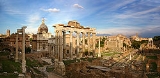
Roman Forum

Encyclopedia
- This article concerns the main forum of ancient Rome. See also Imperial fora and Other fora in Rome for lesser fora and see Forum (Roman)Forum (Roman)A forum was a public square in a Roman municipium, or any civitas, reserved primarily for the vending of goods; i.e., a marketplace, along with the buildings used for shops and the stoas used for open stalls...
for this type of ancient public square.
The Roman Forum is a rectangular forum
Forum (Roman)
A forum was a public square in a Roman municipium, or any civitas, reserved primarily for the vending of goods; i.e., a marketplace, along with the buildings used for shops and the stoas used for open stalls...
(plaza
Plaza
Plaza is a Spanish word related to "field" which describes an open urban public space, such as a city square. All through Spanish America, the plaza mayor of each center of administration held three closely related institutions: the cathedral, the cabildo or administrative center, which might be...
) surrounded by the ruins of several important ancient government buildings at the center of the city of Rome
Rome
Rome is the capital of Italy and the country's largest and most populated city and comune, with over 2.7 million residents in . The city is located in the central-western portion of the Italian Peninsula, on the Tiber River within the Lazio region of Italy.Rome's history spans two and a half...
. Citizens of the ancient city referred to this space, originally a marketplace, as the Forum Magnum, or simply the Forum. It was for centuries the center of Roman public life: the site of triumphal processions
Roman triumph
The Roman triumph was a civil ceremony and religious rite of ancient Rome, held to publicly celebrate and sanctify the military achievement of an army commander who had won great military successes, or originally and traditionally, one who had successfully completed a foreign war. In Republican...
and elections, venue for public speeches, criminal trials
Roman litigation
The history of Roman Law can be divided into three systems of procedure: that of legis actiones, the formulary system, and cognitio extraordinarem. The periods in which these systems were in use overlapped one another and did not have definitive breaks, but it can be stated that the legis actio...
, and gladiatorial matches
Gladiator
A gladiator was an armed combatant who entertained audiences in the Roman Republic and Roman Empire in violent confrontations with other gladiators, wild animals, and condemned criminals. Some gladiators were volunteers who risked their legal and social standing and their lives by appearing in the...
, and nucleus of commercial affairs. Here statues and monuments commemorated the city's great men. The teeming heart of ancient Rome
Ancient Rome
Ancient Rome was a thriving civilization that grew on the Italian Peninsula as early as the 8th century BC. Located along the Mediterranean Sea and centered on the city of Rome, it expanded to one of the largest empires in the ancient world....
, it has been called the most celebrated meeting place in the world, and in all history. Located in the small valley between the Palatine
Palatine Hill
The Palatine Hill is the centermost of the Seven Hills of Rome and is one of the most ancient parts of the city...
and Capitoline Hill
Capitoline Hill
The Capitoline Hill , between the Forum and the Campus Martius, is one of the seven hills of Rome. It was the citadel of the earliest Romans. By the 16th century, Capitolinus had become Capitolino in Italian, with the alternative Campidoglio stemming from Capitolium. The English word capitol...
s, the Forum today is a sprawling ruin of architectural fragments and intermittent archeological excavations attracting numerous sightseers.
Many of the oldest and most important structures of the ancient city were located on or near the Forum. The Kingdom's
Roman Kingdom
The Roman Kingdom was the period of the ancient Roman civilization characterized by a monarchical form of government of the city of Rome and its territories....
earliest shrines and temples were located on the southeastern edge. These included the ancient former royal residence, the Regia
Regia
The Regia was a structure in Ancient Rome, located in the Roman Forum. It was originally the residence of the kings of Rome or at least their main headquarters, and later the office of the Pontifex Maximus, the high priest of Roman religion. It occupied a triangular patch of terrain between the...
(8th century BC
8th century BC
The 8th century BC started the first day of 800 BC and ended the last day of 701 BC.-Overview:The 8th century BC was a period of great changes in civilizations. In Egypt, the 23rd and 24th dynasties led to rule from Nubia in the 25th Dynasty...
), and the Temple of Vesta
Temple of Vesta
The Temple of Vesta is an ancient edifice in Rome, Italy, located in the Roman Forum near the Regia and the House of the Vestal Virgins. The temple's most recognizable feature is its circular footprint. Since the worship of Vesta began in private homes, the architecture seems to be a reminder of...
(7th century BC
7th century BC
The 7th century BC started the first day of 700 BC and ended the last day of 601 BC.The Assyrian Empire continued to dominate the Near East during this century, exercising formidable power over neighbors like Babylon and Egypt. In the last two decades of the century, however, the empire began to...
), as well as the surrounding complex of the Vestal Virgins
House of the Vestals
The House of the Vestal Virgins was the place where Vestal Virgins lived. It was located just behind their circular Temple of Vesta at the eastern edge of the Roman Forum, between the Regia and the Palatine Hill, in Rome...
, all of which were rebuilt after the rise of imperial Rome
Roman Empire
The Roman Empire was the post-Republican period of the ancient Roman civilization, characterised by an autocratic form of government and large territorial holdings in Europe and around the Mediterranean....
. Other archaic shrines to the northwest, such as the Umbilicus Urbis and the Vulcanal
Vulcanal
The Shrine of Vulcan — or Vulcanal, or Volcanal — was an 8th century BC sacred precinct on the future site of the Roman Forum...
(Shrine of Vulcan), developed into the Republic's
Roman Republic
The Roman Republic was the period of the ancient Roman civilization where the government operated as a republic. It began with the overthrow of the Roman monarchy, traditionally dated around 508 BC, and its replacement by a government headed by two consuls, elected annually by the citizens and...
formal Comitium
Comitium
The Comitium in Rome is the location of the original founding of the city. The area is marked by a number of shrines, temples, altars and churches today from throughout its history. The location was lost due to the cities growth and development over a thousand years, but was excavated at the turn...
(assembly area). This is where the Senate
Roman Senate
The Senate of the Roman Republic was a political institution in the ancient Roman Republic, however, it was not an elected body, but one whose members were appointed by the consuls, and later by the censors. After a magistrate served his term in office, it usually was followed with automatic...
— as well as Republican government itself — began. The Senate House, government offices, tribunals, temples, memorials and statues gradually cluttered the area. Over time the archaic Comitium was replaced by the larger adjacent Forum and the focus of judicial activity moved to the new Basilica Aemilia
Basilica Aemilia
The Basilica Aemilia was a civil basilica in the Roman forum, in Rome, Italy. Today only the plan and some rebuilt elements can be seen. The Basilica was 100 meters long and about 30 meters wide...
(179 BC). Some 130 years later, Julius Caesar
Julius Caesar
Gaius Julius Caesar was a Roman general and statesman and a distinguished writer of Latin prose. He played a critical role in the gradual transformation of the Roman Republic into the Roman Empire....
built the Basilica Julia
Basilica Julia
The Basilica Julia , is a structure that once stood in the Roman Forum. It was a large, ornate, public building used for meetings and other official business during the early Roman Empire. Its ruins have been excavated...
, along with the new Curia Julia
Curia Julia
The Curia Hostilia was one of the original senate houses or 'curia' of the Roman Republic. It is believed to have begun as an Etruscan temple where the warring tribes laid down their arms during the reign of Romulus . During the early kingdom, the temple was for the use of the Senators who acted as...
, refocusing both the judicial offices and the Senate itself. This new Forum, in what proved to be its final form, then served as a revitalized city square where the people of Rome could gather for commercial, political, judicial
Roman law
Roman law is the legal system of ancient Rome, and the legal developments which occurred before the 7th century AD — when the Roman–Byzantine state adopted Greek as the language of government. The development of Roman law comprises more than a thousand years of jurisprudence — from the Twelve...
and religious
Religion in ancient Rome
Religion in ancient Rome encompassed the religious beliefs and cult practices regarded by the Romans as indigenous and central to their identity as a people, as well as the various and many cults imported from other peoples brought under Roman rule. Romans thus offered cult to innumerable deities...
pursuits in ever greater numbers.
Eventually much economic and judicial business would transfer away from the Forum Romanum to the larger and more extravagant structures (Trajan's Forum and the Basilica Ulpia
Basilica ulpia
The Basilica Ulpia was an ancient Roman civic building located in the Forum of Trajan. The Basilica Ulpia separates the temple from the main courtyard in the Forum of Trajan with the Trajan's Column to the northwest...
) to the north. The reign of Constantine the Great
Constantine I
Constantine the Great , also known as Constantine I or Saint Constantine, was Roman Emperor from 306 to 337. Well known for being the first Roman emperor to convert to Christianity, Constantine and co-Emperor Licinius issued the Edict of Milan in 313, which proclaimed religious tolerance of all...
, during which the Empire was divided into its Eastern and Western halves, saw the construction of the last major expansion of the Forum complex — the Basilica of Maxentius
Basilica of Maxentius
The Basilica of Maxentius and Constantine is an ancient building in the Roman Forum, Rome, Italy...
(312 AD). This returned the political center to the Forum until the fall of the Western Roman Empire
Western Roman Empire
The Western Roman Empire was the western half of the Roman Empire after its division by Diocletian in 285; the other half of the Roman Empire was the Eastern Roman Empire, commonly referred to today as the Byzantine Empire....
almost two centuries later.
Kingdom
The area of the Forum was originally a low-lying, grassy wetlandWetland
A wetland is an area of land whose soil is saturated with water either permanently or seasonally. Wetlands are categorised by their characteristic vegetation, which is adapted to these unique soil conditions....
. It was drained in the 7th century BC by building the Cloaca Maxima
Cloaca Maxima
The Cloaca Maxima is one of the world's earliest sewage systems. Constructed in Ancient Rome in order to drain local marshes and remove the waste of one of the world's most populous cities, it carried an effluent to the River Tiber, which ran beside the city....
, a large covered sewer system that emptied into the Tiber River
Tiber
The Tiber is the third-longest river in Italy, rising in the Apennine Mountains in Emilia-Romagna and flowing through Umbria and Lazio to the Tyrrhenian Sea. It drains a basin estimated at...
, as more people began to settle between the two hills.
According to tradition, the Forum's beginnings are connected with the alliance between Romulus
Romulus
- People:* Romulus and Remus, the mythical founders of Rome* Romulus Augustulus, the last Western Roman Emperor* Valerius Romulus , deified son of the Roman emperor Maxentius* Romulus , son of the Western Roman emperor Anthemius...
, the first king of Rome controlling the Palatine Hill
Palatine Hill
The Palatine Hill is the centermost of the Seven Hills of Rome and is one of the most ancient parts of the city...
, and his rival, Titus Tatius
Titus Tatius
The traditions of ancient Rome held that Titus Tatius was the Sabine king of Cures, who, after the rape of the Sabine women, attacked Rome and captured the Capitol with the treachery of Tarpeia. The Sabine women, however, convinced Tatius and the Roman king, Romulus, to reconcile and subsequently...
who occupied the Capitoline Hill
Capitoline Hill
The Capitoline Hill , between the Forum and the Campus Martius, is one of the seven hills of Rome. It was the citadel of the earliest Romans. By the 16th century, Capitolinus had become Capitolino in Italian, with the alternative Campidoglio stemming from Capitolium. The English word capitol...
. Accordingly, an alliance formed after combat had been halted by the prayers and cries of the Sabine
Sabine
The Sabines were an Italic tribe that lived in the central Appennines of ancient Italy, also inhabiting Latium north of the Anio before the founding of Rome...
women. Because the valley lay between the two settlements, it was the designated place for the two peoples to meet. Since the early Forum area included pools of stagnant water, the most easily accessible area was the northern part of the valley which was designated as the Comitium
Comitium
The Comitium in Rome is the location of the original founding of the city. The area is marked by a number of shrines, temples, altars and churches today from throughout its history. The location was lost due to the cities growth and development over a thousand years, but was excavated at the turn...
. It was here at the Vulcanal
Vulcanal
The Shrine of Vulcan — or Vulcanal, or Volcanal — was an 8th century BC sacred precinct on the future site of the Roman Forum...
that, according to the story, the two parties laid down their weapons and formed an alliance.
The Forum was outside the walls of the original Sabine fortress, which was entered through the Porta Saturni. These walls were mostly destroyed when the two hills were joined. The original Forum began as an open air market near the Comitium, but outgrew its day to day shopping and marketplace needs. As politics, judicial matters and trials began to take up more and more space, additional fora throughout the city began to emerge to expand on specific needs of the growing population. Fora for cattle, pork, vegetables and wine specialised in their niche products and the associated deities around them.
Rome's second king, Numa Pompilius
Numa Pompilius
Numa Pompilius was the legendary second king of Rome, succeeding Romulus. What tales are descended to us about him come from Valerius Antias, an author from the early part of the 1st century BC known through limited mentions of later authors , Dionysius of Halicarnassus circa 60BC-...
(r. 715-673 BC), is said to have begun the cult of Vesta
Vesta
-Astronomy:* 4 Vesta, second largest asteroid in the solar system, also a proto-planet, named after the Roman deity* Vesta family, group of asteroids that includes 4 Vesta- Places :* Monte Vesta, Lombardy, Italy* Temple of Vesta, Rome, Italy...
, building its house
House of the Vestals
The House of the Vestal Virgins was the place where Vestal Virgins lived. It was located just behind their circular Temple of Vesta at the eastern edge of the Roman Forum, between the Regia and the Palatine Hill, in Rome...
and temple
Temple of Vesta
The Temple of Vesta is an ancient edifice in Rome, Italy, located in the Roman Forum near the Regia and the House of the Vestal Virgins. The temple's most recognizable feature is its circular footprint. Since the worship of Vesta began in private homes, the architecture seems to be a reminder of...
as well as the Regia
Regia
The Regia was a structure in Ancient Rome, located in the Roman Forum. It was originally the residence of the kings of Rome or at least their main headquarters, and later the office of the Pontifex Maximus, the high priest of Roman religion. It occupied a triangular patch of terrain between the...
as the city's first royal palace. Later Tullus Hostilius
Tullus Hostilius
Tullus Hostilius was the legendary third of the Kings of Rome. He succeeded Numa Pompilius, and was succeeded by Ancus Marcius...
(r. 673-642 BC) enclosed the Comitium around the old Etruscan temple where the senate would meet at the site of the Sabine conflict. He is said to have converted that temple into the Curia Hostilia close to where the Senate originally met in an old Etruscan hut. In 600 BC Tarquinius Priscus
Tarquinius Priscus
Lucius Tarquinius Priscus, also called Tarquin the Elder or Tarquin I, was the legendary fifth King of Rome from 616 BC to 579 BC. His wife was Tanaquil.-Early life:According to Livy, Tarquinius Priscus came from the Etruria...
had the area paved for the first time.
Republic
During the Republican period the Comitium continued to be the central location for all judicial and political life in the city. However, in order to create a larger gathering place, the Senate began expanding the open area between the Comitium and the Temple of Vesta by purchasing existing private homes and removing them for public use. Building projects of several consuls repaved and built onto both the Comitium and the adjacent central plaza that was becoming the Forum.The 5th century BC witnessed the construction of the earliest Forum temples with known dates of construction: the Temple of Saturn
Temple of Saturn
The Temple of Saturn is a monument to the agricultural deity. The Temple of Saturn stands at the foot of the Capitoline Hill in the western end of the Forum Romanum in Rome, Italy.-Archaeology:...
(497 BC) and the Temple of Castor and Pollux
Temple of Castor and Pollux
The Temple of Castor and Pollux is an ancient edifice in the Roman Forum, Rome, central Italy. It was originally built in gratitude for victory at the Battle of Lake Regillus . Castor and Pollux were the Dioscuri, the "twins" of Gemini, the twin sons of Zeus and Leda...
(484 BC). The Temple of Concord
Temple of Concord
The Temple of Concord in the ancient city of Rome was a temple dedicated to the Roman goddess Concordia at the western end of the Roman Forum. The temple was built in the 4th century BC as a promise towards peace after a long period of civil strife within the city...
was added in the following century, possibly by the soldier and statesman Marcus Furius Camillus
Marcus Furius Camillus
Marcus Furius Camillus was a Roman soldier and statesman of patrician descent. According to Livy and Plutarch, Camillus triumphed four times, was five times dictator, and was honoured with the title of Second Founder of Rome....
. A long held tradition of speaking from the elevated speakers' Rostra
Rostra
The Rōstra was a large platform built in the city of Rome that stood during the republican and imperial periods. Speakers would stand on the rostra and face the north side of the comitium towards the senate house and deliver orations to those assembled in between...
— originally facing north towards the Senate House to the politicians and assembled elite — put the orator's back to the people assembled in the Forum. A tribune
Tribune
Tribune was a title shared by elected officials in the Roman Republic. Tribunes had the power to convene the Plebeian Council and to act as its president, which also gave them the right to propose legislation before it. They were sacrosanct, in the sense that any assault on their person was...
known as Caius Licinius (consul in 361 BC) was supposed to have been the first to turn away from the Roman elite towards the people in the Forum, an act symbolically repeated two centuries later by Gaius Gracchus
Gaius Gracchus
Gaius Sempronius Gracchus was a Roman Populari politician in the 2nd century BC and brother of the ill-fated reformer Tiberius Sempronius Gracchus...
. This began the tradition of locus popularis, in which even young nobles were expected to speak to the people from the Rostra. Gracchus was thus credited with (or accused of) disturbing the mos maiorum
Mos maiorum
The mos maiorum is the unwritten code from which the ancient Romans derived their social norms. It is the core concept of Roman traditionalism, distinguished from but in dynamic complement to written law. The mos maiorum The mos maiorum ("ancestral custom") is the unwritten code from which the...
("custom of the fathers/ancestors") in ancient Rome. When Censor in 318 BC, Gaius Maenius
Gaius Maenius
Gaius Maenius was a Roman statesman and general.When consul in 338 BC, Gaius Maenius completed the subjugation of Latium, which with Campania had revolted against Rome. He was honored by a triumph, and an extremely phallic column was erected to him in the Forum...
provided buildings in the Forum neighborhood with balconies, which were called after him maeniana, in order that the spectators might better view the games put on within the temporary wooden arenas set up there.
The earliest basilica
Basilica
The Latin word basilica , was originally used to describe a Roman public building, usually located in the forum of a Roman town. Public basilicas began to appear in Hellenistic cities in the 2nd century BC.The term was also applied to buildings used for religious purposes...
s (large, aisled halls) were introduced to the Forum in 184 BC by Marcus Portius Cato, which began the process of "monumentalizing" the site. The Basilica Fulvia
Basilica Fulvia
The Basilica Fulvia was a basilica built in ancient Rome. According to Livy , the censors M. Aemilius Lepidus and M. Fulvius Nobilior had it built in 179 BC. It may be that there had been a previous building existing on the site from 210 BC which was incorporated . In 78 BC, the consul M...
(which underwent several rebuildings and names: Basilica Fulvia et Aemilia, Basilica Paulli, Basilica Aemilia
Basilica Aemilia
The Basilica Aemilia was a civil basilica in the Roman forum, in Rome, Italy. Today only the plan and some rebuilt elements can be seen. The Basilica was 100 meters long and about 30 meters wide...
) was dedicated on the north side of the Forum square in 179 BC. It was followed nine years later by the Basilica Sempronia on the south side. Many of the traditions from the Comitium such as the popular assemblies, funerals of the nobility and games were transferred to the Forum as it developed. Especially notable among these was the move of the comitia tributa, then the focus of popular politics, in 145 BC. Particularly important and unprecedented political events took place in 133 BC when, in the midst of riots in and around the Forum, the Tribune Tiberius Gracchus
Tiberius Gracchus
Tiberius Sempronius Gracchus was a Roman Populares politician of the 2nd century BC and brother of Gaius Gracchus. As a plebeian tribune, his reforms of agrarian legislation caused political turmoil in the Republic. These reforms threatened the holdings of rich landowners in Italy...
was lynched there by a group of Senators.
In the 80s BC, during the dictatorship of Sulla, major work was done on the Forum including the raising of the plaza level by almost a meter and the laying of permanent marble paving stones. (Remarkably, this level of the paving was maintained more or less intact for over a millennium: at least until the sack of Rome by Robert Guiscard
Robert Guiscard
Robert d'Hauteville, known as Guiscard, Duke of Apulia and Calabria, from Latin Viscardus and Old French Viscart, often rendered the Resourceful, the Cunning, the Wily, the Fox, or the Weasel was a Norman adventurer conspicuous in the conquest of southern Italy and Sicily...
and his Normans in 1084, when neglect finally allowed debris to begin to accumulate unabated.) In 78 BC, the immense Tabularium
Tabularium
The Tabularium was the official records office of ancient Rome, and also housed the offices of many city officials. Situated within the Roman Forum, it was on the front slope of the Capitoline Hill, below the Temple of Jupiter Optimus Maximus, to the southeast of the Arx and Tarpeian Rock.Within...
(Records Hall) was built at the Capitoline Hill end of the Forum by order of the consuls for that year, M. Aemilius Lepidus and Q. Lutatius Catulus
Quintus Lutatius Catulus (Capitolinus)
Quintus Lutatius Catulus , sometimes called "Capitolinus", was a politician in the late Roman Republic. His father was the like-named Quintus Lutatius Catulus , also a politician.-Biography:...
. In 63 BC, Cicero
Cicero
Marcus Tullius Cicero , was a Roman philosopher, statesman, lawyer, political theorist, and Roman constitutionalist. He came from a wealthy municipal family of the equestrian order, and is widely considered one of Rome's greatest orators and prose stylists.He introduced the Romans to the chief...
delivered his famous speech denouncing the companions of the conspirator Catiline
Catiline
Lucius Sergius Catilina , known in English as Catiline, was a Roman politician of the 1st century BC who is best known for the Catiline conspiracy, an attempt to overthrow the Roman Republic, and in particular the power of the aristocratic Senate.-Family background:Catiline was born in 108 BC to...
at the Forum (in the Temple of Concord
Temple of Concord
The Temple of Concord in the ancient city of Rome was a temple dedicated to the Roman goddess Concordia at the western end of the Roman Forum. The temple was built in the 4th century BC as a promise towards peace after a long period of civil strife within the city...
, whose spacious hall was sometimes used as a meeting place by the Senators). After the verdict, they were led to their deaths at the Tullianum, the nearby dungeon which was the only known state prison of the ancient Romans.
Over time the Comitium was lost to the ever-growing Curia and to Julius Caesar
Julius Caesar
Gaius Julius Caesar was a Roman general and statesman and a distinguished writer of Latin prose. He played a critical role in the gradual transformation of the Roman Republic into the Roman Empire....
's rearrangements before his assassination in 44 BC. That year two supremely dramatic events were witnessed by the Forum, perhaps the most famous ever to transpire there: Marc Antony's funeral oration for Caesar
Friends, Romans, countrymen, lend me your ears
Friends, Romans, countrymen, lend me your ears is the first line of a famous and often-quoted speech by Mark Antony in the play Julius Caesar, by William Shakespeare. It is taken from Act III, scene II.- Setting :...
(immortalized in Shakespeare's famous play
Julius Caesar (play)
The Tragedy of Julius Caesar, also known simply as Julius Caesar, is a tragedy by William Shakespeare, believed to have been written in 1599. It portrays the 44 BC conspiracy against...
) was delivered from the partially completed speaker's platform known as the New Rostra
Rostra
The Rōstra was a large platform built in the city of Rome that stood during the republican and imperial periods. Speakers would stand on the rostra and face the north side of the comitium towards the senate house and deliver orations to those assembled in between...
and the public burning of Caesar's body occurred on a site directly across from the Rostra around which the Temple to the Deified Caesar
Temple of Caesar
The Temple of Caesar or Temple of Divus Iulius also known as Temple of the Deified Julius Caesar, delubrum, heroon or Temple of the Comet Star, is an ancient structure in the Roman Forum of Rome, Italy, located near the Regia and the Temple of Vesta.-History:It was begun by...
was subsequently built by his great-nephew Octavius (Augustus). Almost two years later, Marc Antony added to the notoriety of the Rostra by publicly displaying the severed head and right hand of his enemy Cicero
Cicero
Marcus Tullius Cicero , was a Roman philosopher, statesman, lawyer, political theorist, and Roman constitutionalist. He came from a wealthy municipal family of the equestrian order, and is widely considered one of Rome's greatest orators and prose stylists.He introduced the Romans to the chief...
there.
The close relationship between the Comitium and the Forum Romanum eventually faded from the writings of the ancients. The former is last mentioned in the reign of Septimus Severus.
Empire
After Julius Caesar's death, and the end of the subsequent Civil WarsRoman civil wars
There were several Roman civil wars, especially during the late Republic. The most famous of these are the war in the 40s BC between Julius Caesar and the optimate faction of the senatorial elite initially led by Pompey and the subsequent war between Caesar's successors, Octavian and Mark Antony in...
, Augustus finished his great-uncle's work of giving the Forum its final form. This included defining the southeastern end of the plaza by constructing the Temple of Divus Iulius and the Arch of Augustus
Arch of Augustus
The "Arch of Augustus" may mean the triumphal arch of Augustus at any of the following sites:*Aosta*Fano*Rimini*Rome...
there (both in 29 BC). Augustus is said to have stated "I found Rome a city of brick, and left it a city of marble". What is true is that he continued the building projects of his predecessor and began many of his own directly in the Forum.
The Forum was witness to the assassination of a Roman Emperor in 69 AD: Galba
Galba
Galba , was Roman Emperor for seven months from 68 to 69. Galba was the governor of Hispania Tarraconensis, and made a bid for the throne during the rebellion of Julius Vindex...
had set out from the palace to meet rebels, but was so feeble that he had to be carried in a litter. He was immediately met by a troop of his rival Otho
Otho
Otho , was Roman Emperor for three months, from 15 January to 16 April 69. He was the second emperor of the Year of the four emperors.- Birth and lineage :...
's cavalry near the Lacus Curtius in the Forum and killed there. During these early Imperial times much economic and judicial business transferred away from the Forum to larger and more extravagant structures to the north. After the building of Trajan's Forum (110 AD), these activities transferred to the Basilica Ulpia
Basilica ulpia
The Basilica Ulpia was an ancient Roman civic building located in the Forum of Trajan. The Basilica Ulpia separates the temple from the main courtyard in the Forum of Trajan with the Trajan's Column to the northwest...
.
The Emperor Diocletian
Diocletian
Diocletian |latinized]] upon his accession to Diocletian . c. 22 December 244 – 3 December 311), was a Roman Emperor from 284 to 305....
(r. 284-305) was the last of the great builders of Rome's city infrastructure and he did not omit the Forum from his program. By his day it had become highly cluttered with honorific memorials. He refurbished and reorganized it, building anew the Temple of Saturn, Temple of Vesta and the Curia. (The last had recently burned and Diocletian's version is the one that can still be visited today.) The reign of Constantine the Great
Constantine I
Constantine the Great , also known as Constantine I or Saint Constantine, was Roman Emperor from 306 to 337. Well known for being the first Roman emperor to convert to Christianity, Constantine and co-Emperor Licinius issued the Edict of Milan in 313, which proclaimed religious tolerance of all...
saw the division of the Empire into its Eastern and Western halves, as well as the construction of the Basilica of Maxentius
Basilica of Maxentius
The Basilica of Maxentius and Constantine is an ancient building in the Roman Forum, Rome, Italy...
(312 AD), the last significant expansion of the Forum complex. This restored much of the political focus to the Forum until the fall of the Western Roman Empire
Western Roman Empire
The Western Roman Empire was the western half of the Roman Empire after its division by Diocletian in 285; the other half of the Roman Empire was the Eastern Roman Empire, commonly referred to today as the Byzantine Empire....
almost two centuries later.
Medieval
In the 6th century some of the old edifices within the Forum began to be transformed into Christian churches. On August 1, 608, the Column of PhocasColumn of Phocas
The Column of Phocas , is a Roman monumental column in the Roman Forum of Rome, Italy. Erected before the Rostra and dedicated or rededicated in honour of the Eastern Roman Emperor Phocas on August 1, 608, was the last addition made to the Forum Romanum...
, a Roman monumental column, was erected before the Rostra
Rostra
The Rōstra was a large platform built in the city of Rome that stood during the republican and imperial periods. Speakers would stand on the rostra and face the north side of the comitium towards the senate house and deliver orations to those assembled in between...
and dedicated or rededicated in honour of the Eastern Roman Emperor
Byzantine Empire
The Byzantine Empire was the Eastern Roman Empire during the periods of Late Antiquity and the Middle Ages, centred on the capital of Constantinople. Known simply as the Roman Empire or Romania to its inhabitants and neighbours, the Empire was the direct continuation of the Ancient Roman State...
Phocas
Phocas
Phocas was Byzantine Emperor from 602 to 610. He usurped the throne from the Emperor Maurice, and was himself overthrown by Heraclius after losing a civil war.-Origins:...
. This proved to be the last monumental addition made to the Forum. By the 8th century the whole space was surrounded by Christian churches taking the place of the abandoned and ruined temples.
An anonymous 8th century traveler from Einsiedeln
Einsiedeln, Switzerland
Einsiedeln is a municipality and district in the canton of Schwyz in Switzerland known for its monastery, the Benedictine Einsiedeln Abbey. Einsiedeln is also the birthplace of Paracelsus, a Renaissance physician and alchemist who is credited with first naming zinc.-Prehistoric...
(now in Switzerland) reported that the Forum was already falling apart in his time. During the Middle Ages, though the memory of the Forum Romanum persisted, its monuments were for the most part buried under debris, and its location was designated the "Campo Vaccino" or "cattle field," located between the Capitoline Hill
Capitoline Hill
The Capitoline Hill , between the Forum and the Campus Martius, is one of the seven hills of Rome. It was the citadel of the earliest Romans. By the 16th century, Capitolinus had become Capitolino in Italian, with the alternative Campidoglio stemming from Capitolium. The English word capitol...
and the Colosseum.
After the 8th century the structures of the Forum were dismantled, re-arranged and used to build feudal towers and castles within the local area. In the 13th century these rearranged structures were torn down and the site became a dumping ground. This, along with the debris from the dismantled medieval buildings and ancient structures, helped contribute to the rising ground level.
The return of Pope Urban V
Pope Urban V
Pope Urban V , born Guillaume Grimoard, was Pope from 1362 to 1370.-Biography:Grimoard was a native of Grizac in Languedoc . He became a Benedictine and a doctor in Canon Law, teaching at Montpellier and Avignon...
from Avignon
Avignon Papacy
The Avignon Papacy was the period from 1309 to 1376 during which seven Popes resided in Avignon, in modern-day France. This arose from the conflict between the Papacy and the French crown....
in 1367 led to an increased interest in ancient monuments, partly for their moral lesson and partly as a quarry for new buildings being undertaken in Rome after a long lapse.
Excavation and preservation
Artists from the late 15th century drew the ruins in the Forum, antiquaries copied inscriptions in the 16th century, and a tentative excavation was begun in the late 18th century.A cardinal took measures to drain it again and built the Alessandrine neighborhood over it. But the excavation by Carlo Fea
Carlo Fea
Carlo Fea was an Italian archaeologist.Born at Pigna, in what is now Liguria, Fea studied law in Rome, receiving the degree of doctor of laws from the university of La Sapienza, but archaeology gradually attracted his attention, and with the view of obtaining better opportunities for his research...
, who began clearing the debris from the Arch of Septimius Severus in 1803, and archaeologists under the Napoleonic regime
History of Italy during foreign domination and the unification
The history of Italy in the Early Modern period was partially characterized by foreign domination:Following the Italian Wars , Italy saw a long period of relative peace, first under Habsburg Spain and then under Habsburg Austria . During the Napoleonic era, Italy was a client state of the French...
marked the beginning of clearing the Forum, which was only fully excavated in the early 20th century.
Remains from several centuries are shown together, due to the Roman practice of building over earlier ruins.
The site today
Today, archeological excavations continue along with constant restoration and preservation. Long a major tourist destination in the city, the Forum is open for foot traffic along the ancient Roman streets which are restored to the late Imperial level. The Forum Museum (Antiquarium Forense) is found at the Colosseum end of a modern road, the Via dei Fori ImperialiVia dei Fori Imperiali
The Via dei Fori Imperiali is a road in the centre of the city of Rome, Italy, that runs in a straight line from the Piazza Venezia to the Colosseum....
. This little museum has a significant collection of sculpture and architectural fragments. There are also reconstructions of the Forum and the nearby Imperial Fora as well as a short video in several languages. It is entered from the Forum by the side of Santa Francesca Romana
Santa Francesca Romana
Santa Francesca Romana, previously known as Santa Maria Nova, is a church in Rome, Italy, situated next to the Roman Forum.- History :...
(No. 53 Piazza S. Maria Nova) and is open from 08:30 to one hour before sunset. Admission is 12 Euros.
In 2008 heavy rains caused structural damage to the modern concrete covering holding the "Black Stone" marble together over the Vulcanal
Vulcanal
The Shrine of Vulcan — or Vulcanal, or Volcanal — was an 8th century BC sacred precinct on the future site of the Roman Forum...
.
The monuments
Many of the Forum's monuments were originally built in the periods of the Kingdom (753 BC-509 BC) and the Republic (509 BC-27 BC), although most were destroyed and rebuilt several times. The existing ruins generally date from the Imperial period (27 BC - 476 AD).
Temples
- Temple of Castor and PolluxTemple of Castor and PolluxThe Temple of Castor and Pollux is an ancient edifice in the Roman Forum, Rome, central Italy. It was originally built in gratitude for victory at the Battle of Lake Regillus . Castor and Pollux were the Dioscuri, the "twins" of Gemini, the twin sons of Zeus and Leda...
(494 BC) - Temple of SaturnTemple of SaturnThe Temple of Saturn is a monument to the agricultural deity. The Temple of Saturn stands at the foot of the Capitoline Hill in the western end of the Forum Romanum in Rome, Italy.-Archaeology:...
(501 BC) - Temple of VestaTemple of VestaThe Temple of Vesta is an ancient edifice in Rome, Italy, located in the Roman Forum near the Regia and the House of the Vestal Virgins. The temple's most recognizable feature is its circular footprint. Since the worship of Vesta began in private homes, the architecture seems to be a reminder of...
(7th century BC) - Temple of Venus and RomaTemple of Venus and RomaThe Temple of Venus and of Rome — in Latin, Templum Veneris et Romae — is thought to have been the largest temple in Ancient Rome. Located on the Velian Hill, between the eastern edge of the Forum Romanum and the Colosseum, it was dedicated to the goddesses Venus Felix and Roma Aeterna...
(135) - Temple of Antoninus and FaustinaTemple of Antoninus and FaustinaThe Temple of Antoninus and Faustina is an ancient Roman temple in Rome, adapted to the church of San Lorenzo in Miranda. It stands in the Forum Romanum, on the Via Sacra, opposite the Regia.-The temple:...
(141) - Temple of CaesarTemple of CaesarThe Temple of Caesar or Temple of Divus Iulius also known as Temple of the Deified Julius Caesar, delubrum, heroon or Temple of the Comet Star, is an ancient structure in the Roman Forum of Rome, Italy, located near the Regia and the Temple of Vesta.-History:It was begun by...
(29 BC) - Temple of Vespasian and TitusTemple of Vespasian and TitusThe Temple of Vespasian and Titus is located in Rome at the western end of the Roman Forum between the Temple of Concordia and the Temple of Saturn. It is dedicated to the deified Vespasian and his son, the deified Titus. It was begun by Titus in 79 after Vespasian's death and Titus's succession...
(79) - Temple of Romulus (309)
- Temple of Divus Romulus (309)
Basilicas
- Basilica AemiliaBasilica AemiliaThe Basilica Aemilia was a civil basilica in the Roman forum, in Rome, Italy. Today only the plan and some rebuilt elements can be seen. The Basilica was 100 meters long and about 30 meters wide...
- Basilica JuliaBasilica JuliaThe Basilica Julia , is a structure that once stood in the Roman Forum. It was a large, ornate, public building used for meetings and other official business during the early Roman Empire. Its ruins have been excavated...
- Basilica of Maxentius and Constantine
- Colossus of ConstantineColossus of ConstantineThe Colossus of Constantine was a colossal acrolithic statue of the late Roman emperor Constantine the Great that once occupied the west apse of the Basilica of Maxentius near the Forum Romanum in Rome...
, colossal statue formerly in the west apse of the Basilica of Maxentius
- Colossus of Constantine
Government buildings or official residences
- RegiaRegiaThe Regia was a structure in Ancient Rome, located in the Roman Forum. It was originally the residence of the kings of Rome or at least their main headquarters, and later the office of the Pontifex Maximus, the high priest of Roman religion. It occupied a triangular patch of terrain between the...
, originally the residence of the kings of Rome or at least their main headquarters, and later the office of the Pontifex Maximus, the high priest of Roman religion. - Curia JuliaCuria JuliaThe Curia Hostilia was one of the original senate houses or 'curia' of the Roman Republic. It is believed to have begun as an Etruscan temple where the warring tribes laid down their arms during the reign of Romulus . During the early kingdom, the temple was for the use of the Senators who acted as...
, official meeting place of the Roman SenateRoman SenateThe Senate of the Roman Republic was a political institution in the ancient Roman Republic, however, it was not an elected body, but one whose members were appointed by the consuls, and later by the censors. After a magistrate served his term in office, it usually was followed with automatic...
(built by Julius Caesar, 44 BC; later reconstruction by Diocletian, 305 AD) - TabulariumTabulariumThe Tabularium was the official records office of ancient Rome, and also housed the offices of many city officials. Situated within the Roman Forum, it was on the front slope of the Capitoline Hill, below the Temple of Jupiter Optimus Maximus, to the southeast of the Arx and Tarpeian Rock.Within...
, the records office of Rome. - Portico Dii ConsentesPortico Dii ConsentesThe Portico Dii Consentes , sometimes known as the Area of the Dii Consentes, is located at the bottom of the ancient Roman road that leads up to the Capitol in Rome and to the Temple of Jupiter at its summit...
("Portico of the Harmonious Gods") - Atrium VestaeHouse of the VestalsThe House of the Vestal Virgins was the place where Vestal Virgins lived. It was located just behind their circular Temple of Vesta at the eastern edge of the Roman Forum, between the Regia and the Palatine Hill, in Rome...
, the house of the Vestal Virgins. - Tullianum, the prison used to hold various foreign leaders and generals.
Smaller monuments
- RostraRostraThe Rōstra was a large platform built in the city of Rome that stood during the republican and imperial periods. Speakers would stand on the rostra and face the north side of the comitium towards the senate house and deliver orations to those assembled in between...
(New Rostra, Rostra Augusti), platform from which politicians made their speeches to the Roman citizens - Umbilicus Urbis Romae, the designated centre ("navel") of the city from which, and to which, all distances in Rome and the Roman Empire were measured (probably identical with the Mundus Cereris)
- Milliarium Aureum After AugustusAugustusAugustus ;23 September 63 BC – 19 August AD 14) is considered the first emperor of the Roman Empire, which he ruled alone from 27 BC until his death in 14 AD.The dates of his rule are contemporary dates; Augustus lived under two calendars, the Roman Republican until 45 BC, and the Julian...
erected this monument, all roads were considered to begin here and all distances in the Roman Empire were measured relative to that point. - Column of PhocasColumn of PhocasThe Column of Phocas , is a Roman monumental column in the Roman Forum of Rome, Italy. Erected before the Rostra and dedicated or rededicated in honour of the Eastern Roman Emperor Phocas on August 1, 608, was the last addition made to the Forum Romanum...
, the last monument built within the Forum. - Lapis NigerLapis NigerThe Lapis Niger is an ancient shrine in the Roman Forum. Together with the associated Vulcanal it constitutes the only surviving remnants of the old Comitium, an early assembly area that preceded the Forum and is thought to derive from an archaic cult site of the 7th or 8th century BC.The black...
("Black Stone"), a very ancient shrine which was obscure even to the Romans. - Plutei of TrajanPlutei of TrajanAlso called the Plutei Traiani, these carved stone balustrades were built by Trajan. They are on display inside the Curia Julia on the Forum Romanum today, but are not part of the original structure.It is unknown exactly where Trajan erected them...
(Plutei Traiani), now in the Curia Julia
Pools, springs
- The Lacus CurtiusLacus CurtiusThe Lacus Curtius is a mysterious hole in the ground in the Roman Forum, now small, more or less filled in and paved over with ancient stone, but once said to have been a widening chasm. Its nature and significance in Rome's early history is unknown, and this was already the case by the late...
, the site of a mysterious pool venerated by Romans even after they had forgotten what it signified. - The Lacus Iuturnae ("Spring of Juturna"), a healing pool where Castor and Pollux were said to have watered their horses
Roads, streets, staircases
- Gemonian stairsGemonian stairsThe Gemonian Stairs were a flight of steps located in the ancient city of Rome. Nicknamed the Stairs of Mourning, the stairs are infamous in Roman history as a place of execution.- Location :...
steps situated in the central part of Rome, leading from the Arx of the Capitoline Hill down to the Roman Forum. - Clivus CapitolinusClivus CapitolinusThe main road to the Roman Capitol, the Clivus Capitolinus starts at the head of the Forum Romanum beside the Arch of Tiberius as a continuation of the Via Sacra; proceeding around the Temple of Saturn and turning to the south in front of the Portico Dii Consentes, it then climbs up the slope of...
was the street that started at the Arch of Tiberius, wound around the Temple of Saturn, and ended at Capitoline Hill. - Via SacraVia SacraThe Via Sacra was the main street of ancient Rome, leading from the top of the Capitoline Hill, through some of the most important religious sites of the Forum , to the Colosseum....
, the famous processionProcessionA procession is an organized body of people advancing in a formal or ceremonial manner.-Procession elements:...
al street of Roman TriumphRoman triumphThe Roman triumph was a civil ceremony and religious rite of ancient Rome, held to publicly celebrate and sanctify the military achievement of an army commander who had won great military successes, or originally and traditionally, one who had successfully completed a foreign war. In Republican...
s; linked the Atrium Vestae with the ColosseumColosseumThe Colosseum, or the Coliseum, originally the Flavian Amphitheatre , is an elliptical amphitheatre in the centre of the city of Rome, Italy, the largest ever built in the Roman Empire...
. - Vicus JugariusVicus JugariusThe Vicus Jugarius, or the Street of the Yoke-Makers, was an ancient street leading into the Roman Forum. The Vicus Jugarius was very old—perhaps even older than Rome itself...
("Street of the Yoke-Makers")
In art
The Roman Forum has been a source of inspiration for visual artists for centuries. Especially notable is Giambattista Piranesi who created (1748–76) a set of 135 etchings — the Vedute di Roma (Views of Rome) — in which the Forum figured significantly. (Many of the features documented in Piranesi's views have now vanished.)Notable artists of the Forum include Maerten van Heemskerck, Pirro Ligorio
Pirro Ligorio
Pirro Ligorio was an Italian architect, painter, antiquarian and garden designer.-Biography:Ligorio was born in Naples. In 1534 he moved to Rome, where he developed his interest in antiquities, and was named superintendent to the ancient monuments by the Popes Pius IV and Paul IV...
, Canaletto
Canaletto
Giovanni Antonio Canal better known as Canaletto , was a Venetian painter famous for his landscapes, or vedute, of Venice. He was also an important printmaker in etching.- Early career :...
, Claude Lorrain
Claude Lorrain
Claude Lorrain, , traditionally just Claude in English Claude Lorrain, , traditionally just Claude in English (also Claude Gellée, his real name, or in French Claude Gellée, , dit le Lorrain) Claude Lorrain, , traditionally just Claude in English (also Claude Gellée, his real name, or in French...
, Giovanni Paolo Panini, Hubert Robert
Hubert Robert
Hubert Robert , French artist, was born in Paris.His father, Nicolas Robert, was in the service of François-Joseph de Choiseul, marquis de Stainville a leading diplomat from Lorraine...
, J.M.W. Turner and many others.
Other fora in Rome
Other foraForum (Roman)
A forum was a public square in a Roman municipium, or any civitas, reserved primarily for the vending of goods; i.e., a marketplace, along with the buildings used for shops and the stoas used for open stalls...
existed in other areas of the city; remains of most of them, sometimes substantial, still exist. The most important of these are a number of large imperial fora forming a complex with the Forum Romanum: the Forum Iulium
Forum of Caesar
The Forum of Caesar, also known as Forum Iulium or Forum Julium, Forum Caesaris, is a forum built by Julius Caesar near the Forum Romanum in Rome in 46 BC.-Construction:...
, Forum Augustum
Forum of Augustus
The Forum of Augustus is one of the Imperial forums of Rome, Italy, built by Augustus. It includes the Temple of Mars Ultor.-History:The triumvir Octavian vowed to build a temple honoring Mars, the Roman God of War, during the battle of Philippi in 42 BC...
, the Forum Transitorium (also: Forum Nerva), and Trajan's Forum
Trajan's Forum
Trajan's Forum is an ancient structure in Rome, Italy, chronologically the last of the Imperial fora. The forum was constructed by the architect Apollodorus of Damascus.-History:...
. The planners of the Mussolini era removed most of the Medieval and Baroque strata and built the Via dei Fori Imperiali road between the Imperial Fora and the Forum. There is also:
- The Forum BoariumForum BoariumThe Forum Boarium was the cattle forum venalium of Ancient Rome and the oldest forum that Rome possessed. It was located on a level piece of land near the Tiber between the Capitoline, the Palatine and Aventine hills. Here, too, is where the first bridges were built...
, dedicated to the commerce of cattleCattleCattle are the most common type of large domesticated ungulates. They are a prominent modern member of the subfamily Bovinae, are the most widespread species of the genus Bos, and are most commonly classified collectively as Bos primigenius...
, between the Palatine HillPalatine HillThe Palatine Hill is the centermost of the Seven Hills of Rome and is one of the most ancient parts of the city...
and the river TiberTiberThe Tiber is the third-longest river in Italy, rising in the Apennine Mountains in Emilia-Romagna and flowing through Umbria and Lazio to the Tyrrhenian Sea. It drains a basin estimated at...
, - The Forum HolitoriumForum HolitoriumThe Forum Holitorium was the market for vegetables, herbs and oil forum venalium of early ancient Rome, by the Tiber at the foot of the Capitoline and Palatine hills...
, dedicated to the commerce of herbHerbExcept in botanical usage, an herb is "any plant with leaves, seeds, or flowers used for flavoring, food, medicine, or perfume" or "a part of such a plant as used in cooking"...
s and vegetableVegetableThe noun vegetable usually means an edible plant or part of a plant other than a sweet fruit or seed. This typically means the leaf, stem, or root of a plant....
s, between the Capitoline Hill and the Servian walls, - The Forum PiscariumForum PiscariumThe Forum Piscarium was the fish forum venalium of ancient Rome, north of the Roman Forum, between the Sacra Via and the Argiletum. It was burned in 210 BC and rebuilt the next year. In 179 it was incorporated in the general Macellum, built by Marcus Fulvius Nobilior in the same region.This forum...
, dedicated to the commerce of fishFishFish are a paraphyletic group of organisms that consist of all gill-bearing aquatic vertebrate animals that lack limbs with digits. Included in this definition are the living hagfish, lampreys, and cartilaginous and bony fish, as well as various extinct related groups...
, between the Capitoline hill and the Tiber, in the area of the current Roman GhettoRoman GhettoThe Roman Ghetto was a ghetto located in the rione Sant'Angelo, in Rome, Italy, in the area surrounded by today's Via del Portico d'Ottavia, Lungotevere dei Cenci, Via del Progresso and Via di Santa Maria del Pianto close to the Tiber and the Theater of Marcellus...
, - The Forum SuariumForum SuariumThe Forum Suarium was the pork forum venalium of early Ancient Rome during the empire, mentioned first in two inscriptions of about 200 AD. This market was near the barracks of the cohortes urbanae in the northern part of the campus Martius, probably close to the present Via di Propaganda, and its...
, dedicated to the commerce of porkPorkPork is the culinary name for meat from the domestic pig , which is eaten in many countries. It is one of the most commonly consumed meats worldwide, with evidence of pig husbandry dating back to 5000 BC....
, near the barracks of the cohortes urbanae in the northern part of the campus MartiusCampus MartiusThe Campus Martius , was a publicly owned area of ancient Rome about in extent. In the Middle Ages, it was the most populous area of Rome...
, - The Forum VinariumForum VinariumThe Forum Vinarium was the wine forum venalium of early Ancient Rome, it was located in the area now of the quartiere Testaccio, between Aventine Hill and the Tiber....
, dedicated to the commerce of wineWineWine is an alcoholic beverage, made of fermented fruit juice, usually from grapes. The natural chemical balance of grapes lets them ferment without the addition of sugars, acids, enzymes, or other nutrients. Grape wine is produced by fermenting crushed grapes using various types of yeast. Yeast...
, in the area now of the "quartiere" TestaccioTestaccioTestaccio is the 20th rione of Rome, deriving its name from Monte Testaccio. In antiquity, much of the Tiber River trade took place here, and the remains of broken clay vessels were stacked creating the artificial Testaccio hill, which today is a source of much archeological evidence as to the...
, between Aventine HillAventine HillThe Aventine Hill is one of the seven hills on which ancient Rome was built. It belongs to Ripa, the twelfth rione, or ward, of Rome.-Location and boundaries:The Aventine hill is the southernmost of Rome's seven hills...
and the Tiber.
Other markets were known but remain unidentifiable due to a lack of precise information on the function of the sites. Among these, the Forum cuppedinis, was known as a general market for many goods.
See also
- Tarpeian RockTarpeian RockThe Tarpeian Rock was a steep cliff of the southern summit of the Capitoline Hill, overlooking the Roman Forum in Ancient Rome. It was used during the Roman Republic as an execution site. Murderers, traitors, perjurors, and larcenous slaves, if convicted by the quaestores parricidii, were flung...
, a traditional execution site overlooking the Forum - Farnese GardensFarnese GardensThe Farnese Gardens are a garden in Rome, central Italy, created in 1550 on the northern portion of Palatine Hill, by Cardinal Alessandro Farnese...
(1550), immediately overlooking the Forum - Colossus of ConstantineColossus of ConstantineThe Colossus of Constantine was a colossal acrolithic statue of the late Roman emperor Constantine the Great that once occupied the west apse of the Basilica of Maxentius near the Forum Romanum in Rome...
, colossal statue formerly in the west apse of the Basilica of MaxentiusBasilica of MaxentiusThe Basilica of Maxentius and Constantine is an ancient building in the Roman Forum, Rome, Italy...
Comprehensive sites
- Digital Roman Forum, 3D reconstructions of the Roman Forum in ca. 400
- Christian Hülsen: The Roman Forum (at LacusCurtius; Hülsen was one of the principal excavators of the Forum)
Primarily visual
- Rome Reborn − A Video Tour through Ancient Rome based on a digital model
- A two-part documentary offering a virtual tour of the north side of the Forum
- QTVR fullscreen of Roman Forum by Tolomeus
- Forum Romanum (photo archive)
- Images of the Forum Romanum
- Map of the Forum in AD 100, blank or labelled
- The Roman Forum from the Campidoglio
- 3D reconstructions movie of the Roman Forum in 5th century A.D.
- The Roman Forum of 179 AD