
See Also

Nero

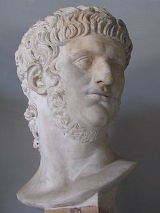
Nero Claudius Caesar Augustus Germanicus , born Lucius Domitius Ahenobarbus, also called Nero Claudius Drusus Germanicus, was the fifth and last Roman Emperor Roman Emperor

"Roman Emperor" is the term historians use to refer to rulers of the Roman Empire [i], after the epoch c ... 

 of the Julio-Claudian dynasty Julio-Claudian Dynasty

The Julio-Claudian Dynasty refers to the first five Roman Emperors [i]: Augustus [i], Tiberius [i], Caligula [i] ... 

 . Nero became heir to the then Emperor, his grand-uncle and adoptive father Claudius Claudius

Christoph Ludwig Agricola was a German [i] landscape painter [i]. ... 

. As Nero Claudius Caesar Drusus he succeeded to the throne on October 13, 54 following Claudius' death. In 66, he added the prefix Imperator Imperator

The Latin [i] word imperator was a title originally roughly equivalent to commander during the perio ... 

 to his name. In 68, Nero was deposed. His subsequent death was reportedly the result of suicide assisted by his scribe Epaphroditos motivated by the threat of execution.

Discussions

  Discussion Features

   Ask a question about 'Nero'

   Start a new discussion about 'Nero'

   Answer questions about 'Nero'

   'Nero' discussion forum

Timeline

37   Born

39   Tigellinus, minister and favorite of the later Roman emperor Roman Emperor

"Roman Emperor" is the term historians use to refer to rulers of the Roman Empire [i], after the epoch c ... 

 Nero, is banished for adultery Adultery

Adultery is generally defined as consensual sexual intercourse [i] by a married [i] person with ... 

 with Caligula Caligula

Gaius Julius Caesar Augustus Germanicus , most commonly known as Caligula, was the third Roman Emperor [i] ... 

's sisters.

49   Seneca the Younger Seneca the Younger

Lucius Annaeus Seneca was a Roman [i] philosopher [i], statesman [i], dramatist [i], and in ... 

 becomes Nero's tutor.

49   Engagement of Nero and Octavia, daughter of Claudius.

50   Claudius adopts Nero

51   Burrus, praetorian prefect from 51-62, is charged by Seneca with the education of Nero.

53   Nero marries Octavia Claudia Octavia

Claudia Octavia or Octavia Neronis was a Roman Empress, step-sister and first wife to Roman Empero... 

.

54   Roman emperor Roman Emperor

"Roman Emperor" is the term historians use to refer to rulers of the Roman Empire [i], after the epoch c ... 

 Claudius Claudius

Christoph Ludwig Agricola was a German [i] landscape painter [i]. ... 

 dies, possibly after being poisoned by Agrippina, his wife and niece, and is succeeded by Nero.

58   Roman emperor Roman Emperor

"Roman Emperor" is the term historians use to refer to rulers of the Roman Empire [i], after the epoch c ... 

 Nero is also a Roman Consul.

62   After the death of Burrus and the disgrace of Seneca, Nero, free from their influence, becomes a megalomaniacal artist fascinated by Hellenism and the Orient. Tigellinus becomes Nero's counselor. From this time onward his rule becomes highly abusive.

   More Events >>


Quotations

Qualis artifex pereo.

Translation: What an artist dies in me!, Translation: What an artisan I am in dying!

Finally I can live like a human being.

after moving into the Golden House, built upon burned out areas after the great fire of Rome.

Hidden talent counts for nothing.

       More Quotes >>


Encyclopedia

Nero Claudius Caesar Augustus Germanicus , born Lucius Domitius Ahenobarbus, also called Nero Claudius Drusus Germanicus, was the fifth and last Roman Emperor Roman Emperor

"Roman Emperor" is the term historians use to refer to rulers of the Roman Empire [i], after the epoch c ... 

 of the Julio-Claudian dynasty Julio-Claudian Dynasty

The Julio-Claudian Dynasty refers to the first five Roman Emperors [i]: Augustus [i], Tiberius [i], Caligula [i] ... 

 . Nero became heir to the then Emperor, his grand-uncle and adoptive father Claudius Claudius

Christoph Ludwig Agricola was a German [i] landscape painter [i]. ... 

. As Nero Claudius Caesar Drusus he succeeded to the throne on October 13, 54 following Claudius' death. In 66, he added the prefix Imperator Imperator

The Latin [i] word imperator was a title originally roughly equivalent to commander during the perio ... 

 to his name. In 68, Nero was deposed. His subsequent death was reportedly the result of suicide assisted by his scribe Epaphroditos motivated by the threat of execution.

Popular legend remembers Nero as a playboy engaged in petty amusements while neglecting the problems of the Roman city and empire, the emperor who "fiddled while Rome burned". Because of his reported excesses and eccentricities, he is traditionally viewed as the second of the so-called Mad Emperors, the first being Caligula Caligula

Gaius Julius Caesar Augustus Germanicus , most commonly known as Caligula, was the third Roman Emperor [i] ... 

.

These assumptions of his behaviour are based entirely on hostile sources; namely Suetonius, Dio Cassius and Tacitus Tacitus

Publius Cornelius Tacitus is one of the important historian [i]s of Roman Antiquity [i]. ... 

. Nero's life was documented almost entirely by his primary rivals- the senatorial class who were pro-Flavian.

Life


Overview

Nero ruled from 54 to 68 AD. During his rule, the Roman Empire was relatively peaceful and prosperous . Nero focused much of his attention on diplomacy, trade, and increasing the cultural capital of the empire. He ordered the building of theatres and promoted athletic games. He also banned the killing of gladiators Gladiators

Gladiators was a game show [i] produced by LWT [i] for ITV [i] in the United Kingdom [i] ... 

.

His reign had a number of successes including the war and negotiated peace with the Parthian Empire Parthia

Parthia was a civilization situated in the northeast of modern Iran, but at its height covering all of ... 

 , the putting down of the British revolt , the putting down of a Vindex's revolt in Gaul and improving diplomatic ties with Greece.

His failures included Galba Galba

Servius Sulpicius Galba was Roman Emperor [i] from June 8 [i], 68 [i] until his death. ... 

's Hispania revolt of 68 that led to his reported suicide and the civil war that ensued from his death.

Family

Born in Antium, near Rome, on December 15, 37, he was the only son of Gnaeus Domitius Ahenobarbus and Agrippina the younger Agrippina the Younger

Julia Agrippina , most commonly known as Agrippina Minor or Agrippina the Younger , was the... 

, sister of Caligula Caligula

Gaius Julius Caesar Augustus Germanicus , most commonly known as Caligula, was the third Roman Emperor [i] ... 

.

His father was grandson to an elder Gnaeus Domitius Ahenobarbus and Aemilia Lepida through their son Lucius Domitius Ahenobarbus. He was also great-grandson to Mark Antony Mark Antony

Marcus Antonius , known in English [i] as Mark Antony, was a Roman [i] ... 

 and Octavia Minor Octavia Minor

Octavia Minor, also known as Octavia the Younger or simply Octavia, was the sister of the fi... 

 through their daughter Antonia Major. Also, through Octavia, he was the great-nephew of Caesar Augustus.

His mother was Agrippina the elder Agrippina the elder

Agrippina , most commonly known as Agrippina Major or Agrippina "the Elder", was one of th... 

 who was granddaughter to Octavia's brother Caesar Augustus and his wife Scribonia through their daughter Julia the Elder Julia the Elder

... no changes ... no changes ...... 

 and her husband Marcus Vipsanius Agrippa Marcus Vipsanius Agrippa

Marcus Vipsanius Agrippa was a Roman statesman and general.... 

. His maternal grandfather Germanicus Germanicus

Iulius Caesar Claudianus Germanicus was a member of the Julio-Claudian dynasty [i] of the early Roman Empire [i] ... 

 was grandson to Tiberius Claudius Nero and Livia Livia

Livia Drusilla, after 14 [i] called Julia Augusta was the wife of Caesar Augustus [i] and the most ... 

, adoptive grandson to her second husband Caesar Augustus, nephew and adoptive son of Tiberius Tiberius

Tiberius Caesar Augustus, born Tiberius Claudius Nero , was the second Roman Emperor [i], from the ... 

, son of Drusus Nero Claudius Drusus

Nero Claudius Drusus Germanicus, born Decimus Claudius Drusus and variously called Drusus, '... 

 through his wife Antonia Minor Antonia Minor

Antonia Minor, also known as Antonia the Younger or simply Antonia.
... 

 , and brother to Claudius Claudius

Christoph Ludwig Agricola was a German [i] landscape painter [i]. ... 

.

Rise to power

Nero was born in 37 with the name Lucius. It was not expected for Lucius to ever become emperor. His maternal uncle, Caligula Caligula

Gaius Julius Caesar Augustus Germanicus , most commonly known as Caligula, was the third Roman Emperor [i] ... 

, had begun his reign at the age of twenty-four and it was assumed that he would produce his own heir. Lucius' mother, Agrippina Agrippina the Younger

Julia Agrippina , most commonly known as Agrippina Minor or Agrippina the Younger , was the... 

, lost favor with Caligula and was exiled in 39. Lucius' father died of edema in 40, briefly orphaning Lucius.

Caligula produced no heir. He, his wife Caesonia, and their infant daughter Julia Drusilla were murdered in 41 allowing Claudius Claudius

Christoph Ludwig Agricola was a German [i] landscape painter [i]. ... 

, Caligula's uncle, to become emperor. Claudius allowed Agrippina to return from exile.

Claudius had married Plautia Urgulanilla, Aelia Paetina and Messalina Messalina

Valeria Messalina , sometimes spelled Messallina, Mesalina was a Roman Empress and third w... 

. He had two children with Messalina- Claudia Octavia Claudia Octavia

Claudia Octavia or Octavia Neronis was a Roman Empress, step-sister and first wife to Roman Empero... 

  and Britannicus Britannicus

Tiberius Claudius Caesar Britannicus was the son of the Roman emperor [i] Claudius [i] and ... 

 . Messalina was likely to produce more heirs, but was executed in 48.

In 49, Claudius marrried Agrippina. Lucius was officially adopted in 50 and renamed Nero Claudius Caesar Drusus . Nero was older than his step-brother, Britannicus, and became heir to the throne.

Nero was proclaimed an adult in 51 at the age of fourteen. He was appointed proconsul, entered and first addressed the Senate Roman Senate

The Roman Senate was the main governing council of both the Roman Republic [i], which started in 510 BC [i] ... 

, made joint public appearances with Claudius, and was featured in coinage. In 53, he married his step-sister Claudia Octavia Claudia Octavia

Claudia Octavia or Octavia Neronis was a Roman Empress, step-sister and first wife to Roman Empero... 

.

Emperor


Early Rule
Claudius Claudius

Christoph Ludwig Agricola was a German [i] landscape painter [i]. ... 

 died in 54 and Nero was soon established as emperor. It is not known how much Nero knew or was involved with the death of Claudius, but Suetonius wrote that:

...even if [Nero] was not the instigator of the emperor's death, he was at least privy to it, as he openly admitted; for he used afterwards to laud mushrooms, the vehicle in which the poison was administered to Claudius, as "the food of the gods, as the Greek proverb has it."


Nero became emperor at seventeen, the youngest Emperor yet. Historians generally consider Nero to have acted as a figurehead early in his reign. Actual decisions were likely to have been left to his mother Agrippina Agrippina the Younger

Julia Agrippina , most commonly known as Agrippina Minor or Agrippina the Younger , was the... 

 , his tutor Lucius Annaeus Seneca Seneca the Younger

Lucius Annaeus Seneca was a Roman [i] philosopher [i], statesman [i], dramatist [i], and in ... 

, and the praefectus praetorianus Burrus. The first five years under Nero became known as examples of fine administration, even resulting in the coinage of the term "Quinquennium Neronis". The matters of the Empire were handled effectively and the Senate Roman Senate

The Roman Senate was the main governing council of both the Roman Republic [i], which started in 510 BC [i] ... 

 enjoyed a period of renewed influence in state affairs.

Problems would soon arise from Nero's personal life and the increasing competition for influence between Agrippina and his two advisers, Seneca and Burrus. Nero was reportedly unsatisfied with his marriage and tended to neglect Octavia Claudia Octavia

Claudia Octavia or Octavia Neronis was a Roman Empress, step-sister and first wife to Roman Empero... 

. He entered an affair with Claudia Acte, a former slave. In 55, Agrippina attempted to intervene in favor of Octavia and demanded that her son dismiss Acte. Nero, with the support of Seneca and Burrus, resisted the intervention of his mother in his personal affairs.

With Agrippina's influence over her son declining, she reportedly turned to a younger candidate for the throne. Fifteen-year-old Britannicus was still legally a minor, but was approaching legal adulthood. Britannicus was a likely heir to Nero and ensuring her influence over him could strengthen her position. However, the youth died suddenly and suspiciously on February 12, 55, the very day before his proclamation as an adult had been set for. According to Suetonius,

[Nero] attempted the life of Britannicus by poison, not less from jealousy of his voice than from fear that he might sometime win a higher place than himself in the people's regard because of the memory of his father.

Matricide and Consolidation of Power
Agrippina's Agrippina the Younger

Julia Agrippina , most commonly known as Agrippina Minor or Agrippina the Younger , was the... 

 power soon further declined while Nero's advisors, Burrus and Seneca Seneca the Younger

Lucius Annaeus Seneca was a Roman [i] philosopher [i], statesman [i], dramatist [i], and in ... 

, became more influential. Roman historians contend that while his advisers took care of affairs of state, Nero would participate in drunken revelry and violence while more mundane matters of politics were neglected. Nero became romantically involved with Poppaea Sabina Poppaea Sabina

Poppaea Sabina was the second wife of the Roman Emperor [i] Nero [i]. ... 

. Reportely because Agrippina was an enemy of her son's new female favorite, in 59 Nero and Poppaea reportedly murdered Agrippina.

he devised a collapsible boat to destroy her by shipwreck or by the falling in of its cabin. Then he pretended a reconciliation and invited her in a most cordial letter to come to Baiae and celebrate the feast of Minerva with him. On her arrival, instructing his captains to wreck the galley in which she had come, by running into it as if by accident, he detained her at a banquet, and when she would return to Bauli, offered her his contrivance in place of the craft which had been damaged, escorting her to it in high spirits and even kissing her breasts as they parted. The rest of the night he passed sleepless in intense anxiety, awaiting the outcome of his design. On learning that everything had gone wrong and that she had escaped by swimming, driven to desperation he secretly had a dagger thrown down beside her freedman Lucius Agelmus, when he joyfully brought word that she was safe and sound, and then ordered that the freedman be seized and bound, on the charge of being hired to kill the emperor; that his mother be put to death, and the pretense made that she had escaped the consequences of her detected guilt by suicide — Suetonius, De Vita Caesarum


In 62, Nero's adviser, Burrus, died and Seneca asked Nero for permission to retire from public affairs. Nero's mistress, Poppea, reportedly gained influence over Nero and convinced Nero to seperate himself from his counselors and friends. Nero declared a divorce to Octavia Claudia Octavia

Claudia Octavia or Octavia Neronis was a Roman Empress, step-sister and first wife to Roman Empero... 

 on grounds of infertility, leaving him free to marry Poppaea. Octavia suddenly died on June 9, 62. To consolidate power, Nero executed two of his few remaining relatives that year as well-
  • Gaius Rubellius Plautus - his mother Julia Drusi Caesaris Julia (daughter of Drusus the Younger)

    Julia was the daughter of Drusus Julius Caesar [i] and Livilla [i] and granddaughter to the Roman Empero ... 

     was granddaughter to Tiberius and Vipsania Agrippina Vipsania Agrippina

    Vipsania Agrippina was the daughter of Marcus Vipsanius Agrippa [i] from his first wife Pomponia Caecilia Attica [i] ... 

     through their son Julius Caesar Drusus Julius Caesar Drusus

    Tiberius Drusus Claudius Julius Caesar Nero or Julius Caesar Drusus or Drusus Julius Caesar, was t... 

    . She was also granddaughter to Drusus Nero Claudius Drusus

    Nero Claudius Drusus Germanicus, born Decimus Claudius Drusus and variously called Drusus, '... 

     and Antonia Minor through their daughter Livilla.
  • Faustus Cornelius Sulla Felix - grandson to Lucius Domitius Ahenobarbus and Antonia Major through their daughter Domitia Lepida Domitia Lepida

    Domitia Lepida, sometimes known simply as Lepida, was the younger daughter of Lucius Domitius Ahenobarbus [i] ... 

    . He was also maternal half-brother to Messalina. He had married Claudia Antonia Claudia Antonia

    (Claudia) Antonia was the daughter of the later Roman Emperor [i] Claudius [i] from his second marriage ... 

    , only daughter of Claudius and Aelia Paetina.

The War and Peace with Parthia
War broke out again between Rome and Parthia Parthia

Parthia was a civilization situated in the northeast of modern Iran, but at its height covering all of ... 

 under Nero's rule in 58 AD. Armenia Armenia

Armenia , officially the Republic of Armenia, is a landlocked [i] mountainous country in the South ... 

 had become a Roman vassal kingdom, but the Parthian king Vologases I appointed a new Armenian ruler. This action was too much for Rome, and commander Gnaeus Domitius Corbulo Gnaeus Domitius Corbulo

Gnaeus Domitius Corbulo was a Roman [i] general.
... 

 invaded Armenia. The result was that the Armenian king received his crown again in Rome from the emperor Nero. A compromise was worked out between the two empires: in the future, the king of Armenia was to be a Parthian prince, but his appointment required approval from the Romans. Nero appointed Tiridates Tiridates I of Armenia

Tiridates I, was king of Armenia [i] from 53 [i] AD with a brief interruption towards the end of the yea ... 

  as the new pro-Roman King. Corbulo was appointed governor of Syria as a reward.


This peace deal of 63 AD was a considerable victory for Nero politically. Nero became very popular in the eastern provinces of Rome and with the Parthians. The peace between Parthia and Rome lasted 50 years until emperor Trajan Trajan

Marcus Ulpius Nerva Traianus , Roman Emperor [i] , commonly called , was the second of th ... 

 of Rome invaded Armenia in 114.

Even Suetonius, who wrote very ill of Nero, said this of Nero and Parthia, "Vologaesus, King of the Parthians, when he sent envoys to the Senate to renew his alliance, earnestly begged this too, that honor be paid to the memory of Nero. In fact, twenty years later , when I was a young man, a person of obscure origin appeared, who gave out that he was Nero, and the name was still in such favor with the Parthians, that they supported him vigorously and surrendered him with great reluctance."
Major rebellions and Power-struggles
Rome was relatively peaceful and prosperous under Nero's 13 year reign with the war with Parthia as his only major war. Like many emperors, Nero faced a number of internal rebellions and power struggles.

In 61 a major rebellion broke out in the new province of Britannia Britannia

Britannia was originally the Latin [i] name that the Roman Empire [i] gave to the island of Great Britain [i] ... 

, centered upon the native tribal leader Boudica Boudica

Boudica was a queen [i] of the Brythonic [i] Celt [i]ic Iceni [i] people of Norfolk in E ... 

, Queen of the Iceni, who had been flogged and whose daughters had been raped by the Romans. The rebellion was eventually crushed, but the military and civilian casualties and the total destruction of three cities were a heavy toll to pay. The fault of Nero in this rebellion is debatable but there was certainly an impact upon the prestige of his regime.

In 65, Gaius Calpurnius Piso, a Roman statesman, organized a conspiracy against Nero. The conspiracy failed and a number of people were executed including Nero's formerly good friend Lucanus, the poet.

In 66, there was the Jewish revolt First Jewish-Roman War

The first Jewish-Roman War [i], sometimes called The Great Revolt, was the first ... 

 in Judea steming from Greek and Jewish religious tension. In 67, Nero dispatched Titus Flavius Vespasianus to restore order. This revolt was eventually put down by 70. This is revolt is famous for Romans breaching the walls of Jerusalem and destroying the Temple of Jerusalem Temple in Jerusalem

The Temple in Jerusalem or the Holy Temple was built in ancient Jerusalem [i] in the 10th century BCE [i] ... 

.

In 68, Julius Vindex, imperial legate in Lyon in Gaul Gaul

Gaul was the name given, in ancient times, to the region of Western Europe [i] comprising present-day n ... 

, rebelled against the fiscal politics of Nero. The revolt spread throughout Gaul and the other western provinces. The governor of Hispania Citerior, Servius Sulpicius Galba Galba

Servius Sulpicius Galba was Roman Emperor [i] from June 8 [i], 68 [i] until his death. ... 

, and the legate of Lusitania, Salvius Otho, joined the rebellion. Nero took over the consulate to have the necessary powers to react. The legate of superior Germany, the Lucius Virginius Rufus, the legate of inferior Germany, Fonteius Capito, and the governors of Pannonia and Dalmatia publicly took sides with Nero. All the eastern provinces stayed faithful to Nero as well. Within a month the troops of Virginius Rufus defeated those of Vindex who committed suicide. Galba's one legion was confined in the city of Clunia.

Nero had regained the control of the situation militarily, but this opportunity was used by his enemies in Rome. The Praetorian Prefect, Nymphidius Sabinus, declared allegiance to Galba. The senate then declared Nero a public enemy. The next day, the Praetorian guard captured Nero and he reportedly committed suicide.

After Nero's death, Rome descended into a period civil war known as the Year of the Four Emperors. Nero's enemies fought among themselves for power. Galba, Otho and Vitellius were briefly emperor until Nero's general Titus Flavius Vespasianus returned from Judea and restored order as emperor.
The Great Fire of Rome
On the night July 18 to July 19, 64 the Great Fire of Rome erupted. The fire started at the southeastern end of the Circus Maximus in shops selling inflammable goods. .

How large the fire was is up for debate. According to Tacitus, who was 9 at the time of the fire, it spread quickly and burnt for nine days, destroying two thirds of the city. Only two other historians who lived through the period ever mentioned the fire. Suetonius, another anti-Nero historian, also mentions it and Pliny the Elder mentions it in passing. Other historians who lived through the period make no mention of it. The only other account on the size of fire is an interpolation in a forged Christian letter from Seneca to Paul: "A hundred and thirty-two houses and four blocks have been burnt in six days; the seventh brought a pause." This account turns out to mean about a tenth of the city was burnt. Rome contained about 1,700 private houses and 47,000 apartment blocks.

It was said by Tacitus that Nero viewed the fire from the tower of Maecenas Gaius Maecenas

Gaius Cilnius Maecenas was a confidant and political advisor to Octavian [i], who was to become the fir... 

, and exulting, as Nero said, "with the beauty of the flames," he sang the whole time the "Sack of Ilium," in his regular stage costume. Rumours circulated that Nero had played his lyre and sung, on top of Quirinal Hill Quirinal Hill

The Quirinal Hill is one of the Seven Hills of Rome [i], at the north-east of the historical city cente ... 

, while the city burned. In recent years, this has turned into a popular legend Factoid

Factoid can refer to a spurious "fact" intended to create or prolong public exposure or to manipulate p... 

 that Nero had fiddled while Rome burned; although this is anachronistic as the fiddle had not yet been invented. It could be that "fiddled" is a metaphor and meant 'squandered' and thus can be interpreted as 'Nero squandered his time as Rome burned'. Other accounts depict him as not being in the city at the time , rushing back on hearing news of the fire, and then organizing a relief effort.

What is historically known is that Nero opened his palaces to provide shelter for the homeless, and arranged for food supplies to be delivered in order to prevent starvation among the survivors. In the wake of the fire, he made a new urban development plan. Houses after the fire were spaced out, built in brick, and faced by porticos on wide roads. He built the complex known as the Domus Aurea Domus Aurea

The Domus Aurea was a large palace built by the Roman emperor [i] Nero [i] after the fire [i] ... 

 along with many new gardens and statues. To find the necessary funds for the reconstruction, tributes were imposed on the provinces of the empire.

It is uncertain who or what actually was the cause of the fire. In a famously ambiguous sentence Tacitus says that Nero had self-acknowledged Christians arrested and condemned "not so much for incendiarism as for their hatred of the human race" . Other ancient sources favor Nero as the arsonist, but massive accidentally started fires were common in ancient Rome and this is probably no exception. In fact, Rome burned again under Vespasian and under Titus.

According to Tacitus, the confused population searched for a scapegoat and soon rumors held Nero responsible. The motivation attributed to him was intending to immortalize his name by renaming Rome to "Neropolis". Nero had to engage in scapegoating of his own and chose for his target a small Eastern sect called the Christians. He ordered known Christians to be thrown to the lions in arenas, while others were crucified in large numbers.

Gaius Cornelius Tacitus Tacitus

Publius Cornelius Tacitus is one of the important historian [i]s of Roman Antiquity [i]. ... 

 described the event:
"And so, to get rid of this rumor, Nero set up [i.e., falsely accused] as the culprits and punished with the utmost refinement of cruelty a class hated for their abominations, who are commonly called Christians. Nero’s scapegoats were the perfect choice because it temporarily relieved pressure of the various rumors going around Rome. Christus, from whom their name is derived, was executed at the hands of the procurator Pontius Pilate Pontius Pilate

Pontius Pilate was the governor [i] of the Roman [i] Iudaea Province [i] fro ... 

 in the reign of Tiberius. Checked for a moment, this pernicious superstition again broke out, not only in Iudaea Iudaea Province

Iudaea was a Roman province [i] that extended over Judaea [i].

... 

, the source of the evil, but even in Rome... Accordingly, arrest was first made of those who confessed; then, on their evidence, an immense multitude was convicted, not so much on the charge of arson as because of [their] hatred for the human race. Besides being put to death they were made to serve as objects of amusement; they were clothed in the hides of beasts and torn to death by dogs; others were crucified, others set on fire to serve to illuminate the night when daylight failed. Nero had thrown open his grounds for the display, and was putting on a show in the circus Circus Maximus

The Circus Maximus is an ancient arena and mass entertainment venue located in Rome [i].
... 

, where he mingled with the people in the dress of charioteer or drove about in his chariot. All this gave rise to a feeling of pity, even towards men whose guilt merited the most exemplary punishment; for it was felt that they were being destroyed not for the public good but to gratify the cruelty of an individual." - Tacitus,

It should be noted that other than this incident, there is no report of Nero abusing Christians or the Christian religion. It is unknown whether these so-called criminals were guilty or innocent. It is also unknown whether they were executed because they were Christian or if it was a coincidence. Some historians believe that Nero may have been temporarily influenced by his wife, Poppea, who was the protector of the Jewish community in Rome during the significant Christian-Jewish tension and violence in the city at the time.

Most likely, this was an act of political desperation where Nero felt he needed to blame someone to satisfy public demands. After the fire, there was certainly economic hardship with much of the population homeless and jobless. Additionally, the laboring and wealthy now had a heavy tax burden to pay for the reconstruction of Rome. To quell the masses during this crisis, Nero may have chosen to scapegoat the unpopular Christian minority. Nonetheless, it is unlikely that Nero acted because of any personal hatred towards Christians or "to gratify [his] cruelty" .
Nero the Artist and the Olympic Games


Nero considered himself a great artist and performer. It was said that Nero loved to perform before a crowd and craved the attention and applause. When he was performing, he insisted that all attention be on him during his entire performance.

While he was singing no one was allowed to leave the theater even for the most urgent reasons. And so it is said that some women gave birth to children there, while many who were worn out with listening and applauding, secretly leaped from the wall, since the gates at the entrance were closed, or feigned death and were carried out as if for burial. - Suetonius, De Vita Caesarum


The emperor left for Greece in 67, where he participated in the Olympic Games Olympic Games

The Olympic Games, or Olympics, are an international multi-sport event [i] taking place every four ... 

 and performed as a singer, while in Rome Nymphidius  was collecting the support of praetorians and Senators. Nero's participation went along with huge sums of bribery; the Greeks postponed the Games upon Nero's wish and furthermore introduced the chariot race. A magnificent villa in Olympia was erected for Nero's stay . Even though Nero was doubtfully a worthy competitor, he won the Games nevertheless through bribes and due to his status as emperor.

When performing, Nero was said to have had a keen rivalry with his opponents:

As if his rivals were of quite the same station as himself, he used to show respect to them and try to gain their favor, while he slandered them behind their backs, sometimes assailed them with abuse when he met them, and even bribed those who were especially proficient. When the victory was won, he made the announcement himself; and for that reason he always took part in the contests of the heralds. To obliterate the memory of all other victors in the games and leave no trace of them, their statues and busts were all thrown down by his order, dragged off with hooks, and cast into [sewers] - Suetonius, De Vita Caesarum

Suicide
In 68, Gaius Julius Vindex, the governor of Gallia Lugdunensis Gallia Lugdunensis

Gallia Lugdunensis was a province [i] of the Roman Empire [i] in what is now the modern c ... 

, revolted. The revolt spread throughout Gaul and the other western provinces. The governor of Hispania Citerior, Servius Sulpicius Galba, and the legate of Lusitania, Salvius Otho, joined the rebellion. The rebellion in Gaul was put down and Nero ordered the death of Galba. Galba declared his loyalty to the Senate and the People of Rome SPQR

S.P.Q.R. is an initialism [i] of a Latin [i] noun phrase, Senatus Populusque Ro ... 

, no longer recognizing Nero's authority. Moreover, he started organizing his own campaign for the empire.

As a result, Lucius Clodius Macer Lucius Clodius Macer

Lucius Clodius Macer was a legatus [i] of the Roman Empire [i] in Africa [i] in the time of Nero [i] ... 

, legate of the legion III Augusta in Africa, revolted and stopped sending grain to Rome. Nymphidius influenced the imperial guard, which turned against Nero on the promise of financial reward by Galba.

The Senate deposed Nero, and declared him an enemy of the state. Nero was captured and committed suicide on June 9, 68 rather than face execution. It is said that he uttered these last words before slitting his throat: "Qualis artifex pereo; What an artist dies in me!" Other sources, however, state that Nero uttered his last words as he lay bleeding to death on the floor. Upon seeing the figure of a Roman soldier who had come to capture him, the confused and dying emperor thought that the centurion was coming to rescue him, and muttered the phrase "hoc est fides". A literal translation would be "this is fidelity", but "what faithfulness" [on the part of the soldier] is probably closer to what Nero meant.

With his death, the Julio-Claudian dynasty Julio-Claudian Dynasty

The Julio-Claudian Dynasty refers to the first five Roman Emperors [i]: Augustus [i], Tiberius [i], Caligula [i] ... 

 came to an end. Chaos ensued in the Year of the four emperors.
Mourning Nero

Some of the best evidence that Nero was, in fact, a popular Emperor among the common people is found in the emergence of Nero imposters.

After Nero's suicide in AD 68, there was a widespread belief, especially in the eastern provinces, that he was not dead and somehow would return . Civil war made the people long for the peace and prosperity realized under Nero's reign.

At least three false Neros presented themselves. The first, who sang and played the cithara or lyre and whose face was similar to that of the dead emperor, appeared the next year but, after persuading some to recognize him, was captured and executed . Sometime during the reign of Titus there was another imposter who appeared in Asia and also sang to the accompaniment of the lyre and looked like Nero but he, too, was killed . Twenty years after Nero's death, during the reign of Domitian, there was a third pretender. Supported by the Parthians, they hardly could be persuaded to give him up and the matter almost came to war . Such fidelity no doubt can be attributed to the magnificent reception that Tiridates, the king's brother, had received from Nero in AD 66 .

Mad or Misunderstood?


Senatorial historians

Nero is spoken poorly of by many different sources. Little in ancient times, if anything, paints him in a favorable light, although he was a popular and competent emperor for most of his rule.

The historian Josephus Josephus

Josephus , who became known, in his capacity as a Roman [i] citizen, as Flavius Josephus ... 

  was the first to mention bias against Nero. Of other historians, he said:


"But I omit any further discourse about these affairs; for there have been a great many who have composed the history of Nero; some of which have departed from the truth of facts out of favor, as having received benefits from him; while others, out of hatred to him, and the great ill-will which they bare him, have so impudently raved against him with their lies, that they justly deserve to be condemned. Nor do I wonder at such as have told lies of Nero, since they have not in their writings preserved the truth of history as to those facts that were earlier than his time, even when the actors could have no way incurred their hatred, since those writers lived a long time after them."

This bias largely arises from history being written by the Senatorial Class and the elite, who disliked Nero for his attempts to be a friend of the lower classes, often at the elite's expense, and to usurp political authority from the senate.Although they proposed to make him consul for life , the main assasination attempts against him originated in the senate. Senatorial historians included:
Tacitus Publius Cornelius
The son of a procurator, who married into the elite family of Agricola. He entered his political life as a senator after Nero's death and, by Tacitus' own admission, owed much to Nero's rivals. Realizing that this bias may be apparent to others, Tacitus protests that his writing is true:
"I would not deny that my elevation was begun by Vespasian, augmented by Titus, and still further advanced by Domitian; but those who profess inviolable truthfulness must speak of all without partiality and without hatred"

Suetonius Tranquillus

Suetonius was a member of the equestrian order and head of the department of the imperial correspondence. Removed by Hadrianus in 121, he started writing biographies of the emperors, accentuating the anecdotal and sensational aspects.

Suetonius, while generally a high-quality historian, has sometimes been accused of favoring certain emperors over others in his biographies. Portions of his biography of Nero appear openly hostile, and while it might be possible that Nero's rule invited such hostility, some modern historians question the accuracy of his account. For example, the following quote, often taken as a sign of Nero's insanity, might simply be propaganda:

Although at first Nero's acts of wantonness, lust, extravagance, avarice and cruelty were gradual, some thought that they might be dismissed as senslessness of youth. However even then their nature was such that no one doubted that they were defects of his character and not due to his time of life.


One example given is this:
He castrated the boy Sporus and actually tried to make a woman of him; and he married him with all the usual ceremonies, including a dowry and a bridal veil, took him to his home attended by a great throng, and treated him as his wife. And the witty jest that someone made is still current, that it would have been well for the world if Nero's father Domitius had had that kind of wife. This Sporus, decked out with the finery of the empresses and riding in a litter, he took with him to the courts and marts of Greece, and later at Rome through the Street of the Images, fondly kissing him from time to time. That he even desired illicit relations with his own mother, and was kept from it by her enemies, who feared that such a relationship might give the reckless and insolent woman too great influence, was notorious, especially after he added to his concubines a courtesan who was said to look very like Agrippina. Even before that, so they say, whenever he rode in a litter with his mother, he had incestuous relations with her, which were betrayed by the stains on his clothing. --Suetonius, Nero, XXVIII .

Dio Cassius Cocceianus
  • Dio Cassius

Dio Cassius was the son of Cassius Apronianus, a Roman senator. He passed the greater part of his life in public service. He was a senator under Commodus and governor of Smyrna after the death of Septimius Severus; and afterwards suffect consul around 205, as also proconsul in Africa and Pannonia.
Philostratus
  • Philostratus II Life of Apollonius Tyana

Jewish Tradition

At the end of 66 conflict broke out between Greeks and Jews in Jerusalem and in Caesarea. According to a Jewish legend in the Talmud Talmud

The Talmud is a record of rabbi [i]nic discussions pertaining to Jewish law [i], ethics [i] ... 

  Nero came to Jerusalem and told his men fire arrows to all four corners of the earth . Thus he realized that the Lord God

God is the deity [i] believed by monotheists [i] to be the supreme reality.... 

 had decided to allow the Temple Temple in Jerusalem

The Temple in Jerusalem or the Holy Temple was built in ancient Jerusalem [i] in the 10th century BCE [i] ... 

 to be destroyed. He then asked a passing Jewish child to repeat the verse he had learned that day . "I will lay my vengeance on Edom Edom

Edom, a Hebrew [i] word meaning "red [i]", is a name given to Esau [i] in the Hebrew Bible [i] ... 

 through the hands of the my nation Israel [for destroying Jerusalem]..." said the child. Nero became terrified, realizing that the Lord would punish him for destroying his Temple, saying to himself, "God wants to destroy his people and wipe his hands clean of me." He then fled Rome and converted to Judaism to avoid such retribution. Titus was then dispatched to put down the rebellion - this led to the wholesale massacre of many Jews, the destruction of Jerusalem . The Jewish tradition reconciles this view of Nero with that of Roman historians by alleging that they could not abide the idea of a Roman emperor converting to Judaism, and therefore made up the story of his insanity and subsequent suicide.

Christian Tradition

Because of Tacitus's claim about Nero blaming the fire on Christians, Christian tradition paints Nero as a first persecutor of Christians and the killer of Peter and Paul.

The Bible gives no indication on how or when Peter or Paul died. The bishop Eusebius of Caesarea was the first to write that Paul was beheaded during the reign of Nero. Yet, other accounts have Paul traveling to Spain and Britian during this period. Peter is first said to have been crucified in Rome by the apocryphal Acts of Peter.
New Testament
Some religious scholars, such as Delbert Hillers of the American Schools of Oriental Research and the editors of the Oxford & Harper Collins translations, contend that the number 666 in the Book of Revelation Book of Revelation

[i] of John is the last [[Biblical canon|canonical book]... 

 is a code for Nero, a view that is also supported in Roman Catholic Roman Catholic Church

The Roman Catholic Church or Catholic Church is the Christian [i] Church [i] ... 

 Biblical commentaries.
.
Later Christian writers
Sibylline Oracles, Book 3, allegedly written before Nero's time, prophesies about the Anti-Christ Antichrist

In Christian eschatology [i] and Islam [i], the Antichrist, Anti-christ or Dajjal [i] has c... 

 and identifies him with Nero. However, it was actually written long after him and this identification was in any case rejected by Irenaeus Irenaeus

Irenaeus was bishop [i] of Lugdunum [i] in Gaul [i], which is now Lyon [i], France [i].
... 

 in Against Heresies, Book 5, 27–30. They represent the mid-point in the change between the New Testament's identification of the past or current antichrist, and later Christian writers' concern with the future anti-christ. One of these later writers is Commodianus whose Institutes, 1.41, states that the future antichrist will be Nero returned from hell.

Nero in ancient literature


Classical sources


Talmud


New Testament


Nero in post-ancient culture


Nero in medieval literature

Usually as a stock exemplar of vice or a bad ruler
  • In the Golden Legend Golden Legend

    The Golden Legend by Jacobus de Voragine [i] is a collection of fanciful hagiographies [i]... 

    , and its apocryphal account of his forcing Seneca the Younger Seneca the Younger

    Lucius Annaeus Seneca was a Roman [i] philosopher [i], statesman [i], dramatist [i], and in ... 

    's suicide, where they meet face to face on this occasion.
  • In Geoffrey Chaucer Geoffrey Chaucer

    Geoffrey Chaucer was an English [i] author [i], poet [i], philosopher [i] ... 

    's Canterbury Tales The Canterbury Tales

    The Canterbury Tales is a collection of stories written by Geoffrey Chaucer [i] in the 14th century [i] ... 

    , The Monk's Prologue and Tale
  • Giovanni Boccaccio Giovanni Boccaccio

    Giovanni Boccaccio was an Italian [i] author and poet, a friend and correspondent of Petrarch [i] ... 

    's Concerning the Falls of Illustrious Men

Literature and film/TV adaptations

  • Nero's rule is described in the novel Quo Vadis by Henryk Sienkiewicz Henryk Sienkiewicz

    Henryk Adam Aleksander Pius Oszyk-Sienkiewicz was a Polish [i] novelist [i], one of the outstan ... 

    . In the 1951 film version, Nero is played by actor Peter Ustinov Peter Ustinov

    Sir Peter Alexander Ustinov, CBE [i], born Peter Alexander von Ustinov ... 

    .
  • Nero is a major character in the play and film "The Sign of the Cross", which bears a strong resemblance to Quo Vadis.
  • Nero appears in Robert Graves Robert Graves

    Robert von Ranke Graves was an English [i] scholar, poet [i], and novelist [i]. ... 

    ' books I, Claudius I, Claudius

    I, Claudius is a novel [i] by English [i] writer Robert Graves [i], first published in 1934 [i] ... 

    and Claudius the God I, Claudius

    I, Claudius is a novel [i] by English [i] writer Robert Graves [i], first published in 1934 [i] ... 

    , which is a fictional autobiography of the Emperor Claudius.
  • Nero's life, times and death are chronicled in Richard Holland's book of the same name - NERO The Man Behind The Myth.
  • In the film version of Philip José Farmer's Riverworld series of novels, Nero takes the place of the book's principal villain King John of England John of England

    John reigned as King of England [i] from April 6 [i], 1199 [i], until his death. ... 

    . Nero was portrayed by English actor Jonathan Cake.
  • Federico Fellini Federico Fellini

    Federico Fellini was one of the most influential and widely revered Italian [i] film [i]-makers o ... 

    's film version of Petronius's Satyricon portrays life in the time of the rule of Nero.
  • Nero is a character in the novel The Light Bearer by Donna Gillespie.

Other TV and film

  • Nero was depicted in one episode of the "Peabody's Improbable History Mister Peabody

    Mr. Peabody is a fictional dog [i] who appeared in the late 1950s [i] and early 1960s [i] television [i] ... 

    " segments of the Rocky and Bullwinkle The Rocky and Bullwinkle Show

    The Rocky and Bullwinkle Show is the collective name for two separate American [i] television [i] ... 

    animated series.
  • In the second-season Doctor Who Doctor Who

    Doctor Who is a long-running British [i] science fiction television [i] ... 

    episode The Romans, aired in 1965, the Doctor is seen accidentally giving Nero the idea of intentionally burning Rome in order to provide space for a new palace.
  • Hans Matheson portrayed Nero in the second episode of the mini-series Imperium .
  • In the film The Exorcism of Emily Rose The Exorcism of Emily Rose

    The Exorcism of Emily Rose is a 2005 [i] horror [i]/thriller [i] film [i] d ... 

    Emily describes herself as being possessed by 6 demons, one of which supposedly possessed Nero.

Other literature

  • Anthony Burgess' book The Kingdom of the Wicked covers a similar period including Nero's reign and his relationship with the early Christians Christianity

    Christianity is a monotheistic [i] religion [i] centered on Jesus of Nazareth [i] ... 

    .
  • Nero and his contemporaries appear in the historical novel The Roman by Mika Waltari.
  • In The Austere Academy The Austere Academy

    The Austere Academy is the fifth novel of the A Series of Unfortunate Events [i] series by Lemony Snicket [i] ... 

    , the fifth book of Lemony Snicket Lemony Snicket

    Lemony Snicket is a character created by Daniel Handler [i], and the pen-name under which Handler wrote ... 

    's A Series of Unfortunate Events A Series of Unfortunate Events

    A Series of Unfortunate Events is a children's [i] book series [i], written by Daniel Handler [i] ... 

    , the evil school vice principal is called Nero Vice Principal Nero

    Vice Principal Nero is the rude and incompetent vice principal of Prufrock Preparatory School in The Austere Academy [i] ... 

    . He is a harsh and uncompromising despot who forces his students to listen to his violin concerts, and continues to play as the school burns down, a clear allusion to the apocryphal tale of Nero playing the fiddle while Rome burned.
  • The fateful role of astrology in Nero's life is the theme of Humphry Knipe Humphry Knipe

    Victor Humphry Knipe is a sociology and history author, and adult film [i] writer, director, and website [i] ... 

    's novel The Nero prediction.

Other Popular Culture

  • In the Bad Religion Bad Religion

    Bad Religion is an influential hardcore punk [i]/punk rock [i] band created in Southern California [i] i ... 

     song, Materialist, it says: "Like Rome under Nero/Our future's one big zero/Recycling the past to meet immediate needs".
  • Nero is also the name of a Belgian Belgium

    The Kingdom of Belgium is a country in northwest Europe [i] bordered by the Netherlands [i] ... 

     comic character by Marc Sleen. In his first appearance he was a character who thought he was the Roman Emperor after drinking a certain type of beer. Later, when he became the protagonist of the comic series, other characters started calling him Nero. He also wears laurel leaves behind his ears since his first appearance.
  • A 1940s 1940s

    ... 

     comic book title Leading Comics Leading Comics

    Leading Comics is a comic book [i] published during the 1940s and early 1950s. ... 

    featured an anthropomorphic Anthropomorphism

    Anthropomorphism is the attribution of human [i] characteristics and qualities to non-human beings, obje ... 

     fox named "Nero Fox," who was shown playing a saxophone instead of a fiddle . Nero Fox later appeared again in the 1980s 1980s

    The 1980s [i] officially refers to the years from 1980 [i] to 1989 [i]. ... 

     comic series Captain Carrot and His Amazing Zoo Crew Captain Carrot and His Amazing Zoo Crew

    Captain Carrot and His Amazing Zoo Crew is a DC Comics [i] comic book [i] property about a team of funny animal [i] ... 

    , when several members of the Zoo Crew superhero team were sent back in time to ancient Rome. Nero also played a prominent role in issue 2 of the DC comics "Armageddon The Alien Agenda Armageddon The Alien Agenda

    [Please note: All of the events described here occur immediately after issue 2 of Armageddon 2001 [i].]

... 

" miniseries.
  • Nero Burning ROM Nero Burning ROM

    Nero Burning ROM is a popular optical disc authoring program [i] for Microsoft Windows [i] ... 

     is a popular CD-RW burning program; the name is a play on the traditional idea that he burned Rome. One of the icons for the program shows the Colosseum Colosseum

    The Colosseum or Coliseum, originally known as the Flavian Amphitheatre , is the largest amphitheatre [i] ... 

     in Rome with flames around it. It should be noted that this is historically inaccurate as the Colosseum was built by the emperors Vespasian, Titus, and Domitian close to Nero's Domus Aurea Domus Aurea

    The Domus Aurea was a large palace built by the Roman emperor [i] Nero [i] after the fire [i] ... 

    .
  • Nero is an avatar of the Eddorian Gharlane in E.E. Smith E. E. Smith

    E. E. Smith, also Edward Elmer Smith, Ph.D., E.E.... 

    's Lensman Lensman

    The Lensman series is a serial science fiction [i] space opera [i] by E. E. Smith [i]. ... 

    novel Triplanetary.
  • He is mentioned, though in the wrong period, in Ivor Novello Ivor Novello

    David Ivor Davies , better known as Ivor Novello, was a Welsh composer, singer and actor who becam... 

    's song If you wonder what a duke should be, heard in the film Gosford Park:

In B.C. 33 Ah, me! That's a dash long time ago.
There lived a Roman hero who had shaken hands with Nero.
And the history you shall know.
He was introduced to the king of Gaul, whoever that might be.
And crossing in galley with a Norman wench got pally
They went and founded me.

  • Also, as a convenient rhyme for hero, in a Satchmo song
  • Bugs Bunny Bugs Bunny

    Bugs Bunny is a fictional [i] street-smart anthropomorphic [i] gray [i] rabbit [i] w ... 

     sings a ditty alluding to Nero's alleged involvement in the Great Fire of Rome:

Be it ever so humble there's no place like Rome.
Nero, he was the emperor, and the palace was his home.
But he liked to play with matches and for the fire yearned;
So, he burned Rome to ashes and fiddled while it burned.

  • In the episode Once More, With Feeling, of the TV series Buffy the Vampire Slayer Buffy the Vampire Slayer

    Buffy the Vampire Slayer is an American television series that originally ran from March 10 [i], 1997 [i] ... 

    , the singing and dancing demon "Sweet" makes a reference to him being the one who bought Nero "his very first fiddle". In adittion, fire has an important role in the episode, since people burst into flames because of the singing and dancing.

Notes


External links


Primary sources


Suetonius. The Lives of the twelve Caesars: Nero


Secondary material