


Lateran Palace

Encyclopedia
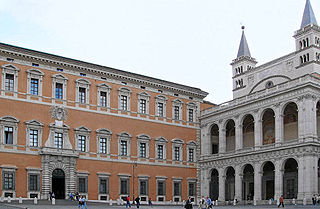
Palace
A palace is a grand residence, especially a royal residence or the home of a head of state or some other high-ranking dignitary, such as a bishop or archbishop. The word itself is derived from the Latin name Palātium, for Palatine Hill, one of the seven hills in Rome. In many parts of Europe, the...
of the Roman Empire
Roman Empire
The Roman Empire was the post-Republican period of the ancient Roman civilization, characterised by an autocratic form of government and large territorial holdings in Europe and around the Mediterranean....
and later the main Papal residence.
Adjacent to the Basilica di San Giovanni in Laterano, the cathedral
Cathedral
A cathedral is a Christian church that contains the seat of a bishop...
church of Rome
Rome
Rome is the capital of Italy and the country's largest and most populated city and comune, with over 2.7 million residents in . The city is located in the central-western portion of the Italian Peninsula, on the Tiber River within the Lazio region of Italy.Rome's history spans two and a half...
, the Lateran Palace is now occupied by the Museo Storico Vaticano which illustrates the history of the Papal States
Papal States
The Papal State, State of the Church, or Pontifical States were among the major historical states of Italy from roughly the 6th century until the Italian peninsula was unified in 1861 by the Kingdom of Piedmont-Sardinia .The Papal States comprised territories under...
. The Lateran Palaces also houses the offices of the Vicariate of Rome
Diocese of Rome
The Diocese of Rome is a diocese of the Catholic Church in Rome, Italy. The bishop of Rome is the Pope, who is the Supreme Pontiff and leader of the Catholic Church...
, as well as the residential apartments of the Cardinal Vicar
Cardinal Vicar
Cardinal Vicar is a title commonly given to the vicar general of the diocese of Rome for the portion of the diocese within Italy. The official title, as given in the Annuario Pontificio , is "Vicar General of His Holiness for the Diocese of Rome"...
, the Pope's delegate for the daily administration of the Diocese of Rome. Until 1970, the palace was also home to the important collections of the Lateran Museum, now dispersed among other parts of the Vatican Museums
Vatican Museums
The Vatican Museums , in Viale Vaticano in Rome, inside the Vatican City, are among the greatest museums in the world, since they display works from the immense collection built up by the Roman Catholic Church throughout the centuries, including some of the most renowned classical sculptures and...
.
From the fourth century, the Palace of the Lateran on Piazza San Giovanni in southeast Rome
Rome
Rome is the capital of Italy and the country's largest and most populated city and comune, with over 2.7 million residents in . The city is located in the central-western portion of the Italian Peninsula, on the Tiber River within the Lazio region of Italy.Rome's history spans two and a half...
was the principal residence of the Popes, and continued so for about a thousand years.
History
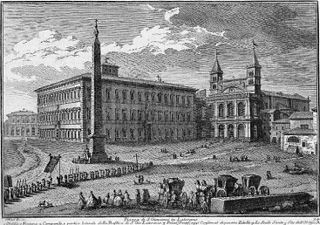
Pre-papal use
The site on which the Basilica di San Giovanni in Laterano sits was occupied during the early Roman EmpireRoman Empire
The Roman Empire was the post-Republican period of the ancient Roman civilization, characterised by an autocratic form of government and large territorial holdings in Europe and around the Mediterranean....
by the domus
Domus
In ancient Rome, the domus was the type of house occupied by the upper classes and some wealthy freedmen during the Republican and Imperial eras. They could be found in almost all the major cities throughout the Roman territories...
of the Plautii Laterani family. The Laterani served as administrators for several emperors; Lucius Sextius Lateranus was the first plebeian to attain the rank of consul
Consul
Consul was the highest elected office of the Roman Republic and an appointive office under the Empire. The title was also used in other city states and also revived in modern states, notably in the First French Republic...
. One of the Laterani, Consul-designate Plautius Lateranus, became famous for being accused by Nero
Nero
Nero , was Roman Emperor from 54 to 68, and the last in the Julio-Claudian dynasty. Nero was adopted by his great-uncle Claudius to become his heir and successor, and succeeded to the throne in 54 following Claudius' death....
of conspiracy against the emperor. The accusation resulted in the confiscation and redistribution of his properties.
Constantinian era
The Domus Laterani fell into the hands of the emperor when Constantine IConstantine I
Constantine the Great , also known as Constantine I or Saint Constantine, was Roman Emperor from 306 to 337. Well known for being the first Roman emperor to convert to Christianity, Constantine and co-Emperor Licinius issued the Edict of Milan in 313, which proclaimed religious tolerance of all...
married his second wife Fausta
Fausta
Fausta Flavia Maxima was a Roman Empress, daughter of the Roman Emperor Maximianus. To seal the alliance between them for control of the Tetrarchy, in 307 Maximianus married her to Constantine I, who set aside his wife Minervina in her favour. Constantine and Fausta had been betrothed since...
, sister of Maxentius
Maxentius
Maxentius was a Roman Emperor from 306 to 312. He was the son of former Emperor Maximian, and the son-in-law of Emperor Galerius.-Birth and early life:Maxentius' exact date of birth is unknown; it was probably around 278...
. Known by that time as the Domus Faustae or "House of Fausta," the structure was eventually given to the Bishop of Rome by Constantine. The actual date of the gift is unknown but scholars believe it had to have been during the pontificate of Pope Miltiades
Pope Miltiades
Pope Saint Miltiades, also called Melchiades , was pope from 2 July 311 to 10 January 314.- Origins :He appears to have been a Berber African by birth, but of his personal history nothing is known.- Pontificate :...
, in time to host a synod
Synod
A synod historically is a council of a church, usually convened to decide an issue of doctrine, administration or application. In modern usage, the word often refers to the governing body of a particular church, whether its members are meeting or not...
of bishop
Bishop
A bishop is an ordained or consecrated member of the Christian clergy who is generally entrusted with a position of authority and oversight. Within the Catholic Church, Eastern Orthodox, Oriental Orthodox Churches, in the Assyrian Church of the East, in the Independent Catholic Churches, and in the...
s in 313 that was convened to challenge the Donatist schism, declaring Donatism as heresy
Heresy
Heresy is a controversial or novel change to a system of beliefs, especially a religion, that conflicts with established dogma. It is distinct from apostasy, which is the formal denunciation of one's religion, principles or cause, and blasphemy, which is irreverence toward religion...
. The basilica
Basilica
The Latin word basilica , was originally used to describe a Roman public building, usually located in the forum of a Roman town. Public basilicas began to appear in Hellenistic cities in the 2nd century BC.The term was also applied to buildings used for religious purposes...
of the domus was converted and extended, eventually becoming the cathedral of Rome, the seat of the popes as patriarchs of Rome: see Basilica di San Giovanni in Laterano.
10th century restoration
Dante Alighieri
Durante degli Alighieri, mononymously referred to as Dante , was an Italian poet, prose writer, literary theorist, moral philosopher, and political thinker. He is best known for the monumental epic poem La commedia, later named La divina commedia ...
speaks of it as beyond all human achievements. At this time the centre of the piazza was occupied by the palace and tower of the Annibaldi family. Between this palace and the Lateran basilica was the equestrian statue of Marcus Aurelius, which at the time was erroneously believed to represent the Christian Emperor Constantine (which association probably accounted for its preservation). A copy of the equestrian statue is now placed in the centre of the Capitoline Square while the original has been safely preserved for display in the nearby Capitoline Museums
Capitoline Museums
The Capitoline Museums are a group of art and archeological museums in Piazza del Campidoglio, on top of the Capitoline Hill in Rome, Italy. The museums are contained in three palazzi surrounding a central trapezoidal piazza in a plan conceived by Michelangelo Buonarroti in 1536 and executed over...
.
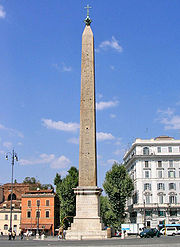
In its place, an obelisk was erected. Originally commissioned by Pharaoh Tuthmosis III, it was completed by his grandson, Tuthmosis IV. At 32.18 m (45.70 m including the base) it is the tallest obelisk in Rome and the largest standing ancient Egyptian obelisk in the world, weighing over 230 ton
Ton
The ton is a unit of measure. It has a long history and has acquired a number of meanings and uses over the years. It is used principally as a unit of weight, and as a unit of volume. It can also be used as a measure of energy, for truck classification, or as a colloquial term.It is derived from...
s. Following the annexation of Egypt to the Empire, it was taken from the temple of Amun
Amun
Amun, reconstructed Egyptian Yamānu , was a god in Egyptian mythology who in the form of Amun-Ra became the focus of the most complex system of theology in Ancient Egypt...
in Karnak
Karnak
The Karnak Temple Complex—usually called Karnak—comprises a vast mix of decayed temples, chapels, pylons, and other buildings, notably the Great Temple of Amun and a massive structure begun by Pharaoh Ramses II . Sacred Lake is part of the site as well. It is located near Luxor, some...
and brought to Alexandria
Alexandria
Alexandria is the second-largest city of Egypt, with a population of 4.1 million, extending about along the coast of the Mediterranean Sea in the north central part of the country; it is also the largest city lying directly on the Mediterranean coast. It is Egypt's largest seaport, serving...
with another obelisk
Obelisk of Theodosius
The Obelisk of Theodosius is the Ancient Egyptian obelisk of Pharaoh Tutmoses III re-erected in the Hippodrome of Constantinople by the Roman emperor Theodosius I in the 4th century AD.-History:The obelisk was first set up by Tutmoses III to the south of the seventh pylon...
by Constantius II
Constantius II
Constantius II , was Roman Emperor from 337 to 361. The second son of Constantine I and Fausta, he ascended to the throne with his brothers Constantine II and Constans upon their father's death....
. From there it was brought on its own to Rome in 357 to decorate the spina of the Circus Maximus
Circus Maximus
The Circus Maximus is an ancient Roman chariot racing stadium and mass entertainment venue located in Rome, Italy. Situated in the valley between the Aventine and Palatine hills, it was the first and largest stadium in ancient Rome and its later Empire...
. The dedication on the base however, gives the glory to Constantine I, not to his son who brought it to Rome.
The whole of the front of the palace was taken up with the Aula Concilii ("Hall of the Council"), a magnificent hall with eleven apses, in which were held the various Councils of the Lateran during the medieval period. The private apartments of the popes in this palace were situated between this Triclinium and the city walls.
Avignon Papacy
The fall of the palace from this position of glory was the result of the departure of the popes from RomeRome
Rome is the capital of Italy and the country's largest and most populated city and comune, with over 2.7 million residents in . The city is located in the central-western portion of the Italian Peninsula, on the Tiber River within the Lazio region of Italy.Rome's history spans two and a half...
during the Avignon Papacy
Avignon Papacy
The Avignon Papacy was the period from 1309 to 1376 during which seven Popes resided in Avignon, in modern-day France. This arose from the conflict between the Papacy and the French crown....
.
Two destructive fires, in 1307 and 1361, did irreparable harm, and although vast sums were sent from Avignon for the rebuilding, the palace never again attained its former splendour. When the popes returned to Rome they resided first at Basilica di Santa Maria in Trastevere, then at Basilica di Santa Maria Maggiore
Basilica di Santa Maria Maggiore
The Papal Basilica of Saint Mary Major , known also by other names, is the largest Roman Catholic Marian church in Rome, Italy.There are other churches in Rome dedicated to Mary, such as Santa Maria in Trastevere, Santa Maria in Aracoeli, Santa Maria sopra Minerva, but the greater size of the...
, and lastly fixed their residence at the Vatican
Vatican City
Vatican City , or Vatican City State, in Italian officially Stato della Città del Vaticano , which translates literally as State of the City of the Vatican, is a landlocked sovereign city-state whose territory consists of a walled enclave within the city of Rome, Italy. It has an area of...
. Sixtus V, more concerned with rationalized urban planning than the preservation of antiquities, then destroyed what still remained of the ancient palace of the Lateran in 1586 and erected the present much smaller edifice in its place.
16th century alterations
Domenico Fontana
Domenico Fontana was a Swiss-born Italian architect of the late Renaissance.-Biography:200px|thumb|Fountain of Moses in Rome....
, who was engaged in alterations to the basilica at the same time. Fontana's strong restrained style, influenced by Giacomo Vignola
Giacomo Barozzi da Vignola
Giacomo Barozzi da Vignola was one of the great Italian architects of 16th century Mannerism. His two great masterpieces are the Villa Farnese at Caprarola and the Jesuits' Church of the Gesù in Rome...
and modelled upon Palazzo Farnese for its regular and harmonious if somewhat bland major façade, and Fontana's sound engineering basis and power of co-ordinating a complicated architectural program on a tightly constrained site, which Sixtus urged forward at top speed, are remarkable. A notice on 29 August 1589 announced that the work had been completed: "A great palace in Piazza Lateranese has been brought to completion by Sixtus V." Fontana reapplied motifs of the Lateran Palace in the part of the Vatican Palace containing the present papal apartments, which he undertook later, and in his additions to the Quirinal Palace
Quirinal Palace
The Quirinal Palace is a historical building in Rome, Italy, the current official residence of the President of the Italian Republic. It is located on the Quirinal Hill, the tallest of the seven hills of Rome...
. The east front was finished under Clement XII, who surmounted it with his coat-of-arms in 1735.
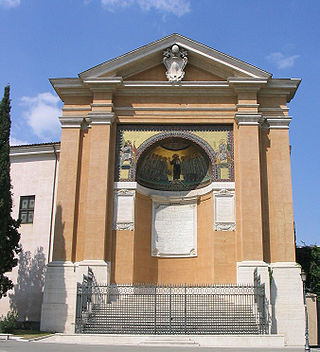
From the old Lateran constructions three monuments survive, two of which are located in one building built by Domenico Fontana
Domenico Fontana
Domenico Fontana was a Swiss-born Italian architect of the late Renaissance.-Biography:200px|thumb|Fountain of Moses in Rome....
in 1589 opposite the Lateran Basilica. These monuments are the Scala Santa and the Chapel of the Sancta Sanctorum. Next to these is the third monument, the Triclinium
Triclinium
A triclinium is a formal dining room in a Roman building. The word is adopted from the Greek τρικλίνιον, triklinion, from τρι-, tri-, "three", and κλίνη, klinē, a sort of "couch" or rather chaise longue...
of Leo III
Pope Leo III
Pope Saint Leo III was Pope from 795 to his death in 816. Protected by Charlemagne from his enemies in Rome, he subsequently strengthened Charlemagne's position by crowning him as Roman Emperor....
, which survives as an apse lined with mosaics and open to the air. It was one of the most famous halls of the ancient palace and was the state banqueting hall. The existing structure is not ancient, but it is possible that some portions of the original mosaics have been preserved in a three-part mosaic: In the centre Christ
Christ
Christ is the English term for the Greek meaning "the anointed one". It is a translation of the Hebrew , usually transliterated into English as Messiah or Mashiach...
gives their mission to the Apostles, on the left he gives the keys to St. Sylvester and the Labarum to Constantine, while on the right St. Peter gives the stole to Leo III and the standard to Charlemagne
Charlemagne
Charlemagne was King of the Franks from 768 and Emperor of the Romans from 800 to his death in 814. He expanded the Frankish kingdom into an empire that incorporated much of Western and Central Europe. During his reign, he conquered Italy and was crowned by Pope Leo III on 25 December 800...
.
Modern use
The Lateran remained in a suburban environment, surrounded by gardens and vineyards, until the growth of modern Rome in the later nineteenth century. Its site was considered unhealthy in Rome's malariaMalaria
Malaria is a mosquito-borne infectious disease of humans and other animals caused by eukaryotic protists of the genus Plasmodium. The disease results from the multiplication of Plasmodium parasites within red blood cells, causing symptoms that typically include fever and headache, in severe cases...
l summers, however. In the late seventeenth century Innocent XII sited in part of it a hospice for orphans, who were set to work in a little silk manufactury. In the nineteenth century Gregory XVI and Pius IX founded in it a museum of religious art and pagan culture for overflow from the Vatican galleries. In 1925 Pius XI established an ethnographic museum devoted to artifacts sent back by missionaries. On 11 February 1929 the Lateran Treaty was signed here, at last regulating the relations between the Holy See and the Italian State and establishing that the basilica and Lateran Palace were integral exclaves of the Papal State.
Seat of the Vicariate of Rome
Pope John XXIIIPope John XXIII
-Papal election:Following the death of Pope Pius XII in 1958, Roncalli was elected Pope, to his great surprise. He had even arrived in the Vatican with a return train ticket to Venice. Many had considered Giovanni Battista Montini, Archbishop of Milan, a possible candidate, but, although archbishop...
returned to the palace some pastoral functions by fixing here the seat of the Vicariate and offices of the diocese of Rome
Diocese of Rome
The Diocese of Rome is a diocese of the Catholic Church in Rome, Italy. The bishop of Rome is the Pope, who is the Supreme Pontiff and leader of the Catholic Church...
. The same pope removed the collections of the Lateran Museum to the Vatican. The Lateran Palace is now occupied by the Museo Storico Vaticano, which illustrates the history of the Papal States. It was moved to the palace in 1987 and inaugurated in 1991. The Palace today still houses the offices of the Vicariate of Rome
Diocese of Rome
The Diocese of Rome is a diocese of the Catholic Church in Rome, Italy. The bishop of Rome is the Pope, who is the Supreme Pontiff and leader of the Catholic Church...
, as well as the living quarters of the Cardinal Vicar General of His Holiness for the Diocese of Rome
Cardinal Vicar
Cardinal Vicar is a title commonly given to the vicar general of the diocese of Rome for the portion of the diocese within Italy. The official title, as given in the Annuario Pontificio , is "Vicar General of His Holiness for the Diocese of Rome"...
.
External links
- palace - map of piazza and plates (engravingEngravingEngraving is the practice of incising a design on to a hard, usually flat surface, by cutting grooves into it. The result may be a decorated object in itself, as when silver, gold, steel, or glass are engraved, or may provide an intaglio printing plate, of copper or another metal, for printing...
s)