
All Topics  
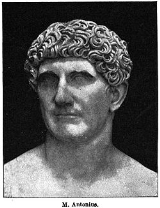
Mark Antony

 
Mark Antony

   Email Print
   Bookmark   Link


Mark Antony


Marcus Antonius (in Latin
Latin

Latin is an Italic language, historically spoken in Latium and Ancient Rome. Through the Military history of the Roman Empire, Latin spread throughout the Mediterranean and a large part of Europe....
: M·ANTONIVS·M·F·M·N) (c. January 14, 83 BC–August 1, 30 BC), known in English as Marc Antony, was a Roman
Roman Republic

The Roman Republic was the phase of the Ancient Rome characterized by a republican form of government; a period which began with the overthrow of the Roman Roman Kingdom, c....
 politician
Politician

A politician is an individual who is involved in influencing public decision making through the influence of politics or a person who influences the way a society is governed....
 and General
General

A General officer is an Officer of high military rank. The term or equivalent is used by nearly every country in the world. General can be used as a generic term for all grades of general officer, or it can specifically refer to a single rank that is just called general....
. He was an important supporter and the best friend of Gaius Julius Caesar
Julius Caesar

'Gaius Julius Caesar' , July 13, 100 BC ? March 15, 44 BC,) was a Roman Republic military and political leader. He played a critical role in the transformation of the Roman Republic into the Roman Empire....
 as a military commander and administrator, being Caesar's second cousin, once removed, by his mother Julia Antonia
Julia Antonia

Julia Caesaris or Julia Antonia was a daughter to consul Lucius Julius Caesar III and mother to the future triumvir and deputy of Caesar, Mark Antony....
. After Caesar's assassination
Assassination of Julius Caesar

The assassination of Julius Caesar occurred in Ancient Rome on the Ides of March in 44 BC when a group of Roman Senator self-proclaimed the Liberatores, led by Gaius Cassius Longinus and his brother-in-law Marcus Junius Brutus, stabbed Caesar to death hoping to restore the Roman Republic....
, Antony formed an official political alliance with Octavian (Augustus) and Marcus Aemilius Lepidus
Marcus Aemilius Lepidus (triumvir)

Marcus Aemilius Lepidus ,born ca 90 BC died 13 BC, was a patrician Ancient Rome politician of the 1st century BC who rose to become a member of the Second Triumvirate and Pontifex Maximus....
, known to historians today as the Second Triumvirate
Second Triumvirate

The Second Triumvirate is the name historians give to the official political alliance of Gaius Julius Caesar Octavianus , Marcus Aemilius Lepidus , and Mark Antony, formed on 26 November 43 BC with the enactment of the Lex Titia, the adoption of which marked the end of the Roman Republic....
.

The triumvirate
Triumvirate

The term triumvirate is commonly used to describe a political regime dominated by three powerful individuals. The arrangement can be formal or informal, and though the three are usually equal on paper, in reality this is rarely the case....
 broke up in 33 BC.


Discussion
Ask a question about 'Mark Antony'
Start a new discussion about 'Mark Antony'
Answer questions from other users
Full Discussion Forum


Recent Posts


Encyclopedia


Marcus Antonius (in Latin
Latin

Latin is an Italic language, historically spoken in Latium and Ancient Rome. Through the Military history of the Roman Empire, Latin spread throughout the Mediterranean and a large part of Europe....
: M·ANTONIVS·M·F·M·N) (c. January 14, 83 BC–August 1, 30 BC), known in English as Marc Antony, was a Roman
Roman Republic

The Roman Republic was the phase of the Ancient Rome characterized by a republican form of government; a period which began with the overthrow of the Roman Roman Kingdom, c....
 politician
Politician

A politician is an individual who is involved in influencing public decision making through the influence of politics or a person who influences the way a society is governed....
 and General
General

A General officer is an Officer of high military rank. The term or equivalent is used by nearly every country in the world. General can be used as a generic term for all grades of general officer, or it can specifically refer to a single rank that is just called general....
. He was an important supporter and the best friend of Gaius Julius Caesar
Julius Caesar

'Gaius Julius Caesar' , July 13, 100 BC ? March 15, 44 BC,) was a Roman Republic military and political leader. He played a critical role in the transformation of the Roman Republic into the Roman Empire....
 as a military commander and administrator, being Caesar's second cousin, once removed, by his mother Julia Antonia
Julia Antonia

Julia Caesaris or Julia Antonia was a daughter to consul Lucius Julius Caesar III and mother to the future triumvir and deputy of Caesar, Mark Antony....
. After Caesar's assassination
Assassination of Julius Caesar

The assassination of Julius Caesar occurred in Ancient Rome on the Ides of March in 44 BC when a group of Roman Senator self-proclaimed the Liberatores, led by Gaius Cassius Longinus and his brother-in-law Marcus Junius Brutus, stabbed Caesar to death hoping to restore the Roman Republic....
, Antony formed an official political alliance with Octavian (Augustus) and Marcus Aemilius Lepidus
Marcus Aemilius Lepidus (triumvir)

Marcus Aemilius Lepidus ,born ca 90 BC died 13 BC, was a patrician Ancient Rome politician of the 1st century BC who rose to become a member of the Second Triumvirate and Pontifex Maximus....
, known to historians today as the Second Triumvirate
Second Triumvirate

The Second Triumvirate is the name historians give to the official political alliance of Gaius Julius Caesar Octavianus , Marcus Aemilius Lepidus , and Mark Antony, formed on 26 November 43 BC with the enactment of the Lex Titia, the adoption of which marked the end of the Roman Republic....
.

The triumvirate
Triumvirate

The term triumvirate is commonly used to describe a political regime dominated by three powerful individuals. The arrangement can be formal or informal, and though the three are usually equal on paper, in reality this is rarely the case....
 broke up in 33 BC. Disagreement between Octavian and Antony erupted into civil war, the Final War of the Roman Republic
Final war of the Roman Republic

The final war of the Roman Republic, also known as Antony's civil war or the war between Antony and Octavian, was last of the Roman civil wars of the Roman republic, fought between Cleopatra and Augustus....
, in 31 BC. Antony was defeated by Octavian at the naval Battle of Actium
Battle of Actium

The Battle of Actium was the final engagement in the Final War of the Roman Republic. It was fought between the forces of Augustus and the combined forces of Mark Antony and Cleopatra VII....
, and in a brief land battle at Alexandria
Alexandria

Alexandria , with a population of 4.1 million, is the second-largest city in Egypt, and is the country's largest seaport, serving about 80% of Egypt's imports and exports....
. He committed suicide, and his lover, the Queen Cleopatra of Egypt, killed herself shortly thereafter.

Early life


A member of the Antonia
Antonius

Antonius was the nomen of the Roman naming convention Antonia, one of the most important plebs families of ancient Rome. The family claimed descendancy from Anton, a son of the Greek god Hercules....
 gens
Gens

In ancient Rome, a gens was a clan, caste, or group of families, that shared a common name and a belief in a common ancestor. In the Roman naming convention, the second name was the name of the gens to which the person belonged....
, Antony was born in Rome, around 83 BC. His father was his namesake, Marcus Antonius Creticus
Marcus Antonius Creticus

Marcus Antonius Creticus was a Ancient Rome politician, member of the Antonius family. Creticus was son of Marcus Antonius Orator and by his marriage to Julia Antonia he had three sons triumvir Mark Antony, Gaius Antonius and Lucius Antonius ....
, the son of the great rhetoric
Rhetoric

Rhetoric is the art of using language as a means to persuade. Along with logic and dialectic, rhetoric is one of the three ancient arts of discourse....
ian Marcus Antonius Orator
Marcus Antonius Orator

Marcus Antonius Orator was a Roman Republic politician of the Antonius family and one of the most distinguished Roman orators of his time. He started his cursus honorum as quaestor in 113 BC and in 102 BC he was elected praetor with proconsular powers for the province of Cilicia....
 executed by Gaius Marius
Gaius Marius

Gaius Marius was a Roman Republic general and politician elected consul an unprecedented seven times during his career. He was also noted for his dramatic Marian Reforms of Roman legion, authorizing recruitment of landless citizens and reorganizing the structure of the legions into separate Cohort ....
' supporters in 86 BC. His mother, Julia Antonia
Julia Antonia

Julia Caesaris or Julia Antonia was a daughter to consul Lucius Julius Caesar III and mother to the future triumvir and deputy of Caesar, Mark Antony....
, was the first cousin of Julius Caesar
Julius Caesar

'Gaius Julius Caesar' , July 13, 100 BC ? March 15, 44 BC,) was a Roman Republic military and political leader. He played a critical role in the transformation of the Roman Republic into the Roman Empire....
. His father died at a young age, leaving him and his brothers, Gaius Antonius
Gaius Antonius

Gaius Antonius was the second son of Marcus Antonius Creticus and Julia Antonia, and thus, younger brother of Mark Antony, triumvir and enemy of Caesar Augustus....
 and Lucius Antonius
Lucius Antonius (brother of Mark Antony)

Lucius Antonius was the younger brother and supporter of Mark Antony, a Ancient Rome politician.Lucius was son of Marcus Antonius Creticus, son of the rhetorician Marcus Antonius Orator executed by Gaius Marius' supporters in 86 BC, and Julia Antonia, a cousin of Julius Caesar....
 in the care of his mother, who married Publius Cornelius Lentulus (Sura)
Publius Cornelius Lentulus (Sura)

Publius Cornelius Lentulus, nicknamed Sura, was one of the chief figures in the Catiline and also a stepfather of Mark Antony.When accused by Lucius Cornelius Sulla of having squandered the public money, he refused to render any account, but insolently held out the calf of his leg , on which part of the person boys were punished whe...
, a politician involved in and executed during the Catiline
Catiline

Lucius Sergius Catilina , known in English language as Catiline, was a Roman Republic politician of the 1st century BC who is best known for the Catiline conspiracy, an attempt to overthrow the Roman Republic, and in particular the power of the aristocratic Roman Senate....
 conspiracy of 63 BC.

Antony's early life was characterized by a lack of parental guidance. According to historians like Plutarch
Plutarch

Lucius Mestrius Plutarchus , c. AD 46 ? 120 ? commonly known in English as Plutarch ? was a Ancient Rome historian , biographer, essayist, and Middle Platonism....
, he spent his teenage years wandering the streets of Rome with his brothers and friends, Publius Clodius Pulcher
Publius Clodius Pulcher

Publius Clodius Pulcher , was a Roman Republic politician of the Populares cause, who passed several significant laws but was chiefly remembered for his feuds with Titus Annius Milo and Marcus Tullius Cicero and for his introduction of the grain dole....
 among them. The connection was eventually severed by a disagreement arising from his relations with Clodius' wife, Fulvia
Fulvia

Fulvia was a Ancient Rome woman who lived in the 1st century BC. According to Plutarch, Fulvia had no interest in spinning nor managing a household nor ruling a husband with no ambition for public life; Fulvia wanted to govern or to command and be a commander-in-chief....
. While they were friends, they embarked on a rather wild life, frequenting gambling houses, drinking too much, and involving themselves in scandalous love affairs. Plutarch mentions the rumor that before Antony reached 20 years of age, he was already indebted to the sum of 250 talents.

After this period of recklessness, Antony fled to Greece to escape his creditors and to study rhetoric
Rhetoric

Rhetoric is the art of using language as a means to persuade. Along with logic and dialectic, rhetoric is one of the three ancient arts of discourse....
. After a short time spent in attendance on the philosophers at Athens
Athens

Athens , the Capital and largest city of Greece, dominates the Attica periphery; as one of the List of cities by time of continuous habitation, its recorded history spans around 3,400 years....
, he was summoned by Aulus Gabinius
Aulus Gabinius

Aulus Gabinius, Rome statesman and general, and supporter of Gnaeus Pompeius Magnus, was a prominent figure in the later days of the Roman Republic....
, proconsul
Proconsul

Ancient RomeIn the Roman Republic, a proconsul was a promagistrate who, after serving as consul, spent a year as a Roman governor of a Roman province....
 of Syria
Syria

Syria , officially the Syrian Arab Republic , is an Arab-majority country in Southwest Asia, bordering Lebanon and the Mediterranean Sea to the west, Israel to the southwest, Jordan to the south, Iraq to the east, and Turkey to the north....
, to take part in the campaigns against Aristobulus
Aristobulus

Aristobulus I was a king of the Hebrews Hasmonean, and the eldest of the five sons of King John Hyrcanus. He was the first of the Hasmonean rulers to call himself "king." According to the Hebrew Scriptures, only descendants of Judah, or, more specifically, the House of David, were qualified to be kings of Israel....
 in Judea
Judea

Judea or Jud?a is the name given to the mountainous southern part of the historic Land of Israel , an area now divided between Israel and the West Bank ....
, and in support of King Ptolemy XII Auletes
Ptolemy XII Auletes

Ptolemy Neos Dionysos Theos Philopator Theos Philadelphos , New Dionysus, God Beloved of his Father, God Beloved of his Brother) was more commonly known as "Auletes" , or "Nothos" ....
 in Egypt. In the ensuing campaign, he demonstrated his talents as a cavalry commander and distinguished himself with bravery and courage.

Supporter of Caesar


In 54 BC, Antony became a member of the staff of Caesar's armies in Gaul
Roman Gaul

Roman Gaul consisted of an area of provincial rule in the Roman Empire, in modern day France, Belgium, Luxembourg, and western Germany. Roman control of the area lasted for 600 years....
 and early Germany. He again proved to be a competent military leader in the Gallic Wars
Gallic Wars

The Gallic Wars were a series of military campaigns waged by the Roman Republic proconsul Julius Caesar against several Gaul, lasting from 58 BC to 51 BC....
, but his personality caused instability wherever he went. Antony and Caesar were said to be best of friends as well as being relatively close relatives. Antony made himself ever available to assist Caesar in carrying out his military campaigns.

Raised by Caesar's influence to the offices of quaestor
Quaestor

Quaestor is a type of public official.In the Roman Republic a quaestor was an elected official who supervised the treasury and financial affairs of the state, its armies and its officers....
, augur
Augur

The augur was a priest and official in the classical world, especially ancient Rome and Etruscans. His main role was to interpret the will of the gods by studying the flight of the birds , known as "taking the auspices." The ceremony and function of the augur was central to any major undertaking in Roman society--public or private--includi...
, and tribune of the plebians
Tribune

Tribune was a title shared by 10 elected officials in the Roman Republic. Tribunes had the power to convene the Plebeian Council and to act as its president, which also gave them the exclusive right to propose legislation before it....
 (50 BC), he supported the cause of his patron with great energy. Caesar's two proconsular commands, during a period of ten years, were expiring in 50 BC, and he wanted to return to Rome for the consular elections. But resistance from the conservative faction of the Roman Senate
Roman Senate

The Senate of the Roman Republic was a political institution in the ancient Roman Republic. According to the Greek historian Polybius, our principal source on the Constitution of the Roman Republic, the Roman Senate was the predominant branch of government....
, led by Pompey
Pompey

Gnaeus Pompeius Magnus, commonly known as Pompey /'p?mpi/, Pompey the Great or Pompey the Triumvir , was a distinguished military and political leader of the late Roman Republic....
, demanded that Caesar resign his proconsulship and the command of his armies before being allowed to seek re-election to the consulship.

This Caesar would not do, as such an act would at least temporarily render him a private citizen and thereby leave him open to prosecution for his acts while proconsul. It would also place him at the mercy of Pompey's armies. To prevent this occurrence Caesar bribed the plebian tribune Curio
Curio

Curio may refer to:* Curio, Switzerland* Curio , a Japanese rock music* Curio , a predominantly glass cabinet with a metal or wood framework used to display collections of figurines...
 to use his veto to prevent a senatorial decree which would deprive Caesar of his armies and provincial command, and then made sure Antony was elected tribune for the next term of office. Antony exercised his tribunician veto, with the aim of preventing a senatorial decree declaring martial law against the veto, and was violently expelled from the senate with another Caesar adherent, Cassius, who was also a tribune of the plebs. Caesar crossed the river Rubicon
Rubicon

Rubicon is a 29 km long river in northern Italy.The river flows from the Apennine Mountains to the Adriatic Sea through the southern Emilia-Romagna region between the towns of Rimini and Cesena....
 upon hearing of these affairs which began the Republican civil war. Antony left Rome and joined Caesar and his armies at Ariminium, where he was presented to Caesar's soldiers still bloody and bruised as an example of the illegalities that his political opponents were perpetrating, and as a casus belli
Casus belli

Casus belli is a Latin language expression meaning the justification for acts of war. Casus means "incident", "rupture" or indeed "case", while belli means "of war"....
. Tribunes of the Plebs were meant to be untouchable and their veto inalienable according to the Roman mos maiorum
Mos maiorum

Mos Maiorum, literally translated as the ?custom of the fathers/ancestors,? is the core concept of Roman traditionalism. The mos maiorum , was an unwritten code from which the Romans derived their societal norms....
 (although there was a grey line as to what extent this existed in the declaration of and during martial law). Antony commanded Italy whilst Caesar destroyed Pompey's legions in Spain, and led the reinforcements to Greece, before commanding the right wing of Caesar's armies at Pharsalus.

When Caesar became dictator
Roman dictator

Dictator was a political office of the Roman Republic. The dictator was above the three branches of government in the constitution of the Roman Republic as no other body or officer could check his power....
 for a second time, Antony was made Master of the Horse
Master of the Horse

The Master of the Horse was a historical position of varying importance in several European nations....
, the dictator's right hand man, and in this capacity he remained in Italy as the peninsula's administrator in 47 BC, while Caesar was fighting the last Pompeians, who had taken refuge in the province of Africa
Africa Province

File:Roman Africa.JPGThe Roman province of Africa was established after the Romans defeated Carthage in the Third Punic War. It roughly comprised the territory of present-day northern Tunisia, north-eastern Algeria and the Mediterranean Sea coast of modern-day western Libya along the Syrtis Minor....
. But Antony's skills as an administrator were a poor match for his generalship, and he seized the opportunity of indulging in the most extravagant excesses, depicted by Cicero
Cicero

Marcus Tullius Cicero was a Ancient Rome philosopher, statesman, lawyer, political theorist, and Constitution of the Roman Republic. Cicero is widely considered one of Rome's greatest rhetoric and prose stylists....
 in the Philippics
Philippicae

The Philippicae or Philippics are a series of 14 speeches Cicero gave condemning Mark Antony in 44 BC and 43 BC. The name derives from the oratory style called philippic....
. In 46 BC he seems to have taken offense because Caesar insisted on payment for the property of Pompey which Antony professedly had purchased, but had in fact simply appropriated. Conflict soon arose, and, as on other occasions, Antony resorted to violence. Hundreds of citizens were killed and Rome itself descended into a state of anarchy. Caesar was most displeased with the whole affair and removed Antony from all political responsibilities. The two men did not see each other for two years. The estrangement was not of long continuance, with Antony meeting the dictator at Narbo (45 BC) and rejecting the suggestion of Trebonius
Trebonius

Gaius Trebonius was a military commander and politician of the late Roman Republic, a trusted associate of Julius Caesar who later participated in his assassination....
 that he should join in the conspiracy that was already afoot. Reconciliation arrived in 44 BC, when Antony was chosen as partner for Caesar's fifth consulship.

Whatever conflicts existed between the two men, Antony remained faithful to Caesar at all times. On February 15, 44 BC, during the Lupercalia
Lupercalia

Lupercalia was a very ancient, Ancient Rome pastoral festival, observed on February 13 through February 15 to avert evil spirits and purify the city, releasing health and fertility....
 festival, Antony publicly offered Caesar a diadem
Diadem (personal wear)

A diadem is a type of Crown , specifically an ornamental headband worn by Eastern monarchs and others as a badge of royalty. The word derives from the Greek language d??d??a diadema, from d??d?? diadeo to bind round, or fasten....
. This was an event fraught with meaning: a diadem was a symbol of a king, and in refusing it, Caesar demonstrated that he did not intend to assume the throne.

On March 14, 44 BC, Antony was alarmed when a Senator named Casca
Servilius Casca

Publius Servilius Casca was one of the assassinations of Julius Caesar in 44 BC. Though his family was loyal to Caesar, his brother Gaius even being a close friend of the dictator, both siblings joined in the assassination....
 told him the Gods would strike down Caesar. The following day, the Ides of March, he went down to warn the dictator but the Liberatores
Liberatores

Liberatores is the Latin name that the assassins of Julius Caesar gave themselves.The men considered the ringleaders of the conspiracy were Gaius Cassius Longinus and Marcus Junius Brutus ....
 reached Caesar first and he was assassinated on March 15, 44 BC. In the turmoil that surrounded the event, Antony escaped Rome dressed as a slave; fearing that the dictator's assassination would be the start of a bloodbath among his supporters. When this did not occur, he soon returned to Rome, discussing a truce with the assassins' faction. For a while, Antony, as consul, seemed to pursue peace and an end to the political tension. Following a speech by Cicero in the Senate, an amnesty was agreed for the assassins.

Then came the day of Caesar's funeral. As Caesar's ever-present second in command, junior consul and cousin, Antony was the natural choice to give the eulogy
Eulogy

A eulogy is a Speech or writing in praise of a person or thing, especially one recently deceased or retired. The word is derived from the Greek word e?????a , meaning praise ....
. In his speech
Friends, Romans, countrymen, lend me your ears

Friends, Romans, countrymen, lend me your ears is the first line of a famous and often-quoted speech by Mark Antony in the play Julius Caesar , by William Shakespeare....
, he made accusations of murder and ensured a permanent breach with the conspirators. Showing a talent for rhetoric
Rhetoric

Rhetoric is the art of using language as a means to persuade. Along with logic and dialectic, rhetoric is one of the three ancient arts of discourse....
 and dramatic interpretation, Antony snatched the toga
Toga

The toga, a distinctive garment of Ancient Rome, was a cloth of perhaps twenty feet in length which was wrapped around the body and generally was worn over a tunic....
 from Caesar's body to show the crowd the stab wounds, pointing at each and naming the authors, publicly shaming them. During the eulogy he also read Caesar's will, which left most of his property to the people of Rome, demonstrating that, contrary to the conspirator's assertions, Caesar had no intention of forming a royal dynasty. Public opinion turned, and that night, the Roman populace attacked the assassins' houses, forcing them to flee for their lives.

Enemy of the state and triumvirate


Antony surrounded himself with a bodyguard of Caesar's veterans and forced the senate to transfer to him the province of Cisalpine Gaul
Cisalpine Gaul

Cisalpine Gaul was the Roman name for a geographical area , in the territory of modern-day northern Italy , inhabited by the Celts. Sometimes referred to as Gallia Citerior , Provincia Ariminum, or Gallia Togata ....
, which was then administered by Decimus Junius Brutus Albinus
Decimus Junius Brutus Albinus

Decimus Junius Brutus Albinus was a Ancient Rome politician and general of the 1st century BC and one of Julius Caesar's assassins....
, one of the conspirators. Brutus refused to surrender the province and Antony set out to attack him in October 44 BC, besieging him at Mutina. Encouraged by Cicero
Cicero

Marcus Tullius Cicero was a Ancient Rome philosopher, statesman, lawyer, political theorist, and Constitution of the Roman Republic. Cicero is widely considered one of Rome's greatest rhetoric and prose stylists....
, the Senate granted Octavian imperium (commanding power), which made his command of troops legal and sent him to relieve the siege, along with Hirtius and Pansa, the consuls for 43 BC. In April 43, Antony's forces were defeated at the Battles of Forum Gallorum
Battle of Forum Gallorum

The Battle of Forum Gallorum was fought near a village in northern Italy , on April 14, 43 BC, between the forces of Mark Antony and the legions of the Roman Republic under the overall command of consul Gaius Vibius Pansa Caetronianus, aided by Aulus Hirtius and the untested Augustus ....
 and Mutina
Battle of Mutina

The Battle of Mutina was fought on April 21, 43 BC between the forces of Mark Antony and the forces of Gaius Vibius Pansa Caetronianus and Aulus Hirtius, who were providing aid to one of Caesar's assassins, Decimus Junius Brutus Albinus....
, forcing Antony to retreat to Transalpine Gaul. However, both consuls were killed, leaving Octavian in sole command of their armies.

When they knew that Marcus Junius Brutus and Gaius Cassius had assembled an army in Greece in order to march on Rome, Antony, Octavian and Lepidus allied together to stop Caesar's assassins. After the battle, a new arrangement was made between the members of the Second Triumvirate: while Octavian returned to Rome, Antony went to Egypt where he allied himself with the Queen Cleopatra, the former lover of Julius Caesar and mother of Caesar's infant son, Caesarion
Caesarion

Ptolemy XV Philopator Philometor Caesar, nicknamed Caesarion Greek language: ?t??e?a??? ??' F???p?t?? F?????t?? ?a?sa?, ?a?sa????, Ptolemaios Philop?tor Philom?tor Kaisar, Kaisar?on was the last king of the Ptolemaic dynasty of Egypt, who reigned, as a child, jointly with his mother Cleopatra VII of Egypt from S...
. Lepidus went on to govern Hispania and the province of Africa. The triumvirate's enemies were subjected to proscription
Proscription

Proscription is the public identification and official condemnation of enemy of the state. It is defined by the Oxford English Dictionary as a "decree of condemnation to death or banishment" and is a heavily politically-charged word frequently used to refer to state-approved murder or persecution....
 including Mark Antony's archenemy Cicero who was killed shortly after.

Antony and Cleopatra


The Parthian Empire
Parthia

Parthia is a region of north-eastern Iran, best known for having been the political and cultural base of the Arsacid dynasty, after which the Arsacid Empire is then also known as the 'Parthian Empire'....
 had supported Brutus and Cassius in the civil war, sending forces which fought with them at Philippi; following Antony and Octavian's victory, the Parthians invaded Roman territory, occupying Syria
Syria

Syria , officially the Syrian Arab Republic , is an Arab-majority country in Southwest Asia, bordering Lebanon and the Mediterranean Sea to the west, Israel to the southwest, Jordan to the south, Iraq to the east, and Turkey to the north....
, advancing into Asia Minor
Anatolia

Anatolia or Asia Minor is a region of Western Asia, comprising most of the modern Republic of Turkey. It is a geographic region bounded by the Black Sea to the north, the Caucasus to the northeast, the Aegean Sea to the west, the Mediterranean Sea to the south, and the Iranian plateau to the east and southeast....
 and installing Antigonus
Antigonus the Hasmonean

Antigonus II Mattathias was the son of King Aristobulus II of Judea. In 40 BC he led, along with Barzapharnes, a Parthian-supported invasion of Judea, seized Jerusalem, and sent his uncle Hyrcanus II to Babylon in chains ....
 as puppet king in Judaea to replace the pro-Roman Hyrcanus
Hyrcanus II

Hyrcanus II, a member of the Hasmonean dynasty, was the Jewish Kohen Gadol and King of Judea in the 1st century BCE....
. Antony sent his general Ventidius
Publius Ventidius Bassus

Publius Ventidius Bassus, or in full, Publius Ventidius Publii filius Bassus, "Publius Ventidius, Publius's son, Bassus" was a Ancient Rome general and one of Julius Caesar's prot?g?es....
 to oppose this invasion. Ventidius won a series of victories against the Parthians, killing the crown prince Pacorus
Pacorus

Two kings of ancient Parthia were named Pacorus:* Pacorus I of Parthia, possibly co-regent with his father Orodes II, c. 38 BC* Pacorus II of Parthia, c. 78–105...
 and expelling them from the Roman territories they had seized. Antony now planned to retaliate by invading Parthia, and secured an agreement from Octavian to supply him with extra troops for his campaign. With this military purpose on his mind, Antony sailed to Greece with Octavia Minor
Octavia Minor

Octavia Minor , also known as Octavia the Younger or simply Octavia, was the sister of the first Roman Emperor, Augustus , half sister of Octavia Major, and fourth wife of Mark Antony....
, his new wife (Octavian's sister), where he behaved in a most extravagant manner, assuming the attributes of the Greek
Greek mythology

Greek mythology is the body of myths and legends belonging to the Ancient Greece concerning their List of Greek mythological figures#Immortals and Greek hero cult, Cosmology#Metaphysical cosmology, and the origins and significance of their own cult and ritual practices....
 god
God (male deity)

God, as a male deity, contrasts with female deities, or "goddesses". While the term 'goddess' specifically refers to a female deity, words like 'gods' and 'deities' can be applied to all gods collectively, regardless of gender....
 Dionysus
Dionysus

In classical mythology, Dionysus or Dionysos , is the God of wine, the inspirer of ritual madness and ecstasy, and a major figure of Greek mythology, and one of the twelve Olympians, among whom Greek mythology treated Dionysus as a late arrival....
 (39 BC). But the rebellion in Sicily
Sicilian revolt

The Sicilian revolt was a revolution against the Second Triumvirate which occurred between 44 BC and 36 BC. The revolt was led by Sextus Pompeius, and ended in a Triumvirate victory....
 of Sextus Pompeius
Sextus Pompeius

Sextus Pompeius Magnus Pius, in English Sextus Pompey , was a Ancient Rome general from the late Roman Republic . He was the last focus of opposition to the Second Triumvirate....
, the last of the Pompeians, kept the army promised to Antony in Italy. With his plans again disrupted, Antony and Octavian quarreled once more. This time with the help of Octavia
Octavia Minor

Octavia Minor , also known as Octavia the Younger or simply Octavia, was the sister of the first Roman Emperor, Augustus , half sister of Octavia Major, and fourth wife of Mark Antony....
, a new treaty was signed in Tarentum
Taranto

Taranto is a coastal city in Puglia, Southern Italy. It is the capital of the Province of Taranto and is an important commercial port as well as the main Italian naval base....
 in 38 BC. The triumvirate was renewed for a period of another five years (ending in 33 BC) and Octavian promised again to send legions to the East.

But by now, Antony was skeptical of Octavian's true support of his Parthian cause. Leaving Octavia pregnant with her second child Antonia in Rome, he sailed to Alexandria
Alexandria

Alexandria , with a population of 4.1 million, is the second-largest city in Egypt, and is the country's largest seaport, serving about 80% of Egypt's imports and exports....
, where he expected funding from Cleopatra, the mother of his twins. The queen of Egypt lent him the money he needed for the army, and after capturing Jerusalem
Jerusalem

Jerusalem is the capital of Israel and its List of Israeli cities in both population and area, with a population of 747,600 residents over an area of if Positions on Jerusalem East Jerusalem is included....
 and surrounding areas in 37 BC, he installed Herod
Herod the Great

Herod , also known as Herod I or Herod the Great , was a Roman Empire client state of Israel. Herod is known for his colossal building projects in Jerusalem and other parts of the ancient world, including the rebuilding of the Second Temple in Jerusalem, sometimes referred to as Herod's Temple....
 as puppet king of Judaea, replacing the Parthian appointee Antigonus. Antony then invaded Parthian territory with an army of about 100,000 Roman and allied troops but the campaign proved a disaster. After defeats in battle, the desertion of his Armenian allies and his failure to capture Parthian strongholds convinced Antony to retreat, his army was further depleted by the hardships of its retreat through Armenia
Kingdom of Armenia

The Kingdom of Armenia was an independent kingdom from 190 BC to AD 387 and a client state of the Roman and Persian empires until 428, stretching from the Caspian Sea to the Mediterranean Sea seas....
 in the depths of winter, losing more than a quarter of its strength in the course of the campaign.

Meanwhile, in Rome, the triumvirate was no more. Lepidus was forced to resign after an ill-judged political move. Now in sole power, Octavian was occupied in wooing the traditional Republican aristocracy to his side. He married Livia
Livia

Livia Drusilla, after 14 AD called Julia Augusta was the wife of Augustus and one of the most powerful women in the Roman Empire, being Augustus' faithful advisor....
 and started to attack Antony in order to raise himself to power. He argued that Antony was a man of low morals to have left his faithful wife abandoned in Rome with the children to be with the promiscuous queen of Egypt. Antony was accused of everything, but most of all, of "becoming native", an unforgivable crime to the proud Romans. Several times Antony was summoned to Rome, but remained in Alexandria with Cleopatra.

Again with Egyptian money, Antony invaded Armenia, this time successfully. In the return, a mock Roman Triumph
Roman triumph

A Roman triumph was a civil religion and religious rite of ancient Rome, held to publically celebrate the achievements of an army commander who had won great military successes, originally and traditionally, who had successfully completed a war....
 was celebrated in the streets of Alexandria. The parade through the city was a pastiche
Pastiche

The word pastiche describes a literary or other artistic genre. The word has two competing meanings, meaning either a "wikt:hodgepodge" or an imitation....
 of Rome's most important military celebration. For the finale, the whole city was summoned to hear a very important political statement. Surrounded by Cleopatra and her children, Antony was about to put an end to his alliance with Octavian. He distributed kingdoms between his children: Alexander Helios
Alexander Helios

Alexander Helios was a Ptolemaic dynasty prince and was the eldest son of Ancient Greeks#Hellenistic Ptolemaic queen Cleopatra VII of Egypt and Roman Republic triumvir Mark Antony....
 was named king of Armenia
Armenia

Armenia , officially the Republic of Armenia , is a landlocked mountainous country in South Caucasus between the Black Sea and the Caspian Sea....
, Media
Medes

The Medes were an Ancient Iranian peoples who lived in the northwestern portions of present-day Iran. This area was known in Greek as Media or Medea ....
 and Parthia
Parthia

Parthia is a region of north-eastern Iran, best known for having been the political and cultural base of the Arsacid dynasty, after which the Arsacid Empire is then also known as the 'Parthian Empire'....
 (which were never conquered by Rome), his twin Selene got Cyrenaica
Cyrenaica

Cyrenaica or Cirenaica is the eastern coastal region of Libya and also an ex-province or state of the country in the pre-1963 administrative system....
 and Libya
Libya

Libya , officially the Great Socialist People's Libyan Arab Jamahiriya , is a country located in North Africa. Bordering the Mediterranean Sea to the north, Libya lies between Egypt to the east, Sudan to the southeast, Chad and Niger to the south, and Algeria and Tunisia to the west....
, and the young Ptolemy Philadelphus
Ptolemy Philadelphus (Cleopatra)

Ptolemy Philadelphus was a Ptolemaic Prince and was the youngest child of Greeks Ptolemaic Queen Cleopatra VII of Egypt and Roman Republic Triumvir Mark Antony....
 was awarded Syria and Cilicia
Cilicia

In antiquity, Cilicia now known as ?ukurova, was a commonly used name of the south coastal region of the Anatolian peninsula, and a political entity in Roman times....
. As for Cleopatra, she was proclaimed Queen of Kings and Queen of Egypt, to rule with Caesarion
Caesarion

Ptolemy XV Philopator Philometor Caesar, nicknamed Caesarion Greek language: ?t??e?a??? ??' F???p?t?? F?????t?? ?a?sa?, ?a?sa????, Ptolemaios Philop?tor Philom?tor Kaisar, Kaisar?on was the last king of the Ptolemaic dynasty of Egypt, who reigned, as a child, jointly with his mother Cleopatra VII of Egypt from S...
 (Ptolemy XV Caesar, son of Julius Caesar), King of Kings and King of Egypt. Most important of all, Caesarion was declared legitimate son and heir of Caesar. These proclamations were known as the Donations of Alexandria
Donations of Alexandria

The Donations of Alexandria were a political statement by Mark Antony in which he distributed lands held by Rome and Parthia amongst Cleopatra VII and their children....
 and caused a fatal breach in Antony's relations with Rome.

Distributing insignificant lands among the children of Cleopatra was not a peace move, but it was not a serious problem either. What did seriously threaten Octavian's political position, however, was the acknowledgment of Caesarion as legitimate and heir to Caesar's name. Octavian's base of power was his link with Caesar through adoption, which granted him much-needed popularity and loyalty of the legions. To see this convenient situation attacked by a child borne by the richest woman in the world was something Octavian could not accept. The triumvirate expired on the last day of 33 BC and was not renewed. Another civil war was beginning.

During 33 and 32 BC, a propaganda war was fought in the political arena of Rome, with accusations flying between sides. Antony (in Egypt) divorced Octavia and accused Octavian of being a social upstart, of usurping power, and of forging the adoption papers by Caesar. Octavian responded with treason charges: of illegally keeping provinces that should be given to other men by lots
Cleromancy

Cleromancy is a form of divination using sortition, casting of lots, or casting bones, in which an outcome is determined by means that normally would be considered random, such as the rolling of dice, but that are believed to reveal the will of God or other supernatural entities....
, as was Rome's tradition, and of starting wars against foreign nations (Armenia and Parthia) without the consent of the Senate. Antony was also held responsible for Sextus Pompeius
Sextus Pompeius

Sextus Pompeius Magnus Pius, in English Sextus Pompey , was a Ancient Rome general from the late Roman Republic . He was the last focus of opposition to the Second Triumvirate....
' execution with no trial. In 32 BC, the Senate deprived him of his powers and declared war against Cleopatra. Both consuls (Gnaeus Domitius Ahenobarbus
Gnaeus Domitius Ahenobarbus (consul 32 BC)

Gnaeus Domitius Ahenobarbus was a general and politician of ancient Rome in the 1st century BC....
 and Gaius Sosius
Gaius Sosius

Gaius Sosius, was a Roman general and politician.Gaius Sosius was elected quaestor in 66 BC and praetor in 49 BC. Upon the start of the Caesar's civil war he joined the optimates....
) and a third of the Senate abandoned Rome to meet Antony and Cleopatra in Greece.

In 31 BC, the war started. Octavian's loyal and talented general Marcus Vipsanius Agrippa
Marcus Vipsanius Agrippa

Marcus Vipsanius Agrippa was a Roman statesman and general. He was a close friend, son-in-law, lieutenant and minister to Octavian, the future emperor Caesar Augustus....
 captured the Greek city and naval port of Methone
Methone

Methone can refer to:* Methone , one of the seven Alkyonides, daughters of the giant Alkyoneus in Greek mythology*Methone , a small moon of Saturn, discovered in 2004...
, loyal to Antony. The enormous popularity of Octavian with the legions secured the defection of the provinces of Cyrenaica and Greece to his side. On September 2, the naval battle of Actium
Battle of Actium

The Battle of Actium was the final engagement in the Final War of the Roman Republic. It was fought between the forces of Augustus and the combined forces of Mark Antony and Cleopatra VII....
 took place. Antony and Cleopatra's navy was destroyed, and they were forced to escape to Egypt with 60 ships.

Octavian, now close to absolute power, did not intend to give them rest. In August 30 BC, assisted by Agrippa, he invaded Egypt. With no other refuge to escape to, Antony committed suicide by stabbing himself with his sword in the mistaken belief that Cleopatra had already done so (30 BC). When he found out that Cleopatra was still alive, his friends brought him to Cleopatra's monument in which she was hiding in, and he died in her arms.(However, some sources claim that he did not commit suicide, but was killed by an Egyptian priest who was in favour of Octavian). Probably within two weeks following his death, Cleopatra committed suicide by letting a venomous snake bite her. Her servants, Iras and Charmion
Charmian (servant to Cleopatra)

Charmian was a trusted servant and advisor to the historical Cleopatra VII of Egypt....
, also killed themselves, and Caesarion was murdered. Antony's daughters by Octavia were spared, as was his son, Iullus Antonius
Iullus Antonius

Iullus Antonius , also known as Iulus, Julus or Jullus, was the second son of Mark Antony and his third wife Fulvia. He is best known for being the famous lover of Julia the Elder....
. But his elder son, Marcus Antonius Antyllus
Marcus Antonius Antyllus

Marcus Antonius Antyllus or Marcus Antonius Minor also known as Antonius or Antyllus . Antyllus was the eldest son and child of Ancient Rome Triumvir Mark Antony from his third wife Fulvia....
, was killed by Octavian's men while pleading for his life in the Caesarium.

Aftermath and legacy


When Antony died, Octavian became uncontested ruler of Rome. In the following years, Octavian, who was known as Augustus after 27 BC, managed to accumulate in his person all administrative, political, and military offices. When Augustus died in 14 AD, his political powers passed to his adopted son Tiberius
Tiberius

Tiberius Julius Caesar Augustus, born Tiberius Claudius Nero , was the second Roman Emperor, from the death of Augustus in AD 14 until his own death in 37....
; the Roman Principate
Principate

The Principate is the first period of the Roman Empire, extending from the beginning of the reign of Caesar Augustus to the Crisis of the Third Century, after which it was replaced with the Dominate....
 had begun.

The rise of Caesar and the subsequent civil war between his two most powerful adherents effectively ended the credibility of the Roman oligarchy
Oligarchy

Oligarchy is a form of government where political power effectively rests with a small Elitism segment of society distinguished by royalty, wealth, family, military influence or occult spiritual hegemony....
 as a governing power and ensured that all future power struggles would centre upon which of two (or more) individuals would achieve supreme control of the government, rather than upon an individual in conflict with the Senate. Thus Antony, as Caesar's key adherent and one of the two men around whom power coalesced following his assassination, was one of the three men chiefly responsible for the fall of the Roman Republic
Roman Republic

The Roman Republic was the phase of the Ancient Rome characterized by a republican form of government; a period which began with the overthrow of the Roman Roman Kingdom, c....
.

Antony's marriages and descendants


Antony had been married in succession to Fadia, Antonia, Fulvia, Octavia and Cleopatra, and left behind him a number of children. Through his daughters by Octavia, he would be ancestor to the Roman Emperors Caligula
Caligula

Gaius Julius Caesar Augustus Germanicus , more commonly known by his nickname Caligula , was the third Roman Emperor, reigning from 16 March 37 until his assassination on 24 January 41....
, Claudius
Claudius

Tiberius Claudius Caesar Augustus Germanicus or Claudius I was the fourth Roman Emperor, a member of the Julio-Claudian dynasty, ruling from January 24, AD 41 to his death in AD 54....
 and Nero
Nero

Nero Claudius Caesar Augustus Germanicus , born Lucius Domitius Ahenobarbus, also called Nero Claudius Caesar Drusus Germanicus, was the fifth and final Roman emperor of the Julio-Claudian dynasty....
.
  1. Marriage to Fadia, a daughter of a freedman
    Freedman

    Freedman is the term used to describe a former Slavery who has been Manumission or Emancipation. The first means the freeing of an individual by the owner, often through deed or will, and sometimes by legislative petition....
    . According to Cicero
    Cicero

    Marcus Tullius Cicero was a Ancient Rome philosopher, statesman, lawyer, political theorist, and Constitution of the Roman Republic. Cicero is widely considered one of Rome's greatest rhetoric and prose stylists....
    , Fadia bore Antony several children. Nothing is known about Fadia or their children. Cicero is the only Roman source that mentions Antony’s first wife.
  2. Marriage to first paternal cousin Antonia Hybrida Minor. According to Plutarch
    Plutarch

    Lucius Mestrius Plutarchus , c. AD 46 ? 120 ? commonly known in English as Plutarch ? was a Ancient Rome historian , biographer, essayist, and Middle Platonism....
    , Antony threw her out of his house in Rome, because she slept with his friend, the tribune Publius Cornelius Dolabella
    Publius Cornelius Dolabella

    Publius Cornelius Dolabella, 70 BC- 43 BC, was a Roman Republic general, by far the most important of the Dolabellae, a plebian family within the patrician gens Cornelii....
    . This occurred by 47 BC and Antony divorced her. By Antonia, he had a daughter:
    • Antonia
      Antonia, granddaughter of Gaius Antonius Hybrida

      Antonia was a Roman citizenship noblewoman. She was the daughter and only child to Antonia Hybrida Minor and triumvir Mark Antony. Her parents were first paternal cousins....
      , married the wealthy Greek Pythodoros
      Pythodoros of Tralles

      Pythodoros of Tralles, also known as Pythodorus was an exceedingly wealthy Anatolian Greeks living in the 1st century BC. Pythodoros originated came from Tralles ....
       of Tralles.
  3. Marriage to Fulvia
    Fulvia

    Fulvia was a Ancient Rome woman who lived in the 1st century BC. According to Plutarch, Fulvia had no interest in spinning nor managing a household nor ruling a husband with no ambition for public life; Fulvia wanted to govern or to command and be a commander-in-chief....
    , by whom he had two sons:
    • Marcus Antonius Antyllus
      Marcus Antonius Antyllus

      Marcus Antonius Antyllus or Marcus Antonius Minor also known as Antonius or Antyllus . Antyllus was the eldest son and child of Ancient Rome Triumvir Mark Antony from his third wife Fulvia....
      , executed by Octavian in 30 BC.
    • Iullus Antonius
      Iullus Antonius

      Iullus Antonius , also known as Iulus, Julus or Jullus, was the second son of Mark Antony and his third wife Fulvia. He is best known for being the famous lover of Julia the Elder....
      , married Claudia Marcella
      Claudia Marcella

      Claudia Marcella was the name of the two daughters of Octavia Minor, the sister of Emperor Augustus, from her first husband, the consul Gaius Claudius Marcellus Minor....
       Major, daughter of Octavia.
  4. Marriage to Octavia Minor
    Octavia Minor

    Octavia Minor , also known as Octavia the Younger or simply Octavia, was the sister of the first Roman Emperor, Augustus , half sister of Octavia Major, and fourth wife of Mark Antony....
    , sister of Octavian, later Augustus; they had two daughters:
    • Antonia Major
      Antonia Major

      Antonia Major , also known as Antonia the Elder, was a daughter to Mark Antony and Octavia Minor and niece to Augustus, Rome?s first Roman Emperor....
      , married Domitius; grandmother of the Empress Valeria Messalina and the emperor Nero
      Nero

      Nero Claudius Caesar Augustus Germanicus , born Lucius Domitius Ahenobarbus, also called Nero Claudius Caesar Drusus Germanicus, was the fifth and final Roman emperor of the Julio-Claudian dynasty....
      .
    • Antonia Minor
      Antonia Minor

      Antonia Minor , also known as Antonia the Younger or simply Antonia was a daughter of Ancient Rome politician Mark Antony and Octavia Minor, sister of roman emperor Augustus, and mother of future emperor Claudius....
      , married Drusus
      Nero Claudius Drusus

      Nero Claudius Drusus Germanicus , born Decimus Claudius Drusus also called Drusus, Drusus I, Nero Drusus, or Drusus the Elder was a Roman Empire politician and military commander....
      , the son of Livia
      Livia

      Livia Drusilla, after 14 AD called Julia Augusta was the wife of Augustus and one of the most powerful women in the Roman Empire, being Augustus' faithful advisor....
      ; mother of the Emperor Claudius
      Claudius

      Tiberius Claudius Caesar Augustus Germanicus or Claudius I was the fourth Roman Emperor, a member of the Julio-Claudian dynasty, ruling from January 24, AD 41 to his death in AD 54....
      , grandmother of the Emperor Caligula
      Caligula

      Gaius Julius Caesar Augustus Germanicus , more commonly known by his nickname Caligula , was the third Roman Emperor, reigning from 16 March 37 until his assassination on 24 January 41....
       and Empress Agrippina the Younger
      Agrippina the Younger

      Julia Agrippina; known as Agrippina Minor , was a great granddaughter of Emperor Augustus, great niece and adoptive granddaughter of Emperor Tiberius, sister to Emperor Caligula, wife of Emperor Claudius and mother of Emperor Nero....
      , great-grandmother of the emperor Nero.


  1. Children with the queen Cleopatra of Egypt, the former lover of Julius Caesar:
    • The twins Alexander Helios
      Alexander Helios

      Alexander Helios was a Ptolemaic dynasty prince and was the eldest son of Ancient Greeks#Hellenistic Ptolemaic queen Cleopatra VII of Egypt and Roman Republic triumvir Mark Antony....
       & Cleopatra Selene II. Selene married King Juba II
      Juba II

      Juba II or Juba II of Numidia was a king of Numidia and then later moved to Mauretania. His first wife was Cleopatra Selene II, the last Ptolemaic dynasty Monarch and daughter to Greece Ptolemaic Queen Cleopatra VII of Egypt and Roman triumvir Mark Antony....
       of Numidia
      Numidia

      Numidia was an ancient Berber people kingdom in present-day Algeria and part of Tunisia that later alternated between being a Roman province and being a Roman client state, and is no longer in existence today....
       and later Mauretania
      Mauretania

      In Antiquity, Mauretania was originally an independent Berber people monarchy on the Mediterranean coast of north Africa , corresponding to western Algeria, northern Morocco and Spain Plazas de soberan?a....
      ; the queen of Syria
      Syria

      Syria , officially the Syrian Arab Republic , is an Arab-majority country in Southwest Asia, bordering Lebanon and the Mediterranean Sea to the west, Israel to the southwest, Jordan to the south, Iraq to the east, and Turkey to the north....
      , Zenobia
      Zenobia

      Zenobia was a Roman Syrian queen who lived in the 3rd century. She was a Queen regnant of the Palmyrene Empire and the second wife of King Septimius Odaenathus....
       of Palmyra
      Palmyra

      Palmyra was in ancient times an important city of central Syria, located in an oasis 215 km northeast of Damascus and 120 km southwest of the Euphrates....
      , is descended from Selene and Juba II.
    • Ptolemy Philadelphus
      Ptolemy Philadelphus (Cleopatra)

      Ptolemy Philadelphus was a Ptolemaic Prince and was the youngest child of Greeks Ptolemaic Queen Cleopatra VII of Egypt and Roman Republic Triumvir Mark Antony....
      .


Fictional portrayals


Fictional works in which the character of Mark Antony plays a central role include:

  • William Shakespeare
    William Shakespeare

    William Shakespeare was an English people poet and playwright, widely regarded as the greatest writer in the English language and the world's preeminent dramatist....
    's Julius Caesar
    Julius Caesar (play)

    Julius Caesar is a Shakespearean tragedy by William Shakespeare, believed to have been written in 1599. It portrays the conspiracy against the Roman Empire dictator Julius Caesar, his assassination and its aftermath....
     and Antony and Cleopatra
    Antony and Cleopatra

    Antony and Cleopatra is a tragedy by William Shakespeare. It was first printed in the First Folio of 1623.The plot is based on Thomas North's translation of Plutarch's Life of Markus Antonius and follows the relationship between Cleopatra VII of Egypt and Mark Antony from the time of the Roman-Persian Wars to Cleopatra's suicide....
  • The TV series Xena: Warrior Princess
    Xena: Warrior Princess

    Xena: Warrior Princess is an United States television series that aired from September 15, 1995 until June 18, 2001. The series was produced by Renaissance Pictures in association with Universal Studios....
  • The TV series Rome
    Rome (TV series)

    Rome is a British Academy Television Awards, Golden Globe-nominated and Primetime Emmy Award-winning historical drama film television series co-created by John Milius, William J....
     (see Mark Antony (character)
    Mark Antony (character of Rome)

    Mark Antony is a historical figure who features as a character in the Home Box Office/BBC2 original television series Rome , played by James Purefoy....
    )
  • The 1963 film Cleopatra
    Cleopatra (1963 film)

    Cleopatra is a 1963 in film film directed by Joseph L. Mankiewicz. The screenplay was adapted by Sidney Buchman, Ben Hecht, Ranald MacDougall, and Joseph L....
  • Colleen McCullough
    Colleen McCullough

    Colleen McCullough Order of Australia is an internationally acclaimed Australian author. McCullough was born in Wellington, New South Wales in central west New South Wales to James and Laurie McCullough....
    's Masters of Rome series
  • The Memoirs of Cleopatra
    The Memoirs of Cleopatra

    The Memoirs of Cleopatra is a novel written by Margaret George and was released on May 15, 1998.The author spent years traveling through different parts of the Mediterranean to research this novel....
    , a novel
    Novel

    File:2009 stapelweise Neuerscheinungen im Buchladen.JPGA novel is today a long narrative in literary prose. The genre has historical roots both in the fields of the medieval and early modern Romance and in the tradition of the novella....
     by Margaret George
    Margaret George

    Margaret George is an United States historian and historical novelist, writing historical biographies. She was born in Nashville, Tennessee. She lives with her husband in Madison, Wisconsin....
  • The Capcom videogame Shadow of Rome
    Shadow Of Rome

    Shadow of Rome is a video game for the PlayStation 2 video game console. It is a hybrid Fighting game/Stealth-based game game based on the Roman Empire around the time of the Julio-Claudian dynasty....
    , in which he is depicted as the main antagonist.
  • The 1999 film Cleopatra
    Cleopatra (1999 film)

    Cleopatra, the 1999 in film is a fictional portrayal of the Egyptian queen Cleopatra, produced by Hallmark Cards#Subsidiaries, starring Leonor Varela as the title character, Timothy Dalton as Caesar, Billy Zane as Marc Antony, Rupert Graves as Octavius, Sean Pertwee as Brutus and Bruce Payne as Cassius....


See also

  • Roman Republic
    Roman Republic

    The Roman Republic was the phase of the Ancient Rome characterized by a republican form of government; a period which began with the overthrow of the Roman Roman Kingdom, c....


Primary sources


  • Dio Cassius xli.–liii
  • Appian
    Appian

    Appianus , of Alexandria was a Ancient Rome historian who flourished during the reigns of Trajan, Hadrian and Antoninus Pius. He is commonly referred to by the anglicised form of his name, Appian....
    , Bell. Civ. i.–v.
  • Cicero
    Cicero

    Marcus Tullius Cicero was a Ancient Rome philosopher, statesman, lawyer, political theorist, and Constitution of the Roman Republic. Cicero is widely considered one of Rome's greatest rhetoric and prose stylists....
    , Letters and Philippics
    Philippicae

    The Philippicae or Philippics are a series of 14 speeches Cicero gave condemning Mark Antony in 44 BC and 43 BC. The name derives from the oratory style called philippic....
  • Plutarch
    Plutarch

    Lucius Mestrius Plutarchus , c. AD 46 ? 120 ? commonly known in English as Plutarch ? was a Ancient Rome historian , biographer, essayist, and Middle Platonism....
    , Parallel Lives (Lives of the Noble Greeks and Romans)
    Parallel Lives

    File:Plutarchs LIVES.jpgPlutarch's Lives of the Noble Greeks and Romans, commonly called Parallel Lives or Plutarch's Lives, is a series of biography of famous men, arranged in tandem to illuminate their common moral virtues or failings....
    • (MIT
      Massachusetts Institute of Technology

      The Massachusetts Institute of Technology is a private university research university located in Cambridge, Massachusetts, Massachusetts, United States....
      )
    • (MIT)


Secondary sources


  • Groebe, Pauly-Wissowa
    Pauly-Wissowa

    The Realencyclop?die der Classischen Altertumswissenschaft, commonly called the Pauly-Wissowa or simply RE, is a German language encyclopedia of classical antiquity scholarship....
     Realencyclopadie
  • de Quincey, Thomas
    Thomas de Quincey

    Thomas de Quincey was an England author and intellectual, best known for his Confessions of an English Opium-Eater ....
    , Essay on the Caesars
  • Lytle, William Haines
    William Haines Lytle

    William Haines Lytle was a politician in Ohio, renowned poet, and military officer in the United States Army during both the Mexican-American War and American Civil War, where he was killed in action as a Brigadier general ....
     (1826–1863), Antony and Cleopatra
  • Caesar
    Julius Caesar

    'Gaius Julius Caesar' , July 13, 100 BC ? March 15, 44 BC,) was a Roman Republic military and political leader. He played a critical role in the transformation of the Roman Republic into the Roman Empire....
    , Commentarii de Bello Gallico
    Commentarii de Bello Gallico

    Commentarii de Bello Gallico is Julius Caesar's firsthand account of his nine years of Gallic Wars, written as a third-person narrative. The Latin title, literally Commentaries about the Gallic War, is often retained in English translations of the book, and the title is also translated to About the Gallic War, Of the Ga...
     and Commentarii de Bello Civili
    Commentarii de Bello Civili

    Commentarii de Bello Civili is an account written by Julius Caesar of his Caesar's civil war against Pompey and the Roman Senate. Shorter than its counterpart on the Commentarii de Bello Gallico, only three books long, and possibly unfinished, it covers the events of 49-48 BC, from shortly before Caesar's invasion of Italy to Pompey's de...
  • , Antoine et Cléopâtre, la fin d'un rêve, Albin Michel
    Éditions Albin Michel

    ?ditions Albin Michel is a France publisher. It was founded in 1900 in literature by Albin Michel.External links...
    , 1990, 287 p.
  • Southern, Pat. Mark Antony. Stroud, Gloucestershire, UK: Tempus Publishing, 1998 (hardcover, ISBN 0-7524-1406-2).


External links