

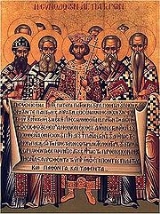
Christian Church

Encyclopedia
The Christian Church is the assembly or association of followers of Jesus Christ. The Greek
term ἐκκλησία that in its appearances in the New Testament
is usually translated as "church" basically means "assembly". It appears in 2 verses of the canonical Gospel of Matthew
, 24 verses of the Acts of the Apostles
, 58 verses of the letters of Paul the Apostle (including therefore the earliest instances of its use in relation to a Christian body), 2 of the Letter to the Hebrews, 1 of the Epistle of James
, 3 of the Third Epistle of John
, and 19 of the Book of Revelation
.
The four traditional "notes of the Christian Church"
are unity, holiness, catholicity, and apostolicity. In the phenomenological sense, there are many associations that call themselves Christian churches.
The New Testament the term ἐκκλησία (church or assembly) is used for local communities and in a universal sense to mean all believers. Traditionally, only orthodox
believers are considered part of the true Church, but convictions of what is orthodox vary.
This article addresses the Christian Church broadly, taking account of the variety of conceptions about it, some identifying it with a concrete visible structure (the view of Oriental Orthodoxy
, the Eastern Orthodox Church
and the Catholic Church), others seeing it as an invisible reality
not identified with any earthly structure (the general Protestant
view), and others equating it with a particular set of groups that share certain essential elements of doctrine and practice, though divided on other points of doctrine and practice and in government (the branch theory
sponsored by some Anglicans
).
word "church" is from the Old English word cirice, derived from West Germanic *kirika, which in turn comes from the Greek kuriakē, meaning "of the Lord" (possessive form of kurios "ruler, lord"). Kuriakē in the sense of "church" is most likely a shortening of kuriakē oikia ("house of the Lord") or ekklēsia kuriakē ("congregation of the Lord"). Christian churches were sometimes called kuriakon (adjective meaning "of the Lord") in Greek starting in the 4th century, but ekklēsia and basilikē were more common.
The word is one of many direct Greek-to-Germanic loans of Christian terminology, via the Goths
. The Slavic terms for "church" (Old Church Slavonic
[crĭky], Russian
[cerkov’], Slovenian
cerkev) are via the Old High German
cognate .
The Greek
word ekklēsia, literally "assembly" or "congregation", is the New Testament
term referring to the Christian Church (either a particular local group
or the whole body of the faithful
). Most Romance
and Celtic languages
use derivations of this word, either inherited or borrowed from the Latin
form ecclesia.
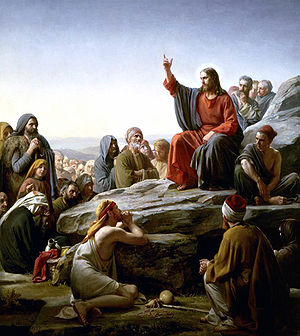 The early Church originated in Roman Judea
in the first century AD
, founded on the teachings of Jesus
of Nazareth
who is believed by Christians to be the Son of God
and Christ
the Messiah
. It is usually thought of as beginning with Jesus' Apostles. According to scripture
Jesus commanded them to spread his teachings to all the world
.
Springing out of the first century Jewish faith
, from Christianity's earliest days, Christians accepted non-Jews (Gentiles) without requiring them to fully adopt Jewish customs (such as circumcision
). The parallels in the Jewish faith are the Proselytes, Godfearers, and Noahide Law, see also Biblical law in Christianity
. Some think that conflict with Jewish religious authorities
quickly led to the expulsion of the Christians from the synagogues in Jerusalem
(see also Council of Jamnia
and List of events in early Christianity).
 The Church gradually spread through the Roman Empire
and outside it, gaining major establishments in cities such as Jerusalem, Antioch
, and Edessa
. It also became a widely persecuted religion. It was condemned by the Jewish authorities as a heresy
(see also Rejection of Jesus
). The Roman authorities persecuted it because, like Judaism, its monotheistic
teachings were fundamentally foreign to the polytheistic traditions of the ancient world
and a challenge to the imperial cult
. The Church grew rapidly until finally legalized
and then promoted by Emperors Constantine and Theodosius I
in the fourth century
as the State church of the Roman Empire
.
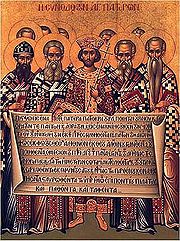 Already in the 2nd century, Christians denounced teachings that they saw as heresies
, especially Gnosticism
but also Montanism
. Ignatius of Antioch
at the beginning of that century and Irenaeus
at the end saw union with the bishops as the test of correct Christian faith. After legalization of the Church in the 4th century, the debate between Arianism
and Trinitarianism, with the emperors favouring now one side now the other, was a major controversy. On February 27, 380, the Roman Empire officially adopted the Trinitarian version of Christianity as its state religion, see also State church of the Roman Empire
. Prior to this date, Constantius II (337-361) and Valens (364-378) had personally favored Arian or Semi-Arian
forms of Christianity, but Valens' successor Theodosius I
supported the Trinitarian doctrine as expounded in the Nicene Creed
from the 1st Council of Nicea.
On this date, Theodosius I decreed that only the followers of Trinitarian Christianity were entitled to be referred to as Catholic
Christians, while all others were to be considered to be heretics, which was considered illegal. In 385, this new legal situation resulted, in the first case of many to come, in the capital punishment of a heretic, namely Priscillian
, condemned to death, with several of his followers, by a civil tribunal for the crime of magic. In the centuries of state-sponsored Christianity that followed, pagans
and "heretical" Christians were routinely persecuted by the Empire and the many kingdoms and countries that later occupied the place of the Empire, but some Germanic tribes
remained Arian well into the Middle Ages
(see also Christendom
).
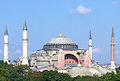 The Church within the Roman Empire
was organized under metropolitan sees, with five rising to particular prominence and forming the basis for the Pentarchy
proposed by Justinian I
. Of these five, one was in the West
(Rome
) and the rest in the East (Constantinople
, Jerusalem
, Antioch
, and Alexandria
). Even after the split of the Roman Empire the Church remained a relatively united institution (apart from Oriental Orthodoxy
and some other groups which separated from the rest of the Church earlier). The Church came to be a central and defining institution of the Empire, especially in the East or Byzantine Empire
, where Constantinople came to be seen as the center of the Christian world, owing in great part to its economic and political power.
Once the Western Empire fell to Germanic incursions in the 5th century
, the (Roman) Church became for centuries the primary link to Roman civilization
for medieval Western Europe
and an important channel of influence in the West for the Eastern Roman, or Byzantine, emperors. While, in the West, the so-called orthodox
Church competed against the Arian Christian and pagan faiths of the Germanic rulers and spread outside what had been the Empire to Ireland, Germany, Scandinavia and the western Slavs, in the East Christianity spread to the Slavs in what is now Russia
, south-central and eastern Europe. The reign of Charlemagne
in Western Europe is particularly noted for bringing the last major Western Arian tribes into communion with Rome, in part through conquest and forced conversion.
Starting in the 7th century
the Islamic Caliphates rose and gradually began to conquer larger and larger areas of the Christian world
. Excepting North Africa
and most of Spain
, northern and western Europe escaped largely unscathed by Islamic expansion, in great part because richer Constantinople and its empire acted as a magnet for the onslaught. The challenge presented by the Muslims would help to solidify the religious identity of eastern Christians even as it gradually weakened the Eastern Empire. Even in the Muslim World
, the Church survived (e.g., the modern Copt
s, Maronites, and others) albeit at times with great difficulty.
Although there had long been frictions between the Bishop of Rome (i.e., the Western
Pope) and the eastern patriarchs within the Byzantine Empire
, Rome's changing allegiance from Constantinople to the Frankish
king Charlemagne set the Church on a course towards separation. The political and theological divisions would grow until Rome and the East excommunicated each other in the 11th century, ultimately leading to the division of the Church into the Western
(Roman Catholic) and Eastern
(Eastern Orthodox) Churches. In 1448, not long before the Byzantine Empire collapsed, the Russian Church gained independence from the Patriarch of Constantinople.
As a result of the redevelopment of Western Europe
, and the gradual fall of the Eastern Roman Empire
to the Arab
s and Turks
(helped by warfare against Eastern Christians
), the final Fall of Constantinople
in 1453 resulted in Eastern scholars fleeing the Moslem hordes bringing ancient manuscripts to the West, which was a factor in the beginning of the period of the Western Renaissance
there. Rome
was seen by the Western Church as Christianity's heartland. Some Eastern churches even broke with Eastern Orthodoxy and entered into communion with Rome (the "Uniate" Eastern Catholic Churches). The changes brought on by the Renaissance eventually led to the Protestant Reformation
during which the Protestant Lutheran and the Reformed followers of Calvin, Hus, Zwingli, Melancthon, Knox, and others split from the Roman Catholic Church. At this time, a series of non-theological disputes also led to the English Reformation
which led to the independence of the Anglican Communion
. Then during the Age of Exploration
and the Age of Imperialism, Western Europe spread the Roman Catholic Church and the Protestant and Reformed Churches around the world, especially in the Americas
. These developments in turn have led to Christianity's being the largest religion in the world today.
groups. The term became especially prominent in referring to the doctrine of the Nicene Creed
and, in historical contexts, is often still used to distinguish this first "official" doctrine from others.
Body of Christ
(cf. ) and Bride of Christ
(cf. ; ). These terms are used to refer to the total community of Christians seen as interdependent in a single entity headed by Jesus Christ
.
Visible and invisible Church. On this, see below.
Church Militant and Church Triumphant
(Ecclesia Militans, Ecclesia Triumphans) These terms, taken together, are used to express the concept of a united Church that extends beyond the earthly realm into Heaven. The term Church Militant comprises all living Christians while Church Triumphant comprises those in Heaven
.
Church Suffering, or Church Expectant. A Roman Catholic
concept encompassing those Christians in Purgatory
, no longer part of the Church Militant and not yet part of the Church Triumphant.
Communion of Saints
. This term expresses the idea of a union in faith and prayer
that binds all Christians regardless of geographical distance or separation by death. In Roman Catholic theology it involves the Church Militant, the Church Triumphant, and also the Church Suffering.
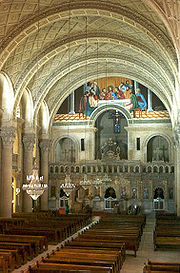 The term orthodox
is generally used to distinguish the faith or beliefs of the "true Church" from other doctrines which disagree, traditionally referred to as heresy
.
The Eastern Orthodox Church
and Oriental Orthodoxy
each claim to be the original Christian Church. The Eastern Orthodox Church bases its claim primarily on its assertion that it holds to traditions and beliefs of the original Christian Church. It also states that 4 out of the 5 sees of the Pentarchy
(excluding Rome) are still a part of it.
The Oriental Orthodox Churches' claims are similar to those of the Eastern Orthodox Church. They never adopted the theory of the Pentarchy
, which was formulated later than the break that followed the Council of Chalcedon
.
This concept of "orthodoxy" began to take on particular significance during the reign of the Roman Emperor
Constantine I
, the first to actively promote Christianity. Constantine convened the first Ecumenical Council
, the Council of Nicea, which attempted to provide the first universal creed of the Christian faith.
The major issue of this and other councils during the 4th century was the christological
debate between Arianism
and Trinitarianism. Trinitarianism is the official doctrine of the Catholic Church and is strongly associated with the term "orthodoxy", although some modern non-trinitarian churches dispute this usage.
"The Catholic tradition claims to be the sole Church of Christ which our Savior, after his Resurrection claims to have entrusted to Peter's pastoral care, commissioning him and the other apostles to extend and rule. However it is argued by protestants who claim that Jesus spoke of himself as the rock that the church is built on and only used the parallel of Peter's name for reference, but did not distinguish that upon Peter literally is the church built.This Church, constituted and organized as a society in the present world, subsists in (subsistit in) the Catholic Church, which is governed by the successor of Peter and by the bishops in communion with him."
"The Holy Roman Catholic and Apostolic Church is the only flock of which Jesus Christ, the Son of God, is the only Shepherd." (Catholic Book of Prayers, Pg. 236, "One Flock, One Shepherd")
The Catholic Church teaches in its doctrine that it is the original Church founded by Christ on the Apostles in the 1st century AD. The papal encyclical Mystici Corporis expresses the dogmatic ecclesiology of the Catholic Church thus: "if we would define and describe this true Church of Jesus Christ– which is the One, Holy, Catholic, Apostolic, Roman Church– we shall find no expression more noble, more sublime, or more divine, than the phrase which calls it ‘the Mystical Body of Jesus Christ." The Second Vatican Council's dogmatic constitution Lumen Gentium
further declares that "the one Church of Christ which in the Creed is professed as one, holy, catholic and apostolic, ... constituted and organized in the world as a society, subsists in the Catholic Church, which is governed by the successor of Peter and by the Bishops in communion with him". A 2007 declaration of the Congregation for the Doctrine of the Faith
clarified that, in this passage, "'subsistence' means this perduring, historical continuity and the permanence of all the elements instituted by Christ in the Catholic Church, in which the Church of Christ is concretely found on this earth", and added:."It is possible, according to Catholic doctrine, to affirm correctly that the Church of Christ is present and operative in the churches and ecclesial Communities not yet fully in communion with the Catholic Church, on account of the elements of sanctification and truth that are present in them. Nevertheless, the word 'subsists' can only be attributed to the Catholic Church alone precisely because it refers to the mark of unity that we profess in the symbols of the faith (I believe... in the 'one' Church); and this 'one' Church subsists in the Catholic Church."
The Catholic Church teaches that only corporate bodies of Christians led by bishops with valid Holy Orders can be recognized as "churches" in the proper sense. In Catholic documents, communities without such bishops are formally called ecclesial communities
.
, most Protestant denominations interpret "catholic", especially in its creedal context, as referring to the Protestant concept of an eternal, invisible church
of Christ and the Elect, and as referenced in the Bible
in phrases such as "body of Christ
" and "great cloud of witnesses". This Protestant interpretation of the words "one, holy, catholic, and apostolic church" in the Nicene Creed identifies exclusively with the Church Triumphant—the church that exists "in heaven" or in eternity as opposed to the Church Militant—the communion of the faithful here on Earth. They view this understanding of "catholic"—written with a lower-case "c"—as necessarily distinct from any concrete expression in an institutional Church.
Anglicans
generally understand their tradition as a branch of the historical Catholic Church and as a via media (middle way) between Roman Catholicism and Eastern Christianity on the one hand, and Protestantism on the other.
Modern Churches of Christ have their historical roots in the Restoration Movement, which was a converging of Christians across denominational lines in search of a return to a hypothesized original, "pre-denominational" Christianity. Participants in this movement sought to base doctrine and practice on the Bible alone, rather than recognizing the traditional councils and denominational hierarchies that had come to define Christianity since the 1st century AD. Members of the Churches of Christ believe that Jesus founded only one church, that the current divisions between Christians are not God's will, and that the only basis for restoring Christian unity is the Bible. They typically prefer to be known simply as "Christians", without any further religious or denominational identification.They see themselves as recreating the New Testament church established by Christ.
Church government is congregational rather than denominational. Churches of Christ purposefully have no central headquarters, councils, or other organizational structure above the local church level. Rather, the independent congregations are a network with each congregation participating at its own discretion in various means of service and fellowship with other congregations. This is done so that no congregation polluted by false teachings will bring down the others. The link the churches of Christ share is their shared commitment to restoration principles.
_-_the_last_supper_(1495-1498).jpg) "Apostolic succession
"Apostolic succession
" is a doctrine of the Roman Catholic Church
, the Eastern Orthodox Church
es, the Oriental Orthodox churches
, the Anglican Communion
and others. The doctrine asserts that the bishops of the "true Church" enjoy the favor or grace
of God as a result of legitimate and unbroken sacramental succession from Jesus' apostles. According to this doctrine, modern bishops, therefore, must be viewed as part of an unbroken line of leadership in succession from the original apostles: though they do not have the authority and powers granted uniquely to the apostles, they are the apostles' successors in governing the Church.
Like the churches mentioned above, Protestants see the authority given to the apostles as unique, proper to apostles alone, but they conclude from this that any doctrine of a succession to the apostles by bishops is to be rejected. The Protestant view of ecclesiastical authority differs accordingly.
 Many Protestants believe that the Church, as described in the Bible
, has a twofold character that can be described as the visible and invisible church.
In this view, the Church invisible consists of all those from every time and place who are vitally united to Christ through regeneration and salvation
and who will be eternally united to Jesus Christ in eternal life
. The universal, invisible church
refers to the "invisible" body of the elect
who are known only to God, and contrasts with the "visible church"—that is, the institutional body on earth which preaches the gospel
and administers the sacraments. Every member of the invisible church is considered saved, while the visible church contains some individuals who are saved and others who are unsaved. This concept has been attributed to St Augustine of Hippo
as part of his refutation of the Donatist sect, but others question whether Augustine really held to some form of an "invisible true Church" concept.
The Church visible, in this same view, consists of all those who visibly join themselves to a profession of faith and gathering together to know and serve the Head of the Church, Jesus Christ. It exists globally in all who identify themselves as Christians and locally in particular places where believers gather for the worship
of God. The visible church may also refer to an association of particular churches from multiple locations who unite themselves under a common charter and set of governmental principles. The church in the visible sense is often governed by office-bearers carrying titles such as minister
, pastor
, teacher, elder, and deacon
.
For the Catholic Church and the Eastern Orthodox Church
, making a real distinction between "the heavenly and invisible Church, alone true and absolute", and "the earthly Church (or rather 'the churches') imperfect and relative" is a "Nestorian
ecclesiology
" and is thus deemed by both as heretical
.
Roman Catholic theology reacted against the Protestant concept of a purely invisible Church by stressing the visible aspect of the Church founded by Christ; but in the 20th century the Catholic Church has placed more stress on the interior life of the Church as a supernatural organism. In an encyclical, Pope Pius XII
stated that the Catholic Church is the Mystical Body of Christ. This encyclical rejected two extreme views of the Church:
governance (Anglican, Catholic, Eastern Orthodoxy, Oriental Orthodoxy
) presbyterian
governance and congregational
governance (Baptist
, Pentecostal, Congregationalist, charismatic
, and other Protestant denominations). Before the Protestant Reformation, church leaders (the bishops) were universally understood to gain their authority through apostolic succession
via the Sacrament of Ordination
.
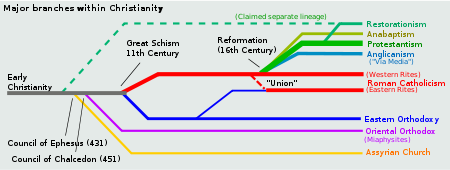 Today there is a wide diversity of Christian groups, with a variety of different doctrines and traditions. These controversies between the various branches of Christianity naturally include significant differences in their respective ecclesiologies.
and, in part, in the Apostles' Creed
("the holy catholic church", sanctam Ecclesiam catholicam, which in Greek would be: ). The phrase is intended to set forth the four marks, or identifying signs, of the Christian Church—unity, holiness, universality, and apostolicity—and is based on the premise that all true Christians form a single united group founded by the apostles.
The word "catholic
" is derived from the Greek
adjective καθολικός pronounced katholikos, which means "general" or "universal". Applied to the Church, it implies a calling to spread the faith throughout the whole world and to all ages. It is also thought of as implying that the Church is endowed with all the means of salvation
for its members. In this sense the Church is taken by Christian theology to refer to the single, universal community of faithful. Baptism
and communion signifies membership of the Church. Excommunication
is expulsion from the visible community of the Church, and is a remedial denial of the sacraments to a baptized Christian that does not invalidate that Christian's baptism. This can be traced back to the New Testament and to Jesus himself: , , , , , , , , , , , , .
Saint Ignatius of Antioch
, the earliest known writer to use the phrase "the catholic church", excluded from the Church heterodox
groups whose teaching and practice conflicted with those of the bishop
s of the Church, and considered that they were not really Christians. In keeping with this idea, many churches and communions consider that those whom they judge to be in a state of heresy
or schism
from their church or communion are not part of the catholic Church. This is the view of Roman Catholic and Oriental Orthodox and Eastern Orthodox Churches.
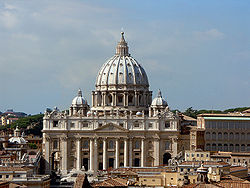 The Eastern Orthodox Church, the Oriental Orthodox Church and the Roman Catholic Church each regard themselves as the one true and unique church of Christ, and claim to be not just a Christian Church but the original Church founded by Christ
, preserving unbroken the original teaching and sacraments. The Roman Catholic Church teaches that "the one Church of Christ, as a society constituted and organized in the world, subsists in the Catholic Church, governed by the Successor of Peter and the bishops in communion with him. Only through this Church can one obtain the fullness of the means of salvation since the Lord has entrusted all the blessings of the New Covenant
to the apostolic college alone whose head is Peter." Similarly, the Eastern Orthodox Church
believes it is "the One Holy Catholic and Apostolic Church, founded by Jesus Christ and His apostles. It is organically and historically the same Church that came fully into being at Pentecost
." They see the members of other churches as linked in only an imperfect way with the one true Church, recognising Protestants not as churches but as ecclesial or specific faith believing communities.
Many other Christian groups take the view that all denominations are part of a symbolic and global Christian church which is a body bound by a common faith if not a common administration or tradition. Like the Roman Catholic Church, the Orthodox Church and some others have always referred to themselves as the Catholic church. Oriental Orthodoxy
shares this view, seeing the Churches of the Oriental Orthodox communion as constituting the one true Church. In the West
the term Catholic has come to be most commonly associated with the Roman Catholic Church because of its size and influence in the West, and because that is historically its name (although in formal contexts most other churches still reject this naming, because the title "Catholic Church" is so linked with the notion of it being the one true church).
describes and prescribes a visible institutional and doctrinal unity, not only geographically throughout the world, but also historically throughout history. They see unity as one of the four marks that the Creed attributes to the genuine Church, and the essence of a mark is that it be visible. A Church whose identity and belief varied from country to country and from age to age would not be "one" in their estimation. As such they see themselves not as a denomination, but as pre-denominational; not as one of many faith communities, but the original and sole true Church.
In the New Testament, the word "Church" or "assembly"—(translations for ekklesia)—normally refers to believers on earth, and they conclude that the Creed's description "one" must be applicable to the Church on earth and must not be reserved for some eschatological
reality. The only exception to the normal New Testament use of the word "" is the mention of the " of the firstborn who are enrolled in heaven." Even there the Christians to whom the letter is addressed are associated with that heavenly Church ("you have come to….") In line with this passage, the ancient Churches mentioned see the saint
s too—that is, the holy dead—as part of the one Church and not as ex-members, so that Christians both in the present life and the afterlife form a single Church.
Many Baptist
and Congregationalist
theologians accept the local sense as the only valid application of the term church. They strongly reject the notion of a universal (catholic
) church. These denominations argue that all uses of the Greek word ekklesia in the New Testament are speaking of either a particular local group or of the notion of "church" in the abstract, and never of a single, worldwide church.
Many Anglicans
, Lutherans
, Old Catholics
, and Independent Catholics
view unity as a mark of catholicity, but see the institutional unity of the Catholic Church as manifested in the shared Apostolic Succession
of their episcopacies, rather than a shared episcopal hierarchy or rites.
Reformed Christians hold that every person justified by faith in the Gospel committed to the Apostles is a member of "One, holy, catholic, and apostolic Church". From this perspective, the real unity and holiness of the whole church established through the Apostles is yet to be revealed; and meanwhile, the extent and peace of the church on earth is imperfectly realized in a visible way.
The Lutheran Church – Missouri Synod declares that only believers in the doctrine of justification
are members of the Christian Church, excluding all others, even if those others are in external communion
with the Church and even if they hold a teaching office in it.
Greek language
Greek is an independent branch of the Indo-European family of languages. Native to the southern Balkans, it has the longest documented history of any Indo-European language, spanning 34 centuries of written records. Its writing system has been the Greek alphabet for the majority of its history;...
term ἐκκλησία that in its appearances in the New Testament
New Testament
The New Testament is the second major division of the Christian biblical canon, the first such division being the much longer Old Testament....
is usually translated as "church" basically means "assembly". It appears in 2 verses of the canonical Gospel of Matthew
Gospel of Matthew
The Gospel According to Matthew is one of the four canonical gospels, one of the three synoptic gospels, and the first book of the New Testament. It tells of the life, ministry, death, and resurrection of Jesus of Nazareth...
, 24 verses of the Acts of the Apostles
Acts of the Apostles
The Acts of the Apostles , usually referred to simply as Acts, is the fifth book of the New Testament; Acts outlines the history of the Apostolic Age...
, 58 verses of the letters of Paul the Apostle (including therefore the earliest instances of its use in relation to a Christian body), 2 of the Letter to the Hebrews, 1 of the Epistle of James
Epistle of James
The Epistle of James, usually referred to simply as James, is a book in the New Testament. The author identifies himself as "James, a servant of God and of the Lord Jesus Christ", with "the earliest extant manuscripts of James usually dated to mid-to-late third century."There are four views...
, 3 of the Third Epistle of John
Third Epistle of John
The Third Epistle of John, often referred to as Third John and written 3 John, is a book of the New Testament attributed to John the Evangelist, traditionally thought to be the author of the Gospel of John and the other two epistles of John...
, and 19 of the Book of Revelation
Book of Revelation
The Book of Revelation is the final book of the New Testament. The title came into usage from the first word of the book in Koine Greek: apokalupsis, meaning "unveiling" or "revelation"...
.
The four traditional "notes of the Christian Church"
Four Marks of the Church
The Four Marks of the Church is a term describing four specific adjectives—one, holy, catholic and apostolic—indicating four major distinctive marks or distinguishing characteristics of the Christian Church...
are unity, holiness, catholicity, and apostolicity. In the phenomenological sense, there are many associations that call themselves Christian churches.
The New Testament the term ἐκκλησία (church or assembly) is used for local communities and in a universal sense to mean all believers. Traditionally, only orthodox
Orthodoxy
The word orthodox, from Greek orthos + doxa , is generally used to mean the adherence to accepted norms, more specifically to creeds, especially in religion...
believers are considered part of the true Church, but convictions of what is orthodox vary.
This article addresses the Christian Church broadly, taking account of the variety of conceptions about it, some identifying it with a concrete visible structure (the view of Oriental Orthodoxy
Oriental Orthodoxy
Oriental Orthodoxy is the faith of those Eastern Christian Churches that recognize only three ecumenical councils — the First Council of Nicaea, the First Council of Constantinople and the First Council of Ephesus. They rejected the dogmatic definitions of the Council of Chalcedon...
, the Eastern Orthodox Church
Eastern Orthodox Church
The Orthodox Church, officially called the Orthodox Catholic Church and commonly referred to as the Eastern Orthodox Church, is the second largest Christian denomination in the world, with an estimated 300 million adherents mainly in the countries of Belarus, Bulgaria, Cyprus, Georgia, Greece,...
and the Catholic Church), others seeing it as an invisible reality
Invisible church
The invisible church or church invisible is a theological concept of an "invisible" body of the elect who are known only to God, in contrast to the "visible church"—that is, the institutional body on earth which preaches the gospel and administers the sacraments...
not identified with any earthly structure (the general Protestant
Protestantism
Protestantism is one of the three major groupings within Christianity. It is a movement that began in Germany in the early 16th century as a reaction against medieval Roman Catholic doctrines and practices, especially in regards to salvation, justification, and ecclesiology.The doctrines of the...
view), and others equating it with a particular set of groups that share certain essential elements of doctrine and practice, though divided on other points of doctrine and practice and in government (the branch theory
Branch theory
The Branch Theory is a theological concept within Anglicanism, holding that the Roman Catholic Church, the Eastern Orthodox Church and the Anglican Communion are the three principal branches of the One, Holy, Catholic, and Apostolic Church.-Theory:...
sponsored by some Anglicans
Anglicanism
Anglicanism is a tradition within Christianity comprising churches with historical connections to the Church of England or similar beliefs, worship and church structures. The word Anglican originates in ecclesia anglicana, a medieval Latin phrase dating to at least 1246 that means the English...
).
Etymology
The English languageEnglish language
English is a West Germanic language that arose in the Anglo-Saxon kingdoms of England and spread into what was to become south-east Scotland under the influence of the Anglian medieval kingdom of Northumbria...
word "church" is from the Old English word cirice, derived from West Germanic *kirika, which in turn comes from the Greek kuriakē, meaning "of the Lord" (possessive form of kurios "ruler, lord"). Kuriakē in the sense of "church" is most likely a shortening of kuriakē oikia ("house of the Lord") or ekklēsia kuriakē ("congregation of the Lord"). Christian churches were sometimes called kuriakon (adjective meaning "of the Lord") in Greek starting in the 4th century, but ekklēsia and basilikē were more common.
The word is one of many direct Greek-to-Germanic loans of Christian terminology, via the Goths
Goths
The Goths were an East Germanic tribe of Scandinavian origin whose two branches, the Visigoths and the Ostrogoths, played an important role in the fall of the Roman Empire and the emergence of Medieval Europe....
. The Slavic terms for "church" (Old Church Slavonic
Old Church Slavonic
Old Church Slavonic or Old Church Slavic was the first literary Slavic language, first developed by the 9th century Byzantine Greek missionaries Saints Cyril and Methodius who were credited with standardizing the language and using it for translating the Bible and other Ancient Greek...
[crĭky], Russian
Russian language
Russian is a Slavic language used primarily in Russia, Belarus, Uzbekistan, Kazakhstan, Tajikistan and Kyrgyzstan. It is an unofficial but widely spoken language in Ukraine, Moldova, Latvia, Turkmenistan and Estonia and, to a lesser extent, the other countries that were once constituent republics...
[cerkov’], Slovenian
Slovenian language
Slovene or Slovenian is a South Slavic language spoken by approximately 2.5 million speakers worldwide, the majority of whom live in Slovenia. It is the first language of about 1.85 million people and is one of the 23 official and working languages of the European Union...
cerkev) are via the Old High German
Old High German
The term Old High German refers to the earliest stage of the German language and it conventionally covers the period from around 500 to 1050. Coherent written texts do not appear until the second half of the 8th century, and some treat the period before 750 as 'prehistoric' and date the start of...
cognate .
The Greek
Ancient Greek
Ancient Greek is the stage of the Greek language in the periods spanning the times c. 9th–6th centuries BC, , c. 5th–4th centuries BC , and the c. 3rd century BC – 6th century AD of ancient Greece and the ancient world; being predated in the 2nd millennium BC by Mycenaean Greek...
word ekklēsia, literally "assembly" or "congregation", is the New Testament
New Testament
The New Testament is the second major division of the Christian biblical canon, the first such division being the much longer Old Testament....
term referring to the Christian Church (either a particular local group
Local church
A local church is a Christian congregation of members and clergy.Local church may also refer to:* Local churches , a Christian group based on the teachings of Watchman Nee and Witness Lee, and associated with the Living Stream Ministry publishing house.* Parish church, a local church united with...
or the whole body of the faithful
Christendom
Christendom, or the Christian world, has several meanings. In a cultural sense it refers to the worldwide community of Christians, adherents of Christianity...
). Most Romance
Romance languages
The Romance languages are a branch of the Indo-European language family, more precisely of the Italic languages subfamily, comprising all the languages that descend from Vulgar Latin, the language of ancient Rome...
and Celtic languages
Celtic languages
The Celtic languages are descended from Proto-Celtic, or "Common Celtic"; a branch of the greater Indo-European language family...
use derivations of this word, either inherited or borrowed from the Latin
Latin
Latin is an Italic language originally spoken in Latium and Ancient Rome. It, along with most European languages, is a descendant of the ancient Proto-Indo-European language. Although it is considered a dead language, a number of scholars and members of the Christian clergy speak it fluently, and...
form ecclesia.
History
Iudaea Province
Judaea or Iudaea are terms used by historians to refer to the Roman province that extended over parts of the former regions of the Hasmonean and Herodian kingdoms of Israel...
in the first century AD
Christianity in the 1st century
The earliest followers of Jesus composed an apocalyptic, Jewish sect, which historians refer to as Jewish Christianity. The Apostles and others following the Great Commission's decree to spread the teachings of Jesus to "all nations," had great success spreading the religion to gentiles. Peter,...
, founded on the teachings of Jesus
Jesus
Jesus of Nazareth , commonly referred to as Jesus Christ or simply as Jesus or Christ, is the central figure of Christianity...
of Nazareth
Nazareth
Nazareth is the largest city in the North District of Israel. Known as "the Arab capital of Israel," the population is made up predominantly of Palestinian Arab citizens of Israel...
who is believed by Christians to be the Son of God
Son of God
"Son of God" is a phrase which according to most Christian denominations, Trinitarian in belief, refers to the relationship between Jesus and God, specifically as "God the Son"...
and Christ
Christ
Christ is the English term for the Greek meaning "the anointed one". It is a translation of the Hebrew , usually transliterated into English as Messiah or Mashiach...
the Messiah
Messiah
A messiah is a redeemer figure expected or foretold in one form or another by a religion. Slightly more widely, a messiah is any redeemer figure. Messianic beliefs or theories generally relate to eschatological improvement of the state of humanity or the world, in other words the World to...
. It is usually thought of as beginning with Jesus' Apostles. According to scripture
Four Evangelists
In Christian tradition the Four Evangelists are Matthew, Mark, Luke, and John, the authors attributed with the creation of the four Gospel accounts in the New Testament that bear the following titles:*Gospel according to Matthew*Gospel according to Mark...
Jesus commanded them to spread his teachings to all the world
Great Commission
The Great Commission, in Christian tradition, is the instruction of the resurrected Jesus Christ to his disciples, that they spread his teachings to all the nations of the world. It has become a tenet in Christian theology emphasizing missionary work, evangelism, and baptism...
.
Springing out of the first century Jewish faith
Tannaim
The Tannaim were the Rabbinic sages whose views are recorded in the Mishnah, from approximately 70-200 CE. The period of the Tannaim, also referred to as the Mishnaic period, lasted about 130 years...
, from Christianity's earliest days, Christians accepted non-Jews (Gentiles) without requiring them to fully adopt Jewish customs (such as circumcision
Circumcision controversy in early Christianity
There is evidence of a controversy over religious male circumcision in Early Christianity. A Council of Jerusalem, possibly held in approximately 50 AD, decreed that male circumcision was not a requirement for Gentile converts. This became known as the "Apostolic Decree" and may be one of the...
). The parallels in the Jewish faith are the Proselytes, Godfearers, and Noahide Law, see also Biblical law in Christianity
Biblical law in Christianity
Christian views of the Old Covenant have been central to Christian theology and practice since the circumcision controversy in Early Christianity. There are differing views about the applicability of the Old Covenant among Christian denominations...
. Some think that conflict with Jewish religious authorities
Rabbinic Judaism
Rabbinic Judaism or Rabbinism has been the mainstream form of Judaism since the 6th century CE, after the codification of the Talmud...
quickly led to the expulsion of the Christians from the synagogues in Jerusalem
Jerusalem in Christianity
For Christians, Jerusalem's place in the ministry of Jesus and the Apostolic Age gives it great importance, in addition to its place in the Old Testament, the Hebrew Bible.-Jerusalem in the New Testament and early Christianity:...
(see also Council of Jamnia
Council of Jamnia
The Council of Jamnia or Council of Yavne is a hypothetical late 1st-century council at which it is postulated the canon of the Hebrew Bible was finalized....
and List of events in early Christianity).
Roman Empire
The Roman Empire was the post-Republican period of the ancient Roman civilization, characterised by an autocratic form of government and large territorial holdings in Europe and around the Mediterranean....
and outside it, gaining major establishments in cities such as Jerusalem, Antioch
Antioch
Antioch on the Orontes was an ancient city on the eastern side of the Orontes River. It is near the modern city of Antakya, Turkey.Founded near the end of the 4th century BC by Seleucus I Nicator, one of Alexander the Great's generals, Antioch eventually rivaled Alexandria as the chief city of the...
, and Edessa
Edessa, Mesopotamia
Edessa is the Greek name of an Aramaic town in northern Mesopotamia, as refounded by Seleucus I Nicator. For the modern history of the city, see Şanlıurfa.-Names:...
. It also became a widely persecuted religion. It was condemned by the Jewish authorities as a heresy
Heresy
Heresy is a controversial or novel change to a system of beliefs, especially a religion, that conflicts with established dogma. It is distinct from apostasy, which is the formal denunciation of one's religion, principles or cause, and blasphemy, which is irreverence toward religion...
(see also Rejection of Jesus
Rejection of Jesus
The Canonical Gospels of the New Testament include some accounts of the rejection of Jesus in the course of his ministry. Judaism's view of Jesus, Jesus in Islam, and the view of the Historical Jesus all differ from Christian views of Jesus.-Hometown rejection:...
). The Roman authorities persecuted it because, like Judaism, its monotheistic
Monotheism
Monotheism is the belief in the existence of one and only one god. Monotheism is characteristic of the Baha'i Faith, Christianity, Druzism, Hinduism, Islam, Judaism, Samaritanism, Sikhism and Zoroastrianism.While they profess the existence of only one deity, monotheistic religions may still...
teachings were fundamentally foreign to the polytheistic traditions of the ancient world
Polytheism
Polytheism is the belief of multiple deities also usually assembled into a pantheon of gods and goddesses, along with their own mythologies and rituals....
and a challenge to the imperial cult
Imperial cult
An imperial cult is a form of state religion in which an emperor, or a dynasty of emperors , are worshipped as messiahs, demigods or deities. "Cult" here is used to mean "worship", not in the modern pejorative sense...
. The Church grew rapidly until finally legalized
Edict of Milan
The Edict of Milan was a letter signed by emperors Constantine I and Licinius that proclaimed religious toleration in the Roman Empire...
and then promoted by Emperors Constantine and Theodosius I
Theodosius I
Theodosius I , also known as Theodosius the Great, was Roman Emperor from 379 to 395. Theodosius was the last emperor to rule over both the eastern and the western halves of the Roman Empire. During his reign, the Goths secured control of Illyricum after the Gothic War, establishing their homeland...
in the fourth century
Christianity in the 4th century
Christianity in the 4th century was dominated by Constantine the Great, and the First Council of Nicea of 325, which was the beginning of the period of the First seven Ecumenical Councils and the attempt to reach an orthodox consensus and to establish a unified Christendom as the State church of...
as the State church of the Roman Empire
State church of the Roman Empire
The state church of the Roman Empire was a Christian institution organized within the Roman Empire during the 4th century that came to represent the Empire's sole authorized religion. Both the Roman Catholic Church and the Eastern Orthodox churches claim to be the historical continuation of this...
.
Heresy
Heresy is a controversial or novel change to a system of beliefs, especially a religion, that conflicts with established dogma. It is distinct from apostasy, which is the formal denunciation of one's religion, principles or cause, and blasphemy, which is irreverence toward religion...
, especially Gnosticism
Gnosticism
Gnosticism is a scholarly term for a set of religious beliefs and spiritual practices common to early Christianity, Hellenistic Judaism, Greco-Roman mystery religions, Zoroastrianism , and Neoplatonism.A common characteristic of some of these groups was the teaching that the realisation of Gnosis...
but also Montanism
Montanism
Montanism was an early Christian movement of the late 2nd century, later referred to by the name of its founder, Montanus, but originally known by its adherents as the New Prophecy...
. Ignatius of Antioch
Ignatius of Antioch
Ignatius of Antioch was among the Apostolic Fathers, was the third Bishop of Antioch, and was a student of John the Apostle. En route to his martyrdom in Rome, Ignatius wrote a series of letters which have been preserved as an example of very early Christian theology...
at the beginning of that century and Irenaeus
Irenaeus
Saint Irenaeus , was Bishop of Lugdunum in Gaul, then a part of the Roman Empire . He was an early church father and apologist, and his writings were formative in the early development of Christian theology...
at the end saw union with the bishops as the test of correct Christian faith. After legalization of the Church in the 4th century, the debate between Arianism
Arianism
Arianism is the theological teaching attributed to Arius , a Christian presbyter from Alexandria, Egypt, concerning the relationship of the entities of the Trinity and the precise nature of the Son of God as being a subordinate entity to God the Father...
and Trinitarianism, with the emperors favouring now one side now the other, was a major controversy. On February 27, 380, the Roman Empire officially adopted the Trinitarian version of Christianity as its state religion, see also State church of the Roman Empire
State church of the Roman Empire
The state church of the Roman Empire was a Christian institution organized within the Roman Empire during the 4th century that came to represent the Empire's sole authorized religion. Both the Roman Catholic Church and the Eastern Orthodox churches claim to be the historical continuation of this...
. Prior to this date, Constantius II (337-361) and Valens (364-378) had personally favored Arian or Semi-Arian
Semi-Arianism
Semi-Arianism is a name frequently given to the Trinitarian position of the conservative majority of the Eastern Christian Church in the 4th century, to distinguish it from strict Arianism....
forms of Christianity, but Valens' successor Theodosius I
Theodosius I
Theodosius I , also known as Theodosius the Great, was Roman Emperor from 379 to 395. Theodosius was the last emperor to rule over both the eastern and the western halves of the Roman Empire. During his reign, the Goths secured control of Illyricum after the Gothic War, establishing their homeland...
supported the Trinitarian doctrine as expounded in the Nicene Creed
Nicene Creed
The Nicene Creed is the creed or profession of faith that is most widely used in Christian liturgy. It is called Nicene because, in its original form, it was adopted in the city of Nicaea by the first ecumenical council, which met there in the year 325.The Nicene Creed has been normative to the...
from the 1st Council of Nicea.
On this date, Theodosius I decreed that only the followers of Trinitarian Christianity were entitled to be referred to as Catholic
Catholic
The word catholic comes from the Greek phrase , meaning "on the whole," "according to the whole" or "in general", and is a combination of the Greek words meaning "about" and meaning "whole"...
Christians, while all others were to be considered to be heretics, which was considered illegal. In 385, this new legal situation resulted, in the first case of many to come, in the capital punishment of a heretic, namely Priscillian
Priscillian
Priscillian was bishop of Ávila and a theologian from Roman Gallaecia , the first person in the history of Christianity to be executed for heresy . He founded an ascetic group that, in spite of persecution, continued to subsist in Hispania and Gaul until the later 6th century...
, condemned to death, with several of his followers, by a civil tribunal for the crime of magic. In the centuries of state-sponsored Christianity that followed, pagans
Paganism
Paganism is a blanket term, typically used to refer to non-Abrahamic, indigenous polytheistic religious traditions....
and "heretical" Christians were routinely persecuted by the Empire and the many kingdoms and countries that later occupied the place of the Empire, but some Germanic tribes
Germanic peoples
The Germanic peoples are an Indo-European ethno-linguistic group of Northern European origin, identified by their use of the Indo-European Germanic languages which diversified out of Proto-Germanic during the Pre-Roman Iron Age.Originating about 1800 BCE from the Corded Ware Culture on the North...
remained Arian well into the Middle Ages
Middle Ages
The Middle Ages is a periodization of European history from the 5th century to the 15th century. The Middle Ages follows the fall of the Western Roman Empire in 476 and precedes the Early Modern Era. It is the middle period of a three-period division of Western history: Classic, Medieval and Modern...
(see also Christendom
Christendom
Christendom, or the Christian world, has several meanings. In a cultural sense it refers to the worldwide community of Christians, adherents of Christianity...
).
State church of the Roman Empire
The state church of the Roman Empire was a Christian institution organized within the Roman Empire during the 4th century that came to represent the Empire's sole authorized religion. Both the Roman Catholic Church and the Eastern Orthodox churches claim to be the historical continuation of this...
was organized under metropolitan sees, with five rising to particular prominence and forming the basis for the Pentarchy
Pentarchy
Pentarchy is a term in the history of Christianity for the idea of universal rule over all Christendom by the heads of five major episcopal sees, or patriarchates, of the Roman Empire: Rome, Constantinople, Alexandria, Antioch, and Jerusalem...
proposed by Justinian I
Justinian I
Justinian I ; , ; 483– 13 or 14 November 565), commonly known as Justinian the Great, was Byzantine Emperor from 527 to 565. During his reign, Justinian sought to revive the Empire's greatness and reconquer the lost western half of the classical Roman Empire.One of the most important figures of...
. Of these five, one was in the West
Western Roman Empire
The Western Roman Empire was the western half of the Roman Empire after its division by Diocletian in 285; the other half of the Roman Empire was the Eastern Roman Empire, commonly referred to today as the Byzantine Empire....
(Rome
Diocese of Rome
The Diocese of Rome is a diocese of the Catholic Church in Rome, Italy. The bishop of Rome is the Pope, who is the Supreme Pontiff and leader of the Catholic Church...
) and the rest in the East (Constantinople
Constantinople
Constantinople was the capital of the Roman, Eastern Roman, Byzantine, Latin, and Ottoman Empires. Throughout most of the Middle Ages, Constantinople was Europe's largest and wealthiest city.-Names:...
, Jerusalem
History of Jerusalem
During its long history, Jerusalem has been destroyed twice, besieged 23 times, attacked 52 times, and captured and recaptured 44 times. The oldest part of the city was settled in the 4th millennium BCE, making Jerusalem one of the oldest cities in the world....
, Antioch
Antioch
Antioch on the Orontes was an ancient city on the eastern side of the Orontes River. It is near the modern city of Antakya, Turkey.Founded near the end of the 4th century BC by Seleucus I Nicator, one of Alexander the Great's generals, Antioch eventually rivaled Alexandria as the chief city of the...
, and Alexandria
Alexandria
Alexandria is the second-largest city of Egypt, with a population of 4.1 million, extending about along the coast of the Mediterranean Sea in the north central part of the country; it is also the largest city lying directly on the Mediterranean coast. It is Egypt's largest seaport, serving...
). Even after the split of the Roman Empire the Church remained a relatively united institution (apart from Oriental Orthodoxy
Oriental Orthodoxy
Oriental Orthodoxy is the faith of those Eastern Christian Churches that recognize only three ecumenical councils — the First Council of Nicaea, the First Council of Constantinople and the First Council of Ephesus. They rejected the dogmatic definitions of the Council of Chalcedon...
and some other groups which separated from the rest of the Church earlier). The Church came to be a central and defining institution of the Empire, especially in the East or Byzantine Empire
Byzantine Empire
The Byzantine Empire was the Eastern Roman Empire during the periods of Late Antiquity and the Middle Ages, centred on the capital of Constantinople. Known simply as the Roman Empire or Romania to its inhabitants and neighbours, the Empire was the direct continuation of the Ancient Roman State...
, where Constantinople came to be seen as the center of the Christian world, owing in great part to its economic and political power.
Once the Western Empire fell to Germanic incursions in the 5th century
Christianity in the 5th century
The 5th century would see further fracturing of the State church of the Roman Empire. Emperor Theodosius II called two synods in Ephesus, one in 431 and one in 449 AD, that addressed the teachings of then-Patriarch of Constantinople Nestorius and similar teachings...
, the (Roman) Church became for centuries the primary link to Roman civilization
Culture of ancient Rome
Ancient Roman culture existed throughout the almost 1200-year history of the civilization of Ancient Rome. The term refers to the culture of the Roman Republic, later the Roman Empire, which, at its peak, covered an area from Lowland Scotland and Morocco to the Euphrates.Life in ancient Rome...
for medieval Western Europe
Western Europe
Western Europe is a loose term for the collection of countries in the western most region of the European continents, though this definition is context-dependent and carries cultural and political connotations. One definition describes Western Europe as a geographic entity—the region lying in the...
and an important channel of influence in the West for the Eastern Roman, or Byzantine, emperors. While, in the West, the so-called orthodox
Orthodoxy
The word orthodox, from Greek orthos + doxa , is generally used to mean the adherence to accepted norms, more specifically to creeds, especially in religion...
Church competed against the Arian Christian and pagan faiths of the Germanic rulers and spread outside what had been the Empire to Ireland, Germany, Scandinavia and the western Slavs, in the East Christianity spread to the Slavs in what is now Russia
Russia
Russia or , officially known as both Russia and the Russian Federation , is a country in northern Eurasia. It is a federal semi-presidential republic, comprising 83 federal subjects...
, south-central and eastern Europe. The reign of Charlemagne
Charlemagne
Charlemagne was King of the Franks from 768 and Emperor of the Romans from 800 to his death in 814. He expanded the Frankish kingdom into an empire that incorporated much of Western and Central Europe. During his reign, he conquered Italy and was crowned by Pope Leo III on 25 December 800...
in Western Europe is particularly noted for bringing the last major Western Arian tribes into communion with Rome, in part through conquest and forced conversion.
Starting in the 7th century
Christianity in the 7th century
Christianity in the 7th century, the Western and Eastern areas of Christianity began to take on distinctive shapes. Whereas in the East the Church maintained its structure and character and evolved more slowly, in the West the Bishops of Rome were forced to adapt more quickly and flexibly to...
the Islamic Caliphates rose and gradually began to conquer larger and larger areas of the Christian world
Christendom
Christendom, or the Christian world, has several meanings. In a cultural sense it refers to the worldwide community of Christians, adherents of Christianity...
. Excepting North Africa
North Africa
North Africa or Northern Africa is the northernmost region of the African continent, linked by the Sahara to Sub-Saharan Africa. Geopolitically, the United Nations definition of Northern Africa includes eight countries or territories; Algeria, Egypt, Libya, Morocco, South Sudan, Sudan, Tunisia, and...
and most of Spain
Al-Andalus
Al-Andalus was the Arabic name given to a nation and territorial region also commonly referred to as Moorish Iberia. The name describes parts of the Iberian Peninsula and Septimania governed by Muslims , at various times in the period between 711 and 1492, although the territorial boundaries...
, northern and western Europe escaped largely unscathed by Islamic expansion, in great part because richer Constantinople and its empire acted as a magnet for the onslaught. The challenge presented by the Muslims would help to solidify the religious identity of eastern Christians even as it gradually weakened the Eastern Empire. Even in the Muslim World
Muslim world
The term Muslim world has several meanings. In a religious sense, it refers to those who adhere to the teachings of Islam, referred to as Muslims. In a cultural sense, it refers to Islamic civilization, inclusive of non-Muslims living in that civilization...
, the Church survived (e.g., the modern Copt
Copt
The Copts are the native Egyptian Christians , a major ethnoreligious group in Egypt....
s, Maronites, and others) albeit at times with great difficulty.
Although there had long been frictions between the Bishop of Rome (i.e., the Western
Western world
The Western world, also known as the West and the Occident , is a term referring to the countries of Western Europe , the countries of the Americas, as well all countries of Northern and Central Europe, Australia and New Zealand...
Pope) and the eastern patriarchs within the Byzantine Empire
Byzantine Empire
The Byzantine Empire was the Eastern Roman Empire during the periods of Late Antiquity and the Middle Ages, centred on the capital of Constantinople. Known simply as the Roman Empire or Romania to its inhabitants and neighbours, the Empire was the direct continuation of the Ancient Roman State...
, Rome's changing allegiance from Constantinople to the Frankish
Frankish Empire
Francia or Frankia, later also called the Frankish Empire , Frankish Kingdom , Frankish Realm or occasionally Frankland, was the territory inhabited and ruled by the Franks from the 3rd to the 10th century...
king Charlemagne set the Church on a course towards separation. The political and theological divisions would grow until Rome and the East excommunicated each other in the 11th century, ultimately leading to the division of the Church into the Western
Roman Catholic Church
The Catholic Church, also known as the Roman Catholic Church, is the world's largest Christian church, with over a billion members. Led by the Pope, it defines its mission as spreading the gospel of Jesus Christ, administering the sacraments and exercising charity...
(Roman Catholic) and Eastern
Eastern Orthodox Church
The Orthodox Church, officially called the Orthodox Catholic Church and commonly referred to as the Eastern Orthodox Church, is the second largest Christian denomination in the world, with an estimated 300 million adherents mainly in the countries of Belarus, Bulgaria, Cyprus, Georgia, Greece,...
(Eastern Orthodox) Churches. In 1448, not long before the Byzantine Empire collapsed, the Russian Church gained independence from the Patriarch of Constantinople.
As a result of the redevelopment of Western Europe
High Middle Ages
The High Middle Ages was the period of European history around the 11th, 12th, and 13th centuries . The High Middle Ages were preceded by the Early Middle Ages and followed by the Late Middle Ages, which by convention end around 1500....
, and the gradual fall of the Eastern Roman Empire
Decline of the Byzantine Empire
The decline of the Byzantine Empire was a process similar to the decline of the Western Roman Empire, in that it lasted many centuries. There is no clear consensus on when this process began; but many dates and time lines have been proposed by historians....
to the Arab
Arab
Arab people, also known as Arabs , are a panethnicity primarily living in the Arab world, which is located in Western Asia and North Africa. They are identified as such on one or more of genealogical, linguistic, or cultural grounds, with tribal affiliations, and intra-tribal relationships playing...
s and Turks
Turkish people
Turkish people, also known as the "Turks" , are an ethnic group primarily living in Turkey and in the former lands of the Ottoman Empire where Turkish minorities had been established in Bulgaria, Cyprus, Bosnia and Herzegovina, Georgia, Greece, Kosovo, Macedonia, and Romania...
(helped by warfare against Eastern Christians
Fourth Crusade
The Fourth Crusade was originally intended to conquer Muslim-controlled Jerusalem by means of an invasion through Egypt. Instead, in April 1204, the Crusaders of Western Europe invaded and conquered the Christian city of Constantinople, capital of the Eastern Roman Empire...
), the final Fall of Constantinople
Fall of Constantinople
The Fall of Constantinople was the capture of the capital of the Byzantine Empire, which occurred after a siege by the Ottoman Empire, under the command of Ottoman Sultan Mehmed II, against the defending army commanded by Byzantine Emperor Constantine XI...
in 1453 resulted in Eastern scholars fleeing the Moslem hordes bringing ancient manuscripts to the West, which was a factor in the beginning of the period of the Western Renaissance
Renaissance
The Renaissance was a cultural movement that spanned roughly the 14th to the 17th century, beginning in Italy in the Late Middle Ages and later spreading to the rest of Europe. The term is also used more loosely to refer to the historical era, but since the changes of the Renaissance were not...
there. Rome
Rome
Rome is the capital of Italy and the country's largest and most populated city and comune, with over 2.7 million residents in . The city is located in the central-western portion of the Italian Peninsula, on the Tiber River within the Lazio region of Italy.Rome's history spans two and a half...
was seen by the Western Church as Christianity's heartland. Some Eastern churches even broke with Eastern Orthodoxy and entered into communion with Rome (the "Uniate" Eastern Catholic Churches). The changes brought on by the Renaissance eventually led to the Protestant Reformation
Protestant Reformation
The Protestant Reformation was a 16th-century split within Western Christianity initiated by Martin Luther, John Calvin and other early Protestants. The efforts of the self-described "reformers", who objected to the doctrines, rituals and ecclesiastical structure of the Roman Catholic Church, led...
during which the Protestant Lutheran and the Reformed followers of Calvin, Hus, Zwingli, Melancthon, Knox, and others split from the Roman Catholic Church. At this time, a series of non-theological disputes also led to the English Reformation
English Reformation
The English Reformation was the series of events in 16th-century England by which the Church of England broke away from the authority of the Pope and the Roman Catholic Church....
which led to the independence of the Anglican Communion
Anglican Communion
The Anglican Communion is an international association of national and regional Anglican churches in full communion with the Church of England and specifically with its principal primate, the Archbishop of Canterbury...
. Then during the Age of Exploration
Age of Discovery
The Age of Discovery, also known as the Age of Exploration and the Great Navigations , was a period in history starting in the early 15th century and continuing into the early 17th century during which Europeans engaged in intensive exploration of the world, establishing direct contacts with...
and the Age of Imperialism, Western Europe spread the Roman Catholic Church and the Protestant and Reformed Churches around the world, especially in the Americas
Americas
The Americas, or America , are lands in the Western hemisphere, also known as the New World. In English, the plural form the Americas is often used to refer to the landmasses of North America and South America with their associated islands and regions, while the singular form America is primarily...
. These developments in turn have led to Christianity's being the largest religion in the world today.
Related concepts
Orthodox Church and orthodox faith. These terms, with lower-case O, and thus distinguished from the term Orthodox Church, have been used to distinguish the true Church from hereticalHeresy
Heresy is a controversial or novel change to a system of beliefs, especially a religion, that conflicts with established dogma. It is distinct from apostasy, which is the formal denunciation of one's religion, principles or cause, and blasphemy, which is irreverence toward religion...
groups. The term became especially prominent in referring to the doctrine of the Nicene Creed
Nicene Creed
The Nicene Creed is the creed or profession of faith that is most widely used in Christian liturgy. It is called Nicene because, in its original form, it was adopted in the city of Nicaea by the first ecumenical council, which met there in the year 325.The Nicene Creed has been normative to the...
and, in historical contexts, is often still used to distinguish this first "official" doctrine from others.
Body of Christ
Body of Christ
In Christian theology, the term Body of Christ has two separate connotations: it may refer to Jesus's statement about the Eucharist at the Last Supper that "This is my body" in , or the explicit usage of the term by the Apostle Paul in to refer to the Christian Church.Although in general usage the...
(cf. ) and Bride of Christ
Bride of Christ
The Bride of Christ or bride, the Lamb's wife is a term used in the New Testament of The Bible. Sometimes the Bride is implied through calling Jesus a Bridegroom. Sometimes the Church is compared to a bride betrothed to Christ. However there are instances where the interpretation of the usage of...
(cf. ; ). These terms are used to refer to the total community of Christians seen as interdependent in a single entity headed by Jesus Christ
Jesus
Jesus of Nazareth , commonly referred to as Jesus Christ or simply as Jesus or Christ, is the central figure of Christianity...
.
Visible and invisible Church. On this, see below.
Church Militant and Church Triumphant
Church militant and church triumphant
In Christian theology, the Christian Church, or Church Universal, is traditionally divided into:*the Church Militant , comprising Christians on earth who are living; christian militia, who struggle against sin, devil and "..the rulers of the darkness of this world, against spiritual wickedness in...
(Ecclesia Militans, Ecclesia Triumphans) These terms, taken together, are used to express the concept of a united Church that extends beyond the earthly realm into Heaven. The term Church Militant comprises all living Christians while Church Triumphant comprises those in Heaven
Heaven
Heaven, the Heavens or Seven Heavens, is a common religious cosmological or metaphysical term for the physical or transcendent place from which heavenly beings originate, are enthroned or inhabit...
.
Church Suffering, or Church Expectant. A Roman Catholic
Roman Catholic Church
The Catholic Church, also known as the Roman Catholic Church, is the world's largest Christian church, with over a billion members. Led by the Pope, it defines its mission as spreading the gospel of Jesus Christ, administering the sacraments and exercising charity...
concept encompassing those Christians in Purgatory
Purgatory
Purgatory is the condition or process of purification or temporary punishment in which, it is believed, the souls of those who die in a state of grace are made ready for Heaven...
, no longer part of the Church Militant and not yet part of the Church Triumphant.
Communion of Saints
Communion of Saints
The communion of saints , when referred to persons, is the spiritual union of the members of the Christian Church, living and the dead, those on earth, in heaven, and, for those who believe in purgatory, those also who are in that state of purification.They are all part of a single "mystical body",...
. This term expresses the idea of a union in faith and prayer
Prayer
Prayer is a form of religious practice that seeks to activate a volitional rapport to a deity through deliberate practice. Prayer may be either individual or communal and take place in public or in private. It may involve the use of words or song. When language is used, prayer may take the form of...
that binds all Christians regardless of geographical distance or separation by death. In Roman Catholic theology it involves the Church Militant, the Church Triumphant, and also the Church Suffering.
Orthodox tradition
Orthodoxy
The word orthodox, from Greek orthos + doxa , is generally used to mean the adherence to accepted norms, more specifically to creeds, especially in religion...
is generally used to distinguish the faith or beliefs of the "true Church" from other doctrines which disagree, traditionally referred to as heresy
Heresy
Heresy is a controversial or novel change to a system of beliefs, especially a religion, that conflicts with established dogma. It is distinct from apostasy, which is the formal denunciation of one's religion, principles or cause, and blasphemy, which is irreverence toward religion...
.
The Eastern Orthodox Church
Eastern Orthodox Church
The Orthodox Church, officially called the Orthodox Catholic Church and commonly referred to as the Eastern Orthodox Church, is the second largest Christian denomination in the world, with an estimated 300 million adherents mainly in the countries of Belarus, Bulgaria, Cyprus, Georgia, Greece,...
and Oriental Orthodoxy
Oriental Orthodoxy
Oriental Orthodoxy is the faith of those Eastern Christian Churches that recognize only three ecumenical councils — the First Council of Nicaea, the First Council of Constantinople and the First Council of Ephesus. They rejected the dogmatic definitions of the Council of Chalcedon...
each claim to be the original Christian Church. The Eastern Orthodox Church bases its claim primarily on its assertion that it holds to traditions and beliefs of the original Christian Church. It also states that 4 out of the 5 sees of the Pentarchy
Pentarchy
Pentarchy is a term in the history of Christianity for the idea of universal rule over all Christendom by the heads of five major episcopal sees, or patriarchates, of the Roman Empire: Rome, Constantinople, Alexandria, Antioch, and Jerusalem...
(excluding Rome) are still a part of it.
The Oriental Orthodox Churches' claims are similar to those of the Eastern Orthodox Church. They never adopted the theory of the Pentarchy
Pentarchy
Pentarchy is a term in the history of Christianity for the idea of universal rule over all Christendom by the heads of five major episcopal sees, or patriarchates, of the Roman Empire: Rome, Constantinople, Alexandria, Antioch, and Jerusalem...
, which was formulated later than the break that followed the Council of Chalcedon
Council of Chalcedon
The Council of Chalcedon was a church council held from 8 October to 1 November, 451 AD, at Chalcedon , on the Asian side of the Bosporus. The council marked a significant turning point in the Christological debates that led to the separation of the church of the Eastern Roman Empire in the 5th...
.
This concept of "orthodoxy" began to take on particular significance during the reign of the Roman Emperor
Roman Emperor
The Roman emperor was the ruler of the Roman State during the imperial period . The Romans had no single term for the office although at any given time, a given title was associated with the emperor...
Constantine I
Constantine I
Constantine the Great , also known as Constantine I or Saint Constantine, was Roman Emperor from 306 to 337. Well known for being the first Roman emperor to convert to Christianity, Constantine and co-Emperor Licinius issued the Edict of Milan in 313, which proclaimed religious tolerance of all...
, the first to actively promote Christianity. Constantine convened the first Ecumenical Council
Ecumenical council
An ecumenical council is a conference of ecclesiastical dignitaries and theological experts convened to discuss and settle matters of Church doctrine and practice....
, the Council of Nicea, which attempted to provide the first universal creed of the Christian faith.
The major issue of this and other councils during the 4th century was the christological
Christology
Christology is the field of study within Christian theology which is primarily concerned with the nature and person of Jesus Christ as recorded in the Canonical gospels and the letters of the New Testament. Primary considerations include the relationship of Jesus' nature and person with the nature...
debate between Arianism
Arianism
Arianism is the theological teaching attributed to Arius , a Christian presbyter from Alexandria, Egypt, concerning the relationship of the entities of the Trinity and the precise nature of the Son of God as being a subordinate entity to God the Father...
and Trinitarianism. Trinitarianism is the official doctrine of the Catholic Church and is strongly associated with the term "orthodoxy", although some modern non-trinitarian churches dispute this usage.
Catholic tradition
"'The sole Church of Christ [is that] which our Savior, after his Resurrection, entrusted to Peter's pastoral care, commissioning him and the other apostles to extend and rule it.... This Church, constituted and organized as a society in the present world, subsists in (subsistit in) the Catholic Church, which is governed by the successor of Peter and by the bishops in communion with him (Lumen gentium, 8 §2).' The Second Vatican Council's Decree on Ecumenism explains: 'For it is through Christ's Catholic Church alone, which is the universal help toward salvation, that the fullness of the means of salvation can be obtained. It was to the apostolic college alone, of which Peter is the head, that we believe that our Lord entrusted all the blessings of the New Covenant, in order to establish on earth the one Body of Christ into which all those should be fully incorporated who belong in any way to the People of God (Unitatis redintegrationis, 3 §1)'.""The Catholic tradition claims to be the sole Church of Christ which our Savior, after his Resurrection claims to have entrusted to Peter's pastoral care, commissioning him and the other apostles to extend and rule. However it is argued by protestants who claim that Jesus spoke of himself as the rock that the church is built on and only used the parallel of Peter's name for reference, but did not distinguish that upon Peter literally is the church built.This Church, constituted and organized as a society in the present world, subsists in (subsistit in) the Catholic Church, which is governed by the successor of Peter and by the bishops in communion with him."
"The Holy Roman Catholic and Apostolic Church is the only flock of which Jesus Christ, the Son of God, is the only Shepherd." (Catholic Book of Prayers, Pg. 236, "One Flock, One Shepherd")
The Catholic Church teaches in its doctrine that it is the original Church founded by Christ on the Apostles in the 1st century AD. The papal encyclical Mystici Corporis expresses the dogmatic ecclesiology of the Catholic Church thus: "if we would define and describe this true Church of Jesus Christ– which is the One, Holy, Catholic, Apostolic, Roman Church– we shall find no expression more noble, more sublime, or more divine, than the phrase which calls it ‘the Mystical Body of Jesus Christ." The Second Vatican Council's dogmatic constitution Lumen Gentium
Lumen Gentium
Lumen Gentium, the Dogmatic Constitution on the Church, is one of the principal documents of the Second Vatican Council. This dogmatic constitution was promulgated by Pope Paul VI on November 21, 1964, following approval by the assembled bishops by a vote of 2,151 to 5...
further declares that "the one Church of Christ which in the Creed is professed as one, holy, catholic and apostolic, ... constituted and organized in the world as a society, subsists in the Catholic Church, which is governed by the successor of Peter and by the Bishops in communion with him". A 2007 declaration of the Congregation for the Doctrine of the Faith
Congregation for the Doctrine of the Faith
The Congregation for the Doctrine of the Faith , previously known as the Supreme Sacred Congregation of the Roman and Universal Inquisition , and after 1904 called the Supreme...
clarified that, in this passage, "'subsistence' means this perduring, historical continuity and the permanence of all the elements instituted by Christ in the Catholic Church, in which the Church of Christ is concretely found on this earth", and added:."It is possible, according to Catholic doctrine, to affirm correctly that the Church of Christ is present and operative in the churches and ecclesial Communities not yet fully in communion with the Catholic Church, on account of the elements of sanctification and truth that are present in them. Nevertheless, the word 'subsists' can only be attributed to the Catholic Church alone precisely because it refers to the mark of unity that we profess in the symbols of the faith (I believe... in the 'one' Church); and this 'one' Church subsists in the Catholic Church."
The Catholic Church teaches that only corporate bodies of Christians led by bishops with valid Holy Orders can be recognized as "churches" in the proper sense. In Catholic documents, communities without such bishops are formally called ecclesial communities
Ecclesial Community
An ecclesial community is, in Roman Catholic terminology, a Christian religious group that does not meet the Roman Catholic definition of a "Church"...
.
Protestant and Anglican traditions
Since the Protestant ReformationProtestant Reformation
The Protestant Reformation was a 16th-century split within Western Christianity initiated by Martin Luther, John Calvin and other early Protestants. The efforts of the self-described "reformers", who objected to the doctrines, rituals and ecclesiastical structure of the Roman Catholic Church, led...
, most Protestant denominations interpret "catholic", especially in its creedal context, as referring to the Protestant concept of an eternal, invisible church
Invisible church
The invisible church or church invisible is a theological concept of an "invisible" body of the elect who are known only to God, in contrast to the "visible church"—that is, the institutional body on earth which preaches the gospel and administers the sacraments...
of Christ and the Elect, and as referenced in the Bible
Bible
The Bible refers to any one of the collections of the primary religious texts of Judaism and Christianity. There is no common version of the Bible, as the individual books , their contents and their order vary among denominations...
in phrases such as "body of Christ
Body of Christ
In Christian theology, the term Body of Christ has two separate connotations: it may refer to Jesus's statement about the Eucharist at the Last Supper that "This is my body" in , or the explicit usage of the term by the Apostle Paul in to refer to the Christian Church.Although in general usage the...
" and "great cloud of witnesses". This Protestant interpretation of the words "one, holy, catholic, and apostolic church" in the Nicene Creed identifies exclusively with the Church Triumphant—the church that exists "in heaven" or in eternity as opposed to the Church Militant—the communion of the faithful here on Earth. They view this understanding of "catholic"—written with a lower-case "c"—as necessarily distinct from any concrete expression in an institutional Church.
Anglicans
Anglicanism
Anglicanism is a tradition within Christianity comprising churches with historical connections to the Church of England or similar beliefs, worship and church structures. The word Anglican originates in ecclesia anglicana, a medieval Latin phrase dating to at least 1246 that means the English...
generally understand their tradition as a branch of the historical Catholic Church and as a via media (middle way) between Roman Catholicism and Eastern Christianity on the one hand, and Protestantism on the other.
Churches of Christ
Churches of Christ are autonomous Christian congregations associated with one another through common beliefs and practices. They seek to base doctrine and practice on the Bible alone, and seek to be New Testament congregations as originally established by the authority of Christ. Historically, Churches of Christ in the United States were recognized as a distinct movement by the U.S. Religious Census of 1906. Prior to that they had been reported in the religious census as part of the movement that had its roots in the several independent movements that occurred through the leadership of people such as Thomas and Alexander Campbell, Walter Scott, and Barton W. Stone. They were active in American frontier settlements and cities. Those leaders had declared their independence from various denominations, seeking a fresh start to restore the New Testament church, and abandoning creeds. The names "Church of Christ," "Christian Church" and "Disciples of Christ" were adopted by the movement because they believed these terms to be biblical.Modern Churches of Christ have their historical roots in the Restoration Movement, which was a converging of Christians across denominational lines in search of a return to a hypothesized original, "pre-denominational" Christianity. Participants in this movement sought to base doctrine and practice on the Bible alone, rather than recognizing the traditional councils and denominational hierarchies that had come to define Christianity since the 1st century AD. Members of the Churches of Christ believe that Jesus founded only one church, that the current divisions between Christians are not God's will, and that the only basis for restoring Christian unity is the Bible. They typically prefer to be known simply as "Christians", without any further religious or denominational identification.They see themselves as recreating the New Testament church established by Christ.
Church government is congregational rather than denominational. Churches of Christ purposefully have no central headquarters, councils, or other organizational structure above the local church level. Rather, the independent congregations are a network with each congregation participating at its own discretion in various means of service and fellowship with other congregations. This is done so that no congregation polluted by false teachings will bring down the others. The link the churches of Christ share is their shared commitment to restoration principles.
Apostolic succession
Apostolic Succession
Apostolic succession is a doctrine, held by some Christian denominations, which asserts that the chosen successors of the Twelve Apostles, from the first century to the present day, have inherited the spiritual, ecclesiastical and sacramental authority, power, and responsibility that were...
" is a doctrine of the Roman Catholic Church
Roman Catholic Church
The Catholic Church, also known as the Roman Catholic Church, is the world's largest Christian church, with over a billion members. Led by the Pope, it defines its mission as spreading the gospel of Jesus Christ, administering the sacraments and exercising charity...
, the Eastern Orthodox Church
Eastern Orthodox Church
The Orthodox Church, officially called the Orthodox Catholic Church and commonly referred to as the Eastern Orthodox Church, is the second largest Christian denomination in the world, with an estimated 300 million adherents mainly in the countries of Belarus, Bulgaria, Cyprus, Georgia, Greece,...
es, the Oriental Orthodox churches
Oriental Orthodoxy
Oriental Orthodoxy is the faith of those Eastern Christian Churches that recognize only three ecumenical councils — the First Council of Nicaea, the First Council of Constantinople and the First Council of Ephesus. They rejected the dogmatic definitions of the Council of Chalcedon...
, the Anglican Communion
Anglican Communion
The Anglican Communion is an international association of national and regional Anglican churches in full communion with the Church of England and specifically with its principal primate, the Archbishop of Canterbury...
and others. The doctrine asserts that the bishops of the "true Church" enjoy the favor or grace
Divine grace
In Christian theology, grace is God’s gift of God’s self to humankind. It is understood by Christians to be a spontaneous gift from God to man - "generous, free and totally unexpected and undeserved" - that takes the form of divine favour, love and clemency. It is an attribute of God that is most...
of God as a result of legitimate and unbroken sacramental succession from Jesus' apostles. According to this doctrine, modern bishops, therefore, must be viewed as part of an unbroken line of leadership in succession from the original apostles: though they do not have the authority and powers granted uniquely to the apostles, they are the apostles' successors in governing the Church.
Like the churches mentioned above, Protestants see the authority given to the apostles as unique, proper to apostles alone, but they conclude from this that any doctrine of a succession to the apostles by bishops is to be rejected. The Protestant view of ecclesiastical authority differs accordingly.
Visible and the invisible church
Bible
The Bible refers to any one of the collections of the primary religious texts of Judaism and Christianity. There is no common version of the Bible, as the individual books , their contents and their order vary among denominations...
, has a twofold character that can be described as the visible and invisible church.
In this view, the Church invisible consists of all those from every time and place who are vitally united to Christ through regeneration and salvation
Salvation
Within religion salvation is the phenomenon of being saved from the undesirable condition of bondage or suffering experienced by the psyche or soul that has arisen as a result of unskillful or immoral actions generically referred to as sins. Salvation may also be called "deliverance" or...
and who will be eternally united to Jesus Christ in eternal life
Eternal life (Christianity)
In Christianity the term eternal life traditionally refers to continued life after death, rather than immortality. While scholars such as John H. Leith assert that...
. The universal, invisible church
Invisible church
The invisible church or church invisible is a theological concept of an "invisible" body of the elect who are known only to God, in contrast to the "visible church"—that is, the institutional body on earth which preaches the gospel and administers the sacraments...
refers to the "invisible" body of the elect
Doctrine of Election
Doctrine of Election, the doctrine that the salvation of a mandepends on the election of God for that end, of which there are two chiefphases: one is election to be Christ's, or unconditional election or Doctrine of Free Will,...
who are known only to God, and contrasts with the "visible church"—that is, the institutional body on earth which preaches the gospel
Gospel
A gospel is an account, often written, that describes the life of Jesus of Nazareth. In a more general sense the term "gospel" may refer to the good news message of the New Testament. It is primarily used in reference to the four canonical gospels of Matthew, Mark, Luke, and John...
and administers the sacraments. Every member of the invisible church is considered saved, while the visible church contains some individuals who are saved and others who are unsaved. This concept has been attributed to St Augustine of Hippo
Augustine of Hippo
Augustine of Hippo , also known as Augustine, St. Augustine, St. Austin, St. Augoustinos, Blessed Augustine, or St. Augustine the Blessed, was Bishop of Hippo Regius . He was a Latin-speaking philosopher and theologian who lived in the Roman Africa Province...
as part of his refutation of the Donatist sect, but others question whether Augustine really held to some form of an "invisible true Church" concept.
The Church visible, in this same view, consists of all those who visibly join themselves to a profession of faith and gathering together to know and serve the Head of the Church, Jesus Christ. It exists globally in all who identify themselves as Christians and locally in particular places where believers gather for the worship
Christian worship
In Christianity, worship is adoration and contemplation of God.-Overview:Throughout most of Christianity's history, corporate Christian worship has been primarily liturgical, characterized by prayers and hymns, with texts rooted in, or closely related to, the Scripture, particularly the Psalter;...
of God. The visible church may also refer to an association of particular churches from multiple locations who unite themselves under a common charter and set of governmental principles. The church in the visible sense is often governed by office-bearers carrying titles such as minister
Minister of religion
In Christian churches, a minister is someone who is authorized by a church or religious organization to perform functions such as teaching of beliefs; leading services such as weddings, baptisms or funerals; or otherwise providing spiritual guidance to the community...
, pastor
Pastor
The word pastor usually refers to an ordained leader of a Christian congregation. When used as an ecclesiastical styling or title, this role may be abbreviated to "Pr." or often "Ps"....
, teacher, elder, and deacon
Deacon
Deacon is a ministry in the Christian Church that is generally associated with service of some kind, but which varies among theological and denominational traditions...
.
For the Catholic Church and the Eastern Orthodox Church
Eastern Orthodox Church
The Orthodox Church, officially called the Orthodox Catholic Church and commonly referred to as the Eastern Orthodox Church, is the second largest Christian denomination in the world, with an estimated 300 million adherents mainly in the countries of Belarus, Bulgaria, Cyprus, Georgia, Greece,...
, making a real distinction between "the heavenly and invisible Church, alone true and absolute", and "the earthly Church (or rather 'the churches') imperfect and relative" is a "Nestorian
Nestorianism
Nestorianism is a Christological doctrine advanced by Nestorius, Patriarch of Constantinople from 428–431. The doctrine, which was informed by Nestorius's studies under Theodore of Mopsuestia at the School of Antioch, emphasizes the disunion between the human and divine natures of Jesus...
ecclesiology
Ecclesiology
Today, ecclesiology usually refers to the theological study of the Christian church. However when the word was coined in the late 1830s, it was defined as the science of the building and decoration of churches and it is still, though rarely, used in this sense.In its theological sense, ecclesiology...
" and is thus deemed by both as heretical
Heresy
Heresy is a controversial or novel change to a system of beliefs, especially a religion, that conflicts with established dogma. It is distinct from apostasy, which is the formal denunciation of one's religion, principles or cause, and blasphemy, which is irreverence toward religion...
.
Roman Catholic theology reacted against the Protestant concept of a purely invisible Church by stressing the visible aspect of the Church founded by Christ; but in the 20th century the Catholic Church has placed more stress on the interior life of the Church as a supernatural organism. In an encyclical, Pope Pius XII
Pope Pius XII
The Venerable Pope Pius XII , born Eugenio Maria Giuseppe Giovanni Pacelli , reigned as Pope, head of the Catholic Church and sovereign of Vatican City State, from 2 March 1939 until his death in 1958....
stated that the Catholic Church is the Mystical Body of Christ. This encyclical rejected two extreme views of the Church:
- A rationalisticRationalismIn epistemology and in its modern sense, rationalism is "any view appealing to reason as a source of knowledge or justification" . In more technical terms, it is a method or a theory "in which the criterion of the truth is not sensory but intellectual and deductive"...
or purely sociological understanding of the Church, according to which she is merely a human organization with structures and activities, is mistaken. The visible Church and its structures do exist but the Church is more, as she is guided by the Holy SpiritHoly SpiritHoly Spirit is a term introduced in English translations of the Hebrew Bible, but understood differently in the main Abrahamic religions.While the general concept of a "Spirit" that permeates the cosmos has been used in various religions Holy Spirit is a term introduced in English translations of...
:Although the juridical principles, on which the Church rests and is established, derive from the divine constitution
ConstitutionA constitution is a set of fundamental principles or established precedents according to which a state or other organization is governed. These rules together make up, i.e. constitute, what the entity is...
given to it by ChristChristChrist is the English term for the Greek meaning "the anointed one". It is a translation of the Hebrew , usually transliterated into English as Messiah or Mashiach...
and contribute to the attaining of its supernaturalSupernaturalThe supernatural or is that which is not subject to the laws of nature, or more figuratively, that which is said to exist above and beyond nature...
end, nevertheless that which lifts the Society of Christians far above the whole natural order is the Spirit of our Redeemer who penetrates and fills every part of the Church. - An exclusively mystical understanding of the Church is mistaken as well, because a mystical "Christ in us" union would deifyTheosisIn Christian theology, divinization, deification, making divine or theosis is the transforming effect of divine grace. This concept of salvation is historical and fundamental for Christian understanding that is prominent in the Eastern Orthodox Church and also in the Catholic Church, and is a...
its members and mean that the acts of Christians are simultaneously the acts of Christ. The theological concept una mystica persona (one mystical person) refers not to an individual relation but to the unity of Christ with the Church and the unity of its members with him in her.
Church government
Major forms of church government include episcopalEpiscopal polity
Episcopal polity is a form of church governance that is hierarchical in structure with the chief authority over a local Christian church resting in a bishop...
governance (Anglican, Catholic, Eastern Orthodoxy, Oriental Orthodoxy
Oriental Orthodoxy
Oriental Orthodoxy is the faith of those Eastern Christian Churches that recognize only three ecumenical councils — the First Council of Nicaea, the First Council of Constantinople and the First Council of Ephesus. They rejected the dogmatic definitions of the Council of Chalcedon...
) presbyterian
Presbyterian polity
Presbyterian polity is a method of church governance typified by the rule of assemblies of presbyters, or elders. Each local church is governed by a body of elected elders usually called the session or consistory, though other terms, such as church board, may apply...
governance and congregational
Congregationalist polity
Congregationalist polity, often known as congregationalism, is a system of church governance in which every local church congregation is independent, ecclesiastically sovereign, or "autonomous"...
governance (Baptist
Baptist
Baptists comprise a group of Christian denominations and churches that subscribe to a doctrine that baptism should be performed only for professing believers , and that it must be done by immersion...
, Pentecostal, Congregationalist, charismatic
Charismatic movement
The term charismatic movement is used in varying senses to describe 20th century developments in various Christian denominations. It describes an ongoing international, cross-denominational/non-denominational Christian movement in which individual, historically mainstream congregations adopt...
, and other Protestant denominations). Before the Protestant Reformation, church leaders (the bishops) were universally understood to gain their authority through apostolic succession
Apostolic Succession
Apostolic succession is a doctrine, held by some Christian denominations, which asserts that the chosen successors of the Twelve Apostles, from the first century to the present day, have inherited the spiritual, ecclesiastical and sacramental authority, power, and responsibility that were...
via the Sacrament of Ordination
Holy Orders
The term Holy Orders is used by many Christian churches to refer to ordination or to those individuals ordained for a special role or ministry....
.
Metaphors
Christian scriptures use a wide range of metaphors to describe the Church. These include:- Family of the Father, the Lord Almighty
- Jesus' family, his mother and brothers, and sisters
- Bride of ChristBride of ChristThe Bride of Christ or bride, the Lamb's wife is a term used in the New Testament of The Bible. Sometimes the Bride is implied through calling Jesus a Bridegroom. Sometimes the Church is compared to a bride betrothed to Christ. However there are instances where the interpretation of the usage of...
- Branches on the vine
- Olive tree
- God's field
- God's building
- Harvest
- Tree
- Net
- Great Sheet
- Spiritual house, a royal priesthood
- Household and temple of God
- City of God, New Jerusalem
- Assembly of the firstborn
- Mother
- God's house
- Pillar and buttress of the truth
- Body of ChristBody of ChristIn Christian theology, the term Body of Christ has two separate connotations: it may refer to Jesus's statement about the Eucharist at the Last Supper that "This is my body" in , or the explicit usage of the term by the Apostle Paul in to refer to the Christian Church.Although in general usage the...
- Temple of the Holy Spirit
Divisions and controversies
One universal church
The phrase One, holy, catholic and apostolic Church appears in the Nicene CreedNicene Creed
The Nicene Creed is the creed or profession of faith that is most widely used in Christian liturgy. It is called Nicene because, in its original form, it was adopted in the city of Nicaea by the first ecumenical council, which met there in the year 325.The Nicene Creed has been normative to the...
and, in part, in the Apostles' Creed
Apostles' Creed
The Apostles' Creed , sometimes titled Symbol of the Apostles, is an early statement of Christian belief, a creed or "symbol"...
("the holy catholic church", sanctam Ecclesiam catholicam, which in Greek would be: ). The phrase is intended to set forth the four marks, or identifying signs, of the Christian Church—unity, holiness, universality, and apostolicity—and is based on the premise that all true Christians form a single united group founded by the apostles.
The word "catholic
Catholic
The word catholic comes from the Greek phrase , meaning "on the whole," "according to the whole" or "in general", and is a combination of the Greek words meaning "about" and meaning "whole"...
" is derived from the Greek
Greek language
Greek is an independent branch of the Indo-European family of languages. Native to the southern Balkans, it has the longest documented history of any Indo-European language, spanning 34 centuries of written records. Its writing system has been the Greek alphabet for the majority of its history;...
adjective καθολικός pronounced katholikos, which means "general" or "universal". Applied to the Church, it implies a calling to spread the faith throughout the whole world and to all ages. It is also thought of as implying that the Church is endowed with all the means of salvation
Salvation
Within religion salvation is the phenomenon of being saved from the undesirable condition of bondage or suffering experienced by the psyche or soul that has arisen as a result of unskillful or immoral actions generically referred to as sins. Salvation may also be called "deliverance" or...
for its members. In this sense the Church is taken by Christian theology to refer to the single, universal community of faithful. Baptism
Baptism
In Christianity, baptism is for the majority the rite of admission , almost invariably with the use of water, into the Christian Church generally and also membership of a particular church tradition...
and communion signifies membership of the Church. Excommunication
Excommunication
Excommunication is a religious censure used to deprive, suspend or limit membership in a religious community. The word means putting [someone] out of communion. In some religions, excommunication includes spiritual condemnation of the member or group...
is expulsion from the visible community of the Church, and is a remedial denial of the sacraments to a baptized Christian that does not invalidate that Christian's baptism. This can be traced back to the New Testament and to Jesus himself: , , , , , , , , , , , , .
Saint Ignatius of Antioch
Ignatius of Antioch
Ignatius of Antioch was among the Apostolic Fathers, was the third Bishop of Antioch, and was a student of John the Apostle. En route to his martyrdom in Rome, Ignatius wrote a series of letters which have been preserved as an example of very early Christian theology...
, the earliest known writer to use the phrase "the catholic church", excluded from the Church heterodox
Heresy
Heresy is a controversial or novel change to a system of beliefs, especially a religion, that conflicts with established dogma. It is distinct from apostasy, which is the formal denunciation of one's religion, principles or cause, and blasphemy, which is irreverence toward religion...
groups whose teaching and practice conflicted with those of the bishop
Bishop
A bishop is an ordained or consecrated member of the Christian clergy who is generally entrusted with a position of authority and oversight. Within the Catholic Church, Eastern Orthodox, Oriental Orthodox Churches, in the Assyrian Church of the East, in the Independent Catholic Churches, and in the...
s of the Church, and considered that they were not really Christians. In keeping with this idea, many churches and communions consider that those whom they judge to be in a state of heresy
Heresy
Heresy is a controversial or novel change to a system of beliefs, especially a religion, that conflicts with established dogma. It is distinct from apostasy, which is the formal denunciation of one's religion, principles or cause, and blasphemy, which is irreverence toward religion...
or schism
Schism (religion)
A schism , from Greek σχίσμα, skhísma , is a division between people, usually belonging to an organization or movement religious denomination. The word is most frequently applied to a break of communion between two sections of Christianity that were previously a single body, or to a division within...
from their church or communion are not part of the catholic Church. This is the view of Roman Catholic and Oriental Orthodox and Eastern Orthodox Churches.
Christ
Christ is the English term for the Greek meaning "the anointed one". It is a translation of the Hebrew , usually transliterated into English as Messiah or Mashiach...
, preserving unbroken the original teaching and sacraments. The Roman Catholic Church teaches that "the one Church of Christ, as a society constituted and organized in the world, subsists in the Catholic Church, governed by the Successor of Peter and the bishops in communion with him. Only through this Church can one obtain the fullness of the means of salvation since the Lord has entrusted all the blessings of the New Covenant
New Covenant
The New Covenant is a concept originally derived from the Hebrew Bible. The term "New Covenant" is used in the Bible to refer to an epochal relationship of restoration and peace following a period of trial and judgment...
to the apostolic college alone whose head is Peter." Similarly, the Eastern Orthodox Church
Eastern Orthodox Church
The Orthodox Church, officially called the Orthodox Catholic Church and commonly referred to as the Eastern Orthodox Church, is the second largest Christian denomination in the world, with an estimated 300 million adherents mainly in the countries of Belarus, Bulgaria, Cyprus, Georgia, Greece,...
believes it is "the One Holy Catholic and Apostolic Church, founded by Jesus Christ and His apostles. It is organically and historically the same Church that came fully into being at Pentecost
Pentecost
Pentecost is a prominent feast in the calendar of Ancient Israel celebrating the giving of the Law on Sinai, and also later in the Christian liturgical year commemorating the descent of the Holy Spirit upon the disciples of Christ after the Resurrection of Jesus...
." They see the members of other churches as linked in only an imperfect way with the one true Church, recognising Protestants not as churches but as ecclesial or specific faith believing communities.
Many other Christian groups take the view that all denominations are part of a symbolic and global Christian church which is a body bound by a common faith if not a common administration or tradition. Like the Roman Catholic Church, the Orthodox Church and some others have always referred to themselves as the Catholic church. Oriental Orthodoxy
Oriental Orthodoxy
Oriental Orthodoxy is the faith of those Eastern Christian Churches that recognize only three ecumenical councils — the First Council of Nicaea, the First Council of Constantinople and the First Council of Ephesus. They rejected the dogmatic definitions of the Council of Chalcedon...
shares this view, seeing the Churches of the Oriental Orthodox communion as constituting the one true Church. In the West
Western world
The Western world, also known as the West and the Occident , is a term referring to the countries of Western Europe , the countries of the Americas, as well all countries of Northern and Central Europe, Australia and New Zealand...
the term Catholic has come to be most commonly associated with the Roman Catholic Church because of its size and influence in the West, and because that is historically its name (although in formal contexts most other churches still reject this naming, because the title "Catholic Church" is so linked with the notion of it being the one true church).
Denominations
The Catholic Church and Eastern Orthodox Church believe that the term one in the Nicene CreedNicene Creed
The Nicene Creed is the creed or profession of faith that is most widely used in Christian liturgy. It is called Nicene because, in its original form, it was adopted in the city of Nicaea by the first ecumenical council, which met there in the year 325.The Nicene Creed has been normative to the...
describes and prescribes a visible institutional and doctrinal unity, not only geographically throughout the world, but also historically throughout history. They see unity as one of the four marks that the Creed attributes to the genuine Church, and the essence of a mark is that it be visible. A Church whose identity and belief varied from country to country and from age to age would not be "one" in their estimation. As such they see themselves not as a denomination, but as pre-denominational; not as one of many faith communities, but the original and sole true Church.
In the New Testament, the word "Church" or "assembly"—(translations for ekklesia)—normally refers to believers on earth, and they conclude that the Creed's description "one" must be applicable to the Church on earth and must not be reserved for some eschatological
Eschatology
Eschatology is a part of theology, philosophy, and futurology concerned with what are believed to be the final events in history, or the ultimate destiny of humanity, commonly referred to as the end of the world or the World to Come...
reality. The only exception to the normal New Testament use of the word "" is the mention of the " of the firstborn who are enrolled in heaven." Even there the Christians to whom the letter is addressed are associated with that heavenly Church ("you have come to….") In line with this passage, the ancient Churches mentioned see the saint
Saint
A saint is a holy person. In various religions, saints are people who are believed to have exceptional holiness.In Christian usage, "saint" refers to any believer who is "in Christ", and in whom Christ dwells, whether in heaven or in earth...
s too—that is, the holy dead—as part of the one Church and not as ex-members, so that Christians both in the present life and the afterlife form a single Church.
Many Baptist
Baptist
Baptists comprise a group of Christian denominations and churches that subscribe to a doctrine that baptism should be performed only for professing believers , and that it must be done by immersion...
and Congregationalist
Congregational church
Congregational churches are Protestant Christian churches practicing Congregationalist church governance, in which each congregation independently and autonomously runs its own affairs....
theologians accept the local sense as the only valid application of the term church. They strongly reject the notion of a universal (catholic
Catholic
The word catholic comes from the Greek phrase , meaning "on the whole," "according to the whole" or "in general", and is a combination of the Greek words meaning "about" and meaning "whole"...
) church. These denominations argue that all uses of the Greek word ekklesia in the New Testament are speaking of either a particular local group or of the notion of "church" in the abstract, and never of a single, worldwide church.
Many Anglicans
Anglicanism
Anglicanism is a tradition within Christianity comprising churches with historical connections to the Church of England or similar beliefs, worship and church structures. The word Anglican originates in ecclesia anglicana, a medieval Latin phrase dating to at least 1246 that means the English...
, Lutherans
Lutheranism
Lutheranism is a major branch of Western Christianity that identifies with the theology of Martin Luther, a German reformer. Luther's efforts to reform the theology and practice of the church launched the Protestant Reformation...
, Old Catholics
Old Catholic Church
The term Old Catholic Church is commonly used to describe a number of Ultrajectine Christian churches that originated with groups that split from the Roman Catholic Church over certain doctrines, most importantly that of Papal Infallibility...
, and Independent Catholics
Independent Catholic Churches
Independent Catholic churches are Catholic congregations that are not in communion with the Roman Catholic Church or any other churches whose sacraments are recognized by the Roman Catholic Church...
view unity as a mark of catholicity, but see the institutional unity of the Catholic Church as manifested in the shared Apostolic Succession
Apostolic Succession
Apostolic succession is a doctrine, held by some Christian denominations, which asserts that the chosen successors of the Twelve Apostles, from the first century to the present day, have inherited the spiritual, ecclesiastical and sacramental authority, power, and responsibility that were...
of their episcopacies, rather than a shared episcopal hierarchy or rites.
Reformed Christians hold that every person justified by faith in the Gospel committed to the Apostles is a member of "One, holy, catholic, and apostolic Church". From this perspective, the real unity and holiness of the whole church established through the Apostles is yet to be revealed; and meanwhile, the extent and peace of the church on earth is imperfectly realized in a visible way.
The Lutheran Church – Missouri Synod declares that only believers in the doctrine of justification
Justification (theology)
Rising out of the Protestant Reformation, Justification is the chief article of faith describing God's act of declaring or making a sinner righteous through Christ's atoning sacrifice....
are members of the Christian Church, excluding all others, even if those others are in external communion
Communion (Christian)
The term communion is derived from Latin communio . The corresponding term in Greek is κοινωνία, which is often translated as "fellowship". In Christianity, the basic meaning of the term communion is an especially close relationship of Christians, as individuals or as a Church, with God and with...
with the Church and even if they hold a teaching office in it.
Other debates
Other debates include the following:- Churchianity is a pejorative term used to describe practices of ChristianityChristianityChristianity is a monotheistic religion based on the life and teachings of Jesus as presented in canonical gospels and other New Testament writings...
that are viewed as placing a larger emphasis on the habits of church life or the institutionInstitutionAn institution is any structure or mechanism of social order and cooperation governing the behavior of a set of individuals within a given human community...
al traditions of the Christian Church (Ecclesia) than on the teachings of JesusMinistry of JesusIn the Christian gospels, the Ministry of Jesus begins with his Baptism in the countryside of Judea, near the River Jordan and ends in Jerusalem, following the Last Supper with his disciples. The Gospel of Luke states that Jesus was "about 30 years of age" at the start of his ministry...
. It can also be used to describe churches where the central focus has moved from Christ to the church. Hence the replacement of ChristChristChrist is the English term for the Greek meaning "the anointed one". It is a translation of the Hebrew , usually transliterated into English as Messiah or Mashiach...
with church in the word churchianity. The opposing position taken by the Orthodox ChurchesOrthodox ChristianityThe term Orthodox Christianity may refer to:* the Eastern Orthodox Church and its various geographical subdivisions...
, the Anglican CommunionAnglican CommunionThe Anglican Communion is an international association of national and regional Anglican churches in full communion with the Church of England and specifically with its principal primate, the Archbishop of Canterbury...
and the Catholic Church is that the Church is very much essential (Extra Ecclesiam nulla salusExtra Ecclesiam nulla salusThe Latin phrase Extra Ecclesiam nulla salus means: "Outside the Church there is no salvation". The most recent Catholic Catechism interpreted this to mean that "all salvation comes from Christ the Head through the Church which is his Body."...
), based on the close union between Christ and the Church as described in Biblical passages such as Epistle to the EphesiansEpistle to the EphesiansThe Epistle of Paul to the Ephesians, often shortened to Ephesians, is the tenth book of the New Testament. Its authorship has traditionally been credited to Paul, but it is considered by some scholars to be "deutero-Pauline," that is, written in Paul's name by a later author strongly influenced by...
(see Bride of ChristBride of ChristThe Bride of Christ or bride, the Lamb's wife is a term used in the New Testament of The Bible. Sometimes the Bride is implied through calling Jesus a Bridegroom. Sometimes the Church is compared to a bride betrothed to Christ. However there are instances where the interpretation of the usage of...
). Orthodox theology, on the other hand, sees Protestant worship and piety as being too man centered, especially when centered on a celebrity pastor and on factions rather than on Christ, whom they claim is the center in traditional piety. - There are many opinions as to the ultimate fate of the souls of individuals who are not part of a particular institutional church, i.e., members of a particular church may or may not believe that the souls of those outside their church organization can or will be saved.
- There have always been differing opinions as to the divinity of God, the SonJesusJesus of Nazareth , commonly referred to as Jesus Christ or simply as Jesus or Christ, is the central figure of Christianity...
and or his unity with God, the FatherGodGod is the English name given to a singular being in theistic and deistic religions who is either the sole deity in monotheism, or a single deity in polytheism....
. Although historically the most significant debate in this arena was the ArianismArianismArianism is the theological teaching attributed to Arius , a Christian presbyter from Alexandria, Egypt, concerning the relationship of the entities of the Trinity and the precise nature of the Son of God as being a subordinate entity to God the Father...
and trinitarianismTrinityThe Christian doctrine of the Trinity defines God as three divine persons : the Father, the Son , and the Holy Spirit. The three persons are distinct yet coexist in unity, and are co-equal, co-eternal and consubstantial . Put another way, the three persons of the Trinity are of one being...
debate in the Roman Empire, debates in this realm have occurred throughout Christian history. - It has been debated in Protestantism whether or not the Christian Church is in fact a unified heavenly institution with the earthly institutions relegated to secondary status.
See also
- Body of ChristBody of ChristIn Christian theology, the term Body of Christ has two separate connotations: it may refer to Jesus's statement about the Eucharist at the Last Supper that "This is my body" in , or the explicit usage of the term by the Apostle Paul in to refer to the Christian Church.Although in general usage the...
- Bride of ChristBride of ChristThe Bride of Christ or bride, the Lamb's wife is a term used in the New Testament of The Bible. Sometimes the Bride is implied through calling Jesus a Bridegroom. Sometimes the Church is compared to a bride betrothed to Christ. However there are instances where the interpretation of the usage of...
- Catholic Church
- List of popes
- Chicago-Lambeth QuadrilateralChicago-Lambeth QuadrilateralThe Chicago-Lambeth Quadrilateral, frequently referred to as the Lambeth Quadrilateral or the Lambeth-Chicago Quadrilateral, is a four-point articulation of Anglican identity, often cited as encapsulating the fundamentals of the Communion's doctrine and as a reference-point for ecumenical...
- Church attendanceChurch attendanceChurch attendance refers to the reception of religious services offered by a particular church, or more generally, by any religious organisation.-Participation statistics:...
- ChristendomChristendomChristendom, or the Christian world, has several meanings. In a cultural sense it refers to the worldwide community of Christians, adherents of Christianity...
- Christian ecumenism
- ChristianityChristianityChristianity is a monotheistic religion based on the life and teachings of Jesus as presented in canonical gospels and other New Testament writings...
- Church architectureChurch architectureChurch architecture refers to the architecture of buildings of Christian churches. It has evolved over the two thousand years of the Christian religion, partly by innovation and partly by imitating other architectural styles as well as responding to changing beliefs, practices and local traditions...
- Church militant and church triumphantChurch militant and church triumphantIn Christian theology, the Christian Church, or Church Universal, is traditionally divided into:*the Church Militant , comprising Christians on earth who are living; christian militia, who struggle against sin, devil and "..the rulers of the darkness of this world, against spiritual wickedness in...
- Churching of womenChurching of womenIn Christian tradition the Churching of Women is the ceremony wherein a blessing is given to mothers after recovery from childbirth. The ceremony includes thanksgiving for the woman's survival of childbirth, and is performed even when the child is stillborn, or has died unbaptized.Although the...
- Evangelical Catholic
- Germanic ChristianityGermanic ChristianityThe Germanic people underwent gradual Christianization in the course of Late Antiquity and the Early Middle Ages. By the 8th century, England and the Frankish Empire were Christian, and by AD 1100 Germanic paganism had also ceased to have political influence in Scandinavia.-History:In the 4th...
- High ChurchHigh churchThe term "High Church" refers to beliefs and practices of ecclesiology, liturgy and theology, generally with an emphasis on formality, and resistance to "modernization." Although used in connection with various Christian traditions, the term has traditionally been principally associated with the...
, such as AnglicanismAnglicanismAnglicanism is a tradition within Christianity comprising churches with historical connections to the Church of England or similar beliefs, worship and church structures. The word Anglican originates in ecclesia anglicana, a medieval Latin phrase dating to at least 1246 that means the English... - History of ChristianityHistory of ChristianityThe history of Christianity concerns the Christian religion, its followers and the Church with its various denominations, from the first century to the present. Christianity was founded in the 1st century by the followers of Jesus of Nazareth who they believed to be the Christ or chosen one of God...
- Jesus Christ
- Kingdom of GodKingdom of GodThe Kingdom of God or Kingdom of Heaven is a foundational concept in the Abrahamic religions: Judaism, Christianity and Islam.The term "Kingdom of God" is found in all four canonical gospels and in the Pauline epistles...
- List of Christian denominations
- List of Christian denominations by number of members
- Low ChurchLow churchLow church is a term of distinction in the Church of England or other Anglican churches initially designed to be pejorative. During the series of doctrinal and ecclesiastic challenges to the established church in the 16th and 17th centuries, commentators and others began to refer to those groups...
, such as EvangelicalismEvangelicalismEvangelicalism is a Protestant Christian movement which began in Great Britain in the 1730s and gained popularity in the United States during the series of Great Awakenings of the 18th and 19th century.Its key commitments are:... - Orthodox Church
- Priesthood of all believersPriesthood of all believersThe universal priesthood or the priesthood of all believers, as it would come to be known in the present day, is a Christian doctrine believed to be derived from several passages of the New Testament...
- Restoration MovementRestoration MovementThe Restoration Movement is a Christian movement that began on the American frontier during the Second Great Awakening of the early 19th century...
- Christian Church (Disciples of Christ)Christian Church (Disciples of Christ)The Christian Church is a Mainline Protestant denomination in North America. It is often referred to as The Christian Church, The Disciples of Christ, or more simply as The Disciples...
(Instrumental) - Churches of Christ, (A Cappella)
- Christian churches and churches of Christ (Independent)
- Evangelical Christian Church in Canada (Christian Disciples)
- Christian Church (Disciples of Christ)
- Unam SanctamUnam sanctamOn 18 November 1302, Pope Boniface VIII issued the Papal bull Unam sanctam which historians consider one of the most extreme statements of Papal spiritual supremacy ever made...