


Pavia

Encyclopedia

Ticinum
Ticinum was an ancient city of Gallia Transpadana, founded on the banks of the river of the same name a little way above its confluence with the Padus ....
, is a town and comune
Comune
In Italy, the comune is the basic administrative division, and may be properly approximated in casual speech by the English word township or municipality.-Importance and function:...
of south-western Lombardy
Lombardy
Lombardy is one of the 20 regions of Italy. The capital is Milan. One-sixth of Italy's population lives in Lombardy and about one fifth of Italy's GDP is produced in this region, making it the most populous and richest region in the country and one of the richest in the whole of Europe...
, northern Italy
Italy
Italy , officially the Italian Republic languages]] under the European Charter for Regional or Minority Languages. In each of these, Italy's official name is as follows:;;;;;;;;), is a unitary parliamentary republic in South-Central Europe. To the north it borders France, Switzerland, Austria and...
, 35 km south of Milan
Milan
Milan is the second-largest city in Italy and the capital city of the region of Lombardy and of the province of Milan. The city proper has a population of about 1.3 million, while its urban area, roughly coinciding with its administrative province and the bordering Province of Monza and Brianza ,...
on the lower Ticino river
Ticino River
The river Ticino is a left-bank tributary of the Po River. It has given its name to the Swiss canton through which its upper portion flows.-The course:...
near its confluence with the Po
Po River
The Po |Ligurian]]: Bodincus or Bodencus) is a river that flows either or – considering the length of the Maira, a right bank tributary – eastward across northern Italy, from a spring seeping from a stony hillside at Pian del Re, a flat place at the head of the Val Po under the northwest face...
. It is the capital of the province of Pavia
Province of Pavia
The Province of Pavia is a province in the region of Lombardy in northern Italy. Pavia is the capital.It has an area of 2,965 km², and a total population of 493,753...
. It has a population of c. 71,000. The city achieved its greatest political importance between 568 and 774, as the capital of the Kingdom of the Lombards
Kingdom of the Lombards
The Kingdom of the Lombards or Lombard Kingdom was an early medieval state, with its capital in Pavia, established by the Lombards on the Italian Peninsula between 568-569 and 774 .Effective control by the rulers of both the major areas that constituted the...
.
Pavia is the capital of a fertile eponymous province
Province of Pavia
The Province of Pavia is a province in the region of Lombardy in northern Italy. Pavia is the capital.It has an area of 2,965 km², and a total population of 493,753...
known for agricultural products including wine
Wine
Wine is an alcoholic beverage, made of fermented fruit juice, usually from grapes. The natural chemical balance of grapes lets them ferment without the addition of sugars, acids, enzymes, or other nutrients. Grape wine is produced by fermenting crushed grapes using various types of yeast. Yeast...
, rice
Rice
Rice is the seed of the monocot plants Oryza sativa or Oryza glaberrima . As a cereal grain, it is the most important staple food for a large part of the world's human population, especially in East Asia, Southeast Asia, South Asia, the Middle East, and the West Indies...
, cereals, and dairy
Dairy
A dairy is a business enterprise established for the harvesting of animal milk—mostly from cows or goats, but also from buffalo, sheep, horses or camels —for human consumption. A dairy is typically located on a dedicated dairy farm or section of a multi-purpose farm that is concerned...
products. Although there are a number of industries located in the suburbs, these tend not to disturb the peaceful atmosphere of the town. The town also is home to the ancient University of Pavia
University of Pavia
The University of Pavia is a university located in Pavia, Lombardy, Italy. It was founded in 1361 and is organized in 9 Faculties.-History:...
. The University
University of Pavia
The University of Pavia is a university located in Pavia, Lombardy, Italy. It was founded in 1361 and is organized in 9 Faculties.-History:...
, together with the IUSS
IUSS Pavia
The Scuola Superiore IUSS or the "Istituto Universitario di Studi Superiori" of Pavia is a higher learning institute located in Pavia, Northern -Italy....
(Institute for Advanced Studies of Pavia), the Ghislieri College
Ghislieri College
The Ghislieri College , founded in 1567 by Pope Pius V and inspired by the Almo Collegio Borromeo, is the second the most ancient colleges in Pavia and co-founder of the IUSS, located in Pavia as well....
, the Borromeo College, the Nuovo College, the Santa Caterina College and the EDiSU, belongs to the Pavia Study System. Furthermore, Pavia is the see city of the Roman Catholic diocese of Pavia. The city possesses a vast amount of artistic and cultural treasures, including several important churches and museums, such as the well-known Certosa di Pavia
Certosa di Pavia
The Certosa di Pavia Gra-Car , Shrine of the Blessed Virgin Mary Mother of Grace, is a monastery and complex in Lombardy, northern Italy, situated near a small town of the same name in the Province of Pavia, 8 km north of Pavia...
.
History
Dating back to pre-Roman times, the town of Pavia (then known as Ticinum) was a municipality and an important military site (a castrum) under the Roman EmpireRoman Empire
The Roman Empire was the post-Republican period of the ancient Roman civilization, characterised by an autocratic form of government and large territorial holdings in Europe and around the Mediterranean....
. It was said by Pliny the Elder
Pliny the Elder
Gaius Plinius Secundus , better known as Pliny the Elder, was a Roman author, naturalist, and natural philosopher, as well as naval and army commander of the early Roman Empire, and personal friend of the emperor Vespasian...
to have been founded by the Laevi
Laevi
The Laevi, or Levi were a Ligurian people in Gallia Transpadana, on the river Ticinus, who, in conjunction with the Marici, built the town of Ticinum .-References:...
and Marici
Marici (Ligures)
The Marici were a Ligurian people. In the Third Book of his Natural History Pliny the Elder identifies them as the co-founders, along with the Laevi, of Ticinum, the modern Pavia....
, two Ligurian
Ligures
The Ligures were an ancient people who gave their name to Liguria, a region of north-western Italy.-Classical sources:...
tribes, while Ptolemy
Ptolemy
Claudius Ptolemy , was a Roman citizen of Egypt who wrote in Greek. He was a mathematician, astronomer, geographer, astrologer, and poet of a single epigram in the Greek Anthology. He lived in Egypt under Roman rule, and is believed to have been born in the town of Ptolemais Hermiou in the...
attributes it to the Insubres
Insubres
The Insubres were a Gaulish population settled in Insubria, in what is now Lombardy . They were the founders of Milan . Though ethnically Celtic at the time of Roman conquest , they were most likely the result of the fusion of pre-existing Ligurian, Celtic and "Italic" population strata with Gaulish...
. The Roman city most likely began as a small military camp, built by the consul Publius Cornelius Scipio
Publius Cornelius Scipio
Publius Cornelius Scipio was a general and statesman of the Roman Republic.A member of the Corneliagens, Scipio served as consul in 218 BC, the first year of the Second Punic War, and sailed with an army from Pisa to Massilia , with the intention of arresting Hannibal's advance on Italy...
in 218 BC to guard a wooden bridge he had built over the river Ticinum, on his way to search for Hannibal, who was rumoured to have managed to lead an army over the Alps and into Italy. The forces of Rome and Carthage
Carthage
Carthage , implying it was a 'new Tyre') is a major urban centre that has existed for nearly 3,000 years on the Gulf of Tunis, developing from a Phoenician colony of the 1st millennium BC...
ran into each other soon thereafter, and the Romans suffered the first of many crushing defeats at the hands of Hannibal, with the consul himself almost losing his life. The bridge was destroyed, but the fortified camp, which at the time was the most forward Roman military outpost in Padania, somehow survived the long Second Punic War, and gradually evolved into a garrison town.
Its importance grew with the extension of the Via Aemilia
Via Aemilia
The Via Aemilia was a trunk Roman road in the north Italian plain, running from Ariminum , on the Adriatic coast, to Placentia on the river Padus . It was completed in 187 BC...
from Ariminum (Rimini) to the Po River
Po River
The Po |Ligurian]]: Bodincus or Bodencus) is a river that flows either or – considering the length of the Maira, a right bank tributary – eastward across northern Italy, from a spring seeping from a stony hillside at Pian del Re, a flat place at the head of the Val Po under the northwest face...
(187 BC), which it crossed at Placentia (Piacenza
Piacenza
Piacenza is a city and comune in the Emilia-Romagna region of northern Italy. It is the capital of the province of Piacenza...
) and there forked, one branch going to Mediolanum
Mediolanum
Mediolanum, the ancient Milan, was an important Celtic and then Roman centre of northern Italy. This article charts the history of the city from its settlement by the Insubres around 600 BC, through its conquest by the Romans and its development into a key centre of Western Christianity and capital...
(Milan
Milan
Milan is the second-largest city in Italy and the capital city of the region of Lombardy and of the province of Milan. The city proper has a population of about 1.3 million, while its urban area, roughly coinciding with its administrative province and the bordering Province of Monza and Brianza ,...
) and the other to Ticinum, and thence to Laumellum where it divided once more, one branch going to Vercellae - and thence to Eporedia and Augusta Praetoria - and the other to Valentia
Valentia
Valentia may refer to:*Valentia Island, off the coast of Ireland*Valentia , a province of Roman Britain*Valence, Drôme, France, known in Roman times as Valentia*Nuragus, Sardinia, Italy, known in Roman times as Valentia...
- and thence to Augusta Taurinorum (Turin
Turin
Turin is a city and major business and cultural centre in northern Italy, capital of the Piedmont region, located mainly on the left bank of the Po River and surrounded by the Alpine arch. The population of the city proper is 909,193 while the population of the urban area is estimated by Eurostat...
) or to Pollentia
Pollentia
thumb|250px|Church of San Vittore at Pollenzo.Pollentia was an ancient city the left bank of the Tanaro, known today as Pollenzo, a frazione of Bra in the Province of Cuneo, Piedmont, northern Italy....
.
Here, in 476, Odoacer
Odoacer
Flavius Odoacer , also known as Flavius Odovacer, was the first King of Italy. His reign is commonly seen as marking the end of the Western Roman Empire. Though the real power in Italy was in his hands, he represented himself as the client of Julius Nepos and, after Nepos' death in 480, of the...
defeated Flavius Orestes
Flavius Orestes
Orestes was a Roman general and politician of Germanic ancestry, who was briefly in control of the Western Roman Empire in 475–6.-Early life:...
after a long siege. To punish the city for helping the rival, Odoacer destroyed it completely. However, Orestes was able to escape to Piacenza
Piacenza
Piacenza is a city and comune in the Emilia-Romagna region of northern Italy. It is the capital of the province of Piacenza...
, where Odoacer followed and killed him, deposing his son Romulus Augustus
Romulus Augustus
Romulus Augustus , was the last Western Roman Emperor, reigning from 31 October 475 until 4 September 476...
. This is commonly considered the end of the Western Roman Empire
Western Roman Empire
The Western Roman Empire was the western half of the Roman Empire after its division by Diocletian in 285; the other half of the Roman Empire was the Eastern Roman Empire, commonly referred to today as the Byzantine Empire....
.
A late name of the city in Latin was Papia (probably related to the Pope
Pope
The Pope is the Bishop of Rome, a position that makes him the leader of the worldwide Catholic Church . In the Catholic Church, the Pope is regarded as the successor of Saint Peter, the Apostle...
), which evolved to the Italian name Pavia. Sometimes it's been referred to as Ticinum Papia, combining both Latin names.
Under the Ostrogoths, Pavia became a fortified citadel
Citadel
A citadel is a fortress for protecting a town, sometimes incorporating a castle. The term derives from the same Latin root as the word "city", civis, meaning citizen....
and their last bulwark in the war against Belisarius
Belisarius
Flavius Belisarius was a general of the Byzantine Empire. He was instrumental to Emperor Justinian's ambitious project of reconquering much of the Mediterranean territory of the former Western Roman Empire, which had been lost less than a century previously....
.
After the Lombards
Lombards
The Lombards , also referred to as Longobards, were a Germanic tribe of Scandinavian origin, who from 568 to 774 ruled a Kingdom in Italy...
conquest, Pavia became the capital of their kingdom (568-774). During the Rule of the Dukes
Rule of the Dukes
The Rule of the Dukes was an interregnum in the Lombard Kingdom of Italy during which Italy was ruled by the Lombard dukes of the old Roman provinces and urban centres...
, it was ruled by Zaban
Zaban
Zaban was the Lombard dux of Pavia during the decade-long interregnum known as the Rule of the Dukes . Pavia had been the capital of the Lombard kingdom, but after the death of King Cleph, it became the centre of a great duchy, one of thirty five into which the Lombard state was then divided...
. It continued to function as the administrative centre of the kingdom, but by the reign of Desiderius
Desiderius
Desiderius was the last king of the Lombard Kingdom of northern Italy...
, it had deteriorated as a first-rate defensive work and Charlemagne
Charlemagne
Charlemagne was King of the Franks from 768 and Emperor of the Romans from 800 to his death in 814. He expanded the Frankish kingdom into an empire that incorporated much of Western and Central Europe. During his reign, he conquered Italy and was crowned by Pope Leo III on 25 December 800...
took it in the Siege of Pavia
Siege of Pavia
The Siege or Battle of Pavia was fought in 773–774 in what is now northern Italy, near Ticinum , and resulted the victory of Franks under Charlemagne against the Lombards under king Desiderius.-Background:...
(June, 774) assuming the kingship of the Lombards. The Hungarians burned Pavia from sometime during 889 to 955 Ad. Pavia remained the capital of the Italian Kingdom and the centre of royal coronations until the diminution of imperial authority there in the 12th century. In 1004 Henry II, Holy Roman Emperor
Henry II, Holy Roman Emperor
Henry II , also referred to as Saint Henry, Obl.S.B., was the fifth and last Holy Roman Emperor of the Ottonian dynasty, from his coronation in Rome in 1014 until his death a decade later. He was crowned King of the Germans in 1002 and King of Italy in 1004...
bloodily suppressed a revolt of the citizens of Pavia, who disputed his recent crowning as King of Italy
King of Italy
King of Italy is a title adopted by many rulers of the Italian peninsula after the fall of the Roman Empire...
.
In the 12th century Pavia acquired the status of a self-governing commune
Medieval commune
Medieval communes in the European Middle Ages had sworn allegiances of mutual defense among the citizens of a town or city. They took many forms, and varied widely in organization and makeup. Communes are first recorded in the late 11th and early 12th centuries, thereafter becoming a widespread...
. In the political division between Guelphs and Ghibellines
Guelphs and Ghibellines
The Guelphs and Ghibellines were factions supporting the Pope and the Holy Roman Emperor, respectively, in central and northern Italy. During the 12th and 13th centuries, the split between these two parties was a particularly important aspect of the internal policy of the Italian city-states...
that characterizes the Italian Middle Ages, Pavia was traditionally Ghibelline, a position that was as much supported by the rivalry with Milan
Milan
Milan is the second-largest city in Italy and the capital city of the region of Lombardy and of the province of Milan. The city proper has a population of about 1.3 million, while its urban area, roughly coinciding with its administrative province and the bordering Province of Monza and Brianza ,...
as it was a mark of the defiance of the Emperor that led the Lombard League
Lombard League
The Lombard League was an alliance formed around 1167, which at its apex included most of the cities of northern Italy , including, among others, Crema, Cremona, Mantua, Piacenza, Bergamo, Brescia, Milan, Genoa, Bologna, Padua, Modena, Reggio Emilia, Treviso, Venice, Vercelli, Vicenza, Verona,...
against the emperor Frederick Barbarossa, who was attempting to reassert long-dormant Imperial influence over Italy.
In the following centuries Pavia was an important and active town.
Under the Treaty of Pavia
Treaty of Pavia (1329)
The Treaty of Pavia which divided the House of Wittelsbach two branches, was signed in Pavia in 1329. Under the accord, Emperor Louis IV granted during his stay in Italy the Palatinate including the Bavarian Upper Palatinate to his brother Duke Rudolph's descendants, Rudolph II, Rupert I and...
, Emperor Louis IV
Louis IV, Holy Roman Emperor
Louis IV , called the Bavarian, of the house of Wittelsbach, was the King of Germany from 1314, the King of Italy from 1327 and the Holy Roman Emperor from 1328....
granted during his stay in Italy the Palatinate to his brother Duke Rudolph's
Rudolf I, Duke of Bavaria
Rudolf I of Bavaria , a member of the Wittelsbach dynasty, was Duke of Bavaria and Count Palatine of the Rhine...
descendants. Pavia held out against the domination of Milan
Milan
Milan is the second-largest city in Italy and the capital city of the region of Lombardy and of the province of Milan. The city proper has a population of about 1.3 million, while its urban area, roughly coinciding with its administrative province and the bordering Province of Monza and Brianza ,...
, finally yielding to the Visconti
House of Visconti
Visconti is the family name of two important Italian noble dynasties of the Middle Ages. There are two distinct Visconti families: The first one in the Republic of Pisa in the mid twelfth century who achieved prominence first in Pisa, then in Sardinia where they became rulers of Gallura...
family, rulers of that city in 1359; under the Visconti Pavia became an intellectual and artistic centre, being the seat from 1361 of the University of Pavia
University of Pavia
The University of Pavia is a university located in Pavia, Lombardy, Italy. It was founded in 1361 and is organized in 9 Faculties.-History:...
founded around the nucleus of the old school of law, which attracted students from many countries.
The Battle of Pavia
Battle of Pavia
The Battle of Pavia, fought on the morning of 24 February 1525, was the decisive engagement of the Italian War of 1521–26.A Spanish-Imperial army under the nominal command of Charles de Lannoy attacked the French army under the personal command of Francis I of France in the great hunting preserve...
(1525) marks a watershed in the city's fortunes, since by that time, the former cleavage between the supporters of the Pope and those of the Holy Roman Emperor had shifted to one between a French party (allied with the Pope) and a party supporting the Emperor and King of Spain Charles V
Charles V, Holy Roman Emperor
Charles V was ruler of the Holy Roman Empire from 1519 and, as Charles I, of the Spanish Empire from 1516 until his voluntary retirement and abdication in favor of his younger brother Ferdinand I and his son Philip II in 1556.As...
. Thus during the Valois-Habsburg
Habsburg
The House of Habsburg , also found as Hapsburg, and also known as House of Austria is one of the most important royal houses of Europe and is best known for being an origin of all of the formally elected Holy Roman Emperors between 1438 and 1740, as well as rulers of the Austrian Empire and...
Italian Wars
Italian Wars
The Italian Wars, often referred to as the Great Italian Wars or the Great Wars of Italy and sometimes as the Habsburg–Valois Wars, were a series of conflicts from 1494 to 1559 that involved, at various times, most of the city-states of Italy, the Papal States, most of the major states of Western...
, Pavia was naturally on the Imperial (and Spanish) side. The defeat and capture of king Francis I
Francis I of France
Francis I was King of France from 1515 until his death. During his reign, huge cultural changes took place in France and he has been called France's original Renaissance monarch...
of France
France
The French Republic , The French Republic , The French Republic , (commonly known as France , is a unitary semi-presidential republic in Western Europe with several overseas territories and islands located on other continents and in the Indian, Pacific, and Atlantic oceans. Metropolitan France...
during the battle ushered in a period of Spanish
Spain
Spain , officially the Kingdom of Spain languages]] under the European Charter for Regional or Minority Languages. In each of these, Spain's official name is as follows:;;;;;;), is a country and member state of the European Union located in southwestern Europe on the Iberian Peninsula...
occupation which lasted until 1713 at the conclusion of the War of the Spanish Succession
War of the Spanish Succession
The War of the Spanish Succession was fought among several European powers, including a divided Spain, over the possible unification of the Kingdoms of Spain and France under one Bourbon monarch. As France and Spain were among the most powerful states of Europe, such a unification would have...
. Pavia was then ruled by the Austria
Austria
Austria , officially the Republic of Austria , is a landlocked country of roughly 8.4 million people in Central Europe. It is bordered by the Czech Republic and Germany to the north, Slovakia and Hungary to the east, Slovenia and Italy to the south, and Switzerland and Liechtenstein to the...
ns until 1796, when it was occupied by the French army under Napoleon
Napoleon I of France
Napoleon Bonaparte was a French military and political leader during the latter stages of the French Revolution.As Napoleon I, he was Emperor of the French from 1804 to 1815...
. During this Austrian period the University was greatly supported by Maria Theresa of Austria
Maria Theresa of Austria
Maria Theresa Walburga Amalia Christina was the only female ruler of the Habsburg dominions and the last of the House of Habsburg. She was the sovereign of Austria, Hungary, Croatia, Bohemia, Mantua, Milan, Lodomeria and Galicia, the Austrian Netherlands and Parma...
and saw a great renaissance that eventually led to a second renaissance due to the presence of leading scientists and humanists like Ugo Foscolo
Ugo Foscolo
Ugo Foscolo , born Niccolò Foscolo, was an Italian writer, revolutionary and poet.-Biography:Foscolo was born on the Ionian island of Zakynthos...
, Alessandro Volta
Alessandro Volta
Count Alessandro Giuseppe Antonio Anastasio Gerolamo Umberto Volta was a Lombard physicist known especially for the invention of the battery in 1800.-Early life and works:...
, Lazzaro Spallanzani
Lazzaro Spallanzani
Lazzaro Spallanzani was an Italian Catholic priest, biologist and physiologist who made important contributions to the experimental study of bodily functions, animal reproduction, and essentially discovered echolocation...
, Camillo Golgi
Camillo Golgi
Camillo Golgi was an Italian physician, pathologist, scientist, and Nobel laureate.-Biography:Camillo Golgi was born in the village of Corteno, Lombardy, then part of the Austrian Empire. The village is now named Corteno Golgi in his honour. His father was a physician and district medical officer...
among others.
In 1815, it again passed under Austrian administration until the Second War of Italian Independence (1859) and the unification of Italy one year later.
Main sights
Pavia's most famous landmark is the CertosaCertosa di Pavia
The Certosa di Pavia Gra-Car , Shrine of the Blessed Virgin Mary Mother of Grace, is a monastery and complex in Lombardy, northern Italy, situated near a small town of the same name in the Province of Pavia, 8 km north of Pavia...
, or Carthusian
Carthusian
The Carthusian Order, also called the Order of St. Bruno, is a Roman Catholic religious order of enclosed monastics. The order was founded by Saint Bruno of Cologne in 1084 and includes both monks and nuns...
monastery, founded in 1396 and located eight kilometres north of the city.
Among other notable structures are:
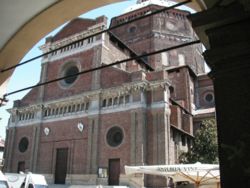
- Cathedral of PaviaPavia CathedralThe Cathedral of Pavia is a church in Pavia, northern Italy, the largest in the city. The construction was begun in the 15th century on the site of two pre-existing Romanesque cathedrals . The cathedral houses the remains of St. Sirus, first bishop of Pavia...
(DuomoDuomoDuomo is a term for a cathedral church. The formal word for a church that is presently a cathedral is cattedrale; a Duomo may be either a present or a former cathedral . Some, like the Duomo of Monza, have never been cathedrals, although old and important...
di Pavia), begun in 1488; however, only by 1898 were the façade and the dome completed according to the original design. The central dome has an octagonal plan, stands 97 m high, and weighs some 20,000 tons. This dome is the third for size in Italy, after St. Peter's BasilicaSt. Peter's BasilicaThe Papal Basilica of Saint Peter , officially known in Italian as ' and commonly known as Saint Peter's Basilica, is a Late Renaissance church located within the Vatican City. Saint Peter's Basilica has the largest interior of any Christian church in the world...
and Santa Maria del FioreSanta Maria del FioreThe Basilica di Santa Maria del Fiore is the cathedral church of Florence, Italy. The Duomo, as it is ordinarily called, was begun in 1296 in the Gothic style to the design of Arnolfo di Cambio and completed structurally in 1436 with the dome engineered by Filippo Brunelleschi...
in Florence. Next to the Duomo were the Civic Tower (existing at least from 1330 and enlarged in 1583 by Pellegrino TibaldiPellegrino TibaldiPellegrino Tibaldi , also known as Pellegrino di Tibaldo de Pellegrini, was an Italian mannerist architect, sculptor, and mural painter.-Biography:...
): its fall on March 17, 1989, was the final motivating force that started the last decade's efforts to save the Leaning Tower of PisaLeaning Tower of PisaThe Leaning Tower of Pisa or simply the Tower of Pisa is the campanile, or freestanding bell tower, of the cathedral of the Italian city of Pisa...
from a similar fate. - San Michele MaggioreSan Michele MaggioreThe Basilica of San Michele Maggiore is a church of Pavia, one of the most striking example of Lombard-Romanesque style. It dates from the 11th and 12th centuries.-History:...
(St. Michael) is an outstanding example of Lombard-Romanesque church architecture in Lombardy. It is located on the site of a pre-existing LombardLombardsThe Lombards , also referred to as Longobards, were a Germanic tribe of Scandinavian origin, who from 568 to 774 ruled a Kingdom in Italy...
church, which the lower part of the campanileCampanileCampanile is an Italian word meaning "bell tower" . The term applies to bell towers which are either part of a larger building or free-standing, although in American English, the latter meaning has become prevalent.The most famous campanile is probably the Leaning Tower of Pisa...
belongs to. Destroyed in 1004, the church was rebuilt from around the end of the 11th century (including the crypt, the transept and the choir), and finished in 1155. It is characterized by an extensive use of sandstoneSandstoneSandstone is a sedimentary rock composed mainly of sand-sized minerals or rock grains.Most sandstone is composed of quartz and/or feldspar because these are the most common minerals in the Earth's crust. Like sand, sandstone may be any colour, but the most common colours are tan, brown, yellow,...
and by a very long transept, provided with a façade and an apse of its own. In the church the Emperor Frederick Barbarossa was crowned in 1155. - The Basilica of San Pietro in Ciel d'OroSan Pietro in Ciel d'OroSan Pietro in Ciel d'Oro is a Roman Catholic basilica of the Augustinians in Pavia, Italy, in the Lombardy region. Its name refers to the mosaics of gold leaf behind glass tesserae that formerly decorated the ceiling of the apse. The plain exterior is of brick, with sandstone quoins and window...
("St. Peter in Golden Sky"), where Saint AugustineAugustine of HippoAugustine of Hippo , also known as Augustine, St. Augustine, St. Austin, St. Augoustinos, Blessed Augustine, or St. Augustine the Blessed, was Bishop of Hippo Regius . He was a Latin-speaking philosopher and theologian who lived in the Roman Africa Province...
, BoethiusAnicius Manlius Severinus BoethiusAnicius Manlius Severinus Boëthius, commonly called Boethius was a philosopher of the early 6th century. He was born in Rome to an ancient and important family which included emperors Petronius Maximus and Olybrius and many consuls. His father, Flavius Manlius Boethius, was consul in 487 after...
and the LombardLombardsThe Lombards , also referred to as Longobards, were a Germanic tribe of Scandinavian origin, who from 568 to 774 ruled a Kingdom in Italy...
king LiutprandLiutprand, King of the LombardsLiutprand was the King of the Lombards from 712 to 744 and is chiefly remembered for his Donation of Sutri, in 728, and his long reign, which brought him into a series of conflicts, mostly successful, with most of Italy. He profited by Byzantine weakness to enlarge his domains in Emilia and the...
are buried, was begun in the 6th century. The current construction was built in 1132. It is similar to San Michele Maggiore, but different in the asymmetric façade with a single portal, the use of brickworkBrickworkBrickwork is masonry produced by a bricklayer, using bricks and mortar to build up brick structures such as walls. Brickwork is also used to finish corners, door, and window openings, etc...
instead of sandstoneSandstoneSandstone is a sedimentary rock composed mainly of sand-sized minerals or rock grains.Most sandstone is composed of quartz and/or feldspar because these are the most common minerals in the Earth's crust. Like sand, sandstone may be any colour, but the most common colours are tan, brown, yellow,...
, and, in the interior, the absence of matronei, galleries reserved for women and the shortest transeptTranseptFor the periodical go to The Transept.A transept is a transverse section, of any building, which lies across the main body of the building. In Christian churches, a transept is an area set crosswise to the nave in a cruciform building in Romanesque and Gothic Christian church architecture...
. The noteworthy arch housing the relics of St. Augustine was built in 1362 by artists from CampioneCampione d'ItaliaCampione d'Italia is an Italian comune of the Province of Como in the Lombardy region, occupying an enclave within the Swiss canton of Ticino, separated from the rest of Italy by Lake Lugano and mountains...
, and is decorated by some 150 statues and reliefs. The church is mentioned by Dante AlighieriDante AlighieriDurante degli Alighieri, mononymously referred to as Dante , was an Italian poet, prose writer, literary theorist, moral philosopher, and political thinker. He is best known for the monumental epic poem La commedia, later named La divina commedia ...
in the X canto of his Divine Comedy. - San Francesco d'Assisi, a late RomanesqueRomanesque architectureRomanesque architecture is an architectural style of Medieval Europe characterised by semi-circular arches. There is no consensus for the beginning date of the Romanesque architecture, with proposals ranging from the 6th to the 10th century. It developed in the 12th century into the Gothic style,...
church (1238–98) with a restored GothicGothic architectureGothic architecture is a style of architecture that flourished during the high and late medieval period. It evolved from Romanesque architecture and was succeeded by Renaissance architecture....
façade, located on Corso Cairoli. - San Teodoro (1117), dedicated to Theodore of PaviaTheodore of PaviaSaint Theodore of Pavia was bishop of Pavia from 743 until his death. He was repeatedly exiled by the Lombard kings. His feast day is May 20. Along with Syrus , he is a patron saint of Pavia....
, a medieval bishop of the Diocese of Pavia, is the third romanesque basilica in the city, though smaller than the former ones. It is situated on the slopes leading down to the Ticino riverTicino RiverThe river Ticino is a left-bank tributary of the Po River. It has given its name to the Swiss canton through which its upper portion flows.-The course:...
and served the fishermen. The apses and the three-level tiburium are samples of the effective simplicity of romanesque decoration. Inside are two outstanding bird's-eye-view frescoes of the city (1525) attributed to the painter Bernardino Lanzani. The latter, the definitive release, was stripped off disclosing the unfinished first one. Both are impressively detailed and reveal how little Pavia’s urban design has changed during the last 500 years. - The large fortified Castello VisconteoVisconti CastleCastle Visconteo is a castle built in the town of Pavia, Lombardy, northern Italy. It was built by Galeazzo II Visconti in 1360, soon after the taking of the city, a free city-state until then. The credited architect is Bartolino da Novara. The castle used to be the main residence of the Visconti...
(built 1360-1365 by Galeazzo II ViscontiGaleazzo II Visconti-External links:*...
). In spite of its being fortified, it actually was used as a private residence rather than a stronghold. The poet Francesco Petrarca spent some time there, when Gian Galeazzo ViscontiGian Galeazzo ViscontiGian Galeazzo Visconti , son of Galeazzo II Visconti and Bianca of Savoy, was the first Duke of Milan and ruled the late-medieval city just before the dawn of the Renaissance...
called him to take charge of the magnificent library which owned about a thousand books and manuscripts, subsequentely lost. The Castle is now home to the City Museums (Musei Civici) and the park is a popular attraction for children. An unconfirmed legend wants the Castle to be connected by a secret underground tunnel to the CertosaCertosa di PaviaThe Certosa di Pavia Gra-Car , Shrine of the Blessed Virgin Mary Mother of Grace, is a monastery and complex in Lombardy, northern Italy, situated near a small town of the same name in the Province of Pavia, 8 km north of Pavia...
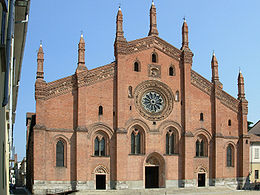
. - The church of Santa Maria del CarmineSanta Maria del Carmine, PaviaSanta Maria del Carmine is a church in Pavia, Lombardy, northern Italy, considered amongst the best examples of Lombard Gothic architecture. It was begun in 1374 by Gian Galeazzo Visconti, Duke of Milan, on a project attributed to Bernardo da Venezia...
is one of the best known examples of GothicGothic architectureGothic architecture is a style of architecture that flourished during the high and late medieval period. It evolved from Romanesque architecture and was succeeded by Renaissance architecture....
brickwork architecture in northern Italy. It is the second largest church in the city after the cathedral and is built on the Latin cross plan, with a perimeter of 80 x 40 meters comprising a nave and two aisles. The characteristic façade has a large rose windowRose windowA Rose window is often used as a generic term applied to a circular window, but is especially used for those found in churches of the Gothic architectural style and being divided into segments by stone mullions and tracery...
and seven cusps. - The renaissance church of Santa Maria di CanepanovaSanta Maria di CanepanovaSanta Maria di Canepanova is a Renaissance church in Pavia, Lombardy, northern Italy. It was designed by Giovanni Antonio Amadeo.The church was built from 1500 to 1507, when Amadeo was at the climax of his fame...
is attributed to Bramante. - The medieval towers still shape the town skyline. The main clusters still rising are rallied in Piazza Leonardo da Vinci, Via Luigi Porta, and Piazza Collegio Borromeo.
Universities, colleges and other institutions
Pavia is a major Italian college town, with several institutes, universities and academies, including the ancient University of PaviaUniversity of Pavia
The University of Pavia is a university located in Pavia, Lombardy, Italy. It was founded in 1361 and is organized in 9 Faculties.-History:...
. Here is an incomplete list of the main institutions located in the city:
- The University of PaviaUniversity of PaviaThe University of Pavia is a university located in Pavia, Lombardy, Italy. It was founded in 1361 and is organized in 9 Faculties.-History:...
, one of the most ancient universities in Europe, was founded in 1361, although a school of rhetoric is documented in 825 making this center perhaps the oldest protouniversity of Europe. The Centrale Building is a wide block made up of twelve courts of the 15th-19th centuries. The sober façade shifts from baroque style to neoclassic. The Big Staircase, the Aula Foscolo, the Aula Volta, the Aula Scarpa and the Aula Magna are neoclassic too. The Cortile degli Spiriti Magni hosts the statues of some of the most important scholars and alumni. Ancient burial monuments and gravestones of scholars of the 14th-16th centuries are walled up in the Cortile Voltiano (most come from demolished churches). The Cortile delle Magnolie holds an ancient pit. The Cortile di Ludovico il Moro has a renaissance loggia and terracotta decorations. Both courts, as well as two more, were the cloisters of the ancient Ospedale di San Matteo. The Orto Botanico dell'Università di PaviaOrto Botanico dell'Università di PaviaThe Orto Botanico dell'Università di Pavia , also known as the Orto Botanico di Pavia, is a botanical garden maintained by the University of Pavia. It is located at Via S. Epifanio, 14, Pavia, Italy, and open weekdays....
is the university's botanical gardenBotanical gardenA botanical garden The terms botanic and botanical, and garden or gardens are used more-or-less interchangeably, although the word botanic is generally reserved for the earlier, more traditional gardens. is a well-tended area displaying a wide range of plants labelled with their botanical names...
. - The Borromeo College (Ital. Almo Collegio Borromeo), founded in 1561 by Carlo Borromeo, is the oldest college at the University of Pavia in northern Italy.
- The Ghislieri CollegeGhislieri CollegeThe Ghislieri College , founded in 1567 by Pope Pius V and inspired by the Almo Collegio Borromeo, is the second the most ancient colleges in Pavia and co-founder of the IUSS, located in Pavia as well....
(Ital. Collegio Ghislieri), founded in 1567 by Pope Pius VPope Pius VPope Saint Pius V , born Antonio Ghislieri , was Pope from 1566 to 1572 and is a saint of the Catholic Church. He is chiefly notable for his role in the Council of Trent, the Counter-Reformation, and the standardization of the Roman liturgy within the Latin Church...
, is the second ancient college in Pavia, with the other first being Almo Collegio Borromeo, and one of the most ancient colleges in Italy and co-founder of the IUSSIUSS PaviaThe Scuola Superiore IUSS or the "Istituto Universitario di Studi Superiori" of Pavia is a higher learning institute located in Pavia, Northern -Italy....
, located in Pavia as well. Collegio Ghislieri is a 450 years old Italian institution committed to promote University studies on the basis of merit, hosting around 200 pupils (males and females) who attend all faculties in Pavia State UniversityUniversity of PaviaThe University of Pavia is a university located in Pavia, Lombardy, Italy. It was founded in 1361 and is organized in 9 Faculties.-History:...
, offering them logistic and cultural opportunities such as scholarships, lectures, conferences, a 100,000 volumes library (the third one among private libraries in Northern Italy), foreign languages courses. Each year about 30 new students coming from all over the country are selected by public contest. Founded by Pope Pius V (Antonio Ghislieri) in 1567, since 18th century laically managed, nowadays under the High Patronage of the Presidency of the Italian Republic, it is ranked among high qualifying institutions by the Italian Ministry for Education and University. - The IUSS PaviaIUSS PaviaThe Scuola Superiore IUSS or the "Istituto Universitario di Studi Superiori" of Pavia is a higher learning institute located in Pavia, Northern -Italy....
or the "Istituto Universitario di Studi Superiori" of Pavia (Eng. IUSS School for Advanced Studies) is a higher learning institute located in Pavia, ItalyItalyItaly , officially the Italian Republic languages]] under the European Charter for Regional or Minority Languages. In each of these, Italy's official name is as follows:;;;;;;;;), is a unitary parliamentary republic in South-Central Europe. To the north it borders France, Switzerland, Austria and...
. It was founded in 1997 by the University of PaviaUniversity of PaviaThe University of Pavia is a university located in Pavia, Lombardy, Italy. It was founded in 1361 and is organized in 9 Faculties.-History:...
, the Borromeo College and the Ghislieri CollegeGhislieri CollegeThe Ghislieri College , founded in 1567 by Pope Pius V and inspired by the Almo Collegio Borromeo, is the second the most ancient colleges in Pavia and co-founder of the IUSS, located in Pavia as well....
, supported by the Italian Minister of Education. It is shaped according to the Scuola Normale Superiore di PisaScuola Normale Superiore di PisaThe Scuola Normale Superiore di Pisa, also known in Italian as Scuola Normale , is a public higher learning institution in Italy. It was founded in 1810, by Napoleonic decree, as a branch of the École Normale Supérieure of Paris...
model and reunites all the five colleges of Pavia, forming the Pavia Study System.
Transport
Pavia railway stationPavia railway station
Pavia railway station serves the city and comune of Pavia, in the region of Lombardy, northern Italy. Opened in 1862, it forms part of the Milan–Pavia–Voghera railway, and is also a terminus of four secondary railways, linking Pavia with Alessandria, Cremona, Vercelli and Stradella.The station is...
, opened in 1862, forms part of the Milan–Pavia–Voghera railway, and is also a terminus of four secondary railways, linking Pavia with Alessandria, Cremona, Vercelli and Stradella.
People
People born in Pavia include:- LanfrancLanfrancLanfranc was Archbishop of Canterbury, and a Lombard by birth.-Early life:Lanfranc was born in the early years of the 11th century at Pavia, where later tradition held that his father, Hanbald, held a rank broadly equivalent to magistrate...
(c. 1005–1089), abbot and Archbishop of Canterbury - Gerolamo CardanoGerolamo CardanoGerolamo Cardano was an Italian Renaissance mathematician, physician, astrologer and gambler...
(1501–1576), scientist - Benedetto CairoliBenedetto CairoliBenedetto Cairoli was an Italian statesman.-Biography:Cairoli was born at Pavia, Lombardy.From 1848 until the completion of Italian unity in 1870, his whole activity was devoted to the Risorgimento, as Garibaldian officer, political refugee, anti-Austrian conspirator and deputy to parliament...
(1825–1889), twice head of the government - Francesco CorbettaFrancesco CorbettaFrancesco Corbetta was an Italian guitar virtuoso, teacher and composer. He spent his early career in Italy. He seems to have worked as a teacher in Bologna where the guitarist and composer Giovanni Battista Granata may have been one of his pupils...
(1615–1681), guitar virtuoso, teacher and composer - Tranquillo Cremona (1837–1878), painter
- Claudia MuzioClaudia MuzioClaudia Muzio was an Italian operatic soprano, whose international career was among the most successful of the early 20th century.-Early years:...
(1889–1936), opera singer - Carlo M. Cipolla (1922–2000), economic historian
People who have lived in Pavia include:
- St. Alexander SauliAlexander SauliSaint Alexander Sauli, the "Apostle of Corsica", was born at Milan, 15 February 1535, of an illustrious Lombard family. He died at Calozza, 11 October 1592, and was interred at Pavia...
(1591–1592), Bishop of Pavia - Alessandro VoltaAlessandro VoltaCount Alessandro Giuseppe Antonio Anastasio Gerolamo Umberto Volta was a Lombard physicist known especially for the invention of the battery in 1800.-Early life and works:...
(1745–1827), scientist - Simion BărnuţiuSimion BarnutiuSimion Bărnuţiu was a Transylvanian-born Romanian historian, academic, philosopher, jurist, and liberal politician. A leader of the 1848 revolutionary movement of Transylvanian Romanians, he represented its Eastern Rite Catholic wing...
(1808–1864), philosopher and politician - Camillo GolgiCamillo GolgiCamillo Golgi was an Italian physician, pathologist, scientist, and Nobel laureate.-Biography:Camillo Golgi was born in the village of Corteno, Lombardy, then part of the Austrian Empire. The village is now named Corteno Golgi in his honour. His father was a physician and district medical officer...
(1843–1926), biologist and Nobel laureate - Giovanni de VenturaGiovanni de VenturaGiovanni de Ventura was a municipal plague doctor for the town of Pavia. He was a certified physician from a University and had a degree.- Contract 1479 :...
(fl. 1479), fifteenth century plague doctorPlague doctorA plague doctor , was a special medical physician who saw those who had the bubonic plague. They were specifically hired by towns that had many plague victims in times of plague epidemics. Since the city was paying their salary they treated everyone, the rich and the poor... - Riccardo PampuriRiccardo PampuriRiccardo Pampuri , was an Italian medical doctor from Trivolzio and is a canonized saint in the Roman Catholic Church. Born Erminio Filippo Pampuri, he took the name Brother Riccardo when he entered the Brothers Hospitallers of St. John of God...
(1897–1930), saint and medical doctor - Albert EinsteinAlbert EinsteinAlbert Einstein was a German-born theoretical physicist who developed the theory of general relativity, effecting a revolution in physics. For this achievement, Einstein is often regarded as the father of modern physics and one of the most prolific intellects in human history...
(1879–1955), physicist and Nobel laureate - Ugo FoscoloUgo FoscoloUgo Foscolo , born Niccolò Foscolo, was an Italian writer, revolutionary and poet.-Biography:Foscolo was born on the Ionian island of Zakynthos...
(1778–1827), Italian writer, revolutionary and poet. - Dante TroisiDante TroisiDante Troisi was an Italian writer and magistrate. His writings primarily deal with the cultural and sociological woes of Italy following World War II. Much of his literature draws on issues raised through his work as a magistrate. His most significant work is likely the novel Diario di un giudice...
(1920–1989), writer and judge
Among the illustrious scholars who studied or taught at the University of Pavia, the following are at least worth remembering: Carlo Goldoni
Carlo Goldoni
Carlo Osvaldo Goldoni was an Italian playwright and librettist from the Republic of Venice. His works include some of Italy's most famous and best-loved plays. Audiences have admired the plays of Goldoni for their ingenious mix of wit and honesty...
, Gerolamo Cardano
Gerolamo Cardano
Gerolamo Cardano was an Italian Renaissance mathematician, physician, astrologer and gambler...
, Gerolamo Saccheri, Ugo Foscolo
Ugo Foscolo
Ugo Foscolo , born Niccolò Foscolo, was an Italian writer, revolutionary and poet.-Biography:Foscolo was born on the Ionian island of Zakynthos...
, Alessandro Volta
Alessandro Volta
Count Alessandro Giuseppe Antonio Anastasio Gerolamo Umberto Volta was a Lombard physicist known especially for the invention of the battery in 1800.-Early life and works:...
the inventor of the battery
Battery (electricity)
An electrical battery is one or more electrochemical cells that convert stored chemical energy into electrical energy. Since the invention of the first battery in 1800 by Alessandro Volta and especially since the technically improved Daniell cell in 1836, batteries have become a common power...
, Lazzaro Spallanzani
Lazzaro Spallanzani
Lazzaro Spallanzani was an Italian Catholic priest, biologist and physiologist who made important contributions to the experimental study of bodily functions, animal reproduction, and essentially discovered echolocation...
, Antonio Scarpa
Antonio Scarpa
Antonio Scarpa was an Italian anatomist and professor.-Biography:Antonio was born to an impoverished family in the frazione of Lorenzaga, Motta di Livenza, Veneto. An uncle, who was a member of the priesthood, gave him instruction until the age of 15, when he passed the entrance exam for the...
, Carlo Forlanini
Carlo Forlanini
Carlo Forlanini was an Italian physician.In 1870 he earned his medical degree from the University of Pavia, where he studied as an alumnus of Borromeo College, and afterwards joined the staff of the Ospedale Maggiore in Milan...
and the Nobel laureate biologist Camillo Golgi
Camillo Golgi
Camillo Golgi was an Italian physician, pathologist, scientist, and Nobel laureate.-Biography:Camillo Golgi was born in the village of Corteno, Lombardy, then part of the Austrian Empire. The village is now named Corteno Golgi in his honour. His father was a physician and district medical officer...
.
External links
- Pavia Touristic Promotion
- Pavia Touristic Portal
- Oltrepò pavese
- Pavia pictures
- Images of Pavia
- Weather in Pavia
- highSCORE Contemporary Music Festival
- [History of the world the early Middle Ages]