
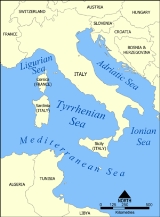
The
Tyrrhenian Sea is part of the
Mediterranean SeaThe Mediterranean Sea is a sea connected to the Atlantic Ocean surrounded by the Mediterranean region and almost completely enclosed by land: on the north by Anatolia and Europe, on the south by North Africa, and on the east by the Levant...
off the western coast of
ItalyItaly , officially the Italian Republic languages]] under the European Charter for Regional or Minority Languages. In each of these, Italy's official name is as follows:;;;;;;;;), is a unitary parliamentary republic in South-Central Europe. To the north it borders France, Switzerland, Austria and...
.
The
Tyrrhenian Sea is part of the
Mediterranean SeaThe Mediterranean Sea is a sea connected to the Atlantic Ocean surrounded by the Mediterranean region and almost completely enclosed by land: on the north by Anatolia and Europe, on the south by North Africa, and on the east by the Levant...
off the western coast of
ItalyItaly , officially the Italian Republic languages]] under the European Charter for Regional or Minority Languages. In each of these, Italy's official name is as follows:;;;;;;;;), is a unitary parliamentary republic in South-Central Europe. To the north it borders France, Switzerland, Austria and...
.
Geography
The sea is bounded by
CorsicaCorsica is an island in the Mediterranean Sea. It is located west of Italy, southeast of the French mainland, and north of the island of Sardinia....
and
SardiniaSardinia is the second-largest island in the Mediterranean Sea . It is an autonomous region of Italy, and the nearest land masses are the French island of Corsica, the Italian Peninsula, Sicily, Tunisia and the Spanish Balearic Islands.The name Sardinia is from the pre-Roman noun *sard[],...
(to the west),
TuscanyTuscany is a region in Italy. It has an area of about 23,000 square kilometres and a population of about 3.75 million inhabitants. The regional capital is Florence ....
, Lazio,
CampaniaCampania is a region in southern Italy. The region has a population of around 5.8 million people, making it the second-most-populous region of Italy; its total area of 13,590 km² makes it the most densely populated region in the country...
,
BasilicataBasilicata , also known as Lucania, is a region in the south of Italy, bordering on Campania to the west, Apulia to the north and east, and Calabria to the south, having one short southwestern coastline on the Tyrrhenian Sea between Campania in the northwest and Calabria in the southwest, and a...
and
CalabriaCalabria , in antiquity known as Bruttium, is a region in southern Italy, south of Naples, located at the "toe" of the Italian Peninsula. The capital city of Calabria is Catanzaro....
(to the east) and
SicilySicily is a region of Italy, and is the largest island in the Mediterranean Sea. Along with the surrounding minor islands, it constitutes an autonomous region of Italy, the Regione Autonoma Siciliana Sicily has a rich and unique culture, especially with regard to the arts, music, literature,...
(to the south).
The maximum depth of the sea is 3785 metres (12,418 ft).
The Tyrrhenian Sea is situated near where the
AfricanThe African Plate is a tectonic plate which includes the continent of Africa, as well as oceanic crust which lies between the continent and various surrounding ocean ridges.-Boundaries:...
and European Plates meet; therefore mountain chains and active volcanoes such as Mount
MarsiliMarsili is a large undersea volcano in the Tyrrhenian Sea, about south of Naples. The seamount is about 3,000 meters tall; its peak and crater are about 450 meters below the sea surface...
are found in its depths. The eight
Aeolian IslandsThe Aeolian Islands or Lipari Islands are a volcanic archipelago in the Tyrrhenian Sea north of Sicily, named after the demigod of the winds Aeolus. The locals residing on the islands are known as Eolians . The Aeolian Islands are a popular tourist destination in the summer, and attract up to...
and
UsticaUstica is the name of a small island, about 9 km across, situated 52 km north of Capo Gallo, Italy in the Tyrrhenian Sea...
are located in the southern part of the sea, north of
SicilySicily is a region of Italy, and is the largest island in the Mediterranean Sea. Along with the surrounding minor islands, it constitutes an autonomous region of Italy, the Regione Autonoma Siciliana Sicily has a rich and unique culture, especially with regard to the arts, music, literature,...
.
Extent
The
International Hydrographic OrganizationThe International Hydrographic Organization is the inter-governmental organisation representing the hydrographic community. It enjoys observer status at the UN and is the recognised competent authority on hydrographic surveying and nautical charting...
defines the limits of the Tyrrhenian Sea as follows:
- In the Strait of Messina
The Strait of Messina is the narrow passage between the eastern tip of Sicily and the southern tip of Calabria in the south of Italy. It connects the Tyrrhenian Sea with the Ionian Sea, within the central Mediterranean...
: A line joining the North extreme of Cape Paci (15°42'E) with the East extreme of the Island of SicilySicily is a region of Italy, and is the largest island in the Mediterranean Sea. Along with the surrounding minor islands, it constitutes an autonomous region of Italy, the Regione Autonoma Siciliana Sicily has a rich and unique culture, especially with regard to the arts, music, literature,...
, Cape Peloro (38°16'N).
- On the Southwest: A line running from Cape Lilibeo (West extreme of Sicily) to the South extreme of Cape Teulada (8°38'E) in Sardinia
Sardinia is the second-largest island in the Mediterranean Sea . It is an autonomous region of Italy, and the nearest land masses are the French island of Corsica, the Italian Peninsula, Sicily, Tunisia and the Spanish Balearic Islands.The name Sardinia is from the pre-Roman noun *sard[],...
.
- In the Strait of Bonifacio
The Strait of Bonifacio is the strait between Corsica and Sardinia, named after the Corsican town Bonifacio. It is wide and divides the Tyrrhenian Sea from the western Mediterranean Sea...
: A line joining the West extreme of Cape Testa (41°14'N) in Sardinia with the Southwest extreme of Cape Feno (41°23'N) in Corsica.
- On the North: A line joining Cape Corse
Cap Corse, a geographical area of Corsica , is a 25-mile long peninsula located at the northern tip of the island. At the base of it is the second largest city in Corsica, Bastia...
(Cape Grosso, 9°23'E) in Corsica, with TinettoTinetto is an Italian island situated in the Ligurian Sea. It is part of an archipelago of three closely spaced islands jutting out south from the mainland at Portovenere...
Island (44°01′N 9°51′E) and thence through TinoTino is an Italian island situated in the Ligurian Sea, at the westernmost end of the Gulf of La Spezia. It is part of an archipelago of three closely spaced islands jutting out south from the mainland at Portovenere...
and PalmariaPalmaria is an Italian island situated in the Ligurian Sea, at the westernmost end of the Gulf of La Spezia. Measuring 1.6 km², it is the largest island of an archipelago of three closely spaced islands jutting out south from the mainland at Portovenere...
islands to San Pietro Point (44°03′N 9°50′E) on the coast of Italy.
Exits
There are four exits from the Tyrrhenian Sea (north to south):
| Exit | Location | Width | Connected Sea |
| Corsica Channel |
between TuscanyTuscany is a region in Italy. It has an area of about 23,000 square kilometres and a population of about 3.75 million inhabitants. The regional capital is Florence .... and CorsicaCorsica is an island in the Mediterranean Sea. It is located west of Italy, southeast of the French mainland, and north of the island of Sardinia.... |
about 80 kilometres (49.7 mi) |
Ligurian SeaThe Ligurian Sea is an arm of the Mediterranean Sea, between the Italian Riviera and the island of Corsica. The sea is probably named after the ancient Ligures people.-Geography:...
|
| Strait of Bonifacio The Strait of Bonifacio is the strait between Corsica and Sardinia, named after the Corsican town Bonifacio. It is wide and divides the Tyrrhenian Sea from the western Mediterranean Sea... |
between CorsicaCorsica is an island in the Mediterranean Sea. It is located west of Italy, southeast of the French mainland, and north of the island of Sardinia.... and SardiniaSardinia is the second-largest island in the Mediterranean Sea . It is an autonomous region of Italy, and the nearest land masses are the French island of Corsica, the Italian Peninsula, Sicily, Tunisia and the Spanish Balearic Islands.The name Sardinia is from the pre-Roman noun *sard[],... |
11 kilometres (6.8 mi) |
Mediterranean Sea The Mediterranean Sea is a sea connected to the Atlantic Ocean surrounded by the Mediterranean region and almost completely enclosed by land: on the north by Anatolia and Europe, on the south by North Africa, and on the east by the Levant... (proper) |
| no name |
between SardiniaSardinia is the second-largest island in the Mediterranean Sea . It is an autonomous region of Italy, and the nearest land masses are the French island of Corsica, the Italian Peninsula, Sicily, Tunisia and the Spanish Balearic Islands.The name Sardinia is from the pre-Roman noun *sard[],... and SicilySicily is a region of Italy, and is the largest island in the Mediterranean Sea. Along with the surrounding minor islands, it constitutes an autonomous region of Italy, the Regione Autonoma Siciliana Sicily has a rich and unique culture, especially with regard to the arts, music, literature,... |
about 290 kilometres (180.2 mi) |
Mediterranean Sea The Mediterranean Sea is a sea connected to the Atlantic Ocean surrounded by the Mediterranean region and almost completely enclosed by land: on the north by Anatolia and Europe, on the south by North Africa, and on the east by the Levant... (proper) |
Strait of MessinaThe Strait of Messina is the narrow passage between the eastern tip of Sicily and the southern tip of Calabria in the south of Italy. It connects the Tyrrhenian Sea with the Ionian Sea, within the central Mediterranean... |
between SicilySicily is a region of Italy, and is the largest island in the Mediterranean Sea. Along with the surrounding minor islands, it constitutes an autonomous region of Italy, the Regione Autonoma Siciliana Sicily has a rich and unique culture, especially with regard to the arts, music, literature,... and CalabriaCalabria , in antiquity known as Bruttium, is a region in southern Italy, south of Naples, located at the "toe" of the Italian Peninsula. The capital city of Calabria is Catanzaro.... on the toe of ItalyItaly , officially the Italian Republic languages]] under the European Charter for Regional or Minority Languages. In each of these, Italy's official name is as follows:;;;;;;;;), is a unitary parliamentary republic in South-Central Europe. To the north it borders France, Switzerland, Austria and... |
3 kilometres (1.9 mi) |
Ionian SeaThe Ionian Sea , is an arm of the Mediterranean Sea, south of the Adriatic Sea. It is bounded by southern Italy including Calabria, Sicily and the Salento peninsula to the west, southern Albania to the north, and a large number of Greek islands, including Corfu, Zante, Kephalonia, Ithaka, and...
|
Basins
The Tyrrhenian Sea is divided into two basins (or plains), the Vavilov plain and the Marsili plain. They are separated by the undersea ridge known as the Issel Bridge, after
Arturo IsselArturo Issel was an Italian geologist, palaeontologist, malacologist and archaeologist. He is noted for first defining the Tyrrhenian Stage in 1914...
.
Name
Its name derives from the Greek name for the
EtruscansEtruscan civilization is the modern English name given to a civilization of ancient Italy in the area corresponding roughly to Tuscany. The ancient Romans called its creators the Tusci or Etrusci...
, who were said to be emigrants from
LydiaLydia was an Iron Age kingdom of western Asia Minor located generally east of ancient Ionia in the modern Turkish provinces of Manisa and inland İzmir. Its population spoke an Anatolian language known as Lydian....
and led by the prince
TyrrhenusIn Etruscan mythology, Tyrrhenus was one of the founders of the Etruscan Federation of twelve cities, along with his brother Tarchon. Herodotus describes him as the saver of Etruscans, because he led them from Lydia to Etruria. His name was given to the Etruscan people by the Greek. The Romans...
. The Etruscans settled along the coast of modern
TuscanyTuscany is a region in Italy. It has an area of about 23,000 square kilometres and a population of about 3.75 million inhabitants. The regional capital is Florence ....
and referred to the water as the "Sea of the Etruscans".
Ports
The main ports of the Tyrrhenian Sea in
ItalyItaly , officially the Italian Republic languages]] under the European Charter for Regional or Minority Languages. In each of these, Italy's official name is as follows:;;;;;;;;), is a unitary parliamentary republic in South-Central Europe. To the north it borders France, Switzerland, Austria and...
are:
RomeRome is the capital of Italy and the country's largest and most populated city and comune, with over 2.7 million residents in . The city is located in the central-western portion of the Italian Peninsula, on the Tiber River within the Lazio region of Italy.Rome's history spans two and a half...
,
NaplesNaples is a city in Southern Italy, situated on the country's west coast by the Gulf of Naples. Lying between two notable volcanic regions, Mount Vesuvius and the Phlegraean Fields, it is the capital of the region of Campania and of the province of Naples...
,
PalermoPalermo is a city in Southern Italy, the capital of both the autonomous region of Sicily and the Province of Palermo. The city is noted for its history, culture, architecture and gastronomy, playing an important role throughout much of its existence; it is over 2,700 years old...
,
LivornoLivorno , traditionally Leghorn , is a port city on the Tyrrhenian Sea on the western edge of Tuscany, Italy. It is the capital of the Province of Livorno, having a population of approximately 160,000 residents in 2009.- History :...
,
CivitavecchiaCivitavecchia is a town and comune of the province of Rome in the central Italian region of Lazio. A sea port on the Tyrrhenian Sea, it is located 80 kilometers west-north-west of Rome, across the Mignone river. The harbor is formed by two piers and a breakwater, on which is a lighthouse...
,
SalernoSalerno is a city and comune in Campania and is the capital of the province of the same name. It is located on the Gulf of Salerno on the Tyrrhenian Sea....
,
TrapaniTrapani is a city and comune on the west coast of Sicily in Italy. It is the capital of the Province of Trapani. Founded by Elymians, the city is still an important fishing port and the main gateway to the nearby Egadi Islands.-History:...
and
CagliariCagliari is the capital of the island of Sardinia, a region of Italy. Cagliari's Sardinian name Casteddu literally means castle. It has about 156,000 inhabitants, or about 480,000 including the outlying townships : Elmas, Assemini, Capoterra, Selargius, Sestu, Monserrato, Quartucciu, Quartu...
. In
FranceThe French Republic , The French Republic , The French Republic , (commonly known as France , is a unitary semi-presidential republic in Western Europe with several overseas territories and islands located on other continents and in the Indian, Pacific, and Atlantic oceans. Metropolitan France...
the most important port is
BastiaBastia is a commune in the Haute-Corse department of France located in the northeast of the island of Corsica at the base of Cap Corse. It is also the second-largest city in Corsica after Ajaccio and the capital of the department....
.
Winds
In
Greek mythologyGreek mythology is the body of myths and legends belonging to the ancient Greeks, concerning their gods and heroes, the nature of the world, and the origins and significance of their own cult and ritual practices. They were a part of religion in ancient Greece...
, it is believed that the cliffs above the Tyrrhenian Sea housed the four winds kept by
AeolusAeolus was the ruler of the winds in Greek mythology. In fact this name was shared by three mythic characters. These three personages are often difficult to tell apart, and even the ancient mythographers appear to have been perplexed about which Aeolus was which...
. The winds are the
MistralThe mistral is a strong, cold and usually dry regional wind in France, coming from the north or northwest, which accelerates when it passes through the valleys of the Rhone and the Durance Rivers to the coast of the Mediterranean around the Camargue region. It affects the northeast of the plain...
from the
RhôneThe Rhone is one of the major rivers of Europe, rising in Switzerland and running from there through southeastern France. At Arles, near its mouth on the Mediterranean Sea, the river divides into two branches, known as the Great Rhone and the Little Rhone...
valley, the
LibeccioThe libeccio is the westerly or south-westerly wind which predominates in northern Corsica all year round; it frequently raises high seas and may give violent westerly squalls. In summer it is most persistent, but in winter it alternates with the Tramontane...
from the south-west, and the
SiroccoSirocco, scirocco, , jugo or, rarely, siroc is a Mediterranean wind that comes from the Sahara and reaches hurricane speeds in North Africa and Southern Europe. It is known in North Africa by the Arabic word qibli or ghibli Sirocco, scirocco, , jugo or, rarely, siroc is a Mediterranean wind...
and
OstroOstro is the traditional Italian name of a southerly wind in the Mediterranean Sea, especially the Adriatic. Its name is derived from the Latin name Auster, which also meant a southerly wind and is part of the etymology of Australia...
from the south.