

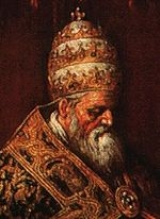
Pope Honorius III

Encyclopedia
Pope Honorius III previously known as Cencio Savelli, was Pope
from 1216 to 1227.
as son of Aimerico. He was a member of the Roman Savelli family.
For a time he was canon
at the church of Santa Maria Maggiore
, then he became Camerlengo of the Holy Roman Church in January 1188 and Cardinal Deacon of Santa Lucia in Silice on February 20, 1193. Under Pope Clement III
(1187–91) and Pope Celestine III
(1191–98) he was treasurer of the Roman Church, notably compiling the Liber Censuum
, and served as acting Vice-Chancellor of the Holy Roman Church 1194 until 1198.
In 1197 he became tutor of the future Emperor Frederick II
, who had been given as ward to Pope Innocent III
(1198–1216) by the Empress-widow Constantia.
Innocent III raised him to the rank of a Cardinal Priest in 1200, obtaining the Titulus of Ss. Ioannis et Pauli
. He was dismissed as Camerlengo of the Holy Roman Church in 1198 but about the same time he assumed the post of Camerlengo of the Sacred College of Cardinals
.
 On July 18, 1216, seventeen cardinals present at the death of Innocent III assembled at Perugia
(where Innocent III had died two days previously) with the purpose of electing a new Pope. The troubled state of affairs in Italy, the threatening attitude of the Tatars
, and the fear of a schism
induced the cardinals to agree to an election by compromise. Cardinals Ugolino of Ostia (afterwards Pope Gregory IX
) and Guido of Praeneste were empowered to appoint the new Pope. Their choice fell upon Cencio Camerario, who accepted the tiara
with reluctance and took the name of Honorius III. He was consecrated at Perugia on July 24, was crowned at Rome August 31, and took possession of the Lateran September 3, 1216. The Roman people were greatly elated at the election, for Honorius III was himself a Roman and by his extreme kindness had endeared himself to the hearts of all.
Like his famous predecessor Innocent III, he set his mind on the achievement of two great things, the recovery of the Holy Land
in the Fifth Crusade
and a spiritual reform of the entire Church; but quite in contrast with Innocent III he sought these achievements by kindness and indulgence rather than by force and severity.
 The Fifth Crusade
was endorsed by the Lateran Council
of 1215, and he started preparations for the crusade to begin in 1217. To procure the means necessary for this colossal undertaking, the Pope and the cardinals were to contribute the tenth part, and all other ecclesiastics the twentieth part, of their income for three years. Though the money thus collected was considerable, it was by no means sufficient for a general crusade as planned by Honorius III.
Far-reaching prospects seemed to open before him when he crowned Peter II of Courtenay (April 1217) as Latin Emperor
(1217–18) of Constantinople
; but the new Emperor was captured on his eastward journey and died in confinement.
Honorius III was aware that there was only one man in Europe who could bring about the recovery of the Holy Land, and that man was his former pupil Frederick II (1212–50) of Germany. Like many other rulers, Frederick II had taken an oath to embark for the Holy Land in 1217. But Frederick II hung back, and Honorius III repeatedly put off the date for the beginning of the expedition.
In April 1220, Frederick II was elected Emperor, and on November 22, 1220 he was crowned Holy Roman Emperor
in Rome.
In spite of the insistence of Honorius III, Frederick II still delayed, and the Egypt
ian campaign failed miserably with the loss of Damietta
(September 8, 1221).
Most rulers of Europe were engaged in wars of their own and could not leave their countries for any length of time. Andrew II of Hungary
(1205–35) and, somewhat later, a fleet of crusaders from the region along the Lower Rhine finally departed for the Holy Land, took Damietta and a few other places in Egypt
; but lack of unity among the Christians, also rivalry between the leaders and the papal legate
Pelagius, resulted in failure.
June 24, 1225, was finally fixed as the date for the departure of Frederick II; and Honorius III brought about his marriage with Queen Isabella II of Jerusalem, with a view to binding him closer to the plan. But the Treaty of San Germano
in July 1225 permitted a further delay of two years.
Frederick II now made serious preparations for the crusade. In the midst of it, however, Pope Honorius III died in Rome on March 18, 1227 without seeing the achievement of his hopes. It was left to his successor, Pope Gregory IX
(1227–41), to insist upon their accomplishment.
But Honorius III really had too large a task; besides the liberation of the Holy Land, he felt bound to forward the repression of Cathar
heresy in the south of France
, the war for the faith in the Spanish peninsula, the planting of Christianity in the lands along the Baltic Sea
, and the maintenance of the impossible Latin empire in Constantinople.
Of these duties the rooting out of heresy lay nearest to Honorius III's heart. In the south of France he carried on Innocent III's work, confirming Simon de Montfort
in the possession of the lands of Raymond VI of Toulouse
and succeeding, as Innocent III had not, in drawing the royal house of France into the conflict.
The most widely important event of this period was the siege and capture of Avignon
. Both Honorius III and Louis VIII of France
(1223–26) turned a deaf ear to Frederick II's assertion of the claims of the empire to that town.
order in 1216, and to the Franciscan
in 1223. He approved the Rule of St. Dominic
in his Bull Religiosam vitam
, dated December 22, 1216, and that of St. Francis
in his Bull Solet annuere, dated November 29, 1223.
In 1217 he gave the title of King of Serbia
to Stefan I Prvovenčani called Prvovenčani, or “First-Crowned”.
During his pontificate also many of the tertiary orders first came into existence. He approved in 1221 the Franciscan Brothers and Sisters of Penance
Rule with the Bull Memoriale Propositi. On January 30, 1226, he approved the Carmelite Order in his Bull Ut vivendi normam. He also approved the religious congregation "Val des Ecoliers" (Vallis scholarium, Valley of scholars), which had been founded by four pious professors of theology at the University of Paris
.
Being a man of learning, Honorius III insisted that the clergy should receive a thorough training, especially in theology. In the case of a certain Hugh whom the chapter of Chartres
had elected bishop, he withheld his approbation because the bishop-elect did not possess sufficient knowledge, quum pateretur in litteratura defectum, as the Pope states in a letter dated January 8, 1219. Another bishop he even deprived of his office on account of illiteracy.
He bestowed various privileges upon the universities of Paris and Bologna
, the two greatest seats of learning during those times. In order to facilitate the study of theology in dioceses that were distant from the great centres of learning, he ordered in his Bull Super specula Domini that some talented young men should be sent to a recognized theological school to study theology with the purpose of teaching it afterwards in their own dioceses..
. It comprises a list of the revenues of the Apostolic See
, a record of donations received, privileges granted, and contracts made with cities and rulers. It was begun under Clement III and completed in 1192 under Celestine III. The original manuscript of the Liber Censuum is still in existence (Vaticanus latinus 8486).
Honorius III wrote also a life of Celestine III; a life of Gregory VII
; an "Ordo Romanus", which is a sort of ceremonial containing the rites of the Church for various occasions; and thirty-four sermons.
He is also the purported author of a grimoire
. "In this text called The Grimoire of Pope Honorius
, he discusses the value of occult knowledge in the Church, and how by summoning or raisiing demonic entities, one could learn to control them. He uses his faith in God and mixes with it the teachings of King Solomon; it contains invocations of demonic entities for every day of the week. He talked about the priest needing to fast for a certain amount of time and the sacrifice of animals in order to help with the binding of evil spirits."
Pope
The Pope is the Bishop of Rome, a position that makes him the leader of the worldwide Catholic Church . In the Catholic Church, the Pope is regarded as the successor of Saint Peter, the Apostle...
from 1216 to 1227.
Early work
He was born in RomeRome
Rome is the capital of Italy and the country's largest and most populated city and comune, with over 2.7 million residents in . The city is located in the central-western portion of the Italian Peninsula, on the Tiber River within the Lazio region of Italy.Rome's history spans two and a half...
as son of Aimerico. He was a member of the Roman Savelli family.
For a time he was canon
Canon (priest)
A canon is a priest or minister who is a member of certain bodies of the Christian clergy subject to an ecclesiastical rule ....
at the church of Santa Maria Maggiore
Basilica di Santa Maria Maggiore
The Papal Basilica of Saint Mary Major , known also by other names, is the largest Roman Catholic Marian church in Rome, Italy.There are other churches in Rome dedicated to Mary, such as Santa Maria in Trastevere, Santa Maria in Aracoeli, Santa Maria sopra Minerva, but the greater size of the...
, then he became Camerlengo of the Holy Roman Church in January 1188 and Cardinal Deacon of Santa Lucia in Silice on February 20, 1193. Under Pope Clement III
Pope Clement III
Pope Clement III , born Paulino Scolari, was elected Pope on December 19, 1187 and reigned until his death.-Cardinal:...
(1187–91) and Pope Celestine III
Pope Celestine III
Pope Celestine III , born Giacinto Bobone, was elected Pope on March 21, 1191, and reigned until his death. He was born into the noble Orsini family in Rome, though he was only a cardinal deacon before becoming Pope...
(1191–98) he was treasurer of the Roman Church, notably compiling the Liber Censuum
Liber Censuum
The Liber Censuum Romanæ Ecclesiæ is an eighteen-volume financial record of the real estate revenues of the papacy from 492 to 1192. The span of the record includes the creation of the Apostolic Camera and the effects of the Gregorian Reform...
, and served as acting Vice-Chancellor of the Holy Roman Church 1194 until 1198.
In 1197 he became tutor of the future Emperor Frederick II
Frederick II, Holy Roman Emperor
Frederick II , was one of the most powerful Holy Roman Emperors of the Middle Ages and head of the House of Hohenstaufen. His political and cultural ambitions, based in Sicily and stretching through Italy to Germany, and even to Jerusalem, were enormous...
, who had been given as ward to Pope Innocent III
Pope Innocent III
Pope Innocent III was Pope from 8 January 1198 until his death. His birth name was Lotario dei Conti di Segni, sometimes anglicised to Lothar of Segni....
(1198–1216) by the Empress-widow Constantia.
Innocent III raised him to the rank of a Cardinal Priest in 1200, obtaining the Titulus of Ss. Ioannis et Pauli
Santi Giovanni e Paolo (Rome)
Santi Giovanni e Paolo is an ancient basilica church in Rome, located on the Celian Hill. It is also called Santi Giovanni e Paolo al Celio or referred to as SS Giovanni e Paolo....
. He was dismissed as Camerlengo of the Holy Roman Church in 1198 but about the same time he assumed the post of Camerlengo of the Sacred College of Cardinals
Camerlengo of the Sacred College of Cardinals
The Camerlengo of the Sacred College of Cardinals was the treasurer of that body.He administered all property, fees, funds and revenue belonging to the College of Cardinals, celebrated the requiem Mass for a deceased cardinal and was charged with the registry of the Acta Consistoralia.It is...
.
Election as Pope
Perugia
Perugia is the capital city of the region of Umbria in central Italy, near the River Tiber, and the capital of the province of Perugia. The city is located about north of Rome. It covers a high hilltop and part of the valleys around the area....
(where Innocent III had died two days previously) with the purpose of electing a new Pope. The troubled state of affairs in Italy, the threatening attitude of the Tatars
Tatars
Tatars are a Turkic speaking ethnic group , numbering roughly 7 million.The majority of Tatars live in the Russian Federation, with a population of around 5.5 million, about 2 million of which in the republic of Tatarstan.Significant minority populations are found in Uzbekistan, Kazakhstan,...
, and the fear of a schism
Schism (religion)
A schism , from Greek σχίσμα, skhísma , is a division between people, usually belonging to an organization or movement religious denomination. The word is most frequently applied to a break of communion between two sections of Christianity that were previously a single body, or to a division within...
induced the cardinals to agree to an election by compromise. Cardinals Ugolino of Ostia (afterwards Pope Gregory IX
Pope Gregory IX
Pope Gregory IX, born Ugolino di Conti, was pope from March 19, 1227 to August 22, 1241.The successor of Pope Honorius III , he fully inherited the traditions of Pope Gregory VII and of his uncle Pope Innocent III , and zealously continued their policy of Papal supremacy.-Early life:Ugolino was...
) and Guido of Praeneste were empowered to appoint the new Pope. Their choice fell upon Cencio Camerario, who accepted the tiara
Papal Tiara
The Papal Tiara, also known incorrectly as the Triple Tiara, or in Latin as the Triregnum, in Italian as the Triregno and as the Trirègne in French, is the three-tiered jewelled papal crown, supposedly of Byzantine and Persian origin, that is a prominent symbol of the papacy...
with reluctance and took the name of Honorius III. He was consecrated at Perugia on July 24, was crowned at Rome August 31, and took possession of the Lateran September 3, 1216. The Roman people were greatly elated at the election, for Honorius III was himself a Roman and by his extreme kindness had endeared himself to the hearts of all.
Like his famous predecessor Innocent III, he set his mind on the achievement of two great things, the recovery of the Holy Land
Holy Land
The Holy Land is a term which in Judaism refers to the Kingdom of Israel as defined in the Tanakh. For Jews, the Land's identifiction of being Holy is defined in Judaism by its differentiation from other lands by virtue of the practice of Judaism often possible only in the Land of Israel...
in the Fifth Crusade
Fifth Crusade
The Fifth Crusade was an attempt to reacquire Jerusalem and the rest of the Holy Land by first conquering the powerful Ayyubid state in Egypt....
and a spiritual reform of the entire Church; but quite in contrast with Innocent III he sought these achievements by kindness and indulgence rather than by force and severity.
Fifth Crusade
Fifth Crusade
The Fifth Crusade was an attempt to reacquire Jerusalem and the rest of the Holy Land by first conquering the powerful Ayyubid state in Egypt....
was endorsed by the Lateran Council
Lateran council
The Lateran councils were ecclesiastical councils or synods of the Catholic Church held at Rome in the Lateran Palace next to the Lateran Basilica. Ranking as a papal cathedral, this became a much-favored place of assembly for ecclesiastical councils both in antiquity and more especially during...
of 1215, and he started preparations for the crusade to begin in 1217. To procure the means necessary for this colossal undertaking, the Pope and the cardinals were to contribute the tenth part, and all other ecclesiastics the twentieth part, of their income for three years. Though the money thus collected was considerable, it was by no means sufficient for a general crusade as planned by Honorius III.
Far-reaching prospects seemed to open before him when he crowned Peter II of Courtenay (April 1217) as Latin Emperor
Latin Empire
The Latin Empire or Latin Empire of Constantinople is the name given by historians to the feudal Crusader state founded by the leaders of the Fourth Crusade on lands captured from the Byzantine Empire. It was established after the capture of Constantinople in 1204 and lasted until 1261...
(1217–18) of Constantinople
Constantinople
Constantinople was the capital of the Roman, Eastern Roman, Byzantine, Latin, and Ottoman Empires. Throughout most of the Middle Ages, Constantinople was Europe's largest and wealthiest city.-Names:...
; but the new Emperor was captured on his eastward journey and died in confinement.
Honorius III was aware that there was only one man in Europe who could bring about the recovery of the Holy Land, and that man was his former pupil Frederick II (1212–50) of Germany. Like many other rulers, Frederick II had taken an oath to embark for the Holy Land in 1217. But Frederick II hung back, and Honorius III repeatedly put off the date for the beginning of the expedition.
In April 1220, Frederick II was elected Emperor, and on November 22, 1220 he was crowned Holy Roman Emperor
Holy Roman Emperor
The Holy Roman Emperor is a term used by historians to denote a medieval ruler who, as German King, had also received the title of "Emperor of the Romans" from the Pope...
in Rome.
In spite of the insistence of Honorius III, Frederick II still delayed, and the Egypt
Egypt
Egypt , officially the Arab Republic of Egypt, Arabic: , is a country mainly in North Africa, with the Sinai Peninsula forming a land bridge in Southwest Asia. Egypt is thus a transcontinental country, and a major power in Africa, the Mediterranean Basin, the Middle East and the Muslim world...
ian campaign failed miserably with the loss of Damietta
Damietta
Damietta , also known as Damiata, or Domyat, is a port and the capital of the Damietta Governorate in Egypt. It is located at the intersection between the Mediterranean Sea and the Nile, about north of Cairo.-History:...
(September 8, 1221).
Most rulers of Europe were engaged in wars of their own and could not leave their countries for any length of time. Andrew II of Hungary
Andrew II of Hungary
Andrew II the Jerosolimitan was King of Hungary and Croatia . He was the younger son of King Béla III of Hungary, who invested him with the government of the Principality of Halych...
(1205–35) and, somewhat later, a fleet of crusaders from the region along the Lower Rhine finally departed for the Holy Land, took Damietta and a few other places in Egypt
Egypt
Egypt , officially the Arab Republic of Egypt, Arabic: , is a country mainly in North Africa, with the Sinai Peninsula forming a land bridge in Southwest Asia. Egypt is thus a transcontinental country, and a major power in Africa, the Mediterranean Basin, the Middle East and the Muslim world...
; but lack of unity among the Christians, also rivalry between the leaders and the papal legate
Papal legate
A papal legate – from the Latin, authentic Roman title Legatus – is a personal representative of the pope to foreign nations, or to some part of the Catholic Church. He is empowered on matters of Catholic Faith and for the settlement of ecclesiastical matters....
Pelagius, resulted in failure.
June 24, 1225, was finally fixed as the date for the departure of Frederick II; and Honorius III brought about his marriage with Queen Isabella II of Jerusalem, with a view to binding him closer to the plan. But the Treaty of San Germano
Treaty of San Germano
The Treaty of San Germano was signed on July 20, 1230 at San Germano, present day Cassino, between Holy Roman Emperor Frederick II and Pope Gregory IX. A Dominican named Guala was responsible for the negotiations....
in July 1225 permitted a further delay of two years.
Frederick II now made serious preparations for the crusade. In the midst of it, however, Pope Honorius III died in Rome on March 18, 1227 without seeing the achievement of his hopes. It was left to his successor, Pope Gregory IX
Pope Gregory IX
Pope Gregory IX, born Ugolino di Conti, was pope from March 19, 1227 to August 22, 1241.The successor of Pope Honorius III , he fully inherited the traditions of Pope Gregory VII and of his uncle Pope Innocent III , and zealously continued their policy of Papal supremacy.-Early life:Ugolino was...
(1227–41), to insist upon their accomplishment.
But Honorius III really had too large a task; besides the liberation of the Holy Land, he felt bound to forward the repression of Cathar
Cathar
Catharism was a name given to a Christian religious sect with dualistic and gnostic elements that appeared in the Languedoc region of France and other parts of Europe in the 11th century and flourished in the 12th and 13th centuries...
heresy in the south of France
France
The French Republic , The French Republic , The French Republic , (commonly known as France , is a unitary semi-presidential republic in Western Europe with several overseas territories and islands located on other continents and in the Indian, Pacific, and Atlantic oceans. Metropolitan France...
, the war for the faith in the Spanish peninsula, the planting of Christianity in the lands along the Baltic Sea
Baltic Sea
The Baltic Sea is a brackish mediterranean sea located in Northern Europe, from 53°N to 66°N latitude and from 20°E to 26°E longitude. It is bounded by the Scandinavian Peninsula, the mainland of Europe, and the Danish islands. It drains into the Kattegat by way of the Øresund, the Great Belt and...
, and the maintenance of the impossible Latin empire in Constantinople.
Of these duties the rooting out of heresy lay nearest to Honorius III's heart. In the south of France he carried on Innocent III's work, confirming Simon de Montfort
Simon de Montfort, 5th Earl of Leicester
Simon IV de Montfort, Seigneur de Montfort-l'Amaury, 5th Earl of Leicester , also known as Simon de Montfort the elder, was a French nobleman who took part in the Fourth Crusade and was a prominent leader of the Albigensian Crusade...
in the possession of the lands of Raymond VI of Toulouse
Raymond VI of Toulouse
Raymond VI was count of Toulouse and marquis of Provence from 1194 to 1222. He was also count of Melgueil from 1173 to 1190.-Early life:...
and succeeding, as Innocent III had not, in drawing the royal house of France into the conflict.
The most widely important event of this period was the siege and capture of Avignon
Avignon
Avignon is a French commune in southeastern France in the départment of the Vaucluse bordered by the left bank of the Rhône river. Of the 94,787 inhabitants of the city on 1 January 2010, 12 000 live in the ancient town centre surrounded by its medieval ramparts.Often referred to as the...
. Both Honorius III and Louis VIII of France
Louis VIII of France
Louis VIII the Lion reigned as King of France from 1223 to 1226. He was a member of the House of Capet. Louis VIII was born in Paris, France, the son of Philip II Augustus and Isabelle of Hainaut. He was also Count of Artois, inheriting the county from his mother, from 1190–1226...
(1223–26) turned a deaf ear to Frederick II's assertion of the claims of the empire to that town.
Other work
Honorius III gave papal sanction to the DominicanDominican Order
The Order of Preachers , after the 15th century more commonly known as the Dominican Order or Dominicans, is a Catholic religious order founded by Saint Dominic and approved by Pope Honorius III on 22 December 1216 in France...
order in 1216, and to the Franciscan
Franciscan
Most Franciscans are members of Roman Catholic religious orders founded by Saint Francis of Assisi. Besides Roman Catholic communities, there are also Old Catholic, Anglican, Lutheran, ecumenical and Non-denominational Franciscan communities....
in 1223. He approved the Rule of St. Dominic
Dominican Order
The Order of Preachers , after the 15th century more commonly known as the Dominican Order or Dominicans, is a Catholic religious order founded by Saint Dominic and approved by Pope Honorius III on 22 December 1216 in France...
in his Bull Religiosam vitam
Religiosam vitam
Religiosam vitam is the incipit designating a Papal bull issued on December 22, 1216 by Pope Honorius III. It established the Dominican Order....
, dated December 22, 1216, and that of St. Francis
Francis of Assisi
Saint Francis of Assisi was an Italian Catholic friar and preacher. He founded the men's Franciscan Order, the women’s Order of St. Clare, and the lay Third Order of Saint Francis. St...
in his Bull Solet annuere, dated November 29, 1223.
In 1217 he gave the title of King of Serbia
Serbia
Serbia , officially the Republic of Serbia , is a landlocked country located at the crossroads of Central and Southeast Europe, covering the southern part of the Carpathian basin and the central part of the Balkans...
to Stefan I Prvovenčani called Prvovenčani, or “First-Crowned”.
During his pontificate also many of the tertiary orders first came into existence. He approved in 1221 the Franciscan Brothers and Sisters of Penance
Secular Franciscan Order
thumb|rigth|Lapel pin of Secular Franciscan Order.The Secular Franciscan Order is a community of Catholic men and women, of any of the Rites in communion with Rome , in the world who seek to pattern their lives after Christ in the spirit of St. Francis of Assisi. Secular Franciscans are...
Rule with the Bull Memoriale Propositi. On January 30, 1226, he approved the Carmelite Order in his Bull Ut vivendi normam. He also approved the religious congregation "Val des Ecoliers" (Vallis scholarium, Valley of scholars), which had been founded by four pious professors of theology at the University of Paris
University of Paris
The University of Paris was a university located in Paris, France and one of the earliest to be established in Europe. It was founded in the mid 12th century, and officially recognized as a university probably between 1160 and 1250...
.
Being a man of learning, Honorius III insisted that the clergy should receive a thorough training, especially in theology. In the case of a certain Hugh whom the chapter of Chartres
Chartres
Chartres is a commune and capital of the Eure-et-Loir department in northern France. It is located southwest of Paris.-Geography:Chartres is built on the left bank of the Eure River, on a hill crowned by its famous cathedral, the spires of which are a landmark in the surrounding country...
had elected bishop, he withheld his approbation because the bishop-elect did not possess sufficient knowledge, quum pateretur in litteratura defectum, as the Pope states in a letter dated January 8, 1219. Another bishop he even deprived of his office on account of illiteracy.
He bestowed various privileges upon the universities of Paris and Bologna
University of Bologna
The Alma Mater Studiorum - University of Bologna is the oldest continually operating university in the world, the word 'universitas' being first used by this institution at its foundation. The true date of its founding is uncertain, but believed by most accounts to have been 1088...
, the two greatest seats of learning during those times. In order to facilitate the study of theology in dioceses that were distant from the great centres of learning, he ordered in his Bull Super specula Domini that some talented young men should be sent to a recognized theological school to study theology with the purpose of teaching it afterwards in their own dioceses..
Writings
Honorius III acquired some fame as an author. The most important of his writings is the Liber censuum Romanae ecclesiae, which is the most valuable source for the medieval position of the Church in regard to property, and also serves in part as a continuation of the Liber PontificalisLiber Pontificalis
The Liber Pontificalis is a book of biographies of popes from Saint Peter until the 15th century. The original publication of the Liber Pontificalis stopped with Pope Adrian II or Pope Stephen V , but it was later supplemented in a different style until Pope Eugene IV and then Pope Pius II...
. It comprises a list of the revenues of the Apostolic See
Apostolic See
In Christianity, an apostolic see is any episcopal see whose foundation is attributed to one or more of the apostles of Jesus.Out of the many such sees, five acquired special importance in Chalcedonian Christianity and became classified as the Pentarchy in Eastern Orthodox Christianity...
, a record of donations received, privileges granted, and contracts made with cities and rulers. It was begun under Clement III and completed in 1192 under Celestine III. The original manuscript of the Liber Censuum is still in existence (Vaticanus latinus 8486).
Honorius III wrote also a life of Celestine III; a life of Gregory VII
Pope Gregory VII
Pope St. Gregory VII , born Hildebrand of Sovana , was Pope from April 22, 1073, until his death. One of the great reforming popes, he is perhaps best known for the part he played in the Investiture Controversy, his dispute with Henry IV, Holy Roman Emperor affirming the primacy of the papal...
; an "Ordo Romanus", which is a sort of ceremonial containing the rites of the Church for various occasions; and thirty-four sermons.
He is also the purported author of a grimoire
Grimoire
A grimoire is a textbook of magic. Such books typically include instructions on how to create magical objects like talismans and amulets, how to perform magical spells, charms and divination and also how to summon or invoke supernatural entities such as angels, spirits, and demons...
. "In this text called The Grimoire of Pope Honorius
The Grimoire of Pope Honorius
The Grimoire of Pope Honorius, or Le Grimoire du Pape Honorius, is a 18th to 19th century grimoire, claiming to be written by Pope Honorius III. It is unique among grimoires in that it was specifically designed to be used by a priest, and some of the instructions include saying a Mass...
, he discusses the value of occult knowledge in the Church, and how by summoning or raisiing demonic entities, one could learn to control them. He uses his faith in God and mixes with it the teachings of King Solomon; it contains invocations of demonic entities for every day of the week. He talked about the priest needing to fast for a certain amount of time and the sacrifice of animals in order to help with the binding of evil spirits."