
All Topics  
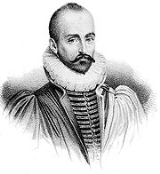
Michel de Montaigne

 
Michel De Montaigne

   Email Print
   Bookmark   Link


Michel de Montaigne


Michel Eyquem de Montaigne (French ) (February 28 1533–September 13 1592) was one of the most influential writers of the French Renaissance
Renaissance

The Renaissance was a cultural movement that spanned roughly the 14th to the 17th century, beginning in Italy in the late Middle Ages and later spreading to the rest of Europe....
. Montaigne is known for popularizing the essay
Essay

An essay is usually a short piece of writing. It is often written from an author's personal Perspective . Essays can be literary criticism, political manifestos, learned arguments, observations of daily life, recollections, and reflections of the author....
 as a literary genre. He became famous for his effortless ability to merge serious intellectual speculation with casual anecdotes and autobiography — and his massive volume Essais (translated literally as "Attempts") contains, to this day, some of the most widely influential essays ever written.


Discussion
Ask a question about 'Michel de Montaigne'
Start a new discussion about 'Michel de Montaigne'
Answer questions from other users
Full Discussion Forum


Recent Posts


Quotations


A man may be humble through vainglory.

Book II, ch. 17

A man must be a little mad if he does not want to be even more stupid.

Book III, ch. 9

C'est de quoi j'ai le plus de peur que la peur.

Translation: The thing I fear most is fear., Book I, ch, 18

Chaque homme porte la forme, entière de l'humaîne condition.

Translation: Every man bears the whole stamp of the human condition., Book III, ch. 1

Few men have been admired by their own households.

Book III, ch. 1

He who would teach men to die would teach them to live.

Book I, ch. 20


Encyclopedia


Michel Eyquem de Montaigne (French ) (February 28 1533–September 13 1592) was one of the most influential writers of the French Renaissance
Renaissance

The Renaissance was a cultural movement that spanned roughly the 14th to the 17th century, beginning in Italy in the late Middle Ages and later spreading to the rest of Europe....
. Montaigne is known for popularizing the essay
Essay

An essay is usually a short piece of writing. It is often written from an author's personal Perspective . Essays can be literary criticism, political manifestos, learned arguments, observations of daily life, recollections, and reflections of the author....
 as a literary genre. He became famous for his effortless ability to merge serious intellectual speculation with casual anecdotes and autobiography — and his massive volume Essais (translated literally as "Attempts") contains, to this day, some of the most widely influential essays ever written. Montaigne had a direct influence on writers the world over: including René Descartes
René Descartes

Ren? Descartes , , also known as Renatus Cartesius , was a French philosophy, mathematician, scientist, and writer who spent most of his adult life in the Dutch Republic....
, Ralph Waldo Emerson
Ralph Waldo Emerson

Ralph Waldo Emerson was an American essayist, philosopher, poet, and leader of the transcendentalism movement in the early 19th century. His teachings directly influenced the growing New Thought movement of the mid 1800s....
, Stefan Zweig
Stefan Zweig

Stefan Zweig was an Austrian novelist, playwright, journalist and biographer....
, Friedrich Nietzsche
Friedrich Nietzsche

Friedrich Wilhelm Nietzsche was a 19th century philosophy Germans philosophy and classical philology. He wrote critical texts on religion, morality, contemporary culture, philosophy, and science, using a distinctive German language style and displaying a fondness for metaphor and aphorism....
, Jean-Jacques Rousseau
Jean-Jacques Rousseau

Jean Jacques Rousseau was a major philosopher, writer, and composer of the eighteenth century The Age of Enlightenment, whose political philosophy influenced the French Revolution and the development of modern political and educational thought....
, Isaac Asimov
Isaac Asimov

Isaac Asimov , was a Russian-born United States author and professor of biochemistry, best known for his works of science fiction and for his popular science books....
, and perhaps William Shakespeare
William Shakespeare

William Shakespeare was an English people poet and playwright, widely regarded as the greatest writer in the English language and the world's preeminent dramatist....
 (see section "Related Writers and Influence" below). He was a conservative and earnest Catholic but, as a result of his anti-dogmatic cast of mind, he is considered the father, alongside his contemporary and intimate friend Étienne de La Boétie
Étienne de La Boétie

?tienne de La Bo?tie was a France judge, writer, political philosopher and friend of Michel de Montaigne, author of the Discourse on Voluntary Servitude ....
, of the 'anti-conformist' tradition in French literature. In his own time, Montaigne was admired more as a statesman than as an author. The tendency in his essays to digress into anecdotes and personal ruminations was seen as detrimental to proper style rather than as an innovation, and his declaration that, 'I am myself the matter of my book', was viewed by his contemporaries as self-indulgent. In time, however, Montaigne would be recognized as embodying, perhaps better than any other author of his time, the spirit of freely entertaining doubt which began to emerge at that time. He is most famously known for his skeptical remark, 'Que sais-je?' ('What do I know?'). Remarkably modern even to readers today, Montaigne's attempt to examine the world through the lens of the only thing he can depend on implicitly — his own judgment — makes him more accessible to modern readers than any other author of the Renaissance. Much of modern literary non-fiction has found inspiration in Montaigne, and writers of all kinds continue to read him for his masterful balance of intellectual knowledge and personal story-telling.

Life

Montaigne was born in the Aquitaine
Aquitaine

Aquitaine , archaic Guyenne/Guienne , is one of the 26 regions of France, in the south-western part of metropolitan France, along the Atlantic Ocean and the Pyrenees mountain range on the border with Spain....
 region of France
France

France , officially the French Republic , is a country whose Metropolitan France is located in Western Europe and that also comprises various Overseas departments and territories of France....
, on the family estate Château de Montaigne
Château de Montaigne

The Ch?teau de Montaigne is a castle situated on the borders of P?rigord and Bordelais, near Bergerac and Saint-?milion, in the small Communes in France of Saint-Michel-de-Montaigne in the Dordogne Departments of France of France....
, in a town now called Saint-Michel-de-Montaigne
Saint-Michel-de-Montaigne

Saint-Michel-de-Montaigne is a Communes of France in the Dordogne Departments of France in Aquitaine in southwestern France....
, not far from Bordeaux. The family was very rich; his grandfather, Ramon Eyquem, had made a fortune as a herring merchant and had bought the estate in 1477. His father, Pierre Eyquem, was a French
France

France , officially the French Republic , is a country whose Metropolitan France is located in Western Europe and that also comprises various Overseas departments and territories of France....
 Roman Catholic soldier in Italy for a time, and developed some very progressive views on education there; he had also been the mayor of Bordeaux. His mother, Antoinette de Louppes, was, apparently, the daughter of a Spanish
Spanish people

Spanish people or Spaniards are a nation or ethnic group native to Spain, in the Iberian Peninsula of southwestern Europe. They are often considered an amalgam of different ethnic groups, rather than an ethnic group by itself....
 converso
Converso

Conversos and its feminine form conversa referred to Jews or Muslims or the descendants of Jews or Muslims who converted to Catholicism in Spain and Portugal, particularly during the 14th and 15th centuries....
 (converted Jewish) father of the Protestant religion, and a Spanish
Spanish people

Spanish people or Spaniards are a nation or ethnic group native to Spain, in the Iberian Peninsula of southwestern Europe. They are often considered an amalgam of different ethnic groups, rather than an ethnic group by itself....
 Roman Catholic mother, who had left Spain in 1497 to join kin who had already settled in Toulouse. Although she lived a great part of Montaigne's life near him, and even survived him, she is only mentioned twice in his work. Montaigne's relationship with his father, however, played a prominent role in his life and works. From the moment of his birth, Montaigne's education followed a pedagogical
Pedagogy

Pedagogy , or paedagogy is the art or science of being a teacher. The term generally refers to strategies of instruction, or a style of instruction....
 plan sketched out by his father and refined by the advice of the latter's humanist
Humanism

Humanism is a broad category of ethics that affirm the dignity and worth of all people, based on the ability to determine right and wrong by appealing to universal human qualities, particularly rationalism, without resorting to the supernatural or alleged divine authority from religious texts....
 friends. Soon after his birth, Montaigne was brought to a small cottage, where he lived the first three years of life in the sole company of a peasant family, 'in order to', according to the elder Montaigne, 'draw the boy close to the people, and to the life conditions of the people, who need our help.' After these first spartan
Spartan

Spartan may refer to:* pertaining to Sparta** Hoplite, heavy infantryman in the Spartan army** Spartan Army* Spartan , apple cultivar developed in 1926...
 years spent amongst the lowest social class, Montaigne was brought back to the Château. The objective was for Latin to become his first language. The intellectual education of Montaigne was assigned to a German tutor (a doctor named Horstanus who couldn't speak French). His father only hired servants who could speak Latin and they also were given strict orders to always speak to the boy in Latin, or when he was in their presence.The same rule applied to his mother, father and servants, who were obliged only to use Latin words he himself employed, and thus acquired a knowledge of the very language his tutor taught him. Montaigne's Latin education was accompanied by constant intellectual and spiritual stimulation. He was familiarized with Greek by a pedagogical method that employed games, conversation, exercises of solitary meditation, rather than books. Music was played from the moment of Montaigne's awakening. An épinettier (playing a zither
Zither

The zither is a musical string instrument, most commonly found in Slovenia, Austria, Hungary, the southern regions of Germany, alpine Europe and East Asian cultures....
 original to the French region of Vosges
Vosges

This article is about the department of France named Vosges. For the mountain range, see Vosges Mountains.Vosges is a France departments of France, named after the local Vosges Mountains....
) constantly accompanied Montaigne and his tutor, playing a tune any time the boy became bored or tired. When he wasn't in the mood for music, he could do whatever he wished: play games, sleep, be alone - most important of all was that the boy wouldn't be obliged to anything, but that, at the same time, he would have everything in order to take advantage of his freedom. Around the year 1539, he was sent to study at a prestigious boarding school
Boarding school

A boarding school is a school where some or all pupils not only study, but also live during term time, with their fellow students and possibly teachers....
 in Bordeaux, the Collège de Guyenne
College of Guienne

The Coll?ge of Guienne, was a school in Bordeaux. It was founded in 1553....
, then under the direction of the greatest Latin scholar of the era, George Buchanan
George Buchanan

George Buchanan may refer to:*George Buchanan , Scottish humanist*Sir George Buchanan , Chief Medical Officer for England*Sir George Buchanan , British diplomat...
, where he mastered the whole curriculum by his thirteenth year. Afterwards he studied law in Toulouse
Toulouse

Toulouse is a commune of France in southwest France on the banks of the Garonne, half-way between the Atlantic Ocean and the Mediterranean Sea....
 and entered a career in the legal system. He was a counselor of the Court des Aides of Périgueux
Périgueux

P?rigueux is a Communes of France in the Dordogne Departments of France in Aquitaine in southwestern France.P?rigueux is the Prefectures in France of the department and the capital of the region....
, and in 1557 he was appointed counselor of the Parlement
Parlement

The political institutions of the Parlement in ancien r?gime France developed out of the previous council of the king, the Conseil du roi or curia regis, and consequently had ancient and customary rights of consultation and deliberation....
 in Bordeaux (a high court). From 1561 to 1563 he was at the court of Charles IX
Charles IX of France

Charles IX born Charles-Maximilien, was King of France, ruling from 1560 until his death. He is best known as king at the time of the St....
. He was awarded the highest honour of the French nobility, the collar
Collar (Order of Knighthood)

A Collar is an ornate chain, often made of gold and enamel, and set with precious stones, which is worn about the neck as a symbol of membership in various chivalric orders....
 of the order of St. Michael, something to which he aspired from his youth. While serving at the Bordeaux Parliament, he became very close friends with the humanist poet Étienne de la Boétie
Étienne de La Boétie

?tienne de La Bo?tie was a France judge, writer, political philosopher and friend of Michel de Montaigne, author of the Discourse on Voluntary Servitude ....
, whose death in 1563 deeply affected Montaigne. It has been argued that because of Montaigne's "imperious need to communicate," that, after losing Étienne, he began the Essais as his "means of communication;" and that "the reader takes the place of the dead friend."

At the age of 33, Montaigne married Françoise de la Cassaigne, in 1565, not quite of his own free will, and his wife bore him six daughters, but only the second-born survived childhood.

Following the petition of his father, Montaigne started to work on the first translation of the Spanish monk Raymond Sebond's Theologia naturalis, which he published a year after his father's death in 1568. After this he inherited the Château de Montaigne, to which he moved back in 1570. Another literary accomplishment of Montaigne, before the publication of his Essays, was the posthumous edition of his friend Boétie's works.

In 1571, he retired from public life to the Tower of the Château, Montaigne's so-called 'citadel', where he almost totally isolated himself from every social and family affair. Locked up in his library, which boasted a collection of some 1,500 works, he began work on his Essays, first published in 1580. On the day of his 38th birthday, as he entered this almost ten-year period of self-imposed reclusion, he had the following inscription crown the bookshelves of his working chamber:

'In the year of Christ 1571, at the age of thirty-eight, on the last day of February, his birthday, Michael de Montaigne, long weary of the servitude of the court and of public employments, while still entire, retired to the bosom of the learned virgins, where in calm and freedom from all cares he will spend what little remains of his life, now more than half run out. If the fates permit, he will complete this abode, this sweet ancestral retreat; and he has consecrated it to his freedom, tranquillity, and leisure.’


Michel De Montaigne 1
During this time of the Wars of Religion
French Wars of Religion

The French Wars of Religion is the name given to a period of civil war and military operations, primarily between France Roman Catholic Church and Protestantism , which also involved the factional struggles between the aristocratic houses of France such as the House of Bourbon and House of Guise ....
 in France, Montaigne, himself a Roman Catholic, acted as a moderating force, respected both by the Catholic King Henry III
Henry III of France

Henry III of France , born Alexandre-?douard de Valois-Angoul?me, was King of France from 1574 to 1589, and as Henry of Valois, first elected List of Polish rulers#Polish-Lithuanian Commonwealth and List of Lithuanian rulers#Polish-Lithuanian Commonwealth from 1573 to 1574....
 and the Protestant Henry of Navarre.

In 1578, Montaigne, whose health had always been excellent, started suffering from painful kidney stone
Kidney stone

Kidney stones, also called renal Calculus , are solid concretions of dissolved dietary mineral in urine; calculi typically form inside the kidneys or bladder....
s, a sickness he had inherited from his father's family. From 1580 to 1581, Montaigne traveled in France, Germany, Austria, Switzerland and Italy, partly in search for a cure. He kept a detailed journal recording various episodes and regional differences. It was published much later, in 1774, under the title Travel Journal.

While in Rome
Rome

Rome is the capital city of Italy and Lazio, and is Italy's largest and most populous city, with 2,724,347 residents in an urban area of some ....
 in 1581, he learned that he had been elected mayor of Bordeaux; he returned and served until 1585, again moderating between Catholics and Protestants. The plague
Black Death

The Black Death, was one of the deadliest pandemics in human history, widely thought to have been caused by a bacterium named Yersinia pestis , but recently attributed by some factors to other diseases....
 broke out in Bordeaux toward the end of his term.

Montaigne continued to extend, revise and oversee the publication of his Essays. In 1588 he met the writer Marie de Gournay
Marie de Gournay

Marie de Gournay was an admirer of Michel de Montaigne, who having read his works in her teens, travelled to meet him and eventually became his "fille d'alliance" ....
 who admired his work and would later edit and publish it. King Henry III
Henry III of France

Henry III of France , born Alexandre-?douard de Valois-Angoul?me, was King of France from 1574 to 1589, and as Henry of Valois, first elected List of Polish rulers#Polish-Lithuanian Commonwealth and List of Lithuanian rulers#Polish-Lithuanian Commonwealth from 1573 to 1574....
 was assassinated in 1589, and Montaigne then helped to keep Bordeaux loyal to Henry of Navarre, who would go on to become King Henry IV.

Montaigne died, at the age of 59, in 1592 at the Château de Montaigne and was buried nearby. Later his remains were moved to the church of Saint
Saint

A saint in Christianity is a human being who has been called to holiness. The term is used differently by various denominations, with some, such as the Anglicans, Methodists, and Lutherans distinguishing between Saints and saints....
 Antoine
Antoine

Antoine is French language given name meaning beyond praise or highly praise-worthy....
 at Bordeaux. The church no longer exists: it became the Convent des Feuillants, which has also disappeared. The Bordeaux Tourist Office says that Montaigne is buried at the Musée Aquitaine, Faculté des Lettres, Université Bordeaux 3 Michel de Montaigne, Pessac
Pessac

Pessac is a Communes of France in the Gironde Departments of France in Aquitaine in southwestern France.It is the second-largest suburb of the city of Bordeaux, and is adjacent to it on the southwest....
. His heart is preserved in the parish church of Saint-Michel-de-Montaigne
Saint-Michel-de-Montaigne

Saint-Michel-de-Montaigne is a Communes of France in the Dordogne Departments of France in Aquitaine in southwestern France....
.

The humanities branch of the University of Bordeaux
University of Bordeaux

The present University of Bordeaux is a grouping of institutions of higher education and research , established 21 March 2007. It is made up of the four successor universities to the historic University of Bordeaux as well as a number of other institutions:...
 is named after him: Université Michel de Montaigne Bordeaux 3.

Michel De Montaigne

Essays

The book is a collection of a large number of short subjective treatments of various topics published in 1580. Montaigne's stated goal is to describe man, and especially himself, with utter frankness. He finds the great variety and volatility of human nature to be its most basic features. He describes his own poor memory, his ability to solve problems and mediate conflicts without truly getting emotionally involved, his disdain for man's pursuit of lasting fame, and his attempts to detach himself from worldly things to prepare for his timely death. He writes about his disgust with the religious conflicts of his time, believing that humans are not able to attain true certainty (skepticism
Skepticism

In ordinary usage, skepticism or scepticism refers to:* an attitude of doubt or a disposition to incredulity either in general or toward a particular object;...
). The longest of his essays, Apology for Raymond Sebond contains his famous motto, "What do I know?"

Montaigne considered marriage
Marriage

Marriage is a social, spirituality, or law union of individuals. This union may also be called matrimony, while the ceremony that marks its beginning is usually called a wedding and the married status created is sometimes called wedlock....
 necessary for the raising of children, but disliked strong feelings of passionate love because he saw them as detrimental to freedom. In education, he favored concrete examples and experience over the teaching of abstract knowledge that has to be accepted uncritically.

Related writers and influence

Thinkers exploring similar ideas include Erasmus, Thomas More
Thomas More

Saint Thomas More was an English lawyer, author, and statesman who in his lifetime gained a reputation as a leading Renaissance humanist scholar, and occupied many public offices, including Lord Chancellor ....
, and Guillaume Budé
Guillaume Budé

Guillaume Bud? was a France scholar....
, who all worked about fifty years before Montaigne.

Since Edward Capell
Edward Capell

Edward Capell , England Shakespeare critic, was born at Troston Hall in Suffolk.Through the influence of the Charles FitzRoy, 2nd Duke of Grafton he was appointed to the office of deputy-inspector of plays in 1737, with a salary of ?200 per annum, and in 1745 he was made groom of the privy chamber through the same influence....
 first made the suggestion in 1780, some scholars believe that Shakespeare was familiar with Montaigne's essays. John Florio's translation of Montaigne's Essais became available for Shakespeare in English in 1603.

Much of Blaise Pascal
Blaise Pascal

Blaise Pascal , was a France mathematician, physicist, and religion philosopher. He was a child prodigy who was educated by his father, a civil servant....
's skepticism in his Pensées
Pensées

The Pens?es represented a defense of the Christian religion by Blaise Pascal, the renowned 17th century philosophy and mathematician. Pascal's religious conversion led him into a life of asceticism, and the Pens?es was in many ways his life's work."Pascal's Wager" is found here....
 was a result of reading Montaigne, whose influence is also seen in the essays of Ralph Waldo Emerson
Ralph Waldo Emerson

Ralph Waldo Emerson was an American essayist, philosopher, poet, and leader of the transcendentalism movement in the early 19th century. His teachings directly influenced the growing New Thought movement of the mid 1800s....
. Friedrich Nietzsche
Friedrich Nietzsche

Friedrich Wilhelm Nietzsche was a 19th century philosophy Germans philosophy and classical philology. He wrote critical texts on religion, morality, contemporary culture, philosophy, and science, using a distinctive German language style and displaying a fondness for metaphor and aphorism....
 was moved to judge of Montaigne: "That such a man wrote has truly augmented the joy of living on this Earth" from "Schopenhauer as Educator".

The American philosopher Eric Hoffer
Eric Hoffer

Eric Hoffer was an American social writer and philosopher. He produced ten books and was awarded the Presidential Medal of Freedom in February 1983 by President of the United States Ronald Reagan....
 employed Montaigne both stylistically and in thought. Hoffer's memoir Truth Imagined said of Montaigne, "He was writing about me. He knew my innermost thoughts." The Welsh novelist John Cowper Powys
John Cowper Powys

John Cowper Powys was a United Kingdom writer, lecturer, and philosopher....
 expressed his admiration for Montaigne's philosophy in his books Suspended Judgements (1916) and The Pleasures of Literature (1938). Judith N. Shklar
Judith N. Shklar

Judith Nisse Shklar was a political theorist, the John Cowles Professor of Government at Harvard University....
 introduces her book Ordinary Vices (1984), "It is only if we step outside the divinely ruled moral universe that we can really put our minds to the common ills we inflict upon one another each day. That is what Montaigne did and that is why he is the hero of this book, In spirit he is on every one of its pages..."

Quotes

  • Obsession is the wellspring of genius and madness.
  • Everyone calls barbarity what he is not accustomed to.
  • If you belittle yourself, you are believed; if you praise yourself, you are disbelieved.
  • When I play with my cat, how do I know that she is not passing time with me rather than I with her?
  • Life in itself is neither good nor evil, it is the place of good and evil, according to what you make it.
  • The continuous work of our life is to build death.
  • If you press me to say why I loved him, I can say no more than because he was he, and I was I.
  • Kings and philosophers defecate, and so do ladies.
  • I enter into discussion and argument with great freedom and ease, inasmuch as opinion finds me in a bad soil to penetrate and take deep root in. No propositions astonish me, no belief offends me, whatever contrast it offers to my own. There is no fancy so frivolous and so extravagant that it does not seem to me quite suitable to the production of the human mind.
  • Our religion is made to eradicate vices, instead it encourages them, covers them, and nurtures them.
  • Human understanding is marvellously enlightened by daily conversation with men, for we are, otherwise, compressed and heaped up in ourselves, and have our sight limited to the length of our own noses.
  • Not being able to govern events, I govern myself.
  • The clatter of arms drowns the voice of law.
  • No matter that we may mount on stilts, we still must walk on our own legs. And on the highest throne in the world, we still sit only on our own bottom.
  • Montaigne's axiom: "Nothing is so firmly believed as that which least is known."


Secondary Literature: Criticism

  • The Cambridge companion to Montaigne / Ullrich Langer., 2005
  • Montaigne and ethics / Patrick Henry., 2002
  • Reading Montaigne / Dikka Berven., 1995
  • Montaigne : a collection of essays : a five volume anthology of scholarly articles / Dikka Berven., 1995
  • Approaches to teaching Montaigne's Essays / Patrick Henry., 1994
  • Michel de Montaigne's essays (Modern Critical Interpretations) / Harold Bloom., 1987
  • Michel de Montaigne (Modern Critical Views) / Harold Bloom., 1987
  • Montaigne : essays in memory of Richard Sayce / I.D. McFarlane., 1982
  • Montaigne and his age / Keith Cameron., 1981
  • Columbia Montaigne Conference papers / Donald Frame., 1981
  • Cosmopolis: The Hidden Agenda of Modernity/Stephen Toulmin ., 1990
  • Screech M. A. , The Complete Essays 1987, 1991, 2003


External links

  • A discussion of a Montaigne reference made in the comic strip Herb and Jamaal:
  • The Charles Cotton
    Charles Cotton

    Charles Cotton was an England poet and writer, best-known for translating the work of Michel de Montaigne from the French language, for his contributions to The Compleat Angler, and for the highly influential The Compleat Gamester which has been attributed to him....
     translation of some of Montaigne's essays:
    • by Project Gutenberg
      Project Gutenberg

      Project Gutenberg, abbreviated as PG, is a volunteer effort to digitize, archive and distribute cultural works, as founder Michael Hart said "To encourage the creation and distribution of eBooks."....
    • at the University of Adelaide
    • at Oregon State University
  • The complete, searchable text of the from the ARFTL project at the University of Chicago
  • The at the University of Chicago
  • A German resource: http://www.michel-montaigne.de
  • - Documentary about Montaigne and his philosophy.
  • The photograph described as 'Montaigne's grave' is actually a memorial outside the parish church at St Michel de Montaigne, where his heart is preserved.