


Avignon

Encyclopedia
Avignon is a French commune in southeastern France in the départment of the Vaucluse bordered by the left bank of the Rhône
river. Of the 94,787 inhabitants of the city on 1 January 2010, 12 000 live in the ancient town centre surrounded by its medieval ramparts.
Often referred to as the "City of Popes" because of the presence of pope
s and antipopes from 1309 to 1423 during the Catholic schism
, it is currently the largest city and capital of the département of Vaucluse. This is one of the few French cities to have preserved its ramparts, its historic centre, the palace of the popes, Rocher des Doms, and the bridge of Avignon. It was classified a World Heritage Site
by UNESCO
under the criteria I, II and IV.
As a showcase of arts and culture, the fame of its annual theatre festival, known as the Festival of Avignon, has far exceeded the French borders.
river, a few kilometres above its confluence with the Durance
, about 580 km (360.4 mi) south-east of Paris, 229 km (142.3 mi) south of Lyon
and 85 km (52.8 mi) north-north-west of Marseille
. Its coordinates are 43°57′N 4°50′E. Avignon occupies a large oval-shaped area, not fully populated and covered to a large extent by parks and gardens.
. The popular proverb is, however, somewhat exaggerated, Avenie ventosa, sine vento venenosa, cum vento fastidiosa (windy Avignon, pest-ridden when there is no wind, wind-pestered when there is)
(capital) of the Vaucluse
département in the region of Provence-Alpes-Côte-d'Azur. It forms the core of the Grand Avignon
metropolitan area (communauté d'agglomération
), which comprises twelve communes on both sides of the river:
, may have been the site of a Celt
ic oppidum
or hill fort
.
Avignon, written as Avennio or Avenio in the ancient texts and inscriptions, takes its name from the Avennius clan. Founded by the Gallic tribe of the Cavares
or Cavari, it became the centre of an important Phocaea
n colony from Massilia (present Marseilles).
Under the Romans, Avenio was a flourishing city of Gallia Narbonensis
, the first Transalpine province of the Roman Empire
, but very little from this period remains (a few fragments of the forum
near Rue Molière).
During the inroads of the Goths, it was badly damaged in the fifth century and belonged in turn to the Goths, the kingdoms of Burgundy
and of Arles
, in the 12th Century. it fell into the hands of the Saracens and was destroyed in 737 by the Franks
under Charles Martel
for having sided with the Arab
s against him. Boso
having been proclaimed Burgundian King of Provence, or of Arelat (after its capital Arles), by the Synod of Mantaille
, at the death of Louis the Stammerer
(879), Avignon ceased to belong to the Frankish kings.
 In 1033, when Conrad II
inherited the Kingdom of Arelat, Avignon passed to the Holy Roman Empire
. With the German rulers at a distance, Avignon set up as a republic with a consular form of government
, between 1135 and 1146. In addition to the Emperor, the Counts of Forcalquier
, of Toulouse
and of Provence
exercised a purely nominal sway over the city; on two occasions, in 1125 and in 1251, the Counts of Toulouse
and Provence
divided their rights in regard to it, while the Count of Forcalquier
resigned any right he possessed to the local Bishops and Consuls in 1135.
At the end of the twelfth century, Avignon declared itself an independent republic, but independence was crushed in 1226 during the crusade against the Albigenses
(the dualist Cathar
heresy centred in neighboring Albi). After the citizens refused to open the gates of Avignon to King Louis VIII of France
and the papal Legate, a three month siege ensued starting on 10 June 1226, and ending in capitulation by Avignon on 13 September 1226. Following the defeat, they were forced to pull down the ramparts and fill up the moat of the city.
On 7 May 1251 Avignon was made a common possession of counts Charles of Anjou and Alphonse de Poitiers, brothers of French king Saint Louis IX. On 25 August 1271, at the death of Alphonse de Poitiers, Avignon and the surrounding countship Comtat-Venaissin (which was governed by rector
s since 1274) were united with the French crown.
Avignon and the Comtat did not become French until 1791. In 1274, the Comtat became a possession of the popes, with Avignon itself, self-governing, under the overlordship of the Angevin count of Provence (who was also king of "Sicily" [i.e., Naples]). The popes were allowed by the count of Provence (a papal vassal) to settle in Avignon in the early 14th century. The popes bought Avignon from the Angevin ruler for 80,000 florins in 1348. From then on until the French Revolution, Avignon and the Comtat were papal possessions, first under the schismatic popes of the Great Schism, then under the popes of Rome ruling via legates and vice-legates. The Black Death
appeared at Avignon in 1348; killing almost two-thirds of the city's population.
as his residence, and from 9 March 1309 until 13 January 1377 was the seat of the Papacy instead of Rome. This caused a schism
in the Catholic Church. At the time, the city and the surrounding Comtat Venaissin
were ruled by the kings of Sicily
of the house of Anjou
. The French King Philip the Fair
, who had inherited from his father all the rights of Alphonse de Poitiers (the last Count of Toulouse
), made them over to Charles II, King of Naples and Count of Provence (1290). Nonetheless, Phillip was a shrewd ruler. Inasmuch as the eastern banks of the Rhone marked the edge of his kingdom, when the river flooded up into the city of Avignon, Phillip taxed the city since during periods of flood, the city technically lay within his domain.
, Avignon belonged to the Papacy until 1791, when, during the disorder of the French Revolution
, it was reincorporated with France.
Seven popes resided there:
This period from 1309–1377 – the Avignon Papacy
– was also called the Babylonian Captivity
of exile, in reference to the Israelite
s' enslavement in biblical times.
The walls that were built by the pope
s in the years immediately following the acquisition of Avignon as papal territory are well preserved. As they were not particularly strong fortifications, the Popes relied instead on the immensely strong fortifications of their palace, the "Palais des Papes
". This immense Gothic
building, with walls 17–18 feet thick, was built 1335–1364 on a natural spur of rock, rendering it all but impregnable to attack. After its capture following the French Revolution
, it was used as a barracks and prison for many years but it is now a museum.
Avignon, which at the beginning of the 14th century was a town of no great importance, underwent extensive development during the time the seven Avignon popes and two anti-popes, Clement V to Benedict XIII made their residences there. To the north and south of the rock of the Doms, partly on the site of the Bishop's Palace, which had been enlarged by John XXII, was built the Palace of the Popes, in the form of an imposing fortress consisting of towers, linked to each other, and named as follows: De la Campane, de Trouillas, de la Glacière, de Saint-Jean, des Saints-Anges (Benedict XII), de la Gâche, de la Garde-Robe (Clement VI), de Saint-Laurent (Innocent VI). The Palace of the Popes belongs, in virtue of its severe architecture, to the Gothic art
of the South of France. Other noble examples can be seen in the churches of St. Didier, St. Peter
and St. Agricola
, as well as the Clock Tower, and in the fortifications built between 1349 and 1368 for a distance of some three miles (5 km), and flanked by thirty-nine towers, all of which were erected or restored by the Roman Catholic Church. The frescoes that are painted on the interiors of the Palace of the Popes and the churches of Avignon were created primarily by artists from Siena
.
The popes were followed to Avignon by agents (factores
) of the great Italian banking-houses, who settled in the city as money-changers, as intermediaries between the Apostolic Chamber and its debtors, living in the most prosperous quarters of the city, which was known as the Exchange. A crowd of traders of all kinds brought to market the produce necessary for maintaining the numerous court and for the visitors who flocked to it; grain and wine from Provence, from the south of France, the Roussillon
and the country around Lyon. Fish was brought from places as distant as Brittany
; cloths, rich stuffs and tapestries came from Bruges
and Tournai
. We need only glance at the account-books of the Apostolic Chamber, still kept in the Vatican archives, to get an idea of the trade of which Avignon became the centre. The university founded by Boniface VIII in 1303, had a good many students under the French popes, drawn there by the generosity of the sovereign pontiffs, who rewarded them with books or benefice
s.
During the Great Schism
(1378–1415) the antipope
s Clement VII
and Benedict XIII
returned to reside at Avignon. Clement VII
lived in Avignon during his entire anti-pontificate, while Benedict XIII
only lived there until 1403 when he was forced to flee to Aragon
.
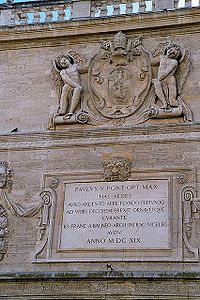
, who was replaced, in his absence, by a vice-legate (contrary to the legate usually a commoner, and not a cardinal). But Pope
Innocent XII abolished nepotism
and the office of Legate in Avignon on 7 February 1693, handing over its temporal government in 1692 to the Congregation of Avignon (i.e. a department of the papal Curia, residing at Rome), with the Cardinal Secretary of State
as presiding prefect, and exercising its jurisdiction through the vice-legate. This congregation, to which appeals were made from the decisions of the vice-legate, was united to the Congregation of Loreto within the Roman Curia; in 1774 the vice-legate was made president, thus depriving it of almost all authority. It was done away with under Pius VI on 12 June 1790.
The Public Council, composed of forty-eight councillors chosen by the people, four members of the clergy and four doctors of the university, met under the presidency of the chief magistrate of the city, the viquier (Occitan) or vicar or representative of the papal Legate or Vice-legate, who annually nominated a man for the post. The councillors' duty was to watch over the material and financial interests of the city; but their resolutions were to be submitted to the vice-legate for approval before being put in force. Three consuls, chosen annually by the Council, had charge of the administration of the streets.
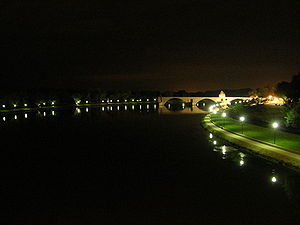 Avignon's survival as a papal enclave was, however, somewhat precarious, as the French crown maintained a large standing garrison at Villeneuve-lès-Avignon
just across the river.
From the fifteenth century onward it became the policy of the Kings of France to rule Avignon as part of their kingdom. In 1476, Louis XI, upset that Charles of Bourbon was made legate
, sent troops to occupy the city, until his demands that Giuliano della Rovere be made legate, once Giuliano della Rovere was made a cardinal
he withdrew his troops from the city.
In 1536 king Francis I of France
invaded the papal territory, in order to overthrow Emperor Charles V, who was emperor of the territory. When he entered the city the people received him very well, and in return for the reception the people were all granted to them the same privileges that French subjects enjoyed, such as being able to hold state offices.
In (1583) King Henry III Valois attempted to offer an exchange of Marquisate of Saluzzo
for Avignon, however his offer was refused by Pope Gregory XIII
.
In 1663 in retaliation for the attack led by the Corsican Guard on the attendants of the Duc de Créqui, the ambassador of Louis XIV in Rome, he attacked and seized Avignon, which at the time was considered an important and integral part of the French Kingdom by the provincial Parliament of Provence.
In 1688 yet another attempt was made to occupy Avignon, however the attempt failed, and from 1688 to 1768 Avignon was at peace with no occupations or wars during that time.
King Louis XV, dissatisfied with Clement XIII's action in regard to the Duke of Parma, occupied the Papal States
from 1768 to 1774 and substituted French institutions for those in force with the approval of the people of Avignon; a French party grew up which, after the sanguinary massacres of La Glacière
between the adherents of the Papacy and the Republicans (16–17 October 1791), carried all before it, and induced the Constituent Assembly to decree the union of Avignon and the Comtat (comital district) Venaissin with France on 14 September 1791. On 25 June 1793 Avignon and Comtat-Venaissin were integrated along with the former principality of Orange
to form the present republican département Vaucluse.
Article 5 of the Treaty of Tolentino
(19 February 1797) definitively sanctioned the annexation, stating that "The Pope renounces, purely and simply, all the rights to which he might lay claim over the city and territory of Avignon, and the Comtat Venaissin and its dependencies, and transfers and makes over the said rights to the French Republic." In 1801 the territory had 191,000 inhabitants.
On 30 May 1814, the French annexation was recognized by the Pope. Ercole Consalvi made an ineffectual protest at the Congress of Vienna
in 1815 but Avignon was never restored to the Holy See
. In 1815 Bonapartist Marshal Guillaume Marie Anne Brune
was assassinated in the town by adherents of the royalist party during the White Terror
.
 It was the seat of a bishop as early as the year 70 AD. The first bishop known to history is Nectarius
, who took part in several councils about the middle of the fifth century. St. Magnus was a Gallo-Roman senator who became a monk
and then bishop of the city. His son, St. Agricol (Agricolus), bishop between 650 and 700, is the patron saint
of Avignon. Several synod
s of minor importance were held there, and its university, founded by Pope Boniface VIII
in 1303 and famed as a seat of legal studies, flourished until the French Revolution
. The memory of St. Eucherius still clings to three vast caves near the village of Beaumont, whither, it is said, the people of Lyon
had to go in search of him when they sought him to make him their archbishop
. As Bishop of Cavaillon, Cardinal Philippe de Cabassoles
, seigneur of Vaucluse
, was the great protector of the Renaissance poet Petrarch
.
In 1309 the city was chosen by Clement V as his residence, and from that time till 1377 was the papal seat. In 1348 the city was sold by Joanna, Countess of Provence
, to Clement VI for 80,000 florin
s.
In 1475 pope Sixtus IV raised the diocese of Avignon to the rank of an archbishopric, in favour of his nephew Giuliano della Rovere, who later became Pope Julius II. The Archdiocese of Avignon has canonic jurisdiction over the department of Vaucluse
. Before the French Revolution
it had as suffragan sees Carpentras
, Vaison and Cavaillon
, which were united by the Napoleonic Concordat of 1801
to Avignon, together with the Diocese of Apt, a suffragan of Aix-en-Provence
. However, at that same time Avignon was reduced to the rank of a bishopric
and was made a suffragan see of Aix
. The Archdiocese of Avignon was re-established in 1822, receiving as suffragan sees the Diocese of Viviers (restored in 1822), Valence
: (formerly under Lyon), Nîmes
(restored in 1822) and Montpellier
(formerly under Toulouse).
In 2002, as part of the reshuffling of the ecclesiastic provinces of France
, the Archdiocese of Avignon ceased to be a metropolitan and became, instead a suffragan diocese
of the new province of Marseilles, while keeping its rank of archdiocese.
 The Councils of Avignon are Councils of the Roman Catholic Church. The first reported council was held in 1060, though nothing is known about the events of the council. In 1080 another council was held, with Hugues de Dié, papal legate
as council president. During the 1080 council Aicard, usurper of the See of Arles was deposed, and Gibelin placed in his position. Three bishops-elect (Lautelin of Embrun, Hugues of Grenoble, Didier of Cavaillon) accompanied the legate to Rome and were consecrated there by Pope Gregory VII
.
During the 13th century four councils were held, including the 1209 council in which the inhabitants of Toulouse were excommunicated from the church by the council for failing to expel the Albigensian heretics from Toulouse. Included in the population that was excommunicated were two papal legates, four archbishops and twenty bishops. The next council was held in 1270, and Bertrand de Malferrat, Archbishop of Arles presided over the council. The usurpers of ecclesiastical property were severely threatened; unclaimed legacies were allotted to pious uses; the bishops were urged to mutually support one another; and individual churches were taxed for the support of the papal legates; and ecclesiastics were forbidden to convoke the civil courts against their bishops. And the council banned Christmas carol
s.
During the 1279 council they were concerned with the clergy's protection of rights, privileges, and immunities. Provisions were also made for those who promised to join the crusade Gregory X had ordered, but had failed to actually go on the crusade. In addition the council decreed that to hear confessions monks must have permission of their ordinary, or bishop, as well as their superior. The last council during the 13th century was the council of 1282, during which they published 10 canons. Among the canons published was one urging people to more regularly attend the parochial churches, and to go to their parish church
for at least feast days
and on Sundays.
During the 1327 council the temporalities
of the Church and ecclesiastical jurisdiction
occupied their attention. The council published seventy-nine canons in 1337. The 79 canons were renewed from earlier councils, and emphasized the duty of Easter Communion in one's own parish church, and of abstinence on Saturday for beneficed persons and ecclesiastics, in honour of the Blessed Virgin, a practice begun three centuries earlier on the occasion of the Truce of God, but no longer universal.
The 15th century saw two councils convened, one in 1457 and one in 1497. The 1457 council was held by Cardinal de Foix, Archbishop of Arles and legate of Avignon, who was also a Franciscan. His primary reason was to promote the doctrine of Immaculate Conception
, in sense of the declaration of the council of Basle
. They forbade the preaching of the contrary doctrine, as well as 64 disciplinary canons that were published, in keeping with the legislation of previous councils. In 1497 Archbishop Francesco Tarpugi (after the council he was cardinal) presided over the council. They published a similar number of decrees to the 1457 council. It was decreed that the sponsors of the newly confirmed were not obligated to make presents to their parents or to them. They also decreed that before the relics of the saints two candles were to be kept lit at all times.
During the next five centuries only six further councils were held. The 1509 council focused on disciplinary measures. The next council, in 1596, was called to discuss the furthering of the observance of the decrees of the Council of Trent
., and the 1609 council was held for very similar circumstances. The councils of 1664 and 1725 were held to formulate disciplinary decrees. The 1725 council also decreed the duty of adhering to the Papal Bull Unigenitus
(1713) of Clement XI that condemned the Oratorian, Pasquier Quesnel
. The final council on record was in 1849 and it published ten chapters of canons concerning discipline and faith.
formed from the existing schools of the city, and was formally constituted in 1303, by Boniface VIII in a Papal Bull
. Boniface VIII, and King Charles II
of Naples should be considered one of the first great protectors and benefactors to the University of Avignon. The Law department within the university has always been its most important department, covering both civil and ecclesiastical law
. The law department existed nearly exclusively for some time after the university's formation and remained the most important department through its existence.
In 1413 Antipope John XXIII
founded the University's department of Theology, which for quite some time had only a few students. The university's art department never did gain any great importance. It was not until the 16th and 17th centuries that the school developed a department of medicine. The Bishop of Avignon was chancellor of the university from 1303 to 1475, after 1475 the bishop became and Archbishop, but remained chancellor of the university.The papal vice-legate, generally a bishop, represented the civil power (in this case the pope) and was chiefly a judicial officer, ranking higher than the Primicerius (Rector).
The Primicerius was elected by the Doctors of Law. In 1503 the Doctors of Law had 4 Theologians, and in 1784 two Doctors of Medicine
added their ranks. Since the Pope was the spiritual head, and after 1348, the temporal ruler of Avignon, he was able to have a great deal of influence in all university affairs. In 1413, John XXIII
granted the university extensive special privileges, such as university jurisdiction, and tax exempt status
. Circumstances in the latter part of the universitys existence such as political, geographical, and educational, caused the university to seek favour from Paris rather than Rome for protection and favour. During the chaos of the French Revolution
the university started to gradually disappear, and in 1792 the university was abandoned and closed. Currently the university has been superseded by the modern Université of Avignon and Vaucluse.
In 1960, Avignon was the subject of considerable debate during the creation of conservation areas. The then mayor of the district proposing a renovation of the district known as the Quartier de la Balance, that incurred the demolition of about two-thirds of the area, keeping only the listed buildings. The solution was adopted as a compromise, with a part of the neighborhood near the Palace Square actually enjoying a true restoration
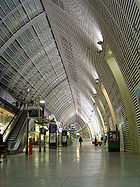 Avignon has an SNCF railway station, Gare d'Avignon-Centre, situated just outside the ramparts of the old town, and the Gare d'Avignon TGV
outside the town, served by the LGV Méditerranée
, a high-speed rail
system.
Provision for transport within the city includes 23 bus lines, and 110 km of bike paths with a bike-sharing program vélopop'
.
The Avignon - Caumont Airport
is situated about 8 km southeast of Avignon.
Avignon is situated on the banks of the river Rhone
, one of the main water thoroughfares in France.
" ("On the bridge of Avignon"), which describes folk dancing
. The bridge of the song is the Saint Bénézet bridge, over the Rhône River
, of which only four arches (out of the initial 22) remain which start from the Avignon side of the river. In fact people would have danced beneath the bridge (sous le pont) where it crossed an island (Île de Barthelasse) on its way to Villeneuve-lès-Avignon
. The bridge was initially built between 1171 and 1185, with an original length of some 900 m (2950 ft), but it suffered frequent collapses during floods and had to be rebuilt several times. Several arches were already missing (and spanned by wooden sections) before the remainder were destroyed in 1660.
with:
Rhône
Rhone can refer to:* Rhone, one of the major rivers of Europe, running through Switzerland and France* Rhône Glacier, the source of the Rhone River and one of the primary contributors to Lake Geneva in the far eastern end of the canton of Valais in Switzerland...
river. Of the 94,787 inhabitants of the city on 1 January 2010, 12 000 live in the ancient town centre surrounded by its medieval ramparts.
Often referred to as the "City of Popes" because of the presence of pope
Pope
The Pope is the Bishop of Rome, a position that makes him the leader of the worldwide Catholic Church . In the Catholic Church, the Pope is regarded as the successor of Saint Peter, the Apostle...
s and antipopes from 1309 to 1423 during the Catholic schism
Western Schism
The Western Schism or Papal Schism was a split within the Catholic Church from 1378 to 1417. Two men simultaneously claimed to be the true pope. Driven by politics rather than any theological disagreement, the schism was ended by the Council of Constance . The simultaneous claims to the papal chair...
, it is currently the largest city and capital of the département of Vaucluse. This is one of the few French cities to have preserved its ramparts, its historic centre, the palace of the popes, Rocher des Doms, and the bridge of Avignon. It was classified a World Heritage Site
World Heritage Site
A UNESCO World Heritage Site is a place that is listed by the UNESCO as of special cultural or physical significance...
by UNESCO
UNESCO
The United Nations Educational, Scientific and Cultural Organization is a specialized agency of the United Nations...
under the criteria I, II and IV.
As a showcase of arts and culture, the fame of its annual theatre festival, known as the Festival of Avignon, has far exceeded the French borders.
Geography
Avignon is situated on the left bank of the RhôneRhône
Rhone can refer to:* Rhone, one of the major rivers of Europe, running through Switzerland and France* Rhône Glacier, the source of the Rhone River and one of the primary contributors to Lake Geneva in the far eastern end of the canton of Valais in Switzerland...
river, a few kilometres above its confluence with the Durance
Durance
The Durance is a major river in south-eastern France.Its source is in the south-western Alps, in Montgenèvre ski resort near Briançon and it flows south-west through the following départements and cities:* Hautes-Alpes: Briançon, Embrun.* Alpes-de-Haute-Provence: Sisteron, Manosque.* Vaucluse:...
, about 580 km (360.4 mi) south-east of Paris, 229 km (142.3 mi) south of Lyon
Lyon
Lyon , is a city in east-central France in the Rhône-Alpes region, situated between Paris and Marseille. Lyon is located at from Paris, from Marseille, from Geneva, from Turin, and from Barcelona. The residents of the city are called Lyonnais....
and 85 km (52.8 mi) north-north-west of Marseille
Marseille
Marseille , known in antiquity as Massalia , is the second largest city in France, after Paris, with a population of 852,395 within its administrative limits on a land area of . The urban area of Marseille extends beyond the city limits with a population of over 1,420,000 on an area of...
. Its coordinates are 43°57′N 4°50′E. Avignon occupies a large oval-shaped area, not fully populated and covered to a large extent by parks and gardens.
Climate
Avignon has a Mediterranean climate characterised by relatively dry summers and cool, damp winters. The city is often subject to windy weather; the strongest wind is the mistralMistral (wind)
The mistral is a strong, cold and usually dry regional wind in France, coming from the north or northwest, which accelerates when it passes through the valleys of the Rhone and the Durance Rivers to the coast of the Mediterranean around the Camargue region. It affects the northeast of the plain...
. The popular proverb is, however, somewhat exaggerated, Avenie ventosa, sine vento venenosa, cum vento fastidiosa (windy Avignon, pest-ridden when there is no wind, wind-pestered when there is)
Administration
Avignon is the préfecturePréfecture
A prefecture in France can refer to :*the Chef-lieu de département, the town in which the administration of a department is located;*the Chef-lieu de région, the town in which the administration of a region is located;...
(capital) of the Vaucluse
Vaucluse
The Vaucluse is a department in the southeast of France, named after the famous spring, the Fontaine-de-Vaucluse.- History :Vaucluse was created on 12 August 1793 out of parts of the departments of Bouches-du-Rhône, Drôme, and Basses-Alpes...
département in the region of Provence-Alpes-Côte-d'Azur. It forms the core of the Grand Avignon
Grand Avignon
Grand Avignon is the name for the metropolitan area around Avignon. It is an agglomeration community...
metropolitan area (communauté d'agglomération
Communauté d'agglomération
An agglomeration community is a metropolitan government structure in France, created by the Chevènement Law of 1999. It is one of three forms of intercommunality, less integrated than an urban community but more integrated than a community of communes...
), which comprises twelve communes on both sides of the river:
- Les AnglesLes Angles, GardLes Angles is a commune in the Gard department in southern France.-Population:-References:*...
, Rochefort-du-GardRochefort-du-GardRochefort-du-Gard is a commune in the Gard department in southern France.-Population:-Culture:Rochefort-du-Gard is integrated into Languedoc-Roussillon but naturally rooted in Provence, and it depends on the economic area of Avignon....
, SazeSazeSaze is a commune in the Gard department in southern France.-Population:-References:*...
and Villeneuve-lès-AvignonVilleneuve-lès-AvignonVilleneuve-lès-Avignon is a commune in the Gard department in southern France. It can also be spelled Villeneuve-lez-Avignon.-Population:-Sights:* Chartreuse Notre-Dame-du-val-de-Bénédiction* Fort Saint-André* Tour Philippe Le Bel...
in the GardGardGard is a département located in southern France in the Languedoc-Roussillon region.The department is named after the River Gard, although the formerly Occitan name of the River Gard, Gardon, has been replacing the traditional French name in recent decades, even among French speakers.- History...
; - Avignon, Caumont-sur-DuranceCaumont-sur-DuranceCaumont-sur-Durance is a commune in the Vaucluse department in the Provence-Alpes-Côte d'Azur region in southeastern France.-References:*...
, JonquerettesJonquerettesJonquerettes is a commune in the Vaucluse department in the Provence-Alpes-Côte d'Azur region in southeastern France.-References:*...
, Morières-lès-AvignonMorières-lès-AvignonMorières-lès-Avignon is a commune in the Vaucluse department in the Provence-Alpes-Côte d'Azur region in southeastern France.-References:*...
, Le PontetLe Pontet, VaucluseLe Pontet is a commune in the Vaucluse department in the Provence-Alpes-Côte d'Azur region in southeastern France.It is the most populous suburb of the city of Avignon, and lies adjacent to the north side of the city.-External links:*...
, Saint-Saturnin-lès-AvignonSaint-Saturnin-lès-AvignonSaint-Saturnin-lès-Avignon is a commune in the Vaucluse department in the Provence-Alpes-Côte d'Azur region in southeastern France.-References:*...
, VedèneVedèneVedène is a commune in the Vaucluse department in the Provence-Alpes-Côte d'Azur region in southeastern France.-References:*...
and VelleronVelleronVelleron is a commune in the Vaucluse department in the Provence-Alpes-Côte d'Azur region in southeastern France.Velleron has some of the great markets in all of France.-References:*...
in the Vaucluse .
Early history
The site of Avignon was settled very early on; the rocky outcrop (le Rocher les Doms) at the north end of the town, overlooking the Rhône RiverRhône River
The Rhone is one of the major rivers of Europe, rising in Switzerland and running from there through southeastern France. At Arles, near its mouth on the Mediterranean Sea, the river divides into two branches, known as the Great Rhone and the Little Rhone...
, may have been the site of a Celt
Celt
The Celts were a diverse group of tribal societies in Iron Age and Roman-era Europe who spoke Celtic languages.The earliest archaeological culture commonly accepted as Celtic, or rather Proto-Celtic, was the central European Hallstatt culture , named for the rich grave finds in Hallstatt, Austria....
ic oppidum
Oppidum
Oppidum is a Latin word meaning the main settlement in any administrative area of ancient Rome. The word is derived from the earlier Latin ob-pedum, "enclosed space," possibly from the Proto-Indo-European *pedóm-, "occupied space" or "footprint."Julius Caesar described the larger Celtic Iron Age...
or hill fort
Hill fort
A hill fort is a type of earthworks used as a fortified refuge or defended settlement, located to exploit a rise in elevation for defensive advantage. They are typically European and of the Bronze and Iron Ages. Some were used in the post-Roman period...
.
Avignon, written as Avennio or Avenio in the ancient texts and inscriptions, takes its name from the Avennius clan. Founded by the Gallic tribe of the Cavares
Cavares
The Cavares were a Gallic tribe, or a federation of tribes, located in the lower Rhone valley. Their strongholds were Avignon , Orange and Cavaillon...
or Cavari, it became the centre of an important Phocaea
Phocaea
Phocaea, or Phokaia, was an ancient Ionian Greek city on the western coast of Anatolia. Greek colonists from Phocaea founded the colony of Massalia in 600 BC, Emporion in 575 BC and Elea in 540 BC.-Geography:Phocaea was the northernmost...
n colony from Massilia (present Marseilles).
Under the Romans, Avenio was a flourishing city of Gallia Narbonensis
Gallia Narbonensis
Gallia Narbonensis was a Roman province located in what is now Languedoc and Provence, in southern France. It was also known as Gallia Transalpina , which was originally a designation for that part of Gaul lying across the Alps from Italia and it contained a western region known as Septimania...
, the first Transalpine province of the Roman Empire
Roman Empire
The Roman Empire was the post-Republican period of the ancient Roman civilization, characterised by an autocratic form of government and large territorial holdings in Europe and around the Mediterranean....
, but very little from this period remains (a few fragments of the forum
Forum (Roman)
A forum was a public square in a Roman municipium, or any civitas, reserved primarily for the vending of goods; i.e., a marketplace, along with the buildings used for shops and the stoas used for open stalls...
near Rue Molière).
During the inroads of the Goths, it was badly damaged in the fifth century and belonged in turn to the Goths, the kingdoms of Burgundy
Kingdom of Burgundy
Burgundy is a historic region in Western Europe that has existed as a political entity in a number of forms with very different boundaries. Two of these entities - the first around the 6th century, the second around the 11th century - have been called the Kingdom of Burgundy; a third was very...
and of Arles
Kingdom of Arles
The Kingdom of Arles or Second Kingdom of Burgundy of the High Middle Ages was a Frankish dominion established in 933 from lands of the early medieval Kingdom of Burgundy at Arles...
, in the 12th Century. it fell into the hands of the Saracens and was destroyed in 737 by the Franks
Franks
The Franks were a confederation of Germanic tribes first attested in the third century AD as living north and east of the Lower Rhine River. From the third to fifth centuries some Franks raided Roman territory while other Franks joined the Roman troops in Gaul. Only the Salian Franks formed a...
under Charles Martel
Charles Martel
Charles Martel , also known as Charles the Hammer, was a Frankish military and political leader, who served as Mayor of the Palace under the Merovingian kings and ruled de facto during an interregnum at the end of his life, using the title Duke and Prince of the Franks. In 739 he was offered the...
for having sided with the Arab
Arab
Arab people, also known as Arabs , are a panethnicity primarily living in the Arab world, which is located in Western Asia and North Africa. They are identified as such on one or more of genealogical, linguistic, or cultural grounds, with tribal affiliations, and intra-tribal relationships playing...
s against him. Boso
Boso of Provence
Boso was a Frankish nobleman from the Bosonid-family, who was related to the Carolingian dynasty, who rose to become King of Provence ....
having been proclaimed Burgundian King of Provence, or of Arelat (after its capital Arles), by the Synod of Mantaille
Synod of Mantaille
The Synod of Mantaille was held in Mantaille, in the southwestern french region of Provence, on 15 October 879 by the bishops and nobles of the region around the rivers Rhône and Saône. They elected Boso of Provence, Count of Vienne, as successor to king Louis II of France, dead since April...
, at the death of Louis the Stammerer
Louis the Stammerer
Louis the Stammerer was the King of Aquitaine and later King of West Francia. He was the eldest son of Charles the Bald and Ermentrude of Orléans. He succeeded his younger brother in Aquitaine in 866 and his father in West Francia in 877, though he was never crowned Emperor...
(879), Avignon ceased to belong to the Frankish kings.
Conrad II, Holy Roman Emperor
Conrad II was Holy Roman Emperor from 1027 until his death.The son of a mid-level nobleman in Franconia, Count Henry of Speyer and Adelaide of Alsace, he inherited the titles of count of Speyer and of Worms as an infant when Henry died at age twenty...
inherited the Kingdom of Arelat, Avignon passed to the Holy Roman Empire
Holy Roman Empire
The Holy Roman Empire was a realm that existed from 962 to 1806 in Central Europe.It was ruled by the Holy Roman Emperor. Its character changed during the Middle Ages and the Early Modern period, when the power of the emperor gradually weakened in favour of the princes...
. With the German rulers at a distance, Avignon set up as a republic with a consular form of government
Form of government
A form of government, or form of state governance, refers to the set of political institutions by which a government of a state is organized. Synonyms include "regime type" and "system of government".-Empirical and conceptual problems:...
, between 1135 and 1146. In addition to the Emperor, the Counts of Forcalquier
Forcalquier
Forcalquier is a commune in the Alpes-de-Haute-Provence department in southeastern France.Forcalquier is located between the Lure and Luberon mountain ranges, about south of Sisteron and west of the Durance river...
, of Toulouse
Toulouse
Toulouse is a city in the Haute-Garonne department in southwestern FranceIt lies on the banks of the River Garonne, 590 km away from Paris and half-way between the Atlantic Ocean and the Mediterranean Sea...
and of Provence
Provence
Provence ; Provençal: Provença in classical norm or Prouvènço in Mistralian norm) is a region of south eastern France on the Mediterranean adjacent to Italy. It is part of the administrative région of Provence-Alpes-Côte d'Azur...
exercised a purely nominal sway over the city; on two occasions, in 1125 and in 1251, the Counts of Toulouse
Toulouse
Toulouse is a city in the Haute-Garonne department in southwestern FranceIt lies on the banks of the River Garonne, 590 km away from Paris and half-way between the Atlantic Ocean and the Mediterranean Sea...
and Provence
Provence
Provence ; Provençal: Provença in classical norm or Prouvènço in Mistralian norm) is a region of south eastern France on the Mediterranean adjacent to Italy. It is part of the administrative région of Provence-Alpes-Côte d'Azur...
divided their rights in regard to it, while the Count of Forcalquier
Forcalquier
Forcalquier is a commune in the Alpes-de-Haute-Provence department in southeastern France.Forcalquier is located between the Lure and Luberon mountain ranges, about south of Sisteron and west of the Durance river...
resigned any right he possessed to the local Bishops and Consuls in 1135.
At the end of the twelfth century, Avignon declared itself an independent republic, but independence was crushed in 1226 during the crusade against the Albigenses
Albigensian Crusade
The Albigensian Crusade or Cathar Crusade was a 20-year military campaign initiated by the Catholic Church to eliminate Catharism in Languedoc...
(the dualist Cathar
Cathar
Catharism was a name given to a Christian religious sect with dualistic and gnostic elements that appeared in the Languedoc region of France and other parts of Europe in the 11th century and flourished in the 12th and 13th centuries...
heresy centred in neighboring Albi). After the citizens refused to open the gates of Avignon to King Louis VIII of France
Louis VIII of France
Louis VIII the Lion reigned as King of France from 1223 to 1226. He was a member of the House of Capet. Louis VIII was born in Paris, France, the son of Philip II Augustus and Isabelle of Hainaut. He was also Count of Artois, inheriting the county from his mother, from 1190–1226...
and the papal Legate, a three month siege ensued starting on 10 June 1226, and ending in capitulation by Avignon on 13 September 1226. Following the defeat, they were forced to pull down the ramparts and fill up the moat of the city.
On 7 May 1251 Avignon was made a common possession of counts Charles of Anjou and Alphonse de Poitiers, brothers of French king Saint Louis IX. On 25 August 1271, at the death of Alphonse de Poitiers, Avignon and the surrounding countship Comtat-Venaissin (which was governed by rector
Rector
The word rector has a number of different meanings; it is widely used to refer to an academic, religious or political administrator...
s since 1274) were united with the French crown.
Avignon and the Comtat did not become French until 1791. In 1274, the Comtat became a possession of the popes, with Avignon itself, self-governing, under the overlordship of the Angevin count of Provence (who was also king of "Sicily" [i.e., Naples]). The popes were allowed by the count of Provence (a papal vassal) to settle in Avignon in the early 14th century. The popes bought Avignon from the Angevin ruler for 80,000 florins in 1348. From then on until the French Revolution, Avignon and the Comtat were papal possessions, first under the schismatic popes of the Great Schism, then under the popes of Rome ruling via legates and vice-legates. The Black Death
Black Death
The Black Death was one of the most devastating pandemics in human history, peaking in Europe between 1348 and 1350. Of several competing theories, the dominant explanation for the Black Death is the plague theory, which attributes the outbreak to the bacterium Yersinia pestis. Thought to have...
appeared at Avignon in 1348; killing almost two-thirds of the city's population.
Avignon and its popes
In 1309 the city, still part of the Kingdom of Arles, was chosen by Pope Clement VPope Clement V
Pope Clement V, born Raymond Bertrand de Got was Pope from 1305 to his death...
as his residence, and from 9 March 1309 until 13 January 1377 was the seat of the Papacy instead of Rome. This caused a schism
Schism (religion)
A schism , from Greek σχίσμα, skhísma , is a division between people, usually belonging to an organization or movement religious denomination. The word is most frequently applied to a break of communion between two sections of Christianity that were previously a single body, or to a division within...
in the Catholic Church. At the time, the city and the surrounding Comtat Venaissin
Comtat Venaissin
The Comtat Venaissin, often called the Comtat for short , is the former name of the region around the city of Avignon in what is now the Provence-Alpes-Côte d'Azur region of France. It comprised roughly the area between the Rhône, the Durance and Mont Ventoux, with a small exclave located to the...
were ruled by the kings of Sicily
Sicily
Sicily is a region of Italy, and is the largest island in the Mediterranean Sea. Along with the surrounding minor islands, it constitutes an autonomous region of Italy, the Regione Autonoma Siciliana Sicily has a rich and unique culture, especially with regard to the arts, music, literature,...
of the house of Anjou
Anjou
Anjou is a former county , duchy and province centred on the city of Angers in the lower Loire Valley of western France. It corresponds largely to the present-day département of Maine-et-Loire...
. The French King Philip the Fair
Philip IV of France
Philip the Fair was, as Philip IV, King of France from 1285 until his death. He was the husband of Joan I of Navarre, by virtue of which he was, as Philip I, King of Navarre and Count of Champagne from 1284 to 1305.-Youth:A member of the House of Capet, Philip was born at the Palace of...
, who had inherited from his father all the rights of Alphonse de Poitiers (the last Count of Toulouse
Counts of Toulouse
The first Counts of Toulouse were the administrators of the city and its environs under the Merovingians. No succession of such royal appointees is known, though a few names survive to the present...
), made them over to Charles II, King of Naples and Count of Provence (1290). Nonetheless, Phillip was a shrewd ruler. Inasmuch as the eastern banks of the Rhone marked the edge of his kingdom, when the river flooded up into the city of Avignon, Phillip taxed the city since during periods of flood, the city technically lay within his domain.
Papal Avignon
Regardless, on the strength of the donation of Avignon, Queen Joanna I of Sicily, as countess of Provence, sold the city to Clement VI for 80,000 florins on 9 June 1348 and, though it was later the seat of more than one antipopeAntipope
An antipope is a person who opposes a legitimately elected or sitting Pope and makes a significantly accepted competing claim to be the Pope, the Bishop of Rome and leader of the Roman Catholic Church. At times between the 3rd and mid-15th century, antipopes were typically those supported by a...
, Avignon belonged to the Papacy until 1791, when, during the disorder of the French Revolution
French Revolution
The French Revolution , sometimes distinguished as the 'Great French Revolution' , was a period of radical social and political upheaval in France and Europe. The absolute monarchy that had ruled France for centuries collapsed in three years...
, it was reincorporated with France.
Seven popes resided there:
- Pope Clement VPope Clement VPope Clement V, born Raymond Bertrand de Got was Pope from 1305 to his death...
: 1305–1314 - Pope John XXIIPope John XXIIPope John XXII , born Jacques Duèze , was pope from 1316 to 1334. He was the second Pope of the Avignon Papacy , elected by a conclave in Lyon assembled by Philip V of France...
: 1316–1334 - Pope Benedict XIIPope Benedict XIIPope Benedict XII , born Jacques Fournier, the third of the Avignon Popes, was Pope from 1334 to 1342.-Early life:...
: 1334–1342 - Pope Clement VIPope Clement VIPope Clement VI , bornPierre Roger, the fourth of the Avignon Popes, was pope from May 1342 until his death in December of 1352...
: 1342–1352 - Pope Innocent VIPope Innocent VIPope Innocent VI , born Étienne Aubert; his father was Adhemar Aubert seigneur de Montel-De-Gelas in Limousin province. His niece was Catherine Aubert, Dame de Boutheon, also the wife of Randon II baron de Joyeuse; she is La Fayette's ancestor...
: 1352–1362 - Pope Urban VPope Urban VPope Urban V , born Guillaume Grimoard, was Pope from 1362 to 1370.-Biography:Grimoard was a native of Grizac in Languedoc . He became a Benedictine and a doctor in Canon Law, teaching at Montpellier and Avignon...
: 1362–1370 - Pope Gregory XIPope Gregory XIGregory XI was pope from 1370 until his death.-Biography:He was born Pierre Roger de Beaufort, in Maumont, in the modern commune of Rosiers-d'Égletons, Limousin around 1336. He succeeded Pope Urban V in 1370, and was pope until 1378...
: 1370–1378
This period from 1309–1377 – the Avignon Papacy
Avignon Papacy
The Avignon Papacy was the period from 1309 to 1376 during which seven Popes resided in Avignon, in modern-day France. This arose from the conflict between the Papacy and the French crown....
– was also called the Babylonian Captivity
Avignon Papacy
The Avignon Papacy was the period from 1309 to 1376 during which seven Popes resided in Avignon, in modern-day France. This arose from the conflict between the Papacy and the French crown....
of exile, in reference to the Israelite
Israelite
According to the Bible the Israelites were a Hebrew-speaking people of the Ancient Near East who inhabited the Land of Canaan during the monarchic period .The word "Israelite" derives from the Biblical Hebrew ישראל...
s' enslavement in biblical times.
The walls that were built by the pope
Pope
The Pope is the Bishop of Rome, a position that makes him the leader of the worldwide Catholic Church . In the Catholic Church, the Pope is regarded as the successor of Saint Peter, the Apostle...
s in the years immediately following the acquisition of Avignon as papal territory are well preserved. As they were not particularly strong fortifications, the Popes relied instead on the immensely strong fortifications of their palace, the "Palais des Papes
Palais des Papes
The Palais des Papes is a historical palace in Avignon, southern France, one of the largest and most important medieval Gothic buildings in Europe....
". This immense Gothic
Gothic architecture
Gothic architecture is a style of architecture that flourished during the high and late medieval period. It evolved from Romanesque architecture and was succeeded by Renaissance architecture....
building, with walls 17–18 feet thick, was built 1335–1364 on a natural spur of rock, rendering it all but impregnable to attack. After its capture following the French Revolution
French Revolution
The French Revolution , sometimes distinguished as the 'Great French Revolution' , was a period of radical social and political upheaval in France and Europe. The absolute monarchy that had ruled France for centuries collapsed in three years...
, it was used as a barracks and prison for many years but it is now a museum.
Avignon, which at the beginning of the 14th century was a town of no great importance, underwent extensive development during the time the seven Avignon popes and two anti-popes, Clement V to Benedict XIII made their residences there. To the north and south of the rock of the Doms, partly on the site of the Bishop's Palace, which had been enlarged by John XXII, was built the Palace of the Popes, in the form of an imposing fortress consisting of towers, linked to each other, and named as follows: De la Campane, de Trouillas, de la Glacière, de Saint-Jean, des Saints-Anges (Benedict XII), de la Gâche, de la Garde-Robe (Clement VI), de Saint-Laurent (Innocent VI). The Palace of the Popes belongs, in virtue of its severe architecture, to the Gothic art
Gothic art
Gothic art was a Medieval art movement that developed in France out of Romanesque art in the mid-12th century, led by the concurrent development of Gothic architecture. It spread to all of Western Europe, but took over art more completely north of the Alps, never quite effacing more classical...
of the South of France. Other noble examples can be seen in the churches of St. Didier, St. Peter
Saint Peter
Saint Peter or Simon Peter was an early Christian leader, who is featured prominently in the New Testament Gospels and the Acts of the Apostles. The son of John or of Jonah and from the village of Bethsaida in the province of Galilee, his brother Andrew was also an apostle...
and St. Agricola
Saints Vitalis and Agricola
Saints Vitalis and Agricola are venerated as martyrs, who are considered to have died at Bologna about 304, during the persecution ordered by Roman Emperor Diocletian.-Legend:...
, as well as the Clock Tower, and in the fortifications built between 1349 and 1368 for a distance of some three miles (5 km), and flanked by thirty-nine towers, all of which were erected or restored by the Roman Catholic Church. The frescoes that are painted on the interiors of the Palace of the Popes and the churches of Avignon were created primarily by artists from Siena
Siena
Siena is a city in Tuscany, Italy. It is the capital of the province of Siena.The historic centre of Siena has been declared by UNESCO a World Heritage Site. It is one of the nation's most visited tourist attractions, with over 163,000 international arrivals in 2008...
.
The popes were followed to Avignon by agents (factores
Factor (agent)
A factor, from the Latin "he who does" , is a person who professionally acts as the representative of another individual or other legal entity, historically with his seat at a factory , notably in the following contexts:-Mercantile factor:In a relatively large company, there could be a hierarchy,...
) of the great Italian banking-houses, who settled in the city as money-changers, as intermediaries between the Apostolic Chamber and its debtors, living in the most prosperous quarters of the city, which was known as the Exchange. A crowd of traders of all kinds brought to market the produce necessary for maintaining the numerous court and for the visitors who flocked to it; grain and wine from Provence, from the south of France, the Roussillon
Roussillon
Roussillon is one of the historical counties of the former Principality of Catalonia, corresponding roughly to the present-day southern French département of Pyrénées-Orientales...
and the country around Lyon. Fish was brought from places as distant as Brittany
Brittany
Brittany is a cultural and administrative region in the north-west of France. Previously a kingdom and then a duchy, Brittany was united to the Kingdom of France in 1532 as a province. Brittany has also been referred to as Less, Lesser or Little Britain...
; cloths, rich stuffs and tapestries came from Bruges
Bruges
Bruges is the capital and largest city of the province of West Flanders in the Flemish Region of Belgium. It is located in the northwest of the country....
and Tournai
Tournai
Tournai is a Walloon city and municipality of Belgium located 85 kilometres southwest of Brussels, on the river Scheldt, in the province of Hainaut....
. We need only glance at the account-books of the Apostolic Chamber, still kept in the Vatican archives, to get an idea of the trade of which Avignon became the centre. The university founded by Boniface VIII in 1303, had a good many students under the French popes, drawn there by the generosity of the sovereign pontiffs, who rewarded them with books or benefice
Benefice
A benefice is a reward received in exchange for services rendered and as a retainer for future services. The term is now almost obsolete.-Church of England:...
s.
During the Great Schism
Western Schism
The Western Schism or Papal Schism was a split within the Catholic Church from 1378 to 1417. Two men simultaneously claimed to be the true pope. Driven by politics rather than any theological disagreement, the schism was ended by the Council of Constance . The simultaneous claims to the papal chair...
(1378–1415) the antipope
Antipope
An antipope is a person who opposes a legitimately elected or sitting Pope and makes a significantly accepted competing claim to be the Pope, the Bishop of Rome and leader of the Roman Catholic Church. At times between the 3rd and mid-15th century, antipopes were typically those supported by a...
s Clement VII
Antipope Clement VII
Robert of Geneva was elected to the papacy as Pope Clement VII by the French cardinals who opposed Urban VI, and was the first Avignon antipope of the Western Schism.-Biography:...
and Benedict XIII
Antipope Benedict XIII
Benedict XIII, born Pedro Martínez de Luna y Pérez de Gotor , known as in Spanish, was an Aragonese nobleman, who is officially considered by the Catholic Church to be an antipope....
returned to reside at Avignon. Clement VII
Antipope Clement VII
Robert of Geneva was elected to the papacy as Pope Clement VII by the French cardinals who opposed Urban VI, and was the first Avignon antipope of the Western Schism.-Biography:...
lived in Avignon during his entire anti-pontificate, while Benedict XIII
Antipope Benedict XIII
Benedict XIII, born Pedro Martínez de Luna y Pérez de Gotor , known as in Spanish, was an Aragonese nobleman, who is officially considered by the Catholic Church to be an antipope....
only lived there until 1403 when he was forced to flee to Aragon
Aragon
Aragon is a modern autonomous community in Spain, coextensive with the medieval Kingdom of Aragon. Located in northeastern Spain, the Aragonese autonomous community comprises three provinces : Huesca, Zaragoza, and Teruel. Its capital is Zaragoza...
.
After the departure of the popes
After the restoration of the Papacy in Rome, the spiritual and temporal government of Avignon was entrusted to a gubernatorial Legate, notably the Cardinal-nephewCardinal-nephew
A cardinal-nephew is a cardinal elevated by a Pope who is that cardinal's uncle, or, more generally, his relative. The practice of creating cardinal-nephews originated in the Middle Ages, and reached its apex during the 16th and 17th centuries. The word nepotism originally referred specifically to...
, who was replaced, in his absence, by a vice-legate (contrary to the legate usually a commoner, and not a cardinal). But Pope
Pope
The Pope is the Bishop of Rome, a position that makes him the leader of the worldwide Catholic Church . In the Catholic Church, the Pope is regarded as the successor of Saint Peter, the Apostle...
Innocent XII abolished nepotism
Nepotism
Nepotism is favoritism granted to relatives regardless of merit. The word nepotism is from the Latin word nepos, nepotis , from which modern Romanian nepot and Italian nipote, "nephew" or "grandchild" are also descended....
and the office of Legate in Avignon on 7 February 1693, handing over its temporal government in 1692 to the Congregation of Avignon (i.e. a department of the papal Curia, residing at Rome), with the Cardinal Secretary of State
Cardinal Secretary of State
The Cardinal Secretary of State—officially Secretary of State of His Holiness The Pope—presides over the Holy See, usually known as the "Vatican", Secretariat of State, which is the oldest and most important dicastery of the Roman Curia...
as presiding prefect, and exercising its jurisdiction through the vice-legate. This congregation, to which appeals were made from the decisions of the vice-legate, was united to the Congregation of Loreto within the Roman Curia; in 1774 the vice-legate was made president, thus depriving it of almost all authority. It was done away with under Pius VI on 12 June 1790.
The Public Council, composed of forty-eight councillors chosen by the people, four members of the clergy and four doctors of the university, met under the presidency of the chief magistrate of the city, the viquier (Occitan) or vicar or representative of the papal Legate or Vice-legate, who annually nominated a man for the post. The councillors' duty was to watch over the material and financial interests of the city; but their resolutions were to be submitted to the vice-legate for approval before being put in force. Three consuls, chosen annually by the Council, had charge of the administration of the streets.
Villeneuve-lès-Avignon
Villeneuve-lès-Avignon is a commune in the Gard department in southern France. It can also be spelled Villeneuve-lez-Avignon.-Population:-Sights:* Chartreuse Notre-Dame-du-val-de-Bénédiction* Fort Saint-André* Tour Philippe Le Bel...
just across the river.
From the fifteenth century onward it became the policy of the Kings of France to rule Avignon as part of their kingdom. In 1476, Louis XI, upset that Charles of Bourbon was made legate
Papal legate
A papal legate – from the Latin, authentic Roman title Legatus – is a personal representative of the pope to foreign nations, or to some part of the Catholic Church. He is empowered on matters of Catholic Faith and for the settlement of ecclesiastical matters....
, sent troops to occupy the city, until his demands that Giuliano della Rovere be made legate, once Giuliano della Rovere was made a cardinal
Cardinal (Catholicism)
A cardinal is a senior ecclesiastical official, usually an ordained bishop, and ecclesiastical prince of the Catholic Church. They are collectively known as the College of Cardinals, which as a body elects a new pope. The duties of the cardinals include attending the meetings of the College and...
he withdrew his troops from the city.
In 1536 king Francis I of France
Francis I of France
Francis I was King of France from 1515 until his death. During his reign, huge cultural changes took place in France and he has been called France's original Renaissance monarch...
invaded the papal territory, in order to overthrow Emperor Charles V, who was emperor of the territory. When he entered the city the people received him very well, and in return for the reception the people were all granted to them the same privileges that French subjects enjoyed, such as being able to hold state offices.
In (1583) King Henry III Valois attempted to offer an exchange of Marquisate of Saluzzo
Marquisate of Saluzzo
The Marquisate of Saluzzo was an historical Italian state that included French and Piedmont territories on the Alps.-Marquisate territories:The Marquisate of Saluzzo occupied parts of the provinces of Cuneo and Turin, and at times areas now under French control. However, Saluzzo was historically...
for Avignon, however his offer was refused by Pope Gregory XIII
Pope Gregory XIII
Pope Gregory XIII , born Ugo Boncompagni, was Pope from 1572 to 1585. He is best known for commissioning and being the namesake for the Gregorian calendar, which remains the internationally-accepted civil calendar to this date.-Youth:He was born the son of Cristoforo Boncompagni and wife Angela...
.
In 1663 in retaliation for the attack led by the Corsican Guard on the attendants of the Duc de Créqui, the ambassador of Louis XIV in Rome, he attacked and seized Avignon, which at the time was considered an important and integral part of the French Kingdom by the provincial Parliament of Provence.
In 1688 yet another attempt was made to occupy Avignon, however the attempt failed, and from 1688 to 1768 Avignon was at peace with no occupations or wars during that time.
King Louis XV, dissatisfied with Clement XIII's action in regard to the Duke of Parma, occupied the Papal States
Papal States
The Papal State, State of the Church, or Pontifical States were among the major historical states of Italy from roughly the 6th century until the Italian peninsula was unified in 1861 by the Kingdom of Piedmont-Sardinia .The Papal States comprised territories under...
from 1768 to 1774 and substituted French institutions for those in force with the approval of the people of Avignon; a French party grew up which, after the sanguinary massacres of La Glacière
Massacres of La Glacière
The bloody massacres of La Glacière that took place during 16–17 October 1791 in the Tour de la Glacière of the Palais des Papes at Avignon, then but recently united to France, were an isolated and early example of violence in the opening phase of the French Revolution; the massacres are...
between the adherents of the Papacy and the Republicans (16–17 October 1791), carried all before it, and induced the Constituent Assembly to decree the union of Avignon and the Comtat (comital district) Venaissin with France on 14 September 1791. On 25 June 1793 Avignon and Comtat-Venaissin were integrated along with the former principality of Orange
Principality of Orange
The Principality of Orange was a feudal state in Provence, in the south of modern-day France, on the left bank of the River Rhone north of the city of Avignon....
to form the present republican département Vaucluse.
Article 5 of the Treaty of Tolentino
Treaty of Tolentino
The Treaty of Tolentino was signed after nine months of negotiations between France and the Papal States on February 19, 1797. It was part of the events following the invasion of Italy in the early stages of the French Revolutionary Wars...
(19 February 1797) definitively sanctioned the annexation, stating that "The Pope renounces, purely and simply, all the rights to which he might lay claim over the city and territory of Avignon, and the Comtat Venaissin and its dependencies, and transfers and makes over the said rights to the French Republic." In 1801 the territory had 191,000 inhabitants.
On 30 May 1814, the French annexation was recognized by the Pope. Ercole Consalvi made an ineffectual protest at the Congress of Vienna
Congress of Vienna
The Congress of Vienna was a conference of ambassadors of European states chaired by Klemens Wenzel von Metternich, and held in Vienna from September, 1814 to June, 1815. The objective of the Congress was to settle the many issues arising from the French Revolutionary Wars, the Napoleonic Wars,...
in 1815 but Avignon was never restored to the Holy See
Holy See
The Holy See is the episcopal jurisdiction of the Catholic Church in Rome, in which its Bishop is commonly known as the Pope. It is the preeminent episcopal see of the Catholic Church, forming the central government of the Church. As such, diplomatically, and in other spheres the Holy See acts and...
. In 1815 Bonapartist Marshal Guillaume Marie Anne Brune
Guillaume Marie Anne Brune
Guillaume Marie Anne Brune, 1st Comte Brune was a French soldier and political figure who rose to Marshal of France....
was assassinated in the town by adherents of the royalist party during the White Terror
White Terror
White Terror is the violence carried out by reactionary groups as part of a counter-revolution. In particular, during the 20th century, in several countries the term White Terror was applied to acts of violence against real or suspected socialists and communists.-Historical origin: the French...
.
Ecclesiastical history of the (Arch)diocese
Nectarius
Nectarius may refer to:* Nectarius of Auvergne , martyr at Auvergne* Nectarius of Constantinople , Archbishop of Constantinople* Nectarius of Jerusalem , Patriarch of Jerusalem...
, who took part in several councils about the middle of the fifth century. St. Magnus was a Gallo-Roman senator who became a monk
Monk
A monk is a person who practices religious asceticism, living either alone or with any number of monks, while always maintaining some degree of physical separation from those not sharing the same purpose...
and then bishop of the city. His son, St. Agricol (Agricolus), bishop between 650 and 700, is the patron saint
Patron saint
A patron saint is a saint who is regarded as the intercessor and advocate in heaven of a nation, place, craft, activity, class, clan, family, or person...
of Avignon. Several synod
Synod
A synod historically is a council of a church, usually convened to decide an issue of doctrine, administration or application. In modern usage, the word often refers to the governing body of a particular church, whether its members are meeting or not...
s of minor importance were held there, and its university, founded by Pope Boniface VIII
Pope Boniface VIII
Pope Boniface VIII , born Benedetto Gaetani, was Pope of the Catholic Church from 1294 to 1303. Today, Boniface VIII is probably best remembered for his feuds with Dante, who placed him in the Eighth circle of Hell in his Divina Commedia, among the Simonists.- Biography :Gaetani was born in 1235 in...
in 1303 and famed as a seat of legal studies, flourished until the French Revolution
French Revolution
The French Revolution , sometimes distinguished as the 'Great French Revolution' , was a period of radical social and political upheaval in France and Europe. The absolute monarchy that had ruled France for centuries collapsed in three years...
. The memory of St. Eucherius still clings to three vast caves near the village of Beaumont, whither, it is said, the people of Lyon
Lyon
Lyon , is a city in east-central France in the Rhône-Alpes region, situated between Paris and Marseille. Lyon is located at from Paris, from Marseille, from Geneva, from Turin, and from Barcelona. The residents of the city are called Lyonnais....
had to go in search of him when they sought him to make him their archbishop
Archbishop
An archbishop is a bishop of higher rank, but not of higher sacramental order above that of the three orders of deacon, priest , and bishop...
. As Bishop of Cavaillon, Cardinal Philippe de Cabassoles
Philippe de Cabassoles
Philippe de Cabassole or Philippe de Cabassoles , the Bishop of Cavaillon, Seigneur of Vaucluse, was the great protector of Renaissance poet Francesco Petrarch.- Early life:...
, seigneur of Vaucluse
Vaucluse
The Vaucluse is a department in the southeast of France, named after the famous spring, the Fontaine-de-Vaucluse.- History :Vaucluse was created on 12 August 1793 out of parts of the departments of Bouches-du-Rhône, Drôme, and Basses-Alpes...
, was the great protector of the Renaissance poet Petrarch
Petrarch
Francesco Petrarca , known in English as Petrarch, was an Italian scholar, poet and one of the earliest humanists. Petrarch is often called the "Father of Humanism"...
.
In 1309 the city was chosen by Clement V as his residence, and from that time till 1377 was the papal seat. In 1348 the city was sold by Joanna, Countess of Provence
Joan I of Naples
Joan I , born Joanna of Anjou, was Queen of Naples from 1343 until her death. She was also Countess of Provence and Forcalquier, Queen consort of Majorca and titular Queen of Jerusalem and Sicily 1343–82, and Princess of Achaea 1373/5–81....
, to Clement VI for 80,000 florin
Italian coin florin
The Italian florin was a coin struck from 1252 to 1533 with no significant change in its design or metal content standard. It had 54 grains of nominally pure gold worth approximately 200 modern US Dollars...
s.
In 1475 pope Sixtus IV raised the diocese of Avignon to the rank of an archbishopric, in favour of his nephew Giuliano della Rovere, who later became Pope Julius II. The Archdiocese of Avignon has canonic jurisdiction over the department of Vaucluse
Vaucluse
The Vaucluse is a department in the southeast of France, named after the famous spring, the Fontaine-de-Vaucluse.- History :Vaucluse was created on 12 August 1793 out of parts of the departments of Bouches-du-Rhône, Drôme, and Basses-Alpes...
. Before the French Revolution
French Revolution
The French Revolution , sometimes distinguished as the 'Great French Revolution' , was a period of radical social and political upheaval in France and Europe. The absolute monarchy that had ruled France for centuries collapsed in three years...
it had as suffragan sees Carpentras
Carpentras
Carpentras is a commune in the Vaucluse department in the Provence-Alpes-Côte d'Azur region in southeastern France.It stands on the banks of the Auzon...
, Vaison and Cavaillon
Cavaillon
Cavaillon is a commune in the Vaucluse department in the Provence-Alpes-Côte d'Azur region in southeastern France.-Geography:The Calavon, a tributary of the Durance locally called Coulon, flows westward through the middle of the commune....
, which were united by the Napoleonic Concordat of 1801
Concordat of 1801
The Concordat of 1801 was an agreement between Napoleon and Pope Pius VII, signed on 15 July 1801. It solidified the Roman Catholic Church as the majority church of France and brought back most of its civil status....
to Avignon, together with the Diocese of Apt, a suffragan of Aix-en-Provence
Aix-en-Provence
Aix , or Aix-en-Provence to distinguish it from other cities built over hot springs, is a city-commune in southern France, some north of Marseille. It is in the region of Provence-Alpes-Côte d'Azur, in the département of Bouches-du-Rhône, of which it is a subprefecture. The population of Aix is...
. However, at that same time Avignon was reduced to the rank of a bishopric
Diocese
A diocese is the district or see under the supervision of a bishop. It is divided into parishes.An archdiocese is more significant than a diocese. An archdiocese is presided over by an archbishop whose see may have or had importance due to size or historical significance...
and was made a suffragan see of Aix
Aix-en-Provence
Aix , or Aix-en-Provence to distinguish it from other cities built over hot springs, is a city-commune in southern France, some north of Marseille. It is in the region of Provence-Alpes-Côte d'Azur, in the département of Bouches-du-Rhône, of which it is a subprefecture. The population of Aix is...
. The Archdiocese of Avignon was re-established in 1822, receiving as suffragan sees the Diocese of Viviers (restored in 1822), Valence
Valence, Drôme
Valence is a commune in southeastern France, the capital of the Drôme department, situated on the left bank of the Rhône, south of Lyon on the railway to Marseilles.Its inhabitants are called Valentinois...
: (formerly under Lyon), Nîmes
Nîmes
Nîmes is the capital of the Gard department in the Languedoc-Roussillon region in southern France. Nîmes has a rich history, dating back to the Roman Empire, and is a popular tourist destination.-History:...
(restored in 1822) and Montpellier
Montpellier
-Neighbourhoods:Since 2001, Montpellier has been divided into seven official neighbourhoods, themselves divided into sub-neighbourhoods. Each of them possesses a neighbourhood council....
(formerly under Toulouse).
In 2002, as part of the reshuffling of the ecclesiastic provinces of France
Provinces of France
The Kingdom of France was organised into provinces until March 4, 1790, when the establishment of the département system superseded provinces. The provinces of France were roughly equivalent to the historic counties of England...
, the Archdiocese of Avignon ceased to be a metropolitan and became, instead a suffragan diocese
Suffragan Diocese
A suffragan diocese is a diocese in the Catholic Church that is overseen not only by its own diocesan bishop but also by a metropolitan bishop. The metropolitan is always an archbishop who governs his own archdiocese...
of the new province of Marseilles, while keeping its rank of archdiocese.
Councils of Avignon
Papal legate
A papal legate – from the Latin, authentic Roman title Legatus – is a personal representative of the pope to foreign nations, or to some part of the Catholic Church. He is empowered on matters of Catholic Faith and for the settlement of ecclesiastical matters....
as council president. During the 1080 council Aicard, usurper of the See of Arles was deposed, and Gibelin placed in his position. Three bishops-elect (Lautelin of Embrun, Hugues of Grenoble, Didier of Cavaillon) accompanied the legate to Rome and were consecrated there by Pope Gregory VII
Pope Gregory VII
Pope St. Gregory VII , born Hildebrand of Sovana , was Pope from April 22, 1073, until his death. One of the great reforming popes, he is perhaps best known for the part he played in the Investiture Controversy, his dispute with Henry IV, Holy Roman Emperor affirming the primacy of the papal...
.
During the 13th century four councils were held, including the 1209 council in which the inhabitants of Toulouse were excommunicated from the church by the council for failing to expel the Albigensian heretics from Toulouse. Included in the population that was excommunicated were two papal legates, four archbishops and twenty bishops. The next council was held in 1270, and Bertrand de Malferrat, Archbishop of Arles presided over the council. The usurpers of ecclesiastical property were severely threatened; unclaimed legacies were allotted to pious uses; the bishops were urged to mutually support one another; and individual churches were taxed for the support of the papal legates; and ecclesiastics were forbidden to convoke the civil courts against their bishops. And the council banned Christmas carol
Christmas carol
A Christmas carol is a carol whose lyrics are on the theme of Christmas or the winter season in general and which are traditionally sung in the period before Christmas.-History:...
s.
During the 1279 council they were concerned with the clergy's protection of rights, privileges, and immunities. Provisions were also made for those who promised to join the crusade Gregory X had ordered, but had failed to actually go on the crusade. In addition the council decreed that to hear confessions monks must have permission of their ordinary, or bishop, as well as their superior. The last council during the 13th century was the council of 1282, during which they published 10 canons. Among the canons published was one urging people to more regularly attend the parochial churches, and to go to their parish church
Parish church
A parish church , in Christianity, is the church which acts as the religious centre of a parish, the basic administrative unit of episcopal churches....
for at least feast days
Calendar of saints
The calendar of saints is a traditional Christian method of organizing a liturgical year by associating each day with one or more saints and referring to the feast day of said saint...
and on Sundays.
During the 1327 council the temporalities
Temporalities
Temporalities are the secular properties and possessions of the Christian Church. It is most often used to describe those properties that were used to support a bishop or other religious person or establishment. Its opposite description would be the spiritualities.In the Middle Ages, the...
of the Church and ecclesiastical jurisdiction
Ecclesiastical jurisdiction
Ecclesiastical jurisdiction in its primary sense does not signify jurisdiction over ecclesiastics , but jurisdiction exercised by church leaders over other leaders and over the laity....
occupied their attention. The council published seventy-nine canons in 1337. The 79 canons were renewed from earlier councils, and emphasized the duty of Easter Communion in one's own parish church, and of abstinence on Saturday for beneficed persons and ecclesiastics, in honour of the Blessed Virgin, a practice begun three centuries earlier on the occasion of the Truce of God, but no longer universal.
The 15th century saw two councils convened, one in 1457 and one in 1497. The 1457 council was held by Cardinal de Foix, Archbishop of Arles and legate of Avignon, who was also a Franciscan. His primary reason was to promote the doctrine of Immaculate Conception
Immaculate Conception
The Immaculate Conception of Mary is a dogma of the Roman Catholic Church, according to which the Virgin Mary was conceived without any stain of original sin. It is one of the four dogmata in Roman Catholic Mariology...
, in sense of the declaration of the council of Basle
Council of Florence
The Council of Florence was an Ecumenical Council of the Roman Catholic Church. It began in 1431 in Basel, Switzerland, and became known as the Council of Ferrara after its transfer to Ferrara was decreed by Pope Eugene IV, to convene in 1438...
. They forbade the preaching of the contrary doctrine, as well as 64 disciplinary canons that were published, in keeping with the legislation of previous councils. In 1497 Archbishop Francesco Tarpugi (after the council he was cardinal) presided over the council. They published a similar number of decrees to the 1457 council. It was decreed that the sponsors of the newly confirmed were not obligated to make presents to their parents or to them. They also decreed that before the relics of the saints two candles were to be kept lit at all times.
During the next five centuries only six further councils were held. The 1509 council focused on disciplinary measures. The next council, in 1596, was called to discuss the furthering of the observance of the decrees of the Council of Trent
Council of Trent
The Council of Trent was the 16th-century Ecumenical Council of the Roman Catholic Church. It is considered to be one of the Church's most important councils. It convened in Trent between December 13, 1545, and December 4, 1563 in twenty-five sessions for three periods...
., and the 1609 council was held for very similar circumstances. The councils of 1664 and 1725 were held to formulate disciplinary decrees. The 1725 council also decreed the duty of adhering to the Papal Bull Unigenitus
Unigenitus
Unigenitus , an apostolic constitution in the form of a papal bull promulgated by Pope Clement XI in 1713, opened the final phase of the Jansenist controversy in France...
(1713) of Clement XI that condemned the Oratorian, Pasquier Quesnel
Pasquier Quesnel
Pasquier Quesnel was a French Jansenist theologian.He was born in Paris, and, after graduating from the Sorbonne with distinction in 1653, he joined the French Oratory in 1657...
. The final council on record was in 1849 and it published ten chapters of canons concerning discipline and faith.
University of Avignon
The University of Avignon (1303–1792),formed from the existing schools of the city, and was formally constituted in 1303, by Boniface VIII in a Papal Bull
Papal bull
A Papal bull is a particular type of letters patent or charter issued by a Pope of the Catholic Church. It is named after the bulla that was appended to the end in order to authenticate it....
. Boniface VIII, and King Charles II
Charles II of Naples
Charles II, known as "the Lame" was King of Naples, King of Albania, Prince of Salerno, Prince of Achaea and Count of Anjou.-Biography:...
of Naples should be considered one of the first great protectors and benefactors to the University of Avignon. The Law department within the university has always been its most important department, covering both civil and ecclesiastical law
Canon law
Canon law is the body of laws & regulations made or adopted by ecclesiastical authority, for the government of the Christian organization and its members. It is the internal ecclesiastical law governing the Catholic Church , the Eastern and Oriental Orthodox churches, and the Anglican Communion of...
. The law department existed nearly exclusively for some time after the university's formation and remained the most important department through its existence.
In 1413 Antipope John XXIII
Antipope John XXIII
Baldassarre Cossa was Pope John XXIII during the Western Schism. The Catholic Church regards him as an antipope.-Biography:...
founded the University's department of Theology, which for quite some time had only a few students. The university's art department never did gain any great importance. It was not until the 16th and 17th centuries that the school developed a department of medicine. The Bishop of Avignon was chancellor of the university from 1303 to 1475, after 1475 the bishop became and Archbishop, but remained chancellor of the university.The papal vice-legate, generally a bishop, represented the civil power (in this case the pope) and was chiefly a judicial officer, ranking higher than the Primicerius (Rector).
The Primicerius was elected by the Doctors of Law. In 1503 the Doctors of Law had 4 Theologians, and in 1784 two Doctors of Medicine
Doctor of Medicine
Doctor of Medicine is a doctoral degree for physicians. The degree is granted by medical schools...
added their ranks. Since the Pope was the spiritual head, and after 1348, the temporal ruler of Avignon, he was able to have a great deal of influence in all university affairs. In 1413, John XXIII
Pope John XXIII
-Papal election:Following the death of Pope Pius XII in 1958, Roncalli was elected Pope, to his great surprise. He had even arrived in the Vatican with a return train ticket to Venice. Many had considered Giovanni Battista Montini, Archbishop of Milan, a possible candidate, but, although archbishop...
granted the university extensive special privileges, such as university jurisdiction, and tax exempt status
Tax exemption
Various tax systems grant a tax exemption to certain organizations, persons, income, property or other items taxable under the system. Tax exemption may also refer to a personal allowance or specific monetary exemption which may be claimed by an individual to reduce taxable income under some...
. Circumstances in the latter part of the universitys existence such as political, geographical, and educational, caused the university to seek favour from Paris rather than Rome for protection and favour. During the chaos of the French Revolution
French Revolution
The French Revolution , sometimes distinguished as the 'Great French Revolution' , was a period of radical social and political upheaval in France and Europe. The absolute monarchy that had ruled France for centuries collapsed in three years...
the university started to gradually disappear, and in 1792 the university was abandoned and closed. Currently the university has been superseded by the modern Université of Avignon and Vaucluse.
Main sights
In the part of the city within the walls, the buildings are old but in most areas they have been restored or reconstructed (such as the post office and the Frederic Mistral High School). The buildings along the main street, Rue de la République, date from the Second Empire (1852–70) with Haussmann façades and amenities around Place de l'Horloge (the central square), the neoclassical city hall, and the theater district.In 1960, Avignon was the subject of considerable debate during the creation of conservation areas. The then mayor of the district proposing a renovation of the district known as the Quartier de la Balance, that incurred the demolition of about two-thirds of the area, keeping only the listed buildings. The solution was adopted as a compromise, with a part of the neighborhood near the Palace Square actually enjoying a true restoration
- Notre Dame des Doms, the cathedral, is a RomanesqueRomanesque architectureRomanesque architecture is an architectural style of Medieval Europe characterised by semi-circular arches. There is no consensus for the beginning date of the Romanesque architecture, with proposals ranging from the 6th to the 10th century. It developed in the 12th century into the Gothic style,...
building, mainly built during the 12th century, the most prominent feature of the cathedral is the gilded statue of the Virgin which surmounts the western tower. The mausoleumMausoleumA mausoleum is an external free-standing building constructed as a monument enclosing the interment space or burial chamber of a deceased person or persons. A monument without the interment is a cenotaph. A mausoleum may be considered a type of tomb or the tomb may be considered to be within the...
of Pope John XXIIPope John XXIIPope John XXII , born Jacques Duèze , was pope from 1316 to 1334. He was the second Pope of the Avignon Papacy , elected by a conclave in Lyon assembled by Philip V of France...
is one of the most beautiful works within the cathederal, it is a noteworthy example of 14th century Gothic carving. - Palais des PapesPalais des PapesThe Palais des Papes is a historical palace in Avignon, southern France, one of the largest and most important medieval Gothic buildings in Europe....
("Papal Palace"), almost dwarfs the cathedral. The palace is an impressive monument and sits within a square of the same name. The palace was begun in 1316 by John XXII and continued by succeeding popes through the 14th century, until 1370 when it was finished. - Minor churches of the town include, among the others, St Pierre, which has a graceful façade and richly carved doors, St Didier and St Agricol, all three of which were built in the Gothic architectural styleArchitectural styleArchitectural styles classify architecture in terms of the use of form, techniques, materials, time period, region and other stylistic influences. It overlaps with, and emerges from the study of the evolution and history of architecture...
. - Civic buildings are represented most notably by the Hôtel de Ville (city hall), a modern building with a belfryBell towerA bell tower is a tower which contains one or more bells, or which is designed to hold bells, even if it has none. In the European tradition, such a tower most commonly serves as part of a church and contains church bells. When attached to a city hall or other civic building, especially in...
of the 14th century, and the old Hôtel des Monnaies, the papal mintPapal mintThe Papal Mint is the pope's institute for the production of hard cash. Papal Mint also refers to the buildings in Avignon, Rome, and elsewhere that used to house the mint...
which was built in 1610 and became a music-school. - Ramparts, built by the popes in the 14th century, still encircled Avignon and they are one of the finest examples of medieval fortificationMedieval fortificationMedieval fortification is military methods of Medieval technology that covers the development of fortification construction and use in Europe roughly from the fall of the Western Roman Empire to the Renaissance...
in existence. The walls of great strength are surmounted by machicolated sattlements, flanked at intervals by thirty-nine massive towers and pierced by several gateways, three of which date from the fourteenth century. The walls were restored under the direction of Eugène Viollet-le-DucEugène Viollet-le-DucEugène Emmanuel Viollet-le-Duc was a French architect and theorist, famous for his interpretive "restorations" of medieval buildings. Born in Paris, he was a major Gothic Revival architect.-Early years:... - Bridges include the little bridge which leads over the river to Villeneuve-les-AvignonVilleneuve-lès-AvignonVilleneuve-lès-Avignon is a commune in the Gard department in southern France. It can also be spelled Villeneuve-lez-Avignon.-Population:-Sights:* Chartreuse Notre-Dame-du-val-de-Bénédiction* Fort Saint-André* Tour Philippe Le Bel...
, and a little higher up, a picturesque ruined bridge of the 12th century, the Pont Saint-BénézetPont Saint-BénezetThe Pont Saint-Bénezet , also known as the Pont d'Avignon , is a famous medieval bridge in the town of Avignon, in southern France.The bridge originally spanned the Rhône River between Avignon and Villeneuve-lès-Avignon on the left bank...
, projects into the river. - Pont d'Avignon (Pont St-Bénézet, see below) Only four of the eighteen piles are left; on one of them stands the small Romanesque chapel of Saint-Bénézet. But the bridge is best known for the famous French song Sur le pont d'AvignonSur le pont d'Avignon"Sur le pont d’Avignon" is a French song about the Pont d'Avignon that dates back to the 15th century. This song is a popular preset on Yamaha Keyboards....
. - The Calvet MuseumFondation CalvetLa Fondation Calvet is an art foundation in Avignon, France, named for Esprit Calvet, who left his collections and library to it in 1810. The foundation maintains a museum and a library, with state support...
, so named after Esprit CalvetEsprit CalvetEsprit Calvet was a French physician and collector. In his last will, established in 1810 and canceling his previous testament of 1788, Calvet donated his cabinet of curiosities, his library and art collections to the city of Avignon, his birthplace...
, a physician who in 1810 left his collections to the town, has a strong collection of paintings, metalwork and other collections. The library has over 140,000 volumes. - The town has a statue of Jean AlthenJean AlthenJean Althen was an Armenian agronomist, who developed in France the cultivation of madder.Although the plant had been present in the region before his arrival, it was Althen who developed its cultivation, turning it into an industry.In 1754, he arrived in Avignon where he started experimenting...
, who migrated from Persia and in 1765 introduced the culture of the madderMadderRubia is a genus of the madder family Rubiaceae, which contains about 60 species of perennial scrambling or climbing herbs and sub-shrubs native to the Old World, Africa, temperate Asia and America...
plant, which long formed the staple—and is still an important tool—of the local cloth trade in the area. - The Musée du Petit PalaisMusée du Petit Palais, AvignonThe Musée du Petit Palais is a museum and art gallery in Avignon, southern France. It opened in 1976 and has an exceptional collection of Renaissance paintings of the Avignon school as well as from Italy, which reunites many "primitives" from the collection of Giampietro Campana...
(opened 1976) at the end of the square overlooked by the Palais des Papes, has an exceptional collection of Renaissance paintings of the Avignon school as well as from Italy, which reunites many "primitives" from the collection of Giampietro CampanaGiampietro CampanaGiampietro Campana , created marchese di Cavelli , was an Italian art collector who assembled one of the nineteenth century's greatest collection of Greek and Roman sculpture and antiquities. The part of his collection of Hellenistic and Roman gold jewellery conserved in the Musée du Louvre...
. - Collection Lambert, housing contemporary art exhibitions
- Musée Angladon, which exhibits the paintings of a private collector who created the museum
- Musée Lapidaire, with the archeological and medieval sculpture collections of the Fondation CalvetFondation CalvetLa Fondation Calvet is an art foundation in Avignon, France, named for Esprit Calvet, who left his collections and library to it in 1810. The foundation maintains a museum and a library, with state support...
, in the old chapel of the Jesuit College. - Musée Louis-Vouland
- Musée RequienMusée RequienMusée Requien or Museum Requien is a natural history museum in Avignon, France. Some of Jean Henri Fabre's work is displayed here.-External links:**...
- Palais du Roure
Avignon Festival
A famous theatre festival is held annually in Avignon. Founded in 1947, the Avignon Festival comprises traditional theatrical events as well as other art forms such as dance, music, and cinema, making good use of the town's historical monuments. Every summer approximately 100,000 people attend the festival. There are really two festivals that take place: the more formal "Festival In", which presents plays inside the Palace of the Popes and the more bohemian "Festival Off", which is known for its presentation of largely undiscovered plays and street performances.The International Congress Centre
It was created in 1976 within the outstanding premises of the Palace of the Popes and hosts many events throughout the entire year. The Congress Centre, designed for conventions, seminars, and meetings for 10 to 550 persons, now occupies two wings of the Popes' Palace.Transport
Gare d'Avignon TGV
Gare d'Avignon TGV is a railway station built on the LGV Méditerranée high-speed train line in South-eastern France. It is located a few kilometres south of Avignon town centre. Avignon itself is in the Provence-Alpes-Côte d'Azur region of France.This station has two platforms with two through lines...
outside the town, served by the LGV Méditerranée
LGV Méditerranée
The LGV Méditerranée is a French high speed railway line of approximately 250 km length, which entered service in June, 2001. Running between Saint-Marcel-lès-Valence and Marseille, it connects the regions of Provence-Alpes-Côte d'Azur and Languedoc-Roussillon to the LGV Rhône-Alpes, and from...
, a high-speed rail
High-speed rail
High-speed rail is a type of passenger rail transport that operates significantly faster than the normal speed of rail traffic. Specific definitions by the European Union include for upgraded track and or faster for new track, whilst in the United States, the U.S...
system.
Provision for transport within the city includes 23 bus lines, and 110 km of bike paths with a bike-sharing program vélopop'
Vélopop'
Vélopop is a bike sharing scheme in Avignon, France launched in July 2009, engineered by Smoove. This community bicycle program comprises 200 bicycles and 17 stations for short term renting....
.
The Avignon - Caumont Airport
Avignon - Caumont Airport
-External links:* *...
is situated about 8 km southeast of Avignon.
Avignon is situated on the banks of the river Rhone
Rhône
Rhone can refer to:* Rhone, one of the major rivers of Europe, running through Switzerland and France* Rhône Glacier, the source of the Rhone River and one of the primary contributors to Lake Geneva in the far eastern end of the canton of Valais in Switzerland...
, one of the main water thoroughfares in France.
Nuclear pollution
On 8 July 2008 waste containing unenriched uranium leaked into two rivers from a nuclear plant in southern France. Some 30,000 L (7,925 gallons) of solution containing 12 g of uranium per litre spilled from an overflowing reservoir at the facility – which handles liquids contaminated by uranium – into the ground and into the Gaffiere and Lauzon rivers. The authorities kept this a secret from public for 12 hours, but then committed a statement prohibiting from swimming and fishing in the Gaffiere and Lauzon rivers. However, the situation there is now safe.Sur le pont d'Avignon
Avignon is commemorated by the French children's song, "Sur le pont d'AvignonSur le pont d'Avignon
"Sur le pont d’Avignon" is a French song about the Pont d'Avignon that dates back to the 15th century. This song is a popular preset on Yamaha Keyboards....
" ("On the bridge of Avignon"), which describes folk dancing
Folk dance
The term folk dance describes dances that share some or all of the following attributes:*They are dances performed at social functions by people with little or no professional training, often to traditional music or music based on traditional music....
. The bridge of the song is the Saint Bénézet bridge, over the Rhône River
Rhône River
The Rhone is one of the major rivers of Europe, rising in Switzerland and running from there through southeastern France. At Arles, near its mouth on the Mediterranean Sea, the river divides into two branches, known as the Great Rhone and the Little Rhone...
, of which only four arches (out of the initial 22) remain which start from the Avignon side of the river. In fact people would have danced beneath the bridge (sous le pont) where it crossed an island (Île de Barthelasse) on its way to Villeneuve-lès-Avignon
Villeneuve-lès-Avignon
Villeneuve-lès-Avignon is a commune in the Gard department in southern France. It can also be spelled Villeneuve-lez-Avignon.-Population:-Sights:* Chartreuse Notre-Dame-du-val-de-Bénédiction* Fort Saint-André* Tour Philippe Le Bel...
. The bridge was initially built between 1171 and 1185, with an original length of some 900 m (2950 ft), but it suffered frequent collapses during floods and had to be rebuilt several times. Several arches were already missing (and spanned by wooden sections) before the remainder were destroyed in 1660.
People who were born or died in Avignon
- Trophime BigotTrophime BigotTrophime Bigot , also known as Théophile Bigot, Teofili Trufemondi, Candlelight Master, Maître à la Chandelle, was a French painter of the Baroque era, active in Rome and his native Provence....
, French painter, died in 1650 - Jean AlesiJean AlesiJean Alesi is a French racing driver of Italian origin. His Formula One career included spells at Tyrrell, Benetton, Sauber, Prost, Jordan and most notably Ferrari where he proved very popular among the tifosi...
, race car driver - Henri BoscoHenri BoscoHenri Bosco was a French writer.Bosco was born in Avignon, Vaucluse into a family of Piedmontese origin. Through his father, he was related to Saint John Bosco, of whom he wrote a biography. His novels for adults and children provide a sensitive evocation of Provençal life...
, writer - Pierre BoullePierre BoullePierre Boulle was a French novelist largely known for two famous works, The Bridge over the River Kwai and Planet of the Apes .-Biography:...
, author of The Bridge over the River Kwai and Planet of the Apes - Alexandre de Rhodes (1591–1660), JesuitSociety of JesusThe Society of Jesus is a Catholic male religious order that follows the teachings of the Catholic Church. The members are called Jesuits, and are also known colloquially as "God's Army" and as "The Company," these being references to founder Ignatius of Loyola's military background and a...
missionaryMissionaryA missionary is a member of a religious group sent into an area to do evangelism or ministries of service, such as education, literacy, social justice, health care and economic development. The word "mission" originates from 1598 when the Jesuits sent members abroad, derived from the Latin... - Bernard KouchnerBernard KouchnerBernard Kouchner is a French politician, diplomat, and doctor. He is co-founder of Médecins Sans Frontières and Médecins du Monde...
, politician - Mireille MathieuMireille MathieuMireille Mathieu is a French chanteuse, and pop singer. Hailed in the French press as the successor to Édith Piaf, she has achieved great commercial success, recording over 1200 songs in nine different languages, with more than 120 million records sold worldwide.-Childhood to early...
, singer - Olivier MessiaenOlivier MessiaenOlivier Messiaen was a French composer, organist and ornithologist, one of the major composers of the 20th century. His music is rhythmically complex ; harmonically and melodically it is based on modes of limited transposition, which he abstracted from his early compositions and improvisations...
, composer - Joseph Vernet, painter
- John Stuart MillJohn Stuart MillJohn Stuart Mill was a British philosopher, economist and civil servant. An influential contributor to social theory, political theory, and political economy, his conception of liberty justified the freedom of the individual in opposition to unlimited state control. He was a proponent of...
died at Avignon in 1873, and is buried in the cemetery. - Dorothea von Rodde-SchlözerDorothea von Rodde-SchlözerDorothea von Rodde-Schlözer , , was a talented German scholar and the first woman to receive a doctor of philosophy degree in Germany.-Life:...
, artist and scholar died here in 1825. - Michel TrinquierMichel TrinquierMichel Trinquier is a French painter who was born the 12 October 1931 in Avignon.- Biography :He starts painting in studying after school at "collège Saint Jean-Baptiste de La Salle in Avignon and becomes member of the "Groupe de l'Atelier"....
, painter born in 1931 in Avignon, - René GirardRené GirardRené Girard is a French historian, literary critic, and philosopher of social science. His work belongs to the tradition of anthropological philosophy...
, a French historian, literary critic, philosopher of social science, and author. - Cédric CarrassoCédric CarrassoCédric Carrasso is a French footballer, who currently plays as a goalkeeper for Bordeaux, and the French national team.-Marseille:Carrasso joined the Marseille youth system at the age of thirteen and, despite leaving for Avignon for one year in 1998, it was there that he signed his first...
, footballer who plays for Bordeaux and the French national team.
Twin towns – Sister cities
Avignon is twinnedTown twinning
Twin towns and sister cities are two of many terms used to describe the cooperative agreements between towns, cities, and even counties in geographically and politically distinct areas to promote cultural and commercial ties.- Terminology :...
with:
| Colchester Colchester Colchester is an historic town and the largest settlement within the borough of Colchester in Essex, England.At the time of the census in 2001, it had a population of 104,390. However, the population is rapidly increasing, and has been named as one of Britain's fastest growing towns. As the... , United Kingdom Diourbel Diourbel Diourbel is a town in Senegal lying east of Thiès. It is known for its mosque and local groundnut industry. It is the capital of the Diourbel Region. Estimated population 2007: 100,445- Transport :... , Senegal Guanajuato Guanajuato, Guanajuato Guanajuato is a city and municipality in central Mexico and the capital of the state of the same name. It is located in a narrow valley, which makes the streets of the city narrow and winding. Most are alleys that cars cannot pass through, and some are long sets of stairs up the mountainsides.... , Mexico |
New Haven New Haven, Connecticut New Haven is the second-largest city in Connecticut and the sixth-largest in New England. According to the 2010 Census, New Haven's population increased by 5.0% between 2000 and 2010, a rate higher than that of the State of Connecticut, and higher than that of the state's five largest cities, and... , United States Siena Siena Siena is a city in Tuscany, Italy. It is the capital of the province of Siena.The historic centre of Siena has been declared by UNESCO a World Heritage Site. It is one of the nation's most visited tourist attractions, with over 163,000 international arrivals in 2008... , Italy Tarragona Tarragona Tarragona is a city located in the south of Catalonia on the north-east of Spain, by the Mediterranean. It is the capital of the Spanish province of the same name and the capital of the Catalan comarca Tarragonès. In the medieval and modern times it was the capital of the Vegueria of Tarragona... , Spain |
Tortosa Tortosa -External links:* *** * * *... , Spain Wetzlar Wetzlar Wetzlar is a city in the state of Hesse, Germany. Located at 8° 30′ E, 50° 34′ N, Wetzlar straddles the river Lahn and is on the German Timber-Framework Road which passes mile upon mile of half-timbered houses. Historically, the city has acted as the hub of the Lahn-Dill-Kreis on the north edge of... , Germany Wichita Wichita, Kansas Wichita is the largest city in the U.S. state of Kansas.As of the 2010 census, the city population was 382,368. Located in south-central Kansas on the Arkansas River, Wichita is the county seat of Sedgwick County and the principal city of the Wichita metropolitan area... , United States |
Sources
-
- d'Arbois de Jubainville, Recherches sur l'origine de la propriété foncière et des noms des lieux habités en France (Paris, 1890), 518
- Fantoni Castrucci, Istoria della città d'Avignone e del Contado Venesino (Venice, 1678)
- J. B. Joudou, Histoire des souverains pontifes qui ont siégé à Avignon (Avignon, 1855)
- A. Canron, Guide de l'étranger dans la ville d'Avignon et ses environs (Avignon, 1858)
- J. F. André, Histoire de la Papauté à Avignon (Avignon, 1887).
- Catholic hierarchy – includes recent diocesan statistics
- WorldStatesmen- France; includes lists of papal (Vice-)Legates
- Martin Garrett, Provence: a Cultural History (Oxford, 2006)