

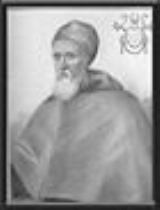
Pope Paul IV

Encyclopedia
Pope Paul IV, C.R.
(28 June 1476 – 18 August 1559), né Giovanni Pietro Carafa, was Pope
from 23 May 1555 until his death.
, near Avellino
, into a prominent noble family of Naples
. His father Giovanni Antonio Carafa died in West Flanders in 1516 and his mother Vittoria Camponeschi was the daughter of Pietro Lalle Camponeschi, 5th Conte di Montorio
, a Neapolitan
nobleman, and wife Dona
Maria de Noronha, a Portuguese
noblewoman of the House of Pereira
Senhores dos Lagares de El-Rei and Senhores de Paiva
, Baltar
e Cabeceiras de Basto
. His title in the Prophecy of St. Malachy is "Of the Faith of Peter."
, his relative, who resigned the see of Chieti (Latin Theate) in his favour. Under the direction of Pope Leo X
, he was ambassador to England and then papal nuncio
in Spain, where he conceived a violent detestation of Spanish rule that affected the policies of his later papacy.
However, in 1524, Pope Clement VII
allowed Carafa to resign his benefice
s and join the ascetic and newly founded Congregation of Clerks Regular, popularly called the Theatines
, after Carafa's see
of Theate. Following the sack of Rome
in 1527, the order moved to Venice
. But Carafa was recalled to Rome
by the reform-minded Pope Paul III
(1534–49), to sit on a committee of reform of the papal court, an appointment that forecast an end to a humanist
papacy, and a revival of scholasticism
, for Carafa was a thorough disciple of Thomas Aquinas
.
of S. Pancrazio and then Archbishop
of Naples
. He reorganised the Inquisition in Italy
.
(1555); his rigid, severe and unbending character combined with his age and patriotism meant he would have declined the honor. He accepted apparently because Emperor Charles V was opposed to his accession.
s disliked Paul IV and he allied with France, possibly against the true interests of the Papacy. He used the Holy Office to suppress the Spirituali
, a Catholic group that was deemed heretical. Among his first acts as Pope was to cut off Michelangelo
's pension, and he ordered the nudes of The Last Judgment in the Sistine Chapel
be painted more modestly (a request that Michelangelo promptly ignored). He also alienated Protestants in England and rejected the claim of Elizabeth I of England
to the Crown.
Paul IV strongly affirmed the Catholic dogma
of extra ecclesiam nulla salus
("Outside the Church there is no salvation"). The strengthening of the Inquisition continued under Paul IV, and few could consider themselves safe by virtue of position in his drive to reform the Church; even cardinals he disliked could be imprisoned.
In 1555 he issued a canon
(papal law), Cum Nimis Absurdum
, by which the Roman Ghetto
was created. Jews were then forced to live in seclusion in a specified area of the rione
Sant'Angelo
, locked in at night, and he decreed that Jews should wear a distinctive sign, yellow hats for men and veils or shawls for women. Jewish ghettos existed in Europe for the next 315 years.
Paul IV was violently opposed to the liberal Giovanni Cardinal Morone
whom he strongly suspected of being a hidden Protestant, so much that he had him imprisoned. In order to prevent Morone from succeeding him and imposing what he believed to be his Protestant beliefs on the Church, Pope Paul IV codified the Catholic Law excluding heretics and non-Catholics from receiving or legitimately becoming Pope, in the bull Cum ex apostolatus officio
.
Paul IV introduced the Index Librorum Prohibitorum
or "Index of Prohibited Books" to Venice
, then an independent and prosperous trading state, in order to crack down on the growing threat of Protestantism. Under his authority, all books written by Protestants were banned, together with Italian and German translations of the Latin Bible.
Like Pope Paul III
, he was an enemy of the Colonna family
. His treatment of Giovanna d'Aragona
, who had married into that family, drew further negative comment from Venice. This because she had long been a patron of artists and writers.
As was usual with Renaissance Popes, Paul IV sought to advance the fortunes of his family as well as that of the papacy. As Cardinal-nephew
, Carlo Carafa
became his uncle's chief adviser and the prime mover in their plans to ally with the French to expel the Spanish from Italy. Carlo's older brother Giovanni
was made commander of the papal forces and Duke of Paliano after the pro-Spanish Colonna
were deprived of that town in 1556. Another nephew, Antonio
, was given command of the Papal guard and made Marquis of Montebello. Their conduct became notorious in Rome. However at the conclusion of the disastrous war with Philip II of Spain
and after many scandals, in 1559 the Pope publicly disgraced his nephews and banished them from Rome.
but was later transferred to Santa Maria sopra Minerva
. His tomb at the Minerva, by Pirro Ligorio
, is dated 1559. It stands in the chapel created by his kinsman Cardinal Oliviero Carafa.
Having developed the Inquisition
brought him the rancor of Roman people who, after his death, decapitated his statue in Campidoglio and dedicated to him the following pasquinata:
Theatines
The Theatines or the Congregation of Clerks Regular of the Divine Providence are a male religious order of the Catholic Church, with the post-nominal initials "C.R."-Foundation:...
(28 June 1476 – 18 August 1559), né Giovanni Pietro Carafa, was Pope
Pope
The Pope is the Bishop of Rome, a position that makes him the leader of the worldwide Catholic Church . In the Catholic Church, the Pope is regarded as the successor of Saint Peter, the Apostle...
from 23 May 1555 until his death.
Early life
Giovanni Pietro Carafa was born in Capriglia IrpinaCapriglia Irpina
Capriglia Irpina is a town and comune in the province of Avellino, Campania, Italy....
, near Avellino
Avellino
Avellino is a town and comune, capital of the province of Avellino in the Campania region of southern Italy. It is situated in a plain surrounded by mountains 42 km north-east of Naples and is an important hub on the road from Salerno to Benevento.-History:Before the Roman conquest, the...
, into a prominent noble family of Naples
Naples
Naples is a city in Southern Italy, situated on the country's west coast by the Gulf of Naples. Lying between two notable volcanic regions, Mount Vesuvius and the Phlegraean Fields, it is the capital of the region of Campania and of the province of Naples...
. His father Giovanni Antonio Carafa died in West Flanders in 1516 and his mother Vittoria Camponeschi was the daughter of Pietro Lalle Camponeschi, 5th Conte di Montorio
Montorio nei Frentani
Montorio nei Frentani is a small town and comune in the province of Campobasso , in Southern Italy.-References:Montorio has one of the most amazing dialects in the Italian language....
, a Neapolitan
Naples
Naples is a city in Southern Italy, situated on the country's west coast by the Gulf of Naples. Lying between two notable volcanic regions, Mount Vesuvius and the Phlegraean Fields, it is the capital of the region of Campania and of the province of Naples...
nobleman, and wife Dona
Don (honorific)
Don, from Latin dominus, is an honorific in Spanish , Portuguese , and Italian . The female equivalent is Doña , Dona , and Donna , abbreviated "Dª" or simply "D."-Usage:...
Maria de Noronha, a Portuguese
Portuguese people
The Portuguese are a nation and ethnic group native to the country of Portugal, in the west of the Iberian peninsula of south-west Europe. Their language is Portuguese, and Roman Catholicism is the predominant religion....
noblewoman of the House of Pereira
Pereira (surname)
Pereira is a common surname in the Portuguese and Galician languages, namely in Portugal, Brazil, and Galicia. It was originally a noble Christian toponym of the Middle Ages, taken from the feudal possession of Pereira , which in Portuguese means 'pear tree'. The name also exists in variations such...
Senhores dos Lagares de El-Rei and Senhores de Paiva
Castelo de Paiva
Castelo de Paiva Municipality is located in the North East of Aveiro District in Portugal with a total area of 115.0 km² and a total population of 17,128 inhabitants...
, Baltar
Baltar (Paredes)
Baltar is a parish in Paredes Municipality in Portugal....
e Cabeceiras de Basto
Cabeceiras de Basto
Cabeceiras de Basto is a municipality in Portugal with a total area of 241.8 km² and a total population of 17,775 inhabitants.The municipality is composed of 17 parishes, and is located in the district of Braga District bordering the municipality of Montalegre to the north, Boticas to the...
. His title in the Prophecy of St. Malachy is "Of the Faith of Peter."
Bishop
He was mentored by Cardinal Oliviero CarafaOliviero Carafa
Oliviero Carafa was an Italian cardinal and diplomat of the Renaissance. Like the majority of his era's prelates, he displayed the lavish and conspicuous standard of living that was expected of a prince of the Church...
, his relative, who resigned the see of Chieti (Latin Theate) in his favour. Under the direction of Pope Leo X
Pope Leo X
Pope Leo X , born Giovanni di Lorenzo de' Medici, was the Pope from 1513 to his death in 1521. He was the last non-priest to be elected Pope. He is known for granting indulgences for those who donated to reconstruct St. Peter's Basilica and his challenging of Martin Luther's 95 Theses...
, he was ambassador to England and then papal nuncio
Nuncio
Nuncio is an ecclesiastical diplomatic title, derived from the ancient Latin word, Nuntius, meaning "envoy." This article addresses this title as well as derived similar titles, all within the structure of the Roman Catholic Church...
in Spain, where he conceived a violent detestation of Spanish rule that affected the policies of his later papacy.
However, in 1524, Pope Clement VII
Pope Clement VII
Clement VII , born Giulio di Giuliano de' Medici, was a cardinal from 1513 to 1523 and was Pope from 1523 to 1534.-Early life:...
allowed Carafa to resign his benefice
Benefice
A benefice is a reward received in exchange for services rendered and as a retainer for future services. The term is now almost obsolete.-Church of England:...
s and join the ascetic and newly founded Congregation of Clerks Regular, popularly called the Theatines
Theatines
The Theatines or the Congregation of Clerks Regular of the Divine Providence are a male religious order of the Catholic Church, with the post-nominal initials "C.R."-Foundation:...
, after Carafa's see
Episcopal See
An episcopal see is, in the original sense, the official seat of a bishop. This seat, which is also referred to as the bishop's cathedra, is placed in the bishop's principal church, which is therefore called the bishop's cathedral...
of Theate. Following the sack of Rome
Sack of Rome (1527)
The Sack of Rome on 6 May 1527 was a military event carried out by the mutinous troops of Charles V, Holy Roman Emperor in Rome, then part of the Papal States...
in 1527, the order moved to Venice
Venice
Venice is a city in northern Italy which is renowned for the beauty of its setting, its architecture and its artworks. It is the capital of the Veneto region...
. But Carafa was recalled to Rome
Rome
Rome is the capital of Italy and the country's largest and most populated city and comune, with over 2.7 million residents in . The city is located in the central-western portion of the Italian Peninsula, on the Tiber River within the Lazio region of Italy.Rome's history spans two and a half...
by the reform-minded Pope Paul III
Pope Paul III
Pope Paul III , born Alessandro Farnese, was Pope of the Roman Catholic Church from 1534 to his death in 1549. He came to the papal throne in an era following the sack of Rome in 1527 and rife with uncertainties in the Catholic Church following the Protestant Reformation...
(1534–49), to sit on a committee of reform of the papal court, an appointment that forecast an end to a humanist
Humanism
Humanism is an approach in study, philosophy, world view or practice that focuses on human values and concerns. In philosophy and social science, humanism is a perspective which affirms some notion of human nature, and is contrasted with anti-humanism....
papacy, and a revival of scholasticism
Scholasticism
Scholasticism is a method of critical thought which dominated teaching by the academics of medieval universities in Europe from about 1100–1500, and a program of employing that method in articulating and defending orthodoxy in an increasingly pluralistic context...
, for Carafa was a thorough disciple of Thomas Aquinas
Thomas Aquinas
Thomas Aquinas, O.P. , also Thomas of Aquin or Aquino, was an Italian Dominican priest of the Catholic Church, and an immensely influential philosopher and theologian in the tradition of scholasticism, known as Doctor Angelicus, Doctor Communis, or Doctor Universalis...
.
Cardinal
In January 1536 he was made Cardinal-PriestCardinal (Catholicism)
A cardinal is a senior ecclesiastical official, usually an ordained bishop, and ecclesiastical prince of the Catholic Church. They are collectively known as the College of Cardinals, which as a body elects a new pope. The duties of the cardinals include attending the meetings of the College and...
of S. Pancrazio and then Archbishop
Archbishop
An archbishop is a bishop of higher rank, but not of higher sacramental order above that of the three orders of deacon, priest , and bishop...
of Naples
Naples
Naples is a city in Southern Italy, situated on the country's west coast by the Gulf of Naples. Lying between two notable volcanic regions, Mount Vesuvius and the Phlegraean Fields, it is the capital of the region of Campania and of the province of Naples...
. He reorganised the Inquisition in Italy
Roman Inquisition
The Roman Inquisition was a system of tribunals developed by the Holy See during the second half of the 16th century, responsible for prosecuting individuals accused of a wide array of crimes related to heresy, including Protestantism, sorcery, immorality, blasphemy, Judaizing and witchcraft, as...
.
Election as pope
He was a surprise choice as pope to succeed Pope Marcellus IIPope Marcellus II
Pope Marcellus II , born Marcello Cervini degli Spannochi, was Pope from 9 April 1555 to 1 May 1555, succeeding Pope Julius III. Before his accession as Pope he had been Cardinal-Priest of Santa Croce in Gerusalemme. He is the most recent Pope to choose to retain his birth name as his regnal name...
(1555); his rigid, severe and unbending character combined with his age and patriotism meant he would have declined the honor. He accepted apparently because Emperor Charles V was opposed to his accession.
Papacy
As pope his nationalism was a driving force; he used the office to preserve some liberties in the face of fourfold foreign occupation. The HabsburgHabsburg
The House of Habsburg , also found as Hapsburg, and also known as House of Austria is one of the most important royal houses of Europe and is best known for being an origin of all of the formally elected Holy Roman Emperors between 1438 and 1740, as well as rulers of the Austrian Empire and...
s disliked Paul IV and he allied with France, possibly against the true interests of the Papacy. He used the Holy Office to suppress the Spirituali
Spirituali
The Spirituali were members of a reform movementwithin the Roman Catholic Church, which existed from the 1510s to the 1560s.The ranks of the Spirituali included Cardinal Gasparo Contarini , Cardinal Jacopo Sadoleto , Cardinal Reginald Pole , Italian poet Vittoria Colonna, and her friend, the artist...
, a Catholic group that was deemed heretical. Among his first acts as Pope was to cut off Michelangelo
Michelangelo
Michelangelo di Lodovico Buonarroti Simoni , commonly known as Michelangelo, was an Italian Renaissance painter, sculptor, architect, poet, and engineer who exerted an unparalleled influence on the development of Western art...
's pension, and he ordered the nudes of The Last Judgment in the Sistine Chapel
Sistine Chapel
Sistine Chapel is the best-known chapel in the Apostolic Palace, the official residence of the Pope in Vatican City. It is famous for its architecture and its decoration that was frescoed throughout by Renaissance artists including Michelangelo, Sandro Botticelli, Pietro Perugino, Pinturicchio...
be painted more modestly (a request that Michelangelo promptly ignored). He also alienated Protestants in England and rejected the claim of Elizabeth I of England
Elizabeth I of England
Elizabeth I was queen regnant of England and Ireland from 17 November 1558 until her death. Sometimes called The Virgin Queen, Gloriana, or Good Queen Bess, Elizabeth was the fifth and last monarch of the Tudor dynasty...
to the Crown.
Paul IV strongly affirmed the Catholic dogma
Dogma
Dogma is the established belief or doctrine held by a religion, or a particular group or organization. It is authoritative and not to be disputed, doubted, or diverged from, by the practitioners or believers...
of extra ecclesiam nulla salus
Extra Ecclesiam nulla salus
The Latin phrase Extra Ecclesiam nulla salus means: "Outside the Church there is no salvation". The most recent Catholic Catechism interpreted this to mean that "all salvation comes from Christ the Head through the Church which is his Body."...
("Outside the Church there is no salvation"). The strengthening of the Inquisition continued under Paul IV, and few could consider themselves safe by virtue of position in his drive to reform the Church; even cardinals he disliked could be imprisoned.
In 1555 he issued a canon
Canon law
Canon law is the body of laws & regulations made or adopted by ecclesiastical authority, for the government of the Christian organization and its members. It is the internal ecclesiastical law governing the Catholic Church , the Eastern and Oriental Orthodox churches, and the Anglican Communion of...
(papal law), Cum Nimis Absurdum
Cum nimis absurdum
Cum nimis absurdum was a papal bull issued by Pope Paul IV dated 14 July 1555. It takes its name from its first words: "Since it is absurd and utterly inconvenient that the Jews, who through their own fault were condemned by God to eternal slavery..."...
, by which the Roman Ghetto
Roman Ghetto
The Roman Ghetto was a ghetto located in the rione Sant'Angelo, in Rome, Italy, in the area surrounded by today's Via del Portico d'Ottavia, Lungotevere dei Cenci, Via del Progresso and Via di Santa Maria del Pianto close to the Tiber and the Theater of Marcellus...
was created. Jews were then forced to live in seclusion in a specified area of the rione
Rioni of Rome
A rione is an Italian term used since the Middle Ages to name the districts of Rome, according to the administrative divisions of that time. The word originates from the Latin word regio A rione (pl. rioni) is an Italian term used since the Middle Ages to name the districts of Rome, according to...
Sant'Angelo
Sant'Angelo (rione of Rome)
Sant'Angelo is the eleventh historic district or rione of Rome, often written as rione XI - Sant'Angelo. Its coat of arms is an angel on a red background, holding a palm branch in its left hand. In another version, the angel holds a sword in its right hand and a scale in its left.Sant'Angelo, the...
, locked in at night, and he decreed that Jews should wear a distinctive sign, yellow hats for men and veils or shawls for women. Jewish ghettos existed in Europe for the next 315 years.
Paul IV was violently opposed to the liberal Giovanni Cardinal Morone
Giovanni Morone
Giovanni Morone was an Italian cardinal. He was named Bishop of Modena in 1529 and was created Cardinal in 1542 by Pope Paul III...
whom he strongly suspected of being a hidden Protestant, so much that he had him imprisoned. In order to prevent Morone from succeeding him and imposing what he believed to be his Protestant beliefs on the Church, Pope Paul IV codified the Catholic Law excluding heretics and non-Catholics from receiving or legitimately becoming Pope, in the bull Cum ex apostolatus officio
Cum ex apostolatus officio
Cum ex Apostolatus Officio is the name of a papal bull issued by Pope Paul IV on February 15, 1559, as a codification or explicitation of the ancient Catholic law that only Catholics can be elected Popes, to the exclusion of non-Catholics, including former Catholics who have become public and...
.
Paul IV introduced the Index Librorum Prohibitorum
Index Librorum Prohibitorum
The Index Librorum Prohibitorum was a list of publications prohibited by the Catholic Church. A first version was promulgated by Pope Paul IV in 1559, and a revised and somewhat relaxed form was authorized at the Council of Trent...
or "Index of Prohibited Books" to Venice
Venice
Venice is a city in northern Italy which is renowned for the beauty of its setting, its architecture and its artworks. It is the capital of the Veneto region...
, then an independent and prosperous trading state, in order to crack down on the growing threat of Protestantism. Under his authority, all books written by Protestants were banned, together with Italian and German translations of the Latin Bible.
Like Pope Paul III
Pope Paul III
Pope Paul III , born Alessandro Farnese, was Pope of the Roman Catholic Church from 1534 to his death in 1549. He came to the papal throne in an era following the sack of Rome in 1527 and rife with uncertainties in the Catholic Church following the Protestant Reformation...
, he was an enemy of the Colonna family
Colonna family
The Colonna family is an Italian noble family; it was powerful in medieval and Renaissance Rome, supplying one Pope and many other Church and political leaders...
. His treatment of Giovanna d'Aragona
Giovanna d'Aragona
Giovanna d'Aragona was a patron of the arts, printers and religious reform in Naples during the Renaissance.-Family:She was the oldest daughter of Duke Ferdinando of Malteno and Castellana de Cardona. Her father was a younger son of Ferdinand I of Naples...
, who had married into that family, drew further negative comment from Venice. This because she had long been a patron of artists and writers.
As was usual with Renaissance Popes, Paul IV sought to advance the fortunes of his family as well as that of the papacy. As Cardinal-nephew
Cardinal-nephew
A cardinal-nephew is a cardinal elevated by a Pope who is that cardinal's uncle, or, more generally, his relative. The practice of creating cardinal-nephews originated in the Middle Ages, and reached its apex during the 16th and 17th centuries. The word nepotism originally referred specifically to...
, Carlo Carafa
Carlo Carafa
Carlo Carafa of a distinguished family of Naples, vicious and talented was successively condottiero in the service of France and of Spain, vying for their protectorates in Italy until 1555, when he was made a cardinal, to 1559 the all-powerful favourite and Cardinal Nephew of Pope Paul IV Carafa,...
became his uncle's chief adviser and the prime mover in their plans to ally with the French to expel the Spanish from Italy. Carlo's older brother Giovanni
Giovanni Carafa, Duke of Paliano
Giovanni Carafa , Duke of Paliano, was a papal nephew and minor Italian prince.The son of Giovanni Alfonso Carafa, Count of Montorio, and Caterina Cantelma, Giovanni came to prominence along with his brothers Carlo and Antonio when their uncle, Cardinal Giovanni Pietro Carafa, was elected Pope Paul...
was made commander of the papal forces and Duke of Paliano after the pro-Spanish Colonna
Colonna family
The Colonna family is an Italian noble family; it was powerful in medieval and Renaissance Rome, supplying one Pope and many other Church and political leaders...
were deprived of that town in 1556. Another nephew, Antonio
Antonio Carafa
Antoni Carafa was an Italian Roman Catholic Cardinal.-Early years:Antonio Carafa was born in Naples to Rinaldo I Carafello Carafa, a local patrician, and Giovanna of the signori of Montefalcone. He was a relative of Pope Paul IV through whose household he gained preferment in the Roman Curia.He...
, was given command of the Papal guard and made Marquis of Montebello. Their conduct became notorious in Rome. However at the conclusion of the disastrous war with Philip II of Spain
Philip II of Spain
Philip II was King of Spain, Portugal, Naples, Sicily, and, while married to Mary I, King of England and Ireland. He was lord of the Seventeen Provinces from 1556 until 1581, holding various titles for the individual territories such as duke or count....
and after many scandals, in 1559 the Pope publicly disgraced his nephews and banished them from Rome.
Death
He was buried in St. Peter's BasilicaSt. Peter's Basilica
The Papal Basilica of Saint Peter , officially known in Italian as ' and commonly known as Saint Peter's Basilica, is a Late Renaissance church located within the Vatican City. Saint Peter's Basilica has the largest interior of any Christian church in the world...
but was later transferred to Santa Maria sopra Minerva
Santa Maria sopra Minerva
The Basilica of Saint Mary Above Minerva is a titular minor basilica and one of the most important churches of the Roman Catholic Dominican order in Rome, Italy. The church, located in the Piazza della Minerva in the Campus Martius region, is considered the only Gothic church in Rome. It houses...
. His tomb at the Minerva, by Pirro Ligorio
Pirro Ligorio
Pirro Ligorio was an Italian architect, painter, antiquarian and garden designer.-Biography:Ligorio was born in Naples. In 1534 he moved to Rome, where he developed his interest in antiquities, and was named superintendent to the ancient monuments by the Popes Pius IV and Paul IV...
, is dated 1559. It stands in the chapel created by his kinsman Cardinal Oliviero Carafa.
Having developed the Inquisition
Inquisition
The Inquisition, Inquisitio Haereticae Pravitatis , was the "fight against heretics" by several institutions within the justice-system of the Roman Catholic Church. It started in the 12th century, with the introduction of torture in the persecution of heresy...
brought him the rancor of Roman people who, after his death, decapitated his statue in Campidoglio and dedicated to him the following pasquinata:
- Carafa hated by the devil and the sky
- is buried here with his rotting corpse,
- Erebus has taken the spirit;
- he hated peace on earth, our faith he contested.
- he ruined the church and the people, men and sky offended;
- treacherous friend, suppliant with the army which was fatal to him.
- You want to know more? Pope was him and that is enough.
Recent Bibliography
- Daniele Santarelli, Il papato di Paolo IV nella crisi politico-religiosa del Cinquecento: le relazioni con la Repubblica di Venezia e l’atteggiamento nei confronti di Carlo V e Filippo II, Rome, Aracne, 2008
- Massimo Firpo, Inquisizione romana e Controriforma. Studi sul cardinal Giovanni Morone (1509-1580) e il suo processo d'eresia, Brescia, Morcelliana, 2005
- Alberto Aubert, Paolo IV. Politica, Inquisizione e storiografia, Firenze, Le Lettere, 1999