

Italian Fascism

Encyclopedia
Italian Fascism also known as Fascism (Italian
: Fascismo) with a capital "F" refers to the original fascist
ideology in Italy
. This ideology is associated with the National Fascist Party
which under Benito Mussolini
ruled the Kingdom of Italy
from 1922 until 1943, the Republican Fascist Party
which ruled the Italian Social Republic
from 1943 to 1945, the post-war Italian Social Movement
, and subsequent Italian neo-fascist
movements.
Italian Fascism is based upon Italian nationalism
and the restoration of "Italia Irredenta" (claimed unredeemed Italian territories) to Italy and territorial expansionism
. Italian Fascists claim that modern Italy is the heir to the Roman Empire
and its legacy, and support the creation of "vital space
" for colonization by Italian settlers and establishing control over the Mediterranean Sea
as Italy's Mare Nostrum
as it had been under the Roman Empire.
Italian Fascism promotes a corporatist
economic system whereby employer and employee syndicate
s are linked together in a corporative associations to collectively represent the nation's economic producers and work alongside the state to set national economic policy. Italian Fascists claim that this economic system resolves and ends class conflict
by creating class collaboration
.
The ideology was founded during World War I
by Italian national syndicalists
who combined left-wing
and right-wing
political views, but fascism gravitated to the right in the early 1920s. Italian Fascists described fascism as a right-wing ideology in the political program The Doctrine of Fascism: "We are free to believe that this is the century of authority, a century tending to the 'right,' a fascist century." However they also officially declared that although they were "sitting on the right" they were generally indifferent to their position on the left-right spectrum, as being a conclusion of their combination of views rather than an objective, and considering it insignificant to their basis of their views that they claimed could just as easily be associated with "the mountain of the center
" as with the right. Mussolini himself claimed in 1919 that his new movement would strike "against the backwardness of the right and the destructiveness of the left".
Etymologically, Fascismo (Fascism) derives from the Italian fascio
(league), derived from the Latin fasces
(bundles); the ancient Roman Symbol of Authority. It dates from Mussolini’s January 1915 and the 1921 establishment of the National Fascist Party
begun as the fasci di combattimento (combat leagues) popular movement. The English fascism denotes the league connotation of the Italian fascio (fagot); in the Italian language, in denoting the political philosophy, the proper noun Fascismo (faʃˈʃizmo) is upper-case, and the generic, common noun fascismo (fascism) is lower-case.
philosopher Giovanni Gentile
, is the official formulation of Italian Fascism, published under Benito Mussolini’s name in 1933. Gentile was intellectually
influenced by Hegel
, Plato
, Benedetto Croce
, and Giambattista Vico
, as such, his Actual Idealism
philosophy was the basis for Fascism
. Hence, the Doctrine’s Weltanschauung proposes the world as action in the realm of Humanity
— beyond the quotidian constrictions of contemporary political trend, by rejecting “perpetual peace” as fantastical, and accepting Man
as a species continually at war
; those who meet the challenge, achieve nobility
. To wit, Actual Idealism generally accepted that conquerors were the men of historical consequence, e.g. the Roman Julius Caesar
, the Greek Alexander the Great, the German Charlemagne
, and the French (Corsican) Napoleon
; the philosopher–intellectual Gentile was especially inspired by the Roman Empire
(27 BC – AD 476, 1453), from whence derives Fascism
, thus:
Therefore, in 1925, Benito Mussolini
assumed the title Duce
(Leader), derived from the Latin dux
(leader), a Roman Republic
military-command title. Moreover, although Fascist Italy
(1922–43) is historically considered an authoritarian–totalitarian dictatorship
, it retained the original “liberal democratic” government façade: the Grand Council of Fascism
remained active as administrators; and King Victor Emmanuel III of Italy
could — at his Crown’s
risk — discretionarily dismiss Mussolini as Italian Prime Minister
, as, in the event, he did.
La dottrina del fascismo proposed an Italy of greater living standards under a single-party Fascist system, than under the multi-party liberal democratic
government of 1920. As the Leader of the National Fascist Party (PNF
— Partito Nazionale Fascista), Benito Mussolini said that democracy
is “beautiful in theory; in practice, it is a fallacy”, and spoke of celebrating the burial of the “putrid corpse of liberty”. In 1923, to give Deputy Mussolini control of the pluralist
parliament
ary government of the Kingdom of Italy
(1861–1946), an economist, the Baron Giacomo Acerbo
proposed — and the Italian Parliament approved — the Acerbo Law
, changing the electoral
system from proportional representation
to majority representation. The party who received the most votes (provided they possessed at least 25 per cent of cast votes), won two-thirds of the parliament; the remaining third was proportionately shared among the other parties — thus the Fascist manipulation of liberal democratic
law that rendered Italy a single-party State
.
In 1924, the National Fascist Party
won the election with 65 per cent of the votes; yet the United Socialist Party of Italy
refused to accept such a defeat — especially Deputy Giacomo Matteotti
who, on 30 May 1924, in Parliament formally accused the PNF of electoral fraud, and reiterated his denunciations of PNF Blackshirt political violence, and was publishing The Fascisti Exposed: A Year of Fascist Domination, a book substantiating his accusations. Consequently, on 24 June 1924, the Ceka (PNF secret police
) assassinated
the Parliament Deputy
; of the five men arrested, Amerigo Dumini
, aka Il Sicario del Duce (The Leader’s Assassin), was sentenced to five years’ imprisonment, yet served only eleven months, and was freed under amnesty from King
Victor Emmanuel III
. Moreover, when the King supported Prime Minister Mussolini, the socialists cried “Foul!”, and unwisely quit Parliament in protest — leaving the Fascists to govern Italy. In that time, assassination was not yet the modus operandi norm; the Italian Fascist Duce usually disposed of opponents in the Imperial Roman way: political arrest punished with island banishment
.
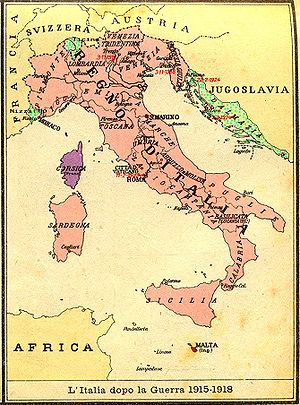
(1914–18), despite the Kingdom of Italy
(1861–1946) being a full-partner Allied Power
against the Central Powers
, Italian nationalism
claimed Italy was cheated in the Treaty of Saint-Germain-en-Laye (1919), thus the Allies had impeded Italy’s progress to becoming a “Great Power”. Thenceforth, the National Fascist Party
(PNF — Partito Nazionale Fascista) successfully exploited that “slight” to Italian nationalism
, in presenting Fascism
as best-suited for governing the country, by successfully claiming that democracy
, socialism
, and liberalism
were failed systems. The PNF assumed Italian government in 1922, consequent to the Fascist Leader Mussolini’s oratory and Blackshirt
paramilitary political violence.
In 1919, at the Paris Peace Conference
, the Allies compelled the Kingdom of Italy to yield to Yugoslavia the Croatian seaport of Fiume (Rijeka
), a mostly-Italian city of little nationalist significance, until early 1919. Moreover, elsewhere, Italy then was excluded from the wartime secret Treaty of London (1915) it had concorded with the Triple Entente
; wherein Italy was to leave the Triple Alliance
and join the enemy, by declaring war
against the German Empire
and Austria-Hungary
, in exchange for territories, at war’s end, upon which the Kingdom of Italy held claims. (see Italia irredenta
)
In September 1919, the nationalist response of outraged war hero Gabriele d'Annunzio
was declaring the establishment of the Italian Regency of Carnaro
. To his independent Italian state, he installed himself as the Regent Duce (Leader), and promulgated the Carta del Carnaro (Charter of Carnaro
, 8 September 1920 ), a politically-syncretic
constitution
al amalgamation of right-wing and left-wing anarchist
, proto-fascist
, and democratic republican
politics, which much influenced the politico-philosophic development of early Italian Fascism. Consequent to the Treaty of Rapallo
(1920) the metropolitan Italian military deposed the Regency of Duce D’Annunzio on Christmas 1920. In the development of the fascist model of government, Gabriele d’ Annunzio was a nationalist
, not a fascist, whose legacy of political–praxis (“Politics as Theatre”) was stylistic (ceremony, uniform, harangue, chanting), not substantive, which Italian Fascism artfully developed as a government model.
of left-wing
and right-wing
socio-economic policies, discontented workers and peasants proved an abundant source of popular political power, especially because of peasant opposition to socialist
agricultural collectivism. Thus armed, the former socialist Benito Mussolini oratorically inspired and mobilized country and working-class people: “We declare war on socialism, not because it is socialist, but because it has opposed nationalism
. . . . ” Moreover, for campaign financing, in the 1920–21 period, the National Fascist Party also courted the industrialists and (historically-feudal) landowners, by appealing to their fears of left-wing socialist and Bolshevik labor politics and urban and rural strikes
; the Fascists promised a good business climate of cost-effective labor, wage, and political stability; the Fascist Party was en route to power; the historian Charles F. Delzell reports:
(1914–18) inflated
Italy’s economy with great debts, unemployment
(aggravated by thousands of demobilised soldiers), social discontent featuring strike
s, organised crime, and anarchist
, Socialist
, and Communist
insurrections. When the elected Italian Liberal Party
Government could not control Italy, the Fascist Revolutionary Party (FRP) Leader Benito Mussolini
took matters in hand, combating those societal ills with the Blackshirts
, paramilitary squads of Great War veterans and ex-socialists; Prime Minister
s such as Giovanni Giolitti
allowed the Fascist’s taking the law in hand. The Liberal Government preferred Fascist class collaboration
to the Communist Party of Italy
’s bloody class conflict
, should they assume government, as had Lenin’s Bolsheviks in the recent Russian Revolution of 1917. The Manifesto of the Fascist Struggle (June 1919) of the FRP presented the politico-philosophic tenets of Fascism
; it included women's suffrage
, a minimum wage
, an eight-hour workday, and reorganisation of public transport. Appeasing its initially strong feminist wing, the Fascist party actually bowed in November 1925, allowing the introduction of limited women's suffrage, much to the dismay of Fascist feminists.
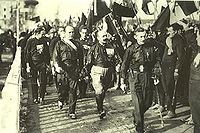 By the early 1920s, popular support for the Fascist Revolutionary Party’s fight against Bolshevism numbered some 250,000 people. In 1921, the Fascisti (Fascists) metamorphosed into the National Fascist Party
, and achieved political legitimacy when Benito Mussolini was elected to the Chamber of Deputies
in 1922. Although the Liberal Party retained power, the governing prime ministries
proved ephemeral, especially that of the fifth Prime Minister Luigi Facta
, whose government proved vacillating. To depose
the weak parliamentary democracy
, Deputy Mussolini (with military, business, and liberal right-wing support) launched the PNF March on Rome
(27–29 October 1922) coup d’État
, to oust Prime Minister Facta
, and assume the government of Italy, to restore nationalist
pride, re-start the economy
, increase productivity with labor controls, remove economic business controls, and impose law and order
. On 28 October, whilst the “March” occurred, King Victor Emmanuel III
withdrew his support of Prime Minister Facta, and appointed PNF Leader Benito Mussolini as the Sixth Prime Minister of Italy
. the March on Rome became a victory parade, the Fascists believed their success was revolutionary
and traditionalist
.
Alberto de Stefani
ended his tenure as Minister of Economics (1922–25), after having re-started the economy and balanced the national budget, the Italian Fascist Government’s economic policies were aligned with classical liberalism
principles; inheritance
, luxury
, and foreign capital taxes were abolished; life insurance
(1923), and the state communications monopolies were privatised, et cetera. Yet such pro-business enterprise policies apparently did not contradict the State’s financing of banks and industry.
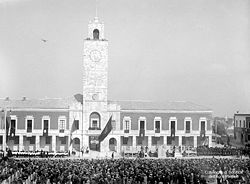 Privatisation — One of Prime Minister Mussolini’s first acts was the 400-million-Lira financing of Gio. Ansaldo & C.
, one of the country’s most important engineering
companies. Subsequent to the 1926 deflation crisis, banks such as the Banco di Roma (Bank of Rome), the Banco di Napoli (Bank of Naples), and the Banco di Sicilia (Bank of Sicily) also were state-financed. In 1924, a private business enterprise established the Unione Radiofonica Italiana (URI — Italian Radiophonic Union), as part of the Marconi
group, to which the Italian Fascist Government granted official radio-broadcast monopoly
; after the Second World War, URI became the Radio Audizioni Italiane (RAI — Italian Radio Audience, 1954–54), then the Radiotelevisione Italiana (RAI — Italian Radiotelevision).
Agriculture — To strengthen the domestic Italian production of grain, in 1925, the Fascist Government established protectionist policies that ultimately failed (see: the Battle for Grain
); historian Denis Mack Smith
reports that: “Success in this battle was . . . another illusory propaganda victory, won at the expense of the Italian economy in general, and consumers in particular. . . Those who gained were the owners of the Latifondia, and the propertied classes in general . . . [Mussolini’s] policy conferred a heavy subsidy on the Latifondisti.”
Industry — The Fascist Government countered the Great Depression
with public works
programs, such as the draining of the Pontine Marshes
, hydroelectricity
development, railway improvement, and rearmament. In 1933, the Istituto per la Ricostruzione Industriale
(IRI — Institute for Industrial Reconstruction) was established to subsidize failing companies, and soon controlled important portions of the national economy via government-linked companies, among them Alfa Romeo
. The Italian economy’s Gross National Product
increased 2 per cent; automobile production was increased, especially that of the Fiat
motor company, and the aeronautical industry was developing. Prime Minister Mussolini also advocated agrarianism
as part of the battles for Land
, the Lira
, and Grain
. As Prime Minister, Benito Mussolini physically participated with the workers in doing the work; the “politics as theatre” legacy of Gabriele D’ Anunzio yielded great propaganda
images of Il Duce as “Man of the People”.
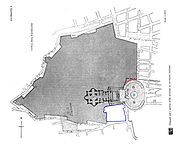
, Benito Mussolini concluded the unresolved Church–State conflict of the Roman Question
(La Questione romana, pending since the Risorgimento, 1815–71) with the Lateran Treaty (February 1929), between the Kingdom of Italy
and the Holy See
, establishing the Vatican City
microstate
in Rome. In exchange for diplomatic recognition of the Vatican City and compensated territorial losses, the Fascist Government established Roman Catholic religious education in every education level; the Vatican would diplomatically recognize the Italian Fascist State.
Moreover, to render the Italian people cosmopolitan, the Fascist Government applied every cultural artefact — from postage stamp
s to monument
al architecture
to sculpture — in making every social class conscious of Italy's cultural heritage, namely the Roman
, Mediæval, Renaissance
, and Baroque
periods, and the Modern age. The Fascist Government combated organised crime
and the Mafia
with violence and vendetta
(honour). Mussolini’s establishment of law and order to Italy and its society was praised by Winston Churchill
, Sigmund Freud
, George Bernard Shaw
, and Thomas Edison
.
, Il Duce, Prime Minister Benito Mussolini, perceived himself as a contemporary Roman Emperor
, and set to establishing a new Italian Empire
. With an expansionist and militarian agenda, Italian colonialism
penetrated Africa in competition with the British
and French
empires. The first Italian Fascist colony was Eritrea
, in East Africa; then Libya
, Somalia
, and Ethiopia
. The Fascists ruled via authoritarian
government, especially in combating insurgents
and guerrillas attempting to expel the Italians from their colonized countries; Omar Mukhtar
was a notable Libyan example.
 Moreover, Italian Fascism was (officially) neither atheist
nor racist
— provided the colonized folk agreed to Italianisation
and swore fealty to Il Duce, (See: Racial classification). Just as Italian Jews
were allowed membership in the National Fascist Party, in metropolitan Italy, in the Libyan
colony, Muslim
s were Fascist Party members via the Muslim Association of the Lictor
. In a unity ceremony, a Libyan chief awarded Prime Minister Mussolini an ancient Yemen
i Sword of Islam artefact. East Africans were allowed to serve with Italians in the MVSN Colonial Militia
.
To fulfil Italian unification
, Fascist imperialism
included the Italia irredenta
(Irredentist Italy) demand of Italian ethnic integrity — recovering all lands previously annexed to the states incorporated to Italy. Said revanchism
included the County of Nice
, part of the Kingdom of Sardinia
until 1860, the Duchy of Savoy
, Corsica
, part of the Republic of Genoa
until 1768, Dalmatia
, part of the Republic of Venice
until 1797, and the island of Malta
, part of the Kingdom of Sicily
until 1530.
To prepare the Italians for military conquest, Mussolini's agenda became radical in the 1930s; seeking a physically fit and psychologically tough imperialist people to establish a modern Italian Empire, like the Roman Empire
, he advocated discarding formalities of language, thought, and action; a coarse mind and hard body suited for aggressive war
. The radical social change to Italian society signalled greater ideologic affinity with Nazi Germany
in international diplomacy, given Nazi approval of Italian Fascist imperial ambitions. Moreover, whilst in Germany, on 27 January 1938, an impressed Mussolini observed Wehrmacht
soldiers march in goose-step. Upon returning to Italy, he adopted that marching style for his military, and also promulgated legal Anti-Semitism in the Manifesto of Race in July 1938, stripping Jews of Italian citizenship
and with it any position in the government or previously held professions. The changes were partly unwelcome, because the Italians were not especially hateful of Jews, and thus were wary of such a cultural imposition, because of a strong German Nazi–Italian Fascist relations. Despite parallels between Nazi Germany
’s racist domestic and foreign policies with those of Italy, Il Duce Mussolini was inconsistent about the application of racism in society. Despite, in the 1920s, having emphasized the importance of “race”, speaking in racialist
terms about white
–coloured relations, stating that the races are in continual competition:
Yet in the 1933–34 period, when political tensions between Fascist Italy and Nazi Germany occurred over Austrian independence, PM Mussolini opportunistically
contradicted his earlier claims about the importance of race, by dismissing it as insignificant:
and philosophers sought ideologic
inspiration from Italy. Italian Fascism was copied by Adolf Hitler
's Nazi Party, the Russian Fascist Organization
, the Romanian National Fascist Movement
(the National Romanian Fascia
, National Italo-Romanian Cultural and Economic Movement
), the Dutch fascists based upon the Verbond van Actualisten journal of H. A. Sinclair de Rochemont
and Alfred Haighton
. The Sammarinese Fascist Party
established an early Fascist government in San Marino
, their politico-philosophic basis essentially was Italian Fascism.
Switzerland — pro-Nazi
Colonel Arthur Fonjallaz
of the National Front
, became an ardent Mussolini admirer after visiting Italy in 1932. He advocated the Italian annexation of Switzerland, whilst receiving Fascist foreign aid. The country was host for two Italian politico-cultural activities: the International Centre for Fascist Studies (CINEF — Centre International d’ Études Fascistes), and the 1934 congress of the Action Committee for the Universality of Rome (CAUR — Comitato d’ Azione della Università de Roma).
Spain — The writer Ernesto Giménez Caballero
, in Genio de España (The Genius of Spain, 1932) called for the Italian annexation of Spain, led by Mussolini presiding an international Latin Roman Catholic empire
. He then progressed to close associated with Falangism
, leading to discarding the Spanish annexation to Italy.
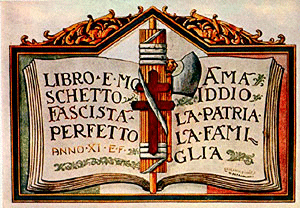 Some Italian Fascism motto
es and slogan
s that taught the fascist citizen to abide responsibility to the State
:
Italian language
Italian is a Romance language spoken mainly in Europe: Italy, Switzerland, San Marino, Vatican City, by minorities in Malta, Monaco, Croatia, Slovenia, France, Libya, Eritrea, and Somalia, and by immigrant communities in the Americas and Australia...
: Fascismo) with a capital "F" refers to the original fascist
Fascism
Fascism is a radical authoritarian nationalist political ideology. Fascists seek to rejuvenate their nation based on commitment to the national community as an organic entity, in which individuals are bound together in national identity by suprapersonal connections of ancestry, culture, and blood...
ideology in Italy
Italy
Italy , officially the Italian Republic languages]] under the European Charter for Regional or Minority Languages. In each of these, Italy's official name is as follows:;;;;;;;;), is a unitary parliamentary republic in South-Central Europe. To the north it borders France, Switzerland, Austria and...
. This ideology is associated with the National Fascist Party
National Fascist Party
The National Fascist Party was an Italian political party, created by Benito Mussolini as the political expression of fascism...
which under Benito Mussolini
Benito Mussolini
Benito Amilcare Andrea Mussolini was an Italian politician who led the National Fascist Party and is credited with being one of the key figures in the creation of Fascism....
ruled the Kingdom of Italy
Kingdom of Italy (1861–1946)
The Kingdom of Italy was a state forged in 1861 by the unification of Italy under the influence of the Kingdom of Sardinia, which was its legal predecessor state...
from 1922 until 1943, the Republican Fascist Party
Republican Fascist Party
The Republican Fascist Party was a political party led by Benito Mussolini during the German occupation of Central and Northern Italy. It was founded as the successor of former National Fascist Party as an anti-monarchist party...
which ruled the Italian Social Republic
Italian Social Republic
The Italian Social Republic was a puppet state of Nazi Germany led by the "Duce of the Nation" and "Minister of Foreign Affairs" Benito Mussolini and his Republican Fascist Party. The RSI exercised nominal sovereignty in northern Italy but was largely dependent on the Wehrmacht to maintain control...
from 1943 to 1945, the post-war Italian Social Movement
Italian Social Movement
The Italian Social Movement , and later the Italian Social Movement–National Right , was a neo-fascist and post-fascist political party in Italy. Formed in 1946 by supporters of former Italian dictator Benito Mussolini, the party became the fourth largest party in Italy by the early 1960s...
, and subsequent Italian neo-fascist
Neo-Fascism
Neo-fascism is a post–World War II ideology that includes significant elements of fascism. The term neo-fascist may apply to groups that express a specific admiration for Benito Mussolini and Italian Fascism or any other fascist leader/state...
movements.
Italian Fascism is based upon Italian nationalism
Italian nationalism
Italian nationalism refers to the nationalism of Italians or of Italian culture. It claims that Italians are the ethnic, cultural, and linguistic descendants of the ancient Romans who inhabited the Italian Peninsula for centuries. The origins of Italian nationalism have been traced to the...
and the restoration of "Italia Irredenta" (claimed unredeemed Italian territories) to Italy and territorial expansionism
Expansionism
In general, expansionism consists of expansionist policies of governments and states. While some have linked the term to promoting economic growth , more commonly expansionism refers to the doctrine of a state expanding its territorial base usually, though not necessarily, by means of military...
. Italian Fascists claim that modern Italy is the heir to the Roman Empire
Roman Empire
The Roman Empire was the post-Republican period of the ancient Roman civilization, characterised by an autocratic form of government and large territorial holdings in Europe and around the Mediterranean....
and its legacy, and support the creation of "vital space
Spazio vitale
Spazio vitale was the territorial expansionist concept of Italian Fascism. It is similar to the German Nazi Party's concept of lebensraum...
" for colonization by Italian settlers and establishing control over the Mediterranean Sea
Mediterranean Sea
The Mediterranean Sea is a sea connected to the Atlantic Ocean surrounded by the Mediterranean region and almost completely enclosed by land: on the north by Anatolia and Europe, on the south by North Africa, and on the east by the Levant...
as Italy's Mare Nostrum
Mare Nostrum
Mare Nostrum may refer to:*Mare Nostrum, the Roman term for the Mediterranean Sea, adopted by Italian nationalists and fascists.*Mare Nostrum , a Spanish-language novel by Vicente Blasco Ibáñez...
as it had been under the Roman Empire.
Italian Fascism promotes a corporatist
Corporatism
Corporatism, also known as corporativism, is a system of economic, political, or social organization that involves association of the people of society into corporate groups, such as agricultural, business, ethnic, labor, military, patronage, or scientific affiliations, on the basis of common...
economic system whereby employer and employee syndicate
Syndicate
A syndicate is a self-organizing group of individuals, companies or entities formed to transact some specific business, or to promote a common interest or in the case of criminals, to engage in organized crime...
s are linked together in a corporative associations to collectively represent the nation's economic producers and work alongside the state to set national economic policy. Italian Fascists claim that this economic system resolves and ends class conflict
Class conflict
Class conflict is the tension or antagonism which exists in society due to competing socioeconomic interests between people of different classes....
by creating class collaboration
Class collaboration
Class collaboration is a principle of social organization based upon the belief that the division of society into a hierarchy of social classes is a positive and essential aspect of civilization.-Class collaboration under capitalism:...
.
The ideology was founded during World War I
World War I
World War I , which was predominantly called the World War or the Great War from its occurrence until 1939, and the First World War or World War I thereafter, was a major war centred in Europe that began on 28 July 1914 and lasted until 11 November 1918...
by Italian national syndicalists
National syndicalism
National syndicalism is a nationalist variant of syndicalism.- Founding of national syndicalism in France :National syndicalism was founded in France by the fusion of Maurrassian integral nationalism with Sorelian syndicalism. Interest in Sorelian thought arose in the French political right,...
who combined left-wing
Left-wing politics
In politics, Left, left-wing and leftist generally refer to support for social change to create a more egalitarian society...
and right-wing
Right-wing politics
In politics, Right, right-wing and rightist generally refer to support for a hierarchical society justified on the basis of an appeal to natural law or tradition. To varying degrees, the Right rejects the egalitarian objectives of left-wing politics, claiming that the imposition of equality is...
political views, but fascism gravitated to the right in the early 1920s. Italian Fascists described fascism as a right-wing ideology in the political program The Doctrine of Fascism: "We are free to believe that this is the century of authority, a century tending to the 'right,' a fascist century." However they also officially declared that although they were "sitting on the right" they were generally indifferent to their position on the left-right spectrum, as being a conclusion of their combination of views rather than an objective, and considering it insignificant to their basis of their views that they claimed could just as easily be associated with "the mountain of the center
Centrism
In politics, centrism is the ideal or the practice of promoting policies that lie different from the standard political left and political right. Most commonly, this is visualized as part of the one-dimensional political spectrum of left-right politics, with centrism landing in the middle between...
" as with the right. Mussolini himself claimed in 1919 that his new movement would strike "against the backwardness of the right and the destructiveness of the left".
Etymologically, Fascismo (Fascism) derives from the Italian fascio
Fascio
Fascio, plural -sci /'faʃʃo, ʃi/ is an Italian word literally meaning "a bundle" or "a sheaf", and figuratively league, and which was used in the late 19th century to refer to political groups of many different orientations...
(league), derived from the Latin fasces
Fasces
Fasces are a bundle of wooden sticks with an axe blade emerging from the center, which is an image that traditionally symbolizes summary power and jurisdiction, and/or "strength through unity"...
(bundles); the ancient Roman Symbol of Authority. It dates from Mussolini’s January 1915 and the 1921 establishment of the National Fascist Party
National Fascist Party
The National Fascist Party was an Italian political party, created by Benito Mussolini as the political expression of fascism...
begun as the fasci di combattimento (combat leagues) popular movement. The English fascism denotes the league connotation of the Italian fascio (fagot); in the Italian language, in denoting the political philosophy, the proper noun Fascismo (faʃˈʃizmo) is upper-case, and the generic, common noun fascismo (fascism) is lower-case.
Doctrine
The Doctrine of Fascism (La dottrina del fascismo, 1932), by the ActualistActual Idealism
Actual Idealism was a form of idealism, developed by Giovanni Gentile, that grew into a 'grounded' idealism, contrasting the Transcendental Idealism of Immanuel Kant, and the Absolute idealism of G. W. F. Hegel...
philosopher Giovanni Gentile
Giovanni Gentile
Giovanni Gentile was an Italian neo-Hegelian Idealist philosopher, a peer of Benedetto Croce. He described himself as 'the philosopher of Fascism', and ghostwrote A Doctrine of Fascism for Benito Mussolini. He also devised his own system of philosophy, Actual Idealism.- Life and thought :Giovanni...
, is the official formulation of Italian Fascism, published under Benito Mussolini’s name in 1933. Gentile was intellectually
Intellectualism
Intellectualism denotes the use and development of the intellect, the practice of being an intellectual, and of holding intellectual pursuits in great regard. Moreover, in philosophy, “intellectualism” occasionally is synonymous with “rationalism”, i.e. knowledge derived mostly from reason and...
influenced by Hegel
Georg Wilhelm Friedrich Hegel
Georg Wilhelm Friedrich Hegel was a German philosopher, one of the creators of German Idealism. His historicist and idealist account of reality as a whole revolutionized European philosophy and was an important precursor to Continental philosophy and Marxism.Hegel developed a comprehensive...
, Plato
Plato
Plato , was a Classical Greek philosopher, mathematician, student of Socrates, writer of philosophical dialogues, and founder of the Academy in Athens, the first institution of higher learning in the Western world. Along with his mentor, Socrates, and his student, Aristotle, Plato helped to lay the...
, Benedetto Croce
Benedetto Croce
Benedetto Croce was an Italian idealist philosopher, and occasionally also politician. He wrote on numerous topics, including philosophy, history, methodology of history writing and aesthetics, and was a prominent liberal, although he opposed laissez-faire free trade...
, and Giambattista Vico
Giambattista Vico
Giovanni Battista ' Vico or Vigo was an Italian political philosopher, rhetorician, historian, and jurist....
, as such, his Actual Idealism
Actual Idealism
Actual Idealism was a form of idealism, developed by Giovanni Gentile, that grew into a 'grounded' idealism, contrasting the Transcendental Idealism of Immanuel Kant, and the Absolute idealism of G. W. F. Hegel...
philosophy was the basis for Fascism
Fascism
Fascism is a radical authoritarian nationalist political ideology. Fascists seek to rejuvenate their nation based on commitment to the national community as an organic entity, in which individuals are bound together in national identity by suprapersonal connections of ancestry, culture, and blood...
. Hence, the Doctrine’s Weltanschauung proposes the world as action in the realm of Humanity
Mankind
Mankind may refer to:* The human species* Mankind , a 15th century morality play* Mankind , a 1998 massively multiplayer online real-time strategy game* Mankind , an album by Factory 81...
— beyond the quotidian constrictions of contemporary political trend, by rejecting “perpetual peace” as fantastical, and accepting Man
Man
The term man is used for an adult human male . However, man is sometimes used to refer to humanity as a whole...
as a species continually at war
War
War is a state of organized, armed, and often prolonged conflict carried on between states, nations, or other parties typified by extreme aggression, social disruption, and usually high mortality. War should be understood as an actual, intentional and widespread armed conflict between political...
; those who meet the challenge, achieve nobility
Nobility
Nobility is a social class which possesses more acknowledged privileges or eminence than members of most other classes in a society, membership therein typically being hereditary. The privileges associated with nobility may constitute substantial advantages over or relative to non-nobles, or may be...
. To wit, Actual Idealism generally accepted that conquerors were the men of historical consequence, e.g. the Roman Julius Caesar
Julius Caesar
Gaius Julius Caesar was a Roman general and statesman and a distinguished writer of Latin prose. He played a critical role in the gradual transformation of the Roman Republic into the Roman Empire....
, the Greek Alexander the Great, the German Charlemagne
Charlemagne
Charlemagne was King of the Franks from 768 and Emperor of the Romans from 800 to his death in 814. He expanded the Frankish kingdom into an empire that incorporated much of Western and Central Europe. During his reign, he conquered Italy and was crowned by Pope Leo III on 25 December 800...
, and the French (Corsican) Napoleon
Napoleon I of France
Napoleon Bonaparte was a French military and political leader during the latter stages of the French Revolution.As Napoleon I, he was Emperor of the French from 1804 to 1815...
; the philosopher–intellectual Gentile was especially inspired by the Roman Empire
Roman Empire
The Roman Empire was the post-Republican period of the ancient Roman civilization, characterised by an autocratic form of government and large territorial holdings in Europe and around the Mediterranean....
(27 BC – AD 476, 1453), from whence derives Fascism
Fascism
Fascism is a radical authoritarian nationalist political ideology. Fascists seek to rejuvenate their nation based on commitment to the national community as an organic entity, in which individuals are bound together in national identity by suprapersonal connections of ancestry, culture, and blood...
, thus:
Therefore, in 1925, Benito Mussolini
Benito Mussolini
Benito Amilcare Andrea Mussolini was an Italian politician who led the National Fascist Party and is credited with being one of the key figures in the creation of Fascism....
assumed the title Duce
Duce
Duce is an Italian title, derived from the Latin word dux, and cognate with duke. National Fascist Party leader Benito Mussolini was identified by Fascists as Il Duce of the movement and became a reference to the dictator position of Head of Government and Duce of Fascism of Italy was established...
(Leader), derived from the Latin dux
Dux
Dux is Latin for leader and later for Duke and its variant forms ....
(leader), a Roman Republic
Roman Republic
The Roman Republic was the period of the ancient Roman civilization where the government operated as a republic. It began with the overthrow of the Roman monarchy, traditionally dated around 508 BC, and its replacement by a government headed by two consuls, elected annually by the citizens and...
military-command title. Moreover, although Fascist Italy
Kingdom of Italy (1861–1946)
The Kingdom of Italy was a state forged in 1861 by the unification of Italy under the influence of the Kingdom of Sardinia, which was its legal predecessor state...
(1922–43) is historically considered an authoritarian–totalitarian dictatorship
Dictatorship
A dictatorship is defined as an autocratic form of government in which the government is ruled by an individual, the dictator. It has three possible meanings:...
, it retained the original “liberal democratic” government façade: the Grand Council of Fascism
Grand Council of Fascism
The Grand Council of Fascism was the main body of Mussolini's Fascist government in Italy. A body which held and applied great power to control the institutions of government, it was created as a party body in 1923 and became a state body on 9 December 1928....
remained active as administrators; and King Victor Emmanuel III of Italy
Victor Emmanuel III of Italy
Victor Emmanuel III was a member of the House of Savoy and King of Italy . In addition, he claimed the crowns of Ethiopia and Albania and claimed the titles Emperor of Ethiopia and King of Albania , which were unrecognised by the Great Powers...
could — at his Crown’s
House of Savoy
The House of Savoy was formed in the early 11th century in the historical Savoy region. Through gradual expansion, it grew from ruling a small county in that region to eventually rule the Kingdom of Italy from 1861 until the end of World War II, king of Croatia and King of Armenia...
risk — discretionarily dismiss Mussolini as Italian Prime Minister
Prime minister of Italy
The Prime Minister of Italy is the head of government of the Italian Republic...
, as, in the event, he did.
La dottrina del fascismo proposed an Italy of greater living standards under a single-party Fascist system, than under the multi-party liberal democratic
Liberal democracy
Liberal democracy, also known as constitutional democracy, is a common form of representative democracy. According to the principles of liberal democracy, elections should be free and fair, and the political process should be competitive...
government of 1920. As the Leader of the National Fascist Party (PNF
National Fascist Party
The National Fascist Party was an Italian political party, created by Benito Mussolini as the political expression of fascism...
— Partito Nazionale Fascista), Benito Mussolini said that democracy
Democracy
Democracy is generally defined as a form of government in which all adult citizens have an equal say in the decisions that affect their lives. Ideally, this includes equal participation in the proposal, development and passage of legislation into law...
is “beautiful in theory; in practice, it is a fallacy”, and spoke of celebrating the burial of the “putrid corpse of liberty”. In 1923, to give Deputy Mussolini control of the pluralist
Pluralism (political theory)
Classical pluralism is the view that politics and decision making are located mostly in the framework of government, but that many non-governmental groups use their resources to exert influence. The central question for classical pluralism is how power and influence is distributed in a political...
parliament
Parliament
A parliament is a legislature, especially in those countries whose system of government is based on the Westminster system modeled after that of the United Kingdom. The name is derived from the French , the action of parler : a parlement is a discussion. The term came to mean a meeting at which...
ary government of the Kingdom of Italy
Kingdom of Italy (1861–1946)
The Kingdom of Italy was a state forged in 1861 by the unification of Italy under the influence of the Kingdom of Sardinia, which was its legal predecessor state...
(1861–1946), an economist, the Baron Giacomo Acerbo
Giacomo Acerbo
Giacomo Acerbo, Baron of Aterno was an Italian economist and Fascist politician that drafted the Acerbo Law which solidified Benito Mussolini's position once in power.-Early life:...
proposed — and the Italian Parliament approved — the Acerbo Law
Acerbo Law
The Acerbo Law was an Italian electoral law proposed by Baron Giacomo Acerbo and passed by the Italian Parliament in 1924. The purpose of it was to give Mussolini's fascist party a majority of deputies.-Background:...
, changing the electoral
Election
An election is a formal decision-making process by which a population chooses an individual to hold public office. Elections have been the usual mechanism by which modern representative democracy operates since the 17th century. Elections may fill offices in the legislature, sometimes in the...
system from proportional representation
Proportional representation
Proportional representation is a concept in voting systems used to elect an assembly or council. PR means that the number of seats won by a party or group of candidates is proportionate to the number of votes received. For example, under a PR voting system if 30% of voters support a particular...
to majority representation. The party who received the most votes (provided they possessed at least 25 per cent of cast votes), won two-thirds of the parliament; the remaining third was proportionately shared among the other parties — thus the Fascist manipulation of liberal democratic
Liberal democracy
Liberal democracy, also known as constitutional democracy, is a common form of representative democracy. According to the principles of liberal democracy, elections should be free and fair, and the political process should be competitive...
law that rendered Italy a single-party State
Single-party state
A single-party state, one-party system or single-party system is a type of party system government in which a single political party forms the government and no other parties are permitted to run candidates for election...
.
In 1924, the National Fascist Party
National Fascist Party
The National Fascist Party was an Italian political party, created by Benito Mussolini as the political expression of fascism...
won the election with 65 per cent of the votes; yet the United Socialist Party of Italy
United Socialist Party (Italy, 1922–1930)
The United Socialist Party was a social-democratic political party in Italy, active from 1922 to 1930....
refused to accept such a defeat — especially Deputy Giacomo Matteotti
Giacomo Matteotti
Giacomo Matteotti was an Italian socialist politician. On 30 May 1924, he openly spoke in the Italian Parliament alleging the Fascists committed fraud in the recently held elections, and denounced the violence they used to gain votes...
who, on 30 May 1924, in Parliament formally accused the PNF of electoral fraud, and reiterated his denunciations of PNF Blackshirt political violence, and was publishing The Fascisti Exposed: A Year of Fascist Domination, a book substantiating his accusations. Consequently, on 24 June 1924, the Ceka (PNF secret police
Secret police
Secret police are a police agency which operates in secrecy and beyond the law to protect the political power of an individual dictator or an authoritarian political regime....
) assassinated
Assassination
To carry out an assassination is "to murder by a sudden and/or secret attack, often for political reasons." Alternatively, assassination may be defined as "the act of deliberately killing someone, especially a public figure, usually for hire or for political reasons."An assassination may be...
the Parliament Deputy
Italian Chamber of Deputies
The Italian Chamber of Deputies is the lower house of the Parliament of Italy. It has 630 seats, a plurality of which is controlled presently by liberal-conservative party People of Freedom. Twelve deputies represent Italian citizens outside of Italy. Deputies meet in the Palazzo Montecitorio. A...
; of the five men arrested, Amerigo Dumini
Amerigo Dumini
Amerigo Dumini was an American-born Italian fascist activist who led the group responsible for the 1924 assassination of United Socialist Party leader Giacomo Matteotti.-Biography:Born in St...
, aka Il Sicario del Duce (The Leader’s Assassin), was sentenced to five years’ imprisonment, yet served only eleven months, and was freed under amnesty from King
House of Savoy
The House of Savoy was formed in the early 11th century in the historical Savoy region. Through gradual expansion, it grew from ruling a small county in that region to eventually rule the Kingdom of Italy from 1861 until the end of World War II, king of Croatia and King of Armenia...
Victor Emmanuel III
Victor Emmanuel III of Italy
Victor Emmanuel III was a member of the House of Savoy and King of Italy . In addition, he claimed the crowns of Ethiopia and Albania and claimed the titles Emperor of Ethiopia and King of Albania , which were unrecognised by the Great Powers...
. Moreover, when the King supported Prime Minister Mussolini, the socialists cried “Foul!”, and unwisely quit Parliament in protest — leaving the Fascists to govern Italy. In that time, assassination was not yet the modus operandi norm; the Italian Fascist Duce usually disposed of opponents in the Imperial Roman way: political arrest punished with island banishment
Exile
Exile means to be away from one's home , while either being explicitly refused permission to return and/or being threatened with imprisonment or death upon return...
.
Conditions precipitating Fascism
Nationalist discontent
After the First World WarWorld War I
World War I , which was predominantly called the World War or the Great War from its occurrence until 1939, and the First World War or World War I thereafter, was a major war centred in Europe that began on 28 July 1914 and lasted until 11 November 1918...
(1914–18), despite the Kingdom of Italy
Kingdom of Italy (1861–1946)
The Kingdom of Italy was a state forged in 1861 by the unification of Italy under the influence of the Kingdom of Sardinia, which was its legal predecessor state...
(1861–1946) being a full-partner Allied Power
Allies of World War I
The Entente Powers were the countries at war with the Central Powers during World War I. The members of the Triple Entente were the United Kingdom, France, and the Russian Empire; Italy entered the war on their side in 1915...
against the Central Powers
Central Powers
The Central Powers were one of the two warring factions in World War I , composed of the German Empire, the Austro-Hungarian Empire, the Ottoman Empire, and the Kingdom of Bulgaria...
, Italian nationalism
Italian nationalism
Italian nationalism refers to the nationalism of Italians or of Italian culture. It claims that Italians are the ethnic, cultural, and linguistic descendants of the ancient Romans who inhabited the Italian Peninsula for centuries. The origins of Italian nationalism have been traced to the...
claimed Italy was cheated in the Treaty of Saint-Germain-en-Laye (1919), thus the Allies had impeded Italy’s progress to becoming a “Great Power”. Thenceforth, the National Fascist Party
National Fascist Party
The National Fascist Party was an Italian political party, created by Benito Mussolini as the political expression of fascism...
(PNF — Partito Nazionale Fascista) successfully exploited that “slight” to Italian nationalism
Nationalism
Nationalism is a political ideology that involves a strong identification of a group of individuals with a political entity defined in national terms, i.e. a nation. In the 'modernist' image of the nation, it is nationalism that creates national identity. There are various definitions for what...
, in presenting Fascism
Fascism
Fascism is a radical authoritarian nationalist political ideology. Fascists seek to rejuvenate their nation based on commitment to the national community as an organic entity, in which individuals are bound together in national identity by suprapersonal connections of ancestry, culture, and blood...
as best-suited for governing the country, by successfully claiming that democracy
Democracy
Democracy is generally defined as a form of government in which all adult citizens have an equal say in the decisions that affect their lives. Ideally, this includes equal participation in the proposal, development and passage of legislation into law...
, socialism
Socialism
Socialism is an economic system characterized by social ownership of the means of production and cooperative management of the economy; or a political philosophy advocating such a system. "Social ownership" may refer to any one of, or a combination of, the following: cooperative enterprises,...
, and liberalism
Liberalism
Liberalism is the belief in the importance of liberty and equal rights. Liberals espouse a wide array of views depending on their understanding of these principles, but generally, liberals support ideas such as constitutionalism, liberal democracy, free and fair elections, human rights,...
were failed systems. The PNF assumed Italian government in 1922, consequent to the Fascist Leader Mussolini’s oratory and Blackshirt
Blackshirts
The Blackshirts were Fascist paramilitary groups in Italy during the period immediately following World War I and until the end of World War II...
paramilitary political violence.
In 1919, at the Paris Peace Conference
Paris Peace Conference, 1919
The Paris Peace Conference was the meeting of the Allied victors following the end of World War I to set the peace terms for the defeated Central Powers following the armistices of 1918. It took place in Paris in 1919 and involved diplomats from more than 32 countries and nationalities...
, the Allies compelled the Kingdom of Italy to yield to Yugoslavia the Croatian seaport of Fiume (Rijeka
Rijeka
Rijeka is the principal seaport and the third largest city in Croatia . It is located on Kvarner Bay, an inlet of the Adriatic Sea and has a population of 128,735 inhabitants...
), a mostly-Italian city of little nationalist significance, until early 1919. Moreover, elsewhere, Italy then was excluded from the wartime secret Treaty of London (1915) it had concorded with the Triple Entente
Triple Entente
The Triple Entente was the name given to the alliance among Britain, France and Russia after the signing of the Anglo-Russian Entente in 1907....
; wherein Italy was to leave the Triple Alliance
Triple Alliance (1882)
The Triple Alliance was the military alliance between Germany, Austria–Hungary, and Italy, , that lasted from 1882 until the start of World War I in 1914...
and join the enemy, by declaring war
Declaration of war
A declaration of war is a formal act by which one nation goes to war against another. The declaration is a performative speech act by an authorized party of a national government in order to create a state of war between two or more states.The legality of who is competent to declare war varies...
against the German Empire
German Empire
The German Empire refers to Germany during the "Second Reich" period from the unification of Germany and proclamation of Wilhelm I as German Emperor on 18 January 1871, to 1918, when it became a federal republic after defeat in World War I and the abdication of the Emperor, Wilhelm II.The German...
and Austria-Hungary
Austria-Hungary
Austria-Hungary , more formally known as the Kingdoms and Lands Represented in the Imperial Council and the Lands of the Holy Hungarian Crown of Saint Stephen, was a constitutional monarchic union between the crowns of the Austrian Empire and the Kingdom of Hungary in...
, in exchange for territories, at war’s end, upon which the Kingdom of Italy held claims. (see Italia irredenta
Italia irredenta
Italian irredentism was an Italian Irredentist movement that aimed at the unification of all ethnically Italian peoples....
)
In September 1919, the nationalist response of outraged war hero Gabriele d'Annunzio
Gabriele D'Annunzio
Gabriele D'Annunzio or d'Annunzio was an Italian poet, journalist, novelist, and dramatist...
was declaring the establishment of the Italian Regency of Carnaro
Italian Regency of Carnaro
The Italian Regency of Carnaro was a self-proclaimed state in the city of Fiume led by Gabriele d'Annunzio between 1919 and 1920.-Impresa di Fiume:...
. To his independent Italian state, he installed himself as the Regent Duce (Leader), and promulgated the Carta del Carnaro (Charter of Carnaro
Charter of Carnaro
The Charter of Carnaro was the constitution of the Italian Regency of Carnaro, a short-lived government in Fiume , proclaimed by Gabriele D'Annunzio on 8 September 1920...
, 8 September 1920 ), a politically-syncretic
Syncretic politics
Syncretic politics or spectral-syncretic refers to a form of politics outside of the conventional left-right political spectrum, this term is especially used by some scholars to describe the political nature of fascism...
constitution
Constitution
A constitution is a set of fundamental principles or established precedents according to which a state or other organization is governed. These rules together make up, i.e. constitute, what the entity is...
al amalgamation of right-wing and left-wing anarchist
Anarchism
Anarchism is generally defined as the political philosophy which holds the state to be undesirable, unnecessary, and harmful, or alternatively as opposing authority in the conduct of human relations...
, proto-fascist
Fascism
Fascism is a radical authoritarian nationalist political ideology. Fascists seek to rejuvenate their nation based on commitment to the national community as an organic entity, in which individuals are bound together in national identity by suprapersonal connections of ancestry, culture, and blood...
, and democratic republican
Republican democracy
A republican democracy is a republic which has democratic forms of government. One of the key principles is free and open debate prior to casting a vote. A republic in the modern understanding is a nation or state where the people are sovereign. It is not a monarchy, where the king or queen is the...
politics, which much influenced the politico-philosophic development of early Italian Fascism. Consequent to the Treaty of Rapallo
Treaty of Rapallo, 1920
The Treaty of Rapallo was a treaty between the Kingdom of Italy and the Kingdom of Serbs, Croats and Slovenes , signed to solve the dispute over some territories in the upper Adriatic, in Dalmatia and in the region which became known as the Julian March.The treaty was signed on 12 November 1920 in...
(1920) the metropolitan Italian military deposed the Regency of Duce D’Annunzio on Christmas 1920. In the development of the fascist model of government, Gabriele d’ Annunzio was a nationalist
Nationalism
Nationalism is a political ideology that involves a strong identification of a group of individuals with a political entity defined in national terms, i.e. a nation. In the 'modernist' image of the nation, it is nationalism that creates national identity. There are various definitions for what...
, not a fascist, whose legacy of political–praxis (“Politics as Theatre”) was stylistic (ceremony, uniform, harangue, chanting), not substantive, which Italian Fascism artfully developed as a government model.
Labor unrest
Given Italian Fascism’s pragmatic political amalgamationsSyncretic politics
Syncretic politics or spectral-syncretic refers to a form of politics outside of the conventional left-right political spectrum, this term is especially used by some scholars to describe the political nature of fascism...
of left-wing
Left-wing politics
In politics, Left, left-wing and leftist generally refer to support for social change to create a more egalitarian society...
and right-wing
Right-wing politics
In politics, Right, right-wing and rightist generally refer to support for a hierarchical society justified on the basis of an appeal to natural law or tradition. To varying degrees, the Right rejects the egalitarian objectives of left-wing politics, claiming that the imposition of equality is...
socio-economic policies, discontented workers and peasants proved an abundant source of popular political power, especially because of peasant opposition to socialist
Socialism
Socialism is an economic system characterized by social ownership of the means of production and cooperative management of the economy; or a political philosophy advocating such a system. "Social ownership" may refer to any one of, or a combination of, the following: cooperative enterprises,...
agricultural collectivism. Thus armed, the former socialist Benito Mussolini oratorically inspired and mobilized country and working-class people: “We declare war on socialism, not because it is socialist, but because it has opposed nationalism
Nationalism
Nationalism is a political ideology that involves a strong identification of a group of individuals with a political entity defined in national terms, i.e. a nation. In the 'modernist' image of the nation, it is nationalism that creates national identity. There are various definitions for what...
. . . . ” Moreover, for campaign financing, in the 1920–21 period, the National Fascist Party also courted the industrialists and (historically-feudal) landowners, by appealing to their fears of left-wing socialist and Bolshevik labor politics and urban and rural strikes
Strike action
Strike action, also called labour strike, on strike, greve , or simply strike, is a work stoppage caused by the mass refusal of employees to work. A strike usually takes place in response to employee grievances. Strikes became important during the industrial revolution, when mass labour became...
; the Fascists promised a good business climate of cost-effective labor, wage, and political stability; the Fascist Party was en route to power; the historian Charles F. Delzell reports:
At first, the Fascists [PNF] were concentrated in Milan and a few other cities. They gained ground quite slowly, between 1919 and 1920; not until after the scare, brought about by the workers “occupation of the factories” in the late summer of 1920 did fascism become really widespread. The industrialists began to throw their financial support to it. Moreover, toward the end of 1920, fascism began to spread into the countryside, bidding for the support of large landowners, particularly in the area between Bologna and Ferrara, a traditional stronghold of the Left, and scene of frequent violence. SocialistSocialismSocialism is an economic system characterized by social ownership of the means of production and cooperative management of the economy; or a political philosophy advocating such a system. "Social ownership" may refer to any one of, or a combination of, the following: cooperative enterprises,...
and CatholicCatholicismCatholicism is a broad term for the body of the Catholic faith, its theologies and doctrines, its liturgical, ethical, spiritual, and behavioral characteristics, as well as a religious people as a whole....
organizer of farm hands in that region, Venezia Giulia, Tuscany, and even distant Apulia, were soon attacked by [Black Shirt] squads of Fascists, armed with castor oil, blackjacks, and more lethal weapons. The era of Squadrismo, and nightly expeditions to burn Socialist and Catholic labor headquarters had begun.
Fascism empowered
The First World WarWorld War I
World War I , which was predominantly called the World War or the Great War from its occurrence until 1939, and the First World War or World War I thereafter, was a major war centred in Europe that began on 28 July 1914 and lasted until 11 November 1918...
(1914–18) inflated
Inflation
In economics, inflation is a rise in the general level of prices of goods and services in an economy over a period of time.When the general price level rises, each unit of currency buys fewer goods and services. Consequently, inflation also reflects an erosion in the purchasing power of money – a...
Italy’s economy with great debts, unemployment
Unemployment
Unemployment , as defined by the International Labour Organization, occurs when people are without jobs and they have actively sought work within the past four weeks...
(aggravated by thousands of demobilised soldiers), social discontent featuring strike
Strike action
Strike action, also called labour strike, on strike, greve , or simply strike, is a work stoppage caused by the mass refusal of employees to work. A strike usually takes place in response to employee grievances. Strikes became important during the industrial revolution, when mass labour became...
s, organised crime, and anarchist
Anarchism
Anarchism is generally defined as the political philosophy which holds the state to be undesirable, unnecessary, and harmful, or alternatively as opposing authority in the conduct of human relations...
, Socialist
Socialism
Socialism is an economic system characterized by social ownership of the means of production and cooperative management of the economy; or a political philosophy advocating such a system. "Social ownership" may refer to any one of, or a combination of, the following: cooperative enterprises,...
, and Communist
Communism
Communism is a social, political and economic ideology that aims at the establishment of a classless, moneyless, revolutionary and stateless socialist society structured upon common ownership of the means of production...
insurrections. When the elected Italian Liberal Party
Italian Liberal Party
The Italian Liberal Party was a liberal political party in Italy.-Origins:The origins of liberalism in Italy came from the so-called "Historical Right", a parliamentary group formed by Camillo Benso di Cavour in the Parliament of the Kingdom of Sardinia following the 1848 revolution...
Government could not control Italy, the Fascist Revolutionary Party (FRP) Leader Benito Mussolini
Benito Mussolini
Benito Amilcare Andrea Mussolini was an Italian politician who led the National Fascist Party and is credited with being one of the key figures in the creation of Fascism....
took matters in hand, combating those societal ills with the Blackshirts
Blackshirts
The Blackshirts were Fascist paramilitary groups in Italy during the period immediately following World War I and until the end of World War II...
, paramilitary squads of Great War veterans and ex-socialists; Prime Minister
Prime minister of Italy
The Prime Minister of Italy is the head of government of the Italian Republic...
s such as Giovanni Giolitti
Giovanni Giolitti
Giovanni Giolitti was an Italian statesman. He was the 19th, 25th, 29th, 32nd and 37th Prime Minister of Italy between 1892 and 1921. A left-wing liberal, Giolitti's periods in office were notable for the passage of a wide range of progressive social reforms which improved the living standards of...
allowed the Fascist’s taking the law in hand. The Liberal Government preferred Fascist class collaboration
Class collaboration
Class collaboration is a principle of social organization based upon the belief that the division of society into a hierarchy of social classes is a positive and essential aspect of civilization.-Class collaboration under capitalism:...
to the Communist Party of Italy
Italian Communist Party
The Italian Communist Party was a communist political party in Italy.The PCI was founded as Communist Party of Italy on 21 January 1921 in Livorno, by seceding from the Italian Socialist Party . Amadeo Bordiga and Antonio Gramsci led the split. Outlawed during the Fascist regime, the party played...
’s bloody class conflict
Class conflict
Class conflict is the tension or antagonism which exists in society due to competing socioeconomic interests between people of different classes....
, should they assume government, as had Lenin’s Bolsheviks in the recent Russian Revolution of 1917. The Manifesto of the Fascist Struggle (June 1919) of the FRP presented the politico-philosophic tenets of Fascism
Fascism
Fascism is a radical authoritarian nationalist political ideology. Fascists seek to rejuvenate their nation based on commitment to the national community as an organic entity, in which individuals are bound together in national identity by suprapersonal connections of ancestry, culture, and blood...
; it included women's suffrage
Women's suffrage
Women's suffrage or woman suffrage is the right of women to vote and to run for office. The expression is also used for the economic and political reform movement aimed at extending these rights to women and without any restrictions or qualifications such as property ownership, payment of tax, or...
, a minimum wage
Minimum wage
A minimum wage is the lowest hourly, daily or monthly remuneration that employers may legally pay to workers. Equivalently, it is the lowest wage at which workers may sell their labour. Although minimum wage laws are in effect in a great many jurisdictions, there are differences of opinion about...
, an eight-hour workday, and reorganisation of public transport. Appeasing its initially strong feminist wing, the Fascist party actually bowed in November 1925, allowing the introduction of limited women's suffrage, much to the dismay of Fascist feminists.
National Fascist Party
The National Fascist Party was an Italian political party, created by Benito Mussolini as the political expression of fascism...
, and achieved political legitimacy when Benito Mussolini was elected to the Chamber of Deputies
Italian Chamber of Deputies
The Italian Chamber of Deputies is the lower house of the Parliament of Italy. It has 630 seats, a plurality of which is controlled presently by liberal-conservative party People of Freedom. Twelve deputies represent Italian citizens outside of Italy. Deputies meet in the Palazzo Montecitorio. A...
in 1922. Although the Liberal Party retained power, the governing prime ministries
Prime minister
A prime minister is the most senior minister of cabinet in the executive branch of government in a parliamentary system. In many systems, the prime minister selects and may dismiss other members of the cabinet, and allocates posts to members within the government. In most systems, the prime...
proved ephemeral, especially that of the fifth Prime Minister Luigi Facta
Luigi Facta
Luigi Facta was an Italian politician, journalist and last Prime Minister of Italy before the leadership of Benito Mussolini....
, whose government proved vacillating. To depose
Deposition (politics)
Deposition by political means concerns the removal of a politician or monarch. It may be done by coup, impeachment, invasion or forced abdication...
the weak parliamentary democracy
Parliamentary system
A parliamentary system is a system of government in which the ministers of the executive branch get their democratic legitimacy from the legislature and are accountable to that body, such that the executive and legislative branches are intertwined....
, Deputy Mussolini (with military, business, and liberal right-wing support) launched the PNF March on Rome
March on Rome
The March on Rome was a march by which Italian dictator Benito Mussolini's National Fascist Party came to power in the Kingdom of Italy...
(27–29 October 1922) coup d’État
Coup d'état
A coup d'état state, literally: strike/blow of state)—also known as a coup, putsch, and overthrow—is the sudden, extrajudicial deposition of a government, usually by a small group of the existing state establishment—typically the military—to replace the deposed government with another body; either...
, to oust Prime Minister Facta
Luigi Facta
Luigi Facta was an Italian politician, journalist and last Prime Minister of Italy before the leadership of Benito Mussolini....
, and assume the government of Italy, to restore nationalist
Nationalism
Nationalism is a political ideology that involves a strong identification of a group of individuals with a political entity defined in national terms, i.e. a nation. In the 'modernist' image of the nation, it is nationalism that creates national identity. There are various definitions for what...
pride, re-start the economy
Economy
An economy consists of the economic system of a country or other area; the labor, capital and land resources; and the manufacturing, trade, distribution, and consumption of goods and services of that area...
, increase productivity with labor controls, remove economic business controls, and impose law and order
Law and order (politics)
In politics, law and order refers to demands for a strict criminal justice system, especially in relation to violent and property crime, through harsher criminal penalties...
. On 28 October, whilst the “March” occurred, King Victor Emmanuel III
Victor Emmanuel III of Italy
Victor Emmanuel III was a member of the House of Savoy and King of Italy . In addition, he claimed the crowns of Ethiopia and Albania and claimed the titles Emperor of Ethiopia and King of Albania , which were unrecognised by the Great Powers...
withdrew his support of Prime Minister Facta, and appointed PNF Leader Benito Mussolini as the Sixth Prime Minister of Italy
Prime minister of Italy
The Prime Minister of Italy is the head of government of the Italian Republic...
. the March on Rome became a victory parade, the Fascists believed their success was revolutionary
Revolutionary
A revolutionary is a person who either actively participates in, or advocates revolution. Also, when used as an adjective, the term revolutionary refers to something that has a major, sudden impact on society or on some aspect of human endeavor.-Definition:...
and traditionalist
Traditional values
Traditional values refer to those beliefs, moral codes, and mores that are passed down from generation to generation within a culture, subculture or community.-Summary:Since the late 1970s in the U.S., the term "traditional values" has become synonymous...
.
Economy
Until 1925, when the liberal economistEconomist
An economist is a professional in the social science discipline of economics. The individual may also study, develop, and apply theories and concepts from economics and write about economic policy...
Alberto de Stefani
Alberto De Stefani
Alberto De Stefani was an Italian politician. Coming from a background in liberalism to Benito Mussolini's fascism, De Stefani was in charge of Italian economics from 1922 to 1925. His time in charge was characterized by laissez-faire ideals....
ended his tenure as Minister of Economics (1922–25), after having re-started the economy and balanced the national budget, the Italian Fascist Government’s economic policies were aligned with classical liberalism
Classical liberalism
Classical liberalism is the philosophy committed to the ideal of limited government, constitutionalism, rule of law, due process, and liberty of individuals including freedom of religion, speech, press, assembly, and free markets....
principles; inheritance
Inheritance tax
An inheritance tax or estate tax is a levy paid by a person who inherits money or property or a tax on the estate of a person who has died...
, luxury
Luxury tax
A luxury tax is a tax on luxury goods: products not considered essential. A luxury tax may be modeled after a sales tax or VAT, charged as a percentage on all items of particular classes, except that it mainly affects the wealthy because the wealthy are the most likely to buy luxuries such as...
, and foreign capital taxes were abolished; life insurance
Life insurance
Life insurance is a contract between an insurance policy holder and an insurer, where the insurer promises to pay a designated beneficiary a sum of money upon the death of the insured person. Depending on the contract, other events such as terminal illness or critical illness may also trigger...
(1923), and the state communications monopolies were privatised, et cetera. Yet such pro-business enterprise policies apparently did not contradict the State’s financing of banks and industry.
Gio. Ansaldo & C.
Ansaldo was one of Italy's oldest and most important engineering companies, existing for 140 years from 1853 to 1993.-From foundation to World War I:...
, one of the country’s most important engineering
Engineering
Engineering is the discipline, art, skill and profession of acquiring and applying scientific, mathematical, economic, social, and practical knowledge, in order to design and build structures, machines, devices, systems, materials and processes that safely realize improvements to the lives of...
companies. Subsequent to the 1926 deflation crisis, banks such as the Banco di Roma (Bank of Rome), the Banco di Napoli (Bank of Naples), and the Banco di Sicilia (Bank of Sicily) also were state-financed. In 1924, a private business enterprise established the Unione Radiofonica Italiana (URI — Italian Radiophonic Union), as part of the Marconi
Guglielmo Marconi
Guglielmo Marconi was an Italian inventor, known as the father of long distance radio transmission and for his development of Marconi's law and a radio telegraph system. Marconi is often credited as the inventor of radio, and indeed he shared the 1909 Nobel Prize in Physics with Karl Ferdinand...
group, to which the Italian Fascist Government granted official radio-broadcast monopoly
Monopoly
A monopoly exists when a specific person or enterprise is the only supplier of a particular commodity...
; after the Second World War, URI became the Radio Audizioni Italiane (RAI — Italian Radio Audience, 1954–54), then the Radiotelevisione Italiana (RAI — Italian Radiotelevision).
Agriculture — To strengthen the domestic Italian production of grain, in 1925, the Fascist Government established protectionist policies that ultimately failed (see: the Battle for Grain
Battle for Grain
The Battle for Grain was an economic policy undertaken by the Fascists in Italy during the 1920s as a move toward autarky.-Background:When Benito Mussolini took over as Prime Minister of Italy in 1922 the economy was in a bad state following World War I...
); historian Denis Mack Smith
Denis Mack Smith
Denis Mack Smith CBE is an English historian, specialising in the history of Italy from the Risorgimento onwards. He is best known for studies of Garibaldi and Cavour and of Mussolini, and for his single-volume Modern Italy: A Political History...
reports that: “Success in this battle was . . . another illusory propaganda victory, won at the expense of the Italian economy in general, and consumers in particular. . . Those who gained were the owners of the Latifondia, and the propertied classes in general . . . [Mussolini’s] policy conferred a heavy subsidy on the Latifondisti.”
Industry — The Fascist Government countered the Great Depression
Great Depression
The Great Depression was a severe worldwide economic depression in the decade preceding World War II. The timing of the Great Depression varied across nations, but in most countries it started in about 1929 and lasted until the late 1930s or early 1940s...
with public works
Public works
Public works are a broad category of projects, financed and constructed by the government, for recreational, employment, and health and safety uses in the greater community...
programs, such as the draining of the Pontine Marshes
Pontine Marshes
thumb|250px|Lake Fogliano, a coastal lagoon in the Pontine Plain.The Pontine Marshes, termed in Latin Pomptinus Ager by Titus Livius, Pomptina Palus and Pomptinae Paludes by Pliny the Elder, today the Agro Pontino in Italian, is an approximately quadrangular area of former marshland in the Lazio...
, hydroelectricity
Hydroelectricity
Hydroelectricity is the term referring to electricity generated by hydropower; the production of electrical power through the use of the gravitational force of falling or flowing water. It is the most widely used form of renewable energy...
development, railway improvement, and rearmament. In 1933, the Istituto per la Ricostruzione Industriale
Istituto per la Ricostruzione Industriale
The Istituto per la Ricostruzione Industriale was an Italian public company set up by the fascist government in 1933 to combat the effects of the global depression on the Italian economy...
(IRI — Institute for Industrial Reconstruction) was established to subsidize failing companies, and soon controlled important portions of the national economy via government-linked companies, among them Alfa Romeo
Alfa Romeo
Alfa Romeo Automobiles S.p.A. is an Italian manufacturer of cars. Founded as A.L.F.A. on June 24, 1910, in Milan, the company has been involved in car racing since 1911, and has a reputation for building expensive sports cars...
. The Italian economy’s Gross National Product
GNP
Gross National Product is the market value of all products and services produced in one year by labor and property supplied by the residents of a country...
increased 2 per cent; automobile production was increased, especially that of the Fiat
Fiat
FIAT, an acronym for Fabbrica Italiana Automobili Torino , is an Italian automobile manufacturer, engine manufacturer, financial, and industrial group based in Turin in the Italian region of Piedmont. Fiat was founded in 1899 by a group of investors including Giovanni Agnelli...
motor company, and the aeronautical industry was developing. Prime Minister Mussolini also advocated agrarianism
Agrarianism
Agrarianism has two common meanings. The first meaning refers to a social philosophy or political philosophy which values rural society as superior to urban society, the independent farmer as superior to the paid worker, and sees farming as a way of life that can shape the ideal social values...
as part of the battles for Land
Battle for Land
The Battle For Land, started in 1928 in Italy by Benito Mussolini, aimed to clear marshland and make it suitable for farming, as well as reclaiming land and reducing health risks.-Aims:...
, the Lira
Battle for the Lira
The Battle for the Lira was an economic policy undertaken by the Fascists in Italy during the 1920s as an attempt to raise the claims of Italy becoming a great power.-Background:...
, and Grain
Battle for Grain
The Battle for Grain was an economic policy undertaken by the Fascists in Italy during the 1920s as a move toward autarky.-Background:When Benito Mussolini took over as Prime Minister of Italy in 1922 the economy was in a bad state following World War I...
. As Prime Minister, Benito Mussolini physically participated with the workers in doing the work; the “politics as theatre” legacy of Gabriele D’ Anunzio yielded great propaganda
Propaganda
Propaganda is a form of communication that is aimed at influencing the attitude of a community toward some cause or position so as to benefit oneself or one's group....
images of Il Duce as “Man of the People”.
Internal relations
In 1929, as Italian Head of StateHead of State
A head of state is the individual that serves as the chief public representative of a monarchy, republic, federation, commonwealth or other kind of state. His or her role generally includes legitimizing the state and exercising the political powers, functions, and duties granted to the head of...
, Benito Mussolini concluded the unresolved Church–State conflict of the Roman Question
Roman Question
thumb|300px|The breach of [[Porta Pia]], on the right, in a contemporaneous photograph.The Roman Question was a political dispute between the Italian Government and the Papacy from 1861 to 1929....
(La Questione romana, pending since the Risorgimento, 1815–71) with the Lateran Treaty (February 1929), between the Kingdom of Italy
Kingdom of Italy (1861–1946)
The Kingdom of Italy was a state forged in 1861 by the unification of Italy under the influence of the Kingdom of Sardinia, which was its legal predecessor state...
and the Holy See
Holy See
The Holy See is the episcopal jurisdiction of the Catholic Church in Rome, in which its Bishop is commonly known as the Pope. It is the preeminent episcopal see of the Catholic Church, forming the central government of the Church. As such, diplomatically, and in other spheres the Holy See acts and...
, establishing the Vatican City
Vatican City
Vatican City , or Vatican City State, in Italian officially Stato della Città del Vaticano , which translates literally as State of the City of the Vatican, is a landlocked sovereign city-state whose territory consists of a walled enclave within the city of Rome, Italy. It has an area of...
microstate
Microstate
A microstate or ministate is a sovereign state having a very small population or very small land area, but usually both. Some examples include Liechtenstein, Malta, Monaco, Nauru, Singapore, and Vatican City....
in Rome. In exchange for diplomatic recognition of the Vatican City and compensated territorial losses, the Fascist Government established Roman Catholic religious education in every education level; the Vatican would diplomatically recognize the Italian Fascist State.
Moreover, to render the Italian people cosmopolitan, the Fascist Government applied every cultural artefact — from postage stamp
Postage stamp
A postage stamp is a small piece of paper that is purchased and displayed on an item of mail as evidence of payment of postage. Typically, stamps are made from special paper, with a national designation and denomination on the face, and a gum adhesive on the reverse side...
s to monument
Monument
A monument is a type of structure either explicitly created to commemorate a person or important event or which has become important to a social group as a part of their remembrance of historic times or cultural heritage, or simply as an example of historic architecture...
al architecture
Architecture
Architecture is both the process and product of planning, designing and construction. Architectural works, in the material form of buildings, are often perceived as cultural and political symbols and as works of art...
to sculpture — in making every social class conscious of Italy's cultural heritage, namely the Roman
Ancient Rome
Ancient Rome was a thriving civilization that grew on the Italian Peninsula as early as the 8th century BC. Located along the Mediterranean Sea and centered on the city of Rome, it expanded to one of the largest empires in the ancient world....
, Mediæval, Renaissance
Renaissance
The Renaissance was a cultural movement that spanned roughly the 14th to the 17th century, beginning in Italy in the Late Middle Ages and later spreading to the rest of Europe. The term is also used more loosely to refer to the historical era, but since the changes of the Renaissance were not...
, and Baroque
Baroque
The Baroque is a period and the style that used exaggerated motion and clear, easily interpreted detail to produce drama, tension, exuberance, and grandeur in sculpture, painting, literature, dance, and music...
periods, and the Modern age. The Fascist Government combated organised crime
Organized crime
Organized crime or criminal organizations are transnational, national, or local groupings of highly centralized enterprises run by criminals for the purpose of engaging in illegal activity, most commonly for monetary profit. Some criminal organizations, such as terrorist organizations, are...
and the Mafia
Mafia
The Mafia is a criminal syndicate that emerged in the mid-nineteenth century in Sicily, Italy. It is a loose association of criminal groups that share a common organizational structure and code of conduct, and whose common enterprise is protection racketeering...
with violence and vendetta
Feud
A feud , referred to in more extreme cases as a blood feud, vendetta, faida, or private war, is a long-running argument or fight between parties—often groups of people, especially families or clans. Feuds begin because one party perceives itself to have been attacked, insulted or wronged by another...
(honour). Mussolini’s establishment of law and order to Italy and its society was praised by Winston Churchill
Winston Churchill
Sir Winston Leonard Spencer-Churchill, was a predominantly Conservative British politician and statesman known for his leadership of the United Kingdom during the Second World War. He is widely regarded as one of the greatest wartime leaders of the century and served as Prime Minister twice...
, Sigmund Freud
Sigmund Freud
Sigmund Freud , born Sigismund Schlomo Freud , was an Austrian neurologist who founded the discipline of psychoanalysis...
, George Bernard Shaw
George Bernard Shaw
George Bernard Shaw was an Irish playwright and a co-founder of the London School of Economics. Although his first profitable writing was music and literary criticism, in which capacity he wrote many highly articulate pieces of journalism, his main talent was for drama, and he wrote more than 60...
, and Thomas Edison
Thomas Edison
Thomas Alva Edison was an American inventor and businessman. He developed many devices that greatly influenced life around the world, including the phonograph, the motion picture camera, and a long-lasting, practical electric light bulb. In addition, he created the world’s first industrial...
.
Nationalism and Empire
Influenced by the Roman EmpireRoman Empire
The Roman Empire was the post-Republican period of the ancient Roman civilization, characterised by an autocratic form of government and large territorial holdings in Europe and around the Mediterranean....
, Il Duce, Prime Minister Benito Mussolini, perceived himself as a contemporary Roman Emperor
Roman Emperor
The Roman emperor was the ruler of the Roman State during the imperial period . The Romans had no single term for the office although at any given time, a given title was associated with the emperor...
, and set to establishing a new Italian Empire
Italian Empire
The Italian Empire was created after the Kingdom of Italy joined other European powers in establishing colonies overseas during the "scramble for Africa". Modern Italy as a unified state only existed from 1861. By this time France, Spain, Portugal, Britain, and the Netherlands, had already carved...
. With an expansionist and militarian agenda, Italian colonialism
Colonialism
Colonialism is the establishment, maintenance, acquisition and expansion of colonies in one territory by people from another territory. It is a process whereby the metropole claims sovereignty over the colony and the social structure, government, and economics of the colony are changed by...
penetrated Africa in competition with the British
British Empire
The British Empire comprised the dominions, colonies, protectorates, mandates and other territories ruled or administered by the United Kingdom. It originated with the overseas colonies and trading posts established by England in the late 16th and early 17th centuries. At its height, it was the...
and French
French colonial empire
The French colonial empire was the set of territories outside Europe that were under French rule primarily from the 17th century to the late 1960s. In the 19th and 20th centuries, the colonial empire of France was the second-largest in the world behind the British Empire. The French colonial empire...
empires. The first Italian Fascist colony was Eritrea
Eritrea
Eritrea , officially the State of Eritrea, is a country in the Horn of Africa. Eritrea derives it's name from the Greek word Erethria, meaning 'red land'. The capital is Asmara. It is bordered by Sudan in the west, Ethiopia in the south, and Djibouti in the southeast...
, in East Africa; then Libya
Libya
Libya is an African country in the Maghreb region of North Africa bordered by the Mediterranean Sea to the north, Egypt to the east, Sudan to the southeast, Chad and Niger to the south, and Algeria and Tunisia to the west....
, Somalia
Somalia
Somalia , officially the Somali Republic and formerly known as the Somali Democratic Republic under Socialist rule, is a country located in the Horn of Africa. Since the outbreak of the Somali Civil War in 1991 there has been no central government control over most of the country's territory...
, and Ethiopia
Ethiopia
Ethiopia , officially known as the Federal Democratic Republic of Ethiopia, is a country located in the Horn of Africa. It is the second-most populous nation in Africa, with over 82 million inhabitants, and the tenth-largest by area, occupying 1,100,000 km2...
. The Fascists ruled via authoritarian
Authoritarianism
Authoritarianism is a form of social organization characterized by submission to authority. It is usually opposed to individualism and democracy...
government, especially in combating insurgents
Insurgency
An insurgency is an armed rebellion against a constituted authority when those taking part in the rebellion are not recognized as belligerents...
and guerrillas attempting to expel the Italians from their colonized countries; Omar Mukhtar
Omar Mukhtar
Omar Mukhtar , of the Mnifa, was born in the small village of Janzour, near Tobruk in eastern Barqa in Libya. Beginning in 1912, he organized and, for nearly twenty years, led native resistance to Italian colonization of Libya. The Italians captured and hanged him in 1931...
was a notable Libyan example.
Atheism
Atheism is, in a broad sense, the rejection of belief in the existence of deities. In a narrower sense, atheism is specifically the position that there are no deities...
nor racist
Racism
Racism is the belief that inherent different traits in human racial groups justify discrimination. In the modern English language, the term "racism" is used predominantly as a pejorative epithet. It is applied especially to the practice or advocacy of racial discrimination of a pernicious nature...
— provided the colonized folk agreed to Italianisation
Italianization
Italianization or Italianisation is a term used to describe a process of cultural assimilation in which ethnically non or partially Italian people or territory become Italian. The process can be voluntary or forced...
and swore fealty to Il Duce, (See: Racial classification). Just as Italian Jews
Italian Jews
Italian Jews can be used in a broad sense to mean all Jews living or with roots in Italy or in a narrower sense to mean the ancient community who use the Italian rite, as distinct from the communities dating from medieval or modern times who use the Sephardi or Ashkenazi rite.-Divisions:Italian...
were allowed membership in the National Fascist Party, in metropolitan Italy, in the Libyan
Libyan
A Libyan is a person or thing of, from, or related to Libya in North Africa.The term Libyan may also refer to:* A person from Libya, or of Libyan descent. For information about the Libyan people, see Demographics of Libya and Culture of Libya. For specific persons, see List of Libyans.* Libyan...
colony, Muslim
Muslim
A Muslim, also spelled Moslem, is an adherent of Islam, a monotheistic, Abrahamic religion based on the Quran, which Muslims consider the verbatim word of God as revealed to prophet Muhammad. "Muslim" is the Arabic term for "submitter" .Muslims believe that God is one and incomparable...
s were Fascist Party members via the Muslim Association of the Lictor
Muslim Association of the Lictor
The Muslim Association of the Lictor was created in 1939 as the Muslim branch of the National Fascist Party of Italy found largely in Italian Libya....
. In a unity ceremony, a Libyan chief awarded Prime Minister Mussolini an ancient Yemen
Yemen
The Republic of Yemen , commonly known as Yemen , is a country located in the Middle East, occupying the southwestern to southern end of the Arabian Peninsula. It is bordered by Saudi Arabia to the north, the Red Sea to the west, and Oman to the east....
i Sword of Islam artefact. East Africans were allowed to serve with Italians in the MVSN Colonial Militia
MVSN Colonial Militia
MVSN Colonial Militia were colonial military units of the Italian Fascist MVSN organization based in the Italian African colonial possessions of Italian North Africa , and in Italian East Africa...
.
To fulfil Italian unification
Italian unification
Italian unification was the political and social movement that agglomerated different states of the Italian peninsula into the single state of Italy in the 19th century...
, Fascist imperialism
Imperialism
Imperialism, as defined by Dictionary of Human Geography, is "the creation and/or maintenance of an unequal economic, cultural, and territorial relationships, usually between states and often in the form of an empire, based on domination and subordination." The imperialism of the last 500 years,...
included the Italia irredenta
Italia irredenta
Italian irredentism was an Italian Irredentist movement that aimed at the unification of all ethnically Italian peoples....
(Irredentist Italy) demand of Italian ethnic integrity — recovering all lands previously annexed to the states incorporated to Italy. Said revanchism
Revanchism
Revanchism is a term used since the 1870s to describe a political manifestation of the will to reverse territorial losses incurred by a country, often following a war or social movement. Revanchism draws its strength from patriotic and retributionist thought and is often motivated by economic or...
included the County of Nice
County of Nice
The County of Nice or Niçard Country is a historical region of France, located in the south-eastern part, around the city of Nice.-History:Its territory lies between the Mediterranean Sea , Var River and the southernmost crest of the...
, part of the Kingdom of Sardinia
Kingdom of Sardinia
The Kingdom of Sardinia consisted of the island of Sardinia first as a part of the Crown of Aragon and subsequently the Spanish Empire , and second as a part of the composite state of the House of Savoy . Its capital was originally Cagliari, in the south of the island, and later Turin, on the...
until 1860, the Duchy of Savoy
Duchy of Savoy
From 1416 to 1847, the House of Savoy ruled the eponymous Duchy of Savoy . The Duchy was a state in the northern part of the Italian Peninsula, with some territories that are now in France. It was a continuation of the County of Savoy...
, Corsica
Corsica
Corsica is an island in the Mediterranean Sea. It is located west of Italy, southeast of the French mainland, and north of the island of Sardinia....
, part of the Republic of Genoa
Republic of Genoa
The Most Serene Republic of Genoa |Ligurian]]: Repúbrica de Zêna) was an independent state from 1005 to 1797 in Liguria on the northwestern Italian coast, as well as Corsica from 1347 to 1768, and numerous other territories throughout the Mediterranean....
until 1768, Dalmatia
Dalmatia
Dalmatia is a historical region on the eastern coast of the Adriatic Sea. It stretches from the island of Rab in the northwest to the Bay of Kotor in the southeast. The hinterland, the Dalmatian Zagora, ranges from fifty kilometers in width in the north to just a few kilometers in the south....
, part of the Republic of Venice
Republic of Venice
The Republic of Venice or Venetian Republic was a state originating from the city of Venice in Northeastern Italy. It existed for over a millennium, from the late 7th century until 1797. It was formally known as the Most Serene Republic of Venice and is often referred to as La Serenissima, in...
until 1797, and the island of Malta
Malta
Malta , officially known as the Republic of Malta , is a Southern European country consisting of an archipelago situated in the centre of the Mediterranean, south of Sicily, east of Tunisia and north of Libya, with Gibraltar to the west and Alexandria to the east.Malta covers just over in...
, part of the Kingdom of Sicily
Kingdom of Sicily
The Kingdom of Sicily was a state that existed in the south of Italy from its founding by Roger II in 1130 until 1816. It was a successor state of the County of Sicily, which had been founded in 1071 during the Norman conquest of southern Italy...
until 1530.
To prepare the Italians for military conquest, Mussolini's agenda became radical in the 1930s; seeking a physically fit and psychologically tough imperialist people to establish a modern Italian Empire, like the Roman Empire
Roman Empire
The Roman Empire was the post-Republican period of the ancient Roman civilization, characterised by an autocratic form of government and large territorial holdings in Europe and around the Mediterranean....
, he advocated discarding formalities of language, thought, and action; a coarse mind and hard body suited for aggressive war
Preemptive war
A preemptive war is a war that is commenced in an attempt to repel or defeat a perceived inevitable offensive or invasion, or to gain a strategic advantage in an impending war before that threat materializes. It is a war which preemptively 'breaks the peace'. The term: 'preemptive war' is...
. The radical social change to Italian society signalled greater ideologic affinity with Nazi Germany
Nazi Germany
Nazi Germany , also known as the Third Reich , but officially called German Reich from 1933 to 1943 and Greater German Reich from 26 June 1943 onward, is the name commonly used to refer to the state of Germany from 1933 to 1945, when it was a totalitarian dictatorship ruled by...
in international diplomacy, given Nazi approval of Italian Fascist imperial ambitions. Moreover, whilst in Germany, on 27 January 1938, an impressed Mussolini observed Wehrmacht
Wehrmacht
The Wehrmacht – from , to defend and , the might/power) were the unified armed forces of Nazi Germany from 1935 to 1945. It consisted of the Heer , the Kriegsmarine and the Luftwaffe .-Origin and use of the term:...
soldiers march in goose-step. Upon returning to Italy, he adopted that marching style for his military, and also promulgated legal Anti-Semitism in the Manifesto of Race in July 1938, stripping Jews of Italian citizenship
Citizenship
Citizenship is the state of being a citizen of a particular social, political, national, or human resource community. Citizenship status, under social contract theory, carries with it both rights and responsibilities...
and with it any position in the government or previously held professions. The changes were partly unwelcome, because the Italians were not especially hateful of Jews, and thus were wary of such a cultural imposition, because of a strong German Nazi–Italian Fascist relations. Despite parallels between Nazi Germany
Nazi Germany
Nazi Germany , also known as the Third Reich , but officially called German Reich from 1933 to 1943 and Greater German Reich from 26 June 1943 onward, is the name commonly used to refer to the state of Germany from 1933 to 1945, when it was a totalitarian dictatorship ruled by...
’s racist domestic and foreign policies with those of Italy, Il Duce Mussolini was inconsistent about the application of racism in society. Despite, in the 1920s, having emphasized the importance of “race”, speaking in racialist
Racialism
Racialism is an emphasis on race or racial considerations. Currently, racialism entails a belief in the existence and significance of racial categories, but not necessarily that any absolute hierarchy between the races has been demonstrated by a rigorous and comprehensive scientific process...
terms about white
White people
White people is a term which usually refers to human beings characterized, at least in part, by the light pigmentation of their skin...
–coloured relations, stating that the races are in continual competition:
Yet in the 1933–34 period, when political tensions between Fascist Italy and Nazi Germany occurred over Austrian independence, PM Mussolini opportunistically
Opportunism
-General definition:Opportunism is the conscious policy and practice of taking selfish advantage of circumstances, with little regard for principles. Opportunist actions are expedient actions guided primarily by self-interested motives. The term can be applied to individuals, groups,...
contradicted his earlier claims about the importance of race, by dismissing it as insignificant:
External influence
The Italian Fascism government model was very influential beyond Italy; in the twenty-one-year intermarium of the First and Second world wars, many political scientistsPolitical science
Political Science is a social science discipline concerned with the study of the state, government and politics. Aristotle defined it as the study of the state. It deals extensively with the theory and practice of politics, and the analysis of political systems and political behavior...
and philosophers sought ideologic
Ideology
An ideology is a set of ideas that constitutes one's goals, expectations, and actions. An ideology can be thought of as a comprehensive vision, as a way of looking at things , as in common sense and several philosophical tendencies , or a set of ideas proposed by the dominant class of a society to...
inspiration from Italy. Italian Fascism was copied by Adolf Hitler
Adolf Hitler
Adolf Hitler was an Austrian-born German politician and the leader of the National Socialist German Workers Party , commonly referred to as the Nazi Party). He was Chancellor of Germany from 1933 to 1945, and head of state from 1934 to 1945...
's Nazi Party, the Russian Fascist Organization
Russian Fascist Organization
Russian Fascist Organization was the name adopted by a Russian émigré group active in Manchuria before World War II.The original RFO was formed in 1925 by members of the Law Faculty at Harbin Normal University. Under the leadership of Prof. N.I. Nikiforov, it looked to Italian fascism for...
, the Romanian National Fascist Movement
National Fascist Movement
The National Fascist Movement was a Romanian political movement formed in 1923 by the merger of the National Romanian Fascia and the National Italo-Romanian Cultural and Economic Movement....
(the National Romanian Fascia
National Romanian Fascia
The National Romanian Fascia was a small fascist group that was active in Romania for a short time during the 1920s.Led by Titus Vifor, the group emerged from the short-lived National Fascist Party in 1921 and, at its peak, had around 1,500 members...
, National Italo-Romanian Cultural and Economic Movement
National Italo-Romanian Cultural and Economic Movement
The National Italo-Romanian Cultural and Economic Movement or National Italo-Romanian Fascist Movement was a short-lived Fascist movement active in Romania during the early 1920s....
), the Dutch fascists based upon the Verbond van Actualisten journal of H. A. Sinclair de Rochemont
H. A. Sinclair de Rochemont
Hugues Alexandre Sinclair de Rochemont was a Dutch fascist and later a collaborator with the Nazis....
and Alfred Haighton
Alfred Haighton
Coenraad Alfred Augustus Haighton was a millionaire businessman and the leader of the Netherlands' first fascist movement.-Fascism:...
. The Sammarinese Fascist Party
Sammarinese Fascist Party
The Sammarinese Fascist Party or Partito Fascista Sammarinese was a fascist political party that ruled San Marino from 1923 to 1943....
established an early Fascist government in San Marino
San Marino
San Marino, officially the Republic of San Marino , is a state situated on the Italian Peninsula on the eastern side of the Apennine Mountains. It is an enclave surrounded by Italy. Its size is just over with an estimated population of over 30,000. Its capital is the City of San Marino...
, their politico-philosophic basis essentially was Italian Fascism.
Switzerland — pro-Nazi
Nazism
Nazism, the common short form name of National Socialism was the ideology and practice of the Nazi Party and of Nazi Germany...
Colonel Arthur Fonjallaz
Arthur Fonjallaz
Arthur Fonjallaz was a Swiss military figure, publisher and fascist.The son of a vineyard owner from Lausanne he attended the Military Academy in Modena and pursued a successful career in the Swiss Army, achieving the highest peace time rank of brigadier general whilst commanding the 4th Infantry...
of the National Front
National Front (Switzerland)
The National Front was a far right political party in Switzerland that flourished during the 1930s.The party began life amongst a number of debating clubs at the University of Zurich, where anti-Semitism, Swiss nationalism and support for ideas similar to those later adopted in the racial policy of...
, became an ardent Mussolini admirer after visiting Italy in 1932. He advocated the Italian annexation of Switzerland, whilst receiving Fascist foreign aid. The country was host for two Italian politico-cultural activities: the International Centre for Fascist Studies (CINEF — Centre International d’ Études Fascistes), and the 1934 congress of the Action Committee for the Universality of Rome (CAUR — Comitato d’ Azione della Università de Roma).
Spain — The writer Ernesto Giménez Caballero
Ernesto Giménez Caballero
Ernesto Giménez Caballero , also known as Gecé, was a Spanish writer, film director, diplomat and pioneer of fascism in the country difficult to classify as an European citizen and philosopher as he can be thought as one of the Spanish surrealists not far from Russian- Polish-Italian- "French"...
, in Genio de España (The Genius of Spain, 1932) called for the Italian annexation of Spain, led by Mussolini presiding an international Latin Roman Catholic empire
Empire
The term empire derives from the Latin imperium . Politically, an empire is a geographically extensive group of states and peoples united and ruled either by a monarch or an oligarchy....
. He then progressed to close associated with Falangism
Falangism
Falangism is the political ideology of the Spanish Falange as well as derivatives of it in other countries. In its original form, Falangism is widely associated as a fascist ideology, the Spanish Falange denied this, claiming it was not a copy of any foreign movement...
, leading to discarding the Spanish annexation to Italy.
Italian Fascist mnemonics
Motto
A motto is a phrase meant to formally summarize the general motivation or intention of a social group or organization. A motto may be in any language, but Latin is the most used. The local language is usual in the mottoes of governments...
es and slogan
Slogan
A slogan is a memorable motto or phrase used in a political, commercial, religious and other context as a repetitive expression of an idea or purpose. The word slogan is derived from slogorn which was an Anglicisation of the Scottish Gaelic sluagh-ghairm . Slogans vary from the written and the...
s that taught the fascist citizen to abide responsibility to the State
Single-party state
A single-party state, one-party system or single-party system is a type of party system government in which a single political party forms the government and no other parties are permitted to run candidates for election...
:
- Me ne frego (“I don’t give a damn!”): the Italian Fascist mottoMottoA motto is a phrase meant to formally summarize the general motivation or intention of a social group or organization. A motto may be in any language, but Latin is the most used. The local language is usual in the mottoes of governments...
. - Libro e moschetto — fascista perfetto (“Book and Musket — Perfect Fascist”)
- Viva la Morte (“Long live Death!”): sacrifice.
- Tutto nello Stato, niente al di fuori dello Stato, nulla contro lo Stato (“Everything in the State, nothing outside the State, nothing against the State”).
- Credere, Obbedire, Combattere (“Believe, Obey, Fight”)
- Se avanzo, seguitemi. Se indietreggio, uccidetemi. Se muoio, vendicatemi (“If I advance, follow me. If I retreat, kill me. If I die, avenge me”) Borrowed from French Royalist Gen. Henri de la RochejaqueleinHenri de la RochejaqueleinHenri du Vergier, comte de la Rochejaquelein was the youngest general of the Royalist Vendéan insurrection during the French Revolution.-Early activities:...
. - Viva Il Duce (“Long live the Leader”)
- 'War is to Man as Motherhood is to Woman.
- Boia chi molla (“who abandons the struggle is a hangman/executioner”), leaving the fight is seen as killing your own comrades. "Boia" was commonly used as an insult in Italy for centuries.
- Molti nemici. Molto onore (“Many enemies. Much Honor”)
- E' l'aratro che traccia il solco, ma è la spada che lo difende ("The plough cuts the furrow, but the sword defends it")
See also
- FascismFascismFascism is a radical authoritarian nationalist political ideology. Fascists seek to rejuvenate their nation based on commitment to the national community as an organic entity, in which individuals are bound together in national identity by suprapersonal connections of ancestry, culture, and blood...
- Definitions of fascismDefinitions of fascismWhat constitutes a definition of fascism and fascist governments is a highly disputed subject that has proved complicated and contentious. Historians, political scientists, and other scholars have engaged in long and furious debates concerning the exact nature of fascism and its core tenets.Most...
- Propaganda of Fascist ItalyPropaganda of Fascist ItalyPropaganda of Fascist Italy was the material put forth by Italian Fascism to justify its authority and programs and encourage popular support.-Use:...
- Economy of Italy under Fascism, 1922–1943
- National Fascist PartyNational Fascist PartyThe National Fascist Party was an Italian political party, created by Benito Mussolini as the political expression of fascism...
- Italian fascist states:
- Kingdom of Italy (1861–1946)Kingdom of Italy (1861–1946)The Kingdom of Italy was a state forged in 1861 by the unification of Italy under the influence of the Kingdom of Sardinia, which was its legal predecessor state...
(1922–1943, as a fascist state) - Italian Social RepublicItalian Social RepublicThe Italian Social Republic was a puppet state of Nazi Germany led by the "Duce of the Nation" and "Minister of Foreign Affairs" Benito Mussolini and his Republican Fascist Party. The RSI exercised nominal sovereignty in northern Italy but was largely dependent on the Wehrmacht to maintain control...
(1943–1945)
- Kingdom of Italy (1861–1946)
- Cesare MoriCesare MoriCesare Mori was a prefect before and during the Fascist period in Italy. He is known in Italy as the Iron Prefect because of his iron-fisted campaigns against the Mafia on Sicily in the second half of the 1920s.- Early years :Mori was born in Pavia and grew up in an orphananage and was only...
- Model of masculinity under fascist ItalyModel of masculinity under fascist ItalyThe model of masculinity under fascist Italy is the hegemonic masculinity prescribed by dictator Benito Mussolini during his fascist reign. This hegemonic model was deemed as the appropriate, ideal identity to follow during the development of a New Italian citizen in a budding New Italy.The model...
- Patriot movementPatriot movementThe Patriot Movement is a loose collection of independent minarchist social movements in the United States beginning in the latter half of the 20th century...
General
- De Felice, RenzoRenzo De FeliceRenzo De Felice was an Italian historian, who specialized in the Fascist era.-Biography:He was born in Rieti and studied under Federico Chabod and Delio Cantimori at the University of Naples. During his time as student, De Felice was a member of the Italian Communist Party...
Interpretations of Fascism, translated by Brenda Huff Everett, Cambridge ; London : Harvard University Press, 1977 ISBN 0-674-45962-8. - Eatwell, Roger. 1996. Fascism: A History. New York: Allen Lane.
- Hughes, H. Stuart. 1953. The United States and Italy. Cambridge, MA: Harvard University Press.
- Mises, Ludwig von. 1944. Omnipotent Government: The Rise of the Total State and Total War. Grove City: Libertarian Press.
- Paxton, Robert O. 2004. The Anatomy of Fascism. New York: Alfred A. Knopf, ISBN 1-4000-4094-9
- Payne, Stanley G. 1995. A History of Fascism, 1914-45. Madison, Wisc.: University of Wisconsin Press ISBN 0-299-14874-2
- Reich, Wilhelm. 1970. The Mass Psychology of Fascism. New York: Farrar, Straus & Giroux.
- Seldes, GeorgeGeorge SeldesGeorge Seldes was an American investigative journalist and media critic. The writer and critic Gilbert Seldes was his younger brother. Actress Marian Seldes is his niece....
. 1935. Sawdust Caesar: The Untold History of Mussolini and Fascism. New York and London: Harper and Brothers. - Alfred Sohn-RethelAlfred Sohn-RethelAlfred Sohn-Rethel was a Marxist economist and philosopher especially interested in epistemology. He also wrote about the relationship of German industry with national socialism.-Life:...
Economy and Class Structure of German Fascism,London, CSE Bks, 1978 ISBN 0-906336-00-7 - Adler, Frank, and Danilo Breschi, eds., Special Issue on Italian Fascism, TELOSTELOS (journal)Telos is an academic journal published in the United States. It was founded in May 1968 to provide the New Left with a coherent theoretical perspective. It sought to expand the Husserlian diagnosis of "the crisis of European sciences" to prefigure a particular program of social reconstruction...
133 (Winter 2005).
Fascist ideology
- De Felice, RenzoRenzo De FeliceRenzo De Felice was an Italian historian, who specialized in the Fascist era.-Biography:He was born in Rieti and studied under Federico Chabod and Delio Cantimori at the University of Naples. During his time as student, De Felice was a member of the Italian Communist Party...
Fascism : an informal introduction to its theory and practice, an interview with Michael LedeenMichael LedeenMichael Arthur Ledeen is an American specialist on foreign policy. His research areas have included state sponsors of terrorism, Iran, the Middle East, Europe , U.S.-China relations, intelligence, and Africa and is a leading neoconservative...
, New Brunswick, N.J. : Transaction Books, 1976 ISBN 0-87855-190-5. - Fritzsche, Peter. 1990. Rehearsals for Fascism: Populism and Political Mobilization in Weimar Germany. New York: Oxford University Press. ISBN 0-19-505780-5
- Griffin, RogerRoger GriffinRoger D. Griffin is a British academic political theorist at Oxford Brookes University, England. His recent efforts have focused on a definition and examination of fascism...
. 2000. "Revolution from the Right: Fascism," chapter in David Parker (ed.) Revolutions and the Revolutionary Tradition in the West 1560-1991, Routledge, London. - Laqueur, WalterWalter LaqueurWalter Zeev Laqueur is an American historian and political commentator. He was born in Breslau, Germany , to a Jewish family. In 1938, Laqueur left Germany for the British Mandate of Palestine. His parents, who were unable to leave, became victims of the Holocaust...
. 1966. Fascism: Past, Present, Future, New York: Oxford: Oxford University Press, 1997. - Schapiro, J. SalwynJ. Salwyn SchapiroJacob Salwyn Schapiro was a Professor Emeritus of History at the City College of New York.-Work:In his book, Liberalism and the Challenge of Fascism, Schapiro set out to discuss the changes in both England and France. Prof...
. 1949. Liberalism and The Challenge of Fascism, Social Forces in England and France (1815–1870). New York: McGraw-Hill. - Laclau, Ernesto. 1977. Politics and Ideology in Marxist Theory: Capitalism, Fascism, Populism. London: NLB/Atlantic Highlands Humanities Press.
- Sternhell, ZeevZeev SternhellZeev Sternhell is an Israeli historian and one of the world's leading experts on Fascism. Sternhell headed the Department of Political Science at the Hebrew University of Jerusalem and writes for Haaretz newspaper.-Biography:...
with Mario Sznajder and Maia Asheri. [1989] 1994. The Birth of Fascist Ideology, From Cultural Rebellion to Political Revolution., Trans. David Maisei. Princeton, NJ: Princeton University Press.
International fascism
- Coogan, KevinKevin CooganKevin Coogan is an American investigative journalist. He is the author of the biography Dreamer of the Day: Francis Parker Yockey and the Postwar Fascist International....
. 1999. Dreamer of the Day: Francis Parker Yockey and the Postwar Fascist International. Brooklyn, N.Y.: Autonomedia. - Griffin, Roger. 1991. The Nature of Fascism. New York: St. Martin’s Press.
- Paxton, Robert O. 2004. The Anatomy of Fascism. New York: Alfred A. Knopf.
- Weber, EugenEugen WeberEugen Joseph Weber was a Romanian-born American historian with a special focus on Western Civilization and the Western Tradition....
. [1964] 1985. Varieties of Fascism: Doctrines of Revolution in the Twentieth Century, New York: Van Nostrand Reinhold Company, (Contains chapters on fascist movements in different countries.) - Wallace, Henry. "The Dangers of American Fascism". The New York TimesThe New York TimesThe New York Times is an American daily newspaper founded and continuously published in New York City since 1851. The New York Times has won 106 Pulitzer Prizes, the most of any news organization...
, Sunday, 9 April 1944. - Trotsky, LeonLeon TrotskyLeon Trotsky , born Lev Davidovich Bronshtein, was a Russian Marxist revolutionary and theorist, Soviet politician, and the founder and first leader of the Red Army....
. 1944 "Fascism, What it is and how to fight it" Pioneer Publishers (pamphlet)
External links
- Fascism Part I - Understanding Fascism and Anti-Semitism
- The Functions of Fascism a radio lecture by Michael ParentiMichael ParentiMichael Parenti is an award-winning, internationally known American political scientist, historian, and culture critic who has been writing on a wide range of both scholarly and popular subjects for over forty years. He has taught at several universities and colleges and has been a frequent guest...
- Italian Fascism