
See Also

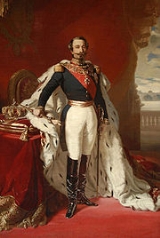
Napoleon III of France

Napol?on III, Emperor of the French was President President

[i], [[trade union]... 

 of France France

France, officially the French Republic, is a country [i] whose metropolitan territory [i] ... 

 from 1849 to 1852, and then Emperor Emperor

An emperor is a monarch [i], usually the sovereign [i] ruler of an empire [i] or another type o ... 

 of the French under the name Napol?on III from 1852 to 1870.

Discussions

  Discussion Features

   Ask a question about 'Napoleon III of France'

   Start a new discussion about 'Napoleon III of France'

   Answer questions about 'Napoleon III of France'

   'Napoleon III of France' discussion forum

Timeline

1848   Prince Prince

The term prince , from the Latin [i] root princeps [i], when used for a member of the highest aristocracy [i] ... 

 Louis-Napoleon Bonaparte Napoleon III of France

Napolon III, Emperor of the French was President [i] of France [i] from 1849 [i] to 1852 [i], and then ... 

 elected first president President

[i], [[trade union]... 

 of the French Second Republic French Second Republic

The French Second Republic was the republican [i] regime of France [i] from February 25 [i], 1848 [i] ... 

.

1852   President Louis-Napoleon Bonaparte Napoleon III of France

Napolon III, Emperor of the French was President [i] of France [i] from 1849 [i] to 1852 [i], and then ... 

 proclaims a new constitution for the French Second Republi

1852   Napoleon III Napoleon III of France

Napolon III, Emperor of the French was President [i] of France [i] from 1849 [i] to 1852 [i], and then ... 

 becomes Emperor of the French List of French monarchs

The monarchs of France [i] ruled, first as kings [i] and later as emperors [i], from the Middle Ages [i] ... 

.

1858   Felice Orsini and his accomplices fail to assassinate Napoleon III Napoleon III of France

Napolon III, Emperor of the French was President [i] of France [i] from 1849 [i] to 1852 [i], and then ... 

 in Paris Paris

native_name = Ville de Paris |common_name = Paris ... 

 but their bombs kill 156 bystanders. Because of the involvement of French émigrés living in Britain United Kingdom

The United Kingdom of Great Britain and Northern Ireland is a country and sovereign state [i] tha ... 

, there is a brief anti-British feeling in France but the emperor refuses to support it.

1870   Emperor Napoleon III of France is deposed and the Third Republic French Third Republic

The French Third Republic, was the governing body of France [i] between the Second French Empire [i] and ... 

 is declared. Empress Eugenie Eugénie de Montijo

Doa [i] Mara Eugenia Ignacia Agustina de Palafox y Kirkpatrick, Countess de Teba, who became Empress ... 

 flees to England with her children.

1873   Died


Encyclopedia

Napoléon III, Emperor of the French was President President

[i], [[trade union]... 

 of France France

France, officially the French Republic, is a country [i] whose metropolitan territory [i] ... 

 from 1849 to 1852, and then Emperor Emperor

An emperor is a monarch [i], usually the sovereign [i] ruler of an empire [i] or another type o... 

 of the French under the name Napoléon III from 1852 to 1870.

Biography


Early life

Louis-Napoléon Bonaparte, as he was known before becoming emperor, was born in Paris. He was the son of Hortense de Beauharnais Hortense de Beauharnais

Hortense de Beauharnais, Queen of Holland, Grand Duchess of Berg and Cleves, Countess of Saint-Leu , was... 

, who was the daughter of Napoléon I's wife Josephine de Beauharnais Joséphine de Beauharnais

Josphine de Beauharnais was the first wife of Napolon Bonaparte [i] and became Empress of the French [i] ... 

 by her first marriage. The identity of his biological father remains a subject of speculation, given his unhappily married mother's record of extramarital liaisons. His assumed father, however, was Hortense's husband, Louis Bonaparte Louis Bonaparte

Louis I Napoleon Bonaparte, King of Holland, Grand Duke of Berg and Cleves, Count of Saint-Leu was the... 

, a younger brother of Napoléon I, and his whole career was built upon the fact that he was the nephew of Napoléon I. During Napoléon I's reign, his parents had been made king and queen of a French France

France, officially the French Republic, is a country [i] whose metropolitan territory [i] ... 

 puppet state, the Kingdom of Holland, meaning that Louis-Napoléon Bonaparte bore the title of prince Prince

The term prince , from the Latin [i] root princeps [i], when used for a member of the highest aristocracy [i]... 

. After Napoléon I's final defeat and deposition in 1815 and the restoration of the Bourbon monarchy in France, all members of the Bonaparte family were forced into exile, so the young Louis-Napoléon was brought up in Switzerland, Germany and Italy. As a young man in Italy, he and his elder brother Napoléon Louis espoused liberal politics and became involved in the Carbonari, a resistance organization fighting Austria Austria

Austria is a landlocked [i] country in central Europe [i]. ... 

n domination of Northern Italy Italy

Italy, officially the Italian Republic , is a Southern European [i] country. ... 

. This would later have an effect on his foreign policy.

There remained in France, under both the Bourbon and then the Orleanist monarchy, a Bonapartist movement which wanted to restore a Bonaparte to the throne. According to the law of succession Napoléon I had made when he was Emperor, the claim passed first to his son, the Duke of Reichstadt, known by Bonapartists as Napoléon II, a sickly youth living under virtual imprisonment at the court of Vienna, then to his eldest brother Joseph Bonaparte Joseph Bonaparte

Joseph Napoleon Bonaparte, King of Naples, King of Spain
... 

, then to Louis Bonaparte and his sons. . Since Joseph had no male children, and because Louis-Napoléon's own elder brother had died in 1831, the death of the Duke of Reichstadt in 1832 made Louis-Napoléon the Bonaparte heir in the next generation. His uncle and father, relatively old men by now, left to him the active leadership of the Bonapartist cause.

Thus he secretly returned to France in October 1836, for the first time since his childhood, to try to lead a Bonapartist coup Coup d'état

A coup d'tat , or simply coup, is the sudden overthrow of a government [i] through unconstitutiona ... 

 at Strasbourg Strasbourg

Strasbourg is the capital and principal city of the Alsace [i] rgion [i] ... 

. The coup failed but he managed to escape. He tried again in August 1840, sailing a ship with some hired soldiers into Boulogne Boulogne-sur-Mer

Boulogne-sur-Mer is a city in northern France [i], in the Pas-de-Calais [i] dpartement [i]... 

, and this time he was caught and imprisoned in the fortress of the town of Ham Ham

Technically, ham is the thigh [i] and buttock [i] of any animal [i] that is slaughtered [i] fo ... 

 in the Department of Somme. While in the Ham fortress his eyesight became poor . During his years of imprisonment he wrote essays and pamphlets that combined his monarchical claim with progressive, even mildly socialist economic proposals. In 1844 his uncle Joseph died, making him the direct heir apparent to the Bonaparte claim. He finally managed to escape to Southport Southport

Southport is a seaside town [i] on the north-west coast of England [i], to the north of Liverpool [i] ... 

, United Kingdom United Kingdom

The United Kingdom of Great Britain and Northern Ireland is a country and sovereign state [i] tha ... 

 in May 1846 by changing clothes with a mason working at the fortress. A month later, his father Louis was dead, making Louis-Napoléon the clear Bonapartist candidate to rule France.

President of the French Republic


Louis-Napoléon lived in Great Britain until the revolution of February 1848 in France deposed King Louis Phillipe Louis-Philippe of France

Louis-Philippe of France reigned as the "Orlanist [i]" king of the French [i] fr... 

 and established a Republic. He was now free to return to France, which he immediately did. He ran for, and won, a seat in the assembly elected to draft a new constitution, but did not make a great contribution and, as a mediocre public orator, failed to impress his fellow members. Some even said that having lived outside of France almost all his life, he spoke French with a slight German accent.

However, when the constitution of the French Second Republic French Second Republic

The French Second Republic was the republican [i] regime of France [i] from February 25 [i], 1848 [i] ... 

 was finally promulgated and direct elections for the presidency were held on 10 December 1848, Louis-Napoléon won in a landslide, with 5,454,000 votes against his closest rival Louis-Eugene Cavaignac Louis Eugène Cavaignac

Louis Eugne Cavaignac, French general, second son of Jean Baptiste Cavaignac [i] and brother of Eleonore Louis Godefroi Cavaignac [i] ... 

's 1,448,000 votes. His overwhelming victory was above all due to the support of the non-politicized rural masses, to whom the name of Bonaparte meant something, contrary to the names of the other contenders for the presidency which were unknown to the masses. Louis-Napoléon's platform was the restoration of order after months of political turmoil, strong government, social consolidation, and national greatness, to which he appealed with all the credit of his name, that of France's national hero Napoléon I who in popular memory was credited with bringing the nation to its pinnacle of military greatness and establishing social stability after the turmoil of the French Revolution.


In the third year of his four-year mandate, President Louis-Napoléon Bonaparte asked the National Assembly for a revision of the constitution to enable the president to run for re-election, arguing that four years were not enough to implement his political and economic program fully. The Constitution of the Second Republic stated that the Presidency of the Republic was to be held for a single term of four years, with no possibility to run for re-election, a restriction written in the Constitution for fear that a President would abuse his power to transform the Republic into a dictatorship or a sort of life Presidency. The National Assembly, which was dominated by the Monarchists, opposed to Louis-Napoléon and in favour of the restoration of the Bourbon dynasty, refused to amend the Constitution.

After months of stalemate, President Louis-Napoléon Bonaparte staged a coup French coup of 1851

The Coup d'État of 2 December 1851 was the coup d'tat [i] staged by Louis-Napolon Bonaparte [i] ... 

 and seized dictatorial powers on the symbolic date of 2 December 1851, the exact 47th anniversary of Napoléon I's crowning as Emperor, and also the exact 46th anniversary of the famous Battle of Austerlitz Battle of Austerlitz

The Battle of Austerlitz, fought on December 2 [i], 1805 [i] about four mile [i]s east of the modern Czech [i] ... 

. The coup was later declared to have been approved by the French people in a national referendum whose fairness and legality have been questioned ever since. The use of a referendum to legalise ex post facto a criminal act was an invention which Hitler Adolf Hitler

Adolf Hitler was Chancellor of Germany [i] from 1933, and Fhrer [i] of Germany [i] from 1934 until h ... 

 and other dictators would later copy. The coup of 1851 definitely alienated Republicans from Napoléon III, and durably tarnished his reputation among later historians. Victor Hugo Victor Hugo

Victor-Marie Hugo was a poet, novelist, playwright, essayist, visual artist, statesman and human rights... 

, who had hitherto shown support toward Louis-Napoléon Bonaparte, decided to go into exile after the coup, and became one of the harshest critics of Napoléon III.

Emperor of the French


Authoritarian empire

New constitutional statutes were passed which officially maintained an elected Parliament, but real power was completely concentrated in the hands of Louis-Napoléon and his bureaucracy. Exactly one year later, on 2 December 1852, after approval by another referendum, the Second Republic French Second Republic

The French Second Republic was the republican [i] regime of France [i] from February 25 [i], 1848 [i] ... 

 was officially ended and the Empire restored, ushering in the Second French Empire Second French Empire

The Second French Empire or Second Empire was the imperial Bonapartist [i] regime of Napoleon III [i]... 

. President Louis-Napoléon Bonaparte became Emperor Napoléon III. In a situation that resembles the case of Louis XVIII of France Louis XVIII of France

Louis XVIII was King of France and Navarre [i] from 1814 [i] until his death i... 

, the numbering of Napoléon's reign treats Napoléon II Napoleon II of France

Napoleon II, Duke of Reichstadt was the son of Napoleon Bonaparte [i], and briefly ... 

, who never actually ruled, as a true Emperor . That same year, he began shipping political prisoners and criminals to penal colonies such as Devil's Island  or New Caledonia New Caledonia

New Caledonia, the foreshortened form of Territory of New Caledonia and Dependencies , is a "sui generis [i] ... 

.

The emperor, hitherto a bachelor, began quickly to look for a wife to produce a legitimate heir. Most of the royal families of Europe were unwilling to marry into the parvenu Bonaparte family, and after rebuffs from Princess Carola of Sweden and from Queen Victoria Victoria of the United Kingdom

Victoria was the Queen [i] of the United Kingdom of Great Britain and Ireland [i] ... 

's German niece Princess Adelaide von Hohenlohe-Langenburg, Napoléon decided to lower his sights somewhat and 'marry for love', choosing the young, beautiful Countess of Teba, Eugénie de Montijo Eugénie de Montijo

Doa [i] Mara Eugenia Ignacia Agustina de Palafox y Kirkpatrick, Countess de Teba, who became Empress ... 

, a Spanish noblewoman with some Scottish ancestry who had been brought up in Paris. On 28 April 1855 Napoléon survived an attempted assassination. In 1856, Eugenie gave birth to a legitimate son and heir, Napoléon Eugène Louis, the Prince Impérial. On 14 January 1858 Napoléon and his wife escaped another assassination attempt, plotted by Felice Orsini.

Liberal empire

Until about 1860, Napoléon's regime was definitely authoritarian, using heavy press censorship to prevent the spread of opposition, manipulating elections, and depriving the Parliament of the right to free debate or any real power. In the 1860s, however, Napoléon III made more and more concessions to placate his liberal opponents, beginning with allowing freer debates in Parliament and free reports of parliamentary debates, continuing with the relaxation of press censorship, and culminating in the appointment of the Liberal Émile Ollivier Émile Ollivier

Olivier mile Ollivier was a French [i] statesman [i].
... 

, previously a leader of the opposition to Napoléon's regime, as Prime Minister in 1870. This later period is known as the Liberal Empire.

Economic and social policy

The French economy was rapidly modernized under Napoléon III. The industrialization of France during this period helped satisfy both the business interests and the working classes. Downtown Paris was renovated with the clearing of slums, the widening of streets, and the construction of parks. Working class neighborhoods, were moved to the outskirts of Paris, where factories utilized their labor.

Napoléon III was a progressive on social matters. In 1853 he established a network of arbitration boards to resolve labor disputes and to prevent strikes. In 1864 he legalized trade unions.

Foreign policy

Napoléon III was determined to follow a strong foreign policy to extend France's power and glory. His challenge to Russia Russia

Russia , also the Russian Federation , is a country [i] that stretches over a vast expanse of Eurasia [i] ... 

's claims to influence in the Ottoman Empire Ottoman Empire

The Ottoman Empire , is also sometimes known in the West [i] as the Turkish Empire. ... 

 led to France's successful participation in the Crimean War Crimean War

The Crimean War lasted from 28 March [i] 1853 [i] until 1 April [i] 1856 [i] and was fought between Imperial Russia [i] ... 

 . He approved the launching of a naval expedition in 1858 to punish the Vietnam Vietnam

Vietnam, officially the Socialist Republic of Vietnam, is a country in Southeast Asia [i]. ... 

ese for their mistreatment of French Catholic missionaries and force the court to accept a French presence in the country. In May–July 1859 French intervention secured the defeat of Austria Austria

Austria is a landlocked [i] country in central Europe [i]. ... 

 in Italy Italy

Italy, officially the Italian Republic , is a Southern European [i] country. ... 

, and the result of this was the unification of Italy, and the acquisition of Savoy Savoy

In modern France, Savoy is part of the Rhne-Alpes [i] region. ... 

 and the region of Nice Nice

Nice is a city in southern [i] France [i] located on the Mediterranean [i] ... 

  by France in 1860. France took part in the Second Opium War Second Opium War

The Second Opium War or Arrow War was a war of the United Kingdom and France against the Qing Dynasty [i] ... 

 along with Great Britain Great Britain

Great Britain is an island lying off the northwestern coast of mainland Europe [i] and to the east of Ireland [i] ... 

, and in 1860 the French troops entered Beijing Beijing

Beijing , a city in northern China [i] ... 

. In the beginning of the 1860s, the objectives of the Emperor in foreign policy had been met: France had scored several military victories in Europe and abroad, the defeat at Waterloo Battle of Waterloo

The Battle of Waterloo, fought on June 18 [i], 1815 [i], was Napoleon Bonaparte [i] ... 

 had been exorcised, and France was regarded again as the largest military power in Europe.

During the American Civil War American Civil War

The American Civil War was a sectional conflict in the United States of America [i] between the federal ... 

, Napoleon III brought France to the fore of the pro-Confederate Confederate States of America

The Confederate States of America was the government formed by eleven southern states of the USA [i]... 

 European powers. For a time, Napoleon III inched steadily towards officially recognizing the Confederacy, especially after the crash of the cotton industry and his expedition in Mexico. It is also said that he was driven by a desire to keep the Union split. Through 1862, Napoleon III entertained Confederate diplomats, raising hopes that he would unilaterally recognize the Confederacy. The Emperor, however, could move little without the support of Great Britain, and never officially recognized the Confederacy.

The French intervention in Mexico French intervention in Mexico

The French intervention in Mexico, also known as the Maximilian Affair, was an invasion of Mexico [i] ... 

  ended in defeat and in the execution of the French-backed Emperor Maximilian Maximilian I of Mexico

Maximilian I, Emperor of Mexico, was a member of Austria [i]'s Imperial Habsburg [i] family. ... 

. More importantly, France saw her dominance on the continent of Europe eroded by Prussia Prussia

Prussia was, most recently, a historic state originating in Brandenburg [i], an area which for centuries ... 

's crushing victory Austro-Prussian War

The AustroPrussian War was a war fought between the Austrian Empire [i] and its German allies and Prussia [i]... 

 over Austria Austria

Austria is a landlocked [i] country in central Europe [i]. ... 

 in June–August 1866. Due to his Carbonari past, Napoléon was unable to bring himself to ally with Austria, despite the obvious threat that a victorious Prussia would present to France.

Demise


Napoléon III paid the price for his Austrian blunder in 1870 when, forced by the diplomacy of the Prussian chancellor Otto von Bismarck Otto von Bismarck

Otto Eduard Leopold, Prince von Bismarck, Duke of Lauenburg was one of the most prominent Europe [i]an ... 

, Napoléon began the Franco-Prussian War Franco-Prussian War

The Franco-Prussian War was declared by France [i] on Prussia [i], which was backed by the North German Confederation [i]... 

. This war proved disastrous for France, and was instrumental in giving birth to the German Empire German Empire

The German Empire is the name conventionally given in English [i] to the German [i] ... 

, which would take France's place as the major land power on the continent of Europe until the end of World War I World War I

World War I, also known as the First World War, the Great War and "The War to End All War... 

. In battle against Prussia in July 1870 the Emperor was captured at the Battle of Sedan Battle of Sedan

The Battle of Sedan was fought during the Franco-Prussian War [i] on September 1 [i], 1870 [i]. ... 

  and was deposed by the forces of the Third Republic French Third Republic

The French Third Republic, was the governing body of France [i] between the Second French Empire [i] and ... 

 in Paris two days later.

He died in exile in England England

England is the largest and most populous constituent country [i] of the United Kingdom [i]. ... 

, at Chislehurst Chislehurst

Chislehurst is a village in the London Borough of Bromley [i].
... 

 , on 9 January 1873. He is buried in the Imperial Crypt at Saint Michael's Abbey Saint Michael's Abbey, Farnborough

Saint Michael's Abbey is a Benedictine [i] abbey in Farnborough, Hampshire [i], fo ... 

, Farnborough Farnborough, Hampshire

Farnborough is a town [i] in the Hampshire [i] borough of Rushmoor [i] in South East England [i]. ... 

, Hampshire Hampshire

Hampshire, sometimes historically Southamptonshire, is a county [i] on the so... 

, England.

Napoléon stayed at No. 6 Clarendon Square, Royal Leamington Spa Leamington Spa

Leamington Spa, properly Royal Leamington Spa but commonly just Leamington, is a [[spa town]... 

 between 1838-1839. The building is now called Napoleon House and has a 'Blue plaque Blue plaque

In England [i], a blue plaque is a sign attached to a house where someone famous once lived to commemora ... 

' put up by the local council.

Legacy

An important legacy of Napoléon III's reign was the rebuilding of Paris Paris

native_name = Ville de Paris
|common_name = Paris
... 

. Part of the design decisions were taken in order to reduce the ability of future revolutionaries to challenge the government by capitalizing on the small, medieval streets Paris to form barricades. However, this should not overlook the fact that the main reason for the complete transformation of Paris was Napoléon III's desire to modernize Paris based on what he had seen of the modernizations of London during his exile there in the 1840s. With his characteristic social approach to politics, Napoléon III desired to improve health standards and living conditions in Paris with the following goals: build a modern sewage system to improve health, develop new housing with larger apartments for the masses, create green parks all across the city to try and keep working classes away from the pubs on Sunday, etc. Large sections of the city were thus flattened down and the old winding streets were replaced with large thoroughfares and broad avenues. The rebuilding of Paris was directed by Baron Haussmann Baron Haussmann

Baron Georges-Eugne Haussmann was a French [i] civic planner whose name is associated with the rebuilding of Paris [i] ... 

 . It was this rebuilding that turned Paris into the city of broad tree-lined boulevards and parks so beloved of tourists today.

Napoléon III also directed the building of the French railway network, which greatly contributed to the development of the coal mining and steel industry in France, radically changing the nature of the French economy, which entered the modern age of large-scale capitalism. The French economy, the second largest in the world at the time , experienced a very strong growth during the reign of Napoléon III. Names such as steel tycoon Eugène Schneider or banking mogul James de Rothschild are symbols of the period. Two of France's largest banks, Société Générale Société Générale

Socit Gnrale is one of the main bank [i]s in France [i].
... 

 and Crédit Lyonnais, still in existence today, were founded during that period. The French stock market also expanded prodigiously, with many coal mining and steel companies issuing stocks. Although largely forgotten by later Republican generations, which only remembered the non-democratic nature of the regime, the economic successes of the Second Empire are today recognized as impressive by historians. The emperor himself, who had spent several years in exile in Victorian Lancashire Lancashire

Lancashire is a county [i] in North West [i] England [i], bounded ... 

, was largely influenced by the ideas of the Industrial Revolution Industrial Revolution

The Industrial Revolution was the major technological [i], socioeconomic [i] a ... 

 in England, and he took particular care of the economic development of the country. He is recognized as the first ruler of France to have taken great care of the economy; previous rulers considering it secondary.

His military adventurism is sometimes considered a fatal blow to the Concert of Europe, which based itself on stability and balance of powers, whereas Napoleon III attempted to rearrange the world map to France's favor even when it involved radical and potentially revolutionary changes in politics.

Opinions

Napoléon III, to this day, has not enjoyed the prestige that Napoléon I enjoyed. Victor Hugo Victor Hugo

Victor-Marie Hugo was a poet, novelist, playwright, essayist, visual artist, statesman and human rights... 

 portrayed him as "Napoléon the small" , a mere mediocrity in contrast with Napoléon I "The Great", presented as a military and administrative genius. In France, such arch-opposition from the age's central literary figure, whose attacks on Napoléon III were obsessive and powerful, made it impossible for a very long time to assess his reign objectively. Karl Marx Karl Marx

Karl Heinrich Marx was an immensely influential German philosopher [i], political economist [i] ... 

 mocked Napoléon III by saying that history repeats itself: "the first time as tragedy, the second time as farce". Napoléon III has often been seen as an authoritarian but ineffectual leader who brought France into dubious, and ultimately disastrous, foreign military adventures.

However, in the latter part of the 20th century historians have moved to reconsider the image of Napoléon III. The diplomatic, and above all, the economic achievements of the reign are now recognized . Historians have also emphasized his attention to the fate of working classes and poor people. His book Extinction du paupérisme , which he wrote while imprisoned at the Fort of Ham in 1844, contributed greatly to his popularity among the working classes and thus his election win in 1848. Throughout his reign the emperor showed concerns to alleviate the sufferings of the poor in the empire, on occasion breaching the nineteenth-century economic orthodoxy of complete laissez-faire and using state resources or interfering in the market. Among other things, the Emperor granted the right to strike to French workers in 1864, despite intense opposition from corporate lobbies.

The Emperor also ordered the creation of three large parks in Paris with the clear intention of offering them for poor working families as an alternative to the pub on Sundays, much as Victoria Park Victoria Park, East London

Victoria Park is a large open space that stretches out across part of the East End of London [i], England [i] ... 

 in London London

London is the capital [i] city of England [i] and of the United Kingdom [i]. ... 

 was also built with the same social motives in mind.

For his combination of these economic ideas with monarchical pomp and an active foreign and military policy, Napoléon III has been called a "socialist on horseback".

Publications

The leading comprehensive histories of the Second Empire Second French Empire

The Second French Empire or Second Empire was the imperial Bonapartist [i] regime of Napoleon III [i]... 

 are:

  • De la Gorce, Histoire du second empire, , and
  • Taxile Delord, Histoire du second empire, .

Other works are many, e. g.,:

  • Bernhard Simson, Ueber die Beziehungen Napoleond III. zu Preussen und Deutschland,
  • Adolf Ebeling, Napoleon III. und sein Hof,
  • Thirra, Napoléon III avant l'empire,
  • E. Ollivier Émile Ollivier

    Olivier mile Ollivier was a French [i] statesman [i].

... 

, L'Empire libéral,
  • A. L. Imbert de Saint-Amand, Napoleon III at the Height of his Power,
  • T. W. Evans, Memoirs of the Second French Empire,
  • Marie-Clotilde-Elisabeth Louise de Riquet, comtesse de Mercy-Argenteau, The Last Love of an Emperor: reminiscences of the Comtesse Louise de Mercy-Argenteau, née Princesse de Caraman-Chimay, describing her association with the Emperor Napoléon III and the social and political part she played at the close of the Second Empire Second French Empire

    The Second French Empire or Second Empire was the imperial Bonapartist [i] regime of Napoleon III [i]... 


Movie portrayals

  • Leon Ames played him in Suez , although Loretta Young Loretta Young

    Loretta Young was an Academy Award [i]-winning American actress. ... 

     as Eugenie is much more highlighted.
  • Claude Rains Claude Rains

    Claude Rains was a British [i], and later American [i], theatre and film a ... 

     shows him in Juarez as a weak man ready to betray Maximilian in Mexico.

See also

  • History of France History of France

    The History of France has been divided into a series of separate historical articles navigable through... 

  • Bonaparte Bonaparte

    Of Corsica [i]n origin, the Bonaparte family is the family of Napoleon I [i], who ... 

  • Second French Empire Second French Empire

    The Second French Empire or Second Empire was the imperial Bonapartist [i] regime of Napoleon III [i]... 

  • Prussia Prussia

    Prussia was, most recently, a historic state originating in Brandenburg [i], an area which for centuries ... 

  • Otto von Bismarck Otto von Bismarck

    Otto Eduard Leopold, Prince von Bismarck, Duke of Lauenburg was one of the most prominent Europe [i]an ... 


External links


|-
|-

|-
|-
|-