


Second Italian War of Independence

Encyclopedia
The Second War of Italian Independence, Franco-Austrian War, Austro-Sardinian War, or Austro-Piedmontese War (also known as the Campaign of Italy, Campagne d'Italie, in France
), was fought by Napoleon III of France
and the Kingdom of Piedmont-Sardinia against the Austrian Empire
in 1859. In respect to the Italian unification
process, this war is also known as the Second Independence War.
, found that they could not defeat a great power such as Austria without allies. This led Camillo Benso, conte di Cavour to attempt to establish relations with other European powers, partially through Piedmont's participation in the Crimean War
. In the peace conference
at Paris
for the Crimean War, Cavour attempted to bring attention to efforts for Italian unification. He found Britain and France to be sympathetic, but entirely unwilling to go against Austrian wishes, as any movement towards Italian independence would necessarily threaten Austria's territory in Lombardy
and Venetia. Individual talks between Napoleon III and Cavour after the conference identified Napoleon as the most likely, albeit still uncommitted, candidate for aiding Italy.
On January 14, 1858, Felice Orsini
, an Italian, led an attempt on Napoleon III's life. This assassination attempt brought widespread sympathy for the Italian unification effort, and had a profound effect on Napoleon himself, who now was determined to help Piedmont against Austria in order to end the revolutionary activities that the governments inside Italy might allow to happen in the future. Emperor Napoleon III and Camillo Benso, Conte di Cavour, the prime minister of the Kingdom of Piedmont-Sardinia, signed a secret treaty of alliance against Austria: France would help Sardinia to fight against Austria if attacked, and Sardinia would then give Nice
and Savoy
to France in return. This secret alliance served both countries: it helped with the Sardinian (Piedmontese) plan of unification of the Italian peninsula
under the House of Savoy
, and weakened Austria, a fiery adversary of Napoleon III's French Empire.
Cavour, being unable to get the French help unless the Austrians attacked first, provoked Vienna with a series of military manoeuvers close to the border. Austria issued an ultimatum on April 23, 1859, asking for the complete demobilization of the Sardinian army, and when it was not heeded Austria started a war with Sardinia (April 29), thus drawing France into the conflict.
, the II, led by Patrice MacMahon
, the III, led by François Certain Canrobert
, the IV, led by Adolphe Niel
, and the V, led by prince Napoleon
. The Imperial Guard
was commanded by Auguste Regnaud de Saint-Jean d'Angély
.
The Sardinian army had about 70,000 soldiers, 4,000 horsemen and 90 guns. It was divided into five divisions, led by Casterlbrugo, Manfredo Fanti
,
Giovanni Durando, Enrico Cialdini
, and Domenico Cucchiari. Two volunteers formations, the Cacciatori delle Alpi
and the Cacciatori degli Appennini, were also present. The commander in chief was Victor Emmanuel II of Savoy, supported by Alfonso Ferrero la Marmora
.
The Austrian army fielded more men: it was composed by 220,000 soldiers, 824 guns and 22,000 horsemen. It was led by Field Marshal
Ferencz Graf Gyulai
.
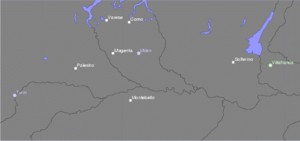
in the first massive use of railways. The Austrian forces counted on a swift victory over the weaker Sardinian army before French forces could arrive in Piedmont. However, Count Gyulai, the commander of the Austrian troops in Lombardy
, was very cautious, marching around the Ticino River
in no specific direction for a while until eventually crossing it to begin the offensive. Unfortunately for him, very heavy rains began to fall as soon as he did this, allowing the Piedmontese to flood the rice fields in front of his advance, slowing his army's march to a crawl.
The Austrians under Gyulai eventually arrived in Vercelli
, menacing Turin
, but the Franco-Sardinian move to strengthen Alessandria
and Po River
bridges around Casale Monferrato
forced them to fall back. On May 14, Napoleon III arrived in Alessandria, taking the command of the operations. The initial clash of the war was at Montebello
on 20 May, a battle between an Austrian Corps under Stadion against a single division of the French I Corps under Forey
. The Austrian contingent was three times as large, but Forey pulled off the victory, making Gyulai even more defensive. In early June, Gyulai was near the rail center of Magenta
with the army fairly spread out, and unfortunately caught defending too far east of the river. Napoleon III attacked the Ticino head on with part of his force while sending another large group of troops to the north to flank the Austrians. The plan worked, which led to Gyulai retreating very far to the quadrilateral fortresses in eastern Lombardy, where he was relieved of his post as commander.
Replacing Gyulai was Emperor Franz Josef I himself, feeling up to the simple task of defending the well-fortified Austrian territory behind the Mincio River. He would experience his first and last command at the Battle of Solferino
. The Piedmontese-French army had taken Milan
and slowly marched further east to finish off Austria in this war before Prussia
could get involved. The Austrians found out that the French had halted at Brescia
, and decided that they should attempt to surprise them by suddenly switching onto the attack. The French had also gone on the offensive, but neither side was sure of where exactly the other was until they suddenly met. Benedek with the Austrian VIII Corps was separated from the main force, defending Pozzolengo
against the Piedmontese part of the opposing army. This they did successfully, though the rest of the Austrian army retreated as soon as a great storm hit, abandoning several towns to the French.
At the same time, in the northern part of Lombardy, the Italian volunteers of Giuseppe Garibaldi
's Hunters of the Alps
defeated the Austrians at Varese
and Como and the Piedmontese-French navy landed 3,000 soldiers and conquered the islands of Lussino (Losinj) and Cherso (Cres) in Dalmatia.
. Most of Lombardy, with its capital Milan
(excepting only the Austrian fortresses of Mantua
and Legnago
and the surrounding territory), was transferred from Austria to France, which would immediately cede these territories to Sardinia. The rulers of Central Italy, who had been expelled by revolution shortly after the beginning of the war, were to be restored.
This deal, made by Napoleon behind the backs of his Sardinian allies, led to great outrage in Sardinia — Cavour himself resigned in protest. However, the terms of Villafranca were never to come into effect: although they were reaffirmed by the final Treaty of Zürich
in November, by then the agreement had become a dead letter. The central Italian states were occupied by the Piedmontese, who showed no willingness to restore the previous rulers, and the French showed no willingness to force them to abide by the terms of the treaty. The Austrians were left to look on in frustration at the French failure to carry out the terms of the treaty.
The next year, in 1860, with French and British approval, the central Italian states — Duchy of Parma
, Duchy of Modena, Grand Duchy of Tuscany
and the Papal Legations
— were annexed by the Kingdom of Sardinia, and France would take its deferred reward, Savoy and Nice. This latter move was vehemently opposed by Italian national hero Garibaldi, a native of Nice
, and directly led to Garibaldi's expedition to Sicily, which would complete the preliminary unification of Italy.
France
The French Republic , The French Republic , The French Republic , (commonly known as France , is a unitary semi-presidential republic in Western Europe with several overseas territories and islands located on other continents and in the Indian, Pacific, and Atlantic oceans. Metropolitan France...
), was fought by Napoleon III of France
Napoleon III of France
Louis-Napoléon Bonaparte was the President of the French Second Republic and as Napoleon III, the ruler of the Second French Empire. He was the nephew and heir of Napoleon I, christened as Charles Louis Napoléon Bonaparte...
and the Kingdom of Piedmont-Sardinia against the Austrian Empire
Austrian Empire
The Austrian Empire was a modern era successor empire, which was centered on what is today's Austria and which officially lasted from 1804 to 1867. It was followed by the Empire of Austria-Hungary, whose proclamation was a diplomatic move that elevated Hungary's status within the Austrian Empire...
in 1859. In respect to the Italian unification
Italian unification
Italian unification was the political and social movement that agglomerated different states of the Italian peninsula into the single state of Italy in the 19th century...
process, this war is also known as the Second Independence War.
Background
The Piedmontese, following their defeat to Austria in the First Italian War of IndependenceFirst Italian War of Independence
The First Italian War of Independence was fought in 1848 between the Kingdom of Sardinia and the Austrian Empire. The war saw main battles at Custoza and Novara in which the Austrians under Radetzky managed to defeat the Piedmontese....
, found that they could not defeat a great power such as Austria without allies. This led Camillo Benso, conte di Cavour to attempt to establish relations with other European powers, partially through Piedmont's participation in the Crimean War
Crimean War
The Crimean War was a conflict fought between the Russian Empire and an alliance of the French Empire, the British Empire, the Ottoman Empire, and the Kingdom of Sardinia. The war was part of a long-running contest between the major European powers for influence over territories of the declining...
. In the peace conference
Treaty of Paris (1856)
The Treaty of Paris of 1856 settled the Crimean War between Russia and an alliance of the Ottoman Empire, the British Empire, Second French Empire, and the Kingdom of Sardinia. The treaty, signed on March 30, 1856 at the Congress of Paris, made the Black Sea neutral territory, closing it to all...
at Paris
Paris
Paris is the capital and largest city in France, situated on the river Seine, in northern France, at the heart of the Île-de-France region...
for the Crimean War, Cavour attempted to bring attention to efforts for Italian unification. He found Britain and France to be sympathetic, but entirely unwilling to go against Austrian wishes, as any movement towards Italian independence would necessarily threaten Austria's territory in Lombardy
Lombardy
Lombardy is one of the 20 regions of Italy. The capital is Milan. One-sixth of Italy's population lives in Lombardy and about one fifth of Italy's GDP is produced in this region, making it the most populous and richest region in the country and one of the richest in the whole of Europe...
and Venetia. Individual talks between Napoleon III and Cavour after the conference identified Napoleon as the most likely, albeit still uncommitted, candidate for aiding Italy.
On January 14, 1858, Felice Orsini
Felice Orsini
Felice Orsini was an Italian revolutionary and leader of the Carbonari who tried to assassinate Napoleon III, Emperor of the French.-Early:Felice Orsini was born at Meldola in Romagna, then part of the Papal States....
, an Italian, led an attempt on Napoleon III's life. This assassination attempt brought widespread sympathy for the Italian unification effort, and had a profound effect on Napoleon himself, who now was determined to help Piedmont against Austria in order to end the revolutionary activities that the governments inside Italy might allow to happen in the future. Emperor Napoleon III and Camillo Benso, Conte di Cavour, the prime minister of the Kingdom of Piedmont-Sardinia, signed a secret treaty of alliance against Austria: France would help Sardinia to fight against Austria if attacked, and Sardinia would then give Nice
Nice
Nice is the fifth most populous city in France, after Paris, Marseille, Lyon and Toulouse, with a population of 348,721 within its administrative limits on a land area of . The urban area of Nice extends beyond the administrative city limits with a population of more than 955,000 on an area of...
and Savoy
Savoy
Savoy is a region of France. It comprises roughly the territory of the Western Alps situated between Lake Geneva in the north and Monaco and the Mediterranean coast in the south....
to France in return. This secret alliance served both countries: it helped with the Sardinian (Piedmontese) plan of unification of the Italian peninsula
Italian Peninsula
The Italian Peninsula or Apennine Peninsula is one of the three large peninsulas of Southern Europe , spanning from the Po Valley in the north to the central Mediterranean Sea in the south. The peninsula's shape gives it the nickname Lo Stivale...
under the House of Savoy
House of Savoy
The House of Savoy was formed in the early 11th century in the historical Savoy region. Through gradual expansion, it grew from ruling a small county in that region to eventually rule the Kingdom of Italy from 1861 until the end of World War II, king of Croatia and King of Armenia...
, and weakened Austria, a fiery adversary of Napoleon III's French Empire.
Cavour, being unable to get the French help unless the Austrians attacked first, provoked Vienna with a series of military manoeuvers close to the border. Austria issued an ultimatum on April 23, 1859, asking for the complete demobilization of the Sardinian army, and when it was not heeded Austria started a war with Sardinia (April 29), thus drawing France into the conflict.
Forces
The French army for the Italian campaign had 130,000 soldiers, 2,000 horsemen and 312 guns, half of the whole French army. The army was under the command of Napoleon III, divided into five corps: the I Corps, led by Achille Baraguey d'HilliersAchille Baraguey d'Hilliers
Louis-Achille Baraguey d'Hilliers, 1st Comte Baraguey d'Hilliers was a Marshal of France and politician.Baraguey d'Hilliers was born in Paris, the son of the French revolutionary general Louis Baraguey d'Hilliers...
, the II, led by Patrice MacMahon
Patrice MacMahon, duc de Magenta
Marie Edme Patrice Maurice de Mac-Mahon, 1st Duke of Magenta was a French general and politician with the distinction Marshal of France. He served as Chief of State of France from 1873 to 1875 and as the first president of the Third Republic, from 1875 to 1879.-Early life:Born in Sully , in the...
, the III, led by François Certain Canrobert
François Certain Canrobert
François Certain de Canrobert, usually known as François Certain-Canrobert and later simply as Maréchal Canrobert , was a marshal of France.-Biography:...
, the IV, led by Adolphe Niel
Adolphe Niel
Adolphe Niel was a French Army general and statesman, also Marshal of France.He was born at Muret, Haute-Garonne and entered the École Polytechnique in 1821. Niel entered the engineer school at Metz, became lieutenant in the Engineers Corps in 1827, and captain in 1833...
, and the V, led by prince Napoleon
Napoléon Joseph Charles Paul Bonaparte
Napoléon Joseph Charles Paul Bonaparte, Prince Français, Count of Meudon, Count of Moncalieri ad personam, titular 3rd Prince of Montfort was the second son of Jérôme Bonaparte, king of Westphalia, by his wife Catherine, princess of Württemberg...
. The Imperial Guard
Imperial Guard (Napoleon III)
The Imperial Guard of Napoleon III was a military unit in the French Army formed by Napoleon III as a re-establishment of his uncle Napoleon I's Imperial Guard, with an identical uniform and almost the same privileges...
was commanded by Auguste Regnaud de Saint-Jean d'Angély
Auguste Regnaud de Saint-Jean d'Angély
Auguste Michel Étienne Regnaud de Saint-Jean d'Angély, later 2nd Count Regnaud de Saint-Jean d'Angély was a Marshal of France, soldier and politician....
.
The Sardinian army had about 70,000 soldiers, 4,000 horsemen and 90 guns. It was divided into five divisions, led by Casterlbrugo, Manfredo Fanti
Manfredo Fanti
Manfredo Fanti was an Italian general.-Biography:Manfredo Fanti was born at Carpi and educated at the military college of Modena....
,
Giovanni Durando, Enrico Cialdini
Enrico Cialdini
Enrico Cialdini, Duca di Gaeta was an Italian soldier, politician and diplomat.-Biography:He was born at Castelvetro, in the province of Modena. In 1831 he took part in the insurrection at Modena, fleeing afterwards to Paris, whence he proceeded to Spain to fight against the Carlists...
, and Domenico Cucchiari. Two volunteers formations, the Cacciatori delle Alpi
Hunters of the Alps
The Hunters of the Alps were a special military corps created by Giuseppe Garibaldi in Cuneo on February 20, 1859 to help the regular Sardinian army to free the northern part of Italy in the Second Italian War of Independence....
and the Cacciatori degli Appennini, were also present. The commander in chief was Victor Emmanuel II of Savoy, supported by Alfonso Ferrero la Marmora
Alfonso Ferrero La Marmora
Alfonso Ferrero, Cavaliere La Màrmora was an Italian general and statesman. His brother Alessandro La Marmora founded the branch of the Italian army now called the Bersaglieri.-Biography:...
.
The Austrian army fielded more men: it was composed by 220,000 soldiers, 824 guns and 22,000 horsemen. It was led by Field Marshal
Field Marshal
Field Marshal is a military rank. Traditionally, it is the highest military rank in an army.-Etymology:The origin of the rank of field marshal dates to the early Middle Ages, originally meaning the keeper of the king's horses , from the time of the early Frankish kings.-Usage and hierarchical...
Ferencz Graf Gyulai
Ferencz Gyulai
Count Ferencz Gyulai de Marosnémethi et Nádaska , also known as Ferenc Gyulai, Ferencz Gyulaj, or Franz Gyulai, was a Hungarian nobleman who served as Austrian Governor of Lombardy-Venetia and commanded the losing Austrian army at the Battle of Magenta.-Biography:Gyulai was born on 1 September 1798...
.
The operations
At the declaration of war, there were no French troops in Italy, so Marshal François Certain Canrobert moved in to PiedmontPiedmont
Piedmont is one of the 20 regions of Italy. It has an area of 25,402 square kilometres and a population of about 4.4 million. The capital of Piedmont is Turin. The main local language is Piedmontese. Occitan is also spoken by a minority in the Occitan Valleys situated in the Provinces of...
in the first massive use of railways. The Austrian forces counted on a swift victory over the weaker Sardinian army before French forces could arrive in Piedmont. However, Count Gyulai, the commander of the Austrian troops in Lombardy
Lombardy
Lombardy is one of the 20 regions of Italy. The capital is Milan. One-sixth of Italy's population lives in Lombardy and about one fifth of Italy's GDP is produced in this region, making it the most populous and richest region in the country and one of the richest in the whole of Europe...
, was very cautious, marching around the Ticino River
Ticino River
The river Ticino is a left-bank tributary of the Po River. It has given its name to the Swiss canton through which its upper portion flows.-The course:...
in no specific direction for a while until eventually crossing it to begin the offensive. Unfortunately for him, very heavy rains began to fall as soon as he did this, allowing the Piedmontese to flood the rice fields in front of his advance, slowing his army's march to a crawl.
The Austrians under Gyulai eventually arrived in Vercelli
Vercelli
Vercelli is a city and comune of about 47,000 inhabitants in the Province of Vercelli, Piedmont, northern Italy. One of the oldest urban sites in northern Italy, it was founded, according to most historians, around the year 600 BC.The city is situated on the river Sesia in the plain of the river...
, menacing Turin
Turin
Turin is a city and major business and cultural centre in northern Italy, capital of the Piedmont region, located mainly on the left bank of the Po River and surrounded by the Alpine arch. The population of the city proper is 909,193 while the population of the urban area is estimated by Eurostat...
, but the Franco-Sardinian move to strengthen Alessandria
Alessandria
-Monuments:* The Citadel * The church of Santa Maria di Castello * The church of Santa Maria del Carmine * Palazzo Ghilini * Università del Piemonte Orientale-Museums:* The Marengo Battle Museum...
and Po River
Po River
The Po |Ligurian]]: Bodincus or Bodencus) is a river that flows either or – considering the length of the Maira, a right bank tributary – eastward across northern Italy, from a spring seeping from a stony hillside at Pian del Re, a flat place at the head of the Val Po under the northwest face...
bridges around Casale Monferrato
Casale Monferrato
Casale Monferrato, population 36,058, is a town and comune in the Piedmont region of north-west Italy, part of the province of Alessandria. It is situated about 60 km east of Turin on the right bank of the Po, where the river runs at the foot of the Montferrato hills. Beyond the river lies the...
forced them to fall back. On May 14, Napoleon III arrived in Alessandria, taking the command of the operations. The initial clash of the war was at Montebello
Battle of Montebello (1859)
The Battle of Montebello was fought on May 20, 1859 at Montebello . It was a minor engagement of the Second Italian War of Independence, fought between Piedmontese cavalry and French infantry against Austrian troops. The Austrian defeat, despite the greater number, was another sign that Austrian...
on 20 May, a battle between an Austrian Corps under Stadion against a single division of the French I Corps under Forey
Elie Frédéric Forey
Élie Frédéric Forey was a Marshal of France.-Biography:Elie Frédéric Forey was born in Paris.He studied at the French military academy Saint-Cyr and was commissioned a lieutenant in the 2nd Light Infantry Regiment in 1824. He served in the expedition against Algiers in 1830...
. The Austrian contingent was three times as large, but Forey pulled off the victory, making Gyulai even more defensive. In early June, Gyulai was near the rail center of Magenta
Battle of Magenta
The Battle of Magenta was fought on June 4, 1859 during the Second Italian War of Independence, resulting in a French-Sardinian victory under Napoleon III against the Austrians under Marshal Ferencz Gyulai....
with the army fairly spread out, and unfortunately caught defending too far east of the river. Napoleon III attacked the Ticino head on with part of his force while sending another large group of troops to the north to flank the Austrians. The plan worked, which led to Gyulai retreating very far to the quadrilateral fortresses in eastern Lombardy, where he was relieved of his post as commander.
Replacing Gyulai was Emperor Franz Josef I himself, feeling up to the simple task of defending the well-fortified Austrian territory behind the Mincio River. He would experience his first and last command at the Battle of Solferino
Battle of Solferino
The Battle of Solferino, , was fought on June 24, 1859 and resulted in the victory of the allied French Army under Napoleon III and Sardinian Army under Victor Emmanuel II against the Austrian Army under Emperor Franz Joseph I; it was the last major battle in world...
. The Piedmontese-French army had taken Milan
Milan
Milan is the second-largest city in Italy and the capital city of the region of Lombardy and of the province of Milan. The city proper has a population of about 1.3 million, while its urban area, roughly coinciding with its administrative province and the bordering Province of Monza and Brianza ,...
and slowly marched further east to finish off Austria in this war before Prussia
Prussia
Prussia was a German kingdom and historic state originating out of the Duchy of Prussia and the Margraviate of Brandenburg. For centuries, the House of Hohenzollern ruled Prussia, successfully expanding its size by way of an unusually well-organized and effective army. Prussia shaped the history...
could get involved. The Austrians found out that the French had halted at Brescia
Brescia
Brescia is a city and comune in the region of Lombardy in northern Italy. It is situated at the foot of the Alps, between the Mella and the Naviglio, with a population of around 197,000. It is the second largest city in Lombardy, after the capital, Milan...
, and decided that they should attempt to surprise them by suddenly switching onto the attack. The French had also gone on the offensive, but neither side was sure of where exactly the other was until they suddenly met. Benedek with the Austrian VIII Corps was separated from the main force, defending Pozzolengo
Pozzolengo
Pozzolengo is a comune in the province of Brescia, in Lombardy.*...
against the Piedmontese part of the opposing army. This they did successfully, though the rest of the Austrian army retreated as soon as a great storm hit, abandoning several towns to the French.
At the same time, in the northern part of Lombardy, the Italian volunteers of Giuseppe Garibaldi
Giuseppe Garibaldi
Giuseppe Garibaldi was an Italian military and political figure. In his twenties, he joined the Carbonari Italian patriot revolutionaries, and fled Italy after a failed insurrection. Garibaldi took part in the War of the Farrapos and the Uruguayan Civil War leading the Italian Legion, and...
's Hunters of the Alps
Hunters of the Alps
The Hunters of the Alps were a special military corps created by Giuseppe Garibaldi in Cuneo on February 20, 1859 to help the regular Sardinian army to free the northern part of Italy in the Second Italian War of Independence....
defeated the Austrians at Varese
Battle of Varese
The Battle of Varese was fought on May 26, 1859 at Varese . It was an engagement of the Second Italian War of Independence, fought between the Italian volunteers formation of the Hunters of the Alps, led by Giuseppe Garibaldi, against Austrian troops...
and Como and the Piedmontese-French navy landed 3,000 soldiers and conquered the islands of Lussino (Losinj) and Cherso (Cres) in Dalmatia.
The peace
Fear of involvement by the German states led Napoleon to seek a way out of the war, so he signed an armistice with Austria in VillafrancaVillafranca di Verona
Villafranca di Verona is a town and comune in the province of Verona in the Veneto, Northern Italy.-History:The position on the ancient via Postumia and the perpendicular intersection structure of its roads suggests that the city had Roman origins....
. Most of Lombardy, with its capital Milan
Milan
Milan is the second-largest city in Italy and the capital city of the region of Lombardy and of the province of Milan. The city proper has a population of about 1.3 million, while its urban area, roughly coinciding with its administrative province and the bordering Province of Monza and Brianza ,...
(excepting only the Austrian fortresses of Mantua
Mantua
Mantua is a city and comune in Lombardy, Italy and capital of the province of the same name. Mantua's historic power and influence under the Gonzaga family, made it one of the main artistic, cultural and notably musical hubs of Northern Italy and the country as a whole...
and Legnago
Legnago
Legnago is a town and comune in the Province of Verona, Veneto, northern Italy. It is located on the Adige river, c. 43 km from Verona.Its fertile land produces crops of rice, other cereals, sugar, and tobacco.-History:...
and the surrounding territory), was transferred from Austria to France, which would immediately cede these territories to Sardinia. The rulers of Central Italy, who had been expelled by revolution shortly after the beginning of the war, were to be restored.
This deal, made by Napoleon behind the backs of his Sardinian allies, led to great outrage in Sardinia — Cavour himself resigned in protest. However, the terms of Villafranca were never to come into effect: although they were reaffirmed by the final Treaty of Zürich
Treaty of Zurich
The Treaty of Zurich was signed by the Austrian Empire, the French Empire, and the Kingdom of Sardinia on November 10, 1859. The agreement was a reaffirmation of the terms of the preliminary peace of Villafranca, which brought the Austro-Sardinian War to an official close...
in November, by then the agreement had become a dead letter. The central Italian states were occupied by the Piedmontese, who showed no willingness to restore the previous rulers, and the French showed no willingness to force them to abide by the terms of the treaty. The Austrians were left to look on in frustration at the French failure to carry out the terms of the treaty.
The next year, in 1860, with French and British approval, the central Italian states — Duchy of Parma
Duchy of Parma
The Duchy of Parma was created in 1545 from that part of the Duchy of Milan south of the Po River, as a fief for Pope Paul III's illegitimate son, Pier Luigi Farnese, centered on the city of Parma....
, Duchy of Modena, Grand Duchy of Tuscany
Grand Duchy of Tuscany
The Grand Duchy of Tuscany was a central Italian monarchy that existed, with interruptions, from 1569 to 1859, replacing the Duchy of Florence. The grand duchy's capital was Florence...
and the Papal Legations
Papal Legations
The term Papal Legation, in a territorial sense, refers to certain northern administrative regions of the erstwhile Papal States: specifically the "Legations" of Ferrara, Bologna, and Romagna. In 1860, after the Second Italian War of Independence, the Papal Legations entered through a referendum...
— were annexed by the Kingdom of Sardinia, and France would take its deferred reward, Savoy and Nice. This latter move was vehemently opposed by Italian national hero Garibaldi, a native of Nice
Nice
Nice is the fifth most populous city in France, after Paris, Marseille, Lyon and Toulouse, with a population of 348,721 within its administrative limits on a land area of . The urban area of Nice extends beyond the administrative city limits with a population of more than 955,000 on an area of...
, and directly led to Garibaldi's expedition to Sicily, which would complete the preliminary unification of Italy.
Timeline 1859
- 26 May, Giuseppe GaribaldiGiuseppe GaribaldiGiuseppe Garibaldi was an Italian military and political figure. In his twenties, he joined the Carbonari Italian patriot revolutionaries, and fled Italy after a failed insurrection. Garibaldi took part in the War of the Farrapos and the Uruguayan Civil War leading the Italian Legion, and...
's Hunters of the AlpsHunters of the AlpsThe Hunters of the Alps were a special military corps created by Giuseppe Garibaldi in Cuneo on February 20, 1859 to help the regular Sardinian army to free the northern part of Italy in the Second Italian War of Independence....
confront Austrian forces led by Field Marshal-Lieutenant Carl Baron Urban at VareseBattle of VareseThe Battle of Varese was fought on May 26, 1859 at Varese . It was an engagement of the Second Italian War of Independence, fought between the Italian volunteers formation of the Hunters of the Alps, led by Giuseppe Garibaldi, against Austrian troops...
; - 20 May, French infantry and Sardinian cavalry defeat the Austrian army, which retreated, near MontebelloBattle of Montebello (1859)The Battle of Montebello was fought on May 20, 1859 at Montebello . It was a minor engagement of the Second Italian War of Independence, fought between Piedmontese cavalry and French infantry against Austrian troops. The Austrian defeat, despite the greater number, was another sign that Austrian...
; - 27 May, Hunters of the Alps defeat Urban at San Fermo, entering ComoComoComo is a city and comune in Lombardy, Italy.It is the administrative capital of the Province of Como....
. - 30 May, Sardinians defeat the Austrian army at the Battle of PalestroBattle of PalestroThe Battle of Palestro was fought on 30/31 May 1859 between the Austrian Empire and the combined forces of the Kingdom of Sardinia-Piedmont and France. The Franco-Piedmontese forces were victorious...
; - 4 June, in the Battle of MagentaBattle of MagentaThe Battle of Magenta was fought on June 4, 1859 during the Second Italian War of Independence, resulting in a French-Sardinian victory under Napoleon III against the Austrians under Marshal Ferencz Gyulai....
, French defeat Austrians; - June 21/June 24, in the Battle of SolferinoBattle of SolferinoThe Battle of Solferino, , was fought on June 24, 1859 and resulted in the victory of the allied French Army under Napoleon III and Sardinian Army under Victor Emmanuel II against the Austrian Army under Emperor Franz Joseph I; it was the last major battle in world...
, Sardinians and Napoleon III of France defeat an army commanded by Austrian Emperor Franz JosephFranz Joseph I of AustriaFranz Joseph I or Francis Joseph I was Emperor of Austria, King of Bohemia, King of Croatia, Apostolic King of Hungary, King of Galicia and Lodomeria and Grand Duke of Cracow from 1848 until his death in 1916.In the December of 1848, Emperor Ferdinand I of Austria abdicated the throne as part of...
himself in northern ItalyItalyItaly , officially the Italian Republic languages]] under the European Charter for Regional or Minority Languages. In each of these, Italy's official name is as follows:;;;;;;;;), is a unitary parliamentary republic in South-Central Europe. To the north it borders France, Switzerland, Austria and...
. The battle inspires Henri Dunant to found the Red Cross; - July 11, Franz JosephFranz Joseph I of AustriaFranz Joseph I or Francis Joseph I was Emperor of Austria, King of Bohemia, King of Croatia, Apostolic King of Hungary, King of Galicia and Lodomeria and Grand Duke of Cracow from 1848 until his death in 1916.In the December of 1848, Emperor Ferdinand I of Austria abdicated the throne as part of...
, faced with the revolution in HungaryHungaryHungary , officially the Republic of Hungary , is a landlocked country in Central Europe. It is situated in the Carpathian Basin and is bordered by Slovakia to the north, Ukraine and Romania to the east, Serbia and Croatia to the south, Slovenia to the southwest and Austria to the west. The...
, meets Napoleon III at VillafrancaVillafranca di VeronaVillafranca di Verona is a town and comune in the province of Verona in the Veneto, Northern Italy.-History:The position on the ancient via Postumia and the perpendicular intersection structure of its roads suggests that the city had Roman origins....
, where they signed an armistice.
See also
- First Italian War of IndependenceFirst Italian War of IndependenceThe First Italian War of Independence was fought in 1848 between the Kingdom of Sardinia and the Austrian Empire. The war saw main battles at Custoza and Novara in which the Austrians under Radetzky managed to defeat the Piedmontese....
- Third Italian War of IndependenceThird Italian War of IndependenceThe Third Italian War of Independence was a conflict which paralleled the Austro-Prussian War, and was fought between the Kingdom of Italy and the Austrian Empire.-Background:...
- Expedition of the ThousandExpedition of the ThousandThe Expedition of the Thousand was a military campaign led by the revolutionary general Giuseppe Garibaldi in 1860. A force of volunteers defeated the Kingdom of the Two Sicilies, leading to its dissolution and annexation by the Kingdom of Sardinia, an important step in the creation of a newly...
- Risorgimento
- Battle of SolferinoBattle of SolferinoThe Battle of Solferino, , was fought on June 24, 1859 and resulted in the victory of the allied French Army under Napoleon III and Sardinian Army under Victor Emmanuel II against the Austrian Army under Emperor Franz Joseph I; it was the last major battle in world...