


Palatine Hill

Encyclopedia
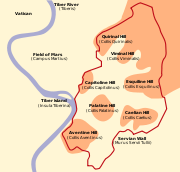
Seven hills of Rome
The Seven Hills of Rome east of the river Tiber form the geographical heart of Rome, within the walls of the ancient city.The seven hills are:* Aventine Hill * Caelian Hill...
and is one of the most ancient parts of the city
City
A city is a relatively large and permanent settlement. Although there is no agreement on how a city is distinguished from a town within general English language meanings, many cities have a particular administrative, legal, or historical status based on local law.For example, in the U.S...
. It stands 40 metres above the Forum Romanum
Roman Forum
The Roman Forum is a rectangular forum surrounded by the ruins of several important ancient government buildings at the center of the city of Rome. Citizens of the ancient city referred to this space, originally a marketplace, as the Forum Magnum, or simply the Forum...
, looking down upon it on one side, and upon the Circus Maximus
Circus Maximus
The Circus Maximus is an ancient Roman chariot racing stadium and mass entertainment venue located in Rome, Italy. Situated in the valley between the Aventine and Palatine hills, it was the first and largest stadium in ancient Rome and its later Empire...
on the other.
It is the etymological
Etymology
Etymology is the study of the history of words, their origins, and how their form and meaning have changed over time.For languages with a long written history, etymologists make use of texts in these languages and texts about the languages to gather knowledge about how words were used during...
origin of the word "palace
Palace
A palace is a grand residence, especially a royal residence or the home of a head of state or some other high-ranking dignitary, such as a bishop or archbishop. The word itself is derived from the Latin name Palātium, for Palatine Hill, one of the seven hills in Rome. In many parts of Europe, the...
" and its cognates in other languages (Italian "Palazzo
Palazzo
Palazzo, an Italian word meaning a large building , may refer to:-Buildings:*Palazzo, an Italian type of building**Palazzo style architecture, imitative of Italian palazzi...
", French "Palais" etc).
Mythology
According to Roman mythologyRoman mythology
Roman mythology is the body of traditional stories pertaining to ancient Rome's legendary origins and religious system, as represented in the literature and visual arts of the Romans...
, the Palatine Hill was the location of the cave, known as the Lupercal
Lupercal
The Lupercal is a cave at the foot of the Palatine Hill in Rome, between the Temple of Apollo Palatinus and the Basilica of Santa Anastasia. In the legend of Rome's foundation, Romulus and Remus were found there by the lactating female wolf who suckled them until they were found by Faustulus...
, where Romulus and Remus
Romulus and Remus
Romulus and Remus are Rome's twin founders in its traditional foundation myth, although the former is sometimes said to be the sole founder...
were found by the she-wolf that kept them alive. According to this legend
Founding of Rome
The founding of Rome is reported by many legends, which in recent times are beginning to be supplemented by scientific reconstructions.- Development of the city :...
, the shepherd Faustulus
Faustulus
In Roman mythology, Faustulus was the shepherd who found the infants Romulus and Remus, who were being suckled by a she-wolf, known as Lupa, on the Palatine Hill. He, with his wife, Acca Larentia, raised the children. In some versions of the myth, Larentia was a prostitute...
found the infants, and with his wife Acca Larentia
Acca Larentia
Acca Larentia or Acca Larentina was a mythical woman, later goddess, in Roman mythology whose festival, the Larentalia, was celebrated on December 23.-Foster mother:...
raised the children. When they were older, the boys killed their great-uncle (who seized the throne from their grandfather), and they both decided to build a new city of their own on the banks of the River Tiber. Suddenly, they had a violent argument with each other and in the end Romulus killed his twin brother Remus. This is how "Rome" got its name - from Romulus. Another legend to occur on the Palatine is Hercules' defeat of Cacus
Cacus
In Roman mythology, Cacus was a fire-breathing giant monster and the son of Vulcan.-Mythology:Cacus lived in a cave in the Palatine Hill in Italy, the future site of Rome. To the horror of nearby inhabitants, Cacus lived on human flesh and would nail the heads of victims to the doors of his cave...
after the monster had stolen some cattle. Hercules struck Cacus with his characteristic club so hard that it formed a cleft on the southeast corner of the hill, where later a staircase bearing the name of Cacus was constructed.
History
Rome has its origins on the Palatine. Indeed, recent excavations show that people have lived there since approximately 1000 BC.According to Livy
Livy
Titus Livius — known as Livy in English — was a Roman historian who wrote a monumental history of Rome and the Roman people. Ab Urbe Condita Libri, "Chapters from the Foundation of the City," covering the period from the earliest legends of Rome well before the traditional foundation in 753 BC...
, after the immigration of the Sabines and the Albans
Alba Longa
Alba Longa – in Italian sources occasionally written Albalonga – was an ancient city of Latium in central Italy southeast of Rome in the Alban Hills. Founder and head of the Latin League, it was destroyed by Rome around the middle of the 7th century BC. In legend, Romulus and Remus, founders of...
to Rome, the original Romans lived on the Palatine.
Many affluent Romans of the Republican period
Roman Republic
The Roman Republic was the period of the ancient Roman civilization where the government operated as a republic. It began with the overthrow of the Roman monarchy, traditionally dated around 508 BC, and its replacement by a government headed by two consuls, elected annually by the citizens and...
(c.509 BC – 44 BC
44 BC
Year 44 BC was either a common year starting on Sunday or Monday or a leap year starting on Friday or Saturday of the Julian calendar and a common year starting on Sunday of the Proleptic Julian calendar...
) had their residences there. During the Empire
Roman Empire
The Roman Empire was the post-Republican period of the ancient Roman civilization, characterised by an autocratic form of government and large territorial holdings in Europe and around the Mediterranean....
(27 BC
27 BC
Year 27 BC was either a common year starting on Sunday, Monday or Tuesday or a leap year starting on Monday of the Julian calendar and a common year starting on Sunday of the Proleptic Julian calendar...
– 476 AD) several emperors resided there; in fact, the ruins of the palaces of Augustus
Augustus
Augustus ;23 September 63 BC – 19 August AD 14) is considered the first emperor of the Roman Empire, which he ruled alone from 27 BC until his death in 14 AD.The dates of his rule are contemporary dates; Augustus lived under two calendars, the Roman Republican until 45 BC, and the Julian...
(27 BC
27 BC
Year 27 BC was either a common year starting on Sunday, Monday or Tuesday or a leap year starting on Monday of the Julian calendar and a common year starting on Sunday of the Proleptic Julian calendar...
– 14 AD), Tiberius
Tiberius
Tiberius , was Roman Emperor from 14 AD to 37 AD. Tiberius was by birth a Claudian, son of Tiberius Claudius Nero and Livia Drusilla. His mother divorced Nero and married Augustus in 39 BC, making him a step-son of Octavian...
(14 AD – 37 AD) and Domitian
Domitian
Domitian was Roman Emperor from 81 to 96. Domitian was the third and last emperor of the Flavian dynasty.Domitian's youth and early career were largely spent in the shadow of his brother Titus, who gained military renown during the First Jewish-Roman War...
(81 AD – 96 AD) can still be seen. Augustus also built a temple to Apollo
Temple of Apollo Palatinus
The Temple of Apollo Palatinus was a temple on the Palatine Hill of ancient Rome, which was first dedicated by Augustus to his patron god Apollo. It was only the second temple in Rome dedicated to the god, after the Temple of Apollo Sosianus...
here, beside his own palace
House of Augustus
The House of Augustus, or the Domus Augusti, is the first major site upon entering the Palatine Hill in Rome, Italy. It served as the primary residence of Caesar Augustus during his reign...
.
The Palatine Hill was also the site of the festival of the Lupercalia
Lupercalia
Lupercalia was a very ancient, possibly pre-Roman pastoral festival, observed on February 13 through 15 to avert evil spirits and purify the city, releasing health and fertility...
.
Location
One building, believed to be the residence of LiviaLivia
Livia Drusilla, , after her formal adoption into the Julian family in AD 14 also known as Julia Augusta, was a Roman empress as the third wife of the Emperor Augustus and his adviser...
(58 BC
58 BC
Year 58 BC was a year of the pre-Julian Roman calendar. At the time, it was known as the Year of the Consulship of Piso and Gabinius...
– 29), the wife of Augustus, is currently undergoing renovation. Situated near to the house of Livia is the temple of Cybele
Temple of Cybele (Palatine)
The Temple of Cybele or Temple of Magna Mater was a temple on the Palatine Hill in Rome. This, the main temple of Cybele or Magna Mater in Rome, was erected after the Roman embassy brought back her icon from Pessinus in 204 BC...
, currently not fully excavated and not open to the public. Behind this structure, cut into the side of the hill, is the so-called House of Tiberius.
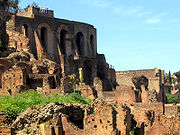
Overlooking the Forum Romanum is the Flavian Palace
Flavian Palace
The Flavian Palace, also known as Domus Flavia, is a part of the vast residential complex of the Roman Emperors on the Palatine Hill in Rome...
which was built largely during the reign of the Flavian dynasty
Flavian dynasty
The Flavian dynasty was a Roman Imperial Dynasty, which ruled the Roman Empire between 69 and 96 AD, encompassing the reigns of Vespasian , and his two sons Titus and Domitian . The Flavians rose to power during the civil war of 69, known as the Year of the Four Emperors...
(69 – 96) – Vespasian
Vespasian
Vespasian , was Roman Emperor from 69 AD to 79 AD. Vespasian was the founder of the Flavian dynasty, which ruled the Empire for a quarter century. Vespasian was descended from a family of equestrians, who rose into the senatorial rank under the Emperors of the Julio-Claudian dynasty...
, Titus
Titus
Titus , was Roman Emperor from 79 to 81. A member of the Flavian dynasty, Titus succeeded his father Vespasian upon his death, thus becoming the first Roman Emperor to come to the throne after his own father....
and Domitian
Domitian
Domitian was Roman Emperor from 81 to 96. Domitian was the third and last emperor of the Flavian dynasty.Domitian's youth and early career were largely spent in the shadow of his brother Titus, who gained military renown during the First Jewish-Roman War...
. This palace, which was extended and modified by several emperors, extends across the Palatine Hill and looks out over the Circus Maximus. The building of the greater part of the palace visible from the Circus was undertaken in the reign of the emperor Septimius Severus
Septimius Severus
Septimius Severus , also known as Severus, was Roman Emperor from 193 to 211. Severus was born in Leptis Magna in the province of Africa. As a young man he advanced through the customary succession of offices under the reigns of Marcus Aurelius and Commodus. Severus seized power after the death of...
(146 – 211).
Immediately adjacent to the palace of Severus is the Hippodrome of Domitian. This is a structure which has the appearance of a Roman Circus
Circus (building)
The Roman circus was a large open-air venue used for public events in the ancient Roman Empire. The circuses were similar to the ancient Greek hippodromes, although serving varying purposes. Along with theatres and amphitheatres, Circuses were one of the main entertainment sites of the time...
and whose name means Circus in Greek, but is too small to accommodate chariots. It can be better described as a Greek Stadium, that is, a venue for foot races. However, its exact purpose is disputed. While it is certain that during the Severan period it was used for sporting events, it was most likely originally built as a stadium-shaped garden. According to a guide from the Sopraintendenza Archeologica di Roma, most of the statuary in the nearby Palatine museum comes from the Hippodrome. (Domitian also built a larger stadium that was actually used for foot-racing competitions; it exists today as Piazza Navona
Piazza Navona
Piazza Navona is a city square in Rome, Italy. It is built on the site of the Stadium of Domitian, built in 1st century AD, and follows the form of the open space of the stadium. The ancient Romans came there to watch the agones , and hence it was known as 'Circus Agonalis'...
, lo stadio di Domiziano.)
The Palatine Hill, and the Roman Forum beneath it, is now a large open-air museum and can be visited on the same ticket as the Colosseum
Colosseum
The Colosseum, or the Coliseum, originally the Flavian Amphitheatre , is an elliptical amphitheatre in the centre of the city of Rome, Italy, the largest ever built in the Roman Empire...
. The entrance is on Via di San Gregorio, the street just beyond the Arch of Constantine
Arch of Constantine
The Arch of Constantine is a triumphal arch in Rome, situated between the Colosseum and the Palatine Hill. It was erected to commemorate Constantine I's victory over Maxentius at the Battle of Milvian Bridge on October 28, 312...
, going away from the Colosseum.
Excavations
During Augustus' reign, an area of the Palatine Hill was roped off for a sort of archaeologicalArchaeology
Archaeology, or archeology , is the study of human society, primarily through the recovery and analysis of the material culture and environmental data that they have left behind, which includes artifacts, architecture, biofacts and cultural landscapes...
expedition, which found fragments of Bronze Age
Bronze Age
The Bronze Age is a period characterized by the use of copper and its alloy bronze as the chief hard materials in the manufacture of some implements and weapons. Chronologically, it stands between the Stone Age and Iron Age...
pots and tools. He declared this site the "original town of Rome." Modern archaeology has identified evidence of Bronze Age settlement in the area which predates Rome's founding. There is a museum on the Palatine in which artifacts dating from before the official foundation of the City are displayed. The museum also contains Roman statuary.
An altar to an unknown deity, once thought to be Aius Locutius
Aius Locutius
Aius Locutius or Aius Loquens , was a Roman deity or numen associated with the Gallic invasions of Rome during the early 4th century BC....
, was discovered here in 1820.
In July 2006, archaeologists announced the discovery of the Palatine House, which they believe to be the birthplace of Rome
Ancient Rome
Ancient Rome was a thriving civilization that grew on the Italian Peninsula as early as the 8th century BC. Located along the Mediterranean Sea and centered on the city of Rome, it expanded to one of the largest empires in the ancient world....
's first Emperor, Augustus
Augustus
Augustus ;23 September 63 BC – 19 August AD 14) is considered the first emperor of the Roman Empire, which he ruled alone from 27 BC until his death in 14 AD.The dates of his rule are contemporary dates; Augustus lived under two calendars, the Roman Republican until 45 BC, and the Julian...
. Head archaeologist Clementina Panella
Clementina Panella
Clementina Panella is an Italian archaeologist, a professor at the University of Rome La Sapienza, where she teaches Methodology of Archaeology. Though none of her publications are available in English, she has guided and co-written a number of articles on the commercial pottery of ancient...
uncovered a section of corridor and other fragments under Rome's Palatine Hill, which she described on July 20 as "a very ancient aristocratic house." The two story house appears to have been built around an atrium
Atrium (architecture)
In modern architecture, an atrium is a large open space, often several stories high and having a glazed roof and/or large windows, often situated within a larger multistory building and often located immediately beyond the main entrance doors...
, with frescoed walls and mosaic flooring, and is situated on the slope of the Palatine that overlooks the Colosseum
Colosseum
The Colosseum, or the Coliseum, originally the Flavian Amphitheatre , is an elliptical amphitheatre in the centre of the city of Rome, Italy, the largest ever built in the Roman Empire...
and the Arch of Constantine
Arch of Constantine
The Arch of Constantine is a triumphal arch in Rome, situated between the Colosseum and the Palatine Hill. It was erected to commemorate Constantine I's victory over Maxentius at the Battle of Milvian Bridge on October 28, 312...
. The Republican-era houses on the Palatine were overbuilt by later palaces after the Great Fire of Rome
Great Fire of Rome
The Great Fire of Rome was an urban fire that occurred beginning July 19, AD 64.-Background:According to Tacitus, the fire spread quickly and burned for six days. Only four of the fourteen districts of Rome escaped the fire; three districts were completely destroyed and the other seven suffered...
(64), but apparently this one was not; the tempting early inference is that it was preserved for a specific and important reason. On the ground floor, three shops opened onto the Via Sacra
Via Sacra
The Via Sacra was the main street of ancient Rome, leading from the top of the Capitoline Hill, through some of the most important religious sites of the Forum , to the Colosseum....
.
The location of the domus is important because of its potential proximity to the Curiae Veteres, the earliest shrine of the curies of Rome.
Lupercal
The Lupercal is a cave at the foot of the Palatine Hill in Rome, between the Temple of Apollo Palatinus and the Basilica of Santa Anastasia. In the legend of Rome's foundation, Romulus and Remus were found there by the lactating female wolf who suckled them until they were found by Faustulus...
cave beneath the remains of Augustus' residence
House of Augustus
The House of Augustus, or the Domus Augusti, is the first major site upon entering the Palatine Hill in Rome, Italy. It served as the primary residence of Caesar Augustus during his reign...
, the Domus Livia (House of Livia
Livia
Livia Drusilla, , after her formal adoption into the Julian family in AD 14 also known as Julia Augusta, was a Roman empress as the third wife of the Emperor Augustus and his adviser...
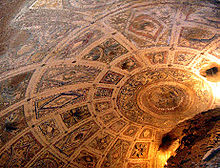
) on the Palatine. Archaeologists came across the 16-metre-deep cavity while working to restore the decaying palace. The first photos of the cave show a richly decorated vault encrusted with mosaics and seashells. The Lupercal was probably converted to a sanctuary by Romans in later centuries.
On November 20, 2007 archaeologists unveiled photographs of the cave. Partially collapsed and decorated with seashells and colored marble, the vaulted sanctuary is buried 16 metres inside the Palatine hill. A white eagle was found atop the sanctuary's vault. Most of the sanctuary is collapsed or filled with earth, but laser scans allowed experts to estimate that the circular structure has a height of 8 metres and a diameter of 7.3 metres.
Adriano La Regina (former Rome’s archaeological superintendent 1976-2004, professor of Etruscology at Rome’s La Sapienza University), Prof. Fausto Zevi (professor of Roman Archaeology at Rome's La Sapienza University) and Prof. Henner von Hesberg (head of the German Archaeological Institute, Rome) denied the identification of the grotto with Lupercal on topographic and stylistic grounds. They concluded that the grotto is actually a nymphaeum
Nymphaeum
A nymphaeum or nymphaion , in ancient Greece and Rome, was a monument consecrated to the nymphs, especially those of springs....
or underground triclinium
Triclinium
A triclinium is a formal dining room in a Roman building. The word is adopted from the Greek τρικλίνιον, triklinion, from τρι-, tri-, "three", and κλίνη, klinē, a sort of "couch" or rather chaise longue...
from Neronian times.
Etymology
According to LivyLivy
Titus Livius — known as Livy in English — was a Roman historian who wrote a monumental history of Rome and the Roman people. Ab Urbe Condita Libri, "Chapters from the Foundation of the City," covering the period from the earliest legends of Rome well before the traditional foundation in 753 BC...
(59 BC
59 BC
Year 59 BC was a year of the pre-Julian Roman calendar. At the time, it was known as the Year of the Consulship of Caesar and Bibulus...
– AD 17) the Palatine hill got its name from the Arcadia
Arcadia
Arcadia is one of the regional units of Greece. It is part of the administrative region of Peloponnese. It is situated in the central and eastern part of the Peloponnese peninsula. It takes its name from the mythological character Arcas. In Greek mythology, it was the home of the god Pan...
n settlement of Pallantium
Pallantium
Pallantium was an ancient city near the Tiber river on the Italian peninsula. Roman mythology, as recounted in Virgil's Aeneid for example, states that the city was founded by Evander of Pallene and other ancient Greeks sometime previous to the Trojan War...
. More likely, it is derived from the noun palātum "palate"; Ennius
Ennius
Quintus Ennius was a writer during the period of the Roman Republic, and is often considered the father of Roman poetry. He was of Calabrian descent...
uses it once for the "heaven", and it may be connected with the Etruscan
Etruscan language
The Etruscan language was spoken and written by the Etruscan civilization, in what is present-day Italy, in the ancient region of Etruria and in parts of Lombardy, Veneto, and Emilia-Romagna...
word for sky, falad.
The term palace
Palace
A palace is a grand residence, especially a royal residence or the home of a head of state or some other high-ranking dignitary, such as a bishop or archbishop. The word itself is derived from the Latin name Palātium, for Palatine Hill, one of the seven hills in Rome. In many parts of Europe, the...
itself stems from Palatium.
See also
- Seven hills of RomeSeven hills of RomeThe Seven Hills of Rome east of the river Tiber form the geographical heart of Rome, within the walls of the ancient city.The seven hills are:* Aventine Hill * Caelian Hill...
- Aventine Hill (Aventino)Aventine HillThe Aventine Hill is one of the seven hills on which ancient Rome was built. It belongs to Ripa, the twelfth rione, or ward, of Rome.-Location and boundaries:The Aventine hill is the southernmost of Rome's seven hills...
- Caelian Hill (Celio)Caelian HillThe Caelian Hill is one of the famous Seven Hills of Rome. Under reign of Tullus Hostilius, the entire population of Alba Longa was forcibly resettled on the Caelian Hill...
- Capitoline Hill (Capitolino)Capitoline HillThe Capitoline Hill , between the Forum and the Campus Martius, is one of the seven hills of Rome. It was the citadel of the earliest Romans. By the 16th century, Capitolinus had become Capitolino in Italian, with the alternative Campidoglio stemming from Capitolium. The English word capitol...
- Cispian Hill (Cispio)CispiusCispius is the nomen of the Roman gens Cispia.-Cispius Laevus:The Mons Cispius, or Cispian Hill, is one of several summits of the Esquiline Hill in Rome. The grammarian Festus says that it was named for a Cispius Laevus of Anagnia, of the Publilia voting tribe . This Cispius may be legendary.-M...
- Esquiline Hill (Esquilino)
- Janiculum Hill (Gianicolo)
- Monte MarioMonte Mario-External links :* * *...
- Oppian Hill (Oppio)Oppian HillThe Oppian Hill is the southern spur of the Esquiline Hill , one of the famous Seven Hills of Rome. It is separated from the Cispius on the north by the valley of the Subura, and from the Caelian Hill on the south by the valley of the Colosseum...
- Pincian Hill (Pincio)Pincian HillThe Pincian Hill is a hill in the northeast quadrant of the historical center of Rome. The hill lies to the north of the Quirinal, overlooking the Campus Martius...
- Quirinal Hill (Quirinale)Quirinal HillThe Quirinal Hill is one of the Seven Hills of Rome, at the north-east of the city center. It is the location of the official residence of the Italian Head of State, who resides in the Quirinal Palace; by metonymy "the Quirinal" has come to stand for the Italian President.- History :It was...
- Vatican Hill (Vaticano)Vatican HillVatican Hill is the name given, long before the founding of Christianity, to one of the hills on the side of the Tiber opposite the traditional seven hills of Rome...
- Velian Hill (Velia)Velian HillThe Velia — or Velian Hill or Velian Ridge — is a saddle or spur stretching out from the middle of the north side of the Palatine Hill towards the Oppian Hill ....
- Viminal Hill (Viminale)Viminal HillThe Viminal Hill is the smallest of the famous seven hills of Rome. A finger-shape cusp pointing toward central Rome between the Quirinal Hill to the northwest and the Esquiline Hill to the southeast, it is home to the Teatro dell'Opera and the Termini Railway Station.At the top of Viminal Hill...