


Condottieri

Encyclopedia
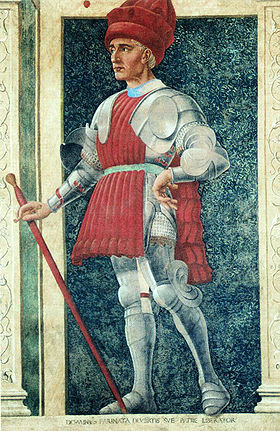
Mercenary
A mercenary, is a person who takes part in an armed conflict based on the promise of material compensation rather than having a direct interest in, or a legal obligation to, the conflict itself. A non-conscript professional member of a regular army is not considered to be a mercenary although he...
soldier leader
Leader
A leader is one who influences or leads others.Leader may also refer to:- Newspapers :* Leading article, a piece of writing intended to promote an opinion, also called an editorial* The Leader , published 1909–1967...
s (or warlords
Warlords
Warlords may refer to:* The plural of warlord, a name for a figure who has military authority but not legal authority over a subnational region.* "WARLORDS", the call sign of a United States Navy Helicopter squadron based in Ayase city, Japan....
) of the professional, military free companies
Free company
A free company or free lance was a late medieval army of mercenaries acting independently of any government, and thus "free". They were not called "free" because their services were gratis, rather they sold their services to the highest bidder...
contracted by the Italian city-states and the Papacy, from the late Middle Ages
Late Middle Ages
The Late Middle Ages was the period of European history generally comprising the 14th to the 16th century . The Late Middle Ages followed the High Middle Ages and preceded the onset of the early modern era ....
and throughout the Renaissance
Renaissance
The Renaissance was a cultural movement that spanned roughly the 14th to the 17th century, beginning in Italy in the Late Middle Ages and later spreading to the rest of Europe. The term is also used more loosely to refer to the historical era, but since the changes of the Renaissance were not...
. In Renaissance Italian, condottiero meant "contractor", and was synonymous with the modern English title Mercenary Captain, which, historiographically
Historiography
Historiography refers either to the study of the history and methodology of history as a discipline, or to a body of historical work on a specialized topic...
, does not connote the hired soldier’s nationality. In contemporary Italian, "condottiero" acquired the broader meaning of "military leader" (e.g., not restricted to mercenaries).
These Italian words were standard usage in English writing of the Napoleonic times
Napoleonic Era
The Napoleonic Era is a period in the history of France and Europe. It is generally classified as including the fourth and final stage of the French Revolution, the first being the National Assembly, the second being the Legislative Assembly, and the third being the Directory...
that remained current in written histories until the late 20th century; because formally-employed, standing, professional armies were uncommon until late in the Napoleonic Wars
Napoleonic Wars
The Napoleonic Wars were a series of wars declared against Napoleon's French Empire by opposing coalitions that ran from 1803 to 1815. As a continuation of the wars sparked by the French Revolution of 1789, they revolutionised European armies and played out on an unprecedented scale, mainly due to...
(1800–1815) thus, the word Condottiere in the English language has come to denote, in the modern sense, any hired soldier.
History
In the thirteenth and fourteenth centuries, the Italian city-stateCity-state
A city-state is an independent or autonomous entity whose territory consists of a city which is not administered as a part of another local government.-Historical city-states:...
s of Venice
Republic of Venice
The Republic of Venice or Venetian Republic was a state originating from the city of Venice in Northeastern Italy. It existed for over a millennium, from the late 7th century until 1797. It was formally known as the Most Serene Republic of Venice and is often referred to as La Serenissima, in...
, Florence
Republic of Florence
The Republic of Florence , or the Florentine Republic, was a city-state that was centered on the city of Florence, located in modern Tuscany, Italy. The republic was founded in 1115, when the Florentine people rebelled against the Margraviate of Tuscany upon Margravine Matilda's death. The...
, and Genoa
Republic of Genoa
The Most Serene Republic of Genoa |Ligurian]]: Repúbrica de Zêna) was an independent state from 1005 to 1797 in Liguria on the northwestern Italian coast, as well as Corsica from 1347 to 1768, and numerous other territories throughout the Mediterranean....
were very rich from their trade with the Levant
Levant
The Levant or ) is the geographic region and culture zone of the "eastern Mediterranean littoral between Anatolia and Egypt" . The Levant includes most of modern Lebanon, Syria, Jordan, Israel, the Palestinian territories, and sometimes parts of Turkey and Iraq, and corresponds roughly to the...
, yet possessed woefully small national armies. In the event that foreign powers and envious neighbours attacked, the ruling nobles hired foreign mercenaries to fight for them. The military-service terms and conditions were stipulated in a condotta (contract) between the city-state and the soldiers (officer and enlisted man), thus, the contracted leader, the mercenary captain commanding, was titled the Condottiere.
From the eleventh to the thirteenth century, European soldiers led by professional officers, fought against the Muslims in the Crusades
Crusades
The Crusades were a series of religious wars, blessed by the Pope and the Catholic Church with the main goal of restoring Christian access to the holy places in and near Jerusalem...
(1095–1291). These crusading officers provided large-scale warfare combat experience in the foreign Holy Land of the Asian Middle East. On the Crusades’ conclusion, the first masnada (bands of roving soldiers) appeared in Italy. Given the profession, some masnade were less mercenaries than bandits and desperate men. These masnada were not Italian, but (mostly) German, from the Duchy of Brabant
Duchy of Brabant
The Duchy of Brabant was a historical region in the Low Countries. Its territory consisted essentially of the three modern-day Belgian provinces of Flemish Brabant, Walloon Brabant and Antwerp, the Brussels-Capital Region and most of the present-day Dutch province of North Brabant.The Flag of...
(hence, Brabanzoni), and from Catalonia
Catalonia
Catalonia is an autonomous community in northeastern Spain, with the official status of a "nationality" of Spain. Catalonia comprises four provinces: Barcelona, Girona, Lleida, and Tarragona. Its capital and largest city is Barcelona. Catalonia covers an area of 32,114 km² and has an...
and Aragon
Aragon
Aragon is a modern autonomous community in Spain, coextensive with the medieval Kingdom of Aragon. Located in northeastern Spain, the Aragonese autonomous community comprises three provinces : Huesca, Zaragoza, and Teruel. Its capital is Zaragoza...
. The latter were Spanish soldiers who had followed King Peter III of Aragon
Peter III of Aragon
Peter the Great was the King of Aragon of Valencia , and Count of Barcelona from 1276 to his death. He conquered Sicily and became its king in 1282. He was one of the greatest of medieval Aragonese monarchs.-Youth and succession:Peter was the eldest son of James I of Aragon and his second wife...
in Italy
War of the Sicilian Vespers
The War of the ' Vespers started with the insurrection of the Sicilian Vespers against Charles of Anjou in 1282 and finally ended with the peace of Caltabellotta in 1302...
in October 1282, and, post-war, remained there, seeking military employment. By 1333 other mercenaries had arrived in Italy to fight with John of Bohemia as the Compagnia della Colomba (Dove Company) in Perugia
Perugia
Perugia is the capital city of the region of Umbria in central Italy, near the River Tiber, and the capital of the province of Perugia. The city is located about north of Rome. It covers a high hilltop and part of the valleys around the area....
’s war against Arezzo
Arezzo
Arezzo is a city and comune in Central Italy, capital of the province of the same name, located in Tuscany. Arezzo is about 80 km southeast of Florence, at an elevation of 296 m above sea level. In 2011 the population was about 100,000....
.
The first well organised mercenaries in Italy were the Ventura Companies of Duke
Duke
A duke or duchess is a member of the nobility, historically of highest rank below the monarch, and historically controlling a duchy...
Werner von Urslingen and Count
Count
A count or countess is an aristocratic nobleman in European countries. The word count came into English from the French comte, itself from Latin comes—in its accusative comitem—meaning "companion", and later "companion of the emperor, delegate of the emperor". The adjective form of the word is...
Konrad von Landau. Werner’s company differed from other mercenary companies because its code of military justice imposed discipline and an equal division of the contract’s income. The Ventura Company increased in number until becoming the fearsome “Great Company
The Great Company (German)
The Great Company was a group of mercenaries, chiefly of German origin but operating in the Italian peninsula, who flourished in the mid-14th century. At its height, the company numbered approximately 6,000 men, chiefly armored cavalry...
” of some 3,000 barbute (each barbuta comprised a knight and a sergeant). The first mercenary company with an Italian condottiero as its chief was the "Company of St. George" formed in 1339 and led by Lodrisio Visconti
Lodrisio Visconti
-Biography:He was the son of Pietro, of the powerful House of Visconti of Milan, and Antiochia Crivelli.After a military training under his father, he helped his cousin Matteo Visconti and the latter's son Galeazzo in the reconquest of Milan against the Torriani. Later, together with the other...
. This company was defeated and destroyed by Luchino Visconti of Milan (another condottiero and Uncle of Lodrisio) in April 1339. Later, in 1377, a second "Company of St. George" was formed under the leadership of Alberico da Barbiano
Alberico da Barbiano
Alberico da Barbiano was the first of the Italian condottieri. His master in military matters was the English mercenary John Hawkwood, known in Italy as Giovanni Acuto...
, also an Italian and the Count of Conio, who later taught military science
Military science
Military science is the process of translating national defence policy to produce military capability by employing military scientists, including theorists, researchers, experimental scientists, applied scientists, designers, engineers, test technicians, and military personnel responsible for...
to condottieri such as Braccio da Montone and Giacomuzzo Attendolo Sforza, who also served in the company.
Once aware of their military power monopoly in Italy, the condottieri bands became notorious for their capriciousness, and soon dictated terms to their ostensible employers. In turn, many condottieri, such as Braccio da Montone
Braccio da Montone
frame|Braccio da Montone.Braccio da Montone , born Andrea Fortebracci, and also known as Braccio Fortebraccio, was an Italian condottiero.-Biography:...
and Muzio Sforza
Muzio Sforza
Muzio Attendolo Sforza was an Italian condottiero. Founder of the Sforza dynasty, he led a Bolognese-Florentine army at the Battle of Casalecchio.He was the father of Francesco Sforza, who ruled Milan for 16 years....
, became powerful politicians. As most were educated men acquainted with Roman military-science manuals (e.g. Vegetius
Vegetius
Publius Flavius Vegetius Renatus, commonly referred to simply as Vegetius, was a writer of the Later Roman Empire. Nothing is known of his life or station beyond what he tells us in his two surviving works: Epitoma rei militaris , and the lesser-known Digesta Artis Mulomedicinae, a guide to...
’s Epitoma rei militarii), they began viewing warfare from the perspective of military science, rather than that of valor or physical courage—a great, consequential departure from chivalry
Chivalry
Chivalry is a term related to the medieval institution of knighthood which has an aristocratic military origin of individual training and service to others. Chivalry was also the term used to refer to a group of mounted men-at-arms as well as to martial valour...
, the traditional mediæval model of soldiering. Consequently, the condottieri fought by out-manœuvring the opponent and fighting his ability to wage war, rather than risk uncertain fortune—defeat, capture, death—in battlefield combat.
The earlier, mediæval condottieri developed the art of war (strategy and tactics) into military science more than any of their historical military predecessors—fighting indirectly, not directly—thus, only reluctantly endangering themselves and their enlisted men, avoiding battle when possible, also avoiding hard work and winter campaigns, as these all reduced the total number of trained soldiers available, and was detrimental to their political and economic interest. Niccolò Machiavelli
Niccolò Machiavelli
Niccolò di Bernardo dei Machiavelli was an Italian historian, philosopher, humanist, and writer based in Florence during the Renaissance. He is one of the main founders of modern political science. He was a diplomat, political philosopher, playwright, and a civil servant of the Florentine Republic...
even said that condottieri fought each other in grandiose, but often pointless and near-bloodless battles. However, later in the Renaissance the condottieri line of battle still deployed the grand armoured knight and mediæval weapons and tactics after most European powers had begun employing professional standing armies of pikemen and musketeer
Musketeer
A musketeer was an early modern type of infantry soldier equipped with a musket. Musketeers were an important part of early modern armies, particularly in Europe. They sometimes could fight on horseback, like a dragoon or a cavalryman...
s--this helped to contribute to their eventual decline and destruction.
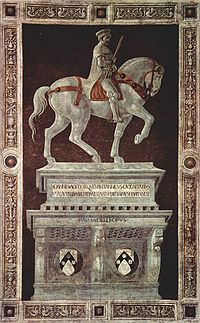
Cola di Rienzo
Cola di Rienzo was an Italian medieval politician and popular leader, tribune of the Roman people in the mid-14th century.-Early career:Cola was born in Rome of humble origins...
(Tribune and effective dictator of the city) had Werner of Urslingen executed in Rome, and Konrad von Landau assumed command of the Great Company. On the conclusion (1360) of the Peace of Bretigny
Treaty of Brétigny
The Treaty of Brétigny was a treaty signed on May 9, 1360, between King Edward III of England and King John II of France. In retrospect it is seen as having marked the end of the first phase of the Hundred Years' War —as well as the height of English hegemony on the Continent.It was signed...
between England and France, Sir John Hawkwood
John Hawkwood
Sir John Hawkwood was an English mercenary or condottiero who was active in 14th century Italy. The French chronicler Jean Froissart knew him as Jean Haccoude and Italians as Giovanni Acuto...
led an army of English mercenaries, called the White Company
White Company
The White Company was a 14th Century Italian mercenary Company of Adventure , led from its arrival in Italy in 1361 to 1365 by the German Albert Sterz and later by the Englishman John Hawkwood...
, into Italy, which took a prominent part in the confused wars of the next thirty years. Towards the end of the century the Italians began to organize armies of the same description. This ended the reign of the purely mercenary company, and began that of the semi-national mercenary army which endured in Europe till replaced by the national standing army system. In 1363, Count von Landau was betrayed by his Hungarian soldiers, and defeated in combat, by the White Company’s more advanced tactics under commanders Albert Sterz and John Hawkwood. Stategically, the barbuta was replaced with the three-soldier, mounted lancia (a capo-lancia, a groom, and a boy); five lance composed a posta, five poste composed a bandiera (flag). By that time, the campaigning condottieri companies were as much Italian as foreign: the Astorre I Manfredi’s Compagnia della Stella (Star Company); a new Company of St. George under Ambrogio Visconti; Niccolò da Montefeltro’s Compagnia del Cappelletto (Little Hat Company); and the Compagnia della Rosa, commanded by Giovanni da Buscareto and Bartolomeo Gonzaga.
From the fifteenth century hence, most condottieri were landless Italian nobles who had chosen the profession of arms as livelihood; the most famous of such mercenary captains was the son of Caterina Sforza
Caterina Sforza
Caterina Sforza, Countess of Forlì was an Italian noblewoman, the illegitimate daughter of Galeazzo Maria Sforza, Duke of Milan and Lucrezia Landriani, the wife of the courtier Gian Piero Landriani, a close friend of the Duke...
, Giovanni dalle Bande Nere
Giovanni dalle Bande Nere
Lodovico de Medici also known as Giovanni dalle Bande Nere was an Italian condottiero.-Biography:Giovanni was born in the Northern Italian town of Forlì to Giovanni de' Medici and Caterina Sforza, one of the most famous women of the Italian Renaissance.From an early age, he demonstrated great...
, from Forlì
Forlì
Forlì is a comune and city in Emilia-Romagna, Italy, and is the capital of the province of Forlì-Cesena. The city is situated along the Via Emilia, to the right of the Montone river, and is an important agricultural centre...
, known as The Last Condottiere; his son was Cosimo I de' Medici, Grand Duke of Tuscany
Cosimo I de' Medici, Grand Duke of Tuscany
Cosimo I de' Medici was Duke of Florence from 1537 to 1574, reigning as the first Grand Duke of Tuscany from 1569.-Biography:...
; besides noblemen, princes also fought as condottieri, given the sizable income to their estates, notably Sigismondo Malatesta
Sigismondo Malatesta
Sigismondo Pandolfo Malatesta , popularly known as the Wolf of Rimini, was an Italian condottiero and nobleman, a member of the House of Malatesta and lord of Rimini, Fano, and Cesena from 1432...
, Lord of Rimini
Rimini
Rimini is a medium-sized city of 142,579 inhabitants in the Emilia-Romagna region of Italy, and capital city of the Province of Rimini. It is located on the Adriatic Sea, on the coast between the rivers Marecchia and Ausa...
, and Federico da Montefeltro
Federico da Montefeltro
Federico da Montefeltro, also known as Federico III da Montefeltro , was one of the most successful condottieri of the Italian Renaissance, and lord of Urbino from 1444 until his death...
, Duke of Urbino
Urbino
Urbino is a walled city in the Marche region of Italy, south-west of Pesaro, a World Heritage Site notable for a remarkable historical legacy of independent Renaissance culture, especially under the patronage of Federico da Montefeltro, duke of Urbino from 1444 to 1482...
; despite war-time inflation
Inflation
In economics, inflation is a rise in the general level of prices of goods and services in an economy over a period of time.When the general price level rises, each unit of currency buys fewer goods and services. Consequently, inflation also reflects an erosion in the purchasing power of money – a...
, soldier’s pay was high:
- 1,900 monthly florinsItalian coin florinThe Italian florin was a coin struck from 1252 to 1533 with no significant change in its design or metal content standard. It had 54 grains of nominally pure gold worth approximately 200 modern US Dollars...
in 1432: Micheletto AttendoloMicheletto Attendolothumb|350px|The decisive attack of Micheletto Attendolo at San Romano, part of The Battle of San Romano triptych by [[Paolo Uccello]]. [[Musée du Louvre]], [[Paris]].Micheletto Attendolo was an Italian condottiero....
(Florence) - 6,600 monthly florins in 1448: William VIII of Montferrat, from Francesco Sforza (Milan); the enlisted soldier’s pay was 3,300 florins, half that of an officer’s
- 33,000 yearly scudi for 250 men in 1505: Francesco II Gonzaga (Florence)
- 100,000 yearly scudi for 200 men in 1505: Francesco Maria I della RovereFrancesco Maria I della RovereFrancesco Maria I della Rovere was an Italian condottiero, who was Duke of Urbino from 1508 until 1538.- Biography :...
(Florence)
The condottieri company commanders selected the soldiers to enlist; the condotta was a consolidated contract, and, when the ferma (service period) elapsed, the company entered an aspetto (wait) period, wherein, the contracting city-state considered its renewal. If the condotta expired definitively, the condottiere could not declare war against the contracting city-state for two years. This military–business custom was respected because professional reputation (business credibility) was everything to the condottieri; a deceived employer was a reputation ruined; likewise for maritime mercenaries, whose contratto d’assento (contract of assent) stipulated naval military-service terms and conditions; sea captains and sailors so-contracted were called assentisti. Their principal employers were Genoa
Genoa
Genoa |Ligurian]] Zena ; Latin and, archaically, English Genua) is a city and an important seaport in northern Italy, the capital of the Province of Genoa and of the region of Liguria....
and the Papal States
Papal States
The Papal State, State of the Church, or Pontifical States were among the major historical states of Italy from roughly the 6th century until the Italian peninsula was unified in 1861 by the Kingdom of Piedmont-Sardinia .The Papal States comprised territories under...
, beginning in the fourteenth century, yet, Venice
Republic of Venice
The Republic of Venice or Venetian Republic was a state originating from the city of Venice in Northeastern Italy. It existed for over a millennium, from the late 7th century until 1797. It was formally known as the Most Serene Republic of Venice and is often referred to as La Serenissima, in...
considered it humiliating to so employ military sailors, and did not use naval mercenaries, even during the greatest danger in the City’s history.
In fifteenth-century Italy, the condottieri were masterful lords of war; during the wars in Lombardy
Wars in Lombardy
The wars in Lombardy were a series of conflicts fought in central-northern Italy between the Republic of Venice and the Duchy of Milan, and their different allies. They lasted from 1425 until the signing of the Treaty of Lodi in 1454...
, Machiavelli observed:
- History I. vii.
The fifteenth-century Italian armies defeated most of the Turkish
Ottoman Empire
The Ottoman EmpireIt was usually referred to as the "Ottoman Empire", the "Turkish Empire", the "Ottoman Caliphate" or more commonly "Turkey" by its contemporaries...
, Swiss
Switzerland
Switzerland name of one of the Swiss cantons. ; ; ; or ), in its full name the Swiss Confederation , is a federal republic consisting of 26 cantons, with Bern as the seat of the federal authorities. The country is situated in Western Europe,Or Central Europe depending on the definition....
, Hungarian
Hungary
Hungary , officially the Republic of Hungary , is a landlocked country in Central Europe. It is situated in the Carpathian Basin and is bordered by Slovakia to the north, Ukraine and Romania to the east, Serbia and Croatia to the south, Slovenia to the southwest and Austria to the west. The...
, German
Germany
Germany , officially the Federal Republic of Germany , is a federal parliamentary republic in Europe. The country consists of 16 states while the capital and largest city is Berlin. Germany covers an area of 357,021 km2 and has a largely temperate seasonal climate...
, French
France
The French Republic , The French Republic , The French Republic , (commonly known as France , is a unitary semi-presidential republic in Western Europe with several overseas territories and islands located on other continents and in the Indian, Pacific, and Atlantic oceans. Metropolitan France...
, and Austria
Austria
Austria , officially the Republic of Austria , is a landlocked country of roughly 8.4 million people in Central Europe. It is bordered by the Czech Republic and Germany to the north, Slovakia and Hungary to the east, Slovenia and Italy to the south, and Switzerland and Liechtenstein to the...
n incursions. In 1487, at Calliano
Calliano
-Places:Italy* Calliano, Piedmont, a comune in the Province of Asti* Calliano, Trentino, a comune in the Province of Trento...
, the Venetians
Republic of Venice
The Republic of Venice or Venetian Republic was a state originating from the city of Venice in Northeastern Italy. It existed for over a millennium, from the late 7th century until 1797. It was formally known as the Most Serene Republic of Venice and is often referred to as La Serenissima, in...
successfully met and acquitted themselves against the German landsknechte and the Swiss infantry, who then were the best soldiers in Europe.
Decline
In time, the financial and political interests of the condottieri proved serious drawbacks to decisive, bloody warfare: the mercenary captains often were treacherous, tending to avoid combat, and "resolve" fights with a bribe — either for the opponent or for themselves. Towards the end of the 15th century, when the large cities had gradually swallowed up the small states, and Italy itself was drawn into the general current of European politics, and became the battlefield of powerful armies - French, Spanish and German - the condottieri, who in the end proved quite unequal to the gendarmerie of France and the improved troops of the Italian states, gradually disappeared.The soldiers of the condottieri were almost entirely heavy armoured cavalry (men-at-arms). They had, at any rate before 1400, nothing in common with the people among whom they fought, and their disorderly conduct and rapacity seem often to have exceeded that of other medieval armies. They were always ready to change sides at the prospect of higher pay. They were connected with each other by the interest of a common profession, and by the possibility that the enemy of to-day might be the friend and fellow-soldier of to-morrow. Further, a prisoner was always more valuable than a dead enemy. In consequence of all this their battles were often as bloodless as they were theatrical. Splendidly equipped armies were known to fight for hours with hardly the loss of a man (Zagonara, 1423; Molinella
Molinella
Molinella is a comune in the Province of Bologna in the Italian region Emilia-Romagna, located about 30 km northeast of Bologna...
, 1467).
The “Age of the Condottieri” began in 1494, with the first, great foreign invasion in a century: the French king, Charles VIII
Charles VIII of France
Charles VIII, called the Affable, , was King of France from 1483 to his death in 1498. Charles was a member of the House of Valois...
's royal army matched the divided Italian city-states and their smaller condottieri armies. The most renowned condottieri fought for foreign powers: Gian Giacomo Trivulzio
Gian Giacomo Trivulzio
Gian Giacomo Trivulzio was an Italian aristocrat and condottiero who held several military commands during the Italian Wars.-Biography:...
abandoned Milan for France, while Andrea Doria
Andrea Doria
Andrea Doria was an Italian condottiere and admiral from Genoa.-Early life:Doria was born at Oneglia from the ancient Genoese family, the Doria di Oneglia branch of the old Doria, de Oria or de Auria family. His parents were related: Ceva Doria, co-lord of Oneglia, and Caracosa Doria, of the...
was Admiral of the Holy Roman Emperor
Holy Roman Emperor
The Holy Roman Emperor is a term used by historians to denote a medieval ruler who, as German King, had also received the title of "Emperor of the Romans" from the Pope...
Charles V
Charles V, Holy Roman Emperor
Charles V was ruler of the Holy Roman Empire from 1519 and, as Charles I, of the Spanish Empire from 1516 until his voluntary retirement and abdication in favor of his younger brother Ferdinand I and his son Philip II in 1556.As...
. In the end, failure was political, rather than military, stemming from disunity and political indecision, and, by 1550, the military service condotta had disappeared, while the term condottiere remained current, denominating the great Italian generals (mainly) fighting for foreign states; men such as Gian Giacomo Medici, Ambrogio Spinola, Marcantonio II Colonna and Raimondo Montecuccoli
Raimondo Montecuccoli
Raimondo, Count of Montecúccoli or Montecucculi was an Italian military general who also served as general for the Austrians, and was also a prince of the Holy Roman Empire and Neapolitan Duke of Melfi....
were prominent into the sixteenth and the seventeenth centuries. To wit, the political practice of hiring foreign mercenaries did not end, even in contemporary Italy. The Vatican
Vatican City
Vatican City , or Vatican City State, in Italian officially Stato della Città del Vaticano , which translates literally as State of the City of the Vatican, is a landlocked sovereign city-state whose territory consists of a walled enclave within the city of Rome, Italy. It has an area of...
’s Swiss Guards are the modern remnants of a historically effective mercenary army.
Distinguished condottieri
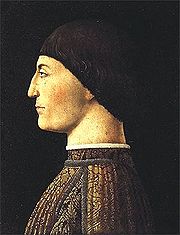
- Roger de FlorRoger de FlorRoger de Flor , also known as Ruggero/Ruggiero da Fiore or Rutger von Blum or Ruggero Flores, was a military adventurer active in Sicily, Italy and the Byzantine Empire...
(c. 1268–1305) - Malatesta da VerucchioMalatesta da VerucchioMalatesta da Verucchio was the founder of the powerful Italian Malatesta family and a famous condottiero. He was born in Verucchio....
(1212–1312) - Castruccio CastracaniCastruccio CastracaniCastruccio Castracani degli Antelminelli was an Italian condottiero and duke of Lucca.-Biography:Castruccio was born in Lucca, a member of the noble family of Antelminelli, of the Ghibelline party. In 1300 he was exiled with his parents and others of their faction by the Guelphs "Black" party,...
, Lord of LuccaLuccaLucca is a city and comune in Tuscany, central Italy, situated on the river Serchio in a fertile plainnear the Tyrrhenian Sea. It is the capital city of the Province of Lucca...
(1281–1328) - Walter VI of BrienneWalter VI of BrienneWalter VI of Brienne was Count of Brienne, Conversano, and Lecce, and titular Duke of Athens. Walter was the son of Walter V, Duke of Athens, and Jeanne de Châtillon , the daughter of the Count of Porcien, a constable to King Philip IV of France.As grandson of Hugh of Brienne Walter VI of Brienne...
- Cangrande della Scala (1291–1329)
- “Sir” John HawkwoodJohn HawkwoodSir John Hawkwood was an English mercenary or condottiero who was active in 14th century Italy. The French chronicler Jean Froissart knew him as Jean Haccoude and Italians as Giovanni Acuto...
(Giovanni Acuto, c. 1320-1394) - Giovanni OrdelaffiGiovanni OrdelaffiGiovanni Ordelaffi was a member of the noble family of Ordelaffi, the Lords of Forlì, in Italy, in the 14th and in the 15th centuries.Born in Forlì, he was a famous condottiero....
from ForlìForlìForlì is a comune and city in Emilia-Romagna, Italy, and is the capital of the province of Forlì-Cesena. The city is situated along the Via Emilia, to the right of the Montone river, and is an important agricultural centre...
(1355–1399) - Facino Cane de CasaleFacino Canethumb|Facino Cane.Facino Cane da Casale , born Bonifacio Cane, was an Italian condottiero.-Biography:Cane was born in Casale Monferrato to a noble family....
(c. 1360–1412) - Andrea Fortebracci, aka Braccio da MontoneBraccio da Montoneframe|Braccio da Montone.Braccio da Montone , born Andrea Fortebracci, and also known as Braccio Fortebraccio, was an Italian condottiero.-Biography:...
(1368–1424) - Alberico da BarbianoAlberico da BarbianoAlberico da Barbiano was the first of the Italian condottieri. His master in military matters was the English mercenary John Hawkwood, known in Italy as Giovanni Acuto...
(1344–1409) - Muzio AttendoloMuzio SforzaMuzio Attendolo Sforza was an Italian condottiero. Founder of the Sforza dynasty, he led a Bolognese-Florentine army at the Battle of Casalecchio.He was the father of Francesco Sforza, who ruled Milan for 16 years....
, aka Sforza (Strong) (1369–1424) - Giovanni VitelleschiGiovanni VitelleschiGiovanni Maria Vitelleschi was an Italian cardinal and condottiere.-Biography:Vitelleschi was born in Corneto , some kilometers north to Rome. He received a military education, which he refined as apostolic protonotary under Pope Martin V...
(d. 1440) - Erasmo da Narni, aka Gattamelata (1370–1443)
- Niccolò PiccininoNiccolò PiccininoNiccolò Piccinino was an Italian condottiero.-Biography:He was born at Perugia, was the son of a butcher.He began his military career in the service of Braccio da Montone, who at that time was waging war against Perugia on his own account, and at the death of his chief, shortly followed by that of...
(1380–1444) - Francesco Bussone da CarmagnolaFrancesco Bussone da CarmagnolaFrancesco Bussone, often called Count of Carmagnola , was an Italian condottiero.- Biography :Francesco Bussone was born at Carmagnola, near Turin, in a humble peasant family....
aka “Count of Carmagnola” (1390–1432) - Micheletto AttendoloMicheletto Attendolothumb|350px|The decisive attack of Micheletto Attendolo at San Romano, part of The Battle of San Romano triptych by [[Paolo Uccello]]. [[Musée du Louvre]], [[Paris]].Micheletto Attendolo was an Italian condottiero....
(Muzio Attendolo’s cousin or nephew) - Francesco Sforza (1401–1466)
- Sigismondo MalatestaSigismondo MalatestaSigismondo Pandolfo Malatesta , popularly known as the Wolf of Rimini, was an Italian condottiero and nobleman, a member of the House of Malatesta and lord of Rimini, Fano, and Cesena from 1432...
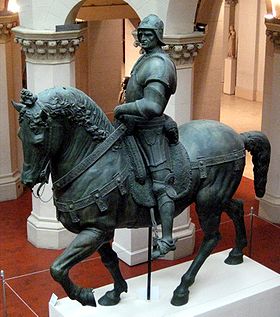
(1417–1468) - Bartolomeo ColleoniBartolomeo ColleoniBartolomeo Colleoni was a Venetian condottiero, who became Captain-General of the republic of Venice, where there is a famous statue showing him on horseback.-Biography:...
(c. 1400–1475) - Federico III da Montefeltro (1422–1482)
- Cesare BorgiaCesare BorgiaCesare Borgia , Duke of Valentinois, was an Italian condottiero, nobleman, politician, and cardinal. He was the son of Pope Alexander VI and his long-term mistress Vannozza dei Cattanei. He was the brother of Lucrezia Borgia; Giovanni Borgia , Duke of Gandia; and Gioffre Borgia , Prince of Squillace...
(1475–1507) - Niccolò di PitiglianoNiccolò di PitiglianoNiccolò di Pitigliano was an Italian condottiero best known as the Captain-General of the Venetians during the Most Serene Republic's war against the League of Cambrai...
(d. 1510) - Bartolomeo d'AlvianoBartolomeo d'AlvianoBartolomeo d'Alviano was an Italian condottiero and captain who distinguished himself in the defence of the Venetian Republic against the Holy Roman Emperor Maximilian.-Biography:...
(1455–1515) - Gian Giacomo TrivulzioGian Giacomo TrivulzioGian Giacomo Trivulzio was an Italian aristocrat and condottiero who held several military commands during the Italian Wars.-Biography:...
(c. 1441-1518) - Giovanni dalle Bande NereGiovanni dalle Bande NereLodovico de Medici also known as Giovanni dalle Bande Nere was an Italian condottiero.-Biography:Giovanni was born in the Northern Italian town of Forlì to Giovanni de' Medici and Caterina Sforza, one of the most famous women of the Italian Renaissance.From an early age, he demonstrated great...
(1498–1526) - Ferrante GonzagaFerrante GonzagaFerrante I Gonzaga was an Italian condottiero, a member of the House of Gonzaga and the founder of the branch of the Gonzaga of Guastalla.-Biography:...
(1507–1557) - Astorre I Manfredi (1345–1405)
Principal battles of the condottieri
- Battle of Forlì (1282) - a French army, for the Pope, against Guido I da Montefeltro, for ForlìForlìForlì is a comune and city in Emilia-Romagna, Italy, and is the capital of the province of Forlì-Cesena. The city is situated along the Via Emilia, to the right of the Montone river, and is an important agricultural centre...
- Battle of MontecatiniBattle of MontecatiniThe Battle of Montecatini was fought in the Val di Nievole on August 29, 1315 between the city of Pisa, and the forces of both Naples and Florence. The army of Pisa, commanded by Uguccione della Faggiuola, won a decisive victory despite being outnumbered. The Neapolitan forces, made up of nearly...
(1314) - Battle of ParabiagoBattle of Parabiago-Background:Lodrisio Visconti set out for Lombardy in the late January 1339, defeating the Milanese in Rivolta d'Adda, and later conquering Cernusco sul Naviglio, Sesto di Monza and Legnano, where he was joined by the Scaliger troops. Luchino set off to meet the Compagnia with his citizen militia...
(1339 - Lodrisio ViscontiLodrisio Visconti-Biography:He was the son of Pietro, of the powerful House of Visconti of Milan, and Antiochia Crivelli.After a military training under his father, he helped his cousin Matteo Visconti and the latter's son Galeazzo in the reconquest of Milan against the Torriani. Later, together with the other...
's "Company of St. George", for VeronaVeronaVerona ; German Bern, Dietrichsbern or Welschbern) is a city in the Veneto, northern Italy, with approx. 265,000 inhabitants and one of the seven chef-lieus of the region. It is the second largest city municipality in the region and the third of North-Eastern Italy. The metropolitan area of Verona...
, against Luchino Visconti and Ettore da Panigo for MilanMilanMilan is the second-largest city in Italy and the capital city of the region of Lombardy and of the province of Milan. The city proper has a population of about 1.3 million, while its urban area, roughly coinciding with its administrative province and the bordering Province of Monza and Brianza ,...
. - War of the Eight SaintsWar of the Eight SaintsThe War of the Eight Saints was a war between Pope Gregory XI and a coalition of Italian city-states led by Florence, which contributed to the end of the Avignon Papacy.-Causes:...
(1375–1378)- Cesena Bloodbath (1377) - PapalPapal StatesThe Papal State, State of the Church, or Pontifical States were among the major historical states of Italy from roughly the 6th century until the Italian peninsula was unified in 1861 by the Kingdom of Piedmont-Sardinia .The Papal States comprised territories under...
and BretonBreton peopleThe Bretons are an ethnic group located in the region of Brittany in France. They trace much of their heritage to groups of Brythonic speakers who emigrated from southwestern Great Britain in waves from the 3rd to 6th century into the Armorican peninsula, subsequently named Brittany after them.The...
mercenaries under John HawkwoodJohn HawkwoodSir John Hawkwood was an English mercenary or condottiero who was active in 14th century Italy. The French chronicler Jean Froissart knew him as Jean Haccoude and Italians as Giovanni Acuto...
slaughtered more than 2,000 citizens of CesenaCesenaCesena is a city and comune in the Emilia-Romagna region of northern Italy, south of Ravenna and west of Rimini, on the Savio River, co-chief of the Province of Forlì-Cesena. It is at the foot of the Apennines, and about 15 km from the Adriatic Sea.-History:Cesena was originally an Umbrian...
.
- Cesena Bloodbath (1377) - Papal
- Battle of CastagnaroBattle of CastagnaroThe Battle of Castagnaro was fought on March 11, 1387 at Castagnaro between Verona and Padua. It is one of the most famous battles of the Italian condottieri age....
(1387) - Giovanni OrdelaffiGiovanni OrdelaffiGiovanni Ordelaffi was a member of the noble family of Ordelaffi, the Lords of Forlì, in Italy, in the 14th and in the 15th centuries.Born in Forlì, he was a famous condottiero....
, for Verona, against John HawkwoodJohn HawkwoodSir John Hawkwood was an English mercenary or condottiero who was active in 14th century Italy. The French chronicler Jean Froissart knew him as Jean Haccoude and Italians as Giovanni Acuto...
, for Padova - Battle of CasalecchioBattle of CasalecchioThe Battle of Casalecchio took place on 26 June 1402 near the town of Casalecchio di Reno, near Bologna. At this battle, a Bolognese army under Giovanni I Bentivoglio opposed Gian Galeazzo Visconti, Duke of Milan, and his allies, the Malatesta of Rimini and the Gonzaga of Mantua...
(1402) - Alberico da BarbianoAlberico da BarbianoAlberico da Barbiano was the first of the Italian condottieri. His master in military matters was the English mercenary John Hawkwood, known in Italy as Giovanni Acuto...
, for Milan, against Muzio Attendolo and others for the Bolognese-Florentine league. - Battle of Sant'EgidioBattle of Sant'Egidiothumb|320px|The Battle of Sant'Egidio, panel by [[Paolo Uccello]], [[Galleria degli Uffizi]].The Battle of Sant'Egidio was fought on 12 July 1416 at Sant'Egidio, near Umbertide between the condottiero Braccio da Montone and the troops of Perugia, under Carlo I Malatesta...
(1416) - Braccio da MontoneBraccio da Montoneframe|Braccio da Montone.Braccio da Montone , born Andrea Fortebracci, and also known as Braccio Fortebraccio, was an Italian condottiero.-Biography:...
, for himself, against Carlo I MalatestaCarlo I MalatestaCarlo I Malatesta was an Italian condottiero during the Wars in Lombardy and lord of Rimini, Fano, Cesena and Pesaro...
, for PerugiaPerugiaPerugia is the capital city of the region of Umbria in central Italy, near the River Tiber, and the capital of the province of Perugia. The city is located about north of Rome. It covers a high hilltop and part of the valleys around the area.... - Battle of MaclodioBattle of MaclodioThe Battle of Maclodio was fought on 11 October 1427, resulting in a victory for the Venetians under Carmagnola over the Milanese under Carlo I Malatesta. The battle was fought at Maclodio a small town near the River Oglio, fifteen kilometres south-west of Brescia...
(1427) - Count of CarmagnolaFrancesco Bussone da CarmagnolaFrancesco Bussone, often called Count of Carmagnola , was an Italian condottiero.- Biography :Francesco Bussone was born at Carmagnola, near Turin, in a humble peasant family....
, for VeniceVeniceVenice is a city in northern Italy which is renowned for the beauty of its setting, its architecture and its artworks. It is the capital of the Veneto region...
, against Carlo I MalatestaCarlo I MalatestaCarlo I Malatesta was an Italian condottiero during the Wars in Lombardy and lord of Rimini, Fano, Cesena and Pesaro...
, for MilanMilanMilan is the second-largest city in Italy and the capital city of the region of Lombardy and of the province of Milan. The city proper has a population of about 1.3 million, while its urban area, roughly coinciding with its administrative province and the bordering Province of Monza and Brianza ,... - Battle of San RomanoBattle of San RomanoThe Battle of San Romano was fought on June 1st 1432, some 30 miles outside Florence, between the troops of Florence, commanded by Niccolò da Tolentino, and Siena, under Francesco Piccinino. The outcome is generally considered favourable to the Florentines, but in the Sienese chronicles it was...
(1432) - Niccolò da TolentinoNiccolò da TolentinoNiccolò Mauruzzi , best known as Niccolò da Tolentino was an Italian condottiero.-Biography:A member of the Mauruzi della Stacciola family of Tolentino, he fled from that city in 1370 after a dispute with his relatives. He therefore fought under several condottieri...
, for FlorenceFlorenceFlorence is the capital city of the Italian region of Tuscany and of the province of Florence. It is the most populous city in Tuscany, with approximately 370,000 inhabitants, expanding to over 1.5 million in the metropolitan area....
, against Francesco PiccininoFrancesco Piccinino260px|thumb|Latin epitaph of Francesco Piccinino.Francesco Piccinino was an Italian condottiero.He was the adoptive son of the condottiero Niccolò Piccinino and the brother of Jacopo Piccinino. At Niccolò's death , he had been already established as a gallant warrior under the Duchy of Milan and...
, for SienaSienaSiena is a city in Tuscany, Italy. It is the capital of the province of Siena.The historic centre of Siena has been declared by UNESCO a World Heritage Site. It is one of the nation's most visited tourist attractions, with over 163,000 international arrivals in 2008... - Battle of AnghiariBattle of Anghiari (1440)The Battle of Anghiari was fought on June 29, 1440, between Milan and the Italian League led by Republic of Florence in the course of the Wars in Lombardy....
(1440) - Niccolò PiccininoNiccolò PiccininoNiccolò Piccinino was an Italian condottiero.-Biography:He was born at Perugia, was the son of a butcher.He began his military career in the service of Braccio da Montone, who at that time was waging war against Perugia on his own account, and at the death of his chief, shortly followed by that of...
, for MilanMilanMilan is the second-largest city in Italy and the capital city of the region of Lombardy and of the province of Milan. The city proper has a population of about 1.3 million, while its urban area, roughly coinciding with its administrative province and the bordering Province of Monza and Brianza ,...
, against FlorenceFlorenceFlorence is the capital city of the Italian region of Tuscany and of the province of Florence. It is the most populous city in Tuscany, with approximately 370,000 inhabitants, expanding to over 1.5 million in the metropolitan area....
, Papal StatesPapal StatesThe Papal State, State of the Church, or Pontifical States were among the major historical states of Italy from roughly the 6th century until the Italian peninsula was unified in 1861 by the Kingdom of Piedmont-Sardinia .The Papal States comprised territories under...
and VeniceVeniceVenice is a city in northern Italy which is renowned for the beauty of its setting, its architecture and its artworks. It is the capital of the Veneto region...
, under Micheletto AttendoloMicheletto Attendolothumb|350px|The decisive attack of Micheletto Attendolo at San Romano, part of The Battle of San Romano triptych by [[Paolo Uccello]]. [[Musée du Louvre]], [[Paris]].Micheletto Attendolo was an Italian condottiero.... - Battle of FornovoBattle of FornovoThe Battle of Fornovo took place 30 km southwest of the city of Parma on 6 July 1495. The League of Venice was able to temporarily expel the French from the Italian Peninsula. It was the first major battle of the Italian Wars.-Antecedents:...
(1495) - Italian League against Charles VIII of FranceCharles VIII of FranceCharles VIII, called the Affable, , was King of France from 1483 to his death in 1498. Charles was a member of the House of Valois... - Battle of AgnadelloBattle of AgnadelloThe Battle of Agnadello, also known as Vailà, was one of the more significant battles of the War of the League of Cambrai and one of the major battles of the Italian Wars....
(1509) - Bartolomeo d'AlvianoBartolomeo d'AlvianoBartolomeo d'Alviano was an Italian condottiero and captain who distinguished himself in the defence of the Venetian Republic against the Holy Roman Emperor Maximilian.-Biography:...
, for VeniceVeniceVenice is a city in northern Italy which is renowned for the beauty of its setting, its architecture and its artworks. It is the capital of the Veneto region...
, against FranceFranceThe French Republic , The French Republic , The French Republic , (commonly known as France , is a unitary semi-presidential republic in Western Europe with several overseas territories and islands located on other continents and in the Indian, Pacific, and Atlantic oceans. Metropolitan France...
and Italian League - Battle of PaviaBattle of PaviaThe Battle of Pavia, fought on the morning of 24 February 1525, was the decisive engagement of the Italian War of 1521–26.A Spanish-Imperial army under the nominal command of Charles de Lannoy attacked the French army under the personal command of Francis I of France in the great hunting preserve...
(1525) - SpainSpainSpain , officially the Kingdom of Spain languages]] under the European Charter for Regional or Minority Languages. In each of these, Spain's official name is as follows:;;;;;;), is a country and member state of the European Union located in southwestern Europe on the Iberian Peninsula...
against FranceFranceThe French Republic , The French Republic , The French Republic , (commonly known as France , is a unitary semi-presidential republic in Western Europe with several overseas territories and islands located on other continents and in the Indian, Pacific, and Atlantic oceans. Metropolitan France... - Battle of MarcianoBattle of MarcianoThe Battle of Marciano occurred in the countryside of Marciano della Chiana, near Arezzo, Tuscany, on August 2, 1554, during the Italian War of 1551...
(1544) - Gian Giacomo Medici for Florence and the Holy Roman Empire against Piero StrozziPiero StrozziPiero Strozzi was an Italian military leader. He was a member of the rich Florentine family of the Strozzi.-Biography:Piero Strozzi was the son of Filippo Strozzi the Younger and Clarice de' Medici....
for Siena and France