
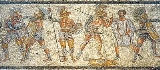
A
gladiator was an armed combatant who entertained audiences in the
Roman RepublicThe Roman Republic was the period of the ancient Roman civilization where the government operated as a republic. It began with the overthrow of the Roman monarchy, traditionally dated around 508 BC, and its replacement by a government headed by two consuls, elected annually by the citizens and...
and
Roman EmpireThe Roman Empire was the post-Republican period of the ancient Roman civilization, characterised by an autocratic form of government and large territorial holdings in Europe and around the Mediterranean....
in violent confrontations with other gladiators, wild animals, and condemned criminals. Some gladiators were volunteers who risked their legal and social standing and their lives by appearing in the arena. Most were despised as slaves, schooled under harsh conditions, socially marginalized, and segregated even in death.
Irrespective of their origin, gladiators offered audiences an example of Rome's martial ethics and, in fighting or dying well, they could inspire admiration and popular acclaim. They were celebrated in high and low art, and their value as entertainers was commemorated in precious and commonplace objects throughout the Roman world.
The origin of gladiatorial combat is open to debate. There is evidence of it in funeral rites during the
Punic WarsThe Punic Wars were a series of three wars fought between Rome and Carthage from 264 B.C.E. to 146 B.C.E. At the time, they were probably the largest wars that had ever taken place...
of the 3rd century BCE, and thereafter it rapidly became an essential feature of politics and social life in the Roman world. Its popularity led to its use in ever more lavish and costly spectacles or "gladiatorial games".
The games reached their peak between the 1st century BCE and the 2nd century CE, and they finally declined during the early 5th century after the adoption of
ChristianityThe state church of the Roman Empire was a Christian institution organized within the Roman Empire during the 4th century that came to represent the Empire's sole authorized religion. Both the Roman Catholic Church and the Eastern Orthodox churches claim to be the historical continuation of this...
as state religion in the 390s, although
venationes were continued into the 6th century.
Origins
Early literary sources seldom agree on the origins of gladiators and the gladiator games. In the late 1st century BCE,
Nicolaus of DamascusNicolaus of Damascus was a Greek historian and philosopher who lived during the Augustan age of the Roman Empire. His name is derived from that of his birthplace, Damascus. He was born around 64 BC....
believed they were
EtruscanEtruscan civilization is the modern English name given to a civilization of ancient Italy in the area corresponding roughly to Tuscany. The ancient Romans called its creators the Tusci or Etrusci...
. A generation later,
LivyTitus Livius — known as Livy in English — was a Roman historian who wrote a monumental history of Rome and the Roman people. Ab Urbe Condita Libri, "Chapters from the Foundation of the City," covering the period from the earliest legends of Rome well before the traditional foundation in 753 BC...
wrote that they were first held in 310 BCE by the
CampaniaCampania is a region in southern Italy. The region has a population of around 5.8 million people, making it the second-most-populous region of Italy; its total area of 13,590 km² makes it the most densely populated region in the country...
ns in celebration of their victory over the
SamnitesSamnium is a Latin exonym for a region of south or south and central Italy in Roman times. The name survives in Italian today, but today's territory comprising it is only a small portion of what it once was. The populations of Samnium were called Samnites by the Romans...
. Long after the games had ceased, the 7th century CE writer
Isidore of SevilleSaint Isidore of Seville served as Archbishop of Seville for more than three decades and is considered, as the historian Montalembert put it in an oft-quoted phrase, "le dernier savant du monde ancien"...
derived Latin
lanista (manager of gladiators) from the Etruscan for executioner, and the title of
CharonIn Greek mythology, Charon or Kharon is the ferryman of Hades who carries souls of the newly deceased across the rivers Styx and Acheron that divided the world of the living from the world of the dead. A coin to pay Charon for passage, usually an obolus or danake, was sometimes placed in or on...
(an official who accompanied the dead from the Roman gladiatorial arena) from
CharunIn Etruscan mythology, Charun acted as one of the psychopompoi of the underworld, not to be confused with the lord of the underworld, known to the Etruscans as Aita...
,
psychopompPsychopomps are creatures, spirits, angels, or deities in many religions whose responsibility is to escort newly deceased souls to the afterlife. Their role is not to judge the deceased, but simply provide safe passage...
of the Etruscan underworld. Roman historians emphasized the gladiator games as a foreign import, most likely Etruscan. This preference informed most standard histories of the Roman games in the early modern era.
Reappraisal of the evidence supports a Campanian origin, or at least a borrowing, for the games and gladiators. The earliest known Roman gladiator schools (
ludi) were in Campania. Tomb
frescoFresco is any of several related mural painting types, executed on plaster on walls or ceilings. The word fresco comes from the Greek word affresca which derives from the Latin word for "fresh". Frescoes first developed in the ancient world and continued to be popular through the Renaissance...
es from
PaestumPaestum is the classical Roman name of a major Graeco-Roman city in the Campania region of Italy. It is located in the north of Cilento, near the coast about 85 km SE of Naples in the province of Salerno, and belongs to the commune of Capaccio, officially also named...
(4th century BCE) show paired fighters, with helmets, spears and shields, in a propitiatory funeral blood-rite that anticipates early Roman gladiator games. Compared to these images, supporting evidence from Etruscan tomb-paintings is tentative and late. The Paestum frescoes may represent the continuation of a much older tradition, acquired or inherited from Greek colonists of the 8th century BCE.
Livy dates the earliest Roman gladiator games to 264 BCE, in the early stages of Rome's
First Punic WarThe First Punic War was the first of three wars fought between Ancient Carthage and the Roman Republic. For 23 years, the two powers struggled for supremacy in the western Mediterranean Sea, primarily on the Mediterranean island of Sicily and its surrounding waters but also to a lesser extent in...
against
CarthageCarthage , implying it was a 'new Tyre') is a major urban centre that has existed for nearly 3,000 years on the Gulf of Tunis, developing from a Phoenician colony of the 1st millennium BC...
. Decimus Iunius Brutus Scaeva had three gladiator pairs fight to the death in Rome's "cattle market" Forum (
Forum BoariumThe Forum Boarium was the cattle forum venalium of Ancient Rome and the oldest forum that Rome possessed. It was located on a level piece of land near the Tiber between the Capitoline, the Palatine and Aventine hills. Here, too, is where the first bridges were built...
) to honour his dead father, Brutus Pera. This is described as
munus (plural:
munera): a commemorative duty owed the
manesIn ancient Roman religion, the Manes or Di Manes are chthonic deities sometimes thought to represent the souls of deceased loved ones. They were associated with the Lares, Genii, and Di Penates as deities that pertained to domestic, local, and personal cult...
of a dead ancestor by his descendants. The gladiator type used (according to a single, later source), was Thracian. but the development of the
munus and its
gladiator types was most strongly influenced by Samnium's support for Hannibal and subsequent punitive expeditions by Rome and her Campanian allies; the earliest and most frequently mentioned type was the
SamniteA Samnite was a Roman gladiator who fought with equipment styled on that of a warrior from Samnium: a short sword , a rectangular shield , a greave , and a helmet. Warriors armed in such a way were the earliest gladiators in the Roman games...
.
The war in Samnium, immediately afterwards, was attended with equal danger and an equally glorious conclusion. The enemy, besides their other warlike preparation, had made their battle-line to glitter with new and splendid arms. There were two corps: the shields of the one were inlaid with gold, of the other with silver...The Romans had already heard of these splendid accoutrements, but their generals had taught them that a soldier should be rough to look on, not adorned with gold and silver but putting his trust in iron and in courage...The DictatorIn the Roman Republic, the dictator , was an extraordinary magistrate with the absolute authority to perform tasks beyond the authority of the ordinary magistrate . The office of dictator was a legal innovation originally named Magister Populi , i.e...
, as decreed by the senateThe Senate of the Roman Republic was a political institution in the ancient Roman Republic, however, it was not an elected body, but one whose members were appointed by the consuls, and later by the censors. After a magistrate served his term in office, it usually was followed with automatic...
, celebrated a triumph, in which by far the finest show was afforded by the captured armour. So the Romans made use of the splendid armour of their enemies to do honour to their gods; while the Campanians, in consequence of their pride and in hatred of the Samnites, equipped after this fashion the gladiators who furnished them entertainment at their feasts, and bestowed on them the name Samnites. (Livy 9.40)
Livy's account skirts the funereal, sacrificial function of early Roman gladiator combats and underlines the later theatrical ethos of the gladiator show: splendidly, exotically armed and armoured barbarians, treacherous and degenerate, are dominated by Roman iron and native courage. His plain Romans virtuously dedicate the magnificent spoils of war to the Gods. Their Campanian allies stage a dinner entertainment using gladiators who may not be Samnites, but play the Samnite role. Other groups and tribes would join the cast list as Roman territories expanded. Most gladiators were armed and armoured in the manner of the enemies of Rome. The
munus became a morally instructive form of historic enactment in which the only honourable option for the gladiator was to fight well, or else die well.
Development
In 216 BCE,
Marcus Ameilius LepidusMarcus Aemilius Lepidus was the Roman consul for 232 BC, and served again as suffect consul for 221 BC. He also served at one time as augur. He died in 216 BC....
, late
consulA consul served in the highest elected political office of the Roman Republic.Each year, two consuls were elected together, to serve for a one-year term. Each consul was given veto power over his colleague and the officials would alternate each month...
and
augurThe augur was a priest and official in the classical world, especially ancient Rome and Etruria. His main role was to interpret the will of the gods by studying the flight of birds: whether they are flying in groups/alone, what noises they make as they fly, direction of flight and what kind of...
, was honoured by his sons with three days of
gladiatora munera in the Forum Romanum, using twenty-two pairs of gladiators. Ten years later,
Scipio AfricanusPublius Cornelius Scipio Africanus , also known as Scipio Africanus and Scipio the Elder, was a general in the Second Punic War and statesman of the Roman Republic...
gave a commemorative
munus in Iberia for his father and uncle, casualties in the Punic Wars. High status non-Romans, and possibly Romans too, volunteered as his gladiators. The context of the
Punic WarsThe Punic Wars were a series of three wars fought between Rome and Carthage from 264 B.C.E. to 146 B.C.E. At the time, they were probably the largest wars that had ever taken place...
and Rome's near-disastrous defeat at the
Battle of CannaeThe Battle of Cannae was a major battle of the Second Punic War, which took place on August 2, 216 BC near the town of Cannae in Apulia in southeast Italy. The army of Carthage under Hannibal decisively defeated a numerically superior army of the Roman Republic under command of the consuls Lucius...
(216 BCE) link these early games to munificence, the celebration of military victory and the religious expiation of military disaster; these
munera appear to serve a morale-raising agenda in an era of military threat and expansion. The next recorded
munus, held for the funeral of
Publius LiciniusinPublius Licinius Crassus Dives was a member of the respected and prominent Crassi branch of the plebeian gens Licinia as well as the father of the famed Marcus Licinius Crassus...
in 183 BCE, was more extravagant. It involved three days of funeral games, 120 gladiators, and public distribution of meat (
visceratio data) – a practice that reflected the gladiatorial fights at Campanian banquets described by Livy and later deplored by Silius Italicus.
The enthusiastic adoption of
gladiatoria munera by Rome's Iberian allies shows how easily, and how early, the culture of the gladiator
munus permeated places far from Rome itself. By 174 BC, "small" Roman
munera (private or public), provided by an
editor of relatively low importance, may have been so commonplace and unremarkable they were not considered worth recording:
Many gladiatorial games were given in that year, some unimportant, one noteworthy beyond the rest — that of Titus FlamininusTitus Quinctius Flamininus was a Roman politician and general instrumental in the Roman conquest of Greece.Member of the gens Quinctia, and brother to Lucius Quinctius Flamininus, he served as a military tribune in the Second Punic war and in 205 BC he was appointed propraetor in Tarentum...
which he gave to commemorate the death of his father, which lasted four days, and was accompanied by a public distribution of meats, a banquet, and scenic performances. The climax of the show which was big for the time was that in three days seventy four gladiators fought.
In 105 BCE, the ruling consuls offered Rome its first taste of state-sponsored "
barbarianBarbarian and savage are terms used to refer to a person who is perceived to be uncivilized. The word is often used either in a general reference to a member of a nation or ethnos, typically a tribal society as seen by an urban civilization either viewed as inferior, or admired as a noble savage...
combat" demonstrated by gladiators from Capua, as part of a training program for the military. It proved immensely popular. The
ludiLudi were public games held for the benefit and entertainment of the Roman people . Ludi were held in conjunction with, or sometimes as the major feature of, Roman religious festivals, and were also presented as part of the cult of state.The earliest ludi were horse races in the circus...
(state games), sponsored by the ruling elite and dedicated to a deity such as
JupiterJupiter is the fifth planet from the Sun and the largest planet within the Solar System. It is a gas giant with mass one-thousandth that of the Sun but is two and a half times the mass of all the other planets in our Solar System combined. Jupiter is classified as a gas giant along with Saturn,...
, a divine or heroic ancestor (and later, during the
ImperiumImperium is a Latin word which, in a broad sense, translates roughly as 'power to command'. In ancient Rome, different kinds of power or authority were distinguished by different terms. Imperium, referred to the sovereignty of the state over the individual...
, the well-being and
numenNumen is a Latin term for a potential, guiding the course of events in a particular place or in the whole world, used in Roman philosophical and religious thought...
of the
emperorThe Roman emperor was the ruler of the Roman State during the imperial period . The Romans had no single term for the office although at any given time, a given title was associated with the emperor...
), could now compete with privately funded
munera for popular support.
Peak
By the closing years of the politically and socially unstable Late Republic, gladiator games provided their sponsors with extravagantly expensive but effective opportunities for self-promotion while offering cheap, exciting entertainment to their clients. Gladiators became big business for trainers and owners, for politicians on the make and those who had reached the top. A politically ambitious
privatusIn Roman law, the Latin adjective privatus makes a legal distinction between that which is "private" and that which is publicus, "public" in the sense of pertaining to the Roman people ....
(private citizen) might postpone his deceased father's
munus to the election season, when a generous show might drum up votes; those in power and those seeking it needed the support of the plebians and their
tribuneTribune was a title shared by elected officials in the Roman Republic. Tribunes had the power to convene the Plebeian Council and to act as its president, which also gave them the right to propose legislation before it. They were sacrosanct, in the sense that any assault on their person was...
s, whose votes might be won with an exceptionally spectacular show, sometimes even the mere promise of one. Sulla, during his term as
praetorPraetor was a title granted by the government of Ancient Rome to men acting in one of two official capacities: the commander of an army, usually in the field, or the named commander before mustering the army; and an elected magistratus assigned varied duties...
, showed his usual acumen in breaking his own sumptuary laws to give the most lavish
munus yet seen in Rome, on occasion of his wife's funeral.
Ownership of gladiators or a gladiator school gave muscle and flair to Roman politics. In 65 BCE, newly elected curule aedile
Julius CaesarGaius Julius Caesar was a Roman general and statesman and a distinguished writer of Latin prose. He played a critical role in the gradual transformation of the Roman Republic into the Roman Empire....
topped Sulla's display with games he justified as
munus to his father, who had died twenty years before. Despite an already enormous personal debt, he used three hundred and twenty gladiator pairs in silvered armour. He had wanted more but the nervous Senate, mindful of the recent
SpartacusSpartacus was a famous leader of the slaves in the Third Servile War, a major slave uprising against the Roman Republic. Little is known about Spartacus beyond the events of the war, and surviving historical accounts are sometimes contradictory and may not always be reliable...
revolt, fearful of Caesar's burgeoning private armies and even more fearful of his overwhelming popularity, imposed a limit of 320 pairs as the maximum number of gladiators a citizen could keep in Rome. Caesar's showmanship was unprecedented not only in scale and expense but in putting aside a Republican tradition of
munera as funeral offerings. The practical differences between
ludi and
munera were beginning to blur.
Gladiatorial games, usually linked with beast shows, spread throughout the Republic and beyond. Anti-corruption laws of 65 and 63 BCE attempted but signally failed to curb their political usefulness to sponsors. Following Caesar's assassination and the Roman Civil War,
AugustusAugustus ;23 September 63 BC – 19 August AD 14) is considered the first emperor of the Roman Empire, which he ruled alone from 27 BC until his death in 14 AD.The dates of his rule are contemporary dates; Augustus lived under two calendars, the Roman Republican until 45 BC, and the Julian...
assumed Imperial authority over the games, including
munera, and formalised their provision as a civic and religious duty. His revision of sumptuary law capped private and public expenditure on
munera, claiming to save the Roman elite from the bankruptcies they would otherwise suffer, and restricted their performance to the festivals of
SaturnaliaSaturnalia is an Ancient Roman festival/ celebration held in honour of Saturn , the youngest of the Titans, father of the major gods of the Greeks and Romans, and son of Uranus and Gaia...
and
QuinquatriaIn Ancient Roman religious tradition, the Quinquatria or Quinquatrus was a festival sacred to Minerva, celebrated on the 19 March. It was so called according to Varro, because it was held on the fifth day after the Ides, in the same way as the Tusculans called a festival on the sixth day after the...
. Henceforth, the ceiling cost for a
praetorPraetor was a title granted by the government of Ancient Rome to men acting in one of two official capacities: the commander of an army, usually in the field, or the named commander before mustering the army; and an elected magistratus assigned varied duties...
's "economical" but official
munus of a maximum 120 gladiators was to be 25,000 denarii ($500,000). "Generous" Imperial
ludi might cost no less than 180,000 denarii ($3.6 million). Throughout the Empire, the greatest and most celebrated games would now be identified with the state-sponsored
Imperial cultThe Imperial cult of ancient Rome identified emperors and some members of their families with the divinely sanctioned authority of the Roman State...
, which furthered public recognition, respect and approval for the Emperor, his law, and his agents. Between 108 and 109 CE,
TrajanTrajan , was Roman Emperor from 98 to 117 AD. Born into a non-patrician family in the province of Hispania Baetica, in Spain Trajan rose to prominence during the reign of emperor Domitian. Serving as a legatus legionis in Hispania Tarraconensis, in Spain, in 89 Trajan supported the emperor against...
celebrated his
DaciaIn ancient geography, especially in Roman sources, Dacia was the land inhabited by the Dacians or Getae as they were known by the Greeks—the branch of the Thracians north of the Haemus range...
n victories using a reported 10,000 gladiators (and 11,000 animals) over 123 days. The cost of gladiators and
munera continued to spiral out of control. Legislation of 177 CE by
Marcus Aurelius, which did little to stop it, was completely ignored by his son,
CommodusCommodus , was Roman Emperor from 180 to 192. He also ruled as co-emperor with his father Marcus Aurelius from 177 until his father's death in 180. His name changed throughout his reign; see changes of name for earlier and later forms. His accession as emperor was the first time a son had succeeded...
.
Decline
The decline of the
munus was not a straightforward process, spanning most of
Late AntiquityLate Antiquity is a periodization used by historians to describe the time of transition from Classical Antiquity to the Middle Ages, in both mainland Europe and the Mediterranean world. Precise boundaries for the period are a matter of debate, but noted historian of the period Peter Brown proposed...
.
They were past the peak of their popularity in the 3rd century, yet they continued throughout the 4th. They were finally banned at the turning of the 5th century as part of the decline of Greco-Roman paganism after the adoption of
ChristianityThe state church of the Roman Empire was a Christian institution organized within the Roman Empire during the 4th century that came to represent the Empire's sole authorized religion. Both the Roman Catholic Church and the Eastern Orthodox churches claim to be the historical continuation of this...
as the state religion.
By that time, gladiatorial games had already been replaced in the popular favour by
theatrical showsRoman theatre may refer to:*Theatre of ancient Rome, the theatrical styles of Ancient Rome*Roman theatre , the theatre buildings of Ancient Rome...
and chariot races, the latter remaining extremely popular throughout the 6th century.
As the crisis of the 3rd century imposed increasing military demands on the Imperial purse, from which the Empire never quite recovered, the obligatory
munera became an increasingly unrewarding tax on the doubtful privileges of office for lesser magistrates. Still, emperors continued to subsidize their performance as a matter of undiminished public interest.
In the early 3rd century, the Christian writer
TertullianQuintus Septimius Florens Tertullianus, anglicised as Tertullian , was a prolific early Christian author from Carthage in the Roman province of Africa. He is the first Christian author to produce an extensive corpus of Latin Christian literature. He also was a notable early Christian apologist and...
had acknowledged their power over the Christian flock, and was compelled to be blunt: the combats were murder, their witnessing spiritually and morally harmful and the gladiator an instrument of pagan human sacrifice. In the next century, Augustine deplored the youthful fascination of his friend (and later fellow-convert and Bishop) Alypius, with the
munera spectacle as inimical to a Christian life and salvation. Amphitheatres continued to host the spectacular administration of Imperial justice: in 315
Constantine IConstantine the Great , also known as Constantine I or Saint Constantine, was Roman Emperor from 306 to 337. Well known for being the first Roman emperor to convert to Christianity, Constantine and co-Emperor Licinius issued the Edict of Milan in 313, which proclaimed religious tolerance of all...
condemned child-snatchers
ad bestias in the arena. Ten years later, he banned the gladiator
munera:
In times in which peace and peace relating to domestic affairs prevail bloody demonstrations displease us. Therefore, we order that there may be no more gladiator combats. Those who were condemned to become gladiators for their crimes are to work from now on in the mines. Thus they pay for their crimes without having to pour their blood.
An Imperially sanctioned
munus at some time in the 330s suggests that yet again, Imperial legislation was ineffective, not least when Constantine defied his own law. In 365,
Valentinian IValentinian I , also known as Valentinian the Great, was Roman emperor from 364 to 375. Upon becoming emperor he made his brother Valens his co-emperor, giving him rule of the eastern provinces while Valentinian retained the west....
threatened to fine a judge who sentenced Christians to the arena and in 384, attempted to limit the expenses of
munera.
In 393,
TheodosiusTheodosius I , also known as Theodosius the Great, was Roman Emperor from 379 to 395. Theodosius was the last emperor to rule over both the eastern and the western halves of the Roman Empire. During his reign, the Goths secured control of Illyricum after the Gothic War, establishing their homeland...
adopted Christianity as the Roman state religion and banned pagan festivals. The
ludi continued, very gradually shorn of their stubbornly pagan
munera.
HonoriusHonorius , was Western Roman Emperor from 395 to 423. He was the younger son of emperor Theodosius I and his first wife Aelia Flaccilla, and brother of the eastern emperor Arcadius....
legally ended
munera in 399, and again in 404, at least in the Western half of the Empire according to
TheodoretTheodoret of Cyrus or Cyrrhus was an influential author, theologian, and Christian bishop of Cyrrhus, Syria . He played a pivotal role in many early Byzantine church controversies that led to various ecumenical acts and schisms...
, because of the martyrdom of
Saint TelemachusSaint Telemachus was a monk who, according to the Church historian Theodoret, tried to stop a gladiator fight in a Roman amphitheatre, and was stoned to death by the crowd. The Christian Emperor Honorius, however, was impressed by the monk's martyrdom and it spurred him to issue an historic ban on...
by spectators at a
munus. Valentinian III repeated the ban in 438, perhaps effectively, though
venationes continued beyond 536.
It is not known how many
gladiatoria munera were given throughout the Roman period. Many, if not most, involved
venationes, and in the later Empire some may have been only that. One primary source, the
Calendar of Furius Dionysius Philocalus for 354, survives to suggest how the gladiator featured among a multitude of festivals in the Late Empire period. In that year, 176 days were reserved for spectacles of various kinds. Of these, 102 days were for theatrical shows, 64 for chariot races and just 10 in December for gladiator games and
venationes.
Thomas Wiedemann interprets this in the much earlier context of the Historia Augusta, in which
Alexander SeverusSeverus Alexander was Roman Emperor from 222 to 235. Alexander was the last emperor of the Severan dynasty. He succeeded his cousin Elagabalus upon the latter's assassination in 222, and was ultimately assassinated himself, marking the epoch event for the Crisis of the Third Century — nearly fifty...
(reigned 222–235) was said to intend the redistribution of
munera throughout the year. This would have broken with the traditional positioning of the major gladiator games at the year's end: as Wiedemann points out, December was the month for
SaturnaliaSaturnalia is an Ancient Roman festival/ celebration held in honour of Saturn , the youngest of the Titans, father of the major gods of the Greeks and Romans, and son of Uranus and Gaia...
, the festival in which the lowest became the highest, and in which death was linked to renewal.
The Gladiators
The trade in gladiators was Empire-wide, and subjected to official supervision. Rome's military success produced an influx of soldier-prisoners who were redistributed for use in State mines or amphitheatres and for sale on the open market. For example, in the aftermath of the Jewish Revolt, the gladiator schools received an influx of Jews – those rejected for training would have been sent straight to the arenas as
noxii (lit. "hurtful ones"). The best – the most robust – were sent to Rome. The granting of slave status to soldiers who had surrendered or allowed their own capture was regarded as an unmerited gift of life and gladiator training was an opportunity for them to regain their honour in the
munus.
Two other sources of gladiators, found increasingly during the Principate and the
Pax RomanaPax Romana was the long period of relative peace and minimal expansion by military force experienced by the Roman Empire in the 1st and 2nd centuries AD. Since it was established by Caesar Augustus it is sometimes called Pax Augusta...
, were slaves condemned to the arena, to gladiator schools or games (
ad ludum gladiatorium) as punishment for crimes, and paid volunteers (
auctorati) who by the late Republic may have comprised approximately half – and possibly the most capable half – of all gladiators. The use of volunteers had a precedent in the Iberian
munus of
Scipio AfricanusPublius Cornelius Scipio Africanus , also known as Scipio Africanus and Scipio the Elder, was a general in the Second Punic War and statesman of the Roman Republic...
; but none of those had been paid. For Romans, "gladiator" would have meant a schooled fighter, sworn and contracted to a master.
For those who were poor or non-citizens, the gladiator schools offered a trade, regular food, housing of sorts and a fighting chance of fame and fortune. Gladiators customarily kept their prize money and any gifts they received.
TiberiusTiberius , was Roman Emperor from 14 AD to 37 AD. Tiberius was by birth a Claudian, son of Tiberius Claudius Nero and Livia Drusilla. His mother divorced Nero and married Augustus in 39 BC, making him a step-son of Octavian...
offered several retired gladiators 100,000
sesterces ($500,000) each to return to the arena.
NeroNero , was Roman Emperor from 54 to 68, and the last in the Julio-Claudian dynasty. Nero was adopted by his great-uncle Claudius to become his heir and successor, and succeeded to the throne in 54 following Claudius' death....
gave the gladiator Spiculus property and residence "equal to those of men who had celebrated triumphs."
Mark AntonyMarcus Antonius , known in English as Mark Antony, was a Roman politician and general. As a military commander and administrator, he was an important supporter and loyal friend of his mother's cousin Julius Caesar...
promoted gladiators to his personal guard.
Women as gladiators
From the 60s CE
female gladiatorA gladiatrix was the female counterpart to the male gladiator, an armed fighter who engaged in violent combat with humans or animals for the entertainment of audiences in the arenas of the Roman Republic and Roman Empire...
s appear, as "exotic markers of exceptionally lavish spectacle". In 66 CE,
NeroNero , was Roman Emperor from 54 to 68, and the last in the Julio-Claudian dynasty. Nero was adopted by his great-uncle Claudius to become his heir and successor, and succeeded to the throne in 54 following Claudius' death....
had Ethiopian women, men and children fight at a
munus to impress
King Tiridates I of ArmeniaTiridates I was King of Armenia beginning in AD 53 and the founder of the Arshakuni Dynasty, the Armenian line of the Arsacid Dynasty. The dates of his birth and death are unknown. His early reign was marked by a brief interruption towards the end of the year 54 and a much longer one from 58...
. Romans seem to have found the idea of a female gladiator novel and entertaining, or downright absurd; Juvenal titillates his readers with a woman named "Mevia", hunting boars in the arena "with spear in hand and breasts exposed", and Petronius mocks the pretensions of a rich, low-class citizen, whose
munus includes a woman fighting from a cart or chariot. A
munus of 89 CE, during
DomitianDomitian was Roman Emperor from 81 to 96. Domitian was the third and last emperor of the Flavian dynasty.Domitian's youth and early career were largely spent in the shadow of his brother Titus, who gained military renown during the First Jewish-Roman War...
's reign, featured a battle between female gladiators and dwarfs. In Halicarnassus, a 2nd century CE relief depicts two female combatants named "Amazon" and "Achillia"; their match ended in a draw. In the same century, an epigraph praises one of
OstiaOstia Antica is a large archeological site, close to the modern suburb of Ostia , that was the location of the harbour city of ancient Rome, which is approximately 30 km to the northeast. "Ostia" in Latin means "mouth". At the mouth of the River Tiber, Ostia was Rome's seaport, but, due to...
's local elite as the first to "arm women" in the history of its games. Female gladiators probably submitted to the same regulations and training as their male counterparts. Roman morality required that all gladiators be of the lowest social classes, and emperors who failed to respect this distinction earned the scorn of posterity; Cassius Dio takes pains to point out that when the much admired emperor
TitusTitus , was Roman Emperor from 79 to 81. A member of the Flavian dynasty, Titus succeeded his father Vespasian upon his death, thus becoming the first Roman Emperor to come to the throne after his own father....
used female gladiators, they were of acceptably low class.
Some regarded female gladiators as a symptom of corrupted Roman sensibilities, morals and womanhood, regardless of class. Before he became emperor,
Septimius SeverusSeptimius Severus , also known as Severus, was Roman Emperor from 193 to 211. Severus was born in Leptis Magna in the province of Africa. As a young man he advanced through the customary succession of offices under the reigns of Marcus Aurelius and Commodus. Severus seized power after the death of...
may have attended the
AntiochAntioch on the Orontes was an ancient city on the eastern side of the Orontes River. It is near the modern city of Antakya, Turkey.Founded near the end of the 4th century BC by Seleucus I Nicator, one of Alexander the Great's generals, Antioch eventually rivaled Alexandria as the chief city of the...
ene Olympic Games, which had been revived by the emperor
CommodusCommodus , was Roman Emperor from 180 to 192. He also ruled as co-emperor with his father Marcus Aurelius from 177 until his father's death in 180. His name changed throughout his reign; see changes of name for earlier and later forms. His accession as emperor was the first time a son had succeeded...
and included traditional Greek female athletics. His attempt to give Rome a similarly dignified display of female athletics was met by the crowd with ribald chants and cat-calls. Probably as a result, he banned the use of female gladiators in 200 CE.
Emperors as "gladiators"
Caligula, Titus, Hadrian,
Lucius VerusLucius Verus , was Roman co-emperor with Marcus Aurelius, from 161 until his death.-Early life and career:Lucius Verus was the first born son to Avidia Plautia and Lucius Aelius Verus Caesar, the first adopted son and heir of Roman Emperor Hadrian . He was born and raised in Rome...
,
CaracallaCaracalla , was Roman emperor from 198 to 217. The eldest son of Septimius Severus, he ruled jointly with his younger brother Geta until he murdered the latter in 211...
,
GetaGeta , was a Roman Emperor co-ruling with his father Septimius Severus and his older brother Caracalla from 209 to his death.-Early life:Geta was the younger son of Septimius Severus by his second wife Julia Domna...
and
Didius JulianusDidius Julianus , was Roman Emperor for three months during the year 193. He ascended the throne after buying it from the Praetorian Guard, who had assassinated his predecessor Pertinax. This led to the Roman Civil War of 193–197...
were all said to have performed in the arena (either in public or private) but risks to themselves were minimal. Claudius, characterised by his historians as morbidly cruel and boorish, fought a whale trapped in the harbor in front of a group of spectators. Commentators invariably disapproved of such performances.
CommodusCommodus , was Roman Emperor from 180 to 192. He also ruled as co-emperor with his father Marcus Aurelius from 177 until his father's death in 180. His name changed throughout his reign; see changes of name for earlier and later forms. His accession as emperor was the first time a son had succeeded...
was a fanatical participant at the
ludi, much to the shame of the Senate, whom he loathed, and the probable delight of the populace at large. He fought as a
secutor, styling himself "
HerculesHercules is the Roman name for Greek demigod Heracles, son of Zeus , and the mortal Alcmene...
Reborn". As a
bestiariusAmong Ancient Romans, bestiarii were those who went into combat with beasts, or were exposed to them. It is conventional to distinguish two categories of bestiarii: the first were those condemned to death via the beasts and the second were those who faced them voluntarily, for pay or glory...
, he was said to have killed 100 lions in one day, almost certainly from a platform set up around the arena perimeter which allowed him to safely demonstrate his marksmanship. On another occasion, he decapitated a running ostrich with a specially designed dart, carried the bloodied head and his sword over to the Senatorial seats and gesticulated as though they were next. He was said to have restyled Nero's colossal statue in his own image as "Hercules Reborn" and re-dedicated it to himself with the inscription; "Champion of
secutores; only left-handed fighter to conquer twelve times one thousand men." For this, he drew a gigantic stipend from the public purse. Perhaps to explain both his obsession and administrative incompetence, gossips suggested that his mother,
Faustina the YoungerAnnia Galeria Faustina Minor , Faustina Minor or Faustina the Younger was a daughter of Roman Emperor Antoninus Pius and Roman Empress Faustina the Elder. She was a Roman Empress and wife to her maternal cousin Roman Emperor Marcus Aurelius...
, had conceived him with a gladiator.
Outline of the games
The earliest
munera took place at or near the tomb of the deceased and these were organised by their
munerator (who made the offering). Later games were held by an
editor, either identical with the
munerator or an official employed by him. As time passed, these titles and meanings may have merged. In the Republican era, private citizens could own and train gladiators, or lease them from a
lanista (owner of a gladiator training school). From the Principate onwards, private citizens could hold munera and own gladiators only under Imperial permission, and the role of
editor increasingly tied to state officialdom. Legislation by
ClaudiusClaudius , was Roman Emperor from 41 to 54. A member of the Julio-Claudian dynasty, he was the son of Drusus and Antonia Minor. He was born at Lugdunum in Gaul and was the first Roman Emperor to be born outside Italy...
required that
quaestorA Quaestor was a type of public official in the "Cursus honorum" system who supervised financial affairs. In the Roman Republic a quaestor was an elected official whereas, with the autocratic government of the Roman Empire, quaestors were simply appointed....
s, the lowest rank of Roman magistrate, personally provide two-thirds of the costs of games for their small-town communities – in effect, both an advertisement of their personal generosity and a part-purchase of their office. Bigger games were put on by senior magistrates, who could better afford them. The largest and most lavish of all were paid for by the emperor himself. An outline of these later games can be conjectured, using written histories, contemporary accounts, statuary, ephemera, memorabilia and stylised pictographic evidence. Almost all the evidence comes from the Late Republic and Empire, and much of it from Pompeii.
Games were advertised beforehand on conspicuously placed billboards, giving the reason for the game, its editor, venue, date and the number of paired gladiators (
ordinarii) to be used. Other highlighted features could include details of
venationes, executions, music and any luxuries to be provided for the spectators, including a decorated awning against the sun, and water sprinklers. Food, drink, sweets and occasionally "door prizes" could be offered. For enthusiasts, a more detailed program (
libellus) was prepared for the day of the
munus, showing the names, types and match records of gladiator pairs (of interest to gamblers) and their order of appearance. Copies of the
libellus were distributed among the crowd on the day of the match. Left-handed gladiators were advertised as an interesting rarity; they were trained to fight right-handers, which gave them advantage over most opponents and produced an interestingly unorthodox combination.
The night before the
munus, the gladiators were given a banquet and opportunity to order their personal and private affairs; Futrell notes its similarity to a ritualistic "last meal". These were probably both family and public events which included even the
noxii and
damnati and they may have been used to drum up more publicity for the coming match.
From Augustus' time, official
munera seem to have followed a standard sequence. A procession (
pompa) entered the arena led by lictors bearing
fascesFasces are a bundle of wooden sticks with an axe blade emerging from the center, which is an image that traditionally symbolizes summary power and jurisdiction, and/or "strength through unity"...
that signified the magistrate-
editors power over life and death. They were followed by a small band of tubicines
playing a fanfare. Images of the gods were carried in to "witness" the proceedings, followed by a scribe (to record the outcome) and a man carrying the palm branch used to honour victors. The magistrate editor
entered among a retinue who carried the arms and armour to be used; more musicians followed, then horses. The gladiators presumably came in last.
These official games usually began with venationes
(beast hunts) and bestiarii
(beast fighting) gladiators. Sometimes beasts were unharmed and simply exhibited. Next came the ludi meridiani
, of variable content but usually involving executions of noxii
(sometimes as "mythological" re-enactments) or others condemned (damnati)
to the arena. Gladiators may have been involved in these though the crowd, and the gladiators themselves, preferred the "dignity" of an even contest. There were also comedy fights; some may have been lethal. A crude Pompeian graffito suggests a burlesque of musicians, dressed as animals named Ursus tibicen
(flute-playing bear) and Pullus cornicen
(horn-blowing chicken), perhaps as accompaniment to clowning by paegniarii during a "mock" contest of the ludi meridiani
.
Before the listed contests were fought, the gladiators may have held informal warm-up matches, using blunted or dummy weapons – some munera
, however, may have used blunted weapons throughout. The editor,
his representative or an honoured guest would check the weapons (probatio armorum
) for the scheduled matches. These were the highlight of the day, and were as inventive, varied and novel as the editor
could afford. Armatures could be very costly – some were flamboyantly decorated with exotic feathers, jewels and precious metals. Increasingly the munus
was the editors gift to spectators who had come to expect the best as their due. In late Republican
munera, between 10 and 13 pairs could have fought on one day; this assumes one match at a time in the course of an afternoon. Fights were interspersed or accompanied by music; the
Zliten mosaicThe Zliten mosaic is a Roman floor mosaic from about the 2nd century AD, found in the town of Zliten in Libya, on the east coast of Leptis Magna. The mosaic was discovered by the Italian archaeologist Salvatore Aurigemma in 1913 and is now on display at The Archaeological Museum of Tripoli...
in Libya (circa 80–100 CE) shows musicians playing an accompaniment to provincial games (with gladiators,
bestiarii, or
venatores and prisoners attacked by beasts). Their instruments are a long straight trumpet (
tubicenThe word lituus originally meant a curved augural staff or a curved war-trumpet in the ancient Latin language. In English it is used with several meanings.-Roman ritual wand:...
), a large curved horn (
CornuA cornu or cornum was a type of brass instrument similar to the buccina used by the Roman army of antiquity mainly for communicating orders to troops in battle. It is a Latin word literally meaning horn. The instrument was about long and took the form of a letter 'G'...
) and a
water organThe water organ or hydraulic organ is a type of pipe organ blown by air, where the power source pushing the air is derived by water from a natural source or by a manual pump...
(
hydraulis). Similar representations (musicians, gladiators and
bestiari) are found on a tomb relief in
PompeiiThe city of Pompeii is a partially buried Roman town-city near modern Naples in the Italian region of Campania, in the territory of the comune of Pompei. Along with Herculaneum, Pompeii was destroyed and completely buried during a long catastrophic eruption of the volcano Mount Vesuvius spanning...
.
Combat
In the earliest
munera, death was considered the proper outcome of combat. During the Imperial era, matches were sometimes advertised
sine missione (without release [from the sentence of death]), which suggests that
missio (the sparing of a defeated gladiator's life) had become a common practice at the games. The contract between
editor and
lanista could include compensation for unexpected deaths. As the demand for gladiators began to exceed supply, matches
sine missione were officially banned, a pragmatic Augustan decision that also happened to reflect popular demands for "natural justice". Refusals by Caligula and Claudius to spare popular but defeated fighters did nothing to boost their own popularity. In most circumstances, a gladiator who fought well was likely to be spared.
By common custom, the spectators decided whether or not a losing gladiator should be spared, and chose the winner in the rare event of a "standing tie". Most matches employed a senior referee (
summa rudis) and an assistant, shown in mosaics with long staffs (
rudes) to caution or separate opponents at some crucial point in the match. A gladiator's self-acknowledged defeat, signaled by a raised finger (
ad digitum), told the referee to stop the combat and refer to the
editor, whose decision would usually rest on the crowd's mood. During the match, referees exercised judgement and discretion; they could stop bouts entirely, or pause them to allow combatants rest, refreshment and a "rub-down".
Most gladiators fought at two or three munera annually. An unknown number died in their first match and a few fought in up to 150 combats. At a Pompeian match between chariot-fighters, Publius Orosius, with previous 51 wins to his credit, was granted missio after losing to Scylax, with 26 victories. A single bout probably lasted between 10–15 minutes, or 20 minutes at most; Spectators preferred well matched
ordinarii with complementary fighting styles but other combinations are found, such as several gladiators fighting together or the serial replacement of a match loser by a new gladiator, who would fight the winner.
Victors received the palm branch and an award from the
editor. An outstanding fighter might receive a laurel crown and money from an appreciative crowd but for anyone originally condemned
ad ludum the greatest reward was manumission (i.e., emancipation), symbolised by the gift of a wooden training sword or staff (
rudis) from the
editor. Martial describes a match between
PriscusPriscus was a Roman gladiator of Celtic origins. His combat with his friend Verus was the highlight of the opening day of the games conducted by Titus to inaugurate the Flavian Amphitheatre in AD 80, and was recorded in a laudatory poem by Martial — the only detailed description of a gladiatorial...
and
VerusOriginally from Moesia, Verus was a slave who became a well-known gladiator during the reigns of the Emperors Vespasian and Titus in the latter part of the 1st century...
, who fought so evenly and bravely for so long that when both acknowledged defeat at the same instant,
TitusTitus , was Roman Emperor from 79 to 81. A member of the Flavian dynasty, Titus succeeded his father Vespasian upon his death, thus becoming the first Roman Emperor to come to the throne after his own father....
awarded victory and a
rudis to each. Flamma was awarded the
rudis four times, but chose to remain a gladiator. His gravestone in
SicilySicily is a region of Italy, and is the largest island in the Mediterranean Sea. Along with the surrounding minor islands, it constitutes an autonomous region of Italy, the Regione Autonoma Siciliana Sicily has a rich and unique culture, especially with regard to the arts, music, literature,...
includes his record: "Flamma,
secutor, lived 30 years, fought 34 times, won 21 times, fought to a draw 9 times, defeated 4 times, a
SyrianSyria was a Roman province, annexed in 64 BC by Pompey, as a consequence of his military presence after pursuing victory in the Third Mithridatic War. It remained under Roman, and subsequently Byzantine, rule for seven centuries, until 637 when it fell to the Islamic conquests.- Principate :The...
by nationality. Delicatus made this for his deserving comrade-in-arms."
Factions and rivals
Popular factions supported favourite gladiators and gladiator types. Under Augustan legislation, the Samnite type was renamed
secutor (equipped with an oblong or "large" shield), whose supporters were
secutarii. As the games evolved, any lightly armed, defensive fighter could be included in this group. The heavily armoured and armed Thracian types (
Thraex) and Murmillo, who fought with smaller shields, were
parmularii (small shield), as were their supporters. Trajan preferred the
parmularii and Domitian the
secutarii; Marcus Aurelius took neither side. Nero seems to have enjoyed the brawls between rowdy, enthusiastic and sometimes violent factions, but called in the troops if they went too far.
Once a band of five retiariiA retiarius was a Roman gladiator who fought with equipment styled on that of a fisherman: a weighted net , a three-pointed trident , and a dagger...
in tunics, matched against the same number of secutores, yielded without a struggle; but when their death was ordered, one of them caught up his trident and slew all the victors. CaligulaCaligula , also known as Gaius, was Roman Emperor from 37 AD to 41 AD. Caligula was a member of the house of rulers conventionally known as the Julio-Claudian dynasty. Caligula's father Germanicus, the nephew and adopted son of Emperor Tiberius, was a very successful general and one of Rome's most...
bewailed this in a public proclamation as a most cruel murder.
There were also local rivalries. At Pompeii's amphitheatre, trading of insults between Pompeians and Nucerian spectators during public
ludi led to stone throwing and riot. Many were killed or wounded. Nero banned gladiator
munera (though not the games) at Pompeii for ten years as punishment. The story is told in graffiti and high quality wall painting, with much boasting of Pompeii's "victory" over Nuceria.
Schools and training
The earliest named gladiator school (singular:
ludus; plural:
ludi) is that of Aurelius Scaurus at Capua – he was
lanista of the gladiators employed by the state circa 105 BCE to instruct the legions and simultaneously entertain the public. Few other
lanistae are known by name: they were head of their
familia gladiatoria, with legal power over life and death of every family member, including
servi poenae,
auctorati and ancillaries but socially they were
infames, on a footing with pimps and butchers and despised as price gougers. No such stigma was attached to a gladiator owner (
munerarius or
editor) of good family, high status and independent means;
CiceroMarcus Tullius Cicero , was a Roman philosopher, statesman, lawyer, political theorist, and Roman constitutionalist. He came from a wealthy municipal family of the equestrian order, and is widely considered one of Rome's greatest orators and prose stylists.He introduced the Romans to the chief...
congratulated his friend Atticus on buying a splendid troop – if he rented them out, he might recover their entire cost after two performances.
Following the Spartacus revolt and the political exploitation of
munera, legislation progressively restricted the ownership, siting and organisation of the schools. By
DomitianDomitian was Roman Emperor from 81 to 96. Domitian was the third and last emperor of the Flavian dynasty.Domitian's youth and early career were largely spent in the shadow of his brother Titus, who gained military renown during the First Jewish-Roman War...
's time, many had been more or less absorbed by the State, including those at Pergamum,
AlexandriaAlexandria is the second-largest city of Egypt, with a population of 4.1 million, extending about along the coast of the Mediterranean Sea in the north central part of the country; it is also the largest city lying directly on the Mediterranean coast. It is Egypt's largest seaport, serving...
, Praeneste and Capua. The city of Rome itself had four; the
Ludus MagnusThe Ludus Magnus or The Great Gladiatorial Training School is the largest of the gladiatorial arenas in Rome, Italy. It was built by the emperor Domitian in the valley between the Esquiline and the Caelian hills, an area already occupied by Republican and Augustan structures...
(the largest and most important, housing up to about 2,000 gladiators),
Ludus DacicusThe Ludus Dacicus or The Dacian Gladiatorial Training School was one of the five gladiatorial arenas in Rome, located east of the Colosseum, where probably Dacian gladiators were trained...
,
Ludus Gallicus, and the
Ludus Matutinus, which trained
bestiarii.
Volunteers required a magistrate's permission to join a school as
auctorati. If this was granted, the school's physician assessed their suitability. Their contract (
auctoramentum) stipulated how often they were to perform, their fighting style and earnings. A condemned bankrupt or debtor accepted as
novicius could negotiate for partial or complete debt payment by his
lanista or
editor. Faced with runaway re-enlistment fees for skilled
auctorati, Marcus Aurelius set their upper limit at 12,000
sesterces ($60,000).
All prospective gladiators, whether volunteer or condemned, swore the same oath (
sacramentum). Novices (
novicii) trained under teachers of particular fighting styles, probably retired gladiators. They could ascend through a hierarchy of grades (singular:
palus) in which
primus palus was the highest. Lethal weapons were prohibited in the schools – weighted, blunt wooden versions were probably used. Fighting styles were probably learned through constant rehearsal as choreographed "numbers". An elegant, economical style was preferred. Training included preparation for a stoical, unflinching death. Successful training required intense commitment.
Those condemned
ad ludum were probably
brandedHuman branding or stigmatizing is the process in which a mark, usually a symbol or ornamental pattern, is burned into the skin of a living person, with the intention that the resulting scar makes it permanent. This is performed using a hot or very cold branding iron...
or marked with a
tattoo-Tattooing in prehistoric times:Tattooing has been a Eurasian practice since Neolithic times. "Ötzi the Iceman", dated circa 3300 BC, bore 57 separate tattoos: a cross on the inside of the left knee, six straight lines 15 centimeters long above the kidneys and numerous small parallel lines along...
(
stigma, plural
stigmata) on the face, legs and/or hands. These
stigmata may have been text – fugitive slaves were marked thus on the forehead until Constantine banned the use of facial stigmata in 325 CE. Soldiers were marked on the hand.
Gladiators were accommodated in cells typically arranged in barrack formation around a central practice arena.
JuvenalThe Satires are a collection of satirical poems by the Latin author Juvenal written in the late 1st and early 2nd centuries AD.Juvenal is credited with sixteen known poems divided among five books; all are in the Roman genre of satire, which, at its most basic in the time of the author, comprised a...
describes the segregation of gladiators according to type and status, suggestive of rigid hierarchies within the schools: "even the lowest scum of the arena observe this rule; even in prison they're separate".
Retiarii were kept away from
damnati, and "fag targeteers" from "armoured heavies". As most
ordinarii at games were from the same school, this kept potential opponents separate and safe from each other until the lawful
munus. Discipline could be extreme, even lethal. Remains of a Pompeian
ludus site attest to developments in supply, demand and discipline; in its earliest phase, the building could accommodate 15–20 gladiators. Its replacement could have housed about 100 and included a very small cell, probably for lesser punishments and so low that standing was impossible.
Despite the harsh discipline, gladiators represented a substantial investment for their
lanista and were otherwise well cared for. Their high-energy, vegetarian diet combined barley, boiled beans, oatmeal, ash (believed to help fortify the body) and dried fruit. Compared to modern athletes, they were probably overweight, but this may have "protected their vital organs from the cutting blows of their opponents". The same research suggests they may have fought barefoot.
Regular massage and high quality medical care helped mitigate an otherwise very severe training regime. Part of
GalenAelius Galenus or Claudius Galenus , better known as Galen of Pergamon , was a prominent Roman physician, surgeon and philosopher...
's medical training was at a gladiator school in Pergamum where he saw (and would later criticise) the training, diet, and long term health prospects of the gladiators.
Legal and social status
"He vows to endure to be burned, to be bound, to be beaten, and to be killed by the sword." The gladiator's oath as cited by Petronius (Satyricon, 117).
The legal status of gladiators was unequivocal: they were slaves, and only slaves found guilty of specific offences could be sentenced to the arena. Citizens were legally exempt from this sentence but those found guilty of particular offenses could be stripped of citizenship, formally enslaved and dealt with accordingly. Freedmen or freedwomen offenders could be legally reverted to slavery. Arena punishment could be meted for banditry, theft and arson but above all, treasons such as rebellion, census evasion to avoid paying taxes, and refusal to swear lawful oaths.
Offenders seen as obnoxious to the state (
noxii) received the most humiliating punishments. By the 1st century BCE,
noxii were being condemned to the beasts (
damnati ad bestias) in the arena, with almost no chance of survival, or were made to kill each other. From the early Imperial era, some were forced to participate in humiliating and novel forms of mythological or historical enactment, culminating in their execution.
Those judged less harshly might be condemned
ad ludum venatorium or
ad gladiatorium – combat with animals or gladiators, in which they were armed as thought appropriate. These
damnati at least might put on a good show and retrieve some respect. They might even – and occasionally did – survive to fight another day. Some may even have become "proper" gladiators.
Modern customs and institutions offer few useful parallels to the legal and social context which defined the
gladiatoria munera Under law, anyone condemned to the arena or the gladiator schools (
ad ludum) was a
servus poenae under sentence of death unless manumitted. A
rescriptA rescript is a document that is issued not on the initiative of the author, but in response to a specific demand made by its addressee...
of Hadrian reminded magistrates that "those sentenced to the sword" should be despatched immediately "or at least within the year". Those sentenced to the
ludi should not be discharged before five years or three years if awarded
manumissionManumission is the act of a slave owner freeing his or her slaves. In the United States before the passage of the Thirteenth Amendment to the United States Constitution, which abolished most slavery, this often happened upon the death of the owner, under conditions in his will.-Motivations:The...
.
The phenomenon of the "volunteer" gladiator is more problematic. All contracted volunteers, including those of equestrian and senatorial class, were legally enslaved by their
auctoratio because it involved their potentially lethal submission to a master. Nor does the citizen or free volunteer's "professional" status translate into modern terms. All
arenarii (those who appeared in the arena) were "
infamesIn ancient Roman culture, infamia was a loss of legal or social standing. As a technical term of Roman law, infamia was an official exclusion from the legal protections enjoyed by a Roman citizen, as imposed by a censor or praetor...
by reputation", a form of social dishonour which excluded them from most of the advantages and rights of citizenship. Payment for such appearances compounded their
infamia. The legal and social status of even the most popular and wealthy
auctorati was thus marginal at best. They could not vote, plead in court nor leave a will; unless they were manumitted, their lives and property belonged to their masters. Nevertheless, there is evidence of informal if not entirely lawful practices to the contrary. Some "unfree" gladiators bequeathed money and personal property to wives and children, possibly via a sympathetic owner or
familia; some had their own slaves and gave them their freedom. One gladiator was even granted "citizenship" to several Greek cities of the Eastern Roman world.
Among the most admired and skilled
auctorati were those who returned to the arena having been granted manumission. Some of these highly trained and experienced specialists may have had no other practical choice open to them. Under Roman law, a former gladiator could not "offer such services [as those of a gladiator] after manumission, because they cannot be performed without endangering [his] life."
Caesar's
munus of 46 BCE included at least one equestrian, son of a Praetor, and possibly two senatorial volunteers. Under Augustus, senators and equestrians and their descendants were formally excluded from the
infamia of association with the arena and its personnel
(arenarii). However, some magistrates – and some later Emperors – tacitly or openly condoned such transgressions and some volunteers were prepared to embrace the resulting loss of status. Some did so for payment, some for military glory and, in one recorded case, for personal honour. In 11 CE, Augustus, who enjoyed the games, bent his own rules and allowed equestrians to volunteer because "the prohibition was no use". Under
TiberiusTiberius , was Roman Emperor from 14 AD to 37 AD. Tiberius was by birth a Claudian, son of Tiberius Claudius Nero and Livia Drusilla. His mother divorced Nero and married Augustus in 39 BC, making him a step-son of Octavian...
, the Larinum decree (19 CE) reiterated the laws which Augustus himself had waived. Thereafter,
CaligulaCaligula , also known as Gaius, was Roman Emperor from 37 AD to 41 AD. Caligula was a member of the house of rulers conventionally known as the Julio-Claudian dynasty. Caligula's father Germanicus, the nephew and adopted son of Emperor Tiberius, was a very successful general and one of Rome's most...
flouted them and
ClaudiusClaudius , was Roman Emperor from 41 to 54. A member of the Julio-Claudian dynasty, he was the son of Drusus and Antonia Minor. He was born at Lugdunum in Gaul and was the first Roman Emperor to be born outside Italy...
strengthened them.
NeroNero , was Roman Emperor from 54 to 68, and the last in the Julio-Claudian dynasty. Nero was adopted by his great-uncle Claudius to become his heir and successor, and succeeded to the throne in 54 following Claudius' death....
and
CommodusCommodus , was Roman Emperor from 180 to 192. He also ruled as co-emperor with his father Marcus Aurelius from 177 until his father's death in 180. His name changed throughout his reign; see changes of name for earlier and later forms. His accession as emperor was the first time a son had succeeded...
ignored them.
Valentinian IIFlavius Valentinianus , commonly known as Valentinian II, was Roman Emperor from 375 to 392.-Early Life and Accession :...
, some hundreds of years later, protested against the same infractions and repeated similar laws: his was an officially Christian empire.
One very notable social renegade was an aristocratic descendant of the
GracchiThe Gracchi brothers, Tiberius and Gaius, were Roman Plebian nobiles who both served as tribunes in 2nd century BC. They attempted to pass land reform legislation that would redistribute the major patrician landholdings among the plebeians. For this legislation and their membership in the...
, infamous for his marriage (as a bride) to a male horn player. He made a voluntary and "shameless" arena appearance not only as a lowly
retiarius tunicatusA retiarius was a Roman gladiator who fought with equipment styled on that of a fisherman: a weighted net , a three-pointed trident , and a dagger...
but in woman's attire and a
conical hatPointed hats have been a distinctive item of headgear of a wide range of cultures throughout history. Though often suggesting an ancient Indo-European tradition, they were also traditionally worn by women of Lapland, the Japanese, the Mi'kmaq people of Atlantic Canada, and the Huastecs of Veracruz...
adorned with gold ribbon. In Juvenal's account, he seems to have relished the scandalous self-display, applause and the disgrace he inflicted on his more sturdy opponent by repeatedly skipping away from the confrontation.
Amphitheatres
Most spectators would have witnessed gladiator fights in the
arenaAn arena is an enclosed area, often circular or oval-shaped, designed to showcase theater, musical performances, or sporting events. It is composed of a large open space surrounded on most or all sides by tiered seating for spectators. The key feature of an arena is that the event space is the...
s or
amphitheatreAn amphitheatre is an open-air venue used for entertainment and performances.There are two similar, but distinct, types of structure for which the word "amphitheatre" is used: Ancient Roman amphitheatres were large central performance spaces surrounded by ascending seating, and were commonly used...
s built throughout the Republic and later, the Empire.
Early
munera were probably private affairs, and offered limited visibility for non-privileged spectators. As these events became larger, open spaces such as the Forum Romanum were adapted (as the Forum Boarium had been) as venues in Rome and elsewhere, with temporary, elevated seating for the patron and high status spectators. These were not truly public events:
A show of gladiators was to be exhibited before the people in the market-place, and most of the magistrates erected scaffolds round about, with an intention of letting them for advantage. CaiusGaius Sempronius Gracchus was a Roman Populari politician in the 2nd century BC and brother of the ill-fated reformer Tiberius Sempronius Gracchus...
commanded them to take down their scaffolds, that the poor people might see the sport without paying anything. But nobody obeying these orders of his, he gathered together a body of labourers, who worked for him, and overthrew all the scaffolds the very night before the contest was to take place. So that by the next morning the market-place was cleared, and the common people had an opportunity of seeing the pastime. In this, the populace thought he had acted the part of a man; but he much disobliged the tribunes his colleagues, who regarded it as a piece of violent and presumptuous interference.
Towards the end of the Republic, Cicero (
Murena, 72–3) still describes these shows as ticketed — their usefulness was served by inviting the rural tribunes of the plebs, not the people of Rome
en masse - but in Imperial times, poor citizens in receipt of the
corn doleIn classical antiquity, the grain supply to the city of Rome could not be met entirely from the surrounding countryside, which was taken up by the villas and parks of the aristocracy and which produced mainly fruit, vegetables and other perishable goods...
were allocated free seating, possibly by lottery. Others had to pay.
Ticket scalpersTicket resale is the act of reselling tickets for admission to events. Tickets are bought from licensed sellers and are then sold for a price determined by the individual or company in possession of the tickets. Tickets sold through secondary sources may be sold for less or more than their face...
(
Locarii) sometimes sold or let out seats at inflated prices.
MartialMarcus Valerius Martialis , was a Latin poet from Hispania best known for his twelve books of Epigrams, published in Rome between AD 86 and 103, during the reigns of the emperors Domitian, Nerva and Trajan...
wrote that "Hermes [a gladiator who always drew the crowds] means riches for the ticket scalpers".
The standard amphitheatre layout made the execution of justice visible to all classes. It elevated, separated and distanced the Roman community from the place where judgment was meted out. It was a theatre, with the arena as stage, a place of entertainment and containment, its actors polluted by their association with ignominy and death. From across the stands, crowd and
editor could assess each others character and temperament, and freely express their mutual pleasure or displeasure not only at the spectacle below but at each other. For the crowd, the amphitheatre afforded unique opportunities for free expression and free speech (
theatralis licentia). Petitions could be submitted to the
editor (as magistrate) in full view of the community.
Factiones and claques could vent their spleen on each other, and occasionally on Emperors. The emperor Titus's dignified yet confident ease in his management of an amphitheatre crowd and its factions were taken as a measure of his enormous popularity and the rightness of his imperium. The amphitheatre
munus thus served the Roman community as living theatre and a court in miniature, in which judgement was also served on the judges.
Yet, permanent amphitheatres appeared long after the
munera had become an established part of Roman life. The blocking of earlier provision for permanent venues, and particularly of permanent seating, reflected genuine unease, not simply at political graft but at the erosion of public morals that must arise from frequent and excessively "luxurious"
munera. Pompeii's first amphitheatre was built by Sullan colonists around 70 BCE. The first in the city of Rome was the extraordinary wooden Amphitheatre of Gaius Scribonius Curio (built in 53 BCE). The first part-stone amphitheatre in Rome was inaugurated in 29–30 BCE, in time for the triple triumph of Octavian (later Augustus). Shortly after it burned down in 64 CE,
VespasianVespasian , was Roman Emperor from 69 AD to 79 AD. Vespasian was the founder of the Flavian dynasty, which ruled the Empire for a quarter century. Vespasian was descended from a family of equestrians, who rose into the senatorial rank under the Emperors of the Julio-Claudian dynasty...
began its replacement, later known as the Amphitheatrum Flavium (
ColosseumThe Colosseum, or the Coliseum, originally the Flavian Amphitheatre , is an elliptical amphitheatre in the centre of the city of Rome, Italy, the largest ever built in the Roman Empire...
), which seated 50,000 spectators and would remain the largest in the Empire. It was
inauguratedThe inaugural games of the Flavian Amphitheatre were held in AD 80, on the orders of the Roman Emperor Titus, to celebrate the completion of the Colosseum, then known as the Flavian Amphitheatre . Vespasian began construction of the amphitheatre around AD 70, and it was completed by Titus...
by
TitusTitus , was Roman Emperor from 79 to 81. A member of the Flavian dynasty, Titus succeeded his father Vespasian upon his death, thus becoming the first Roman Emperor to come to the throne after his own father....
in 80 CE, the personal gift of the Emperor to the people of Rome, paid for by the Imperial share of booty after the Jewish Revolt.
Amphitheatres also provided a potential model for social control. Seating was "disorderly and indiscriminate" until
AugustusAugustus ;23 September 63 BC – 19 August AD 14) is considered the first emperor of the Roman Empire, which he ruled alone from 27 BC until his death in 14 AD.The dates of his rule are contemporary dates; Augustus lived under two calendars, the Roman Republican until 45 BC, and the Julian...
prescribed its arrangement in his Social Reforms. To persuade the Senate, he expressed his distress on behalf of a Senator who could not find seating at a crowded games in
PuteoliPozzuoli is a city and comune of the province of Naples, in the Italian region of Campania. It is the main city of the Phlegrean peninsula.-History:Pozzuoli began as the Greek colony of Dicaearchia...
:
In consequence of this the senate decreed that, whenever any public show was given anywhere, the first row of seats should be reserved for senators; and at Rome he would not allow the envoys of the free and allied nations to sit in the orchestra, since he was informed that even freedmen were sometimes appointed. He separated the soldiery from the people. He assigned special seats to the married men of the commons, to boys under age their own section and the adjoining one to their preceptors; and he decreed that no one wearing a dark cloak should sit in the middle of the house. He would not allow women to view even the gladiators except from the upper seats, though it had been the custom for men and women to sit together at such shows. Only the Vestal virgins were assigned a place to themselves, opposite the praetor's tribunal.
These arrangements do not seem to have been strongly enforced.
Death, disposal, and remembrance
The proximity of death defined the
munus for all concerned. To die well, a gladiator should never ask for mercy, nor cry out. A "good death" redeemed a defeated gladiator from the dishonourable weakness and passivity of defeat, and provided a noble example to those who watched:
For death, when it stands near us, gives even to inexperienced men the courage not to seek to avoid the inevitable. So the gladiator, no matter how faint-hearted he has been throughout the fight, offers his throat to his opponent and directs the wavering blade to the vital spot. (Seneca. Epistles, 30.8)
Some mosaics show defeated gladiators kneeling in preparation for the moment of death. Seneca's "vital spot" seems to have meant the neck. Gladiator remains from Ephesus confirm this.
The body of a gladiator who had died well was placed on a couch of
LibitinaIn Roman mythology, Libitina was the goddess of death, corpses and funerals. Her name was also a synonym for death [see Horace Odes 3.30].Her face was seldom portrayed; hardly any sacrifices were offered to her, as they were to Orcus, her male equivalent. Today, her very name has sunk into such...
and removed from the arena with dignity. Once in the arena morgue, the corpse would have been stripped of armour, and probably had its throat cut to prove that dead was dead. The Christian author
TertullianQuintus Septimius Florens Tertullianus, anglicised as Tertullian , was a prolific early Christian author from Carthage in the Roman province of Africa. He is the first Christian author to produce an extensive corpus of Latin Christian literature. He also was a notable early Christian apologist and...
, commenting on
ludi meridiani in Roman
CarthageCarthage , implying it was a 'new Tyre') is a major urban centre that has existed for nearly 3,000 years on the Gulf of Tunis, developing from a Phoenician colony of the 1st millennium BC...
during the peak era of the games, describes a more humiliating method of removal. One arena official, dressed as the "brother of Jove",
Dis PaterDis Pater, or Dispater was a Roman god of the underworld, later subsumed by Pluto or Hades. Originally a chthonic god of riches, fertile agricultural land, and underground mineral wealth, he was later commonly equated with the Roman deities Pluto and Orcus, becoming an underworld deity.Dis Pater...
(god of the underworld) strikes the corpse with a mallet. Another, dressed as
MercuryMercury was a messenger who wore winged sandals, and a god of trade, the son of Maia Maiestas and Jupiter in Roman mythology. His name is related to the Latin word merx , mercari , and merces...
, tests for life-signs with a heated "wand"; once confirmed as dead, the body is dragged from the arena. Whether these victims were gladiators or
noxii is unknown. Modern pathological examination confirms the probably fatal use of a mallet on some, but not all the gladiator skulls found in a gladiators' cemetery. Kyle (1998) proposes that gladiators who disgraced themselves might have been subjected to the same indignities as
noxii, denied the relative mercies of a quick death and dragged from the arena as carrion. Whether the corpse of such a gladiator could be redeemed from further ignominy by friends or
familia is not known.
Few gladiators survived more than 10 matches or lived past the age of 30. One (Felix) is known to have lived to 45 and one retired gladiator lived to 90. George Ville calculated an average age at death at 27 for gladiators (based on headstone evidence), with mortality "among all who entered the arena" around the 1st century CE at 19/100. A rise in the risk of death for losers, from 1/5 to 1/4 between the early and later Imperial periods, seems to suggest
missio was granted less often. Marcus Junkelmann disputes Ville's calculation for average age at death; the majority would have received no headstone, and would have died early in their careers, at 18–25 years of age.
Death and disposal therefore perpetuated the divisions and judgements of society. In the pre-Christian era, the highest status funerals involved expensive, prolonged cremation ceremonies, sometimes complete with a
munus offering. At the opposite extreme, the
noxii (and possibly other
damnati) could be thrown into rivers or dumped unburied. This extended their
damnatio beyond death into perpetual oblivion and their shade (
manes) to restless wandering upon the earth as dreadful
larvae or
lemures. All others – citizens, slaves or free – were usually buried beyond the town or city limits to avoid the ritual and physical pollution of their community. Gladiators were segregated in separate cemeteries. Even for those whose death had brought honourable release, the taint of
infamia was perpetual.
Memorials were a major expense, and testify only to those who prospered. Gladiators could subscribe to a union (
collegia) which ensured proper burial, with compensation for wives and children. The gladiator's
familia or one of its members (including
lanistae, comrades, wives and children) sometimes paid.
Tomb inscriptions from the Eastern Roman Empire include these brief examples:
"The familia set this up in memory of Saturnilos."
"For Nikepharos, son of Synetos, Lakedaimonian, and for Narcissus the secutor. Titus Flavius Satyrus set up this monument in his memory from his own money."
"For Hermes. Paitraeites with his cell-mates set this up in memory".
The hand of
NemesisIn Greek mythology, Nemesis , also called Rhamnousia/Rhamnusia at her sanctuary at Rhamnous, north of Marathon, was the spirit of divine retribution against those who succumb to hubris . The Greeks personified vengeful fate as a remorseless goddess: the goddess of revenge...
absolved a gladiator from the ignominy of defeat, and his memorial maintained his
virtus in perpetuity as a skilled fighter, worth avenging:
"I, Victor, left-handed, lie here, but my homeland was in Thessalonica. Doom killed me, not the liar Pinnas. No longer let him boast. I had a fellow gladiator, Polyneikes, who killed Pinnas and avenged me. Claudius Thallus set up this memorial from what I left behind as a legacy."
Gladiators and the military
A man who knows how to conquer in war is a man who knows how to arrange a banquet and put on a show.
Rome was essentially a landowning military aristocracy. From the early days of the Republic, ten years of military service were a citizen's duty and a prerequisite for election to public office.
Devotio (willingness to sacrifice one’s life to the greater good) was central to the Roman military ideal, and was the core of the Roman military oath. It applied from highest to lowest alike in the chain of command. As a soldier committing his life (voluntarily, at least in theory) to the greater cause of Rome's victory, he was not expected to survive defeat.
The Punic Wars of the late 3rd century BCE – in particular the near-catastrophic defeat of Roman arms at Cannae – had long lasting effects on the Republic, its citizen armies, and the development of the gladiatorial
munera. In the aftermath of Cannae, Scipio Africanus crucified Roman deserters and had non-Roman deserters thrown to the beasts. The Senate refused to ransom Hannibal's Roman captives: instead, they made drastic preparations:
In obedience to the Books of Destiny, some strange and unusual sacrifices were made, human sacrifices amongst them. A Gaulish man and a Gaulish woman and a Greek man and a Greek woman were buried alive under the Forum Boarium...They were lowered into a stone vault, which had on a previous occasion also been polluted by human victims, a practice most repulsive to Roman feelings. When the gods were believed to be duly propitiated...Armour, weapons, and other things of the kind were ordered to be in readiness, and the ancient spoils gathered from the enemy were taken down from the temples and colonnades. The dearth of freemen necessitated a new kind of enlistment; 8,000 sturdy youths from amongst the slaves were armed at the public cost, after they had each been asked whether they were willing to serve or no. These soldiers were preferred, as there would be an opportunity of ransoming them when taken prisoners at a lower price.
By the
devotio of a voluntary oath, a slave might achieve the quality of a Roman (
Romanitas), become the embodiment of true
virtus (manliness, or manly virtue), and paradoxically, be granted
missio while remaining a slave. The account notes, uncomfortably, the proximity of recent human sacrifice. While the Senate mustered their willing slaves, Hannibal offered his dishonoured Roman captives a chance for honourable death, in what Livy describes as something very like the Roman
munus. The
munus was thus an essentially military, self-sacrificial ideal, taken to extreme fulfillment in the gladiator's oath. The gladiator as a specialist fighter, and the ethos and organization of the gladiator schools, would inform the development of the Roman military as the most effective force of its time. In 107 BCE, the
MarianGaius Marius was a Roman general and statesman. He was elected consul an unprecedented seven times during his career. He was also noted for his dramatic reforms of Roman armies, authorizing recruitment of landless citizens, eliminating the manipular military formations, and reorganizing the...
Reforms established the Roman army as a professional body. Two years later, following its defeat at Arausio:
...weapons training was given to soldiers by P. Rutilius, consul with C. Mallis. For he, following the example of no previous general, with teachers summoned from the gladiatorial training school of C. Aurelus Scaurus, implanted in the legions a more sophisticated method of avoiding and dealing a blow and mixed bravery with skill and skill back again with virtue so that skill became stronger by bravery's passion and passion became more wary with the knowledge of this art.
The military were great aficionados of the games, and supervised the schools. Many schools and amphitheatres were sited at or near military barracks, and some provincial army units owned gladiator troupes. As the Republic wore on, the term of military service increased from ten to the sixteen years formalised by Augustus in the Principate. It would rise to twenty, and later, to twenty five years. Roman military discipline was ferocious; severe enough to provoke mutiny, despite the consequences. A career as a volunteer gladiator may have seemed an attractive option for some.
In the
Year of the Four EmperorsThe Year of the Four Emperors was a year in the history of the Roman Empire, AD 69, in which four emperors ruled in a remarkable succession. These four emperors were Galba, Otho, Vitellius, and Vespasian....
,
OthoOtho , was Roman Emperor for three months, from 15 January to 16 April 69. He was the second emperor of the Year of the four emperors.- Birth and lineage :...
's troops at Bedriacum included 2000 gladiators. Opposite him on the field,
VitelliusVitellius , was Roman Emperor for eight months, from 16 April to 22 December 69. Vitellius was acclaimed Emperor following the quick succession of the previous emperors Galba and Otho, in a year of civil war known as the Year of the Four Emperors...
's army was swollen by levies of slaves, plebs and gladiators. In 167 CE, troop depletions by plague and desertion may have prompted Marcus Aurelius to draft gladiators at his own expense. Gladiators do not seem to have made good field soldiers – their enrollment should be seen as an act of desperation. During the Civil Wars that led to the Principate, Octavian (later Augustus) acquired the personal gladiator troop of his erstwhile opponent, Mark Antony. They had served their late master with exemplary loyalty but were quietly disposed of. They were, after all,
infames.
Religion, ethics and sentiment
Roman writing as a whole demonstrates a deep ambivalence towards the
gladiatoria munera. Even the most complex and sophisticated
munera of the Imperial era employed a evoked the ancient, ancestral
dii manes of the underworld and were framed by the protective, lawful rites of
sacrificium. Their popularity made their co-option by the state inevitable;
CiceroMarcus Tullius Cicero , was a Roman philosopher, statesman, lawyer, political theorist, and Roman constitutionalist. He came from a wealthy municipal family of the equestrian order, and is widely considered one of Rome's greatest orators and prose stylists.He introduced the Romans to the chief...
acknowledged their sponsorship as a political imperative. Despite the popular adulation of gladiators, they were set apart, despised; and despite Cicero's contempt for the mob, he shared their admiration: "Even when [gladiators] have been felled, let alone when they are standing and fighting, they never disgrace themselves. And suppose a gladiator has been brought to the ground, when do you ever see one twist his neck away after he has been ordered to extend it for the death blow?" His own death would later emulate this example. Yet, Cicero could also refer to his popularist opponent
ClodiusPublius Clodius Pulcher was a Roman politician known for his popularist tactics...
, publicly and scathingly, as a
bustuarius – literally, a "funeral-man", implying that Clodius has shown the moral temperament of the lowest sort of gladiator. Such finer distinctions aside, "gladiator" could be (and was) used as an insult throughout the Roman period. For
Silius ItalicusSilius Italicus, in full Tiberius Catius Asconius Silius Italicus , was a Roman consul, orator, and Latin epic poet of the 1st century CE,...
, who wrote as the games approached their peak, the degenerate Campanians had devised the very worst of precedents, which now threatened the moral fabric of Rome: "It was their custom to enliven their banquets with bloodshed and to combine with their feasting the horrid sight of armed men fighting; often the combatants fell dead above the very cups of the revelers, and the tables were stained with streams of blood. Thus demoralised was Capua." Death might be rightly meted out as punishment, or met with equanimity in peace or war as a gift of fate, but death inflicted without moral purpose was ignoble, and might pollute and demean those who witnessed it.
While the
munus itself could be interpreted as pious necessity, the increasing
luxuria of
munera corroded Roman virtue by encouraging profligacy and the corruptions of self-indulgence: such foreign debaucheries whetted un-Roman appetites. Caesar's 46 BCE
ludi were hardly justified as
munus after a 20 year interval since his father's death, in which case they were mere entertainment for political gain. Cassius Dio claimed to represent the voices of the Roman street; Caesar's
munus was a waste of lives – and of money, better doled out to needy army veterans. Yet for Seneca, and for Marcus Aurelius – both professed Stoics – the degradation of gladiators in the
munus highlighted their Stoic virtues: their unconditional obedience to their master and to fate, and equanimity in the face of death. Having "neither hope nor illusions", the gladiator could transcend his own debased nature, and disempower death itself by meeting it face to face. Courage, dignity, altruism and loyalty were morally redemptive;
LucianLucian of Samosata was a rhetorician and satirist who wrote in the Greek language. He is noted for his witty and scoffing nature.His ethnicity is disputed and is attributed as Assyrian according to Frye and Parpola, and Syrian according to Joseph....
idealised this principle in his story of Sisinnes, who voluntarily fought as a gladiator, earned 10,000 drachmas and used it to buy freedom for his friend, Toxaris. Seneca had a lower opinion of the mob's un-Stoical appetite for
ludi meridiani: "Man [is]...now slaughtered for jest and sport; and those whom it used to be unholy to train for the purpose of inflicting and enduring wounds are thrust forth exposed and defenceless."
These accounts seek a higher moral meaning from the
munus, but
OvidPublius Ovidius Naso , known as Ovid in the English-speaking world, was a Roman poet who is best known as the author of the three major collections of erotic poetry: Heroides, Amores, and Ars Amatoria...
's very detailed (though satirical) instructions for seduction in the amphitheatre suggest that the spectacles could generate a potent and dangerously sexual atmosphere. Augustan seating prescriptions placed women – excepting the Vestals, who were legally inviolate – as far as possible from the action of the arena floor; or tried to. There remained the thrilling possibility of clandestine sexual transgression by high-caste spectators and their heroes of the arena. Such assignations were a source for gossip and satire but some became unforgivably public:
What was the youthful charm that so fired Eppia? What hooked her? What did she see in him to make her put up with being called "the gladiator's moll"? Her poppet, her Sergius, was no chicken, with a dud arm that prompted hope of early retirement. Besides his face looked a proper mess, helmet-scarred, a great wart on his nose, an unpleasant discharge always trickling from one eye. But he was a gladiator. That word makes the whole breed seem handsome, and made her prefer him to her children and country, her sister, her husband. Steel is what they fall in love with.
Eppia – a senator's wife – and her Sergius eloped to Egypt, where he deserted her. Most gladiators would have aimed lower. Two wall
graffitiGraffiti is the name for images or lettering scratched, scrawled, painted or marked in any manner on property....
in Pompeii describe Celadus the Thraex as "the sigh of the girls" and "the glory of the girls" – which may or may not have been Celadus's own wishful thinking.
In the later Imperial era, Servius Maurus Honoratus uses the same disparaging term as Cicero –
bustuarius – for gladiators. Tertullian used it somewhat differently – all victims of the arena were sacrificial in his eyes – and expressed the paradox of the
arenarii as a class, from a Christian viewpoint:
On the one and the same account they glorify them and they degrade and diminish them; yes, further, they openly condemn them to disgrace and civil degradation; they keep them religiously excluded from council chamber, rostrum, senate, knighthood, and every other kind of office and a good many distinctions. The perversity of it! They love whom they lower; they despise whom they approve; the art they glorify, the artist they disgrace.
Gladiators in Roman art and culture
In this new Play, I attempted to follow the old custom of mine, of making a fresh trial; I brought it on again. In the first Act I pleased; when in the meantime a rumor spread that gladiators were about to be exhibited; the populace flock together, make a tumult, clamor aloud, and fight for their places: meantime, I was unable to maintain my place.
Images of gladiators could be found throughout the Republic and Empire, among all classes. Walls in the 2nd century BCE "Italian
AgoraThe Agora was an open "place of assembly" in ancient Greek city-states. Early in Greek history , free-born male land-owners who were citizens would gather in the Agora for military duty or to hear statements of the ruling king or council. Later, the Agora also served as a marketplace where...
" at
DelosThe island of Delos , isolated in the centre of the roughly circular ring of islands called the Cyclades, near Mykonos, is one of the most important mythological, historical and archaeological sites in Greece...
were decorated with paintings of gladiators. Mosaics dating from the 2nd through 4th centuries CE have been invaluable in the reconstruction of combat and its rules, gladiator types and the development of the
munus. Throughout the Roman world, ceramics, lamps, gems and jewellery, mosaics, reliefs, wall paintings and statuary offer evidence, sometimes the best evidence, of the clothing, props, equipment, names, events, prevalence and rules of gladiatorial combat. Earlier periods provide only occasional, perhaps exceptional examples. The
Gladiator MosaicThe Gladiator Mosaic is a famous mosaic of gladiators, dated to the first half of the 4th century. It was discovered in 1834 on the Borghese estate at Torrenova, on the Via Casilina outside Rome...
in the
Galleria BorgheseThe Borghese Gallery is an art gallery in Rome, Italy, housed in the former Villa Borghese Pinciana. It is a building that was from the first integral with its gardens, nowadays considered quite separately by tourists as the Villa Borghese gardens...
displays several gladiator types, and the
Bignor Roman VillaBignor Roman Villa is a large Roman courtyard villa which has been excavated and put on public display on the Bignor estate in the English county of West Sussex...
mosaic from
Provincial BritainRoman Britain was the part of the island of Great Britain controlled by the Roman Empire from AD 43 until ca. AD 410.The Romans referred to the imperial province as Britannia, which eventually comprised all of the island of Great Britain south of the fluid frontier with Caledonia...
shows
CupidIn Roman mythology, Cupid is the god of desire, affection and erotic love. He is the son of the goddess Venus and the god Mars. His Greek counterpart is Eros...
s as gladiators. Souvenir ceramics were produced depicting named gladiators in combat; similar images of higher quality, were available on more expensive articles in high quality ceramic, glass or silver.
Pliny the ElderGaius Plinius Secundus , better known as Pliny the Elder, was a Roman author, naturalist, and natural philosopher, as well as naval and army commander of the early Roman Empire, and personal friend of the emperor Vespasian...
gives vivid examples of the popularity of gladiator portraiture in Antium and an artistic treat laid on by an adoptive aristocrat for the solidly plebian citizens of the Roman Aventine:
When a freedmanA freedman is a former slave who has been released from slavery, usually by legal means. Historically, slaves became freedmen either by manumission or emancipation ....
of Nero was giving a gladiatorial show at Antium, the public porticoes were covered with paintings, so we are told, containing life-like portraits of all the gladiators and assistants. This portraiture of gladiators has been the highest interest in art for many centuries now, but it was Gaius Terentius who began the practice of having pictures made of gladiatorial shows and exhibited in public; in honour of his grandfather who had adopted him he provided thirty pairs of Gladiators in the Forum for three consecutive days, and exhibited a picture of the matches in the Grove of Diana.
Modern reconstructions
See also
- Gladiatrix
- List of Roman amphitheatres
- List of Roman gladiator types
- Military of ancient Rome
The Roman military was intertwined with the Roman state much more closely than in a modern European nation. Josephus describes the Roman people being as if they were "born ready armed." and the Romans were for long periods prepared to engage in almost continuous warfare, absorbing massive losses...
- Slavery in ancient Rome
The institution of slavery in ancient Rome played an important role in society and the Roman economy. Besides manual labor on farms and in mines, slaves performed many domestic services and a variety of other tasks, such as accounting...
- Sword and Sandal
The Peplum , also known as Sword-and-Sandal, is a genre of largely Italian-made Historical or Biblical Epics that dominated the Italian film industry from 1957 to 1965, eventually being replaced in 1965 by the "Spaghetti Western"...