
All Topics  
Pope Gregory I

 
Pope Gregory I

   Email Print
   Bookmark   Link


Pope Gregory I


Pope Saint Gregory I or Gregory the Great (c. 540 – 12 March 604
604

Events...
) was pope
Pope

The Pope is the Bishop of Rome, the leader of the Roman Catholic Church and head of state of Vatican City. The current pope is Pope Benedict XVI, who was elected April 19, 2005 in Papal conclave, 2005....
 from 3 September 590
590

Events...
 until his death.

He is also known as Gregory the Dialogist in Eastern Orthodoxy because of his Dialogues. For this reason, English translations of Orthodox texts will sometimes list him as "Gregory Dialogus". He was the first of the popes to come from a monastic background.


Discussion
Ask a question about 'Pope Gregory I'
Start a new discussion about 'Pope Gregory I'
Answer questions from other users
Full Discussion Forum


Encyclopedia


Pope Saint Gregory I or Gregory the Great (c. 540 – 12 March 604
604

Events...
) was pope
Pope

The Pope is the Bishop of Rome, the leader of the Roman Catholic Church and head of state of Vatican City. The current pope is Pope Benedict XVI, who was elected April 19, 2005 in Papal conclave, 2005....
 from 3 September 590
590

Events...
 until his death.

He is also known as Gregory the Dialogist in Eastern Orthodoxy because of his Dialogues. For this reason, English translations of Orthodox texts will sometimes list him as "Gregory Dialogus". He was the first of the popes to come from a monastic background. Gregory is a Doctor of the Church
Doctor of the Church

Doctor of the Church is a title given by a variety of Christian churches to individuals whom they recognize as having been of particular importance, particularly regarding their additions to theological or doctrinal matters....
 and one of the six Latin Fathers. Immediately after his death, Gregory was canonized by popular acclaim. John Calvin
John Calvin

John Calvin was an influential French people theology and pastor during the Protestant Reformation. He was a principal figure in the development of the system of Christian theology later called Calvinism....
 admired Gregory and declared in his Institutes
Institutes of the Christian Religion

Institutes of the Christian Religion is John Calvin's seminal work on Protestant systematic theology. Highly influential in the Western world and still widely read by theological students today, it was published in Latin in 1536 and in his native French language in 1541, with the definitive editions appearing in 1559 and in 1560 ....
, that Gregory was the last good pope.

Biography


Early life

The exact date of St. Gregory's birth is uncertain, but is usually estimated to be around the year 540, in the city of Rome
Rome

Rome is the capital city of Italy and Lazio, and is Italy's largest and most populous city, with 2,724,347 residents in an urban area of some ....
. His parents named him Gregorius, which according to Aelfric in "An Homily on the Birth-Day of S. Gregory," translated by Elizabeth Elstob
Elizabeth Elstob

Elizabeth Elstob , the 'Saxon Nymph,' was born and brought up in the Quayside area of Newcastle upon Tyne, and, like Mary Astell of Newcastle, is nowadays regarded as one of the first English feminists....
, "... is a Greek Name, which signifies in the Latin Tongue Vigilantius, that is in English, Watchful...." The medieval writers who give this universally believed etymology do not hesitate to apply it to the life of Gregory. Aelfric, for example, goes on: "He was very diligent in God's Commandments."

When Gregory was a child Italy
Italy

Italy , officially the Italian Republic , is a country located on the Italian Peninsula in Southern Europe and on the two largest islands in the Mediterranean Sea, Sicily and Sardinia....
 was retaken from the Goths
Goths

The Goths were East Germanic tribes who, in the 3rd and 4th centuries, invasion the Roman Empire and later adopted Arian Christianity. In the 5th and 6th centuries, divided as the Visigoths and the Ostrogoths, they established powerful successor-states of the Roman Empire in the Iberian peninsula and Italy....
 by Justinian I
Justinian I

Flavius Petrus Sabbatius Iustinianus , AD 482 or 483 ? 13 or 14 November 565, was the second member of the Justinian Dynasty and List of Roman Emperors from 527 until his death....
, emperor of the Roman Empire
Byzantine Empire

Byzantine Empire and Eastern Roman Empire are conventional names used to describe the Roman Empire during the Middle Ages, centered on its capital of Constantinople....
 ruling from Constantinople
Constantinople

Constantinople was the empire capital of the Roman Empire , the Byzantine Empire , the Latin Empire , and the Ottoman Empire . Strategically located between the Golden Horn and the Sea of Marmara at the point where Europe meets Asia, Byzantine Constantinople had been the capital of a Christendom empire, successor to ancient ancient Greece...
. The war
Justinian I

Flavius Petrus Sabbatius Iustinianus , AD 482 or 483 ? 13 or 14 November 565, was the second member of the Justinian Dynasty and List of Roman Emperors from 527 until his death....
 was over by 552. An invasion of the Franks
Franks

The Franks or Frankish people were a West Germanic ethnic group first identified in the 3rd century as living north and east of the Lower Rhine River....
 was defeated in 554. The western empire
Roman Empire

The Roman Empire was the Roman Republic phase of the Ancient Rome, characterised by an autocracy form of government and large territorial holdings in Europe and around the Mediterranean....
 had long since vanished in favor of the Gothic kings of Italy. The senate
Roman Senate

The Senate of the Roman Republic was a political institution in the ancient Roman Republic. According to the Greek historian Polybius, our principal source on the Constitution of the Roman Republic, the Roman Senate was the predominant branch of government....
 had been disbanded. After 554 there was peace in Italy and the appearance of restoration, except that the government now resided in Constantinople. Italy was still united into one country, "Rome" and still shared a common official language, the very last of classical Latin.

As the fighting had been mainly in the north, the young Gregorius probably saw little of it. Totila
Totila

Totila was king of the Ostrogoths from 541 until his death. He waged the Gothic War against the Byzantine Empire for the mastery of Italy. Most of the historical evidence for Totila consists of chronicles by the Byzantine historian Procopius, who accompanied the Byzantine general Belisarius during the Gothic War....
 sacked and vacated Rome in 547, destroying most of its ancient population, but in 549 he invited those who were still alive to return to the empty and ruinous streets. It has been hypothesized that young Gregory and his parents, Gordianus and Silvia, retired during that intermission to Gordianus' Sicilian estates, to return in 549.

Gregory had been born into a wealthy noble Roman family with close connections to the church. The Lives in Latin use nobilis but they do not specify from what historical layer the term derives or identify the family. No connection to patrician
Patrician

The term "patrician" originally referred to a group of elitism citizens in ancient Rome, including both their natural and adopted members. In the late Roman empire, the class was broadened to include high council officials, and after the fall of the Western Empire became a term for Byzantine Imperial governors in the West....
 families of the Roman Republic
Roman Republic

The Roman Republic was the phase of the Ancient Rome characterized by a republican form of government; a period which began with the overthrow of the Roman Roman Kingdom, c....
 has been demonstrated. Gregory's great-great-grandfather had been Pope Felix III
Pope Felix III

Pope Saint Felix III was pope from March 13, 483 to 492....
, but that pope was the nominee of the Gothic king, Theodoric
Theodoric the Great

File:Theodoric bronze weight inlaid with silver issued by prefect Catulinus Rome 493 526.jpg'Theodoric the Great' , known in Latin as 'Flavius Theodericus' and in Greek sources, was king of the Ostrogoths , ruler of Italy , and regent of the Visigoths ....
.

The family owned and resided in a villa suburbana
Roman villa

A Roman villa is a villa that was built or lived in during the Roman republic and the Roman Empire. A villa was originally a Rome country house built for the upper class....
 on the Caelian Hill
Caelian Hill

The Caelian Hill is one of the famous seven hills of Rome of Rome. Under reign of Tullus Hostilius, the entire population of Alba Longa was forcibly resettled on the Caelian Hill....
, fronting the same street, now the Via di San Gregorio, as the former palaces of the Roman emperors on the Palatine Hill
Palatine Hill

The Palatine Hill is the centermost of the Seven Hills of Rome and is one of the most ancient parts of the city. It stands 40 metres above the Roman Forum, looking down upon it on one side, and upon the Circus Maximus on the other....
 opposite. The north of the street runs into the Colosseum
Colosseum

The Colosseum or Roman Coliseum, originally the Flavian Amphitheatre , is an elliptical amphitheatre in the center of the city of Rome, Italy, the largest ever built in the Roman Empire....
; the south, the Circus Maximus
Circus Maximus

The Circus Maximus is an ancient hippodrome and mass entertainment venue located in Rome. Situated in the valley between the Aventine Hill and Palatine Hill hills, it was the first and largest circus in ancient Rome....
. In Gregory's day the ancient buildings were in ruins and were privately owned. Villas covered the area. Gregory's family also owned working estates in Sicily
Sicily

Sicily is an Autonomous regions with special statute of Italy. Of all the regions of Italy, Sicily covers the largest land area at 25,708 km? and currently has just over five million inhabitants....
 and around Rome.

Gregory's father, Gordianus, held the position of Regionarius in the Roman Church. Nothing further is known about the position. Gregory's mother, Silvia, was well-born and had a married sister, Pateria, in Sicily
Sicily

Sicily is an Autonomous regions with special statute of Italy. Of all the regions of Italy, Sicily covers the largest land area at 25,708 km? and currently has just over five million inhabitants....
. Gregory later had portraits done in fresco in their former home on the Caelian and these were described 300 years later by John the Deacon
John, deacon of Rome

Johannes Hymonides, known as John the Deacon of Rome , was towards the middle of the 9th century a monk of Monte Cassino near Rome, and later a deacon of the Roman Church....
. Gordianus was tall with a long face and light eyes. He wore a beard. Silvia was tall, had a round face, blue eyes and a cheerful look. They had another son whose name and fate are unknown.

The monks of St. Andrew's (the ancestral home on the Caelian) had a portrait of Gregory made after his death, which John the Deacon also saw in the 9th century. He reports the picture of a man who was "rather bald" and had a "tawny" beard like his father's and a face that was intermediate in shape between his mother's and father's. The hair that he had on the sides was long and carefully curled. His nose was "thin and straight" and "slightly aquiline." "His forehead was high." He had thick, "subdivided" lips and a chin "of a comely prominence" and "beautiful hands."

Gregory was educated. Gregory of Tours
Gregory of Tours

Saint Gregory of Tours was a Gallo-Roman History and Bishops of Tours, which made him a leading prelate of Gaul. He was born Georgius Florentius, later adding the name Gregorius in honour of his maternal great-grandfather....
 reports that "in grammar, dialectic and rhetoric ... he was second to none...." He wrote correct Latin but did not read or write Greek. He knew Latin authors, natural science, history, mathematics and music and had such a "fluency with imperial law" that he may have trained in law, it has been suggested, "as a preparation for a career in public life."

While his father lived, Gregory took part in Roman political life and at one point was Prefect of the City
Praefectus urbi

Praefectus urbanus, or praefectus urbi, Prefect#Ancient Rome of the city of Rome, and later of Constantinople. The office originated under the Kingdom of Rome#Kings of Rome, continued during the Republic and Empire, and held high importance in late antiquity....
.

Gregory as monastic

Gregory's father's three sisters were nuns. Gregory's mother Silvia
Saint Silvia

Saint Silvia was the mother of St. Gregory the Great; she had another son but his name did not survive through the ages. She is also venerated as a saint by the Catholic Church....
 herself is a saint
Saint

A saint in Christianity is a human being who has been called to holiness. The term is used differently by various denominations, with some, such as the Anglicans, Methodists, and Lutherans distinguishing between Saints and saints....
. On his father's death, he converted his family villa suburbana
Roman villa

A Roman villa is a villa that was built or lived in during the Roman republic and the Roman Empire. A villa was originally a Rome country house built for the upper class....
, located on the Caelian Hill
Caelian Hill

The Caelian Hill is one of the famous seven hills of Rome of Rome. Under reign of Tullus Hostilius, the entire population of Alba Longa was forcibly resettled on the Caelian Hill....
 just opposite the Circus Maximus
Circus Maximus

The Circus Maximus is an ancient hippodrome and mass entertainment venue located in Rome. Situated in the valley between the Aventine Hill and Palatine Hill hills, it was the first and largest circus in ancient Rome....
, into a monastery
Monastery

Monastery , a term derived from the Greek language word ???ast?????, neut. of ???ast????? - monasterios denotes the building, or complex of buildings, that houses a room reserved for prayer as well as the domestic quarters and workplace of Monk, whether monks or nuns, and whether living in Cenobium or alone ....
 dedicated to the apostle
Twelve Apostles

In Christianity, apostles were missionaries among the leaders in the Early Christianity and, in the Epistle to the Hebrews, Jesus Christ himself....
 Saint Andrew
Saint Andrew

Saint Andrew , called in the Eastern Orthodox Church tradition Protocletos, or the First-called, is a Christian Twelve Apostles and the younger brother of Saint Peter....
. Gregory himself entered as a monk
Monk

A Monk is a person who practices religious asceticism, the unconditioning of mind and body in favor of the realization of one's true nature, and does so living either alone or with any number of like-minded people, whilst always maintaining some degree of physical separation from those not sharing the same purpose....
. After his death it was rededicated as San Gregorio Magno al Celio.

Eventually, Pope Pelagius II ordained him a deacon
Deacon

Deacon is a role in the Christianity that is generally associated with service of some kind, but which varies among theological and denominational traditions....
 and solicited his help in trying to heal the schism
Schism

Schism or schisms may refer to:...
 of the Three Chapters in northern Italy
Northern Italy

Northern Italy comprises two areas belonging to Italian NUTS level 1 regions:*North-West : Aosta Valley, Piedmont, Lombardy, Liguria;*North-East : Friuli-Venezia Giulia, Veneto, Trentino-Alto Adige/S?dtirol, Emilia-Romagna....
. In 579, Pelagius II chose Gregory as his apocrisiarius or ambassador to the imperial court in Constantinople
Constantinople

Constantinople was the empire capital of the Roman Empire , the Byzantine Empire , the Latin Empire , and the Ottoman Empire . Strategically located between the Golden Horn and the Sea of Marmara at the point where Europe meets Asia, Byzantine Constantinople had been the capital of a Christendom empire, successor to ancient ancient Greece...
. On his return to Rome, Gregory served as secretary to Pelagius II, and was elected Pope to succeed him.

Gregory as Pope


When he became Pope in 590, among his first acts were writing a series of letters disavowing any ambition to the throne of Peter and praising the contemplative life of the monks. At that time the Holy See
Holy See

The Holy See is the episcopal jurisdiction of the Bishop of Rome, commonly known as the Pope, and is the preeminent episcopal see of the Roman Catholic Church, forming the central government of the Church....
 had not exerted effective leadership in the West since the pontificate of Gelasius I
Pope Gelasius I

Pope Saint Gelasius I was pope from 492 until his death in 496. He was the third and last List of African popes in the Roman Catholic Church, Gelasius was a prolific writer whose style placed him on the cusp between Late Antiquity and the Early Middle Ages....
. The episcopacy in Gaul
Gaul

Gaul is the name used for the region of Western Europe comprising part of present day northern Italy, France, Belgium, western Switzerland and the parts of the Netherlands and Germany on the west bank of the River Rhine....
 was drawn from the great territorial families, and identified with them: the parochial horizon of Gregory's contemporary, Gregory of Tours
Gregory of Tours

Saint Gregory of Tours was a Gallo-Roman History and Bishops of Tours, which made him a leading prelate of Gaul. He was born Georgius Florentius, later adding the name Gregorius in honour of his maternal great-grandfather....
, may be considered typical; in Visigothic Spain
Spain

Spain or the Kingdom of Spain , is a country located in Southern Europe on the Iberian Peninsula.The Spanish constitution does not establish any official denomination of the country, even though Espa?a , Estado espa?ol and Naci?n espa?ola are used interchangeably....
 the bishop
Bishop

A bishop is an ordination or consecration member of the Clergy#Christian clergy who is generally entrusted with a position of authority and oversight....
s had little contact with Rome; in Italy
Italy

Italy , officially the Italian Republic , is a country located on the Italian Peninsula in Southern Europe and on the two largest islands in the Mediterranean Sea, Sicily and Sardinia....
 the papacy was beset by the violent Lombard
Lombards

The Lombards were a Germanic peoples originally from Northern Europe who settled in the valley of the Danube and from there invaded Byzantine Italian peninsula in 568 under the leadership of Alboin....
 dukes and the rivalry of the Jews in the Exarchate of Ravenna
Exarchate of Ravenna

The Exarchate of Ravenna or of Italy was a centre of Byzantine Empire power in Italy, from the end of the 6th century to 751, when the last Exarch was put to death by the Lombards....
 and in the south. The scholarship and culture of Celtic Christianity
Celtic Christianity

Celtic Christianity, or Insular Christianity broadly refers to the Early Middle Ages Christian practice that developed in Britain and Ireland before and during the post-Roman period, when Germanic invasions sharply reduced contact between the broadly Celts populations of Britons and Irish with Christians on the Continent until their s...
 had developed utterly unconnected with Rome, and it was from Ireland
Ireland

Ireland is the List of islands by area in Europe, and the twentieth-largest island in the world. It lies to the north-west of continental Europe and is surrounded by hundreds of islands and islet....
 that Britain
Great Britain

Great Britain is an island lying to the northwest of Continental Europe. It is the List of islands by area, and the largest in Europe. With a population of 58.9 million people it is List of islands by population....
 and Germany
Germany

Germany , officially the Federal Republic of Germany , is a country in Central Europe. It is bordered to the north by the North Sea, Denmark, and the Baltic Sea; to the east by Poland and the Czech Republic; to the south by Austria and Switzerland; and to the west by France, Luxembourg, Belgium, and the Netherlands....
 were likely to become Christianized
Christianization

The historical phenomenon of Christianization, the religious conversion of individuals to Christianity or the conversion of entire peoples at once, also includes the practice of converting native Paganism practices and culture, pagan religious imagery, pagan sites and the pagan calendar to Christian uses, due to the Christian efforts at Ch...
, or so it seemed.

Gregory is credited with re-energizing the Church's missionary work among the barbarian peoples of northern Europe. He is most famous for sending a mission under Augustine of Canterbury to evangelize the pagan Anglo-Saxons
Anglo-Saxons

Anglo-Saxons is the term usually used to describe the invading tribes in the south and east of Great Britain starting from the early 5th century AD, and their creation of the English nation, lasting until the Norman conquest of England of 1066....
 of England. The mission was successful, and it was from England that missionaries later set out for the Netherlands and Germany.

Servus servorum Dei


In line with his predecessors such as Dionysius
Pope Dionysius

Pope Saint Dionysius was pope from July 22, 259 to December 26, 268.He may have been born in Magna Gr?cia, but this has not been verified. Dionysius was elected pope in 259, after the martyrdom of Sixtus II in 258....
, Damasus
Pope Damasus I

Pope Damasus I was pope from 366 to 384.He was born around 305, probably near the city of Idanha-a-Velha , in what is present-day Portugal, or near the city of Castelo Branco , then part of the Western Roman Empire....
, and St. Leo the Great, St. Gregory asserted the primacy of the office of the Bishop of Rome
Bishop of Rome

The Bishop of Rome is the Bishop of the Holy See, more often referred to in the Catholic Church tradition as the Pope. The first Bishop of Rome to bear the title of "Pope" was Pope Boniface III in 607, the first to assume the title of "Universal Bishop" by decree of Phocas....
. Although he did not employ the term "Pope", he summed up the responsibilities of the papacy in his official appellation, as "servant of the servants of God". As Benedict of Nursia
Benedict of Nursia

Saint Benedict of Nursia was a saint from Italy, the founder of Western Christian monasticism communities, and a rule-giver for cenobite monks....
 had justified the absolute authority of the abbot
Abbot

The word abbot, meaning father, is a title given to the head of a monastery in various traditions, including Christianity. The office may also be given as an honorary title to a clergyman who is not actually the head of a monastery....
 over the souls in his charge, so Gregory expressed the hieratic
Hieratic

Hieratic is a cursive writing system used in Pharaoh Ancient Egypt that developed alongside the Egyptian hieroglyphs system, to which it is intimately related....
 principle that he was responsible directly to God
God

God is a deity in theism and deism religions and other belief systems, representing either the sole deity in monotheism, or a principal deity in polytheism....
 for his ministry.

St. Gregory's pontificate saw the development of the notion of private penance
Penance

Penance is repentance of sins as well as the proper name of the Catholic and Orthodox Christian Sacrament of Penance and Reconciliation/Confession....
 as parallel to the institution of public penance. He explicitly taught a doctrine of Purgatory
Purgatory

Purgatory is the condition or process of purification or temporary punishment in which the souls of those who die in a state of grace are made ready for heaven....
 where a soul destined to undergo purification after death because of certain sins, could begin its purification in this earthly life, through good works
Divine grace

In theology, grace may be described as 'enabling power sufficient for progression'. In Christianity, grace divine is an "unmerited favour" of God, indispensable gift from God for development, improvement, and character expansion, and without God's grace, there are certain limitations, weaknesses, flaws, impurities, and faults mankind cannot...
, obedience
Obedience

The term Obedience can refer to:* Obedience * Vow of obedience as an evangelical counsel* Obedience training for dogs* Obedience trial, a dog sport...
 and Christian conduct, making the travails to come lighter and shorter.

St. Gregory's relations with the Emperor in the East were a cautious diplomatic stand-off. He concentrated his energies in the West, where many of his letters are concerned with the management of papal estates. His relations with the Merovingian kings, encapsulated in his deferential correspondence with Childebert II
Childebert II

Childebert II was the Merovingian king of Austrasia, which included Provence at the time, from 575 until his death in 595, the eldest and succeeding son of Sigebert I, and the king of Burgundy from 592 to his death, as the adopted and succeeding son of his uncle Guntram....
, laid the foundations for the papal alliance with the Franks
Franks

The Franks or Frankish people were a West Germanic ethnic group first identified in the 3rd century as living north and east of the Lower Rhine River....
 that would transform the Germanic kingship into an agency for the Christianization of the heart of Europe — consequences that remained in the future.

More immediately, Gregory undertook the conversion of the Anglo-Saxon kingdoms
Heptarchy

Heptarchy is a collective name applied to the supposed seven Anglo-Saxons kingdoms of south, east, and central Great Britain during late antiquity and the early Middle Ages which eventually unified into England ....
, where inaction might have encouraged the Celtic missionaries already active in the north of Britain. Sending Augustine of Canterbury to convert the Kingdom of Kent
Kingdom of Kent

The Kingdom of Kent was a kingdom of Jutes in southeast England and was one of the seven traditional kingdoms of the so-called heptarchy....
 was prepared by the marriage of the king to a Merovingian princess who had brought her chaplain
Chaplain

A chaplain is typically a priest, pastor, ordained deacon, rabbi, imam or other member of the clergy serving a group of people who are not organized as a mission or church , or who are unable to attend church for various reasons; such as health, confinement, or military or civil duties; Laity chaplains are also found in other settings such...
s with her. By the time of Gregory's death, the conversion of the king and the Kentish nobles and the establishment of a Christian toehold at Canterbury
Canterbury

Canterbury lies at the heart of the City of Canterbury, a local government district of Kent, in South East England. It lies on the River Stour....
 were established.

St. Gregory's chief acts as Pope include his long letter issued in the matter of the schism of the Three Chapters of the bishops of Venetia
Venetia

Venetia is a name used mostly in a historical context for the area of Northeast Italy, corresponding approximately to the present-day Italian administrative regions of the Veneto and Friuli-Venezia Giulia....
 and Istria
Istria

File:Istria Croatian Adriatic.pngIstria , formerly Histria , is the largest peninsula in the Adriatic Sea. The peninsula is located at the head of the Adriatic between the Gulf of Trieste and the Bay of Kvarner....
. He is also known in the East as a tireless worker for communication and understanding between East and West. He is also credited with increasing the power of the papacy.

According to the Catholic Encyclopedia
Catholic Encyclopedia

The Catholic Encyclopedia, also referred to today as the Old Catholic Encyclopedia, is an English language encyclopedia published by The Encyclopedia Press....
, he was declared a saint
Canonization

Canonization is the act by which a particular Christian church declares a deceased person to be a saint and is included in the canon, or list, of recognized saints....
 immediately after his death by "popular acclamation".

Works


Liturgical reforms

In letters, St. Gregory remarks that he moved the Pater Noster
Pater Noster

Pater Noster is probably the best-known prayer in Christianity.Pater Noster or Paternoster may also refer to:* Paternoster, a passenger elevator which consists of a chain of open compartments that move slowly in a loop up and down inside a building...
 (Our Father) to immediately after the Roman Canon and immediately before the Fraction
Fraction

In common usage a fraction is any part of a Units of measurement.Fraction may also mean:*Fraction , a quotient of numbers, e.g. "?"; or, more generally, an element of a quotient field...
. This position is still maintained today in the Roman Liturgy. The pre-Gregorian position is evident in the Ambrosian Rite
Ambrosian Rite

Ambrosian Rite, also called the Milanese Rite, is a Roman Catholic Church Liturgy Catholic Liturgical Rites. The rite is named after Ambrose, a Bishop of Milan in the fourth century....
. Gregory added material to the Hanc Igitur of the Roman Canon and established the nine Kyrie
Kyrie

K?rie is from the Greek language word ????e , the vocative case of ?????? , meaning O Lord. It is the common name of an important prayer of Christian liturgy, also called K?rie, el?ison which is Greek language for Lord, have mercy....
s
(a vestigial remnant of the litany
Litany

A litany, in Christian worship, is a form of prayer used in church services and processions, and consisting of a number of petitions. The word comes from the Latin litania, from the Greek language ??t? , meaning "prayer" or "supplication"....
 which was originally at that place) at the beginning of Mass
Mass

In physical science, mass refers to the degree of acceleration a body acquires when subject to a force: bodies with greater mass are accelerated less by the same force....
. He also reduced the role of deacons in the Roman Liturgy.

Sacramentaries
Sacramentary

The Sacramentary is a book of the Middle Ages containing the words spoken by the priest celebrating a Mass and other church services. The books were usually in fact written for bishops or other higher clegy such as abbots, and many lavishly decorated illuminated manuscript sacramentaries have survived....
 directly influenced by Gregorian reforms are referred to as Sacrementaria Gregoriana. With the appearance of these sacramentaries, the Western liturgy
Latin liturgical rites

Latin liturgical rites used within that area of the Roman Catholic Church where the Latin language once dominated were for many centuries no less numerous than the liturgical rites of the Eastern Rite Catholic Churches autonomous particular Churches....
 begins to show a characteristic that distinguishes it from Eastern liturgical traditions. In contrast to the mostly invariable Eastern liturgical texts, Roman and other Western liturgies since this era have a number of prayers that change to reflect the feast or liturgical season; These variations are visible in the collect
Collect

In Christianity liturgy, a collect [k?l?kt; kol-ekt'] is both a liturgical action and a short, general prayer. In the Middle Ages, the prayer was referred to in Latin as collectio, but in the more ancient sources, as oratio....
s and preface
Preface

A preface is an introduction to a book written by the author of the book. An introductory essay written by a different person is a foreword and precedes an author's preface....
s as well as in the Roman Canon itself.

A system of writing down reminders of chant melodies was probably devised by monks around 800 to aid in unifying the church service throughout the Frankish empire. Charlemagne
Charlemagne

Charlemagne was List of Frankish kings from 768 to his death. He expanded the Franks kingdoms into a Carolingian Empire that incorporated much of Western Europe and Central Europe....
 brought cantors from the Papal chapel in Rome to instruct his clerics in the “authentic” liturgy. A program of propaganda
Propaganda

Propaganda is the dissemination of information aimed at influencing the opinions or behaviors of large numbers of people. As opposed to Objectivity providing information, propaganda in its most basic sense presents information in order to influence its audience....
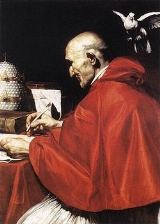
 spread the idea that the chant used in Rome came directly from Gregory the Great, who had died two centuries earlier and was universally venerated. Pictures were made to depict the dove of the Holy Spirit perched on Gregory's shoulder, singing God's authentic form of chant into his ear. This gave rise to calling the music "Gregorian chant
Gregorian chant

Gregorian chant is the central tradition of Western plainsong, a form of monophony liturgy chant in Western Christianity that accompanied the celebration of Mass and other ritual services....
". A more accurate term is plainsong
Plainsong

Plainsong is a body of traditional songs used in the liturgy of the Roman Catholic Church. The liturgies of the Eastern Orthodox Church, though similar in many ways and probably older than the Roman tradition, are generally not classified as plainsong....
 or plainchant.

Sometimes the establishment of the Gregorian Calendar
Gregorian calendar

The Gregorian calendar is the internationally accepted civil calendar. It was first proposed by the Calabrian doctor Aloysius Lilius, and decreed by Pope Gregory XIII, after whom it was named, on 24 February 1582 by the papal bull Inter gravissimas....
 is erroneously attributed to Gregory the Great; however, that calendar was actually instituted by Pope Gregory XIII
Pope Gregory XIII

Pope Gregory XIII , born Ugo Boncompagni, was Pope from 1572 to 1585....
 in 1582 by way of a papal bull
Papal bull

A Papal bull is a particular type of letters patent or charter issued by a pope. It is named after the bulla that was appended to the end to authenticate it....
 entitled, Inter gravissimas
Inter gravissimas

Inter gravissimas was a papal bull issued by Pope Gregory XIII on February 24, 1582. The document reformed the Julian calendar and created a new calendar which came to be called the Gregorian calendar, which is used in most countries today....
.

In the Eastern Orthodox Church
Eastern Orthodox Church

The Eastern Orthodox Church is the second largest single Christian communion in the world with an estimated 225 million members worldwide. It is considered by its adherents to be the Four Marks of the Church established by Jesus Christ and his Apostles nearly 2000 years ago....
, Gregory is credited with compiling the Liturgy of the Presanctified Gifts
Liturgy of the Presanctified Gifts

The Liturgy of the Presanctified Gifts, informally Presanctified Liturgy, is an Eastern Christianity liturgical service for the distribution of Eucharist on the weekdays of Great Lent....
. This liturgy is celebrated on Wednesdays, Fridays, and certain other weekdays during Great Lent
Great Lent

Great Lent, or the Great Fast, is the most important fasting season in the church year in Eastern Christianity, which prepares Christians for the greatest feast of the church year, Easter ....
 in the Eastern Orthodox Church
Eastern Orthodox Church

The Eastern Orthodox Church is the second largest single Christian communion in the world with an estimated 225 million members worldwide. It is considered by its adherents to be the Four Marks of the Church established by Jesus Christ and his Apostles nearly 2000 years ago....
 and those Eastern Catholic Churches which follow the Byzantine Rite
Byzantine Rite

The Byzantine Rite, sometimes called the Rite of Constantinople or Constantinopolitan Rite, is the liturgy used currently by all the Eastern Orthodox Churches and by the Greek-Catholic Churches ....
.

Writings

Beowig1
Gregory is the only Pope between the fifth and the eleventh centuries whose correspondence and writings have survived enough to form a comprehensive corpus. Some of his writings are:
  • Sermons (forty on the Gospel
    Gospel

    In Christianity, a gospel is generally one of the first four books of the New Testament that describe the birth, life, ministry, crucifixion, and resurrection of Jesus....
    s are recognized as authentic, twenty-two on Ezekiel
    Ezekiel

    This article is about the main speaker in the biblical Book of Ezekiel. For a summary and analysis of the book itself, see Book of Ezekiel.According to religious texts, Ezekiel was a prophet and priest in the Hebrew Bible who prophesied for 22 years sometime in the 6th century BC in the form of visions while exiled in Babylon, as recorded...
    , two on the Song of Songs
    Song of songs

    Song of Songs is a book of the Hebrew Bible or Old Testament. It may also refer to:In music:*Song of songs , the debut album by David and the Giants...
    )
  • Dialogues, a collection of miracles, signs, wonders, and healings including the popular life of Saint Benedict
  • Commentary on Job
    Commentary on Job

    Saint Gregory's Commentary on Job, or Moralia, sive Expositio in Job, sometimes called Magna Moralia, but not to be confused with Aristotle's Great Ethics known by the same title, was written between 578 and 595, begun when Gregory was at the court of Tiberius II at Constantinople, but finished only after he had alre...
    , frequently known even in English-language histories by its Latin title, Magna Moralia
  • The Rule for Pastors
    Pastoral Care

    Liber Regulae Pastoralis or Regula Pastoralis is a treatise on the responsibilities of the clergy written by Pope Gregory I around the year 590, shortly after his Pope inauguration....
    , in which he contrasted the role of bishops as pastors of their flock with their position as nobles of the church: the definitive statement of the nature of the episcopal office
  • Copies of some 854 letters have survived, out of an unknown original number recorded in Gregory's time in a register. It is known to have existed in the Vatican, its last known location, in the 9th century. It consisted of 14 papyrus rolls, now missing. Copies of letters had begun to be made, the largest batch of 686 by order of Adrian I. The majority of the copies, dating from the 10th to the 15th century, are stored in the Vatican Library
    Vatican Library

    The Vatican Library , is the library of the Holy See, currently located in Vatican City. It is one of the oldest libraries in the world and contains one of the most significant collections of historical texts....
    .


Opinions of the writings of Gregory vary. "His character strikes us as an ambiguous and enigmatic one," Cantor observed. "On the one hand he was an able and determined administrator, a skilled and clever diplomat, a leader of the greatest sophistication and vision; but on the other hand, he appears in his writings as a superstitious and credulous monk
Monk

A Monk is a person who practices religious asceticism, the unconditioning of mind and body in favor of the realization of one's true nature, and does so living either alone or with any number of like-minded people, whilst always maintaining some degree of physical separation from those not sharing the same purpose....
, hostile to learning, crudely limited as a theologian, and excessively devoted to saints, miracle
Miracle

File:Folio 171r - The Raising of Lazarus.jpgA miracle is a sensibly perceptible interruption of the laws of nature, such that can only be explained by divine intervention, and is sometimes associated with a miracle-worker....
s, and relic
Relic

A relic is an object or a personal item of Religion significance, carefully preserved with an air of veneration as a tangible memorial. Relics are an important aspect of some forms of Buddhism, Christianity, Hinduism, shamanism, and many other religions....
s".

Issues


Controversy with Eutychius

In Constantinople, Gregory took issue with the aged Patriarch Eutychius of Constantinople
Patriarch Eutychius of Constantinople

Eutychius , considered a saint in the Catholic Church and Orthodox Church Christianity traditions, was the Patriarch of Constantinople from . His feast is kept by the Byzantine Church on 6 April, and he is mentioned in the Catholic Church's "Corpus Iuris Civilis" ....
, who had recently published a treatise, now lost, on the General Resurrection
Resurrection of the dead

Zoroastrianism, Judaism, Christianity and Islam all variously describe a resurrection of the dead, usually of all people to face God on Judgment Day....
. Eutychius maintained that the resurrected body "will be more subtle than air, and no longer palpable". Gregory opposed with the palpability of the risen Christ in . As the dispute could not be settled, the Roman emperor
Roman Emperor

The Roman Emperor was the ruler of the Roman Empire during the imperial period . The Romans had no single term for the office: Latin language titles such as imperator , Augustus , Caesar and princeps were all associated with it....
, Tiberius II Constantine
Tiberius II Constantine

Flavius Tiberius Constantinus Augustus or Tiberius II Constantine, known in Greek as Tiberios Konstantinos was a Byzantine emperor of the Justinian Dynasty....
, undertook to arbitrate. He decided in favor of palpability and ordered Eutychius' book to be burned. Shortly after both Gregory and Eutychius became ill, Gregory recovered, but Eutychius died on April 5, 582, at age 70. On his deathbed he recanted inpalpability and Gregory dropped the matter. Tiberius also died a few months after Eutychius.

Sermon on Mary Magdalene

In a sermon
Sermon

A sermon is an public speaking by a prophet or member of the clergy. Sermons address a Bible, Theology, Religion, or Morality topic, usually expounding on a type of belief, law or Human behavior within both past and present contexts....
 whose text is given in Patrologia Latina
Patrologia Latina

The Patrologia Latina is an enormous collection of the writings of the Church Fathers and other ecclesiastical writers published by Jacques-Paul Migne between 1844 and 1855, with indices published between 1862 and 1865....
, Gregory stated that he believed "that the woman Luke called a sinner and John called Mary was the Mary out of whom Mark declared that seven demons were cast" (Hanc vero quam Lucas peccatricem mulierem, Joannes Mariam nominat, illam esse Mariam credimus de qua Marcus septem damonia ejecta fuisse testatur), thus identifying the sinner of , the Mary of and (the sister of Lazarus
Lazarus

Lazarus is the name of two separate men mentioned in the New Testament. The more famous one is Lazarus of Bethany, the subject of the miracle recounted only in the Gospel of John, in which Jesus raises him from the dead....
 and Martha of Bethany), and Mary Magdalene
Mary Magdalene

Saint Mary Magdalene or Mary Magdalene is described, both in the canonical New Testament and in the New Testament apocrypha, as a devoted Disciple of Jesus....
, from whom Jesus had cast out seven demons, related in .

While most Western writers shared this view, it was not seen as a Church teaching, but as an opinion, the pros and cons of which were discussed. With the liturgical changes made in 1969, there is no longer mention of Mary Magdalene as a sinner in Roman Catholic liturgical materials.

The Eastern Orthodox Church has never accepted Gregory's identification of Mary Magdalene with the sinful woman.

Iconography


In art Gregory is usually shown in full pontifical robes with the tiara and double cross, despite his actual habit of dress. Earlier depictions are more likely to show a monastic tonsure and plainer dress. Orthodox icons traditionally show St. Gregory vested as a bishop, holding a Gospel Book
Gospel Book

The Gospel Book, or Book of the Gospels is a codex or bound volume containing one or more of the four Gospels of the Christian New Testament....
 and blessing with his right hand. It is recorded that he permitted his depiction with a square halo
Halo (religious iconography)

A halo is a ring of light that surrounds a person in art. They are often used in religious works to depict holy or sacred figures, and have at various periods also been used in images of rulers or heroes....
, then used for the living. A dove is his attribute
Emblem

An emblem is a pictorial , abstract art or representational, that epitomizes a concept ? e.g., a moral truth, or an allegory ? or that represents a person, such as a Monarch or Saint symbology....
, from the well-known story recorded by his friend Peter the Deacon
Peter the Deacon (disambiguation)

Peter the Deacon or Petrus Diaconus may refer to:#One of the Scythian monks who appeared in 519 before Pope Hormisdas in connexion with the Theopaschite controversy....
, who tells that when the pope was dictating his homilies on Ezechiel a curtain was drawn between his secretary and himself. As, however, the pope remained silent for long periods at a time, the servant made a hole in the curtain and, looking through, beheld a dove seated upon Gregory's head with its beak between his lips. When the dove withdrew its beak the pope spoke and the secretary took down his words; but when he became silent the servant again applied his eye to the hole and saw the dove had replaced its beak between his lips.

This scene is shown as a version of the traditional Evangelist portrait
Evangelist portrait

Evangelist portraits are a specific type of miniature included in ancient and medi?val illuminated manuscript Gospel Books, and later in Bibles and other books, as well as other media....
 (where the Evangelists' symbols are also sometimes shown dictating) from the tenth century onwards. An early example is the dedication miniature from the an eleventh century manuscript of St. Gregory's Moralia in Job. The miniature shows the scribe, Bebo of Seeon Abbey, presenting the manuscript to the Holy Roman Emperor
Holy Roman Emperor

Image:HRR 14Jh.jpgThe Roman of the Emperor's title was a reflection of the translatio imperii principle that regarded the Holy Roman Emperors as the inheritors of the title of Emperor of the Western Roman Empire, a title left unclaimed in the West after the death of Julius Nepos in 480....
, Henry II
Henry II, Holy Roman Emperor

Saint Henry II , called the Holy or the Saint, was the fifth and last Holy Roman Empire of the Ottonian dynasty from his coronation in Rome in 1014 until his death a decade later....
. In the upper left the author is seen writing the text under divine inspiration Usually the dove is shown whispering in Gregory's ear for a clearer composition.

The imaginative and anachronistic example at the top of this article is from the studio of Carlo Saraceni
Carlo Saraceni

Carlo Saraceni was an Italy early-Baroque painter, whose reputation as a "first-class painter of the second rank" was improved with the publication of a modern monograph in 1968....
 or by a close follower, ca 1610. From the Giustiniani collection, the painting is conserved in the Galleria Nazionale d'Arte Antica
Galleria Nazionale d'Arte Antica

The Galleria Nazionale d'Arte Antica, or National Gallery of Ancient Art, is an art gallery in Rome, Italy, located on two sites: the Palazzo Barberini and the Palazzo Corsini....
, Rome. The face of Gregory is a caricature of the features described by John the Deacon mentioned under his early life above: total baldness, outthrust chin, beak-like nose, where John had described partial baldness, a mildly protruding chin, slightly aquiline nose and strikingly good looks. In this picture also Gregory has his monastic back on the world, which the real Gregory, despite his reclusive intent, was seldom allowed to have.

Alms

Alms
Alms

Alms or almsgiving exists in a number of religions. In general, it involves giving materially to another as an act of religious virtue....
 in Christianity
Christianity

Christianity is a Monotheistic religion #Christian view religion centered on the life and teachings of Jesus as New Testament view on Jesus' life....
 is defined by passages of the New Testament
New Testament

The New Testament is the name given to the second major division of the Christianity Bible, the first such division being the much longer Old Testament....
 such as Matthew
Gospel of Matthew

The Gospel of Matthew is one of the four canonical gospels in the New Testament and is a synoptic gospel. It narrates an account of the New Testament view on Jesus' life and Ministry of Jesus of Jesus of Nazareth....
 19:21, which commands "...go and sell that thou hast, and give to the poor ... and come and follow me." A donation
Donation

A donation is a gift given by physical or legal persons, typically for Charitable organization purposes and/or to benefit a cause. A donation may take various forms, including cash, Service , new or used goods including but not limited to clothing, toys, food, vehicles, it also may consist of emergency, relief or humanitarian aid items, dev...
 on the other hand is a gift to some sort of enterprise, profit or non-profit.

On the one hand the alms of St. Gregory are to be distinguished from his donations, but on the other he probably saw no such distinction. The church had no interest in secular profit and as pope Gregory did his utmost to encourage that high standard among church personnel. Apart from maintaining its facilities and supporting its personnel the church gave most of the donations it received as alms.

Gregory is known for his administrative system of charitable relief of the poor at Rome. They were predominantly refugees from the incursions of the Lombards
Lombards

The Lombards were a Germanic peoples originally from Northern Europe who settled in the valley of the Danube and from there invaded Byzantine Italian peninsula in 568 under the leadership of Alboin....
. The philosophy under which he devised this system is that the wealth belonged to the poor and the church was only its steward. He received lavish donations from the wealthy families of Rome, who, following his own example, were eager to expiate to God for their sins. He gave alms equally as lavishly both individually and en masse. He wrote in letters:

"I have frequently charged you ... to act as my representative ... to relieve the poor in their distress ...."
"... I hold the office of steward to the property of the poor ...."


The church received donations of many different kinds of property
Property

Property is any physical or virtual entity that is ownership by an individual or jointly by a group of individuals. An owner of property has the right to consumption, sell, Renting, mortgage, transfer and exchange his or her property....
: consumables such as food and clothing; investment
Investment

Investment or investing is a term with several closely-related meanings in business management, finance and economics, related to Saving or deferring Consumption ....
 property: real estate
Real estate

Real estate is a law term that encompasses land along with anything permanently affixed to the land, such as buildings, specifically property that is fixed in location.
 and works of art; and capital goods, or revenue
Revenue

In business, revenue or revenues is income that a corporation receives from its normal business activities, usually from the sale of product to customers....
-generating property, such as the Sicilian
Sicily

Sicily is an Autonomous regions with special statute of Italy. Of all the regions of Italy, Sicily covers the largest land area at 25,708 km? and currently has just over five million inhabitants....
 latifundia
Latifundia

Latifundia are pieces of property covering tremendous areas. The latifundia of Roman empire were great landed estates, specializing in agriculture destined for export: grain, olive oil, or wine....
, or agricultural estates, staffed and operated by slaves, donated by Gregory and his family. The church already had a system for circulating the consumables to the poor: associated with each parish
Parish

A parish is a local church; it is an administrative unit typically found in Roman Catholic, Anglican, United Methodist, and Presbyterianism churches....
 was a diaconium or office of the deacon
Deacon

Deacon is a role in the Christianity that is generally associated with service of some kind, but which varies among theological and denominational traditions....
. He was given a building from which the poor could at any time apply for assistance.

The state in which Gregory became pope in 590 was a ruined one. The Lombards held the better part of Italy. Their predations had brought the economy to a standstill. They camped nearly at the gates of Rome. The city was packed with refugees from all walks of life, who lived in the streets and had few of the necessities of life. The seat of government was far from Rome in Constantinople
Constantinople

Constantinople was the empire capital of the Roman Empire , the Byzantine Empire , the Latin Empire , and the Ottoman Empire . Strategically located between the Golden Horn and the Sea of Marmara at the point where Europe meets Asia, Byzantine Constantinople had been the capital of a Christendom empire, successor to ancient ancient Greece...
, which appeared unable to undertake the relief of Italy. The pope had sent emissaries, including Gregory, asking for assistance, to no avail.

In 590, Gregory could wait for Constantinople no longer. He organized the resources of the church into an administration for general relief. In doing so he evidenced a talent for and intuitive understanding of the principles of accounting, which was not to be invented for centuries. The church already had basic accounting documents: every expense
Expense

In common usage, an expense or expenditure is an outflow of money to another person or group to pay for an item or service, or for a category of costs....
 was recorded in journals
Journal

__FORCETOC__A journal has several related meanings:* a daily record of events or business; a private journal is usually referred to as a diary....
 called regesta, "lists" of amounts, recipients and circumstances. Revenue was recorded in polyptici, "books
Bookkeeping

Bookkeeping is the recording of the value of assets, liabilities, income, and expenses in the daybooks, journals, and ledgers, in which debit and credit entries are chronologically posted to record changes in value....
." Many of these polyptici were ledger
Ledger

A ledger or lieger , is the principal book for recording transactions. Originally, the term referred to a large volume of Scripture/service book kept in one place in church and accessible....
s recording the operating expenses of the church and the asset
Asset

In business and accounting, assets are everything of value that is owned by a person or company. It is a claim on the property your income of a borrower....
s, the patrimonia. A central papal administration, the notarii, under a chief, the primicerius notariorum, kept the ledgers and issued brevia patrimonii, or lists of property for which each rector
Rector

The word rector has a number of different meanings, but all of them indicate an academic, religious or political administrator.The word "rector" also appears in many modern languages, such as Albanian, Dutch language, Spanish language, Catalan language and Romanian language....
 was responsible.

Gregory began by aggressively requiring his churchmen to seek out and relieve needy persons and reprimanded them if they did not. In a letter to a subordinate in Sicily
Sicily

Sicily is an Autonomous regions with special statute of Italy. Of all the regions of Italy, Sicily covers the largest land area at 25,708 km? and currently has just over five million inhabitants....
 he wrote: "I asked you most of all to take care of the poor. And if you knew of people in poverty, you should have pointed them out ... I desire that you give the woman, Pateria, forty soldi
Solidus (coin)

The solidus was originally a gold coin issued by the Ancient Rome.The solidus was first introduced by Diocletian around 301, struck at 60 to the Roman pound of pure gold and with an initial value equal to 1000 denarius....
 for the children's shoes and forty bushels of grain ...." Soon he was replacing administrators who would not cooperate with those who would and at the same time adding more in a build-up to a great plan that he had in mind. He understood that expenses must be matched by income
Income

Income, refers to consumption opportunity gained by an entity within a specified time frame, which is generally expressed in monetary terms. However, for households and individuals, "income is the sum of all the wages, salaries, profits, interests payments, rents and other forms of earnings received......
. To pay for his increased expenses he liquidated the investment property and paid the expenses in cash according to a budget recorded in the polyptici. The churchmen were paid four times a year and also personally given a golden coin for their trouble.

Money, however, was no substitute for food in a city that was on the brink of famine. Even the wealthy were going hungry in their villas. The church now owned between of revenue-generating farmland divided into large sections called patrimonia. It produced goods of all kinds, which were sold, but Gregory intervened and had the goods shipped to Rome for distribution in the diaconia. He gave orders to step up production, set quotas and put an administrative structure in place to carry it out. At the bottom was the rusticus who produced the goods. Some rustici were or owned slaves. He turned over part of his produce to a conductor from whom he leased the land. The latter reported to an actionarius, the latter to a defensor and the latter to a rector. Grain, wine, cheese, meat, fish and oil began to arrive at Rome in large quantities, where it was given away for nothing as alms.

Distributions to qualified persons were monthly. However, a certain proportion of the population lived in the streets or were too ill or infirm to pick up their monthly food supply. To them Gregory sent out a small army of charitable persons, mainly monks, every morning with prepared food. It is said that he would not dine until the indigent were fed. When he did dine he shared the family table, which he had saved (and which still exists), with 12 indigent guests. To the needy living in wealthy homes he sent meals he had cooked with his own hands as gifts to spare them the indignity of receiving charity. Hearing of the death of an indigent in a back room he was depressed for days, entertaining for a time the conceit that he had failed in his duty and was a murderer.

These and other good deeds and charitable frame of mind completely won the hearts and minds of the Roman people. They now looked to the papacy for government, ignoring the rump state at Constantinople, which had only disrespect for Gregory, calling him a fool for his pacifist dealings with the Lombards. The office of urban prefect went without candidates. From the time of Gregory the Great to the rise of Italian nationalism the papacy was most influential in ruling Italy.

Famous quotes and anecdotes

  • Non Angli, sed Angeli - "They are not Angles
    Angles

    The Angles is a modern English language word for a Germanic languages people who took their name from the cultural ancestral region of Angeln, a modern district located in Schleswig-Holstein, Germany....
    , but Angels". Aphorism
    Aphorism

    The word aphorism denotes an original thought, spoken or written in a laconic and easily memorable form.The name was first used in the Aphorisms of Hippocrates....
     of unknown origin summarizing words reported to have been spoken by Gregory when he first encountered blue-eyed, blond-haired English boys at a slave market, sparking his dispatching of St. Augustine of Canterbury to England to convert the English, according to Bede
    Bede

    Bede , , was a monasticism at the Northumbrian monastery of Saint Peter at Monkwearmouth, today part of Sunderland, England, and of its companion monastery, Saint Paul's, in modern Jarrow , both in the Kingdom of Northumbria....
    . He said: "Well named, for they have angelic faces and ought to be co-heirs with the angels in heaven." Discovering that their province was Deira
    Deira

    Deira was a kingdom in Northern England during the 6th century AD. Itextended from the River Humber to the River Tees, and from the sea to the western edge of the Vale of York....
    , he went on to add that they would be rescued de ira, "from the wrath", and that their king was named Aella, Alleluia, he said.
  • Ecce locusta - "Look at the locust." Gregory himself wanted to go to England as a missionary and started out for there. On the fourth day as they stopped for lunch a locust landed on the edge of the Bible Gregory was reading. He exclaimed ecce locusta, "look at the locust", but reflecting on it he saw it as a sign from Heaven since the similar sounding loco sta means "stay in place." Within the hour an emissary of the pope arrived to recall him.
  • Pro cuius amore in eius eloquio nec mihi parco - "For the love of whom (God) I do not spare myself from his Word." The sense is that since the creator of the human race and redeemer of him unworthy gave him the power of the tongue so that he could witness, what kind of a witness would he be if he did not use it but preferred to speak infirmly?
  • Non enim pro locis res, sed pro bonis rebus loca amanda sunt - "Things are not to be loved for the sake of a place, but places are to be loved for the sake of their good things." When Augustine asked whether to use Roman or Gallican customs in the mass in England, Gregory said, in paraphrase, that it was not the place that imparted goodness but good things that graced the place, and it was more important to be pleasing to the Almighty. They should pick out what was "pia", "religiosa" and "recta" from any church whatever and set that down before the English minds as practice.
  • For the rule of justice and reason suggests that one who desires his own orders to be observed by his successors should undoubtedly keep the will and ordinances of his predecessor. In his letters, Gregory often emphasized the importance of giving proper deference to last wills and testaments, and of respecting property rights.
  • At length being anxious to avoid all these inconveniences, I sought the haven of the monastery… For as the vessel that is negligently moored, is very often (when the storm waxes violent) tossed by the water out of its shelter on the safest shore, so under the cloak of the Ecclesiastical office, I found myself plunged on a sudden in a sea of secular matters, and because I had not held fast the tranquillity of the monastery when in possession, I learnt by losing it, how closely it should have been held. In Moralia, sive Expositio in Job (“Commentary on Job,” also known as Magna Moralia), Gregory describes to the Bishop Leander the circumstances under which he became a monk.


Memorials


Lives

In Britain, appreciation for Gregory remained strong even after his death, with him being called Gregorius noster ("our Gregory") by the British. It was in Britain, at a monastery in Whitby
Whitby Abbey

Whitby Abbey is a ruins Benedictine abbey sited on Whitby's East Cliff in North Yorkshire on the north-east coast of England.The stark and magnificent ruins of Whitby Abbey are much more than a spectacular clifftop landmark....
, that the first full length life
Vita

Vita or VITA may refer to:*Vita , a brief biography, often that of a saint * A curriculum vitae* Beta , the 2nd letter of the Greek alphabet...
 of Gregory was written, in c.713. Appreciation of Gregory in Rome and Italy itself, however, did not come until later. The first vita of Gregory written in Italy was not produced until John the Deacon
John, deacon of Rome

Johannes Hymonides, known as John the Deacon of Rome , was towards the middle of the 9th century a monk of Monte Cassino near Rome, and later a deacon of the Roman Church....
 in the 9th century.

Monuments

The namesake church of San Gregorio al Celio (largely rebuilt from the original edifices during the 17th-18th centuries) remembers his work. One of the three oratories annexed, the oratory of St. Silvia, is said to lie over the tomb of Gregory's mother.

Music

Composer Alan Hovhaness
Alan Hovhaness

Alan Hovhaness was an United States composer of Armenian-American and Scottish American ancestry, but the inspiration for his mature work was as much Eastern as Western....
 wrote an elegiac
Elegy

An elegy is a mournful, melancholic or plaintive Poetry#Elegy, especially a funeral song or a lament for the dead....
 intermezzo
Intermezzo

In music, an intermezzo , in the most general sense, is a composition which fits between other musical or dramatic entities, such as acts of a play or movements of a larger musical work....
 for strings and trumpet called the Prayer of Saint Gregory (Op. 62b).

Feast Day

The current Roman Catholic calendar of saints
Roman Catholic calendar of saints

The General Roman Calendar indicates the days of the year to which are assigned the liturgical celebrations of Saint and of the mysteries of the Jesus Christ that are to be observed wherever the Roman Rite is used....
, revised in 1969 as instructed by the Second Vatican Council
Second Vatican Council

The Second Ecumenical Council of the Vatican, or Vatican II, was the twenty-first Ecumenical Council of the Roman Catholic Church. It opened under Pope John XXIII in 1962 and closed under Pope Paul VI in 1965....
, celebrates St. Gregory the Great on 3 September. Before that, the General Roman Calendar assigned his feast day to 12 March, the day of his death in 604. This day always falls within Lent, during which there are no obligatory Memorials. For this reason his feast day was moved to 3 September the day of his episcopal consecration
Consecration

Consecration is the ritual dedication to a special purpose or service, usually religious. The word "consecration" literally means "to associate with the sacred"....
 in 590.

The Eastern Orthodox Church
Eastern Orthodox Church

The Eastern Orthodox Church is the second largest single Christian communion in the world with an estimated 225 million members worldwide. It is considered by its adherents to be the Four Marks of the Church established by Jesus Christ and his Apostles nearly 2000 years ago....
 and the associated Eastern Catholic Churches continue to commemorate St. Gregory on 12 March. The occurrence of this date during Great Lent
Great Lent

Great Lent, or the Great Fast, is the most important fasting season in the church year in Eastern Christianity, which prepares Christians for the greatest feast of the church year, Easter ....
 is considered appropriate in the Byzantine Rite
Byzantine Rite

The Byzantine Rite, sometimes called the Rite of Constantinople or Constantinopolitan Rite, is the liturgy used currently by all the Eastern Orthodox Churches and by the Greek-Catholic Churches ....
, which traditionally associates Saint Gregory with the Divine Liturgy of the Presanctified Gifts, celebrated only during that liturgical
Liturgy

A liturgy is the customary public worship done by a specific religious group, according to their particular traditions. The word may refer to an elaborate formal ritual such as the Eastern Orthodox Divine Liturgy and Mass , or a daily activity such as the Muslim salat and Jewish Jewish services....
 season.

Other Churches too honour Saint Gregory: the Church of England
Church of England

The Church of England is the State religion Christianity Ecclesia in England, the Mother Church of the worldwide Anglican Communion and the oldest among the communion's thirty-eight independent national and regional churches....
 on 3 September, the Evangelical Lutheran Church in America
Evangelical Lutheran Church in America

The Evangelical Lutheran Church in America is a mainline Protestantism List of Christian denominations headquartered in Chicago, Illinois. Formed in 1988 by the merging of three churches and currently having about 4.70 million baptized members, it is the largest of all the Lutheranism denominations in the Religion in the United States and t...
 and the Episcopal Church in the United States on 12 March.

A traditional procession
Procession

A procession is, in general, an organized body of people advancing in a formal or ceremonial manner....
 is held in Zejtun
Zejtun

Zeitun is a medium sized town in the south of Malta. Zejtun holds the title of Citt? Beland, which was bestowed by Ferdinand von Hompesch zu Bolheim, Grandmaster of Knights of Malta in 1797, Beland being his mother's surname....
, Malta
Malta

Malta , officially the Republic of Malta , is a densely populated developed country European microstates microstate in the European Union....
 in honour of Saint Gregory (San Girgor) on Easter
Easter

Easter is the most important religious feast in the Christianity liturgical year.Christians believe that Jesus was Resurrection of Jesus from the dead three days after his Crucifixion of Jesus, and celebrate this resurrection on Easter Day or Easter Sunday , two days after Good Friday....
 Wednesday, which most often falls in April, the range of possible dates being 25 March to 28 April.

Bibliography

. Studia Anselmiana, volume 135.
  • Vincenzo Recchia, Lettera e profezia nell'esegesi di Gregorio Magno (Bari: Edipuglia, 2003), Pp. 157 (Quaderni di "Invigilata Lucernis," Dipartamento di Studi Classici e Cristiani, Universita\ degli Studi di Bari, vol. 20).
  • George Demacopoulos, Five Models of Spiritual Direction in the Early Church (Notre Dame (IN), University of Notre Dame Press, 2007).
  • Hester, Kevin L., Eschatology and Pain in St. Gregory the Great. The Christological Synthesis of Gregory's Morals on the Book of Job (Milton Keynes: Paternoster, 2007), Pp. xv, 155 (Studies in Christian History and Thought).


External links

  • . Index of 70 downloadable .pdf files containing the texts of Gregory I.
  • Photographic images of a manuscript copied about 850-875 AD.*
  • Orthodox icon
    Icon

    An 'icon' is a religious work of art, most commonly a painting, from Eastern Christianity. More broadly the term is used in a wide number of contexts for an image, picture, or representation; it is a sign or likeness that stands for an object by signifying or representing it either concretely or by analogy, as in semiotics; by extension, ...
     and synaxarion.