


Catacombs of Rome

Encyclopedia
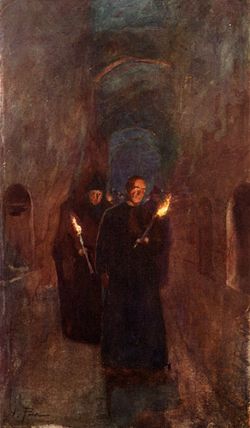
Catacombs
Catacombs, human-made subterranean passageways for religious practice. Any chamber used as a burial place can be described as a catacomb, although the word is most commonly associated with the Roman empire...
, underground burial places under or near Rome
Rome
Rome is the capital of Italy and the country's largest and most populated city and comune, with over 2.7 million residents in . The city is located in the central-western portion of the Italian Peninsula, on the Tiber River within the Lazio region of Italy.Rome's history spans two and a half...
, Italy
Italy
Italy , officially the Italian Republic languages]] under the European Charter for Regional or Minority Languages. In each of these, Italy's official name is as follows:;;;;;;;;), is a unitary parliamentary republic in South-Central Europe. To the north it borders France, Switzerland, Austria and...
, of which there are at least forty, some discovered only in recent decades. Though most famous for Christian
Christianity
Christianity is a monotheistic religion based on the life and teachings of Jesus as presented in canonical gospels and other New Testament writings...
burials, either in separate catacombs or mixed together, they began in the 2nd century, much as a response to overcrowding and shortage of land. While past scholars have written, and much of the public today still thinks, that catacombs came about to help persecuted Christians to bury their dead secretly, this myth has been debunked: Among other reasons, catacombs always were along major highways (which would have meant they couldn't be kept secret for long), pagans also used catacombs although their religion was legal, and most catacomb building took place after Christianity's legalization. The soft volcanic tuff
Tuff
Tuff is a type of rock consisting of consolidated volcanic ash ejected from vents during a volcanic eruption. Tuff is sometimes called tufa, particularly when used as construction material, although tufa also refers to a quite different rock. Rock that contains greater than 50% tuff is considered...
rock under Rome is highly suitable for tunnelling, as it is softer when first exposed to air, hardening afterwards. Many have kilometres of tunnels, in up to four stories (or layers).
The Christian catacombs are extremely important for the art history
Art history
Art history has historically been understood as the academic study of objects of art in their historical development and stylistic contexts, i.e. genre, design, format, and style...
of early Christian art
Christian art
Christian art is sacred art produced in an attempt to illustrate, supplement and portray in tangible form the principles of Christianity, though other definitions are possible. Most Christian groups use or have used art to some extent, although some have had strong objections to some forms of...
, as they contain the great majority of examples from before about 400 AD, in fresco and sculpture
Sculpture
Sculpture is three-dimensional artwork created by shaping or combining hard materials—typically stone such as marble—or metal, glass, or wood. Softer materials can also be used, such as clay, textiles, plastics, polymers and softer metals...
. The Jewish catacombs are similarly important for the study of Jewish art
Secular Jewish culture
Secular Jewish culture embraces several related phenomena; above all, it is the international culture of secular communities of Jewish people, but it can also include the cultural contributions of individuals who identify as secular Jews...
at this period.
History
Precursors
The EtruscansEtruscan civilization
Etruscan civilization is the modern English name given to a civilization of ancient Italy in the area corresponding roughly to Tuscany. The ancient Romans called its creators the Tusci or Etrusci...
, like many other European peoples, used to bury their dead in underground chambers. The original Roman custom was cremation, after which the burnt remains were kept in a pot, ash-chest or urn, often in a columbarium
Columbarium
A columbarium is a place for the respectful and usually public storage of cinerary urns . The term comes from the Latin columba and originally referred to compartmentalized housing for doves and pigeons .The Columbarium of Pomponius Hylas is a particularly fine ancient Roman example, rich in...
. From about the 2nd century AD, inhumation
Burial
Burial is the act of placing a person or object into the ground. This is accomplished by excavating a pit or trench, placing an object in it, and covering it over.-History:...
(burial of unburnt remains) became more fashionable, in graves or sarcophagi
Sarcophagus
A sarcophagus is a funeral receptacle for a corpse, most commonly carved or cut from stone. The word "sarcophagus" comes from the Greek σαρξ sarx meaning "flesh", and φαγειν phagein meaning "to eat", hence sarkophagus means "flesh-eating"; from the phrase lithos sarkophagos...
, often elaborately carved, for those who could afford them. Christians also preferred burial to cremation
Cremation
Cremation is the process of reducing bodies to basic chemical compounds such as gasses and bone fragments. This is accomplished through high-temperature burning, vaporization and oxidation....
because of their belief in bodily resurrection
Resurrection
Resurrection refers to the literal coming back to life of the biologically dead. It is used both with respect to particular individuals or the belief in a General Resurrection of the dead at the end of the world. The General Resurrection is featured prominently in Jewish, Christian, and Muslim...
at the Second Coming
Second Coming
In Christian doctrine, the Second Coming of Christ, the Second Advent, or the Parousia, is the anticipated return of Jesus Christ from Heaven, where he sits at the Right Hand of God, to Earth. This prophecy is found in the canonical gospels and in most Christian and Islamic eschatologies...
.
Christian catacombs
The first large-scale catacombs were excavated from the 2nd century onwards. Originally they were carved through tufo, a soft volcanic rockVolcanic rock
Volcanic rock is a rock formed from magma erupted from a volcano. In other words, it is an igneous rock of volcanic origin...
, outside the boundaries of the city, because Roman law
Roman law
Roman law is the legal system of ancient Rome, and the legal developments which occurred before the 7th century AD — when the Roman–Byzantine state adopted Greek as the language of government. The development of Roman law comprises more than a thousand years of jurisprudence — from the Twelve...
forbade burial places within city limits. Furthermore, the pagan custom was to incinerate corpses, while early Christians and Jews used to bury. Being most of the latter of lower classes and slaves, they usually lacked the resources to buy land for burial purposes, thus using the soft volcanic rock of the whereabouts of Rome to dig tunnels in which to bury their dead. At first they were used both for burial and the memorial services and celebrations of the anniversaries of Christian martyr
Martyr
A martyr is somebody who suffers persecution and death for refusing to renounce, or accept, a belief or cause, usually religious.-Meaning:...
s (following similar Roman customs). They probably were not used for regular worship. Many modern depictions of the catacombs show them as hiding places for Christian populations during times of persecution, but this has been thoroughly debunked.
There are sixty known subterranean burial chambers in Rome. They were built along Roman roads, like the Via Appia, the Via Ostiense, the Via Labicana
Via Labicana
The Via Labicana was an ancient road of Italy, leading east southeast from Rome. It seems possible that the road at first led to Tusculum, that it was then extended to Labici, and later still became a road for through traffic; it may even have superseded the Via Latina as a route to the southeast,...
, the Via Tiburtina
Via Tiburtina
Via Tiburtina is an ancient road in Italy leading east-northeast from Rome to Tivoli . It was built by the Roman consul Marcus Valerius Maximus around 286 BC and later lengthened to the territories of the Marsi and the Equi, in the Abruzzo, as Via Valeria. Its total length was approximately...
, and the Via Nomentana
Via Nomentana
Via Nomentana is an ancient road of Italy, leading North-East from Rome to Nomentum , a distance of . It originally bore the name Via Ficulnensis, from the old Latin village of Ficulnea, about from Rome. It was subsequently prolonged to Nomentum, but never became an important high road, and merged...
. Names of the catacombs – like St Calixtus
Pope Callixtus I
Pope Saint Callixtus I or Callistus I was pope from about 217 to about 222, during the reigns of the Roman Emperors Elagabalus and Alexander Severus...
and St Sebastian, which is alongside Via Appia – refer to martyrs that might be buried there.
Christian excavators (fossors) built vast systems of galleries and passages on top of each other. They lie 7–19 m (23–62.3 ft) below the surface in area of more than 2.4 square kilometres (593.1 acre). Narrow steps that descend as many as four stories join the levels. Passages are about 2.5 by 1 m (8.2 by 3.3 ft). Burial niches (loculi
Loculus (architecture)
Loculus is a Latin word literally meaning little place and was used in a number of senses. In architecture it is a recess large enough to receive a human corpse. Usually found in either a catacomb, hypogeum, mausoleum or other place of entombment. Loculus can also refer to an alternative name for...
) were carved into walls. They are 40–60 cm (15.7–23.6 in) high and 120–150 cm (47.2–59.1 in) long. Bodies were placed in chambers in stone sarcophagi in their clothes and bound in linen. Then the chamber was sealed with a slab bearing the name, age and the day of death. Fresco decorations were typically Roman. The catacomb of Saint Agnes is a small church. Some families were able to construct cubicula which would house various loculi and the architectural elements of the space would be a support for decoration. Another excellent place for artistic programs were the arcosoliums.
Decline and rediscovery
In 380, Christianity became a state religion. At first many still desired to be buried in chambers alongside martyrs. However, the practice of catacomb burial declined slowly, and the dead were increasingly buried in church cemeteries. In the 6th century catacombs were used only for martyrs’ memorial services, though some paintings were added as late as the 7th century, for example a Saint StephenSaint Stephen
Saint Stephen The Protomartyr , the protomartyr of Christianity, is venerated as a saint in the Roman Catholic, Anglican, Lutheran, Oriental Orthodox and Eastern Orthodox Churches....
in the Catacomb of Commodilla. Apparently Ostrogoths, Vandals
Vandals
The Vandals were an East Germanic tribe that entered the late Roman Empire during the 5th century. The Vandals under king Genseric entered Africa in 429 and by 439 established a kingdom which included the Roman Africa province, besides the islands of Sicily, Corsica, Sardinia and the Balearics....
and Lombards
Lombards
The Lombards , also referred to as Longobards, were a Germanic tribe of Scandinavian origin, who from 568 to 774 ruled a Kingdom in Italy...
that sacked Rome also violated the catacombs, presumably looking for valuables. By the 10th century catacombs were practically abandoned, and holy relic
Relic
In religion, a relic is a part of the body of a saint or a venerated person, or else another type of ancient religious object, carefully preserved for purposes of veneration or as a tangible memorial...
s were transferred to above-ground basilica
Basilica
The Latin word basilica , was originally used to describe a Roman public building, usually located in the forum of a Roman town. Public basilicas began to appear in Hellenistic cities in the 2nd century BC.The term was also applied to buildings used for religious purposes...
s.
In the intervening centuries they remained forgotten until they were accidentally rediscovered in 1578, after which Antonio Bosio
Antonio Bosio
Antonio Bosio was an Italian scholar, the first systematic explorer of subterranean Rome , author of Roma Sotterranea and first urban spelunker.-Biography:Bosio was born in Malta....
spent decades exploring and researching them for his volume, Roma Sotterranea (1632). Archeologist Giovanni Battista de Rossi
Giovanni Battista de Rossi
Giovanni Battista de Rossi was an Italian archaeologist, famous outside his field for his rediscovery of early Christian catacombs.-Life and works:He was born in Rome...
(1822–1894) published the first extensive professional studies about catacombs. In 1956 and 1959 Italian authorities found more catacombs near Rome. The catacombs have become an important monument of the early Christian church
Early Christianity
Early Christianity is generally considered as Christianity before 325. The New Testament's Book of Acts and Epistle to the Galatians records that the first Christian community was centered in Jerusalem and its leaders included James, Peter and John....
.
Today
Currently maintenance of the catacombs is in the hands of the PapacyPope
The Pope is the Bishop of Rome, a position that makes him the leader of the worldwide Catholic Church . In the Catholic Church, the Pope is regarded as the successor of Saint Peter, the Apostle...
which has invested in the Salesians of Don Bosco
Salesians of Don Bosco
The Salesians of Don Bosco is a Roman Catholic religious order founded in the late nineteenth century by Saint John Bosco in an attempt, through works of charity, to care for the young and poor children of the industrial revolution...
the supervision of the Catacombs of St. Callixtus on the outskirts of Rome.
Responsibility for the Christian catacombs lies with the Pontifical Commission of Sacred Archaeology
Pontifical Commission of Sacred Archaeology
The Pontifical Commission of Sacred Archaeology is an official board of the Vatican founded in 1852 by Pope Pius IX for the purpose of promoting and directing excavations in the Catacombs of Rome and on other sites of Christian antiquarian interest, and of safeguarding the objects found during...
(Pontificia Commissione di Archeologia Sacra), which directs excavations and restorations. Study of the catacombs is directed by the Pontifical Academy of Archaeology
Pontifical Academy of Archaeology
The Pontifical Academy of Archaeology is an academic honorary society established in Rome by the Catholic Church for the advancement of Christian archaeological study...
.
Typology
Roman catacombs are made up of underground passages (ambulacra), out of whose walls graves (loculi) were dug. These loculi, generally laid out vertically (pilae), could contain one or more bodies. Another type of burial, typical of Roman catacombs, was the arcosolium, consisting of a curved niche, enclosed under a carved horizontal marble slab. cubicula (burial rooms containing loculi all for one family) and cryptae (chapels decorated with frescoes) are also commonly found in catacomb passages. When space began to run out, other graves were also dug in the floor of the corridors - these graves are called formae.Reception
The catacombs have been influential in classical musicClassical music
Classical music is the art music produced in, or rooted in, the traditions of Western liturgical and secular music, encompassing a broad period from roughly the 11th century to present times...
, featuring in one of Respighi
Ottorino Respighi
Ottorino Respighi was an Italian composer, musicologist and conductor. He is best known for his orchestral "Roman trilogy": Fountains of Rome ; Pines of Rome ; and Roman Festivals...
's Pini di Roma
Pini di Roma
Pines of Rome is a symphonic poem written in 1924 by the Italian composer Ottorino Respighi and, together with Fontane di Roma and Feste Romane, forms what is sometimes loosely referred to as his "Roman trilogy"...
and in Mussorgsky
Modest Mussorgsky
Modest Petrovich Mussorgsky was a Russian composer, one of the group known as 'The Five'. He was an innovator of Russian music in the romantic period...
's Pictures at an Exhibition
Pictures at an Exhibition
Pictures at an Exhibition is a suite in ten movements composed for piano by Russian composer Modest Mussorgsky in 1874.The suite is Mussorgsky's most famous piano composition, and has become a showpiece for virtuoso pianists...
.
List of catacombs in Rome
The Roman catacombs, of which there are forty in the suburbs, were built along the consular roads out of Rome, such as the Appian way, the via Ostiense, the via Labicana, the via Tiburtina, and the via NomentanaVia Nomentana
Via Nomentana is an ancient road of Italy, leading North-East from Rome to Nomentum , a distance of . It originally bore the name Via Ficulnensis, from the old Latin village of Ficulnea, about from Rome. It was subsequently prolonged to Nomentum, but never became an important high road, and merged...
.
Catacombs of Marcellinus and Peter
These catacombs are situated on the ancient Via LabicanaVia Labicana
The Via Labicana was an ancient road of Italy, leading east southeast from Rome. It seems possible that the road at first led to Tusculum, that it was then extended to Labici, and later still became a road for through traffic; it may even have superseded the Via Latina as a route to the southeast,...
, today Via Casilina
Via Casilina
The Via Casilina was an ancient Roman road in Latium.It was created from the fusion of two other ancient Roman roads, the Via Latina and the Via Labicana. It connected Rome to ancient Casilinum . It entered Rome...
in Rome
Rome
Rome is the capital of Italy and the country's largest and most populated city and comune, with over 2.7 million residents in . The city is located in the central-western portion of the Italian Peninsula, on the Tiber River within the Lazio region of Italy.Rome's history spans two and a half...
, Italy
Italy
Italy , officially the Italian Republic languages]] under the European Charter for Regional or Minority Languages. In each of these, Italy's official name is as follows:;;;;;;;;), is a unitary parliamentary republic in South-Central Europe. To the north it borders France, Switzerland, Austria and...
, near the church of Santi Marcellino e Pietro ad Duas Lauros. Their name refers to the Christian
Christian
A Christian is a person who adheres to Christianity, an Abrahamic, monotheistic religion based on the life and teachings of Jesus of Nazareth as recorded in the Canonical gospels and the letters of the New Testament...
martyrs Marcellinus and Peter
Marcellinus and Peter
Saints Marcellinus and Peter were two 4th century Christian martyrs in the city of Rome.-Life:Very little is known about the two martyrs' lives. Marcellinus, a priest, and Peter, an exorcist, died in the year 304, during the persecution of Diocletian...
who, according to tradition, were buried here, near the body of St. Tiburtius.
Catacombs of Domitilla
Close to the Catacombs of San Callisto are the large and impressive Catacombs of Domitilla (named after Saint DomitillaFlavia Domitilla (saint)
Flavia Domitilla was daughter of Domitilla the Younger by an unknown father, perhaps Quintus Petillius Cerialis. She married her cousin, the consul Titus Flavius Clemens.-In Roman literature:...
), spread over 15 kilometers of underground caves.
The Domitilla Catacombs are unique in that they are the oldest of Rome's underground burial networks, and the only ones to still contain bones. They are also the best preserved and one of the most extensive of all the catacombs. Included in their passages are a 2nd-century fresco
Fresco
Fresco is any of several related mural painting types, executed on plaster on walls or ceilings. The word fresco comes from the Greek word affresca which derives from the Latin word for "fresh". Frescoes first developed in the ancient world and continued to be popular through the Renaissance...
of the Last Supper
Last Supper
The Last Supper is the final meal that, according to Christian belief, Jesus shared with his Twelve Apostles in Jerusalem before his crucifixion. The Last Supper provides the scriptural basis for the Eucharist, also known as "communion" or "the Lord's Supper".The First Epistle to the Corinthians is...
and other valuable artifacts.
They are the only catacombs that have a subterranean basilica; entrance to the catacombs is achieved through this sunken 4th-century church, at via delle Sette Chiese 280. In the past, the basilica had become unsafe, and was abandoned in the 9th century. It was rediscovered in 1593, and much of it was reconstructed in 1870.
In the beginning of 2009, at the request of the Vatican, the Divine Word Missionaries, a Roman Catholic Society of priests and Brothers, assumed responsibility as administrator of St. Domitilla Catacombs.
Catacombs of Commodilla

Via Ostiensis
The Via Ostiensis was an important road in ancient Rome. It ran west 30 km from the city of Rome to its important sea port of Ostia Antica, from which it took its name. The road began near the Forum Boarium, ran between the Aventine and the Tiber River along its left bank, and left the...
, contain one of the earliest images of a bearded Christ. They originally held the relics of Saints Felix and Adauctus
Felix and Adauctus
Saints Felix and Adauctus were Christian martyrs who are believed to have lived during the reigns of Diocletian and Maximian.The Acts, first published in Ado's Martyrology, relate as follows: Felix, a Roman priest, and brother of another priest, also named Felix, being ordered to offer sacrifice...
.
Catacombs of Generosa
Located on the Campana Road, these catacombs are said to have been the resting place, perhaps temporarily, of Simplicius, Faustinus and BeatrixSimplicius, Faustinus and Beatrix
Saints Simplicius, Faustinus and Beatrix were a group of Christian Martyrs who died in Rome during the Diocletian persecution .-Legend:...
, Christian Martyrs
Christian martyrs
A Christian martyr is one who is killed for following Christianity, through stoning, crucifixion, burning at the stake or other forms of torture and capital punishment. The word "martyr" comes from the Greek word μάρτυς, mártys, which means "witness."...
who died in Rome
Rome
Rome is the capital of Italy and the country's largest and most populated city and comune, with over 2.7 million residents in . The city is located in the central-western portion of the Italian Peninsula, on the Tiber River within the Lazio region of Italy.Rome's history spans two and a half...
during the Diocletian
Diocletian
Diocletian |latinized]] upon his accession to Diocletian . c. 22 December 244 – 3 December 311), was a Roman Emperor from 284 to 305....
persecution (302 or 303).
Catacombs of Prætextatus
These are found along the via AppiaAppian Way
The Appian Way was one of the earliest and strategically most important Roman roads of the ancient republic. It connected Rome to Brindisi, Apulia, in southeast Italy...
, and were built at the end of 2nd century. They consist of a vast underground burial area, at first in pagan then in Christian use, housing various tombs of Christian martyrs
Christian martyrs
A Christian martyr is one who is killed for following Christianity, through stoning, crucifixion, burning at the stake or other forms of torture and capital punishment. The word "martyr" comes from the Greek word μάρτυς, mártys, which means "witness."...
. In the oldest parts of the complex may be found the "cubiculum of the coronation", with a rare depiction for that period of Christ being crowned with thorns, and a 4th century painting of Susanna
Susanna (Book of Daniel)
Susanna or Shoshana included in the Book of Daniel by the Roman Catholic and Eastern Orthodox churches. It is one of the additions to Daniel, considered apocryphal by Protestants. It is listed in Article VI of the Thirty-Nine Articles of the Church of England among the books which are included...
and the old men in the allegorical guise of a lamb and wolves.
Catacombs of Priscilla
The Catacomb of Priscilla, situated at the Via Salaria, in front of the Villa AdaVilla Ada
Villa Ada is the largest park in Rome, Italy, with a surface of 450 acres/182 hectares. It is located in the northeastern part of the city. Its highest prominence is Monte Antenne, 67 m , an ancient archeological site.-History:...
, derives its name probably from the name of the landowner on whose land they were built. They are looked after by an order of nuns.
Catacombs of San Callisto
Hypogeum
Hypogeum or hypogaeum literally means "underground", from Greek hypo and gaia . It usually refers to an underground, non-Christian temple or a tomb...
and a funeral area directly dependent on the Catholic Church
Roman Catholic Church
The Catholic Church, also known as the Roman Catholic Church, is the world's largest Christian church, with over a billion members. Led by the Pope, it defines its mission as spreading the gospel of Jesus Christ, administering the sacraments and exercising charity...
. It takes its name from the deacon Saint Callixtus, proposed by Pope Zephyrinus
Pope Zephyrinus
Pope Saint Zephyrinus, born in Rome, was bishop of Rome from 199 to 217. His predecessor was bishop Victor I. Upon his death on December 20, 217, he was succeeded by his principal advisor, bishop Callixtus I.-Papacy:...
in the administration of the same cemetery - on his accession as pope, he enlarged the complex, that quite soon became the official one for the Roman Church. The arcades, where more than fifty martyrs and sixteen pontiffs are buried, form part of a complex graveyard that occupies fifteen hectares and is almost twenty km long.
This catacomb's most ancient parts are the crypt of Lucina, the region of the Popes and the region of Saint Cecilia
Saint Cecilia
Saint Cecilia is the patroness of musicians and Church music because as she was dying she sang to God. It is also written that as the musicians played at her wedding she "sang in her heart to the Lord". St. Cecilia was an only child. Her feast day is celebrated in the Roman Catholic, Anglican,...
, where some of the most sacred memories of the place are preserved (including the crypt of the Popes, the crypt of Saint Cecilia, and the crypt of the Sacraments); the other regions are named the region of Saint Gaius and the region of Saint Eusebius
Eusebius of Rome
Eusebius of Rome , the founder of the church on the Esquiline Hill in Rome that bears his name, is listed in the Roman Martyrology as one of the saints venerated on 14 August....
(end of the 3rd century), West region (built in the first half of the 4th century) and the Liberian region (second half of the 4th century), all showing grandiose underground architecture. A modern staircase, on the site of an ancient one, was built by Pope Damasus I
Pope Damasus I
Pope Saint Damasus I was the bishop of Rome from 366 to 384.He was born around 305, probably near the city of Idanha-a-Velha , in what is present-day Portugal, then part of the Western Roman Empire...
, giving access to the region of the Popes, in which is to be found the crypt of the popes, where nine pontiffs and, perhaps, eight representatives of the ecclesiastical hierarchy
Ecclesiology
Today, ecclesiology usually refers to the theological study of the Christian church. However when the word was coined in the late 1830s, it was defined as the science of the building and decoration of churches and it is still, though rarely, used in this sense.In its theological sense, ecclesiology...
had been buried - along its walls are the original Greek inscriptions for the pontiffs Pontian
Pope Pontian
Pope Pontian or Pontianus was Pope from 21 July 230 to 29 September 235.A little more is known of Pontian than his predecessors, apparently from a lost papal chronicle that was available to the compiler of the Liberian Catalogue of bishops of Rome, made in the fourth century.During his pontificate...
, Anterus
Pope Anterus
Pope Saint Anterus was Pope from November 21, 235 to January 3, 236, and succeeded Pope Pontian, who had been deported from Rome along with the antipope Hippolytus to Sardinia....
, Fabian
Pope Fabian
Pope Fabian was Pope from January 10, 236 to January 20, 250, succeeding Pope Anterus.Eusebius of Caesarea relates how the Christians, having assembled in Rome to elect a new bishop, saw a dove alight upon the head of Fabian, a layman and stranger to the city, who was thus marked out for this...
, Lucius I
Pope Lucius I
Pope Saint Lucius I was Pope from June 25, 253 to March 5, 254.St. Lucius was born in Rome at an unknown date; nothing is known about his family except his father's name, Porphyrianus. He was elected probably on June 25, 253, and died on March 5, 254...
and Eutychian
Pope Eutychian
Pope Saint Eutychian or Eutychianus was pope from January 4, 275 to December 7, 283 ....
. In the far wall Pope Sixtus II was also buried, after he was killed during the persecution of Valerian
Valerian (emperor)
Valerian , also known as Valerian the Elder, was Roman Emperor from 253 to 260. He was taken captive by Persian king Shapur I after the Battle of Edessa, becoming the only Roman Emperor who was captured as a prisoner of war, resulting in wide-ranging instability across the Empire.-Origins and rise...
; in front of his tomb Pope Damasus had carved an inscription in poetic metre
Meter (poetry)
In poetry, metre is the basic rhythmic structure of a verse or lines in verse. Many traditional verse forms prescribe a specific verse metre, or a certain set of metres alternating in a particular order. The study of metres and forms of versification is known as prosody...
in characters thought up by the calligrapher Furius Dionisius Filocalus
Chronography of 354
The Chronography of 354, also known as the Calendar of 354, was a 4th century illuminated manuscript, which was produced in 354 AD for a wealthy Roman Christian named Valentinus. It is the earliest dated codex to have full page illustrations. None of the original has survived...
.
In the adjoining crypt is the grave of Saint Cecilia, whose relics were removed by Pope Paschal I
Pope Paschal I
Pope Saint Paschal I was pope from January 25, 817 to February 11, 824. A native of Rome and son of Bonosus, he was raised to the pontificate by the acclamation of the clergy, shortly after the death of Pope Stephen IV, and before the sanction of the emperor Louis the Pious had been obtained - a...
in 821: the early 9th century frescoes on the walls represent Saint Cecilia praying, the bust of the Redeemer and Pope Urban I
Pope Urban I
Pope Saint Urban I was Pope from 14 October 222 to 230. He was born in Rome, Roman Empire and succeeded St. Callixtus I who had been martyred. For centuries it was believed that Urban too was martyred...
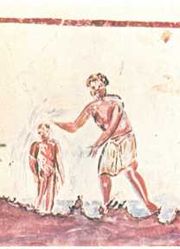
. A short distance away, an arcade dating to the end of the 2nd century gives access to the cubicula of the sacraments, with their frescoes from the first half of the 3rd century hinting at baptism
Baptism
In Christianity, baptism is for the majority the rite of admission , almost invariably with the use of water, into the Christian Church generally and also membership of a particular church tradition...
, the Eucharist and the resurrection of the flesh; in the region of Saint Militiades next door, a child's sarcophagus has a front sculpted with biblical episodes. In the region of Saints Gaius and Eusebius are some crypts set apart, opposite each other, with the tombs of Pope Gaius
Pope Caius
Pope Saint Caius or Gaius was Pope from December 17, 283 to April 22, 296. Christian tradition makes him a native of the Dalmatian city of Salona, today Solin near Split, the son of a man also named Caius, and a member of a noble family related to the Emperor Diocletian.Little information on Caius...
(with an inscription) and Pope Eusebius
Pope Eusebius
Pope Saint Eusebius was pope in the year 309 or 310....
, who died in Sicily where he had been exiled by Maxentius and whose body was translated to Rome during the pontificate of Militiades
Pope Miltiades
Pope Saint Miltiades, also called Melchiades , was pope from 2 July 311 to 10 January 314.- Origins :He appears to have been a Berber African by birth, but of his personal history nothing is known.- Pontificate :...
; on a marble copy of the end of the 4th century (of which fragments may be seen on the opposite wall) may be read of an inscription by Damasus on the schism
Schism (religion)
A schism , from Greek σχίσμα, skhísma , is a division between people, usually belonging to an organization or movement religious denomination. The word is most frequently applied to a break of communion between two sections of Christianity that were previously a single body, or to a division within...
provoked by Heraclius
Heraclius
Heraclius was Byzantine Emperor from 610 to 641.He was responsible for introducing Greek as the empire's official language. His rise to power began in 608, when he and his father, Heraclius the Elder, the exarch of Africa, successfully led a revolt against the unpopular usurper Phocas.Heraclius'...
over the matter of the lapsi
Lapsi (Christian)
Lapsi was the name given to apostates in the early Christian Church, when Christians were persecuted by the Roman authorities to renounce their faith. It also means those who have lapsed or fallen away from their faith and decide later in life to come back to it.-Sacrificati:Those who had actually...
.
Joining onto the arcade itself are, in succession, the crypt of the martyrs Calogerus and Parthenius
Parthenius of Nicaea
Parthenius of Nicaea or Myrlea in Bithynia was a Greek grammarian and poet. According to the Suda, he was the son of Heraclides and Eudora, or according to Hermippus of Berytus, his mother's name was Tetha. He was taken prisoner by Cinna in the Mithridatic Wars and carried to Rome in 72 BC. He...
and the double cubiculum of Severus, which contains a rhythmic inscription (dated to no later than 304) in which a bishop of Rome (at that time Marcellinus
Pope Marcellinus
Pope Saint Marcellinus, according to the Liberian Catalogue, became bishop of Rome on June 30, 296; his predecessor was Pope St CaiusMarcellinus’ pontificate began at a time when Diocletian was Roman Emperor, but had not yet started to persecute the Christians. He left Christianity rather free and...
is first called pope and first openly professes belief in the final resurrection. In a region further from there is the burial of Pope Cornelius
Pope Cornelius
Pope Saint Cornelius was pope from his election on 6 or 13 March 251 to his martyrdom in June 253.- Christian persecution :Emperor Decius, who ruled from 249 to 251 AD, persecuted Christians in the Roman Empire rather sporadically and locally, but starting January in the year 250, he ordered all...
, whose tomb still has its original inscription giving him the title of martyr and, on its sides, splendid paintings with figures in 7th and 8th century Byzantine style
Byzantine architecture
Byzantine architecture is the architecture of the Byzantine Empire. The empire gradually emerged as a distinct artistic and cultural entity from what is today referred to as the Roman Empire after AD 330, when the Roman Emperor Constantine moved the capital of the Roman Empire east from Rome to...
representing popes Sixtus II
Pope Sixtus II
Pope Sixtus II or Pope Saint Sixtus II was Pope from August 30, 257 to August 6, 258. He died as a martyr during the persecution by Emperor Valerian....
and Cornelius and the African bishops Cyprian
Cyprian
Cyprian was bishop of Carthage and an important Early Christian writer, many of whose Latin works are extant. He was born around the beginning of the 3rd century in North Africa, perhaps at Carthage, where he received a classical education...
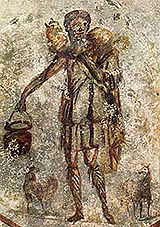
and Ottatus. In a nearby cubiculum are some of the most ancient burials, after AD 175, with Roman frescoes of (on the ceiling) the Good Shepherd
Good Shepherd
Good Shepherd may refer to:In Christianity:* The Good Shepherd , pericope found in John 10:1-21, and a popular image in which the Good Shepherd represents Jesus...
and orantes
Orans
Orans , is a figure with extended arms or bodily attitude of prayer, usually standing, with the elbows close to the sides of the body and with the hands outstretched sideways, palms up....
and (on the far wall) two fish with a basket of loaves behind it, a symbol of the Eucharist.
Catacombs of San Lorenzo
Built into the hill beside San Lorenzo fuori le MuraSan Lorenzo fuori le Mura
The Papal Basilica of Saint Lawrence outside the Walls is a Roman Catholic parish church and minor basilica, located in Rome, Italy. The basilica is one of the Seven Pilgrim Churches of Rome and one of the five Patriarchal basilicas, each of which is assigned to a patriarchate. St...
, these catacombs are said to have been the final resting place of St. Lawrence. The church was built by Pope Sixtus III
Pope Sixtus III
Pope Saint Sixtus III was pope from 31 July 432 to 18 August 440.The name of Sixtus is often connected with a great building boom in Rome: Santa Sabina on the Aventine Hill was dedicated during his pontificate and he built Santa Maria Maggiore, whose dedication to Mary the Mother of God reflected...
and later remodeled into the present nave. Sixtus also redecorated the shrine in the catacomb and was buried there.
Catacombs of San Pancrazio
Established underneath the San Pacrazio basilica which was built by Pope SymmachusPope Symmachus
Saint Symmachus was pope from 498 to 514. His tenure was marked by a serious schism over who was legitimately elected pope by the citizens of Rome....
on the place where the body of the young martyr Saint Pancras, or Pancratius, had been buried. In the 17th century, it was given to the Discalced Carmelites
Discalced Carmelites
The Discalced Carmelites, or Barefoot Carmelites, is a Catholic mendicant order with roots in the eremitic tradition of the Desert Fathers and Mothers...
, who completely remodeled it. The catacombs house fragments of sculpture and pagan and early Christian inscriptions.
Catacombs of San Sebastiano
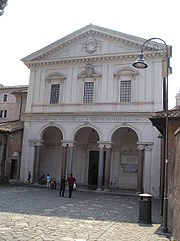
One of the smallest Christian cemeteries, this has always been one of the most accessible catacombs and is thus one of the least preserved (of the four original floors, the first is almost completely gone). On the left hand end of the right hand wall of the nave of the primitive basilica, rebuilt in 1933 on ancient remains, arches to end the middle of the nave of the actual church, built in the 13th century, are visible, along with the outside of the apse of the Chapel of the Relics; whole and fragmentary collected sarcophagi (mostly of 4th century date) were found in excavations.
Via a staircase down, one finds the arcades where varied cubicula (including the cubiculum of Giona's fine four stage cycle of paintings, dating to the end of the 4th century). One then arrives at the restored crypt of S. Sebastiano, with a table altar on the site of the ancient one (some remains of the original's base still survive) and a bust of Saint Sebastian attributed to Bernini
Gian Lorenzo Bernini
Gian Lorenzo Bernini was an Italian artist who worked principally in Rome. He was the leading sculptor of his age and also a prominent architect...
. From here one reaches a platform, under which is a sandstone cavityad catacumbas which once may have been named "ad catacumbas", thus giving this and all other tombs of this type their name. 3 mausolei of the second half of the 2nd century (but also in later use) open off the platform. The first one on the right, decorated on the outside with paintings of funereal banquets and the miracle of the calling out of Cerasa's demons, on the inside contains paintings (including a ceiling painting of a Gorgon's head) and inhumation burials and has a surviving inscription reading "Marcus Clodius Hermes", the name of its owner. The second, called by some "tomb of the Innocentiores" (a burial club which owned it), has a refined stucco ceiling, Latin inscriptions in Greek characters, and a graffito with the initials of the Greek words for "Jesus Christ, Son of God, Saviour
Ichthys
Ichthys, from Koine Greek: , is the Greek word for "fish"....
". On the left is the mausoleum of Ascia, with an exterior wall painting of vine shoots rising from kantharoi
Kantharos
A kantharos or cantharus is a type of Greek pottery used for drinking. It is characterized by its high swung handles which extend above the lip of the pot.The god Dionysus had a kantharos which was never empty....
up trompe-l'œil pillars.
A room called the "Triglia" rises from the platform, roughly in the middle of the basilica and cut into from above by the present basilica. This covered room was used for funereal banquets; the plastered walls have hundreds of graffitoes by the devotees at these banquets, carved in the second half of the 3rd to the beginnings of the 4th century, with appeals to the apostles Peter and Paul. From the "Trigilia" one passed into an ancient ambulatory, which turns around into an apse: here is a collection of epitaphs and a model of all the mausolei, of the "Triglia" and of the Constantinian
Constantine I
Constantine the Great , also known as Constantine I or Saint Constantine, was Roman Emperor from 306 to 337. Well known for being the first Roman emperor to convert to Christianity, Constantine and co-Emperor Licinius issued the Edict of Milan in 313, which proclaimed religious tolerance of all...
basilica. From here one descends into the "Platonica", a construction at the rear of the basilica that was long believed to have been the temporary resting place
Cemetery
A cemetery is a place in which dead bodies and cremated remains are buried. The term "cemetery" implies that the land is specifically designated as a burying ground. Cemeteries in the Western world are where the final ceremonies of death are observed...
for Peter and Paul, but was in fact (as proved by excavation) a tomb for the martyr Quirinus, bishop of Sescia in Pannonia
Pannonia
Pannonia was an ancient province of the Roman Empire bounded north and east by the Danube, coterminous westward with Noricum and upper Italy, and southward with Dalmatia and upper Moesia....
, whose remains were brought here in the 5th century. To the right of the "Platonica" is the chapel of Honorius III
Pope Honorius III
Pope Honorius III , previously known as Cencio Savelli, was Pope from 1216 to 1227.-Early work:He was born in Rome as son of Aimerico...
, adapted as the vestibule of the mausoleum, with interesting 13th century paintings of Peter and Paul, the Crucifixion, saints, the Massacre of the Innocents
Massacre of the Innocents
The Massacre of the Innocents is an episode of infanticide by the King of Judea, Herod the Great. According to the Gospel of Matthew Herod orders the execution of all young male children in the village of Bethlehem, so as to avoid the loss of his throne to a newborn King of the Jews whose birth...
, Madonna and Child
Madonna (art)
Images of the Madonna and the Madonna and Child or Virgin and Child are pictorial or sculptured representations of Mary, Mother of Jesus, either alone, or more frequently, with the infant Jesus. These images are central icons of Roman Catholicism and Eastern Orthodox Christianity where Mary remains...
, and other subjects. On the left is an apsidal mausoleum with an altar built against the apse: on the left wall a surviving graffito reading "domus Petri" either hints at Peter having been buried here or testifies to the belief at the time the graffito was written that Peter was buried here.
Catacombs of San Valentino
These catacombs were dedicated to Saint ValentineSaint Valentine
Saint Valentine is the name of several martyred saints of ancient Rome. The name "Valentine", derived from valens , was popular in Late Antiquity...
. In the 13th century, the martyr's relics were transferred to Basilica of Saint Praxedes
Santa Prassede
The Basilica of Saint Praxedes , commonly known in Italian as Santa Prassede, is an ancient titular church and minor basilica in Rome, Italy, located near the papal basilica of Saint Mary Major...
.
Catacombs of Sant'Agnese
Built for the conservation and veneration of the remains of Saint Agnes of Rome. Agnes' bones are now conserved in the church of Sant'Agnese fuori le muraSant'Agnese fuori le mura
The church of Saint Agnes Outside the Wall is a titulus church, minor basilica in Rome, on a site sloping down from the Via Nomentana, which runs north-east out of the city, still under its ancient name. What is said to be the remains of Saint Agnes's are below the high altar...
in Rome, built over the catacomb. Her skull is preserved in a side chapel in the church of Sant'Agnese in Agone
Sant'Agnese in Agone
Sant'Agnese in Agone is a seventeenth century Baroque church in Rome, Italy. It faces onto the Piazza Navona, one of the main urban spaces in the historic centre of the city and the site where the Early Christian Saint Agnes was martyred in the ancient Stadium of Domitian.The rebuilding of the...
in Rome's Piazza Navona
Piazza Navona
Piazza Navona is a city square in Rome, Italy. It is built on the site of the Stadium of Domitian, built in 1st century AD, and follows the form of the open space of the stadium. The ancient Romans came there to watch the agones , and hence it was known as 'Circus Agonalis'...
.
Catacombs of via Anapo
On the via SalariaVia Salaria
The Via Salaria was an ancient Roman road in Italy.It eventually ran from Rome to Castrum Truentinum on the Adriatic coast - a distance of 242 km. The road also passed through Reate and Asculum...
, the Catacombs of via Anapo are datable to the end of the 3rd or the beginning of the 4th century, and contain diverse frescoes of biblical subjects.
Jewish catacombs
There are 6 known Jewish catacombs in Rome, two of which are open to the public: Vigna Randanini and Villa TorloniaVilla Torlonia
Villa Torlonia is the name applied to several country retreats of the Torlonia princely family in the outskirts of the city of Rome, in Frascati, Lazio, including:*Villa Torlonia *Villa Torlonia, San Mauro Pascoli*in Rome:...
.
The Jewish catacombs were discovered in 1918, and archaeological excavations
Archaeology
Archaeology, or archeology , is the study of human society, primarily through the recovery and analysis of the material culture and environmental data that they have left behind, which includes artifacts, architecture, biofacts and cultural landscapes...
continued for twelve years. The structure has two entrances, one on via Syracuse and the other inside Villa Torlonia
Villa Torlonia (Rome)
Villa Torlonia is a villa and surrounding gardens in Rome, Italy, formerly belonging to the Torlonia family. It is entered from via Nomentana....
. The catacombs extend for more than 13000 square metres (139,930.8 sq ft), and date back to the period between the 2nd and 3rd centuries, and possibly remained in use until the 5th century. There are almost a century of epitaphs, but these do not show any examples of a particular relief, beyond some rare frescoes showing the classic Jewish religious symbols.
The other catacombs are not open to the public because of the instability of their structure and the presence of radon
Radon
Radon is a chemical element with symbol Rn and atomic number 86. It is a radioactive, colorless, odorless, tasteless noble gas, occurring naturally as the decay product of uranium or thorium. Its most stable isotope, 222Rn, has a half-life of 3.8 days...
.
See also
- Antonio BosioAntonio BosioAntonio Bosio was an Italian scholar, the first systematic explorer of subterranean Rome , author of Roma Sotterranea and first urban spelunker.-Biography:Bosio was born in Malta....
, (c. 1575-1576–1629) was an Italian scholar, the first systematic explorer of subterranean Rome
External links
- About the Saint Sebastian Catacombs
- About the Saint Callistus Catacombs
- Catacombe Roma
- Rodolpho Lanciani, Pagan and Christian Rome 1892, Chapter VII: Christian Cemeteries
- UrbanAdventure.org with some short videos taken in the catacombs or Rome
- Rome Catacombs
- The Catacombs of St Callixtus
- The Catacombs
- Culte des reliques à l'époque moderne