

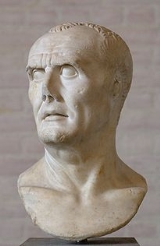
Gaius Marius

Encyclopedia
Gaius Marius was a Roman
general
and statesman
. He was elected consul
an unprecedented seven times during his career. He was also noted for his dramatic reforms
of Roman armies
, authorizing recruitment of landless citizens, eliminating the manipular military formations, and reorganizing the structure of the legions into separate cohorts
. Marius defeated the invading Germanic tribes, for which he was called "the third founder of Rome." His life and career were significant in Rome's transformation from Republic
to Empire
.
. The town had been conquered by the Romans in the late 4th century BC and was given Roman citizenship
without voting rights. Only in 188 BC did the town receive full citizenship. Although Plutarch
claims that Marius' father was a laborer, this is almost certainly false since Marius had connections with the nobility in Rome, he ran for local office in Arpinum, and he had marriage relations with the local nobility in Arpinum, which all combine to indicate that he was born into a locally important family of equestrian
status. The problems he faced in his early career in Rome show the difficulties that faced a "new man" (novus homo
).
There is a legend that Marius, as a teenager, found an eagle
's nest with seven chicks in it – eagle clutch
es hardly ever have more than 3 eggs; even if two females used the same nest, finding 7 offspring in a single nest would be exceptionally rare. Since eagles were considered sacred animals of Jupiter, the supreme god of the Romans, it was later seen as an omen
predicting his election to the consulship seven times. Later, as consul, he decreed that the eagle
would be the symbol of the Senate and People of Rome
.
In 134 BC, he was serving with the army at Numantia
and his good services brought him to the attention of Publius Cornelius Scipio Aemilianus Africanus. Whether he arrived with Scipio Aemilianus or was already serving in the demoralized army that Scipio Aemilianus took over at Numantia is not clear. According to Plutarch
, in a supper with Scipio Aemilianus, Marius asked the last where the Roman people would find any such chieftain and leader to follow, and Aemilianus gently tapped on Marius' shoulder, saying: "Here, perhaps". It would seem that even at this early stage in his army career, Marius had ambitions for a political career in Rome. He ran for election as one of the twenty-four special military tribune
s of the first four legions who were elected (the rest were appointed by the magistrate who raised the legion). Sallust
tells us that he was unknown by sight to the electors but was returned by all the tribes on the basis of his accomplishments.
Next, he ran for the quaestor
ship after losing an election for local office in Arpinum. The military tribunate shows that he was already interested in Roman politics before the quaestorship. Perhaps he simply ran for local office as a means of gaining support back home, and lost to some other local worthy. Nothing is known of his actions while quaestor.
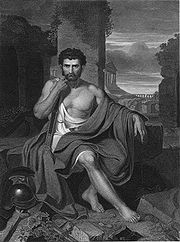 In 120 BC, Marius was returned as plebian tribune for the following year. He won with the support of Quintus Caecilius Metellus
(later known as Metellus Numidicus), who was an inherited patronus. The Metelli, though neither ancient nor patrician, were one of the most powerful families in Rome at this time. During his tribunate, Marius pursued a populares
line. He passed a law that restricted the interference of the wealthy in elections. In the 130s voting by ballot had been introduced in elections for choosing magistrates, passing laws and deciding legal cases, replacing the earlier system of oral voting. The wealthy continued to try to influence the voting by inspecting ballots and Marius passed a law narrowing the passages down which voters passed to cast their votes in order to prevent outsiders from harassing the electors. In the passage of this law, Marius alienated the Metelli, who opposed it.
Soon thereafter, Marius ran for the aedile
ship and lost. This loss was at least in part due to the enmity of the Metelli. In 116 BC he barely won election as praetor
for the following year (presumably coming in sixth) and was promptly accused of ambitus
(electoral corruption). He barely won acquittal on this charge, and spent an uneventful year as praetor in Rome (as Urban Praetor, Peregrine Praetor or President of the extortion court). In 114 BC, Marius' imperium
was prorogued
and he was sent to govern Lusitania
, where he engaged in some sort of minor military operation. During this period in Roman history governors seem regularly to have served two years in Hispania
, so he was probably replaced in 113 BC.
He received no triumph
on his return and did not apparently run for the consul
ship, but he did marry Julia, the aunt of Julius Caesar
. The Julii Caesares were a patrician family, but at this period seem to have found it hard to advance above the praetorship. (Only once in the 2nd century – in 157 BC – did a member of the family become consul.) To judge by this marriage, Marius had apparently achieved some substantial political or financial influence by this point (possibly from his governship in Hispania).
of the Caecilii Metelli and a Caecilius Metellus had aided Marius' campaign for the tribunate. Although he seems to have had a break with the Metelli as a result of the laws he passed while tribune, the rupture was not permanent, since in 109 BC Quintus Caecilius Metellus
took Marius with him as his legate
on his campaign against Jugurtha
. Legates (legati) were originally simply envoys sent by the Senate
, but men appointed as legates by the Senate were used by generals as subordinate commanders, usually becoming the general's most trusted lieutenant. Hence, Metellus had to have asked the Senate to appoint Marius as legate to allow him to serve as Metellus' subordinate. In Sallust
's long account of Metellus' campaign no other legates are mentioned, so it is assumed that Marius was Metellus's senior subordinate and right-hand man. Thus Metellus was using Marius' military experience, while Marius was strengthening his position to run for the consulship. The rupture in 119 BC may have been exaggerated after the fact in light of his later and much more serious disagreement with Metellus about Numidia
.
. Despite lack of approval from Metellus (brought on by Marius' status as a novus homo) who instead advised Marius to wait and run with Metellus' son
(who was only twenty, which would signify a campaign 20 years in the future) Marius began to campaign for the consulship. Sallust
claims that this was catalyzed, in part, by a fortune-teller who "told him that great and wonderful things were presaged to him that he might therefore pursue whatever designs he had formed trusting to the gods for success, and that he might try fortune as often as he pleased for that all his undertakings would prosper." Marius soon earned the respect of the troops by his conduct towards them, eating his meals with them and proving he was not afraid to share in any of their labours. He also won over the Italian traders by claiming that he could capture Jugurtha
in a few days with half Metellus' troops. Both groups wrote home in praise of him, suggesting that he could end the war quickly unlike Metellus, who was pursuing a policy of methodically subduing the countryside. Eventually Metellus gave in, realizing that it was counterproductive to have a resentful subordinate.
Under these circumstances, Marius was triumphantly elected consul later that year, for 107 BC. He was campaigning against Metellus's apparent lack of swift action against Jugurtha. Because of the repeated military debacles from 113 BC to 109 BC and the accusations that the oligarchy was open to flagrant bribery, it became easier for the virtuous new man who had worked with difficulty up the ladder of offices to be elected as an alternative to the inept or corrupt nobility. The Senate had a trick up its sleeve, however. In accordance with the provisions of the Lex Sempronia on Consular provinces
, which dictated that the Senate in a given year was to determine the Consular provinces for the next year at the end of year before the elections, the Senate decided not to make the war against Jugurtha one of the provinces and to prorogue Metellus in Numidia. Marius got around this through a ploy that had been used in 131 BC. In that year there was a dispute as to who should command the war against Aristonicus
in Asia, and a tribune had passed a law authorizing an election to select the commander (there was precedent for this procedure from the Second Punic War
). A similar law was passed in 108 BC and Marius was voted the command by the People in this special election. Metellus shed bitter tears when he learned of the decision. Upon returning home, he avoided meeting Marius, and was granted a Triumph and the agnomen
Numidicus (conqueror of Numidia).
invasion, saw the dire need for an increase in troop numbers. Until this time, the standard requirements to become a Roman soldier were very strict. To be considered a soldier in the service of the republic, an individual had to be a member of the 5th Census Class
or higher and own property worth over 3000 sesterces in value. Furthermore, soldiers were required to provide their own arms and uniform for combat. Marius relaxed the recruitment policies by removing the necessity to own land, and allowed all Roman citizens entry, regardless of social class (Plutarch, The Life of Marius). The benefits to the army were numerous, with the disenfranchised, unemployed masses enlisting for military service alongside the more fortunate citizens. Poorer citizens were drawn to life-long service, as they were rewarded with the prospect of settlement in conquered land. This also 'Romanized' the population in newly subjugated provinces, thus reducing unrest and lowering the chance of revolt against the Roman Republic. The new Roman army, its numbers vastly bolstered by lower class citizens whose future was tied to their permanent career, was always able to provide reserves in times of disaster. In addition, the growth of the army ensured continued military success due to the high number of fresh soldiers available for each campaign. Even though the army increased in size considerably, Marius also sought to improve organization among his troops.
Marius needed more troops, and to this effect he made a change in procedure used for recruiting troops, probably unaware of the momentous implications of this change. All of the Gracchi
an agrarian reforms had been premised on the traditional Roman levy, which excluded from service those whose property qualification fell below the minimum property qualification for the fifth census class. The Gracchi
had tried to restore the smallholders who would constitute the majority of those qualified to serve. The end of the Gracchan land legislation did nothing to change the military crisis that gave rise to that legislation. It seems that the minimum qualification for the fifth census class (the lowest one eligible for military service) was lowered from 11,000 to 3000 sesterces
of property, and already in 109 BC the consuls had had to seek suspension of Gaius Gracchus
' restrictions on the levy. In 107 BC Marius decided to ignore the census qualification altogether and recruited with no inquiry into the property of the potential soldier. From now on Rome's legions would largely consist of poor citizens (the "capite censi
" or "head count") whose future after service could only be assured if their general could somehow bring about a land distribution on their behalf. Thus the soldiers had a very strong personal interest in supporting their general against the Senate (i.e., the oligarchy) and the "public interest" that was often equated with the Senate. Marius did not avail himself of this potential source of support, but in less than two decades Marius' ex-quaestor Sulla
would use it against the Senate and Marius.
to the south and west toward Mauretania
. Marius' quaestor in 107 BC had been Lucius Cornelius Sulla Felix, the son of a patrician family that had fallen on hard times. Marius was supposedly unhappy at receiving the dissolute youth as his subordinate, but Sulla proved a competent military leader. By 105 the king of Mauretania, Bocchus
, who was also Jugurtha's father-in-law and reluctant ally, was worried about the approaching Romans. After receiving word that an accommodation with them was possible, Bocchus insisted that Sulla make the hazardous journey to his capital, where Sulla induced Bocchus to betray Jugurtha, who was duly handed over to Sulla, thus ending the war. Since Marius held the imperium and Sulla was acting as his subordinate, the honor of capturing Jugurtha belonged strictly to Marius, but Sulla had clearly been immediately responsible and had a signet ring made for himself commemorating the event. Sulla would later claim that the credit for ending the war was his. Meanwhile, Marius was the hero of the hour, and his services would be needed in another emergency.
in Gaul
in 109 BC and their complete defeat of Marcus Junius Silanus had resulted in unrest among the Celt
ic tribes recently conquered by the Romans in southern Gaul. In 107 the consul Lucius Cassius Longinus
was completely defeated by the Tigurini
clan, and the senior surviving officer (Gaius Popillius Laenas, son of the consul of 132) had saved what was left only by surrendering half the baggage and suffering the humiliation of having his army "march under the yoke." The next year (106 BC) another consul, Quintus Servilius Caepio
, marched to Gaul and captured the disloyal community of Tolosa (Toulouse
), where a huge sum of money (the Gold of Tolosa), was taken from shrines. The larger part of it mysteriously vanished when being transported to Massilia (Marseille
). Caepio was prorogued into the next year, when one of the new consuls, Gnaeus Mallius Maximus
, also operated in southern Gaul. Mallius was a new man like Marius, and he and the noble Caepio found it impossible to co-operate.
The Cimbri and the Teutones (both migrating Germanic tribes) appeared on the Rhône
, and while Caepio was on the west bank he refused to come to the aid of Mallius on the left. Eventually the Senate got Caepio's reluctant agreement to co-operate, but even when he crossed the river to help the threatened Mallius, he refused to join forces and kept his own at a fair distance. First the Germans routed Caepio and then destroyed Mallius's army on October 6, 105 BC at Arausio
. Since the Romans fought with the river at their back, flight was not possible and reportedly 80,000 were killed. The losses in the preceding decade had been bad enough, but this defeat, apparently caused by the arrogance of the nobility and its refusal to co-operate with talented non-nobles, was the last straw. Not only had huge numbers of Romans lost their lives but Italy itself was now exposed to invasion from barbarian hordes. The failure to deal with this threat marked the start of a period when dissatisfaction with the oligarchy (and thus, conflict between the optimates and the populares) was becoming increasingly, and dangerously, bitter. Sometime during this war Marius participated in the Trial of Trebonius
.
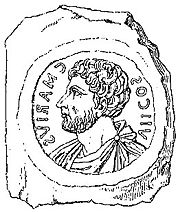 In late 105 BC Marius was elected consul again while still in Africa. Election in absentia was unusual enough, but at some time after 152 BC a law had been passed dictating a ten-year interval between consulships, and there is even some evidence to indicate that by 135 BC a law had been passed that prohibited second consulships altogether. Nonetheless by this time news of a new advancing tribe known as the Cimbri
had reached Rome and in the emergency Marius was again chosen consul. The law was either repealed or set aside under the circumstances of emergency, as Marius was then elected to an unprecedented five successive consulships (104 BC–100 BC). He returned to Rome by January 1, 104 BC, when he celebrated his triumph over Jugurtha, who was first led in the procession, then killed in the public prison.
The Cimbri conveniently marched into Hispania and the Teutoni milled around in northern Gaul, leaving Marius to prepare his army. One of his legates was his old quaestor, Sulla, which shows that at this time there was no ill-will between them. In 104 BC, Marius was returned as consul again for 103 BC. Though he could have continued to operate as proconsul
, it seems that the position as consul would make his position as commander unassailable and avoid any problems with the consuls if he was only a proconsul. Marius seems to have been able to get exactly what he wanted, and it even seems that his support determined whom the people would elect as his colleagues (his choice was apparently determined, on several occasions, on the basis of their malleability: only Catulus in 102 BC, and Flaccus in 100 BC, would have been serious candidates in their own right without his support, and even Flaccus was described as more servant than partner in the office.) In 103 BC, the Germans still did not emerge from Hispania, and conveniently Marius's colleague (L. Aurelius Orestes, son of C. Gracchus's commander in Sardinia
in 126 BC–124 BC) died, so Marius had to return to Rome to oversee the elections, being re-elected for 102 BC.
; and the Tigurini
(the allied Celtic tribe who had defeated Longinus in 107) were to cross the Alps from the northeast. This decision proved fatally flawed. The Germanic soldiers divided their forces, making each contingent manageable, and the Romans could use their shorter lines of communication and supply to concentrate their forces at will.
First, Marius had to deal with the Teutones, who were in the province of Narbonensis
marching toward the Alps. He refused to give them a battle where they wanted, and withdrew to Aquae Sextiae (a settlement founded by Gaius Sextius Calvinus in 124 BC), which blocked their path. The leading contingent of the Germanic warriors, the Ambrones
, foolishly attacked
the Roman position without waiting for reinforcements and 30,000 were killed. Marius then hid 3,000 troops in ambush, so when the main Germanic contingent finally attacked, the hidden Roman troops could fall on them from behind. In the ensuing defeat, the Teutones were completely annihilated, to the number of something over 100,000.
Marius's colleague Quintus Lutatius Catulus
in 102 BC did not have as much luck. He botched the holding of the Brenner Pass
, allowing the Cimbri to advance into northern Italy by late 102 BC. Marius was in Rome, and after becoming elected consul for 101 BC and deferring his Triumph
over the Teutones, he marched north to join Catulus, whose command was prorogued into 101. Finally, in the summer of that year a battle was fought at Vercellae in Cisalpine Gaul. Once again, Roman discipline overcame a larger barbarian force. At least 65,000 were killed (perhaps as many as 100,000 again) and all the remainder enslaved. The Tigurini gave up their efforts to enter Italy from the northeast and went home. Catulus and Marius celebrated a joint Triumph, but in popular thinking all the credit went to Marius, who was praised as "the third founder of Rome." Catulus became alienated from Marius and would later become one of his chief opponents. As a sort of reward (the danger was now gone) Marius was returned as consul for 100 BC. This year would not go at all well for Marius.
was tribune for the second time (having apparently had Marius's support on both this occasion and the previous one), and advocated reforms like those earlier put forth by the Gracchi
. He pushed for a bill that gave colonial lands to the veterans of the recent war and offered to lower the price of wheat distributed by the state. The Senate, however, opposed these measures and violence broke out. The Senate then ordered Marius, as consul, to put down the revolt. Marius, although he was generally allied with the radicals, complied with the request and put down the revolt in the interest of public order. He then went to the east and into retirement.
What is important in this incident is that instead of seizing the opportunity to establish himself as supreme ruler and reformer of the state, Marius showed the senate, who had always been suspicious of his motives, that he was one of them instead of the outsider that Quintus Metellus said he was in 108 BC. Marius' overall concern, for his part, was how to maintain the Senate's esteem.
was elected tribune and proposed a greater division of state lands, the enlargement of the Senate, and a conferral of Roman citizenship upon all freemen of Italy. But Drusus was assassinated, and many of the Italian states then revolted against Rome in the Social War of 91–88 BC. Marius took command (following the deaths of the consul, Publius Rutilius Lupus, and the praetor Quintus Servilius Caepio) and fought along with Sulla against the rebel cities, but retired from the war in its early stages – probably due to poor health (it has been suggested that he suffered a stroke.)
of Pontus
began his bid to conquer Rome's eastern provinces and invaded Greece. In 88 BC, Lucius Cornelius Sulla
was elected consul. The choice before the Senate was to put either Marius or Sulla in command of an army which would aid Rome's Greek allies and defeat Mithridates. The Senate chose Sulla, but soon the Assembly appointed Marius. In this unsavory episode of low politics, he was helped by the unscrupulous actions of Publius Sulpicius Rufus
, whose debts Marius had promised to erase. Sulla refused to acknowledge the validity of the Assembly's action.
Sulla left Rome and traveled to the army waiting in Nola, the army the Senate had asked him to lead against Mithridates. Sulla urged his legions to defy the Assembly's orders and accept him as their rightful leader. Sulla was successful and the legions stoned the representatives from the Assembly. Sulla then commanded six legions to march with him to Rome
and institute a civil war
. This was a momentous event, and was unforeseen by Marius, as no Roman army had ever marched upon Rome—it was forbidden by law and ancient tradition.
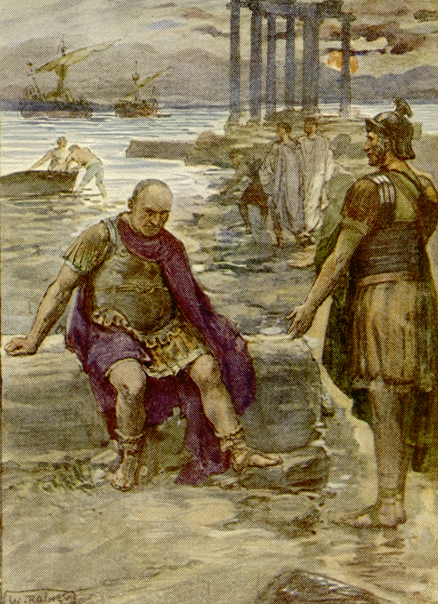 Once it became obvious that Sulla was going to defy the law and seize Rome by force, Marius attempted to organize a defense of the city using gladiators. Unsurprisingly Marius' ad-hoc force was no match for Sulla's legions. Marius was defeated and fled Rome. Marius narrowly escaped capture and death on several occasions and eventually found safety in Africa. Sulla and his supporters in the Senate passed a death sentence on Marius, Sulpicius and a few other allies of Marius. A few men were executed but (according to Plutarch), many Romans disapproved of Sulla's actions; some who opposed Sulla were actually elected to office in 87 BC. (Gnaeus Octavius
, a supporter of Sulla, and Lucius Cornelius Cinna
, a supporter of Marius, were elected consul). Regardless, Sulla was confirmed again as the commander of the campaign against Mithridates
, so he took his legions out of Rome and marched east to the war.
Some of the soldiers went through Rome killing the leading supporters of Sulla, including Octavius. Their heads were exhibited in the Forum. All told some dozen Roman nobles had been murdered. The Senate passed a law exiling Sulla, and Marius was appointed the new commander in the eastern war. Cinna was chosen for his third consulship and Marius to his seventh consulship. After five days, Cinna and the populares
general Quintus Sertorius
ordered their more disciplined troops to kill the rampaging soldiers.
Marius died just one month after his return to Rome.
was elected to two more consulships afterwards and then died during a mutiny when trying to lead his forces into Greece. The forces of Sulla returned to Italy at Brundisium in 83 BC in another civil war
, and Gaius Marius the Younger
died defending Praeneste, a city east of Rome. Upon his return to Rome, Sulla instituted a new reign of terror that dwarfed everything that came before. Thousands, including Senators, Knights, and other Roman nobles who had supported Marius in any way, were outlawed and executed. Julius Caesar
, a nephew of the wife of Marius the Elder and married to the younger daughter of Cinna, was one of the many who were outlawed. Caesar was to divorce his wife – or to be killed. The young Caesar refused to divorce his wife but several of Sulla's council and friends entreated that he let the young Caesar live. Sulla's wrath was spared on the young Caesar, but Sulla remarked: "...in this youth are many a Marius...". A great-nephew of Julius Caesar – the first emperor Augustus
– was also a descendant of Gnaeus Octavius
. The second wife of Caesar was Sulla's granddaughter. A descendant of Sulla married a daughter of Emperor Claudius
, a great nephew of Augustus.
Marius was a successful Roman general
and military reformer. His improvements to the structure and organization of the Roman legion
were profound and effective. However he was, in part, responsible for the breakdown in relations with Sulla which led to Sulla's march on Rome. He himself had broken with tradition on previous occasions and his effort to reverse the Senate's appointment of Sulla as commander of the Mithridatic War was highly questionable under Roman constitutional tradition. The five days of terror upon his return to Rome saw many hundreds slaughtered in his name.
The Marian reforms to the legions, recruiting among un-propertied urban citizens, were one of the steps leading to the eventual collapse of the Republic. Marius set the precedent of recruiting among the poor and then granting these veterans land upon the conclusion of the campaign. Thus the legions became more loyal to their generals rather than the state. The loyalty of such legions is what allowed Marius himself, Sulla, and eventually Julius Caesar
to march on Rome.
The struggle between Marius and Sulla led to the deaths of numerous distinguished Roman senators
, equestrians and unknown thousands of Roman soldiers and citizens. It set a precedent for the civil wars to come that led ultimately to the destruction of the Republican form of government and thus to the establishment of the principate
system of the Empire
.
, is largely focused upon the rise of Gaius Marius and his subsequent lengthy career.
The historical novel Emperor:The Gates of Rome, by Conn Iggulden, largely based on the rise of Gaius Julius Caesar.
Roman Republic
The Roman Republic was the period of the ancient Roman civilization where the government operated as a republic. It began with the overthrow of the Roman monarchy, traditionally dated around 508 BC, and its replacement by a government headed by two consuls, elected annually by the citizens and...
general
General
A general officer is an officer of high military rank, usually in the army, and in some nations, the air force. The term is widely used by many nations of the world, and when a country uses a different term, there is an equivalent title given....
and statesman
Statesman
A statesman is usually a politician or other notable public figure who has had a long and respected career in politics or government at the national and international level. As a term of respect, it is usually left to supporters or commentators to use the term...
. He was elected consul
Consul
Consul was the highest elected office of the Roman Republic and an appointive office under the Empire. The title was also used in other city states and also revived in modern states, notably in the First French Republic...
an unprecedented seven times during his career. He was also noted for his dramatic reforms
Marian reforms
The Marian reforms of 107 BC were a group of military reforms initiated by Gaius Marius, a statesman and general of the Roman republic.- Roman army before the Marian reforms :...
of Roman armies
Roman legion
A Roman legion normally indicates the basic ancient Roman army unit recruited specifically from Roman citizens. The organization of legions varied greatly over time but they were typically composed of perhaps 5,000 soldiers, divided into maniples and later into "cohorts"...
, authorizing recruitment of landless citizens, eliminating the manipular military formations, and reorganizing the structure of the legions into separate cohorts
Cohort (military unit)
A cohort was the basic tactical unit of a Roman legion following the reforms of Gaius Marius in 107 BC.-Legionary cohort:...
. Marius defeated the invading Germanic tribes, for which he was called "the third founder of Rome." His life and career were significant in Rome's transformation from Republic
Roman Republic
The Roman Republic was the period of the ancient Roman civilization where the government operated as a republic. It began with the overthrow of the Roman monarchy, traditionally dated around 508 BC, and its replacement by a government headed by two consuls, elected annually by the citizens and...
to Empire
Roman Empire
The Roman Empire was the post-Republican period of the ancient Roman civilization, characterised by an autocratic form of government and large territorial holdings in Europe and around the Mediterranean....
.
Early career
Marius was born in 157 BC in the town of Arpinum in southern LatiumLatium
Lazio is one of the 20 administrative regions of Italy, situated in the central peninsular section of the country. With about 5.7 million residents and a GDP of more than 170 billion euros, Lazio is the third most populated and the second richest region of Italy...
. The town had been conquered by the Romans in the late 4th century BC and was given Roman citizenship
Roman citizenship
Citizenship in ancient Rome was a privileged political and legal status afforded to certain free-born individuals with respect to laws, property, and governance....
without voting rights. Only in 188 BC did the town receive full citizenship. Although Plutarch
Plutarch
Plutarch then named, on his becoming a Roman citizen, Lucius Mestrius Plutarchus , c. 46 – 120 AD, was a Greek historian, biographer, essayist, and Middle Platonist known primarily for his Parallel Lives and Moralia...
claims that Marius' father was a laborer, this is almost certainly false since Marius had connections with the nobility in Rome, he ran for local office in Arpinum, and he had marriage relations with the local nobility in Arpinum, which all combine to indicate that he was born into a locally important family of equestrian
Equestrian (Roman)
The Roman equestrian order constituted the lower of the two aristocratic classes of ancient Rome, ranking below the patricians , a hereditary caste that monopolised political power during the regal era and during the early Republic . A member of the equestrian order was known as an eques...
status. The problems he faced in his early career in Rome show the difficulties that faced a "new man" (novus homo
Novus homo
Homo novus was the term in ancient Rome for a man who was the first in his family to serve in the Roman Senate or, more specifically, to be elected as consul...
).
There is a legend that Marius, as a teenager, found an eagle
Eagle
Eagles are members of the bird family Accipitridae, and belong to several genera which are not necessarily closely related to each other. Most of the more than 60 species occur in Eurasia and Africa. Outside this area, just two species can be found in the United States and Canada, nine more in...
's nest with seven chicks in it – eagle clutch
Clutch (eggs)
A clutch of eggs refers to all the eggs produced by birds or reptiles, often at a single time, particularly those laid in a nest.In birds, destruction of a clutch by predators, , results in double-clutching...
es hardly ever have more than 3 eggs; even if two females used the same nest, finding 7 offspring in a single nest would be exceptionally rare. Since eagles were considered sacred animals of Jupiter, the supreme god of the Romans, it was later seen as an omen
Omen
An omen is a phenomenon that is believed to foretell the future, often signifying the advent of change...
predicting his election to the consulship seven times. Later, as consul, he decreed that the eagle
Eagle (heraldry)
The eagle is used in heraldry as a charge, as a supporter, and as a crest. Parts of the eagle's body such as its head, wings or leg are also used as a charge or crest....
would be the symbol of the Senate and People of Rome
SPQR
SPQR is an initialism from a Latin phrase, Senatus Populusque Romanus , referring to the government of the ancient Roman Republic, and used as an official emblem of the modern day comune of Rome...
.
In 134 BC, he was serving with the army at Numantia
Numantia
Numantia is the name of an ancient Celtiberian settlement, whose remains are located 7 km north of the city of Soria, on a hill known as Cerro de la Muela in the municipality of Garray....
and his good services brought him to the attention of Publius Cornelius Scipio Aemilianus Africanus. Whether he arrived with Scipio Aemilianus or was already serving in the demoralized army that Scipio Aemilianus took over at Numantia is not clear. According to Plutarch
Plutarch
Plutarch then named, on his becoming a Roman citizen, Lucius Mestrius Plutarchus , c. 46 – 120 AD, was a Greek historian, biographer, essayist, and Middle Platonist known primarily for his Parallel Lives and Moralia...
, in a supper with Scipio Aemilianus, Marius asked the last where the Roman people would find any such chieftain and leader to follow, and Aemilianus gently tapped on Marius' shoulder, saying: "Here, perhaps". It would seem that even at this early stage in his army career, Marius had ambitions for a political career in Rome. He ran for election as one of the twenty-four special military tribune
Military tribune
A military tribune was an officer of the Roman army who ranked below the legate and above the centurion...
s of the first four legions who were elected (the rest were appointed by the magistrate who raised the legion). Sallust
Sallust
Gaius Sallustius Crispus, generally known simply as Sallust , a Roman historian, belonged to a well-known plebeian family, and was born at Amiternum in the country of the Sabines...
tells us that he was unknown by sight to the electors but was returned by all the tribes on the basis of his accomplishments.
Next, he ran for the quaestor
Quaestor
A Quaestor was a type of public official in the "Cursus honorum" system who supervised financial affairs. In the Roman Republic a quaestor was an elected official whereas, with the autocratic government of the Roman Empire, quaestors were simply appointed....
ship after losing an election for local office in Arpinum. The military tribunate shows that he was already interested in Roman politics before the quaestorship. Perhaps he simply ran for local office as a means of gaining support back home, and lost to some other local worthy. Nothing is known of his actions while quaestor.
Quintus Caecilius Metellus Numidicus
Quintus Caecilius Metellus Numidicus was the leader of the conservative faction of the Roman Senate and a bitter enemy of Gaius Marius....
(later known as Metellus Numidicus), who was an inherited patronus. The Metelli, though neither ancient nor patrician, were one of the most powerful families in Rome at this time. During his tribunate, Marius pursued a populares
Populares
Populares were aristocratic leaders in the late Roman Republic who relied on the people's assemblies and tribunate to acquire political power. They are regarded in modern scholarship as in opposition to the optimates, who are identified with the conservative interests of a senatorial elite...
line. He passed a law that restricted the interference of the wealthy in elections. In the 130s voting by ballot had been introduced in elections for choosing magistrates, passing laws and deciding legal cases, replacing the earlier system of oral voting. The wealthy continued to try to influence the voting by inspecting ballots and Marius passed a law narrowing the passages down which voters passed to cast their votes in order to prevent outsiders from harassing the electors. In the passage of this law, Marius alienated the Metelli, who opposed it.
Soon thereafter, Marius ran for the aedile
Aedile
Aedile was an office of the Roman Republic. Based in Rome, the aediles were responsible for maintenance of public buildings and regulation of public festivals. They also had powers to enforce public order. There were two pairs of aediles. Two aediles were from the ranks of plebeians and the other...
ship and lost. This loss was at least in part due to the enmity of the Metelli. In 116 BC he barely won election as praetor
Praetor
Praetor was a title granted by the government of Ancient Rome to men acting in one of two official capacities: the commander of an army, usually in the field, or the named commander before mustering the army; and an elected magistratus assigned varied duties...
for the following year (presumably coming in sixth) and was promptly accused of ambitus
Ambitus
In ancient Roman law, ambitus was a crime of political corruption, mainly a candidate's attempt to influence the outcome of an election through bribery or other forms of soft power...
(electoral corruption). He barely won acquittal on this charge, and spent an uneventful year as praetor in Rome (as Urban Praetor, Peregrine Praetor or President of the extortion court). In 114 BC, Marius' imperium
Imperium
Imperium is a Latin word which, in a broad sense, translates roughly as 'power to command'. In ancient Rome, different kinds of power or authority were distinguished by different terms. Imperium, referred to the sovereignty of the state over the individual...
was prorogued
Prorogatio
In the constitution of ancient Rome, prorogatio was the extension of a commander's imperium beyond the one-year term of his magistracy, usually that of consul or praetor...
and he was sent to govern Lusitania
Lusitania
Lusitania or Hispania Lusitania was an ancient Roman province including approximately all of modern Portugal south of the Douro river and part of modern Spain . It was named after the Lusitani or Lusitanian people...
, where he engaged in some sort of minor military operation. During this period in Roman history governors seem regularly to have served two years in Hispania
Hispania
Another theory holds that the name derives from Ezpanna, the Basque word for "border" or "edge", thus meaning the farthest area or place. Isidore of Sevilla considered Hispania derived from Hispalis....
, so he was probably replaced in 113 BC.
He received no triumph
Roman triumph
The Roman triumph was a civil ceremony and religious rite of ancient Rome, held to publicly celebrate and sanctify the military achievement of an army commander who had won great military successes, or originally and traditionally, one who had successfully completed a foreign war. In Republican...
on his return and did not apparently run for the consul
Consul
Consul was the highest elected office of the Roman Republic and an appointive office under the Empire. The title was also used in other city states and also revived in modern states, notably in the First French Republic...
ship, but he did marry Julia, the aunt of Julius Caesar
Julius Caesar
Gaius Julius Caesar was a Roman general and statesman and a distinguished writer of Latin prose. He played a critical role in the gradual transformation of the Roman Republic into the Roman Empire....
. The Julii Caesares were a patrician family, but at this period seem to have found it hard to advance above the praetorship. (Only once in the 2nd century – in 157 BC – did a member of the family become consul.) To judge by this marriage, Marius had apparently achieved some substantial political or financial influence by this point (possibly from his governship in Hispania).
Subordinate to Metellus
The Marii were the inherited clientsPatronage in ancient Rome
Patronage was the distinctive relationship in ancient Roman society between the patronus and his client . The relationship was hierarchical, but obligations were mutual. The patronus was the protector, sponsor, and benefactor of the client...
of the Caecilii Metelli and a Caecilius Metellus had aided Marius' campaign for the tribunate. Although he seems to have had a break with the Metelli as a result of the laws he passed while tribune, the rupture was not permanent, since in 109 BC Quintus Caecilius Metellus
Quintus Caecilius Metellus Numidicus
Quintus Caecilius Metellus Numidicus was the leader of the conservative faction of the Roman Senate and a bitter enemy of Gaius Marius....
took Marius with him as his legate
Legatus
A legatus was a general in the Roman army, equivalent to a modern general officer. Being of senatorial rank, his immediate superior was the dux, and he outranked all military tribunes...
on his campaign against Jugurtha
Jugurtha
Jugurtha or Jugurthen was a King of Numidia, , born in Cirta .-Background:Until the reign of Jugurtha's grandfather Masinissa, the people of Numidia were semi-nomadic and indistinguishable from the other Libyans in North Africa...
. Legates (legati) were originally simply envoys sent by the Senate
Roman Senate
The Senate of the Roman Republic was a political institution in the ancient Roman Republic, however, it was not an elected body, but one whose members were appointed by the consuls, and later by the censors. After a magistrate served his term in office, it usually was followed with automatic...
, but men appointed as legates by the Senate were used by generals as subordinate commanders, usually becoming the general's most trusted lieutenant. Hence, Metellus had to have asked the Senate to appoint Marius as legate to allow him to serve as Metellus' subordinate. In Sallust
Sallust
Gaius Sallustius Crispus, generally known simply as Sallust , a Roman historian, belonged to a well-known plebeian family, and was born at Amiternum in the country of the Sabines...
's long account of Metellus' campaign no other legates are mentioned, so it is assumed that Marius was Metellus's senior subordinate and right-hand man. Thus Metellus was using Marius' military experience, while Marius was strengthening his position to run for the consulship. The rupture in 119 BC may have been exaggerated after the fact in light of his later and much more serious disagreement with Metellus about Numidia
Numidia
Numidia was an ancient Berber kingdom in part of present-day Eastern Algeria and Western Tunisia in North Africa. It is known today as the Chawi-land, the land of the Chawi people , the direct descendants of the historical Numidians or the Massyles The kingdom began as a sovereign state and later...
.
Run for the consulship
By 108 BC, Marius conceived the desire to run for the consulshipRoman consul
A consul served in the highest elected political office of the Roman Republic.Each year, two consuls were elected together, to serve for a one-year term. Each consul was given veto power over his colleague and the officials would alternate each month...
. Despite lack of approval from Metellus (brought on by Marius' status as a novus homo) who instead advised Marius to wait and run with Metellus' son
Quintus Caecilius Metellus Pius
Quintus Caecilius Metellus Pius was a pro-Sullan politician and general. He was named Pius because of his 99 BC petition to return his father from exile and was true to his cognomen for the constance and inflexibility with which he always fought for his father's rehabilitation and return to...
(who was only twenty, which would signify a campaign 20 years in the future) Marius began to campaign for the consulship. Sallust
Sallust
Gaius Sallustius Crispus, generally known simply as Sallust , a Roman historian, belonged to a well-known plebeian family, and was born at Amiternum in the country of the Sabines...
claims that this was catalyzed, in part, by a fortune-teller who "told him that great and wonderful things were presaged to him that he might therefore pursue whatever designs he had formed trusting to the gods for success, and that he might try fortune as often as he pleased for that all his undertakings would prosper." Marius soon earned the respect of the troops by his conduct towards them, eating his meals with them and proving he was not afraid to share in any of their labours. He also won over the Italian traders by claiming that he could capture Jugurtha
Jugurtha
Jugurtha or Jugurthen was a King of Numidia, , born in Cirta .-Background:Until the reign of Jugurtha's grandfather Masinissa, the people of Numidia were semi-nomadic and indistinguishable from the other Libyans in North Africa...
in a few days with half Metellus' troops. Both groups wrote home in praise of him, suggesting that he could end the war quickly unlike Metellus, who was pursuing a policy of methodically subduing the countryside. Eventually Metellus gave in, realizing that it was counterproductive to have a resentful subordinate.
Under these circumstances, Marius was triumphantly elected consul later that year, for 107 BC. He was campaigning against Metellus's apparent lack of swift action against Jugurtha. Because of the repeated military debacles from 113 BC to 109 BC and the accusations that the oligarchy was open to flagrant bribery, it became easier for the virtuous new man who had worked with difficulty up the ladder of offices to be elected as an alternative to the inept or corrupt nobility. The Senate had a trick up its sleeve, however. In accordance with the provisions of the Lex Sempronia on Consular provinces
Roman province
In Ancient Rome, a province was the basic, and, until the Tetrarchy , largest territorial and administrative unit of the empire's territorial possessions outside of Italy...
, which dictated that the Senate in a given year was to determine the Consular provinces for the next year at the end of year before the elections, the Senate decided not to make the war against Jugurtha one of the provinces and to prorogue Metellus in Numidia. Marius got around this through a ploy that had been used in 131 BC. In that year there was a dispute as to who should command the war against Aristonicus
Eumenes III
Eumenes III was the pretender to the throne of Pergamon.When the Pergamene King Attalus III died in 133 BC, he bequeathed his kingdom to the Romans...
in Asia, and a tribune had passed a law authorizing an election to select the commander (there was precedent for this procedure from the Second Punic War
Second Punic War
The Second Punic War, also referred to as The Hannibalic War and The War Against Hannibal, lasted from 218 to 201 BC and involved combatants in the western and eastern Mediterranean. This was the second major war between Carthage and the Roman Republic, with the participation of the Berbers on...
). A similar law was passed in 108 BC and Marius was voted the command by the People in this special election. Metellus shed bitter tears when he learned of the decision. Upon returning home, he avoided meeting Marius, and was granted a Triumph and the agnomen
Agnomen
An agnomen , in the Roman naming convention, was a nickname, just as the cognomen was initially. However, the cognomina eventually became family names, so agnomina were needed to distinguish between similarly named persons...
Numidicus (conqueror of Numidia).
Recruitment
The most dramatic and influential changes Marius made to the Roman army were named the Marian Reforms. In 107 BC, shortly after being elected as Consul, Marius, fearing BarbarianBarbarian
Barbarian and savage are terms used to refer to a person who is perceived to be uncivilized. The word is often used either in a general reference to a member of a nation or ethnos, typically a tribal society as seen by an urban civilization either viewed as inferior, or admired as a noble savage...
invasion, saw the dire need for an increase in troop numbers. Until this time, the standard requirements to become a Roman soldier were very strict. To be considered a soldier in the service of the republic, an individual had to be a member of the 5th Census Class
Social class in ancient Rome
Social class in ancient Rome was hierarchical, but there were multiple and overlapping social hierarchies. The status of free-born Romans was established by:* ancestry ;...
or higher and own property worth over 3000 sesterces in value. Furthermore, soldiers were required to provide their own arms and uniform for combat. Marius relaxed the recruitment policies by removing the necessity to own land, and allowed all Roman citizens entry, regardless of social class (Plutarch, The Life of Marius). The benefits to the army were numerous, with the disenfranchised, unemployed masses enlisting for military service alongside the more fortunate citizens. Poorer citizens were drawn to life-long service, as they were rewarded with the prospect of settlement in conquered land. This also 'Romanized' the population in newly subjugated provinces, thus reducing unrest and lowering the chance of revolt against the Roman Republic. The new Roman army, its numbers vastly bolstered by lower class citizens whose future was tied to their permanent career, was always able to provide reserves in times of disaster. In addition, the growth of the army ensured continued military success due to the high number of fresh soldiers available for each campaign. Even though the army increased in size considerably, Marius also sought to improve organization among his troops.
Marius needed more troops, and to this effect he made a change in procedure used for recruiting troops, probably unaware of the momentous implications of this change. All of the Gracchi
Gracchi
The Gracchi brothers, Tiberius and Gaius, were Roman Plebian nobiles who both served as tribunes in 2nd century BC. They attempted to pass land reform legislation that would redistribute the major patrician landholdings among the plebeians. For this legislation and their membership in the...
an agrarian reforms had been premised on the traditional Roman levy, which excluded from service those whose property qualification fell below the minimum property qualification for the fifth census class. The Gracchi
Gracchi
The Gracchi brothers, Tiberius and Gaius, were Roman Plebian nobiles who both served as tribunes in 2nd century BC. They attempted to pass land reform legislation that would redistribute the major patrician landholdings among the plebeians. For this legislation and their membership in the...
had tried to restore the smallholders who would constitute the majority of those qualified to serve. The end of the Gracchan land legislation did nothing to change the military crisis that gave rise to that legislation. It seems that the minimum qualification for the fifth census class (the lowest one eligible for military service) was lowered from 11,000 to 3000 sesterces
Sestertius
The sestertius, or sesterce, was an ancient Roman coin. During the Roman Republic it was a small, silver coin issued only on rare occasions...
of property, and already in 109 BC the consuls had had to seek suspension of Gaius Gracchus
Gaius Gracchus
Gaius Sempronius Gracchus was a Roman Populari politician in the 2nd century BC and brother of the ill-fated reformer Tiberius Sempronius Gracchus...
' restrictions on the levy. In 107 BC Marius decided to ignore the census qualification altogether and recruited with no inquiry into the property of the potential soldier. From now on Rome's legions would largely consist of poor citizens (the "capite censi
Capite censi
Capite censi were literally, in Latin, "those counted by head" in the ancient Roman census. Also known as "the head count", the term was used to refer to the lowest class of citizens, people not of the nobility or middle classes, owning little or no property...
" or "head count") whose future after service could only be assured if their general could somehow bring about a land distribution on their behalf. Thus the soldiers had a very strong personal interest in supporting their general against the Senate (i.e., the oligarchy) and the "public interest" that was often equated with the Senate. Marius did not avail himself of this potential source of support, but in less than two decades Marius' ex-quaestor Sulla
Lucius Cornelius Sulla
Lucius Cornelius Sulla Felix , known commonly as Sulla, was a Roman general and statesman. He had the rare distinction of holding the office of consul twice, as well as that of dictator...
would use it against the Senate and Marius.
War in Numidia
Marius found that it wasn't as easy to end the war as he had claimed. He arrived comparatively late in 107 BC and in that year and the next he forced JugurthaJugurtha
Jugurtha or Jugurthen was a King of Numidia, , born in Cirta .-Background:Until the reign of Jugurtha's grandfather Masinissa, the people of Numidia were semi-nomadic and indistinguishable from the other Libyans in North Africa...
to the south and west toward Mauretania
Mauretania
Mauretania is a part of the historical Ancient Libyan land in North Africa. It corresponds to present day Morocco and a part of western Algeria...
. Marius' quaestor in 107 BC had been Lucius Cornelius Sulla Felix, the son of a patrician family that had fallen on hard times. Marius was supposedly unhappy at receiving the dissolute youth as his subordinate, but Sulla proved a competent military leader. By 105 the king of Mauretania, Bocchus
Bocchus
Bocchus is the name of 2 kings of Mauretania.* Bocchus I* Bocchus II...
, who was also Jugurtha's father-in-law and reluctant ally, was worried about the approaching Romans. After receiving word that an accommodation with them was possible, Bocchus insisted that Sulla make the hazardous journey to his capital, where Sulla induced Bocchus to betray Jugurtha, who was duly handed over to Sulla, thus ending the war. Since Marius held the imperium and Sulla was acting as his subordinate, the honor of capturing Jugurtha belonged strictly to Marius, but Sulla had clearly been immediately responsible and had a signet ring made for himself commemorating the event. Sulla would later claim that the credit for ending the war was his. Meanwhile, Marius was the hero of the hour, and his services would be needed in another emergency.
Cimbri and Teutones
The arrival of the CimbriCimbri
The Cimbri were a tribe from Northern Europe, who, together with the Teutones and the Ambrones threatened the Roman Republic in the late 2nd century BC. The Cimbri were probably Germanic, though some believe them to be of Celtic origin...
in Gaul
Gaul
Gaul was a region of Western Europe during the Iron Age and Roman era, encompassing present day France, Luxembourg and Belgium, most of Switzerland, the western part of Northern Italy, as well as the parts of the Netherlands and Germany on the left bank of the Rhine. The Gauls were the speakers of...
in 109 BC and their complete defeat of Marcus Junius Silanus had resulted in unrest among the Celt
Celt
The Celts were a diverse group of tribal societies in Iron Age and Roman-era Europe who spoke Celtic languages.The earliest archaeological culture commonly accepted as Celtic, or rather Proto-Celtic, was the central European Hallstatt culture , named for the rich grave finds in Hallstatt, Austria....
ic tribes recently conquered by the Romans in southern Gaul. In 107 the consul Lucius Cassius Longinus
Lucius Cassius Longinus (consul 107 BC)
Lucius Cassius Longinus was a consul of the Roman Republic in 107 BC. His colleague was Gaius Marius.As a praetor in 111 BC, he was sent to Numidia to bring Jugurtha to Rome, promising him safe conduct. Jugurtha valued this pledge as much as the public pledge for his safety. In his consulship with...
was completely defeated by the Tigurini
Tigurini
The Tigurini were a pagus of the Celtic Helvetii. They crossed the Rhine together with the Helvetii to invade Gaul in 109 BCE...
clan, and the senior surviving officer (Gaius Popillius Laenas, son of the consul of 132) had saved what was left only by surrendering half the baggage and suffering the humiliation of having his army "march under the yoke." The next year (106 BC) another consul, Quintus Servilius Caepio
Quintus Servilius Caepio
Quintus Servilius Caepio the Elder was a Roman statesman and general, consul in 106 BC, and proconsul of Cisalpine Gaul in 105 BC. He was the father of Quintus Servilius Caepio the Younger and the grandfather of Servilia Caepionis....
, marched to Gaul and captured the disloyal community of Tolosa (Toulouse
Toulouse
Toulouse is a city in the Haute-Garonne department in southwestern FranceIt lies on the banks of the River Garonne, 590 km away from Paris and half-way between the Atlantic Ocean and the Mediterranean Sea...
), where a huge sum of money (the Gold of Tolosa), was taken from shrines. The larger part of it mysteriously vanished when being transported to Massilia (Marseille
Marseille
Marseille , known in antiquity as Massalia , is the second largest city in France, after Paris, with a population of 852,395 within its administrative limits on a land area of . The urban area of Marseille extends beyond the city limits with a population of over 1,420,000 on an area of...
). Caepio was prorogued into the next year, when one of the new consuls, Gnaeus Mallius Maximus
Gnaeus Mallius Maximus
Gnaeus Mallius Maximus was a Roman politician and general.He was a novus homo when he was elected to the consulship of the Roman Republic in 105 BC. He drew Gallia Transalpina as his province for the year. He was defeated by Cimbri at the battle of Arausio . He lost his sons in the battle and he...
, also operated in southern Gaul. Mallius was a new man like Marius, and he and the noble Caepio found it impossible to co-operate.
The Cimbri and the Teutones (both migrating Germanic tribes) appeared on the Rhône
Rhône River
The Rhone is one of the major rivers of Europe, rising in Switzerland and running from there through southeastern France. At Arles, near its mouth on the Mediterranean Sea, the river divides into two branches, known as the Great Rhone and the Little Rhone...
, and while Caepio was on the west bank he refused to come to the aid of Mallius on the left. Eventually the Senate got Caepio's reluctant agreement to co-operate, but even when he crossed the river to help the threatened Mallius, he refused to join forces and kept his own at a fair distance. First the Germans routed Caepio and then destroyed Mallius's army on October 6, 105 BC at Arausio
Battle of Arausio
The Battle of Arausio took place on October 6, 105 BC, at a site between the town of Arausio and the Rhône River. Ranged against the migratory tribes of the Cimbri under Boiorix and the Teutoni were two Roman armies, commanded by the proconsul Quintus Servilius Caepio and consul Gnaeus Mallius...
. Since the Romans fought with the river at their back, flight was not possible and reportedly 80,000 were killed. The losses in the preceding decade had been bad enough, but this defeat, apparently caused by the arrogance of the nobility and its refusal to co-operate with talented non-nobles, was the last straw. Not only had huge numbers of Romans lost their lives but Italy itself was now exposed to invasion from barbarian hordes. The failure to deal with this threat marked the start of a period when dissatisfaction with the oligarchy (and thus, conflict between the optimates and the populares) was becoming increasingly, and dangerously, bitter. Sometime during this war Marius participated in the Trial of Trebonius
Trial of Trebonius
The Trial of Trebonius refers to the military trial of the Roman soldier Trebonius for the killing of Gaius Lusius, his superior officer and nephew of the Roman General and Consul Gaius Marius. The trial serves to show Marius’ impartiality when dealing out justice that made him popular among his...
.
As consul
Cimbri
The Cimbri were a tribe from Northern Europe, who, together with the Teutones and the Ambrones threatened the Roman Republic in the late 2nd century BC. The Cimbri were probably Germanic, though some believe them to be of Celtic origin...
had reached Rome and in the emergency Marius was again chosen consul. The law was either repealed or set aside under the circumstances of emergency, as Marius was then elected to an unprecedented five successive consulships (104 BC–100 BC). He returned to Rome by January 1, 104 BC, when he celebrated his triumph over Jugurtha, who was first led in the procession, then killed in the public prison.
The Cimbri conveniently marched into Hispania and the Teutoni milled around in northern Gaul, leaving Marius to prepare his army. One of his legates was his old quaestor, Sulla, which shows that at this time there was no ill-will between them. In 104 BC, Marius was returned as consul again for 103 BC. Though he could have continued to operate as proconsul
Proconsul
A proconsul was a governor of a province in the Roman Republic appointed for one year by the senate. In modern usage, the title has been used for a person from one country ruling another country or bluntly interfering in another country's internal affairs.-Ancient Rome:In the Roman Republic, a...
, it seems that the position as consul would make his position as commander unassailable and avoid any problems with the consuls if he was only a proconsul. Marius seems to have been able to get exactly what he wanted, and it even seems that his support determined whom the people would elect as his colleagues (his choice was apparently determined, on several occasions, on the basis of their malleability: only Catulus in 102 BC, and Flaccus in 100 BC, would have been serious candidates in their own right without his support, and even Flaccus was described as more servant than partner in the office.) In 103 BC, the Germans still did not emerge from Hispania, and conveniently Marius's colleague (L. Aurelius Orestes, son of C. Gracchus's commander in Sardinia
Sardinia
Sardinia is the second-largest island in the Mediterranean Sea . It is an autonomous region of Italy, and the nearest land masses are the French island of Corsica, the Italian Peninsula, Sicily, Tunisia and the Spanish Balearic Islands.The name Sardinia is from the pre-Roman noun *sard[],...
in 126 BC–124 BC) died, so Marius had to return to Rome to oversee the elections, being re-elected for 102 BC.
Battle with the Germanic tribes
In 102 BC the Cimbri returned from Hispania into Gaul and together with the Teutones decided to invade Italy. The Teutones were to head south and advance toward Italy along the Mediterranean coast; the Cimbri were to attempt to cross the Alps into Italy from the northwest by the Brenner PassBrenner Pass
- Roadways :The motorway E45 leading from Innsbruck via Bolzano to Verona and Modena uses this pass, and is one of the most important north-south connections in Europe...
; and the Tigurini
Tigurini
The Tigurini were a pagus of the Celtic Helvetii. They crossed the Rhine together with the Helvetii to invade Gaul in 109 BCE...
(the allied Celtic tribe who had defeated Longinus in 107) were to cross the Alps from the northeast. This decision proved fatally flawed. The Germanic soldiers divided their forces, making each contingent manageable, and the Romans could use their shorter lines of communication and supply to concentrate their forces at will.
First, Marius had to deal with the Teutones, who were in the province of Narbonensis
Gallia Narbonensis
Gallia Narbonensis was a Roman province located in what is now Languedoc and Provence, in southern France. It was also known as Gallia Transalpina , which was originally a designation for that part of Gaul lying across the Alps from Italia and it contained a western region known as Septimania...
marching toward the Alps. He refused to give them a battle where they wanted, and withdrew to Aquae Sextiae (a settlement founded by Gaius Sextius Calvinus in 124 BC), which blocked their path. The leading contingent of the Germanic warriors, the Ambrones
Ambrones
The Ambrones were a tribe that appeared briefly in the Roman sources relating to the 2nd century BC. They formed part of a coalition of peoples with the Cimbri of Jutland and the Teutones who were forced south by the flooding of their homeland.-History:...
, foolishly attacked
Battle of Aquae Sextiae
The Battle of Aquae Sextiae took place in 102 BC. After a string of Roman defeats , the Romans under Gaius Marius finally defeated the Teutones and Ambrones.-The battle:...
the Roman position without waiting for reinforcements and 30,000 were killed. Marius then hid 3,000 troops in ambush, so when the main Germanic contingent finally attacked, the hidden Roman troops could fall on them from behind. In the ensuing defeat, the Teutones were completely annihilated, to the number of something over 100,000.
Marius's colleague Quintus Lutatius Catulus
Quintus Lutatius Catulus
Quintus Lutatius Catulus was consul of the Roman Republic in 102 BC, and the leading public figure of the gens Lutatia of the time. His colleague in the consulship was Gaius Marius, but the two feuded and Catulus sided with Sulla in the civil war of 88–87 BC...
in 102 BC did not have as much luck. He botched the holding of the Brenner Pass
Brenner Pass
- Roadways :The motorway E45 leading from Innsbruck via Bolzano to Verona and Modena uses this pass, and is one of the most important north-south connections in Europe...
, allowing the Cimbri to advance into northern Italy by late 102 BC. Marius was in Rome, and after becoming elected consul for 101 BC and deferring his Triumph
Roman triumph
The Roman triumph was a civil ceremony and religious rite of ancient Rome, held to publicly celebrate and sanctify the military achievement of an army commander who had won great military successes, or originally and traditionally, one who had successfully completed a foreign war. In Republican...
over the Teutones, he marched north to join Catulus, whose command was prorogued into 101. Finally, in the summer of that year a battle was fought at Vercellae in Cisalpine Gaul. Once again, Roman discipline overcame a larger barbarian force. At least 65,000 were killed (perhaps as many as 100,000 again) and all the remainder enslaved. The Tigurini gave up their efforts to enter Italy from the northeast and went home. Catulus and Marius celebrated a joint Triumph, but in popular thinking all the credit went to Marius, who was praised as "the third founder of Rome." Catulus became alienated from Marius and would later become one of his chief opponents. As a sort of reward (the danger was now gone) Marius was returned as consul for 100 BC. This year would not go at all well for Marius.
Sixth consulship
During this year Lucius Appuleius SaturninusLucius Appuleius Saturninus
Lucius Appuleius Saturninus was a Roman popularist and tribune; he was a political ally of Gaius Marius, and his downfall caused a great deal of political embarrassment for Marius, who absented himself from public life until he returned to take up a command in the Social War of 91 to 88...
was tribune for the second time (having apparently had Marius's support on both this occasion and the previous one), and advocated reforms like those earlier put forth by the Gracchi
Gracchi
The Gracchi brothers, Tiberius and Gaius, were Roman Plebian nobiles who both served as tribunes in 2nd century BC. They attempted to pass land reform legislation that would redistribute the major patrician landholdings among the plebeians. For this legislation and their membership in the...
. He pushed for a bill that gave colonial lands to the veterans of the recent war and offered to lower the price of wheat distributed by the state. The Senate, however, opposed these measures and violence broke out. The Senate then ordered Marius, as consul, to put down the revolt. Marius, although he was generally allied with the radicals, complied with the request and put down the revolt in the interest of public order. He then went to the east and into retirement.
What is important in this incident is that instead of seizing the opportunity to establish himself as supreme ruler and reformer of the state, Marius showed the senate, who had always been suspicious of his motives, that he was one of them instead of the outsider that Quintus Metellus said he was in 108 BC. Marius' overall concern, for his part, was how to maintain the Senate's esteem.
Social War
While Marius was away and after he returned, Rome had several years of relative peace. But in 95 BC, Rome passed a decree expelling from the city all residents who were not Roman citizens. In 91 BC Marcus Livius DrususMarcus Livius Drusus (tribune)
The younger Marcus Livius Drusus, son of Marcus Livius Drusus, was tribune of the plebeians in 91 BC. In the manner of Gaius Gracchus, he set out with comprehensive plans, but his aim was to strengthen senatorial rule...
was elected tribune and proposed a greater division of state lands, the enlargement of the Senate, and a conferral of Roman citizenship upon all freemen of Italy. But Drusus was assassinated, and many of the Italian states then revolted against Rome in the Social War of 91–88 BC. Marius took command (following the deaths of the consul, Publius Rutilius Lupus, and the praetor Quintus Servilius Caepio) and fought along with Sulla against the rebel cities, but retired from the war in its early stages – probably due to poor health (it has been suggested that he suffered a stroke.)
Sulla and the First Civil War
After the Social War, King MithridatesMithridates VI of Pontus
Mithridates VI or Mithradates VI Mithradates , from Old Persian Mithradatha, "gift of Mithra"; 134 BC – 63 BC, also known as Mithradates the Great and Eupator Dionysius, was king of Pontus and Armenia Minor in northern Anatolia from about 120 BC to 63 BC...
of Pontus
Pontus
Pontus or Pontos is a historical Greek designation for a region on the southern coast of the Black Sea, located in modern-day northeastern Turkey. The name was applied to the coastal region in antiquity by the Greeks who colonized the area, and derived from the Greek name of the Black Sea: Πόντος...
began his bid to conquer Rome's eastern provinces and invaded Greece. In 88 BC, Lucius Cornelius Sulla
Lucius Cornelius Sulla
Lucius Cornelius Sulla Felix , known commonly as Sulla, was a Roman general and statesman. He had the rare distinction of holding the office of consul twice, as well as that of dictator...
was elected consul. The choice before the Senate was to put either Marius or Sulla in command of an army which would aid Rome's Greek allies and defeat Mithridates. The Senate chose Sulla, but soon the Assembly appointed Marius. In this unsavory episode of low politics, he was helped by the unscrupulous actions of Publius Sulpicius Rufus
Publius Sulpicius Rufus
Publius Sulpicius Rufus was an orator and statesman of the Roman Republic, legate in 89 to Gnaeus Pompeius Strabo in the Social War, and in 88 tribune of the plebs....
, whose debts Marius had promised to erase. Sulla refused to acknowledge the validity of the Assembly's action.
Sulla left Rome and traveled to the army waiting in Nola, the army the Senate had asked him to lead against Mithridates. Sulla urged his legions to defy the Assembly's orders and accept him as their rightful leader. Sulla was successful and the legions stoned the representatives from the Assembly. Sulla then commanded six legions to march with him to Rome
Sulla's civil wars
Sulla's civil wars were a series of civil wars in which Lucius Cornelius Sulla, a Roman statesman and general, attempted to take control of the Roman Republic.- Background :...
and institute a civil war
Sulla's first civil war
Sulla's first civil war was one of a series of civil wars in ancient Rome, between Gaius Marius and Sulla, between 88 and 87 BC.- Prelude - Social War :...
. This was a momentous event, and was unforeseen by Marius, as no Roman army had ever marched upon Rome—it was forbidden by law and ancient tradition.
Gnaeus Octavius
Gnaeus Octavius was a senator and later consul of the Roman Republic. His father, also called Gnaeus Octavius, was Consul in 128 BC.His uncle, Marcus Octavius, was a key figure in opposition to the reforms of Tiberius Gracchus in 133 BC...
, a supporter of Sulla, and Lucius Cornelius Cinna
Lucius Cornelius Cinna
Lucius Cornelius Cinna was a four-time consul of the Roman Republic, serving four consecutive terms from 87 to 84 BC, and a member of the ancient Roman Cinna family of the Cornelii gens....
, a supporter of Marius, were elected consul). Regardless, Sulla was confirmed again as the commander of the campaign against Mithridates
First Mithridatic War
The First Mithridatic War was a war challenging Rome's expanding Empire and rule over the Greek world. In this conflict, the Kingdom of Pontus and many Greek cities rebelling against Rome were led by Mithridates VI of Pontus against the Roman Republic and the Kingdom of Bithynia...
, so he took his legions out of Rome and marched east to the war.
Seventh consulship and death
While Sulla was on campaign in Greece, fighting broke out between the conservative supporters of Sulla, led by Octavius, and the popular supporters of Cinna. Marius along with his son then returned from exile in Africa with an army he had raised there and combined with Cinna to oust Octavius. This time it was the army of Marius that entered Rome.Some of the soldiers went through Rome killing the leading supporters of Sulla, including Octavius. Their heads were exhibited in the Forum. All told some dozen Roman nobles had been murdered. The Senate passed a law exiling Sulla, and Marius was appointed the new commander in the eastern war. Cinna was chosen for his third consulship and Marius to his seventh consulship. After five days, Cinna and the populares
Populares
Populares were aristocratic leaders in the late Roman Republic who relied on the people's assemblies and tribunate to acquire political power. They are regarded in modern scholarship as in opposition to the optimates, who are identified with the conservative interests of a senatorial elite...
general Quintus Sertorius
Quintus Sertorius
Quintus Sertorius was a Roman statesman and general, born in Nursia, in Sabine territory. His brilliance as a military commander was shown most clearly in his battles against Rome for control of Hispania...
ordered their more disciplined troops to kill the rampaging soldiers.
Marius died just one month after his return to Rome.
Legacy
CinnaLucius Cornelius Cinna
Lucius Cornelius Cinna was a four-time consul of the Roman Republic, serving four consecutive terms from 87 to 84 BC, and a member of the ancient Roman Cinna family of the Cornelii gens....
was elected to two more consulships afterwards and then died during a mutiny when trying to lead his forces into Greece. The forces of Sulla returned to Italy at Brundisium in 83 BC in another civil war
Sulla's second civil war
Sulla's second civil war was one of a series of civil wars of ancient Rome. It was fought between Lucius Cornelius Sulla and Gaius Marius the younger in 82 BC.-Prelude:...
, and Gaius Marius the Younger
Gaius Marius the Younger
Gaius Marius Minor, also known in English as Marius the Younger or informally "the younger Marius" , was the adopted son of Gaius Marius, who was seven times consul, and a famous military commander. Appian first describes him as the son of the great Marius, but in a subsequent passage, he is...
died defending Praeneste, a city east of Rome. Upon his return to Rome, Sulla instituted a new reign of terror that dwarfed everything that came before. Thousands, including Senators, Knights, and other Roman nobles who had supported Marius in any way, were outlawed and executed. Julius Caesar
Julius Caesar
Gaius Julius Caesar was a Roman general and statesman and a distinguished writer of Latin prose. He played a critical role in the gradual transformation of the Roman Republic into the Roman Empire....
, a nephew of the wife of Marius the Elder and married to the younger daughter of Cinna, was one of the many who were outlawed. Caesar was to divorce his wife – or to be killed. The young Caesar refused to divorce his wife but several of Sulla's council and friends entreated that he let the young Caesar live. Sulla's wrath was spared on the young Caesar, but Sulla remarked: "...in this youth are many a Marius...". A great-nephew of Julius Caesar – the first emperor Augustus
Augustus
Augustus ;23 September 63 BC – 19 August AD 14) is considered the first emperor of the Roman Empire, which he ruled alone from 27 BC until his death in 14 AD.The dates of his rule are contemporary dates; Augustus lived under two calendars, the Roman Republican until 45 BC, and the Julian...
– was also a descendant of Gnaeus Octavius
Gnaeus Octavius
Gnaeus Octavius was a senator and later consul of the Roman Republic. His father, also called Gnaeus Octavius, was Consul in 128 BC.His uncle, Marcus Octavius, was a key figure in opposition to the reforms of Tiberius Gracchus in 133 BC...
. The second wife of Caesar was Sulla's granddaughter. A descendant of Sulla married a daughter of Emperor Claudius
Claudius
Claudius , was Roman Emperor from 41 to 54. A member of the Julio-Claudian dynasty, he was the son of Drusus and Antonia Minor. He was born at Lugdunum in Gaul and was the first Roman Emperor to be born outside Italy...
, a great nephew of Augustus.
Marius was a successful Roman general
General
A general officer is an officer of high military rank, usually in the army, and in some nations, the air force. The term is widely used by many nations of the world, and when a country uses a different term, there is an equivalent title given....
and military reformer. His improvements to the structure and organization of the Roman legion
Roman legion
A Roman legion normally indicates the basic ancient Roman army unit recruited specifically from Roman citizens. The organization of legions varied greatly over time but they were typically composed of perhaps 5,000 soldiers, divided into maniples and later into "cohorts"...
were profound and effective. However he was, in part, responsible for the breakdown in relations with Sulla which led to Sulla's march on Rome. He himself had broken with tradition on previous occasions and his effort to reverse the Senate's appointment of Sulla as commander of the Mithridatic War was highly questionable under Roman constitutional tradition. The five days of terror upon his return to Rome saw many hundreds slaughtered in his name.
The Marian reforms to the legions, recruiting among un-propertied urban citizens, were one of the steps leading to the eventual collapse of the Republic. Marius set the precedent of recruiting among the poor and then granting these veterans land upon the conclusion of the campaign. Thus the legions became more loyal to their generals rather than the state. The loyalty of such legions is what allowed Marius himself, Sulla, and eventually Julius Caesar
Julius Caesar
Gaius Julius Caesar was a Roman general and statesman and a distinguished writer of Latin prose. He played a critical role in the gradual transformation of the Roman Republic into the Roman Empire....
to march on Rome.
The struggle between Marius and Sulla led to the deaths of numerous distinguished Roman senators
Roman Senate
The Senate of the Roman Republic was a political institution in the ancient Roman Republic, however, it was not an elected body, but one whose members were appointed by the consuls, and later by the censors. After a magistrate served his term in office, it usually was followed with automatic...
, equestrians and unknown thousands of Roman soldiers and citizens. It set a precedent for the civil wars to come that led ultimately to the destruction of the Republican form of government and thus to the establishment of the principate
Principate
The Principate is the first period of the Roman Empire, extending from the beginning of the reign of Caesar Augustus to the Crisis of the Third Century, after which it was replaced with the Dominate. The Principate is characterized by a concerted effort on the part of the Emperors to preserve the...
system of the Empire
Roman Empire
The Roman Empire was the post-Republican period of the ancient Roman civilization, characterised by an autocratic form of government and large territorial holdings in Europe and around the Mediterranean....
.
Consulships
In fiction
The historical novel The First Man in Rome, by Colleen McCulloughColleen McCullough
Colleen McCullough-Robinson, , is an internationally acclaimed Australian author.-Life:McCullough was born in Wellington, in outback central west New South Wales, in 1937 to James and Laurie McCullough. Her mother was a New Zealander of part-Māori descent. During her childhood, her family moved...
, is largely focused upon the rise of Gaius Marius and his subsequent lengthy career.
The historical novel Emperor:The Gates of Rome, by Conn Iggulden, largely based on the rise of Gaius Julius Caesar.
Further reading
- Carney, Thomas Francis. A Biography of C. Marius. Chicago: Argonaut, 1970 (hardcover, ISBN 0824400232).
- D'Arms, John H. "The Campanian Villas of C. Marius and the Sullan Confiscations", The Classical Quarterly, Vol. 18, No. 1. (1968), pp. 185–188.
- Evans, Richard J. Gaius Marius: A Political Biography. Pretoria: University of South Africa, 1994 (hardcover, ISBN 0869818503).
- Reviewed by John Carter in The Classical Review, Vol. 46, No. 2. (1996), pp. 313–315.
- Farrand, Michael J. The Man Who Saved History, narrative poem based on the life of Caius Marius found in Plutarch's Lives (originally Parallel Lives) by the Greek historian PlutarchPlutarchPlutarch then named, on his becoming a Roman citizen, Lucius Mestrius Plutarchus , c. 46 – 120 AD, was a Greek historian, biographer, essayist, and Middle Platonist known primarily for his Parallel Lives and Moralia...
. - Frank, Elfrieda. "Marius and the Roman Nobility", The Classical Journal, Vol. 50, No. 4. (1955), pp. 149–152.
- Gilbert, C.D. "Marius and Fortuna", The Classical Quarterly, Vol. 23, No. 1. (1973), pp. 104–107.
- Hildinger, Erik, Swords Against the Senate: The Rise of the Roman Army and the Fall of the Republic, Da Capo PressDa Capo PressDa Capo Press, is an American publishing company with headquarters in Cambridge, Massachusetts. It was founded in 1964 as a publisher of music books, as a division of Plenum Publishers. it had additional offices in offices in New York City, Philadelphia and Emeryville, California...
, 2002 (softcover ISBN 978-0-306-81279-8). - Kildahl, Phillip Andrew. Caius Marius. New York: Irvington Publishers, 1968 (hardcover, ISBN 0829017569).
- Weinrib, Ernest Joseph. The Spaniards in Rome: From Marius to Domitian. London: Taylor & Francis Books, 1990 (hardcover, ISBN 0824033086).
- Ancient WarfareAncient Warfare (magazine)Ancient Warfare is a glossy, bi-monthly military history magazine published by the Dutch publishing company Karwansaray. The founding and current magazine editor is Jasper Oorthuys....
magazine, Vol. V, Issue 1 (Feb/Mar, 2011), was devoted to "Gaius Marius: The 'new man' who saved Rome", with articles by Alberto Pérez, Michael J. Taylor, Christopher A. Matthew, Sean Hussmann, and Duncan B. CampbellDuncan Campbell (ancient historian)Duncan B Campbell is a scholar of Greek and Roman warfare. He published his first paper in 1984, as an undergraduate at Glasgow University , and produced a complete re-assessment of Roman siegecraft for his PhD. Besides academic articles, he has written several popular books about ancient warfare,...
.
External links
- Life of Marius by Plutarch
- Marius and Sulla
- Vancea, Oscar. The Military Reforms of Caius Marius, Clio History Journal, 2007.
- The Roman Army After Marius' Reforms—An introduction.