

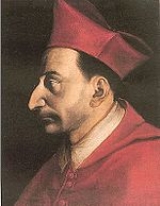
Charles Borromeo

Encyclopedia
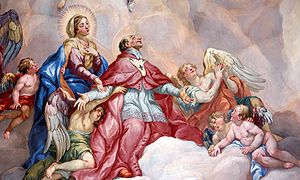
Cardinal (Catholicism)
A cardinal is a senior ecclesiastical official, usually an ordained bishop, and ecclesiastical prince of the Catholic Church. They are collectively known as the College of Cardinals, which as a body elects a new pope. The duties of the cardinals include attending the meetings of the College and...
archbishop
Archbishop
An archbishop is a bishop of higher rank, but not of higher sacramental order above that of the three orders of deacon, priest , and bishop...
of the Catholic Archdiocese of Milan from 1564 to 1584. He was a leading figure during the Counter-Reformation
Counter-Reformation
The Counter-Reformation was the period of Catholic revival beginning with the Council of Trent and ending at the close of the Thirty Years' War, 1648 as a response to the Protestant Reformation.The Counter-Reformation was a comprehensive effort, composed of four major elements:#Ecclesiastical or...
and was responsible for significant reforms in the Catholic Church, including the founding of seminaries for the education of priests. He is honoured as a saint
Saint
A saint is a holy person. In various religions, saints are people who are believed to have exceptional holiness.In Christian usage, "saint" refers to any believer who is "in Christ", and in whom Christ dwells, whether in heaven or in earth...
in the Catholic Church and his feast day is November 4.
Early life
The son of Gilberto II Borromeo, conte (countCount
A count or countess is an aristocratic nobleman in European countries. The word count came into English from the French comte, itself from Latin comes—in its accusative comitem—meaning "companion", and later "companion of the emperor, delegate of the emperor". The adjective form of the word is...
) of Arona
Arona, Italy
Arona is a town and comune on Lake Maggiore, in the province of Novara . Its main economic activity is tourism, especially from Milan, France and Germany.-History:...
, and Margherita de' Medici (sister of Pope Pius IV), Carlo Borromeo was born on 2 October 1538 at the castle of Arona on the shores of Lago Maggiore in northern Italy. The aristocratic Borromeo family's coat of arms
Coat of arms
A coat of arms is a unique heraldic design on a shield or escutcheon or on a surcoat or tabard used to cover and protect armour and to identify the wearer. Thus the term is often stated as "coat-armour", because it was anciently displayed on the front of a coat of cloth...
included the Borromean rings
Borromean rings
In mathematics, the Borromean rings consist of three topological circles which are linked and form a Brunnian link, i.e., removing any ring results in two unlinked rings.- Mathematical properties :...
, sometimes taken to symbolize the Holy Trinity.
When Borromeo was about twelve years old, his uncle Giulio Cesare Borromeo, resigned to him an abbacy (the office and dignity of an abbot
Abbot
The word abbot, meaning father, is a title given to the head of a monastery in various traditions, including Christianity. The office may also be given as an honorary title to a clergyman who is not actually the head of a monastery...
). Borromeo applied the revenue from this position in charity to the poor. He studied the civil and canon law
Canon law (Catholic Church)
The canon law of the Catholic Church, is a fully developed legal system, with all the necessary elements: courts, lawyers, judges, a fully articulated legal code and principles of legal interpretation. It lacks the necessary binding force present in most modern day legal systems. The academic...
at Pavia
Pavia
Pavia , the ancient Ticinum, is a town and comune of south-western Lombardy, northern Italy, 35 km south of Milan on the lower Ticino river near its confluence with the Po. It is the capital of the province of Pavia. It has a population of c. 71,000...
. In 1554 his father died, and although he had an elder brother, Count Federigo, he was requested by the family to take the management of their domestic affairs. After a time, he resumed his studies, and in 1559 he took his doctoral degree. In 1560 his uncle, Cardinal Angelo de' Medici, was raised to the pontificate as Pope Pius IV
Pope Pius IV
Pope Pius IV , born Giovanni Angelo Medici, was Pope from 1559 to 1565. He is notable for presiding over the culmination of the Council of Trent.-Biography:...
.
Pius IV named Borromeo as protonotary apostolic
Protonotary apostolic
In the Roman Catholic Church, protonotary apostolic is the title for a member of the highest non-episcopal college of prelates in the Roman Curia or, outside of Rome, an honorary prelate on whom the pope has conferred this title and its special privileges.-History:In later antiquity there were in...
(secretary of state), entrusted with both the public and the privy seal of the ecclesiastical state. He then named Borromeo to the post of Cardinal of Romagna
Romagna
Romagna is an Italian historical region that approximately corresponds to the south-eastern portion of present-day Emilia-Romagna. Traditionally, it is limited by the Apennines to the south-west, the Adriatic to the east, and the rivers Reno and Sillaro to the north and west...
and the March
Marches
A march or mark refers to a border region similar to a frontier, such as the Welsh Marches, the borderland between England and Wales. During the Frankish Carolingian Dynasty, the word spread throughout Europe....
of Ancona, and supervisor of the Franciscan
Franciscan
Most Franciscans are members of Roman Catholic religious orders founded by Saint Francis of Assisi. Besides Roman Catholic communities, there are also Old Catholic, Anglican, Lutheran, ecumenical and Non-denominational Franciscan communities....
s, Carmelites
Carmelites
The Order of the Brothers of Our Lady of Mount Carmel or Carmelites is a Catholic religious order perhaps founded in the 12th century on Mount Carmel, hence its name. However, historical records about its origin remain uncertain...
and Knights of Malta
Knights Hospitaller
The Sovereign Military Hospitaller Order of Saint John of Jerusalem of Rhodes and of Malta , also known as the Sovereign Military Order of Malta , Order of Malta or Knights of Malta, is a Roman Catholic lay religious order, traditionally of military, chivalrous, noble nature. It is the world's...
.
Archbishop of Milan
At age twenty-two, Borromeo was highly trusted at the papal court. Soon afterwards Pius IV raised him to the archbishopric of MilanRoman Catholic Archdiocese of Milan
The Archdiocese of Milan is a metropolitan see of the Catholic Church in Italy. It has long maintained its own rite: the Ambrosian rite. It is led by the Archbishop of Milan who serves as metropolitan to the dioceses of Bergamo, Brescia, Como, Crema, Cremona, Lodi, Mantova, Pavia, and Vigevano.The...
. In compliance with the pope's desire, Borromeo lived in splendor to represent the glory of the church. He established an academy of learned persons, the Academy of the Vatican Nights, and published their memoirs as the Noctes Vaticanae.
About the same time, Borromeo founded and endowed a college at Pavia
Pavia
Pavia , the ancient Ticinum, is a town and comune of south-western Lombardy, northern Italy, 35 km south of Milan on the lower Ticino river near its confluence with the Po. It is the capital of the province of Pavia. It has a population of c. 71,000...
, today known as Almo Collegio Borromeo, which he dedicated to Saint Justina of Padua
Justina of Padua
Saint Justina of Padua is a Christian saint who was said to have been martyred in 304 AD. Justina was said to have been a young woman who took private vows of chastity and was killed during the persecutions of Diocletian. She is a patron saint of Padua.Medieval histories described her as a...
. On the death of his elder brother Federigo, his family urged Borromeo to quit the church to marry and have children, so that the family name would not become extinct.
Borromeo declined the proposal. He worked even harder for the welfare of the church. Owing to his influence over Pius IV, he facilitated the final deliberations of the Council of Trent
Council of Trent
The Council of Trent was the 16th-century Ecumenical Council of the Roman Catholic Church. It is considered to be one of the Church's most important councils. It convened in Trent between December 13, 1545, and December 4, 1563 in twenty-five sessions for three periods...
. He took a large share in the creation of the Tridentine Catechism
Roman Catechism
During the Catholic Counter-Reformation, the Council of Trent commissioned the Roman Catechism to expound doctrine and to improve the theological understanding of the clergy...
(Catechismus Romanus).
Reform Program (Acta Ecclesiae Mediolanersis)
After the death of his uncle, Pius IV (1566), Borromeo contributed materially to suppressing the cabals of the conclavePapal conclave
A papal conclave is a meeting of the College of Cardinals convened to elect a Bishop of Rome, who then becomes the Pope during a period of vacancy in the papal office. The Pope is considered by Roman Catholics to be the apostolic successor of Saint Peter and earthly head of the Roman Catholic Church...
. Subsequently he devoted himself wholly to the reformation of his diocese. It had deteriorated in practice owing to the 80-year absence of previous archbishops. Borromeo made numerous pastoral visits, and restored dignity to divine service.
In conformity with the decrees of the Council of Trent
Council of Trent
The Council of Trent was the 16th-century Ecumenical Council of the Roman Catholic Church. It is considered to be one of the Church's most important councils. It convened in Trent between December 13, 1545, and December 4, 1563 in twenty-five sessions for three periods...
, which suggested simplifying church interiors, Borromeo cleared the cathedral of ornate tombs, rich ornaments, banners, and arms. He did not even spare the monuments of his own relatives. He divided the nave of the church into two compartments to separate the sexes at worship.
He extended his reforms to the collegiate churches, monasteries and even to the Confraternities of Penitents, particularly that of St. John the Baptist
John the Baptist
John the Baptist was an itinerant preacher and a major religious figure mentioned in the Canonical gospels. He is described in the Gospel of Luke as a relative of Jesus, who led a movement of baptism at the Jordan River...
. This group was to attend to prisoners and those condemned to death, to give them help and support.
Borromeo believed that abuses in the church arose from clergy ignorance. Among his most important actions, he established seminaries, colleges and communities for the education of candidates for holy orders. His emphasis on Catholic learning greatly increased the preparation of men for priesthood and benefited their congregations.
In addition, Borromeo founded the fraternity of Oblates of St. Ambrose, a society of secular men who did not take orders, but devoted themselves to the church and followed a discipline of monastic prayers and study. They provided assistance to parishes where ordered by the church.
Suppression of witchcraft and heresy
Though the Diet of Ilanz of 1524 and 1526 had proclaimed freedom of worship in the Republic of the Three Leagues, Saint Charles repressed Protestantism in the Swiss valleys. The Catholic Encyclopedia relates: “In November [1583] he began a visitation as Apostolic visitor of all the cantons of Switzerland and the Grisons, leaving the affairs of his diocese in the hands of Monsignor Owen LewisOwen Lewis (bishop)
Owen Lewis, also known as Lewis Owen was a Welsh Roman Catholic priest, jurist, administrator and diplomat, who became bishop of Cassano.-Early life:...
, his vicar-general. He began in the Mesoleina Valley; here not only was there heresy to be fought, but also witchcraft and sorcery, and at Roveredo it was discovered that the provost, or rector, was the foremost in sorceries.” During his pastoral visit to the region, the Cardinal had about a hundred people arrested for practicing witchcraft. Ten women and the provost were condemned to “the flaming death”. They were put to death by being placed head-first in the fire.
Reacting to the pressure of the Protestant Reformation
Protestant Reformation
The Protestant Reformation was a 16th-century split within Western Christianity initiated by Martin Luther, John Calvin and other early Protestants. The efforts of the self-described "reformers", who objected to the doctrines, rituals and ecclesiastical structure of the Roman Catholic Church, led...
, Borromeo encouraged the Golden League formed in 1586 by Ludwig Pfyffer
Ludwig Pfyffer
Ludwig Pfyffer was a Swiss military leader, spokesman for Roman Catholic interests in the cantons, chief magistrate of Lucerne, and probably the most important Swiss political figure in the latter half of the 16th century.-Early career:...
in Switzerland. Based in Lucerne, the organization (also called the Borromean League) linked activities of several Swiss Catholic cantons of Switzerland
Switzerland
Switzerland name of one of the Swiss cantons. ; ; ; or ), in its full name the Swiss Confederation , is a federal republic consisting of 26 cantons, with Bern as the seat of the federal authorities. The country is situated in Western Europe,Or Central Europe depending on the definition....
, which became the center of Catholic Counter-Reformation efforts. This Inquisition-type organization was determined to expel heretics and burned some people at the stake. It created severe strains in the civil administration of the confederation, and it caused the break-up of Appenzell
Appenzell
Appenzell is a region and historical canton in the northeast of Switzerland, entirely surrounded by the Canton of St. Gallen....
canton along religious lines.
In 1576, when Milan
Milan
Milan is the second-largest city in Italy and the capital city of the region of Lombardy and of the province of Milan. The city proper has a population of about 1.3 million, while its urban area, roughly coinciding with its administrative province and the bordering Province of Monza and Brianza ,...
suffered an epidemic of the bubonic plague
Bubonic plague
Plague is a deadly infectious disease that is caused by the enterobacteria Yersinia pestis, named after the French-Swiss bacteriologist Alexandre Yersin. Primarily carried by rodents and spread to humans via fleas, the disease is notorious throughout history, due to the unrivaled scale of death...
, Borromeo led efforts to accommodate the sick and bury the dead. He avoided no danger and spared no expense. He visited all the parishes where the contagion raged, distributing money, providing accommodation for the sick, and punishing those, especially the clergy, who were remiss in discharging their duties.
Controversy and last days
Borromeo met with much opposition to his reforms. The governor of the province, and many of the senators, addressed complaints to the courts of RomeRome
Rome is the capital of Italy and the country's largest and most populated city and comune, with over 2.7 million residents in . The city is located in the central-western portion of the Italian Peninsula, on the Tiber River within the Lazio region of Italy.Rome's history spans two and a half...
and Madrid
Madrid
Madrid is the capital and largest city of Spain. The population of the city is roughly 3.3 million and the entire population of the Madrid metropolitan area is calculated to be 6.271 million. It is the third largest city in the European Union, after London and Berlin, and its metropolitan...
. They were apprehensive that the cardinal's ordinances would encroach upon the civil jurisdiction.
Borromeo also faced staunch opposition of several religious orders, particularly that of the Humiliati
Humiliati
The Humiliati were an Italian religious order of men formed probably in the 12th century. It was suppressed by a Papal bull in 1571 though an associated order of women continued into the 20th century.-Origin:Its origin is obscure...
(Brothers of Humility). Some members of that society formed a conspiracy against his life, and a shot was fired at him in the archiepiscopal chapel. His survival was considered miraculous.
He successfully attacked his Jesuit confessor
Confessor
-Confessor of the Faith:Its oldest use is to indicate a saint who has suffered persecution and torture for the faith, but not to the point of death. The term is still used in this way in the East. In Latin Christianity it has come to signify any saint, as well as those who have been declared...
, Giovanni Battista Ribera who, with other members of the college of Milan, was found to be guilty of unnatural offenses. This action increased Borromeo's enemies within the church.
Borromeo's manifold labors and austerities appear to have shortened his life. He was seized with an intermittent fever, and died at Milan on 3 November 1584. He was canonized in 1610, and his feast is celebrated on 4 November each year in the Roman Catholic Rite.
Legacy
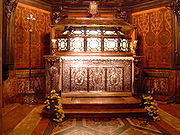
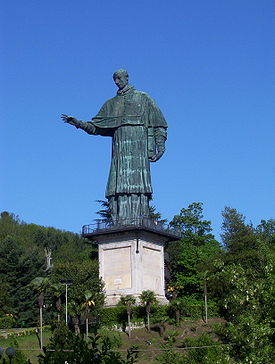
- Besides the Noctes Vaticanae, to which he appeared to have contributed, Borromeo's written legacy consisted only of some homilies, discourses and sermons, with a collection of letters. Borromeo's sermons have been translated into many languages.
- Contrary to Borromeo's last wishes, the Duomo di MilanoDuomo di MilanoMilan Cathedral is the cathedral church of Milan, Italy. Dedicated to Santa Maria Nascente , it is the seat of the Archbishop of Milan, currently Cardinal Angelo Scola....
created a memorial crypt to him in the church.
- His relative Federico BorromeoFederico BorromeoFederico Borromeo was an Italian ecclesiastic, cardinal and archbishop of Milan.-Biography:Federico Borromeo was born in Milan as the second son of Giulio Cesare Borromeo, Count of Arona, and Margherita Trivulzio...
and admirers commissioned a statue 20 m high that was erected on the hill above Arona, as they regarded him an important leader of the Counter-ReformationCounter-ReformationThe Counter-Reformation was the period of Catholic revival beginning with the Council of Trent and ending at the close of the Thirty Years' War, 1648 as a response to the Protestant Reformation.The Counter-Reformation was a comprehensive effort, composed of four major elements:#Ecclesiastical or...
.
- The famous church of San Carlo alle Quattro FontaneSan Carlo alle Quattro FontaneThe Church of Saint Charles at the Four Fountains is a Roman Catholic church in Rome, Italy. Designed by the architect Francesco Borromini, it was his first independent commission. It is an iconic masterpiece of Baroque architecture, built as part of a complex of monastic buildings on the Quirinal...
in Rome was dedicated in his honor.
- His nephew, Federico BorromeoFederico BorromeoFederico Borromeo was an Italian ecclesiastic, cardinal and archbishop of Milan.-Biography:Federico Borromeo was born in Milan as the second son of Giulio Cesare Borromeo, Count of Arona, and Margherita Trivulzio...
(1564–1631), was archbishop of Milan from 1595 and, furthering Charles' support for Catholic learning, in 1609 founded the Ambrosian Library in that city. He donated a tremendous collection of art and literature to the library.
- Borromeo's emblem is the Latin word humilitas (humility), which is a portion of the Borromeo shield. He is usually represented in art in his robes, barefoot, carrying the cross as archbishop; a rope round his neck, one hand raised in blessing, thus recalling his work during the plague.
- Borromeo is one of only four people mentioned at the beginning of the Catechism of the Catholic ChurchCatechism of the Catholic ChurchThe Catechism of the Catholic Church is the official text of the teachings of the Catholic Church. A provisional, "reference text" was issued by Pope John Paul II on October 11, 1992 — "the thirtieth anniversary of the opening of the Second Vatican Ecumenical Council" — with his apostolic...
, citing them as responsible for the Council of TrentCouncil of TrentThe Council of Trent was the 16th-century Ecumenical Council of the Roman Catholic Church. It is considered to be one of the Church's most important councils. It convened in Trent between December 13, 1545, and December 4, 1563 in twenty-five sessions for three periods...
, which gave way to the modern day catechism. The others mentioned are St. Peter Canisius, St. Turibius of Mongrovejo and St. Robert Bellarmine.
- The city and county of St. Charles, Missouri are named for Borromeo. Also, a Brazilian city was named after him, named in portuguese São CarlosSão CarlosSão Carlos is a city of 221,950 inhabitants in the state of São Paulo, Brazil. It is located at , at about 231 km from the city of São Paulo.-History:...
.
- The Parish of St. Charles, Louisiana is named for Borromeo.
Veneration
People's devotion to Borromeo as a saint arose quickly and continued to grow. The Milanese celebrated his anniversary as though he were already canonized. Supporters collected documentation for his canonization. They began the process at Milan, Pavia, Bologna and other places.In 1602 Pope Paul V
Pope Paul V
-Theology:Paul met with Galileo Galilei in 1616 after Cardinal Bellarmine had, on his orders, warned Galileo not to hold or defend the heliocentric ideas of Copernicus. Whether there was also an order not to teach those ideas in any way has been a matter for controversy...
beatified Borromeo. In 1604 his case was sent on to the Congregation of Rites. On 1 November 1610, Paul V canonized Charles Borromeo. Three years later, the church added Borromeo's feast to the Roman Catholic calendar of saints
Roman Catholic calendar of saints
The General Roman Calendar indicates the days of the year to which are assigned the liturgical celebrations of saints and of the mysteries of the Lord that are to be observed wherever the Roman Rite is used...
for celebration on 4 November, which is still his feast. Along with Anselm of Lucca
Anselm of Lucca
Saint Anselm of Lucca , called the Younger or Anselm II to distinguish him from his uncle, was an Italian bishop, a prominent figure in the Investiture Controversy and in the fighting in Central Italy between the forces of Countess Matilda of Tuscany, the papal champion, and those of Henry IV,...
, he was one of only two cardinal-nephew
Cardinal-nephew
A cardinal-nephew is a cardinal elevated by a Pope who is that cardinal's uncle, or, more generally, his relative. The practice of creating cardinal-nephews originated in the Middle Ages, and reached its apex during the 16th and 17th centuries. The word nepotism originally referred specifically to...
s to have been canonized.
The position which Charles Borromeo held in Europe was indeed remarkable. He is venerated as a saint of learning and the arts. The mass of correspondence both to and by him testifies to the way in which his opinion was sought. The popes under whom he served sought his advice. The Catholic sovereigns of Europe: Henry III of France
Henry III of France
Henry III was King of France from 1574 to 1589. As Henry of Valois, he was the first elected monarch of the Polish-Lithuanian Commonwealth with the dual titles of King of Poland and Grand Duke of Lithuania from 1573 to 1575.-Childhood:Henry was born at the Royal Château de Fontainebleau,...
, Philip II of Spain
Philip II of Spain
Philip II was King of Spain, Portugal, Naples, Sicily, and, while married to Mary I, King of England and Ireland. He was lord of the Seventeen Provinces from 1556 until 1581, holding various titles for the individual territories such as duke or count....
, Mary, Queen of Scots and others showed how they valued his influence.
His brother cardinals wrote in praise of his virtues. Cardinal Valerio of Verona said of him that Borromeo was "to the well-born a pattern of virtue, to his brother cardinals an example of true nobility." Cardinal Baronius styled him "a second Ambrose
Ambrose
Aurelius Ambrosius, better known in English as Saint Ambrose , was a bishop of Milan who became one of the most influential ecclesiastical figures of the 4th century. He was one of the four original doctors of the Church.-Political career:Ambrose was born into a Roman Christian family between about...
, whose early death, lamented by all good men, inflicted great loss on the Church."
Late in the sixteenth or at the beginning of the seventeenth century, Catholics in England circulated among themselves a "Life of St. Charles". Saint Edmund Campion, a Jesuit who visited Borromeo at Milan in 1580 on his way to England, likely took his influence with him. Campion visited with Borromeo for eight days, when they would talk at length every night after dinner. Borromeo had also been involved in English affairs when he assisted Pius IV. He had a great veneration for the portrait of Bishop Fisher
John Fisher
Saint John Fisher was an English Roman Catholic scholastic, bishop, cardinal and martyr. He shares his feast day with Saint Thomas More on 22 June in the Roman Catholic calendar of saints and 6 July on the Church of England calendar of saints...
.
Borromeo also worked closely with Francis Borgia
Francis Borgia
Saint Francis Borgia, 4th duke of Gandía, 3rd Father General of the Jesuit Order, Grandee of Spain, was a Spanish Jesuit and third Superior General of the Society of Jesus. He was canonized on 20 June 1670.-Early life:He was born Francesco Borgia de Candia d'Aragon within the Duchy of Gandía,...
, General of the Jesuits, and with Andrew Avellino
Andrew Avellino
Saint Andrew Avellino was an Italian saint. Born at Castronuovo, a small town in Sicily, his baptismal name was Lancelotto, which out of love for the cross he changed into Andrew when he entered the Order of Theatines.-Life:From his early youth he was a great lover of chastity...
of the Theatines
Theatines
The Theatines or the Congregation of Clerks Regular of the Divine Providence are a male religious order of the Catholic Church, with the post-nominal initials "C.R."-Foundation:...
, who gave great help to his work in Milan.
Karlskirche
Karlskirche
The St. Charles's Church is a church situated on the south side of Karlsplatz, Vienna. It is located on the edge of the 1st district, 200 metres outside the Ringstraße...
, Vienna, Austria; Carolus Borromeuskerk, Antwerp, Belgium
Belgium
Belgium , officially the Kingdom of Belgium, is a federal state in Western Europe. It is a founding member of the European Union and hosts the EU's headquarters, and those of several other major international organisations such as NATO.Belgium is also a member of, or affiliated to, many...
; Mission San Carlos Borromeo de Carmelo
Mission San Carlos Borromeo de Carmelo
Mission San Carlos Borroméo del río Carmelo, also known as the Carmel Mission, is a Roman Catholic mission church in Carmel, California. It is on the National Register of Historic Places and a U.S...
in Carmel-by-the-Sea, California
Carmel-by-the-Sea, California
Carmel-by-the-Sea, often called simply Carmel, is a small city in Monterey County, California, United States, founded in 1902 and incorporated in 1916. Situated on the Monterey Peninsula, the town is known for its natural scenery and rich artistic history...
; Cathedral of San Carlos Borromeo
Cathedral of San Carlos Borromeo
The Cathedral of San Carlos Borromeo, also known as the Royal Presidio Chapel, is a Roman Catholic cathedral located in Monterey, California, United States. The cathedral is the oldest continuously operating parish and the oldest stone building in California. It was built in 1794 making it the...
in nearby Monterey, California
Monterey, California
The City of Monterey in Monterey County is located on Monterey Bay along the Pacific coast in Central California. Monterey lies at an elevation of 26 feet above sea level. As of the 2010 census, the city population was 27,810. Monterey is of historical importance because it was the capital of...
; the city of Saint Charles, Missouri
Saint Charles, Missouri
St. Charles is a city in, and the county seat of, St. Charles County, Missouri. As of the 2010 census, the city had a population of 65,794, making St. Charles the 2nd largest city in St. Charles County. It lies just to the northwest of St. Louis, Missouri on the Missouri River, and, for a time,...
, San Carlos City, Negros Occidental
San Carlos City, Negros Occidental
San Carlos City is a 2nd class component city in the province of Negros Occidental, Philippines. The settlement was elevated to city status on July 1, 1960 per Republic Act 2643...
, were all named in his honor.
Roman Catholic schools and parishes are named after him in Toronto, CanadaTacoma, Washington
Tacoma, Washington
Tacoma is a mid-sized urban port city and the county seat of Pierce County, Washington, United States. The city is on Washington's Puget Sound, southwest of Seattle, northeast of the state capital, Olympia, and northwest of Mount Rainier National Park. The population was 198,397, according to...
;Kettering, Ohio
Kettering, Ohio
As of the census of 2000, there were 57,502 people, 25,657 households, and 15,727 families residing in the city. The population density was 3,077.4 people per square mile . There were 26,936 housing units at an average density of 1,441.6 per square mile...
; Fort Wayne, Indiana
Fort Wayne, Indiana
Fort Wayne is a city in the US state of Indiana and the county seat of Allen County. The population was 253,691 at the 2010 Census making it the 74th largest city in the United States and the second largest in Indiana...
; Bloomington, Indiana
Bloomington, Indiana
Bloomington is a city in and the county seat of Monroe County in the southern region of the U.S. state of Indiana. The population was 80,405 at the 2010 census....
; Albuquerque, New Mexico
Albuquerque, New Mexico
Albuquerque is the largest city in the state of New Mexico, United States. It is the county seat of Bernalillo County and is situated in the central part of the state, straddling the Rio Grande. The city population was 545,852 as of the 2010 Census and ranks as the 32nd-largest city in the U.S. As...
; Bayport
Bayport, Minnesota
Bayport is a city in Washington County, Minnesota, United States. The population was 3,471 at the 2010 census.Bayport is located on the St. Croix River one mile south of Stillwater, Minnesota. It is the headquarters of the Andersen Corporation, a major manufacturer of windows...
, Minnesota
Minnesota
Minnesota is a U.S. state located in the Midwestern United States. The twelfth largest state of the U.S., it is the twenty-first most populous, with 5.3 million residents. Minnesota was carved out of the eastern half of the Minnesota Territory and admitted to the Union as the thirty-second state...
; Paisley
Paisley
Paisley is the largest town in the historic county of Renfrewshire in the west central Lowlands of Scotland and serves as the administrative centre for the Renfrewshire council area...
, Scotland
Scotland
Scotland is a country that is part of the United Kingdom. Occupying the northern third of the island of Great Britain, it shares a border with England to the south and is bounded by the North Sea to the east, the Atlantic Ocean to the north and west, and the North Channel and Irish Sea to the...
; Brooklyn, New York, Staten Island
Staten Island
Staten Island is a borough of New York City, New York, United States, located in the southwest part of the city. Staten Island is separated from New Jersey by the Arthur Kill and the Kill Van Kull, and from the rest of New York by New York Bay...
, New York
New York
New York is a state in the Northeastern region of the United States. It is the nation's third most populous state. New York is bordered by New Jersey and Pennsylvania to the south, and by Connecticut, Massachusetts and Vermont to the east...
; Syracuse, New York
Syracuse, New York
Syracuse is a city in and the county seat of Onondaga County, New York, United States, the largest U.S. city with the name "Syracuse", and the fifth most populous city in the state. At the 2010 census, the city population was 145,170, and its metropolitan area had a population of 742,603...
; London, England; New York
New York
New York is a state in the Northeastern region of the United States. It is the nation's third most populous state. New York is bordered by New Jersey and Pennsylvania to the south, and by Connecticut, Massachusetts and Vermont to the east...
; Woonsocket, Rhode Island
Woonsocket, Rhode Island
Woonsocket is a city in Providence County, Rhode Island, United States. The population was 41,186 at the 2010 census, making it the sixth largest city in the state. Woonsocket lies directly south of the Massachusetts border....
; Cinnaminson, New Jersey; Montgomery, New Jersey; Peoria, Arizona
Peoria, Arizona
Peoria is a city in Maricopa and Yavapai counties in the U.S. state of Arizona. Located primarily in Maricopa County, it is a major suburb of Phoenix. According to 2010 Census Bureau releases, the population of the city is 154,065. Peoria is currently the sixth largest city in Arizona for land...
; Orlando, Florida
Orlando, Florida
Orlando is a city in the central region of the U.S. state of Florida. It is the county seat of Orange County, and the center of the Greater Orlando metropolitan area. According to the 2010 US Census, the city had a population of 238,300, making Orlando the 79th largest city in the United States...
; Port Charlotte, Florida
Port Charlotte, Florida
Port Charlotte is a census-designated place in Charlotte County, Florida, United States. The population was 46,451 at the 2000 census. It is part of the Punta Gorda Metropolitan Statistical Area.-History:...
; San Francisco, California
San Francisco, California
San Francisco , officially the City and County of San Francisco, is the financial, cultural, and transportation center of the San Francisco Bay Area, a region of 7.15 million people which includes San Jose and Oakland...
; Livermore, California
Livermore, California
Livermore is a city in Alameda County. The population as of 2010 was 80,968. Livermore is located on the eastern edge of California's San Francisco Bay Area....
; Sacramento, California
Sacramento, California
Sacramento is the capital city of the U.S. state of California and the county seat of Sacramento County. It is located at the confluence of the Sacramento River and the American River in the northern portion of California's expansive Central Valley. With a population of 466,488 at the 2010 census,...
; Bloomington, California
Bloomington, California
Bloomington is an unincorporated census-designated place in San Bernardino County, California, United States. The population was 23,851 at the 2010 census, up from 19,318 at the 2000 census....
; Columbus, Ohio
Columbus, Ohio
Columbus is the capital of and the largest city in the U.S. state of Ohio. The broader metropolitan area encompasses several counties and is the third largest in Ohio behind those of Cleveland and Cincinnati. Columbus is the third largest city in the American Midwest, and the fifteenth largest city...
; Lima, Ohio
Lima, Ohio
Lima is a city in and the county seat of Allen County, Ohio, United States. The municipality is located in northwestern Ohio along Interstate 75 approximately north of Dayton and south-southwest of Toledo....
; Cassville, Wisconsin
Cassville, Wisconsin
Cassville is a village in Grant County, Wisconsin, United States. The population was 1,085 at the 2000 census. The village is located along the Mississippi River within the Town of Cassville.-History:...
;Chippewa Falls, Wisconsin
Chippewa Falls, Wisconsin
Chippewa Falls is a city located on the Chippewa River in Chippewa County in the U.S. state of Wisconsin. The population was 13,661 at the 2010 census. Incorporated as a city in 1869, it is the county seat of Chippewa County....
; Hartland, Wisconsin
Hartland, Wisconsin
Hartland is a village in Waukesha County, Wisconsin, along the Bark River, and is a suburb of Milwaukee. The population was estimated at 8,689 in 2006.-Geography:Hartland is located at...
; Pikesville, Maryland
Pikesville, Maryland
Pikesville is a census-designated place in Baltimore County, Maryland, United States. Pikesville is just northwest of the Baltimore city limits. It is the northwestern suburb closest to Baltimore.The population was 29,123 at the 2000 census...
; Arlington, Virginia; Oklahoma City, Oklahoma
Oklahoma City, Oklahoma
Oklahoma City is the capital and the largest city in the state of Oklahoma. The county seat of Oklahoma County, the city ranks 31st among United States cities in population. The city's population, from the 2010 census, was 579,999, with a metro-area population of 1,252,987 . In 2010, the Oklahoma...
; Cheboygan, Michigan
Cheboygan, Michigan
Cheboygan is a city in the U.S. state of Michigan. As of the 2000 census, the city population was 5,295. It is the county seat of Cheboygan County....
; Newport, Michigan; Ryde, New South Wales, Australia; Waverley, New South Wales, Australia; Portland, Oregon
Portland, Oregon
Portland is a city located in the Pacific Northwest, near the confluence of the Willamette and Columbia rivers in the U.S. state of Oregon. As of the 2010 Census, it had a population of 583,776, making it the 29th most populous city in the United States...
; Cleveland, Ohio
Cleveland, Ohio
Cleveland is a city in the U.S. state of Ohio and is the county seat of Cuyahoga County, the most populous county in the state. The city is located in northeastern Ohio on the southern shore of Lake Erie, approximately west of the Pennsylvania border...
; Cebu City
Cebu City
The City of Cebu is the capital city of Cebu and is the second largest city in the Philippines, the second most significant metropolitan centre in the Philippines and known as the oldest settlement established by the Spaniards in the country.The city is located on the eastern shore of Cebu and was...
, Philippines
Philippines
The Philippines , officially known as the Republic of the Philippines , is a country in Southeast Asia in the western Pacific Ocean. To its north across the Luzon Strait lies Taiwan. West across the South China Sea sits Vietnam...
. The San Carlos Seminary
San Carlos Seminary
The Royal and Conciliar San Carlos Seminary is the archdiocesan seminary of the Roman Catholic Archdiocese of Manila. It was established in the year 1702, by decree of King Philip V of Spain...
of the Archdiocese of Manila in Makati City
Makati City
The City of Makati is one of the 17 cities that make up Metro Manila, one of the most populous metropolitan areas in the world. Makati is the financial center of the Philippines and one of the major financial, commercial and economic hubs in Asia...
, Philippines, San Carlos Major Seminary of the Archdiocese of Cebu, University of San Carlos
University of San Carlos
The University of San Carlos is a Roman Catholic university governed by the Society of the Divine Word since 1935 in Cebu City. It offers pre-elementary and basic education as well as undergraduate and graduate courses, and a broad spectrum of academic programs through its eight colleges.It...
in Cebu City
Cebu City
The City of Cebu is the capital city of Cebu and is the second largest city in the Philippines, the second most significant metropolitan centre in the Philippines and known as the oldest settlement established by the Spaniards in the country.The city is located on the eastern shore of Cebu and was...
, Philippines
Philippines
The Philippines , officially known as the Republic of the Philippines , is a country in Southeast Asia in the western Pacific Ocean. To its north across the Luzon Strait lies Taiwan. West across the South China Sea sits Vietnam...
, the Priestly Seminary of St. Charles Borromeo (Kňazský Seminár sv. Karola Boromejského) in Košice, Slovakia, and the seminary of the Archdiocese of Philadelphia, Pennsylvania
St. Charles Borromeo Seminary
St. Charles Borromeo Seminary is the seminary of the Roman Catholic Archdiocese of Philadelphia. Named for Charles Borromeo, it is located in Wynnewood, Pennsylvania,...
, Colegio San Carlos in Aguadilla, Puerto Rico, are all named after him.
Shrine In Milan Cathedral
"Saint Charles Borromeo is buried beneath the chancel of Milan Cathedral in the Scurolo of San Carlo, an octagonal chapel designed by Domenico Pellegrini. The altar in this chapel is of solid silver; plates of silver cover the walls of a considerable part of the vault, and a great number of large silver and gold lamps burn there night and day. Besides the richest vestments and like ornaments, Giussano tells us that in eight years the donaries here amounted to above the value of one hundred and fifty thousand crowns of gold. “San Carlo lies in that glorious temple he helped to beautify … and from which he drove the buyers and sellers,” wrote Louise M. Stacpoole-Kenn. The remains of the saint are contained in an urn of rock crystal, the gift of Philip IV, king of Spain. The body may be viewed for payment of one euro. In Italian Hours, Henry James describes a visit to the tomb: “This holy man lies at his eternal rest in a small but gorgeous sepulchral chapel … and for the modest sum of five francs you may have his shriveled mortality unveiled and gaze at it … The little sacristan … lighted a couple of extra candles and proceeded to remove from above the altar, by means of a crank, a sort of sliding shutter, just as you may see a shop-boy do of a morning at his master's window. In this case too a large sheet of plate-glass was uncovered, and to form an idea of the étalage you must imagine that a jeweller, for reasons of his own, has struck an unnatural partnership with an undertaker. The black mummified corpse of the saint is stretched out in a glass coffin, clad in his mouldering canonicals, mitred, crosiered and gloved, glittering with votive jewels. It is an extraordinary mixture of death and life; the desiccated clay, the ashen rags, the hideous little black mask and skull, and the living, glowing, twinkling splendour of diamonds, emeralds and sapphires. The collection is really fine, and many great historic names are attached to the different offerings. Whatever may be the better opinion as to the future of the Church, I can't help thinking she will make a figure in the world so long as she retains this great fund of precious "properties," this prodigious capital decoratively invested and scintillating throughout Christendom at effectively-scattered points.”Sources, references and external links
- The Life of St. Charles Borromeo, Confessor and Archbishop of Milan
- A Sala, Documenti circa la vita e la gesta di Borromeo (4 vols., Milan: 1857–1859)
- Chanoine Silvain, Histoire de St Charles Borromeo (Milan: 1884)
- A Cantono, "Un grande riformatore del secolo XVI" (Florence: 1904); "Borromus" in Herzog-Hauck, Realencyklopädie (Leipzig: 1897).
- University of San Carlos, Cebu City, Philippines Official Site
- Saint Charles Borromeo Seminary, Archdiocese of Philadelphia
- Pietro Canetta, "Biography of Carlo Borromeo" (in Italian), Magazzeno Storico Verbanese
- "St. Charles Borromeo", Catholic Encyclopedia
- "St. Charles Borromeo, Cardinal, Archbishop of Milan, Confessor", Butler's Lives of the Saints