
All Topics  
Pope Leo X

 
Pope Leo X

   Email Print
   Bookmark   Link


Pope Leo X


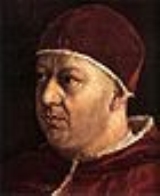
Pope Leo X, born Giovanni de' Medici (December 11, 1475 – December 1, 1521) was Pope from 1513 to his death. He was the last non-priest to be elected Pope. He is known primarily for the sale of indulgences to reconstruct St. Peter's Basilica
St. Peter's Basilica

The Basilica of Saint Peter , officially known in Italian language as the Basilica di San Pietro in Vaticano and commonly known as St. Peter's Basilica, is located within the Vatican City....
 and his challenging of Martin Luther
Martin Luther

Martin Luther was a Germans monk, theology, university professor, priest, father of Protestantism, and Protestant Reformers whose ideas started the Protestant Reformation and changed the course of Western culture....
's 95 theses
95 Theses

The Ninety-Five Theses on the Power and Efficacy of Indulgences, commonly known as The Ninety-Five Theses, were written by Martin Luther in 1517 and are widely regarded as the primary catalyst for the Protestant Reformation....
. He was the second son of Lorenzo de' Medici
Lorenzo de' Medici

Lorenzo de' Medici was an Italy statesman and de facto ruler of the Florentine Republic during the Italian Renaissance. Known as Lorenzo the Magnificent by contemporary Florentines, he was a diplomat, politician and patron of scholars, artists, and poets....
, the most famous ruler of the Florentine Republic, and Clarice Orsini
Clarice Orsini

Clarice Orsini was the daughter of Jacopo Orsini , lord of Monterotondo and Bracciano, and his wife and cousin Maddalena Orsini. Born in Rome, she is most known as the wife of Lorenzo de' Medici , de facto ruler of the Florentine Republic....
. His cousin, Giulio di Giuliano de' Medici, would later succeed him as Pope Clement VII
Pope Clement VII

Pope Clement VII , born Giulio di Giuliano de' Medici, was a Cardinal from 1513 to 1523 and was Pope from 1523 to 1534....
 (1523–34).

the church, he received the tonsure
Tonsure

Tonsure is the practice of some Christianity churches, mystics, Buddhist novices and Bhikkhus, and some Hindu temples of cutting the hair from the scalp of clerics, devotees or holy people as a symbol of their renunciation of worldly fashion and esteem....
 at the age of seven and was soon loaded with rich benefices and preferments.


Discussion
Ask a question about 'Pope Leo X'
Start a new discussion about 'Pope Leo X'
Answer questions from other users
Full Discussion Forum


Quotations


Made thirty, we should make thirty-one.

Said on July 1, 1517, when he created 30 new cardinals. Another priest, who seemed to him also worthy, was nominated during the ceremony.

It is a heretical opinion, but a common one, that the sacraments of the New Law give pardoning grace to those who do not set up an obstacle.

Exsurge Domine, Bull of Pope Leo X issued June 15, 1520, condemning the 95 theses of Martin Luther.

To deny that in a child after baptism sin remains is to treat with contempt both Paul and Christ.

Exsurge Domine, Bull of Pope Leo X issued June 15, 1520.

The inflammable sources of sin, even if there be no actual sin, delay a soul departing from the body from entrance into heaven.

Exsurge Domine, Bull of Pope Leo X issued June 15, 1520.

To one on the point of death imperfect charity necessarily brings with it great fear, which in itself alone is enough to produce the punishment of purgatory, and impedes entrance into the kingdom.

Exsurge Domine, Bull of Pope Leo X issued June 15, 1520.

That there are three parts to penance: contrition, confession, and satisfaction, has no foundation in Sacred Scripture nor in the ancient sacred Christian doctors.

Exsurge Domine, Bull of Pope Leo X issued June 15, 1520.


Encyclopedia


Pope Leo X, born Giovanni de' Medici (December 11, 1475 – December 1, 1521) was Pope from 1513 to his death. He was the last non-priest to be elected Pope. He is known primarily for the sale of indulgences to reconstruct St. Peter's Basilica
St. Peter's Basilica

The Basilica of Saint Peter , officially known in Italian language as the Basilica di San Pietro in Vaticano and commonly known as St. Peter's Basilica, is located within the Vatican City....
 and his challenging of Martin Luther
Martin Luther

Martin Luther was a Germans monk, theology, university professor, priest, father of Protestantism, and Protestant Reformers whose ideas started the Protestant Reformation and changed the course of Western culture....
's 95 theses
95 Theses

The Ninety-Five Theses on the Power and Efficacy of Indulgences, commonly known as The Ninety-Five Theses, were written by Martin Luther in 1517 and are widely regarded as the primary catalyst for the Protestant Reformation....
. He was the second son of Lorenzo de' Medici
Lorenzo de' Medici

Lorenzo de' Medici was an Italy statesman and de facto ruler of the Florentine Republic during the Italian Renaissance. Known as Lorenzo the Magnificent by contemporary Florentines, he was a diplomat, politician and patron of scholars, artists, and poets....
, the most famous ruler of the Florentine Republic, and Clarice Orsini
Clarice Orsini

Clarice Orsini was the daughter of Jacopo Orsini , lord of Monterotondo and Bracciano, and his wife and cousin Maddalena Orsini. Born in Rome, she is most known as the wife of Lorenzo de' Medici , de facto ruler of the Florentine Republic....
. His cousin, Giulio di Giuliano de' Medici, would later succeed him as Pope Clement VII
Pope Clement VII

Pope Clement VII , born Giulio di Giuliano de' Medici, was a Cardinal from 1513 to 1523 and was Pope from 1523 to 1534....
 (1523–34).

Early life

For the church, he received the tonsure
Tonsure

Tonsure is the practice of some Christianity churches, mystics, Buddhist novices and Bhikkhus, and some Hindu temples of cutting the hair from the scalp of clerics, devotees or holy people as a symbol of their renunciation of worldly fashion and esteem....
 at the age of seven and was soon loaded with rich benefices and preferments. His father prevailed on his relative Innocent VIII to name him cardinal
Cardinal (Catholicism)

A cardinal is a senior Ecclesiology official, usually a Bishop , of the Catholic Church. They are collectively known as the College of Cardinals, which as a body elects a new pope....
-deacon
Deacon

Deacon is a role in the Christianity that is generally associated with service of some kind, but which varies among theological and denominational traditions....
 of Santa Maria in Domnica
Santa Maria in Domnica

Santa Maria in Domnica ? also known as Santa Maria alla Navicella ? is a basilica churches of Rome Rome....
 in March 1489, although he was not allowed to wear the insignia or share in the deliberations of the college until three years later. Meanwhile he received a careful education at Lorenzo's brilliant humanistic court under such men as Angelo Poliziano, Pico della Mirandola, Marsilio Ficino
Marsilio Ficino

Marsilio Ficino was one of the most influential humanism philosophy of the early Italian Renaissance, an astrologer, a reviver of Neoplatonism who was in touch with every major academic thinker and writer of his day, and the first translator of Plato's complete extant works into Latin....
 and Bernardo Dovizio Bibbiena. From 1489 to 1491 he studied theology
Theology

Theology is the study of the existence or attributes of a deity or gods, or more generally the study of religion or spirituality. It is sometimes contrasted with religious studies: theology is understood as the study of religion from an internal perspective , and religious studies as the study of religion from an external perspective....
 and canon law
Canon law

Canon law is internal ecclesiastical law governing the Roman Catholic Church, the Eastern Orthodox Church churches, and the Anglicanism of churches....
 at Pisa
Pisa

Pisa is a city in Tuscany, central Italy, on the right bank of the mouth of the Arno River on the Ligurian Sea. It is the capital city of the Province of Pisa....
 under Filippo Decio
Filippo Decio

Filippo Decio or Decius was an eminent Italy jurist whose services were courted by European universities and rulers. He was one of the most influential representatives of the pre-Renaissance humanism scholastic ius commune tradition....
 and Bartolomeo Sozzini.

On 23 March 1492 he was formally admitted into the sacred college and took up his residence at Rome
Rome

Rome is the capital city of Italy and Lazio, and is Italy's largest and most populous city, with 2,724,347 residents in an urban area of some ....
, receiving a letter of advice from his father which ranks among the wisest of its kind. The death of Lorenzo on the following April 8, however, called the sixteen-year-old cardinal to Florence. He participated in the conclave of 1492 which followed the death of Innocent VIII, and opposed the election of Cardinal Borgia. He made his home with his elder brother Piero
Piero di Lorenzo de' Medici

Piero de' Medici , called Piero the Unfortunate, was the Gran maestro of Florence from 1492 until his exile in 1494....
 at Florence throughout the agitation of Savonarola
Girolamo Savonarola

Girolamo Savonarola , was an Italian Dominican Order priest and leader of Florence from 1494 until his execution in 1498. He was known for his book burning, destruction of what he considered immoral art, and hostility to the Renaissance....
 and the invasion of Charles VIII
Charles VIII of France

Charles VIII, called the Affable, , was List of French monarchs from 1483 to his death. Charles was a member of the House of Valois. His invasion of Italy initiated the long series of Italian Wars which characterized the first half of the 16th century....
 of France
France

France , officially the French Republic , is a country whose Metropolitan France is located in Western Europe and that also comprises various Overseas departments and territories of France....
, until the uprising of the Florentines and the expulsion
Expulsion

Expulsion may refer to:*Expulsion , removing a student from a school or university*Expulsion from the United States Congress*Deportation, the expulsion of someone from a country...
 of the Medici in November 1494. While Piero found refuge at Venice
Venice

Venice is a city in northern Italy, the capital city of the Italian regions Veneto, a population of 271,251 . Together with Padua, Italy, the city is included in the Padua-Venice Metropolitan Area ....
 and Urbino
Urbino

Urbino is a walled city in the Marche region in Italy, south-west of Pesaro, a World Heritage Site notable for a remarkable historical legacy of independent Renaissance culture, especially under the patronage of Federico da Montefeltro, duke of Urbino from 1444 to 1482....
, Cardinal Giovanni travelled in Germany
Germany

Germany , officially the Federal Republic of Germany , is a country in Central Europe. It is bordered to the north by the North Sea, Denmark, and the Baltic Sea; to the east by Poland and the Czech Republic; to the south by Austria and Switzerland; and to the west by France, Luxembourg, Belgium, and the Netherlands....
, in the Netherlands
Netherlands

The Netherlands is a country that is part of the Kingdom of the Netherlands. It is a parliamentary democratic constitutional monarchy. The Netherlands is located in North-West Europe, and bordered by the North Sea to the north and west, Belgium to the south, and Germany to the east....
 and in France.

In May 1500 he returned to Rome, where he was received with outward cordiality by Alexander VI, and where he lived for several years immersed in art and literature. In 1503 he welcomed the accession of Julius II to the pontificate; the death of Piero de' Medici in the same year made Giovanni head of his family. On 1 October 1511 he was appointed papal legate
Papal legate

A Papal Legate ? from the Latin, authentic Roman title Legatus ? is a personal representative of the Pope to Foreign nations, or to some part of the Catholic Church....
 of Bologna
Bologna

Bologna is the capital city of Emilia-Romagna in northern Italy, in the Po Valley , between the Po River and the Apennine Mountains, exactly between the Reno River and the S?vena River....
 and the Romagna, and when the Florentine republic declared in favour of the schismatic Pisans Julius II sent him against his native city at the head of the papal army. This and other attempts to regain political control of Florence were frustrated, until a bloodless revolution permitted the return of the Medici. Giovanni's younger brother Giuliano was placed at the head of the republic, but the cardinal actually managed the government.

Giovanni was elected Pope on 9 March 1513, and this was proclaimed two days later. On the 15 March he was ordained priest, and consecrated as bishop on the 17th. He was crowned Pope on 19 March at the age of 37.

Role in Italian Wars

At the very time of Leo's accession Louis XII of France
Louis XII of France

Louis XII , called "the Father of the People" was the thirty-fifth List of French monarchs of France and the sole monarch from the House of Valois Cadet branch of the House of Valois....
, in alliance with Venice, was making a determined effort to regain the duchy of Milan
Duchy of Milan

The Duchy of Milan was a state in northern Italy from 1394 to 1797. It was part of the Holy Roman Empire, by then a decentralised entity, and was ruled by several dynasties, most of them major powers from outside Italy....
, and Leo, after fruitless endeavours to maintain peace, joined the league of Mechlin on 5 April 1513 with the emperor Maximilian I
Maximilian I, Holy Roman Emperor

Maximilian I of Habsburg was Holy Roman Empire from 1508 until his death, but had ruled jointly with his father for the last ten years of his reign, from circa 1483....
, Ferdinand I of Spain and Henry VIII of England
Henry VIII of England

Henry VIII was King of England from 21 April 1509 until his death. He was also Lordship of Ireland and claimant to the Early Modern France. Henry was the second monarch of the House of Tudor, succeeding his father, Henry VII of England....
. The French and Venetians were at first successful, but were defeated in June at the Battle of Novara
Battle of Novara (1513)

The Battle of Novara was a battle of the War of the League of Cambrai fought on June 6, 1513, near Novara, in Northern Italy.The French had been victorious at Battle of Ravenna the previous year....
. The Venetians continued the struggle until October. On 9 December the fifth Lateran council
Fifth Council of the Lateran

When elected pope, Pope Julius II promised under oath that he would soon convoke a general council. However, as time progressed the promise was not fulfilled....
, which had been reopened by Leo in April, ratified the peace with Louis XII and officially registered the conclusion of the Pisan schism.

While the council was engaged in planning a crusade and in considering the reform of the clergy, a new crisis occurred between the pope and the new king of France, Francis I
Francis I

Francis I may refer to:* Francis I, Duke of Brittany * Francis I, Duke of Lorraine * Francis I of France * Francesco I de' Medici, Grand Duke of Tuscany ...
, an enthusiastic young prince, dominated by the ambition of recovering Milan and the Kingdom of Naples
Kingdom of Naples

The Kingdom of Naples is the modern day name for a polity which existed on the southern part of the Italian peninsula. Also known contemporaneously, and somewhat confusingly, as the Kingdom of Sicily, this kingdom was founded after the secession of the island of Sicily from the old Kingdom of Sicily as a result of the Sicilian Vespers...
. Leo at once formed a new league with the emperor and the king of Spain, and to ensure English support made Thomas Wolsey a cardinal. Francis entered Italy in August and on 14 September won the battle of Marignano
Battle of Marignano

The Battle of Marignano was a battle fought during the phase of the Italian Wars called the War of the League of Cambrai, that took place on 13 and 14 September, 1515, near the town today called Melegnano, 16 km southeast of Milan....
. The pope in October signed an agreement binding him to withdraw his troops from Parma
Parma

Parma is a city in the Italian region of Emilia-Romagna famous for its architecture and the fine countryside around it. It is the home of the University of Parma, one of the oldest universities in the world....
 and Piacenza
Piacenza

Piacenza is a city in the Emilia-Romagna region of northern Italy. It is the capital of the province of Piacenza....
, which had been previously gained at the expense of the duchy of Milan, on condition of French protection at Rome and Florence. The king of Spain wrote to his ambassador at Rome "that His Holiness had hitherto played a double game and that all his zeal to drive the French from Italy had been only a mask"; this reproach seemed to receive some confirmation when Leo X held a secret conference with Francis at Bologna in December 1515. The ostensible subjects under consideration were the establishment of peace between France, Venice and the Empire, with a view to an expedition against the Turks, and the ecclesiastical affairs of France. Precisely what was arranged is unknown. During these two or three years of incessant political intrigue and warfare it was not to be expected that the Lateran council should accomplish much. Its three main objectives, the peace of Christendom, the crusade (against the Turks), and the reform of the church, could be secured only by general agreement among the powers, and either Leo or the council, or both, failed to secure such agreement. Its most important achievements were the registration at its eleventh sitting (9 December 1516) of the abolition of the pragmatic sanction, which the popes since Pius II had unanimously condemned, and the confirmation of the concordat
Concordat

A concordat usually refers to an agreement between the Apostolic See and a government of a certain country on religious matters, although it is also used in relation to some other agreements in internal United Kingdom and others counties' politics....
 between Leo X and Francis I, which was destined to regulate the relations between the French Church and the Holy See until the Revolution. Leo closed the council on 16 March 1517. It had ended the Pisan schism, ratified the censorship of books introduced by Alexander VI and imposed tithes for a war against the Turks. It raised no voice against the primacy of the pope.

War of Urbino

The year which marked the close of the Lateran council was also signalized by Leo's war against the duke of Urbino Francesco Maria I della Rovere
Francesco Maria I della Rovere

Francesco Maria I della Rovere was an Italy condottiero, who was Duke of Urbino from 1508 until 1538....
. Pope Leo was proud of his family and had practised nepotism from the outset. His cousin Giulio, who subsequently became pope as Clement VII, he had made the most influential man in the curia
Curia

A curia in early Ancient Rome times was a subdivision of the people, i.e. more or less a tribe, and with a metonymy it came to mean also the meeting place where the tribe discussed its affairs....
, naming him archbishop of Florence, cardinal and vice-chancellor
Vice-Chancellor

A Vice-Chancellor of a university in England, Wales, Northern Ireland, New Zealand, Australia, India other Commonwealth of Nations countries, and some universities in Hong Kong, is the chief executive of the University....
 of the Holy See. Leo had intended his younger brother Giuliano and his nephew Lorenzo for brilliant secular careers. He had named them Roman patricians; the latter he had placed in charge of Florence; the former, for whom he planned to carve out a kingdom in central Italy of Parma, Piacenza, Ferrara
Ferrara

Ferrara is a city in Emilia-Romagna, northern Italy, capital city of the Province of Ferrara.It is situated 50 km north-northeast of Bologna, on the Po di Volano, a branch channel of the main stream of the Po River, located 5 km north....
 and Urbino, he had taken with himself to Rome and married to Filiberta of Savoy. The death of Giuliano in March 1516, however, caused the pope to transfer his ambitions to Lorenzo. At the very time (December 1516) that peace between France, Spain, Venice and the Empire seemed to give some promise of a Christendom united against the Turks, Leo was preparing an enterprise as unscrupulous as any of the similar exploits of Cesare Borgia
Cesare Borgia

Cesare Borgia, born , Duke of Valentinois, and Romagna, Prince of Andria and Venafro, Count of Dyois, Lord of Piombino, Camerino and Urbino, Gonfalone of the Church and Captain General of the Church, was a Spanish-Italian Condottieri, lord and cardinal....
. He obtained 150,000 ducats towards the expenses of the expedition from Henry VIII of England
Henry VIII of England

Henry VIII was King of England from 21 April 1509 until his death. He was also Lordship of Ireland and claimant to the Early Modern France. Henry was the second monarch of the House of Tudor, succeeding his father, Henry VII of England....
, in return for which he entered the imperial league of Spain and England against France.

The war lasted from February to September 1517 and ended with the expulsion of the duke and the triumph of Lorenzo; but it revived the allegedly nefarious policy of Alexander VI, increased brigandage
Brigandage

Brigandage refers to the life and practice of brigands: highway robbery and plunder....
 and anarchy in the Papal States
Papal States

The Papal States, State of the Church or Pontifical States were one of the major historical states of Italy from roughly the 6th century until the Italian peninsula was unified in 1861 by the Kingdom of Piedmont-Sardinia ....
, hindered the preparations for a crusade and wrecked the papal finances. Francesco Guicciardini
Francesco Guicciardini

Francesco Guicciardini was an Italy historian and statesman. A friend and critic of Niccol? Machiavelli, he is considered one of the major political writers of the Italian Renaissance....
 reckoned the cost of the war to Leo at the prodigious sum of 800,000 ducats. The new duke of Urbino was the Lorenzo de' Medici to whom Machiavelli addressed The Prince
The Prince

Il Principe is a politics treatise by the Florence Civil service and Political philosophy Niccol? Machiavelli. Originally called De Principatibus , it was originally written in 1513, but not published until 1532, five years after Machiavelli's death....
. His marriage in March 1518 was arranged by the pope with Madeleine la Tour d'Auvergne, a royal princess of France, whose daughter was the Catherine de' Medici
Catherine de' Medici

Catherine de' Medici was born in Florence, as Caterina Maria Romula di Lorenzo de' Medici. Her parents, Lorenzo II de' Medici, Duke of Urbino, and Madeleine de la Tour d'Auvergne, both died within weeks of her birth....
 celebrated in French history.

The war of Urbino was further marked by a crisis in the relations between pope and cardinals. The sacred college had allegedly grown especially worldly and troublesome since the time of Sixtus IV, and Leo took advantage of a plot of several of its members to poison him, not only to inflict exemplary punishments by executing one and imprisoning several others, but also to make a radical change in the college. On 3 July 1517 he published the names of thirty-one new cardinals, a number almost unprecedented in the history of the papacy. Among the nominations were notables such as Lorenzo Campeggio, Giambattista Pallavicini, Adrian of Utrecht (the future Pope Adrian VI
Pope Adrian VI

Pope Adrian VI , born Adriaan Florenszoon Boeyens, served as Bishop of Rome from 9 January 1522 until his death some 18 months later. He was the last non-Italian pope until John Paul II, 456 years later....
), Thomas Cajetan
Thomas Cajetan

Thomas Cardinal Cajetan , commonly Tommaso de Vio was an Italy cardinal best known for his opposition to the teachings of Martin Luther and the Protestant Reformation while he was the Pope's Papal legate in Wittenberg....
, Cristoforo Numai and Egidio Canisio. The naming of seven members of prominent Roman families, however, reversed the policy of his predecessor which had kept the political factions of the city out of the curia. Other promotions were for political or family considerations or to secure money for the war against Urbino. The pope was accused of having exaggerated the conspiracy of the cardinals for purposes of financial gain, but most of such accusations appear to be unsubstantiated.

Leo, meanwhile, felt the need of staying the advance of the warlike Ottoman sultan
Sultan

Sultan is an Islamic honorifics, with several historical meanings. Originally it was an Arabic language abstract noun meaning "strength", "authority", or "rulership", derived from the verbal noun ???? sulah, meaning "authority" or "power"....
, Selim I
Selim I

Selim I also known as "the Grim" or "the Brave", or the best translation "the Stern", Yavuz in Turkish language, the long name is Yavuz Sultan Selim; October 10 1465/1466/1470 September 22, 1520) was the Sultan of the Ottoman Empire from 1512 to 1520....
, who was threatening western Europe
Europe

Europe is, conventionally, one of the world's seven continents. Comprising the westernmost peninsula of Eurasia, Europe is generally divided from Asia to its east by the water divide of the Ural Mountains, the Ural , the Caspian Sea, and by the Caucasus Mountains to the southeast....
, and made elaborate plans for a crusade. A truce was to be proclaimed throughout Christendom; the pope was to be the arbiter of disputes; the emperor and the king of France were to lead the army; England, Spain and Portugal
Portugal

Portugal , officially the Portuguese Republic , is a country on the Iberian Peninsula. Located in southwestern Europe, Portugal is the westernmost country of mainland Europe and is bordered by the Atlantic Ocean to the west and south and by Spain to the north and east....
 were to furnish the fleet; and the combined forces were to be directed against Constantinople
Constantinople

Constantinople was the empire capital of the Roman Empire , the Byzantine Empire , the Latin Empire , and the Ottoman Empire . Strategically located between the Golden Horn and the Sea of Marmara at the point where Europe meets Asia, Byzantine Constantinople had been the capital of a Christendom empire, successor to ancient ancient Greece...
. Papal diplomacy
Diplomacy

Diplomacy is the art and practice of conducting negotiations between representatives of groups or states. It usually refers to international diplomacy, the conduct of international relations through the intercession of professional diplomats with regard to issues of peace-making, trade, war, economics and culture....
 in the interests of peace failed, however; Cardinal Wolsey made England, not the pope, the arbiter between France and the Empire; and much of the money collected for the crusade from tithes and indulgences was spent in other ways. In 1519 Hungary
Hungary

Hungary , officially in English the Republic of Hungary , is a landlocked country in the Carpathian Basin of Central Europe, bordered by Austria, Slovakia, Ukraine, Romania, Serbia, Croatia, and Slovenia....
 concluded a three years' truce with Selim I, but the succeeding sultan, Suleyman the Magnificent, renewed the war in June 1521 and on 28 August captured the citadel of Belgrade
Belgrade

Belgrade is the capital and largest city of Serbia. The city lies on international waterway, at the confluence of the Sava River and Danube rivers, where the Pannonian Plain meets the Balkan Peninsula....
. The pope was greatly alarmed, and although he was then involved in war with France he sent about 30,000 ducats to the Hungarians. Leo treated the Uniate Greeks with great loyalty, and by bull of 18 May 1521 forbade Latin
Latin

Latin is an Italic language, historically spoken in Latium and Ancient Rome. Through the Military history of the Roman Empire, Latin spread throughout the Mediterranean and a large part of Europe....
 clergy to celebrate mass in Greek churches and Latin bishops
Bishops

Bishops can refer to:*The plural of bishop, a religious official*The plural of bishop , a chess piece*Diocesan College, South Africa*The Bishops, British band...
 to ordain Greek clergy. These provisions were later strengthened by Clement VII and Paul III and went far to settle the chronic disputes between the Latins and Uniate Greeks.

Reformation and last years

Leo was disturbed throughout his pontificate by heresy
Heresy

Heresy is an introduced change to some system of belief, especially a religion, that conflicts with the previously established canon of that belief....
 and schisms, especially the Reformation
Protestant Reformation

The Protestant Reformation was a Christian reform movement in Europe. It is thought to have begun in 1517 with Martin Luther's Ninety-Five Theses and may be considered to have ended with the Peace of Westphalia in 1648....
 touched off by Martin Luther
Martin Luther

Martin Luther was a Germans monk, theology, university professor, priest, father of Protestantism, and Protestant Reformers whose ideas started the Protestant Reformation and changed the course of Western culture....
.

The Protestant Schism

Against the misconduct from some servants of the church, the Augustinian monk Martin Luther
Martin Luther

Martin Luther was a Germans monk, theology, university professor, priest, father of Protestantism, and Protestant Reformers whose ideas started the Protestant Reformation and changed the course of Western culture....
 posted (31 October 1517) his famous ninety-five theses on the church door at Wittenberg
Wittenberg

Wittenberg, officially Lutherstadt Wittenberg, is a town in Germany in the States of Germany Saxony-Anhalt, on the Elbe River. It has a population of about 50,000....
, which successively escalated to a widespread revolt against the church. Although Leo did not fully comprehend the importance of the movement, he directed (3 February 1518) the vicar-general of the Augustinians to impose silence on the monks
Monks

Monks may refer to:*Plural of monk* Robert Monks -- American entrepreneur, politician, and corporate activist* "Monks " -- a character from Charles Dickens' Oliver Twist...
. On 30 May Luther sent an explanation of his theses to the pope; on 7 August he was summoned to appear at Rome. An arrangement was effected, however, whereby that summons was cancelled, and Luther went to Augsburg
Augsburg

Augsburg is an Independent City city in the south-west of Bavaria. The College town is home of the Regierungsbezirk Swabia and also of the Swabia and the Augsburg ....
 in October 1518 to meet the papal legate, Cardinal Cajetan, who was attending the imperial diet convened by the emperor Maximilian to impose the tithes for the Turkish war
Greco-Turkish War

There have been several Greco-Turkish Wars:* Greco-Turkish War , also called the Thirty Days' War* the Greek front of the First Balkan War...
 and to elect a king of the Romans; but neither the arguments of the educated cardinal, nor the dogmatic papal bull of the 9th of November requiring all Christians to believe in the pope's power to grant indulgences, moved Luther to retract. A year of fruitless negotiation followed, during which controversy over the pamphlets of the reformer set all Germany on fire. A papal bull of 15 June 1520, which condemned forty-one propositions extracted from Luther's teachings, was taken to Germany by Eck in his capacity of apostolic nuncio
Nuncio

Nuncio is an Ecclesiology diplomatic title, derived from the ancient Latin word, Nuntius, meaning "envoy." This article addresses this title as well as derived similar titles, all within the structure of the Roman Catholic Church....
, published by him and the legates Alexander and Caracciolo, and burned by Luther on 10 December at Wittenberg. Leo then formally excommunicated Luther by bull of the 3 January 1521; in a brief the Pope also directed the emperor to take energetic measures against heresy. On 26 May 1521 the emperor signed the edict of the diet of Worms, which placed Luther under the ban of the Empire; on 21 of the same month Henry VIII of England
Henry VIII of England

Henry VIII was King of England from 21 April 1509 until his death. He was also Lordship of Ireland and claimant to the Early Modern France. Henry was the second monarch of the House of Tudor, succeeding his father, Henry VII of England....
 (who was later to split from Catholicism himself) sent to Leo his book against Luther on the seven sacraments. The pope, after careful consideration, conferred on the king of England the title "Defender of the Faith
Defender of the Faith

Defender of the Faith may refer to*Fidei defensor , a title of several European Christian monarchs.*Defender of the Faith, a title of the heads of the ruling Solomonic dynasty of the former Ethiopian Empire....
" by bull of 11 October 1521. Neither the imperial edict nor the work of Henry VIII halted the Lutheran movement, and Luther himself, safe in the solitude of the Wartburg, survived Leo X.

It was under Leo X also that the Protestant movement emerged in Scandinavia. The pope had repeatedly used the rich northern benefices to reward members of the Roman curia, and towards the close of the year 1516 he sent the grasping and impolitic Arcimboldi as papal nuncio to Denmark
Denmark

Denmark is a Scandinavian country in northern Europe and the senior member of the Kingdom of Denmark. It is the southernmost of the Nordic countries....
 to collect money for St Peter's. King Christian II
Christian II of Denmark

Christian II was a Danish monarch and King of Denmark, Norway and Sweden , under the Kalmar Union. Christian was born the son of King Hans of Denmark and Christina of Saxony, at Nyborg Castle in 1481 and succeeded his father as king and regent in Denmark and Norway, where he later was to be succeeded by his uncle King Frederick I of Denmar...
 took advantage of the growing dissatisfaction on the part of the native clergy toward the papal government, and of Arcimboldi's interference in the Swedish revolt, in order to expel the nuncio and summon (1520) Lutheran theologians to Copenhagen
Copenhagen

Copenhagen is the capital and largest city of Denmark, with an urban area with a population of 1,153,615 . Copenhagen is situated on the Islands of Zealand and Amager....
. Christian approved a plan by which a formal state church should be established in Denmark, all appeals to Rome should be abolished, and the king and diet should have final jurisdiction in ecclesiastical causes. Leo sent a new nuncio to Copenhagen (1521) in the person of the Minorite Francesco de Potentia, who readily absolved the king and received the rich bishopric of Skara. The pope or his legate, however, took no steps to remove abuses or otherwise reform the Scandinavian churches. (Some Scandinavian countries still have Protestant state churches.)

Italian politics

That Leo did not do more to check the anti-papal rebellion in Germany and Scandinavia is to be partially explained by the political complications of the time, and by his own preoccupation with papal and Medicean politics in Italy. The death of the emperor Maximilian in 1519 had seriously affected the situation. Leo vacillated between the powerful candidates for the succession, allowing it to appear at first that he favoured Francis I while really working for the election of a minor German prince. He finally accepted Charles V
Charles V, Holy Roman Emperor

Charles V was ruler of the Holy Roman Empire from 1519 and, as Charles I of Spain, of the Spanish realms from 1516 until his abdication in 1556....
 of Spain as inevitable, and the election of Charles (28 June 1519) revealed Leo's desertion of his French alliance, a step facilitated by the death at about the same time of Lorenzo de' Medici and his French wife.

Leo was now anxious to unite Ferrara, Parma and Piacenza to the States of the Church. An attempt late in 1519 to seize Ferrara failed, and the pope recognized the need of foreign aid. In May 1521 a treaty of alliance was signed at Rome between him and the emperor. Milan and Genoa
Genoa

Genoa is a city and an important seaport in northern Italy, the capital of the Province of Genoa and of the region of Liguria. The city has a population of about 610,000 and the urban area has a population of about 900,000....
 were to be taken from France and restored to the Empire, and Parma and Piacenza were to be given to the Church on the expulsion of the French. The expense of enlisting 10,000 Swiss was to be borne equally by pope and emperor. Charles took Florence and the Medici family under his protection and promised to punish all enemies of the Catholic faith. Leo agreed to invest Charles with Naples, to crown him emperor, and to aid in a war against Venice. It was provided that England and the Swiss might join the league. Henry VIII announced his adherence in August. Francis I had already begun war with Charles in Navarre
Navarre

Navarre is a region in northern Spain, constituting one of its autonomous communities in Spain - the "Foral Community of Navarre" ....
, and in Italy, too, the French made the first hostile movement (23 June 1521). Leo at once announced that he would excommunicate the king of France and release his subjects from their allegiance unless Francis laid down his arms and surrendered Parma and Piacenza. The pope lived to hear the joyful news of the capture of Milan from the French and of the occupation by papal troops of the long-coveted provinces (November 1521).

Personal relationships


Several historians have suggested the likelihood that Leo may have been homosexual. In particular they draw upon the account of Francesco Guicciardini (1483-1540). Writing in 1525, he declared, At the beginning of his pontificate most people deemed him very chaste; however, he was afterwards discovered to be exceedingly devoted - and every day with less and less shame - to that kind of pleasure that for honour's sake may not be named. This charge was familiar to contemporaries, and several tracts of the time allude to active same-sex relations – naming Count Ludovico Rangone and Galeotto Malatesta
Malatesta

Malatesta may refer to:*The House of Malatesta, an Italy family which ruled over Rimini from the thirteenth to the fifteenth century*Errico Malatesta , an Italian anarchism...
 among his lovers. Some tracts (possibly libellous) contend that he died while in bed engaged in a sexual act with a youth

Leo’s modern biographer, Cesare Falconi examined a particular infatuation with the Venetian noble Marc'Antonio Flaminio (1498-1550). Leo fell in love with Marc’Antonio and desired to arrange the best education that could be offered for the time. Suspecting ulterior motives, Gian Antonio had his son sent to Bologna
Bologna

Bologna is the capital city of Emilia-Romagna in northern Italy, in the Po Valley , between the Po River and the Apennine Mountains, exactly between the Reno River and the S?vena River....
 to study philosophy. Leo intervened, through the office of his secretary Beroaldo, and arranged a position for Marc’Antonio close to him in the papal secretariat.

Death


Having fallen ill of malaria, Leo X died on 1 December 1521, so suddenly that the last sacraments could not be administered; but the contemporary suspicions of poison were unfounded. He was buried in Santa Maria sopra Minerva
Santa Maria sopra Minerva

Santa Maria sopra Minerva is a basilica churches of Rome Rome. The church, located in the Piazza della Minerva in the Campus Martius region, is considered the only Gothic architecture church in Rome, and is the city's principal Dominican Order church....
.

Legacy

Hanno
When he became Pope, Leo X is reported to have said to his brother Giuliano: "Since God has given us the papacy, let us enjoy it." The Venetian ambassador who related this of him was not unbiased, nor was he in Rome at the time, nevertheless the phrase illustrates fairly the Pope's pleasure-loving nature and the lack of seriousness that characterized him. And enjoy he did, traveling around Rome at the head of a lavish parade featuring panthers, jesters, and Hanno, a white elephant
Hanno (elephant)

Hanno was the pet White elephant given by King Manuel I of Portugal to Pope Leo X on his coronation. Hanno came to Rome in 1514 and quickly became the Pope's favorite animal....
. Leo X was also lavish in charity: retirement homes, hospitals, convents, discharged soldiers, pilgrims, poor students, exiles, cripples, the sick, and the unfortunate of every description were generously remembered, and more than 6,000 ducats were annually distributed in alms.

His extravagance offended not only people like Martin Luther, but also some cardinals, who, led by Alfonso Petrucci
Alfonso Petrucci

Alfonso Petrucci was an Italian people nobleman and Cardinal . Born in Siena, he was a son of Pandolfo Petrucci and Aurelia Borghese. He died in Rome....
 of Siena, plotted an assassination attempt. Eventually, Pope Leo found out who these people were, and had them followed. The conspirators died of "food poisoning." Some people argue that Leo X and his followers simply concocted the assassination charges in a moneymaking scheme to collect fines from the various wealthy cardinals Leo X detested.

As patron of learning Leo X deserves a prominent place among the popes. He raised the church to a high rank as the friend of whatever seemed to extend knowledge or to refine and embellish life. He made the capital of Christendom the center of culture. While yet a cardinal, he had restored the church of Santa Maria in Domnica after Raphael's designs; and as pope he had San Giovanni dei Fiorentini
San Giovanni dei Fiorentini

San Giovanni Battista dei Fiorentini is a church in Rome on Via Giulia in rione Ponte ....
, on the Via Giulia
Via Giulia

Via Giulia is a street in the historic centre of Rome, mostly in rione Regola , although its northern part belongs to rione Ponte . It was one of the first important urban planning projects in Renaissance Rome....
, built, after designs by Jacopo Sansovino
Jacopo Sansovino

Jacopo d'Antonio Sansovino , was an Italy sculptor and architect, known best for his works around the Piazza San Marco in Venice. Andrea Palladio, in the Preface to his Quattro Libri was of the opinion that Sansovino's Biblioteca Marciana was the best building erected since Antiquity....
 and pressed forward the work on St Peter's and the Vatican under Raphael
Raphael

Raphael Sanzio, usually known by his first name alone was an Italy Painting and architect of the High Renaissance, celebrated for the perfection and grace of his paintings and drawings....
 and Agostino Chigi
Agostino Chigi

Agostino Andrea Chigi was an Italy banker and patron of the Renaissance.Born in Siena, he was the son of the prominent banker Mariano Chigi, a member of an ancient and illustrious house....
.

His constitution of 5 November 1513 reformed the Roman university, which had been neglected by Julius II. He restored all its faculties, gave larger salaries to the professors, and summoned distinguished teachers from afar; and, although it never attained to the importance of Padua
Padua

Padua is a city in the Veneto, northern Italy. It is the capital of the province of Padua and the economic and communications hub of the area. Padua's population is 212,500 ....
 or Bologna, it nevertheless possessed in 1514 a faculty (with a good reputation) of eighty-eight professors. Leo called Janus Lascaris
Janus Lascaris

Janus Lascaris , also called John, and surnamed Rhyndacenus , was a noted Greek scholars in the Renaissance.After the fall of Constantinople he was taken to the Peloponnesus and to Crete....
 to Rome to give instruction in Greek, and established a Greek printing-press from which the first Greek book printed at Rome appeared in 1515. He made Raphael custodian of the classical antiquities of Rome and the vicinity. The distinguished Latinists Pietro Bembo
Pietro Bembo

Pietro Bembo was a Republic of Venice scholar, poet, literary theory, and Catholic Cardinal. He was an influential figure in the development of the Italian language, specifically Tuscan, as a literary medium, and his writings assisted in the 16th-century revival of interest in the works of Petrarch....
 and Jacopo Sadoleto
Jacopo Sadoleto

Jacopo Sadoleto was an Italy Humanism and churchman....
 were papal secretaries, as well as the famous poet Bernardo Accolti
Bernardo Accolti

Bernardo Accolti was an Italy poet.He was born at Arezzo, the son of Benedetto Accolti.Known in his own day as l'Unico Aretino, he acquired great fame as a reciter of impromptu verse....
. Other poets such as Marco Girolamo Vida
Marco Girolamo Vida

file:MarcoGerolamoVida.jpgMarco Girolamo Vida or Marcus Hieronymus Vida was an Italy Humanism, bishop and poet. Born at Cremona, Vida joined the court of Pope Leo X and was given a priory at Frascati....
, Gian Giorgio Trissino
Gian Giorgio Trissino

File:Vincenzo Catena Portrait of Gian Giorgio Trissino.jpgGian Giorgio Trissino was an Italy Renaissance Humanism, poet, dramatist, diplomat and grammarian....
 and Bibbiena, writers of novelle like Matteo Bandello
Matteo Bandello

Matteo Bandello was an Italian writer....
, and a hundred other literati of the time were bishops, or papal scriptors or abbreviators, or in other papal employ.

Leo's lively interest in art and literature, to say nothing of his natural liberality, his alleged nepotism, his political ambitions and necessities, and his immoderate personal luxury, exhausted within two years the hard savings of Julius II, and precipitated a financial crisis from which he never emerged and which was a direct cause of most of what, from a papal point of view, were calamities of his pontificate. He created many new offices and sold them, a move seen by later Catholics as being "shameless". He sold cardinals' hats. He sold membership in the "Knights of Peter". He borrowed large sums from bankers, curials, princes and Jews. The Venetian ambassador Gradenigo estimated the paying number of offices on Leo's death at 2,150, with a capital value of nearly 3,000,000 ducats and a yearly income of 328,000 ducats. Marino Giorgi reckoned the ordinary income of the pope for the year 1517 at about 580,000 ducats, of which 420,000 came from the States of the Church, 100,000 from annates
Annates

Annates were the whole of the first year's profits of a Roman Catholic Church benefice which were generally given to the papal treasury. They were also known as the "First Fruits" , a concept which dates back to earlier Greek mythology, Roman mythology, and Hebrew religions....
, and 60,000 from the composition tax instituted by Sixtus IV. These sums, together with the considerable amounts accruing from indulgences, jubilees, and special fees, vanished as quickly as they were received. Then the pope resorted to pawning palace furniture, table plate, jewels, even statues of the apostles. Several banking firms and many individual creditors were ruined by the death of the pope.

In the past many conflicting estimates were made of the character and achievements of the pope during whose pontificate Protestantism first took form. More recent studies have served to produce a reportedly fairer and more honest opinion of Leo X. A report of the Venetian ambassador Marino Giorgi bearing date of March 1517 indicates some of his predominant characteristics:

Several minor events of Leo's pontificate are worthy of mention. He was particularly friendly with King Manuel I of Portugal
Manuel I of Portugal

Manuel I ; Portuguese language: Manoel I, English language: Emmanuel I), the Fortunate , 14th List of Portuguese monarchs was the son of Infante Fernando, Duke of Viseu, by his wife, Beatriz of Portugal ....
 on account of the latter's missionary enterprises in Asia
Asia

Asia is the world's largest and most populous continent. It covers 8.6% of the Earth's total surface area and, with over 4 billion people, it contains more than 60% of the world's current human population....
 and Africa
Africa

Africa is the world's second-largest and second most-populous continent, after Asia. At about 30.2 million km? including adjacent islands, it covers 6% of the Earth's total surface area and 20.4% of the total land area....
. His concordat with Florence (1516) guaranteed the free election of the clergy in that city. His constitution of 1 March 1519 condemned the king of Spain's claim to refuse the publication of papal bulls. He maintained close relations with Poland
Poland

Poland , officially the Republic of Poland , is a country in Central Europe. Poland is bordered by Germany to the west; the Czech Republic and Slovakia to the south; Ukraine, Belarus and Lithuania to the east; and the Baltic Sea and Kaliningrad Oblast, a Russian Enclave and exclave, to the north....
 because of the Turkish advance and the Polish contest with the Teutonic Knights. His bull of July 1519, which regulated the discipline of the Polish Church, was later transformed into a concordat by Clement VII. Leo showed special favours to the Jews and permitted them to erect a Hebrew printing
Printing

Printing is a process for reproducing text and image, typically with ink on paper using a printing press. It is often carried out as a large-scale industrial process, and is an essential part of publishing and transaction printing....
-press at Rome. He approved the formation of the Oratory
Oratory (worship)

In Christianity, an oratory is a room for prayer, from the Latin orare, to pray.In the Roman Catholic Church, an oratory is for all intents and purposes another word for what is commonly called a chapel....
 of Divine Love, a group of pious men at Rome which later became the Theatine Order, and he canonized Francis of Paola
Francis of Paola

Saint Francis of Paola was an Italian mendicant friar and the founder of the Roman Catholic Minim ....
.

See also

  • Protestant Reformation
    Protestant Reformation

    The Protestant Reformation was a Christian reform movement in Europe. It is thought to have begun in 1517 with Martin Luther's Ninety-Five Theses and may be considered to have ended with the Peace of Westphalia in 1648....
  • Martin Luther
    Martin Luther

    Martin Luther was a Germans monk, theology, university professor, priest, father of Protestantism, and Protestant Reformers whose ideas started the Protestant Reformation and changed the course of Western culture....
  • House of Medici
  • Italian Wars
    Italian Wars

    The Italian Wars, often referred to as the Great Italian Wars or the Great Wars of Italy in historical works, were a series of conflicts from 1494 to 1559 that involved, at various times, most of the Italian city-states, the Papal States, all the major states of western Europe as well as the Ottoman Empire....
  • Francis I of France
    Francis I of France

    Francis I , was crowned King of France in 1515 in the cathedral at Reims and reigned until 1547.Francis I is considered to be France's first Renaissance monarch....
  • Charles V, Holy Roman Emperor
    Charles V, Holy Roman Emperor

    Charles V was ruler of the Holy Roman Empire from 1519 and, as Charles I of Spain, of the Spanish realms from 1516 until his abdication in 1556....
  • Henry VIII of England
    Henry VIII of England

    Henry VIII was King of England from 21 April 1509 until his death. He was also Lordship of Ireland and claimant to the Early Modern France. Henry was the second monarch of the House of Tudor, succeeding his father, Henry VII of England....
  • Portrait of Leo X
    Portrait of Leo X (Raphael)

    The Portrait of Pope Leo X with two Cardinals is a painting by the Italy High Renaissance master Raphael, circa 1518-1519. It is housed in the Uffizi of Florence....


Footnotes


Sources

  • Luther Martin. Luther's Correspondence and Other Contemporary Letters, 2 vols., tr.and ed. by Preserved Smith, Charles Michael Jacobs, The Lutheran Publication Society, Philadelphia, Pa. 1913, 1918. and from Google Books. Reprint of Vol.1, Wipf & Stock Publishers (March 2006). ISBN 1-59752-601-0
  • Ludwig von Pastor
    Ludwig von Pastor

    Ludwig Pastor, later Freiherr von Campersfelden , was a German historian and a diplomat for Austria. He became one of the most important Catholic historians of his time and is most notable for his History of the Popes....
    , History of the Popes from the Close of the Middle Ages; Drawn from the Secret Archives of the Vatican
    Vatican Secret Archives

    The Vatican Secret Archives , located in the Vatican City, is the central repository for all of the acts promulgated by the Holy See. These archives also contain the state papers, correspondence, pope account books, and many other documents which the church has accumulated over the centuries....
     and other original sources
    , 40 vols. St. Louis, B.Herder 1898
  • Vaughan, Herbert M. The Medici Popes. New York: G.P. Putnam’s Sons, 1908.
  • Zophy, Jonathan W. A Short History of Renaissance and Reformation Europe Dances over Fire and Water. 1996. 3rd ed. Upper Saddle River, New Jersey: Prentice Hall, 2003.


External links

  • Pope Leo X
  • life in Latin by Paulus Jovius